Introduction
Patients experience spiritual suffering when their need to find meaning and purpose in life through connectedness with self, others, nature and/or what one holds to be sacred is unfulfilled (Cobb, Puchlaski & Rumbold, Reference Cobb, Puchlaski and Rumbold2012). Suffering of this nature may also be identified as spiritual distress (Herdman & Kamitsuru, Reference Herdman and Kamitsuru2014), spiritual pain (Mako, Galek & Poppito, Reference Mako, Galek and Poppito2006), spiritual struggle (Grossoehme, Teeters, Jelinek, Dimitriou & Conard, Reference Grossoehme, Teeters, Jelinek, Dimitriou and Conard2016), spiritual crises (Agora Spiritual Care Guideline, 2013), and negative religious coping (Pargament, Feuille & Burdzy, Reference Pargament, Feuille and Burdzy2011). Some researchers consider these concepts differently. For example, “spiritual crisis” is often used in emergency situations, whereas “spiritual pain” has been used where patients have spiritual issues for a longer period of time (Agora Spiritual Care Guideline, 2013; Puchalski & Ferrell, Reference Puchalski and Ferrell2010). For the purpose of this study, we use the term spiritual suffering to include all the aforementioned concepts in which health care providers deem it necessary to refer patients for consultations and interventions by specialized spiritual care providers.
Spiritual suffering is a common problem, occurring in 27-50% of chronically ill and dying patients (Thuné-Boyle, Stygall, Keshtgar, Davidson & Newman, Reference Thuné-Boyle, Stygall, Keshtgar, Davidson and Newman2013; Tarakeshwar et al., Reference Tarakeshwar, Vanderwerker, Paulk, Pearce, Kasl and Prigerson2006; Fitchett et al., Reference Fitchett, Murphy, Kim, Gibbons, Cameron and Davis2004). Different authors have reported harmful physical and psychological effects associated with spiritual suffering (Pargament, Koenig, Tarakeshwar & Hahn, Reference Pargament, Koenig, Tarakeshwar and Hahn2001; Thuné-Boyle et al., Reference Thuné-Boyle, Stygall, Keshtgar, Davidson and Newman2013; Ramirez et al., Reference Ramirez, Macêdo, Sales, Figueiredo, Daher, Araújo, Pargament, Hyphantis and Carvalho2012). For example, Pargament and colleagues (Reference Pargament, Pargament, Koenig, Tarakeshwar and Hahn2004) reported that among elderly patients followed for two years after hospitalization, those experiencing spiritual suffering had increased functional limitations and levels of depressive symptoms, compared to those not experiencing spiritual suffering at baseline or follow-up. They also associated high levels of spiritual suffering with greater risk of mortality, even after controlling for demographic, physical, and mental health factors (Pargament, Koenig, Tarakeshwar & Hahn, Reference Pargament, Koenig, Tarakeshwar and Hahn2001). Other research has shown an inverse relationship between patients’ spiritual suffering and quality of life (Pargament, Reference Pargament, Pargament, Koenig, Tarakeshwar and Hahn2004; Manning-Walsh, Reference Manning-Walsh2005), and life satisfaction (Hebert, Zdaniuk, Schulz & Scheier, Reference Hebert, Zdaniuk, Schulz and Scheier2009; Winkelman et al., Reference Winkelman, Lauderdale, Balboni, Phelps, Peteet, Block, Kachnic, VanderWeele and Balboni2011).
Guidelines for palliative and spiritual care (National Comprehensive Cancer Network, 2010; Agora Spiritual Care Guideline, 2013; Puchalski et al., Reference Puchalski, Ferrell, Virani, Otis-Green, Baird, Bull, Chochinov, Handzo, Nelson-Becker, Prince-Paul and Pugliese2009) acknowledge the importance of identifying spiritual suffering and recommend screening and appropriate referrals for specialized spiritual care when it appears that patients may be experiencing spiritual suffering. Health care providers such as nurses and physicians are well-positioned to screen patients for specialized spiritual care. Accurate screening measures, however, are required for health care providers to effectively screen patients for this kind of suffering (Puchalski et al., Reference Puchalski, Ferrell, Virani, Otis-Green, Baird, Bull, Chochinov, Handzo, Nelson-Becker, Prince-Paul and Pugliese2009). Using a standard approach with an accurate measure can ensure that all health care providers, with or without special training, consider spiritual needs of their patients. The identified need for specialized spiritual care can then be made explicit in the patient's medical file and better integrated into care offered by the multidisciplinary team (Agora Spiritual Care Guideline, 2013; Puchalski et al., Reference Puchalski, Ferrell, Virani, Otis-Green, Baird, Bull, Chochinov, Handzo, Nelson-Becker, Prince-Paul and Pugliese2009). A number of measures have been identified in previous reviews that assess different aspects of spirituality (Best et al., Reference Best, Aldridge, Butow, Olver, Price and Webster2015; Brémault-Phillips, Sacrey, Olson, Weis & Cherwick, Reference Brémault-Phillips, Sacrey, Olson, Weis and Cherwick2016). Measures that have been tested for accuracy of screening spiritual suffering, however, have not been systematically identified or evaluated.
The objective of this review was to synthesize the evidence regarding the accuracy of measures used to screen adults for spiritual suffering. The review questions to be addressed were as follows: What measures have been used to screen for spiritual suffering among adults receiving health care services, and what is the accuracy of these measures?
Methods
We used the methodology outlined in the Joanna Briggs Institute (JBI) Reviewers’ Diagnostic Test Accuracy Manual (2015) to conduct the systematic review. The review protocol has been registered in PROSPERO (registration number: CRD42018082602). The study inclusion criteria included: 1) studies published in English; 2) primary studies published as full-text papers or dissertations; 3) studies that examined measures used to screen adults (18 years and older receiving health care services) for spiritual suffering (including spiritual history, assessment, and diagnostic tools, if the measure has been used to screen/refer individuals for spiritual suffering to spiritual care services); and 4) studies that have compared a measure used to screen adults for spiritual suffering to a reference test, such as another assessment of spiritual suffering or a chaplain evaluation, and reported one or more of the following criteria: sensitivity, specificity, predictive values, likelihood ratios, and receiver operating characteristics.
Search strategy
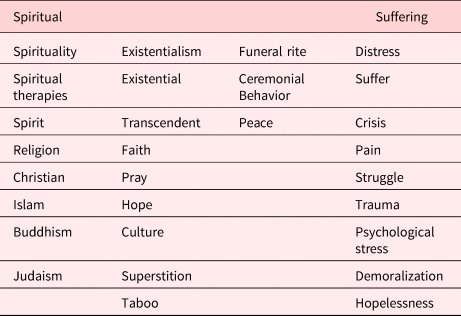
The search strategy was conducted in consult with a librarian specialized in systematic reviews of health research and entailed three steps (JBI, 2015). First, we performed an initial search of Medline and CINAHL to identify the text words contained in titles and abstracts and index terms used to describe these articles. We used an iterative process to ensure we captured diagnostic test studies that have been conducted with a broad range of conceptualization of spiritual suffering. We developed search terms (Table 1) based on the results of the initial searches (see Supplementary File 1 for complete search terms).
Search terms for spiritual suffering

Second, we used all the recognized search terms to search CINAHL, PubMed, Embase, PsycINFO, and ProQuest–Nursing and Allied Health Source Dissertations. All bibliometric databases were searched from their inception to November 5, 2017. Last, we conducted hand-searches of reference lists of identified articles for additional studies. Three reviewers (S.B., L.W., and C.D.) independently screened the identified studies.
Methodological quality of the studies
Two independent authors (S.B. and L.W.) assessed included articles for methodological quality using the QUADAS 2 (Quality Assessment of Diagnostic Accuracy Studies 2) appraisal tool (Appendix B). We did not exclude any study from the review based on quality. The first author (S.B.) contacted three corresponding authors of the included papers for additional information as deemed necessary.
Data extraction
We used a modified Joanna Briggs Institute (JBI) data extraction form to collect data from included studies (Appendix C). Two authors (S.B. and L.W.) independently extracted and entered data from each article into a standardized template using Microsoft Excel. Disagreements were resolved through discussion.
Data synthesis
We undertook a narrative synthesis of extracted data. We presented diagnostic criteria (e.g., sensitivity and specificity) of the identified screening measures in a tabular format to enable comparison of diagnostic performance of the measures along with other relevant study information.
Results
Description of studies
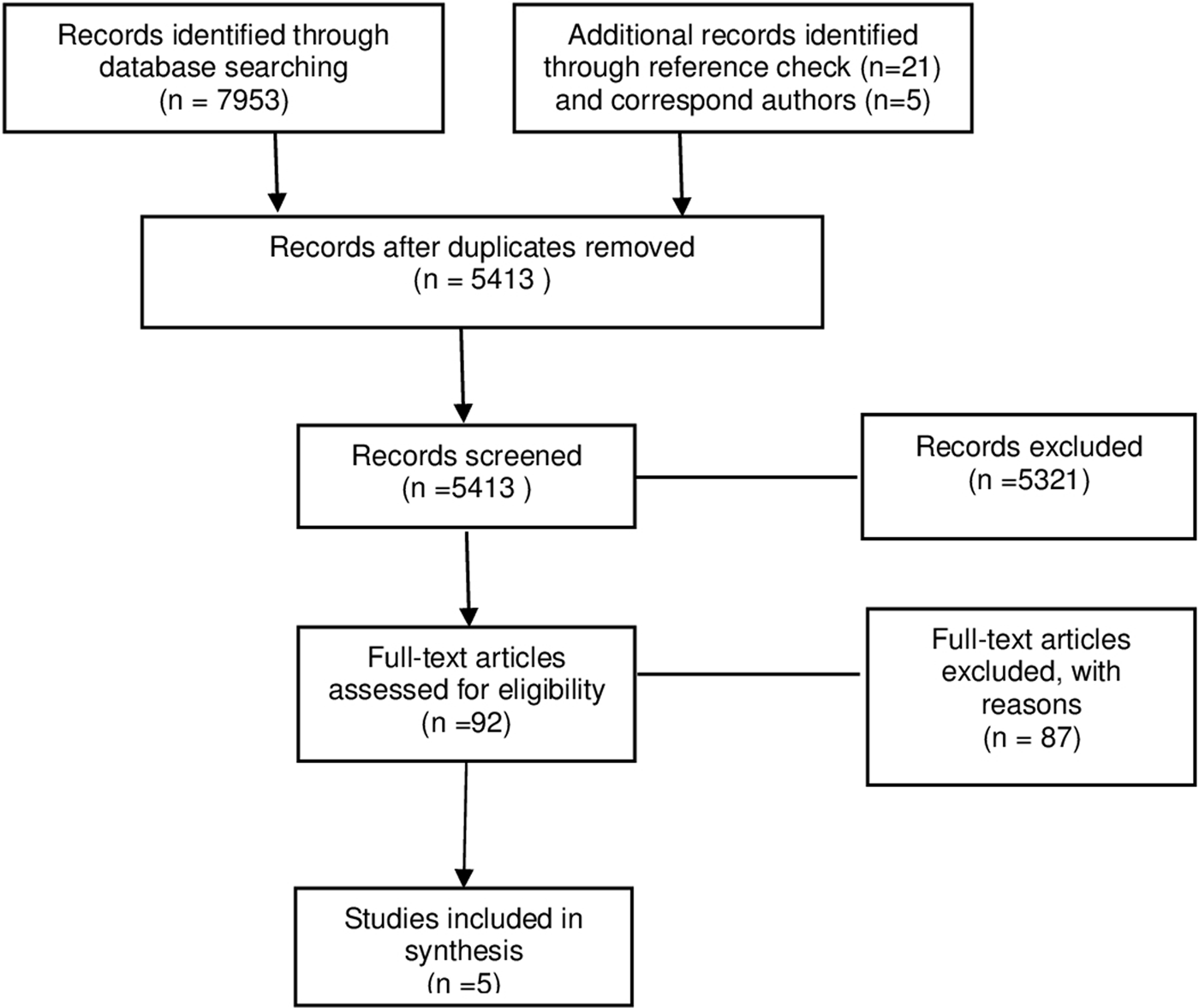
The search produced a total of 7,979 articles. Three reviewers (S.B., L.W. & C.D.) screened the titles and abstracts of the studies and retrieved 92 studies for full-text screening. Of the 92 studies, we excluded studies because they did not either: a) test the diagnostic accuracy of the screening measures (n = 82); b) provide enough information to calculate diagnostic criteria (n = 2); c) provide information in English (n = 2); or d) test the accuracy of the measures in adult population (n = 1). (See Appendix D for more detailed information on the excluded studies.) Five studies met inclusion criteria and were subjected to data extraction. Of the five corresponding authors contacted about relevant studies that might have been missed in the search, three responded and suggested five articles, of which one had not been identified in the database search. After full-text screening, the study that had not been identified in the database search was excluded as it did not test the diagnostic accuracy of a measure (Figure 1).
Flow chart outlining the study selection process.

Characteristics of included studies
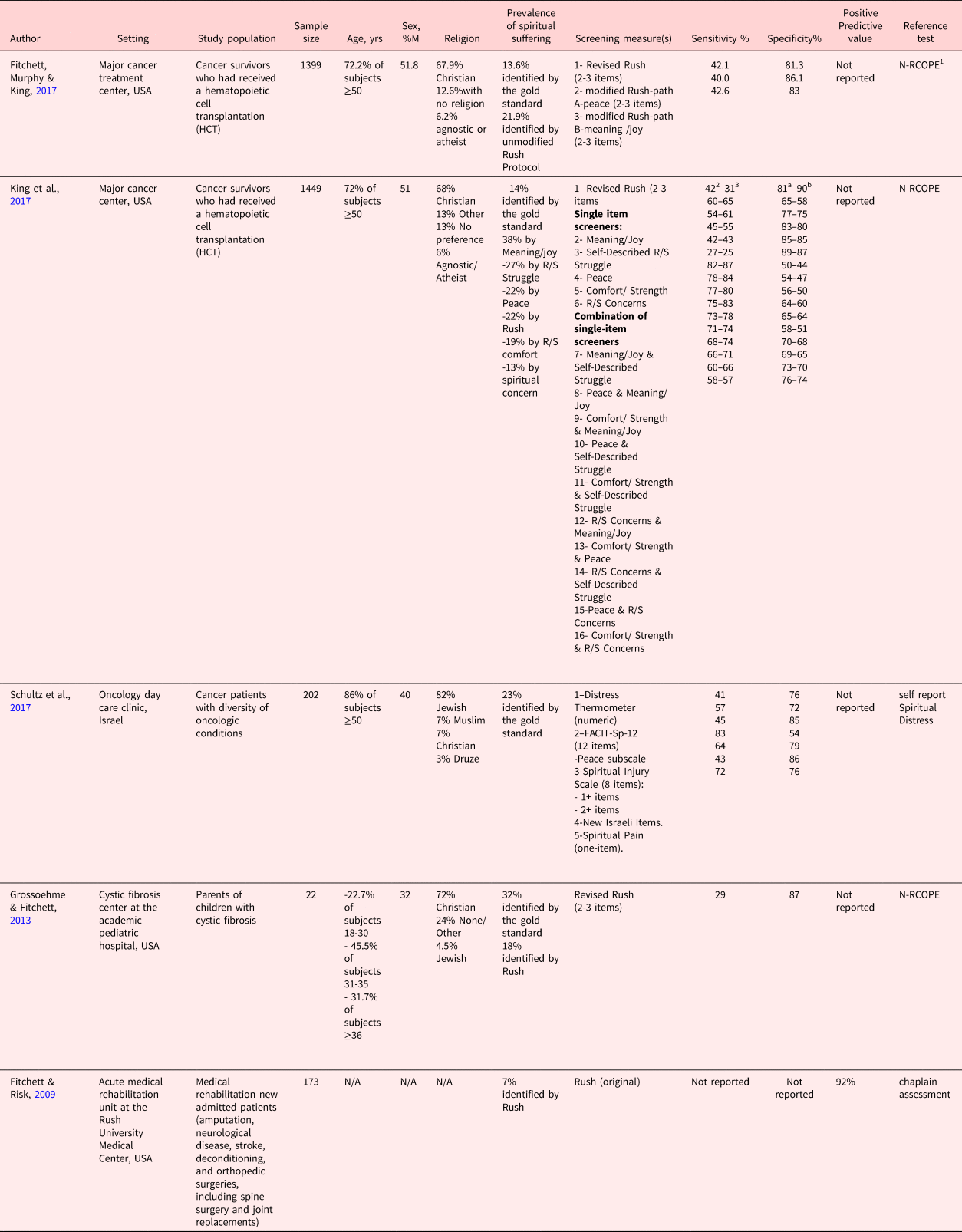
The five included studies were published between 2009 and 2017, and the majority (80%) were from the United States (see Table 2). Three were conducted at cancer centers with patients (Fitchett, Murphy & King, Reference Fitchett, Murphy and King2017; King et al., Reference King, Fitchett, Murphy, Pargament, Harrison and Loggers2017, Schultz et al., Reference Schultz, Meged-Book, Mashiach and Bar-Sela2017). One study was conducted with patients admitted to an acute medical rehabilitation center (Fitchett & Risk, Reference Fitchett and Risk2009), and one with parents of children with cystic fibrosis (CF) at a hospital CF center (Grossoehme & Fitchett, Reference Grossoehme and Fitchett2013). All studies reported demographic information of participants with the exception of Fitchett & Risk (Reference Fitchett and Risk2009). A total of 3,245 patients participated in the five included studies. Between 32% to 51.8% of participants were male. The majority of study participants reported that they were Christian and older than fifty years of age.
Characteristics of included studies

1 The negative subscale of Religious Coping.
2 whole sample.
3 Sample of 2 years or less since transplant.
Methodological quality of the studies
The QUADAS-2 tool evaluates the risk of bias and applicability of primary diagnostic accuracy studies. The QUADAS-2 consists of four main domains including: 1) patient selection, 2) index test, 3) reference test, and 4) flow/timing. The risk of bias is examined in all four domains. The first three domains (i.e., patient selection, index test, reference test) were also assessed in terms of the applicability of the studies. Applicability reveals congruency between information of the included study and the review question. To assess applicability of a study, review authors should match information regarding the patient selection, index test, and reference test with their review question. Risk of bias and applicability was judged as “low,” “high,” or “unclear.” If a study was judged as “high” or “unclear” in any of the four domains of risk of bias, we judged the study to be “at risk of bias.” If a study was judged as “high” or “unclear” in one or more domains of applicability, we determined the study to have “concerns regarding applicability.”
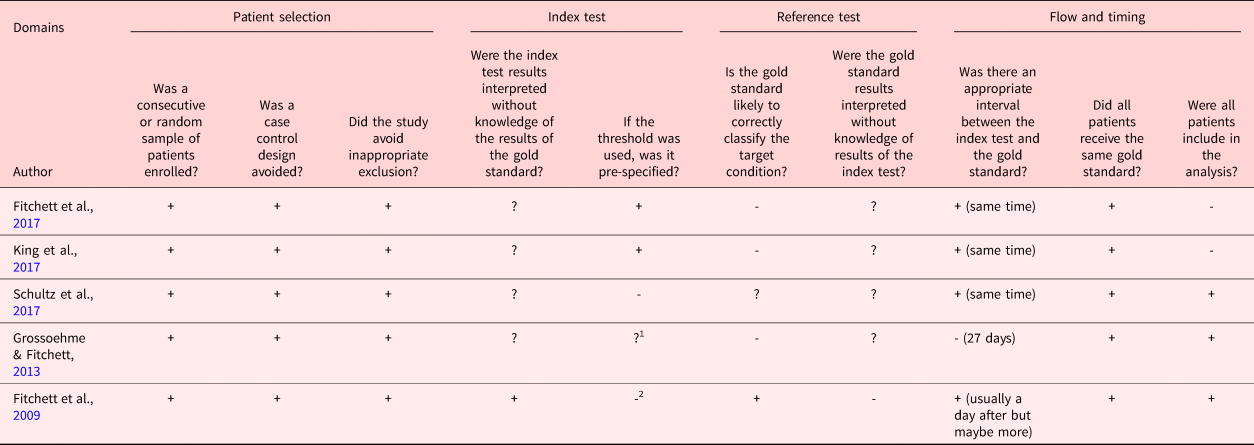
Table 3 details how included studies performed against individual QUADAS-2 items regarding the risk of bias. All the included studies were determined at risk of bias since they were judged as high or unclear in at least one domain. Overall, selection bias, spectrum bias, partial verification bias, incorporate bias, differential verification bias, and disease/condition progression bias were minimized with one exception. Grossoehme & Fitchett (Reference Grossoehme and Fitchett2013) reported a 27-day interval between assessments using the index spiritual screening measure and reference test, increasing the risk of disease/condition progression bias (see Table 3). Blinding of index spiritual screening measures and reference test results was poorly reported across all studies which results in risk of information bias. The risk of misclassification bias in studies that used the N-RCOPE and self-reported Spiritual Distress as a reference test is high as these tests cannot be considered a true gold standard for identifying a harmful level of spiritual suffering (King et al., Reference King, Fitchett, Murphy, Pargament, Harrison and Loggers2017, Fitchett, Murphy & King, Reference Fitchett, Murphy and King2017; Grossoehme & Fitchett, Reference Grossoehme and Fitchett2013). All studies were determined to have low concerns in terms of applicability.
Critical appraisal checklist for diagnostic test accuracy studies regarding the risk of bias

+(yes); ? (unclear); - (no)
1The authors explained that Rush had good specificity (87%) and relatively low sensitivity (29%), but didn't explain what was the threshold.
2Based on chaplain's judgment.
Review findings
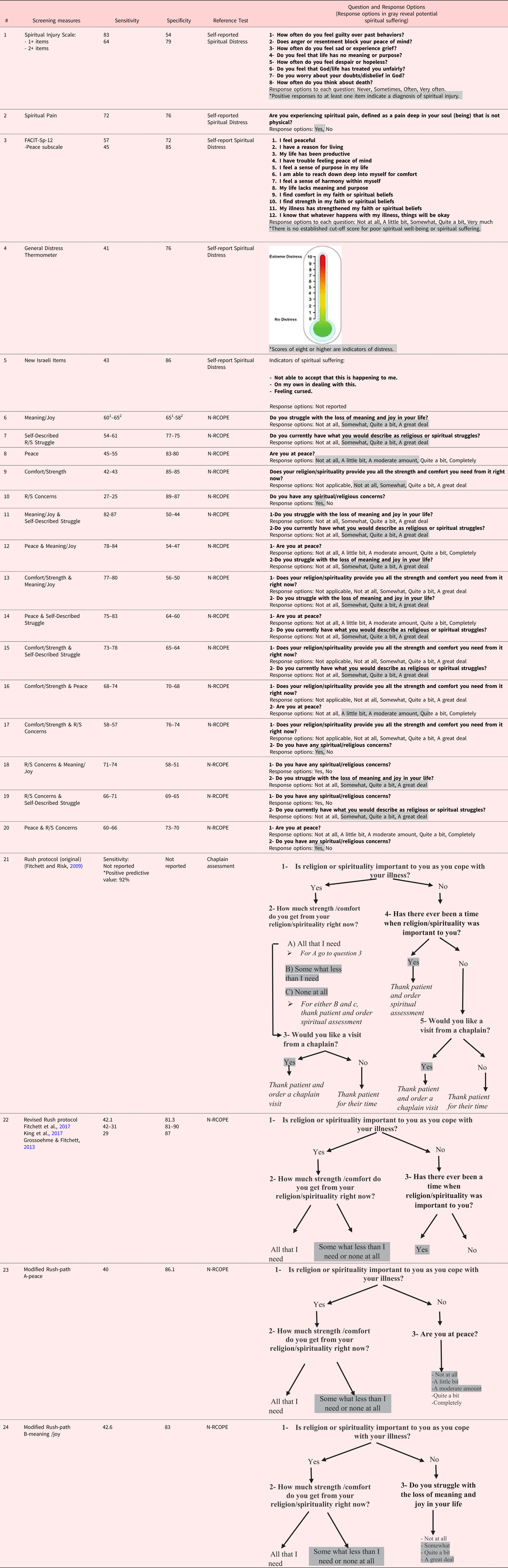
Prevalence of spiritual suffering, as identified by reported reference tests, ranged from 13.6% to 32%. None of the studies reported adverse effects from screening with spiritual screening measures. Respectively, the Negative Religious Coping measure (N-RCOPE) (n = 3 studies) and the Rush protocol (n = 4 studies) were the most commonly used reference test and spiritual screening measure. The original version of the Rush protocol was used by Fitchett and Risk (Reference Fitchett and Risk2009). Researchers of other studies used the revised (King et al., Reference King, Fitchett, Murphy, Pargament, Harrison and Loggers2017; Grossoehme & Fitchett, Reference Grossoehme and Fitchett2013) and modified (Fitchett, Murphy & King, Reference Fitchett, Murphy and King2017) versions of this measure (see Table 4 for details).
Summary table of the screening measures

1whole sample.
2 Sample of 2 years or less since transplant.
Three reference tests were used in the five included studies: 1) the negative subscale of Religious Coping (N-RCOPE) (n = 3 studies, Fitchett, Murphy & King, Reference Fitchett, Murphy and King2017; King et al., Reference King, Fitchett, Murphy, Pargament, Harrison and Loggers2017; Grossoehme & Fitchett, Reference Grossoehme and Fitchett2013); 2) the self-reported Spiritual Distress (n = 1 study, Schultz et al., Reference Schultz, Meged-Book, Mashiach and Bar-Sela2017); and 3) a chaplain assessment (n = 1 study, Fitchett & Risk, Reference Fitchett and Risk2009).
Four out of the five studies (24 measures) reported sensitivity and specificity of the screening measures, which were often individual or combined items of different measures (Fitchett, Murphy & King, Reference Fitchett, Murphy and King2017; King et al., Reference King, Fitchett, Murphy, Pargament, Harrison and Loggers2017; Schultz et al., Reference Schultz, Meged-Book, Mashiach and Bar-Sela2017; Grossoehme & Fitchett, Reference Grossoehme and Fitchett2013). Fitchett & Risk (Reference Fitchett and Risk2009) reported a positive predictive value (see Table 2) where chaplain assessments were the reference test used, but only for patients who identified with potential spiritual suffering according to the screening measure. While chaplains identified some newly admitted patients with spiritual suffering who screened negative on the spiritual screening measure, no estimate of true or false negatives could be ascertained from the study as chaplain assessments were not conducted on all patients who screened negative (Fitchett & Risk, Reference Fitchett and Risk2009). The information from this study was not sufficient to calculate sensitivity and specificity of the screening measure.
Some researchers suggested an accurate spiritual screening measure should have a cut-off point for sensitivity (King et al., Reference King, Fitchett, Murphy, Pargament, Harrison and Loggers2017; Fitchett, Murphy & King, Reference Fitchett, Murphy and King2017) and specificity (Fitchett et al., Reference Fitchett, Murphy and King2017) of at least 85%. The only measure identified in this review with such an acceptable sensitivity was the 2-item Meaning/Joy & Self-Described Struggle, with a sensitivity of 82–87% (King et al., Reference King, Fitchett, Murphy, Pargament, Harrison and Loggers2017). The R/S Concern (King et al., Reference King, Fitchett, Murphy, Pargament, Harrison and Loggers2017), Comfort/ Strength (King et al., Reference King, Fitchett, Murphy, Pargament, Harrison and Loggers2017), Peace subscale of FACIT-Sp-12 (Schultz et al., Reference Schultz, Meged-Book, Mashiach and Bar-Sela2017), New Israel Items (Schultz et al., Reference Schultz, Meged-Book, Mashiach and Bar-Sela2017), revised Rush protocol (King et al., Reference King, Fitchett, Murphy, Pargament, Harrison and Loggers2017; Grossoehme & Fitchett, Reference Grossoehme and Fitchett2013), and modified Rush protocol-path A-peace (Fitchett, Reference Fitchett, Murphy and King2017) all have acceptable specificity of 85 to 90% (see Table 2). The revised Rush Protocol (King et al., Reference King, Fitchett, Murphy, Pargament, Harrison and Loggers2017) has the highest specificity (81–90%), and the single item Spiritual Pain (Schultz et al., Reference Schultz, Meged-Book, Mashiach and Bar-Sela2017) has the greatest balance of sensitivity (74%) and specificity (76%) among all the identified measures.
Discussion
This is the first review to systematically identify screening measures for spiritual suffering that have been tested for accuracy among adults receiving health care. The broad inclusion criteria of this review resulted in a significant number of spiritual screening measures (N = 24) being included (given the limited size of the field being researched). Among all identified measures, the 2-item Meaning/Joy & Self-Described Struggle (King et al., Reference King, Fitchett, Murphy, Pargament, Harrison and Loggers2017) had the highest sensitivity (82-87%), the revised Rush protocol (King et al., Reference King, Fitchett, Murphy, Pargament, Harrison and Loggers2017) had the highest specificity (81-90%), and the single item Spiritual Pain (Schultz et al., Reference Schultz, Meged-Book, Mashiach and Bar-Sela2017) had the greatest balance of sensitivity (74%) and specificity (76%).
Although there is no consistently agreed upon definition for spiritual suffering, suffering on a spiritual level has been recognized in palliative models and guidelines (Canadian Hospice Palliative Care Association, 2013; National Institute for Clinical Excellence, 2004; Puchalski et al., Reference Puchalski, Ferrell, Virani, Otis-Green, Baird, Bull, Chochinov, Handzo, Nelson-Becker, Prince-Paul and Pugliese2009). Different studies have identified different aspects of spiritual suffering and the negative effect it has on patients’ physical and psychological outcomes (Pargament, Koenig, Tarakeshwar & Hahn, Reference Pargament, Koenig, Tarakeshwar and Hahn2001; Thuné-Boyle et al., Reference Thuné-Boyle, Stygall, Keshtgar, Davidson and Newman2013; Ramirez et al., Reference Ramirez, Macêdo, Sales, Figueiredo, Daher, Araújo, Pargament, Hyphantis and Carvalho2012). For example, spiritual suffering has been associated with increased emotional distress, poorer quality of life, and decreased functional status (Exline, Reference Exline, Pargament, Exline and Jones2013; Hebert, Zdaniuk, Schulz & Scheier, Reference Hebert, Zdaniuk, Schulz and Scheier2009; Pargament, Koenig, Tarakeshwar & Hahn, Reference Pargament, Pargament, Koenig, Tarakeshwar and Hahn2004; Park, Wortmann & Edmondson, Reference Park, Wortmann and Edmondson2011). In the current study, we identified measures that have been evaluated in a rigorous and systematic way to determine spiritual suffering. Driven by demands to integrate spiritual care into routine patient care (Selman, Young, Vermandere, Stirling & Leget, Reference Selman, Young, Vermandere, Stirling and Leget2014; Puchalski et al., Reference Puchalski, Ferrell, Virani, Otis-Green, Baird, Bull, Chochinov, Handzo, Nelson-Becker, Prince-Paul and Pugliese2009), our review identified a substantial number of spiritual measures, highlighting clinicians’ and researchers’ recognition of the importance of using evidence-based measures. Given the current state of the research, we suggest more methodologically rigorous studies are needed to ensure the accuracy of measures for screening for spiritual suffering.
People often experience spiritual suffering when they are adjusting to new life circumstances such as the diagnosis of chronic or life-limiting disease, palliative care, or an acute physical crisis such as lower or upper-extremity amputation (Agora Spiritual Care Guideline, 2013). As many different religious and non-religious beliefs exist, it is recommended that screening be conducted for all people in inpatient and outpatient facilities to identify those who could benefit from receiving care from a spiritual specialist (Agora Spiritual Care Guideline, 2013; Puchalski & Ferrell, Reference Puchalski and Ferrell2010).
This research is an important step toward addressing some of the practical issues surrounding the provision of spiritual care and referring patients for specialized spiritual services (Selman et al., Reference Selman, Young, Vermandere, Stirling and Leget2014; Rushton, Reference Rushton2014), specifically, how best to screen for spiritual suffering. Health care providers may have difficulty identifying spiritual suffering for a number of reasons: 1) difficulty that patients may have in articulating the concept of spiritual suffering (Boston et al., Reference Boston, Bruce and Schreiber2011; Fitchett, Meyer & Burton, Reference Fitchett, Meyer and Burton2000), and/or 2) clinicians’ lack of knowledge regarding the incorporation of the spiritual dimension into routine care (Balboni et al., Reference Balboni, Sullivan, Enzinger, Epstein-Peterson, Tseng, Mitchell, Niska, Zollfrank, VanderWeele and Balboni2014; Walter, Reference Walter2002; Selman et al., Reference Selman, Young, Vermandere, Stirling and Leget2014). An accurate screening measure can help overcome barriers in identifying spiritual suffering. The results of this study will help to inform researchers, clinicians, and policy-makers about the accuracy of available spiritual screening measures when selecting a measure that best meets their needs.
It is important to take into consideration the limitations of the included studies in this review. One of the most important limitations is that there currently is no tool that can be used as a “true” gold standard for measuring spiritual suffering (Grossoehme & Fitchett, Reference Grossoehme and Fitchett2013). Researchers who have used the N-RCOPE scale as a reference test declare that this tool cannot be considered a true gold standard for identifying a harmful level of spiritual suffering (King et al., Reference King, Fitchett, Murphy, Pargament, Harrison and Loggers2017; Grosseohme & Fitchett, Reference Grossoehme and Fitchett2013; Fitchett, Murphy & King, Reference Fitchett, Murphy and King2017). One suggested reason is because the N-RCOPE items mainly assess struggles with the Divine, which is only one of three types of spiritual struggle (Pargament and colleagues, Reference Pargament, Pargament, Koenig, Tarakeshwar and Hahn2004). The other two types of spiritual struggle, interpersonal (i.e., struggle with other people) and intrapersonal (i.e., struggle with one's own life purpose or values), are not well covered by this scale (King et al., Reference King, Fitchett, Murphy, Pargament, Harrison and Loggers2017; Grosseohme & Fitchett, Reference Grossoehme and Fitchett2013; Fitchett, Murphy & King, Reference Fitchett, Murphy and King2017). Therefore, the N-RCOPE scale can underestimate spiritual suffering as it covers only one dimension of spiritual suffering.
The Spiritual Distress self-report measure is another measure that has been used as a reference test for diagnosing spiritual suffering (Schultz et al., Reference Schultz, Meged-Book, Mashiach and Bar-Sela2017). This measure, consisting of one question “Are you experiencing spiritual distress?” is consistent with the definition of spiritual distress outlined by the North American Nursing Diagnosis Association (i.e., the impaired ability to experience and integrate meaning and purpose in life through the individual's connectedness with self, others, art, music, literature, nature, or a power greater than oneself) (Herdman & Kamitsuru, Reference Herdman and Kamitsuru2014). Strong similarities (Kappa = 0.92–0.94) between patient's self-diagnosis of spiritual distress and a professional diagnosis have been reported in other studies, justifying the use of this question as a reference test (Caldeira et al., Reference Caldeira, Timmins, Carvalho and Vieira2017; Chaves et al., Reference Chaves, Carvalho, Beijo, Goyatá and Pillon2011). Schultz and colleagues (Reference Schultz, Meged-Book, Mashiach and Bar-Sela2017) used the self-reported Spiritual Distress measure to identify general rather than harmful levels of spiritual suffering which would require specialized spiritual care. The self-reported measure of spiritual distress, then, can overestimate spiritual suffering as it is a one-item question with a “yes” and “no” response and does not indicate the complexity of spiritual suffering or a threshold above which a specialists’ referral, for example, from a chaplain, psychologist, specialized nurse or social worker, would be required. Fitchett and colleagues (Reference Fitchett, Meyer and Burton2000) noted that not all patients who believe they are having spiritual suffering would benefit from specialized spiritual care or a referral to a spiritual specialist as many may have basic spiritual or religious needs (such as praying, presence of beloved ones) that can be addressed by their family members or non-specialists. It is therefore important that screening measures used in clinical practice can differentiate between high levels of spiritual suffering that require a specialist's referral and other spiritual needs that can be addressed by non-specialists.
Currently, assessment by professional specialists who are trained in spiritual care such as psychologists, healthcare chaplainsFootnote 1, or medical social workers, are the only true gold standard for identifying spiritual suffering as they have the professional skills and judgment to determine high levels of spiritual suffering (Agora Spiritual Care Guideline, 2013; Grossoehme & Fitchett, Reference Grossoehme and Fitchett2013). Only Fitchett and Risk (Reference Fitchett and Risk2009) used chaplain assessment as a reference test. However, they did not have chaplains assess spiritual suffering among patients who screened negative, which resulted in the inability to determine the sensitivity and specificity of the measure. We recommend the use of specialists’ assessment in future research as a reference test to confirm the presence of spiritual suffering identified by spiritual screening measures.
Our review demonstrated limited methodological quality of the included studies which was mainly the result of insufficient reporting of methods and results. Although evidence for the effectiveness of identified spiritual screening measures is limited, the measures can nonetheless be valuable in initiating a discussion with patients and consequently initiating a conversation with providers of spiritual suffering. In the absence of a validated spiritual screening measure with documented sensitivity and specificity, we emphasize the importance of clinicians using their clinical judgment when using any of the identified screening measures. Patient's behaviors, condition, and individual needs should be taken into consideration with the result of the screening measure when making final decisions about whether or not to refer patients for specialized spiritual care. Complete dependency on the results of the screening measures without using clinical judgment and building a relationship with patients may result in a failure to detect spiritual suffering that requires referral to spiritual care specialists. We suggest that clinicians with limited training in the spiritual domain collaborate with specialists in spiritual care who have additional expertise in determining spiritual suffering. Specialists can advise members of the healthcare team about verbal and non-verbal indicators of spiritual suffering in patients (Caldeira et al., Reference Caldeira, Timmins, Carvalho and Vieira2017). Being aware of these indicators can help improve clinical judgment in clinicians and increase accurate referral of patients with spiritual suffering to spiritual care services (Caldeira et al., Reference Caldeira, Timmins, Carvalho and Vieira2017).
Guidelines for spiritual care suggest three criteria for choosing an appropriate spiritual screening measure for use in clinical settings that include accuracy, brevity, and simplicity (Agora Spiritual Care Guideline, 2013; Puchalski et al., Reference Puchalski, Ferrell, Virani, Otis-Green, Baird, Bull, Chochinov, Handzo, Nelson-Becker, Prince-Paul and Pugliese2009). The current review has focused on evidence regarding the accuracy of spiritual screening measures. In order to address major barriers to incorporating spiritual care into routine practice, such as insufficient time (Edwards, Pang, Shiu & Chan, Reference Edwards, Pang, Shiu and Chan2010; Balboni et al., Reference Balboni, Sullivan, Enzinger, Epstein-Peterson, Tseng, Mitchell, Niska, Zollfrank, VanderWeele and Balboni2014) and knowledge (Edwards, et al., Reference Edwards, Pang, Shiu and Chan2010; Ross, Reference Ross2006; Balboni et al., Reference Balboni, Sullivan, Enzinger, Epstein-Peterson, Tseng, Mitchell, Niska, Zollfrank, VanderWeele and Balboni2014), we suggest that brevity and simplicity of measures be taken into consideration by clinicians when choosing a measure to screen for spiritual suffering.
There are a number of limitations to this systematic review that should be noted. First, we may not have identified all relevant test accuracy studies, as some authors may not present their research as a test accuracy study and many databases do not have indexing terms for labelling test accuracy studies (Centre for Reviews and Dissemination, 2009). To increase the likelihood of capturing all relevant studies, we used topic-specific terms rather than using diagnostic test accuracy as an index term or study design as a filter (Whiting et al., Reference Whiting, Rutjes, Westwood, Mallett, Deeks, Reitsma, Leeflang, Sterne and Bossuyt2011). We also widened the search to five databases. Second, spiritual suffering is a broad concept which has been described differently by authors in the literature. We therefore used a search strategy to allow for common concepts for spiritual suffering such as religious or existential distress. The distinction between these individual concepts is not explored in this review.
Conclusion
This review was conducted to synthesize the research evidence on the accuracy of measures used to screen adults for spiritual suffering. While most of the identified spiritual screening measures are brief and simple to use, a few measures have sufficient accuracy to effectively screen patients for spiritual suffering. However, due to poor methodological quality of all included studies which assessed the accuracy of the measures, we advise clinicians to use their critical appraisal skills and clinical judgment when selecting and using any of the identified measures. We also suggest an assessment by a spiritual care specialist as the reference test in future studies to determine the diagnostic accuracy of spiritual screening measures while an accurate screening measure is developed.
Supplementary material
The supplementary material for this article can be found at https://doi.org/10.1017/S1478951519000506.
Acknowledgment
This review will contribute towards the requirements of a PhD through the University of Ottawa and is funded by the Board of the Canadian Foundation for Spiritual Care. Sayna Bahraini has received a CIHR Integrated Knowledge Translation Research Network Doctoral Fellowship (FDN143237). IDG is a recipient of a CIHR Foundation Grant (FDN #143237).
Conflict of Interest
There are no conflicts of interest.