Introduction
Currently, the percentage of older people in the global population is growing rapidly (Partridge et al., Reference Partridge, Deelen and Slagboom2018). This raises the need for a variety of systematic actions in the field of social or economic policy, as well as for planned psychological interventions (Woods and Clare, Reference Woods and Clare2008; Schaie and Willis, Reference Schaie and Willis2011). Their main goal is not only to deal with the problems of old age, but also to help in ageing with dignity (Shahid, Reference Shahid2014) and to recognise and appreciate the potential of older people in shaping the social world (Baltes and Carstensen, Reference Baltes, Carstensen, Staudinger and Lindenberger2003; Tornstam, Reference Tornstam2005). The achievement of this goal may be facilitated by broadening the knowledge on predictors of quality of life in the older population.
This seems to be a rather complex task, however, since older adults constitute a highly heterogeneous group when it comes to their psychosocial functioning (e.g. Mungas et al., Reference Mungas, Beckett, Harvey, Tomaszewski Farias, Reed, Carmichael, Olichney, Miller and DeCarli2010). This is reflected, inter alia, in their subjective assessment of physical health (Berg et al., Reference Berg, Hoffman, Hassing, McClearn and Johansson2009) and related need for health care (Staudinger et al., Reference Staudinger, Fleeson and Baltes1999; Haywood et al., Reference Haywood, Garratt and Fitzpatrick2005). Self-assessed health (SAH) may be listed among the main factors determining the quality of life of older adults, including the level of their satisfaction with life (SWL) (Sprangers et al., Reference Sprangers, de Regt, Andries, van Agt, Bijl, de Boer, Foets, Hoeymans, Jacobs, Kempen, Miedema, Tijhuis and de Haes2000; Bishop et al., Reference Bishop, Martin and Poon2006). While the impact of objective measures of health on SWL is relatively small, the subjective assessment of one's own health is positively related to general wellbeing (Berg et al., Reference Berg, Hoffman, Hassing, McClearn and Johansson2009; Despot Lučanin and Lučanin, Reference Despot Lučanin and Lučanin2012; Dumitrache et al., Reference Dumitrache, Rubio and Rubio-Herrera2017).
Many older people maintain a positive assessment of physical health, despite the fact that objective measures clearly indicate its deterioration (Rodgers et al., Reference Rodgers, Neville and La Grow2017; Spuling et al., Reference Spuling, Wolff and Wurm2017). This effect may be attributed to some mental resources that contribute to SWL in old age, such as purpose in life (Musich et al., Reference Musich, Wang, Kraemer, Hawkins and Wicker2018), the sense of coherence (Seah et al., Reference Seah, Espnes, Ang, Lim, Kowitlawakul and Wang2021) and wisdom (Ardelt and Edwards, Reference Ardelt and Edwards2016). Apart from these, ego-resiliency (ER) is also indicated as an important moderator of the impact of stressful circumstances on quality of life in the older population (Nygren et al., Reference Nygren, Aléx, Jonsén, Gustafson, Norberg and Lundman2005; Tomás et al., Reference Tomás, Sancho, Melendez and Mayordomo2012).
ER is a personality characteristic that reflects a person's adaptability to the stress and challenges that people face in their lives (Block and Block, Reference Block, Block and Collins1980). Individuals high in ER are able to respond flexibly and appropriately to everyday hassle as well as to normative transitions of their lives. They cope adaptively with stress and flexibly shift their problem-solving strategies (Block and Kremen, Reference Block and Kremen1996; Block and Block, Reference Block and Block2006). ER is also related to personality traits from the five-factor model (McCrae and Costa, Reference McCrae, Costa, John, Robins and Pervin2008). A meta-analysis of 30 studies conducted by Oshio et al. (Reference Oshio, Taku, Hirano and Saeed2018) showed that the highest (negative) correlation was noted for neuroticism, which is one of the strongest personality predictors of health. This effect was found for the older population as well (Marks and Lutgendorf, Reference Marks and Lutgendorf1999). Neuroticism reflects a tendency to experience negative emotions, including irritability, anxiety and sadness (McCrae and Costa, Reference McCrae, Costa, John, Robins and Pervin2008). For older individuals, a high level of neuroticism is associated with a number of adverse health effects, including symptoms of depression (Banjongrewadee et al., Reference Banjongrewadee, Wongpakaran, Wongpakaran, Pipanmekaporn, Punjasawadwong and Mueankwan2020) and higher mortality (Shipley et al., Reference Shipley, Weiss, Der, Taylor and Deary2007).
ER was found to mitigate the negative impact of stressful events on the functioning of people in late adulthood and facilitate the process of adapting to the challenges of ageing (Staudinger et al., Reference Staudinger, Fleeson and Baltes1999; Wagnild, Reference Wagnild2003). Moreover, literature suggests that ER positively influences the regulation of emotions in the process of coping with adversities, supports the immune system, increases the ability to seek social support, promotes the use of mature defence mechanisms and proactive coping strategies, and is positively associated with SWL (Davis et al., Reference Davis, Zautra, Johnson, Murray, Okvat, Aldwin, Park and Spiro2007; Van Kessel, Reference Van Kessel2013). This research points to ER as an important personality resource that facilitates coping with stress in late adulthood. It helps older people to assess the difficulties that occur with age as less threatening and reduce the negative consequences resulting from them (Byun and Jung, Reference Byun and Jung2016; García-León et al., Reference García-León, Pérez-Mármol, Gonzalez-Pérez, del Carmen García-Ríos and Peralta-Ramírez2019).
Previous studies on the moderating role of ER in the psychosocial functioning of older people have focused mainly on determining the role of this personality resource in mitigating the negative effects of ageing on physical and mental health, emotional and social functioning, or the process of adapting to the challenges of old age (Resnick et al., Reference Resnick, Gwyther and Roberto2011; Wells, Reference Wells2012). Meanwhile, much less is known about the moderating role of ER in shaping SWL in individuals facing various difficulties resulting from normative ageing. The aim of the presented study is therefore to investigate the relationship between SAH, SWL and ER in older adults.
We hypothesised that in late adulthood, ER moderates the relationship between SAH and SWL. More specifically, we expected that the predictive role of subjective assessment of own physical health on SWL is weaker for those with higher ER. This would mean that the SWL of highly resilient older adults is less dependent on their subjective health assessment, i.e. they are able to maintain a positive assessment of their life even if they do not assess their physical condition positively.
Method
Participants
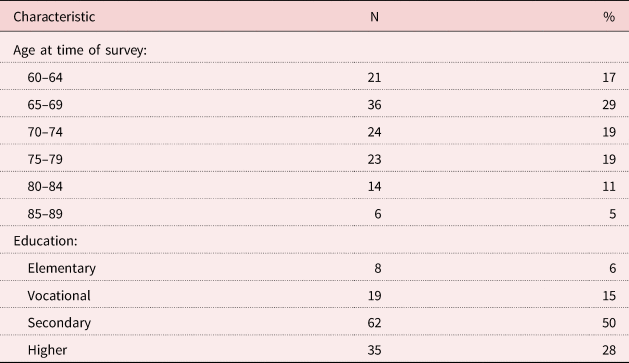
The sample consisted of 124 community-dwelling Polish older adults (including 93 females) aged between 60 and 89 (mean = 71.72, standard deviation = 7.08). A demographic description of the sample is detailed in Table 1. All participants gave informed consent to participate in the study and completed the measures in paper and pencil format. They did not receive compensation for their participation. One female participant was excluded from the analyses due to substantial missing data. Because it was a self-report survey, i.e. non-interventional study, formal ethical approval was not required according to national law. Still, the American Psychological Association ethical standards as well as relevant guidelines by the Polish Psychological Association were followed in the conduct of the study.
Demographic characteristics of participants

Note: N = 124.
Measures
SAH was measured using selected items from the World Health Organization Quality of Life WHOQOL-BREF assessment (The WHOQOL Group, 1998; Skevington et al., Reference Skevington, Lotfy and O'Connell2004). The WHOQOL-BREF measures the quality of life in four domains: physical health, psychological health, social relationships and environment. In line with the objectives of the present study, we focused on the first domain, which is represented by seven items (e.g. ‘To what extent do you feel that physical pain prevents you from doing what you need to do?’, ‘Do you have enough energy for everyday life?’, ‘How satisfied are you with your sleep?’). The participants were asked to rate their subjective health status using a five-point Likert scales ranging from 1 (not at all) to 5 (an extreme amount) or from 1 (not at all) to 5 (completely) or from 1 (very poor) to 5 (very well) or from 1 (very dissatisfied) to 5 (very satisfied), depending on the item wording (Skevington et al., Reference Skevington, Lotfy and O'Connell2004). The reliability of the overall score for the WHOQOL-BREF physical health domain was α = 0.81 (95% confidence intervals (CI) = 0.75, 0.85) for the current sample. Higher scores indicate more positive assessment of one's own physical health.
To measure SWL we used the Satisfaction with Life Scale (SWLS; Diener at al., Reference Diener, Emmons, Larsen and Griffin1985). It consists of five items (e.g. ‘In most ways my life is close to my ideal’, ‘So far I have gotten the important things I want in life’) to which the answers are given on a seven-point Likert scale ranging from 1 (strongly disagree) to 7 (strongly agree). The reliability of the overall SWLS score for the current sample was α = 0.82 (95% CI = 0.76, 0.86). Higher scores indicate a higher level of SWL.
ER was measured with the Ego-Resiliency Scale ER89 (Block and Kremen, Reference Block and Kremen1996). The ER89 consists of 14 items (e.g. ‘I enjoy dealing with new and unusual situations’, ‘Most of the people I meet are likeable’). Participants responded to the items using a seven-point Likert scale ranging from 1 (does not apply at all) to 7 (applies very strongly). Higher scores indicate higher resiliency. The reliability of ER89 for the current sample was α = 0.80 (95% CI = 0.75, 0.85).
Data analysis
To test the postulated moderation, we conducted a hierarchical multiple regression analysis using the PROCESS macro for SPSS (Model 1), version 3.5 (Hayes, Reference Hayes2017). The significance of the interaction between SAH and ER was determined by means of bootstrap-generated 95% CI values (10,000 bootstrapped samples). As recommended by Hayes (Reference Hayes2017), for statistically significant interactions, the Johnson-Neyman (J-N) technique was employed to identify the regions of significance, i.e. the value of the moderator above or below which SAH was a statistically significant predictor of SWL.
Results
We postulated that ER moderates the relationship between SAH and SWL in older adults. Table 2 presents descriptive statistics for the study variables. As for the moderator variable (ER), scores above 5.81 indicate high ER (1 SD above sample mean), scores below 4.15 indicate low ER (1 SD below sample mean), while scores between the two values may be regarded as moderate. All intercorrelations between SAH, SWL and ER were statistically significant but weak, with the weakest one being the correlation between the focal predictor (SAH) and the moderator (ER). There was also a weak but statistically significant positive correlation between age and ER, as well as a marginally significant negative correlation between age and SAH. Men and women did not differ in any psychological variable or age.
Descriptive statistics, bivariate correlations and reliability coefficients for the study variables

Notes: SD: standard deviation. SK: skewness. KU: kurtosis. Cronbach's alpha coefficients are presented in parentheses along the diagonal.
Significance levels: † p < 0.10, * p < 0.05, *** p < 0.001.
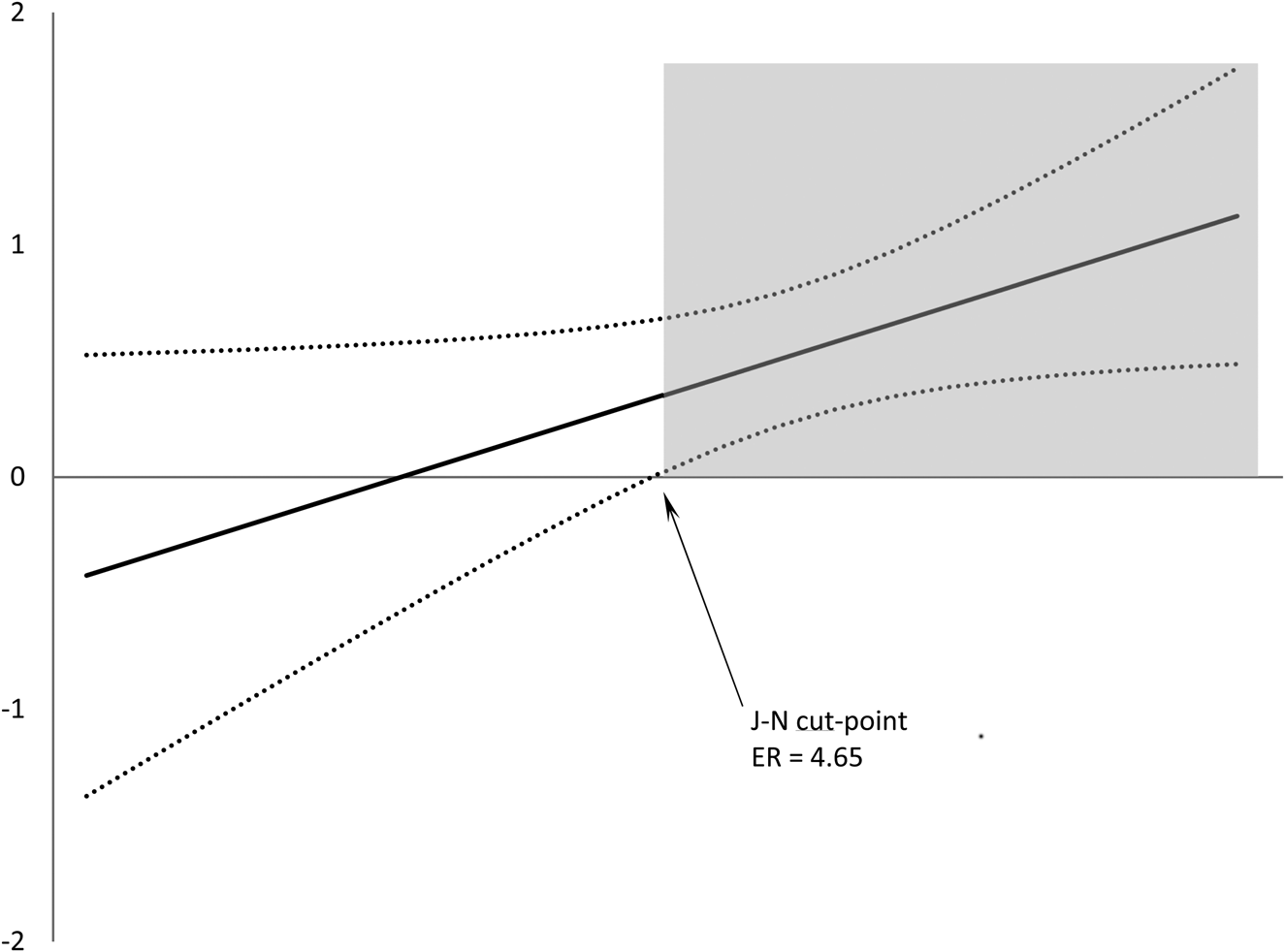
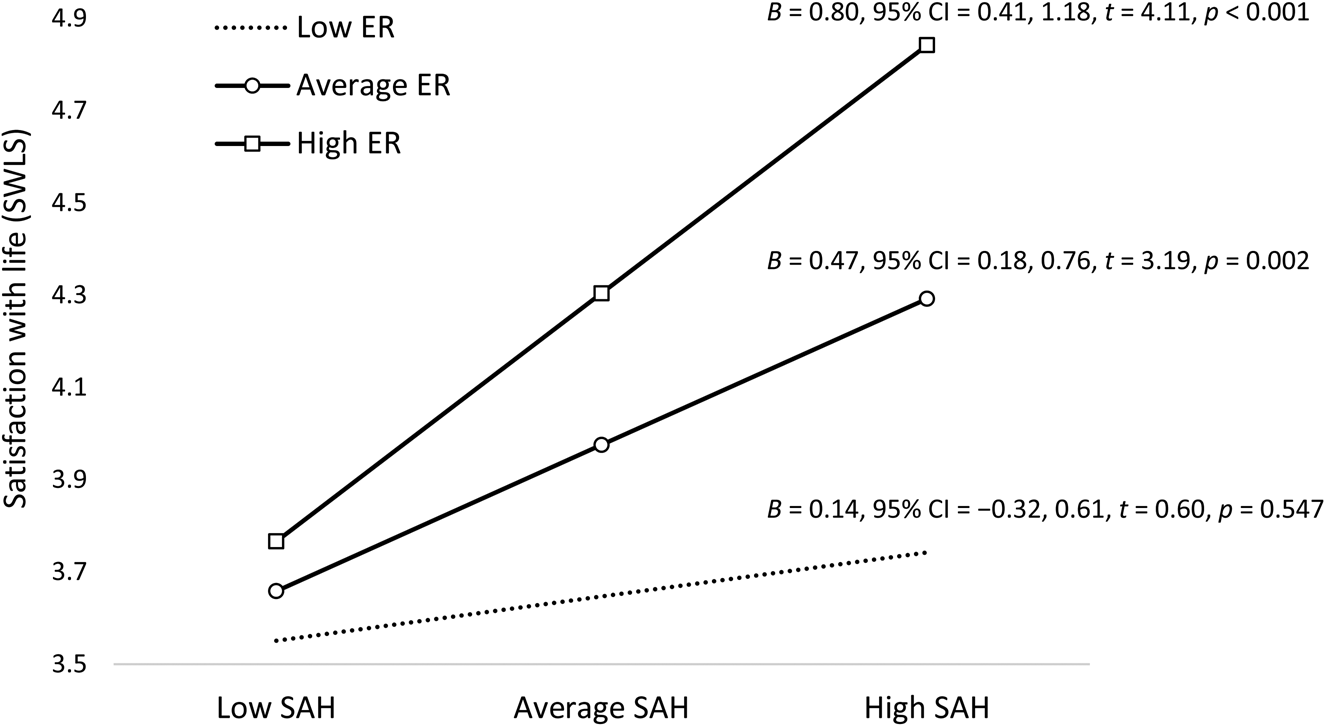
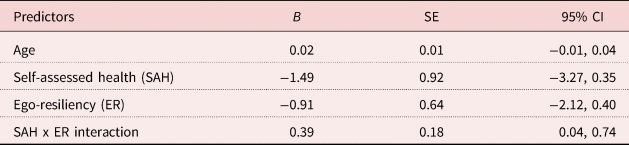
To verify the hypothesised moderation, we tested a model with SAH as the focal predictor of SWL and ER as the moderator variable. Additionally, age was entered as a covariate. The whole model was statistically significant with R 2 = 0.26; F(4, 118) = 10.14; p < 0.001. As predicted, we found a statistically significant interaction between SAH and ER, i.e. ER moderated the effect of SAH on SWL (see Table 3). However, the direction of this moderation was opposite to what was postulated. SAH was a statistically significant positive predictor of SWL when ER was high or moderate. For those with ER higher than the J-N cut-point of 4.65 (which refers to 58.5% of the study sample; see Figure 1), the higher SAH the higher the SWL (see Figure 2). In contrast, SAH did not predict SWL for those with low ER (41.5% of the sample, i.e. participants below the J-N cut-point; see Figures 1 and 2).
Plot of the Johnson-Neyman (J-N) technique results for the moderation effect of ego-resiliency (ER) on self-assessed health (SAH) as focal predictor of satisfaction with life (SWL).
Notes: The y-axis refers to the magnitude of the conditional effects of the focal predictor (SAH) on the outcome variable (SWL). The x-axis refers to the values of the moderator variable (ER). The solid line represents the conditional effects of SAH on SWL. The dotted lines illustrate the 95% confidence intervals for those conditional effects. The grey area refers to the region of the moderator (ER) where the association between the focal predictor (SAH) and the outcome variable (SWL) is statistically significant.

Self-assessed health (SAH) predicting satisfaction with life at different levels of ego-resiliency (ER).
Notes: SWLS: Satisfaction with Life Scale. CI: confidence intervals.

Main and interactive effects of self-assessed health and ego-resiliency on satisfaction with life: bootstrap results for regression model parameters

Notes: SE: standard error. CI: confidence intervals.
Discussion
We postulated that ER moderates the relationship between SAH and SWL in older adults in such a way that the relationship would be weaker for highly resilient individuals. This was based on the assumption that ER protects a positive evaluation of own life as a whole even when the assessment of its specific aspect, i.e. one's physical condition, would not be so favourable. The present study confirmed the general hypothesis regarding the moderating role of ER. However, the direction of this moderation was opposite to our original expectations. The results showed that the relationship between SAH and SWL was significant only for those with high or moderate ER. There was no relationship between the two variables when ER was low. This challenges our original reasoning and necessitates the search for an alternative conceptualisation of the regulating role of ER in the context of older adults’ SAH.
We believe that a finer analysis of the very concept of SAH may be helpful here. SAH is an example of a domain-specific self-esteem, as opposed to general self-esteem. In terms of Brown and Marshall's (Reference Brown, Marshall and Kernis2006: 5) typology, SAH represents a category of self-evaluations, i.e. ‘the way people evaluate their various abilities and attributes’. In contrast to global self-esteem, i.e. ‘the way that people generally feel about themselves’ (Brown and Marshall, Reference Brown, Marshall and Kernis2006: 4), domain-specific self-evaluations may be analysed not only in terms of their valence, but also accuracy (e.g. Mathias et al., Reference Mathias, Biebl and DiLalla2011; Urban and Urban, Reference Urban and Urban2020). Valence refers to the level of self-esteem ranging from negative to positive evaluation of either oneself as a whole (in the case of global self-esteem) or one's specific attribute (in the case of self-evaluations). In turn, accuracy refers to the degree that a given subjective self-evaluation reflects objective state of affairs in that particular domain.
The accuracy of domain-specific self-evaluations is itself an important variable independent of the valence of such an evaluation. Empirical studies focused on various domains showed that the accuracy of self-evaluations correlates negatively with the level of psychopathology. For example, adults diagnosed with attention deficit hyperactivity disorder were less accurate in their driving self-assessments compared to the community comparison group (Bagwell et al., Reference Bagwell, Barkley and Murphy2005); preschool-aged boys who overrated their cognitive competences and peer acceptance exhibited more externalising problems (Mathias et al., Reference Mathias, Biebl and DiLalla2011). On the other hand, accurate self-evaluation was found to lead to a better performance and more effective self-regulation (Urban and Urban, Reference Urban and Urban2020).
Referring the conceptual distinction between valence and accuracy of self-evaluations to phenomena analysed in the present study, the valence of SAH ranges from a highly negative to highly positive subjective evaluation of one's own health. Accuracy of SAH, in turn, refers to the degree to which the subjective assessment of health reflects the objective physical condition of the subject. Low SAH does not necessarily mean that the subject experiences real health issues as reflected by the results of a medical examination. Likewise, high SAH does not unequivocally entail a good physical condition and the lack of objective medical problems. This is because SAH is a subjective evaluation of health with a varying degree of accuracy (see Tkatch et al., Reference Tkatch, Musich, MacLeod, Kraemer, Hawkins, Wicker and Armstrong2017).
Going further into the results of our study, we would say that the valence of SAH positively correlates with SWL. The more positive the SAH, the higher the SWL. The accuracy of SAH, in turn, may be responsible for the strength of this positive relationship. Realistic SAH, which properly reflects one's physical condition, should be a stronger predictor of SWL. The presence or absence of objective medical conditions may have a higher potential to impact one's psychological wellbeing compared to a purely subjective, inaccurate evaluation of one's health.
The logic of the above reasoning may be used to explain the moderation effect found in our study, according to which the positive relationship between SAH and SWL was statistically significant only for those with at least moderate ER. This would entail, however, that ER is related to the accuracy of SAH. Indeed, such an assumption may be inferred from the existing literature. ER is, by definition, related to the capacity to flexibly modify one's self-control and to adapt to instantly changing situational demands (Block and Kremen, Reference Block and Kremen1996; Letzring et al., Reference Letzring, Block and Funder2005). This requires ‘being in contact’ with objective reality, i.e. being highly sensitive to the true characteristics of both external situations and one's own internal states.
This is also consistent with the research on wisdom in older adults (e.g. Tornstam, Reference Tornstam2005; Ardelt, Reference Ardelt, Schaie and Willis2011). ER was found to positively correlate with wisdom in older adults (Hayat et al., Reference Hayat, Khan and Sadia2016). Regardless of the differences in defining wisdom (e.g. Bangen et al., Reference Bangen, Meeks and Jeste2013), there is an agreement that wisdom allows for an adequate, holistic and multi-dimensional evaluation of oneself. It helps in perceiving one's own life as it is, rather than as it looks from the perspective of one's anxieties, projections or delusions (Sternberg, Reference Sternberg2003; Kunzmann and Baltes, Reference Kunzmann, Baltes, Sternberg and Jordan2005; Weststrate et al., Reference Weststrate, Ferrari and Ardelt2016). It thus seems reasonable that ego-resilient older adults, as higher in wisdom, are more accurate in their SAH. Their evaluation of health and fitness reflects their objective condition, which strengthens the relationship between their SAH and psychological wellbeing.
There are several limitations of the present study. Given the prevalence of women in the studied sample, a caution should be taken with regard to the generalisability of the results. Moreover, the cross-sectional design does not allow for a directional interpretation of the relationship between SAH and SWL. Still, given that health, as an important factor influencing psychological wellbeing, is a widespread concern expressed by many older adults, the present study adds to this issue by pointing to the regulative functions of ER. The obtained results suggest that ER, as an important psychological resource, promotes the accuracy of SAH and thus makes it a more robust predictor of SWL. To verify this hypothetical interpretation, future studies are needed in which the subjective assessment of health should be supplemented with objective indicators of the elderly's physical condition (e.g. the results of medical examinations). This would allow the accuracy of SAH to be determined and its conditional relationship with wellbeing to be confirmed.
The results of this study have also some applicative potential. If highly ego-resilient older adults are indeed more accurate in their SAH, they can be more trusted in what they report about their physical condition. In contrast, self-report about the health of those low in ER should be treated with more caution, because it can be either under- or overrated. This does not imply intentional simulation (or dissimulation), but merely that the general flexibility in self-regulation (high ER) corresponds with an ability to assess specific aspects of one's functioning (e.g. physical health) more objectively. Based on such interpretation, the results of the present study may be utilised by professionals involved in medical care for older adults, such as physicians, nurses, psychologists and social workers. They can roughly estimate the level of ER (e.g. using a short self-report measure such as ER89) to establish a wider context for subsequent interpretation of a medical interview. In the case of ego-resilient patients, their reports about specific ailments should direct towards an in-depth examination of that specific domain. In contrast, physical complaints of those low in ER less accurately exhibit real health issues, pointing instead to a broader array of problems. Reporting on physical symptoms may, in this case, suggest an unspecific ‘cry for attention’, due to psychological rather than somatic distress. Thus, taking into account the patient's level of ER may help to focus on what the real problem is in the health care of the older adult.
Data
The data that support the findings of this study are openly available in the Open Science Framework repository at http://doi.org/10.17605/OSF.IO/WBDTA.
Author contributions
WB (40%): conceptualisation, data collection, statistical analyses, writing; DD (30%): conceptualisation, data collection, writing; PB (30%): conceptualisation, writing.
Conflict of interest
The authors declare no conflicts of interest.
Ethical standards
The American Psychological Association ethical standards as well as relevant guidelines by the Polish Psychological Association were followed in the conduct of this study.