1. Introduction
At a time when overseas development assistance has become increasingly focused on poverty reduction, it is no surprise that innovative management tools like payments for environmental services (PES) are also scrutinized for their potential to contribute to this goal. Much hope exists that poor providers of environmental services (ES), such as remote upland farmers, can raise their incomes by receiving PES from the allegedly richer ES buyers, such as urban water users or global carbon-sequestration buyers. Indeed, some donors are only interested in PES for their hoped-for pro-poor effects, rather than their environmental impacts.
The purpose of this article is to provide a conceptual framework for analyzing to what extent the poor participate in and benefit from PES – questions that under closer scrutiny are more comprehensive than is often assumed. This will be spiced with preliminary empirical evidence from developing-country case studies portrayed in the PES literature, and from fieldwork done by the Center for International Forestry Research (CIFOR) in Bolivia, Colombia, Ecuador, Venezuela, and Vietnam. An overall conclusion is that poor people can widely participate in PES schemes, that this participation usually makes them better off (though seldom yielding huge gains), and that poverty concerns in selected cases should rather be with poor non-participants, especially landless people. There is no reason to believe that PES could, at the one extreme, risk becoming a poverty trap nor, at the other, a massive contribution to the poverty-alleviation Millennium Development Goals. It is recommended that less emphasis be given to direct PES poverty targeting, and more to increasing the scale of well-functioning PES schemes, which likely has more important welfare implications.
The article is organized as follows. Section 2 will frame the concepts of PES and poverty, and hypothesize on how they are interlinked. Section 3 looks at the ability of the poor to participate in PES schemes as sellers, while section 4 describes how they are likely to fare if they pass the participation filters. Section 5 explains the welfare effects on poor ES buyers, and section 6 that of PES-derived effects on poor non-participants. Section 7 summarizes the main arguments and discusses policy implications.
2. Definitions and concepts
In CIFOR's applied work, PES has been defined as (1) voluntary transaction where (2) a well-defined ES (or corresponding land use) is (3) being ‘bought’ by a (minimum one) ES buyer (4) from a (minimum one) ES provider (5) if and only if ES provision is secured (conditionality). This narrow yet simple definition draws on the theoretical PES literature (Simpson and Sedjo, Reference Simpson and Sedjo1996; Ferraro and Kiss, Reference Ferraro and Kiss2002; Ferraro and Simpson, Reference Ferraro and Simpson2002). In practice, there are many ‘PES-like’ compensation schemes in the tropics that satisfy several but not all five criteria. One global review identified a gross list of 287 such cases, some of them in planning stages (Landell-Mills and Porras, Reference Landell-Mills and Porras2002). However, there are probably not more than a couple of dozens of experiences globally that fit all five criteria above.Footnote 1
This PES definition includes several sub-dimensions and categories (Wunder, Reference Wunder2005), of which two particularly should be distinguished for poverty-assessment purposes. First, public-sector schemes (central State or municipalities) tend to have different access filters and less payment-differentiation mechanisms than ones with private-sector buyers (section 3). Second, people can be paid either for conservation of pre-existing environmental services (use-restricting schemes) or for their restoration (asset-building schemes). Whether PES is for doing something or for not doing something has likely implications for local economic activity, employment, and thus also for poverty (section 6).
In the same vein, conceptual clarity about ‘poverty’ and ‘the poor’ is needed. In the following, we will be mainly concerned with absolute poverty, defined as a shortfall in welfare below a commonly defined standard, for instance a national poverty line. However, in some rural environments all households live below the national poverty line, but are still heterogeneous in terms of their assets, income and entitlements. This makes it necessary to look also at distribution and poverty depth; in particular, PES effects on ‘the poorest of the poor’ differ from those on smallholders (section 6). There is now a widespread consensus that poverty has multiple dimensions, thus integrating also broader entitlements (World Bank, 2000). In fact, PES also has non-income effects on participants, which tend to be positive (section 4.3). Finally, one can split up the concept of poverty alleviation into poverty reduction, i.e. lifting people above the poverty line, and poverty prevention, i.e. impeding people from falling into (deeper) poverty through safety nets, seasonal gap fillers, etc. (Angelsen and Wunder, Reference Angelsen and Wunder2003). Since PES will typically accrue as a regular, fixed income flow, its potential will mostly be in poverty reduction, rather than its prevention.
The links between PES and poverty can be summarized in four sequential questions:
1. Participation filters: To what extent do poor people participate in PES schemes as buyers and sellers of environmental services?
2. Effects on sellers: If the poor become service sellers, does this make them better off?
3. Effects on users: Do poor service buyers (and non-paying poor service users) become better off from PES?
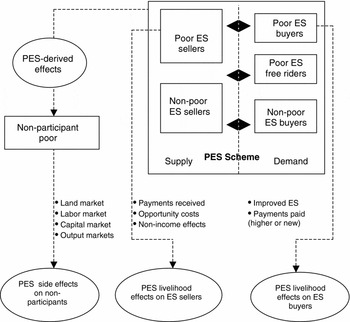
4. Derived effects: How are other, non-participant poor affected by PES outcomes?
The answers to these questions provide us with three categories of poor to scrutinize:
(a) Poor environmental service sellers (supply side)
(b) Poor environmental service users (demand side)
(c) Other poor people potentially being impacted by PES implementation (derived effects)
In the existing literature on PES and poverty, most discussion has been limited to questions 1 and 2, both of which are exclusively concerned with the fate of group (a). As will be shown below, it is important to broaden the view to the other two questions and groups for a more complete view of PES effects on poverty. Let us start by looking at question 1, i.e. the requirements for participation of the poor in PES schemes.
3. To what extent do poor people sell environmental services?
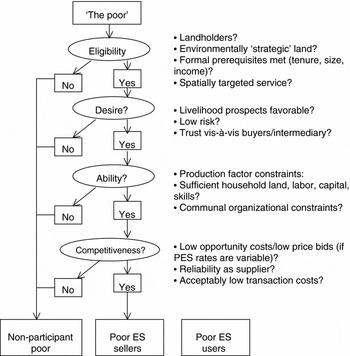
This section will look at access to and ‘market share’ in PES schemes by poor potential ES providers. Poor people face explicit PES access rules and underlying structural constraints, but will also consider whether they desire to participate or not. Figure 1 gives a graphical illustration of the selection process leading to participation of the poor in PES schemes, or not.Footnote 2
Participation of the poor in PES schemes

3.1 Eligibility
A first hurdle concerns the eligibility of the poor. Normally only landholders can participate in a PES program, leaving out the landless that tend to be among ‘the poorest of the poor’: without control over land, it is impossible to guarantee the continuous delivery of an ES.Footnote 3 Among those owning land, only lands with a ‘strategic environmental value’ will find buyers’ interest. In other words, the land has to be located vitally for service delivery (e.g. on a steep slope bordering a stream with important downstream water users) and the ES has to be either threatened (e.g. deforestation pressures that would accelerate the slope's soil erosion) or there has to be an opportunity to recuperate ES (e.g. planting trees to reduce ongoing soil erosion).
Note that the land-based eligibility criterion already excludes billions of poor people and directs them to the group of ‘non-participant poor’: the urban poor, the rural landless, those with land without environmental value, or land without ‘strategic ES value’ – i.e. where non-action does not make much difference for service provision. The degree of strategic spatial targeting will be larger for biodiversity protection, landscape beauty, and watershed protection – all of which are very space-specific. This contrasts with forest carbon sequestration, which can be done anywhere on the Globe where trees can grow – a much less restrictive enrolment filter. Spatial targeting is also more common in private than in public PES schemes; the State is usually reluctant to strongly discriminate participant access throughout space.
Whereas spatial targeting thus filters out a large absolute number of poor, it will normally increase the poor's relative participation, because environmentally sensitive lands often spatially coincide with remote, sparsely populated, poverty-struck areas. Recent comparative poverty mapping in seven tropical developing countries showed a marked spatial correlation between closed forests and high poverty rates – although seldom high population numbers, and thus not high poverty densities (Sunderlin et al., Reference Sunderlin, Dewi and Puntodewo2007). In absolute numbers, provision of most ES is thus strongly targeted and exclusionary, but among the few eligible, the share of poor people is likely to be high, as exemplified by the Mexican national watershed PES.Footnote 4
Public-sector PES schemes are normally less spatially targeted, but tend to have more formal requirements for enrolment – some of which are pro-poor, others anti-poor. In a study examining six carbon and two watershed projects in Latin America, we reconfirmed this mixed picture (Grieg-Gran et al., Reference Grieg-Gran, Porras and Wunder2005). Some rules discriminated against smallholders, such as formal land-tenure requirements and the exclusion of agroforestry and silvopasture (both being land user favored by the poor); others such as maximum farm-size enrolled and targeting of underdeveloped regions were pro-poor. Probably the requirement of formal land titles is the most common anti-poor enrolment criterion. Costa Rica abandoned a previous formal land-title requirement for PES to eliminate this bias (Pagiola, Reference Pagiola2007). This shows that enrolment without formal title is possible, as long as landholders have locally recognized tenure and a proven ability to exclude potential intruders. On the other hand, all national-level public PES-like programs in developing countries (Costa Rica, China, Mexico, South Africa, Vietnam) employ pro-poor targeting measures; in the South African Work for Water program, radical pro-poor screening only makes the poor and unemployed eligible (Turpie et al., Reference Turpie, Marais and Blignaut2007).
3.2 Desire
Not only do the poor need to be eligible, they also need to have own motivation and desire to participate in PES: is there an expected gain from participation, i.e. will PES payments more than cover the opportunity costs of buyer-requested land-use adjustments? But beyond income, a broader livelihood assessment of benefits, costs, and risks is pertinent. For instance, a piece of forestland threatened by invasions unless the landholder keeps ‘working’ it (i.e. gradually deforesting) might not be desirable to enroll in a PES set-aside scheme: rewards may be attractive, but the risks of losing the land might be too high unless land-tenure security is simultaneously strengthened (section 5). Similarly, landholders are often suspicious of outsiders offering contracts that involve land-use caps, mistaking these for the first step towards land expropriation – in particular, in settings where land tenure remains insecure and PES contracts are a completely untested initiative. Initial trust-building through PES intermediaries or ES buyers may be necessary to convince landowners to participate. Finally, ES providers’ transaction costs of participating are also relevant: does enrolment require so much paperwork and permits from the authorities that the effort is not worthwhile?
3.3 Ability
Poor people may be both eligible and willing to join a PES scheme, but still lack the ability to enroll. This applies in particular to what above was called ‘asset-building PES’, i.e. schemes where active investments are required to establish, for instance, biodiversity-friendly silvopastural systems (Pagiola, this Special Issue). Poor households may lack the necessary capital, skills, or labor, as well as access to credit or technical assistance, to implement the changes required by the PES scheme. In Ecuador and Guatemela, Southgate et al. (Reference Southgate, Haab, Lundine and Rodríguez2007) found that the smallest farmers were less willing to enroll land into conservation set-aside PES, since they perceived their food security to be compromised.
Other ability constraints may be at the village level, external to household decision-making. For instance, under loosely defined land tenure and access regimes, neighbors may exert strong pressures on the landowner not to fence off access to a land area proposed for set-aside conservation. In Bolivia, in one small-scale biodiversity-conservation PES the landowner had already agreed to the proposal, but backed off when his off-farm living sons opposed it due to fears of losing future land access (Robertson and Wunder, Reference Robertson and Wunder2005: 115–116).
3.4 Competitiveness
A final question determining the poor's PES participation is whether the willing, able, and eligible poor constitute competitive ES providers, or whether ES buyers are actually better off looking for non-poor providers. A first sub-question here is whether the farm-specific opportunity costs of the poor are sufficiently low to enable them to make a net profit from PES. If the PES scheme offers a single fixed rate per land area enrolled or per ES output unit, the farmer will have a ‘take it or leave it’ offer, and this competitiveness factor will already be captured under the ‘desire’ heading above. However, with variable rates in a bidding/auctioning system, a lower ES supply bid from the landowner will also increase enrolment chances.
What does this mean in practice? If poor landholders possess marginal lands, are strongly capital and technology-constrained, and labor remuneration is low, their opportunity costs for changing land use are probably also low. Yet, if they work their smaller plots more intensively (e.g. labor-intensive crops) while large landholders prefer land-extensive, low-input activities with low per-hectare returns (e.g. extensive cattle ranching), this situation may be reversed. One watershed study in Guatemala found large differences between farmers’ PES-relevant conservation opportunity costs, with poor farmers exhibiting lower costs and higher competitiveness (Costa and Zeller, Reference Costa and Zeller2003). Results are bound to be site-specific, but in general the poor are more likely to have lower opportunity costs.
A second competitiveness factor is the reliability of poor farmers as service suppliers. If they have de facto insecure land tenure and low control – a feature not uncommon for poor people – they may not be able to exclude outside intruders extracting resources or even taking over the land entirely. This risk would decisively jeopardize competitiveness vis-à-vis alternative ES suppliers who effectively control third-party access to their land.
The third, and often most important competitive factor, is the high PES transaction costs ES buyers face in working with smallholders. Imagine a water plant looking to secure the supply of clean urban drinking water, with options for investing in the conservation of two sub-watersheds. Both comprise an area of 3,000 ha, face the same degree of threat from erosion, and potential participants are equally eligible, willing, and able. But the first watershed has three large landholders with 1,000 ha each, while the second holds 1,000 poor landholders with 3 ha each. The transaction costs of working in the second, poverty-struck watershed, in terms of PES negotiation, contracts, monitoring, enforcement, and sanctions are bound to be much higher than those in the first.
The transaction-cost factor can be a ‘killer assumption’ for an intended pro-poor PES scheme, as experienced in the field of carbon services (Smith and Scherr, Reference Smith and Scherr2002). This effect will be stronger the higher are the economies of scale in service provision. For instance, some carbon-sequestration buyers requiring certification under the Kyoto Protocol have so elevated fixed costs that they operate with a minimum project size of around US$50,000, which may effectively exclude smallholders. The Ecuadorian PROFAFOR carbon sequestration program decided after some years of operation to introduce a minimum plot size of 50 ha to reduce excessive transaction costs. This has excluded some poor smallholders as potential participants, although the scheme still includes many collective contracts with marginalized highland communities (Wunder and Albán, Reference Wunder and Albán2007).Footnote 5
Do competitiveness constraints affect all ES equally? Making small-holders sufficiently competitive to participate in PES is often simpler for highly spatially targeted services (watershed and biodiversity protection, landscape beauty) where buyers have to work with whoever happens to occupy the targeted space – e.g. if in the above example it is only feasible to work in one single watershed, not two.Footnote 6 However, the dilemma of transaction costs becomes prime for homogenous services with a high degree of spatial mobility and competition (carbon sequestration, in particular).
What can be done to address competitiveness problems of poor ES suppliers in general, and their transaction-cost problem in particular? Creative scheme design to ‘bundle’ smallholder contracts, as currently experimented with in Costa Rica, might alleviate that constraint. ‘Bubble projects’ for carbon sequestration are similar cost-saving attempts to make ES commitments for an entire region, rather than individual landholders (Smith and Scherr, Reference Smith and Scherr2002). Obviously, this will move at least part of the transaction costs from the buyer to those seller institutions that have to make sure collective commitment is converted into individual compliance. These measures may thus reduce transaction costs and increase competitiveness, but can hardly eliminate the structural constraint proper.
4. Do poor people gain from selling environmental services?
4.1 Voluntary participants – rational sellers?
Once poor people have made it through the narrow eye of the PES enrolment selection needle, the next question is: does participation make them better off? In a recent study, we scrutinized the full spectrum of potential welfare effects using the Sustainable Livelihood Approach as a general framework (Grieg-Gran et al., Reference Grieg-Gran, Porras and Wunder2005). The following will instead distinguish only between income and non-income effects, and concentrate on the empirically most important impacts, illustrated by site-specific examples.
The welfare effects on ES sellers will generally be determined by ‘the rules of the PES game’ (payment rates and modes, conditionality, monitoring), which can either be preset by the buyers (as in most public, nation-wide schemes) or be negotiated up-front among buyers and sellers (see figure 2), but will either way normally be well-known prior to ES providers’ participation decision. As explained in section 2, PES contracts are voluntary agreements, so individual service providers can only be made outright worse off if they were de facto forced into participation (thus violating PES criterion (1)), being cheated, or just surprised by the ex-post livelihood impacts (e.g. due to under-estimated opportunity costs) and local-economy derived effects (e.g. changing land or labor markets) – or simply make irrational decisions.
The impacts of PES schemes on the poor

In the Chinese Sloping Land Conversion Program, some farmers have experienced net welfare losses, i.e. the tree planting on their land produced on aggregate fewer benefits than the previous land use; public payments were not enough to tip the balance. In general, this happened not because farmers wrongly predicted returns, but because many ‘received a payment offer they could not refuse’, i.e. they were forced to participate in the tree-planting scheme (Bennett, Reference Bennett2007). In similar public forest-protection contracts in Vietnam,Footnote 7 we found that payments of around US$3/ha/yr typically made up only 1–2 per cent of total household income (with a few high-end exceptions), which was typically not enough to significantly improve rural livelihoods. However, most payment-receiving farmers were not full-fledged landowners but received long-term allocations of public land that had already been declared ‘protection forest’. The Vietnamese case was thus not a voluntary scheme, and not a PES program in the strict sense, but rather an economic side-incentive functioning as ‘the oil that greases the wheel’ of the pre-existing command-and-control machinery (Wunder et al., Reference Wunder, The and Ibarra2005).
It has been conjectured that poor service sellers could become ‘PES trapped’ into lasting negative livelihood outcomes, e.g. when long-term land-use deals were signed under asymmetric access to information (Landell-Mills and Porras, Reference Landell-Mills and Porras2002). Long PES contract horizons do occur; e.g. in the Ecuadorian PROFAFOR case carbon buyers increased contract length from 25 to 99 years to raise permanence (Wunder and Albán, Reference Wunder and Albán2007). But so far, convincing real-world examples of ‘PES trap’ cases with systematic welfare losses on behalf of poor ES sellers notably seem to be missing. Not only does PES offer a new income source in often cash-poor areas with low diversification, the cash flow is potentially also more stable than common alternative sources, such as cash crops with heavily fluctuating output prices (Wunder, Reference Wunder2006). At least, this is the case if the PES program is well-administered and continuously funded, allowing ES buyers to fully meet their obligations (Pagiola et al., Reference Pagiola, Arcenas and Platais2005).
4.2 Income gains
Even if poor PES providers are likely to become better off, questions remain as to ‘how much’ and ‘in what way’ they will gain from participation. As in any commercial transaction, there is an inherent conflict over price between ES buyers maximizing consumer surplus (‘biggest conservation bang for the buck’) and ES providers boosting their provider surplus (PES minus opportunity costs). In other words, a PES contract produces an economic rent, the distribution of which to buyers and sellers will depend on their respective negotiation power.
ES buyers will often, though not always, be in a better negotiating position – on account of being fewer in number, more well-informed and initiative-seeking than ES providers. The use of provider price differentiation, inverse auctions and other bidding tools is designed by the buyers to squeeze the provider share of the rents, thus also reducing their welfare gains. Increasing organization and information levels among ES providers may sometimes improve their negotiating position. However, exceptionally there are also reverse cases where relatively few sellers hold unique assets that many buyers are willing to compete for. For instance, in the Zimbabwean CAMPFIRE program, which can be scrutinized as a PES-like program, communities controlling land areas with attractive wildlife and landscape-beauty values have been able to auction off land-access rights for safaris and trophy-hunting to the highest-bidding tour operators (Frost and Bond, Reference Frost and Bond2007).
Notwithstanding possible power asymmetries, in many cases PES comes to constitute a noteworthy share of participants’ household income – as far as we can tell from preliminary evidence. In Costa Rica, PES payments accounted for more than 10 per cent of household income in more than one quarter of participants (E. Ortiz, cited in Pagiola et al., Reference Pagiola, Arcenas and Platais2005); in the Virilla watershed PES payments averaged 16 per cent of cash household incomes, but three-quarters of households there earned more than US$820 monthly and were thus far from poor in the first place (Miranda et al., Reference Miranda, Porras and Moreno2003). However, in poverty-struck zones the situation can be quite different. In Costa Rica's Osa Peninsula, a small survey found that of those PES recipients that were under the poverty line, the scheme lifted half of them above it and became the primary household cash income source in 44 per cent of cases (Muñoz, Reference Muñoz2004). In Pimampiro, watershed-protection payments to poor upland settlers made up 30 per cent of recipient households’ spending on food, medicine and schooling (Echavarría et al., Reference Echavarría, Vogel, Albán and Meneses2004). PROFAFOR carbon projects in low-income, high-altitude areas of Ecuador, and the Huetar Norte project in a disadvantaged region of Costa Rica, both created some employment in the short run and a valuable plantation asset for future incomes (Albán and Argüello, Reference Albán and Argüello2004; Milne, Reference Milne2000; Miranda et al., Reference Miranda, Porras and Moreno2003), with expected internal rates of return of 12–27 per cent over a 30-year horizon (Grieg-Gran et al., Reference Grieg-Gran, Porras and Wunder2005). In Bolivia, we found that four of five PES-like schemes jointly targeting biodiversity conservation and landscape beauty through communal ecotourism produced local annual income gains of between US$77 and US$640 per household.Footnote 8 At least for poor people living in remote, disadvantaged regions, the relative size of income contributions from PES or PES-like schemes seems thus likely to have been quite significant.
Obviously, all gains reported in the above studies are gross PES-income figures; we do not know the size of landowners’ opportunity costs (income forgone due to PES-induced land-use restrictions). Relatively few PES studies have explicitly calculated opportunity costs, but the few that do confirm that voluntary PES schemes produce benefits in excess of opportunity costs. For instance, the PES scheme in the Bolivian Los Negros watershed produced in-kind benefits from beehive transfers (the locally preferred PES payment modality) with the low monetary equivalent of US$3.5–7/ha/yr. But so far the opportunity costs were likely to be negligible, so the voluntary participants of the scheme are thus likely to receive small but positive net gains (Robertson and Wunder, Reference Robertson and Wunder2005).
A larger-scale PES-like example is the Noel Kempff Mercado Climate Action Project (NKMCAP), also in Bolivia. A national park was extended by 634,000 ha into a logging-concession area. The credits from the avoided-logging carbon loss were bought by North American companies investing in carbon-emission offsets. Three local communities lost their jobs in the bought-out timber companies, and received in compensation economic benefits from park-ranger employment, investments in improved agriculture and ecotourism. Gross benefits over three years were estimated at US$96,782–260,695 (Milne et al., Reference Milne, Arroyo and Peacock2001) and US$128,580 (Asquith et al., Reference Asquith, Vargas-Ríos and Smith2002), respectively.Footnote 9 Deducting opportunity costs, the 1,050 community members received a modest but positive net per-capita gain of US$100–250.
4.3 Non-income gains
Frequently PES recipients gain more than just income from participation; non-monetary side benefits can be equally important (Rosa et al., Reference Rosa, Kandel and Dimas2003). Three factors stand out: land-tenure consolidation, increases in human and social capital, and higher visibility vis-à-vis external investors.
Regarding tenure, one global review had feared that PES could induce more powerful groups to crowd out smallholders from their land whenever insecure property rights existed (Landell-Mills and Porras, Reference Landell-Mills and Porras2002). While in theory this could have happened – and certainly land-appropriation fears exist among peasants (section 3) – in various Latin American cases, PES participation actually increased smallholder land-tenure security vis-à-vis neighbors or squatters. Conversely, most PES gains are not large enough to really attract the interest of the powerful (Rosa et al., Reference Rosa, Kandel and Dimas2003; Robertson and Wunder, Reference Robertson and Wunder2005).
There are two avenues for a PES scheme to increase land-tenure security, which may work jointly or separately. First, tenure-consolidation efforts can explicitly be enabled by the PES scheme – as an up-front requirement or as an accompanying result. For instance, in CIFOR's efforts to promote a community conservation concession in East Kalimantan (Indonesia), a process towards land-tenure clarification among different villages’ overlapping land claims was started up front, acknowledged as a necessary PES precondition (Wunder et al., Reference Wunder, Campbell, Frost, Iwan, Sayer and Wollenberg2007). Mapping, demarcating, and legalizing land claims is also often done as PES implementation progresses, either because PES receipts help finance the required legalization process (as for the Bolivian Chalalán Ecolodge) or because ES buyers use land-tenure formalization as a reward for ES sellers’ compliance, as in the NKMCAP (Robertson and Wunder, Reference Robertson and Wunder2005).
A second PES-induced pathway toward more secure land tenure is a perceptional one. Local acceptance of land tenure often depends on proof of ‘economic use’ of that piece of land. A major tenure-securing effect of a PES scheme can be to create local recognition that land set aside for conservation has tangible economic value and is not just idle ‘reserve land’ up for grabs by immigrants or neighbors. This was confirmed in our Bolivian case of Los Negros where forested land is threatened by an influx of landless migrants from the highlands. Landowners confirmed that the fact they received maps with demarcated boundaries and could demonstrate income-generating activity from the conserved land, gave it a de facto higher protection from invasions (Robertson and Wunder, Reference Robertson and Wunder2005).
Beyond land-tenure effects, experiences show that PES participants tend to increase their human and social capital by improving internal organization, e.g. through collective bargaining and action vis-à-vis the service buyers (Grieg-Gran et al., Reference Grieg-Gran, Porras and Wunder2005; Rosa et al., Reference Rosa, Kandel and Dimas2003). Again, some benefits are provided in advance (training courses, help in starting an association, etc.); others accrue through PES ‘learning-by-doing’ (e.g. through negotiating with ES buyers or intermediaries). The Chalalán Ecolodge showed both effects: substantial up-front training was provided by Conservation International to the community that now fully controls the operation, and significant internal coherence and entrepreneurial spirit has been added (Robertson and Wunder, Reference Robertson and Wunder2005). This empowerment is to the advantage of local people in any other business dealings with the outside world.
Finally, the PES program can also work as a strategic ‘site propaganda’, increasing the visibility of the village or community vis-à-vis both donors and public entities. For instance, in Bolivia we found that several villages involved in PES-like initiatives suddenly found it easier to attract a donor for a health clinic, road improvement, or land-tenure recognition by the municipality, because the PES scheme had put the community ‘on the map’ of these external agents. In the Los Negros case, the PES scheme has served as an effective negotiation platform to mediate long-standing conflicts between upstream land-colonizing farmers and downstream irrigation users (Robertson and Wunder, Reference Robertson and Wunder2005).
4.4 Inequality and social costs
Despite the predominance of positive socio-economic PES outcomes, some negative social side-effects can also occur. Paying some and not others (e.g. enrolling only ‘strategically located’ landowners) can create jealousies and raise inequality. This is probably a feature shared with most development initiatives: not every individual is equally equipped and motivated to take advantage of new income-generation options. In addition, in some hybrid cases between PES and traditional projects, focusing on communal development rather than conditional payments (e.g. NKMCAP and tourism payments in the Eduardo Avaroa Reserve), flows of non-conditional benefits can create paternalistic expectations of even greater flows, and tensions when these hyper-expectations are not met (Robertson and Wunder, Reference Robertson and Wunder2005).
Nevertheless, some collective PES payments benefiting all households may create equality but not equity: households that bear disproportionate opportunity costs are under-compensated and are made worse off, but cannot individually reject the PES deal. This can create social tensions, as in the case of the Zimbabwean CAMPFIRE program where landowners and users directly adjacent to wildlife-priority areas often lost out (Frost and Bond, Reference Frost and Bond2007), and in the NKMCAP where one community particularly dependent on logging (Florida) was disproportionably hit (Asquith et al., Reference Asquith, Vargas-Ríos and Smith2002). Fine-tuning compensation payments in collective deals to individual opportunity costs may thus be an important step to prevent social tensions.
5. Do poor environmental service users benefit from PES?
It is frequently assumed that ES providers/sellers are much poorer than ES users/buyers, so that PES-related poverty-alleviation efforts should focus on the former. Empirically this key assumption seems to hold quite well, for three reasons. First, as mentioned, the poor often occupy fragile lands that are economically less developed but strategic for ES provision. Second, various environmental services are in a way luxury goods that only the rich Northern-Hemisphere countries (carbon, biodiversity services) and the more well-off strata of people in Southern-Hemisphere countries (landscape beauty) can afford to pay for. Third, groups of poor potential buyers often lack the internal coordination to act as ES buyers, even if it would be rational for them to compensate ES providers. For instance, a recent PES feasibility analysis in the Philippines found that payments in one watershed dominated by many poor lowland rice farmers were unlikely to materialize, whereas chances were much better in a similar watershed were the users included municipal water plants and the ecotourism industry (PREM, 2005). In practice, most existing PES schemes are therefore monopsonies or oligopsonies, without direct poverty-alleviation scope on the buyer side.
If downstream areas are populous, the number of poor ES buyers represented by one municipal water plant may often exceed that of upstream poor ES sellers by orders of magnitude, which also has poverty implications. In a recently started PES scheme in Chaina (Colombia), ∼5,600 water users, many of them poor farmers, depend for their water quality on the action of 15 potential ‘ES providers’ – upstream settler households currently increasing sedimentation through deforestation of a 440 ha sub-watershed (Blanco et al., Reference Blanco, Wunder and Navarrete2005). At a larger scale, the aqueduct of Táchira (Western Venezuela) serves ∼90,000 people, but is similarly being threatened by sedimentation from ∼90 upstream households’ farming, and a small-scale PES scheme has recently been piloted to reverse the trend (Blanco et al., Reference Blanco, Wunder and Sabogal2006). Hence, maximizing sellers’ PES rates alone would here have little poverty-alleviation effect: the major welfare benefits from PES accrue through reducing drinking-water fluctuations and pollution, thus improving the numerous poor water users’ health. Helping the poor is thus here best achieved by making sure the PES scheme is efficient in delivering the service it promises.
Far from all ES users are also ES buyers, especially so if they are poor: many disadvantaged ES users free-ride on others’ payments to receive improved services. Poor tropical farmers are likely to suffer most from global warming (water shortages, declining crop yields, disease-proneness) since they lack the means to adapt their farming systems, and are thus particularly helped by current mitigation efforts – which they are not paying for (IPCC, 2001). Poor urban water users often receive their drinking water for free since their taps are not metered; in poor countries, non-payment shares easily reach 50–90 per cent. Hence, free-riders benefit from any PES-led improvement in water quality or availability.Footnote 10
6. How do poor non-participants fare?
What happens to those impoverished people who are not participating in PES? For most, PES effects will be neutral, but some may be significantly affected by the scheme through its effect on land, labor, capital, and output markets. Let us look at each of these separately.
PES schemes will usually directly affect the market for or the availability of land. To the extent that PES schemes are achieving effective conservation – e.g. reducing open-access lands and stabilizing agricultural frontiers – they could particularly hurt the landless who are looking for opportunities to invade land for homesteading – the scenario prevalent, for instance, in the aforementioned Los Negros watershed. While most landowners there were disadvantaged, the landless people were among ‘the poorest of the poor’, thus pointing to important conflicts of interest between different strata of poor (Robertson and Wunder, Reference Robertson and Wunder2005).
Regarding labor-market effects, other subgroups of poor usually self-engage (or are being employed) in some of the environmentally most threatening activities, such as logging-company workers, firewood cutters and charcoal makers, extractors over-harvesting non-timber forest products (NTFP), or farm hands hired for clearing land and for cultivating converted soils. These poor people often depend on environmental degradation for their livelihoods. To the extent that the PES scheme is ‘use-restricting’ (section 2), i.e. it caps total economic activity levels (as in the Los Negros conservation set-aside PES), the poor are likely to lose out in terms of employment or informal-sector income. For instance, PES restrictions were found to likely hurt traditional herder and NTFP harvester groups in India (Kerr, Reference Kerr2002). Conversely, if ES provision is ‘asset-building’, such as establishing silvopastural systems in treeless pastures (Pagiola, this issue) or planting trees in degraded landscapes with few productive alternatives (Albán and Argüello, Reference Albán and Argüello2004), one can expect a net expansion in rural jobs that benefits unskilled rural labor, thus alleviating poverty.
Prospective employment-contraction effects in use-restricting schemes have to be weighed against the local multiplier effects from their inflows of cash – the main limiting production factor in many remote rural areas. This concerns the financial inflows from recurrent PES payments, but also accompanying up-front investments. In five of the nine PES or PES-like schemes we reviewed in Bolivia, significant up-front investments in infrastructure, training, negotiation, etc. were made, which partially also reflected the ‘project-PES hybrid’ character of these schemes. In various cases, direct causal links could be made from cash inflows to local livelihood gains (Robertson and Wunder, Reference Robertson and Wunder2005: 121–127). On the downside, if logging produces valuable timber rents that, say, end up in the country's capital, then restricting timber harvests through PES could indirectly harm poor people working in, say, the urban service sector previously stimulated by the recycling of these rents.
Finally, PES can also change output markets. For instance, a successful ecotourism scheme could raise local demand and prices of certain protein-rich foodstuffs (fish, meat, etc), making them unavailable for especially those on-site poor that do not receive higher incomes. Some output-market effects can be off-site; cutting off raw-material supply may have notable downstream development impacts. For instance, the urban poor buying charcoal could face higher prices if an important peri-urban charcoal-production area was set aside in a conservation PES scheme. Yet, conversely, these higher prices would benefit poor charcoal producers at other sites, showing the complexity of these PES-derived welfare effects.
How important are these PES-derived effects from production-factor and output markets for the poor? Few empirical studies on these linkages exist; in most cases one would expect effects to be small, especially the off-site effects, although timber rents could be a prominent exception. Local effects can sometimes be sizeable. For instance, laid-off logging and sawmill workers constituted the most weighty local welfare loss, and the main reason for community compensations being implemented in NKMCAP (Asquith et al., Reference Asquith, Vargas-Ríos and Smith2002). In other words, the non-participating poor, especially the landless and the unemployed, should not be forgotten in livelihoods-impact assessments of PES schemes, since in some cases effects can be substantial.
7. Conclusions and perspectives
The empirical evidence on welfare impacts of PES in developing countries remains sketchy, both because many schemes are still young and because little systematic ‘with and without PES’ welfare data have been gathered. Yet, as suggested in this article, some patterns are emerging. Let us return to our four initial questions from section 2, provide some tentative answers, and discuss policy implications.
First, to what extent can poor people participate as sellers in PES schemes? We know that their access depends upon eligibility, desire, ability, and competitiveness. Among these filters, two conditions tend to be anti-poor: informal and/or insecure land tenure (affecting all four filters) and high buyer-transaction costs of working with numerous smallholders (reducing competitiveness). Options to address these conditions may be to skip or modify inappropriate access restrictions (such as formal land-title requirements), or to develop collective smallholder-bundling schemes that reduce transaction costs. If ample participation of poor providers is a prime concern, explicit poverty targeting (e.g. maximum-income thresholds) and subsidies (e.g. pro-poor carbon premiums) may be considered, though targeting tends to come at the cost of environmental efficiency losses.Footnote 11 Nevertheless, other pre-existing filtering conditions are clearly pro-poor, such as formal caps on land size enrolled in most public PES schemes, and in particular the spatial overlap between marginal production areas and environmentally sensitive lands. To the extent that these pro-poor filters dominate in the first place, we may not need to worry much about the poor's seller access to PES schemes.
Second, do ES sellers become better off? Whenever poor people are selected as sellers, they are also very likely to benefit from getting paid – unless they were forced to participate in the first place. As for the payment mode, large singular cash transfers often can have detrimental local development impacts, but there is growing evidence from other fields (e.g. education, emergency aid, demobilization) that well-designed conditional cash transfers can be an efficient way to simultaneously achieve targeted sectoral goals and stimulate general recipient welfare gains.Footnote 12 In terms of outcomes, typically PES income gains beyond the (rarely quantified) opportunity costs do materialize, but asset transfers (e.g. tree plantations) or non-income gains (training, improved organization, land-tenure recognition, etc.) can also be important. Yet, it seems that per-capita provider income gains are seldom impressively large: typically ES buyers are in a better negotiating position to appropriate the ‘gains from trade’. What could be done to increase poor providers’ share of the environmental rent from PES deals? Again, pro-poor premia can be one pathway to increase provider incomes. One can also provide communities and smallholders with more information about the value of the service at stake, and realistic compensation levels for land-use changes. Sometimes poor communities actually overestimate buyers’ willingness to pay, thus endangering the deal per se.
Third, what about the demand side? Poor ES users – in some cases ES buyers, in most cases free riders – can benefit significantly, so PES poverty assessments should not focus exclusively on ES sellers. Sometimes these poor ES users outnumber poor sellers by orders of magnitude, especially for watershed protection. If so, making sure that the promised service is delivered is certainly the best way to help the poor. In particular cases, donors and NGOs could help organize multiple poor service users so they can become ES buyers – say, poor fishermen paying for mangrove conservation. Although ‘the poor paying the non-poor’ could be a highly remunerative strategy for the former, it is usually very challenging to implement.
Fourth, how are non-participants affected? In most cases, these effects are mixed, and minor in size. However, sometimes the impacts of use-restricting PES on the non-participating poor are noteworthy. Especially landless colonists can suffer if open access to land is closed, and people working in environmentally degrading activities can lose their job. This feature is not exclusive to PES; it is shared with any efficient conservation initiative. If implementers on fairness or political feasibility accounts are highly concerned with these derived effects, it may be advisable to undertake compensatory measures that minimize third-party losses.
How important is PES thus on aggregate for poverty alleviation? In most cases, PES has positive but point-wise, quantitatively small poverty-reduction effects. Those claiming that PES will become a poverty trap are clearly barking up the wrong tree. Those believing in its major poverty-alleviation potential underestimate the limitations posed by narrow spatial targeting and by the ‘naturally’ superior negotiation position of ES buyers. Arguably, the main bottleneck impeding PES from reducing poverty more is their hitherto reduced implementation scale. Analogous to the growth vs. distribution development debate, the key trick is probably not how to redistribute the PES cake towards a greater share for the poor, but how to increase the size of the entire cake. External donors can ease the scale bottleneck by helping to finance PES start-up costs (trust-building, negotiation, baseline studies, monitoring systems, etc.), if PES operational costs are likely to remain sustainably low.
Yet, to the extent that multiple side objectives (e.g. concerns for poverty, human rights, gender, indigenous people) are increasingly squeezed into the PES equation, the schemes will lose efficiency in achieving their main target: to deliver an improved environmental service. If schemes become over-regulated and efficiency is lost, the outreach to the private sector – globally a prime target for PES schemes so far (Landell-Mills and Porras, Reference Landell-Mills and Porras2002) – would be reduced. PES would increasingly become ‘old wine in new bottles’, subsumed into the generic family of altruistic development projects to which they were actually meant to be an alternative. Reduced PES scale would not only limit environmental impacts, but eventually also pro-poor effects. Policy- and decision-makers should thus not ‘put the (poverty) carriage before the (PES) horse’. Poverty reduction is an important PES side objective, and safeguards can be taken to address it properly – but it should never become the primary goal of PES.