Introduction
The amount of elderly people is expected to more than triple during the next 50 years (United Nations, 2002), and as a natural consequence there will be a proportional increase in people having dementia. Behavioral and psychological symptoms like depression and anxiety often coexist with dementia, and create an additional burden for patients and their caregivers. Although depression among persons with dementia is well studied, anxiety has received less attention despite its severe consequences (Seignourel et al., Reference Seignourel, Kunik, Snow, Wilson and Stanley2008).
Anxiety symptoms may predict accelerated cognitive decline and have been related to poorer cognitive performance (Beaudreau and O'Hara, Reference Beaudreau and O'Hara2008). Co-morbid anxiety has also been associated with various other negative outcomes, such as limitations in activities of daily living, behavioral problems (Teri et al., Reference Teri1999), problems in patient/carer relationship, increased caregiver burden (Orrell and Bebbington, Reference Orrell and Bebbington1996; Kaufer et al., Reference Kaufer1998), increased use of healthcare services (Haupt et al., Reference Haupt, Karger and Janner2000), increased risk of nursing home placement (Gibbons et al., Reference Gibbons, Teri and Logsdon2002), and reduced functional status, over and above the effects of cognitive decline (Schultz et al., Reference Schultz, Hoth and Buckwalter2004).
Prevalence rates of 17–38% for anxiety disorders in persons with dementia have been reported in the literature (Ballard et al., Reference Ballard, Neill, O'Brien, McKeith, Ince and Perry2000), and generalized anxiety disorder (GAD) appears to be the most frequent disorder (Mintzer et al., Reference Mintzer, Brawman-Mintzer, Mirski and Barkin2000). Clinically significant symptoms of anxiety, as measured with the Neuropsychiatric Inventory (NPI; score >3), have been demonstrated in 37% of patients (Aalten et al., Reference Aalten, Jolles, de Vugt and Verhey2007). Additionally, prevalence rates of 25–70% for presence of anxiety symptoms have been reported (Teri et al., Reference Teri1999; Hart et al., Reference Hart, Craig, Compton, Critchlow, Kerrigan and McIlory2003; Moran et al., Reference Moran, Walsh, Lynch, Coen, Coakley and Lawlor2004; Tatsch et al., Reference Tatsch2006; Archer et al., Reference Archer2007). Anxiety levels seem to be relatively stable across stages of dementia severity, until a decrease at the terminal stage (Seignourel et al., Reference Seignourel, Kunik, Snow, Wilson and Stanley2008).
Most studies have focused on patients with Alzheimer's disease (AD), and less is known about the frequency of anxiety in other illnesses associated with dementia. In particular, it has been suggested that the occurrence of psychological symptoms in dementia with Lewy bodies (DLB) is underinvestigated (Borroni et al., Reference Borroni, Agosti and Padovani2008). In one previous study, however, somewhat higher anxiety prevalence was found in patients with DLB (56%) compared to patients with AD (42%; Ricci et al., Reference Ricci2009). Also, Gibbons et al. (Reference Gibbons, Teri, Logsdon and McCurry2006) note that the relationship between patient and caregiver assessment of anxiety is yet to be established, and refer to research on depression in patients with dementia, where the patients commonly report less symptoms than caregivers.
An important issue regarding anxiety in dementia is whether it should be considered as a separate clinical entity or as part of a broader syndrome (Porter et al., Reference Porter2003; Seignourel et al., Reference Seignourel, Kunik, Snow, Wilson and Stanley2008). In particular, it has been suggested that there is a strong overlap between anxiety and agitation and depression. According to Seignourel et al. (Reference Seignourel, Kunik, Snow, Wilson and Stanley2008), there is currently more evidence for the distinctiveness of anxiety and agitation than their equivalence, whereas the distinction between anxiety and depression is yet unclear.
In this observational cross-sectional study, we assessed the frequency of caregiver- and patient-reported anxiety and associations between anxiety and socio-demographic and clinical variables in an outpatient sample with first-time diagnosed mild dementia. Based on existing literature, our hypotheses were: (1) The subtypes of mild dementia are associated with different frequencies of anxiety; (2) Caregivers report more anxiety than patients; (3) Anxiety in mild dementia correlates highly with depression, but not with agitation; and (4) Clinically significant anxiety is associated with more impairment in dementia ratings and in neuropsychological test performance, as well as with increased caregiver stress, when controlling for depression.
Methods
Subjects
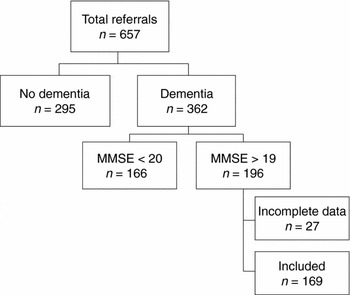
The study sample comprised participants recruited for a longitudinal dementia study (DEMVEST; Aarsland et al., Reference Aarsland2008). All new referrals to outpatient clinics in geriatric medicine and old age psychiatry were screened from March 2005 to March 2007, in the counties of Rogaland and Hordaland in Western Norway. Patients with suspected mild dementia were invited to participate in the study. In order to ensure the selection of patients with mild dementia only, a minimal score of 20 was required on the Mini-Mental State Examination (MMSE; Folstein et al., Reference Folstein, Folstein and McHugh1975). Patients with no dementia, acute delirium or confusion, terminal illness, current or previous bipolar disorder or psychotic disorder, or who were recently diagnosed with a major somatic illness were excluded. A total number of 657 subjects were screened during the two-year inclusion period, of which 196 fulfilled the eligibility criteria. The screening and assessment procedures as well as the dementia subtype diagnostic criteria are described in detail in a previous publication (Aarsland et al., Reference Aarsland2008). The sample in the current study is a subsample (n = 169) from the DEMVEST study with available anxiety scores (see Figure 1). Excluded patients did not differ significantly from included patients with regard to age, sex, MMSE score, or duration of symptoms. The study protocol was approved by the Regional Committee for Medical and Health Research Ethics in Western Norway as well as the Norwegian Social Science Data Services.
Flow chart for participant exclusion.

Measures
Neuropsychiatric symptoms
Symptoms of anxiety were rated by a caregiver on the NPI (Cummings et al., Reference Cummings, Mega, Gray, Rosenberg-Thompson, Carusi and Gornbein1994) subscale/part E Anxiety. On the NPI, symptoms are assessed for the last 30 days: rating frequency (1–4) and severity (1–3). Frequency and severity are multiplied into a summary score (1–12). A score of 4 or higher is generally considered as clinically significant (Porter et al., Reference Porter2003). In the present study, both categorical (caseness, presence of clinically significant anxiety) and dimensional scores were used. In addition, the NPI assesses caregiver distress in relation to the symptoms in question, with a scale from 0 (not at all distressing) to 5 (extremely distressing).
Patients’ own perceptions of anxiety were measured with the anxiety tension item on the Montgomery and Åsberg Depression Rating Scale (MADRS; Montgomery and Åsberg, Reference Montgomery and Åsberg1979). The MADRS items are rated from 0 to 6. The anxiety item (Item 3) addresses “feelings of ill-defined discomfort, edginess, inner turmoil, mental tension mounting to either panic, dread or anguish” during the last three days. A score of 2 or higher, indicating that the patient experienced anxiety at least time to time, was used to define the presence of anxiety. Ratings of the MADRS and the NPI were conducted independently and blindly.
Depression and agitation were measured with the NPI subscales C (Agitation and aggression) and D (Depression).
Dementia and cognitive functioning
In the DEMVEST study, a battery of standardized and established rating scales and tests was used for investigating patients’ cognitive functioning. In the current study, a selection of these tests was chosen in order to assess eventual associations between neuropsychological test performance and anxiety. MMSE (Folstein et al., Reference Folstein, Folstein and McHugh1975) is a brief test used for screening for cognitive impairment. The Clinical Dementia Rating (CDR; Morris, Reference Morris1997) is used for assessing the severity of dementia, on a scale from 0 to 3. The rating scale also comprises six cognitive and practical domains: Memory, Orientation, Judgment and problem-solving, Community affairs, Home and hobbies, and Personal care. The second edition of California Verbal Learning Test (CVLT-II; Delis et al., Reference Delis, Kramer, Kaplan and Ober2000) was used for assessing verbal learning and memory. Visual scanning, psychomotor speed, and attention were assessed with Trail Making Test A and B (Armitage, Reference Armitage1946). Raw scores were used for the neuropsychological tests.
Other variables
The Relative Stress Scale (RSS; Greene et al., Reference Greene, Smith, Gardiner and Timbury1982) was used for assessing caregiver burden when taking care of a person with dementia. This scale has 15 items that are scored from 0 to 4, total scores ranging from 0 to 60. Higher scores reflect higher caregiver burden. Socio-demographic variables, duration of dementia symptoms, and co-morbid somatic illnesses (cardiac disease, hypertension, diabetes mellitus, chronic obstructive pulmonary disease, and hypothyreosis) were registered by a questionnaire designed for the study. A composite score ranging from 0 to 5 was calculated for current somatic co-morbidities. A trained nurse or a medical doctor interviewed both patients and caregivers.
Statistical analyses
The analyses included descriptive statistics and non-parametric statistics to assess differences between groups (Fisher exact test, Mann-Whitney U-test) and associations between variables (Spearman's correlation coefficient). Binary logistic regression analyses were conducted in order to examine the associations between anxiety and scores on CDR and RSS, while adjusting for depression, age, sex, and dementia subtype. Results are presented as percentages and odds ratios (OR) with 95% confidence intervals (CIs). Statistical analyses were performed with the PASW statistical software, version 17 (SPSS, Inc., Chicago, IL), and p < 0.05 was considered statistically significant.
Results
Sample characteristics
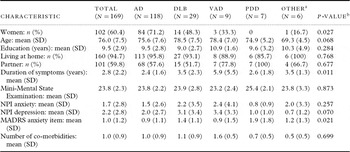
The sample of 169 patients included patients with AD (n = 119, 70.4%), DLB (n = 29, 17.2%), Parkinson's disease dementia (PDD; n = 10, 5.9%), vascular dementia (VaD; n = 9, 5.6%), frontotemporal dementia (FTD; n = 3, 1.8%), and alcoholic dementia (n = 3, 1.8%). The mean age was 76.0 (SD 7.5, range 50–90) and 60% of the sample were women. Of the total sample, 95% were living at home and 60% had a live-in partner. On average, the participants had 1.0 (SD 0.9, range 0–3) co-morbid conditions, the most common current co-morbidity being hypertension (42%). Within the group with DLB, there was a larger proportion of men, the duration of dementia symptoms was longer, and the scores on the MADRS anxiety item and the RSS were significantly higher, compared to the group with AD (see Table 1).
Participant characteristics

a Three cases of frontotemporal dementia and three cases of alcoholic dementia.
b Differences between groups (AD vs. DLB) were analyzed using the Mann-Whitney U-test and Fisher exact test.
Note: AD = Alzheimer's dementia; DLB = dementia with Lewy bodies; VaD = vascular dementia; PDD = Parkinson's disease dementia; SD = standard deviation; NPI = Neuropsychiatric Inventory; MADRS = Montgomery and Åsberg Depression Rating Scale.
Caregiver and patient ratings of anxiety
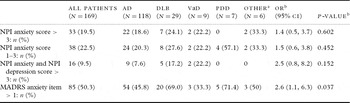
Table 2 shows the frequencies of anxiety in the total sample and in dementia subtypes. Based on caregiver ratings on the NPI, 19.5% of the total sample had clinically significant anxiety, and half of these (9.5%) had clinically significant depressive symptoms. An additional 22.5% had subclinical anxiety. A somewhat higher proportion of the patients (50%; vs. 42% caregiver rating) reported feeling anxious at least from time to time on the MADRS item. There was a small but significant correlation between caregiver and patient ratings of anxiety (r = 0.23, p = 0.002). Patients with DLB were more likely to report experiencing anxiety compared to patients with AD (OR: 2.6, 95% CI: 1.1–6.3). However, there were no significant differences between the groups in caregiver-reported anxiety, or in caregiver distress in relation to anxiety.
Frequency of anxiety in patients with mild dementia

a Three cases of frontotemporal dementia and three cases of alcoholic dementia.
b Differences between groups (AD vs. DLB) were analyzed using the Fisher exact test and odds ratios with 95% confidence intervals.
Note: AD = Alzheimer's disease; DLB = dementia with Lewy bodies; VaD = vascular dementia; PDD = Parkinson's disease dementia; OR = odds ratio; CI = confidence interval; NPI = Neuropsychiatric Inventory; MADRS = Montgomery and Åsberg Depression Rating Scale.
Clinical correlates of anxiety
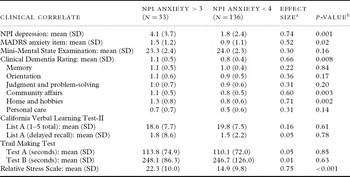
Neither caregivers’ nor patients’ ratings of anxiety (NPI; continuous score) had statistically significant associations with socio-demographic variables, duration of dementia symptoms, or number of co-morbid somatic illnesses. Anxiety correlated significantly with depression (r = 0.30, p < 0. 001) but not with agitation (r = 0.09, p = 0.266). Correlates of clinically significant anxiety (NPI ≥ 4) are shown in Table 3. Suffering from clinically significant anxiety was associated with more depression (p = 0.001) and higher caregiver stress (p < 0.001). There were no significant associations between anxiety and performance on the MMSE, CVLT-II, or Trail Making Test A and B. Patients with clinically significant anxiety had, however, higher global CDR scores (p = 0.008), and more impairment in the CDR subscales “Community affairs” (p = 0.003) and “Home and hobbies” (p = 0.002).
Clinical correlates of anxiety in patients with first-time diagnosed dementia (n = 169)

a Effect sizes are calculated as Cohen's d.
b p-values are based on Mann-Whitney U-tests.
Note: NPI= Neuropsychiatric Inventory; MADRS = Montgomery and Åsberg Depression Rating Scale; SD = standard deviation.
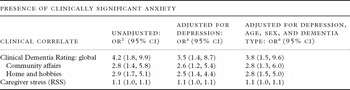
The associations between anxiety and the significant clinical correlates were examined further with logistic regression analyses. Adjusting for NPI depression scores separately, or together with age, sex, and dementia subtype, had only marginal effect on the associations (Table 4). In the adjusted analyses, the ORs for the association between anxiety and CDR subscales and global score ranged from 2.5 to 3.8, indicating that half-point increase on the dementia severity/impairment ratings increased the odds for anxiety substantially. Each additional point on the RSS increased the odds for anxiety by 6–7%.
Unadjusted and adjusted associations of anxiety with dementia-related impairment and caregiver stress in patients with first-time diagnosed dementia (n = 169)

a Odds ratios calculated with binary logistic regression models.
Note: OR = odds ratio; CI = confidence interval; RSS = Relative Stress Scale.
In additional, exploratory post-hoc analysis, the associations between anxiety-related caregiver distress (NPI Anxiety–Distress), dementia-related impairment (CDR), and general caregiver stress (RSS) were examined. NPI Anxiety–Distress correlated significantly with the RSS (r = 0.32, p < 0.001) and the global CDR (r = 0.23, p = 0.002). Of the CDR subscales, significant correlations were found with Judgment and problem-solving (r = 0.21, p = 0.007), Community affairs (r = 0.30, p < 0.001), Home and hobbies (r = 0.24, p = 0.001), and Personal care (r = 0.24, p = 0.002), but not with Memory or Orientation.
Discussion
Overall, the study findings show that symptoms of anxiety are common among patients with mild dementia, and one-fifth of the patients seem to show symptoms consistent with clinically significant anxiety. This is considerably higher than in the general elderly population (Aarsland et al., Reference Aarsland2009).
Our first hypothesis was that subtypes of dementia are associated with different frequencies of anxiety. Patients with DLB reported experiencing anxiety significantly more often compared to patients with AD, although carer-rated scores did not differ significantly. While previous research suggests that individuals with retained insight experience greater anxiety (Seignourel et al., Reference Seignourel, Kunik, Snow, Wilson and Stanley2008), it does not seem likely that patients with DLB would report more anxiety due to more insight. Patients with DLB generally demonstrate more severe visuospatial and visuoconstructive impairment than patients with other types of dementia (Lezak, Reference Lezak, Howieson and Loring2004). Visuospatial impairment is associated with right hemisphere brain dysfunction, which again has been linked to anosognosia (Ecklund-Johnson and Torres, Reference Ecklund-Johnson and Torres2005). However, higher reporting of anxiety could be connected to experiencing frightening hallucinations, as visual hallucinations are a common symptom in DLB.
Our second hypothesis was that caregivers report that the patients have more anxiety compared to patients themselves. The findings demonstrated that 50% of the patients reported having anxiety from time to time, compared to the caregiver reported 42%. There was also a small but significant association between patient and caregiver ratings of anxiety. Gibbons et al. (Reference Gibbons, Teri, Logsdon and McCurry2006) refer to research on depression in patients with dementia, where the patients commonly report less symptoms than caregivers. In their sample, correlations between caregiver and patient reports were low. Since the patients in our study had only mild dementia, it may be expected that they also had more intact insight in their symptoms and were able to give more accurate reports of their emotional symptoms.
Our third hypothesis was supported by the study findings, demonstrating a correlation between anxiety and depression, and no significant association between anxiety and agitation. The pattern with stronger associations between depression and anxiety corresponds with previous findings (Seignourel et al., Reference Seignourel, Kunik, Snow, Wilson and Stanley2008), although modest correlations between anxiety and agitation have also been reported (Twelftree and Qazi, Reference Twelftree and Qazi2006). The non-significant association between anxiety and agitation may be a consequence of selecting only patients with mild dementia for the current study, as agitated behavior may be expected to increase with progressing dementia.
Our fourth and final hypothesis was that clinically significant anxiety is associated with more impairment in dementia ratings and in neuropsychological test performance, and with increased caregiver stress, even when adjusting for depression. We found no associations between anxiety and scores on neuropsychological tests. However, higher impairment in dementia ratings increased the odds for anxiety substantially, independently of depression, age, sex, and dementia subtype. Likewise, the association between caregiver stress and anxiety remained significant in the adjusted analyses.
In particular, anxiety was associated with impairment in CDR subscales “Community affairs” and “Home and hobbies.” Thus, anxiety seems to be associated not so much with cognitive test performance than with the ability to function in daily life, inside and outside one's home environment. Whether losing one's capacity to function in daily life is a cause or consequence of anxiety should be examined in longitudinal studies.
Since significant correlations were found between measures using caregivers as primary informants, it might also be plausible to explain the previously mentioned associations as expressions of caregiver distress. In addition to dementia-related caregiver stress, caregivers’ distress with regard to patient's anxiety was also associated with the dementia-related impairment score, and in particular with the functional impairment subscales. Due to the cross-sectional design of the study, no absolute conclusions can be drawn about causal relationships. The causal pathways between anxiety, caregiver stress, and dementia-related impairment are likely to be complex, and should be assessed further in future studies.
The fact that there was only a small correlation between patient and caregiver reports of anxiety suggests a need to include also patients’ perspectives to the assessment of psychological status, at least when it comes to patients with mild dementia. However, patients’ own experience of anxiety was assessed with only one item from a depression scale in the present study, which may limit the validity of these results. Currently, there are only few validated instruments for assessing anxiety in dementia, and even fewer that include patients’ own experience. Seignourel et al. (Reference Seignourel, Kunik, Snow, Wilson and Stanley2008) recommend Rating Anxiety in Dementia (RAID; Shankar et al., Reference Shankar, Walker, Frost and Orrell1999) as one of the most adequate instruments for this purpose. In addition to having strong psychometric properties, the RAID integrates information from multiple informants, including the patient. Geriatric Anxiety Inventory (GAI), a self-report instrument designed as a brief screening tool, may also be used to detect anxiety in elderly people with dementia (Pachana and Byrne, Reference Pachana and Byrne2012).
Other limitations of the study include the lack of a healthy control group and the cross-sectional analyses. The relatively small study sample also raises the possibility that negative findings may be due to Type II errors. The sample was also referral-based, and thus it is possible that the observed frequency of anxiety is higher than in patients with mild dementia in the community. Finally, diagnosis was based on clinical assessment in addition to imaging and blood tests, and thus may not be 100% accurate, although pathological diagnosis was consistent with the first seven patients coming to autopsy.
The findings in the current study together with previous literature clearly document that anxiety is an important part of dementia. Anxiety should be taken into account when assessing dementia, as well as screened for when examining patients with known dementia. Changes in the frequency and severity of anxiety over time, as the disease progresses, should be examined in future longitudinal studies.
Conclusion
Anxiety is common in patients with mild dementia, and, in particular, in patients with DLB. There is a modest but significant correlation between patient and caregiver ratings of anxiety. In mild dementia, anxiety correlates with depression but not with agitation. Anxiety seems to be associated not so much with cognitive test performance than with caregiver stress and the patient's ability to function in daily life. The causal pathways between anxiety, caregiver stress, and dementia-related impairment are likely to be complex, and should be assessed further in future longitudinal studies.
Conflict of interest
None.
Description of authors’ roles
D. Aarsland and A. Rongve designed the DEMVEST study and supervised the data collection and the writing of the paper; I. H. Nordhus participated in the formulation of study hypotheses and supervised the writing of the paper; and M. Hynninen and M. Breitve developed the hypotheses, conducted the data analysis, and wrote the paper.