1. Introduction
The New Institutional Economics (NIE) literature has lately paid great attention to understanding how institutions change and how they cause economic growth. Successful changes are interpreted by theorists as those able to foster sustained growth and social progress in countries or specific industries within economies. It is further claimed that economic development only happens if: (i) institutions support exchange by lowering transaction costs and encouraging trust, and (ii) institutions influence the state to protect private property and persons rather than expropriate and subjugate them (Shirley, Reference Shirley, Ménard and Shirley2005).
Seminal papers written by the Nobel Laureate Douglass North have shed some light on these social phenomena. North (Reference North1990, Reference North1994, Reference North2005) defines institutions as ‘humanly devised constraints that shape human interaction’ (Reference North1990: 3); and explains that institutions are continuously changing at the margin, without affecting the core of cultural aspects or the set of beliefs intrinsic to an economic sector or country.
More specifically, marginal institutional change and economic development integrate a never ending cycle: a small adjustment in institutions generates new opportunities for economic agents to refine business strategies; once the refined set of strategies is implemented, economic agents force a new round of institutional adjustment; if institutions are aligned with the two conditions posed above, social development takes place as economic agents perform activities in a more efficient manner (decreased transaction costs) and are incentivized to produce and innovate (protected intellectual property, for instance).
Despite the great acceptance on North's view, scholars have argued that the NIE has not yet provided causal explanations on how long institutions persist or why and how they suffer dramatic changes (Arrow, Reference Arrow, Carroll and Teece1999; Ménard and Shirley, Reference Ménard, Shirley, Ménard and Shirley2005). Besides, Shirley (Reference Shirley, Ménard and Shirley2005: 631) states that few empirical ‘studies have attempted to grapple with the messy details of real institutional change’; and therefore, evidence is still inconclusive to define a theoretical justification on how changes and development occur (Jütting, Reference Jütting2003). In light of these claimed criticisms, this paper focuses on the institutions of the electricity sector in Brazil, aiming to heighten the body of empirical research in NIE and produce satisfactory explanations that motivate theory refinement.
The term ‘dramatic’ used in this article refers to processes of institutional evolution that fall out of the framework proposed by North (Reference North1990). In other words, an institutional change happens to be ‘dramatic’ when the set of beliefs intrinsic to an industry or economy as a whole changes considerably as result of a revolution or an intense redefinition of social constraints (ratification of a new constitution, for instance).
The Brazilian electricity sector provides a particularly interesting case for three reasons: (i) in less than a century the sector experienced a set of marginal institutional changes followed by a dramatic institutional reform – the former toward centralization and the latter toward market economy; (ii) the second reform was conducted through the national privatization program (NPP; 1995–2001) and the electricity sector reform (ESR; 1995–1998), which were motivated by the Constitution of 1988 and ended up re-structuring the entire electricity market (Feldman, Reference Feldman1998; Ferreira, Reference Ferreira, Pinheiro and Fukasaku2000; Pinheiro and Giambiagi, Reference Pinheiro, Giambiagi, Pinheiro and Fukasaku2000); and (iii) the second reformulation along with financial support has created incentives for production and consumption of renewable electricity (Almeida, Reference Almeida2005; Castro et al., Reference Castro, Dantas, Leite and Brandão2008; Fava Neves and Conejero, Reference Fava Neves and Conejero2010), which can be analyzed as economic growth and progress in environmental protection.
Put differently, the case characterizes a rich setting for reviewing why and how formal institutions of electricity were fundamentally redefined twice (Leite, Reference Leite2009). This study therefore focuses on the historical facts that led the government, in the first moment, to take control over utilities of generation and distribution; and in a second moment, to restructure the institutional environment with incentive-driven policies. Based on a qualitative approach, our objective is to provide compelling empirical evidence for why dramatic institutional changes occur and how these changes influence development.
The remainder of the paper is organized as follows. Section 2 introduces the analytical methodology and data. Section 3 reviews the empirical literature in institutions and institutional change. Section 4 analyzes the historical evolution of institutions governing the Brazilian electricity sector. Section 5 discusses the implications of the institutional changes. Section 6 summarizes the findings, recognizes limitations, and suggests future research in the field.
2. Analytical methodology and data
This paper uses case study (Yin, Reference Yin2009) as the research methodology to evaluate the institutional evolution of electricity and its implications. There are, at least, two strong arguments for using case studies rather than alternative methodologies when the purpose is to analyze institutions. First, measurement errors and reverse causality problems are likely to emerge if econometric models are implemented (Aron, Reference Aron2000). The reason is twofold: (i) institutions are not exogenous to the development process and the use of instrumental variables has proven to be a difficult task (Jütting, Reference Jütting2003); (ii) institutions and reforms are path-dependent and causality often runs both ways simultaneously. Second, case studies are capable of providing causal explanations to entangled real-life occurrences without having to rely on the notion of ceteris paribus. In other words, case study is appropriate if one is willing to maintain the holistic and meaningful characteristics of real-life events without controlling related and interesting variables.
Case study corresponds to a research methodology that provides guidance for rigorous data collection, presentation, and analysis. As Yin (Reference Yin2009) suggests, case study fits best for qualitative analysis if: (i) research focuses on why and how questions, (ii) researcher is interested in contemporary context, and (iii) investigator has no control over the set of events analyzed. Yin (Reference Yin2009) adds that case studies are appropriate for situations in which multiple sources of evidence and prior theoretical propositions are considered to guide data collection and analysis.
This paper matches the three conditions mentioned. From an outside perspective, this study reviews why and how Brazil implemented two institutional reforms in the electricity sector in less than a century. Following the inductive approach (Corbin and Strauss, Reference Corbin and Strauss1990; Peterson, Reference Peterson2011; Strauss and Corbin, Reference Strauss, Corbin, Denzin and Lincoln1994), we suggest that adding other case studies to this historical analysis might enhance our ability to refine existing theoretical models and perhaps comprehend the phenomenon of dramatic institutional evolution.
Data collection was based on two sources: (i) extensive literature review; and (ii) key informant interviews. Two authoritative studies (Baer, Reference Baer2008; Leite, Reference Leite2009) provide the foundations of the historical background. For more recent years, additional sources were included in the literature review as they provide important descriptions to the sequence of facts analyzed (Feldman, Reference Feldman1997, Reference Feldman1998; Ferreira, Reference Ferreira, Pinheiro and Fukasaku2000; Pinheiro and Giambiagi, Reference Pinheiro, Giambiagi, Pinheiro and Fukasaku2000). The current regulation governing transactions between utilities of generation and utilities of distribution and between utilities and independent consumers (ICs) was collected from publications and websites of related political bodies (i.e. Ministry of Mines and Energy, ANEEL, CCEE, and ONS).
Primary data were collected from a series of structured interviews conducted between May 25th and July 16th of 2010. The interviews were conducted with sector experts who represent a range of interests. In total, we interviewed 15 people: seven decision makers at utilities; five members of consulting companies/market facilitators; one project manager from a design-building company; one member of CCEE (coordinating agency of the wholesale market of power, in Portuguese); and one member of ONS (National System Operator).
The interviews proved useful to enlighten our understanding on strategic behavior of economic agents and operations in the electricity market after the second institutional reform. However, little information was obtained in the sense of clarifying the factors that motivated the changes. The following section reviews empirical studies that look at institutions and institutional changes.
3. Literature review
Several studies have attempted to provide plausible explanations to what factors drive institutional reforms that in turn set the arena for economic progress (Bardhan, Reference Bardhan2000; Greif, Reference Greif1994; Keefer and Vlaicu, Reference Keefer and Vlaicu2008; La Porta et al., Reference La Porta, Lopez-De-Silanes, Shleifer and Vishny1997, Reference La Porta, Lopez-De-Silanes, Shleifer and Vishny1998, Reference La Porta, Lopez-De-Silanes, Shleifer and Vishny1999; Nugent and Robinson, Reference Nugent and Robinson2010; Rodrik, Reference Rodrik2000).
La Porta et al. (Reference La Porta, Lopez-De-Silanes, Shleifer and Vishny1997, Reference La Porta, Lopez-De-Silanes, Shleifer and Vishny1998) confirms that formal institutions matter for the economic growth of a country. The authors compared the effect of the legal environment on the size and efficiency of capital markets across countries. Among other results, the authors conclude that common law countries are better equipped to protect financiers against expropriation by entrepreneurs. French-civil-law countries have the least developed capital markets as the legal system is not very efficient in safeguarding property rights. German- and Scandinavian-civil-law countries fall in the middle.
In another study La Porta et al. (Reference La Porta, Lopez-De-Silanes, Shleifer and Vishny1999) assesses the effect of several factors on quality of public institutions. The authors found statistically significant relationships between wealth, ethno-linguistic homogeneity, legal origin, and religion (control variables); and quality of institutions (response variable). To mention, wealthier, ethno-linguistically homogeneous, common-law, and predominantly protestant countries have better institutions in the sense of promoting economic development. In the paper, however, the authors do not address or recognize that reverse causality might have been a methodological problem.
Focusing on the coffee industry in Latin-American countries, Nugent and Robinson (Reference Nugent and Robinson2010) use historical evidence to compare institutional evolution across countries. The authors review the institutions of the coffee industry in Costa Rica, Guatemala, El Salvador, Colombia, Brazil, and Venezuela; and based on a qualitative approach, conclude that the differences in institutional evolution observed in those countries are critically linked to the legal environment, geographic characteristics, and technology.
Greif (Reference Greif1994) conducts a comparative historical analysis of the relations between culture and institutional evolution. Specifically, the author compares how the Maghribis and the Genoese responded to the same organizational problem (i.e. alteration in the merchant-agent game due to expansion of their trade to areas previously inaccessible to them). While the former society adopted a collectivist system, the latter adopted an individualist system; which resembles that of contemporary developing countries and that of developed countries, respectively. The paper concludes that historical trajectories of institutions and economic growth are path dependent, and for that reason, studies addressing institutional change must understand the interrelations between culture, the organization of society, and economic growth.
Bardhan (Reference Bardhan2000) also finds evidence that institutions and strategies adopted by economic agents are path dependent. The author however suggests that the underlying reasons may differ from those pointed by Greif (Reference Greif1994). Focusing on the case of developing countries the author suggests that the institutional arrangement of a society is often the outcome of strategic distributive conflicts among different social groups. He argues that the distribution of power and power over resources may sometimes affect the way institutions are reformed, and consequently influence the way social progress occurs.
Rodrik (Reference Rodrik2000) emphasizes that there is no blueprint of an institutional design as countries with similar endowments can have different institutional evolution. The author recognizes that part of the reason is associated with path dependence; and adds that participation in the political system can also affect the way institutions evolve. The paper provides a range of evidence indicating that participatory democracies tend to have more predictable and stable institutional evolution, driving societies to higher quality growth.
Focusing exclusively in democratic countries, Keefer and Vlaicu (Reference Keefer and Vlaicu2008) question why some democracies perform better than others in the sense of obtaining faster and more stable economic growth. Based on a politics model, the paper concludes that the presence or absence of credible political competitors causes striking differences of institutional evolution.
In sum, legal origin (La Porta et al., Reference La Porta, Lopez-De-Silanes, Shleifer and Vishny1997, Reference La Porta, Lopez-De-Silanes, Shleifer and Vishny1998, Reference La Porta, Lopez-De-Silanes, Shleifer and Vishny1999; Nugent and Robinson, Reference Nugent and Robinson2010), wealth (La Porta et al., Reference La Porta, Lopez-De-Silanes, Shleifer and Vishny1999), ethno-linguistic characteristics (La Porta et al., Reference La Porta, Lopez-De-Silanes, Shleifer and Vishny1999), religion (La Porta et al., Reference La Porta, Lopez-De-Silanes, Shleifer and Vishny1999), geographic characteristics and technology (Nugent and Robinson, Reference Nugent and Robinson2010), past strategic decisions and culture (Greif, Reference Greif1994), distribution of power and power over resources (Bardhan, Reference Bardhan2000), and political systems (Keefer and Vlaicu, Reference Keefer and Vlaicu2008; Rodrik, Reference Rodrik2000) are factors that influence institutions and the way institutions evolve.
Nevertheless, a general explanation about what drives dramatic institutional reforms and consequent economic growth is still missing. Shirley (Reference Shirley, Ménard and Shirley2005: 634) adds that deeper analysis of institutions within developing countries is necessary. Next section focuses on the institutions and institutional evolution of the electricity sector in Brazil.
4. Institutions of electricity in Brazil
The evolution of Brazil's electricity sector is marked by a historical lack of consensus among governments about long-term economic policy. For over five decades (1934–1989), the government's involvement in the electricity sector prevailed and then started decreasing as the Constitution of 1988 was ratified. With the new Constitution, a range of neo-liberal polices were adopted including privatization of state-owned enterprises and reform of economic sectors.
In the face of severe international debts and high inflation rates, Brazil fell into recession between 1982 and 1984 (Baer, Reference Baer2008). The plan of privatizing state-owned companies was seen as crucial for the rise of a long-term sustainable economy (Pinheiro and Giambiagi, Reference Pinheiro, Giambiagi, Pinheiro and Fukasaku2000). Privatization alone, however, would not fulfill the major goal of recovering the Brazilian economy. In parallel to the privatization program, several economic sectors in which the government was present as player (e.g. electricity, telecommunications, railroads, highways, petrochemicals, steel, fertilizer) had institutions restructured in order to effectively meet the directives of the new Constitution.
The reformulation of institutions of electricity in specific was not an easy task for the reasons highlighted by Spiller and Tommasi (Reference Spiller, Tommasi, Ménard and Shirley2005).Footnote 1 Not to mention, policy makers had the additional challenge of designing incentives for new enterprises of power generation to enter the field given that the major player (Brazil's government) was in process of privatizing its assets. Rule markers defined categories of generating firms and power consumers, organized the market place as a dual-channel market, established regulatory agencies, and provided autonomy for those agencies to formulate enforcement rules. Almeida (Reference Almeida2011) suggests that the objectives of the ESR were to create a competitive wholesale market of power and to regulate transmission and distribution services.Footnote 2 Almeida's suggestion in fact matches almost perfectly to the analysis carried out in Joskow (Reference Joskow1996).
The following sections review in-depth how the government started intervening in the electricity sector after the 1929 Great Depression, how it retired from the role of player more than six decades after; and how the institutional environment evolved to its current structure. The specific objectives here are to provide compelling qualitative evidence for why the marginal institutional changes following the 1929 Great Depression led the state to actively participate in the electricity sector, and why the dramatic reform following the ratification of the 1988 Constitution was successful to influence economic development.
Background
The negative effects of the 1929 Great Depression led occidental countries to adopt initiatives of market protection and domestic industrial support (Leite, Reference Leite2009). Brazil was not an exception. State intervention in the electricity sector began with the Water Code (1934) which empowered Brazil's government to set electricity rates (Pompeu, Reference Pompeu2006). The reason for this control was the fact that electricity rates had been partly indexed to international gold prices and partly to the domestic currency (Baer, Reference Baer2008). As the Great Depression caused high volatility of gold prices and undervaluation of the Brazilian currency, power rates could easily go up and consequently bring electricity consumption down. Low electricity consumption in turn could adversely affect domestic production, which was one of the government priorities at that time to overcome the global depression.
Controlled rates of electricity were considered to be of national interest until the 1950s. For over three decades the government set relatively low rates as a mechanism of subsidy to industrial development. From one side, the rates policy (along with other policies created in the 1950s) indeed stimulated industrial development and economic growth (Baer, Reference Baer2008: 66). From the other however, it repelled private enterprises of power generation and distribution that were operating in the country. In other words, the government's control over electricity prices limited private power generating firms and distribution utilities (mainly foreignFootnote 3) from reaching adequate rates of return on investments (ROI) which in turn led them to leave the country.
The framework for institutional change proposed by North (Reference North1990) fits well here to explain what occurred after the Wall Street Crash of 1929. The government's intervention in the electricity sector through the Water Code (1934) can be interpreted as a marginal change in the institutions of electricity in Brazil. Electricity rates became fixed and controlled by the state while other ‘rules of the game’ were kept unchanged. As North's framework anticipates, economic agents responded to the intervention by adapting business strategies. Businesses that were not directly related to power utilities were benefited from the measure as it reduced uncertainty of input prices. Consequently, these firms invested in productive assets and grew. Baer (Reference Baer2008) highlights the growth of three industries a decade after the Crash. The textile industry grew 147%, the mines industry produced three times as much it did in 1929, and the paper and pulp industry produced more than six times its 1929 production.
The negative side of the intervention, however, was borne by power utilities. Not different than other firms, utilities also re-examined strategies in light of the recently changed institutional framework but instead, decided to breach concession contracts and cease operation. The underlying reason was straightforward: subsidized electricity rates were not providing enough capital to finance investments in new generation assets, badly needed to meet the rapid industrial growth. As the two largest utility companies ceased operations, the state had no other alternative but gradually enter the fields of power generation and distribution, which can be interpreted as the beginning of a new cycle of institutional change/strategy tuning.
Only two decades later, the state dominated the sector. In 1962, private companies accounted for 64% of the power generating capacity; in 1977 this proportion was reduced to less than 20%; and in 1984 almost all generation was run by state-dominated enterprises (Leite, Reference Leite2009). Ferreira (Reference Ferreira, Pinheiro and Fukasaku2000) contends that the centralized model was justified not only to be consistent with government programs of economic growth but also to permit high levels of technical efficiency in a hydropower-dominated system. It is noteworthy to mention that the three largest operating dams in the country (Itaipu, Tucuruí, and Ilha Solteira, respectively) were financed with government's resources and started operations between 1973 and 1984.
During the 1970s and 1980s a sequence of economy shocks associated with poor financial strategies pushed Brazil into recession times with serious inflationary problems.Footnote 4 Government leaders believed that a large-scale import substitution program (financed with international loans) was the best alternative to fight the first oil shock of 1973. The substitution program was set under the assumption that loans would be paid back as soon as the stimulated production was in place, decreasing imports and increasing exports. The reality, however, was not so: the second oil shock of 1979 and the interest rate shock of 1982 turned down international demand for Brazilian products and aggravated debts contracted few years earlier.
Storming debts and high inflation rates forced Brazil's government to venture its last attempt to overcome the inevitable crisis. Public enterprises, the last stable segment of the Brazilian economy, were used as tools of macroeconomic policies. Specifically, production of public enterprises (electricity, telephone services, iron, and steel) was used as instrument to control inflation. Baer (Reference Baer2008) points out that, as a result of those policies, the average electricity rate decreased by 40% between 1979 and 1984. State-owned companies were also forced to contract loans in order to provide the government with capital inflow to manage the deteriorating balance of payments (Werneck, Reference Werneck1987).
Economy shocks along with bad financial strategies left Brazil in a bankrupt state.Footnote 5 Regarding the electricity sector, the forced accumulation of debt placed generation and distribution utilities in unsustainable financial situations. Moreover, the increasing demand of power and the fall in public investment in generation caused severe power outages in the mid 1990s.
With the liberal directives of the 1988 Constitution, privatization of state-owned enterprises and reform of several economic segments were given high priority to overcome the debt crisis and better match supply and demand of power. The positive effects of such initiatives were, however, only seen after 2001 once the two major programs for institutional change were complete – the NPP and the ESR. Figure 1 represents government's participation in the electricity sector over time and highlights some of the related historical events.
Government's participation in the electricity sector.

National privatization program (1995–2001)
The NPP was one of the government initiatives launched to modernize the Brazilian economy through a general liberalization process, in concordance to the 1988 Constitution. Besides, ‘privatization was seen as a safety net or bridge to stability, affording the country some leeway for resolving its two main disequilibria, the current account and fiscal deficits’ (Pinheiro and Giambiagi, Reference Pinheiro, Giambiagi, Pinheiro and Fukasaku2000). Public enterprises of electricity, telecommunication, railroads, highways, petrochemicals, steel, fertilizer, as well as an aircraft-manufacturing firm and a computer firm were all in the government's privatization list. The privatization process generated $93.4 billion in revenues and the electricity sector alone accounted for 31.8% ($29.7 billion) of the total (Coelho, Reference Coelho, Pinheiro and Fukasaku2000).
Privatization was conducted differently depending upon the economic sector. Law 8,031 of 1990 established formal procedures for the privatization process of every sector where public enterprises existed. This law introduced legal structures not only for private acquisition of existing enterprises but also for the establishment of a variety of new private firms (Feldman, Reference Feldman1997), including investments in power distribution grids and transmission network.
Five years later, law 8,987 provided general rules for the process of contracting private companies to operate public assets. In the electricity sector, privatization of generation facilities, transmission grids, and utilities of distribution occurred through the settlement of long-term concession contracts between the government and private firms. This law also specified the rights and obligations of concessionaries.
Concession contracts of electricity enterprises were publicly auctioned between 1995 and 2000. The NPP privatized a total of 23 state-owned utilities. There was, however, a clear improvement on specifying contracts over time (Ferreira, Reference Ferreira, Pinheiro and Fukasaku2000). As contracts were individually drafted for every public enterprise being conceded, clauses were better specified as the regulatory reform proceeded (Pinheiro and Giambiagi, Reference Pinheiro, Giambiagi, Pinheiro and Fukasaku2000). In other words, because concession of state-owned electricity facilities and the restructure of formal institutions were happening simultaneously, contracts drafted at the end of the five-year period were better specified than those written at the beginning of the privatization program.
Concurrent policymaking decisions caused reluctance among potential auction bidders. Leite (Reference Leite2009: 54) suggests that there was a lack of interest in public auctions because during early stages of the ESR high levels of market uncertainty intimidated buyers: ‘auctions began before the complete definition of market regulations’. For Feldman (Reference Feldman1997) Brazil was experiencing a paradox of simultaneous growth, represented by the necessary privatization; and inertia, associated with the lack of interest and market uncertainty.
The close relation between the NPP and the ESR seems to cause confusion even among energy economists and policy makers. While Ferreira (Reference Ferreira, Pinheiro and Fukasaku2000) associates the three formal laws (8,031; 8,937; 9,074) with the NPP, Feldman (Reference Feldman1997) relates the first two laws to the same program and the third to the ESR. Either way, it is noteworthy to observe the close relation between these programs. Regulations of the electricity sector were written taking into consideration definitions made through the laws associated with the NPP. Likewise, concession contracts were drafted based on specific regulations as they were defined through the ESR.
Electricity sector reform (1995–1998)
The ESR and post amendments established a market that was, until then, missing. Until 1995 market competition was not observed and all categories of electricity consumers could only accept products and services offered by local utilities of distribution, all government-dominated. Rights and obligations of players, market regulations, and mechanisms of enforcement were crafted from scratch. Incentives not only to generators but also to consumers of renewable electricity were created to diversify the electricity supply mix and to motivate entry of new power-generating firms.
The Public Service law (law 9,074 of 1995) introduced the guidelines for free market competition in the electricity sector (Feldman, Reference Feldman1997). It formally defined electricity buyers and sellers, and their rights and obligations. Specifically, this law formalized the entity of Independent Power Producers (IPPs) just as the Public Utility Regulatory Policies Act did in 1978 in the US. In addition, that law validated the entity of ICs who can obtain ‘wire’ service from the local distributor and purchase power supplies directly from IPPs.
A questionable measure formalized through law 9,074 was that companies of generation, transmission, and distribution should be functionally separated or completely restructured through vertical divestiture. The measure partly meets the approach mentioned by Joskow (Reference Joskow1996) to resolve coordination problems associated with abusive pricing strategies that could otherwise arise. Feldman (Reference Feldman1997: 5) suggests that the reason for this action came from past experiences of other Latin American countries: ‘a combination of reform and unbundling has resulted in a third more closing and twice as much megawatt production, as opposed to cases where the reform has not been accompanied by unbundling’.
Ferreira (Reference Ferreira, Pinheiro and Fukasaku2000: 207) in turn relates the measure to the situation of four state-owned companies: ‘CESP, CEMIG, COPEL, and CEEE were not only responsible for 34.7% of the generation capacity in 1995 but also owned the largest assets of distribution across the country’. As the country did not intend to concede operation rights along with unilateral power to concessionaries, these four state-owned companies had their assets divided among 15 smaller companies. Some of them are still controlled by a single holding but organized under different subsidiaries (Key informant interviews, 2010).
Regulations and enforcement mechanisms were indirectly introduced with the promulgation of law 9,427 in 1996 which formalized the creation of the Electricity Regulatory Agency (ANEEL, in Portuguese). ANEEL is an autonomous regulatory agency responsible for overseeing the electricity sector and for enforcing quality protocols over generation firms, transmission utilities, and distribution utilities.
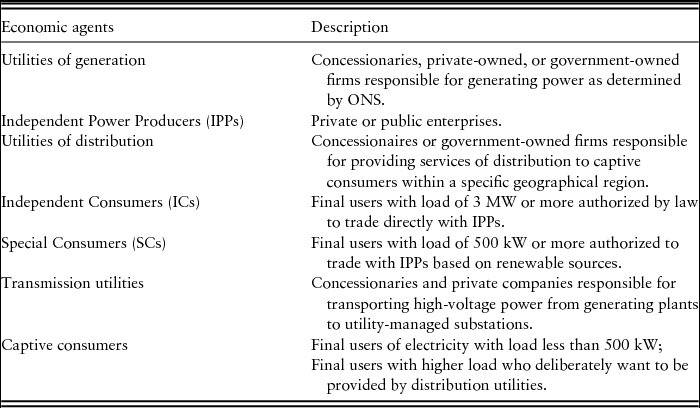
Law 9,427 also defined the entity of special consumers (SCs), a sub-category of ICs who are authorized to trade renewable electricity (e.g. small hydro, biomass, solar, and wind-based) directly with IPPs and to obtain ‘wire’ services from the local utility of distribution. This definition marks the beginning of the renewable electricity segment, the fastest-growing segment within Brazil's electricity sector (Castro et al., Reference Castro, Dantas, Leite and Brandão2008; Fava Neves and Conejero, Reference Fava Neves and Conejero2010). Captive consumers are also defined under this law as final consumers of power who must accept prices and conditions offered by local distributors.
The law 9,648 promulgated in 1998 established two other political bodies and introduced the first incentive to SCs. First, it formally established the Wholesale Electricity Agency (MAE, in Portuguese), an organization responsible for assisting wholesale transactions among players (i.e. utilities of generation, IPPs, utilities of distribution, ICs, and SCs). Second, the law assigned the task of coordinating network operations to the National System Operator (ONS, in Portuguese). Finally, it introduced the first incentive for SCs of power: a 50% discount in ‘wire’ service rates. Figure 2 summarizes the conditions before and after the NPP and ESR; and what factors led Brazil to adopt these tools of institutional change.
Summary of conditions and driving factors of institutional change.
Later institutional changes
Out of the ESR scope, a set of major changes were still promulgated to formalize the specification of players and the new market design. Minor adjustments also took place after the conclusion of the ESR in order to stimulate new entry, especially in the segment of renewable electricity.
In 2000, an amendment of law 9,074 decreased the minimum load (capacity installed/demand) required for ICs to trade directly with IPPs. Since then, ICs that have load of 3 MW or higher have been authorized to negotiate and buy electricity from IPPs regardless of the input used for generation. Medium-sized firms and hospitals, for instance, are compatible with these requirements and trade directly with IPPs.
Under the same amendment, the entity of SCs had specifications formalized: SCs are final consumers with load of 500 kW or more that are allowed to trade directly with IPPs as long as the input used to generate power is renewable. Shopping malls, galleries, and museums for instance can easily meet these technical requirements and be categorized as SCs. Final consumers with load equal or less than 500 kW (e.g. households, small-sized firms) are considered captive and must be supplied by local utilities. The law also re-states ANEEL regulation 264 and protects ICs and SCs rights by allowing them to accept prices and conditions offered by utilities of distribution rather than trading power themselves if they wish. Table 1 summarizes the definition of the economic agents in Brazil's electricity sector.
Categories of economic agents in Brazil's electricity sector
With the definition of economic agents in place, an additional rule was still necessary to complete the reformulation of institutions governing the electricity sector. The regulation 5,163 of 2004 played this role and formalized the marketplace as it currently is. The regulation has designed a dual-channel market in which utilities of distribution are enforced to purchase power through auctions, and the resulting mode of governance must be specification contract.Footnote 6 The same regulation has allowed ICs and SCs to coordinate transactions under a free channel using any governance strategy except spot markets. Also in 2004, CCEE (Chamber of Electrical Energy Commercialization) replaced MAEFootnote 7 with the mission of coordinating the dual-channel market defined through regulation 5,163.
Figure 3 above summarizes the organization of both regulated channel and free channel. It highlights transactions (thick arrows) between generating firms, utilities of distribution, and consumers of electricity. Dark-gray boxes represent wholesale markets whereas light-gray box corresponds to captive markets. Thin arrows represent the flow of electricity.
The dual-channel market of power.
Minor institutional adjustments were implemented thereafter in order to stimulate production and consumption of renewable electricity. The ANEEL regulation 281 expanded the discount in ‘wire’ service rates to IPPs: utilities of generation based on renewable sources that were established before 2004 receive a full exception in service rate. The law 10,438 of 2002 expanded the stimulus even further and partially released renewable-based IPPs established after 2004 from paying the whole ‘wire’ service rate. Still, the law 9,991 of 2000 eliminated the R&D tax that biomass-, wind-, and small-scale hydro-based generating firms had to pay.
It is noteworthy to highlight at this point in our analysis why North's framework (Reference North1990) provides little guidance to explain how the NPP, ESR, and later adjustments caused institutional change. Motivated by Brazil's economic situation in mid 1990s and by the liberal Constitution of 1988, these programs redefined market rules as well as rights and obligations of economic agents. Together they also defined an innovative mechanism to control for unilateral market power that utilities of distribution naturally carry. Yet, they empowered three regulatory agencies to guarantee operational efficiency, enforce market rules, and introduce competition in the generation segment; inexistent before 1995.
Putting in short, the institutional environment in which power transactions take place was fully redefined through these tools and later adjustments. That plausibly led economic agents to formulate new assumptions and beliefs regarding the functionality of the electricity sector. Thus, the second wave of institutional change can be interpreted as dramatic rather than marginal because, first, market rules were fundamentally changed, and second, players started to develop strategies based on a completely renovated set of assumptions and beliefs.
Between 2002 and 2003 a national-scale program took place to promote production of renewable electricity and solve the historical imbalance of supply and demand of power (that date from mid 1990s). The National Program of Incentives for Alternative Electricity Sources (Proinfa, in Portuguese) supported the construction of 63 small hydropower mills, 52 windmills, and 27 biomass-based generators with a total of 3,299 MW (2.7% of the current capacity of generation, 2013). Financial and marketing advantages were given to Proinfa investors: (i) financial support of up to 70% of the total investment cost; (ii) reduced interest rates; (iii) acquisition of production guaranteed; and (iv) minimum price guarantee for the following 20 years. With the end of Proinfa in 2003, the Brazilian Development Bank (BNDES, in Portuguese) created a new line of credit that has provided similar benefits, except for the acquisition and minimum price guarantees.
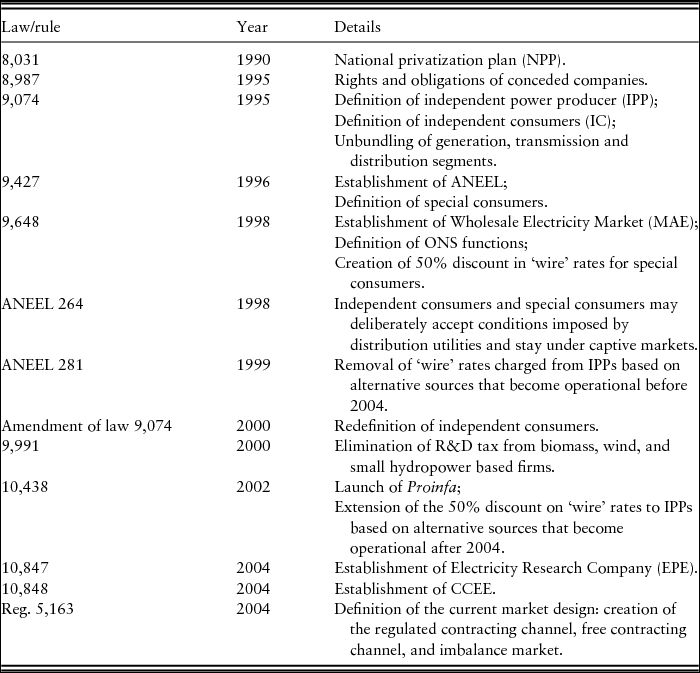
Table 2 summarizes the laws and amendments related to the electricity sector in Brazil. Next section discusses about the positive and negative aspects of the second institutional reform.
Laws and amendments related to the formal institutions of electricity in Brazil
5. Implications of the institutional changes
The NPP, ESR, and later adjustments have intensively modified the industry structure as well as the opportunity set for economic agents. For instance, incentives (i.e. discounts in ‘wire’ service and R&D rates, and Proinfa) have stimulated the entry of numerous generating plants. As of 2013, there are 387 small hydropower plants, 459 biomass-based plants, and 96 windmills in operation that were not generating power before the institutional change. These power plants are mostly classified as IPPs and participate with approximately 13% of the total capacity of generation in the country (ANEEL, 2013).
As result of the second institutional reform – toward market economy – the entry of renewable electricity generators has not only diversified the energy mix but also decreased oil dependence for electricity production in the country (Castro et al., Reference Castro, Dantas, Leite and Brandão2008). Previously, large-scale hydropower plants dominated the segment with more than 90% of the generation capacity. As of 2013, there are 178 large-scale hydropower plants in operation that account for approximately 67% of the total capacity installed (ANEEL, 2013). Besides, numbers indicate that diesel fuel-fired plants represent no more than 3% of the country's power supply. These results represent gains in economic development as they increase reliability of utility services by spreading power generation over different inputs.
Incentives along with the dual-market design also motivated the entry of free channel players. There are approximately 587 ICs and 967 SCs trading electricity through the free channel with demand of 982 TWh and 134 TWh per year, respectively (CCEE, 2013). It is noteworthy to remember that this segment of consumers was inexistent before 1995, and the only alternative available for final consumers of electricity was to accept prices and services offered by local utilities of distribution. This change is aligned with Shirley's condition for economic development in the sense that ICs and SCs are now free to choose the type of electricity to buy (e.g. renewable or conventional), and from whom to purchase. In Shirley's terms, ICs and SCs are no longer subjugated to prices and services of local distributors as they can freely choose certain attributes of the electricity as well as its provider.
Commentators argue, however, that free consumers (ICs and SCs) might be exposed to additional procurement costs as they need to identify counterparties, draft agreements and safeguards, monitor performance, and so on. On the other hand, industry experts reply that ‘incentives not only offset procurement cost but also create marginal benefits for consuming renewable electricity’ (Key informant interviews, 2010). If SCs can contract with an IPP at BRL$110 per MWhFootnote 8 (€33.74 per MWh), our estimate indicates that tariff rates might be 45% less expensive in the free channel when compared to the average tariff offered by local distributors to captive consumers in 2013.Footnote 9 We recognize, however, that this estimate is a mere representation of reality because the rates exercised in the free market channel are not publicly available.
In this sense the second institutional reform has created opportunities for some consumers to acquire more affordable electricity. By trading directly with power suppliers, ICs are able to alleviate unnecessary expenses that would be intrinsic to retail prices otherwise (i.e. margin of the utility and related transaction costs). This interpretation seems to be aligned with the existing NIE theory: economic development happens as institutional reforms lessen transaction costs and good prices.
To a lesser extent, the same is true for captive consumers (i.e. those with demand of 500 kW or less) who can only accept prices and conditions imposed by local utilities of distribution. Households, a likely type of captive consumer, would be harmed if utilities exercised unilateral market power in their conceded geographical area. To minimize the probability of such harm, the institutional reform has established enforcement organizations that play pivotal roles in regulating retail prices and services. Specifically, CCEE organizes competitive-oriented auctions through which utilities must acquire the largest share of their aggregate demand; ANEEL estimates profit margins based on retail prices and auction prices; ANEEL compares those margins across all operating utilities in order to ensure that profits fall within a plausible range; also, ANEEL imposes operation standards so the services offered to captive consumers maintain a certain level of quality and reliability.
Those regulatory activities certainly generate transaction costs to captive consumers that were absent before the NPP and ESR, tools for the dramatic institutional reform. However, one might plausibly argue that such costs are consistently inferior to the costs associated with power outages and blackouts frequently experienced across the country in 1990s. Besides, one would also contend that these transaction costs are lower than unilateral market prices that would have been charged to captive consumers if the NPP and ESR had privatized utilities without establishing regulatory agencies. Therefore, the institutional reform has positively affected performance of Brazil's electricity sector by lessening transaction cost to final consumers.
Interestingly enough, this latter implication appears to be aligned with structural reforms implemented in several other countries worldwide: ‘natural monopoly sectors are being reformed with governance structures that rely on unregulated markets and alternative regulatory mechanisms’ (Joskow, Reference Joskow1996: 342). It also corroborates with Shirley (Reference Shirley, Ménard and Shirley2005: 611) when she suggests that economic development occurs only if the institutional framework protects firms and citizens against expropriation of rents, and fosters exchange by lowering transaction costs.
In regard to domestic electricity prices, a direct comparison of tariffs before and after the dramatic institutional change cannot be performed. A series of tariff rates for residential consumers appears to be inexistent before 1995 as historical data are now collected and maintained by ANEEL, established in 1996. To the best of our knowledge electricity rates increased considerably fast after the privatization of public assets. However, it is important to recall that rates were kept low since the 50s to subsidize industrial growth and to fight inflation. Current residential tariffs might be compared across countries, nevertheless. While households paid BRL$391.62 per MWh (€148.34 per MWh) on average in 2013, households in the European Union paid on average GBP$159.4 per MWh (€194.39 per MWh) in the last 12 months reported. For British residents in particular, domestic electricity prices were on average GBP$159.1 per MWh (€194.02 per MWh) between July 2012 and June 2013.Footnote 10 At the very least, the second institutional reform seems to have created conditions for citizens to access electricity at less expensive rates than England rates, for instance.
Discussions follow an opposite path as one attempts to analyze the results of the first institutional change – toward market protection. Due to high levels of uncertainty and worldwide instability after the 1929 Great Depression, government's decision forced private utilities to exit Brazil's electricity sector. Sequentially, a sequence of economic shocks and poor financial strategies not only threw the country into recession but also resulted in frequent power outages in the 1990s. The first institutional reform therefore failed to protect firms and citizens against expropriation of rents and also failed to reduce transaction costs; the two necessary conditions for economic growth (Shirley, Reference Shirley, Ménard and Shirley2005).
6. Concluding remarks
The overall purpose of this article was to expand the empirical literature of institutional evolution. Specific objectives were: (i) to review the causes and implications of institutional reforms in a developing country; and (ii) to provide empirical evidence on how dramatic, rather than marginal, institutional change occurs.
Different from earlier studies, which have adeptly analyzed cases of marginal institutional increment, this article focused on a case where both marginal and dramatic institutional changes occurred. Brazil's electricity sector in particular experienced a marginal institutional change in the first moment and a dramatic institutional reform in the second – the first toward government centralization and the second toward market economy. A comprehensive review of historical facts indicates causes and means for institutional change that had not been observed in earlier work. Specifically, the first institutional change was motivated by ‘high levels of worldwide uncertainty’ whereas the second institutional reform was influenced by the directives of the 1988 Constitution, ‘economic recession’ (Brazil at stage of bankruptcy, debt crisis, and high inflation rates) and ‘reliability of utility services’. The latter two factors may be combined and classified as ‘economic performance’ in order to maintain the same degree of generality that scholars have used elsewhere.
Results also indicate that the first institutional change failed to satisfy two conditions for economic growth, as proposed by Shirley (Reference Shirley, Ménard and Shirley2005). The first set of institutional reforms not only forced private companies to exit Brazil – due to their inability to reach expected returns in a government controlled environment – but also exposed citizens to frequent power outages – forcing business to incur soaring transaction costs. Conversely, the second institutional reform re-established balance between supply and demand of power by introducing mechanisms for IPPs to operate, created a favorable environment for medium and large firms (those categorized as ICs and SCs) to acquire power at low costs, and permitted diversification of the supply mix through the entry of generating firms based on renewable sources. Thus, the second institutional reform appears to have met the necessary conditions (Shirley, Reference Shirley, Ménard and Shirley2005) for economic development.
There were a few limitations that we could not overcome. First, we recognize that the interviews with key informants provide little intuition about the institutional evolution of the electricity sector. The interviews were however crucial for our understanding of the economic relations and incentives in place in the current electricity sector. Second, one would like to estimate and compare social, economic, and environmental conditions before the institutional change to conditions thereafter. In that way the effects of the institutional change could be estimated, or at least, correlated to socio-economic growth and progress in environmental protection. As this article covered a reasonably long time horizon, data have proven to be absent or of difficult access. Specific employment data and greenhouse gas (GHG) emissions data for Brazil's electricity sector, for instance, appear not to be available. Statistics on electricity prices for residential consumers seems to begin in 1996, preventing us from comparing tariffs before and after the second institutional change.
Nevertheless, the analytical results of this paper might be aligned with other empirical studies in order to identify a pattern of historical facts and changes. Once a pattern is determined, a tentative hypothesis might guide us toward refining the current NIE theory. Grounded theory (Corbin and Strauss, Reference Corbin and Strauss1990; Peterson, Reference Peterson2011; Strauss and Corbin, Reference Strauss, Corbin, Denzin and Lincoln1994) might be used as the analytical framework to help us identify patterns and specific issues not yet considered in theoretical models.
Finally, we would like to add that further advances can only be obtained if we investigators enhance the body of empirical knowledge and consistently systematize historical evidence in order to create grounds for refining well-accepted economic theories. We hope we have succeeded in doing so.
Acknowledgements
An earlier version of this article was presented in Florence, Italy. We would like to thank for the comments and suggestions received in that occasion, as well as for those received from Dr. Geoffrey Hodgson, Chief Editor of this journal, and from the anonymous reviewers.