





Introduction
Historically, pyridate has been applied to various crops for controlling seedling broadleaf weeds and some sedges. Its effectiveness has been documented against weeds such as wild mustard (Sinapis arvensis L.), common lambsquarters (Chenopodium album L.), and pigweed (Amaranthus spp.) in crops of wheat (Triticum spp.), potato (Solanum tuberosum L.), mint (Mentha spp.), and chickpea (Cicer arietinum L.) (Belchim 2025). Early research by Roberts and Bond (Reference Roberts and Bond1983) highlighted pyridate’s effect on vegetable species and perennial ryegrass (Lolium perenne L.), showing no perennial ryegrass injury when pyridate was applied at rates below 1 kg ha−1 and transient discoloration at rates below 2 kg ha−1. In evaluating pyridate for sedge control, several studies were conducted across different cropping systems. Pyridate has shown varying levels of effectiveness against yellow nutsedge in peanut (Arachis hypogaea L.) crops. Three applications of pyridate alone controlled yellow nutsedge comparably to two applications of bentazon, though regrowth was observed after 3 to 4 wk depending on moisture conditions, without any enhancement from a crop oil concentrate (Grichar Reference Grichar1992). When combined with 2,4-DB and applied 3 wk postemergence, pyridate achieved 75% and 87% early-season control of yellow nutsedge at two different locations (Edenfield et al. Reference Edenfield, Colvin, Brecke, Shilling and McLean2001b). However, when applied postemergence without a surfactant, pyridate did not control yellow nutsedge as effectively as chlorimuron, imazaquin, or imazethapyr (Derr and Wilcut Reference Derr and Wilcut1993). In nursery crops, pyridate provided less control of purple nutsedge (Cyperus rotundus L.) than flurtamone (Derr and Wilcut Reference Derr and Wilcut1993).
Pyridate’s success in controlling sedges in agricultural crops suggests it has potential utility for managing troublesome sedges in cool-season turfgrass systems. Its unique mode of action could introduce new strategies to enhance current methods, especially given the challenges posed by sedges in turf management. Yellow nutsedge has been a persistent issue in turfgrass due to its prolific tuber production and rapid growth, which detracts from the uniformity and aesthetic appeal of turf, particularly in areas with poor drainage (Holm et al. Reference Holm, Plucknett, Pancho and Herberger1991). Similarly, false green kyllinga and green kyllinga (Kyllinga brevifolia Rottb.) have become widespread in golf course turf, with false green kyllinga becoming notably widespread due to its dense rhizome mats that mimic desirable turfgrass (Bryson et al. Reference Bryson, Carter, McCarty and Yelverton1997; McElroy et al. Reference McElroy, Yelverton, Burton and Brownie2005).
Currently, herbicides such as halosulfuron, imazosulfuron, and sulfentrazone are standard herbicides used for sedge management in cool-season turf. However, their effectiveness varies significantly. Halosulfuron, while effective against yellow nutsedge, does not provide consistent, long-term control of false green kyllinga (Blum et al. Reference Blum, Isgrigg and Yelverton2000). Imazosulfuron holds promise but requires precise timing and often sequential applications to achieve optimal control (Henry et al. Reference Henry, Sladek, Hephner and Cooper2012). Sulfentrazone can control sedges but is less effective against false green kyllinga, typically requiring higher doses or repeated applications for substantial impact (Gannon et al. Reference Gannon, Yelverton and Tredway2012). The variable performance of these herbicides, coupled with the emergence of resistance in some sedge populations (McCullough et al. Reference McCullough, Yu, McElroy, Chen, Zhang, Grey and Czarnota2016), underscores the need for alternative or combined management approaches.
Although pyridate has been widely used as a herbicide on various agricultural crops, its potential ability to control weeds in turfgrass systems has not been thoroughly investigated. Given its proven success in controlling yellow nutsedge in crops like peanut and corn, pyridate holds promise for managing weeds in turfgrass. Should it prove to be similarly effective against kyllinga species, pyridate could greatly improve sedge control options in the turfgrass industry. To explore this, we conducted research to identify the optimal pyridate dose for controlling false green kyllinga and yellow nutsedge in maintained turfgrass, while also comparing the performance of pyridate alone or combined with sulfentrazone against other conventional herbicides in terms of sedge control and turfgrass tolerance.
Materials and Methods
Low-Dose Pyridate for False Green Kyllinga Control
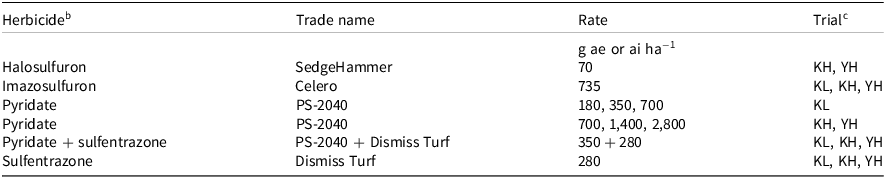
Two field experiments were conducted in 2022 and 2023 to evaluate the tolerance of perennial ryegrass or perennial ryegrass + tall fescue turf to multiple postemergence-applied herbicides and their efficacy in controlling false green kyllinga (Table 1). The study was designed as a randomized complete block with four spatial replications across two unique sites. Turf varieties and soil edaphic variables are listed in Table 1. Each plot measured 1 m × 1.8 m. Pyridate was applied at 180, 350, or 700 g ha−1, and its effects were compared with those of pyridate + sulfentrazone, imazosulfuron, and sulfentrazone using products and rates given in Table 2. All treatments included a nonionic surfactant (Induce; Helena Chemical Company, Collierville, TN) applied at 250 mL L−1 (Table 2). All herbicides were applied with a CO2-pressurized hooded boom sprayer equipped with two 6503 flat-fan nozzles (TeeJet Technologies, Glendale Heights, IL), spaced 36 cm apart, calibrated to deliver 281 L ha−1 of spray solution at 4.8 km h−1. False green kyllinga consisted of a natural population having infested sites for at least 10 yr and plants were fully green and growing to comprise 35% to 60% canopy cover at study initiation depending on the site. The experiment sites were mowed regularly at heights shown in Table 1 and at 3-d intervals for heights ≤1.8 cm and weekly for heights ≥5.6 cm.
Experimental site characterization and herbicide application dates to evaluate false green kyllinga and yellow nutsedge control. a

Table 1. Long description
The table presents data on experimental sites, including trial identifiers, site types, application dates, coordinates, turf varieties, mow heights, soil types, soil pH, soil organic matter percentages, and weed cover percentages. It consists of eight rows and ten columns. Each row provides specific details for different trials. For example, Trial KL1 is a PR fairway with an application date of August 26, 2022, located at coordinates 37.233268 N, 80.436653 W, using Prosport turf variety, with a mow height of 1.5 centimeters, soil type S2, soil pH of 6.4, soil organic matter of 3.4 percent, and weed cover of 35 percent. Similar detailed information is provided for other trials such as KL2, KH1, KH2, YH1, and YH2, each with varying site types, application dates, coordinates, turf varieties, mow heights, soil types, soil pH, soil organic matter percentages, and weed cover percentages.
a Abbreviations: KB, Kentucky bluegrass; OM, organic matter; PR, perennial ryegrass; TF, tall fescue.
b Trial descriptions: KL, low-dose pyridate studies to evaluate false green kyllinga control; KH, high-dose pyridate studies to evaluate false green kyllinga control; YH, high-dose pyridate studies to evaluate yellow nutsedge control.
c Soil taxonomy: S1, Duffield silt loam (fine-loamy, mixed, active, mesic, Ultic Hapludalfs)–Ernest silt loam (fine-loamy, mixed, superactive, mesic Aquic Fragiudults) complex; S2, Groseclose urban land complex loam (clayey, mixed, mesic Typic Hapludults); S3, Wheeling sandy loam (fine-loamy, mixed, active, mesic Typic Fragiudalfs).
Herbicides evaluated in three trials. a

Table 2. Long description
A table with four columns and six rows, comparing herbicides, trade names, rates, and trials. The columns are labeled Herbicide, Trade name, Rate, and Trial. The rows list different herbicides, their corresponding trade names, application rates in g ae or ai ha⁻¹, and the trials in which they were evaluated. Row 1: Halosulfuron, SedgeHammer, 70, KH, YH. Row 2: Imazosulfuron, Celero, 735, KL, KH, YH. Row 3: Pyridate, PS-2040, 180, 350, 700, KL. Row 4: Pyridate, PS-2040, 700, 1,400, 2,800, KH, YH. Row 5: Pyridate + sulfentrazone, PS-2040 + Dismiss Turf, 350 + 280, KL, KH, YH. Row 6: Sulfentrazone, Dismiss Turf, 280, KL, KH, YH.
a All treatments were applied through a conventional CO₂-pressurized backpack sprayer delivering medium-sized droplets (226 to 325 µm). A nonionic surfactant (Induce; Helena Chemical Company, Collierville, TN) was included with all treatments at 250 mL L−1.
b Herbicide manufacturers: SedgeHammer, Gowan Company, Yuma, AZ; Celero, Valent USA Corp., Walnut Creek, CA; PS-2040, Albaugh LLC, Ankeny, IA; Dismiss Turf, FMC Corp., Philadelphia, PA.
c Trials were each repeated at two unique sites separated in space and/or time and included: KL, kyllinga control with low-dose pyridate; KH, kyllinga control with high-dose pyridate; YH, yellow nutsedge control with high-dose pyridate.
False green kyllinga green cover was assessed at 28 and 42 d after treatment (DAT) by digital image analysis. In each plot image, all false green kyllinga tissue was manually desaturated, and relative pixel counts of weedy tissue versus total plot pixels, determined by hue/saturation thresholds using TurfAnalyzer software (Green Research Services, Fayetteville, AR), were converted to percentages. Turf injury and false green kyllinga control were visually assessed on a scale of 0% to 100%, with 0% representing no control or no injury and 100% representing complete plant death. Data were assessed at 0, 7, 14, 28, and 42 DAT. All response variables were subjected to ANOVA using the GLM procedure with SAS software (v. 9.3; SAS Institute, Cary, NC). Treatment was considered a fixed effect, while experimental run and block were treated as random effects. The mean square of the treatment effect was tested for all assessed parameters using the mean square associated with the treatment by experimental run interaction (McIntosh Reference McIntosh1983). Means were separated using a Fisher protected LSD test (α = 0.05). Means were presented separately by experimental run if the treatment by experimental run interactions were significant, otherwise, means were pooled over experimental runs.
High-Dose Pyridate for False Green Kyllinga and Yellow Nutsedge Control
Four field experiments were conducted (two for each weed species) to assess weed control and turf injury to selected treatments. Sites were separated by time and space (Table 1). At both sites with false green kyllinga, the response of perennial ryegrass and Kentucky bluegrass (Poa pratensis L.) was also evaluated (Table 1). At the two sites where yellow nutsedge was assessed, tall fescue response to treatment was also evaluated. The experimental design was a randomized complete block with four spatial replications and two temporal/spatial runs for each species. All study parameters were the same as the low-dose pyridate study, except pyridate doses were increased to 700, 1,400, and 2,800 g ha−1; and halosulfuron was also included as a comparison in addition to pyridate + sulfentrazone, imazosulfuron, and sulfentrazone (Table 2). Data were collected and analyzed similarly to the low-dose study because the experimental design and response variables are similar for both studies.
Results and Discussion
Low-Dose Pyridate for False Green Kyllinga Control
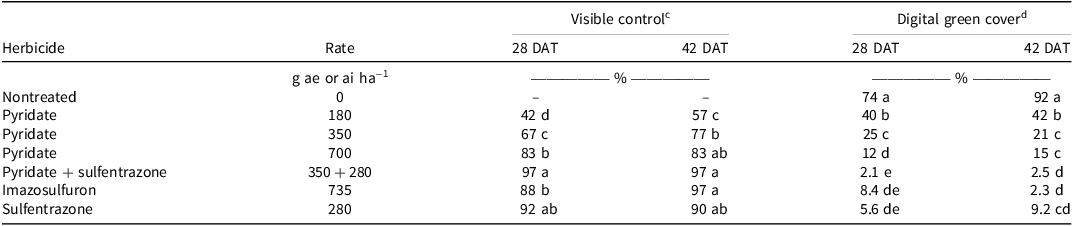
The treatment effect was significant for perennial ryegrass injury at 7 DAT (P ≤ 0.0001), and false green kyllinga visible control (P = 0.0107) and digitally assessed green cover (P = 0.0312) at 28 and 42 DAT. These effects did not interact with trial (P = 0.1151) (Table 3). Perennial ryegrass injury was estimated to be 16% by applications of pyridate + sulfentrazone and by 8% with applications of sulfentrazone (data not shown). All other treatments did not cause injury to perennial ryegrass, and injury was not observed on or after 14 DAT (data not shown). Pyridate controlled false green kyllinga more effectively with increasing dose, achieving 83% control when applied at 700 g ha−1 (Table 3). When mixed with sulfentrazone, pyridate provided 97% control of false green kyllinga, which was better than pyridate alone and imazosulfuron when assessed at 28 DAT. At 42 DAT, pyridate applied at 700 g ha−1 provided 83% control of false green kyllinga, a result that was equivalent to that of pyridate + sulfentrazone, imazosulfuron, and sulfentrazone (Table 3). Digitally assessed false green kyllinga cover was 74% and 92% in nontreated plots at 28 and 42 DAT, respectively (Table 3). At 42 DAT, only in plots that received pyridate + sulfentrazone was false green kyllinga cover reduced to levels that were equivalent to those of imazosulfuron and sulfentrazone.
Visible false green kyllinga control and digitally assessed false green kyllinga green cover as influenced by low pyridate doses compared to pyridate + sulfentrazone, imazosulfuron and sulfentrazone at 28 and 42 d after treatment averaged over field sites from 2022 and 2023. a, b

Table 3. Long description
The table presents data on the effects of various herbicide treatments on visible control and digital green cover of false green kyllinga at 28 and 42 days after treatment (DAT). It includes columns for herbicide names, application rates, visible control percentages at 28 and 42 DAT, and digital green cover percentages at 28 and 42 DAT. The table has 6 rows and 6 columns. Row 1: Nontreated, 0, 42, 57, 74, 92. Row 2: Pyridate, 180, 42, 57, 40, 42. Row 3: Pyridate, 350, 67, 77, 25, 21. Row 4: Pyridate, 700, 83, 83, 12, 15. Row 5: Pyridate + sulfentrazone, 350 + 280, 97, 97, 2.1, 2.5. Row 6: Imazosulfuron, 735, 88, 97, 8.4, 2.3. Row 7: Sulfentrazone, 280, 92, 90, 5.6, 9.2.
a Abbreviation: DAT, days after initial treatment.
b Means followed by the same letter within each column are not statistically different based on a Fisher protected LSD test (α = 0.05).
c Visible control is based on a visually estimated reduction in perceived healthy weed tissue.
d Digital green cover is based on the percentage pixel count of weeds, which were manually desaturated, versus surrounding plot area.
When applied alone with a crop oil concentrate adjuvant, pyridate (530 g ha−1) applied once controlled yellow nutsedge by 42% at 20 DAT, and when it was applied twice, yellow nutsedge control increased to 78% at 56 d after the initial treatment (Grichar Reference Grichar1992). In Georgia in an experiment with a peanut crop, pyridate (1,070 g ha−1) combined with 2,4-DB (230 g ha−1) provided 87% control of yellow nutsedge at 28 DAT. In ornamental plantings, yellow nutsedge shoot weight was reduced by 81% to 82% when pyridate was applied at either 1,000 or 2,000 g−1, but control of purple nutsedge was not more than 21% (Derr and Wilcut Reference Derr and Wilcut1993). Results from the current study and previous research on yellow nutsedge control suggested that higher doses of pyridate are needed to control it.
High-Dose Pyridate for False Green Kyllinga and Yellow Nutsedge Control
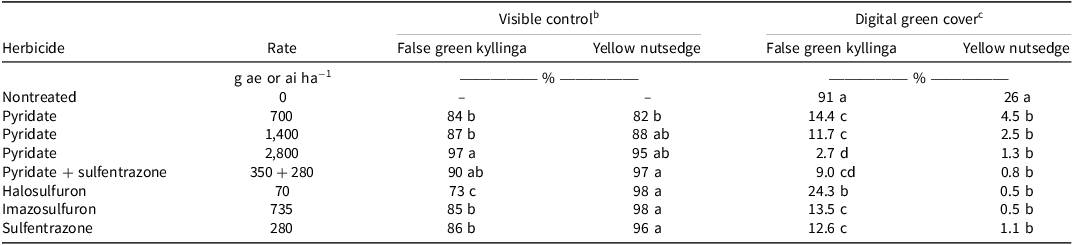
The treatment effect was significant for tall fescue injury at 7 DAT (P = 0.0007), perennial ryegrass + Kentucky bluegrass turf injury (P ≤ 0.0001), and control or digitally assessed green cover of false green kyllinga (P = 0.0227) and yellow nutsedge (P = 0.0141) at 42 DAT, and these effects were not dependent on trial (P ≥ 0.2681). Pyridate applied at 2,800 g ha−1 resulted in 37% injury to tall fescue and 31% injury to perennial ryegrass + Kentucky bluegrass when assessed at 7 DAT (data not shown). Pyridate at 1,400 g ha−1, pyridate + sulfentrazone, and sulfentrazone injured both turf species by 9% to 16%, which was less than injury that occurred with pyridate at 2,800 g ha−1 (data not shown). Similar responses were reported by Corbett et al. (Reference Corbett, Crawford, Godara and Askew2026), that pyridate applied at 1,400 g ha−1 resulted in 14% injury to tall fescue, and 13% injury to perennial ryegrass. Turf was not injured by any other treatment, and no injury was observed beyond 14 DAT (data not shown). Pyridate at 700 g ha⁻1 controlled 84% of false green kyllinga, which was equivalent to that of imazosulfuron and sulfentrazone and 11% more than that of halosulfuron (Table 4). The highest dose of pyridate controlled 97% of false green kyllinga, more than the standard herbicides typically used (Table 4). Pyridate at 700 g ha⁻1 controlled yellow nutsedge less effectively than the standard herbicides and the pyridate + sulfentrazone mixture (Table 4). Pyridate at 1,400 g ha⁻1 or greater doses controlled yellow nutsedge by at least 88% and was equivalent to all standard herbicides. Green cover of false green kyllinga was 91% in nontreated plots at 42 DAT and was reduced to 3% by the high dose of pyridate and to 9% by the pyridate + sulfentrazone mixture (Table 4). The high dose of pyridate reduced false green kyllinga cover more than any other treatment. Yellow nutsedge green cover was 26% in nontreated plots at 42 DAT and was reduced by all treatments to <5% (Table 4).
Visible control and digitally assessed green cover of false green kyllinga and yellow nutsedge as influenced by high pyridate doses compared to pyridate + sulfentrazone, halosulfuron, imazosulfuron, and sulfentrazone at 42 d after treatment averaged over two field trials for each species that were separated in space and time during the 2024 growing season. a

Table 4. Long description
The table presents data on the visible control and digital green cover of false green kyllinga and yellow nutsedge influenced by various herbicides. It has 8 rows and 5 columns. The columns are labeled ‘Herbicide’, ‘Rate’, ‘Visible control false green kyllinga’, ‘Visible control yellow nutsedge’, ‘Digital green cover false green kyllinga’, and ‘Digital green cover yellow nutsedge’. The rows list different herbicides and their rates, followed by the visible control percentages for false green kyllinga and yellow nutsedge, and the digital green cover percentages for the same species. Notable trends include the high visible control and low digital green cover of false green kyllinga and yellow nutsedge with higher doses of pyridate and combinations with sulfentrazone.
a Means followed by the same letter within each column are not statistically different based on a Fisher protected LSD test (α = 0.05).
b Visible control is based on a visually estimated reduction in perceived healthy weed tissue.
c Digital green cover is based on the percentage pixel count of weeds, which were manually desaturated, versus surrounding plot area.
The levels of yellow nutsedge control achieved when pyridate was applied at rates of 700 to 2,800 g ha⁻1 in these studies are similar to those reported in studies with peanut (Edenfield et al. Reference Edenfield, Colvin, Brecke, Shilling and McLean2001a; Grichar Reference Grichar1992) and nursery crops (Derr and Wilcut Reference Derr and Wilcut1993). False green kyllinga was controlled by higher rates of pyridate more than that of halosulfuron, imazosulfuron, and sulfentrazone. The levels of false green kyllinga control by halosulfuron, imazosulfuron, and sulfentrazone are comparable to those previously reported. Imazosulfuron provides more effective control of false green kyllinga than halosulfuron (Elmore and Tuck Reference Elmore and Tuck2022; Elmore et al. Reference Elmore, Patton, Tuck, Murphy and Carleo2019), but this disparity was negated by interseeding that occurred after treatment in one study (Elmore and Tuck Reference Elmore and Tuck2022). Halosulfuron applied at 70 g ha⁻1 is typically more effective than sulfentrazone (McElroy et al. Reference McElroy, Yelverton, Burton and Brownie2005), but both herbicides tend to be less effective, and their efficacy is inconsistent when applied once (Li et al. Reference Li, Sousek, Reicher and Gaussoin2021; McElroy et al. Reference McElroy, Yelverton, Burton and Brownie2005). As observed with treatments involving halosulfuron, imazosulfuron, and sulfentrazone (Elmore et al. Reference Elmore, Patton, Tuck, Murphy and Carleo2019; Li et al. Reference Li, Sousek, Reicher and Gaussoin2021; McElroy et al. Reference McElroy, Yelverton, Burton and Brownie2005), the control of yellow nutsedge or false green kyllinga with pyridate is expected to diminish over time, similar to the decline in yellow nutsedge control noted in peanut studies (Derr and Wilcut Reference Derr and Wilcut1993; Edenfield et al. Reference Edenfield, Colvin, Brecke, Shilling and McLean2001b; Grichar Reference Grichar1992).
The study demonstrated that pyridate is effective agent for controlling false green kyllinga and yellow nutsedge in turfgrass, with higher doses providing superior control compared to herbicides such as halosulfuron, imazosulfuron, and sulfentrazone. However, the highest dose of 2,800 g ha⁻1 also caused transient injury to tall fescue and perennial ryegrass + Kentucky bluegrass turf. Combining pyridate with sulfentrazone further enhanced control, particularly of false green kyllinga. These findings represent the first report of pyridate’s effectiveness against false green kyllinga, suggesting its potential use in turf management but with consideration for application rates to minimize turf damage.
Practical Implications
Pyridate applied at rates ≥700 g ha−1 effectively controlled false green kyllinga and yellow nutsedge in cool-season turfgrass and performed comparably to the standard herbicides used to control sedges. Control improved when the rate increased and was further enhanced when pyridate was tank mixed with sulfentrazone, particularly against false green kyllinga. Transient turf injury occurred at the highest rate (2,800 g ha−1), indicating that moderate application rates may optimize weed control while minimizing turfgrass damage.
Pyridate, a photosystem II inhibitor, acts at a different binding site than other photosystem II inhibitors and provides an additional option for turfgrass managers to diversify sedge control efforts while retaining the same mode of action. With sedges ranking among the most common and troublesome weeds in turfgrass, expanding control options remain valuable for turfgrass managers. Pyridate applied alone or in combination with sulfentrazone would allow turfgrass managers to effectively manage these weeds.
Given that pyridate is registered to control sedge in production crops at approximately 1,000 g ha−1, a range of 700 to 1,400 g ha−1 may be an appropriate dose for use on turfgrass based on turf safety and weed control observed in these studies.
Acknowledgments
We thank Suzannah Hale for technical assistance and superintendents Jason Ratcliff and Greg Caldwell for facilities support.
Funding
This research was funded by Albaugh, LLC.
Competing Interests
Bret Corbett is employed by Albaugh, LLC, and was involved in the initial design of these experiments and data interpretation. The experiments were all conducted independently at Virginia Tech.


 Open access

