Introduction
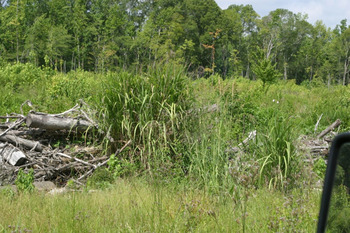
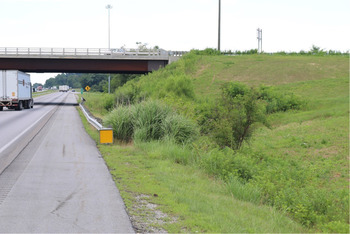
There are mounting concerns about the invasiveness of the non-native, warm-season, perennial grass giant miscanthus. In recent years, giant miscanthus has attracted attention as a promising biofuel crop because of its biomass production, which is twice that of the native switchgrass (Panicum virgatum L.) (Khanna et al. Reference Khanna, Dhungana and Clifton-Brown2008) and 2.5 times the amount of ethanol produced per hectare of corn (Zea mays L.) (Anonymous 2008). High yield combined with other plant characteristics, such as cold temperature tolerance, low fertility requirements, annual harvest, low water needs, and no known insect or pathogen pests makes giant miscanthus a preferred potential biomass source (Pyter et al. Reference Pyter, Voigt, Dohleman and Long2007; Scurlock Reference Scurlock1999). However, infestations of giant miscanthus have developed outside cultivated fields and have displaced desirable vegetation (Figures 1 and 2).
Giant miscanthus plant that has escaped cultivation at a Winston County test site, Louisville, MS, 2016.

Miscanthus escapes along Interstate 26 north near Hendersonville, NC, July 2016.

Giant miscanthus is considered sterile; therefore, the Weed Risk Assessment protocols for US Department of Agriculture Animal and Plant Health Inspection Service score giant miscanthus in the low category for invasiveness potential. However, Nielsen (Reference Nielsen1987) found that, under some circumstances, giant miscanthus does produce viable seeds. Other species considered sterile have been documented to spread by seed or rhizome fragmentation, such as cordgrass [Spartina × townsendii H. Groves & J. Groves (pro sp.) [alterniflora × maritima]] and giant reed (Arundo donax L.) (Long et al. Reference Long, Dohleman, Jones, Clifton-Brown and Jorgensen2007; Mack Reference Mack2008). Thus, low seed production or demonstrated sterility may not be adequate to prevent spread under a broad range of environmental conditions. Most research on giant miscanthus has focused on herbicide tolerance for stand establishment and weed control during production, rather than stand eradication for alternative land uses. To circumvent potential problems of invasiveness, more research is needed on control options for giant miscanthus.
In a greenhouse study, Anderson et al. (Reference Anderson, Voigt, Bollero and Hager2011) determined that immature giant miscanthus shoot dry weight decreased 59% when treated with an application of glyphosate at 3.6 kg ha−1. However, in a separate field study, the same researchers found no reduction of shoot numbers when treated with a single application of glyphosate at 2.5 kg ae ha−1 in the spring or fall. They theorized glyphosate did not adequately translocate throughout the entire rhizome mass and speculated death of aboveground growth stimulated buds below ground to break dormancy.
Generally, systemic herbicide application timing to control perennial plants is considered best when maximum basipetal translocation of carbohydrates occurs (Banks et al. Reference Banks, Kirby and Santelmann1977; Mitra and Bhowmik Reference Mitra and Bhowmik1999). After flowering, perennial plants begin translocating carbohydrates into the roots and rhizomes; therefore, this is considered the ideal time to maximize systemic herbicide movement into those plant parts. Giant miscanthus produces the highest quantity of aboveground biomass by late summer or early fall. During this time, carbohydrates, along with the herbicides, are translocated to the rhizomes. However, Anderson et al. (Reference Anderson, Voigt, Bollero and Hager2011) did not achieve adequate control of giant miscanthus with glyphosate applied in fall or spring.
Although giant miscanthus rhizomes occur mainly in the top 10 cm of soil (Harvey and Hutchens Reference Harvey, Hutchens, Chartier, Beenackers and Grassi1995), tillage alone is not adequate for termination. Anderson et al. (Reference Anderson, Voigt, Bollero and Hager2011) reported tillage alone resulted in more shoots than in plots that were tilled and sprayed with one or two applications of glyphosate at 2.5 kg ae ha−1. One application of glyphosate in combination with shallow tillage reduced giant miscanthus shoot numbers by 38%, and two glyphosate applications resulted in 67% reduction. The authors concluded multiple applications of glyphosate plus tillage over a growing season, if not several growing seasons, will be necessary to eradicate a mature stand of giant miscanthus.
While evaluating various POST herbicide treatments for giant miscanthus production, Everman et al. (Reference Everman, Lindsey, Henry, Henry, Glaspie, Phillips and McKenney2011) determined the 4-hydroxyphenylpyruvate dioxygenase inhibitors, growth regulators, and photosystem II–inhibitor herbicides caused less than 3% visible injury to giant miscanthus. In addition, giant miscanthus has demonstrated tolerance to PRE and POST herbicide applications of carfentrazone and halosulfuron (Smith et al. Reference Smith, Askew, Hagood and Barney2015). When evaluating rhizome-propagated giant miscanthus under greenhouse conditions, Everman et al. (Reference Everman, Lindsey, Henry, Henry, Glaspie, Phillips and McKenney2011) and Smith et al. (Reference Smith, Askew, Hagood and Barney2015) reported nicosulfuron applied POST at 35 and 31.5 g ai ha−1 resulted in 28% and 35% injury, respectively.
Numerous invasive plants with agronomic or horticultural origins have escaped cultivation, become naturalized, expanded their range, and subsequently had negative environmental impacts on native plants and animals (Mack Reference Mack2000). With limited knowledge about effective termination of giant miscanthus stands, additional research is needed before giant miscanthus is used for biomass production. Therefore, the objective of this research was to determine the effectiveness of herbicide treatments and application timing on the termination of giant miscanthus. Identifying effective herbicides to control or terminate giant miscanthus can help minimize the potential for it to become a problematic plant.
Materials and Methods
Field experiments were conducted on field populations of giant miscanthus near Louisville, MS (33.11°N, 89.01°W), in 2013 and near Starkville, MS (33.39°N, 88.74°W), in 2014. The Louisville experiment was conducted on a 3-yr-old stand of giant miscanthus ‘Nagara.’ The soil was an Ora fine sandy loam. Two field sites adjacent to one another received herbicide applications. One site received herbicide applications on June 25, 2013, and the other on September 25, 2013. The Louisville experiment consisted of 21 herbicide treatments. Treatments included glyphosate at 1.3, 2.2, 4.5, and 7.3 kg ae ha−1; imazapyr at 56, 280, and 560 g ae ha−1; clethodim at 56 and 280 g ai ha−1; fluazifop at 426 g ai ha−1; metsulfuron at 14 and 84 g ai ha−1; imazapic at 202 g ai ha−1; hexazinone at 560 g and 1.12 kg ai ha−1; monosodium methyl arsenate at 3.7 kg ai ha−1; diuron at 2.2 kg ai ha−1; sulfosulfuron at 79 g ai ha−1; sulfometuron at 101 g ai ha−1; metsulfuron plus nicosulfuron at 11 plus 56 g ai ha−1; and quinclorac at 841 g ai ha−1. A nontreated plot was included for comparison.
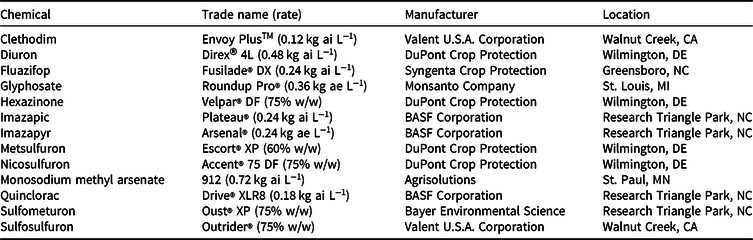
In 2014, treatments were repeated near Starkville, MS, on a 4-yr-old stand of giant miscanthus ‘Freedom.’ Soil at this site was a Freestone fine sandy loam and Kipling silty clay loam. The number of treatments was reduced in 2014 due to lack of giant miscanthus control observed at Louisville in 2013. Two field sites adjacent to one another received herbicide applications. One site received herbicide applications on July 11, 2014, and the other on September 26, 2014. The Starkville experiment consisted of 13 herbicide treatments. Treatments included glyphosate at 1.3, 2.2, 4.5, and 7.3 kg ae ha−1; imazapyr at 56, 280, and 560 g ae ha−1; clethodim at 56 and 280 g ai ha−1; fluazifop at 426 g ai ha−1; imazapic at 202 g ai ha−1; hexazinone at 1.12 kg ai ha−1; plus a combination of glyphosate plus fluazifop at 2.8 kg ae ha−1 plus 426 g ai ha−1. A nontreated plot was included for comparison. In all, 22 herbicide treatments were evaluated for giant miscanthus control (Table 1).
Herbicide information for all products used in this experiment.

Approximately 1 mo before herbicide applications, each field site was mowed to a stubble height of 10 cm and left to decay. For each field site, giant miscanthus regrew to a height of 60 cm before herbicides were applied. All herbicide treatments were applied with a CO2-pressurized backpack sprayer equipped with four Teejet 8002VS flat fan nozzles (Spraying Systems Co., Wheaton, IL) that delivered 186 L ha−1 at 138 kPa.
Qualitative measurements were taken in the form of visible control 12 mo after treatment (MAT). Plots were rated on a scale of 0 to 100, where 0 indicated no control and 100 indicated complete control of biomass, based on nontreated plots. Quantitative measurements were also taken in the form of biomass samples, which were harvested from a 0.3 m2 randomly selected area of each plot 12 MAT with a reciprocating saw at the soil surface. Biomass samples were placed in a mesh bag and dried at 58 C for 5 d, after which biomass samples were weighed.
The experimental design was a modified split plot with application timing as the whole plot. The subplots were herbicide treatments in a randomized complete block with four replications, in 3- by 6-m plots. Data were not compared across sites, because of differences in treatments. Data for visible estimates of control and biomass were subjected to ANOVA using the PROC GLIMMIX procedure in SAS version 9.4 (SAS Institute Inc., Cary, NC). Dry weights were logarithmic transformed (base 10) for analysis. All means were separated with the LSMEANS and PDIFF option in SAS (α = 0.05). Type III tests were used to test all possible fixed effects or interactions among the fixed effects. Replications (nested within application timing) were treated as a random factor, whereas application timing, herbicide, and herbicide rate were treated as fixed factors. Nontransformed biomass dry-weight data are presented.
Results and Discussion
Louisville Site
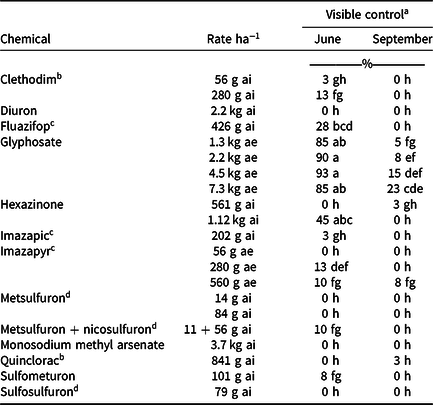
Visible control ratings taken 12 MAT revealed a significant interaction between herbicide treatment and application timing (P < 0.0001) (Table 2). Glyphosate applied in June provided 85%, 90%, 93%, and 85% visible control at 1.3, 2.2, 4.5, and 7.3 kg ae ha−1, respectively. However, only 8%, 15%, 23%, and 5% visible control was obtained with September applications at the same concentrations, respectively. All other treatments applied in September were less effective than June applications: visible control was no greater than 8%. Hexazinone at 1.12 kg ai ha−1 applied in June provided 45% visible control 12 MAT. All other herbicide treatments applied in June provided 28% or less giant miscanthus visible control.
Giant miscanthus visible control as affected by chemical treatments 12 mo after treatment in a 2013 field study at Louisville, MS.
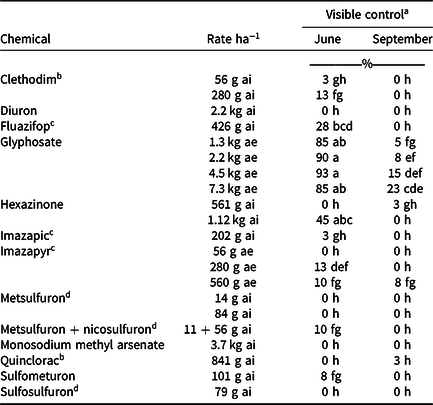
a Means followed by same letter are not significantly different from each other at a 0.05 significance level.
b Treatment applied with a crop oil concentrate at 2.3 L/ha−1.
c Treatment applied with a nonionic surfactant at 0.25% vol/vol.
d Treatment applied with a nonionic surfactant at 0.5% vol/vol.
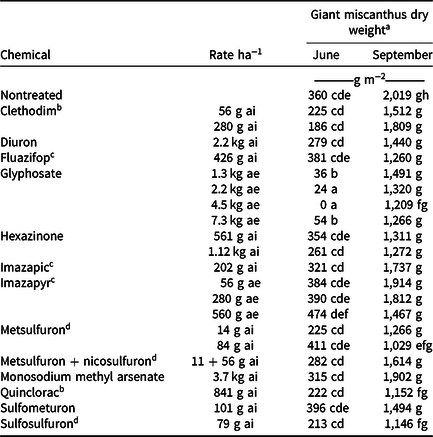
Twelve MAT, dry weights revealed a significant interaction between herbicide treatment and application timing (P < 0.0001) (Table 3). Glyphosate at 1.3, 2.2, 4.5, and 7.3 kg ae ha−1 applied in June produced 36, 24, 0, and 54 g m−2 of dry weight, respectively (P < 0.0001). From the June application timing, nontreated plots produced 360 g m−2. Treatments applied in September were not consistent with those applied in June. For fall applications, glyphosate applied at 4.5 kg ae ha−1 reduced giant miscanthus shoot biomass only 40%, compared to a 43% reduction by quinclorac at 841 g ai ha−1 or 79 g ai ha−1 sulfosulfuron. Compared with the nontreated control, which produced 2,019 g m−2, metsulfuron applied at 14 g ai ha−1 produced 1,029 g m−2 of dry weight, which provided the highest level of giant miscanthus reduction among September applications, at 49%.
Giant miscanthus dry weight as affected by chemical treatments 12 mo after treatment in a 2013 field study at Louisville, MS.
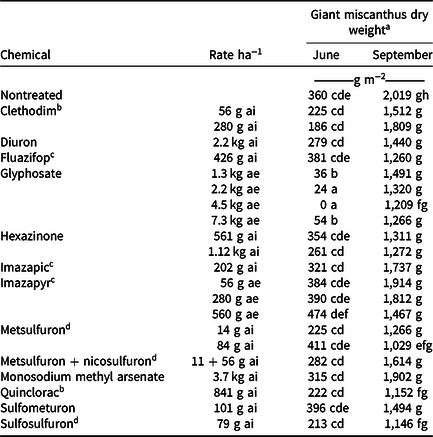
a Means followed by same letter are not significantly different from each other at 0.05 significance level.
b Treatment applied with a crop oil concentrate at 2.3 L ha−1.
c Treatment applied with a nonionic surfactant at 0.25% vol/vol.
d Treatment applied with a nonionic surfactant at 0.5% vol/vol−1.
In a field study of giant miscanthus, Anderson et al. (Reference Anderson, Voigt, Bollero and Hager2011) found no differences between the number of shoots in control plots and in each of the plots that received a single application of glyphosate at 2.5 kg ae ha−1 in the spring or fall. Based on biomass dry weights in this study, giant miscanthus reduction is highest when an application of glyphosate at 2.2 or more kg ae ha−1 is applied in summer; September applications failed to provide acceptable biomass reduction in this experiment.
Starkville Site
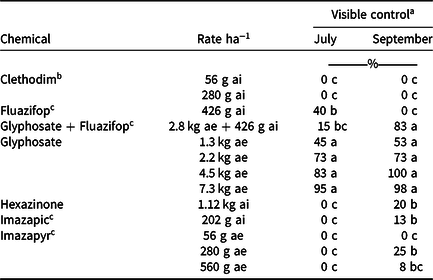
Visible control ratings taken 12 MAT revealed a significant interaction between herbicide treatment and application timing (P = 0.0008) (Table 4). Visible control with glyphosate applied in July was estimated at 45%, 73%, 83%, and 95% at rates of 1.3, 2.2, 4.5, and 7.3 kg ae ha−1, respectively. Based on visible ratings, similar results were observed from treatments applied in September, with 53%, 73%, 100%, and 98% control, respectively. Glyphosate plus fluazifop provided only 15% visible control when applied in July, compared with 83% control when that combination was applied in September. No other treatments applied in July or September provided visible control greater than 40% by 12 MAT.
Giant miscanthus visible control as affected by chemical treatments 12 mo after treatment in a 2014 field study near Starkville, MS.

a Means followed by same letter are not significantly different from each other at a 0.05 significance level.
b Treatment applied with a crop oil concentrate at 2.3 L/ha−1.
c Treatment applied with a nonionic surfactant at 0.25% vol/vol.
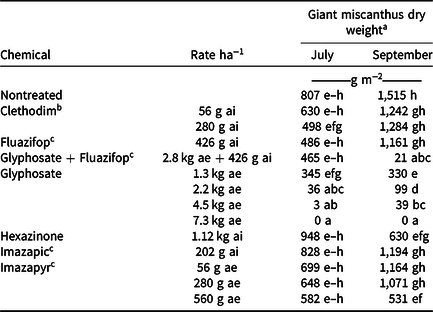
Twelve MAT, dry weights revealed a significant interaction between herbicide treatment and application timing (P > 0.0001) (Table 5). Glyphosate applied at 7.3, 4.5, 2.2, and 1.3 kg ae ha−1 in July produced 0, 3, 36, and 345 g m−2 of dry weight, respectively. From the July application timing, nontreated plots produced 807 g m−2. Unlike results from the Louisville site on ‘Nagara’ giant miscanthus in 2013, treatments applied in July on ‘Freedom’ giant miscanthus near Starkville were consistent with those applied in September, with the exception of glyphosate plus fluazifop at 2.8 kg ae ha−1 plus 426 g ai ha−1, which produced 465 g m−2 dry weight when applied in the summer but 21 g m−2 dry weight when applied in the fall. Fall glyphosate treatments achieved between 78% and 100% reduction. Although Anderson et al. (Reference Anderson, Voigt, Bollero and Hager2011) reported adequate control of giant miscanthus was not achieved with glyphosate during the fall or spring, those researchers theorized glyphosate likely did not adequately translocate to the entire rhizome mass in each plot, or death of aboveground growth stimulated buds belowground to break dormancy.
Giant miscanthus dry weight as affected by chemical treatments 12 mo after treatment in a 2014 field study near Starkville, MS.

a Means followed by same letter are not significantly different from each other at a 0.05 significance level.
b Treatment applied with a crop oil concentrate at 2.3 L ha−1.
c Treatment applied with a nonionic surfactant at 0.25% vol/vol.
These theories may also explain why September applications at the 2013 Louisville study did not provide acceptable control. In Louisville, visible control ratings taken 1 MAT revealed no difference among glyphosate treatments applied in June or September (P = 0.4831). Glyphosate application, regardless of application timing, resulted in 35% to 78% visible control 1 MAT. In Starkville, visible control ratings taken 1 MAT also revealed no difference among glyphosate treatments applied in July or September (P = 0.2182). Glyphosate application, regardless of application timing, resulted in 30% to 70% visible control 1 MAT. Visible control ratings 1 MAT were similar between sites and application timings. However, giant miscanthus recovered from fall glyphosate applications in 2013, whereas giant miscanthus did not recover from glyphosate applied in summer 2013 or either application timing in 2014. In June and September 2013, Louisville received 7.4 and 10.6 cm of precipitation, respectively, and average temperatures were 26.2 C and 24.7 C, respectively. In July and September 2014, Starkville received 5.6 and 2.6 cm of precipitation, respectively, and average temperatures were 25.7 C and 25.1 C, respectively. Compared with all application timings, September 2013 received the most precipitation and had the coolest average temperature, which may have favored recovery from glyphosate applications. More research is needed to determine how environmental factors such as these influence herbicide absorption and translocation of glyphosate in giant miscanthus populations as well as miscanthus’ ability to recover from glyphosate treatments.
Compared with the nontreated plots, which produced 1,515 g m−2, imazapyr at 560 g ae ha−1 and hexazinone at 1.12 kg ai ha−1 applied in September produced 531 and 630 g m−2 of dry weight, respectively (Table 5). These treatments were the only nonglyphosate treatments applied in the fall that provided control significantly greater than nontreated giant miscanthus. Biomass data showed that all other treatments, regardless of summer or fall application timing, provided no more than a 40% reduction. No other herbicide treatment evaluated provided an acceptable level of control.
Results from these experiments suggest an application of glyphosate in the summer provides the most consistent control of giant miscanthus 12 MAT. The differences between sites could be a result of the two different giant miscanthus cultivars, ‘Nagara’ and ‘Freedom’; or length of time giant miscanthus had been established at the sites; or environmental factors such as temperature and precipitation. Under field conditions, research shows that giant miscanthus has a slow decomposition rate (Amougou et al. Reference Amougou, Bertrand, Cadoux and Recous2012). Therefore, mowed giant miscanthus biomass could potentially affect herbicide efficacy as well. Removing giant miscanthus biomass before treatment by burning or harvesting may increase herbicide efficacy and aid the eradication process of giant miscanthus. Additional research is needed on control options for giant miscanthus.
The 2013 experiments were conducted on property owned by Winston County and leased to a private company to produce giant miscanthus seedstock and biomass to process in a nearby startup refinery. Over the duration of this experiment, the lease and plant materials were sold to another biomass company. Plant material harvested for this experiment was the first giant miscanthus biomass harvested in the 3 yr it had been planted. Although involved parties were compliant with state regulations, the lack of attention to escaped giant miscanthus into adjacent woodlands should be a concern not only to adjacent landowners but to the weed scientists as well (Figure 1). Wind-dispersed plants, such as Miscanthus, have the potential to be spread by wind and machinery (Figure 2).
Acknowledgments
This project is a contribution of the Mississippi Agriculture and Forestry Experiment Station, the Mississippi Department of Transportation, and the Mississippi State University Extension Service. This material is based on work supported by the National Institute of Food and Agriculture, U.S. Department of Agriculture Hatch project under accession number 1003078 project number MIS-199020, and Smith-Lever funding. No conflicts of interest have been declared. The authors thank Debbie Boykin with the U.S. Department of Agriculture Agricultural Research Service for her help with statistical analysis, and Jim Taylor and Chris Maddox for their assistance in the field.