For decades, the United States has been the great exception: the only advanced industrial democracy that did not organize a system of care or insurance for nearly all citizens. Its patchwork of government and private arrangements in 2009 left ∼50 million residents uninsured (DeNavas-Walt et al., Reference DeNavas-Walt, Proctor and Smith2010). The United States has been equally exceptional for its extremely high level of spending as a share of GDP: an estimated 17.6% in 2010 (Keehan et al., Reference Keehan, Sisko, Truffer, Poisal, Cuckler, Madison, Lizonitz and Smith2011).
American ‘exceptionalism’ in health policy has not been based on a national consensus accepting these results. The mainstream of the Democratic Party has long sought to guarantee universal coverage, from President Truman on, and the party platform for the 2008 election declared that, “Democrats are united around a commitment that every American man, woman and child be guaranteed affordable, comprehensive healthcare” (Democratic National Convention Committee, 2008: 9). The election of Barack Obama as President with Democratic majorities in both chambers of Congress enabled Democrats to try again, and while the effort clearly did not result in ‘guaranteed, affordable, comprehensive healthcare’ for all, it did yield major legislation. On 23 March 2010, President Obama signed the Senate's version of the Patient Protection and Affordable Care Act (ACA) into law, along with an immediate package of amendments that brought the law a bit closer to the more liberal House of Representatives’ preferences.Footnote 1
Both health policy scholars and potential patients therefore might ask how close the legislation could come to making the health care system in the United States less exceptional. From an academic perspective, the United States, although only one case, is a very large one – equal in population to Canada, Germany, France, Italy and the United Kingdom combined.Footnote 2 For patients, the question is how close the United States might move toward the arguably greater equity and efficiency of health care systems in other rich democracies.
The ACA as enacted is a patchwork and a compromise. It was also quickly caught up in some of the aspects of U.S. politics that make major reforms difficult, such as the tendency to leave responsibilities to state governments and the use of litigation to undo the results of legislation and regulation. In any system, policies can be reversed due to changes in the political balance, different actors having more influence at later stages of the policy process or simply because the policy theory was not as plausible as legislators hoped.Footnote 3 In this instance, judgments made in 2010 or 2011 already require some qualification due to the U.S. Supreme Court's ruling in NFIB v. Sebelius, issued on 28 June 2012 (Liptak, Reference Liptak2012; McDonough, Reference McDonough2012; Radnofsky, Reference Radnofsky, Mathews and McWhirter2012; Supreme Court of the United States, 2012). Yet it is still useful and appropriate to put the U.S. reform into international perspective. At a minimum, that will provide perspective on the stakes in the battles over implementing the legislation.Footnote 4
The reform is extremely complex, and even good summaries leave many open questions (Commonwealth Fund, 2010; Kaiser Family Foundation, 2010c). There is a lot of uncertainty about how individuals, employers, insurers, health care providers and especially the governments of the states will respond. We can begin, however, with the estimates that were used when Congress voted for and the President signed the legislation. These estimates, by the Congressional Budget Office (CBO), projected that the reform would eliminate close to 60% of the coverage gap: reducing “the number of nonelderly people who are uninsured by about 32 million, leaving about 23 million nonelderly residents uninsured (about one-third of whom would be unauthorized immigrants)” (CBO, 2010). The Supreme Court's decision makes it quite likely that the expansion in coverage will be smaller because some states will not cooperate (Radnofsky et al., Reference Radnofsky, Mathews and McWhirter2012); nevertheless, a substantial majority of the coverage expansion would not be affected by the decision. The evidence that the legislation would increase control of spending is much weaker and more controversial (Cutler, Reference Cutler2010; Holtz-Eakin and Ramlet, Reference Holtz-Eakin and Ramlet2010; Hacker, Reference Hacker2010b; Oberlander, Reference Oberlander2011).
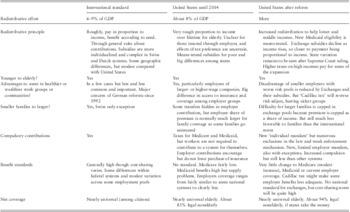
The design of the reformed U.S. system could be described, extremely roughly, as Japanese pooling with Swiss and American problems at American prices. It would include policies that are distinctive, but somewhat similar to examples in other rich democracies, on two important dimensions: how risks are pooled, and the amount of funds redistributed to subsidize care for people with lower incomes. It would require individuals to contribute to a system of shared savings, but in ways that are more complex and less compelling than the international norm. It differs further from international norms by having a less clear and common standard for benefits. The reform would do least, however, to move the United States toward international practices for controlling spending. This in turn is a major reason why the results would include less standard benefits and incomplete coverage.
In short, even if the 2010 legislation were fully implemented, the United States would remain an outlier on coverage, yet this would be less due to a failure to make an effort to redistribute – a lack of solidarity – than due to a failure to control costs.
International standards
Our comparison begins from observing that there are common aspects of health care finance among rich democracies aside from the United States (White, 1995a, Reference White2001). There are major differences among countries as to factors such as the extent of cost-sharing (e.g. Germany vs France); coverage of benefits beyond medical and hospital services (e.g. the lack of a national drug benefit in Canada); whether the guarantee consists of insurance or direct access to systems of care (e.g. England vs Japan); prevalence of gatekeeping by general practitioners (e.g. Netherlands vs Germany), the authority of subnational governments (e.g. Canada vs France) and roles for private insurance (e.g. gap vs parallel, see White, Reference White2009a), to list only a few. Yet there are basic aspects of health care systems on which there is an international standard (White, Reference White2001). All other rich democracies organize health care finance in a way that promises coverage for virtually all citizens. With rare exceptions, individuals are compelled to contribute to a system. Contributions are not related to illness or age, and in most countries not to family size.Footnote 5 Contributions tend to be roughly proportional to income, and lower-income people contribute substantially less than those with higher incomes. There are variations in coverage of other benefits, but within any given system, even if there are multiple funds, coverage guarantees or mandates for medically necessary medical and hospital services vary only modestly, if at all.
In the United States (before implementing the reform), wage-earners are required to contribute to the costs of hospital insurance for the elderly and disabled (Medicare Part A), and all taxpayers help pay for other care for the elderly and for some of the poor and other population groups (such as Medicare Parts B and D, and Medicaid). They are not, however, required to contribute to a system that provides insurance for themselves – unlike the systems that provide insurance or care for workers and their families in other countries.Footnote 6 Insurance premia are largely subject to risk-rating by many factors. For most people, contributions are set as flat amounts, regardless of their incomes. There is extensive variation in the terms of coverage.
All other rich democracies also have some system of spending controls that relies, to a much greater extent than in the United States, on regulation of prices and limits on system capacity. Simpler insurance and payment systems, in turn, lead to relatively low administrative costs. In the United States, payers are supposed to compete with each other to control spending (and gain market advantage) through selective contracting with providers. Other systems seek spending control by concentrating the power of payers vis a vis providers, in what could be most generally termed collective contracting or coordinated payment.Footnote 7
Four main types of coverageFootnote 8
The U.S. reform would build on existing arrangements. It is a patchwork (Marmor and Oberlander, Reference Marmor and Oberlander2011) because it seeks to mend holes in an existing garment. It is significant because the patches would be and need to be quite large.
1. As at present, the elderly (aged 65 and above), persons legally determined to be disabled, and persons with End-Stage Renal Disease would be insured through Medicare, a national government insurance system somewhat similar to Canada's governmental insurance.Footnote 9 Medicare is funded partly by general revenues and partly by payroll contributions during beneficiaries’ working lives. Its benefits are a bit thin by international standards, because cost-sharing percentages are higher than in most countries and because underlying prices, as for all U.S. care, are especially high.
2. The reform (as interpreted by the Supreme Court) also offers funding to states to encourage them to provide insurance through Medicaid to households with incomes up to 138% of the federal government's definition of poverty (federal poverty level, FPL). The federal government already paid at least 57% of states’ costs in the existing Medicaid program. The legislation offers states 100% of the costs of the expansion through 2016, phasing down to 90% by 2020 and afterwards. Assuming all states would participate (as the law required), Medicaid expansion was expected to account for about 40% of the new coverage under the ACA.Footnote 10
The ACA expanded the previous Medicaid program by making adults without children eligible and raising the income level up to which states were required to fund mothers and children. Some states currently offer Medicaid to mothers and children at higher-income levels, and may continue to do so (Kaiser Family Foundation, 2010a).
Because it is a program for poor people, Medicaid generally has low cost-sharing and extensive benefits. The benefit package varies from state to state, with some providing more extensive nonmedical (e.g. vision, dental) benefits than others. Medicaid benefits for the newly eligible childless adults in the new system may be less extensive than for other beneficiaries. However, the package will at a minimum be comparable with normal current coverage for workers, and total cost-sharing is to be limited to 5% of income (Kaiser Family Foundation, 2010b).
State Medicaid programs either insure people directly and pay fees-for-service, or contract with private insurers or provider networks for some form of ‘managed care’ (Kaiser Commission, 2010a). In the latter case, the contracting party may specialize in Medicaid enrollees. Medicaid fees tend to be much lower than those paid by other insurers, and therefore access to care, especially specialty care, can be problematic in spite of the low or zero cost-sharing (Sack, Reference Sack2010; Kaiser Commission, 2010b).
Conservative governors and legislators in many states attacked the Medicaid expansion; joined in a lawsuit to eliminate the strong penalties in the law that were meant to force states to participate; and the penalties were eliminated by the Supreme Court's ruling on 28 June. Some governors responded to the ruling by declaring that their states would therefore not expand the Medicaid coverage. As a result, many adults in those states with incomes below the FPL may not be helped by the reform, and the expansion could be significantly smaller than CBO projected (McDonough, Reference McDonough2012; Radnofsky et al., Reference Radnofsky, Mathews and McWhirter2012; Weil, Reference Weil2012b).
Yet in countries with federal systems and joint national/state finance of medical care, such as Australia and Canada, nonmandatory national funds nevertheless have eventually been accepted by all state governments.Footnote 11 All U.S. states eventually chose to participate in Medicaid even though the population served is disproportionately minority and politically weak. Resistance to covering adults might exceed the objections to covering mothers and children. Yet quite powerful constituencies – the hospital industry in particular – will pressure state governments to take the billions of dollars being made available. Advocates for taking the money will argue that state voters are sending money to Washington to pay for Medicaid expansions in other states, and it makes no sense not to take their share. The Court has ensured that state differences in support for solidarity will at least slow coverage expansions and continue some of the worst inequalities. Yet the financial incentives and history of the effects of similar incentives in both other countries and the United States should cause the vast majority of states to participate in the Medicaid expansions – if they are not repealed by a Republican national government.
3. The most important innovation is a major reform of the current market through which individuals and small businesses purchase insurance (Commonwealth Fund, 2010; Davis, Reference Davis2010; Kaiser Family Foundation, 2010c). The federal government will sponsor a new system through which individuals and small businesses can (or must) purchase coverage through ‘Health Insurance Exchanges’. The federal government will provide financial assistance for the purchase of insurance through the exchanges for enrollees with incomes up to four times the FPL. In 2009, that would have meant some assistance for a family of three so long as its income was no more than $73,240. The subsidies are designed to limit the cost of purchasing a ‘silver’ plan (explained below) as a share of income: from no more than 2% if family income is <133% of the FPL, to 9.5% of income between 300% and 400% of the FPL.
Insurers could be included in the exchanges with plans that offered any of the following levels of coverage relative to a package of ‘essential benefits’ that the Secretary of Health and Human Services will define: ‘Catastrophic’, high-deductible plans for people up to the age of 30 years; ‘Bronze’, with projected actuarial value of 60% of costs for the essential benefits; ‘Silver’, at 70%; ‘Gold’, at 80%; and ‘Platinum’, at 90%. The premium subsidies are based on the Silver plan, but low-income people may be unable to pay the cost-sharing that could involve. Therefore, the ACA provides a second set of subsidies. The effect is to give benefits more like platinum coverage to individuals not on Medicaid but with income up to 200% of the poverty level, and slightly more than silver coverage from 200% to 250% of the poverty level.Footnote 12
Exchange plans will not be allowed to refuse enrollment or to charge different prices based on medical experience. Unlike in all countries other than Switzerland, however, premiums for insurance through the exchanges will vary by age (oldest three times as high as youngest) and families with children will pay more.
The reform is designed to have states create and manage the exchanges subject to federal standards. As part of the Republican party's opposition to the reform, some state governments (including Florida and Texas) explicitly refused to begin implementing the exchanges, while many others hesitated, perhaps waiting to see how the Supreme Court would rule on the constitutionality of the legislation (Weil, Reference Weil2012a). The laws provide for the national government to set up an exchange if a state (either by choice or incompetence) does not, so such resistance was expected to create administrative challenges but not block the reform. After the Court's ruling, however, some opponents of the reform began arguing that the law's wording meant that exchanges created by the national government would not have authority to provide subsidies – which would greatly reduce their effectiveness in expanding coverage (Pear, Reference Pear2012). This is clearly contrary to the intent of the reform, as it makes no sense to let the national government create exchanges if they cannot do what the state exchanges would have done. There is also doubt that anyone would have a standing to bring a suit on these grounds until 2015. It seems fair to say that the reform was intended to give states the ability to design exchanges, but ensure that exchanges were created if states failed to do so. One cannot know for sure how the courts would rule.Footnote 13
4. Only about 24 million people, however, were projected by CBO to obtain their insurance through the exchanges when the system is fully implemented in 2016. Over 150 million were projected to have coverage purchased through and in part by their employers, as is also the case at present (CBO, 2010).Footnote 14 This system has distinctive aspects for both pooling and subsidies.
The key fact about pooling is, each employer is a separate insurance pool. This is similar to company funds in Japan or, at one time, Germany – but in those countries only large companies with favorable risk profiles would choose to insure separately. Other firms could join broader pools, without any risk-rating of their own employees. In the United States, firms that offer insurance coverage to their workers are normally not able to put their employees into a broader risk pool.Footnote 15
The set of subsidies associated with employer-sponsored insurance in the United States is complex, controversial and poorly understood. This is particularly important because the reform is designed to change the subsidies in ways that will be described in more detail below.
When employers provide insurance as a benefit, the government indirectly subsidizes the expense by treating the employer's contribution as nontaxable income. The average value of this subsidy in 2004 was nearly $2000 per employee (Schoen et al., Reference Schoen, Stremekis, Collins and Davis2009). The tax preference is extremely unpopular among economists (Rampell, Reference Rampell2009), with even more ‘liberal’ (in American terms) economists claiming it is inequitable. The tax break is, however, quite popular with both business and workers. Moreover, the conventional view that the tax preference is ‘regressive’ is largely wrong.
In dollar value, the tax break is larger for those in higher tax brackets. Therefore, it looks like a larger ‘subsidy’ to the ‘rich’. But the share of income excluded from taxes is much larger for lower-wage workers than for higher-wage workers, because the value of their health insurance is a much larger share of their total compensation (Employee Benefit Research Institute, 2009a; Schoen et al., Reference Schoen, Stremekis, Collins and Davis2009). As a result, the tax preference on average reduces taxes proportionally more for low-wage workers than for high-wage workers (Schoen et al., Reference Schoen, Stremekis, Collins and Davis2009). By normal public finance definitions, this would be progressive. It is only ‘regressive’ from the standpoint of the workers who receive no insurance.
There also appear to be progressive, though less visible, subsidies within firms. A combination of federal nondiscrimination law, state nondiscrimination law and established practice means that employers typically offer similar coverage to all full-time employees (Employee Benefit Research Institute, 2009b; Schoen et al., Reference Schoen, Stremekis, Collins and Davis2009). The question is what would happen if benefits were converted to wages. It seems especially unlikely that employers would give larger raises within the same job classification to employees with families than to those who are single. So the tax preference must redistribute from single workers to families. One may also suspect that higher-wage employees would get somewhat larger cash raises than lower-wage employees. Therefore, employer provision of health insurance within a firm is quite likely to redistribute toward those with greater financial need – not merely medical need.
Other effects of employer-sponsored insurance have clear political effects even if the actual subsidies are uncertain. When individuals receive insurance through their employers, they normally have deducted from their wages a premium that is less than half the cost of the coverage. Hence, the cost of insurance may seem to be a larger subsidy from employer to employee than in sickness fund systems, which also have both deductions from wages and employer payments into the fund.Footnote 16 In practice, nobody really knows how much of the ‘employer’ contribution is offset by lower wages (never mind lower wages for whom), but it is likely that American workers view the employer share as a larger subsidy than workers in other countries may perceive. Even more clearly, when workers receive insurance through their employer, the ‘employer’ share is not being collected from taxes. Therefore, replacing employer-sponsored insurance with some other system would have required much higher new taxes. It also would have worried workers who liked the insurance they have (Cohn, Reference Cohn2010; Oberlander Reference Oberlander2010; Hacker, Reference Hacker2010a).
All these subsidies, real or imagined, help explain why the Obama administration and its allies wished to preserve much of the role for employer-sponsored insurance in a reformed system – in spite of the negative risk pool effects. Creating the exchange insurance, however, would produce a system that, other things being equal, would be a much better deal for many employers. Smaller employers with riskier employees could obtain lower premiums by going into a larger and less risky pool. The exchange insurance would have larger federal subsidies for most workers (those with incomes below 400% of the FPL).Footnote 17 In order to discourage employers from dropping their coverage once this alternative was created, the reform includes sanctions and inducements to encourage employers that presently offer decent coverage to continue to do so, and some that do not offer coverage to consider doing so (Jost, Reference Jost2010).
Who would have which coverage
A system with multiple types of coverage can raise some questions about who will be covered in which ways. For example, an employed person who is old enough to otherwise be eligible for Medicare would normally be covered by their employer coverage, if it exists. The larger uncertainties in the new U.S. design involve the borders of the other three categories.
There has always been a gap between Medicaid eligibility and enrollment, partly because eligibility is complex and people move in and out of eligible status, and partly because states save money by not enrolling people (Kaiser Commission, 2010a). Hence, there is some uncertainty about how many beneficiaries would be added to Medicaid by the reform. There may also be some people who could be insured either by their employers, through the exchanges or through Medicaid; and it is difficult to predict which choices they will make. Therefore, some analysts have predicted that the new enrollment in Medicaid could vary significantly, in either direction, from the 16 million projected by CBO at the time the legislation was enacted (Sommers et al., Reference Sommers, Swartz and Epstein2011).
There is even more doubt about who would be insured through their own employers or through the exchanges. The first uncertainty involves who will be covered at all. As we will see below, the U.S. legislation creates a mix of the employer-sponsored and individual mandate methods of providing insurance, without being quite as compulsory as the international examples of either. The second uncertainty involves the balance between coverage through the exchanges and through individual employers. As in any system with individual employer pools, we might expect those to be abandoned due to the risk-pooling advantages of moving employees into larger groups (in this case the exchange pools; in the old German system, the regional funds). The penalties to employers for dropping coverage, and the fact that higher-wage employees would not be subsidized in the exchanges, will slow such movement. Nevertheless, what proportion of employers will drop their coverage due to creation of the exchanges is the greatest uncertainty about the new design. There are good reasons to think the switch will be larger than CBO estimated – in part because some employee benefit consultants will be advising employers to switch (Eibner et al., Reference Eibner, Girosi, Price, Cordova, Hussey, Beckman and McGlynn2010; Singhai et al., Reference Singhai, Stueland and Ungerman2011).
Coverage compared with other countries
Redistribution
Although it would not cover all Americans, the 2010 legislation was designed to be within the range of international levels of redistribution to people with lower incomes or of government (or quasi-public) commitment to support costs of health care.
About two-thirds of Americans are elderly or have incomes below 400% of the poverty level (U.S. Census Bureau, 2010), so they would be eligible for the public programs, or for subsidy through the exchange or have the option of moving into the exchange if their employers did not offer adequate support for costs of insurance. This is equivalent to the sickness fund population in the former Dutch system.Footnote 18 It also does not count the tax code subsidies to people with higher incomes through employment-based coverage.Footnote 19
The Supreme Court's ruling, however, means that some states may not provide Medicaid coverage to the newly eligible adults with incomes below the FPL.Footnote 20 In those states that choose not to do so, the system would be much less equal than in other countries, as some of the most vulnerable citizens would be excluded. Although the pressures to participate in the system will be very strong over the long run, in the short run major inequities, far out of line with the international norm, could persist in quite large states such as Florida and Texas.
If we look at the cost rather than the reach of government support, the U.S. system even now looks less distinctive. As Woolhandler and Himmelstein (Reference Woolhandler and Himmelstein2002) put it, by 1999 the United States was already “paying for national health insurance and not getting it”. Tax-supported public spending per capita on health care spending already was higher than in many other OECD (Organization for Economic Cooperation and Development) nations. Major sources of finance include the high costs of Medicare and Medicaid, payments made by governments as employers and the tax preference for insurance purchased through nongovernmental employers.
This spending has all risen since 1999, and both the expansions of Medicaid and new subsidies in the exchanges would add to the total. The exchange subsidies could be very large and quite redistributive. In the Kaiser Family Foundation's (2011) estimates, a family of four in a community with average costs with a 50-year-old head of household and income of $64,419 (275% of poverty) would receive a subsidy of $11,205 – and it would be more if the head of household were older, had a lower income or lived in a more expensive community. Because the subsidies aim to reduce costs to a percentage of income, and the percentages are lower for lower incomes, they would be quite redistributive. Their size would also be less or more in less or more expensive regions. The tax break for employer-sponsored insurance already reflects local costs (though the “Cadillac tax,” discussed below, would reduce this effect).
The United States in 2008 already exceeded the OECD average share of GDP devoted to public or quasi-public (e.g. sickness fund) spending on health care (in the same range as Canada and Belgium, and behind only Sweden, New Zealand, Germany, France, Denmark and Austria). Out-of-pocket expenditure as a share of the total was among the lowest among OECD nations, though that is partly because prices are so high that it is hard to pay out of pocket.Footnote 21 Public spending in absolute terms per capita was lower only than Norway's (author's calculations from OECD, 2010). The reformed system, financed largely by taxes that we have no reason to believe are less progressive than international norms, is therefore likely to be well within any international standard of redistribution or solidarity – at least, if solidarity means the effort higher-income people make to support lower-income people.
Pooling
Although the set of alternative pools is unusually complex, having various insurance pools with different sponsors is also not so distinctive. The old German system, with company funds, regional funds, ‘substitute funds’, private market insurance and various other categories is one example. The peculiar set of categories in the new U.S. design is similar to the categories in Japan, though the proportions differ (Fukawa, Reference Fukawa2002).
Japan's ‘society-managed insurance’ is essentially insurance sponsored by large companies, with somewhat better benefits than the norm, much like large employer coverage in the United States. It has very modest direct subsidies. ‘Government-managed insurance’ pools private employees across employers, somewhat like in the exchanges, with larger government subsidies than for large employers; recently, management of this system was devolved to the prefectural level, much as exchanges will be managed by states (Matsuda, Reference Matsuda2009). ‘National Health Insurance’ covers the self-employed, agricultural workers and unemployed including retirees. It mainly consists of local government plans (so at smaller regional divisions than Medicaid) but, like Medicaid, has poorer members than average, and it receives half of its funding from the national government. Finally, although the elderly (aged 70 and above or between 65 and 69 if disabled) are all in either one of the three categories above or in the system for government employees, they are treated as a separate pool, with somewhat lower cost-sharing than in other pools. Seventy percent of the pool's finance comes from the other funds, in ways that redistribute from funds with fewer elderly to those with more; the rest is covered by extra subsidies from national and local governments (Fukawa, Reference Fukawa2002). Although this is not as administratively separate as Medicare, it clearly treats the elderly as a separate population.
Compulsion: the individual and employer ‘mandates’
The design of the U.S. reform is linked to employment but more of an ‘individual mandate’ than a normal employment-based system.
In other employment-based systems, such as Japan or Germany, employers withhold a portion of payroll, and are required to contribute a portion themselves. Employees and their families are either automatically enrolled in a fund (as in Japan or, previously, for some workers in Germany) or can choose among funds (current Germany), but do not choose whether to have insurance. In a mandate system such as Switzerland and the Netherlands, people are required to purchase insurance but must themselves take action. The government provides some subsidies. Mandate systems are inherently not as comprehensive as any system that enrolls people automatically. Individuals may disobey the mandate and not enroll; or they may enroll but not pay their premia. Each of these problems occurs in both the Netherlands and Switzerland, though so far nonpayment is more common than nonenrollment, and perhaps 3% of the population may be involved (Okma, Reference Okma2009; Crivelli, Reference Crivelli2010).
Employers have a quite limited role in the Dutch mandate system. They collect a payroll contribution for the government, and may offer a group contract, but there is no requirement that they contribute toward the costs. Employers have no significant role in the Swiss mandate system (Colombo et al., Reference Colombo, Zurn and Oxley2006; Jost, Reference Jost2009; Okma, Reference Okma2009). The new U.S. model is an individual mandate but with a much larger role for employers.
It requires that employers with more than 50 employees either offer insurance that meets certain standards or pay a penalty based on how many of their employees purchase insurance through the exchange. The provisions have a variety of twists, but the core idea is that employers of this size who do not offer qualifying insurance will pay a penalty of about $2000 per employee (adjusted annually). Insurance offered by employers either should meet exchange standards (including for cost to employees) or be a ‘grandfathered’ plan that met the legal requirements in force as of 2011 and has not been significantly changed since then (Commonwealth Fund, 2010; Jost, Reference Jost2010; Kaiser Family Foundation, 2010c). Employers normally pay far more than $2000 per employee if they offer insurance now, but the penalty would add to the downside of dropping coverage at any point in time. In addition, the tax preference and employee expectations give further reasons for employers to continue to offer insurance in lieu of wages.
Individuals (more precisely, tax-filing units) will also be required to buy qualifying insurance from the exchange or through their employer (the individual mandate). If they do not do so, they will be subject to a penalty, when fully implemented in 2016, of between $695 and $2085 per household, depending on income (Commonwealth Fund, 2010; Kaiser Family Foundation, 2010c). The law includes a series of exemptions, however. The most important are for low incomes (though people below those levels should be eligible for Medicaid) and if the lowest cost plan option is more than 8% of the person's income. This could easily be true of individuals above the subsidy threshold, even if they chose the ‘bronze’ plan. For example, costs for a silver plan for a family of four with a 50-year-old head of household in a community with medium-level costs are projected to be more like 16% of a $105,000 income in 2014 (Kaiser Family Foundation, 2011).
In addition to the exceptions, the individual mandate is weakened by the provisions for its enforcement. The Internal Revenue Service (IRS) should be able to identify if a tax filer has failed to meet the insurance requirement, and can add the penalty to calculated taxes. However, the legislation does not allow the IRS to enforce the penalty with either civil or criminal penalties, or a lien on filers’ assets. The means of enforcement appear to consist, largely, of deducting the penalty from the amount of the tax refund that a filer would otherwise have received (Congressional Research Service, 2010). While many millions of filers do receive refunds, millions do not; taxpayers have some ability to adjust the amount of taxes withheld from their earnings and therefore make refunds less likely.
Considering the exceptions and weak enforcement of the individual mandate, it appears to be distinctly less mandatory than the Dutch or Swiss systems; yet the employer role is also much less automatic than in France or Germany or Japan. Health insurance in the reformed U.S. system would be largely associated with compulsion; through taxes that support the government programs and to a greater extent than before for privately purchased insurance. Yet the compulsion would remain weaker than in other systems.
Benefits and standardization of insurance
The new U.S. system would differ even further from the international standard on a fourth dimension. The benefit packages would be much more varied, much less certain and, in the case of the standard ‘silver’ plan, probably less adequate.
The variation both between the levels (bronze, silver, etc.) and within them will make it unusually hard for enrollees to know what they are getting, and the states are likely to have great difficulty regulating the system. In spite of the rhetoric about the merits of markets in other countries, the Dutch and Swiss require much more standard benefits (Jost, Reference Jost2009).
Adequacy will depend on both how ‘essential health benefits’ are defined and the proportion of ‘essential’ that is covered. The range of issues that could be defined as part of this decision is quite staggering (see Ulmer et al., Reference Ulmer, Ball, McGlynn and Hamdounia2011 for perhaps inadvertent illustration of the point). The legislation left definition of the ‘essential’ package to the Secretary of Health and Human Services. The Secretary chose, however, to allow states to make the decision by selecting benchmark plans from within their existing insurance markets. The result will be greater variation among states and even less of a national standard (Health Policy Brief, 2011). Within that standard (whatever it may be), the law offers subsidies for exchange coverage at the ‘Silver’ level – so 70% of the costs of ‘essential’ benefits. The Commonwealth Fund estimated what an ‘essential’ set of benefits could be and reported that large employers on average provided benefits that reimbursed 84% of expenses (Davis, Reference Davis2010). Setting a standard of 70% for subsidies of the Silver plan could encourage larger employers outside of the Exchanges to reduce the value of the insurance they offer.Footnote 22 It seems fair to conclude that the 2010 reform would not move the United States toward international norms of either comprehensible or adequate benefits.
Another provision of the law reflects the same unwillingness to be explicit about benefit levels, but will have negative effects on pooling as well. Beginning in 2018, insurers (or employers if they self-insure) will be forced to pay an excise tax of 40% of the value of insurance above certain cost levels. This penalty's supporters called it a ‘cadillac tax’ because they believed it would prevent the federal tax break from applying to unusually luxurious plans. From a comparative perspective this much is unexceptional: governments seek to guarantee some set of benefits, and not more.
However, rather than defining the target benefits, Congress and the President defined ‘excessive’ in terms of the cost of coverage. This means that it is especially likely to apply to employers with less healthy (e.g. older) employees in more expensive medical markets (Jost and White, Reference Jost and White2010). The penalty will provide employers in those situations with strong incentives to either cut benefits or just dump their employees into the exchange and pay the penalties – especially if their employees have low enough incomes to qualify for subsidies. Thus, the tax would make comparable benefits less affordable for more costly groups: risk enhancement instead of the usual risk adjustment!
Because of objections on similar grounds, the excise tax was delayed and weakened in the bargaining over the final version of the ACA (Van de Water, Reference Van de Water2010); but as designed, it is likely to begin to drive down benefit levels in riskier groups as 2018 approaches, for employers above the cap are likely to want to implement the changes gradually but in time to avoid the tax that year.Footnote 23
Hence, the extent and definitions of benefits in the U.S. reform are problematic and distinctive in a negative way. The division into different risk pools is unusually complex but, save for the backward risk adjustment from the ‘Cadillac tax’, not entirely distinctive. The level of transfers is actually entirely standard – but less adequate because of the high cost of services.
Table 1 summarizes the comparison of coverage provisions.
Movement toward the rest of the world on coverage

Cost controls compared with other countries
In spite of the remaining and significant gap between the United States reform and other countries’ coverage policies, the reform does much less to reduce the differences in cost control policies (Oberlander, Reference Oberlander2011).
The cost control nonprovisions of the legislation also maintain what is most unique about insurance provided through employment in the United States. In the United States, each employer is left alone to battle the insurers and medical providers over costs. Individual employers have little leverage to get better deals, so their major spending control tool in the current market is to change the benefit packages they sponsor – which in turn exacerbates variation and benefit uncertainty. In traditional sickness fund systems, and in the Dutch and Swiss systems, the power of payers is concentrated to somewhat constrain costs through either government rate setting or all-payer bargaining. This in turn supports the relative standardization and simplicity of other systems compared with either the current or future U.S. approach to health care finance.
We can identify three broad approaches to cost control. The international standard includes the main sources of cost control outside the United States. This includes concentration of payer power, coordinated payment rules, limits on capital investment and relative administrative simplicity. No nation's policy-makers are happy with this set of measures, but all pursue them more than the United States does, and that explains why spending is much higher in the United States than in other countries (Angrisano et al., Reference Angrisano, Farrell, Kocher, Laboissiere and Parker2007; Ginsburg, Reference Ginsburg2008; Marmor et al., Reference Marmor, Oberlander and White2009).
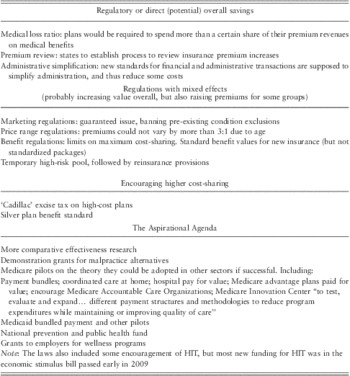
The 2010 reform does little to extend this approach beyond the Medicare program, though it does tighten payment restrictions within Medicare. As described in Table 2 below, it includes modest measures to reduce the administrative cost and profit portions of premiums, but no regulation of provider payments. An indirect version of the international standard was proposed and seriously debated. Jacob Hacker and others proposed that exchanges give customers the option of buying public insurance based on Medicare. Advocates for this ‘public plan’ wanted it to pay providers at Medicare rates (or slightly higher), and to strongly encourage providers to contract with the public plan by requiring them to do so if they wanted to serve Medicare patients. Because Medicare normally pays lower fees than private insurers pay, this could give the public plan a pricing advantage. Private insurers would be forced to find better ways to control costs, since they would now be competing not only with each other but with the public plan. They would either succeed or lose more market share – strengthening the public plan further (Hacker, Reference Hacker2009; Holahan, Reference Holahan2009).
Health care reform provisions to control costs of insurance

HIT, Health Information Technology.
Source: Kaiser Family Foundation (2010c).
This attempt to synthesize the international standard method of concentrated payer power with the idea of competing insurers was strongly promoted by the major health care reform advocacy groups associated with the Democratic Party and by many Democratic members of Congress. It was defeated, however, due to opposition by providers, business and the conservative wing of the party, with whom President Obama, after much public vacillation, sided (Oberlander, Reference Oberlander2010, Reference Oberlander2011; White, Reference White2011a, Reference White2011b; Kirsch, Reference Kirsch2012). The more direct approach, namely to regulate payment across all payers, was barely mentioned (Oberlander, Reference Oberlander2011; White, Reference White2011b).
The new insurance design should modestly reduce marketing and underwriting costs for individuals insured through the exchanges. That, however, would address only a small part of the extra costs generated by insurer competition in the United States. It would have little effect on marketing to large employers. Nor would it reduce the costs of billing, for both insurers and providers, created by having a wide variety of insurance plans that cover different benefits with different cost-sharing and with widely varying fees set by different contracts. Even in the exchange sector, we would have costs from advertising and a proliferation of plans within the various metallic (gold, silver) benefit standards. Hence, the reform would do little to move U.S. spending controls toward the international standard.
A second approach is to limit insurance, by delisting benefits or through cost-sharing. Levels of nonmedical benefits and of cost-sharing vary substantially across rich democracies. In some countries, such as France, there has been a slow trend toward greater cost-sharing and some delisting.Footnote 24 In others, such as Germany, mild moves in that direction have been offset by other policies, such as expansion of long-term care benefits. On balance, increased reliance on cost-sharing in the United States would move the United States further from, not closer to, international norms.
American conservatives want to reduce insurance, especially through high deductibles and ‘health savings accounts’, and by reducing tax subsidies for coverage. Along with limiting medical liability, these approaches were the Republican proposals in the 2008 presidential election (Buchmueller et al., Reference Buchmueller, Glied, Royalty and Swartz2008). Although the Republican ideas were not incorporated in the legislation, some of the perspective is reflected in two key provisions: the ‘Cadillac tax’ and the high cost-sharing for the silver plan.
As mentioned above, many American health economists support the excess insurance argument, even if they would not go so far as the conservative advocates. Thus, an eminent group of economists mostly associated with the Democrats endorsed the excise tax as “the most promising approach to reducing private-sector health care costs” (Rampell, Reference Rampell2009; see also Gruber, Reference Gruber2009). A portion of the enacting coalition, particularly more conservative Democrats, believed these economists. Although proposals of this sort exist everywhere, it seems fair to say that the reformed system would maintain the extent to which the United States is more likely than other countries to rely for spending control on constraining demand, rather than limiting prices, capacity or administrative costs.
Most of the cost control language in the reform follows the third approach, which emphasizes reorganizing medical care delivery. I call this the Aspirational Agenda because it is broadly promoted and endorsed in the international health policy community but barely exists in practice. The U.S. version of 2010 (see Table 2) included increasing the use of (or at least spending more on) Health Information Technology (HIT); finding ways to ‘Pay for Performance’ rather than for health services (P4P); increasing spending on preventive care in hopes that would reduce spending on curative care; reorganizing health care delivery to create something called Accountable Care Organizations (ACOs); doing much more cost-effectiveness analysis (CEA) in order to have more evidence-based medicine (EBM); creating ‘medical homes’, somehow replacing fee-for-service payment of physicians with something else; and various other measures (hundreds of pages of legislative text).Footnote 25
These measures were included in part because leading figures in the administration believed in them and appeared to have been at best skeptical of the coordinated payment and capacity regulation approaches (Orszag and Ellis, Reference Orszag and Ellis2007; Emanuel, Reference Emanuel2008; Cohn, Reference Cohn2010; Cutler, Reference Cutler2010). Yet the Obama administration's position also involved a political calculation: interest group opposition to these measures was much less fervent than opposition to the measures of the international standard (Cutler, Reference Cutler2010; Oberlander, Reference Oberlander2010, Reference Oberlander2011).
Advocates for the Aspirational Agenda may also have believed it was more politically viable because many of its components were endorsed during the 2008 presidential campaign by both Senator Obama and Senator McCain (Antos et al., Reference Antos, Wilensky and Kuttner2008; Buchmueller et al., Reference Buchmueller, Glied, Royalty and Swartz2008; Pauly, Reference Pauly2008). This seeming agreement, however, did not prevent Republicans from attacking the ideas when they became identified with the Democrats. The agenda also was not popular with the public (Bernstein, Reference Bernstein2009; Oberlander and White, Reference Oberlander and White2009a; Carman, et al., Reference Carman, Maurer, Yegian, Dardess, McGee, Evers and Marlo2010). Hence, the agenda was politically risky even if avoiding other cost controls made it easier to pass the legislation.
There was also little if any solid evidence that these approaches would save money within a decade, if then (Alliance for Health Reform, 2008; Pauly, Reference Pauly2008; Marmor et al., Reference Marmor, Oberlander and White2009). CBO was especially skeptical, and in December of 2008 issued a report with very discouraging estimates of potential savings (CBO, 2008). CBO's judgment is critical within the U.S. legislative process because it determines the estimates of how much legislation will cost; cost-savings from measures that CBO will not ‘score’ will not be believed by anyone who is not ideologically committed to these measures.Footnote 26
The Aspirational Agenda measures adopted in legislation consist largely of pilots and ‘experiments’ focused on the Medicare program. They could not have a substantial effect even on Medicare, even if they worked, for many years.Footnote 27 Believers in the agenda hope that success in Medicare would be followed by the measures being adopted for privately funded care, but that would take even longer.
Interest in the Aspirational Agenda is common around the world; actually relying on it for cost control is uniquely American.
Conclusion: politics and prospects
If it is not repealed after the 2012 election, and especially if the state governments that are currently opposing the reform decide that sending their citizens’ taxes to Washington for no return is not good politics, the 2010 U.S. health care reform would substantially expand health insurance in the United States. In terms of social sharing, it would move the United States somewhat closer to the international standard. In terms of cost control, it would not.
Readers interested in overviews of why the legislation passed, and the reasons for its provisions on coverage and cost control, can consult a wide range of sources.Footnote 28 For our purposes, it's important to understand the following:
Legislation did not result from any groundswell of public support for government social programs. The available polls show no unusual outcry for reform in 2009; little enthusiasm for and later opposition to the reform itself; and even a decline in the portion of the public that believed the U.S. government should guarantee health care to its citizens.Footnote 29
The interest group environment was more permissive than in previous health reform conflicts, but not in ways that should lead one to expect greater cost control or coverage expansions in the future. Provider interests were neutral or modestly supportive of the reform, but that was because it seemed likely to expand their customer base and did not include regulatory cost controls. There is no reason to believe the provider interests would accept more threatening reforms, and especially not more extensive regulation of fees (Cohn, Reference Cohn2010; Oberlander, Reference Oberlander2010; Hacker, Reference Hacker2010a, b; White, Reference White2011a).
The legislation was passed without majority public support, in a purely partisan manner, by a partisan majority that is no longer in power. Sometimes legislation becomes more popular after its benefits are implemented; but the most significant benefits of the 2010 reform will not be implemented until 2014. Readers will know how the Democrats fared in the 2012 Presidential and legislative elections; but as the elections approached the best-case scenario was that they would keep the Presidency and retain control of the Senate with a reduced majority. Moreover, the Republican party pledged to repeal “Obamacare” and made attacking the reform a major part of its campaign strategy. Weakened Democratic control (at best) and fervent Republican opposition are not conditions that suggest U.S. health policy will move further toward other countries' policies in the future. The reform has already been somewhat weakened by the Supreme Court's ruling in July of 2012.
Even a divided government might weaken health insurance coverage in the United States, if a reelected President Obama followed the logic of many of his own statements and advice of senior aides such as Treasury Secretary Geithner and pursued a big deficit-reduction package consisting mainly of spending cuts (Schlesinger, Reference Schlesinger2012). Even in 2011, Democrats within budget negotiations were proposing cuts to Medicare and Medicaid (Greenstein et al., Reference Greenstein, Kogan and Van de Water2011).
Until they are implemented in 2014 it seems especially likely that the most important parts of the legislation could be repealed by a conservative government. These include the Medicaid expansions, subsidies for coverage in the exchanges, the penalties on some individuals who do not purchase insurance, and the fines on some employers that do not offer insurance. Repeal of the first two provisions, which support the vast majority of the coverage expansions, would offer very large projected budget savings, yet would not require taking benefits away from anyone who already has them. It is difficult to imagine a more attractive budgetary maneuver, especially for policy-makers who detest the program involved.
If those key provisions survive to be implemented in 2014, then the political dynamic could be different. Some participants in the 2009–2010 debate argued, as one report put it, that “Congress needs to trick itself into cost-cutting mode” by passing coverage expansion first (Armstrong and Wayne, Reference Armstrong and Wayne2009a, b; see also Oberlander, Reference Oberlander2011). Once expenses are on the federal budget, and voters are receiving benefits, it should be harder to take benefits away and easier to get support for regulating payments.
Over a long time period, experience with Medicare suggests that politicians tend to favor regulating payments to providers if the alternative is raising taxes or cutting benefits to large numbers of voters (White, Reference White1995b). The 2009–2010 reform battle revealed the same pattern, as conservative Democrats who opposed the public plan still supported tighter payment restrictions within the existing Medicare program. Jon Oberlander shows that application of regulation to the health care system as a whole was virtually excluded from the rhetoric of the Obama administration and its advisers; and this emphasis on everything else reflects dynamics within the health policy community (Rampell, Reference Rampell2009; Oberlander, Reference Oberlander2011; White, Reference White2011b). Yet the international approaches are known, even if usually ignored; and there are signs that even eminent analysts who do not like the idea could endorse all-payer regulation (Newhouse, Reference Newhouse2010).
If it is actually implemented, therefore, the 2010 package of reforms could change the political dynamics of U.S. health policy in a way that encourages further convergence between the United States and other systems of health care finance. It remains quite possible, however, that we will see a retreat from the modest convergence that was legislated in 2010.
Acknowledgements
The author has benefited especially from comments by Jon Oberlander and Ted Marmor when doing work on this topic. He thanks the anonymous reviewers of this article, and especially Jean de Kervasdoué for the opportunity to try to explain U.S. reform to French audiences while on sabbatical at the Conservatoire National des Arts et Métiers from 2010 to 2011.