Introduction
Many chronic conditions such as osteoarthritis, osteoporosis, post-herpetic neuralgia, cancer and co-morbidities are associated with both nociceptive and neuropathic pain, and become more prevalent with age.Reference Laiho, Tuomilehto and Tilvis1, Reference Davis and Srivastava2 Pain is therefore common amongst older people, with prevalence rates of persistent pain in older adults in the community at over 40%.Reference Maxwell, Dalby and Slater3
Frailty is a disorder of several inter-related physiological systems that results in a depletion in homeostatic reserve and vulnerability to disproportionate changes in health status after relatively minor events such as changes in medication, or a minor operation or minor infection.Reference Clegg, Young, Iliffe, Rikkert and Rockwood4 It is estimated that one in ten people over 65 years, and between a quarter and a half of those aged over 85 years are frail.Reference Clegg, Young, Iliffe, Rikkert and Rockwood4
The conceptualization of frailty as an abnormal health state, related to the ageing process, has emerged over the last 15 years, and robust models have been developed and validated to identify and severity-grade frailty. The two principle models of frailty are the phenotypeReference Fried, Tangen and Walston5 and the cumulative deficitReference Rockwood, Song and MacKnight6 models. The phenotype model includes five variables: unintentional weight loss, self-reported exhaustion, low energy expenditure, slow gait speed, and weak grip strength. Frailty is identified if three or more of these variables are present. The cumulative deficit model was originally derived from the Canadian Study of Health and Ageing (CSHA) and is based on the accumulation of ‘deficits’, with increasing numbers of deficits leading to increasing frailty. Examples of deficits include: symptoms (e.g. low mood), signs (e.g. tremor), and abnormal laboratory values, disease states, and disabilities.Reference Clegg, Young, Iliffe, Rikkert and Rockwood4 There is increasing recognition that frailty should be viewed as a long-term condition.Reference Harrison, Clegg, Conroy and Young7
Evidence from cross-sectional data suggests that older adults with the most severe pain are significantly more frail than those with no pain or less severe pain.Reference Weaver, Kuo and Raji8 It has been proposed that persistent pain may contribute to, or accelerate, the development of frailty in older people through mechanisms such as impaired mobility, depression, decreased nutritional intake and the burden of co-morbidities,Reference Rudy, Weiner, Lieber, Slaboda and Boston9, 10 and interventions to improve pain management may help prevent frailty.Reference Shega, Dale, Andrew, Paice, Rockwood and Weiner11
Pain is a subjective sensation with a complex, non-linear relationship between nociceptive information and pain perception.Reference Wiech, Ploner and Tracey12 Numerous methods of pain assessment have been developed. These are mostly ‘self-report’ measures that typically include: the identification of the pain site(s), pain intensity, descriptors to capture the sensory and affective components of pain, and an assessment of the impact on quality of life or intrusiveness such as interference with work inside and outside of the home. Pain is a significant, often unmet need in older people that can impact on their quality of life and mood.Reference Lin, Li and Chang13, Reference Chen, Hayman, Shmerling, Bean and Leveille14 Understanding pain in older people with frailty is an important first step towards developing appropriate interventions specifically for this population.
The aims of this review were firstly, to identify studies that assessed pain in older people reliably characterized as frail, and any reported associations between frailty and pain; secondly, to identify biologically plausible mechanisms that may alter pain perception or contribute to, or exacerbate, pain in a frail older person; and thirdly, to identify specific implications of pain management for older people with frailty.
Search methods
We identified cohort and cross-sectional studies reporting on pain in community-dwelling older people (mean age >65 years) that had included a validated frailty measure such as the phenotype,Reference Fried, Tangen and Walston5 or the cumulative deficit model.Reference Rockwood, Song and MacKnight6 We excluded studies that only reported a frailty indicator measure, for example gait speed, or the timed up-and-go test. Whilst these indicators demonstrate high sensitivity for the identification of frailty, they have poor specificityReference Clegg, Rogers and Young15 and are therefore unsuitable for epidemiological research. Mood (anxiety and depression) was also included as an outcome of interest as frailty and its associated functional impairment are risk factors for depression.Reference Mezuk, Edwards, Lohman, Choi and Lapane16 Analgesic outcomes were also identified.
We developed a structured search strategy using controlled vocabulary and text words to search databases including CINAHL, MEDLINE, Embase and Web of Science. We combined search terms for ‘pain’ and ‘frailty’ and ‘elderly’. Search strategies are available on request from the authors. This search strategy also identified a parallel literature describing pain more generally in older people, which included possible mechanisms for pain in older people with frailty, and issues related to pain management in this particular population of older people. These aspects were reviewed separately.
Results
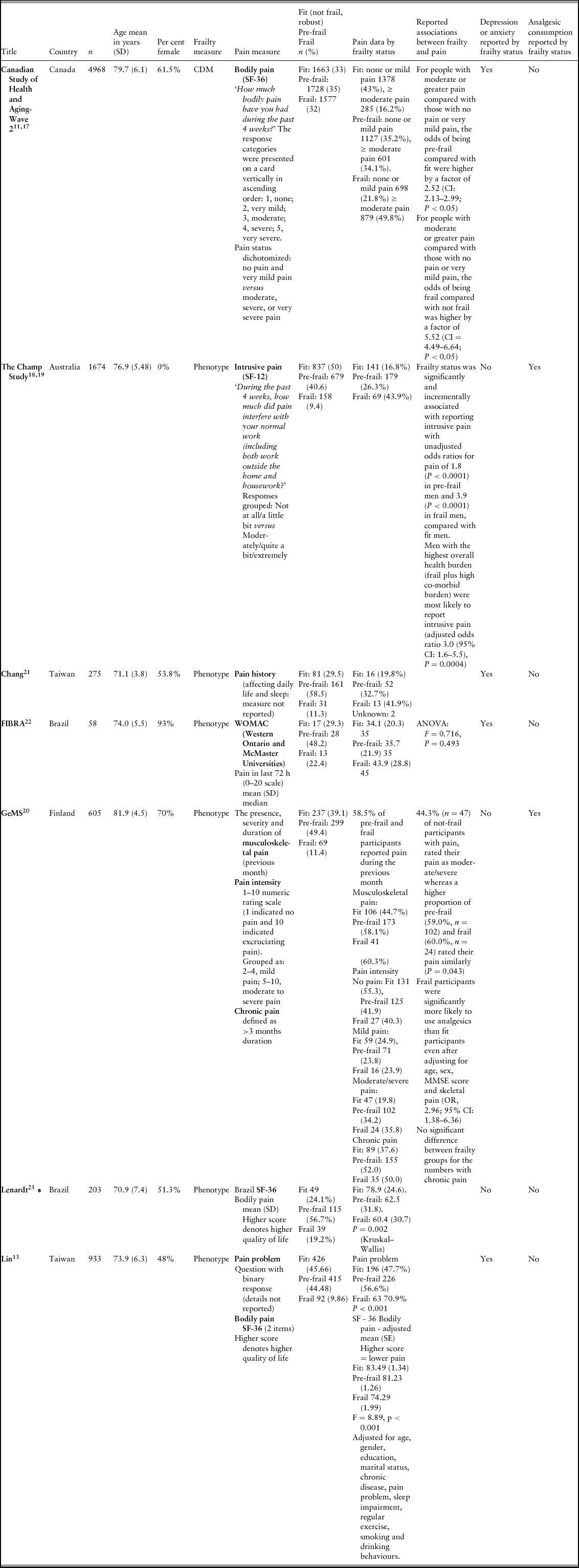
The review process is summarized in Fig. 1. We identified seven studies that reported pain outcomes in older people with frailty (Table 1). One study was conducted in Canada,Reference Shega, Dale, Andrew, Paice, Rockwood and Weiner11, Reference Shega, Andrew and Kotwal17 one in Australia,Reference Blyth, Cumming and Nicholas18, Reference Blyth, Rochat and Cumming19 one in Finland,Reference Koponen, Bell, Karttunen, Nykanen, Desplenter and Hartikainen20 two in Taiwan,Reference Lin, Li and Chang13, Reference Chang, Chan, Kuo, Hsiung and Chen21 and two in Brazil.Reference Miguel Rde, Dias, Dias, da Silva, Menicucci Filho and Ribeiro22, Reference Lenardt, Carneiro, Albino and Willig23 The mean age of participants ranged from 71 to 82 years (see Table 1). Six studies had mixed sex populations. The Concord Health and Ageing in Men Project (CHAMP) study only recruited males.Reference Blyth, Cumming and Nicholas18, Reference Blyth, Rochat and Cumming19 The CHAMP studyReference Blyth, Cumming and Nicholas18, Reference Blyth, Rochat and Cumming19 measured frailty using the cumulative deficit model. The remaining studies used the phenotype model. All studies reported participants as not frail (fit or robust), pre-frail (an intermediate state), and frail. The proportion of frail participants ranged in the studies from 9 to 32%. Four studies used questions from the SF-12 or SF-36 to assess pain.Reference Shega, Dale, Andrew, Paice, Rockwood and Weiner11, Reference Lin, Li and Chang13, Reference Blyth, Rochat and Cumming19, Reference Lenardt, Carneiro, Albino and Willig23 Chang et al.Reference Chang, Chan, Kuo, Hsiung and Chen21 reported the presence of pain history but did not report the specific measure. The Geriatric Multidisciplinary Strategy for the Good Care of the Elderly (GeMS) study investigated the presence and severity of musculoskeletal pain, and chronicity.Reference Koponen, Bell, Karttunen, Nykanen, Desplenter and Hartikainen20 The Frailty in the Brazilian elderly (FIBRA) studyReference Miguel Rde, Dias, Dias, da Silva, Menicucci Filho and Ribeiro22 used the Western Ontario and McMaster Universities Questionnaire (WOMAC). All the studies reported pain data at one time point. In the FIBRA study,Reference Miguel Rde, Dias, Dias, da Silva, Menicucci Filho and Ribeiro22 participants all had, or were suspected of having, osteoarthritis of the knee or hip. The remaining studies recruited older people without specific conditions. Three studies reported pain intensity.Reference Lin, Li and Chang13, Reference Koponen, Bell, Karttunen, Nykanen, Desplenter and Hartikainen20, Reference Lenardt, Carneiro, Albino and Willig23
Preferred Reporting Items for Systematic Reviews and Meta-Analyses (PRISMA) flow diagram

Pain outcomes for not fit (not frail), pre-frail and frail older people
CDM, cumulative deficit model; n, number included in analysis; *additional data obtained from correspondence with the author.
Pain outcomes
In the Canadian Study of Health & Aging-Wave 2,Reference Shega, Dale, Andrew, Paice, Rockwood and Weiner11, Reference Shega, Andrew and Kotwal17 approximately 16% of non-frail, 34% of pre-frail, and 50% of frail participants reported moderate pain or greater. Overall frailty status was significantly associated with pain self-report. For those with moderate or greater pain compared with those with no pain, or very mild pain, the odds of being pre-frail or frail compared with not frail were significantly higher.
In the CHAMP studyReference Blyth, Cumming and Nicholas18, Reference Blyth, Rochat and Cumming19, approximately 17% of non-frail participants reported intrusive pain, 26% of participants in the pre-frail category, and over 40% of those with frailty. Frailty status was significantly associated with reporting intrusive pain. Associations between pain, frailty and co-morbidity found that those with the highest overall health burden (frail plus high co-morbid burden) were most likely to report persistent pain. A strong association between frailty and intrusive pain remained after accounting for opioid use and depression.
In the Chang study,Reference Chang, Chan, Kuo, Hsiung and Chen21 over 40% of frail older people reported pain, compared with approximately 20% of non-frail older people. In the FIBRA study,Reference Miguel Rde, Dias, Dias, da Silva, Menicucci Filho and Ribeiro22 mean and median pain scores were non-significantly higher in the frail group. In the GeMS study,Reference Koponen, Bell, Karttunen, Nykanen, Desplenter and Hartikainen20 over 60% of frail participants had musculoskeletal pain compared with approximately 45% of non-frail participants. Furthermore, significantly more frail and pre-frail participants rated their pain as moderate/severe compared with non-frail. There was no significant difference in those who suffered with chronic pain (>3 months duration) across the three groups. Lenardt et al. Reference Lenardt, Carneiro, Albino and Willig23 and Lin et al. Reference Lin, Li and Chang13 used the pain domain of the SF-36 quality of life measure. Both studies found significantly lower quality of life in the pain domain. The Lin et al. studyReference Lin, Li and Chang13 demonstrated that over 70% of frail participants reported pain compared with 48% of non-frail.
Analgesic consumption and frailty
Two studies reported analgesic consumption according to frailty status. In the CHAMP studyReference Blyth, Rochat and Cumming19 it was reported that opioid use varied by frailty status, with 6.5% of frail men using opioids compared with 2.4% of pre-frail, and 1.2% of not frail men. In the GEMS study,Reference Koponen, Bell, Karttunen, Nykanen, Desplenter and Hartikainen20 there was a significant increase in analgesic use for increasing levels of frailty, and use of opioids and acetaminophen (paracetamol) was significantly more prevalent in pre-frail and frail participants compared with non-frail participants. There was no significant difference in the prevalence of use of non-steroidal anti-inflammatory drugs (NSAIDs) between the different frailty states.
Depression
Four studies reported depression data for the different frailty states. In the Canadian Study of Health and Ageing, for older people with depressed mood, the adjusted odds (OR) of being frail to not frail were higher by a factor of 4.13 (95% CI: 3.34–5.12).Reference Shega, Dale, Andrew, Paice, Rockwood and Weiner11 In the FIBRA study,Reference Miguel Rde, Dias, Dias, da Silva, Menicucci Filho and Ribeiro22 three (17.6%) non-frail older people self-reported depression compared with 15 (53.6%) pre-frail and seven (61.5%) frail older people (P = 0.041). However, data derived from the Geriatric Depression Scale (GDS) found no significant association between frailty and the presence of depression (P = 0.118). In the Chang et al.Reference Chang, Chan, Kuo, Hsiung and Chen21 and Lin et al.Reference Lin, Li and Chang13 studies, there were significantly more participants with depression in the frail and pre-frail categories compared with those in the non-frail group.
Anxiety
Lin et al.Reference Lin, Li and Chang13 reported health-related quality of life (SF-36) in the domain of mental health and found that being frail or pre-frail was associated with significantly lower mental health related quality of life compared with being non-frail (P < 0.001). The CHAMP studyReference Blyth, Cumming and Nicholas18 reported anxiety data using the Goldberg Anxiety and Depression scale, and assessed worry about health. They reported strong association between worry about health and pain that was both persistent and intrusive, and that remained after accounting for age, number of co-morbidities, depression, self-rated health status, arthritis, and gait speed (adjusted OR 2.9; 95% CI: 1.8–4.7), P < 0.0001). The corresponding adjusted OR for the association between anxiety and pain was 2.3 (95% CI: 1.0–4.8; P = 0.036). Results were not reported for the different frailty states.
Pain mechanisms in people with frailty
There were several potential biological mechanisms described that might account for the increased prevalence of pain in older people with frailty compared with fit people. Firstly, frailty is associated with physiological changes that could theoretically alter pain perception or exacerbate pain in an older person. Changes occur in the brain, immune system, endocrine system and the skeletal system.Reference Clegg, Young, Iliffe, Rikkert and Rockwood4 Secondly, age-related changes in the neurophysiology of nociception and the perceptual experience of pain have been reported, including the reduced efficacy of the endogenous analgesic system in older people.Reference Gibson and Farrell24 The diffuse noxious inhibitory control (DNIC) is a pain-modulating process controlled by endogenous opioids which works via descending inhibition such that a noxious stimulus in one part of the body inhibits perception of a second painful stimulus.Reference Le Bars, Dickenson and Besson25–Reference Le Bars, Chitour, Kraus, Dickenson and Besson28 Studies utilizing experimental pain models on humans have reported age-related differences in this process whereby a first pain fails to modify a second pain, but instead enhances it.Reference Lariviere, Goffaux, Marchand and Julien29–Reference Washington, Gibson and Helme31 Age-related increase in pain threshold (the least experience of pain a person is able to recognise) has been reported.Reference Gibson and Farrell24, Reference Lautenbacher32 This decreased sensitivity to pain has potentially important implications, placing the older person at greater risk of injury.Reference Gibson and Farrell24
Discussion
Although pain has been extensively studied in older people, we identified only seven studies that reported pain in populations of older people with well-defined frailty. This is perhaps unsurprising as robust, validated measures of frailty have only been developed in recent years. From the limited data available, it would appear that the presence of pain is higher in older people with frailty compared with people characterized as pre-frail or not frail. Thus older people reporting pain are statistically more likely to be frail. Critically, however, a lack of prospective data precludes inferences about the direction of the relationship, i.e. whether pain or frailty is the antecedent. There was little information regarding the source of the pain other than one study with a particular focus on musculoskeletal pain,Reference Koponen, Bell, Karttunen, Nykanen, Desplenter and Hartikainen20 and one which only recruited participants with osteoarthritis of the knee and hip.Reference Miguel Rde, Dias, Dias, da Silva, Menicucci Filho and Ribeiro22 Furthermore, there were only two studies that reported analgesic consumption according to frailty status and these did not include information on the perceived efficacy of the medication or possible adverse events. Therefore, there remains little information to determine what proportion of older people with frailty are in receipt of medication, and whether this medication is adequate.
Mood state can impact on persistent pain and older people with frailty experience more anxiety and depression than non-frail people.Reference Mezuk, Edwards, Lohman, Choi and Lapane16, Reference NÃ-Mhaoláin, Fan and Romero-Ortuno33 The extent to which this is related to more frequent external stresses such as the loss of friends, or family support, or a greater reaction to these losses due to the abnormal health state of frailty and impaired resilience is unclear. Anxiety may contribute to, or exacerbate, pain in frail older people. Anxiety is associated with subjective feelings of apprehension about impending or anticipated harm,Reference Tang and Gibson34 autonomic arousal (increased heart rate) and avoidance behaviour. Both state and trait anxiety can result in increased pain sensitivity, increased report of pain intensity and reduced pain tolerance.Reference Tang and Gibson34–Reference Carter, McNeil and Vowles39 Negative expectations of pain, or pain worsening, induce anticipatory anxiety about the impending pain, thus triggering the activation of the neuropeptide cholecystokinin, which can facilitate pain transmission.Reference Colloca and Benedetti40 In the CHAMP study, there was a strong association between persistent and intrusive pain with worry about health and overall anxiety.Reference Blyth, Cumming and Nicholas18 However, within this review there was a lack of anxiety data, reported by frailty status, to draw any conclusions about the role of anxiety and pain in this particular population.
Depression was reported for the different frailty states in four studies. From the limited data available for this review, the presence of depression appeared higher in frail older people compared with fit older people. The relationship between depression and pain is complex. Pain is both an antecedent and consequence of depression.Reference Goesling, Clauw and Hassett41 From a neurobiological perspective, pain processing and mood are controlled by common neurotransmitters including norepinephrine, which contributes to pain inhibition via descending pathways of the central nervous system. Avoidance and withdrawal behaviours, common in both pain and depressed populations,Reference Goesling, Clauw and Hassett41 could be relevant. The fear avoidance model of pain proposes that when a person perceives pain as threatening they typically respond with pain-related fear avoidance behaviour,Reference Zale, Lange, Fields and Ditre42 which results in decreased functioning and disability.Reference Vlaeyen and Linton43 A recent meta-analysis identified a strong association between pain-related fear and disability,Reference Zale, Lange, Fields and Ditre42 but because only cross-sectional studies were included, inferences about the direction of the relationship were precluded. However, as frailty is often combined with disability and co-morbidity,Reference Zale, Lange, Fields and Ditre42 and the overlap increases with greater frailty,Reference Theou, Rockwood, Mitnitski and Rockwood44 there is an obvious substrate for a perpetuating cycle of pain, depression and immobility, thus compromising the life of the older person.
Frailty is associated with an increased risk of delirium,Reference Eeles, White, O'Mahony, Bayer and Hubbard45 cognitive impairmentReference Boyle, Buchman, Wilson, Leurgans and Bennett46 and dementia.Reference Buchman, Boyle, Wilson, Tang and Bennett47 The frail person who presents with one of these conditions is a particular challenge for appropriate pain assessment. A cognitively impaired person, or a person who cannot readily articulate their pain, may be unable to use traditional numeric or verbal pain rating scales.Reference Herr and Garand48 This can result in under-recognition of pain and subsequent inadequate pain treatment management for older patients with cognitive impairments.Reference Parmelee49 It has been proposed that older, more frail, and more cognitively impaired people receive the least treatment for pain, even though that population has the greatest need for assistance.Reference Bernabei, Gambassi and Lapane50 Within this review, analgesic consumption appeared to be higher in people with frailty compared with fit older people, although limited data precludes strong conclusions.
Older people with frailty tend to be high users of health services. Therefore, there should be reasonable existing opportunities to assess and manage pain. However, the higher presence of pain in frail adults compared with fit older adults, identified in this review, suggests that pain may be an unmet need for many of this group. This could be as a result of factors that include decisions by the older person or by their clinician. One of the challenges of treating pain appropriately in older people with frailty is they often have multiple co-morbidities and are in receipt of multiple medications.Reference van Ojik, Jansen, Brouwers and van Roon51 Personal decision-making regarding the use of pain medication has been reported in qualitative studies of older people where pain medication may not be considered a priority by the older person already taking multiple medications for multiple conditions.Reference Davis, Hiemenz and White52 However, it was reported within the GeMS study, that nearly half of the older people with frailty wanted their doctor to pay greater attention to pain management.
There are factors that potentially influence clinicians’ decisions regarding prescribing analgesia. Concerns over the use of opioids in older people still persist:Reference Smith and Bruckenthal53 a recent review failed to identify any comparative studies investigating the effectiveness of opioids for the treatment of chronic malignant and non-malignant pain in older populations.Reference van Ojik, Jansen, Brouwers and van Roon51 Furthermore, changes in medication can often have a disproportionate impact on the frail older person, thus altering their health state negatively.Reference Clegg, Young, Iliffe, Rikkert and Rockwood4 People with frailty tend to have less predictable drug responses, increased drug sensitivity, and the potential for harmful side-effects.Reference van Ojik, Jansen, Brouwers and van Roon51 A recent review of the clinical pharmacology of analgesic medicines in older people with frailty, suggest that frailty may be predictive of an individual's pharmaco-kinetic and pharmacodynamics response; however, there are limited data examining this.Reference McLachlan, Bath and Naganathan54
Recommendations
The relationship between frailty and pain has not been well studied and warrants further attention. In particular, there is a need for prospective studies that follow a well-defined cohort of older people over a number of years and include robust measures of frailty and pain. These studies will provide useful information to determine if pain as an important potential stress factor contributes to the development of, or acceleration, of frailty or, alternatively, if frailty predisposes to pain.
Furthermore, there is a need to investigate pain interventions in a well-defined frail population. Currently, there is an under-representation of older people in clinical trials despite this population having a disproportionally higher disease burden and higher medication consumption compared with the rest of the population. Under-recruitment of older people into randomized controlled trials is partly due to exclusion criteria, ethical dilemmas, and patient preference.Reference Clegg, Relton, Young and Witham55 Trial designs such as the cohort multiple randomised controlled trial (cmRCT) may provide a solution to the recruitment of older people.Reference Clegg, Relton, Young and Witham55 This design incorporates a cohort of people with the condition of interest (in this case frailty), and scheduled follow-up, as well as providing a platform for intervention studies. The inclusion of older people based on their frailty status, rather than their chronological age, will provide useful information to clinicians so they can be better informed on the benefits and risks of interventions in this population.
Basic science studies utilizing established pain models could provide information on the changes that occur in nociception in later life, and the extent to which descending pain modulating becomes compromised in older adults with frailty. To date, basic science research studies have failed to include the ‘oldest old’ and typically involve adults between the ages of 65 and 75 years.Reference Lautenbacher56 Whilst age is not necessarily an indicator of frailty, rates of frailty increase with age, and the inability of studies to include the ‘oldest old’ precludes inferences specifically for a frail population.Reference Collard, Boter, Schoevers and Oude Voshaar57
The pain measures that were included in the studies identified for this review were largely based around single questions and, whilst providing useful short measures of pain, they provide limited information on the underlying causes of pain, or the experience of the older person with frailty in pain and how pain impacts and compromises their lives. Qualitative studies could help to answer some of these questions. Leading on from this, understanding more about the communication that occurs between GPs and older people with frailty during consultations around pain and analgesia may provide useful information on the challenges of managing pain within this particular population.
Acknowledgements
Thanks to Deirdre Andre from the University of Leeds for undertaking the search for this review. This article presents independent research by the National Institute for Health Research Collaboration for Leadership in Applied Health Research and Care Yorkshire and Humber (NIHR CLAHRC YH); www.clahrc-yh.nihr.ac.uk. The views and opinions expressed are those of the authors, and not necessarily those of the NHS, the NIHR or the Department of Health.
Financial support
L.B., A.C., J.Y. and A.H. receive funding through the National Institute for Health Research Collaboration for Leadership in Applied Health Research and Care Yorkshire and Humber (NIHR CLAHRC YH); www.clahrc-yh.nihr.ac.uk.
Conflicts of interest
None