

%20--%3e%3c!DOCTYPE%20svg%20PUBLIC%20'-//W3C//DTD%20SVG%201.0//EN'%20'http://www.w3.org/TR/2001/REC-SVG-20010904/DTD/svg10.dtd'%3e%3csvg%20version='1.0'%20id='Layer_1'%20xmlns='http://www.w3.org/2000/svg'%20xmlns:xlink='http://www.w3.org/1999/xlink'%20x='0px'%20y='0px'%20width='64px'%20height='64px'%20viewBox='5.5%20-3.5%2064%2064'%20enable-background='new%205.5%20-3.5%2064%2064'%20xml:space='preserve'%3e%3cg%3e%3ccircle%20fill='%23FFFFFF'%20fill-opacity='0'%20cx='37.785'%20cy='28.501'%20r='28.836'/%3e%3cpath%20fill='%23595959'%20d='M37.441-3.5c8.951,0,16.572,3.125,22.857,9.372c3.008,3.009,5.295,6.448,6.857,10.314%20c1.561,3.867,2.344,7.971,2.344,12.314c0,4.381-0.773,8.486-2.314,12.313c-1.543,3.828-3.82,7.21-6.828,10.143%20c-3.123,3.085-6.666,5.448-10.629,7.086c-3.961,1.638-8.057,2.457-12.285,2.457s-8.276-0.808-12.143-2.429%20c-3.866-1.618-7.333-3.961-10.4-7.027c-3.067-3.066-5.4-6.524-7-10.372S5.5,32.767,5.5,28.5c0-4.229,0.809-8.295,2.428-12.2%20c1.619-3.905,3.972-7.4,7.057-10.486C21.08-0.394,28.565-3.5,37.441-3.5z%20M37.557,2.272c-7.314,0-13.467,2.553-18.458,7.657%20c-2.515,2.553-4.448,5.419-5.8,8.6c-1.354,3.181-2.029,6.505-2.029,9.972c0,3.429,0.675,6.734,2.029,9.913%20c1.353,3.183,3.285,6.021,5.8,8.516c2.514,2.496,5.351,4.399,8.515,5.715c3.161,1.314,6.476,1.971,9.943,1.971%20c3.428,0,6.75-0.665,9.973-1.999c3.219-1.335,6.121-3.257,8.713-5.771c4.99-4.876,7.484-10.99,7.484-18.344%20c0-3.543-0.648-6.895-1.943-10.057c-1.293-3.162-3.18-5.98-5.654-8.458C50.984,4.844,44.795,2.272,37.557,2.272z%20M37.156,23.187%20l-4.287,2.229c-0.458-0.951-1.019-1.619-1.685-2c-0.667-0.38-1.286-0.571-1.858-0.571c-2.856,0-4.286,1.885-4.286,5.657%20c0,1.714,0.362,3.084,1.085,4.113c0.724,1.029,1.791,1.544,3.201,1.544c1.867,0,3.181-0.915,3.944-2.743l3.942,2%20c-0.838,1.563-2,2.791-3.486,3.686c-1.484,0.896-3.123,1.343-4.914,1.343c-2.857,0-5.163-0.875-6.915-2.629%20c-1.752-1.752-2.628-4.19-2.628-7.313c0-3.048,0.886-5.466,2.657-7.257c1.771-1.79,4.009-2.686,6.715-2.686%20C32.604,18.558,35.441,20.101,37.156,23.187z%20M55.613,23.187l-4.229,2.229c-0.457-0.951-1.02-1.619-1.686-2%20c-0.668-0.38-1.307-0.571-1.914-0.571c-2.857,0-4.287,1.885-4.287,5.657c0,1.714,0.363,3.084,1.086,4.113%20c0.723,1.029,1.789,1.544,3.201,1.544c1.865,0,3.18-0.915,3.941-2.743l4,2c-0.875,1.563-2.057,2.791-3.541,3.686%20c-1.486,0.896-3.105,1.343-4.857,1.343c-2.896,0-5.209-0.875-6.941-2.629c-1.736-1.752-2.602-4.19-2.602-7.313%20c0-3.048,0.885-5.466,2.658-7.257c1.77-1.79,4.008-2.686,6.713-2.686C51.117,18.558,53.938,20.101,55.613,23.187z'/%3e%3c/g%3e%3c/svg%3e)
%20--%3e%3c!DOCTYPE%20svg%20PUBLIC%20'-//W3C//DTD%20SVG%201.0//EN'%20'http://www.w3.org/TR/2001/REC-SVG-20010904/DTD/svg10.dtd'%3e%3csvg%20version='1.0'%20id='Layer_1'%20xmlns='http://www.w3.org/2000/svg'%20xmlns:xlink='http://www.w3.org/1999/xlink'%20x='0px'%20y='0px'%20width='64px'%20height='64px'%20viewBox='5.5%20-3.5%2064%2064'%20enable-background='new%205.5%20-3.5%2064%2064'%20xml:space='preserve'%3e%3cg%3e%3ccircle%20fill='%23FFFFFF'%20fill-opacity='0'%20cx='37.637'%20cy='28.806'%20r='28.276'/%3e%3cg%3e%3cpath%20fill='%23595959'%20d='M37.443-3.5c8.988,0,16.57,3.085,22.742,9.257C66.393,11.967,69.5,19.548,69.5,28.5c0,8.991-3.049,16.476-9.145,22.456%20C53.879,57.319,46.242,60.5,37.443,60.5c-8.649,0-16.153-3.144-22.514-9.43C8.644,44.784,5.5,37.262,5.5,28.5%20c0-8.761,3.144-16.342,9.429-22.742C21.101-0.415,28.604-3.5,37.443-3.5z%20M37.557,2.272c-7.276,0-13.428,2.553-18.457,7.657%20c-5.22,5.334-7.829,11.525-7.829,18.572c0,7.086,2.59,13.22,7.77,18.398c5.181,5.182,11.352,7.771,18.514,7.771%20c7.123,0,13.334-2.607,18.629-7.828c5.029-4.838,7.543-10.952,7.543-18.343c0-7.276-2.553-13.465-7.656-18.571%20C50.967,4.824,44.795,2.272,37.557,2.272z%20M46.129,20.557v13.085h-3.656v15.542h-9.944V33.643h-3.656V20.557%20c0-0.572,0.2-1.057,0.599-1.457c0.401-0.399,0.887-0.6,1.457-0.6h13.144c0.533,0,1.01,0.2,1.428,0.6%20C45.918,19.5,46.129,19.986,46.129,20.557z%20M33.042,12.329c0-3.008,1.485-4.514,4.458-4.514s4.457,1.504,4.457,4.514%20c0,2.971-1.486,4.457-4.457,4.457S33.042,15.3,33.042,12.329z'/%3e%3c/g%3e%3c/g%3e%3c/svg%3e)
Introduction
For much of the post-Cold War period, Organisation for Economic Co-operation and Development (OECD) countries maintained relatively open investment regimes, reflecting a market-oriented consensus that foreign direct investment (FDI) fostered growth, innovation, and international integration. Over the past decade, these policies have progressively shifted. The impact of the 2008 financial crisis, the rise of disruptive technologies, and the growing economic and geopolitical weight of China have prompted governments to reassess the risks of foreign ownership and rethink their approach to foreign investment (Lang, Reference Lang2019; Meunier, Reference Meunier and Chaisse2019, Reference Meunier2022, Reference Meunier2022; Carrai, Reference Carrai2020; Bauerle Danzman and Meunier, Reference Bauerle Danzman and Meunier2024), moving away from a predominantly market-based logic toward a security-oriented approach in sectors tied to critical technologies and infrastructure (Roberts et al., Reference Roberts, Choer Moraes and Ferguson2019; Cohen, Reference Cohen2020; Rosén and Meunier, Reference Rosén and Meunier2023).
Governments increasingly recognize that foreign acquisition of advanced technologies can confer competitive advantage on rival states, and that foreign ownership of critical infrastructure can expose them to supply-chain disruption and the misuse of sensitive data (Bauerle Danzman and Meunier, Reference Bauerle Danzman and Meunier2023a). These concerns have elevated investment screening mechanisms (ISMs) from a largely technical instrument to a salient tool of economic statecraft within an expanding geoeconomic toolkit that also includes export controls, technology-transfer restrictions, and outbound investment screening (Lenihan, Reference Lenihan2018; Meunier, Reference Meunier2025). Such changes form part of a wider process of institutional adaptation to overlapping crises in which investment policy has become increasingly contested (Streeck and Thelen, Reference Streeck and Thelen2005; De Wilde et al., Reference De Wilde, Leupold and Schmidtke2016; Chilton et al., Reference Chilton, Milner and Tingley2020; Dür et al., Reference Dür, Hamilton and De Bièvre2023), making ISMs a key site of institutional change in contemporary political economies (Doppen et al., Reference Doppen, Calcara and De Bièvre2024).
Across OECD countries, the security shift has been general, but the extent to which states have prioritized security over openness varies notably (Bauerle Danzman and Meunier, Reference Bauerle Danzman and Meunier2021; Riela, Reference Riela2023). Recent research has captured this variation along several design features, including the number of sectors covered, the control over specific countries, and the time frame for screening (Bencivelli et al., Reference Bencivelli, Faubert, Gallo and Négrin2023; Doppen et al., Reference Doppen, Calcara and De Bièvre2024). Most of these variables speak to a specific relationship between the government (in the form of the reviewing authorities) and the investors, establishing the overall framework of ISMs. By focusing on this basic relationship, it appears that some ISMs allow for greater government discretion in investment screening than others in scrutinizing, conditioning, or blocking foreign investments. This prompts the following question: under what conditions do OECD countries adopt extensive or limited scopes of government intervention in ISMs?
Existing scholarship has tackled a similar question from several angles, highlighting either political-economic or international factors (e.g. Bauerle Danzman, Reference Bauerle Danzman2019; Meunier, Reference Meunier2022; Chan and Meunier, Reference Chan and Meunier2022; Bencivelli et al., Reference Bencivelli, Faubert, Gallo and Négrin2023; Calcara and Poletti, Reference Calcara and Poletti2023; Alami, Reference Alami2024; Doppen et al., Reference Doppen, Calcara and De Bièvre2024). While qualitative and quantitative evidence supports the relevance of these factors individually, to the best of our knowledge, no current study has analyzed how different combinations of them jointly shape ISMs. As recent contributions suggest, there is a need to integrate domestic and international drivers of institutional change within a single analytical framework (Alami, Reference Alami2024; Doppen et al., Reference Doppen, Calcara and De Bièvre2024). This study attempts to fill that gap by identifying the conditions under which countries have ISM arrangements that provide for an extensive or limited scope of government intervention relative to the OECD average.
In doing so, the article makes a mostly empirical and explorative contribution to the literature on the politics of ISMs. It uses qualitative comparative analysis (QCA) inductively to explore whether domestic political-economic conditions and international pressures combine into recurring configurations associated with different scopes of government intervention. The aim is to identify empirically relevant pathways, clarify how different conditions intersect, and generate theory-building insights for future research on ISMs and economic security. Two hypotheses emerge from the comparison and are developed in the empirical discussion. The first is a regulatory-compensation hypothesis: countries with narrow sectoral state ownership may rely more heavily on discretionary screening as a substitute for ownership-based control, particularly where technological competitiveness and negative perceptions of major investor states make foreign acquisitions strategically sensitive. The second is an ownership-based protection hypothesis: countries with broad sectoral state ownership may maintain a more limited scope of intervention because ownership and corporate-governance arrangements already provide channels of strategic control, especially where deep global value chain (GVC) integration and more positive geopolitical perceptions reinforce openness.
The article proceeds as follows. The next section defines the outcome and introduces the analytical conditions guiding the exploratory QCA. The research design section explains case selection, calibration, and data sources. The empirical section presents the necessity and sufficiency results, discusses illustrative and unexplained cases, and interprets the emerging configurations. The conclusion summarizes the empirical contribution and identifies limitations and avenues for future research.
Scope of government intervention and analytical conditions
The growth of ISMs is typically associated with the emergence of large, emerging foreign investors with global ambitions. This was the case with Japan in the 1970s and is currently the case with China (Hanemann and Huotari, Reference Hanemann and Huotari2015; Bauerle Danzman and Meunier, Reference Bauerle Danzman and Meunier2023b). In the Japanese case, however, ISMs were primarily introduced in response to increased economic competition; whereas in the Chinese case, the expansion of ISMs has been driven not only by economic concern, but also by security considerations linked to state ownership and strategic technologies. Today, most OECD countries have updated their investment mechanisms in response to China's growing presence in international markets; however, they have done so in markedly different ways.
Recent research has sought to capture this variation in different ways by assessing several variables and design features of ISMs (Bencivelli et al., Reference Bencivelli, Faubert, Gallo and Négrin2023; Doppen et al., Reference Doppen, Calcara and De Bièvre2024). Doppen and colleagues conceptualized two ideal types of ISMs, which can be either “open” or “closed,” meaning respectively more and less extensive in scope. The two ideal types, the authors theorize, should reflect a specific relationship between the institutional authorities responsible for reviewing the investments and the economic operators carrying them out, resulting in different degrees of government discretion within ISMs.
Four main properties can determine the scope of government intervention in ISMs: sectoral coverage, the number of reviewing authorities, review criteria, and the degree of government oversight of investors. ISMs with an extensive scope of government intervention grant reviewing authorities greater discretion to intervene in the review process and ultimately block investments considered potentially harmful to national security. This type of ISM typically features a broad sectoral coverage, multiple reviewing authorities, a broad set of review criteria extending security concerns, and substantial formal oversight of investors. By contrast, ISMs with a limited scope of intervention provide authorities with a smaller ability to intervene in the screening process. This type of ISM is characterized by a narrow sectoral coverage, a single reviewing authority, specific criteria limited to security, and limited government oversight of investors. This conceptualization is analytically useful for comparing the scope of reviewing authorities to intervene and review investments in ISMs, which ultimately reflects how different OECD countries institutionalize the balance between market openness and political control in investment screening.
The existing literature identifies a wide range of possible factors that may explain differences in ISMs. Existing research links ISM design to innovation capacity and technological competition (Bauerle Danzman and Meunier, Reference Bauerle Danzman and Meunier2021; Meunier, Reference Meunier2022; Bencivelli et al., Reference Bencivelli, Faubert, Gallo and Négrin2023), exposure to Chinese investment and other economic vulnerabilities (Meunier, Reference Meunier2014; Bauerle Danzman and Meunier, Reference Bauerle Danzman and Meunier2023b), state-market relations, and organized business interests (Hall and Soskice, Reference Hall, Soskice, Hall and Soskice2001; Jackson and Deeg, Reference Jackson and Deeg2008; Bohle and Regan, Reference Bohle and Regan2021; Calcara, Reference Calcara2023; Calcara and Poletti, Reference Calcara and Poletti2023; Dür et al., Reference Dür, Mateo and Visart2025), and geopolitical positioning vis-à-vis major powers such as China, Russia, and the United States (Jensen, Reference Jensen2008; Babić and Dixon, Reference Babić and Dixon2022; Bencivelli et al., Reference Bencivelli, Faubert, Gallo and Négrin2023; Bauerle Danzman and Meunier, Reference Bauerle Danzman and Meunier2023b; Alami, Reference Alami2024). Rather than deriving fixed hypotheses from this literature, this study uses it inductively to identify a set of theoretically relevant conditions for configurational analysis.
Following this logic, this study treats the literature as a guide for condition selection, based on which five conditions are identified: sectoral breadth of state ownership; formal public–private interpenetration within SOE governance; technological competitiveness; participation in global value chains; and perceptions of China's Belt and Road Initiative (Table 2). The first three conditions capture domestic political-economic and innovation-related dimensions, while the latter two capture international economic integration and geopolitical perceptions. This grouping corresponds to the main explanatory clusters identified in previous research and reduces a broad and heterogeneous literature to a limited number of analytically distinct but potentially interdependent conditions. However, these five conditions are not presented as a complete theory of ISM design: they provide an empirically grounded and theoretically informed framework for examining whether these domestic and international conditions combine into recurring pathways associated with extensive or limited government intervention. In this sense, the article uses QCA inductively: it starts from conditions identified in the literature, examines how they combine empirically, and then interprets the resulting configurations in light of broader debates on investment screening, economic security, and institutional change (see Supplementary Annex 1 for additional information).
Research design
QCA is a set-theoretical approach that bridges qualitative and quantitative methods, combining the in-depth knowledge of case studies with the inferential power of medium-to-large numbers of cases. It treats social phenomena as sets in which cases hold varying degrees of membership, analyses them as combinations of conditions, and identifies the necessity and sufficiency of conditions for an outcome through set relations (Rihoux and Ragin, Reference Rihoux and Ragin2009; Oana et al., Reference Oana, Schneider and Thomann2021; Ide and Mello, Reference Ide and Mello2022). In this study, QCA is used primarily as an exploratory and inductive tool. The purpose is not to test predefined hypotheses of each condition, but to identify whether theoretically informed conditions cluster into recurring configurations associated with extensive or limited government intervention (additional information in Supplementary Annex 1).
The cases under review encompass 27 OECD countries in 2022.Footnote 1 Focusing on OECD countries ensures a relatively comparable set of advanced economies while still capturing substantial variation in investment screening regimes. While a large body of research examines individual national cases, comparative analyses across OECD regions remain limited. This broader comparison allows the study to capture a wider range of institutional configurations than would be possible by focusing exclusively on EU member states.
This study focuses on a specific year, 2022. While a cross-temporal analysis would have offered additional leverage on institutional change, this was not feasible for practical reasons such as data collection. However, the choice of 2022 is theoretically and empirically meaningful. By that year, ISMs had been significantly shaped by concerns surrounding China's Belt and Road Initiative (BRI), which raised questions about strategic dependencies and control over critical infrastructure, prompting governments, particularly in the EU, to reassess their ISMs to counterbalance the influence of BRI-driven projects. At the same time, the European Union's FDI Screening Regulation, which was implemented in 2020, had gained momentum by 2022, fostering greater coordination among member states to protect sensitive sectors such as energy, technology, and critical infrastructure. Russia's 2022 invasion of Ukraine added a further geopolitical shock, reinforcing incentives to strengthen screening in the name of energy security and national resilience (see Supplementary Annex 1).
Operationalization: scope of government intervention in ISMs
This study focuses on variations in the scope of government intervention embedded in ISMs, which can range from extensive to limited. In this particular case, four main characteristics (subsets) determine the extent of government intervention in an ISM: sectoral coverage, number of reviewing authorities, review criteria, and formal oversight over investors. Countries whose ISM presents all four characteristics are considered to be part of the extensive scope of government intervention set and are therefore fully coded in (1). Countries displaying three of the four characteristics are considered more in than out (0.67). Countries exhibiting two characteristics are considered more out than in (0.33), while those with one or zero are considered fully out and thus belong to the set of limited government intervention. These characteristics capture how much discretion public authorities possess to scrutinize, condition, or block foreign investment (Table 1).
Definition of the outcome

Table 1 Long description
The table has three columns: Definition, Interpretation, and Illustrative cases. Row 1, Set: an extensive scope of government intervention and scrutiny, relative to the OECD average; reviewing authorities have greater room to scrutinize, condition, or block investment; illustrative cases are Australia, Canada, France, Japan, the United Kingdom, and the United States. Row 2, Set negation: a limited scope of government intervention and scrutiny, relative to the OECD average; reviewing authorities have narrower room to scrutinize, condition, or block investment; illustrative cases are Estonia, Hungary, Lithuania and the Netherlands. A note states that membership is four-valued (1, 0.67, 0.33, 0) and reflects how many of the four defining characteristics an investment screening mechanism displays: sectoral coverage, number of reviewing authorities, review criteria, and formal oversight of investors.
Note: Membership is four-valued (1, 0.67, 0.33, 0) and reflects how many of the four defining characteristics an ISM displays: sectoral coverage, number of reviewing authorities, review criteria, and formal oversight of investors.
Conditions

Table 2 Long description
The table has three columns: Condition, Membership (in), and Non-membership (out), and five rows, one per condition. State ownership (SO): broad sectoral breadth of state ownership; narrow sectoral breadth. Public–private interpenetration (PP): strong formal interpenetration in state-owned enterprise governance; weak formal interpenetration. Technological competitiveness (CA): high technological competitiveness; low technological competitiveness. GVC participation (GV): high two-sided global value chain participation; low two-sided participation. Perceptions of the BRI (VP): negative perceptions of China's Belt and Road Initiative; positive perceptions. A note states that calibration anchors and sources are reported in Supplementary Annex 1.
Note: Calibration anchors and sources are reported in Supplementary Annex 1.
Regarding the individual characteristics, the first subset – review coverage – can be either broad or specific. Broad review coverage is coded where screening is cross-sectoral, mixed with broad coverage, or covers more than 20 sectors. By contrast, specific review coverage is coded where screening is limited to sector-specific regimes or covers fewer than 20 sectors; these thresholds are based on empirical observations of the data and previous studies (e.g. Doppen et al., Reference Doppen, Calcara and De Bièvre2024). The second subset – the number of reviewing authorities – can be either multiple or single. If the ISM presents either an interagency review, in which responsibility is shared among multiple authorities, or tiered levels of authority, in which multiple authorities can review transactions depending on different levels of risk, then it is coded as multiple. Conversely, if it does not have either of these two variables, it is coded as single. The third subset focuses on review criteria. ISMs with review criteria that allow the government to intervene in transactions for reasons beyond security, including transactions that may involve insufficient economic benefits, monopolies, or increased domestic ownership, are coded as broad. By contrast, ISMs whose review criteria are limited to security reasons are coded as specific. The fourth and final subset – formal government authority – focuses on government authority over investors. The range of such formal authority over investors is large if ISMs allow for lengthy screening processes, ex post review, and formal call-in power, as well as enhanced review of foreign-controlled firms. It is coded as small if it meets fewer than two features. The empirical evidence comes from the new PRISM dataset, which captures the characteristics of foreign investment mechanisms with the exception of ex post review (Bauerle Danzman and Meunier, Reference Bauerle Danzman and Meunier2023a), which is searched country-by-country and triangulated with other studies (see Supplementary Annex 4).
Explorative conditions
The first condition examines the sectoral breadth of state ownership in key industries relative to the scope of intervention. It is conceptualized as the extent to which the state holds majority ownership across multiple sectors, including strategic ones such as telecommunications, energy, and transportation, and is assessed through the presence of majority-owned SOEs (enterprises in which the state holds at least 50 percent of equity). The focus on majority ownership is deliberate. Where the state holds a controlling stake, government control over the enterprise is definite, extending to board composition, executive appointment, investment, and divestment decisions, and the disposal of strategic assets, which is precisely the channel of protection that may substitute for discretionary screening.Footnote 2, Footnote 3
Following set-theoretic logic, state ownership is a four-value fuzzy set (0, 0.33, 0.67, 1) based on broad versus narrow sectoral breadth, as documented in OECD sectoral-distribution tables and country profiles. Full membership (1) denotes majority-owned SOEs across a broad range of network and infrastructure sectors; 0.67 denotes moderately broad breadth, mainly in network industries; 0.33 denotes narrow breadth confined to a few infrastructure or residual sectors; and full non-membership (0) denotes very narrow ownership limited to exceptional sectors.Footnote 4
On this basis, countries such as France and Germany, which display majority state ownership across many network and infrastructure sectors, are coded as fully in the set of broad sectoral state ownership, whereas countries such as Canada and the United States, where state ownership is confined to a small number of residual sectors, are coded as fully out. Countries including Italy, Japan, Sweden, and the Netherlands display moderately broad sectoral breadth and therefore receive partial membership scores. These categories represent ideal types rather than fixed realities, with several cases occupying intermediate positions. The data are drawn from OECD reports on the size, sectoral distribution, and governance of state-owned enterprises, which provide detailed comparative information on SOE sectoral presence, numbers, and economic significance.
The second condition, which is related to but analytically distinct from the first, examines formal public–private interpenetration within SOE governance. This label is used in a restricted sense: the condition does not capture all forms of public–private elite circulation, informal lobbying, or revolving-door dynamics. Instead, it focuses on observable governance arrangements in state-owned enterprises. Specifically, the composition of SOE boards and the role of government in appointing or dismissing SOE CEOs are used as proxies for formal channels through which political authorities and enterprise governance may overlap. Countries in which SOE boards include former or current politicians and ministerial officials, and where governments are consulted on CEO appointments and dismissals, are considered to display stronger formal public–private interpenetration within SOE governance.
On this basis, countries displaying both features are coded fully in; those with political board representation but no government role in CEO appointment, more in than out; those with a government role but no political board members, more out than in; and those with neither, fully out. Accordingly, France, Germany, Hungary, and Mexico are fully in, as their SOE boards include political or ministerial figures and governments retain influence over board composition or CEO appointment; Austria, Japan, and Norway are more in than out, with former politicians on boards but limited government involvement in appointments; and Slovenia, Poland, and the Netherlands – lacking political board profiles and any formal CEO-appointment role – are fully out. The qualitative data come from two OECD reports, Ownership and Governance of State-Owned Enterprises (OECD, 2021, 2024).
The third condition focuses on countries’ technological competitiveness, based on the idea that variation in investment screening is linked to differences in competitive advantages in specific sectors. To assess technological competitiveness, this study uses countries’ position along the technological innovation frontier as indicated by the WIPO Global Innovation Index. This condition is calibrated directly: the threshold for full membership is set at rank 10, the crossover at rank 20, and the threshold for full non-membership at rank 30. On this basis, the United States, Sweden, Germany, and the Republic of Korea record membership scores at or above 0.95; France, Japan, and Austria fall in the upper intermediate range; and Latvia, Lithuania, and Poland record scores closer to zero.
The fourth condition captures how far an economy is integrated into international production networks, measured through two-sided GVC participation: activities linked simultaneously backward (importing foreign inputs to produce exports) and forward (exporting domestic inputs that partners re-export). This indicator is preferable to the conventional backward–forward decomposition because it isolates mid-chain positions – where producers both source and supply across borders – and thus captures the reciprocal interdependence most relevant to an economy's exposure to external shocks. It is also the dominant mode of GVC engagement, whereas standard backward measures conflate pure backward with two-sided linkages and overstate dependence (Borin et al., Reference Borin, Mancini and Taglioni2025). Higher two-sided participation therefore signals deeper integration than either one-directional measure reveals. In light of this, the condition is calibrated directly, with the threshold for full membership set at 20 percent of trade, the crossover at 10 percent, and the threshold for full non-membership at 2 percent. On this basis, Slovenia, Hungary, and Belgium record the highest membership scores; the Netherlands, Finland, and Estonia sit well above the crossover; Italy and the Republic of Korea sit just above it; and the United States and Australia record scores close to zero. The data come from the World Bank's WITS database, which provides the tripartite (backward, forward, and two-sided) decomposition and offers complete, consistent bilateral coverage for all 27 OECD countries in 2022.
The fifth and final condition captures countries’ perceptions of China's BRI and how such perceptions may affect institutional changes in ISMs. Countries with negative perceptions of the BRI may tend to adopt more restrictive and interventionist screening regimes. To measure these perceptions, this study relies on sentiment scores from García-Herrero and Schindowski (Reference García-Herrero and Schindowski2023). Scores are calibrated directly, with the qualitative anchor for membership set at a score of −1.5, the crossover at 0, and the anchor for non-membership at +1. Following this scheme, Norway, Australia, and Canada record membership scores above 0.9 in the set of negative BRI perceptions, whereas Hungary, Estonia, and the Netherlands record scores at or near zero. Countries with mixed or ambivalent sentiment receive partial membership scores. Detailed calibration decisions, country-level qualitative evidence for each condition, and sensitivity checks using alternative thresholds are reported in Supplementary Annexes 1 and 4.
Empirical analysis: paths to an extensive and limited scope of government intervention within ISMs
Conventionally, QCA analysis begins with an assessment of single necessary and sufficient conditions. The results indicate that no individual condition reaches the recommended consistency threshold of 0.90 to be considered a necessary condition for either an extensive or a limited scope of government intervention in ISMs (Table 3). This finding is consistent with the assumption that investment screening regimes are shaped by conjunctural causation, whereby outcomes emerge from combinations of domestic and international conditions rather than from single explanatory factors.
Single necessity for an extensive and a limited scope of government intervention

Table 3 Long description
For each condition, the table reports three parameters, consistency, coverage, and relevance of necessity (RoN), first for an extensive scope of government intervention and then for a limited scope. State ownership: extensive 0.784, 0.550, 0.437; limited 0.872, 0.566, 0.446. Public–private interpenetration: extensive 0.833, 0.686, 0.651; limited 0.716, 0.546, 0.564. Technological competitiveness: extensive 0.663, 0.672, 0.744; limited 0.556, 0.522, 0.666. GVC participation: extensive 0.657, 0.608, 0.666; limited 0.821, 0.703, 0.725. Perceptions of the BRI: extensive 0.590, 0.771, 0.869; limited 0.436, 0.527, 0.762. A note states that no condition reaches the 0.90 consistency threshold for necessity.
Note: Cons. = consistency, Cov. = coverage, RoN = relevance of necessity. Columns 2–4 refer to an extensive scope of government intervention; columns 5–7 to a limited scope. No condition reaches the 0.90 consistency threshold for necessity.
Nevertheless, some conditions approach the necessity threshold and therefore warrant closer attention. One such condition is a strong formal public–private interpenetration within SOE governance. Countries such as France, Germany, Hungary, and Mexico – where SOE boards include political or ministerial figures and governments retain influence over executive appointments – tend to display higher membership in the set of extensive government intervention. Rather than indicating a necessary condition, this pattern suggests that formal SOE-governance linkages may matter in some configurations associated with broader screening discretion. This is consistent with the idea that dense formal public–private linkages within SOE governance may increase concerns about foreign interference in state–business relations and, in turn, lead governments to retain broad screening discretion.
With regard to a limited scope of government intervention, broad sectoral state ownership and high participation in GVCs come relatively close to necessity. However, the latter condition displays ambiguity, as highly GVC-integrated economies are distributed across both outcomes. This pattern suggests that deep integration into global production networks does not have a uniform association with ISM design. Instead, GVC exposure can push governments toward either greater openness or greater discretion, depending on how GVC exposure interacts with domestic institutional structures and geopolitical perceptions.
The empirical analysis also indicates that broad sectoral breadth of state ownership tends to be associated with a limited scope of government intervention, although this condition does not reach the necessity threshold. Countries such as Slovenia and Estonia – each characterized by extensive state ownership across multiple strategic sectors – cluster toward limited-scope outcomes. This pattern suggests that, in some cases, direct ownership across a wide range of strategic sectors may function as a partial alternative to expansive screening powers, since governments already possess other channels for controlling strategic assets.Footnote 5
Similar to single necessity, no condition on its own reaches the recommended consistency threshold of 0.80 (Table 4). The only condition that comes slightly close to individual sufficiency for explaining an extensive scope of government intervention is negative perceptions of China's BRI. Countries such as the United States and Australia, which exhibit strongly negative sentiment toward the BRI, display high membership in the extensive-scope outcome even when other conditions vary. This provides preliminary evidence for arguments emphasizing the influence of international framing on domestic economic governance (Katzenstein, Reference Katzenstein1978; Thatcher, Reference Thatcher2004).
Single sufficiency for an extensive and a limited scope of government intervention

Table 4 Long description
For each condition the table reports three parameters, consistency, coverage and proportional reduction in inconsistency (PRI), first for an extensive scope of government intervention and then for a limited scope. State ownership: extensive 0.550, 0.784, 0.328; limited 0.566, 0.872, 0.352. Public–private interpenetration: extensive 0.686, 0.833, 0.503; limited 0.546, 0.716, 0.282. Technological competitiveness: extensive 0.672, 0.663, 0.505; limited 0.522, 0.556, 0.278. GVC participation: extensive 0.608, 0.657, 0.343; limited 0.703, 0.821, 0.503. Perceptions of the BRI: extensive 0.771, 0.590, 0.594; limited 0.527, 0.436, 0.163. A note states that no condition reaches the 0.80 consistency threshold for sufficiency, and that negative perceptions of the BRI come closest for an extensive scope.
Note: Cons. = consistency, Cov. = coverage, PRI = proportional reduction in inconsistency. Columns 2–4 refer to an extensive scope of government intervention; columns 5–7 to a limited scope. No condition reaches the 0.80 consistency threshold for sufficiency; negative perceptions of the BRI (VP) come closest for an extensive scope.
Extensive scope
When these conditions are combined, different sufficiency paths can be identified that are associated with either an extensive or limited scope of intervention in ISMs.Footnote 6 To better interpret the sufficiency paths, this study employs Fiss’ framework (Fiss, Reference Fiss2011), combining the parsimonious and the intermediate solutions from the QCA results to distinguish core conditions from peripheral conditions. Core conditions appear in both the parsimonious and intermediate solutions and are therefore treated as central to the configuration; peripheral conditions appear only in the intermediate solution, providing additional context without being considered essential (Fiss, Reference Fiss2011).
Starting from countries with an extensive scope of government intervention, three sufficiency paths can be identified (Table 5). The first path combines narrow sectoral breadth of state ownership and strong formal public–private interpenetration as core conditions, together with high technological competitiveness and high participation in global value chains as peripheral conditions. This configuration characterizes countries such as Austria and Denmark and suggests that, in contexts where ownership-based control is limited to a small set of sectors but formal SOE-governance linkages and strong technological advantages are present, governments may rely on investment screening as a regulatory instrument to protect strategic industrial ecosystems from potential foreign interference.
Sufficiency paths for an extensive scope of government intervention in ISMs

Table 5 Long description
Three sufficiency paths are reported in columns. Conditions present are marked with a filled circle and conditions absent with a crossed circle; large symbols mark core conditions and small symbols peripheral ones; a blank cell marks an irrelevant condition. Path 1, ∼SO*PP*CA*GV: state ownership absent and public–private interpenetration present as core; technological competitiveness and GVC participation present as peripheral; consistency 0.976, PRI 0.928, raw coverage 0.199, unique coverage 0.068; cases Austria and Denmark. Path 2, PP*CA*VP: interpenetration, technological competitiveness, and negative BRI perceptions all present as core; 0.944, 0.885, 0.394, 0.257; cases: Canada, Denmark, France, Japan, the United Kingdom, and the United States. Path 3, ∼SO*∼PP*∼GV*VP: interpenetration and GVC participation absent as core, state ownership absent and BRI perceptions present as peripheral; 1.000, 1.000, 0.153, 0.051; case: Australia. Solution consistency 0.956; solution coverage 0.514.
Note: ● = condition present, ⊗ = condition absent; large symbols mark core conditions (present in both the parsimonious and the intermediate solution), small symbols peripheral conditions; a blank cell marks an irrelevant condition. Solution consistency 0.956; solution coverage 0.514.
The second path combines strong public–private interpenetration, high technological competitiveness, and negative perceptions of the BRI, with all conditions operating as core. This configuration applies to the United States, the United Kingdom, Canada, France, and Japan. One possible interpretation is that negative perceptions of the BRI reinforce concerns about the foreign acquisition of technologically valuable firms, making screening a more salient instrument of economic security. While France and Canada rely in part on embedded public–private coordination structures, the United States and the United Kingdom illustrate how countries with limited sectoral state ownership may nevertheless develop expansive discretionary screening powers grounded in national security legislation.
The third path differs from the previous ones, although it also includes weak formal public–private interpenetration and low participation in global value chains as core conditions, with narrow sectoral state ownership and negative perceptions of China's BRI entering as peripheral. In this configuration, extensive scope is associated with countries that are less integrated into GVCs and hold negative perceptions of the BRI. Australia, the only case covered by this path, suggests that extensive screening may also emerge where limited ownership-based control and concern over Chinese investment coincide with lower GVC embeddedness. The impact of China's growing footprint on the Australian economy may therefore help illustrate this pathway, although the single-case nature of the configuration calls for caution in drawing broader conclusions. Caution is warranted for a further reason. Australia has screened investment since 1975, so this path may reflect path dependence as much as BRI sentiment.Footnote 7
Limited scope
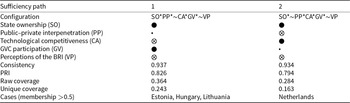
On the other hand, countries that allow a limited scope of government intervention within ISMs are associated with two sufficiency paths (Table 6). The first path is a complex solution combining countries that have broad sectoral state ownership, strong formal public–private interpenetration within SOE governance, low technological competitiveness, high integration with GVCs, and positive perceptions of China's BRI. With the exception of formal public–private interpenetration within SOE governance, all conditions are considered core conditions. This set of conditions suggests that a limited scope of government intervention is associated with countries that can already rely on some investment protection by holding majority stakes in strategic companies. In this configuration, broad state ownership appears alongside low technological competitiveness, high GVC integration, and more positive views of the BRI, suggesting that ownership-based control may reduce the perceived need for broad discretionary screening when innovation-protection concerns and geopolitical threat perceptions are less salient. This configuration characterizes Estonia, Hungary, and Lithuania. In these countries, broad sectoral state ownership provides a baseline level of protection, while positive or accommodating views of Chinese investment and deep global integration reduce incentives for broad discretionary screening.
Sufficiency paths for a limited scope of government intervention in ISMs

Table 5 Long description
Two sufficiency paths are reported in columns. Conditions present are marked with a filled circle and conditions absent with a crossed circle; large symbols mark core conditions and small symbols peripheral ones. Path 1, SO*PP*∼CA*GV*∼VP: public–private interpenetration and GVC participation present and technological competitiveness and negative BRI perceptions absent, all core; state ownership is present as peripheral; consistency 0.937, PRI 0.826, raw coverage 0.364, unique coverage 0.243; cases Estonia, Hungary, and Lithuania. Path 2, SO*∼PP*CA*GV*∼VP: state ownership and technological competitiveness present and interpenetration absent, all core; GVC participation present and negative BRI perceptions absent as peripheral; 0.934, 0.794, 0.284, 0.163; case: the Netherlands. Solution consistency 0.924; solution coverage 0.527.
Note: ● = condition present, ⊗ = condition absent; large symbols mark core conditions, small symbols peripheral conditions; a blank cell marks an irrelevant condition. Solution consistency 0.924; solution coverage 0.527.
The second sufficiency path combines broad state ownership, weak formal public–private interpenetration and high technological competitiveness as core conditions, with high participation in GVCs and positive perceptions of the BRI operating as peripheral conditions. The Netherlands exemplifies this configuration. Despite its strong innovation performance, positive perceptions of Chinese investment and deep GVC embeddedness are associated with a comparatively limited screening scope. The Dutch case may illustrate that technological competitiveness does not automatically translate into extensive screening; its effect appears to depend on how it combines with ownership structures, governance linkages, GVC integration, and geopolitical perceptions. All the sufficiency paths have been tested against two additional conditions: geographic proximity to Russia and US security alignment. In both cases, the three extensive-scope paths and the two limited-scope paths remain stable (see Supplementary Annex 1).
Comparing the sufficiency paths and theoretical insights
From the QCA empirical analysis, we can derive some theoretical interpretation and insights when comparing the different sufficiency paths that lead to an extensive or limited scope of government intervention in ISMs in the context of OECD countries. First, the QCA analysis lends support to the argument that domestic political-economy features, such as the sectoral breadth of state ownership and formal public–private interrelations within SOE governance, in combination with other domestic and international factors, such as different perceptions of China's BRI, can be empirically significant in explaining different levels of government intervention in ISMs. This suggests that it is the configurational interplay between domestic and international conditions that shapes national approaches to investment screening.
More specifically, configurations combining narrow sectoral state ownership, strong formal public–private interpenetration within SOE governance, high innovation competitiveness, and negative perceptions of China's BRI are most consistently associated with an extensive scope of government intervention in ISMs. This pattern suggests that, where ownership-based control is limited, governments may rely more heavily on regulatory and discretionary screening instruments. These patterns are further reinforced when countries possess valuable technological assets and frame Chinese investment primarily through a negative lens, making investment screening a salient tool of economic security. Importantly, even in contexts characterized by strong formal SOE-governance linkages, governments may still expand screening authority when ownership-based protections are perceived as insufficient. In theory-building terms, this supports a regulatory compensation hypothesis: countries with narrow sectoral state ownership may be more likely to develop extensive ISM powers when technological competitiveness, formal SOE-governance interpenetration, or negative geopolitical perceptions make foreign acquisitions politically or strategically sensitive.
By contrast, a limited scope of government intervention tends to emerge in configurations characterized by broad sectoral state ownership, often combined with strong or weak formal public–private interpenetration within SOE governance, deep GVC integration, and positive perceptions of the BRI. In these contexts, countries appear to rely primarily on ownership structures and corporate governance arrangements to safeguard strategic assets, reducing the perceived need for expansive discretionary screening. Positive or accommodating views of Chinese investment further reinforce an orientation toward economic openness, even in highly integrated economies. Taken together, these patterns suggest that ownership-based control and regulatory screening may operate, in some configurations, as partially substitutable instruments within broader national strategies of economic governance. This generates a second ownership-based protection hypothesis: countries with broad sectoral state ownership may be more likely to maintain limited ISM intervention when ownership structures already provide channels of strategic control, especially where GVC integration and more positive geopolitical perceptions reinforce openness.
The United States provides a useful illustration of the regulatory-compensation hypothesis. In the US case, sectoral state ownership is narrow, meaning that the federal government does not rely extensively on direct ownership of strategic firms to control sensitive sectors. At the same time, the United States is highly technologically competitive and contains firms operating at the frontier of advanced technologies, digital infrastructure, defense-related industries, artificial intelligence, semiconductors, and data-intensive sectors (Schmidt, Reference Schmidt2022; Singh et al., Reference Singh, Sargent and Sutter2023). These technological assets increase the perceived strategic stakes of foreign acquisition. In addition, negative perceptions of China's BRI and broader concerns about Chinese state-linked investment have contributed to framing foreign investment screening as a matter of economic and national security. The trajectory of US legislation makes this connection explicit. The Foreign Investment Risk Review Modernization Act (FIRRMA), adopted in 2018, substantially expanded the jurisdiction of the Committee on Foreign Investment in the United States, extending review to investments in businesses involved with critical technologies, critical infrastructure, and sensitive personal data. This expansion was tightly linked to growing concern over Chinese investment in precisely those industries in which the pre-existing screening mechanisms gave the federal government limited oversight (Meunier, Reference Meunier and Chaisse2019; Carrai, Reference Carrai2020; Bauerle Danzman and Meunier, Reference Bauerle Danzman and Meunier2023a). In this context, extensive screening powers can be interpreted as a regulatory substitute for limited ownership-based control. Rather than protecting strategic sectors primarily through public ownership, the US relies on discretionary screening authority to scrutinize, condition, or block foreign acquisitions considered sensitive. The US case may therefore illustrate how narrow state ownership, when combined with technological competitiveness and geopolitical concern, can generate strong incentives for extensive government intervention in ISMs.
Where the US compensates for limited public ownership with expansive regulatory discretion, the Netherlands combines a different mix of conditions and arrives at the opposite outcome. The Dutch case provides a useful illustration of the ownership-based protection hypothesis. Unlike countries that rely primarily on discretionary screening powers, the Netherlands combines comparatively broader state ownership across network and infrastructure sectors with deep integration into global value chains and a generally openness-oriented economic model. In this configuration, ownership structures and corporate-governance arrangements may already provide channels for safeguarding strategic assets, reducing the perceived need for highly expansive screening powers. At the same time, the Netherlands’ strong embeddedness in international production networks reinforces the economic value of maintaining openness to foreign investment (OECD, 2025). More positive or accommodating perceptions of Chinese investment further support a less interventionist approach. Read alongside the US case, the Netherlands therefore supports the broader claim that ownership-based control and regulatory screening can operate as partially substitutable instruments of strategic economic governance, with the substitution logic operating in opposite directions across the two cases.
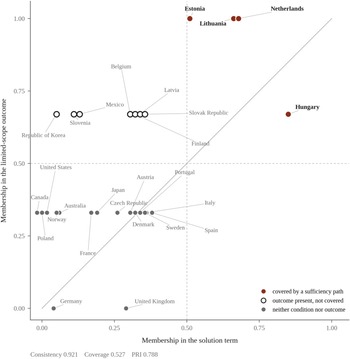
These two illustrative cases bring into focus the configurational logic underlying the QCA results. The distribution of cases in the solution plots provides further support for this interpretation, while also indicating the limits of the analysis. Figures 1 and 2 illustrate the empirical distribution of the QCA results for solutions leading to either an extensive or limited scope of government intervention, respectively. Countries in the upper-right quadrant are those covered by the solutions, while those in the lower-left quadrant represent irrelevant cases; the closer countries are to the top corner of the upper-right quadrant, the more empirically significant they are. Cases in the upper-left quadrant are not covered by any sufficient combination, while those in the lower-right quadrant are considered deviant (Oana et al., Reference Oana, Schneider and Thomann2021). The greater the number of cases in these last two quadrants, the less explanatory power the sufficiency paths have. On this basis, the United Kingdom, the United States, France, Japan, Austria, and Australia appear as the most relevant cases for an extensive scope of government intervention, while the Netherlands, Estonia, and Lithuania are more closely associated with a limited scope. At the same time, both graphs show several cases that remain unexplained: Italy, Germany, and Sweden in Figure 1, and Belgium, Latvia, and the Republic of Korea in Figure 2. These unexplained and deviant cases are analytically important because they identify where the current exploratory framework reaches its limits, suggesting that future research should examine additional conditions such as sector-specific technology exposure, administrative capacity, party politics, alliance dynamics, the maturity of the screening regime itself, or more fine-grained security-threat measures.
Distribution of cases for the extensive-scope solution.

Figure 1 Long description
A square scatterplot. Both axes run from 0 to 1 and are labeled at 0, 0.25, 0.50, 0.75, and 1. A diagonal line marks perfect consistency with sufficiency and dashed lines mark the 0.5 crossover on each axis. Each of the 27 countries is a single marker. Eight countries lie in the upper-right quadrant and are covered by a sufficiency path: the United States (0.82 and 0.67), France (0.76 and 0.67), the United Kingdom (0.67 and 1.00), Japan (0.67, 0.67), Austria (0.67, 0.67), Australia (0.67, 0.67), Denmark (0.63, 0.67), and Canada (0.57, 0.67). Eight display the outcome but are not covered in the upper-left quadrant: the Czech Republic (0.43), Sweden (0.38), Italy (0.33), Germany (0.18), Spain (0.14), Norway (0.09), Portugal (0.00), and Poland (0.00, all with outcome 0.67 except Germany at 1.00. The remaining 11 fall in the lower-left quadrant. No case is deviant for consistency. Consistency 0.956, coverage 0.514, PRI 0.908.
Distribution of cases for the limited-scope solution.

Figure 2 Long description
A square scatterplot. Both axes run from 0 to 1 and are labeled at 0, 0.25, 0.50, 0.75, and 1. A diagonal line marks perfect consistency with sufficiency and dashed lines mark the 0.5 crossover on each axis. Each of the 27 countries is a single marker. Four countries lie in the upper-right quadrant and are covered by a sufficiency path: Hungary at 0.85 and 0.67, the Netherlands at 0.67 and 1.00, Lithuania at 0.67 and 1.00, and Estonia at 0.51 and 1.00. Seven display the outcome but are not covered in the upper-left quadrant: the Slovak Republic, Latvia, Finland, and Belgium each at 0.33, Mexico at 0.13, Slovenia at 0.11, and the Republic of Korea at 0.05, all with outcome 0.67. The remaining 16 fall in the lower-left quadrant. No case is deviant for consistency. Consistency 0.921, coverage 0.527, PRI 0.788.
Conclusion
The starting point of this study was the observation that countries adopt different designs of ISMs, reflecting how they balance the pursuit of open and integrated economies with the need to ensure security in the face of potential political and economic threats. Depending on how this balance is managed, ISMs vary in several design features, one of the most consequential being the extent to which governments retain discretionary authority to intervene in screening processes. While previous studies have identified a range of domestic and international factors influencing such differences, this study has integrated some of them into an exploratory configurational analysis, asking whether they combine into recurring pathways associated with either an extensive or a limited scope of government intervention. By employing a QCA, the study identifies multiple sufficiency paths and thus highlights the equifinal nature of ISM design, whereby similar institutional outcomes can arise from different combinations of domestic and international conditions. Distinguishing between core and peripheral conditions further enables an assessment of how political–economic structures and external pressures may interact in shaping investment screening.
The results do not point to any single condition as the explanation for cross-national variation in ISM design. Instead, they reveal several recurring configurations in which domestic conditions combine with international factors to form pathways associated with different scopes of government intervention. More specifically, narrow state ownership, sometimes combined with strong formal SOE-governance interpenetration, high technological competitiveness, and negative perceptions of the BRI, is associated with an extensive scope of government intervention. In these contexts, governments appear to compensate for limited ownership-based control by expanding the scope of investment screening as a tool of economic security and industrial policy, particularly to protect technological advantages and to address concerns about China's growing presence. By contrast, broader sectoral state ownership, when combined with other conditions, is often associated with a limited scope of government intervention in ISMs. Direct ownership may provide a baseline level of protection and thereby reduce the need for broad discretionary screening, a tendency that is especially evident in countries deeply integrated into global value chains and holding more positive views of China's BRI, where economic openness and integration are more strongly prioritized. Based on these results, these patterns generate two theory-building hypotheses for future research: first, that narrow ownership-based control may encourage regulatory compensation through more extensive ISM powers; and second, that broad ownership-based control may reduce reliance on expansive screening where alternative channels of strategic control already exist.
By exploring these alternative pathways, this study highlights the diversity of institutional responses to contemporary geoeconomic pressures, with implications beyond investment screening. ISMs are increasingly deployed alongside export controls, technology transfer restrictions, and outbound investment review mechanisms as part of a broader and integrated toolkit of economic statecraft (Lenihan, Reference Lenihan2018; Meunier, Reference Meunier2025). The configurations identified in this study, particularly the role of ownership structures and BRI perceptions, may offer analytical leverage for understanding how states design and combine these adjacent instruments more broadly. At the same time, the study contributes to broader debates on how states adapt economic governance in times of polycrisis.
However, this study is not without limitations. The configurational logic identifies structural propensities rather than deterministic outcomes, and the analysis speaks to how ISMs are designed rather than to which instrument a government selects in a given crisis. The 2025 Nexperia dispute is illustrative in this regard: even though the Dutch ISM framework is classified here as one of limited scope, the Dutch government nonetheless intervened decisively when domestic strategic concerns over semiconductor technology and external US pressure converged on a single firm (Demertzis, Reference Demertzis2026). It did so, however, under the Goods Availability Act rather than through the screening mechanism (Government of the Netherlands, 2025). The export restrictions on ASML's sales to China are a second instance of the same logic, running through export controls and licensing rather than inbound investment review (Svoboda, Reference Svoboda2025). Neither episode contradicts the classification adopted here, but both suggest that where screening scope is limited, governments under acute pressure may reach for adjacent tools, making the instruments of that toolkit, to some degree, functionally substitutable.
Several cases also remain unexplained by the identified configurations, and some pathways display lower consistency, pointing to the need for further research. Future studies could incorporate additional conditions, including the maturity of screening regimes, extend the analysis over time, and combine configurational approaches with in-depth case studies to further unpack the politics of investment screening. Overall, this study seeks to lay the groundwork for a more systematic and comparative research agenda on ISMs and their role in the evolving landscape of economic statecraft.
Funding
The research for this paper was funded by the NextGenerationEU – Mission 4 – C2 PRIN-PNRR 2022 P2022YBXC5, CUP D53D23022520001, “Recasting the national interest in Europe. Institutions, politics, and policies for the defense of critical infrastructures and supply chains.”
Data
The replication dataset is available at https://dataverse.harvard.edu/dataset.xhtml?persistentId=doi:10.7910/DVN/HSJG2D.
Supplementary material
The supplementary material for this article can be found at https://doi.org/10.1017/ipo.2026.10100.
Acknowledgements
Earlier versions of this article were presented at the workshops “Recasting the National Interest in Europe” (Bologna, January 27–28, 2025) and “Policy and Institutional Change in Uncertain Times” (University of Bologna, November 2025). We thank the organizers and participants of both workshops, as well as the editors and anonymous reviewers, for their comments.
Competing interests
The authors declare none.







 Open access

