Introduction
Human capital theory claims that in modernity the attributes of persons are crucial for the economic success of individuals as well as of societies. In the case of the Arabian Gulf countries, their abundant mineral resources have also led to wealth. However, within a predictable period of time these resources will vanish, and as past experience has shown, wealth gained by the exploitation of mineral resources has rarely led to sustainable growth (e.g. in Spain and its colonies in the 15th to 17th centuries; Landes, Reference Landes1998).
Human capital, however, differs in that it leads to enduring growth, but what is ‘human capital’? On closer inspection of theories and research (Mincer, Reference Mincer1958; Schultz, Reference Schultz1961; Barro, Reference Barro1991; Becker, Reference Becker1993/1964; Heckman, Reference Heckman2000), two main psychological traits emerge. The first is cognitive ability (synonymous with ‘cognitive competence’, in economics frequently known as ‘cognitive skill’), comprising the ability to think (intelligence), knowledge (the asset of true and relevant knowledge) and the intelligent use of this knowledge. A broad concept of ‘intelligence’ also includes knowledge aspects in the form of so-called ‘crystallized intelligence’. The second is a personality dimension standing for industrious discipline (diligence, commitment, conscientiousness, self-discipline, self-monitoring, agreeableness, robustness). Additionally, physical (e.g. health, eyesight, hearing ability), personality/attitudes (e.g. agreeableness, morality, assertiveness) and non-cognitive competence (e.g. social competence) attributes are relevant in the working process, but less for predicting and explaining differences in job achievement and economic success.
A growing body of research shows that cognitive ability strongly contributes to an individual's and a nation's wealth (Hunt, Reference Hunt1995; Murnane et al., Reference Murnane, Willett and Levy1995; Schmidt & Hunter, Reference Schmidt and Hunter1998; Gottfredson, Reference Gottfredson and Nyborg2003; Lynn & Vanhanen, Reference Lynn and Vanhanen2006; Jones, Reference Jones2011). However, cognitive ability changes not only individual productivity, but in a more global sense general lifestyles (Oesterdiekhoff & Rindermann, Reference Oesterdiekhoff and Rindermann2007; Rindermann & Meisenberg, Reference Rindermann and Meisenberg2009; Pinker, Reference Pinker2011) and the functionality of institutions, governments and politics, leading to the so-called economic system ‘cognitive capitalism’ (Rindermann, Reference Rindermann2012).
Modernization of economy and society will lead to an increase in cognitive demands (Hunt, Reference Hunt1995). Routine production services will diminish; symbolic–analytic services will grow (Reich, Reference Reich1991). As research and development become more important, an intellectual, well educated, highly motivated creative class operating on a high cognitive level is necessary for competitiveness. Empirical research shows that even at already high levels of intelligence, higher cognitive ability counts, especially in the complex STEM fields (science, technology, engineering and maths). For example, smarter persons have a higher probability of receiving a doctorate and securing tenure at a top-50 US university, publishing more scientific papers and developing more patents (Wai et al., Reference Wai, Lubinski and Benbow2005; Park et al., Reference Park, Lubinski and Benbow2008).
The Arabian Gulf countries have recognized these challenges. They have tried to diversify their economies, and, more importantly, improve their educational systems. New universities have been founded, several in conjunction with leading American and European universities. Today school enrolment has reached nearly 100%, class sizes have been reduced, more than 90% of an age cohort reach grade 5 (still a very low aim), more than two-thirds attend secondary school, average years of schooling have increased and teachers receive a more modern education (UNDP & Arab Fund for Economic and Social Development, 2003; World Bank, 2008). In the last generation all Arab countries have made significant progress in primary to tertiary school enrolment, especially for girls and women. Adult literacy rates increased from about 40–50% in 1970 to 70–95% in 2003.
The Arab countries participate in international student assessment studies, but the results are both surprising and sobering. The increases in the school enrolment rates and numbers of years of schooling have not led to sufficient competence acquisition (World Bank, 2008). In PIRLS 2001 (reading literacy of 4th graders) oil-rich Kuwait achieved 396 points. This compares with around 500 points for European countries (on a student assessment scale [SAS] with mean=500, SD=100). Even a poor country such as Iran with SAS=414 has higher scores; the Kuwait result is much too low for such a wealthy country. The same is true for TIMSS 2003 (mean of mathematics and science in 8th grade): students in wealthy Saudi Arabia (SAS=365) and Bahrain (420) are not notably superior to those from poor Morocco (392), Tunisia (407), Palestine (413), Lebanon (413), Iran (432) and Jordan (450). In psychometric intelligence tests the mean across different Arab countries is around IQ 83, and for the UAE IQ is between 83 and 87 (Lynn & Vanhanen, Reference Lynn and Vanhanen2006, updated). Wealthy or not, the educational achievement and cognitive competence levels are not sufficient for a modern economy.
One Emirate of the United Arab Emirates (UAE), Dubai, participated in TIMSS 2007 and PISA 2009. The percentage of immigrants among school students is extremely high (TIMSS, 4th grade: 83%, 8th grade: 80%, PISA: 71%) and their results are much higher than those of Dubai nationals (TIMSS means in mathematics and science, 4th grade: 407 vs 470, 8th grade: 418 vs 493; PISA 2009 reading: 395 vs 490). Transformed to an IQ scale (mean=100, SD=15; without further corrections) the natives' values correspond to an IQ of 86. This is far too low for success in a knowledge economy. The pattern of results across various Arab and Muslim countries (from north-west Africa to the Middle East) is confirmed by other educational indicators used by the Arab Human Development Report (UNDP & Arab Fund for Economic and Social Development, 2003). For instance, the number of published books is low (‘In 1991, Arab countries produced 6,500 books compared to 102,000 books in North America, and 42,000 in Latin America and the Caribbean,’ p. 77), and among them are many on religious topics. Teaching too often is based on ‘rote learning, which is not especially conducive to critical thinking,’ (p. 53). The UAE reports criticize the poor teaching quality in Emirati schools for turning students off science (Makhmasi et al., Reference Makhmasi, Zaki, Barada and Al-Hammadi2012). This is confirmed by Arab university professors. In 2010, the first author of this paper spoke with the Dean of an internationally recognized Saudi Arabian university. He was told that university professors need around two years to ‘cure’ their students of superficial learning (e.g. passive memorization) and to develop comprehensive learning and active problem-solving styles.
Finally, in many Arab countries the potential of girls and women is not used. Contrary to expectations, boys did not achieve better results in maths than girls (Dubai, TIMSS 2007, 4th grade: boys 438 vs girls 452; 8th grade: 461 vs 461). A similar pattern (favouring girls) is found in the majority of Arab and Muslim countries: Kuwait, Qatar, Bahrain, Yemen, Egypt, Jordan, Saudi Arabia, and Palestine, Kazakhstan, Iran, Malaysia and Indonesia, not or mixed in Morocco, Algeria, Lebanon, Syria and Tunisia (Mullis et al., Reference Mullis, Martin and Foy2008, p. 58f). Therefore, women could be a valuable resource for future achievement in STEM fields. Policies in Arab countries are changing. The UAE, especially, are investing greatly in the education of the future workforce, and in many Gulf countries women form the majority of students at universities.
The aim of this study was to measure the ability of Emirati engineering students compared with their German counterparts. In case of differences, it was attempted to identify possible causes and to provide recommendations for supporting competence acquisition.
Methods
Participants
Thirty engineering students from the UAE and 30 from Germany (Gröper, Reference Gröper2011) participated in the study. Half of the Emirati students were men and half were women (both N=15); among the German students 77% were men and 23% were women. The Emirati students were intentionally selected (by the responsible Arab organizer of a student internship programme at a German information technology company) for equal sex distribution. The German students also participated as trainees in the same company, and there was an unequal sex distribution among these engineering students.
Of the Emirati students, five (17%) spoke two languages at home (Arabic and one other; an indicator of migration background), and of the German students two (7%) spoke two languages at home. Students in the Emirates could only participate in the internship programme if they were Emirati nationals. It was the aim of the programme to reduce the dependency of Emirati economics on ‘expat’ (expatriate) foreign experts, and change the economy from a rentier mode of production to a knowledge-based one. Therefore, the expertise of all Emirati students should be fostered. Thus, the Emirati internship programme can be regarded as double ‘affirmative active’, namely, favouring girls and favouring Emirati natives.
No evidence exists that the Emirati or German internship students were more selected from their general age cohort or from the cohort of university students. However, the Emirati engineering students had to pass an assessment centre test (selected for grades, minimum 3.0 or B, English and communication skills, but without intelligence testing). The internship project should have a touch of an ‘elite’ programme. Nevertheless, the validity of the assessment centres for selecting for competence is weak, especially if cognitive ability tests are not applied (Schmidt & Hunter, Reference Schmidt and Hunter1998). Consequently, there is only weak evidence that the Emirati engineering students were more strongly selected from the total Emirati engineering sample than the German engineering students. Since at least weak and very weak students (in grades and English skills) were not admitted to this study, both the Emirati and German trainees probably represent groups that were somewhat positively selected towards achievement (compared with all engineering students). Both groups consisted of undergraduate students, not graduate engineers. They could represent the final level of engineer graduates.
The mean age of the students was 22.35 years (SD=2.01, range 19–29 years). The Emirati students were somewhat younger (males by 5 months; females by 14 months), women about one year in both samples. The majority had completed around 60% of their studies (mean=6.72 semesters, SD=3.04). Since at German universities the language of instruction is German, whereas in the UAE it is only or predominantly English, the Emirati students were more familiar with the English language.
Measures
Students completed a biographical questionnaire (in English) asking age, sex, number of semesters studying at university, educational level of parents (educational level: none, high school, university), number of books their parents owned, number of books the student owned and level of appreciation of education by the parents (subjective importance of education on a 7-point Likert scale from ‘much less important than average’ to ‘extremely more important than average’).
To measure cognitive ability, the Cognitive Abilities Test (CogAT, Level H, Form 6; Lohman & Hagen, Reference Lohman and Hagen2001) was used. The CogAT is a test with tasks adapted to grade level. Its Grade 12 version is sufficiently demanding to measure the ability of university students. The test consists of two scholastic scales (Verbal, Quantitative/Numerical) and one non-scholastic scale (Non-Verbal/Figural), enabling the measurement of competences necessary to study at universities in cross-cultural comparisons, but with one exception: the Verbal scales were estimated as being too difficult for second-language speakers and, therefore, were not used in this study. From the Quantitative dimension two scales were chosen: quantitative relations (arithmetic and geometric tasks and equations, e.g. ‘3+4= and 4+3, left greater, right greater or equal?’) and number series (series of numbers have to be completed, e.g. ‘–2, –4, –8, –16, ?’). From the Figural dimension three scales were chosen: figure classification (like series of numbers, but with figures, e.g. ‘what fits to ♦ ♥ ♠ …; A ♣ B Δ C O D ⊗ E ∅?’), figure analogies (finding a relation between two figures and transferring it to a new pair of figures, e.g. ‘Δ : Δ=o:…; A ♣ B Δ C O D ⊗ E ∅?’) and figure analysis (mental rotation with folded sheets of paper with holes punched in: ‘When unfolded, how many holes are there and where are they?’).
The numerical CogAT scales are not solvable without knowledge and competences acquired at school (e.g. calculating with fractions, brackets and geometric areas). The Numerical dimension is a good indicator of crystallized (school-near, scholastic) intelligence in maths, highly relevant in engineering. The Figural dimension is indicative of fluid intelligence, including mental rotation. Both are necessary for the successful study of engineering and for successful job performance in this field. The sum value is an indicator of broader ‘intelligence’ (including knowledge of mathematics acquired at school and taught at university) or ‘cognitive ability’, with a strong focus on general reasoning, not acknowledging verbal intelligence. The mathematics scales are nearly language free; some minimal language is necessary for describing the tasks, but the number series scale and all figural tasks are completely free of language (except for the instruction, which all participants understood).
The figural scales were summed and normed according to the norms for US Grade 12 students and transformed to an IQ scale (mean=100, SD=15). Since only two of the three quantitative scales were administered, the norms indicated in the manual could not be used. However, the test authors provided means and standard deviations of a sum of both scales applied from the same norm sample (transformed to IQ scale). For the CogAT sum value, both scale means were averaged.
The norms required two corrections: first, for Grade 12 selection effects in the US, and second, for adapting to the internationally used UK-Greenwich norm.
Grade 12 selection effects
The CogAT was normed using US high school students in Grade 12. However, not all young men and women in the US attain Grade 12. Since it is highly probable that those attending school are positively selected for higher levels of intelligence, and since school itself fosters intelligence (Ceci, Reference Ceci1991), the norm sample showed a higher ability level compared with the total age sample; consequently, a downward correction is necessary. The US Department of Education (Miller et al., Reference Miller, Warren and Owen2011, Table 2-1 p. 11) reports that 81% of US 15- to 19-year-olds are enrolled in formal education. However, it cannot simply be assumed that the bottom 19% of the intelligence distribution are not attending school, because some intelligent ones will not attend and, additionally, around 1–3% are home-schoolers (NCES, 2008). Thus, a more cautious estimation procedure was chosen in a simulation: from a normal distribution with IQ mean 100 and standard deviation 15, the percentile ranks 1 (to 2), 4 (to 5), 7, 10, 13, 16, 19, 22, 25, 28, 31, 34, 37, 40, 43, 46, 49, 52 and 55 were deleted. This resulted in an IQ gain for the remaining sample of 2.40 IQ points (mean=102.40). Thus, it was estimated that the selective effect of the CogAT norm sample is equivalent to 2.40 IQ points. To come to national norms it would be necessary to subtract from the CogAT norms 2.40 IQ points. Consequently, for German and UAE students, 2.40 IQ points were added.
UK-Greenwich norm
Following Rindermann and colleagues (Reference Rindermann, Sailer and Thompson2009), who used student assessment tests (TIMSS, PISA and PIRLS), the UK has a mean IQ of 100 (Greenwich-IQ as surveyors benchmark) and the USA 98 (‘exactly’ 1.59 IQ point difference). The same result is found using Lynn & Vanhanen's (Reference Lynn and Vanhanen2006) IQ collection, and the pattern remains unchanged if recently published updates are used (e.g., Lynn & Meisenberg, Reference Lynn and Meisenberg2010). In more recently performed analyses and re-standardizations of student assessment results (not published), including PISA 2009 and a data set from Hanushek & Woessmann (Reference Hanushek and Woessmann2008), the difference is reduced slightly to 1.43 points. Thus, the best guess for the UK–US difference is 1.51 IQ points (mean of 1.59 and 1.43 IQ). In order to express the IQs in the British Greenwich-IQ, 1.51 IQ points were subtracted.
A correction for secular rise in intelligence was not applied. Such a correction would not affect the difference between UAE and German engineering students. The CogAT norming was done with a sample drawn in the year 2000. According to US-NAEP results (National Assessment of Educational Progress study; Rampey et al., Reference Rampey, Dion and Donahue2009) the group of older students (17-year-old students, NAEP scale converted to the IQ scale) did not achieve any improvement in the 21st century (from 1999 to 2008: −0.75 IQ points). Thus any Flynn correction is not necessary.
Statistical analysis
Raw and IQ means and standard deviations for Emirati and German, and male and female, students are presented. Because of the unequal sex and age distributions, partial correlations between country and intelligence controlling for sex and age were used. Finally, a causal analysis was performed in order to explain differences in cognitive ability statistically, using as predictors country (Emirates/UAE=0, Germany=1), sex (female=0, male=1), educational level of parents, parents' number of books and student's number of books (all information from the biographical questionnaire). For the analyses, SPSS 20.0 and Mplus 5.21 were used. Correlations were added (shown in parentheses after the beta values). ‘Good’ values for fit indices (if models are not saturated) are SRMR≤0.05 and CFI≥0.97, and an ‘acceptable’ fit is reached with SRMR≤0.10 and CFI≥0.95.
Results
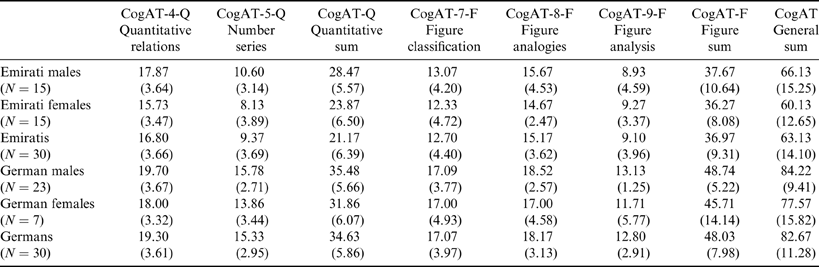
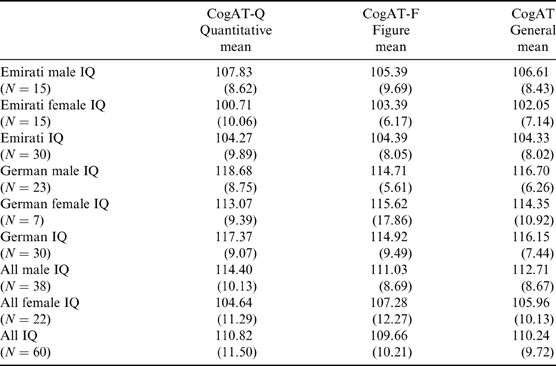
Both groups solved more CogAT tasks than the US average (Tables 1 and 2). However, German engineering students solved more CogAT tasks than Emirati engineering students (Table 1). The difference in the sum raw value is about d=1.54. The pattern was similar for male (18 raw points) and female students (17 raw points). In both nations, male students perform better than female students (7 and 6 raw points). Transformed to IQ values (Table 2), the difference between German and Emirati students reaches (rounded) 12 IQ points: 10 IQ points for men, and 12 IQ points for women.
Raw mean (SD) scores, German and Emirati engineering students

CogAT: Cognitive Abilities Test (Lohman & Hagen, Reference Lohman and Hagen2001); CogAT-Q: Quantitative tests; CogAT-F: Figural tests (Non-verbal); CogAT-4: test scale 4.
Overview of mean (SD) IQ results, German and Emirati engineering students
CogAT: Cognitive Abilities Test (Lohman & Hagen, Reference Lohman and Hagen2001); CogAT-Q: Quantitative tests; CogAT-F: Figural tests (Non-Verbal); IQ based on US-norms transformed to an unselected US age level IQ and then to the British norm level (Greenwich-IQ).
The IQ range of the German students was 102 to 134 IQ points, and that of the Emirati students was 86 to 124 IQ points. Among the German students, fifteen (50%) had an IQ of 115 or higher (SAS≥600/IQ≥115; according to Hanushek & Woessmann, Reference Hanushek and Woessmann2008, the minimum level for ‘rocket scientists’); among the Emirati students the number was 3 (10%). The IQ level of ‘global performers’, which is 119 IQ points (SAS≥625/IQ≥118.75; Pritchett & Viarengo, Reference Pritchett, Viarengo, Hausmann, Austin and Mia2009), was met by eleven German students (37%), and by one Emirati (3%). Using the ‘intellectual class’ minimum level of Rindermann et al. (Reference Rindermann, Sailer and Thompson2009; IQ≥125), three German students (10%), but no Emirati student, achieved this level.
In the correlational analysis, country highly correlated with IQ (Quantitative, Figural, General: r C-Q=0.58, r C-F=0.52, r C-G=0.61), sex correlated less with IQ, but was still marked (r S-Q=0.41, r S-F=0.18, r S-G=0.34), and age did not correlate at all, or very little, with IQ (r A-Q=0.10, r A-F=0.02, r A-G=0.07). Partialling out sex (there were more women among Emiratis) and age (Emiratis were younger) hardly changes the correlations with country (r PC-Q=0.54 [r Diff=–0.04], r PC-F=0.51 [r Diff=–0.01], r PC-G=0.59 [r Diff=–0.02]). Thus the German–Emirati difference does not depend on sex and age sampling imbalances.
German parents had a higher educational level (r=0.28), owned more books (r=0.37, M G=201 vs M E=109), but did not show more appreciation of education (Emirati parents appreciated education more, as rated by their adult children: r=–0.43). German students owned more books (r=0.23, M G=102 vs M E=40). The correlations with students' IQ (CogAT general mean) were (in parentheses, partialling out country, sex and age): r EduP-IQ=0.16 (r P=0.02), r BookP-IQ=0.30 (r P=0.13), r BookS-IQ=0.23 (r P=0.12) and r EstEd-IQ=–0.35 (r P=–0.12). Higher appreciation of education showed a robust, but not plausible, negative correlation with cognitive ability. Most probably, this self-rating measure was not valid; answers seemed to depend on frames of reference or wishful thinking.
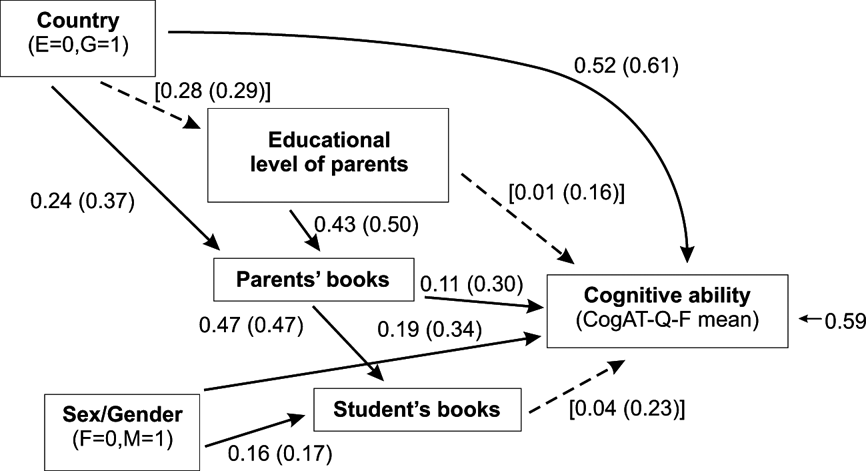
A path analysis was conducted in order to explain differences in cognitive ability (see Fig. 1). Country showed the strongest effect (direct: β C→IQ=0.52, r=0.61; total β Ct→IQ=0.55), followed by sex (β S→IQ=0.19, r=0.34) and parents' number of books (β BookP→IQ=0.11, r=0.30). Adding a direct path from parental educational level to CogAT would have no effect (β EduP→IQ=0.01, r=0.16); similarly, the effect of students' number of books would be negligible (β BookS→IQ=0.04, r=0.23). Adding a path from country to parental educational level would result in an important effect of β C→EduP=0.28 (r=0.29), but the variance explained in cognitive ability remains unchanged (and the fit of the model would decrease to CFI=0.93, SRMR=0.07; using the structural equation modelling program LISREL for comparison results in a similar outcome).
Path analysis with standardized path coefficients (β), with correlations (r) in parentheses, for Emirati and German engineering students (N=60, Full Information Maximum Likelihood/FIML, Comparative Fit Index/CFI=1.00, Standardized Root Mean Square Residual/SRMR=0.03).
For a better understanding of the effects in ‘everyday life units’, the raw values were also looked at. Country (being a German engineer student) adds 11 IQ points, sex (being male) 4 IQ points and books (having more than 1000 parental books) 1 IQ point. German parents had 46 more books. A higher educational level of parents (e.g. one level higher, university vs high school) was associated with parents owning 115 books more. Men had 67 books more than women (the pattern was identical for Emirati vs German students: men owned roughly double the number of books). Ten more parents' books translated into four more books of their studying children. Why nationality has such a large impact on cognitive ability could not be explained by this model.
Discussion
Validity of results
The results are astonishing. It is remarkable that university students are enrolled in engineering with a mean IQ of around 104 (Emirati) and 116 (Germans). In the Emirati sample, eleven of the 30 students (37%) had IQs below 100. How is it possible to study engineering at university with a cognitive ability in maths and general reasoning of less than 100? What kind of work can be accomplished at this level? Can professors successfully teach students with these low IQ levels the various cognitively demanding subjects, ranging from maths to technology, physics to chemistry? Will university admission committees let them graduate? Will professors give them certificates? And what about the other Emirati students who were not admitted to this kind of gifted programme? Are the statistics (or their corrections) wrong? Are the tests biased?
Three arguments back the validity of the results. First, both groups lie about one standard deviation above their country means measured in different surveys. The country mean of UAE natives in TIMSS and PISA is around IQ 86 (SAS directly transformed to the IQ scale), and that of German natives in the same studies is IQ 104 (TIMSS 2007, 4th grade maths and science, mean 544; in PISA 2009 reading 511). The Emirati engineering students lie 18 IQ points above this value, and the German ones 12 IQ points. The Emirati engineer difference to the country mean is somewhat higher, reflecting the necessary levels for studying such a complex subject and a possible effect of the selection procedure.
Second, a similar pattern of results was found in samples of South African engineering students (Rushton et al., Reference Rushton, Skuy and Fridjhon2003, Reference Rushton, Skuy and Bons2004). Engineering students at the University of the Witwatersrand with European background (‘Whites’, their ancestors predominantly stemming from the Netherlands and UK) achieved in Raven's Matrices (APM) a mean IQ of 117 (US norms); students studying the same subject at the same university with East Indian background (‘East Indians’, predominantly stemming from India) achieved a mean IQ of 106, and students with African background (‘Blacks’, Zulu, Xhosa and other) achieved a mean IQ of 103. Test validities were similar for all three groups. As well as the Emirati and German engineer ability pattern, the South African engineer ability pattern reflects the mean ability differences in non-selected samples. The mean result of South African 4th grade students in PIRLS reading was SAS=326 (Mullis et al., Reference Mullis, Martin, Kennedy and Foy2007, p. 136; directly transformed to IQ metric 74; Rushton et al., Reference Rushton, Skuy and Fridjhon2003, Reference Rushton, Skuy and Bons2004, report a result of around 70 using psychometric intelligence tests), and British and Dutch students achieved around 100 and 102 in student assessment studies, and India students 88 (the last calculated by using data provided by Hanushek & Woessmann, Reference Hanushek and Woessmann2008). Even lower cognitive abilities of science students are reported from Libya (around IQ 79; Shahomee & Lynn, Reference Shahomee and Lynn2010). Comparatively low ability test results are also reported from other developing and emerging countries (e.g. Bali; Rindermann & te Nijenhuis, Reference Rindermann and te Nijenhuis2012).
Third, universities, their structures and their teaching and grading cultures are based on the given human capital levels in students and in professors. Usually, once admitted, the policy is that students should reach final graduation. If the student selection process is not strictly based on well-founded competence criteria, but also on political ones, or the university has no selection process at all (usually due to political constraints), professors have little chance of establishing a minimum competence threshold based on job profile or subject profile task analyses (e.g. an engineer has to know integral calculus to do their own analyses) within university. Moreover, professors usually also come from former student and graduate samples.
This is not just a special UAE, Arab or emerging country phenomenon. Personal experience backs these claims. The first author of this paper was himself at a German university for one and a half year (2006–2008, Paderborn) working as an interim professor teaching education, giving seven seminars in one term with up to 182 students in each seminar (grading 720 to 960 students each 6-month term). There was no student selection process, and the upper limit of student number attending a course was the subject number per room according to fire department guidelines. There were German students, who wanted to become teachers, who could not master correct spoken or written German and, for instance, confused ‘ethic’ with ‘ethnic’, misspelled the acronym TIMSS as ‘TIMMS’, confused country size with population size, did not understand the principles of experiments, forgot the topic and date of their presentation, lost their certificates (there was no university digitized certification system) and could not master simple mathematics. Smarter students complained about the low level of student presentations, and students leaving seminars after writing their names on attendance lists (and of others actually not being present). However, nearly all the students acquired a degree (of sorts) and went on to become teachers.
The difference in mean IQ between Emirati male and female students (favouring men) contradicts the usual mean difference favouring girls in maths in the UAE and many other Arab countries. In Western countries, boys and men usually achieve better results in maths, and the higher the ability level, the larger the differences (Wai et al., Reference Wai, Cacchio, Putallaz and Makel2010). Especially in technological scales and spatial reasoning, both of which are important for studying and working in engineering, males achieve higher results (Flores-Mendoza et al., Reference Flores-Mendoza, Widaman, Rindermann, Primi, Mansur-Alves and Couto Pena2013). But these differences could be changed (Ceci & Williams, Reference Ceci and Williams2010; Wai et al., Reference Wai, Cacchio, Putallaz and Makel2010). Female students are better adapted to educational institutions, and are more highly disciplined, which leads to a lower female IQ threshold for university study (Flynn, Reference Flynn2012, chapter 6), boosted by affirmative action in the Emirates (Emirati gender difference: 7.12 IQ points; German gender difference: 2.00 IQ points). Rather astonishing and in accordance with the measured ability advantage for male students is their higher number of books possessed.
Finally, the ability level of the German engineering students is lower than expected (IQ 116 vs an expectation of around 120). Informal communication (including an inspection of examination tasks) with a scientist working in the engineer department, where the majority of German engineering students of this sample are studying, revealed that, compared with a generation ago, the level has lowered. The reasons he gave were the low application rates and the absence of a student selection procedure, making it necessary to take applicants who are less qualified.
Causes of the country gap
Why are the ability levels of Emirati engineering students lower than those of comparable German students (and of comparable students with European background in South Africa), mirrored in the ability levels of less or non-selected samples found in TIMSS, PISA, PIRLS and psychometric intelligence test collections? Within education, low pre-school attendance rates, discipline problems at school (skipping school, especially by boys), rote learning and the low educational levels of teachers all contribute (UNDP & Arab Fund for Economic and Social Development, 2003). Within families, low educational and ability levels of parents, especially of mothers, are relevant (and formal certificates do not always correspond to ability levels). The incentive to study hard in a country like the UAE, where nationals retire at the age of 42 years, and many are very rich without having to work, is (instrumental rationally) low. Cultural problems such as authoritarianism within families and school play a role – but culture is subject to change. Genetic differences cannot be excluded, but since no IQ-coding genes explaining intelligence differences have been found, genetic causes are not compellingly verifiable (Rindermann et al., Reference Rindermann, Woodley and Stratford2012).
Suggestions to raise competence levels
Improvements can be recommended to support competence development in Arabian and Gulf countries. PISA, TIMSS, PIRLS and other international reports can provide many hints on general aspects of education in Arab countries (UNDP & Arab Fund for Economic and Social Development, 2003; World Bank, 2008). They indicate that low and short pre-school enrolment, low instructional time, no tracking according to competence and low numbers of books at home are problematic in these states.
Reforms should include more and more cognitively stimulating kindergarten education, more instructional time per day, week and year, central exams, gifted education by tracking according to ability, education for discipline, participation in international student assessment studies, and lifelong education for adults (Rindermann & Ceci, Reference Rindermann and Ceci2009; Zhang & Lee, Reference Zhang and Lee2011). Several studies have shown that cognitive training is helpful (e.g. Irwing et al., Reference Irwing, Hamza, Khaleefa and Lynn2008; Klauer & Phye, Reference Klauer and Phye2008; Rindermann & Baumeister, Reference Rindermann and Baumeister2013), even at the level of university students (Skuy et al., Reference Skuy, Gewer, Osrin, Khunou, Fridjhon and Rushton2002). People should read more books, especially cognitively stimulating books. Children should be authoritatively educated (UNDP & Arab Fund for Economic and Social Development, 2003, p. 3). Educational counselling supports parents and teachers. Migrants, necessary for the economy, educational system and society, should be treated in a reasonable way (right of residence, legal certainty) – in the long run, this benefits the host country most (Brain Gain; Goldin et al., Reference Goldin, Cameron and Balarajan2012). Discriminatory policies or affirmative action usually lead to misallocation of human capital and harm the economy and society (Hunt, Reference Hunt1995; Sowell, Reference Sowell2004). The majority of these suggestions will have strong economic, social and cultural effects, and it is not clear whether such a change is wished or opposed by important subgroups in Arabian societies.
Universities should apply objective written entrance exams identical to those used by established leading universities; they should use competence tests similar to PISA or verbal and numerical intelligence scales. The processing of test results should be done anonymously by external experts. A minimum threshold of IQ 105 (or in SAS 533) should be maintained. The OECD is currently doing a PISA study of adults (Programme for the International Assessment of Adult Competencies, PIAAC), and these could be used along with psychometric IQ test tasks. Final examinations for university certification should be objective central written exams, if possible identical to those used in established leading universities, and graded anonymously by external experts. Schools should have more autonomy, but rewarded for achievement in objective measures (World Bank, 2008). Instruction should include comprehensive learning and active problem solving.
The UNDP Arab Human Development Report (2003, p. IV) has formulated the goal in plain words: ‘Developing an enlightened Arab knowledge model that encourages cognitive learning, critical thinking, problem solving and creativity’. School and educational systems (admission, subjects taught, instruction, grading) should be based on criteria of competence, not on political or ethnical ones. Jobs should be given following competence (Schmidt, Reference Schmidt and Locke2009). Wealth acquisition and reputation should be based on education and competence. Ministers should be selected according to ability. The economy and society should be guided by ‘meritoric’ principles, so that the more able are allocated to the more complicated jobs and demanding educational opportunities rather than positions of supremacy or rule. This would lead to a Singaporean method of schooling, management and government, and would certainly change the culture – but culture will be changed in the long run anyway if these reforms are successful, because nations will develop a well educated middle-class with responsible citizens.