


Captorhinids were a clade of small to medium-sized early eureptiles that became widespread on Laurasia and Gondwana during the Permian. The earliest known member of the group, of small size and with a single-rowed dentition well suited for insectivory, lived in North America during the late Carboniferous (Müller & Reisz Reference Modesto, Fear, Danley and Reisz2005; Reisz et al. Reference Olson2016). Captorhinids radiated during the early Permian, maintaining small forms with a single row of teeth that likely fed on insects or even on smaller tetrapods (e.g., Brocklehurst Reference Brocklehurst2017; Modesto et al. Reference Modesto, Scott and Reisz2018 and references therein), which coexisted with other small to medium-sized forms that developed other food processing styles. Some of those species were omnivorous, with teeth arranged in a single row or with several rows of teeth oblique to the jaw margins (Modesto et al. Reference Modesto, Richards, Ide and Sidor2007; LeBlanc & Reisz Reference Kuhn2015; Brocklehurst Reference Brocklehurst2017; Reisz et al. Reference Olson2020), whereas others were high-fibre herbivores, always with multiple rows of teeth arranged more or less parallel to the jaw margins (Dodick & Modesto Reference Dodick and Modesto1995; Reisz & Sues Reference Olson and Barghusen2000; Modesto et al. Reference Matamales-Andreu, Fortuny, Mujal and Galobart2014, Reference Melchor and Sarjeant2019; LeBlanc et al. Reference Kuhn2015; Brocklehurst Reference Brocklehurst2017). This last group has been classified in a subfamily of their own, the Moradisaurinae de Ricqlès et Taquet, Reference de Ricqlès and Taquet1982.
Moradisaurines showed a wide range of sizes, from very small species with a skull length of about 25 mm (Olson Reference Nyakatura, Allen, Lauströer, Andikfar, Danczak, Ullrich, Hufenbach, Martens and Fischer1970), to medium-sized species with a skull length of about 450 mm (de Ricqlès & Taquet Reference de Ricqlès and Taquet1982; Modesto et al. Reference Melchor and Sarjeant2019). All of them possessed tooth plates with several tooth rows on the dentary and on the maxilla, well suited for high-fibre herbivory (e.g., Dodick & Modesto Reference Dodick and Modesto1995; Reisz & Sues Reference Olson and Barghusen2000; LeBlanc et al. Reference Kuhn2015). In fact, some representatives of both small and medium-sized forms have been inferred to be able to produce a propalinal motion of the lower jaw during food processing (Dodick & Modesto Reference Dodick and Modesto1995; Modesto et al. Reference Modesto, Richards, Ide and Sidor2007, Reference Matamales-Andreu, Fortuny, Mujal and Galobart2014, Reference Melchor and Sarjeant2019), which enabled them to efficiently grind and shred the plant material on which they fed. The number of rows and teeth per row were variable among the different species and throughout ontogeny (e.g., LeBlanc & Reisz Reference Kuhn2015; Jung & Sumida Reference Ivakhnenko, Ivakhnenko and Kurotchkin2017; Modesto et al. Reference Melchor and Sarjeant2019). In the largest forms, the limb bones became distinctly more robust (e.g., Modesto et al. Reference Melchor and Sarjeant2019), but not as much as theoretically expected (Romano & Rubidge Reference Pomar-Gomà2019). In order to reduce the mechanical stress on the limb bones during locomotion, those herbivorous large forms probably moved more slowly (Romano & Rubidge Reference Pomar-Gomà2019), which did not compromise their ability to obtain plant food, contrarily to smaller captorhinids, which needed to catch their prey.
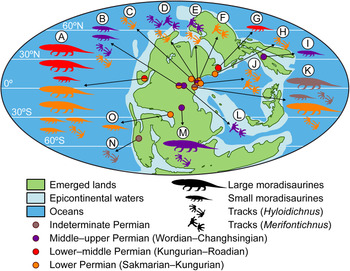
Ichnites attributed to captorhinomorphs that could be produced by moradisaurines, corresponding to the ichnogenus Hyloidichnus Gilmore, Reference Gand, Tüysüz, Steyer, Allain, Sakınç, Sanchez, Șengör and Sen1927, first appear in Sakmarian rocks (lower Permian) of North America (Lucas et al. Reference López-Gómez and Arche2013; Schneider et al. Reference Reisz, MacDougall, LeBlanc, Scott and Nagesan2020), slightly earlier than the oldest known moradisaurines, which belong to the genus Captorhinikos Olson, Reference Mujal, Fortuny, Oms, Bolet, Galobart and Anadón1954, reported from the Artinskian to the middle Kungurian (lower Permian) of North and South America (Cisneros et al. Reference Cisneros, Angielczyk, Kammerer, Smith, Fröbisch, Marsicano and Richter2020a and references therein). The genus Captorhinikos is currently considered the most basal member and the first high-fibre herbivore of the clade (Brocklehurst Reference Brocklehurst2017; Modesto et al. Reference Melchor and Sarjeant2019). Larger herbivorous species started to appear shortly after, represented by the genera Labidosaurikos Stovall, Reference Sàbat, Gelabert and Rodríguez-Perea1950 (Kungurian, early Permian: Dodick & Modesto Reference Dodick and Modesto1995), Kahneria Olson, Reference Mujal, Fortuny, Pérez-Cano, Dinarès-Turell, Ibáñez-Insa, Oms, Vila, Bolet and Anadón1962a (Kungurian/Roadian?, early/middle Permian: Olson Reference Mujal, Fortuny, Pérez-Cano, Dinarès-Turell, Ibáñez-Insa, Oms, Vila, Bolet and Anadón1962a) and Rothianiscus Kuhn, Reference Jung and Sumida1961 (Kungurian/Roadian?, early/middle Permian: Olson Reference Mujal, Fortuny, Pérez-Cano, Dinarès-Turell, Ibáñez-Insa, Oms, Vila, Bolet and Anadón1962a), together with other undetermined specimens from southern North America (Kungurian, early Permian: Modesto et al. Reference Martin-Closas and Ramos2016) and Mallorca (Artinskian–Kungurian?, early Permian: Liebrecht et al. Reference LeBlanc and Reisz2017; Matamales-Andreu et al. Reference Marchetti, Klein, Buchwitz, Ronchi, Smith, De Klerk, Sciscio and Groenewald2019). This also coincided with an increase in morphological disparity (Brocklehurst Reference Brocklehurst2017), which may have played a part in the ecological success of the group, contributing to the shift to eureptile dominance in the post-Artinskian ichnoassemblages of both Europe and North America (Marchetti et al. Reference Marchetti, Ronchi, Santi and Voigt2015b, Reference Marchetti, Santi and Avanzini2019c). There, the ichnogenus Hyloidichnus becomes abundant, and in rare cases, it is accompanied by another ichnogenus purportedly produced by large moradisaurines, Merifontichnus Gand, Garric, Demathieu et Ellenberger, Reference Gand, Garric, Demathieu and Ellenberger2000 (Gand & Durand Reference Gand, De La Horra, Galán-Abellán, López-Gómez, Barrenechea, Arche and Benito2006; Marchetti Reference Lucas, Krainer, Chaney, DiMichele, Voigt, Berman and Henrici2016; Citton et al. Reference Citton, Ronchi, Maganuco, Caratelli, Nicosia, Sacci and Romano2019; Santi et al. Reference Reisz, Haridy and Müller2020). In the middle–upper Permian, moradisaurines appear represented by small-sized species in eastern Europe (Gecatogomphius Vjushkov et Chudinov, Reference Stappenbeck1957, middle Permian: Ivakhnenko Reference Hminna, Voight, Saber, Schneider and Hmich2008), central-east Asia (Gansurhinus Reisz, Liu, Li et Müller, Reference Reisz, Haridy and Müller2011, middle–late Permian: Reisz et al. Reference Reisz, Haridy and Müller2011) and North Africa (Acrodenta Dutuit, Reference Dutuit1976, and other unidentified moradisaurines, late? Permian: Jalil & Dutuit Reference Holmes1996; Hmich et al. Reference Hmich, Schneider, Saber, Voigt and El Wartiti2006), and the largest known species, in central Africa (Moradisaurus Taquet, Reference Sidor, O'Keefe, Damiani, Steyer, Smith, Larsson, Sereno, Ide and Maga1969, middle–late? Permian: Olroyd & Sidor Reference Moodie2017; Modesto et al. Reference Melchor and Sarjeant2019). The most recent ichnites attributed to moradisaurines belong to the ichnogenus Hyloidichnus and were found in upper Permian rocks of North Africa (Voigt et al. Reference Sullivan and Reisz2010).
As evidenced by some of the works cited above, the record of body fossils of moradisaurine captorhinid eureptiles in southern Europe was hitherto restricted to the island of Mallorca (Balearic Islands, western Mediterranean). Liebrecht et al. (Reference LeBlanc and Reisz2017) described a fragment of maxilla and parts of the palate of a large moradisaurine, which confirmed the presence of this clade on the island, previously inferred from tracks (Calafat et al. Reference Calafat, Fornós, Marzo, Ramos, Rodríguez-Perea and Cabrera1986, Reference Calafat, Fornós, Marzo, Ramos-Guerrero and Rodríguez-Perea1986–1987; Calafat Reference Calafat1988; Gand et al. Reference Gand, Kerp, Parsons and Martínez-García2010; Matamales-Andreu et al. Reference Marchetti, Klein, Buchwitz, Ronchi, Smith, De Klerk, Sciscio and Groenewald2019). Both the bones and the tracks were found in Port des Canonge unit, the age of which is at present unclear and under study, preliminarily dated as lower Permian (Artinskian or Kungurian) (Matamales-Andreu et al. Reference Marchetti, Klein, Buchwitz, Ronchi, Smith, De Klerk, Sciscio and Groenewald2019). Nevertheless, from the Permian beds of the neighbouring island of Menorca, some authors (Pretus & Obrador Reference Olson1987; Carmona Reference Carmona2004) had also reported large bones of unidentified tetrapods, which had not been studied in detail so far.
The first report of vertebrate remains on Menorca was published by Pretus & Obrador (Reference Olson1987), illustrating a large scapula found ex situ. That and other bones, herein revised, were the object of the preliminary work of Carmona (Reference Carmona2004), who suggested that two of the fossil vertebrae belonged to a large and a small species of indeterminate seymouriamorphs. However, it is worth noting that Carmona (Reference Carmona2004) did not consider all the bones that had been collected until then, because some of them had yet to be prepared.
The present work resumes the study of tetrapod bone remains from the Permian of Cala del Pilar–Pla de Mar section (Menorca, Balearic Islands, western Mediterranean), re-assigning all of them to moradisaurine captorhinid eureptiles. This includes the detailed description of all the material present in old collections except for the scapula figured by Pretus & Obrador (Reference Olson1987), which is currently housed in a private collection and preparation required to properly study it has not been possible. Moreover, new ichnological material found at the outcrop is also studied. Unfortunately, new prospection/excavation campaigns have not been carried out due to administrative setbacks. Nevertheless, this study aims to shed light on the hitherto poorly described tetrapod fossils of this site, characterising a new locality of Permian palaeoequatorial faunas.
1. Geological and geographical context
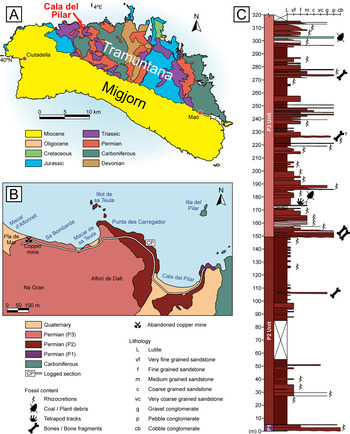
Menorca is the northeasternmost island of the Balearic Archipelago, located in the western Mediterranean. Even as an extension towards the NE of the Betic Orogen, Menorca is quite different from the rest of the Balearic Islands in structural and stratigraphic terms (Bourrouilh Reference Bourrouilh1973; Vera et al. Reference Smith, Sidor, Tabor and Steyer2004; Sàbat et al. Reference Reisz, Liu, Li and Müller2018). Geologically, the island is neatly divided into two main regions: Migjorn, at the S, where a post-orogenic upper Miocene cover is largely dominant; and Tramuntana, at the N, with older materials that broadly span from the Lochkovian (Lower Devonian) to the Rupelian (lower Oligocene) (Bourrouilh Reference Bourrouilh1973, Reference Bourrouilh1983; Vera et al. Reference Smith, Sidor, Tabor and Steyer2004; Martin-Closas & Ramos Reference Marchetti, Belvedere, Voigt, Klein, Castanera, Díaz-Martínez, Marty, Xing, Feola, Melchor and Farlow2005) (Fig. 1a). The Permian red-beds studied in the present paper, framed between two erosive surfaces, lay within the latter structural unit. They are unconformably disposed over the underlying Devonian or Carboniferous rocks, and the top of their sequence is eroded and overlain by the Lower–Middle Triassic Buntsandstein facies (Gómez-Gras Reference Gilmore1987, Reference Gómez-Gras1992, Reference Gand and Durand1993; Rosell et al. Reference Postma1988, Reference Pretus and Obrador1989a, Reference Ramos and Doubingerb; Bercovici et al. Reference Bercovici, Diez, Broutin, Bourquin, Linol, Villanueva-Amadoz, López-Gómez and Durand2009; Linol et al. Reference Leonardi2009). Those beds were first attributed to the upper Permian by Bourrouilh (Reference Bourrouilh1973, Reference Bourrouilh1983) and were subsequently studied by Pomar-Gomà (Reference Olson1979), Obrador (Reference Obrador and Martínez-Díaz1983), Martí et al. (Reference Marchetti, Ronchi, Santi and Voigt1985), Rodríguez-Perea et al. (Reference Olson and Beerbower1987), Gómez-Gras (Reference Gilmore1987, Reference Gómez-Gras1992, Reference Gand and Durand1993), Rosell et al. (Reference Postma1988, Reference Pretus and Obrador1989a, Reference Ramos and Doubingerb), Arribas et al. (Reference Arribas, Gómez-Gras, Rosell and Tortosa1990), Brandes & Tiedt (Reference Brandes and Tiedt1991), Broutin et al. (Reference Broutin, Ferrer, Gisbert and Nmila1992), Gómez-Gras & Alonso-Zarza (Reference Gómez-Gras2003), Bercovici et al. (Reference Bercovici, Diez, Broutin, Bourquin, Linol, Villanueva-Amadoz, López-Gómez and Durand2009), Linol et al. (Reference Leonardi2009) and Borruel-Abadía et al. (Reference Borruel-Abadía, Barrenechea, Galán-Abellán, De la Horra, López-Gómez, Ronchi, Luque, Alonso-Azcárate and Marzo2019).
(A) Geological map of Menorca (modified after Rosell et al. Reference Pretus and Obrador1989a), indicating the location of Cala del Pilar. (B) Detailed geological map of the study zone, indicating where the section was logged (toponyms after Buenaventura Reference Buenaventura2004). (C) Synthetic stratigraphic log of Cala del Pilar–Pla de Mar section, indicating the fossiliferous horizons. Those with a question mark were found ex situ and attributed to that bed based on lithological equivalence.

Despite all these detailed works, the precise palaeogeographic position of Menorca before the Alpine orogeny is still a matter of discussion. During the late Carboniferous–early Permian, the extensional collapse of the Variscan orogen in Iberia and neighbouring regions opened many rift basins, which were filled with continental sediments until the Middle Triassic (López-Gómez et al. Reference Llull and Perelló2019a). Some authors (Gómez-Gras Reference Gómez-Gras1992, Reference Gand and Durand1993; Sàbat et al. Reference Reisz, Liu, Li and Müller2018) have argued that the sections of Menorca have a sedimentary evolution that is somewhat reminiscent to that of the basins of the SW of the Catalan Coastal Ranges, in the eastern margin of the Iberian Peninsula. However, the palaeocurrent directions of the Permian and Triassic of Menorca point generally towards the SW (Linol et al. Reference Leonardi2009), whereas in the Iberian Peninsula the trend is towards the SE (López-Gómez & Arche Reference López-Gómez, Alonso-Azcárate, Arche, Arribas, Fernández-Barrenechea, Borruel-Abadía, Bourquin, Cadenas, Cuevas, De la Horra, Díez, Escudero-Mozo, Fernández-Viejo, Galán-Abellán, Galé, Gaspar-Escribano, Gisbert-Aguilar, Gómez-Gras, Goy, Gretter, Heredia-Carballo, Lago, Lloret, Luque, Márquez, Márquez-Aliaga, Martín-Algarra, Martín-Chivelet, Martín-González, Marzo, Mercedes-Martín, Ortí, Pérez-López, Pérez-Valera, Pérez-Valera, Plasencia, Ramos, Rodríguez-Méndez, Ronchi, Salas, Sánchez-Fernández, Sánchez-Moya, Sopeña, Suárez-Rodríguez, Tubía, Ubide, Valero-Garcés, Vargas, Viseras, Vergés and Kullberg1987, Reference López-Gómez, Martín-González, Heredia, De la Horra, Barrenechea, Cadenas, Juncal, Diez, Borruel-Abadía, Pedreira, García-Sansegundo, Farias, Galé, Lago, Ubide, Fernández-Viejo and Gand1992; Arche & López-Gómez Reference Arche and López-Gómez1992), and, therefore, it is unlikely that they were part of a same fluvial system or (sub)basin. The most probable scenario with the data available today is that the Menorcan basin was relatively independent from the other basins of Iberia, including that of the neighbouring island of Mallorca. In any case, the Menorcan basin was probably located very close to the equator throughout the Permian, approximately in a latitude of 4 ° N (Scotese Reference Reisz, Sues and Sues2014), in the western margin of the Palaeotethys ocean (Bercovici et al. Reference Bercovici, Diez, Broutin, Bourquin, Linol, Villanueva-Amadoz, López-Gómez and Durand2009; Linol et al. Reference Leonardi2009). The climate was tropical, alternating arid and hot seasons with rainy seasons (Gómez-Gras & Alonso-Zarza Reference Gómez-Gras2003; Bercovici et al. Reference Bercovici, Diez, Broutin, Bourquin, Linol, Villanueva-Amadoz, López-Gómez and Durand2009; Roscher et al. Reference Roscher, Stordal and Svensen2011).
Gómez-Gras (Reference Gilmore1987) described three lithostratigraphic units for the Permian of Menorca (informally named P1, P2 and P3), which were revised by Rosell et al. (Reference Postma1988, Reference Pretus and Obrador1989a, Reference Ramos and Doubingerb), Gómez-Gras (Reference Gómez-Gras1992, Reference Gand and Durand1993), Bercovici et al. (Reference Bercovici, Diez, Broutin, Bourquin, Linol, Villanueva-Amadoz, López-Gómez and Durand2009) and Linol et al. (Reference Leonardi2009). For the present paper, one stratigraphic section has been logged in detail at the cliffs between Cala del Pilar and Pla de Mar (Fig. 1b, c; Supplementary Material 1 available at https://doi.org/10.1017/S1755691021000268), encompassing the three lithostratigraphic units.
1.1. Palaeoenvironment and climatic conditions
The palaeoenvironments of the Permian recorded in Cala del Pilar–Pla de Mar section changed through time, responding to the evolution of the basin and its climatic conditions. A review of the three main lithostratigraphic units, based on the works of Gómez-Gras (Reference Gilmore1987, Reference Gómez-Gras1992, Reference Gand and Durand1993), Rosell et al. (Reference Postma1988, Reference Pretus and Obrador1989a, Reference Ramos and Doubingerb), Gómez-Gras & Alonso-Zarza (Reference Gómez-Gras2003), Bercovici et al. (Reference Bercovici, Diez, Broutin, Bourquin, Linol, Villanueva-Amadoz, López-Gómez and Durand2009), Linol et al. (Reference Leonardi2009) and new data collected for the present study, is offered here.
In the studied section, the P1 unit consists of 4–6 m of crudely bedded, coarse breccias with intercalated sandstones, overlaying the angular, erosive boundary with the Carboniferous Culm facies. In the first stages of rifting, when the subsidence rates are high, alluvial/colluvial fans transverse to the main axis of the basin usually develop near the footwall scarp (e.g., Speksnijder Reference Rosell, Gómez-Gras and Elízaga1985; Miall Reference Marchetti, Voigt, Mujal, Lucas, Francischini, Fortuny and Santucci2006; Franzel et al. Reference Franzel, Jones, Meadows, Allen, McCaffrey and Morgan2021 and references therein). The P1 unit is here interpreted as one of such deposits, and the formation of calcareous mature palaeosols on top of each of the breccia beds (Gómez-Gras & Alonso-Zarza Reference Gómez-Gras2003; Bercovici et al. Reference Bercovici, Diez, Broutin, Bourquin, Linol, Villanueva-Amadoz, López-Gómez and Durand2009) attests that the depositional events that formed this unit were multiple, separated in time and under a climate with periods of very low precipitation (Gómez-Gras & Alonso-Zarza Reference Gómez-Gras2003). Apart from rhizocretions, no fossils have been reported from the P1 unit so far.
In the studied section, the P2 unit consists of about 150 m of massive lutites with sporadic intercalations of sandstones with climbing ripples and, rarely, microbreccias of reworked pedogenic calcretes. This unit represents a playa lake palaeoenvironment (as defined by Briere Reference Briere2000) in which lutites from overbank flows were deposited (Bercovici et al. Reference Bercovici, Diez, Broutin, Bourquin, Linol, Villanueva-Amadoz, López-Gómez and Durand2009). Throughout the sequence, there is an alternation of 1–12 m-thick lutitic packs with 0.25–1.5 m-thick intervals that are more resistant to the erosion, with immature palaeosols and/or mud cracks. The former correspond to the deposition of fine sediments during high water table periods, whereas the latter reflect intervals of desiccation of the playa lakes and subsequent formation of mud cracks and incipient palaeosols. Appearing between those, there are sandstone and microbreccia beds with geometries ranging from lenticular (channelled flow) to tabular (unconfined flow), representing crevasse splays and sheetfloods that reworked the floodplains in sporadic heavy rain events (Gómez-Gras & Alonso-Zarza Reference Gómez-Gras2003). The fossil content of this unit consists of rhizocretions developed in different types of palaeosols (Bercovici et al. Reference Bercovici, Diez, Broutin, Bourquin, Linol, Villanueva-Amadoz, López-Gómez and Durand2009), and bones and bone fragments that have been observed in a bed of reworked pedogenic calcrete fragments.
The studied section also comprises the lower 170 m of the P3 unit, consisting of sandstones intercalated with lutites. The bases of the sandstone elements are usually erosive, with a lag of abundant reworked pedogenic calcretes from the floodplains (Gómez-Gras & Alonso-Zarza Reference Gómez-Gras2003). Sandstones are organised in two main sequence types: the first, with lateral accreting surfaces and a general upwards decrease of grain size, representing meandering channels, and the second, consisting mostly of tabular beds with horizontal, low-angle cross-bedding or climbing ripple lamination, representing sheetflood deposits. Lutites are mostly massive and with a pervasive development of calcareous palaeosols (Bercovici et al. Reference Bercovici, Diez, Broutin, Bourquin, Linol, Villanueva-Amadoz, López-Gómez and Durand2009). This unit represents a floodplain (playa, as per Briere Reference Briere2000) with abundant vegetation under a seasonal climate. It was traversed by meandering rivers and, during the rainy seasons, unconfined sheetfloods covered the floodplain. One of the meandering channels, observed at m 301.5–303.5 of the studied section, corresponds to sandstone and breccia beds with abundant lignite lenses and plant debris. This channel was probably abandoned as an oxbow lake, where local reducing conditions favoured precipitation of copper minerals (Crespí & Merino Reference Crespí and Merino1998; Llull & Perelló Reference Liebrecht, Fortuny, Galobart, Müller and Sander2013). Other areas of the floodplain were swamped or with a high water table for long time intervals, developing alfisols (Bercovici et al. Reference Bercovici, Diez, Broutin, Bourquin, Linol, Villanueva-Amadoz, López-Gómez and Durand2009), which have been recognised in several beds of this unit. The most abundant fossils of the P3 unit are rhizocretions (Bercovici et al. Reference Bercovici, Diez, Broutin, Bourquin, Linol, Villanueva-Amadoz, López-Gómez and Durand2009) and ichnofossils of the Scoyenia ichnofacies, including tetrapod tracks. Bones and bone fragments are also locally abundant as part of reworked pedogenic calcrete breccias.
The uppermost part of the P3 unit, cropping out NW of Pla de Mar at Penyals d'Alforinet, has not been considered in the present study because it is separated from the lower part by a very thick covered interval, probably faulted and, moreover, no tetrapod fossils have been found there so far. It was studied in great detail by Bercovici et al. (Reference Bercovici, Diez, Broutin, Bourquin, Linol, Villanueva-Amadoz, López-Gómez and Durand2009) and Linol et al. (Reference Leonardi2009), and the palaeoenvironments recorded there are similar to those of the rest of the P3 unit.
2. Material and methods
2.1. Collection number abbreviations
FMNH = Field Museum of Natural History, Chicago, Illinois, USA; IPS = Institut Català de Paleontologia Miquel Crusafont (formerly Institut de Paleontologia de Sabadell), Sabadell, Barcelona, Spain; MBCN = Museu Balear de Ciències Naturals, Sóller, Mallorca, Balearic Islands, Spain; MNHN = Muséum National d'Histoire Naturelle, Paris, France; MT = Macar de sa Teula, field code for the rock with the ichnites, which was left in the field: GPS coordinates [40°3′9″N, 3°58′24″E].
2.2. ZooBank registration of new names
New taxon names have been registered in ZooBank (http://zoobank.org) in order to comply with the rules of the International Code of Zoological Nomenclature for electronic publications (article 8.5.3). The LSID for this publication is: urn:lsid:zoobank.org:pub:8153E0E1-9B66-4C55-89B9-A246195DCD02.
2.3. Stratigraphy and sedimentology
For the stratigraphic and sedimentological study, one section has been logged in situ, bed by bed, to a minimum resolution of 1 cm of bed thickness (in 1:25 scale), using a tape measure in well-exposed outcrops and a Jacobs staff for lutite, semi-covered and covered intervals. This section, named Cala del Pilar–Pla de Mar, is presented here in Supplementary Material 1 (in 1:40 scale), and a synthetic version is in Figure 1c (in 1:1160 scale). The recognised sedimentary lithofacies have been classified according to Miall (Reference Marchetti, Voigt, Lucas, Stimson, King and Calder1985, Reference Marchetti, Voigt, Mujal, Lucas, Francischini, Fortuny and Santucci2006), Postma (Reference Olson1990), Mack et al. (Reference Lucas1993), Gómez-Gras & Alonso-Zarza (Reference Gómez-Gras2003), Bercovici et al. (Reference Bercovici, Diez, Broutin, Bourquin, Linol, Villanueva-Amadoz, López-Gómez and Durand2009) and Linol et al. (Reference Leonardi2009) (Supplementary Material 1).
2.4. Provenance and three-dimensional (3D) modelling of tetrapod ichnofossils
The tetrapod ichnites studied in the present work (MT01) were all preserved as natural casts on the surface of an ex situ rock found on the beach of Macar de sa Teula. The rock seemed freshly detached from its original bed, which was determined on the outcrop that had to be the one from m 174.0–179.5 (Fig. 1c), because both the bed and the ex situ rock had approximately the same thickness and consisted in very fine sandstones (somewhat silty) with abundant invertebrate burrows and common gleyed patches, unlike other nearby beds. Therefore, its position has been indicated in Figure 1c with a question mark. A photogrammetric 3D model of the ichnites was created (see ‘3. Systematic palaeoichnology’) and then the rock was left in the outcrop.
Photogrammetry is a technique that has recently become widespread in ichnological studies (e.g., Falkingham Reference Falkingham2012; Mujal et al. Reference Michel, Tabor, Montañez, Schmitz and Davydov2016, Reference Modesto, Lamb and Reisz2020), making it possible to collect and save information that would otherwise be lost to erosion in the case of big, unmovable rock surfaces. Moreover, it provides an alternative to the confection of artificial casts, which are sometimes hard to make in open environments that are difficult to reach. The present study has broadly followed the same methodology as Mujal et al. (Reference Michel, Tabor, Montañez, Schmitz and Davydov2016, Reference Modesto, Lamb and Reisz2020 and references therein), using the open-source software MeshLab v2016.12 (http://meshlab.sourceforge.net/) and ParaView 5.5.0-RC4 64-bit (http://www.paraview.org) to process the meshes. However, to create the mesh, the licensed software Agisoft Photoscan standard v1.1.4. (www.agisoft.com) has been used instead. In order to produce the 3D model, 89 pictures of the surface of MT01 were taken from different angles and distances using a digital camera (Panasonic Lumix DMC-TZ27). Then, they were aligned, and the dense point cloud and the mesh were created. After that, a false-colour height map and contour lines were superimposed on the 3D model, and finally it was drawn on a vector-based graphics design software and measured using the open-source software ImageJ 1.52d (https://imagej.nih.gov/ij/), following the criteria of Leonardi (Reference LeBlanc, Brar, May and Reisz1987) and Hasiotis et al. (Reference Gómez-Gras2007) (Table 1). The ichnites selected for study correspond to the category ‘1’ of footprint preservation scale by Marchetti et al. (Reference Marchetti2019a) – that is, relatively poorly preserved ichnites missing some diagnostic structures (i.e., some digits). The other ichnites present on the slab scored a ‘0’, that is, their preservation was very poor (Marchetti et al. Reference Marchetti2019a), so they could not be studied.
Set of measurements taken on selected footprints of MT01. Although all the ichnites have been numbered, only the best preserved ones have been measured. Columns without data correspond to poorly-preserved ichnites that have been used for trackway measurements, such as MT01-3, or to well-preserved ichnites without trackway information, such as MT01-10 and MT01-13.

The 3D models studied herein are archived and freely available in MorphoSource (https://www.morphosource.org/) with the following DOI: MT01-1 and MT01-2 (https://doi.org/10.17602/M2/M367858), MT01-10 (https://doi.org/10.17602/M2/M367864) and MT01-13 (https://doi.org/10.17602/M2/M367870).
2.5. Phylogenetic analysis
The phylogenetic analysis was performed using a modified version (Supplementary Material 2) of the matrix of Cisneros et al. (Reference Cisneros, Angielczyk, Kammerer, Smith, Fröbisch, Marsicano and Richter2020a), mainly with changes introduced by Modesto et al. (Reference Melchor and Sarjeant2019) and Brocklehurst (Reference Brocklehurst2020). All character state changes for Captorhinikos chozaensis were applied following Modesto et al. (Reference Melchor and Sarjeant2019), except for their character ‘72’ (here, character ‘73’) as there was no state 2 (see character list in Modesto et al. Reference Melchor and Sarjeant2019). Character states for Moradisaurus were also recoded following Modesto et al. (Reference Melchor and Sarjeant2019). The rest of character state changes listed by Modesto et al. (Reference Melchor and Sarjeant2019) had already been applied in the matrix of Cisneros et al. (Reference Cisneros, Angielczyk, Kammerer, Smith, Fröbisch, Marsicano and Richter2020a). MBCN15730 (the moradisaurine from Mallorca) and Kahneria were added to the matrix with the character state codes of Brocklehurst (Reference Brocklehurst2020), modifying the following: character ‘10’ of the matrix used by Brocklehurst (Reference Brocklehurst2020) was redefined into two characters by Cisneros et al. (Reference Cisneros, Angielczyk, Kammerer, Smith, Fröbisch, Marsicano and Richter2020a), so they are now in both cases character ‘10’ with state 1 and character ‘11’ with state 1. Character ‘42’ of MBCN15730 (character ‘41’ in Brocklehurst Reference Brocklehurst2020) was changed from 1 to ?, as the ventral side of the palatine is not visible on the specimen. Balearosaurus bombardensis gen. et sp. nov. and the other indeterminate small moradisaurine from Menorca studied in the present work have been coded first-hand. For the final analysis, both the indeterminate small moradisaurine from Menorca and MAP PV664 (Moradisaurinae indet.) from Brazil (Cisneros et al. Reference Cisneros, Angielczyk, Kammerer, Smith, Fröbisch, Marsicano and Richter2020a) were removed because of their large amount of missing data, which caused significant polytomies in the Moradisaurinae. Phylogenetic analysis was run using PAUP* v.4.0 (Swofford Reference Scotese2003) as a branch-and-bound search with parsimony as the optimality criterion, unordered and unweighted characters and with branches collapsing when their maximum length was zero. Then, a strict consensus tree was computed, and bootstrap support values were calculated with 1000 repetitions, not showing values under 50.
3. Systematic palaeoichnology
Ichnogenus Hyloidichnus Gilmore, Reference Gand, Tüysüz, Steyer, Allain, Sakınç, Sanchez, Șengör and Sen1927
Hyloidichnus isp.
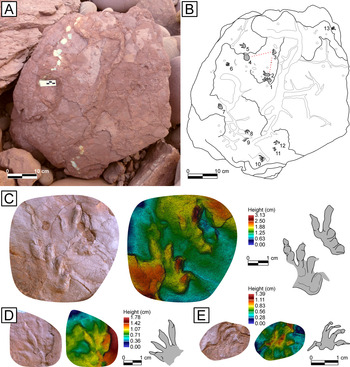
(Fig. 2a–d; Table 1)
Studied material. MT01-1, MT01-2, MT01-3, MT01-4, natural cast of a partial trackway with a right manus pes set, a left pes imprint and a right pes imprint. MT01-5, natural cast of an isolated left manus imprint. MT01-10, natural cast of a left ?pes imprint. Most of the other footprints of the same surface (MT01-6, MT01-7, MT01-8, MT01-9, MT01-11, MT01-12) may also belong to this ichnogenus given their similar size and general shape but their preservation is too incomplete. All of them were found on an ex situ boulder at Macar de sa Teula, attributable to m 174–179.5 of Cala del Pilar–Pla de Mar section, P3 unit, indeterminate Permian, Menorca, Balearic Islands, western Mediterranean.
Ichnites of the boulder herein named MT01 from an indeterminate Permian of Cala del Pilar–Pla de Mar section (Menorca), with height models and interpretative drawings. (A) Picture of MT01 as it was found. (B) Interpretative drawing of MT01, with each number referring to a specific ichnite under the nomenclature MT01-[number]. (C) Picture, false colour-coded height model and interpretative drawing of MT01-1 and MT01-2 (Hyloidichnus isp.). (D) Picture, false colour-coded height model and interpretative drawing of MT01-10 (Hyloidichnus isp.). (E) Picture, false colour-coded height model and interpretative drawing of MT01-13 (cf. Erpetopus isp.).

Description. Pes imprints semiplantigrade, pentadactyl, probably slightly longer (26.4 mm) than wide. The most deeply imprinted parts are digits I and II (medial functional prevalence of the autopodia). The digit imprints radiate from the sole and are relatively slender and straight, with some tips ending in pointed claw traces. The relative length of the preserved digit imprints can be ordered as follows (MT01-1): I < II < III < IV (digit V imprint is not preserved). The sole is anteroposteriorly short, with a well-marked posterior margin that is slightly concave. Manus imprint slightly smaller than pes imprint, semiplantigrade, pentadactyl, wider than long. The most deeply imprinted part is the distal region of digit IV, but digits I–III are not preserved so it is not possible to evaluate the functional prevalence of the autopodia. The digit imprints radiate from the palm and are straight and rather short, with tips ending in pointed claw traces. Given the faint imprints of the two available manus (MT01-2 and MT01-5), the relative length of the preserved digit imprints cannot be established, although digit IV appears to be the longest. Acute divergence angle between digit IV and V imprints (21.4 °). Palm anteroposteriorly short, with a well-marked posterior margin that is very slightly concave. The imprints of the basal parts of all the digits are well defined, and are the deepest imprinted areas of the sole. Trackway of a quadrupedal animal with a simple alternating pattern, with a pace angulation of 71.86 ° for the pedes. The pes imprints are almost parallel to the midline (divarication of 5 °), whereas the manus imprints are strongly rotated inwards (divarication of 44.6 °) and seem to be slightly smaller than those of the pes. The pace of the pes ranges between 64.6 and 69.4 mm, the length of the pace of the pes ranges between 35.4 and 43.3 mm, and the width of its pace is 54.0 mm. The interpes distance is 39.9 mm, and the manus–pes distance is 12.9 mm.
Remarks. The following combination of characters makes it possible to assign these footprints to Hyloidichnus (see Gand Reference Gand1987; Voigt Reference Stovall2005; Voigt et al. Reference Sullivan and Reisz2010; Marchetti Reference Lucas, Krainer, Chaney, DiMichele, Voigt, Berman and Henrici2016; Marchetti et al. Reference Marchetti, Belvedere, Voigt, Klein, Castanera, Díaz-Martínez, Marty, Xing, Feola, Melchor and Farlow2020a; Logghe et al. Reference Linol, Bercovici, Bourquin, Diez, López-Gómez, Broutin, Durand and Villanueva-Amadoz2021): (1) manus imprints slightly smaller than those of the pedes; (2) orientation of pes imprints parallel to the midline; (3) manus imprints rotated inwards; (4) manus imprint located internally to the pes imprint; (5) acute angle between manus digit IV and V imprints; (6) digit imprints with clawed tips; (7) straight and radiating digits in both the pes and the manus imprints; (8) short sole/palm imprints; (9) ectaxonic tracks; and (10) medial–lateral decrease in relief of the track imprints. However, the incomplete preservation of the manus imprints and the trackway precludes any ichnospecies-level assignation. Captorhinomorph eureptiles, and more specifically captorhinids and moradisaurine captorhinids, have been deemed as its most probable trackmakers (e.g., Gand Reference Gand1987; Haubold Reference Gómez-Gras and Alonso-Zarza2000; Gand & Durand Reference Gand, De La Horra, Galán-Abellán, López-Gómez, Barrenechea, Arche and Benito2006; Voigt et al. Reference Sullivan and Reisz2010; Logghe et al. Reference Linol, Bercovici, Bourquin, Diez, López-Gómez, Broutin, Durand and Villanueva-Amadoz2021), and this ichnogenus has been found from the Sakmarian (lower Permian) to the Wuchiapingian (upper Permian) (e.g., Lucas Reference López-Gómez and Arche2019; Schneider et al. Reference Reisz, MacDougall, LeBlanc, Scott and Nagesan2020; Logghe et al. Reference Linol, Bercovici, Bourquin, Diez, López-Gómez, Broutin, Durand and Villanueva-Amadoz2021).
Ichnogenus Erpetopus Moodie, Reference Miall1929
cf. Erpetopus isp.
(Fig. 2a, b, e; Table 1)
Studied material. MT01-13, a natural cast of an isolated right ichnite, possibly a manus imprint. Found on an ex situ boulder at Macar de sa Teula, attributable to m 174–179.5 of Cala del Pilar–Pla de Mar section, P3 unit, indeterminate Permian, Menorca, Balearic Islands, western Mediterranean.
Description. Semiplantigrade, pentadactyl ichnite, slightly wider (11.5 mm) than long (10.9 mm). The most deeply imprinted parts are the bases of the digit imprints, and, especially, those of digits II and V. The digit imprints are thin and those of digits II–IV are distinctly curved inwards distally, whereas the imprints of digits I and V are somewhat straight. Although some of the digit tip imprints undoubtedly have drag traces (I and V), others show a slightly expanded tip that may have corresponded to claw traces (II–IV). The relative length of the digit imprints can be ordered as follows: V < I < II < III < IV. The divergence angles of digit IV–V imprints is high (95.3 °), and that of the digit I–V imprints forms a clearly obtuse angle (161.5 °). The sole is anteroposteriorly short, concave and well imprinted posteriorly.
Remarks. MT01-13 can be assigned to Erpetopus because of the following combination of characters (Marchetti et al. Reference Marchetti, Klein, Buchwitz, Ronchi, Smith, De Klerk, Sciscio and Groenewald2014): (1) pes slightly wider than long; (2) slender, curved digit imprints with clawed tips; (3) digit imprints with overlapping digit bases, typical of parareptiles (Marchetti et al. Reference Marchetti, Ronchi, Santi, Schirolli and Conti2020b); (4) short digit V imprint; (5) high IV–V divergence; (6) high I–V divergence; and (7) small size, less than 20 mm. The most probable trackmakers for Erpetopus are acleistorhinid and nyctiphruretid parareptiles, and this ichnogenus has been found from the middle Artinskian (lower Permian) to the Wuchiapingian (upper Permian), being the reference ichnotaxon for the Erpetopus footprint biochron (e.g., Lucas Reference López-Gómez and Arche2019; Schneider et al. Reference Reisz, MacDougall, LeBlanc, Scott and Nagesan2020; Cisneros et al. Reference Cisneros, Kammerer, Angielczyk, Fröbisch, Marsicano, Smith and Richter2020b).
4. Systematic vertebrate palaeontology
Reptilia Laurenti, Reference Laurenti1768
Eureptilia Olson, Reference Moreau, Benaouiss, Tourani, Steyer, Laurin, Peyer, Béthoux, Aouda and Jalil1947
Family Captorhinidae Case, Reference Case1911
Subfamily Moradisaurinae de Ricqlès et Taquet, Reference de Ricqlès and Taquet1982
Genus Balearosaurus gen. nov
Type and only included species. Balearosaurus bombardensis gen. et sp. nov.
Origin of the name. Combination of Balearo-, as it was found in the Balearic Islands, and -saurus, Latin for ‘lizard’.
Diagnosis. As for the type species.
Balearosaurus bombardensis gen. et sp. nov.
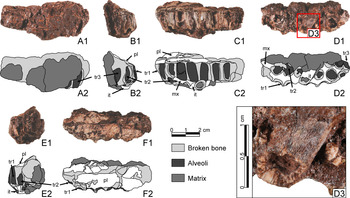
(Fig. 3a–f)
Type specimen. Holotype IPS35597 (fragment of right maxilla and palatine), Cala del Pilar–Pla de Mar section, P3 unit, indeterminate Permian, Menorca, Balearic Islands, western Mediterranean.
Holotype specimen of Balearosaurus bombardensis gen. et sp. nov. (IPS35597, right maxillar and palatine), from an indeterminate Permian of Cala del Pilar–Pla de Mar section (Menorca): (A) labial view; (B) anterior view; (C) lingual view; (D) occlusal view; (E) posterior view; (F) dorsal view. Abbreviations: it = isolated tooth; mx = maxillar; pl = palatine; tr1–3 = teeth row 1–3. All specimens in the same scale except for D3.

Origin of the name. Because most of the fossils here considered to belong to this species were found in the coastal zone called Sa Bombarda (Menorca, Balearic Islands, western Mediterranean).
Studied material. IPS35597 (fragment of right maxilla and palatine), from an ex situ rock at Punta des Carregador, attributable to m 149.5 of Cala del Pilar–Pla de Mar section, P3 unit, indeterminate Permian, Menorca, Balearic Islands, western Mediterranean.
Diagnosis. Large moradisaurine captorhinid eureptile with a maxilla with at least three rows of cylindrical teeth that possess an external ornamentation based on longitudinal thin ridges and furrows.
Description. Fragment of right maxilla and palatine measuring 67.0 mm in maximum anteroposterior length, with a maximum labiolingual width of 25.6 mm and a maximum dorsoventral height of 27.1 mm. No sutures are visible. Three rows of alveoli can be observed: the one in the lingual side shows traces of six alveoli, all of them sectioned. Some still have remains of thecodont teeth attached. The middle row has also six partially covered alveoli. The labial row has five preserved alveoli, three of which are also sectioned and two that are covered by matrix. All of them have a similar size (maximum diameter 6.4–7.4 mm), and are arranged diagonally to each other. Horizontally on the occlusal side of the maxilla there is a partial isolated cylindrical tooth. Its diameter (7.8 mm) agrees with that of the surrounding alveoli, and its outer surface is covered by an ornamentation consisting of numerous and very thin longitudinal furrows and ridges (Fig. 3d3). On the dorsal side of the maxilla there is a flat surface corresponding to the palatine, tilted 27.3 ° towards the medial part of the cranium.
Remarks. The maxilla clearly agrees with those of large moradisaurine captorhinid eureptiles. IPS35597 shows at least three parallel rows of teeth; the presence of several longitudinal rows of teeth, organised approximately parallel to the jaw margins, is a diagnostic character of Moradisaurinae (Vjushkov & Chudinov Reference Stappenbeck1957; Olson Reference Mujal, Fortuny, Pérez-Cano, Dinarès-Turell, Ibáñez-Insa, Oms, Vila, Bolet and Anadón1962a, Reference Mujal, Marchetti, Schoch and Fortunyb, Reference Müller and Reisz1965; de Ricqlès & Taquet Reference de Ricqlès and Taquet1982; de Ricqlès & Bolt Reference de Ricqlès and Bolt1983; Jalil & Dutuit Reference Holmes1996; Ivakhnenko Reference Hminna, Voight, Saber, Schneider and Hmich2008; Reisz et al. Reference Reisz, Haridy and Müller2011; Modesto et al. Reference Matamales-Andreu, Fortuny, Mujal and Galobart2014, Reference Martin-Closas and Ramos2016, Reference Melchor and Sarjeant2019; LeBlanc et al. Reference Kuhn2015; LeBlanc & Reisz Reference Kuhn2015; Jung & Sumida Reference Ivakhnenko, Ivakhnenko and Kurotchkin2017). The maxillary teeth are of a similar diameter than that of the largest members of the subfamily, such as Labidosaurikos (see Dodick & Modesto Reference Dodick and Modesto1995), Moradisaurus (see de Ricqlès & Taquet Reference de Ricqlès and Taquet1982; Modesto et al. Reference Melchor and Sarjeant2019), Rothianiscus (see Olson Reference Mujal, Fortuny, Pérez-Cano, Dinarès-Turell, Ibáñez-Insa, Oms, Vila, Bolet and Anadón1962a, Reference Müller and Reisz1965), and the unidentified tooth plates from the ‘KB’ locality of Texas (Modesto et al. Reference Martin-Closas and Ramos2016) and Mallorca (Liebrecht et al. Reference LeBlanc and Reisz2017). However, the teeth of all the species in those genera have a smooth surface, devoid of any kind of ornamentation (Olson Reference Mujal, Fortuny, Pérez-Cano, Dinarès-Turell, Ibáñez-Insa, Oms, Vila, Bolet and Anadón1962a, Reference Müller and Reisz1965; de Ricqlès & Taquet Reference de Ricqlès and Taquet1982; Dodick & Modesto Reference Dodick and Modesto1995; Modesto et al. Reference Martin-Closas and Ramos2016, Reference Melchor and Sarjeant2019; Liebrecht et al. Reference LeBlanc and Reisz2017), contrarily to what can be observed on the isolated tooth on the surface of the maxilla in IPS35597, which is traversed by numerous longitudinal furrows and ridges. Only the Captorhinikos sp. described by Cisneros et al. (Reference Cisneros, Angielczyk, Kammerer, Smith, Fröbisch, Marsicano and Richter2020a, fig. 2) has small furrows and ridges on some teeth, but they seem to be restricted on the base of the crown, contrarily to the isolated tooth of IPS35597, which has a much denser ornamentation that completely covers the preserved surface of the tooth.
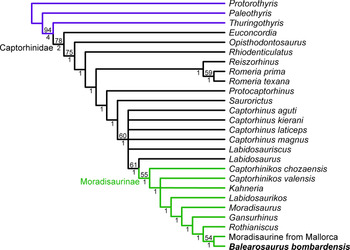
The phylogenetic analysis (Fig. 4) places Balearosaurus bombardensis as a derived species within the moradisaurine captorhinids, sister to the undetermined moradisaurine of the neighbouring island of Mallorca, based mostly on the low number of tooth rows. Those two, in turn, are a sister clade of the North American Rothianiscus, a genus of large forms with also relatively few rows of teeth, similarly to the Balearic species.
Strict consensus of the best 36 trees recovered (tree length = 251 steps) of the Captorhinomorpha, including the large moradisaurines of the Balearic Islands, using a branch-and-bound search. Consistency index (CI) = 0.553; retention index (RI) = 0.756. Double-digit numbers on the branches represent the bootstrap support values (n = 1000, values under 50 not shown), and single digits below represent the Bremer decay support value of that node.

cf. Balearosaurus bombardensis gen. et sp. nov.
(Figs 5, 6)
Studied material. IPS35588 (chevron?), IPS35590 (middle caudal vertebra), IPS35592 (anterior dorsal vertebra), IPS35598 (distal fragment of left jaw), IPS120163 (right ilium), IPS120164 (left pubis) and IPS120165 (proximal epiphysis of left tibia), all found in close association in an ex situ rock at Sa Bombarda, attributable to m 226–227 of Cala del Pilar–Pla de Mar section, P3 unit, indeterminate Permian, Menorca, Balearic Islands, western Mediterranean.
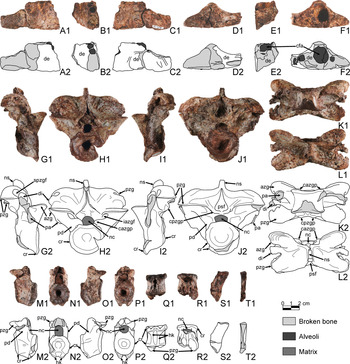
Pictures and interpretative drawings of cranial and axial elements of cf. Balearosaurus bombardensis gen. et sp. nov. from an indeterminate Permian of Cala del Pilar–Pla de Mar section (Menorca). (A–F) IPS35598, distal fragment of left jaw: (A) lingual view; (B) anterior view; (C) labial view; (D) ventral view; (E) posterior view; (F) occlusal view. (G–L) IPS35592, anterior dorsal vertebra: (G) right lateral view; (H) anterior view; (I) left lateral view; (J) posterior view; (K) ventral view; (L) dorsal view. (M–R) IPS35590, middle caudal vertebra: (M) right lateral view; (N) anterior view; (O) left lateral view; (P) posterior view; (Q) ventral view; (R) dorsal view. (S, T) IPS35588, possible fragment of haemal arch: (S) right lateral view; (T) anterior view. Abbreviations: azg = prezygapophysis; cazgp = centroprezygapophyseal process; cfa = alveolus of caniniform; cpzgp = centropostzygapophyseal process; cr = cortical rim; de = dentary; di = diapophysis; hk = haemal keel; iazgf = infraprezygapophyseal fossa; nc = neural canal; ns = neural spine; pa = parapophysis; pd = pedicel; pl = palatine; psf = postspinal fossa; pzg = postzygapophysis; spzgf = suprapostzygapophyseal fossa.

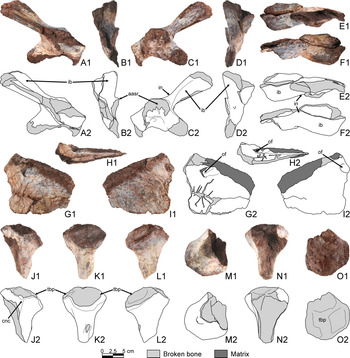
Pictures and interpretative drawings of girdle and limb elements of cf. Balearosaurus bombardensis gen. et sp. nov. from an indeterminate Permian of Cala del Pilar–Pla de Mar section (Menorca). (A–F) IPS120163, right ilium: (A) lateral view; (B) anterior view; (C) medial view; (D) posterior view; (E) ventral view; (F) dorsal view. (G–I) IPS120164, left pubis: (G) medial view; (H) ventral view; (I) lateral view. (J–O) IPS120165, fragment of the proximal epiphysis of a left tibia: (J) extensor view; (K) lateral view; (L) flexor view; (M) distal view; (N) medial view; (O) proximal view. Abbreviations: aasr = area of attachment of sacral ribs; cnc = cnemial crest; ib = iliac blade; in = iliac neck; of = obturator foramen; tbp = tibial plateau.

Description. IPS35598 (Fig. 5a–f): distal fragment of left jaw measuring 66.5 mm in maximum anteroposterior length, maximum labiolingual width of 30.9 mm and maximum dorsoventral height of 35.4 mm. No sutures are visible. The anterior and posterior ends are broken off, and the occlusal region and part of the lingual and ventral sides are strongly abraded. Although the teeth are missing, one row of five alveoli, which are hemiellipsoidal in shape, can be observed. The first two alveoli are tilted anteriorly, whereas the other three point dorsally. All the alveoli are relatively small (maximum diameter 5.7–6.1 mm) except for the fourth, which is clearly the largest (diameter 15.2 mm), and must certainly have born a large caniniform. Given the symmetrical shape of the alveoli, the mode of attachment of the teeth was thecodont. In dorsal aspect, the jaw is narrowest in its anterior end, and its lingual side expands considerably near the largest alveolus. In labial aspect, the surface is rather flat, and it is traversed by several shallow grooves. In ventral aspect, it possesses a longitudinal groove.
IPS35592 (Fig. 5g–l): anterior dorsal vertebra measuring 92.0 mm in height, with a maximum width of 93.8 mm and a maximum length of 53.0 mm. Anteroposteriorly compressed, amphicoelous pleurocentrum that measures 36.2 mm in height, with a width of 42.0 mm and length of 26.8 mm, its axis slanting 24 ° anteriorly with respect to the horizontal. The outline of the pleurocentrum is circular in anteroposterior view and spool-shaped in lateral view, because the cortical rim is slightly flared outwards laterally and ventrally. In ventral aspect, the pleurocentrum is slightly flattened, and no evidence of a ridge or keel can be observed. The neural canal has a somewhat pentagonal contour, being more rounded in anterior view (10.5 mm high × 14.7 mm wide) than in posterior view (8.4 mm high × 13.9 mm wide), flattening the dorsal edge of the pleurocentrum. The pedicels are attached dorsolaterally to the pleurocentrum, anteriorly developing a rather shallow, small fossa just above the cortical rim. From the anterior lateroventral sides of the neural canal, two rounded centroprezygapophyseal processes extend laterally on the pedicels, and possess associated infraprezygapophyseal fossae dorsally, just below the edge of the articular surfaces of the prezygapophyses. The neural arch that stands above is notably expanded and swollen, extending out as much as the width of the pleurocentrum. The prezygapophyses extend laterally from the pedicels (each apophysis corresponding to 1/3 of the total width of the vertebra) and are connected to the transverse processes (diapophysis + parapophysis) posterolaterally. The articular surfaces of the prezygapophyses are slightly tilted inwards from the horizontal plane (10 °), and possess a faintly convex obovate contour, which is twice as wide laterally than it is anteroposteriorly. From the medial edges of the prezygapophyses, two carinae extend dorsally, converging at the base of the neural spine. The transverse processes are located between the pre- and postzygapophyses, and are tilted 27 ° from the vertical axis in anteroposterior aspect. The diapophysis is slightly (15 %) thicker than the parapophysis, and they are both connected by an osseous lamina with an angle of 13 ° from the vertical axis in lateral view. Whereas the diapophysis is dorsolaterally detached forming a small process, the parapophysis fuses at mid-length of the posterior region of the prezygapophysis, being reduced to a small bulge. The postzygapophyses are located just behind the diapophyses in anterior view, separated by a rather deep emargination. A small, laterally elongated suprapostzygapophyseal fossa is present anteriorly on the emarginated side. The postzygapophyseal articular facets are slightly tilted inwards (6.5 °) from the horizontal plane, and possess a flat surface. The margins of these surfaces are slightly flared outwards, extending as ridges towards the roof of the neural channel, delimiting the postspinal fossa, which possesses a distinct triangular shape. The hypothetical two edges of the base of that triangle appear on the laminae framing it as two small, dorsolaterally elongated centropostzygapophyseal processes. The dorsal outline of the neural arch in anteroposterior aspect is rather flat, only with small undulations corresponding to the two postzygapophyses and the base of the neural spine. The neural spine is very low (10 % of the total height in anterior view) and thin (6 % of the total width).
IPS35590 (Fig. 5m–r): middle caudal vertebra measuring 44.3 mm in preserved height, with a maximum width of 24.8 mm and a maximum length of 39.8 mm. Cylindrical, amphicoelous pleurocentrum that measures 28.3 mm in height, with a width of 24.8 mm and a length of 26.7 mm, its axis slanting 13.5 ° anteriorly with respect to the horizontal. The cortical rim is slightly flared outwards, and it bears a conspicuous bulge on the ventral part of the anterior side, located dorsally just between the haemal keels. In ventral aspect, two haemal keels traverse the pleurocentrum, being more prominent on the anterior cortical rim, and decreasing in height towards the posterior end. No clear facets for the haemal arch have been observed. The neural canal has a rectangular contour in anterior view (12.8 mm high × 9.7 mm wide) and is narrower and almost circular in posterior view (8.8 mm high × 10.3 mm wide). In anterior aspect, the neural arch is broken just above the neural canal. Conversely, in posterior aspect, the postzygapophyses can be observed, the right one being complete. It is strongly directed posteriorly, and the articular surface is flat and slightly tilted inwards (24.5 °). The neural spine is not preserved.
IPS35588 (Fig. 5s, t): possible fragment of haemal arch (chevron) measuring 37.5 mm in maximum dorsoventral height, with a lateral width of 7.9 mm and an anteroposterior length of 14.7 mm. Laterally compressed, dorsoventrally elongated fragment, with a rounded anterior margin that becomes thinner posteriorly. Its distal region is broken; its proximal region, corresponding to the articular surface, is not completely ossified and somewhat irregular, forming an angle of about 65.3 ° with respect to the main axis of the bone.
IPS120163 (Fig. 6a–f): right ilium, with a lateral surface that appears to be smooth and with no trace of the acetabulum. Anteriorly, the bone ends abruptly in a flat, unfinished surface, corresponding to the suture with the pubis. Ventrally and posteriorly, the bone is eroded, as it was the exposed part when it was found, thus missing the sutural surfaces to the ischium and part of that to the pubis. On its medial surface, there is a somewhat oval area of attachment of the sacral ribs, measuring 66.6–77.1 mm in diameter. It is located anteriorly to the iliac neck; its dorsal margin is slightly protruding, its anterior margin is somewhat depressed, and its posterior margin is flat and continuous with the rest of the bone. The iliac blade (length 123.1 mm, maximum width of 72.6 mm and height of 47.6 mm) forms an angle of about 63.4 ° with the posterior part of the bone. Its neck has a semicircular section, dorsally flattened and with a rounded ventral part, and the blade is elongated, dorsoventrally compressed and expanded distally, with a flattened triangular section. Its posterior end has an unfinished, irregular surface.
IPS120164 (Fig. 6g–i): left pubis consisting of a thin, relatively flat, triangular plate (maximum anteroposterior length of 148.1 mm and maximum height of 142.8 mm), which is slightly curved ventromedially. The maximum lateral width is around its posterior–dorsal edge, reaching 32.3 mm. The anterior, dorsal and posterior margins of the plate are either unfinished or broken, whereas the ventral margin becomes progressively thinner and sharp-edged. The obturator foramen has a subtriangular to oval contour (13.5–20.1 mm in height × 12.3–13-3 mm in width), and obliquely pierces the bone from an anterior–dorsal position in the medial side to a posterior–ventral position on the lateral side.
IPS120165 (Fig. 6j–o): fragment of the proximal epiphysis of a left tibia, measuring 131.8 mm in maximum proximal–distal length, with an articular surface of 108.5 mm in anteroposterior width and a mediolateral width of 96.4 mm. Most of the medial part of the shaft has been eroded, as it was exposed on the surface when the fossil was found. Articular surfaces can be distinguished on the tibial plateau with some degree of confidence, even though there the bone is slightly eroded (or was not completely ossified). In the lateral half of the plateau, there is a somewhat semicircular depression to accommodate the lateral condyle of the femur. Additionally, another (less clear) elongated or lunate depression can be observed on the medial–extensor edges of the plateau, corresponding to the articulation surface for the medial condyle of the femur. In extensor view, the most proximal part of the cnemial crest can be observed, and although it has been mostly eroded, it appears to bear a fairly inconspicuous knob. Moreover, in lateral view, there is a conspicuous ridge about 44.5 mm below the edge of the tibial plateau.
Remarks. All of the bone remains considered here were found in close association, albeit not articulated, and so, given their consistent size and lack of duplicate elements, they can all be considered to belong to the same individual. IPS35597, the holotype specimen of Balearosaurus bombardensis gen. et. sp. nov., was collected from a lower stratigraphic position, and given its consistent size and taxonomical attribution it could be considered to be conspecific with the remains herein identified as cf. Balearosaurus bombardensis gen. et. sp. nov. However, there is no decisive proof that this specimen (mostly represented by postcranial elements) belongs to the same species as the holotype maxilla of Balearosaurus bombardensis gen. et. sp. nov., and, therefore, it is treated here separately under open nomenclature.
Cranial remains clearly agree with those of large moradisaurine captorhinid eureptiles. IPS35598 is conspicuously heterodont, differentiating a caniniform from other smaller teeth, a condition that is not known to occur in the other Permian tetrapods with swollen vertebral neural arches such as seymouriamorphs and diadectomorphs (see below), which have teeth of similar size in the anterior region of the jaws (e.g., Case Reference Case1911; Case & Williston Reference Case and Williston1912; White Reference Viglietti, Smith, Angielczyk, Kammerer, Fröbisch and Rubidge1939; Olson Reference Moreau, Benaouiss, Tourani, Steyer, Laurin, Peyer, Béthoux, Aouda and Jalil1947; Carroll et al. Reference Carroll, Kuhn and Tatarinov1972; Berman et al. Reference Berman, Reisz and Eberth1987, Reference Berman, Sumida and Martens1998; Berman & Sumida Reference Berman and Sumida1995; Kissel Reference Jalil and Dutuit2010). Conversely, the dentition of moradisaurines does differ in being relatively small, bullet-shaped teeth and having larger caniniforms (Vjushkov & Chudinov Reference Stappenbeck1957; Olson Reference Mujal, Fortuny, Pérez-Cano, Dinarès-Turell, Ibáñez-Insa, Oms, Vila, Bolet and Anadón1962a, Reference Müller and Reisz1965; de Ricqlès & Taquet Reference de Ricqlès and Taquet1982; Dodick & Modesto Reference Dodick and Modesto1995; Ivakhnenko Reference Hminna, Voight, Saber, Schneider and Hmich2008; LeBlanc et al. Reference Kuhn2015; Modesto et al. Reference Melchor and Sarjeant2019). However, the fact that IPS35598 is broken and abraded precludes detailed comparison with other species; regardless, it can be stated that the alveolus for the caniniform is approximately as large as that of the largest known captorhinid, Moradisaurus grandis Taquet, Reference Sidor, O'Keefe, Damiani, Steyer, Smith, Larsson, Sereno, Ide and Maga1969 (see de Ricqlès & Taquet Reference de Ricqlès and Taquet1982).
Elements of the axial skeleton, especially IPS35592, are also diagnostic of moradisaurines. Swollen vertebral neural arches are found in seymouriamorphs, diadectomorphs, moradisaurine captorhinomorphs and parareptiles (e.g., Olson & Beerbower Reference Olson1953; Olson & Barghusen Reference Olroyd and Sidor1962; Olson Reference Mujal, Fortuny, Pérez-Cano, Dinarès-Turell, Ibáñez-Insa, Oms, Vila, Bolet and Anadón1962a, Reference Mujal, Marchetti, Schoch and Fortunyb, Reference O'Keefe, Sidor, Larsson, Maga and Ide1979; Kuhn Reference Kissel1969; Sullivan & Reisz Reference Santi, Marchetti, Schirolli and Ronchi1999; Modesto et al. Reference Matamales-Andreu, Fortuny, Mujal and Galobart2014). Contrarily to the Menorcan material, seymouriamorph anterior dorsal vertebrae show distinct diapophyses that laterally extend past the zygapophyses (White Reference Viglietti, Smith, Angielczyk, Kammerer, Fröbisch and Rubidge1939; Sumida Reference Schneider, Lucas, Scholze, Voigt, Marchetti, Klein, Opluštil, Werneburg, Golubevb, Barrick, Nemyrovska, Ronchil, Day, Silantiev, Rößler, Saber, Linnemann, Zharinova and Shen1990). Moreover, in seymouriamorphs, the parapophyses are located on the intercentra (White Reference Viglietti, Smith, Angielczyk, Kammerer, Fröbisch and Rubidge1939; Sumida Reference Schneider, Lucas, Scholze, Voigt, Marchetti, Klein, Opluštil, Werneburg, Golubevb, Barrick, Nemyrovska, Ronchil, Day, Silantiev, Rößler, Saber, Linnemann, Zharinova and Shen1990), whereas in IPS35592 they are on the lateral sides of the neural arches, connected to the diapophyses by a thin lamina, a condition that is seen in captorhinomorphs (e.g., Olson & Barghusen Reference Olroyd and Sidor1962; Olson Reference Mujal, Fortuny, Pérez-Cano, Dinarès-Turell, Ibáñez-Insa, Oms, Vila, Bolet and Anadón1962a, Reference Mujal, Marchetti, Schoch and Fortunyb; Sumida Reference Schneider, Lucas, Scholze, Voigt, Marchetti, Klein, Opluštil, Werneburg, Golubevb, Barrick, Nemyrovska, Ronchil, Day, Silantiev, Rößler, Saber, Linnemann, Zharinova and Shen1990; Reisz et al. Reference Reisz, Haridy and Müller2011). Dorsal vertebrae of diadectomorphs and parareptiles are also reminiscent of IPS35592; however, they always possess a thickened and dorsally elongated neural spine, and additional articulation facets in the form of the hypantrum–hyposphene complex (von Meyer Reference Vera, Alonso-Chaves, Andreo, Arias, Azañón, Balanyá, Barón, Booth-Rea, Castro, Chacón, Company, Crespo-Blanc, Delgado, Díaz de Federico, Esteras, Estévez, Fernández, Fornós, Galindo-Zaldívar, García-Casco, García-Dueñas, García-Hernández, Garrido, de Gea, Gelabert, Gervilla, González-Lodeiro, Jabaloy, López-Garrido, Luján, Martín-Algarra, Martín-Chivelet, Martín-Martín, Molina, Morata, Nieto, Obrador, O'Dogherty, Orozco, Pérez-López, Pomar, Puga, Ramos, Rey, Rivas, Rodríguez-Cañero, Ruiz-Cruz, Ruiz-Ortiz, Sàbat, Sánchez-Gómez, Sánchez-Navas, Sandoval, Sanz de Galdeano, Soto, Torres-Roldán, Villas and Vera1860; Stappenbeck Reference Rosell, Gómez-Gras and Elízaga1905; Case Reference Case1911; Kuhn Reference Kissel1969; Carroll et al. Reference Carroll, Kuhn and Tatarinov1972; Sumida Reference Schneider, Lucas, Scholze, Voigt, Marchetti, Klein, Opluštil, Werneburg, Golubevb, Barrick, Nemyrovska, Ronchil, Day, Silantiev, Rößler, Saber, Linnemann, Zharinova and Shen1990; Berman et al. Reference Berman, Sumida and Martens1998; Nyakatura et al. Reference Modesto, Scott and Reisz2015). The vertebra studied herein does possess what seem to be paired, small additional articulation facets, but in the form of the centrozygapophyseal processes and fossae, which are by no means comparable to the stout and conspicuous hypantrum–hyposphene of diadectomorphs and parareptiles. Illustration of isolated vertebral remains of moradisaurines is scarce in the literature, but IPS35592 is remarkably similar to the Rothianiscus vertebra (FMNH UR 829) illustrated by Olson & Barghusen (Reference Olroyd and Sidor1962) (R.M.A., pers. obs.) and to a purported juvenile Moradisaurus vertebra, uncatalogued, in the collections of the MNHN (J.F. & R.M.A., pers. obs.).
The elements of the pelvic girdle are slightly different from those of other moradisaurines of which the pelvis is known, such as Captorhinikos (see Olson Reference Mujal, Marchetti, Schoch and Fortuny1962b) and Rothianiscus (see Olson & Barghusen Reference Olroyd and Sidor1962), in that the iliac blade is dorsoventrally flatter and more posteriorly directed in IPS120163. Some smaller captorhinids, such as Captorhinus Cope, Reference Cope1896, do have iliac blades strongly directed posteriorly (see Holmes Reference Hmich, Schneider, Saber, Voigt and El Wartiti2003), but, apart from in its size, they differ from IPS120163 in that the blade is dorsoventrally flattened in the latter.
Moradisaurinae indet.
(Fig. 7)
Studied material. IPS35593 (middle/posterior dorsal vertebra), found in an ex situ rock attributable to m 226–227 of Cala del Pilar–Pla de Mar section (the same as the specimens IPS35588, IPS35590, IPS35592, IPS35598, IPS120163, IPS120164 and IPS120165 mentioned above). IPS120166 (proximal fragment of left jaw), collected in situ from the bed at m 273–274 of Cala del Pilar–Pla de Mar section, P3 unit, indeterminate Permian, Menorca, Balearic Islands, western Mediterranean.
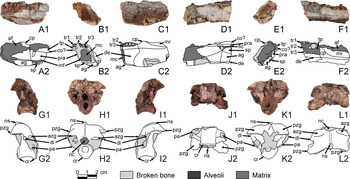
Pictures and interpretative drawings of cranial and axial elements of Moradisaurinae indet. from an indeterminate Permian of Cala del Pilar–Pla de Mar section (Menorca). (A–F) IPS120166, proximal fragment of left jaw: (A) lingual view; (B) anterior view; (C) labial view; (D) ventral view; (E) posterior view; (F) occlusal view. (G–L) IPS35588, middle/posterior dorsal vertebra: (G) right lateral view; (H) anterior view; (I) left lateral view; (J) posterior view; (K) ventral view; (L) dorsal view. Abbreviations: af = adductor fossa; ag = angular; azg = prezygapophysis; co = coronoid; cp = coronoid process; cr = cortical rim; de = dentary; di = diapophysis; mc = mandibular canal; mf = Meckelian foramen; mr = mandibular ramus; nc = neural canal; ns = neural spine; pa = parapophysis; pd = pedicel; pra = prearticular; pzg = postzygapophysis; sp = splenial; tp = teeth plate; tr1–3 = teeth row 1–3.

Description. IPS120166 (Fig. 7a–f): proximal fragment of left jaw measuring 42.6 mm in maximum anteroposterior length, with a maximum labiolingual width of 13.6 mm and a maximum dorsoventral height of 26.6 mm. Five bones are partially represented in the studied fragment, although only sutures between two pairs of them are visible (prearticular–splenial and angular–prearticular). Three rows of teeth can be observed on a platform on the dentary, overhanging in the lingual side (maximum labiolingual width of 11.9 mm and maximum dorsoventral height of 7.6 mm). Four small (maximum diameter of 2.0 mm), bullet-shaped teeth are preserved in the labial row. Detailed preparation has not been possible due to its small size and the potential risk of damaging the fossil, but they seem to be conical and somewhat pointed. Four teeth can be distinguished in the middle row, the most posterior of which is clearly larger (maximum diameter of 5.0 mm). Two other small teeth have been counted in the lingual row. All of them are arranged diagonally to each other. In labial view, the dentary is rather flat and tilted laterally (38.3 °), and its lower two-thirds are ornamented with irregular grooves. Posterior to the teeth plate rises the coronoid process (tilted 48.3 ° posteriorly), although the suture between the dentary and the coronoid is not visible, and part of the mandibular ramus. In lingual view, just below the tooth plate there is a flat and smooth surface corresponding to the prearticular. In its posterior part, and although it is covered by matrix, there is an area that corresponds to the articular facet of the hemimandible. The ventral edge of the prearticular is connected to the angular below with a distinct suture and a conspicuous angulation of the surface, which becomes almost horizontal. In the most anterior preserved part of the connexion between the prearticular and the angular there is an anteroposteriorly stretched foramen (Meckelian foramen) that connects to the mandibular canal visible in anterior aspect. Just below this foramen there is a small portion of the splenial, connecting posteriorly and ventrally with the angular by means of a conspicuous suture.
IPS35588 (Fig. 7g–l): middle/posterior dorsal vertebra measuring 33.9 mm in height, with a maximum width of 38.0 mm and a maximum length of 26.9 mm. Cylindrical, amphicoelous pleurocentrum measuring 14.5 mm in height, with a width of 14.6 mm and a length of 17.2 mm, its axis being almost horizontal. The outline of the pleurocentrum is circular in anteroposterior view and spool-shaped in lateral view, because the cortical rim is slightly flared outwards laterally and ventrally. In ventral aspect, there is no evidence of a ridge or keel. The neural canal has a somewhat pentagonal contour in anterior view (7.1 mm in height × 7.9 mm in width) and is covered by matrix in posterior view. The pedicels are attached dorsolaterally to the pleurocentrum supporting the neural arch, which is notably expanded and swollen, extending out as much as the width of the pleurocentrum. The prezygapophyses extend laterally from the pedicels and are connected to the transverse processes posterolaterally. The articular surfaces of the prezygapophyses are essentially horizontal, and are approximately twice as wide laterally than they are wide anteroposteriorly. Transverse processes are located between the pre- and postzygapophyses, and are tilted 23.1 ° from the vertical axis in anteroposterior aspect. The diapophysis appears to be half as thick as the parapophysis, and they are both connected by an osseous lamina with an angle of 31 ° from the vertical axis in lateral view. Whereas the diapophysis is dorsolaterally detached forming a small process, the parapophysis fuses at mid-length of the posterior region of the prezygapophysis. The postzygapophyses are located just behind the diapophyses in anterior view, separated by a rather deep emargination. A small, laterally elongated suprapostzygapophyseal fossa is present anteriorly on the emarginated side. The postzygapophyseal articular facets essentially horizontal, possess a flat surface and their margins are slightly flared outwards. The neural spine is very low (8 % of the total height in anterior view) and thin (7 % of the total width). In anterior aspect, it continues ventrally as a faint lamina that fades halfway to the neural canal; in posterior aspect, the spine bifurcates ventrally in two thin laminae that delimit the postspinal fossa, which possesses a distinct triangular shape.
Remarks. The fossils considered here come from two beds separated by a thickness of about 50 m. Therefore, they certainly do not belong to the same specimen (the vertebra would belong to a slightly larger animal), but they have been grouped here because they agree in general size and purported taxonomical attribution. The vertebra (IPS35588) shows typical moradisaurine traits and it is essentially a smaller version of IPS35592, very similar to the vertebrae illustrated by Reisz et al. (Reference Reisz, Haridy and Müller2011). However, it does not belong to a juvenile specimen of Balearosaurus bombardensis but, rather, to an adult of a distinct, smaller species, as it is completely ossified and there remain no traces of the neurocentral suture. The jaw (IPS120166) is also small, and broadly comparable to that of some genera of small moradisaurines such as Captorhinikos (see Olson Reference Mujal, Marchetti, Schoch and Fortuny1962b; LeBlanc et al. Reference Kuhn2015; Cisneros et al. Reference Cisneros, Angielczyk, Kammerer, Smith, Fröbisch, Marsicano and Richter2020a), Kahneria (see Olson Reference Mujal, Fortuny, Pérez-Cano, Dinarès-Turell, Ibáñez-Insa, Oms, Vila, Bolet and Anadón1962a), Gecatogomphius (see Ivakhnenko Reference Hminna, Voight, Saber, Schneider and Hmich2008), Acrodenta (see Jalil & Dutuit Reference Holmes1996) and the unidentified tooth plate from the Argana Basin (Jalil & Dutuit Reference Holmes1996). It differs from most of those genera in that IPS120166 only has three rows of teeth in the most proximal part of the jaw, whereas the others have four or more with a comparable or smaller jaw size. Acrodenta does have three rows of teeth, and differs from all other moradisaurine captorhinids in the acrodont mode of implantation of its teeth, which are thin and sharply pointed (Jalil & Dutuit Reference Holmes1996). Teeth in IPS120166 are not as thin and pointed as in Acrodenta, as they are more similar to the bullet-shaped teeth of Captorhinikos or Kahneria, and their mode of implantation cannot be observed in the present material. Therefore, it has been identified in open nomenclature.
5. Discussion
5.1. Age attribution
The precise age attribution for each of the Permian units of Menorca remains mostly unresolved. Bourrouilh (Reference Bourrouilh1973, Reference Bourrouilh1983) was the first author to carry out a palynological study on those units with a sample collected at 16.9 km along the road from Es Mercadal to Alaior, which pointed to an upper Permian age (Bourrouilh Reference Bourrouilh1973, Reference Bourrouilh1983). That outcrop was assigned to the lower half of the P3 unit by Rosell et al. (Reference Pretus and Obrador1989a, Reference Ramos and Doubingerb), who also provided another palynological analysis from an unspecified locality that revealed a ‘Thuringian’ biofacies (middle–upper Permian). A few years later, Broutin et al. (Reference Broutin, Ferrer, Gisbert and Nmila1992) reported yet another palynoassemblage from Pla de Mar, found in the copper mine beds (in m 301.5–303.5 of the log presented here, and, thus, in the middle part of the P3 unit), and also considered it to belong to the ‘Thuringian’ biofacies. That palyniferous horizon could not be relocated by Bercovici et al. (Reference Bercovici, Diez, Broutin, Bourquin, Linol, Villanueva-Amadoz, López-Gómez and Durand2009), but they did find more layers that yielded palynomorphs in the uppermost beds of the P3 unit at Penyals d'Alforinet (not considered herein; see ‘1.1. Palaeoenvironment and climatic conditions’), arguing a Wordian–Changhsingian stage (middle–uppermost Permian) interval for them. More recent works, such as Bourquin et al. (Reference Bourquin, Bercovici, López-Gómez, Diez, Broutin, Ronchi, Durand, Arché, Linol and Amour2011) or Borruel-Abadía et al. (Reference Borruel-Abadía, Barrenechea, Galán-Abellán, De la Horra, López-Gómez, Ronchi, Luque, Alonso-Azcárate and Marzo2019), considered that palynoassemblage to be of lower Wuchiapingian stage (Lopingian, upper Permian) without providing further proof. Then, they inferred that the lower–middle P3 unit was of upper Capitanian stage (Guadalupian, middle Permian), the P2 unit was of Wordian–lower Capitanian stage (Guadalupian, middle Permian) and the P1 unit was of lower Wordian stage (Guadalupian, middle Permian), without presenting specific data or any compelling argument on how these conclusions were reached.
From a review of the literature, it becomes clear that the only interval of the Permian of Menorca that has been confidently dated, albeit in a notably wide range of time, is the middle–upper part of the P3 unit as Wordian–Changhsingian (middle–uppermost Permian) (Bourrouilh Reference Bourrouilh1973, Reference Bourrouilh1983; Rosell et al. Reference Pretus and Obrador1989a, Reference Ramos and Doubingerb; Broutin et al. Reference Broutin, Ferrer, Gisbert and Nmila1992; Bercovici et al. Reference Bercovici, Diez, Broutin, Bourquin, Linol, Villanueva-Amadoz, López-Gómez and Durand2009). Additionally, the ichnological study of the present work has dated the lower part of the P3 unit as middle Artinskian–Wuchiapingian. All other age inferences, especially those for the lower units, are here considered unfounded, as with the present data it is only possible to attribute the P3 unit to an undetermined interval between the middle Artinskian and the Changhsingian (lower–uppermost Permian), lacking any data for units P1 and P2.
5.2. Tetrapod fauna
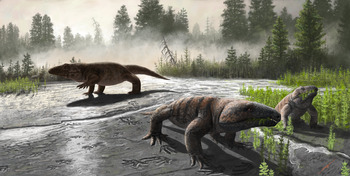
All the body fossils from the Permian P3 unit of Cala del Pilar–Pla de Mar section have been identified to belong to the captorhinid eureptile subfamily Moradisaurinae, similarly to most of the ichnological material, which was produced by captorinomorphs, perhaps moradisaurines as well (Hyloidichnus isp.) (Fig. 8). The lack of precise age constraints in the case of the Menorcan units limits the possibility of making detailed palaeobiogeographical inferences. Still, this section will explore the possible relationships with all the other similar species.
Reconstruction of the palaeoassemblage of the Permian P3 unit of Menorca, representing one specimen of Balearosaurus bombardensis gen. et sp. nov. (background) and two specimens of the smaller Moradisaurinae indet. (foreground), wandering on a crevasse splay lobe and leaving their tracks (Hyloidichnus) near other cf. Erpetopus tracks. Created by Henry Sutherland Sharpe. © 2021 Henry Sutherland Sharpe. Used under license.

5.2.1. Palaeobiogeography of moradisaurine captorhinid eureptiles
The distribution of all known moradisaurine fossils (bones and putative ichnites) throughout the Permian was essentially restricted to low palaeolatitudes between 30 °N and 30 °S (Fig. 9) (the only exception being the Hyloidichnus reported from Argentina by Melchor & Sarjeant Reference Marchetti, Voigt, Lucas, Francischini, Dentzien-Dias, Sacchi, Mangiacotti, Scali, Gazzola, Ronchi and Millhouse2004). Modesto et al. (Reference Martin-Closas and Ramos2016) suggested that moradisaurines and caseids replaced diadectids and edaphosaurids as the dominant high-fibre herbivores in the late part of the early Permian because they may have been better suited to thrive in more arid climates. Indeed, from the early Permian to the middle–late Permian, the low-latitude belt of Pangaea shifted from a tropical climate to an arid climate (Tabor & Poulsen Reference Sennikov and Golubev2008). With moradisaurines restricted to intertropical latitudes, the niches as dominant herbivores in temperate and high latitudes were filled, during the middle and late Permian, by taxa of other groups such as dicynodonts, pareiasaurs and some dinocephalians (e.g., Day et al. Reference Day, Ramezani, Bowring, Sadler, Erwin, Abdala and Rubidge2015; Viglietti et al. Reference Speksnijder2016; Bernardi et al. Reference Bernardi, Petti, Kustatscher, Franz, Hartkopf-Fröder, Labandeira, Wappler, van Konijnenburg-van Cittert, Peecook and Angielczyk2017; Olroyd & Sidor Reference Moodie2017; Sennikov & Golubev Reference Rodríguez-Perea, Ramos-Guerrero, Pomar, Paniello, Obrador and Martí2017; Marchetti et al. Reference Marchetti, Avanzini and Conti2019b). Such latitudinal provincialism was supported by the analysis of Bernardi et al. (Reference Bernardi, Petti, Kustatscher, Franz, Hartkopf-Fröder, Labandeira, Wappler, van Konijnenburg-van Cittert, Peecook and Angielczyk2017), who showed that the late Permian faunal palaeoassemblages of low latitudes clustered in what were named ‘tropical faunas’, which were clearly distinct from the palaeoassemblages of higher latitudes. This had also been argued by Sidor et al. (Reference Romano and Rubidge2005) regarding the singular middle/upper? Permian assemblage of the Moradi Formation of Niger, with relict representatives of Carboniferous temnospondyl clades that were little related to other coeval taxa. The present work adds to that evidence, as the distribution of moradisaurines, from the early Permian to the late Permian (Fig. 9), supports the hypothesis of a strong latitudinal provincialism, especially isolating the faunas of the most arid, intertropical regions of Pangaea.
World map during the Permian (modified from Scotese Reference Reisz, Sues and Sues2014) with the localities that have yielded bones and tracks of possible moradisaurine captorhinid eureptiles. (A) Captorhinikos chozaensis, Captorhinikos parvus, Captorhinikos valensis, Labidosaurikos meachami, a tooth plate from an indeterminate species and Hyloidichnus isp. from the lower Permian (Gilmore Reference Gand, Tüysüz, Steyer, Allain, Sakınç, Sanchez, Șengör and Sen1927; Stovall Reference Sàbat, Gelabert and Rodríguez-Perea1950; Olson Reference Mujal, Fortuny, Oms, Bolet, Galobart and Anadón1954, Reference Mujal, Marchetti, Schoch and Fortuny1962b, Reference Nyakatura, Allen, Lauströer, Andikfar, Danczak, Ullrich, Hufenbach, Martens and Fischer1970; Haubold et al. Reference Hasiotis, Platt, Hembree, Everhart and William1995; Lucas et al. Reference López-Gómez and Arche2013; Modesto et al. Reference Matamales-Andreu, Fortuny, Mujal and Galobart2014, Reference Martin-Closas and Ramos2016; LeBlanc et al. Reference Kuhn2015; Voigt & Lucas Reference Tabor and Poulsen2015, Reference Taquet2017; Schneider et al. Reference Reisz, MacDougall, LeBlanc, Scott and Nagesan2020), and Kahneria seltina, Rothianiscus multidonta and Rothianiscus robusta from the lower–middle Permian of southern North America (Olson & Beerbower Reference Olson1953; Olson & Barghusen Reference Olroyd and Sidor1962; Olson Reference Mujal, Fortuny, Pérez-Cano, Dinarès-Turell, Ibáñez-Insa, Oms, Vila, Bolet and Anadón1962a; Reference Müller and Reisz1965). (B) Hyloidichnus isp. from the lower Permian (Voigt et al. Reference Sumida2011; Zouicha et al. Reference Vjushkov and Chudinov2021), and Acrodenta irerhi, an indeterminate moradisaurine and Hyloidichnus isp. from the middle–upper Permian of northeastern Africa (Jalil & Dutuit Reference Holmes1996; Hmich et al. Reference Hmich, Schneider, Saber, Voigt and El Wartiti2006; Voigt et al. Reference Sullivan and Reisz2010; Hminna et al. Reference Heyler and Lessertisseur2012; Moreau et al. Reference Miall2020). (C) Hyloidichus isp. from the lower Permian of northern Iberian Peninsula (Gand et al. Reference Gand, De La Horra, Galán-Abellán, López-Gómez, Barrenechea, Arche and Benito1997; López-Gómez et al. Reference Logghe, Mujal, Marchetti, Nel, Pouillon, Giner, Garrouste and Steyer2019b). (D) Hyloidichnus isp. from the lower Permian, and Hyloidichnus isp. and Merifontichnus isp. from the middle Permian of southern Massif Central and Provence (Heyler & Lessertisseur Reference Heyler and Lessertisseur1963; Gand Reference Gand1987, Reference Gand1993; Gand et al. Reference Gand, Garric, Demathieu and Ellenberger2000; Gand & Durand Reference Gand, De La Horra, Galán-Abellán, López-Gómez, Barrenechea, Arche and Benito2006; Michel et al. Reference Martí, Paniello, Pomar, Ramos, Rodríguez-Perea, Mateu Ibars and Marzo2015; Logghe et al. Reference Linol, Bercovici, Bourquin, Diez, López-Gómez, Broutin, Durand and Villanueva-Amadoz2021). (E) Hyloidichnus isp. from the lower Permian (Voigt & Haubold Reference Swofford2015; Mujal et al. Reference Michel, Tabor, Montañez, Schmitz and Davydov2016) and possible Merifontichnus isp. from the middle Permian of the Pyrenees (Mujal et al. Reference Modesto, Scott, Berman, Müller and Reisz2017). (F) Merifontichnus isp. from the lower Permian of Sardinia (Citton et al. Reference Citton, Ronchi, Maganuco, Caratelli, Nicosia, Sacci and Romano2019; Santi et al. Reference Reisz, Haridy and Müller2020). (G) Gecatogomphius kavejevi from the middle Permian of eastern Europe (Vjushkov & Chudinov Reference Stappenbeck1957; Olson Reference Mujal, Fortuny, Pérez-Cano, Dinarès-Turell, Ibáñez-Insa, Oms, Vila, Bolet and Anadón1962a; Ivakhnenko Reference Hminna, Voight, Saber, Schneider and Hmich2008). (H) Hyloidichnus isp. from the lower Permian of northern Anatolia (Gand et al. Reference Gand, Garric, Demathieu and Ellenberger2011). (I) Gansurhinus qingtoushanensis from the middle–upper Permian of central-east Asia (Reisz et al. Reference Reisz, Haridy and Müller2011). (J) Hyloidichnus isp. and Merifontichnus isp. from the lower Permian of the Alps (Marchetti et al. Reference Mack, James and Monger2013, Reference Marchetti, Forte, Bernardi, Wappler, Hartkopf-Fröder, Krainer and Kustatscher2015a, Reference Marchetti, Ronchi, Santi and Voigtb, Reference Marchetti, Belvedere, Voigt, Klein, Castanera, Díaz-Martínez, Marty, Xing, Feola, Melchor and Farlowc; Marchetti Reference Lucas, Krainer, Chaney, DiMichele, Voigt, Berman and Henrici2016; Santi et al. Reference Reisz, Haridy and Müller2020). (K) Indeterminate moradisaurine and Hyloidichus isp. from the lower Permian of Mallorca (Calafat et al. Reference Calafat, Fornós, Marzo, Ramos, Rodríguez-Perea and Cabrera1986, Reference Calafat, Fornós, Marzo, Ramos-Guerrero and Rodríguez-Perea1986–1987; Calafat Reference Calafat1988; Gand et al. Reference Gand, Kerp, Parsons and Martínez-García2010; Liebrecht et al. Reference LeBlanc and Reisz2017; Matamales-Andreu et al. Reference Marchetti, Klein, Buchwitz, Ronchi, Smith, De Klerk, Sciscio and Groenewald2019), and Balearosaurus bombardensis gen. et sp. nov., an indeterminate moradisaurine and Hyloidichnus isp. from an indeterminate Permian of Menorca (the present work). (L) possible Merifontichnus isp. from the middle–upper Permian of north-central Africa (Contessi et al. Reference Contessi, Voigt and Bibonne2018). (M) Hyloidichnus isp. and Moradisaurus grandis from the middle–upper? Permian of central Africa (de Ricqlès & Taquet Reference de Ricqlès and Taquet1982; O'Keefe et al. Reference Modesto, Richards, Ide and Sidor2005; Smith et al. Reference Rosell, Arribas, Elízaga and Gómez-Gras2015; Olroyd & Sidor Reference Moodie2017; Modesto et al. Reference Melchor and Sarjeant2019). (N) Hyloidichnus isp. from an indeterminate Permian of southern South America (Melchor & Sarjeant Reference Marchetti, Voigt, Lucas, Francischini, Dentzien-Dias, Sacchi, Mangiacotti, Scali, Gazzola, Ronchi and Millhouse2004; Marchetti et al. Reference Marchetti, Forte, Bernardi, Wappler, Hartkopf-Fröder, Krainer and Kustatscher2020a). (O) Captorhinikos sp. from the lower Permian of northern South America (Cisneros et al. Reference Cisneros, Angielczyk, Kammerer, Smith, Fröbisch, Marsicano and Richter2020a).

Therefore, if central Pangaea was an area that hindered faunal exchanges between temperate latitudes of both hemispheres, the alternative corridors that explain the great similarities between northern and southern temperate faunas should be sought either in the coastal environments, with less harsh climates (Sidor et al. Reference Romano and Rubidge2005), or in the Cathaysian Bridge, which preserved more humid conditions throughout the Permian (Tabor & Poulsen Reference Sennikov and Golubev2008). Brocklehurst et al. (Reference Brocklehurst, Dunne, Cashmore and Fröbisch2018) argued that, in all cases, the Permian assemblages of Gondwana were more similar to the ones of eastern Laurasia, whereas it seemed that dispersion had been low between Gondwana and western Laurasia (which includes most of the moradisaurine localities). Thus, the most probable explanation was that the Cathaysian Bridge operated as the main dispersal route at least until the Guadalupian (middle Permian), and that the most important dispersal barrier between western Gondwana and western Laurasia were the high mountains of the Variscan orogen (Brocklehurst et al. Reference Brocklehurst, Dunne, Cashmore and Fröbisch2018). Among the different clades included in the analysis, eureptiles seemed to be the group least affected by this barrier, as their dispersal and vicariance rates remained relatively stable throughout the period of uplifting of the mountains (Brocklehurst et al. Reference Brocklehurst, Dunne, Cashmore and Fröbisch2018). This agrees with the pattern observed in Figure 9 herein, which shows that moradisaurines were present and radiated in both the northern and southern sides of the Variscan mountains from the very beginning of their evolutionary history. Therefore, even though it appears that the arid climatic belt in central Pangaea or the Variscan mountains could have served as a strong obstacle for dispersion of certain tetrapod groups such as amphibians, parareptiles and synapsids (Brocklehurst et al. Reference Brocklehurst, Dunne, Cashmore and Fröbisch2018), they provided comfortable environments for a specialised clade such as moradisaurines.
5.2.2. Phylogenetic relationships of moradisaurine captorhinid eureptiles
The phylogenetic tree of the Captorhinomorpha obtained in the present work (Fig. 4) differs in some aspects from those recently published; specifically, it recovers one polytomy in all the species of Captorhinus, the genus Labidosauriscus and the clade (Labidosaurus + Moradisaurinae), and another polytomy including Captorhinikos valensis, Kahneria and all the other moradisaurines except for Captorhinikos chozaensis. The first polytomy is probably the result of merging the character matrix of Modesto et al. (Reference Melchor and Sarjeant2019), resulting in a polytomy between Captorhinus aguti, Captorhinus laticeps and Captorhinus magnus, and the character matrix provided by Cisneros et al. (Reference Cisneros, Angielczyk, Kammerer, Smith, Fröbisch, Marsicano and Richter2020a), which obtains a polytomy between Captorhinus kierani, Labidosauriscus and (Labidosaurus + Moradisaurinae). In the former, the polytomy is caused by coding changes in C. chozaensis, which have been verified again in the present work; in the latter, it is caused by the addition of the two recently described taxa C. kierani and Labidosauriscus richardi. The second polytomy is obtained as a result of adding Kahneria to the matrix; nevertheless, it does not affect the clade (Balearic species + Rothianiscus), which is recovered regardless of Kahneria being included in the data matrix or not.
A significative topological difference between the trees of Modesto et al. (Reference Melchor and Sarjeant2019) and Cisneros et al. (Reference Cisneros, Angielczyk, Kammerer, Smith, Fröbisch, Marsicano and Richter2020a) is in the position of the single tooth-rowed genus Labidosaurus. It is recovered outside all the multiple tooth-rowed Moradisaurinae in the former, whereas in the latter it appears between C. chozaensis and the rest of multiple tooth-rowed moradisaurines. The tree presented in Figure 4 concurs with the tree recovered by Modesto et al. (Reference Melchor and Sarjeant2019). This aspect has important implications for the phylogeny of the Moradisaurinae, making it a clade restricted to the species with several rows of teeth parallel to the jaw margin, implying that high-fibre herbivory evolved only once within the Captorhinomorpha. In any case, the topology within derived moradisaurines remains the same in the three trees, with the lower–middle Permian North American genus Rothianiscus, with one species with three rows of teeth in the major part of its tooth plates (Olson Reference Mujal, Fortuny, Pérez-Cano, Dinarès-Turell, Ibáñez-Insa, Oms, Vila, Bolet and Anadón1962a) as sister to the two large species from Mallorca (Liebrecht et al. Reference LeBlanc and Reisz2017) and Menorca (Fig. 4).
The large moradisaurine from the island of Mallorca was described by Liebrecht et al. (Reference LeBlanc and Reisz2017), based on a fragment of right maxilla and parts of the palate that belonged to an unknown, large species with three rows of teeth. It was initially assumed (Liebrecht et al. Reference LeBlanc and Reisz2017) to be of upper Permian age based on the work of Ramos & Doubinger (Reference Olson1989), which dated the palynoassemblages of the upper lithostratigraphic unit of the Permian of the island (Pedra de s'Ase unit) as ‘Thuringian’, and thus as middle–upper Permian. However, the moradisaurine fossil was collected in the lower unit (Port des Canonge unit) (Liebrecht et al. Reference LeBlanc and Reisz2017), which did not have any reliable age attribution. That unit is now currently under study, and has been preliminarily dated as lower Permian (Artinskian–Kungurian) based on its tetrapod ichnological assemblage (Matamales-Andreu et al. Reference Marchetti, Klein, Buchwitz, Ronchi, Smith, De Klerk, Sciscio and Groenewald2019). Therefore, the unidentified moradisaurine from Mallorca (Liebrecht et al. Reference LeBlanc and Reisz2017) should be considered of lower Permian age awaiting further available paleontological and geological data.
As stated above, the phylogenetic analysis offered in the present work (Fig. 4) places this taxon as sister to the large captorhinid from the neighbouring island of Menorca described herein, Balearosaurus bombardensis gen. et sp. nov. They belong, however, to clearly distinct species, and possibly genera, which can be set apart mostly based on dental characters, as the Mallorcan moradisaurine has smooth, bulbous teeth (Liebrecht et al. Reference LeBlanc and Reisz2017), whereas in the Menorcan species the teeth are more cylindrical and ornamented with numerous ridges and furrows (Fig. 3). Despite its great palaeogeographical proximity, it is important to stress that the Permian units of eastern Iberia (including what are now the Balearic Islands) were deposited in small, semi-isolated half-graben basins (e.g., Gómez-Gras Reference Gómez-Gras1992, Reference Gand and Durand1993), which probably operated as biogeographical islands for local speciation of some groups such as moradisaurines.
The close relationship of Rothianiscus with the two large moradisaurines of the Balearic Islands further supports the hypothesis put forward in ‘5.2.1. Palaeobiogeography of moradisaurine captorhinid eureptiles’, since the former genus has been found in southern North America, which was on the northwestern side of the Variscan mountains, whereas the Balearic Islands were on its southeastern side (Fig. 9). Therefore, the general case made for all Moradisaurinae is repeated here on a smaller scale, with closely related taxa separated by the Variscan mountains, suggesting that they were not a strong barrier to dispersal of eureptiles.
Regarding the small moradisaurine of Menorca described in the present work, which was impossible to determine with the present material, its relationships within the Moradisaurinae are less clear, and will not be discussed here awaiting the discovery of more complete specimens in the future.
6. Conclusions
The present work has characterised, by means of ichnological and osteological data, a palaeoassemblage from an indeterminate Permian of Cala del Pilar–Pla de Mar section (Menorca, Balearic Islands, western Mediterranean) dominated by moradisaurine captorhinid eureptiles. The field study has allowed us to locate and characterise the palaeoenvironments of the bone-bearing beds from which some fossils were extracted and preliminarily studied in the 1980s. This, together with an exhaustive review of the literature, has shown that most of the previous age assignations to those deposits were unfounded, as only the uppermost part of the section had been confidently dated as middle/upper Permian. Additionally, from the middle part of the section, ichnites have been discovered and described for the first time in the Permian of Menorca, recognising the ichnogenera Hyloidichnus, purportedly produced by captorhinomorph eureptiles, in this case probably moradisaurine captorhinids, and possibly Erpetopus, of acleistorhinid or nyctiphruretid parareptile trackmakers. Two taxa of moradisaurines have also been identified by means of the study of all the fossil bones from the middle part of the Cala del Pilar–Pla de Mar section present in historical collections, which has been the main focus of the present work. The smallest of the two has been identified as an indeterminate moradisaurine based on two bones collected from different beds: a fragment of jaw with three rows of teeth, and an isolated dorsal vertebra with typical characters of the group. The largest of the two taxa has been described as Balearosaurus bombardensis gen. et sp. nov. based on a fragment of maxilla with at least three rows of bullet-shaped teeth ornamented with ridges and furrows. Another relatively incomplete specimen consisting of cranial, axial and appendicular bones has also been tentatively assigned to the same species. Balearosaurus bombardensis gen. et sp. nov. was closely related to the large moradisaurine reported from the neighbouring island of Mallorca, and those two were, in turn, phylogenetically related to Rothianiscus, a genus of large moradisaurines from the lower–middle Permian of southern North America. This, together with the distribution of all other known moradisaurines, has allowed us to put forward the hypothesis that the Variscan mountains were not an important barrier to the biogeographical dispersion of moradisaurines, because species of this clade occurred on both sides of the mountains since the earliest members of the group. Moreover, all known moradisaurines lived in palaeolatitudes between 30 °N and 30 °S, in regions where other herbivorous groups more typical of temperate palaeolatitudes have rarely been reported. This suggests that moradisaurines, together with caseids, may have been among the herbivores best suited to thrive in the arid climates of the low latitudes of Pangaea, outcompeting the other herbivorous groups until their demise in the late Permian.
7. Supplementary material
Supplementary material is available online at https://doi.org/10.1017/S1755691021000268
8. Acknowledgements
We thank Antoni Obrador, Miquel Fernàndez, Enric Vicens and Joan Lluís Pretus for the information about the original discovery of the tetrapod bone remains studied herein. Our thanks to David Gómez-Gras, Antoni Rodríguez-Perea, Eudald Mujal and Raül Carmona for the bibliography provided and discussion on some aspects; to Miquel Fernàndez and Sebastià Matamalas for their aid in the fieldwork; to Marina Rull and Xènia Aymerich for repreparation of the specimens; to Enric Vicens for letting R.M.A. use the photographic equipment of the Palaeontology Unit of the Universitat Autònoma de Barcelona; to William F. Simpson and Kenneth D. Angielczyk for the pictures of vertebral material of moradisaurines housed in the Field Museum (Chicago); to Daniela Schwarz, Florian Witzmann, Igmar Werneburg and Tom Hübner for access to the materials of the collections of Museum für Naturkunde (Berlin), Eberhard Karls Universität Tübingen (Tübingen) and Museum der Natur (Gotha), used here for comparison; to John A. Nyakatura for giving R.M.A. the raw computed tomography scans of Orobates for comparison; to Henry S. Sharpe for the illustration in Figure 8, funded with the grant 2112-2020-000001 of the Consell Insular de Menorca granted to R.M.A., À.G. and J.F.; to Neil Brocklehurst and Lorenzo Marchetti, reviewers of this paper, for their thoughtful and constructive comments that improved the original manuscript; and to the head editor Stig Walsh. We acknowledge support from the CERCA program (Generalitat de Catalunya, Spain). R.M.A. was supported by the predoctoral grant FPU17/01922 (Ministerio de Ciencia, Innovación y Universidades, Spain) and the grant Synthesys+ DE-TAF-23 (European Commission). J.F. was supported by the Agencia Estatal de Investigación (Spain) and the European Regional Development Fund AEI/FEDER EU, project CGL2017-82654-P (European Union). J.F. is member of the consolidated research group 2017 SGR 086 GRC (Generalitat de Catalunya, Spain). O.O. and À.G. are members of the consolidated research group 2017 SGR 1666 GRC (Generalitat de Catalunya, Spain).