


Introduction
Unusual or “psychotic-like” experiences (PLEs) include altered perceptions such as hearing or seeing things that others cannot, and having ideas that may appear odd to others. However, despite their anomalous nature, we now know that such experiences are not, in fact, uncommon. Recent studies show that up to 40% of adults in the general population and over half of children in community surveys report “unusual” perceptions or ideas (Van Os, Linscott, Myin-Germeys, Delespaul and Krabbendam, Reference Van Os, Linscott, Myin-Germeys, Delespaul and Krabbendam2009; Laurens, Hodgins, Taylor and Murray, Reference Laurens, Hodgins, Taylor, Murray, David, McGuffin and Kapur2011).
PLEs are usually transient, and do not necessarily cause difficulties. However, for a small minority of young people, PLEs are persistent, distressing and impairing, and are then associated with an increased likelihood of the future development of an at-risk mental state (Wigman et al., Reference Wigman, van Winkel, Raaijmakers, Ormel, Verhulst and Reijneveld2011; Dominguez, Wichers, Lieb, Wittchen and van Os, Reference Dominguez, Wichers, Lieb, Wittchen and van Os2011). Cognitive models of psychosis suggest that both PLE impact, and the development of an at-risk mental state and subsequent need for care, are mediated by negative appraisals of PLEs, concurrent emotional upset, and unhelpful coping strategies (e.g. social and occupational withdrawal and avoidance; Garety, Kuipers, Fowler, Freeman and Bebbington, Reference Garety, Kuipers, Fowler, Freeman and Bebbington2001; Garety, Bebbington, Fowler, Freeman and Kuipers, Reference Garety, Bebbington, Fowler, Freeman and Kuipers2007; Lovatt, Mason, Brett and Peters, Reference Lovatt, Mason, Brett and Peters2010). Consistent with this, there is emerging evidence from longitudinal studies that negative appraisals, distress and poor coping are associated with the persistence of PLEs into adolescence (Lin et al., Reference Lin, Wigman, Nelson, Vollebergh, van Os and Baksheev2011).
Together, these findings raise the possibility of a very early, proactive and preventative intervention for children with PLEs, designed to promote adaptive appraisals of PLEs, improve coping strategies, and reduce emotional problems where these exist. Changing these mediating factors should improve current wellbeing and increase future resilience to a range of life stressors, but, crucially, should also render the PLEs themselves less likely to persist and cause distress or impairment, thereby reducing future risk of developing an at-risk mental state. Such early intervention has the potential to deal with problems before they are associated with other damage via peer group pressures, such as long term bullying, and substance abuse, both factors associated themselves with later at-risk mental states (Mackie, Castellanos-Ryan and Conrod, Reference Mackie, Castellanos-Ryan and Conrod2011). Once an at-risk mental state has developed, evidence for the effectiveness of intervention to reduce transition to psychosis is limited. By this stage (usually 14 years and over), social and occupational decline has often already occurred, and may not be recovered (Marshall and Rathbone, Reference Marshall and Rathbone2011; Addington et al., Reference Addington, Cornblatt, Cadenhead, Cannon, McGlashan and Perkins2011; Yung and Nelson, Reference Yung and Nelson2011; McGorry et al., Reference McGorry, Yung, Phillips, Yuen, Francey and Cosgrave2002; Morrison et al., Reference Morrison, Bentall, French, Walford, Kilcommons and Knight2002). Intervening with adolescents reporting persistent, distressing PLEs has been mooted as an alternative strategy but, again, this group are usually reaching mid-adolescence by the time they are identified, and are already on a trajectory of increasing risk (Wigman et al., Reference Wigman, van Winkel, Raaijmakers, Ormel, Verhulst and Reijneveld2011).
Recent findings from community youth surveys indicate that while the majority of children reporting PLEs are not currently distressed or impaired by them, around 40% do report impact on their lives, and some children with PLEs also report, on questionnaire measures, emotional problems in the clinical range (Laurens et al., Reference Laurens, Hodgins, Maughan, Murray, Rutter and Taylor2007, Reference Laurens, Hodgins, Taylor, Murray, David, McGuffin and Kapur2011). Our innovative cognitive behavioural therapy package has been developed specifically for this group of children. The intervention was designed to target appraisals of PLEs, emotional upset, and coping skills, focusing on the 9–14 age range. The package draws on traditional techniques used in cognitive therapy for emotional and behavioural problems in young people (e.g. Stallard, Reference Stallard2002). We have augmented these techniques with re-appraisal strategies drawn from adult CBT for psychosis interventions (e.g. Fowler, Garety and Kuipers, Reference Fowler, Garety and Kuipers1995) and particularly the recently developed, brief, normalizing, computerized, interactive reasoning packages designed to specifically target appraisal processes (e.g. Moritz, Veckenstedt, Randjbar, Vitzthum and Woodward, Reference Moritz, Veckenstedt, Randjbar, Vitzthum and Woodward2011; Waller, Freeman, Jolley, Dunn and Garety, Reference Waller, Freeman, Jolley, Dunn and Garety2011).
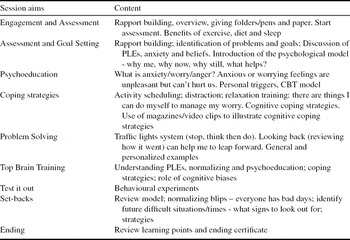
The manualized treatment protocol was designed to be delivered over up to 20 weekly sessions. Each session focused on a specific topic (such as Recognizing feelings – see Table 1), using illustrative examples relating to areas of difficulty for the individual child. The sessions were customized with games, activities, and prizes. Magazine cuttings and video clips were used to discuss key points. A commissioned designer developed visually appealing handouts to support children's understanding of CBT concepts. For each session, the manual outlined goals, content, a learning point, and suggested games, tasks and handouts.
Intervention content overview by session

The aims of the intervention were:
1. To improve mood and reduce distress and emotional problems;
2. To help children understand, normalize and cope with PLEs and therefore develop more helpful attributions;
3. To improve coping skills and peer relationships by addressing unhelpful reasoning and problem solving biases;
4. To promote “staying strong” (future resilience) techniques.
In this study, we present case material and clinical outcomes from the first four children to try the manualized therapy and report on the feasibility and acceptability of the intervention.
Method
Participants
Participants were a convenience sample identified from a larger community survey of PLEs in schoolchildren (Laurens et al., Reference Laurens, Hodgins, Maughan, Murray, Rutter and Taylor2007, Reference Laurens, Hodgins, Taylor, Murray, David, McGuffin and Kapur2011). Children whose caregivers had indicated willingness to be re-contacted about other research studies were screened for inclusion. Inclusion criteria were: aged 9–14; caregiver willing for child to participate and able to arrange meetings; and self-report of at least one PLE together with emotional distress within the top 20% on UK population norms for the SDQ, as assessed by the community survey and at a second assessment for inclusion in the current study. The distress did not have to be PLE-related. The length of time between the two assessment points ranged from 4 months to 14 months (mean = 9.5 months, SD = 4.43). We report on the first four children to meet all inclusion criteria.
Measures
Psychotic-like experiences (PLEs, Laurens et al., Reference Laurens, Hodgins, Maughan, Murray, Rutter and Taylor2007, Reference Laurens, Hodgins, Taylor, Murray, David, McGuffin and Kapur2011) were assessed using nine questions, rated by children on a 3-point scale, “0 - Not true”, “1 - Somewhat true”, or “2 - Certainly true”. Five questions shown to be predictive of later schizophrenia spectrum diagnoses by Poulton et al. (Reference Poulton, Caspi, Moffitt, Cannon, Murray and Harrington2000) and four additional questions to cover the range of psychotic symptomatology were adapted from the Diagnostic Interview Schedule for Children (DIS-C, Costello, Edelbrock, Dulcan and Kalas, Reference Costello, Edelbrock, Dulcan and Kalas1984). Items assess lifetime occurrence of hallucinatory experiences (e.g. “Have you ever heard voices other people could not hear?”) and unusual ideas (e.g. “Have you ever felt you were under the control of some special power?”). Overall impact on the child's life in terms of distress and interference in life was rated from 0 (no distress or interference) to 2 (both distress and interference). The items have been demonstrated to have good internal consistency and face, predictive and criterion validity in research studies (Laurens et al., Reference Laurens, Hodgins, Maughan, Murray, Rutter and Taylor2007; Kelleher, Harley, Murtagh and Cannon, Reference Kelleher, Harley, Murtagh and Cannon2011) but have not previously been used as a measure of clinical change, and test-retest reliability data have not yet been published.
The Strengths and Difficulties Questionnaire (SDQ; Goodman, Reference Goodman2001; Meltzer, Gatward, Goodman and Ford, Reference Meltzer, Gatward, Goodman and Ford2000) is a widely used measure of mental health in children. Five subscales assess emotional problems, conduct, hyperactivity-inattention, peer relationships; and prosocial behaviours, over the previous 6 months. Each subscale comprises five items rated on a 3-point scale: “0 - not true”, “1 - somewhat true”, and “2 - certainly true”, giving a subscale score from 0 to 10. A total score is generated by summing the individual scores for the first four subscales (range 0 to 40). The SDQ has good internal reliability, test–retest stability, and validity in children aged 8 to 16 years (Goodman, Reference Goodman2001; Goodman, Meltzer and Bailey, Reference Goodman, Meltzer and Bailey2003; Muris, Meesters, Eijkelenboom and Vincken, Reference Muris, Meesters, Eijkelenboom and Vincken2004).
Child and therapist feedback questionnaires (Therapy Rating Scales: TRS-child and TRS-therapist) were designed for this study. Items assessed understanding, engagement, perceived usefulness and enjoyment, and were rated on a 5-point Likert scale from 1 (completely disagree) to 5 (completely agree). The TRS-Child was completed after approximately 6 sessions and again at the end of therapy, with an independent rater. Therapists rated every session. High scores indicated high levels of satisfaction with the program.
Novel CBT intervention
Table 1 outlines the session content. To allow therapists to individualize session material, a maximum of 20 sessions was offered for the intervention. Sessions lasted up to 45 minutes and were conducted by a clinical psychologist or CBT therapist specializing in working with children with a range of mental health problems, including psychosis.
Procedure
Ethical approval was obtained from the King's College London Psychiatry, Nursing and Midwifery Research Ethics Sub-Committee. Parents/guardians and children were given information sheets about trying out a new intervention that draws on “talking treatments which have been shown to be helpful for both adults and children reporting anxiety, mood disorders and unusual experiences” which was “designed to help children aged 9 to 14 years” to develop “improved skills for coping with stress” and to “become more resilient to a range of stressors”. As the likelihood is that any given child with PLEs will not go on to develop an at-risk mental state, and as we were not planning to follow children up after the end of the intervention, we did not consider the inclusion of explicit information about averting potential future mental health risks to be justified and, indeed, were concerned that offering this information would have the counter-therapeutic effect of increasing catastrophic and stigmatizing appraisals of PLEs. The information sheet stated that their child would need to complete some additional questions to find out if their situation had changed since taking part in the large screening study, and if intervention would be suitable. Children no longer meeting screening criteria were signposted to other appropriate services. Parents gave consent for their children to participate, and children completed an assent form. It was made clear that children and caregivers were free to withdraw from the study at any time.
Whilst the intervention was designed to be helpful, all therapists were sensitive to the possibility of participant distress and qualified to deal with this. Referral to local services was available where required and a consultant child and adolescent psychiatrist was available for consultation. Every effort was made to be flexible with timings of appointments. All participants and families provided consent for case material to be reported in this case series. Identifiable details have been changed throughout to preserve anonymity. Measures were completed by children prior to, mid-way through, and at the end of therapy. Mid-point and end-point assessments were administered by an independent rater. No additional measures, other than those reported here, were administered. The child's therapist left the room while the child was completing feedback. Therapists completed an attendance record, a checklist of items covered in the session, and the TRS-T questionnaire at the end of each therapy session.
Design
The study is a case series with outcome measures completed pre-, mid-, and post-therapy. No formal statistical analyses were undertaken due to the small sample size. However, we calculated effect sizes for each outcome measure, and individual reliable change indices (Jacobson and Truax, Reference Jacobson and Truax1991) on the SDQ for each child. As some improvement occurred from initial screening to pre-therapy, pre-therapy and post-therapy scores were used for this purpose. Reliable change could not be calculated for the PLE scores, as this is a new measure and test-retest reliability data have not yet been published.
Case examples
Case A: Julia
Background. Julia was a 12-year-old girl, of Black British ethnicity, African origin. She attended the local state primary school and lived with her mother, elder sister and younger brother. She had no contact with her father. Julia described her home life as “happy”. Julia reported that she had some friends, but that she did not always feel comfortable around them.
Difficulties and goals. Julia's predominant difficulties were anxiety about what people at school thought about her, anxiety about schoolwork, a fear she was “going mad” and a belief that she could predict others’ behaviour, which sometimes led her to avoid peers at school. Julia could not recall how long she had held this belief. Julia's goals were to feel more relaxed about schoolwork, and to feel more relaxed with her friends.
Formulation. Julia's beliefs about others and about her own experiences were hypothesized to underlie her strategy of maintaining social distance. Her worries about going mad led her to unhelpful appraisals of her anxiety about schoolwork, which limited her coping strategies.
Intervention. Julia was seen for 6 sessions. Therapy included cognitive restructuring, helping Julia to challenge beliefs concerning her predictive powers by keeping a record of whether her predictions were always right. Julia's beliefs did not appear to be rigidly held. Julia reported enjoying the work on identifying and labelling emotions and was able to generate some ideas for different coping behaviours that she could use to manage her anxiety about schoolwork. Julia found it difficult to reflect on her thoughts and feelings without assistance, so the use of written work, diagrams and drawings was important.
Outcome and feedback. Therapy discontinued after six sessions as Julia and her parents felt that she had benefited from the treatment and that they no longer had any concerns. During the feedback interview, Julia reported that she liked most of the handouts and could remember and list nearly all of them. In particular, she liked the handout that illustrated past experiences and their possible effect on present concerns. Julia also reported particularly enjoying games, and described session lengths as “just right”.
Case B: Dean
Background. Dean was an 11-year-old boy, of Black British ethnicity, Caribbean origin. He was enrolled at the local state primary school. His family situation was complex. Dean attended his first appointment with his older brother, who did not live with the family. From then on Dean attended alone. Dean's father had left the family home. Dean was the only child of his father's in his family. His other siblings had different fathers. Dean's mother had a negative view of his father and Dean spoke about wondering what this meant about what he, Dean, was like. In addition to his elder brother who lived away from home, Dean had four half-brothers, one of whom went to prison about half-way through Dean's therapy. Dean once spoke about his mother going into hospital, but it was unclear whether this was related to physical or mental ill health. Dean's older brother also reported having had some PLEs when he was younger.
Difficulties and goals. Dean's PLEs included suspicions that his friends were only friends with him because he had special powers. Dean believed he was too powerful to undertake certain activities (e.g. he would only play football in goal because he thought he would be too powerful were he to play on the pitch). He avoided activities as a consequence of his beliefs about his special powers. Dean reported these beliefs being present since he was 5 years old, when he recalled standing in the rain and noticing that he was much stronger when it was raining. Dean thought the rain had given him the special powers. Dean was concerned that he was “going mad”. Dean's goals were to “feel normal” and “be like everyone else”.
Formulation. Dean's beliefs about special powers were hypothesized to underlie his partial withdrawal from friendships and activities. He struggled with his temper, and with trying to work out how powerful, or assertive he could or should be. He also felt unsure about himself and his own performance. Fear of losing his temper and of doing something wrong also contributed to his avoidance.
Intervention. Dean was seen for 14 sessions. Therapeutic work with Dean included cognitive restructuring and provision of cognitive and behavioural coping strategies. Dean found the writing and drawing activities particularly beneficial.
Outcome and feedback. By the end of therapy, Dean no longer believed he had special powers. Dean's family did not give feedback about their experience of Dean at home, but Dean said he felt “completely different”. He reported feeling that he could use new skills and that he felt happy. He was doing more things with his mother, not struggling as much at school, and his friendships had improved. Dean's feedback about the therapist was positive: “She lets me speak a lot”. Dean recalled some sessions that had been particularly helpful in providing him with alternative strategies for dealing with difficult situations: “She tells me I should learn to control my temper and walk away, and now I do that”. It seemed to be important to Dean to be able to intersperse talking with an activity. Dean couldn't think of any negative feedback: “I wouldn't change anything”.
Case C: Robert
Background. Robert was a 10-year-old boy, of white British ethnicity. He was enrolled at the local state primary school, although his attendance was poor. His family situation and history were complex. Robert's mother had given birth to him when she was 16 years old. She had experienced a difficult childhood that included her being sexually abused. Robert's mother presented with significant mental health problems, and his mother, maternal grandmother and maternal uncle had diagnoses of bipolar disorder. When Robert was born, his mother had become preoccupied with thoughts that Robert was the person who had sexually abused her earlier in her life. As a consequence, she neglected Robert. Robert was subject to care proceedings and placed with his aunt and her children, who were older than Robert. At the time of this intervention, Robert was still living with his aunt and some of her children. He had only recently started having contact with his mother, her new partner and the three children she had had since he had been taken into care. Robert's aunt had a difficult relationship with Robert's mother.
Difficulties and goals. Although Robert lived in a house with several other people, he was socially isolated. He had no friends at school and had missed a lot of school. He presented as preoccupied about staying near his aunt. Robert also misinterpreted other people's emotions, usually understanding them as conveying negative affect towards him. Robert's PLEs included a belief that there were “cybermen” in the garden that watched him at night. As a result of this, Robert would often sleep with his aunt. He would not go out into the garden or out to the front of the house to play with other children. Robert was highly anxious, and would often chew his fingers. Robert's goal was to have a friend that he could play with.
Formulation. Robert's suspicions about other people's intentions towards him were hypothesized to be the main factor preventing him going to school and interacting with other children. He also tended not to talk about his worries, so missed out on getting feedback, which could help him to find more helpful alternative explanations.
Intervention. Robert was seen for 14 sessions. Robert attended therapy sessions regularly, missing only one, which his aunt attended instead. Robert made particular use of the cognitive and coping skills that were taught him. His family was involved in the therapy and helped Robert to carry out behavioural experiments. These included using a whiteboard to express his emotions to his family, trying out going to people's houses from school, and working towards having a sleepover with new-found friends from school. Robert was able to use thought challenging in the sessions, for example, challenging thoughts about what the therapist was thinking about him. Robert found certain coping strategies particularly helpful, including distraction techniques such as listening to music and cognitive “thought-stopping” techniques.
Outcome and feedback. At the end of therapy Robert was attending school and had increased his social activities and network. He was going on his own to the local shop and to play, had learnt to ride a bike, and had had a sleepover. His unusual beliefs had decreased. Robert was able to use his coping strategies in some stressful situations, including his mother and her children coming to stay when they were evicted from their home. Robert's family described him as “like a different person” and were very positive about the effect of therapy. Robert reported feeling that he had tools that he could use in the future. Robert described the sessions positively, especially the games and handouts. Although there was no formal opportunity for family feedback, Robert's family was very positive about the effect of therapy, sending a card to the therapist that included the sentence “we have high hopes for Robert's future”.
Case D: Chloe
Background. Chloe was an 11-year-old girl, of white British ethnicity. She was enrolled at the local state secondary comprehensive school. Her family situation and history were complex. Her father was absent and her mother had chronic arthritis. Chloe's mother nearly died whilst giving birth to her and was in a coma for some days as a result. Chloe subsequently was cared for by her maternal grandparents. Chloe's maternal grandmother had a diagnosis of depression and was going through a period of low mood when Chloe started therapy. Chloe also reported a history of bullying at school with children laughing at her for having head lice after she had been seen scratching her head. As a result, she had requested for her hair to be cut very short.
Difficulties and goals. Chloe reported feelings that she was being watched or followed, which she found frightening. She reported feeling like people at school looked at her and this stopped her speaking to people or putting her hand up in class at times. She also related these to worries about being burgled. In addition, Chloe reported sometimes seeing or hearing her old imaginary friend, “Charlotte”. She did not find this distressing for the majority of the time but sometimes didn't like it. Chloe also reported many worries around where she should live, how she should behave, and interpersonal difficulties with friends and family members. She reported that she felt like her feelings were not taken seriously, and gave an example of accidentally being shut for over an hour in a loft storage area when she was younger and her family laughing at this, when in fact she was very scared. Chloe wanted to get along better with her family and her peers.
Formulation. Chloe's suspiciousness and ideas of reference were limiting her relationships with her peers, and prevented her telling her family how she felt about their reactions to her. Her worries about their negative reactions to her were preventing her from sharing her worries about being followed and burgled, which reduced her opportunities for developing more helpful alternative appraisals.
Intervention. Chloe was seen for 15 sessions, two of which included her grandparents. Chloe attended sessions regularly. Chloe seemed to respond well to cognitive behavioural ideas, and engaged in thought challenging and behavioural experiments. She also reported finding it helpful to be able to talk about the worries she had with an independent person. By the end of therapy, Chloe was able to explain the CBT model and think of ways to challenge her own thoughts, for example, about her friends’ perceptions of her. She engaged in two family sessions, explaining some of her feelings about not being understood or listened to. Her grandparents responded well to this intervention and were able to take on board some of Chloe's feedback, as well as giving some feedback about wanting her to speak to them more about her worries.
Outcome and feedback. At the end of therapy, Chloe had begun to speak more about how she was feeling with her family and friends. She had also begun to use thought challenging by herself to cope with some upsetting thoughts. Chloe had engaged in behavioural experiments related to being able to sit outside without feeling scared of people seeing her and she reported that this had decreased her anxiety. Chloe reported being happier with where she was living and with her friendships. Chloe's unusual experiences still remained to some degree, but her associated distress was less. Chloe's grandparents reported still feeling that there were things that could be improved in their relationship with her, but some of these issues related more to typical concerns of adolescence. Overall, the family reported being pleased. In response to the question asking what was particularly fun, Chloe answered “finding what I really feel like” and “finding someone who understands”. She said she liked all of the handouts, although described one cartoon as “scary”. This cartoon was modified as a result. At the end of therapy, Chloe gave the therapist a card which said “thank you for your help”.
TRS-child ratings
Mid-point TRS scores were 39, 39 and 36 for children B-D (Julia did not have a midpoint assessment) and end of therapy scores were 37, 38, 39 and 35 (but with one question omitted), respectively, all out of a possible total of 40. All four children rated the sessions as highly enjoyable and useful.
TRS-therapist ratings
Therapists reported finding the manual easy to follow, and found the interactive materials and “rewards” an excellent tool for engagement and for learning. Therapist satisfaction scores for the four therapy cases (out of a maximum of 5) were 3.8, 4.7, 4.9 and 4.8, respectively. Twenty sessions were not needed: therapy length ranged from 6 to 15 sessions. Some sessions seemed to require more time for some children, indicating a need to explicitly build flexibility of delivery into the approach. Suggested changes to the manual included incorporating an explanation of the cognitive behavioural therapy “hot cross bun”; to include a “what works” section in the formulation; and to expand the early family history assessment; and to use more up to date DVDs to communicate concepts.
Summary of results
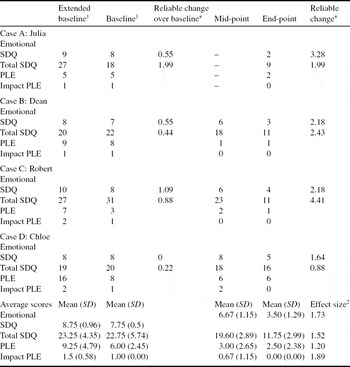
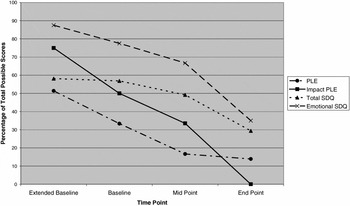
The baseline, mid-treatment and post-treatment data on the three outcome measures are shown for each of the participants in Table 2. Figure 1 shows the scores for each measure as a percentage of the total possible score for the measure. Scores are plotted against time point. A clear decrease in all measures over time can be seen.
Individual and averaged SDQ and PLE scores reported pre-, mid-, and post-therapy

Notes: SDQ = Strengths and Difficulties Questionnaire; PLE = psychotic-like experiences; *A Reliable Change score >1.96 indicates reliable change. 1The length of time between the two baseline assessment points ranged from 4 months to 14 months (mean = 9.5 months, SD = 4.43). 2Effect sizes are calculated within participant, and based on unmasked ratings.
Percentage scores for all measures over time

Effect sizes were large, though must be interpreted with caution given our methodological limitations. Improvements from pre- to post-therapy achieved the criteria for reliable change on the SDQ total difficulties and SDQ emotional symptoms scale for three of the four children. Change from initial contact to pre-therapy, in contrast, did not reach reliable change criteria, with the exception of a single SDQ total difficulties score.
Discussion
This case series assessed the feasibility, acceptability and clinical impact of a manualized CBT intervention for children aged 9–14 years experiencing PLEs and emotional distress. Outcomes for the four children who participated were positive. Scores on the Total SDQ, the emotional symptoms subscale of the SDQ and the PLE questionnaire reduced during therapy for all children, and child and therapist feedback on the manual was positive. Perceived impact of PLEs reduced to zero in all children by the end of therapy, even in the child whose PLEs continued to occur. This is consistent with models of cognitive behavioural therapy for psychosis in adults, which emphasize the importance of the perceived meaning of unusual experiences, rather than their presence or absence (Garety et al., Reference Garety, Kuipers, Fowler, Freeman and Bebbington2001, Reference Garety, Bebbington, Fowler, Freeman and Kuipers2007; Morrison, Reference Morrison2001).
Participants were enthusiastic about sessions and valued the opportunity to talk about their experiences. In one case, the child attended despite caregiver involvement being limited. All four children had not informed their caregivers about their PLEs prior to screening and lacked a source of support to speak about them. In this sense they were isolated, trying to cope with unusual experiences on their own. In adults, talking about difficult experiences has been shown to have health benefits, both mental and physical (Smyth and Pennebaker, Reference Smyth and Pennebaker2008; Graham-Bermann, Kulkarni and Kanukollu, Reference Graham-Bermann, Kulkarni and Kanukollu2011), so being unable to speak about their PLEs was likely to be a maintaining factor for our target group of young people.
The cognitive components of the manual were reported to be particularly useful. Specifically, re-appraisal and normalizing of PLEs enabled the children to feel less anxious and sad about their experiences. For two participants this helped them to challenge a thought that they were “going crazy”. Stigma surrounding unusual experiences and mental health difficulties seem to be present even in this young population, and having a mental health professional provide information about PLEs and ways of coping was well received.
Overall the children did not suggest any substantial changes to the manual. The minor changes suggested by the therapists have been incorporated into the revised version.
Limitations
The study assessed the feasibility of a manualized CBT intervention in a small, selected sample. Consequently, results cannot be generalized to all children with PLEs and emotional distress. The case series did not include a comparison group, so although we infer that the therapy was helpful, because no reliable change occurred over the extended baseline, it remains possible that improvement was caused by some other, unmeasured factor. Although we referred to general therapeutic goals, we did not rate attainment of specific, operationalized goals, which also limits our assessment of the effectiveness of the intervention. Assessments were not blind, and this is likely to have inflated our effect sizes. Wykes, Steel, Everitt and Tarrier (Reference Wykes, Steel, Everitt and Tarrier2008) report a difference in average effect sizes of almost 0.2 between studies using unmasked (average ES 0.492) and masked (average ES 0.307) assessments in randomized trials. The measure of PLEs, although designed specifically for our target group, is a research measure and has not been validated as a tool for assessing clinical change.
Clinical implications
Although caution must be exerted in interpreting such a small case series, there are some interesting implications of our results. They suggest that such an intervention is both feasible and beneficial for a distressed and isolated group of children who do not otherwise receive help. It is also possible that the intervention will be protective against the development of more serious mental health problems in the future. We have offered an essentially normalizing psychological intervention, designed to improve resilience and wellbeing, to a group who were distressed and accepted help. We offered intervention before the development of an “at-risk mental state”, with the hope of averting the development of future risk. Such an intervention may avoid some of the stigma that can be associated with later intervention. However, this is a sensitive area, and in our current work we are monitoring the attitudes towards the intervention of both children and their families, and assessing both perceived stigma and self-stigmatizing beliefs. As a next step, we plan to extend the intervention to children's community mental health services, and conduct a small randomized controlled evaluation. We will also audit the numbers of children presenting to services who have these difficulties, who could potentially benefit from this kind of intervention.
Conclusion
Our new CBT intervention for children with PLEs and emotional distress appears to be both feasible and clinically useful. A randomized controlled trial with an appropriate control group is now needed to establish the replicability and specificity of the improvements.
Acknowledgements
The authors thank the children and caregivers for their assistance in conducting the research. The authors acknowledge financial support from the Department of Health via the National Institute for Health Research (NIHR) Specialist Biomedical Research Centre for Mental Health award to South London and Maudsley NHS Foundation Trust (SLaM) and the Institute of Psychiatry at King's College, London. KRL gratefully acknowledges the support of an NIHR Career Development Fellowship (CDF/08/01/015).



Comments
No Comments have been published for this article.