How do international nongovernmental organizations (international NGOs, or INGOs) influence states? Do they lessen the need for states to provide their own services or, conversely, do they stimulate the growth of governmental services? Take, for instance, the case of health.Footnote 1 Many accounts assume that INGOs curtail public health services. Even prior to the devastating earthquake in Haiti in 2010, INGOs were estimated to provide 85 percent of public services.Footnote 2 As Haitian activist Patrick Elie reported in an interview to Dominion Magazine: “Everything that should be in the hands of the state has been taken away by business interests or by the plague of NGOs. NGOs are being used to slowly remove all the flesh from the state.”Footnote 3 In one recent report on the Balkans, health INGOs in particular were criticized for fragmenting government services and taking away talented government employees; many worry that “too much civil society [will] weaken institutions of government.”Footnote 4
Even the World Health Organization (WHO) is concerned about the potential impact of health INGOs on a state's ability to provide its own health services. In 2007, it warned that health INGOs often lack “long-term vision” in health care delivery.Footnote 5 Given these arguments, it would appear that health INGOs have negative consequences on public service provision in developing countries.
Conversely, many within the health INGO community speak of the potential positive impacts health INGOs have on public health provision within a middle- or low-income state; they see the role of health INGOs as a complement and not a substitute for state health provision.Footnote 6 For example, in Venezuela in 2004 several health INGOs pressed the administration of President Hugo Chavez to change the publicly provided antiretroviral drugs to correspond with a list of drugs recommended by WHO. A representative of the health INGOs involved there stated that the role of the organizations was to act as “social ombudsman” to the government.Footnote 7 In the Philippines in 2009, health INGOs proposed an increase in publicly provided midwives and rural doctors; many of their proposals were recently adopted by the government of President Gloria Arroyo.Footnote 8
Given the exponential growth in INGOs in the past thirty years, their impact on state spending in developing countries appears to be an important policy question. Yet, limited scholarly attention has focused on systematically examining INGOs' effects on the behavior of the state with regard to public service provision and spending. Do these organizations actually usurp state service activities, lessening the need for government spending for a particular social service? Or, conversely, does their involvement create increased state social service spending that could augment services provided by INGOs? Existing scholarship fails to offer many insights into these empirical questions and provides limited theory about the causal mechanisms connecting INGO activity to state spending.
We examine the effects of health INGOs active within a state on the health spending of states in the developing world. Health INGOs have both many incentives that motivate efforts to increase governmental health spending in host countries and many capabilities to do so. Drawing on sociological as well as political science literatures, we argue that health INGOs could theoretically create increased demand for governmental health spending through (1) indirectly affecting the policy-making climate, (2) aiding domestic NGO and health activists in their efforts, and (3) directly pressuring governments for increased health spending. Thus, health INGOs, although they typically supply their own health services within a country, should lead to more pressure for public service provision by the state and, it follows, increases in health spending by the government.
We test our argument using a new data set on health INGOs per capita, together with a well-established model of health spending.Footnote 9 Using new data, we also test for the operation of each of the three causal mechanisms. We find some support for our first mechanism, climatic conditioning, and strong support for our second mechanism, indirect transnational policy advocacy. We find very little support for our third mechanism, direct policy advocacy, indicating either that few organizations actually advocate for changes in health spending this way or that this mechanism is not very successful in leading to increased health spending. This leads us to conclude that health INGOs help increase health spending both by changing the policy-making climate and by aiding domestic efforts for increases in health spending.
Extant Literature
Determinants of State Social Spending
Middle- and lower-income states provide many forms of social services. Provision of primary education and basic health services has long been considered the mainstay of government provisions, often justified for their linkage to overall economic growth and political stability.Footnote 10 By improving a population's basic knowledge and health, these provisions can help improve the productivity of workers, benefiting economic development.Footnote 11 McGuire, for example, has found that government health spending on basic health care provision in East Asia and Latin America has dramatically reduced infant mortality.Footnote 12
What determines service provision? In the long term, Engerman and Sokoloff have linked variation in current social service provision to long-running inequality embedded in domestic political institutions; where social and geographic conditions favored political systems with an emphasis on equality (for example, democracies), social spending was higher, as was economic development.Footnote 13
Variation in health care spending in middle- and lower-income countries has been linked to democracy, welfare legacies, economic crisis, and fiscal constraint.Footnote 14 In general, democratization creates demand for new social services and expansion of existing health spending.Footnote 15 Expansion of the franchise creates incentives for political parties to advocate for expanded social services and provides new domestic interest groups the political space with which to pressure the existing government for expanded social spending.Footnote 16 Competing political parties that democracy gives rise to and empowers base their legitimacy on more widespread social services. As Huber and Stephens point out with reference to high-income countries in particular, some groups empowered through expansion of the franchise, particularly women's groups and leftist parties, can be important proponents of welfare spending.Footnote 17
Welfare legacies may limit as well as generate social spending. Haggard and Kaufman contend that entrenched interests limited the demand of social spending in Latin America.Footnote 18 Huber and colleagues echo this finding with regard to the limited impact of leftist parties in determining overall levels of health spending in Latin America.Footnote 19 Internal insecurity and dependence on foreign actors have been argued by Gough and colleagues to severely limit spending in Sub-Saharan Africa.Footnote 20 Legacies of public health spending in particular are especially strong in Eastern Europe and weak in East Asia and Sub-Saharan Africa.Footnote 21
Social spending is also dependent on governmental revenues and economic performance. During economic downturns, revenues contract and the governmental and private-sector benefits of social spending are often cut to conserve limited resources.Footnote 22 However, during economic upturns, revenues expand and facilitate public spending via the resulting increase in slack resources.Footnote 23 Moreover, revenues are a central indicator not only of cyclical fluctuation in state resources but of actual state capabilities.Footnote 24 Recession and economic affluence and growth also matter.Footnote 25
Factors outside of the political system also influence welfare spending.Footnote 26 Trade openness has been found to decrease social spending in lower-income countries. This is attributed to both changes in the ability of labor organizations and leftist parties to justify demands for welfare spending in the wake of globalization and in increased pressure from business groups to limit social spending in order to appear more competitive in the global market.Footnote 27 Rudra and Haggard find this link holds more in authoritarian regimes.Footnote 28 In contrast, however, Avelino and colleagues find that trade openness and capital mobility have little impact on health spending in Latin America.Footnote 29
In short, the extant literature on welfare spending, especially governmental health spending, in middle- and lower-income countries emphasizes the role of democratic institutions, ideological legacies, and fiscal constraints. Recent work on health spending in particular has also stressed that foreign aid may be used as a substitute for government spending.Footnote 30
Given these existing strands of literature, the role, if any, of health INGOs in determining health spending in developing countries is theoretically unclear. Health INGOs often contribute to domestic pressure for health spending increases. In line with the widespread literature on the influence of domestic interest groups on demand for social spending in democracies (in particular women's groups), it follows that health INGOs would have a positive impact on health spending.Footnote 31 Conversely, if health INGOs behave similarly to earmarked foreign aid, the effect of health INGOs on health spending may be negative. As activists fear, health INGO activities may substitute for governmental spending.
Effects of INGOs on State Policies
Before outlining how health INGOs can be incorporated into the theoretical literature on the determinants of health spending, it is worth mentioning that most of the literature on INGOs has focused predominantly on human rights and environmental advocacy organizations. As Edwards points out, even basic knowledge of the macro impact of INGOs outside of highly developed countries is still rather limited.Footnote 32 To our knowledge, no existing cross-national studies examine the impact of health INGOs on governmental spending. Indeed, there also appears to be little literature on the impact of any subgroup of INGOs on public spending.
We do know, however, much about the impacts of domestic health NGOs and health INGOs on particular state projects. Further, by many accounts, government-INGO collaboration appears to be increasing. For example, Ullah and colleagues find that health INGOs help provide professional assistance to the governmental fight against tuberculosis in Bangladesh.Footnote 33 Alonso and Brugha found that health [I]NGO involvement led to a “rehabilitation” of the government health system in Timor.Footnote 34 Campos and colleagues report that NGOs were able to fill gaps in governmental services and increased the ability of the rural poor to organize politically and Shandra and colleagues find that health INGOs help decrease infant mortality rates in democracies.Footnote 35
The larger existing literature on the effects of INGOs on state policies centers on the role INGOs play in norms transmission, resource mobilization for domestic groups, and in their ability to attract international third-party support.Footnote 36 In particular, the transnational advocacy network (TAN) framework highlights the role advocacy INGOs play in aiding domestic pressure on a regime and in calling for outside actors, such as intergovernmental organizations and third-party states, to pressure state policy change.Footnote 37 INGOs often work with domestic interest groups and organizations to pressure their governments—they also try to craft alternative policies and pressure government officials themselves.Footnote 38 A somewhat distinct strain of literature, the world polity approach, sees INGOs as an important educator in global cultural standards.Footnote 39
In this literature on the effects of INGOs, the focus is typically on the impact of INGOs on state repression, treaty adoption, and environmental performance.Footnote 40 Kim also focuses on the impact human rights INGOs have on the establishment of domestic human rights institutions.Footnote 41 However, recent work by Chwieroth and colleagues does find that INGO ties inhibit capital account liberalization.Footnote 42 This work highlights the role INGOs play in climatic “mimetic isomorphism.”Footnote 43 In other words, these organizations influence policy through indirectly conditioning the cultural climate to reflect the policy positions advocated by the INGO. INGOs can influence policy indirectly by providing support for a particular type of policy model.Footnote 44
Much has been written on problems of accountability, coordination, and corruption in the field of INGOs.Footnote 45 Murdie has found that these problems can limit the impact of INGOs on human rights and development outcomes.Footnote 46 Although much of this literature has focused on development and humanitarian relief INGOs, we highlight this literature to stress two related points: (1) INGOs are not always a homogenous ideological lot; and (2) the motivations of INGOs are not all “principled” or lacking in material underpinnings. These points, although quite straightforward at first glance, deserve a little extrapolation.
First, as Boli and Thomas suggest, INGOs vary in their ideological leanings, methods of operations, and policy suggestions.Footnote 47 As Barnett points out with respect to four major humanitarian or health INGOs, wide variation exists in INGOs' behavior to governments.Footnote 48 Some want complete independence and would prefer to work separate from governmental agencies in their host or base state; others strive for coordination and shared resources at both levels. Second, as Cooley and Ron contend, there is often a “scramble” for donor funds and attention by INGOs.Footnote 49 Competition between INGOs for scarce resources can limit their incentives to coordinate on the ground. INGOs often have material incentives for involvement in certain locales or on certain advocacy issues.Footnote 50 This could be seen as counter to the larger transnational advocacy network framework, which often views advocacy actors as distinct from other actors by their principled, as opposed to material, motivations.Footnote 51 With regards to effect on state spending, these material motivations of INGOs may actually lead to an overall advocacy of increased social-service spending. Given current trends in governmental-INGO collaboration, INGOs may have material motivations for increased governmental social-service spending. This could be important to their long-term organizational survival. (We return to this logic shortly.)
In sum, the extant literature on the policy impacts of INGOs, although not focusing on state spending or health INGOs, stresses many mechanisms through which INGOs could affect policy outcomes.
Theoretical Argument and Hypotheses
Given the existing literature on the determinants of state social spending in middle- and lower-income countries, together with the existing literature on the policy effects of INGOs, we stress a trio of rationales underscoring our basic hypothesis that health INGOs within a country will have a positive impact on a country's governmental health spending.
Before highlighting these individual but related causal mechanisms, however, it must be generally stressed that health INGOs have multiple potential motivations and capabilities for increasing state spending on health services. For many health INGOs, their mission statements include the goal of improved self-sufficiency of the state where they are working.Footnote 52 It follows that health INGOs, even if providing health services within a country, would still advocate directly or indirectly for increased health spending—many journalistic accounts support this contention.Footnote 53
Our interviews with health INGOs working in developing countries support this idea. Organizations often try both explicitly and more subtly to “build capacity” within a country. This “capacity building” involves making sure that governments can take on the goods and services required for improved healthFootnote 54 In fact, we did have organizational personnel respond that their primary goal was “trying to leverage or increase government programs” for health instead of “providing services in lieu of the government providing them.”Footnote 55
Because health INGOs often partner with governments in delivering health services, they may have a material interest in increased health spending by the government.Footnote 56 This would especially be the case if there are lots of organizations within a state, increasing the need for additional funding sources.Footnote 57 INGOs may petition aid agencies for additional aid for the country with the idea that additional funds, even if bilateral, will also benefit themselves and their missions.Footnote 58
Some scholars and journalists actually suggest that INGOs are taking over state roles. As we will detail, we examined more than 2,000 mission statements of health INGOs without finding a single explicit account of such a bold INGO goal.Footnote 59 Theoretically, from a strictly materialistic view of INGO motivations, less governmental money in health spending could limit their resource gains from collaborative or subcontracted projects. Indeed, less spending by governments could draw negative attention to health INGOs from the aid community, limiting their own resources even more.
Additionally, unlike foreign aid donors, health INGOs involved domestically with a state are more in line with the preferences of their own service recipients.Footnote 60 Though this is not always the case, health INGOs' services can be thought of as more “locally” controlled than the provisions of bilateral or IGO aid. Health INGOs typically have staff or members from the local community and often try to involve local preferences into their decision making. Fungibility or substitution issues that arise from foreign IGO or bilateral donations, therefore, would not be as present for services provided by health INGOs, many of which are providing active advocacy efforts and budget support.Footnote 61
With these general thoughts in mind, we now turn to our three related causal mechanisms, two indirect and one direct. These rationales all underscore the same primary hypothesis:
H1: The greater the presence of health INGOs in a country, the higher the country's governmental health spending.
Though testing for this hypothesis is extremely important for policy, especially given existing debates on the role of health INGOs in service delivery, testing for the empirical implications of these causal mechanisms is also important for building our theoretical understanding of how health INGOs work. After providing each of these rationales underlying our primary hypothesis, we also provide a testable hypothesis for each of these causal mechanisms. Supplemental tests of these hypotheses will help us discern which causal mechanisms are at work in linking health INGOs to governmental health spending.
Climatic Conditioning
Our first mechanism, climatic conditioning, is a variant of DiMaggio and Powell's “mimetic isomorphism” that we might rather cumbersomely have dubbed “climatic mimetic isomorphism.”Footnote 62 This stresses the influences of policy models that are noncompetitive as well as indirect. According to this model, health INGOs indirectly have an impact on health spending by altering the intellectual climate in ways that enable or encourage a particular policy model, such as one within which health spending increases noncompetitively. By “noncompetitive,” we mean free from pressures to emulate successful competitors. By “indirect,” we refer to policy dispersion of models more likely to operate through shaping policy-making discourse, opinions, and options that frame policy decisions than by directly affecting final policy decisions themselves. Such climatic conditionings may be complemented by a weak variant of “normative isomorphism.”Footnote 63 True, classical normative isomorphism, in which professionals recruited from, or trained in, other nations bring their norms into actual policy-making positions, is unlikely to be advanced by the presence of health INGOs, for INGO personnel are less likely to occupy key policy-making positions. However, the norms of health INGO professionals, as with their more-detailed policy models, are likely to ripple though the policy-making culture of the hosts and acquaintances of health INGOs, altering their policy-making predispositions and options. Indeed, what we expect to be at play are both a classical, model-centered mimetic isomorphism that alters cognitive climates and a variant that more loosely conditions policy-making by affecting broad, normative policy-making predispositions rather than by providing blueprint-like policy models.
This view of health INGOs altering a state's policy-making culture is in line with the larger INGO literature. INGOs bring new ideas into a state and connect its citizens to those outside the geographic boundaries.Footnote 64 These new ideas can result in general learning or acceptance to increased governmental spending; in other words, both the general population and policy-makers may be more likely to adopt a policy utilized elsewhere because of general cultural changes and views toward the alternative approach.Footnote 65
Similar to the constructivist and learning schools on policy diffusion, this mechanism involves the idea that given countries will adopt policies that appear to work for other countries.Footnote 66 This mechanism is definitely apparent in the practice of health INGOs taking on local members or volunteers. These members could likely see themselves as connected to the larger subgrouping of states where the health INGO is working or otherwise has a membership base.
Given the large proportion of health INGOs based in Western Europe, existing liberal (that is, reformist liberal, social democratic, and Christian communitarian) views on social service spending there could spread and influence the policy-making climate in other areas where health INGOs have members. As such, through this mechanism, health INGOs should affect general views on governmental health care and the role of the state, especially in caring for the poor. This logic would lead to the following direct test of this mechanism:
H2: Health INGOs increase a population's support for governmental service provision, leading to increased health spending.
Indirect Transnational Advocacy Effects
Our second mechanism, indirect transnational advocacy, contends that health INGOs provide material resources, space, and personnel to domestic NGOs and health movement activists, reinforcing theses actors' pressures on policy-makers. This mechanism draws on a distinct, less culturally focused literature that deals in the ways in which INGOs aid domestic NGOs and more diffuse domestic social movements in their resource mobilization.Footnote 67
Health INGOs are organizations with resources useful for domestic pressure groups, such as labor organizations or women's groups, which form the backbone of the theoretical linkage between democracy and welfare spending.Footnote 68 INGOs can provide a meeting place for local interests, social programs that connect various domestic actors, and a sounding board through which domestic groups can gain attention.Footnote 69
Much in line with the classic literature on resource mobilization, all of these resources provided by INGOs help domestic groups mobilize, especially groups with similar ideological bents.Footnote 70 This has been recently seen in Benin, for example, where INGOs helped groups of domestic citizens protest for the government to continue its support of hospitals, carrying signs that read “Don't Kill the Hospitals” and “Health is Wealth.”Footnote 71
This is also in line with the transnational advocacy framework; INGOs provide resources and attention that enable domestic groups to petition their governments.Footnote 72 In other words, health INGOs can provide the resources necessary for citizens to have a voice; this will have payoffs not only on health spending but on health care quality.Footnote 73 Therefore, health INGOs present within a state should increase the resources and political power of health-oriented social groups. These groups will then be able to better pressure their government to increase health spending in an effort to improve health services within a state. Accordingly, this mechanism would see health INGOs affecting health spending through increasing the mobilization activities of citizens domestically.
As Bartley previously found in a study of the environmental movement and Murdie and Bhasin found in a study of human rights INGOs, this mechanism would imply that health INGOs help mobilize groups within the state to pressure their own government for change.Footnote 74 As such, this mechanism's underlying logic would lead to the following observable implications:
H3: Health INGOs increase a population's mobilizations against their government and these mobilization efforts should lead to increased health spending.
Direct Transnational Advocacy Effects
More directly, it appears that some health INGOs themselves pressure governments for increases in health services.Footnote 75 They provide policy recommendations and technical advice for bureaucrats.Footnote 76 Many health INGOs attend the same meetings where governmental officials exchange ideas.Footnote 77 With respect to normative isomorphism, there is often a “revolving door” for professionals between work for a government agency and work for an INGO.Footnote 78 Therefore, health INGO professionals within a state may be able to influence health spending by taking on roles within the government itself.
This mechanism, direct transnational advocacy, should not be confused with coercive isomorphism.Footnote 79 Health INGOs hold little, if any, coercive power over states. Unlike the International Monetary Fund, for example, health INGOs cannot effectively force states to change their policies. While human rights INGOs often encourage outside coercive actors to pressure a state more aggressively,Footnote 80 this does not appear to be the modus operandi of health and other service delivery INGOs.Footnote 81 Their policy pressure appears to be more directed at the state itself through professional policy recommendations.Footnote 82 According to this mechanism, through providing these recommendations, health INGOs directly pressure governments to increase their health spending. Essentially, then, this mechanism would imply that:
H4: Health INGOs should provide policy recommendations to states and health spending should be determined by these policy recommendations alone.
In order for direct policy pressure by health INGOs to work, health INGO professionals must be providing similar advice to governmental bureaucrats and policy-makers. But INGOs are not a homogenous lot; there are many examples of INGOs in other issue areas advocating for opposite policy recommendations.Footnote 83 If, for example, some health INGOs were advocating for more liberal health spending while others were advocating, along with neoliberal economists, for restrictions on health spending, the overall impact of health INGOs might be limited. So, what are health INGOs advocating? At the end of the day, this is largely an empirical question that has not received much attention from the existing literature. However, given its importance for our research question, before conducting our study we did a content analysis of the mission statements of 2,260 INGOs that make reference to health in their stated goals.Footnote 84 Although we did find much ideological variation on other health issues (that is, abortion, end-of-life care, the use of psychiatric drugs), we did not find evidence of variation in policy opinions on health spending. Such variation might exist outside of the information provided by the mission statements that we examined, but it does not appear that there is much ideological variation among health INGOs on this issue.
Primary Hypothesis: Health INGOs Increase Health Spending
Research Design
To examine the validity of the primary hypothesis (H1), we use a quantitative data set of government health spending and health INGO activities in nonhighly developed countries for the years 1980 to 2000. Below, we outline the variables and model specification.
Data considerations
Our dependent variable, as with previous studies on health spending, is change in the amount of governmental spending on health, as a share of gross domestic product (GDP).Footnote 85 This variable captures annual changes in amount of funding the government spends for health care transfer and health services provision.Footnote 86
Our key independent variable must capture the activities and presence of health INGO activities within a state. Most previous quantitative studies on INGOs have utilized the number of all types of INGOs that have a member or volunteer within a country.Footnote 87 This data comes from the Yearbook of International Organizations, an INGO itself whose mission is to facilitate connections between organizations.Footnote 88 Very recently, some studies have tried to restrict this data to only INGOs with a certain mission statement, such as environmental rights or human rights.Footnote 89 Restricting INGO data to only a specific issue area averts bias that could occur from the unnecessary inclusion of INGOs that are not related to the specific issue at hand, such as the Star Trek Association or the World Association of Seaweed Processors. Therefore, it seems advisable to restrict our data to health INGOs only.
To do so, we utilize health ingos, a count of all health INGOs that self-report to the Yearbook as having a member or volunteer within a country in a given year. These data were graciously provided us by Smith and Wiest.Footnote 90After restricting their focus to only INGOs that focus on health, Smith and Wiest coded this data from hard copies of the Yearbook at two- and three-year intervals.Footnote 91 We use linear interpolation to fill in the years not coded. To account for differences in health INGOs numbers that can be attributed to the size of the country, we weigh this count by the natural log of the total population within a country.Footnote 92
In order to assess the validity of our primary hypothesis, we sought to situate our key health INGO variable into Haggard and Kaufman's existing model of health spending.Footnote 93 As such, we include a control for democracy, using the dichotomous indicator based on a Polity IV 21-point score of 6 or greater,Footnote 94recession, revenue (as a percent of GDP), representing fiscal constraints, gdp per capita,Footnote 95net transfers,Footnote 96 and total population size.Footnote 97 Consistent with existing literature, we expect democracy and revenue to be consistently associated with more health spending.Footnote 98
Model specification
We use an error-correction model with panel-corrected standard errors on pooled, time-series data. We do this for a number of reasons. First, the use of an error-correction model allows us to capture both short- and long-term changes in variables that are in a long-run relationship.Footnote 99 Second, by utilizing lagged dependent variables the model allows us to adjust for serially correlated errors.Footnote 100 Third, by using panel-corrected standard errors, we take account of and adjust for heteroskedasticity and contemporaneous correlation, as Haggard and Kaufman did.Footnote 101
Our theoretical argument should apply to a wide swath of countries outside of the most-developed countries. However, as Gough and colleagues point out, health spending in many areas of the world, most prominently Sub-Saharan Africa, has been historically extremely lacking.Footnote 102 As Smith and Wiest and Mawdsley and colleagues similarly point out, INGOs have not been uniformly active in the global South; their presence has been absent at times in the Middle East and North African and Sub-Saharan African regions.Footnote 103 To deal with these dynamics, we first restricted our focus to just the East Asian, Latin American, and Eastern European countries and years covered in Haggard and Kaufman.Footnote 104 Restricting our sample in this way allows us to concretely assess whether health INGOs have an impact on health spending in areas of the world where we have strong theoretical priors about the determinants of health spending.
For our baseline sample, however, we expand the Haggard and Kaufman sample to include a global sample of all nonhighly developed countries for which we have reliable data from the Global Development Network Growth Database/IMF Global Financial Database for the 1980 to 2000 period, as was used in the Haggard and Kaufman study.Footnote 105 Expanding the sample in this way allows us to ensure that our baseline findings apply to a wide range of countries outside of the most developed world. As an added test, we similarly restrict our sample to only non-Sub-Saharan African countries. We do so to remain attentive to the differences in health spending in Sub-Saharan Africa during this time period, as outlined in Gough and colleagues.Footnote 106 Our results are consistent in sign and similar in significance levels across samples, reiterating the robustness of our findings.
We do employ a few small changes from the Haggard and Kaufman specification of health spending.Footnote 107 First, Haggard and Kaufman pool data up to the regional level only.Footnote 108 As evidenced from the small number of countries and years in their sample of health spending (215 observations total) and combined with the use of an error-correction model, pooling to only the regional level could create problems with model overfitting. To account for issues of small sample size, we therefore pool the regions together and then estimated models with interaction terms between our key variable of interest and regional dummies. We were able to determine that the key variable (health ingos per capita) does not have statistically significant differing effect across regions. This is true no matter which region is specified as the left-out category. Therefore, we report model results for one model pooled across regions.Footnote 109
Additionally, Haggard and Kaufman (Reference Haggard and Kaufman2008) use a specification of error correction models that includes lagged levels and lagged changes of the regressors, unlike the more conventional approach of utilizing lagged levels and unlagged changes of the regressors.Footnote 110 In expanding our sample beyond the Haggard and Kaufman (Reference Haggard and Kaufman2008) country-years, we follow the conventional approach and estimate a model where we include lagged levels and unlagged changes of the regressors.Footnote 111 Finally, we include yearly fixed effects in our models, reflecting the idea that our intercept is not the same across time.Footnote 112
Therefore, the statistical model used in this study is as follows:
 $$
\eqalign{
& \Delta {\rm GOVERNMENTAL}\;{\rm HEALTH}\;{\rm SPENDING}_{i,t} \cr
& \quad = {\rm GOVERNMENTAL}\;{\rm HEALTH}\;{\rm SPENDING}_{i,t - 1} \cr
& \quad = \Delta {\rm HEALTH}\;{\rm INGOS}\;{\rm PER}\;{\rm CAPITA}_{i,t} + {\rm HEALTH}\;{\rm INGOS}\;{\rm PER}\;{\rm CAPITA}_{i,t - 1} \cr
& \quad + {\rm HAGGARD}\;{\rm AND}\;{\rm KAUFMAN}\;{\rm (2008)}\;{\rm CONTROLS}_{i,t - 1} \cr
& \quad + \Delta {\rm HAGGARD}\;{\rm AND}\;{\rm KAUFMAN}\;{\rm (2008)}\;{\rm CONTROLS}_{i,t} + e_{i,t} \cr}
$$
We have few theoretical priors about whether the relationship between health INGOs and health spending should be more short term, as will be captured through the changes in health INGOs per capita variable, or long term, as will be captured through the lagged level variable. On the one hand, it does seem likely that health INGOs would have only a temporary effect—that they would operate through the mechanisms we have outlined to directly or indirectly affect health spending mainly in the short term. This would be consistent with arguments laid out by Cooley and Ron for example, about the short-term planning cycles of most health INGOs.Footnote 113 On the other hand, long-term changes could be possible, however, if the “shocks” brought through these mechanisms by health INGOs would continue over multiple time periods or persist over the entire time of the model.
One additional issue concerning model specification also deserves mention: where health INGOs go. In our theory, health INGOs are strategic actors, making decisions to work in ways that can lead to positive changes in health spending. Thinking of health INGOs in this way requires us to consider which countries these organizations are likely to go to. If health INGOs are drawn to countries for the same reasons that states increase their health spending, addressing these underlying reasons would be necessary to isolate any effect health INGOs could have on health spending. Similarly, if health INGOs were attracted to only “easy” states with high and increasing levels of health spending, we would have to address issues of endogeneity or self-selection in order to isolate the effects of health INGOs on health spending. As a first cut, models of the determinants of health INGOs per capita within a country do not show that health INGOs were drawn to states with higher levels or changes in health spending.Footnote 114 Interviews with health INGO officials also support this idea; when asked, health INGO officials do not indicate that they were drawn to states by either high or low levels of government health spending.Footnote 115
To our knowledge, a literature on the determinants of health INGOs within a state does not exist. However, there is a literature on the determinants of all types of INGOs and a small literature on the determinants of human rights INGOs in particular.Footnote 116 Drawing on this literature and on interviews with health INGO officials, we propose that these organizations are likely drawn to states with high health issue salience, such as states with new epidemics, or to countries with high media attention and connections to the outside world. Models where the dependent variable is health INGOs per capita show that these indicators are positively associated with health INGO presence. However, our models of health spending with these indicators as additional controls do not show that epidemics or indicators of connections to the outside world have a statistically significant impact on changes in health spending. Two-stage least squares models with the indicators as instruments show many of these indicators as statistically significant and strong instruments in the first stage, indicating that they are properly identified predictors of health INGOs.Footnote 117 Crucially, the Durbin-Wu-Hausman tests for two-stage models with all of these indicators as instruments are not significant, indicating the lagged health INGOs per capita is not an endogenous regressor of changes in health spending.Footnote 118 Though we hope that this is not the last word on the determinants of health INGOs within a country, we feel confident about the one-stage analysis of the impact of health INGOs on health spending that we use.Footnote 119
Results
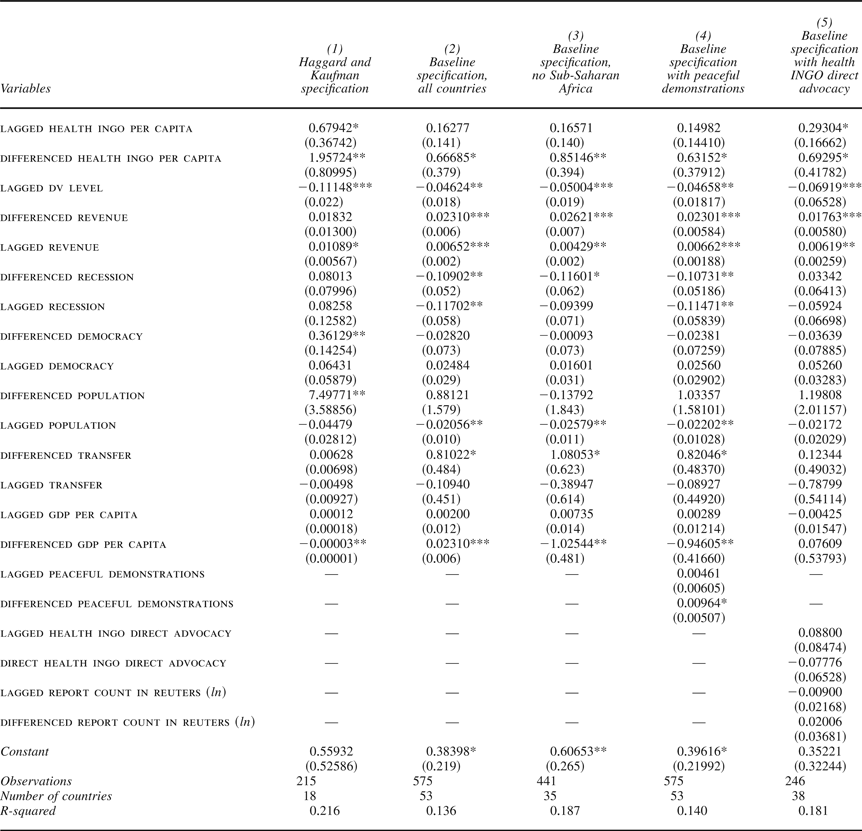
Our primary hypothesis is supported in this analysis: health INGOs have a positive impact on governmental health spending. Table 1, column (1), provides results for health INGOs per capita in the context of the basic Haggard and Kaufman sample of Eastern European, Eastern Asian, and Latin American countries.Footnote 120 Both the lagged level and the change in health INGOs per capita are statistically significant and the coefficients are in the positive direction, indicating both a short- and a long-term effect on health spending. The effect of a one-time change in health INGOs is rather large, 1.96, larger than a temporary shock of a change to democracy (0.36). Within this sample, the long-term effect of a one-unit change in the health INGOs per capita within a country is also substantial, equating to a 6.09 increase in health spending as a percentage of GDP over the time period covered in the model.Footnote 121 The statistically significant control variables we used are also similar to Haggard and Kaufman and the larger literature on the determinants of health spending.Footnote 122democratization (change in democracy) has a robust positive impact. revenue increases also have a positive impact on health spending. The demographic variables, not shown in the tables in Haggard and Kaufman, are also similar to the original model without the addition of our health INGO variables.Footnote 123
Regression of health spending on health INGOs and control variables, various samples 1980–2000
Notes: Error correction model with yearly fixed effects (omitted) and panel-corrected standard errors in parentheses.
*** p < 0.01;
** p < 0.05;
* p < 0.10 (two-tailed).
When we expand our sample beyond the Haggard and Kaufman country-years, however, as shown in Table 1, column (2), health INGOs per capita retains a positive and statistically significant impact on health spending only in the short term, as indicated by the coefficient on the changes in health INGOs per capita variable and the lack of statistical significance for the coefficient on the lagged level variable.Footnote 124 We see this as somewhat expected; health INGOs are working to change health spending in the immediate period with which they are working within a country. The goods and services they are providing, especially when we expand beyond the countries in Haggard and Kaufman's sample, may quickly dissipate if the “shock” of positive changes in health INGOs per capita does not continue.Footnote 125 If, however, the shock of a positive increase in health INGOs per capita remains, the total effect of these organizations can be much larger. As such, the results in Table 1, column (2) imply that a change in the number of health INGOs per capita for only one period would have a 0.67 effect on health spending. If the change would continue for ten years, half of the sample time period, however, the total effect would be a 5.188 increase in government health expenditure.
Table 1, column (3), reiterates these dynamics in a sample that excludes Sub-Saharan Africa, where we expect insecurity to severely limit health spending.Footnote 126 Our findings are very similar, albeit slightly heightened and at a slightly more precise statistical significance level, to the global sample results in Table 1, column (2). Changes in health INGOs per capita have a positive impact on health spending. Together, we feel these findings support our primary hypothesis. Health INGOs are not taking away from the role of the state; in fact, these organizations are actually leading to increases in government health spending.
We also conducted a series of robustness tests on this general finding. Due to concerns with aid fungibility, we add a control for aid per capita.Footnote 127 Reflecting Huber and colleagues, we added a control variable for leftist parties.Footnote 128 Reflecting Avelino and colleagues, we also made sure our results remained significant with the addition of a control for trade openness.Footnote 129 The positive effect of change in health INGOs on health spending continues to be positive with these additional controls.Footnote 130
Supplementary Hypotheses: Concerning Causal Mechanisms
All three of our identified causal mechanisms led to the same primary hypothesis, which was supported in the empirical analysis: health INGOs exert a positive effect on health spending. In novel ways, we attempt to test for implications of each of our causal mechanisms argued to be driving this primary finding. However, we do not see these causal mechanisms as competing. In fact, with our discussions of health INGO officials, we were struck by the multitude of ways in which health INGOs are working to affect health spending, consistent with our various causal mechanisms. These tests, instead, are simply to indicate whether evidence for any of these mechanisms exists in the larger world.
For all of these tests, we use the expanded global sample presented in Table 1, column (2). We think this expanded sample represents the hardest test of our theoretical implications.Footnote 131
Supplementary Hypothesis: Climatic Conditioning
Recall that our climatic conditioning mechanism (H2) implies both that health INGOs increase a population's support for governmental service provision and that this support augments health spending itself. To test this mechanism, we sought out measures of opinions about government's role in service provision and the availability of health care. The World Values Survey asks individuals for their agreement (on a 10-point scale) with whether “the government should take more responsibility to ensure that everyone is provided for.”Footnote 132 We use the proportion of a population that answers affirmatively (greater than 5 on the 10-point scale) with this statement as the dependent variable, arguing that more citizens within a state should agree with this statement if health INGOs are affecting policy-making opinion within a country in ways that support increased health spending.Footnote 133 As such, we are also arguing that greater proportions of a population answering this question affirmatively should be related to future increases in health spending.
Data on this variable are available for only eighteen observations of country-years utilized in the global sample used to test our primary hypothesis. Given this small number of observations, we rely on both a simple t-test for differences in means and ordinary least squares (OLS) regression for the first-stage equation looking at the influence that health INGOs have on public opinion and the latter stage looking at the effect that this public opinion has on future changes in health spending.
As to the first causal stage relationship between health INGOs and public opinion, for the t-test, we divide countries into two groups: those with below the regional mean of change in health INGOs per capita and those with above the regional mean. We use the regional mean to account for any regional differences in health INGO per capita effects. For the OLS regression, we control for regime type, Eastern European or post-Soviet region, and the log of GDP per capita. Our key independent variable is yearly change in the number of health INGOs per capita from year t−1 to year t; we expect a greater proportion of individuals within a country to agree that the state should have more responsibility in ensuring people are provided for when there is a greater change in health INGOs per capita. In other words, more people should agree to government's role in providing for its citizens as there is an increased change in the number of health INGOs per capita.
T-test results are supportive at this stage.Footnote 134 For countries with less than the regional mean of change in health INGOs per capita, their mean scores on the proportion of the population that agree the government should take more responsibility to help people is lower than in countries that had more than the regional mean of change in health INGOs per capita. The difference in these mean scores is statistically different across the groups at conventional levels, indicating that countries with more increases in health INGOs per capita have a greater proportion of people who agree to government's role in service provision.
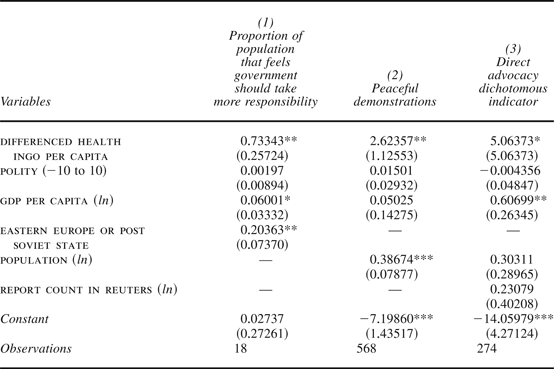
This same pattern holds when looking at this through an OLS regression, as shown in Table 2, column (1): greater increases in health INGOs per capita are associated with more of a population agreeing to government having an expanded role in providing for its citizens. This would offer support for supplementary hypothesis (H2) and the underlying climatic conditioning mechanism.
Regressions concerning mechanisms for health spending effects of INGOs; baseline specification, all countries
Notes: Column (1) uses ordinary least squares; column (2) uses a generalized estimating equations (GEE) negative binomial model with AR(1) correlation structure; and column (3) uses rare events logit, robust standard errors.
*** p < .01;
** p < .05;
* p < .10 (two-tailed).
We also have extended this logic to the final outcome variable that matters for changes in health spending: the proportion of the population that is climatically conditioned to think the government should help people.Footnote 135 First, using a t-test, we focused on the relationship between the proportion of the population that believes the government should help make sure everyone is provided for and differenced health spending in a given year. We divide states into two groups, those with below and above the mean proportion that answer this question affirmatively. Using this approach, we found moderate support that differenced health spending as a percentage of GDP is higher in countries with higher proportions of their population that believe everyone should be provided for.
We used an OLS regression to examine the role that the lagged proportion variable has on the differenced health spending outcome, accounting for the lagged level of health spending.Footnote 136 We find that increases in this proportion matter for future changes in health spending. Of course, due to data limitations, we could not use the fully specified error-correction model in this study. However, given these t-test and OLS regression results, we can say that this climatic conditioning mechanism appears to have some support in this limited examination: health INGOs matter for public opinion on government service provision and this opinion matters for actual changes in health spending. Further data collection projects, such as that currently being done by the WHO's World Health Survey, may help future research disentangle this relationship.Footnote 137
Research Design for Supplementary Hypothesis: Indirect Transnational Policy Advocacy
The first observable implication of our indirect transnational policy advocacy mechanism (H3) concerns the effect health INGOs have on domestic mobilization. Following work by Murdie and Bhasin on human rights INGOs, we test this mechanism by examining the impact changes in health INGOs per capita have on the level of peaceful demonstrations within a country.Footnote 138 Like Murdie and Bhasin, focusing on changes in INGO numbers reflects the “the idea of campaigning efforts” through which INGOs would work to increase demonstrations.Footnote 139 To capture our dependent variable, we utilize a measure from Banks's Cross-National Time-Series Data Archive.Footnote 140 This measure, anti-government demonstrations, is the number of peaceful gatherings of at least 100 people to show “opposition to government policies or authority.”Footnote 141 Given the count nature of the dependent variable and existing studies on political protests, we utilize a negative binomial model and control for regime type using the 21-point Polity scale, GDP per capita (ln), and population size (ln). We account for time series cross-sectional dynamics through the use of a generalized estimating equation with an AR(1) correlation structure and robust standard errors.
Table 2, column (2) provides this empirical test's results. Increased change in health INGOs per capita corresponds to an increase in peaceful demonstrations. Based on these results, as the change in health INGOs per capita variable moves from its minimum to its maximum in the sample, for example, there is expected to be an increase of 0.391 demonstrations (95 percent confidence interval from 0.041 to 0.777). This is larger than the 0.287 peaceful demonstrations that would occur as democracy goes from its minimum to its maximum in the sample (95 percent confidence interval of 0.109 to 0.464) but is smaller than the almost three additional demonstrations that would occur if a country's population went from the smallest to the largest in the sample (95 percent confidence interval of 2.32 to 3.77). For an organization type that is not commonly thought of as specialized on nonviolent protest promotion, this result seems very substantial.
Table 1, column (4) illustrates the next step in the empirical implications of this mechanism: the impact of peaceful demonstrations on health spending. The logic here is that now we know that health INGOs affect domestic mobilization, we can examine whether this domestic mobilization does increase health spending. We do this through adding our variable for peaceful demonstrations to the specification of health spending outlined earlier. As Table 1, column (4) shows, the differenced health INGOs per capita measure remains statistically significant and in the expected direction. Additionally, we find that change in the number of peaceful demonstrations has a positive and statistically significant impact on health spending. Overall, these results provide support for the observable implications of the indirect transnational policy advocacy mechanism, as outlined in H3.
Research Design for Supplementary Hypothesis: Direct Advocacy Mechanism
Our final mechanism (H4) concerns the effects of direct policy advocacy by health INGOs on health spending. To examine this mechanism, we utilize newly created events data from the Integrated Data for Events Analysis (IDEA) project that we think closely captures direct actions by health INGOs to governments.
To create this data, Murdie first used the March 2007 online edition of the Yearbook of International Organizations to search for all INGOs active during any portion of the period utilized for this study.Footnote 142 She then restricted the focus to INGOs identified by the Yearbook as predominantly health in orientation; there were 2,260 INGOs that fit this definition. A dictionary of the names, in English as well as in any other language identified by the INGO, and common acronyms of the INGOs was then sent to Virtual Research Associates. Using the Integrated Data for Events Analysis (IDEA) framework, Virtual Research Associates isolated all events in Reuters Global News Service that mention these INGOs and are targeted to a state or governmental actor.Footnote 143 We collapse this data to the country-year. The reason is that this variable, health ingo direct advocacy, captures events of direct advocacy by health INGOs to states.Footnote 144 Following common practice, we also account for any media bias in IDEA by controlling for the natural log of the total number of reports recorded about that country-year in Reuters. The availability of this data restricts the start date of our sample to 1990.
One thing worth noticing at the outset is the paucity of events of health INGO direct advocacy. More than 75 percent of the observations have no health INGO direct advocacy events in a country-year. In fact, in the larger sample of all countries from 1990 to 2009, only two observations had more than thirty health INGO direct advocacy events within a country-year: Algeria in 1999 and 2000. This is in stark contrast to one hundred human rights INGO direct advocacy, for example, where observations were routinely above one hundred. The paucity of events in this sample could indicate that most health INGOs do not directly advocate for policy change, at least in ways captured by events data. This makes some theoretical sense: health INGOs are traditionally not focused on state shaming—their ability to increase health spending may be expected to be more directly linked to the resources they bring to the domestic population within a state (indirect advocacy) and the ideas they help to permeate (climatic conditioning). Because of the paucity of events captured in health ingo direct advocacy, we operationalize this final variable as a dichotomous indicator with a 0 equating to no events and a 1 equating to one or more events.Footnote 145
As a first-cut test of this direct advocacy mechanism, we examine whether a change in health INGOs per capita increases the likelihood of a health INGO direct advocacy event. Such an effect would constitute the first half of the logic of how health INGOs affect health spending via a causal chain that runs from INGOs to the presence of direct advocacy by INGOs to health spending. We use the health INGO direct advocacy dummy as the dependent variable, change in health INGOs per capita as the key independent variable, and control for population (ln), GDP per capita (ln), total events in Reuters (ln), and the 21-point Polity scale. Given the large amount of zeroes in this health INGO dummy, we utilize a rare events logit model.Footnote 146
Table 2, column (3) provides the result of this first-stage relationship between health INGOs and health INGO direct advocacy. As expected, we find a positive and statistically significant relationship, indicating that health INGOs per capita do lead to direct advocacy events.
To complete the logic connecting health INGOs to health spending via this direct advocacy mechanism, we add our new health INGO direct advocacy variable to the basic model of health spending outlined to test our primary hypothesis. As Table 1, column (5) shows (and as somewhat expected, given the low number of direct advocacy events), we find no statistically significant effect of health INGO direct advocacy on health spending. This result indicates that we should reject the hypothesis that health INGOs increase health spending via direct INGO advocacy of such increases, for there can be no INGO effect via direct advocacy if there is no direct advocacy effect. However, because the test is based on a limited count of direct advocacy events that no doubt limits its power, the lack of a direct advocacy effect may not be robust. As evidence for a health INGO effect on direct advocacy activities has emerged, as shown in Table 2, column (3), any evidence that health INGO direct advocacy has an impact on health spending that might emerge from future research would be closer to evidence for health INGO effects channeled via direct advocacy than would otherwise be the case. In short, further research on a possible direct advocacy mechanism is necessary.Footnote 147
Given these results from the tests of the supplemental hypotheses, it appears that the main role of health INGOs in increasing health spending comes either indirectly from general changes in policy opinions (climatic conditioning) or from aiding in resources available to domestic groups (indirect policy advocacy).
Conclusion
Although conventional wisdom often posits that INGOs hinder governmental services, in the case of health, we find that INGOs actually increase governmental spending. This finding is consistent to a myriad of different control variables and specifications. This effect could occur through three causal channels: (1) changing the policy-making environment (climatic conditioning) and (2) mobilizing resources that help generate domestic pressure for increased health spending, as well as (3) directly impacting health spending through advocating themselves for increased governmental health provision. Supplementary tests of the observable implications of these causal mechanisms provide support for the first two mechanisms, especially the indirect advocacy mechanism. Health INGOs have both pragmatic and principled motivations to improve government spending on health care within a state; they provide a “citizen voice” that does not undermine governmental social service spending. This result has important implications for both those in the policy and academic worlds.
In contrast to popular calls that INGOs limit the role of the state, we find that INGOs can actually lead to increased state health spending. INGO presence in a country advances its state's health outputs as much as if the INGOs had advocated for such increase. Moreover, through examining the implications of the causal mechanisms underlying this argument, we find support for very advocacy-like outcomes as a result of health INGO activities.
Theoretically, this project draws attention to an often-missing subtype of INGOs, health INGOs, and shows the utility in looking at INGOs by issue-area focus. Our theory is general; the logic could be extended to other issues INGOs often focus on, such as democracy assistance, education, or economic development. Moreover, this research outlines how an actor without much formal power can still have an impact on domestic political outcomes. This study thus supports the “second image reversed” literature in international relations, indicating that international actors can have an influence on domestic decisions and behavior.Footnote 148 By moving beyond the typical focus on intergovernmental organizations, this study adds to the second-image reversed literature by focusing on the domestic impact of an international nongovernmental actor.
This present study regarding INGO policy influence bears on broad theoretical discussions in a number of literatures, for example, transnational advocacy networks, global civil society, and global social movementsFootnote 149 Further, utilizing the cross-disciplinary literature on policy diffusion and adaptation, this study builds on previous theoretical attempts to articulate causal mechanisms through which INGOs exert influence.Footnote 150 Empirically, this article uses new data that allow us to cast some quantitative light on such conceptual distinctions. Future empirical work in this vein would also add to the overall literature.
Finally, this research provides an important step in understanding the effects of health INGOs. The possibility of other health INGO effects calls out for further research. Future projects should examine the impact of health INGOs on health outcomes, services provided, and public opinion of health quality.