Introduction
The United States has seen an increase in chemical, biological, radiological, nuclear, and explosive (CBRNE) events, including natural disasters, terrorist attacks, and epidemics.Reference Toner 1 The impact of disasters depends not only on the severity of the event, but the ability to effectively respond, mitigate, and treat the ill or injured.Reference Schultz, Mothershead and preparedness 2 This is especially true in the health care setting, where a coordinated effort among health care professionals is needed.Reference Hansoti, Kellogg and Aberle 3
Despite the need for a well-trained team and over 300 available emergency preparedness courses, health care staff report a lack of emergency preparedness knowledge and training.Reference Hansoti, Kellogg and Aberle 3 , Reference Wanner and Jasper 5 It has been suggested that this may stem from a lack of focused training and frameworks specific to different disciplines within health care.Reference Lin, McKenney and Elkbuli 6 Health care team members face increasing work demands, limited resources, high training requirements, and conflicting schedules. These factors may limit the amount of focused emergency management training available to clinical and non-clinical health care professionals.
Despite the challenges associated with providing emergency management training, it is necessary as data has shown that health care professionals who take emergency preparedness courses show an increase in perceived knowledge and ability to respond to disaster events.Reference Hansoti, Kellogg and Aberle 3 However, there is limited literature analyzing the professional occupations of emergency management course participants. Understanding trends in emergency preparedness training enrollment among health care professionals can help identity which courses are most beneficial based on occupation and enable more effective resource allocation. This study’s aim is to contextualize the professional backgrounds of students enrolled in health care emergency management training to identify training gaps to optimize resources.
Methods
Study Design
Emergency Management course registration data were retrospectively collected from the Northwell Health Crisis Management Incident Response Team (CMIRT) training database, from January 1st, 2021 to June 10th, 2024. This database securely stores information in a de-identified, password-protected drive. Our institution’s IRB deemed this study not human subjects research (IRB-HSRD24-0125).
Data Analysis
Occupational backgrounds were categorized into 5 groups (Supplemental Table 1): Administration, Clinical, Emergency Management, First Responder, and Security. The Clinical category was further subdivided into Advanced Clinical Providers, Clinical Assistants, Clinical Laboratory Technologists, Nurses, Physicians, and Others. The 4 courses with the highest enrollment were selected for analysis: Nursing Leadership, Hospital Emergency Response Training (HERT), First Receiver Training, and Evacuation of Facilities in Disasters System (eFINDS). Participants from the Nursing Leadership course were analyzed separately as only nurses can be enrolled. Frequency and percentage were used for categorical variables. Tests of associations were based on chi-square. Statistical analysis was conducted using SAS software. Statistical significance was set at P < 0.05.
Results
Emergency Management Course Offerings and Associated Enrollment
A total of 1168 participants were included in the study, of which 203 were nurses enrolled in the Nursing Leadership Course. The remaining 965 participants were enrolled in HERT (n= 216), First Receiver Training (n=458), and eFINDS (n=291).
Emergency Management Course Type and Associations Between Occupation
Excluding the Nursing Leadership course, the participants’ occupational background included 316 administrators (33%), 322 clinical professionals (33%), 56 emergency managers (6%), 17 environmental professionals (2%), 24 first responders (2%), and 230 security professionals (24%). Non-clinical professionals were significantly more likely to be enrolled in emergency management courses than clinical professionals (P=0.0001).
Occupation was significantly correlated with course enrollment type. Administrators and emergency managers were more likely to enroll in eFINDS. Clinical professionals and security were more likely to enroll in the First Receiver course, while environmental workers and first responders were more likely to enroll in HERT (P=000.1) (Figure 1).
Association between course type and occupation (P = 000.1).
Occupation was significantly correlated with course enrollment type. Administrators and emergency managers were more likely to enroll in eFINDS. Clinical professionals and security were more likely to enroll in the First Receiver course, while environmental workers and first responders were more likely to enroll in HERT (P = 000.1).

Emergency Management Course Type and Associations Between Clinical Occupation
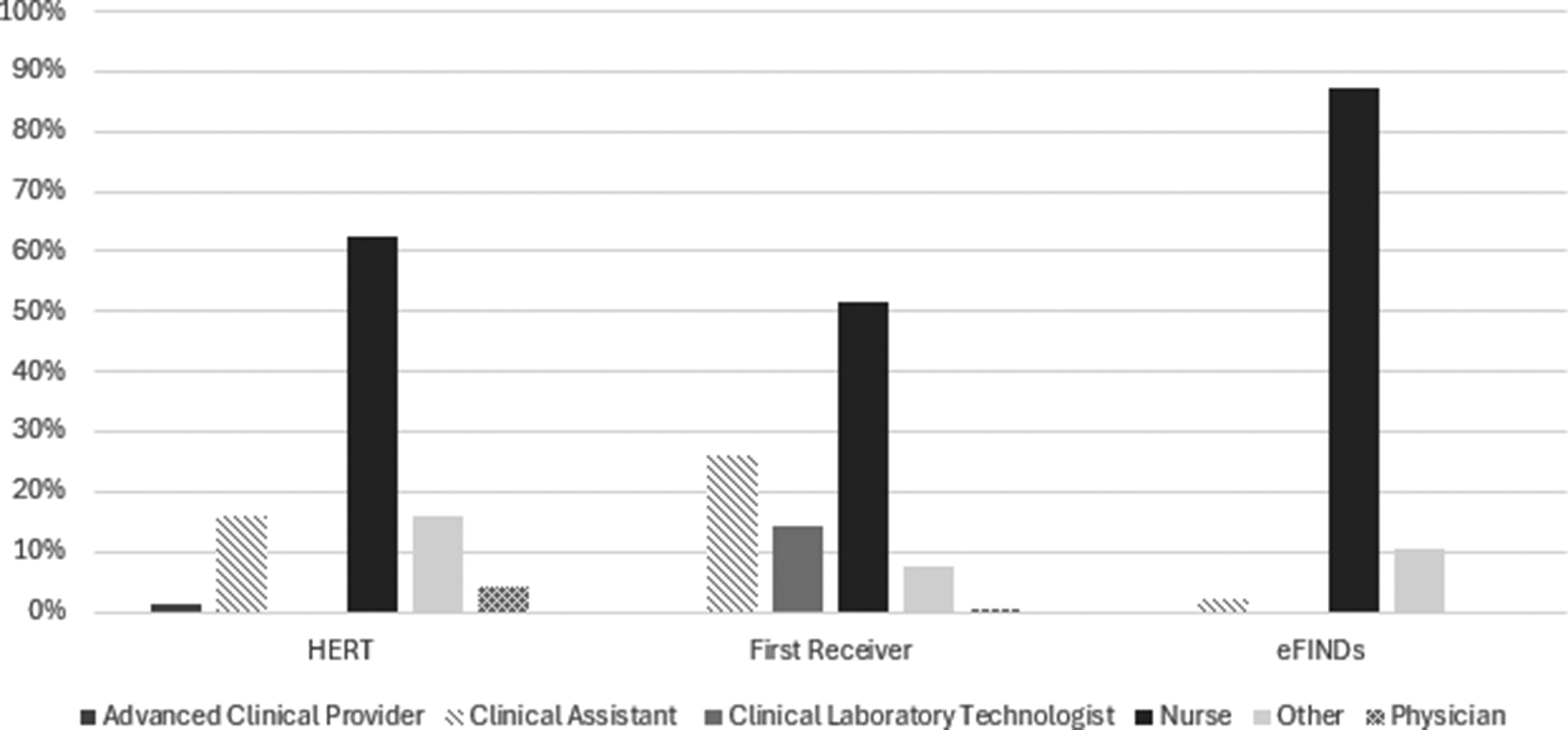
Among clinical professionals, nurses were more likely to be enrolled in any emergency management classes than any other clinical professional group. Approximately 50% of nurses captured in this data set, enrolled in the Nursing Leadership course, which is specifically designed for nurses. In contrast, physicians were among the clinical group with the lowest rates of course enrollment, representing less than 2% of clinical professionals within the data set. (Figure 2) (P=000.1).
Association between course type and clinical occupation (P = 000.1).
Among clinical professionals enrolled in the HERT class, nurses were most likely to be enrolled. Within the First Receiver course, nurses followed by clinical assistants were more likely to be enrolled compared to other clinical professionals. Lastly, the eFINDS course had higher percentages of nurse enrollment (P = 000.1).

Discussion
Non-clinical health care professionals were significantly more likely to be enrolled in emergency management courses than clinical professionals. This data supports previous findings that clinical staff report a lack of emergency preparedness knowledge and training.Reference Waring, Skryabina and Goodwin 4
Previous studies have shown that training tailored to specific professional groups led to increased enrollment and increased disaster preparedness confidence after participating in training that is applicable to their professional role.Reference Lin, McKenney and Elkbuli 6 This was evidenced by the fact that 50% of nurses in this data set participated in Nursing Leadership, a course specifically designed for nurses. Nurses were more likely to participate in emergency management classes than any other clinical professional (Figure 2).
In contrast, within this dataset, physicians had the lowest rates of emergency management course enrollment, representing less than 2% of clinical professionals (Figure 2). All were from the emergency medicine service line. This aligns with previous studies that demonstrated emergency medicine physicians receive more disaster preparedness training than other physicians, however the number of hours is minimal, and training methods vary.Reference Wanner and Jasper 5 One national survey reported only 45% of physicians working in emergency units felt that their teams are prepared to provide medical care during disaster.Reference Lin, McKenney and Elkbuli 6 This warrants further investigation, considering studies have designated this group as the most prepared to respond to disasters.
This study demonstrated that occupation is correlated to variances in emergency management course enrollment. This may be due to subject matter being more relevant to one occupation than others, or it could stem from specific departmental training requirements. For example, emergency managers and administrators were more likely to participate in eFINDS training (Figure 1). eFINDS training was mandated by New York State for use by health care facilities following Hurricane Sandy, explaining the high enrollment among administrators and emergency managers.
An identified area of focus is the lack of clinical professionals adequately trained in disaster response, especially physicians. While thoughtfully designed emergency management courses tailored to different professional roles could be a key strategy for improving enrollment, further investigation of national emergency management training trends are necessary.
Supplementary material
To view supplementary material for this article, please visit http://doi.org/10.1017/dmp.2025.14.
Acknowledgements
The authors wish to thank Molly McCann-Pineo, PhD, MS, for her assistance with statistical analysis.
Author contribution
All authors contributed to the study conception and design. Kayla Keenan and Corey Martinez performed data collection. Data analysis was performed in collaboration with Molly McCann and reviewed by all authors. All authors contributed to previous versions of the manuscript. All authors read and approved of the final manuscript.
Disclosures
The authors have no conflicts of interest to declare. No financial sponsorship was accepted in producing this manuscript and there are no material contributions or third-party sources of funding to acknowledge.