Introduction
Hydropunctaria C. Keller, Gueidan & Thüs is a recently described genus comprising several species formerly included in the genus Verrucaria. The species as currently known have an epilithic thallus containing more or less discrete regions of dark pigment (‘punctae’ or ridges) and they grow in seashore or freshwater habitats (Gueidan et al. Reference Gueidan, Savić, Thüs, Roux, Keller, Tibell, Prieto, Heiðmarsson, Breuss and Orange2009). The type species of the genus, H. maura (Wahlenb.) C. Keller et al., is one of the most widespread and abundant lichens of the littoral zone of the seashore in NW Europe, occupying the littoral fringe as defined by Lewis (Reference Lewis1964), and often forming a black zone which is visible from a distance. Hydropunctaria maura was described (as Verrucaria maura) from the coast of northern Norway, together with a similar species, V. aractina Wahlenb. (Acharius Reference Acharius1803). Verrucaria aractina was accepted as a species distinct from H. maura by Zschacke (Reference Zschacke1933–34), but recent authors have regarded H. maura as a variable species including H. aractina and several other poorly known or poorly described species (Clauzade & Roux Reference Clauzade and Roux1985; Santesson et al. Reference Santesson, Moberg, Nordin, Tønsberg and Vitikainen2004). Hydropunctaria maura, in the sense of recent authors, is known to be variable in appearance; Fletcher (Reference Fletcher1975) described it as ‘polymorphic’; Renobales & Noya (Reference Renobales and Noya1991) distinguished three phenotypes within H. maura growing in a region of northern Spain, but did not recognize them taxonomically. R. Santesson (2003, in litt.) believed that material collected in northern Scotland in 1969 represented an undescribed species related to H. maura.
The difficulty in this group, as in many others, has been to distinguish those morphological differences between collections which indicate underlying genetic variability, from differences which are the result of environmental factors acting on the same genotype, including degree of insolation and moisture, and climate. While some insights can be achieved by careful study of specimens, especially mixed collections of morphologically differing thalli, the problems are formidable. DNA sequence analysis has provided a valuable new method of investigating this group. In the present paper, H. maura is typified, and distinguished from several morphologically very similar, but phylogenetically distinct, species.
Methods
Fresh material of Hydropunctaria was collected in Wales, England, SW Ireland and northern Norway, including material collected at or near the type localites of H. maura and H. aractina in Finnmark. Sections were prepared by hand. Ascospores were measured in c. 5% KOH.
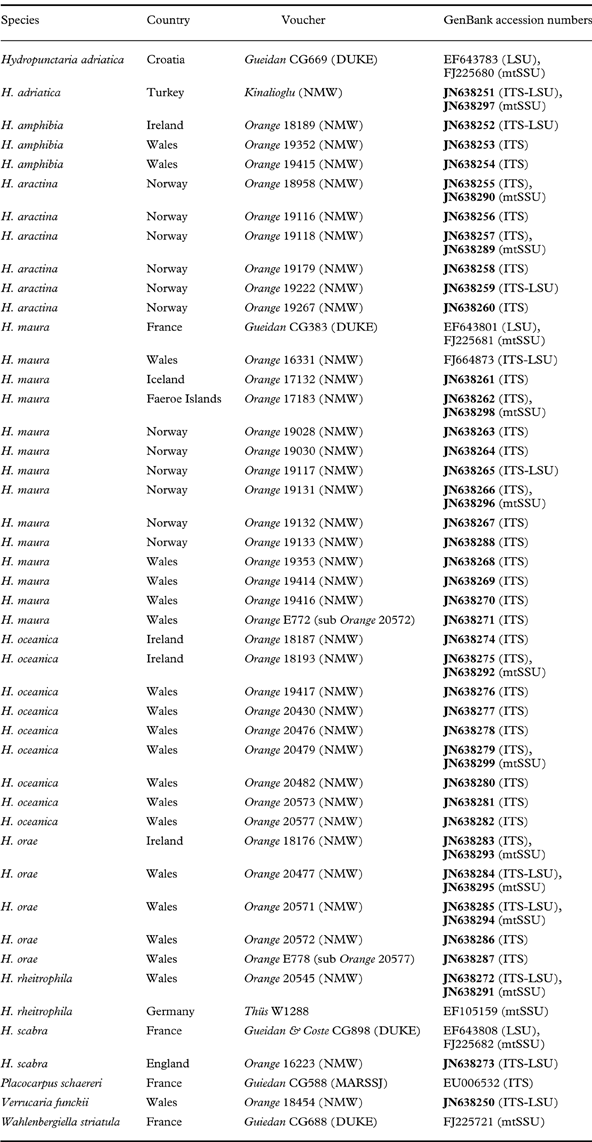
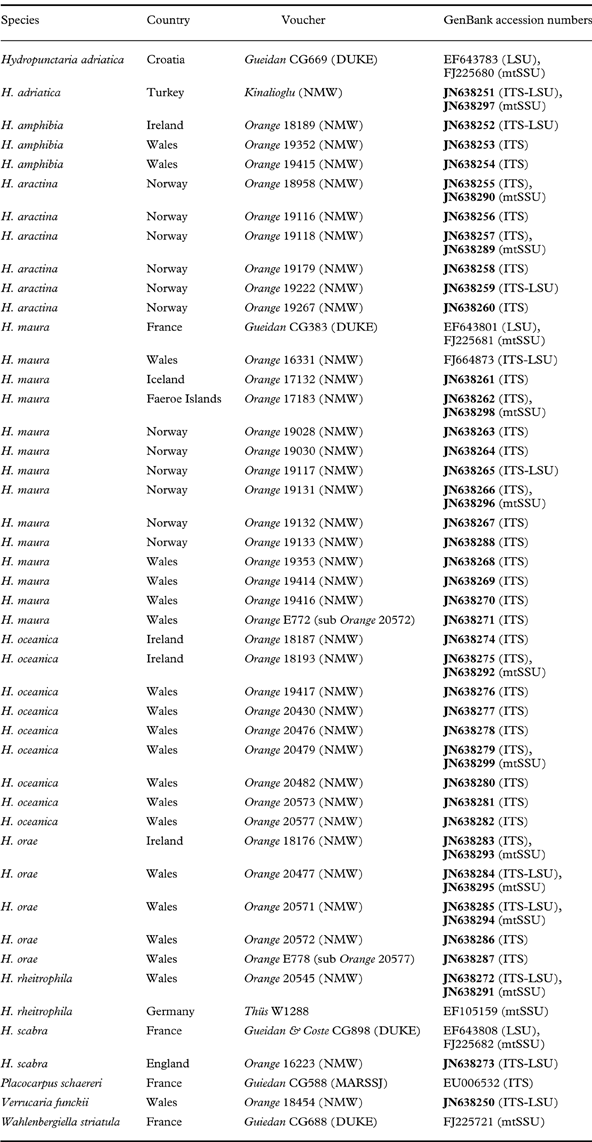
Specimens used in the phylogenetic analyses. New sequences are in bold.
DNA extraction and sequencing
DNA was extracted from thallus or ascoma tissue of recently collected or frozen specimens, using the Qiagen DNeasy Plant Mini Kit; the manufacturer's instructions were followed except that warm water was used for the final elution. PCR amplification was carried out using Bioneer AccuPower PCR Premix in 20 µl tubes. The two internal transcribed spacer regions and the 5.8S region (ITS1-5.8S-ITS2) of the nuclear ribosomal genes, and the 5′ end of the nuclear ribosomal large subunit (LSU) were amplified, using the primers ITS1F, LR3, nu-LSU-155-5′ and LR7 (Vilgalys & Hester Reference Vilgalys and Hester1990; Gardes & Bruns Reference Gardes and Bruns1993; Döring et al. Reference Döring, Clerc, Grube and Wedin2000). Part of the mitochondrial ribosomal small subunit (mtSSU) was amplified using the primers mrSSU1 and mrSSU3R (Zoller et al. Reference Zoller, Scheidegger and Sperisen1999). The PCR thermal cycling parameters were: initial denaturation for 5 min at 94°C, followed by 5 cycles of 30 s at 94°C, 30 s at 55°C, and 1 min at 72°C; then 30 cycles of 30 s at 94°C, 30 s at 52°C and 1 min at 72°C. PCR products were visualized on agarose gels stained with ethidium bromide, and purified using the Sigma GenElute PCR Clean-Up Kit. Sequencing was performed by The Sequencing Service (College of Life Sciences, University of Dundee, www.dnaseq.co.uk) using Applied Biosystems Big-Dye Ver 3.1 chemistry on an Applied Biosystems model 3730 automated capillary DNA sequencer, or by Macrogen Inc.
Sequence editing and alignment
Sequences were assembled and edited using DNAstar Lasergene software (http://www.dnastar.com/products/lasergene.php). Alignment was carried out using BioEdit (http://www.mbio.ncsu.edu/BioEdit/bioedit.html); ClustalW was used to create an initial alignment, which was edited manually.
Phylogenetic analysis
Phylogenetic relationships and support values were investigated using a Bayesian approach. Additional support values were obtained using Maximum Likelihood bootstrapping. Three datasets were analyzed separately: the ITS1-5.8S-ITS2 region, the ribosomal LSU, and the mitochondrial SSU. The Bayesian analysis employed the HKY+I model for the ITS1 and ITS2 regions, and the GTR+I+G model for the other regions, selected using the Akaike Information Criterion (AIC) in MrModeltest 2.2 (Nylander Reference Nylander2004). Gaps were treated as missing data. Using MrBayes 3.1.2 (Huelsenbeck & Ronquist Reference Huelsenbeck and Ronquist2005), two analyses of two parallel runs were carried out for 1 000 000 generations, with trees sampled every 100 generations. Stationarity was considered to have been reached when the average standard deviation of split frequencies dropped to <0·01, and the values for the Potential Scale Reduction Factor were close to 1. A ‘burn in’ sample of 2 500 trees was discarded from each run, respectively. Maximum Likelihood analysis was carried out using PhyML v.3.00 (Guindon & Gascuel Reference Döring, Clerc, Grube and Wedin2003), as implemented on the Phylemon2 web server (http://phylemon.bioinfo.cipf.es). Settings included GTR substitution model (selected by running the dataset with each available model, and choosing the model producing the lowest log-likelihood score), 8 substitution rate categories, the search option ‘Best of Nearest Neighbour Interchange and Subtree Pruning and Regrafting’, and 500 bootstrap replicates; for other options the default settings were used.
Support values of ≥95% Bayesian posterior probabilities and ≥70% Maximun Likelihood bootstrapping were regarded as significant.
Results
Phylogenetic analyses
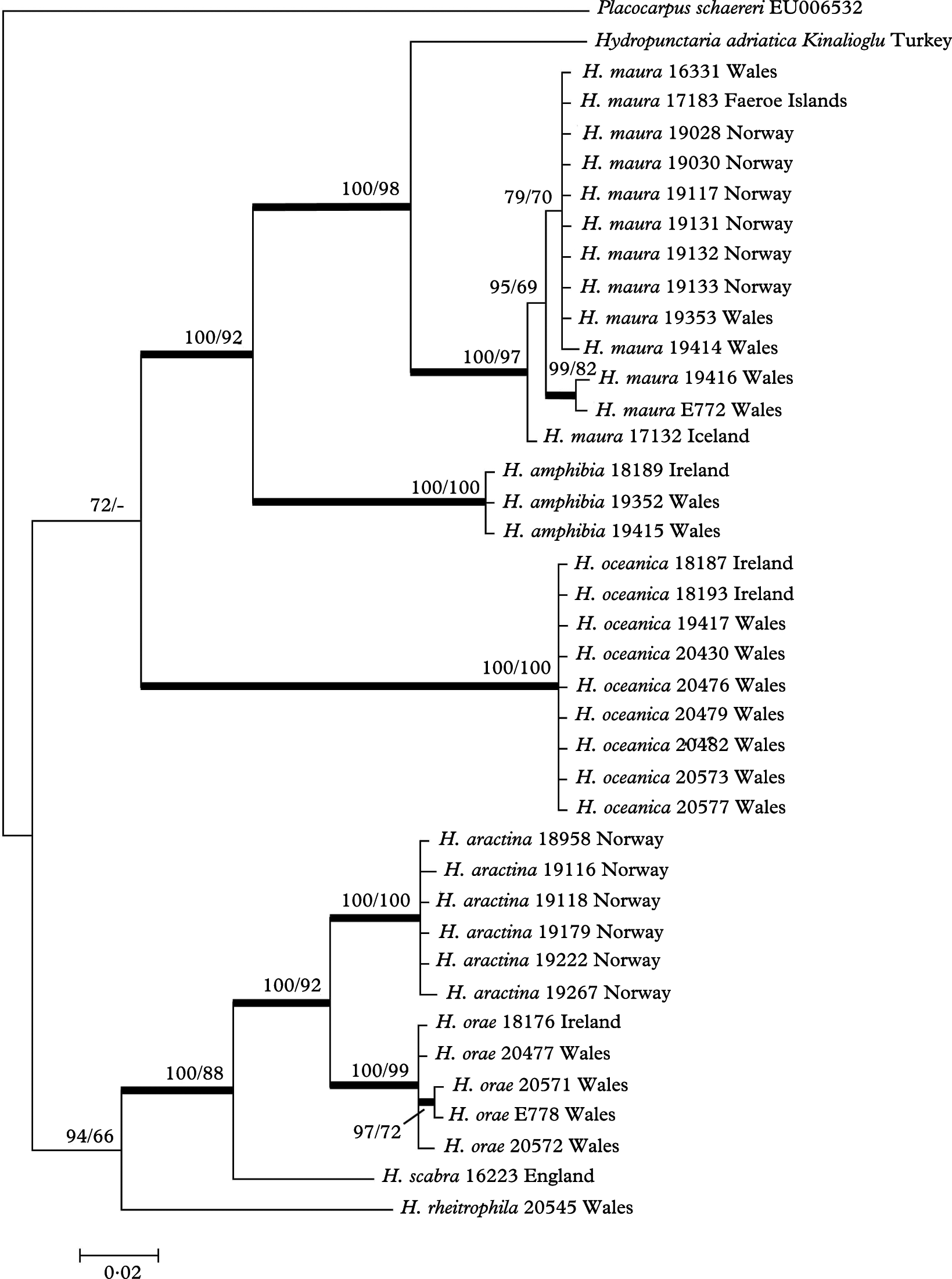
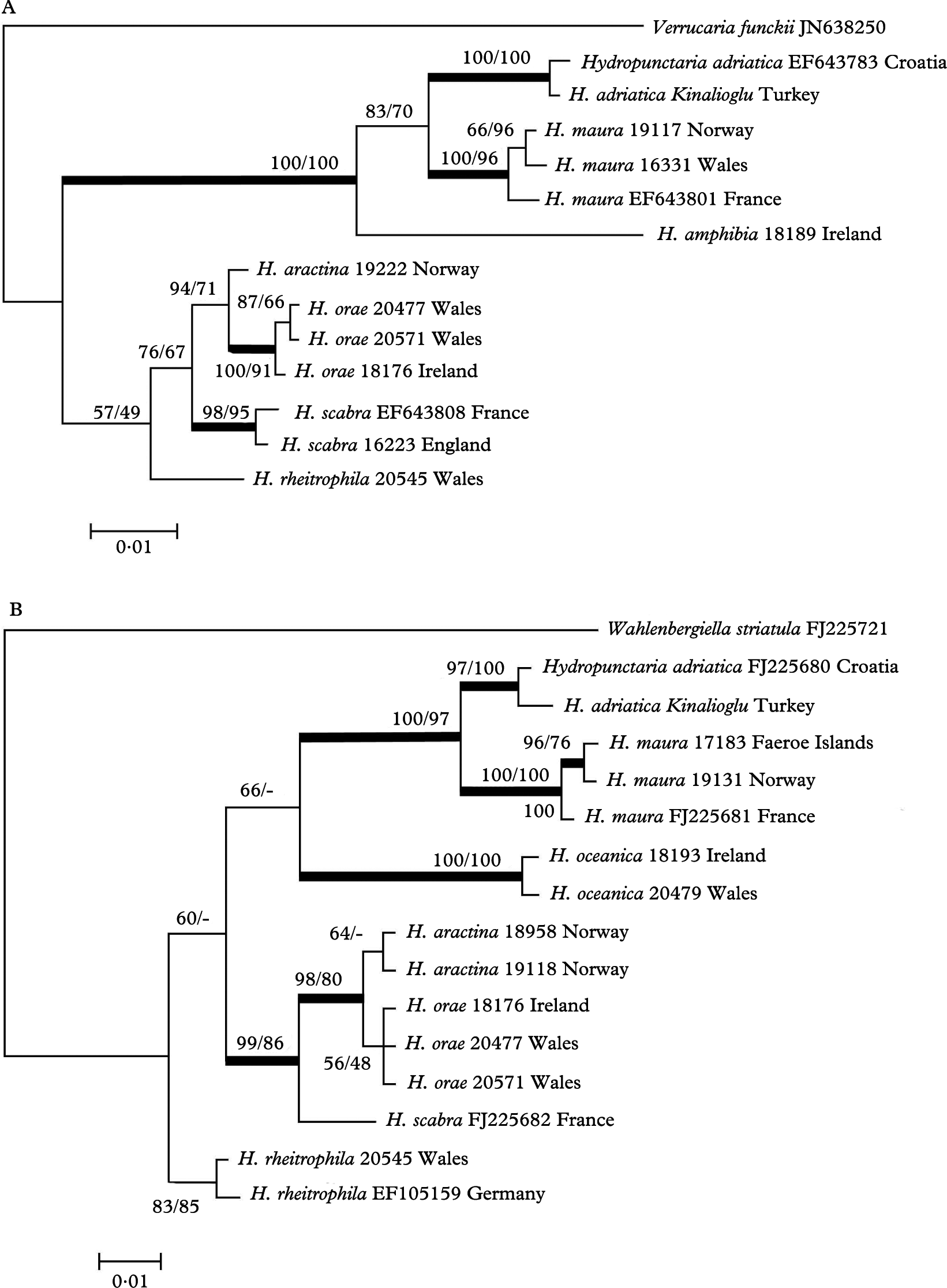
The trees resulting from analysis of the ITS1-5.8S-ITS2, LSU and mtSSU regions are shown in Figs 1 & 2. In the tree of the ITS region (Fig. 1), sequences from specimens which would be regarded as belonging to Hydropunctaria maura by most recent authors formed four well-supported clades (corresponding in Fig. 1 to H. maura, H. oceanica, H. aractina and H. orae). Hydropunctaria maura s.str. forms a well-supported clade with H. amphibia and the single available sequence of H. adriatica. Hydropunctaria aractina and H. orae form a well-supported clade with H. scabra. Hydropunctaria rheitrophila is basal to this clade but with low support. In the LSU tree (Fig. 2A), a well-supported clade with H. adriatica, H. maura and H. amphibia is also recovered; a clade with H. aractina, H. orae, H. scabra and H. rheitrophila is recovered, but with low support. The mtSSU tree (Fig. 2B) recovered a well-supported clade with H. adriatica and H. maura, and a well-supported clade with H. aractina, H. orae and H. scabra. Sequences of H. maura which clustered with each other in the ITS tree also clustered in the mtSSU tree (although H. aractina and H. orae form two poorly supported clades in the mtSSU tree, this is an artefact, as the sequences are identical apart from small amounts of missing data). Thus the well-supported nodes show a similar topology in each of the three trees. The position of H. oceanica is unresolved, appearing as basal to the H. adriatica- H. maura- H. amphibia clade in the Bayesian analyses of ITS and mtSSU (Figs 1 & 2B) but with low support; in the Maximum Likelihood analysis it appeared as basal to all other sequences (ITS) or basal to a clade with H. aractina, H. orae, H. scabra and H. rheitrophila (mtSSU), but with low support in both.
Phylogenetic relationships amongst Hydropunctaria species, based on a Bayesian analysis of the nuclear ribosomal ITS1-5.8S-ITS2 region. The tree was rooted using Placocarpus schaereri (Verrucariaceae). The two support values associated with each branch are posterior probabilities (PP) and maximum likelihood bootstrap (MLb) values, respectively. Branches in bold indicate a support of PP ≥95% and MLb ≥70%. If a node of the Bayesian tree was not recovered by ML bootstrapping, the ML value is replaced by a dash.

Phylogenetic relationships amongst Hydropunctaria species, based on a Bayesian analysis. The two support values associated with each branch are posterior probabilities and maximum likelihood bootstrap values, respectively. Branches in bold indicate a support of PP ≥95% and MLb ≥70%. A, Bayesian analysis of the nuclear ribosomal LSU, the tree was rooted using Verrucaria funckii (Verrucariaceae); B, Bayesian analysis of the mitochondrial SSU in which the tree was rooted using Wahlenbergiella striatula (Verrucariaceae) (at nodes of the Bayesian tree which were not recovered by ML bootstrapping, the ML value is replaced by a dash).

Morphology
Hydropunctaria aractina, H. maura, H. oceanica, H. orae and H. scabra show a similar basic morphology; the thallus is epilithic, dark in colour, with the cells arranged in irregular columns, tightly adhering, and with no airspaces between the cells (the ‘subgelatinous’ type of thallus). The lower parts of the thallus mostly lack living photobiont cells and are either colourless or with darkly pigmented walls; columns of dark pigment project from this basal layer upwards into the photobiont layer, often reaching the surface. The thallus varies from continuous to completely cracked into discrete areoles, and the degree of cracking is apparently correlated with thallus thickness. The thickness of the thallus varies between species, but there is great overlap; however, when growing adjacent to H. maura, the three species H. aractina, H. oceanica and H. orae always have thinner thalli than H. maura. The cortex is represented by a pseudocortex (cells poorly differentiated from cells of the photobiont layer); the cortical cell walls are pigmented, though the pigment may be weak or absent in shade. In H. maura and H. oceanica (and in H. adriatica and H. amphibia) the pigment is brown (rarely greenish brown in part); in H. aractina, H. orae and H. scabra it is dull green or green-brown. These pigments differ from that in the basal layer of the thallus, which is dark reddish brown, K+ grey-brown. The ascospores are simple, colourless, ellipsoid to oblong-ellipsoid, filled with small oil-droplets at maturity, without perispore, with a length mostly in the range 13·5–18·0 µm; they are relatively uniform in size between the species, but additional measurements are necessary. In all species the asci are verrucarioid (wall thickened above, I−), and the hymenial gel is I+ red, K/I+ blue.
The Species
Hydropunctaria adriatica (Zahlbr.) C. Keller & Gueidan
Taxon 58: 194 (2009).—Dermatocarpon adriaticum Zahlbr., Annales Mycologici 2: 267 (1904); type: Punta St. Salvatore bei Triest, auf vom Meere überspülten Kalkfelsen, C. Techet (specimen location undetermined); Litorale austriacum: ad saxa maritima prope Triest., C. Techet. [A. Zahlbruckner, Lichenes rariores exsiccati 61] (NMW-C95.13.653-syntypus?!).—Verrucaria adriatica (Zahlbr.) Zahlbr. in Ginzberger, Denkschr. Kaiserl. Akad. der Wissensch. 92: 303 (1916).
This is a poorly understood species known from the shores of the Mediterranean and the Black Sea. Zschacke (Reference Zschacke1933–34) distinguished it from H. maura by the generally thinner thallus, lack of a dark basal layer, and exciple unpigmented below. In Zahlbruckner, Lichenes rariores exsiccati no 61 (probably a syntype) and in a recently collected specimen, the cortical pigment is brown.
The basionym of this species is Dermatocarpon adriaticum Zahlbr. The name Verrucaria adriatica is a new combination, as clearly stated by Zahlbruckner (in Ginzberger Reference Ginzberger1915).
Additional specimen examined. Turkey: Giresun Province: Keşap district, Değirmenağzi village, sea shore (mainly intertidal zone), on siliceous rock, 11 iv 2010, K. Kinalioglu (NMW-C.2011.014.61).
Hydropunctaria amphibia (Clemente) Orange comb. nov.
Verrucaria amphibia Clemente in Ach., Syn. meth. lich.: 94 (1814); type: [Spain] Habitat in Hispaniæ breccis calcariis fluxa maris submersis aut saltem aqua sæpe adspersis, præcipue super fragmenta quartzii (specimen location undetermined).
This species differs from all the others treated here by the greater development of densely pigmented tissue. The thallus contains densely pigmented areas reaching to the surface, in the form of elongated bars up to 60 µm wide. These are particularly conspicuous near the thallus margin, where they are perpendicular to the margin, and parallel to elongated cracks. The apex of the perithecium is flat-topped or crenulate, rather than more or less rounded (or immersed) in the other species. The pseudocortex contains brown pigment. Ascospores (13–) 15–16·6–18 (–20) × (5·0–) 5·5–6·2–7·0 (–7·5) µm, (2·1–) 2·4–2·7–3·0 (–3·5) times as long as wide [29/4].
Selected specimens examined. Sequenced specimens: Great Britain: Wales: V.C. 49, Caernarvonshire: near Aberdaron, Porth Oer, 23/1672.3017, 2010, A. Orange 19415 (NMW-C.2010.001.219). V.C. 52, Anglesey: near Llanfaethlu, Porth Swtan, 23/2993.8975, 2010, A. Orange 19352 (NMW-C.2011.014.12).—Ireland: V.C. H1, South Kerry: Valencia Island, Foilhomurrin Bay, 00/3564.7353, 2009, A. Orange 18189 (NMW-C.2009.002.123).
Hydropunctaria aractina (Wahlenb.) Orange comb. nov.
Verrucaria aractina Wahlenb. in Ach., Methodus, Suppl.: 17 (1803); lectotype (selected here): [Norway, Finnmark, Alta], Finmarkia Norvegiæ ad Påsekop [Bossekop] in scopulis maritimis d. 25 April 1802, G. Wahlenberg (UPS-[L-164364] 381395, Fragment 4, Thallus 1!); epitype (selected here): Norway, Alta kommune, Alta, north side of Komsa, Skjåbukta, 69°59·37′N, 23°16·51′E, on rocks on seashore, 30 June 2010, A. Orange 19118 (NMW-C.2010.001.208); GenBank accession nos JN638257, JN638289).
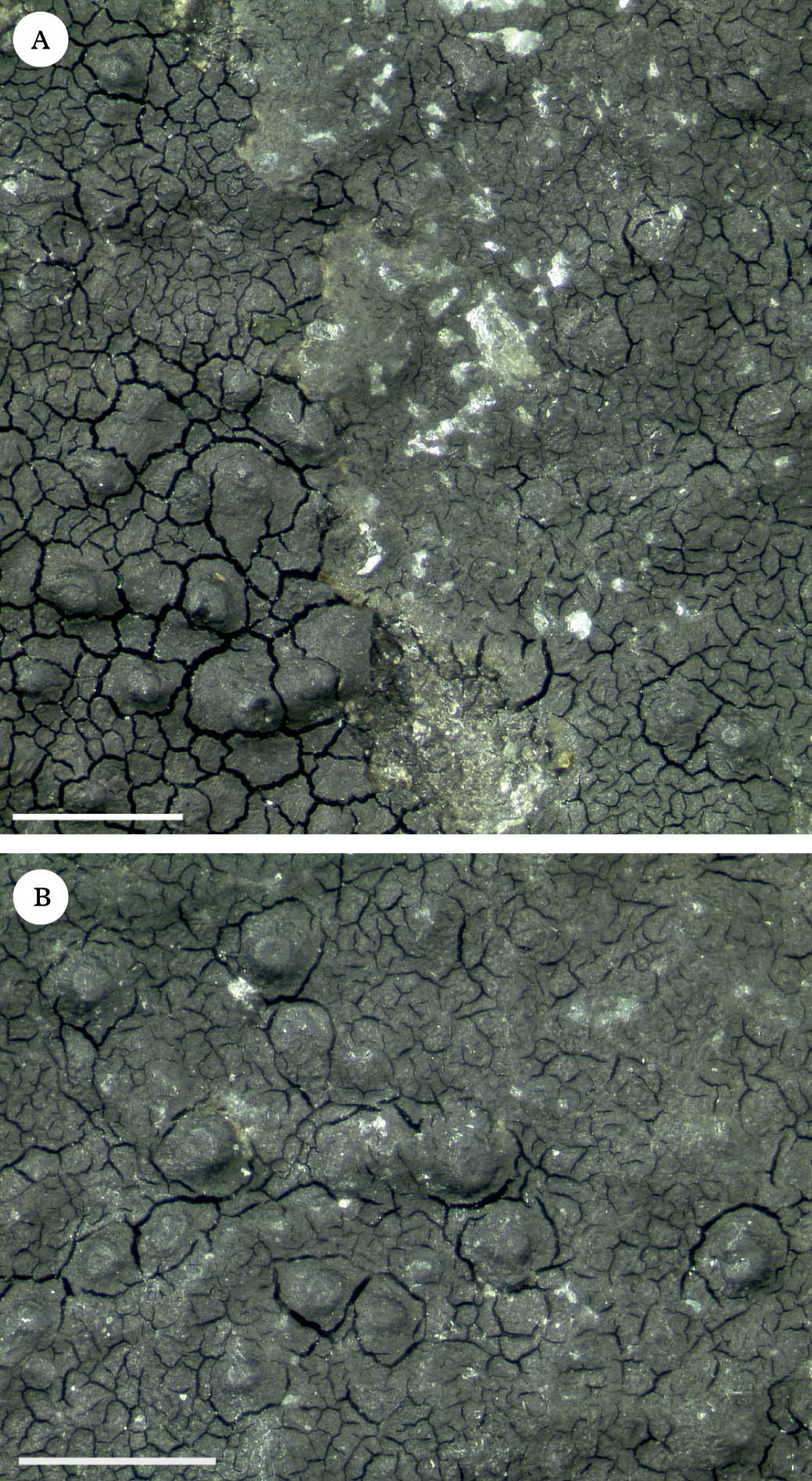
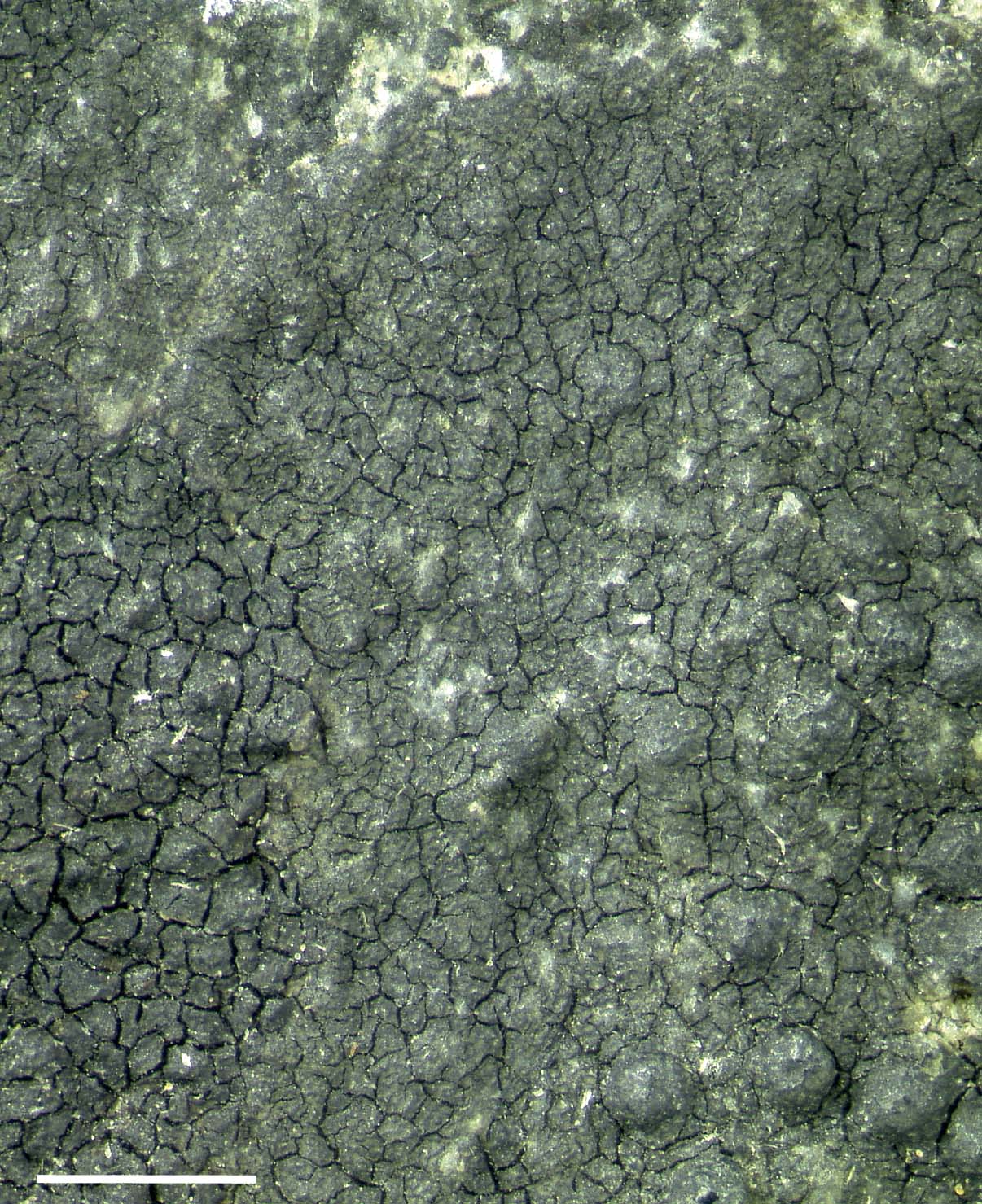
Hydropunctaria aractina, right (lectotype); thicker thallus on left is H. maura. Scale=1 mm. In colour online.
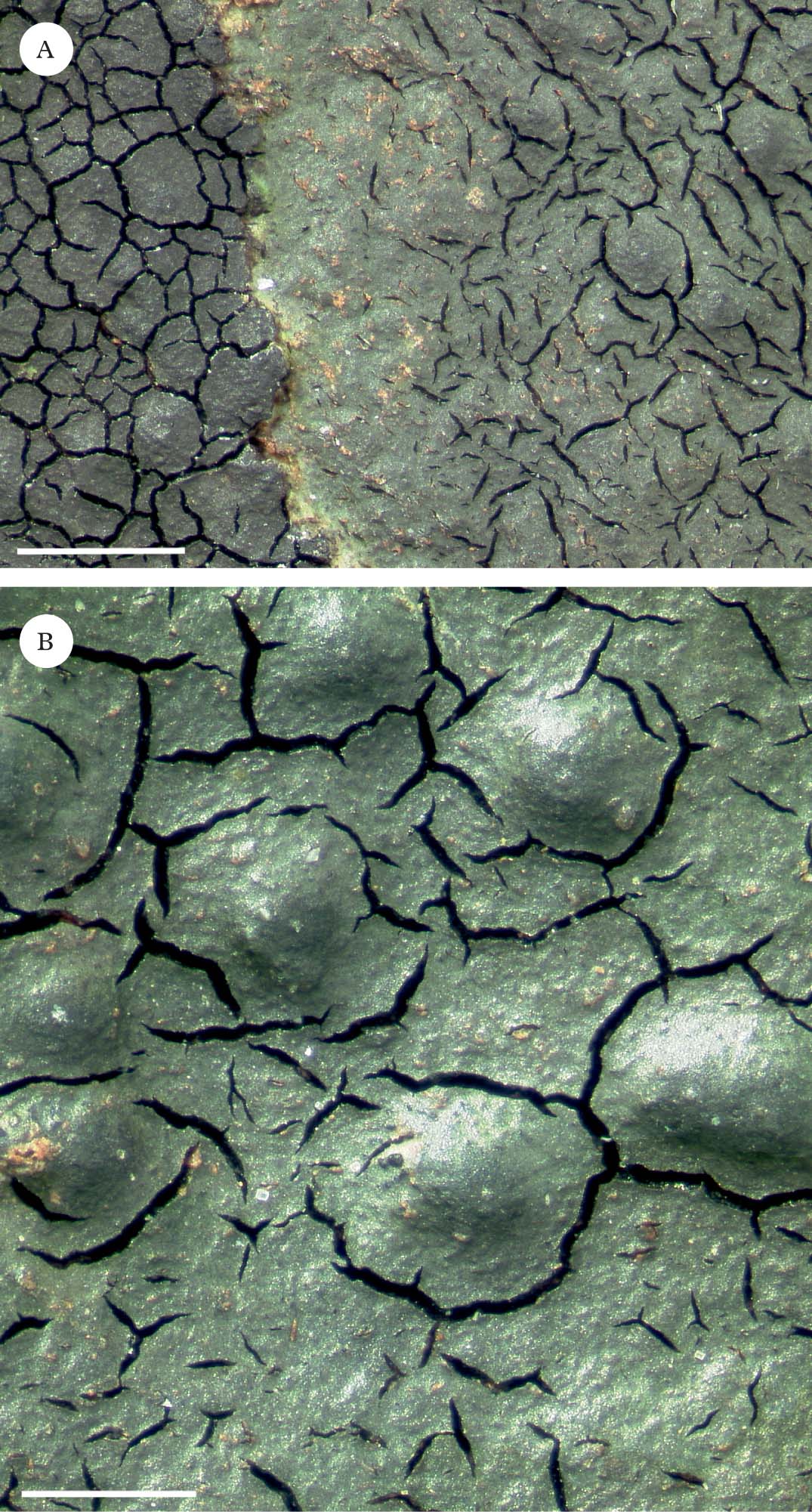
Hydropunctaria aractina (Orange 19118). A, epitype right with H. maura left; B, thallus with perithecia. Scales: A & B=1 mm. In colour online
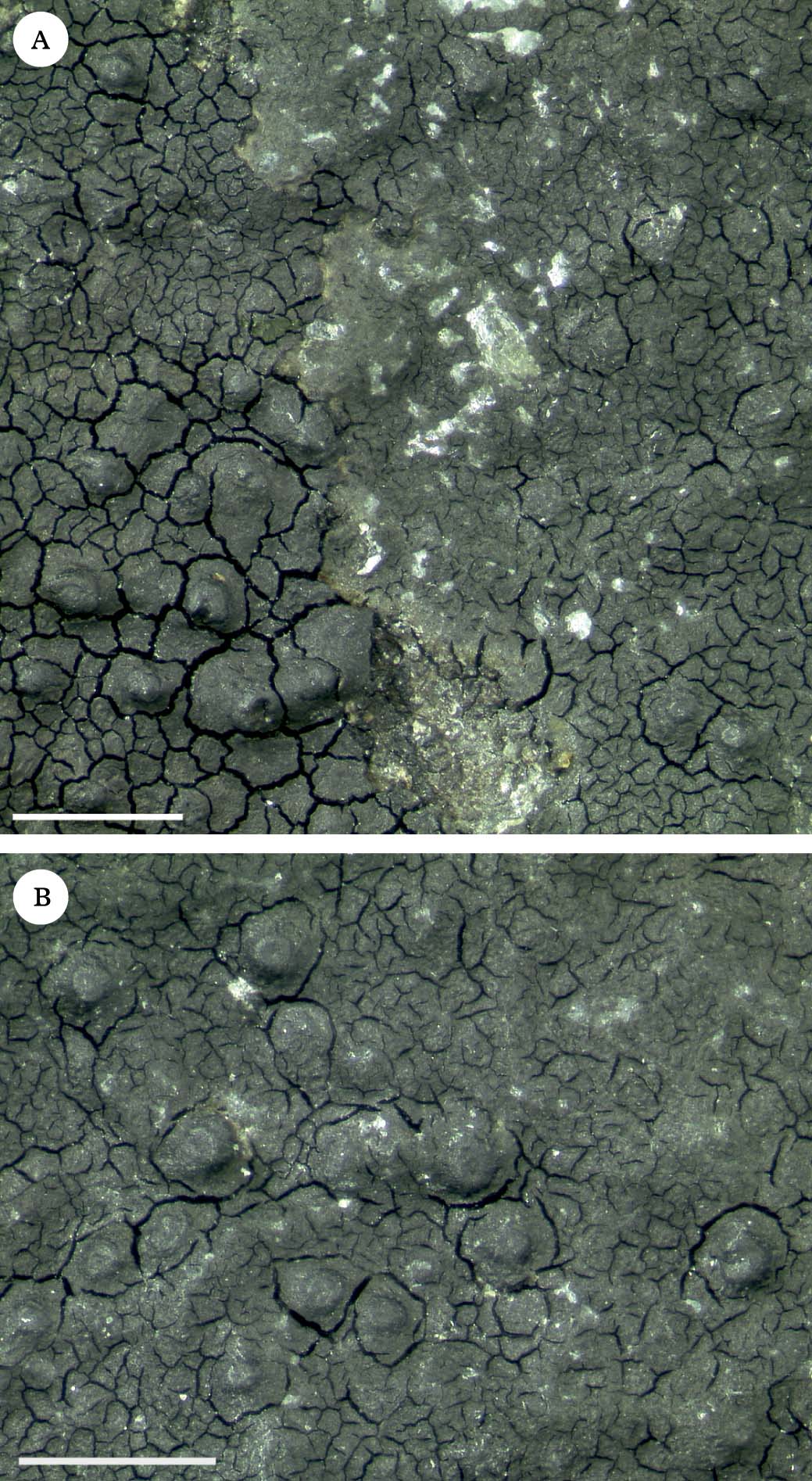
Prothallus not seen. Thallus brownish black to dark grey, or greenish black or green in moist shade, thin to moderately thick, 20–200 µm thick, cracks usually numerous, but in some specimens only rarely forming discrete islands; sterile areoles plane, mostly 120–400 µm diam., fertile 200–860 µm diam., surface matt, smooth, or rough with ill-defined punctae. Thallus in section with a basal layer which varies from mostly colourless, to densely pigmented above, and with densely pigmented columns rising into the photobiont layer, sometimes reaching the surface; the columns either appearing isolated or joined below, depending on degree of pigmentation of the basal layer. Thallus with a pseudocortex, surface cells with dilute to dense, dull green to green-brown, K− pigment, often overlain by a thin, decolourized epinecral layer.
Perithecia forming low to moderate projections 400–600 µm diam., but often too indistinct to measure accurately; surface smooth to roughened. Ascospores oblong-ellipsoid, (12–) 13·5–14·6–16·0 (–17) × (6·5–) 7·0–7·5–8·0 µm, 1·7–1·9–2·2 (–2·5) times as long as wide [n=46/4].
Habitat and distribution. Confirmed from several localities in Troms and Finnmark, northern Norway, growing with Hydropunctaria maura in the littoral zone of the seashore.
Notes. Differs from contiguous thalli of Hydropunctaria maura in the thinner thallus, and the presence of dull green to green-brown pigment in the pseudocortex (brown in H. maura). Although the distinction between the two species is easily seen when they are growing together, the differences are small, and the ranges of thickness overlap, so that isolated thalli may be difficult to identify with certainty. The apparently slightly smaller spore size in H. aractina needs to be confirmed when more specimens are collected, as mature ascospores were often difficult to find in the sequenced material. This species is so far confirmed only from northern Norway, so it has not been possible to compare this species to H. oceanica and H. orae in mixed collections.
Typification and nomenclature. In the protologues of Verrucaria aractina and V. maura (Acharius Reference Acharius1803), V. aractina was said to have a cracked, scabrid thallus and conical fruiting bodies, and V. maura was said to have a cracked, smooth thallus with hidden (immersed) fruiting bodies. While these characters may not distinguish the two species correctly in general, they do distinguish between the two Hydropunctaria species present in the type material of both V. maura and V. aractina. Thicker thalli with more or less smooth areoles correspond to V. maura, and thin, scabrid thalli to V. aractina. The type packet of V. aractina contains a packet labelled ‘lectotype’, but this lectotypification seems never to have been published. This fragment (labelled as Fragment 4 by the present author) shows both species contiguous with each other. The same fragment is selected here, and the thin, scabrid thallus near the centre of the fragment, here called Thallus 1, is designated as the lectotype of V. aractina. An epitype is also designated here; the specimen shows a thin thallus resembling the lectotype and other fragments in the type packet; it is growing with V. maura and the distinction between the two species can clearly be seen, as in the lectotype of V. aractina. The epitype was collected 2·5 km from Wahlenberg's locality at Bossekop. Material was not collected from Bossekop itself, as Hydropunctaria species were found to be rare and impossible to collect when the small peninsula at Bossekop was visited in June 2010; this is probably the peninsula mentioned in the protologue of Verrucaria striatula by Acharius (Reference Acharius1803: 21–22), and thus visited by Wahlenberg, but much of the shore has been destroyed, apart from an area of hard bedrock at the end; rocks shortly NE of the peninsula were not visited in 2010. Since only two species of Hydropunctaria were found on the shore in the region of the type locality in June–July 2010 (in Troms and Finnmark), it is reasonable to assume that the lectotype of V. aractina is conspecific with the specimen chosen as epitype.
The packet containing the type material of V. aractina contains 15 fragments of rock; these were originally glued to a card, but by May 2011 nearly all had become detached. The card is annotated as two separate collections:
1. Finmarkia Norvegiæ in insula sinus altensis d. 10 Maji 1802.
2. Finmarkia Norvegiæ ad Påsekop in scopulis maritimis d. 25 April 1802.
The fragments were assigned numbers by the present writer. Fragments 1–3 are still attached to the card as part of collection 2. Fragment 4 also belongs to this collection, as the outline of this fragment is clearly recognizable on the card. The other fragments are difficult to assign to a specific collection.
Fragments present in type packet of Verrucaria aractina:
1. V. aractina.
2. No recognizable lichen, fragment apparently pasted face down.
3. V. aractina.
4. Thallus 1 is V. aractina (lectotype), and also another thallus; the remaining thalli are V. maura.
5. V. aractina, becoming greenish in presumably damper conditions; one thallus probably V. maura.
6. Probably V. maura.
7. Most is V. aractina, locally greenish in presumably moister conditions; a small amount is probably V. maura, and there is a small quantity of Wahlenbergiella striatula.
8. A good mixed collection of V. aractina and V. maura.
9. V. aractina and V. maura.
10. V. aractina.
11. V. aractina, probably also V. maura.
12. V. aractina.
13. V. aractina.
14. V. aractina.
15. V. aractina.
Additional specimens examined. Norway: Troms: Lyngen kommune, Eidstranda, Koppmolneset, 69°55·00′N, 20°06·71′E, 2010, A. Orange 18958 (NMW-C.2011.014.42). Finnmark: Alta kommune, Alta, north side of Komsa, Skjåbukta, 69°59·37′N, 23°16·51′E, 2010, A. Orange 19116 (NMW-C.2010.001.206); Porsanger kommune, east of Lakselv, Soggovuotna, Hávdna, 70°05·22′N, 25°04·74′E, 2010, A. Orange 19179 (NMW - C.2010.001.209); Porsanger kommune, north-east of Lakselv, Roddinessjøen., 70°06·32′N, 25°13·90′E, 2010, A. Orange 19222 (NMW-C.2010.001.256); Porsanger kommune, west side of Porsangen, Trollholmsund, 70°18·54′N, 25°10·40′E, 2010, A. Orange 19267 (NMW - C.2011.014.43).
Hydropunctaria maura (Wahlenb.) C. Keller et al.
Taxon 58: 208 (2009).—Verrucaria maura Wahlenb. in Ach., Methodus, Suppl.: 19 (1803); lectotype (reselected here): [Norway, Finnmark, Alta], Finmarkia Norvegiæ in insula sinus Altensis, 10–11 May 1802, G. Wahlenberg (UPS-[L-048912] 84247, Fragment 5!); epitype (selected here): Norway, Finnmark, Alta kommune, Alta, north side of Komsa, Skjåbukta, 69°58·39′N, 23°16·41′E, on rocks on seashore, 30 June 2010, A. Orange 19131 (NMW - C.2010.001.238; GenBank accession nos JN638266, JN638296).
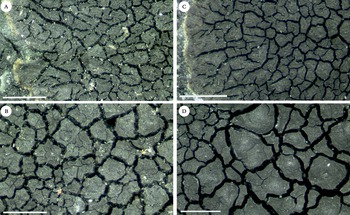
Hydropunctaria maura. A & C, thalli showing margins (left); B & D thalli with fertile areoles and immersed perithecia; A & B, lectotype; C & D, Orange 19131, epitype. Scales=500 µm. In colour online.

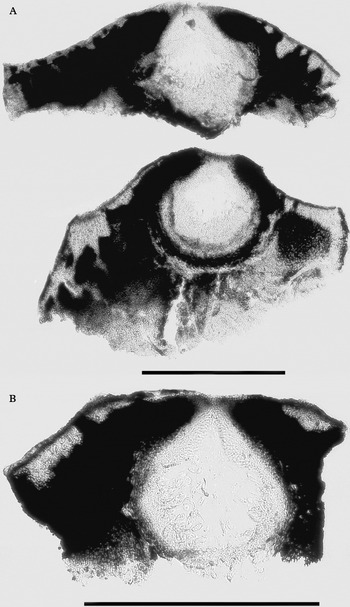
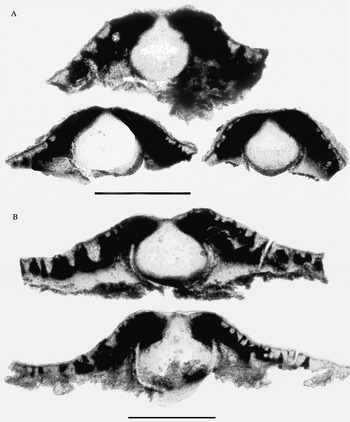
Sections of perithecia of Hydropunctaria species. A, H. aractina, Orange 19118 (epitype); B, H. maura, Orange 19131 (epitype); Scales: A=300 µm; B=500 µm.

Prothallus narrow, sometimes scarcely visible, whitish to pale brown, not or scarcely fimbriate. Thallus moderately thick, 60–300 µm thick, greenish black to brownish black, sometimes brown near margin, or green-brown in shade, but typically very dark and appearing almost black to the unaided eye; young margin thin, continuous, soon cracked into separate areoles 100–600 µm diam. (sterile) or 300–600 µm diam. (fertile), areoles plane or slightly concave to slightly convex, matt or rarely slightly glossy, surface smooth or most frequently roughened by slightly raised punctae or short ridges c. 20–60 (–90)×20–30 µm, these are black and contrasting with the surrounding thalli in shaded specimens, but often concolorous and with the outline indistinct; older areoles sometimes with the surface partly subdivided by dark lines; sides of areoles black. Thallus in section with a basal layer which is often colourless below in part, but with the upper part densely pigmented, with pillars of densely pigmented tissue projecting upwards into the algal layer and often reaching the thallus surface, pigment dark brown to dark reddish brown, K+ dulling or + dark grey-brown. Thallus surface with a pseudocortex, scarcely differentiated from the tissue below except for the presence of brown, K− pigment (rarely in part greenish brown); sometimes with a decolourized epinecral layer above.
Perithecia varying from largely immersed in the thallus to moderately projecting, projections 160–440 µm wide when measurable, conical-hemispherical and sometimes slightly irregular in shape, but not distinctly angular nor with projections. Exciple 70–190 µm diam. (few measured), exciple darkly pigmented; involucrellum well-developed, merging with parts of the dark basal layer. Ascospores oblong-ellipsoid, (14·5–) 15·5–16·6–18·0 (–19·0) × (7·0–) 7·5–8·0–8·5 (–9·0) µm, (1·6–) 1·9–2·1–2·3 (–2·5) times as long as wide [n=37/7].
Pycnidia immersed, with colourless wall and ostiole, 90×50 µm; conidia rod-shaped, 4·1–5·7 (–6·6)×1·2–1·6 µm.
Habitat and distribution. Widespread and often abundant on seashore rocks; specimens confirmed by ITS sequences from Wales, Ireland, the Faeroe Islands, Iceland and Norway. At all sites studied H. maura is much more abundant than H. aractina, H. oceanica and H. orae, and appears to be more tolerant of drought and exposure than those species. This is usually the most abundant species of Verrucariaceae on the seashore in Great Britain, but in northern Norway it is often less abundant than other species, and often confined to sheltered gullies.
Notes. The thallus is always well-developed and cracked into mostly discrete areoles, but otherwise is variable in appearance, either smooth or roughened, and with the perithecia varying from immersed to rather prominent. Hydropunctaria aractina, H. oceanica and H. orae always have a thinner thallus than H. maura when growing adjacent to it. In addition, the pigment of the pseudocortex is often distinctly greenish in H. aractina and H. orae (brown or at most partly greenish brown in H. maura).
Typification and nomenclature. When received on loan in May 2011, the holotype of V. maura comprised 14 fragments of rock, including 2 very small ones; only 2 were still glued to the original card, including one of the very small fragments. A folded packet labelled ‘lectotype’ was empty. There is no way to determine which of the 14 fragments had been chosen as lectotype by Gueidan et al. (Reference Gueidan, Savić, Thüs, Roux, Keller, Tibell, Prieto, Heiðmarsson, Breuss and Orange2009, Appendix 2), and a new fragment was selected as a replacement. Hydropunctaria maura and H. aractina are very similar and difficult to distinguish, but material with a thick thallus cracked into discrete, smooth areoles best fits the protologue, and Fragment 5 was chosen on this basis.
Fragments present in type packet of Verrucaria maura (numbers assigned by the writer):
1. Thallus 1 is V. maura, Thallus 2 is thin and cracked, but still c. 100 µm thick, with a few visible punctae, and could be V. aractina.
2. V. maura.
3. Possibly V. maura; thallus quite thick in places (c. 100 µm, measured dry in situ), but often rather thin; a little V. ditmarsica also present.
4. Like 3; V. maura?
5. Lectotype; most is V. maura, with some V. ditmarsica and V. ceuthocarpa.
6. Most is V. maura, with some V. ditmarsica and V. ceuthocarpa.
7. V. maura, with some V. ditmarsica and V. ceuthocarpa.
8. V. maura, with a little V. ceuthocarpa.
9. Either V. maura or V. aractina.
10. Most probably V. maura.
11. V. maura.
12. Probably V. maura
13. V. maura, with some V. ditmarsica, V. ceuthocarpa.
14. No lichens present.
An epitype is necessary to interpret the lectotype, as molecular data are currently necessary for reliable distinction of species in this group. Orange 19131 is proposed as an epitype. It was collected at Alta, is apparently uniform, and it resembles the re-selected lectotype in its strongly cracked thallus with smooth areoles.
Selected additional specimens examined. Sequenced specimens: Great Britain: Wales: V.C. 41, Glamorgan: Gower, Rhossili, 21/4069.8715, 2005, A. Orange 16331 (NMW-C.2005.001.341). V.C. 45, Pembrokeshire: near Haverfordwest, St Brides, 12/8024.1108, 2011, A. Orange (Extraction E772, associated with H. orae, Orange 20572). V.C. 49, Caernarvonshire: near Aberdaron, Porth Oer, 23/1672.3017, 2010, A. Orange 19414 (NMW-C.2010.001.213); near Aberdaron, west of Porth Oer, 23/1601.2954, 2010, A. Orange 19416 (NMW-C.2010.001.214). V.C. 52, Anglesey: near Llanfaethlu, Porth Swtan, 23/2993.8975, 2010, A. Orange 19353 (NMW-C.2011.014.13).—Norway: Troms: Skjervøy kommune, north of Bakkeby, Maursundet, north of Boršu, 69°55·33′N, 20°50·64′E, 2010, A. Orange 19028 (NMW-C.2010.001.156); ibid., 69°55·38′N, 20°53·58′E, 2010, A. Orange 19030 (NMW [C.2010.001.157]). Finnmark: Alta kommune, Alta, north side of Komsa, Skjåbukta, 69°59·37′N, 23°16·51′E, 2010, A. Orange 19117 (NMW-C.2010.001.207); ibid., 69°58·39′N, 23°16·41′E, 2010, A. Orange 19132 (NMW-C.2010.001.239); ibid., A. Orange 19133 (NMW-C.2010.001.240).—Faeroe Islands: Sørvágur, Sørvágsfjørður, 62°04.85′N, 07°20.55′W, 2007, A. Orange 17183 (NMW-C.2007.001.90).—Iceland: Norður-Þingeyjarsýsla: Seyðisfjörður, 65°16·60′N, 14°00·33′W, 2007, A. Orange 17132 (NMW-C.2011.014.41).
Hydropunctaria oceanica Orange sp. nov.
MycoBank no: MB 563381
Hydropunctaria maurae similis, sed differt thallo tenuiore et serie ITS et mtSSU.
Typus: Great Britain, Wales, Pembrokeshire, near Haverfordwest, St Brides, National Grid Reference 12/8005.1108, 51°45′18·56″N, 005°11′17·42″W, on gently sloping ledge on siliceous rocks on seashore, 26 March 2011, A. Orange 20479 (NMW-C.2011.014.53—holotypus; BG, BM, MA, UPS—isotypi; GenBank accession nos JN638279, JN638299).
Hydropunctaria oceanica, holotype. A, with H. maura (left); B, fertile areoles with perithecia. Scales: A=1 mm; B=500 µm. In colour online.
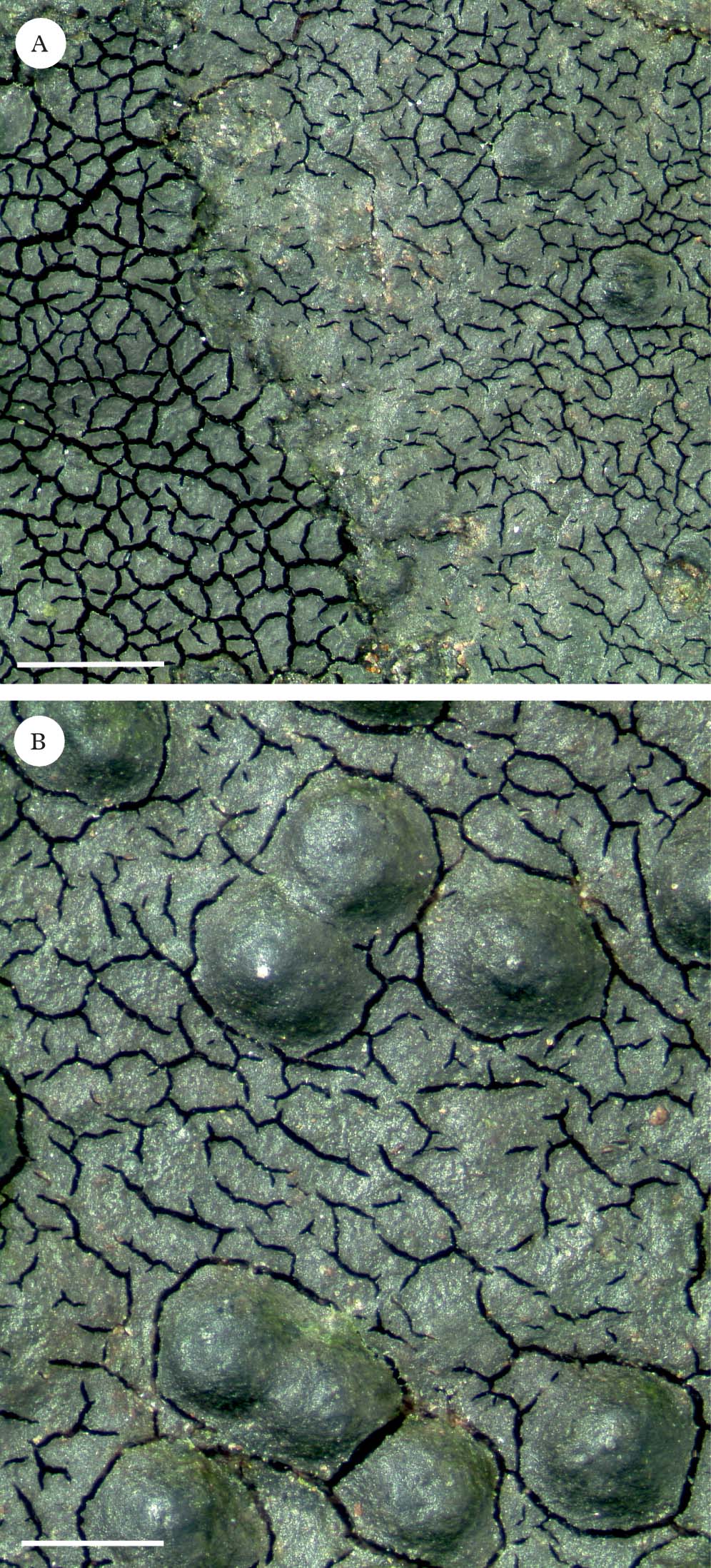
Prothallus whitish, non-fimbriate. Thallus episubstratal, thin, c. 35–100 µm thick, dark grey-brown to brown-black, sometimes with a greenish tinge; cracks sparse to numerous, but rarely delimiting discrete areoles except in very local thicker areas; surface roughened with indistinct, concolorous punctae or short flexuose or branched ridges, c. 20–90×20–40 µm, but often too indistinct to measure; thallus gradually thinning to margin. Pseudocortex with dilute to moderately dense pigment, pigment brown, K− or almost; cells of photobiont layer c. 2·5–3·7×2·0–3·3 µm. Epinecral layer sometimes present, c. 4 µm thick, colourless, of collapsed cells, the structure difficult to discern. Photobiont cells 5·0–9·0×4·5–8·0 µm. Basal parts of thallus colourless to brown, living photobiont cells few or absent, densely pigmented areas (punctae) projecting from basal layer into photobiont layer, pigment dark red-brown, K+ dark grey-brown.
Perithecia forming conspicuous conical-hemispherical projections 260–500 µm diam., roughened below like the thallus, above smooth, concolorous with thallus or black, apex rounded or slightly flattened; ostiolar region concolorous, inconspicuous. Involucrellum well-developed, merging with dark basal tissue. Exciple 170–210 µm diam. (few measured). Asci 8-spored, c. 45–82×18–29 µm. Ascospores oblong-ellipsoid, (12·5–) 13·5–15·0–16·5 (–18·0)×(5·5–) 7·0–7·3–8·0 (–8·5) µm, (1·4–) 1·8–2·1–2·3 (–2·7) times as long as wide [n=66/8].
Etymology. From Latin oceanica (of the ocean).
Habitat and distribution. On gently to steeply sloping rocks on the seashore, often in places which are occasionally lightly irrigated by rain water; usually growing with Hydropunctaria maura, sometimes with H. orae. Confirmed from three localities in Wales, and one in SW Ireland.
Notes. This species is often found contiguous with Hydropunctaria maura, which is then thicker, with usually discrete areoles, and with rather inconspicuous perithecia forming only low projections. The distinction between the two species is easily seen in the field. When growing with H. orae, the latter is greener in colour, the thallus is sometimes slightly thicker, and the perithecial mounds are slightly larger. The thallus of H. oceanica contains a brown pigment in the pseudocortex, but in H. orae the pigment is dull green. Hydropunctaria aractina differs in the usually greenish cortical pigment, but mixed collections have not been seen.
Material collected in northern Scotland by R. Santesson in 1969, and recognized by him as worthy of taxonomic recognition, may belong to this species, but the taxon should be recollected here and sequenced for confirmation.
Additional specimens examined. Great Britain: Wales: V.C. 45, Pembrokeshire: near Haverfordwest, St Brides, 12/8010.1103, 2011, A. Orange 20476 (NMW-C.2011.014.54); ibid., 12/8005.1108, A. Orange 20482 (NMW-C.2011.014.56); ibid., 12/8024.1108, A. Orange 20573 (NMW-C.2011.014.51); ibid., 12/8031.2227, A. Orange 20577 (NMW [C.2011.014.47]). V.C. 49, Caernarvonshire: near Aberdaron, west of Porth Oer, 23/1601.2954, 2010, A. Orange 19417 (NMW-C.2010.001.215). V.C. 52, Anglesey: south of Carmel Head, Ynys y Fydlyn, 23/2915.9172, 2011, A. Orange 20430 (NMW-C.2011.014.52).—Ireland: V.C. H1, South Kerry: Valencia Island, Foilhomurrin Bay, 00/3564.7353, 2009, A. Orange 18187 (NMW-C.2009.002.121); same locality and date, A. Orange 18193 (NMW-C.2009.002.126).
Hydropunctaria orae Orange sp. nov.
MycoBank no: MB 563382
Hydropunctaria maurae similis, sed differt thallo tenuiore, pigmento corticali viridi, et serie ITS et mtSSU.
Typus: Great Britain, Wales, Pembrokeshire, near Haverfordwest, St Brides, National Grid Reference 12/8024.1108, 51°45′18·83″N, 005°11′07·52″W, on steep rocks on NW-facing seashore, 11 June 2011, A. Orange 20571 (NMW-C.2011.014.48—holotypus; GenBank accession nos JN638285, JN638294).
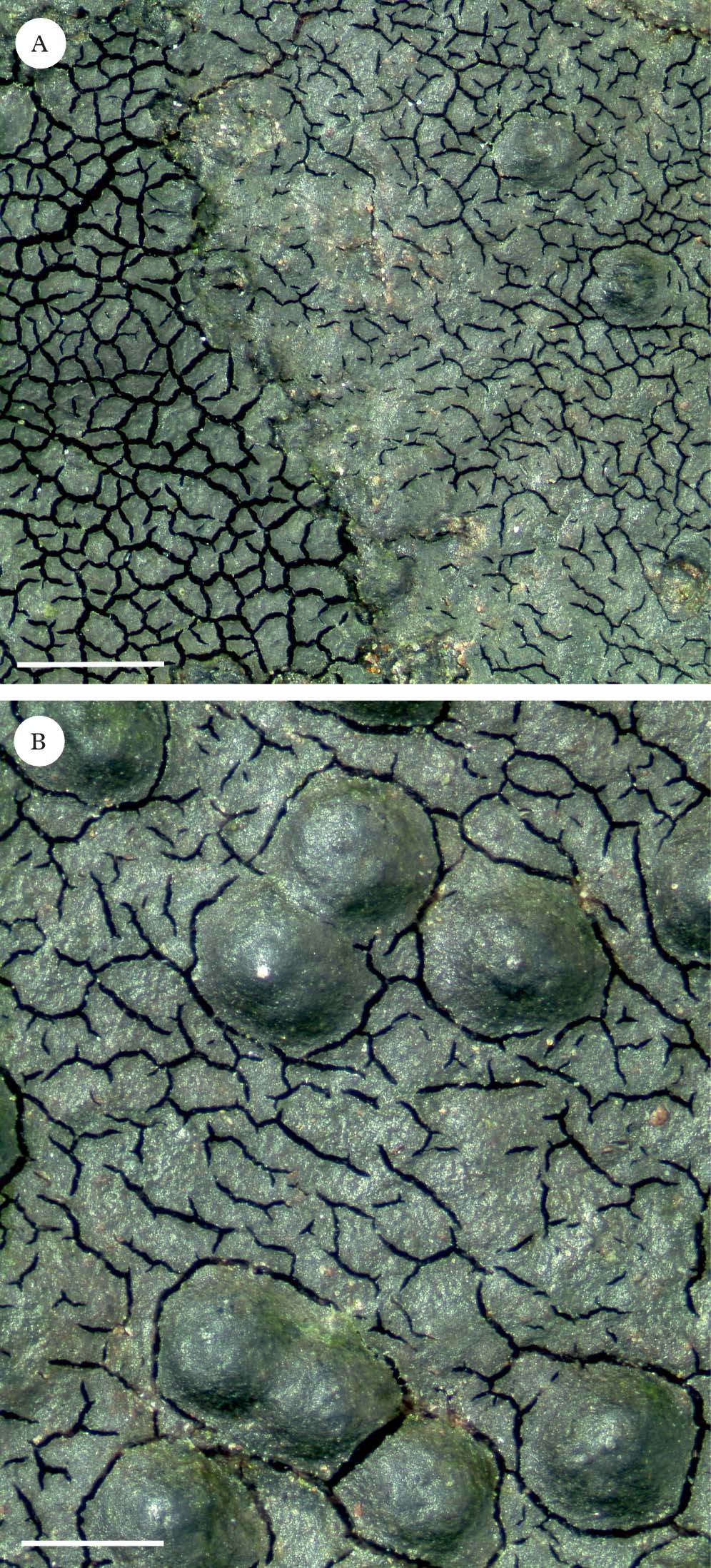
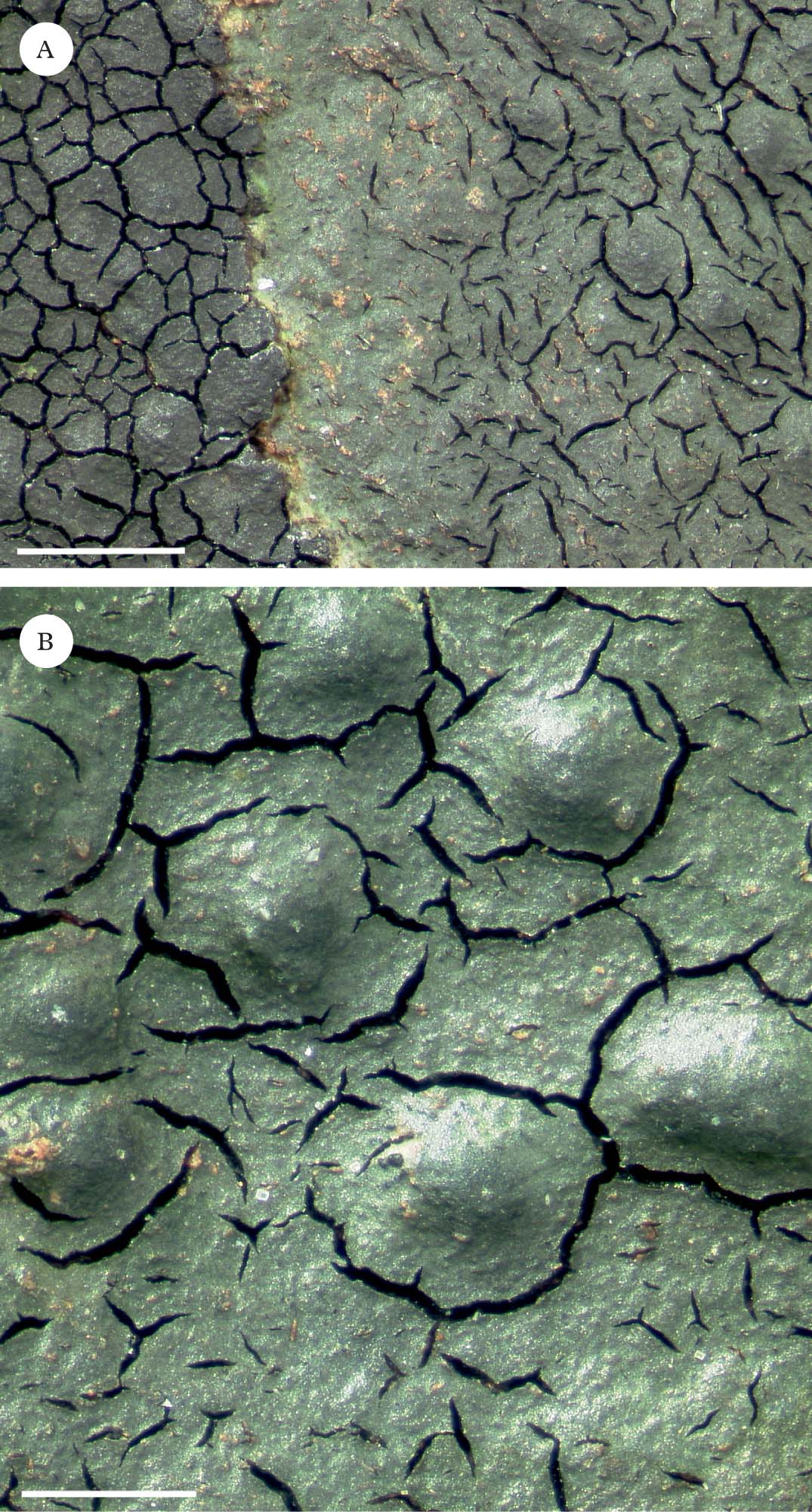
Hydropunctaria orae. A, holotype (right), with H. maura (left); B, thallus with perithecia (holotype). Scales: A=1 mm; B=500 µm. In colour online.
Sections of perithecia of Hydropunctaria species. A, H. oceanica holotype top, Orange 20430 bottom; B, H. orae, top holotype, bottom Orange 20575. Scales: A & B=300 µm.

Prothallus not seen. Thallus thin to moderately thick, 40–100 µm, dull mid green to dark greenish grey, thinner areas often without cracks, thicker parts with few to numerous cracks, but rarely forming discrete ‘islands’ of thallus. Thallus surface minutely roughened by low punctae c. 20–40 µm wide, occasionally forming minute ridges up to 80×30 µm, punctae concolorous, or darker than surrounding surface in shaded specimens. Thallus comprising cells in vertical columns, in upper part of thallus 2·0–4·0×1·6–3·3 µm, walls sometimes slightly thickened. Pseudocortex present, but a surface layer c. 5 µm thick sometimes pigmented, pigment dull green, K−. Lower part of thallus with no or few living algal cells, cells often with large oil droplets; densely pigmented and more or less discrete punctae projecting upward from the basal layer into the green layer, occasionally reaching the thallus surface, pigment dark reddish brown, K+ dark greyish brown. Epinecral layer sometimes present, colourless, up to 5 µm thick, comprising collapsed and scarcely recognizable cell remains. Photobiont cells 5·0–10·5×3·7–9·0 µm.
Perithecia forming low to moderately projecting, occasionally rather prominent, warts in the thallus 300–840 µm diam., apex rounded, rarely depressed, ostiole inconspicuous. Asci 8-spored, c. 43–52×21–26 µm. Involucrellum well-developed, merging with dark basal tissue. Exciple 260–270 µm diam. (few measured). Ascospores oblong-ellipsoid, simple, colourless, filled with small oil droplets when mature, (13·0–) 14·5–16·1–17·5 (–19·5)×(6·0–) 7·0–7·4–8·0 (–8·5) µm, (1·7–) 1·9–2·2–2·5 (–2·8) times as long as wide [n=75/4].
Habitat and distribution. On gently sloping to steep rocks on the seashore, especially where slightly irrigated by rain water; and on stone in freshwater stream shortly above seashore. Confirmed from one locality in S Wales and one in SW Ireland.
Etymology. From Latin ora (coast or edge).
Notes. The thallus of this species is relatively thin, so that cracks are relatively few and perithecia are rather prominent. The thallus often has a green tinge, which in some specimens is partly due to a green pigment in the pseudocortex. In mixed collections, thalli of H. maura are thicker, more extensively cracked, less green, and with less prominent perithecia. In Orange 20572, from a relatively shaded rock face, H. maura is green-brown whereas adjacent H. orae is mid-green to dark grey-green. In Orange 20575, H. orae had green pigment in the pseudocortex whereas adjacent H. maura had brown pigment. In one mixed collection (Orange 20577) of H. orae with H. oceanica, the latter looked browner (dark grey-brown, with brown pigment in the pseudocortex) than the H. orae (dark grey-green, with dull green pigment in the pseudocortex), and the H. oceanica also looked slightly thinner with smaller perithecia.
Additional specimens examined. Great Britain: Wales: V.C. 45, Pembrokeshire: near Haverfordwest, St Brides, 12/8010.1103, 2011, A. Orange 20477 (NMW [C.2011.014.55]); ibid., 12/8024.1108., 2011, A. Orange 20572 (NMW [C.2011.014.49]); ibid., 12/8031.2227, 2011, A. Orange 20575 (NMW [C.2011.014.50]).—Ireland, V.C. H1, South Kerry: Valencia Island, Foilhomurrin Bay, 00/3564.7353, 2009, rock in stream above seashore, A. Orange 18176 (NMW [C.2011.014.44]).
Hydropunctaria rheitrophila (Zschacke) C. Keller et al.
Taxon 58: 194 (2009).—Verrucaria rheitrophila Zschacke, Verh. Bot. Vereins Prov. Brandenburg 64: 108 (1922).
A description of this freshwater species was provided by Orange (2004). The thallus is typically uncracked, 60–95 µm thick, the cortical pigment (when present) is brown, and the spores are significantly smaller than other species in the genus, (8·5–) 11·0–12.7–14·0 (–16·0)×(6·0–) 6·5–7·4–8·0 (–0·5) µm, (1·3–) 1·5–1·7–1·9 (–2·3) times as long as wide [n=112/8].
Selected specimens examined. Sequenced specimen: Great Britain: Wales: V.C. 42, Breconshire: Llanwrtyd Wells, near Lledgwial, 22/8595.4771, on stones in streamlet, 2011, A. Orange 20545 (NMW-C.2011.014.62).
Hydropunctaria scabra (Vězda) C. Keller et al.
Taxon 58: 194 (2009).—Verrucaria scabra Vězda, Folia Geobot. Phytotax. 5: 308 (1970).
(Fig. 10)
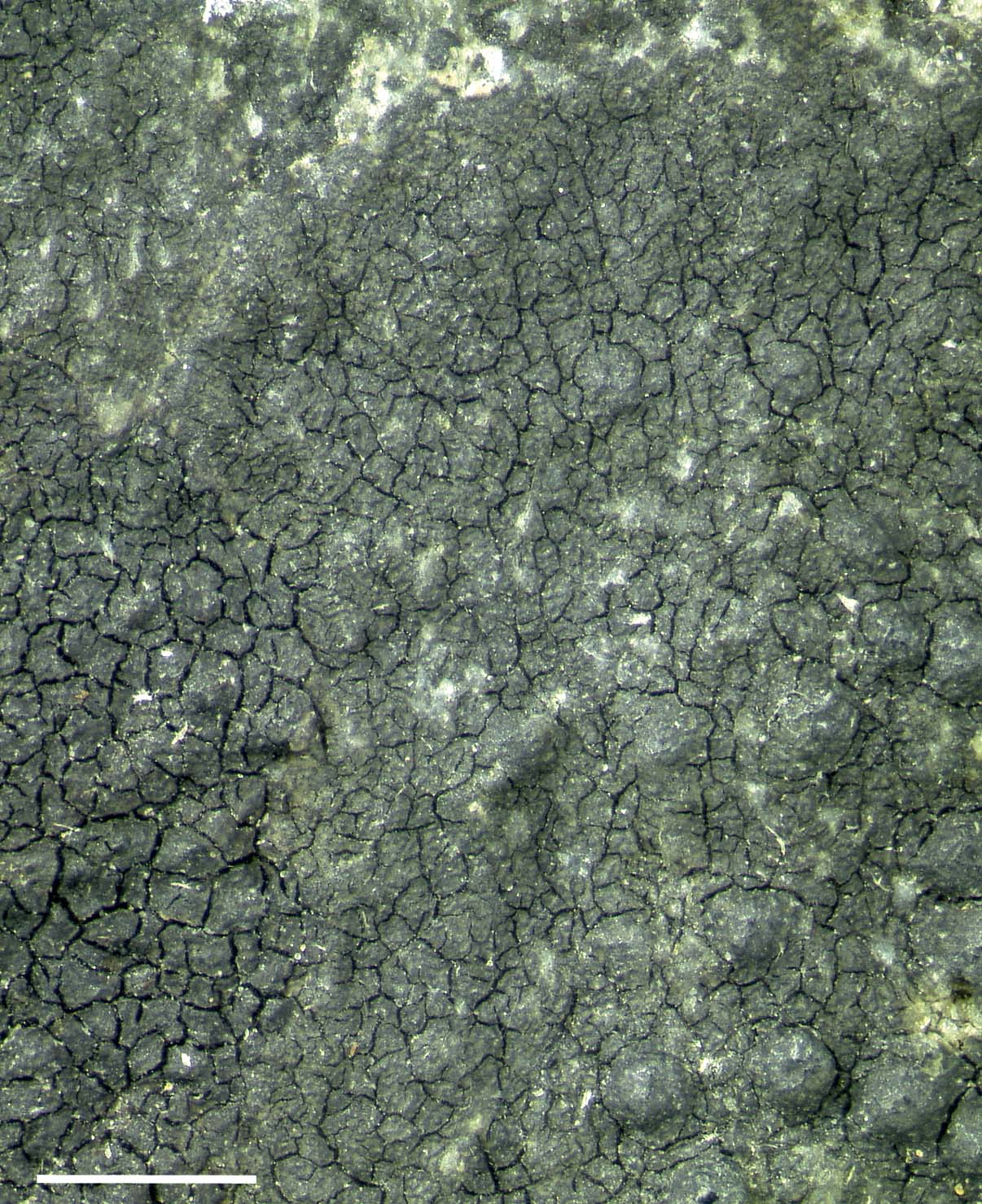
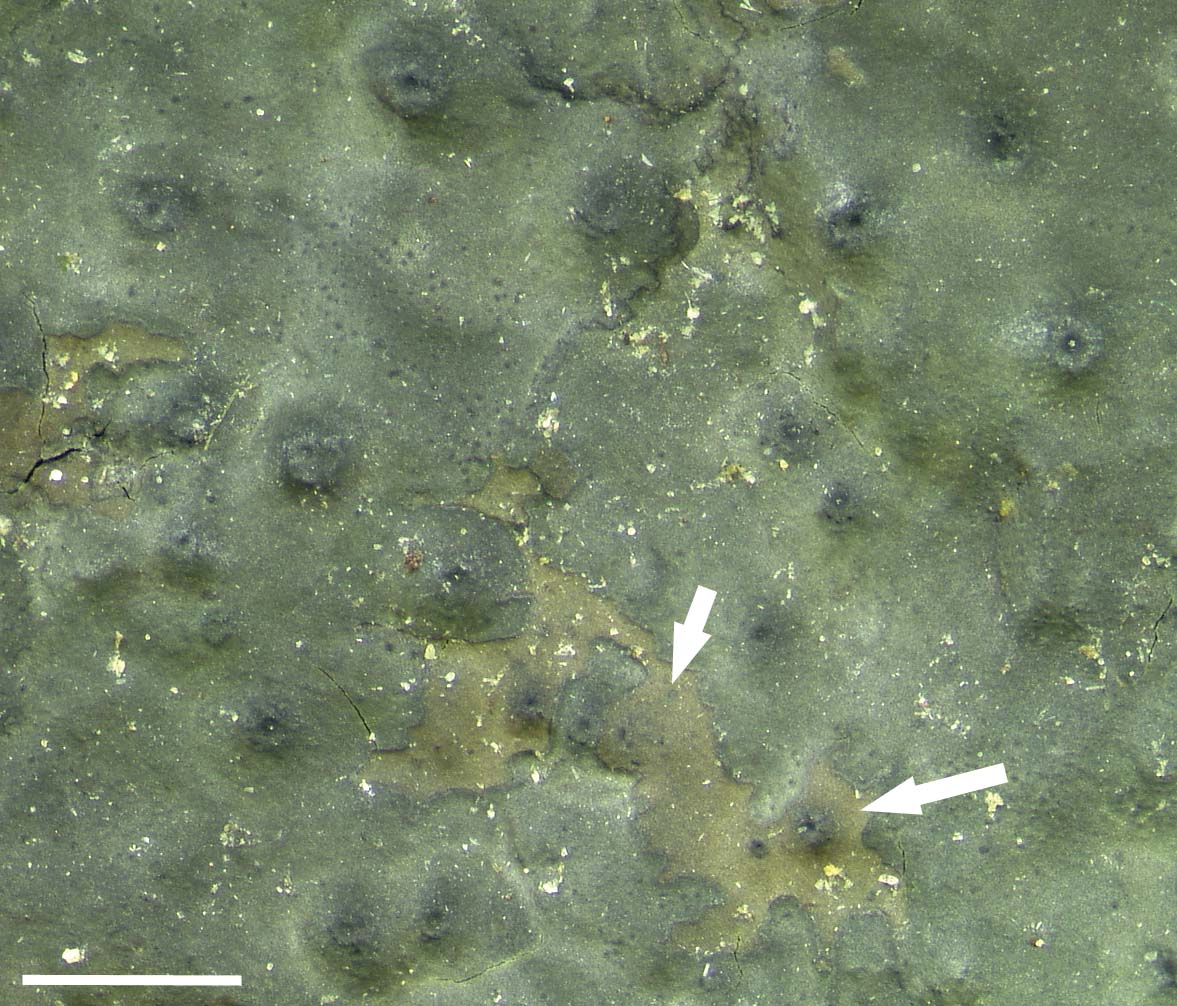
Hydropunctaria scabra, Orange 16223, with small thallus of H. rheitrophila (arrows). Scale=1 mm. In colour online.
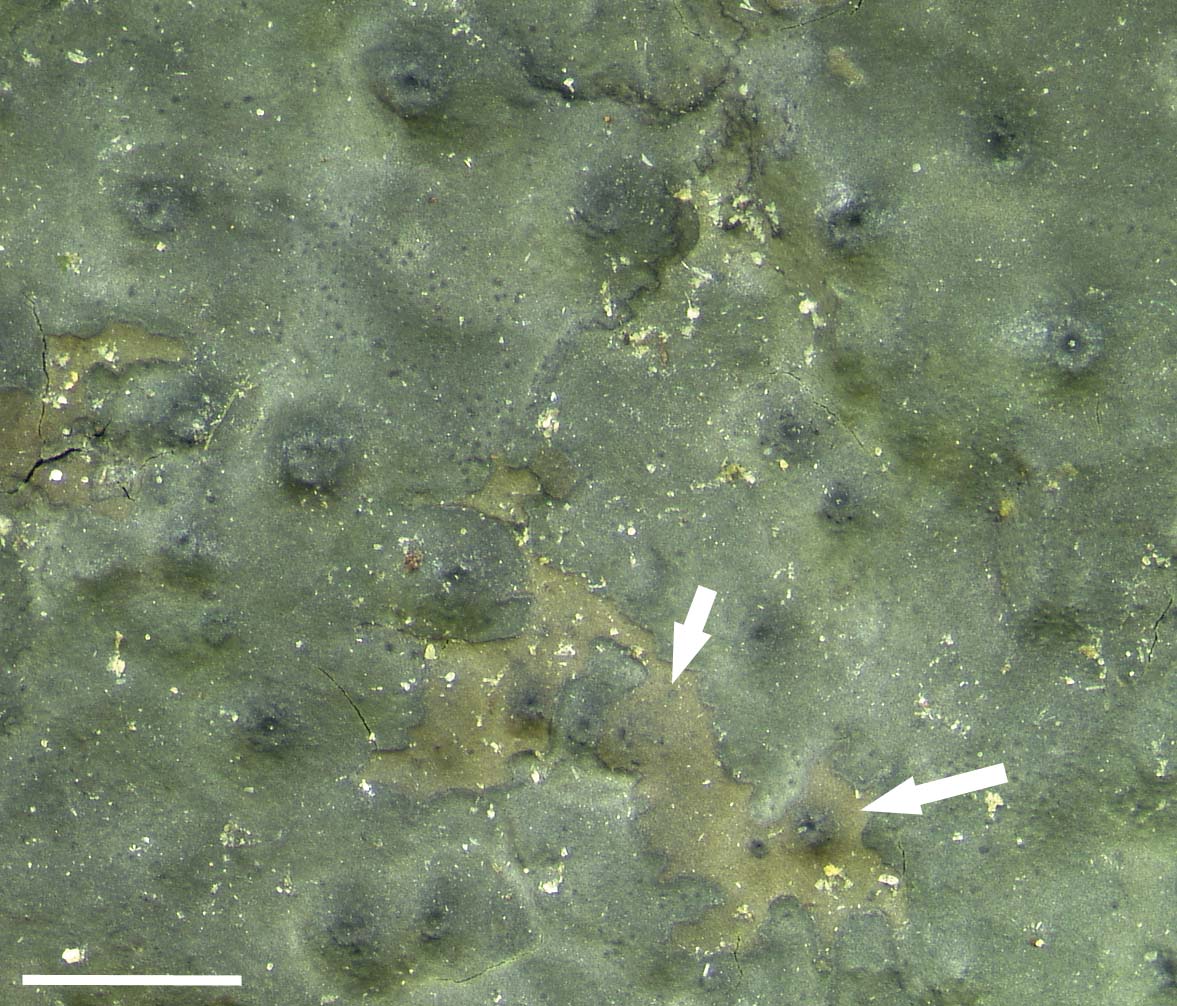
A description of this freshwater species was provided by Orange (2004). The thallus is typically uncracked, 35–150 µm thick, the cortical pigment (when present) is dull green, and the spores are (11·0–) 14·0–15·7–17·5 (–21·5)×(7·0–) 7·5–8·3–9·0 (–10·5) µm, (1·4–) 1·7–1·9–2·1 (–2·5) times as long as wide [n=124/7].
Selected specimens examined. Sequenced specimen: Great Britain: England: V.C. 69, Westmorland: Helvellyn, Brown Cove, Brown Cove Tarn, 35/3428.1601, 2005, A. Orange 16223 (NMW-C.2005.001.319).
Provisional key to species of Hydropunctaria in northern Europe
The following key is intended as a brief synopsis of the species treated here; until the variation within each species is better known, and until more regions have been investigated, positive identification of several of the species requires sequencing.
1 Ascospores small, (8·5–) 11–12·7–14 (–16) µm long; thallus thin, 60–95 µm, typically uncracked, cortical pigment brown; perithecia immersed or forming only very low projections; freshwater habitats ... H. rheitrophila
Ascospores larger, average length 14·5 µm or more ... 2
2(1) Dark tissue in thallus reaching the surface as distinctly elongated bars 40–400×40–60 µm, at least near the thallus margin, where they are perpendicular to the thallus margin; apex of perithecium plane or crenulate; cortical pigment brown; marine ... H. amphibia
Dark tissue in thallus in the form of small isodiametric punctae or occasionally minute ridges c. 20–90×20–40 µm, visible or not at the thallus surface ... 3
3(2) Thallus relatively thick, 60–300 µm, mostly cracked into discrete areoles; cortical pigment brown (rarely in part greenish brown); marine ... H. maura
Thallus relatively thin, up to 200 µm thick, cracks sparse to numerous, thallus always thinner and less cracked than H. maura when the species are growing contiguously; cortical pigment brown or green; marine or freshwater ... 4
4(3) Cortical pigment brown; marine ... H. oceanica
(H. adriatica, from the Mediterranean and Black Sea, would also key out here)
Cortical pigment dull green to green-brown ... 5
5(4) Thallus typically uncracked when fresh (fine cracks may appear on storage); freshwater ... H. scabra
Thallus usually with cracks when fresh; marine ... H. aractina
(currently known from N Norway) and H. orae (currently known from Wales and Ireland).
Discussion
Although Hydropunctaria maura has been regarded as a single variable species by several authors, Wahlenberg (in Acharius Reference Acharius1803) distinguished two species, H. aractina and H. maura, based on thallus morphology. Sequencing of material from the region of the type localities shows that Wahlenberg's species are phylogenetically distinct. It is a pleasure to reinstate Wahlenberg's species here. However, the variability of the species and the existence of other, previously unrecognized entities, means that morphological distinction of phylogenetically distinct entities in this complex is difficult, and it is not surprising that recent checklists in NW Europe have not accepted H. aractina.
DNA sequencing, especially of the ITS region, is a valuable tool in uncovering cryptic and semi-cryptic speciation. In the Verrucariaceae, due to a scarcity of well-defined morphological characters, even relatively unrelated taxa can be confused if only morphology is considered (e.g. Savić & Tibell Reference Savić and Tibell2008). However, in recently diverged species, incomplete lineage sorting could result in a lack of correspondence between a gene tree (for instance the ITS tree in Fig. 1) and the true species tree. In the present case, the results of the ITS analysis are largely supported by the LSU analysis and, more importantly, by the analysis of the independent gene region of the mitochondrial SSU. The well-supported parts of the tree show a similar topology in the three gene regions. In addition, the clusters of sequences in the ITS tree are correlated with subtle morphological characters including thallus thickness and type of cortical pigment, suggesting that truly separate entities are involved.
Species rank is considered here to be the most appropriate for the clusters in the ITS tree. Hydropunctaria aractina, H. oceanica and H. orae cannot be included within H. maura, as they do not form a single clade with that species. The morphologically well-defined H. amphibia, which is accepted by recent authors, is more closely related to H. maura than any of the other three. Hydropunctaria aractina and H. orae are sister taxa, with identical mtSSU sequences; however, it is proposed that they should be treated as separate species due to significant differences in the ITS region (including parts not used in the analyses due to alignment problems) and their occurrence in different geographical regions, as far as is known.
There are several available but currently unaccepted names for marine Hydropunctaria species, but these cannot be used without a wide-ranging study of the genus, including type localities, and even then it may be inadvisable to use names which were often proposed with little thought, or which are represented by atypical type specimens. The name H. aractina has been taken up here, since this is a very early name introduced by an author who described five species of marine Verrucaria (all currently accepted, including H. aractina), and the attribution of this name seems clear-cut. In contrast, Verrucaria perareolata Erichs. was synonymized with H. maura by Jacobsen & Coppins (Reference Jacobsen and Coppins1989), who said that the details supposedly separating it from H. maura were based upon misobservation. Verrucaria antricola Wedd. (1875) is known only from the holotype, which is a shade form of H. maura or another species with brown cortical pigment [(France) Vendée, Île d'Yeu, sur la rocher qui forme la paroi de la grotte de la Belle Maison, 1 Juni 1875, Weddell (PC-0116518!)].
Some of the species defined here are likely to be difficult to identify using morphology alone, but subtle morphological differences do exist, so that the species may be termed semi-cryptic (Vondrák et al. Reference Vondrák, Říha, Arup and Søchting2009). Failure to recognize these species would lead to a loss of information in phylogenetic and ecological studies, and in conservation practice, and would have no clear advantages except for ease of field (mis-)identification. In practice, H. maura appears to be by far the most abundant species of the complex, so the identity of this lichen as one of the most conspicuous species of rocky shores is not called into question. The other species are usually readily distinguishable from H. maura in the field, and after further studies are carried out to determine the range and variation of the taxa, reliable determination in the field or under the dissecting microscope may well be possible. Hydropunctaria scabra has been accepted by recent authors as a freshwater species, but morphologically it is rather similar to H. orae and others. Thus it is also a semi-cryptic species, distinguished most easily by its ecology. The difficulty of identifying a specimen of Hydropunctaria collected in a freshwater stream only metres above the seashore, at the start of this investigation, illustrates this; the specimen subsequently proved to be H. orae.
I would like to thank the curators of PC and UPS for the loan of specimens, and Dr K. Kinalioglu for allowing me to use a specimen of Hydropunctaria adriatica in this study.