Introduction
Undergraduate curriculum designers must decide how to represent the various medical specialties in a time-limited curriculum. The Promoting Excellence guidance issued by the General Medical Council (GMC) in 2015 tasked educators with developing a curriculum that would prepare medical students with the knowledge, skills and attitudes required of a foundation doctor.
This guidance reframes medical education in two significant ways. Firstly, it links the objectives of medical school curricula to the requirements of a junior doctor. This effectively splits the training of doctors into undergraduate training and postgraduate training with the objectives of each phase being different. The aim of undergraduate training is preparation of the student for early clinical practice, whereas the aim of postgraduate training is to develop the student's clinical ability and to cultivate their interest in a specialty. Secondly, the Promoting Excellence guidance links the activities of a medical school to the health service context. This places medical education in a constant state of tension between the tendency to revert to teacher-centred pedagogies and the need to respond to the National Health Service context.Reference Mennin1
The average amount of time across UK medical schools that is allocated to ENT teaching during the undergraduate curriculum is 1.5 weeks.Reference Mace and Narula2,Reference Khan and Saeed3 However, multiple studies suggest students, junior doctors and general practitioners lack confidence in managing patients with ENT pathology.Reference Biswas, Rafferty and Jassar4–Reference Veitch, Lewis and Gibbin6 This suggests these newly qualified doctors are not suitably prepared to manage patients they are likely to encounter in their daily clinical practice.
This study aimed to explore the efficacy of the current ENT provision, identify areas for potential improvement and propose recommendations on how to optimise ENT provision in the undergraduate curriculum. Although numerous studies exist that highlight the need to improve existing ENT provision, a qualitative study exploring these issues has not previously been conducted.
Materials and methods
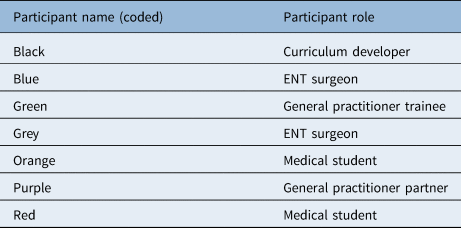
This was a qualitative study using semi-structured interviews to explore the perceptions of seven participants from four relevant groups pertinent to the research question. These groups included ENT surgeons, medical students, curriculum developers and general practitioners recruited through purposeful selection. This study had a total of seven participants. The professional backgrounds of these participants are shown in Table 1.
Professional backgrounds of participants

One-to-one semi-structured interviews were used for data collection. Interview schedules were developed that were relevant to the professional background of the participant. The schedules were informed by relevant theoretical frameworks including Lave and Wenger's situated learning theory,Reference Lave and Wenger7 communities of practice theory and Frederick Hafferty's theory of hidden curricula.Reference Hafferty and Franks8
A total of seven interviews were conducted. Five were conducted face-to-face in a quiet public space that was mutually convenient for both the interviewer and the participant. The remaining two interviews were performed over Skype® communication tool. Interviews lasted between 24 and 36 minutes. The interviews were audio recorded with the participants’ permission. In addition, notes were made of any key points of interest during the interviews. Data were analysed using inductive thematic analysis.
Ethical approval
This study received ethical approval following review by the Imperial College London Education Ethics Review Process (approval number: EERP 1819–042).
Results and discussion
Participants had all undertaken a mandatory week-long ENT placement as an undergraduate, although they had studied in different medical schools. Some participants elected to receive further exposure to ENT as an undergraduate, either through a specialty choice module, or through organising an elective placement in ENT.
Despite heterogeneity in the professional backgrounds of participants, there were four emergent themes through the interviews, which are discussed below. Under each theme relevant recommendations are made for curriculum developers. These themes were: (1) scope of the undergraduate ENT provision; (2) barriers to learning and teaching; (3) alternate means of delivery of ENT education; and (4) professional identity development.
Undergraduate ENT provision
Participants provided their perspectives on the effectiveness of existing ENT curricula, while also providing suggestions on how the scope of undergraduate ENT provision can be reconsidered to serve students more effectively.
Effectiveness of current ENT provision
Participants viewed ENT as a relatively niche subspecialty but recognised the importance of ENT being part of the undergraduate curriculum, citing the prevalence of ENT conditions in the general public and its relevance for community practitioners:
…it's a niche specialty. For example, while we don't get exposure to neurosurgery as medical student, there is a neurology placement which hopefully covers everything that commonly comes up in neurosurgery. But there is no corresponding medical specialty for ENT. ENT covers both medical and surgical side of things… I think to me [the provision of ENT] at present is [inadequate] … especially because apparently 20% of a GP's consultations are ear, nose and throat related. (Blue, ENT surgeon)
I suppose that it's a fairly sub-specialised and niche part of surgery and medicine, but as a general practitioner, it forms a large part of my practice. It's unfortunately an area of practice I'm not that confident in due to the limited exposure I received during medical school and beyond. I think it's an important specialty, especially for primary care. (Purple, general practitioner partner)
All participants agreed on the relevance of ENT in the undergraduate curriculum and advocate its inclusion. However, the perception of ENT as a ‘niche’ or smaller specialty, as stated by participants, may undermine efforts to increase representation of ENT within the undergraduate medical curriculum.
Undergraduate ENT provision aims
Participants agreed on what the undergraduate ENT provision should aim to achieve, with objectives relating to theoretical knowledge, clinical skills and professional attitudes. Participants felt that knowledge should focus on common presentations likely to be encountered in allied specialties, along with rarer ‘red flag’ conditions that should be recognised. With regard to practical skills, participant comments related principally to skills that would be most valuable in general practice.
You don't need to teach everyone how to use a (flexible nasendoscope), but its more about this is how I do otoscopy, Rinne's and Weber's. This is what a nasal fracture looks like. This is how I take a history with someone with x, y or z. (Blue, ENT surgeon)
Participants who were ENT doctors reported that their decision to pursue a career in ENT was not influenced by their undergraduate experience but rather by self-selected modules or postgraduate practice. The lack of impact of mandatory ENT placements on career aspirations has previously been reported in published literature.Reference Bhutta, Mandavia, Syed, Qureshi, Hettige and Wong9 Nonetheless, participants recognise the importance of supporting a student's interest in ENT by identifying and signposting opportunities for interested students during medical school.
Recommendation 1
Because of the prevalence of ENT pathology in the general population, its relevance to general practice and the specific inclusion of otoscopy as a GMC outcome for graduates, ENT should remain a mandatory aspect of the undergraduate medical curriculum.
Recommendation 2
All compulsory ENT-related activities should contribute directly to the acquisition of either knowledge, clinical skill or development of relevant professional attitudes. As compulsory ENT placements do not significantly contribute to students’ career intentions, activities within compulsory placements designed to promote ENT as a career should be deprioritised.
Recommendation 3
Opportunities to develop an interest in ENT remain important. Elective ENT placements (e.g. specialty choice modules, elective opportunities, summer shadowing placements) that support the career aspirations of students should remain freely available and be sign-posted to students.
Barriers to learning and teaching
Participants outlined a number of issues that undermined the aims of the existing ENT provision. These included learner-related factors, teacher-related factors and the factors relating to the content of ENT placements.
Competing interests for students
Participants highlighted the issue of absenteeism which undermines existing efforts to deliver ENT teaching to undergraduates.
During my placement I really didn't see many other students, if at all in the first place. I saw, the odd student in a different clinic or maybe in a different theatre. (Red, medical student)
Given the issue of a high rate of absenteeism, simply lengthening placements will not guarantee achievement of educational objectives unless the underlying causes of absenteeism are first addressed. The impact of assessment on students’ motivations was identified as a key structural factor that resulted in students being less engaged with ENT placements.
It was unassessed and the timing of it for me was just before finals. So really your mind is not really on experiencing the placement. It's on revision for the other assessed modules. (Purple, general practitioner partner)
Assessments are widely recognised as a key driver of learning, both by this sample of participants and in the literature. Although a tempting solution would be to simply increase the representation of ENT in summative assessments, despite being effective this would be neither practical nor feasible, as one participant outlines:Reference Wormald, Schoeman, Somasunderam and Penn10
We tried blueprinting for the written paper in final year and it works out that they would be three quarters of an SBA [single best answer] or something for ENT judging by the amount of time [of the ENT placement]. You could see that actually students would think rather that there's only one SBA on ENT so it would be better to spend that time revising for something else. (Black, curriculum developer)
Doubling the current ENT provision from a single week to two weeks would only increase its representation in summative assessments by a single question, a change that is unlikely to influence student behaviour significantly. Artificially increasing the weighting of ENT in assessments beyond its current provision would undermine the integrity of the assessments process and is unlikely to be deemed acceptable by stakeholders.Reference Schuwirth, Van Der Vleuten and Swanwick11 The challenge for curriculum developers is to devise an assessment strategy that, along with being feasible, reliable and valid, is acceptable to stakeholders. One such approach is outlined by participant Grey:
We collected these workplace-based assessments in a booklet. I would hand that in at the end of the year, and that would form part of the assessment of actually passing the year. If you didn't complete the booklet, you didn't pass the year. (Grey, ENT surgeon)
The example provided by Grey demonstrates how formative assessments can be designed to encourage positive learning behaviours. Despite the booklets not contributing to the overall grade of the student, it was effective for ensuring attendance because of the potential consequences of absenteeism. Introducing a workbook that restates the explicit learning outcomes of the ENT placement, along with mandatory workplace-based assessments would help to realign the explicit and implicit cues for the student and would cultivate the intended knowledge skills and professional attitudes within the student.Reference Miller12
Recommendation 4
Curriculum developers should consider strategies to encourage engagement with undergraduate placements in ENT. Formative assessments, such as workbooks, which carry consequences for student progression can be considered as an effective solution.
Teacher-related factors
Role conflict describes the phenomenon whereby an individual experiences or perceives incompatible demands placed upon them as a result of the roles that they hold.Reference Kopala13 For clinician–educators, their clinical role may demand that priority is given to patient care by providing a timely and attentive service to the patient. By contrast, their education role may demand time and attention to the learner to ensure an educationally rich learning experience. Promoting approaches that enable both clinical and educational roles to be simultaneously fulfilled are more likely to be readily adopted by clinician–educators. Such an approach that can be used in the out-patient setting is proposed by a participant below:
There are always patients sitting in the waiting room doing nothing waiting. So, in that case you can send a student off to take a history or to examine the patients. (Green, general practitioner trainee)
This approach has the benefit of allowing students to actively participate in patient care and learn through practice while enabling clinicians to continue to deliver patient care without increasing appointment times or reducing patient satisfaction.Reference Hajioff and Birchall14
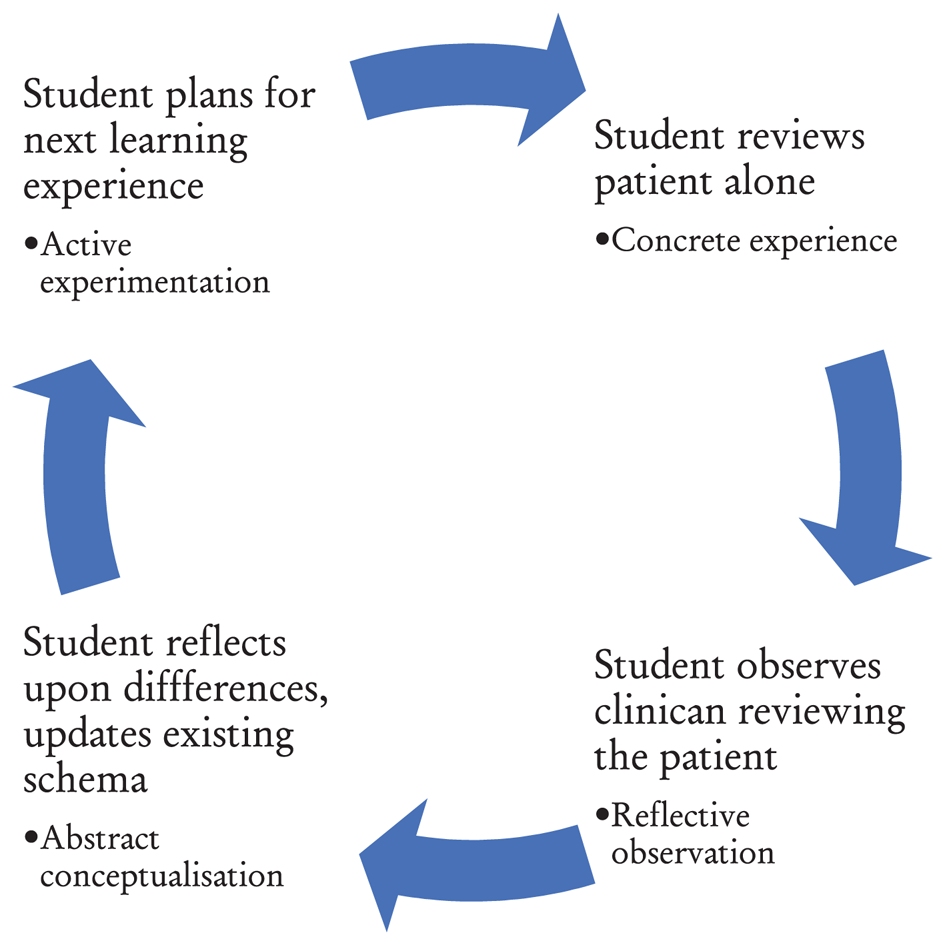
The activity of seeing and assessing patients followed by reviewing them with a clinician ensure that students move through the various parts of the Kolb learning cycle (Figure 1).
Mapping of student activities in an out-patient clinic to Kolb's learning cycle (adapted from KolbReference Kolb30).

Content being delivered
Participants recognised that certain clinical activities were not appropriate to support the intended learning outcomes of a placement. In particular, participants recalled examples of when the case mix of conditions they encountered was not aligned with their educational objectives.
The [operation] theatre sessions were scheduled for complex head and neck cases, which had a very large ENT team with a consultant, fellow, two registers, the plastics team, meaning I couldn't see anything. I don't know whether it was appropriate for training someone who's completely naive to ENT. (Blue, ENT surgeon)
Such examples highlight the importance of designing clinical attachments with the educational objectives of the student firmly in mind. Medical school leads must ensure that the activities that students are scheduled to undertake are relevant to students and contribute directly to objectives of the placement. Activities that do not directly support the placement's objectives should be deprioritised or omitted entirely. This will ensure that the time spent in the placement is both engaging and productive.
Recommendation 5
The specific activities that students undertake during clinical rotations should be carefully considered to ensure they are at the appropriate level for the student and contribute directly to the objectives of the placement.
Alternate means of ENT education delivery
Participants highlighted a number of alternative options to deliver ENT teaching that can support the student experience during their clinical placements in ENT. These options include e-learning and teaching ENT in the primary care setting.
E-learning
Multiple participants suggested e-learning as a potential option to complement current ENT provision. In particular, participants identified the role of e-learning as an adjunct to introduce students to clinical concepts prior to experiencing them on a placement.
We're talking a lot with the new curriculum about digitisation… maybe you'll learn the skill through an e-module before you even arrive there, which will help a lot. You know what you're looking for. The difficulty is looking at the ear drum or looking at the nose. These are cavities that aren't easy to access. But the e-module can help you with visualising so you can look at an ear and see what you see. (Black, curriculum developer)
If the first time you see it as live within a clinic in front of a patient, you're unlikely to feel confident to ask the very basic questions that you may want to ask. And if you've already seen it before and say in e-modules or lectures you're more likely to have a better learning experience. (Purple, general practitioner partner)
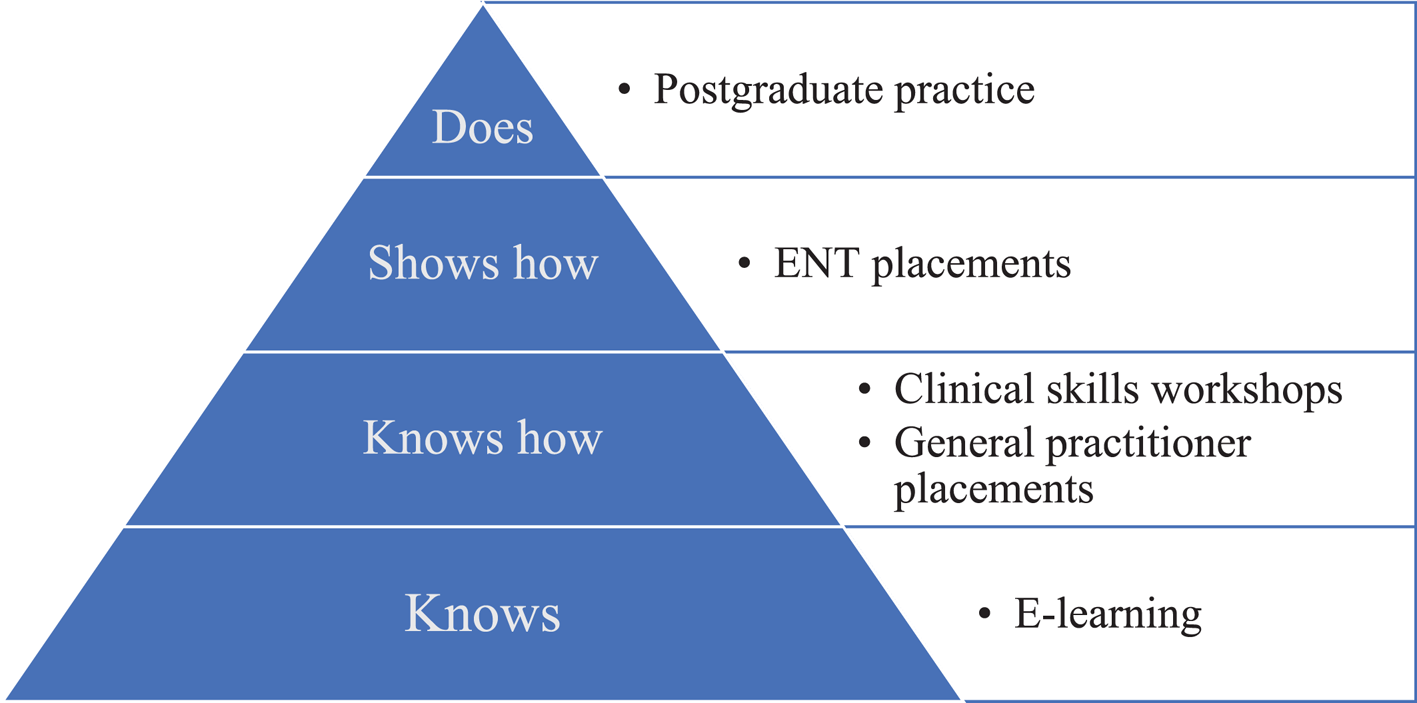
E-learning has been recognised as a valuable approach to teaching ENT by a number of organisations within the ENT community. Both ENT UK and the Students and Foundation Doctors in Otolaryngology have developed a variety of e-learning tools to encourage learning online including interactive e-learning modules, educational videos and an undergraduate e-book.15,16 E-learning resources are ideal in providing a foundation level of knowledge upon which students can build.Reference Watson, Wright, Morris, McMeeken, Rivett and Blackstock17 The development of more advanced levels of understanding can be subsequently supported through traditional approaches such as clinical skills workshops and experience through clinical placements. The timing and provision of clinical skills training and placements should be considered strategically. Millers pyramid serves as a useful conceptual framework through which to consider the teaching strategy (Figure 2).Reference Miller12
Miller's pyramid adapted to demonstrate how different methods of ENT teaching can be used to develop a student's competence in ENT.

According to our participants, the current undergraduate ENT teaching provides students with, at best, competence in ENT at the ‘knows’ level. Through a radical approach to the redesign of the ENT placement, curriculum developers can encourage transformative learning practices to help students achieve higher levels of competence in ENT.Reference Sharpe, Benfield, Roberts and Francis18 Such an approach would incorporate e-learning as part of a blended learning approach, utilising additional alternative methods of ENT teaching delivery in addition to re-imagining the current ENT clinical placement.
ENT teaching in general practice
The prevalence of ENT conditions that present to primary care is well recognised in published literature.Reference Donnelly, Quraishi and McShane19–Reference Griffiths21 General practice offers students an environment where students practise clinical examinations relevant to ENT on patients, both with and without ENT pathology. Practising physical examination on patients without pathology helps students develop an appreciation of ‘what normal feels like’, an essential component in the development of clinical phronesis.Reference Chiavaroli and Trumble22 As a result, when students subsequently undergo placements in ENT departments, they will be more confident in reviewing and examining patients. The majority of patients in general practice are happy to undergo examinations of the head and neck solely for the purposes of medical education.Reference Gandhi, Leung, Patil and Wong23–Reference Abe, Suzuki, Fujisaki and Ban26
There are specific advantages of general practitioners teaching ENT, namely the time and space available in general practice to create an environment conducive to learning, specific qualities of general practitioners that make them good teachers and the ability of general practitioners to teach ENT from the perspective of what is available in primary care. However, not all general practitioners feel confident to teach ENT; therefore, ENT teaching in the community could be delivered through a ‘hub and spoke model’ whereby multiple practices collaborate and teach ENT in a single practice.Reference Dimitrov, Unadkat, Khanna, Rennie and Saleh27
We have talked in the past about GP hubs because in any one general practice that you also don't have people that are confident in everything… Maybe it's the same for ENT to ensure that the right person is teaching the students… you could have tutorials with several students or going to one practice maybe, and that GP, upskilling other GPs to teach the important facets. (Black, curriculum developer)
Finally, while primary care has the potential to provide students with much of the basic competences in ENT, it is unable to replace the value presented by ENT experience in secondary care. Placements in secondary care remain vital in allowing students to encounter presentations, investigations and management of conditions that would be otherwise difficult to encounter in primary care.
Secondary care offers generally conditions in the more severe end of the spectrum, such as malignancy, much more frequently than you would expect to see in primary care certainly. You would be seeing complex cases, you would see more refractory cases certainly… the rare but important stuff you would be unlikely to see in GP. (Green, general practitioner trainee)
As previously established, curriculum developers should aim to teach students about both the ‘common’ as well as the ‘rare but important’ aspects of ENT. General practice is well suited to teaching about common ENT conditions while secondary care serves an equally important educational role of providing exposure to rare but important ENT conditions.
Recommendation 6
Shorter placements carry specific challenges for students to learn. Curriculum developers should support this process by ensuring access to appropriate learning resources, such as e-learning modules, before and after the placement, to support learning in the clinical environment and ensuring enough time is provided to utilise these resources.
Recommendation 7
A variety of contexts should be considered to provide additional exposure to ENT, including general practice, community ENT clinics, e-learning and simulation workshops. By considering synergies between individual approaches, a holistic programme can be developed whereby the strengths of any individual context can be used to mitigate for the shortcomings of another.
Identity: personal and professional
An important function of clinical placements that may often be overlooked is the development of a professional identity. Participants provided their perspectives on the current provision of ENT and its impact on professional identity development. One particular challenge identified is the impact of the short duration of the current ENT placement.
When students want to belong, but they can't belong in short placements. Yet, they also want to get more breadth of experience and they don't want to just do endoscopies for six weeks. So it's trying to marry those two up and it's always a challenge within undergraduate education. (Black, curriculum developer)
Shorter placements invariably result in a shorter period of time to socialise within a team, thus impairing the transfer of professional values from clinicians to students.Reference Jarvis-Selinger, Pratt and Regehr28 However, attention to other influences on professional identity development can help to promote professional identity development, as suggested by participant Green:
Something medical students lack a lot in placements, is feeling that they're part of a community, they're making contributions towards patient care and that they're progressing on their journey to become a fully-fledged doctor. So I think there should be a degree of providing clinical care in a limited way. (Green, general practitioner trainee)
This participant states that the process of being involved in the delivery of care and being treated as ‘one of the team’ is important in the development of a student's professional identity. Both professional inclusivity and social exclusivity are recognised in contributing to professional identity development.Reference Weaver, Peters, Koch and Wilson29
Social exclusivity is described as a student's perceptions of being socially separate from non-medical students and isolated from students in other disciplines. In previous generations, the firm structure may have promoted a sense of social exclusivity.
The challenge for educators is to promote both professional inclusivity and social exclusivity despite a short placement in ENT. Designing placements with these two considerations in mind can help to promote the development of a professional identity in students. For example, ensuring that students are introduced to all members of the team during their clinical activities can help to promote professional inclusivity. Another example of a measure that can promote social exclusivity is the provision of a specific welcome pack or newsletter for students rotating through a particular department.
Recommendation 8
Shorter placements pose a challenge to the development of rapport between students and learners, which in turn can affect learning during the placement. Specific consideration should be given on ways to promote professional inclusivity and social exclusivity to address this challenge.
Limitations
The small sample size of this study precludes the ability to draw generalisations. Questionnaire studies could be used to corroborate some of the insights gained through this study amongst the general population of stakeholders.
In addition, there would be value in interviewing additional groups of practitioners who do not directly interface with ENT patients to elicit their perspectives of current undergraduate ENT placements and the provision of other specialties. Such groups may include practitioners in specialties that occupy a greater footprint in the undergraduate curriculum. This exercise can be useful to determine the perspectives that are most widely shared amongst each group of practitioners while also allowing exploration of additional perspectives that have not been described in this study.
• Undergraduate provision of ENT teaching does not adequately meet the desired objectives of students and curriculum developers
• Specific challenges to meeting the intended learning outcomes of the undergraduate ENT provision are highlighted
• These challenges include student-related, teacher-related and environmental factors
• This study reconsidered how ENT placements are delivered
• The use of e-learning, simulation workshops and additional community-based ENT experience may improve learning provision
Conclusion
Teaching of ENT should be considered an important part of the undergraduate curriculum. However, the current undergraduate ENT provision does not support its intended outcome, namely the acquisition of a basic level of competence to diagnose and manage simple ENT problems.
The reasons for this include insufficient curriculum time and limitations of existing teaching strategies. The current provision can be optimised by increasing the length of time devoted to ENT and using alternative contexts to deliver ENT teaching. In addition, with appropriate consideration, ENT teaching can be used to support the wider curriculum aspiration of cultivating a professional identity in medical students.
Competing interests
None declared