Introduction
Studies have found that second-generation immigrants have an increased risk of schizophrenia (Cantor-Graae & Selten, Reference Cantor-Graae and Selten2005; Cantor-Graae & Pedersen, Reference Cantor-Graae and Pedersen2007). However, the factor or factors responsible for this association are unknown. Hypothetical explanations include environmental factors, such as discrimination (Janssen et al. Reference Janssen, Hanssen, Bak, Bijl, de Graaf, Vollebergh, McKenzie and van Os2003; Veling et al. Reference Veling, Susser, van Os, Mackenbach, Selten and Hoek2008), social defeat (Selten & Cantor-Graae, Reference Selten and Cantor-Graae2007), exposure to viral agents (Sharpley et al. Reference Sharpley, Hutchinson, McKenzie and Murray2001; Mortensen et al. Reference Mortensen, Norgaard-Pedersen, Waltoft, Sorensen, Hougaard, Torrey and Yolken2007, Reference Mortensen, Pedersen, Hougaard, Norgaard-Petersen, Mors, Borglum and Yolken2010), low prenatal vitamin D levels (McGrath, Reference McGrath1999), parental or offspring stress related to migration and post-migration (Fearon & Morgan, Reference Fearon and Morgan2006; Weiser et al. Reference Weiser, Werbeloff, Vishna, Yoffe, Lubin, Shmushkevitch and Davidson2008), parental selective migration (Pedersen et al. Reference Pedersen, Mortensen and Cantor-Graae2011) and parental malnutrition in the country of origin (Susser et al. Reference Susser, Neugebauer, Hoek, Brown, Lin, Labovitz and Gorman1996; Hulshoff Pol et al. Reference Hulshoff Pol, Hoek, Susser, Brown, Dingemans, Schnack, van Haren, Pereira Ramos, Gispen-de Wied and Kahn2000).
Various operational definitions have been used to identify second-generation immigrants. In a study conducted in Israel, Corcoran et al. (Reference Corcoran, Perrin, Harlap, Deutsch, Fennig, Manor, Nahon, Kimhy, Malaspina and Susser2009) defined second-generation immigrants as persons having at least one parent born abroad and used parental birth certificates to ascertain the birthplace of the parent. Veling et al. (Reference Veling, Susser, van Os, Mackenbach, Selten and Hoek2008) used information obtained from municipal authorities in the Hague to determine ethnicity of the background population data, also defined as at least one foreign-born parent, and also face-to-face patient interviews. Coid et al. (Reference Coid, Kirkbride, Barker, Cowden, Stamps, Yang and Jones2008), in their population-based survey, used a multi-ethnic panel of researchers to compile all available information on ethnicity, including self-ascription, parental birthplace, with second-generation defined as ‘UK-born’. Cantor-Graae & Pedersen (Reference Cantor-Graae and Pedersen2007) defined second-generation immigrants prospectively as people born in Denmark having at least one parent born abroad, using information from the Danish Civil Registration System. However, with increasing global migration, it is not clear that parental country of birth necessarily is informative with regard to ethnicity. Therefore, to access the validity of the finding of the increased risk of schizophrenia among second-generation immigrants residing in Denmark, we compared two independent definitions of parental foreign ethnicity, foreign parental country of birth versus genetic divergence based on genome-wide genotypic data. Genetic divergence refers to allele frequency differences between individuals, reflecting population stratification (allele frequency differences between individuals due to ancestry differences).
Materials and method
The study was based on a linkage between information in the Danish Psychiatric Central Register (Munk-Jorgensen & Mortensen, Reference Munk-Jorgensen and Mortensen1997), the Danish Civil Registration System (Pedersen et al. Reference Pedersen, Gotzsche, Moller and Mortensen2006) and genetic information obtained from dried blood spot samples from the Danish Neonatal Screening Biobank (Norgaard-Pedersen & Hougaard, Reference Norgaard-Pedersen and Hougaard2007). These blood spots have been systematically stored for individuals born in Denmark since 1 May 1981. We identified all singletons who had been diagnosed with schizophrenia (ICD-10: F20) during the period from 1994 to 2006 and who were born in Denmark on 1 May 1981 or later (n=1510). From these singletons, the sample was restricted to cases who had biological material located in the Danish Neonatal Screening Biobank (n=967). For each case we randomly selected one control based on the following matching criteria: (a) sex; (b) exact date of birth; (c) born in Denmark; (d) alive and with no history of schizophrenia on the date of first diagnosis of schizophrenia of the matched case. We subsequently restricted the study to case–control pairs, where both samples contained sufficient biological material to allow at least four discs to be sampled. Each disc was 3.2 mm in diameter, which corresponds approximately to 3 μl of whole blood. Using this procedure, we identified 915 cases and their 915 individually time-matched controls.
DNA was extracted from the dried blood spots using Extract-N-Amp Blood PCR kit (Sigma Aldrich, USA) and subsequently whole-genome-amplified in triplicate using the REPLIg kit (Qiagen, Germany) (Hollegaard et al. Reference Hollegaard, Grauholm, Borglum, Nyegaard, Norgaard-Pedersen, Orntoft, Mortensen, Wiuf, Mors, Didriksen, Thorsen and Hougaard2009). The three separate reactions were pooled before genotyping. Genotyping was performed using the Illumina Human 610-quad beadchip (Illumina Inc., USA). Genotyping was successful for 1775 individuals (892 cases, 883 controls), all individuals had a call rate >0.96 and it was performed consecutively on a matched-pair basis, thereby eliminating potential bias due to differential genotyping procedures for cases and controls.
Among the 582 549 bi-allelic single nucleotide polymorphisms (SNPs) included on the chip, 541 148 SNPs passed quality control, all having a call-rate >0.99, minor allele frequency >0.0015 and no genome-wide significant deviation from the Hardy Weinberg Equilibrium in the controls (p>0.0001). The autosomal SNPs that passed quality control were pruned for linkage disequilibrium (r 2<0.3) using PLINK (Purcell et al. Reference Purcell, Neale, Todd-Brown, Thomas, Ferreira, Bender, Maller, Sklar, de Bakker, Daly and Sham2007), leaving 128 890 markers for further analyses. We used principal component analyses (PCA) based on the remaining 128 890 markers to quantify genetic divergence, which outputs each individual's coordinates along the principal axes of variation. Principal components were calculated using SAS (McVean, Reference McVean2009; SAS Institute Inc., 2009) according to the procedure used by Eigenstrat (Patterson et al. Reference Patterson, Price and Reich2006; Price et al. Reference Price, Patterson, Plenge, Weinblatt, Shadick and Reich2006). Missing alleles were sampled at random from a Bernoulli distribution with a parameter that equalled the minor allele frequency. PCA is a standard tool that has been used to investigate population structure in genetics for decades (for a review, see Price et al. Reference Price, Zaitlen, Reich and Patterson2010). There exist several limitations to detect population structure. The top principal components do not necessary reflect population structure. They may instead reflect family relatedness, long-range linkage disequilibrium, or assay artefacts. It is therefore crucial to perform stringent quality control of the data prior to PCA to ensure correct interpretation of the results. In this study, we have applied a very stringent quality control to our samples, which should eliminate the above-mentioned artefacts. Identity by state analysis was performed in order to identify related individuals, PCA was performed on a subset of SNPs pruned for linkage disequilibrium (thereby excluding the effect of long-range linkage disequilibrium) and only high quality SNPs and samples were analysed.
Among the originally identified 915 cases and their 915 individually time-matched controls, we successfully obtained genetic information for both the case and the control among 863 case–control pairs. Since cases without individually matched controls (n=29) and controls without individually matched cases (n=20) did not contribute information when estimating relative risks, we randomly allocated these individuals to one of the 863 case–control pairs according to almost identical matching criteria to those used previously, i.e. (a) sex; (b) born within 30 days of the matched case; (c) alive and with no history of schizophrenia on the date of first diagnosis of the matched case. We performed sensitivity analyses showing that this choice had no influence on our results.
Incidence rate ratios were estimated using conditional logistic regression (Andersen et al. Reference Andersen, Borgan, Gill and Keiding1997; King & Zeng, Reference King and Zeng2002; SAS Institute Inc., 2008) and, due to the matching scheme where each case was compared individually to its matched control, only all incidence rate ratios were controlled for age, sex and date of birth. Confidence intervals and p values were two-sided and based on likelihood ratio tests (Clayton & Hills, Reference Clayton and Hills1993). The nested time-matched design has the advantage of estimating incidence rate ratios as opposed to odds ratios (Andersen et al. Reference Andersen, Borgan, Gill and Keiding1997; King & Zeng, Reference King and Zeng2002). However, incidence rate ratios will be termed relative risks, as these have equivalent interpretations.
The associations between the first two principal components and the relative risk of schizophrenia were estimated, both by including each principal component classified according to deciles of their distribution and as a continuous variable using second degree fractional polynomials (Royston et al. Reference Royston, Ambler and Sauerbrei1999). Based on the findings of Novembre et al. (Reference Novembre, Johnson, Bryc, Kutalik, Boyko, Auton, Indap, King, Bergmann, Nelson, Stephens and Bustamante2008), showing that the first two principal components mirror geography within Europe, we a priori decided to focus on these two principal components.
Using information on parental country of birth recorded in the Danish Civil Registration System, and independently of the genetic data, individuals were classified as both parents born in Denmark or parental foreign country of birth (one or both parents born abroad). Parental foreign country of birth was further subdivided according to the foreign parent's geographical region of birth, i.e. Africa, America, Asia, Europe, Greenland, Middle East and Scandinavia, as previously (Cantor-Graae & Pedersen, Reference Cantor-Graae and Pedersen2007). Due to limited power, individuals having both parents born abroad were classified according to the most distant foreign parent's region of birth. Most of those with parental foreign country of birth included in the study had one Danish-born parent (69 Danish-born mothers, 63-Danish born fathers, 70 both parents foreign-born, 34 one or both parents with unknown parental country of birth).
As described above, 40% of cases were not genotyped due to the lack of the necessary amount of blood in the Neonatal Screening Biobank. Participants born early in the study period were less likely to have sufficient biological material for inclusion in the study (results not shown). However, as date of birth is a matching criterion in this study, this cannot bias our results. Furthermore, to evaluate whether our sample was subject to selection bias, we systematically compared the influence of parental history of mental illness (Pedersen & Mortensen, Reference Pedersen and Mortensen2001), parental foreign country of birth (Cantor-Graae & Pedersen, Reference Cantor-Graae and Pedersen2007), age of parents (Byrne et al. Reference Byrne, Agerbo, Ewald, Eaton and Mortensen2003), urbanization of place of birth (Pedersen, Reference Pedersen2006) in the 863 case–control pairs included in the study versus the original risk pairs (1510 cases and 1510 individually matched controls). We found very similar magnitude and direction of all associations when comparing these samples in separate analyses (results not shown), thus ensuring that the obtained sample was not biased with regard to any of these factors.
The identity of the individuals in the study was blinded to the investigators and the study did not involve contact with individual patients. The study therefore did not need approval from the ethics committee according to Danish laws, but the project was approved by the Danish Data Protection Agency and the Steering Committee of the Danish Neonatal Screening Biobank.
Results
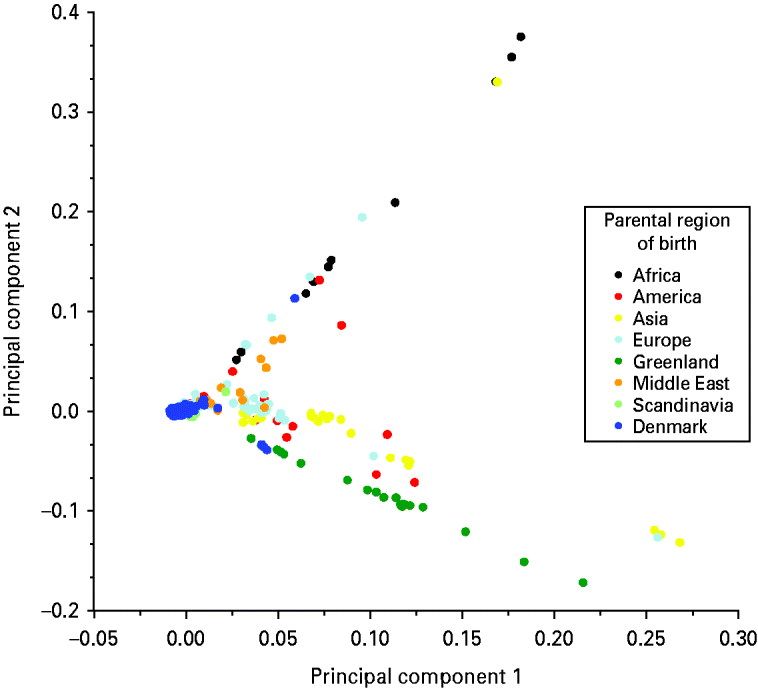
The principal component scatterplot shows a clear correspondence between the first two principal components based on the genome-wide SNP genotypic data and parental country of birth as registered in the Danish Civil Registration System (Fig. 1). It should be remembered that only people born in Denmark were included in the study. Also, Danish-born people who had parents born in Scandinavian countries clustered together with Danish-born people with Danish-born parents, as expected.
Scatterplot of the first two principal components according to parental region of birth.

Relative risks of schizophrenia according to the first principal component
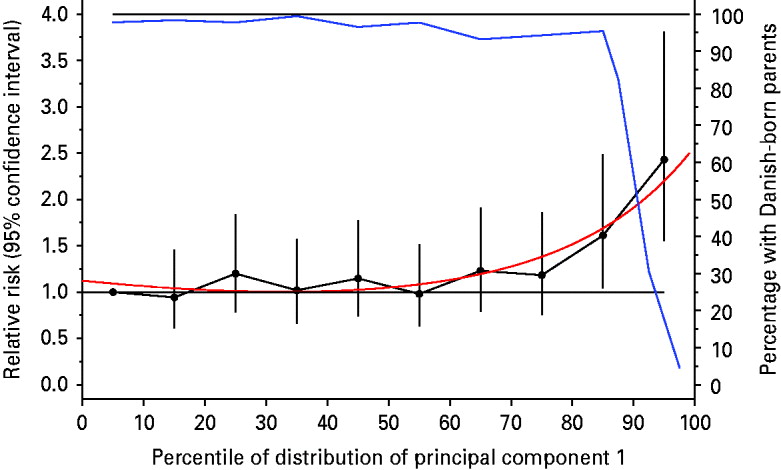
Fig. 2 shows the relative risk of schizophrenia (left-hand y-axis, black lines) according to deciles of the first principal component. Individuals in the lowest decile of the distribution were chosen as the reference category. Individuals in the lowest 60% of the distribution of the first principal component had identical relative risks of schizophrenia (Fig. 2, black lines). Among the remaining individuals, the risk of schizophrenia increased with increasing genetic divergence (p=0.0002, Fig. 2). The association between the first principal component and the risk of schizophrenia was not reducible to a trend including the first principal component in the model as one continuous variable (p=0.004), but it was reducible to a fractional polynomial (p=0.85, Fig. 2, red line), which was also highly significant (p<0.0001). In addition, there was a weak significant association between the risk of schizophrenia and the second principal components (p=0.03). However, this association was explained entirely when adjusting for either parental foreign country of birth (p=0.40) or the first principal component (p=0.58).
The left-hand y-axis shows the relative risk of schizophrenia according to the first principal component (black and red lines). Vertical lines indicate 95% confidence intervals. Individuals in the lowest decile of the distribution were chosen as the reference category for the categorical analyses (black lines). The red line shows the fitted second-degree fractional polynomial. Both for the categorical (black line) and the continuous model (red line), there was a significant association between the relative risk of schizophrenia and the first principal component (p=0.0002 v. p<0.0001). The right-hand y-axis shows the percentage of Danish-born people with Danish-born parents (blue line) according to the first principal component.

There was a very strong association between the first principal component and parental foreign country of birth (Fig. 2, right-hand y-axis, blue line). Among people in the lowest decile of the distribution of the first principal component, 97.7% had Danish-born parents. This fraction decreased only slightly until the 85th percentile of the distribution. People with higher values of the first principal component were most often of foreign-born parentage.
Relative risk according to parental foreign country of birth
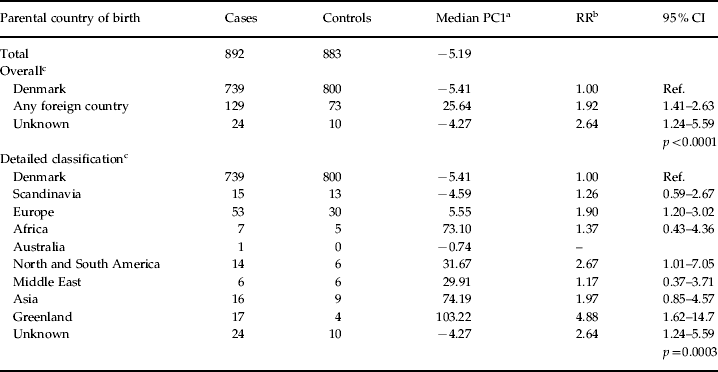
People of foreign-born parents had a significantly 1.92-fold increased risk of schizophrenia as compared with people of Danish-born parents (p<0.0001, Table 1). Table 1 also shows the median of the first principal component according to parental region of birth. People with parents born in Denmark and Scandinavia had almost identical values, whereas people with parents born in Greenland, Asia and Africa were the most genetically divergent.
Relative risks (RR) of schizophrenia according to parental country of birth

CI, Confidence interval.
Estimates were based on people born in Denmark 1981–1995 who developed schizophrenia 1994–2006 .
a Median of the first principal component (PC1) (×1000) based on the genome-wide association data.
b Estimates of RR were controlled for age, sex and calendar period using the individually time-matched design.
c Individuals with unknown father (i.e. unknown paternal place of birth) were treated in a separate category in the analyses (24 cases and 10 controls). The p values do not include the effect of unknown father.
To assess which measure of parental foreign ethnicity best captured the increased risk associated with foreign paternal ethnicity, the effects of genetic divergence and foreign parental country of birth were adjusted mutually. After mutual adjustment, the effects of both measures of foreign parental ethnicity were reduced to a level below statistical significance (p=0.40 v. p=0.28). As a consequence, in terms of the relative risks obtained, these two independently collected measures of parental foreign ethnicity are interchangeable.
We performed additional analyses that showed that our results were robust to the normalization of the number of variants used by Eigenstrat and to using all 541 148 markers to calculate principal components as opposed to the 128 890 markers pruned for linkage disequilibrium.
Discussion
To investigate which measure of paternal foreign ethnicity most accurately captures the increased risk of schizophrenia among second-generation immigrants, we used two independent sources of information: (1) parental place of birth as recorded prospectively in the Danish Civil Registration System; (2) genetic divergence based on genome wide genotypic data. We found that the increased risk associated with foreign parental birth was reduced to a level well below significance when adjusting for genetic divergence, as quantified by the first principal component (Table 1). But we also found that the increased risk associated with extreme genetic divergence was reduced to a level well below statistical significance when adjusting for foreign parental country of birth. As a consequence, these two independently collected measures of parental foreign ethnicity are interchangeable. This is the first study to compare two competing measures of foreign parentage and their influence on the risk of schizophrenia.
Previously, PCA have been used with success in order to assign an individual to a geographic birth location based on genetic information, demonstrating that genetic correlation between pairs of individuals decays with distance in Europe (Novembre et al. Reference Novembre, Johnson, Bryc, Kutalik, Boyko, Auton, Indap, King, Bergmann, Nelson, Stephens and Bustamante2008). As expected for this study, Danish-born people with foreign-born parents differ genetically from Danish-born people with Danish-born parents. Our data also support the findings of Novembre et al. (Reference Novembre, Johnson, Bryc, Kutalik, Boyko, Auton, Indap, King, Bergmann, Nelson, Stephens and Bustamante2008), with individuals with a parent born in Scandinavia clustering with people having Danish-born parents and that individuals with a parent born in Asia, Greenland or Africa were among the most distantly clustering individuals (Table 1, Fig. 1). Our results therefore demonstrate that genetic divergence and parental foreign country of birth are closely related entities and that both entities seem to have validity with regard to the ability to distinguish genetically heterogeneous groups of people. Correlation between genetics and measures of ethnicity based on oral or written information has also been found in a study of people in Qatar, where surname origin correlated with genetic ancestry (Hunter-Zinck et al. Reference Hunter-Zinck, Musharoff, Salit, Al-Ali, Chouchane, Gohar, Matthews, Butler, Fuller, Hackett, Crystal and Clark2010).
In a larger population-based study including the total Danish population, we observed an increased risk of schizophrenia among Danish-born people with foreign-born parents. This increased risk was virtually independent of parental foreign country of origin (Cantor-Graae & Pedersen, Reference Cantor-Graae and Pedersen2007). In this study, the risk of schizophrenia increased with increasing genetic divergence. These findings taken together suggest that genetic divergence and foreign parental birth are both poor proxy variables of the true risk-increasing mechanism responsible for the increased risk of schizophrenia among Danish second-generation immigrants. Supporting the above statement, it should be noted that Danish-born people with a parent born in a Scandinavian country have an increased risk of schizophrenia while genetically they are almost identical to native Danes (Table 1, Figs 1, 2).
Strength and limitations
Our study was based on people admitted or in out-patient contact with a diagnosis of schizophrenia (F20), as registered in the Danish Psychiatric Central Register, which has shown a high diagnostic validity (Jakobsen et al. Reference Jakobsen, Frederiksen, Hansen, Jansson, Parnas and Werge2005). In addition to genetic information, we also had information on other potential confounders, such as parental country of birth. Although only 60% of the individuals with schizophrenia had sufficient biological material to be included in the study, we demonstrated that, whatever the cause of this high drop-out, it is very unlikely to have biased our findings. As opposed to most other genome-wide genotypic data generated in relation to schizophrenia, all our blood samples were stored, treated and analysed consecutively on a matched-pair basis. As a consequence, it is extremely unlikely that our findings are caused by bias from systematic differences in the genetic information on cases and controls. A limitation of the study is that, except for Danish-born people with a parent born in Europe or Scandinavia, we only had limited power to perform more detailed analyses of exact parental country of birth.
Information on parental country of birth originates from the Danish Civil Registration System, which has recorded this information for all Danish residents prospectively from 1968 onwards. There exist no studies evaluating the quality of the information recorded, which is generally believed to be of high quality (Pedersen et al. Reference Pedersen, Gotzsche, Moller and Mortensen2006).
In conclusion, Danish-born people with foreign-born parents and genetically divergent persons had a significant increased risk. In terms of relative risk of schizophrenia, genetic divergence and parental foreign country of birth are interchangeable entities and both entities have validity with regard to identifying second-generation immigrants.
Acknowledgements
This study was supported by The Stanley Medical Research Institute and the Danish Strategic Research Council. The sponsors had no role in the design of the study, in analysis and interpretation of the data or in the writing of the manuscript.
Declaration of Interest
None.