China created a dual welfare system for urban and rural residents during the Maoist era that saw rural residents excluded from the generous social welfare benefits enjoyed by urbanites. Instead, rural residents received meagre welfare benefits from their collectives in the form of community medical insurance and limited social relief. This dual social welfare system persisted throughout the 1980s and 1990s, a time when China recorded astonishing economic growth. Social welfare provision for rural residents deteriorated in the 1980s as community medical insurance programmes collapsed in most regions and the cost of medical care and education rose rapidly. Furthermore, from 1985 onwards, the gap between urban and rural income widened. The average rural household income was only 30 per cent of the average urban household income in 2007, a drop from 54 per cent in 1985.Footnote 1 From the 1990s, many foresaw the problem of rural unrest in China as protests by rural residents began to spread.Footnote 2
In the mid-2000s, Hu Jintao 胡锦涛 and Wen Jiabao 温家宝 made efforts to address China's rural problems. In 2006, the Chinese Communist Party (CCP) announced the goal of constructing a harmonious society (hexie shehui 和谐社会) by 2020, a goal which included the development of a social welfare system covering both urban and rural residents.Footnote 3 In 2006, the government abolished agricultural taxes and made nine years of mandatory education free. In 2007, it introduced a minimum livelihood guarantee for rural residents. However, attempts to create rural pensions were stalled in a bureaucratic deadlock for years. In 2005, the Ministry of Labour and Social Security (MOLSS) proposed the creation of a rural pension and suggested a model that used individual accounts and would require only a minimal government subsidy. However, this proposal was opposed by the Ministry of Finance (MOF), and a stalemate continued until early 2008. It therefore came as a surprise that in December 2008, at the central economic conference (zhongyang jingji gongzuo huiyi 中央经济工作会议), China announced the creation of a new rural pension programme (xinxing nongcun shehui yanglao baoxian 新型农村社会养老保险)Footnote 4 based on a model in which individual accounts would be combined with basic pensions, and that those basic pensions would be entirely financed by government subsidies. This signified that responsibility for caring for the rural elderly was no longer confined to individuals but had been extended to the state. In the battle over rural pensions, the policy outcome pointed to a clear victory for the programme's advocate, the MOLSS, over its opponent, the MOF. This paper attempts to explain the policymaking process, and outcome, in the creation of this new rural pension.
Many studies on social policies during the Hu–Wen era explain policy outcomes as responses to the problems confronting China, such as social instability and income inequality,Footnote 5 or as a way to boost the popularity and legitimacy of the top leaders.Footnote 6 By focusing on the top leaders as the main actors in policymaking, these studies may explain outcomes in policy areas that were a priority for Hu and Wen (for example, mandatory education), but they are limited in their ability to explain the prolonged bureaucratic impasse in the case of the rural pension programme. An alternative model for explaining policies frames them as outcomes of power struggles between bureaucrats who advance policy options based upon parochial interests and perceptions.Footnote 7 This model provides a good explanation for the bureaucratic deadlock over the new rural pension that lasted until early 2008 but does not explain why policy outcomes turned out to be a victory for the advocates of the policy rather than a compromise between supporters and opponents.
To solve the puzzles presented by the case of the new rural pension, this study proposes a new model to explain the policymaking process, which I term “delegation and then intervention” (hereafter, DTI). In this model, top leaders initially delegate policy formulation to bureaucrats because the leaders have limited time and energy to investigate the need and feasibility of adopting policies. If a bureaucratic deadlock occurs, top leaders step in to support bureaucrats' policy initiatives. Top leaders are likely to support a policy proposal if it is compatible with their policy orientation. I argue that MOLSS bureaucrats were motivated to push for a new rural pension programme as a result of the bureaucratic legacy left by the old rural pension of the 1990s, namely the rural social security bureau (nongcun shehui baoxian si 农村社会保险司). After the end of the old rural pension in 1999, this bureau had to find a new mission to justify its survival, which led bureaucrats to advocate for the creation of the new rural pension. The MOF opposed the creation of a new rural pension, arguing that China did not need the rural pensions because land and family already provided protection for the rural elderly.Footnote 8 In other words, the MOF fundamentally rejected the necessity of creating rural pensions, which left little room for negotiation with the MOLSS on this issue. This study confirms the thesis that when bureaucratic organizations fight owing to a difference in their core beliefs, rather than resource allocation, they are less likely to reach a consensus.Footnote 9
I conducted extensive documentary research in two stages for the current study. First, I traced the process by which the new rural pension was created back to the early 2000s via sources such as books, academic papers, newspapers and magazines.Footnote 10 Through this research, I identified the key policy actors for the new rural pension. At the top leadership level at that time was premier Wen Jiabao, vice-premier Zhang Dejiang 张德江, who was in charge of social welfare, and state councillor Hua Jianmin 华建敏; at the bureaucratic level, the MOLSS (since 2008, the Ministry of Human Resources and Social Security, hereafter the MOHRSS), the MOF, and, to a lesser extent, the National Development and Reform Commission (NDRC). For the second stage, I gathered documentary sources that focused specifically on these actors from newspapers, magazines, official documents, books published by these bureaucratic organizations, and writings and interviews related to key policy actors.Footnote 11 By examining documents from the late 1990s, I was able to identify shifts in the bureaucratic organizations' positions and strategies during the creation of the new rural pension. In order to gain a better understanding of what was discussed in policy circles, I examined several internal references (neibu cankao 内部参考).Footnote 12
This article is made up of six sections. Following the introduction, the second section elaborates the DTI model. The third section examines the legacy of the old rural pension. The fourth section focuses on the bureaucratic conflict over the new rural pension, including the dispute over the core beliefs behind the policy. It also examines the strategies used by the MOLSS to set an agenda for creating the new rural pension. The fifth section examines the intervention of top leaders in support of the new rural pension. The sixth section is a summary and points out the limitations of this study.
The “Delegation and Then Intervention” Model of Policymaking
Studies focusing on state actors in policymaking present different views about the roles of top leaders and bureaucrats.Footnote 13 This study considers Politburo members to be top leaders in China and government officials at ministry level and below to be bureaucrats. The command model posits that it is only top leaders who make policy, leaving implementation to the bureaucrats. According to this view, the characteristics of top leaders, such as their interests, perceptions and personalities, are critical to understanding policy outcomes. The issues that top leaders consider to be high priority may be under the exclusive purview of those leaders, but the scope of these issues is likely to be small. The bureaucratic politics model on the other hand focuses on bureaucrats. It understands policy as the outcome of bargaining among bureaucrats who fight for the policy options which reflect their interests and perceptions. These interests and perceptions are largely determined by the bureaucratic organization's mission.Footnote 14 Although the bureaucratic politics model properly turns our attention to the role of bureaucrats in policymaking, it has been criticized for ignoring the vertical relations between top leaders and bureaucrats.Footnote 15 The CCP controls a significant portion of the personnel in government, from bureaucrats in leading positions to section vice-chiefs.Footnote 16 Thus, in order to understand the behaviour of bureaucrats, we need to pay attention to the vertical relations between those at the top and bureaucrats.
The literature on political control is useful for understanding these vertical relations and in particular the factors that enable top leaders to succeed or fail at inducing bureaucrats to act according to their preferences.Footnote 17 This question is worth investigating when the policy preferences of top leaders and bureaucrats are known to diverge. However, in some circumstances, top leaders' policy preferences are too broad to be useful for evaluating whether a bureaucrat's action is in accordance with those preferences. Moreover, the policy preferences of two sets of actors are not necessarily divergent.Footnote 18 Although political control is an important topic, it fails to appreciate the role of bureaucrats in initiating policies.Footnote 19
Kenneth Lieberthal and Michel Oksenberg attempted to build a compromise between the bureaucratic and control models, leaning towards the former, by formulating the fragmented authoritarianism model. This model claims that if policies are made at the ministerial level, the policymaking process involves prolonged bargaining among bureaucrats, and policy outcomes tend to entail incremental changes. This is because the bureaucratic structure in China is fragmented. To overcome bureaucratic impasses, they argue, support from top leaders might be required. In the fragmented authoritarianism model, top leaders facilitate consensus building among competing bureaucratic organizations.Footnote 20 On the other hand, the DTI model suggests that top leaders could play a more assertive role by deciding which bureaucratic positions should prevail.
Susan Shirk also sought a compromise between the bureaucratic and control models, albeit leaning towards the latter. In her model, delegation by consensus, she posits that top leaders delegate policymaking to bureaucrats. If there is a consensus among bureaucrats, top leaders tend to endorse it; if bureaucrats fail to come to a consensus, top leaders either make a decision or table the decision indefinitely. Examining economic policymaking in the 1980s, Shirk focuses on the cases in which there was a consensus among bureaucrats and those in which the issues were tabled.Footnote 21 However, she fails to fully investigate cases where top leaders intervened in favour of a policy proposal. The current study aims to fill the gap.
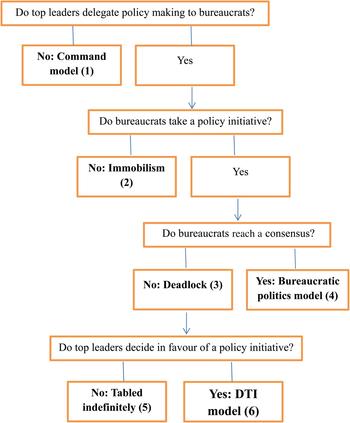
This article presents the DTI model in which top leaders delegate policymaking to bureaucrats and then intervene, if a bureaucratic deadlock occurs, in favour of bureaucratic policy initiatives. The DTI model makes the following three assumptions: top leaders and bureaucrats are the main actors in policymaking; top leaders share common preferences on relevant policy issues; and individuals have bounded rationality – that is, they try to realize their preferences but their ability to do so is constrained owing to limited energy, time and information.Footnote 22
The DTI model involves a sequence of steps. The first step is whether top leaders delegate policymaking to bureaucrats. If not, the command model is likely to be applicable (see Figure 1 [1]). Although top leaders set broad goals, they are usually uncertain about how to achieve them. Thus, they tend to delegate policymaking to bureaucrats who have the expertise. Because top leaders set broad goals, there is room for bureaucrats to debate policy proposals among themselves. If top leaders delegate policymaking to bureaucrats, the second step is whether bureaucrats take the initiative on policy. If bureaucrats remain inactive, immobilism prevails (see Figure 1 [2]). According to Lieberthal and Oksenberg, immobilism occurs because the fragmented structure of bureaucracy discourages bureaucrats from taking the initiative as their proposal is likely to be mired in bureaucratic struggles.Footnote 23 Zhu Xufeng claims that Chinese bureaucrats tend to be reluctant to take the initiative for fear of displeasing their superiors: a radical proposal could imply criticism of the existing policies.Footnote 24 In addition to taking these constraints into account, the DTI model identifies factors that encourage bureaucrats to take a policy initiative.Footnote 25 It suggests that bureaucrats are likely to initiate a policy when the top leaders' policy orientation is compatible with their proposals, because top leaders' support is critical to having the policy adopted. This study finds that a bureaucratic organization's interests, which tend to be closely linked to its missions, are a driving force impelling bureaucrats to take the initiative. Bureaucratic organizations are created to perform certain missions. If these missions are no longer needed, then the organizations risk being dismantled. Consequently, bureaucrats in these organizations would try to invent new missions to prevent the abolition of their organizations.Footnote 26
Top Leaders and Bureaucrats in Policymaking

If bureaucrats take the initiative on policy, the third step is whether they are able to obtain the support of other bureaucratic organizations. As Shirk points out, top leaders are likely to endorse policy proposals that the relevant bureaucratic organizations agree on.Footnote 27 If bureaucratic organizations can compromise, the bureaucratic politics model might best explain the outcome (see Figure 1 [4]). However, bureaucrats often fail to reach a consensus. As Anthony Downs and Sean Nicholson-Crott separately claim, the possibility of bureaucratic consensus building depends on whether bureaucratic conflict is over core beliefs or resource allocation.Footnote 28 If the dispute is over resource allocation, they are more likely to reach a consensus because all would gain from adopting the new policy. Take, for example, the case of the health reforms of the late 2000s. The MOHRSS and the Ministry of Health argued fiercely over how to spend resources to improve the healthcare system, yet they managed to reach a compromise in 2009.Footnote 29 The potential for reaching a consensus was great because the organizations stood to gain from health reforms that would make huge resources available to them both. On the other hand, if bureaucratic organizations have different core beliefs, then it would be difficult for them to reach a consensus as there would be little room for compromise. Creating new rural pensions provided an example of a bureaucratic conflict over policy core beliefs. Bureaucrats in the MOF believed that land and family provided protection for the rural elderly.
If bureaucrats are in deadlock, the fourth step is whether top leaders intervene to resolve the issue in favour of the initiative. When they do so, the DTI model is relevant; if not, the issue would be tabled indefinitely (see Figure 1 [5 and 6]). If top leaders find the policy proposal useful for realizing their preferences, they are more likely to support it. What drives the preferences of top leaders? This study assumes autocrats' key interests lie in their political survival, which could be challenged either by internal political elites or by the masses.Footnote 30 Mass uprisings can lead to a top leader's downfall. Thus, they need to be aware of any potential source of public discontent. The Hu–Wen leadership appeared to take rural discontent seriously, probably because Hu had first-hand experience of the inland regions and Wen's specialty lay in rural issues.Footnote 31 Furthermore, by emphasizing rural issues they could distinguish their leadership from that of Jiang Zemin 江泽民, who focused on the development of coastal regions, and boost their own political legitimacy. In short, the Hu–Wen leadership's interest in alleviating rural discontent led them to support the creation of a new rural pension.
In the DTI model, bureaucrats try to persuade top leaders to lend support to their policy initiatives through both formal and informal channels. An informal channel, for example, might be high-level bureaucrats using their personal relationships (guanxi 关系) with top leaders to present their policy proposals.Footnote 32 Bureaucratic organizations also use formal channels such as delivering internal reports to top leaders.Footnote 33 This study finds that the MOLSS used internal reports to persuade top leaders to support the creation of rural pensions. One of the ways used by the MOLSS to make its argument convincing was to present empirical data drawn from its own extensive field research.Footnote 34 Top leaders are then able to write instructions (pishi 批示) when reviewing these internal reports. Pishi can take many forms such as a signature to indicate that the leader has read the report or an order to subordinates. Once top leaders write an order on an internal report, subordinates tend to expend a huge amount of energy and resources implementing that order.Footnote 35 A critical pishi can carry great weight in policymaking. For example, even though the MOF opposed the creation of a new rural pension in the mid-2000s, Wen Jiabao's pishi, which ordered the MOLSS and other related bureaucratic organizations to research the matter, suggests that Wen was interested in pursuing this line.Footnote 36
The DTI model posits that policy outcomes could involve radical changes. This is different from the incremental policy outcomes predicted by the fragmented authoritarianism model. The DTI model agrees with the command model in that top leaders play a key role in making a decision. But, unlike the command model, the DTI model suggests that bureaucrats play an important role in agenda setting. It also suggests that top leaders are likely to be better informed when making a decision because they have observed the bureaucratic conflict surrounding the issue. However, it may not necessarily lead to socially optimal policies because decision making ultimately depends on the interests of the top leaders.
The Legacies of the Old Rural Pension Policy
Although the government set up a pension scheme for urban employees in the 1950s, it did not do the same for rural residents until the 1980s. During the Maoist era, collective farming provided support for the elderly within communities, but decollectivization in the early 1980s rendered that unfeasible.Footnote 37 In the mid-1980s, the central government began to discuss the need for rural pensions and delegated the work to the Ministry of Civil Affairs (MOCA). In 1992, the MOCA devised a rural pension programme at the county level based on a model of individual accounts with a defined contribution. The programme was financed primarily through individual premiums, although in a few regions it was supported by a collective subsidy. County governments were responsible for managing the scheme and enrolment was voluntary.Footnote 38 Several problems with the programme emerged following its implementation, including a low level of take up and mismanagement of funds.Footnote 39
In the wake of the 1997 Asian financial crisis, top leaders made the minimization of financial risk a top priority. Economic bureaucrats, searching for ways to follow this lead, subsequently framed the rural pension as a risk.Footnote 40 In 1998, the State Council re-assigned the task of managing rural pensions to the newly created MOLSS, taking it away from the MOCA. Then, in 1999, the State Council decided to end rural pensions, claiming that China lacked the necessary preconditions.
The old policy left two negative legacies that would affect the creation of a new rural pension. First, the idea that China did not need rural pensions gained traction among top leaders and economic bureaucrats.Footnote 41 In 2000, Zhu Rongji 朱镕基, then premier of the State Council, asserted that usage rights to agricultural land provided rural populations with the means to maintain a basic livelihood, and that the primary form of caring for the elderly in rural China was family support. He argued that China, a developing country with a vast population, could not afford to provide social welfare to the rural sector.Footnote 42 Second, the abrupt ending of the rural pension meant that rural residents lost trust in public pension schemes. This was one of the reasons that demand for rural pensions was so low in the 2000s. However, the old rural pension programme also left two positive legacies. First, it created a bureaucratic organization responsible for rural pensions which later played an active role in setting the agenda for a new rural pension, and second, drawing a lesson from the failure of the old programme, advocates of the new rural pension claimed convincingly that government subsidies were necessary for the success of the new programme.
Bureaucratic Conflict over the Creation of the New Rural Pension Programme
In 2006, Hu and Wen announced the goal of establishing social welfare institutions that would cover both urban and rural residents by 2020. Including rural residents in the social welfare system was a significant change in policy, given that they had been marginalized from the social welfare system since the 1950s. However, the terms of the goal were very broad, leaving room for different interpretations. First, the goal was to be achieved by 2020 – although Hu and Wen were supposed to retire in 2012 and 2013, respectively. Second, they did not specify which social welfare institutions were to be created for rural residents by this date. There was also debate over whether China needed to create new rural pensions: the MOLSS claimed that it was necessary; the MOF argued to the contrary.
Dispute over core beliefs
As mentioned above, in the late 1990s many top leaders and economic bureaucrats were of the view that rural pensions were neither necessary nor feasible in China. Thus, the prime task for advocates of rural pensions was to challenge this idea. First, they pointed to the rapid aging of Chinese society. The term “aging society” usually refers to a society in which more than 10 per cent of the population is aged over 60. In 2000, 10.9 per cent of the rural population was over 60; in comparison, 9.7 per cent of the urban population was over 60.Footnote 43 By 2010, according to the sixth census, the percentage of people over 60 had increased to 13 per cent of the total population.Footnote 44
Second, bureaucrats in the MOLSS disputed the idea that land and family would be sufficient to provide a basic livelihood for the elderly in rural China. Liu Conglong 刘从龙, then vice-chief of the rural social security bureau of the MOLSS, claimed that revenues from land were very low in rural China. Moreover, because farmers had only user rights, if they were too old to cultivate the land, the land was almost useless to them. Only 5.7 per cent of rural household income was from property, including rental fees for agricultural land.Footnote 45 Family protection for the elderly had declined, partly owing to the one-child policy and partly because of increasing rural-to-urban migration. As the young went in search of employment opportunities in the cities, many elderly parents were left behind in rural areas.
Third, to support the view that China had the necessary preconditions for creating rural pensions, the MOLSS rural social security bureau conducted a study comparing China with other countries. According to this report, the average per capita gross domestic product (GDP), measured in purchasing power parity, was US$5,226 in 13 Western European countries when they adopted rural pensions; it was US$6,127 in China in 2006. Agriculture provided an average of 17 per cent of the GDP in 13 European countries when they adopted rural pensions; it was 12 per cent in China in 2006. Using these criteria, the MOLSS claimed that China had the necessary conditions for creating a rural pension programme.Footnote 46
Even in the mid-2000s when Hu and Wen set the goal of creating social welfare institutions for rural residents, the MOF had still not changed its stance on the need for a rural pension. In 2006, the MOF's social welfare bureau (caizhengbu shehui baozhang si 财政部社会保障司) issued a report on planning for rural social welfare for the following ten years. Arguing that it would be impossible to create a comprehensive rural social welfare programme given China's stage of development, it stated that priorities should be focused on improving health insurance, introducing a minimum livelihood guarantee and expanding social welfare for those whose land was expropriated and those who migrated to urban areas. It objected to the creation of a new rural pension on the grounds that it was not needed because family and land provided protection for the rural elderly and China lacked the necessary conditions. Furthermore, it argued in favour of ceasing local experiments with rural pension programmes.Footnote 47
In early 2008, Wang Jun 王军, then vice-minister of the MOF, announced a five-year plan for the development of social welfare which did not even mention rural pensions. Referring to the CCP's mandate to construct a social welfare system for urban and rural residents, Wang only mentioned health insurance and social relief.Footnote 48 The MOF's objections prevented any consensus being reached among bureaucrats regarding the new rural pension and were the main cause of the delay in the decision to create a new programme. In 2007, a report from the State Council Development Research Centre pointed out that a new rural pension scheme had not been established owing to the lack of consensus among bureaucratic organizations – there were disagreements on whether the government would provide subsidies, how it would do so, and how much it would provide.Footnote 49
The views of the MOLSS and the MOF about the need for a rural pension programme continued to diverge, and public opinion did not provide a clear answer. According to a survey of 963 rural residents published in 2007, the three problems rural residents wanted to solve most were the difficulties in accessing and high cost of medical care (70.7 per cent); the difficulties children faced attending school (70 per cent); and how to increase income (63.7 per cent). Next, they were concerned about rural pensions (46.7 per cent); obtaining employment (42.6 per cent); constructing roads (39.8 per cent); and improving irrigation (36.6 per cent).Footnote 50 Whereas 70 per cent of rural residents wanted to see an improvement in health care and education, only 46.7 per cent wanted rural pensions. Advocates and opponents of the rural pension interpreted this information differently: the former believed it demonstrated a relatively high demand for rural pensions, whereas the latter regarded the demand to be low.
The first strategy of the MOLSS: local experiments
After the State Council decided to end rural pensions in 1999, the MOLSS tried to persuade top leaders to allow some regions to keep their rural pension schemes. According to Zhao Dianguo 赵殿国, then the chief of the rural social security bureau of the MOLSS, this was the second-best strategy for the MOLSS, given that other bureaucratic organizations opposed the creation of national rural pensions at the time.Footnote 51 However, the MOF also opposed this idea, arguing that rectification should be applied throughout the nation.Footnote 52 The MOLSS presented top leaders with 20 internal reports, all based upon extensive field research on the conditions of rural pensions in 29 provinces. Wen Jiabao wrote a pishi on the MOLSS report about Shanghai, stating that “rectifying the rural pensions should start from the reality and sufficiently consider differences of local economic and social development. The MOLSS should continue to conduct research and make a proposal.”Footnote 53 This implies that Wen Jiabao was in favour of allowing some regions to have a rural pension programme. This policy position was reinforced at the 16th Party Congress in 2002 when the CCP declared that “the regions that have the correct conditions could explore the creation of the rural pensions.”Footnote 54 Two factors stood in favour of the MOLSS obtaining approval for local experimentation with rural pensions. First, there were many rural pension programmes left as a legacy of the old rural pension. Considering that public pension programmes involved an implicit long-term commitment on the part of the government, the MOLSS's argument that ending these programmes could undermine rural stability, especially in regions where they were successful, appeared to persuade top leaders. Second, in China, particularly during the reform period, local experiments tended to be regarded as legitimate.
Following the CCP's decision to allow local experimentation with rural pensions in 2002, the MOLSS conducted experiments with various models of the old rural pension. For instance, in 2006, the MOLSS chose eight counties to test a scheme that provided government subsidies to rural pensions. Evaluating these experiments after one year, reports from the MOLSS bureaucrats claimed that China already had the prerequisites for rural pensions that were financed by individual premium payments and government subsidies.Footnote 55 The MOLSS provided assistance to these local test schemes. For instance, in 2005, Zhao Dianguo mentioned that the MOLSS aided experimental rural pension programmes in Beijing, Shanxi and Fujian.Footnote 56
Most regions adopted one of three models for the new rural pensions: combining basic pensions with individual accounts; combining social pooling with individual accounts, and an individual accounts-only model. Each model was given a government subsidy. Of all these models, it was the Suzhou model of combining a basic pension with individual accounts that drew the attention of state councillor Hua Jianmin. Hua's pishi was instrumental to the MOLSS then forming a research team, headed by vice-minister Hu Xiaoyi 胡晓义, which conducted research in Suzhou in early 2007 and published an internal report. According to this report, the Suzhou government offered a monthly subsidy of 80–120 yuan to each elderly rural resident. The institutional innovation of providing financial support to the elderly even though they had not contributed to the rural pension when they were young was given a positive evaluation. In fact, the 2009 model of rural pensions adopted this element. According to the report, the fact that even less developed regions in Jiangsu, including Taizhou 泰州, Yancheng 盐城 and Xuzhou 徐州, had established rural pensions demonstrated that China already had the necessary conditions to roll out a new rural pension nationally.Footnote 57 The local experiments' positive results boosted the chances of the MOLSS of gaining a favourable response from top leaders about the feasibility of creating new rural pensions.
The second strategy of the MOLSS: proposing a national model
In 2005, the MOLSS attempted to move beyond local experiments by proposing a national rural pension scheme. The MOLSS suggested a model that used individual accounts. Unlike the old rural pension programme, the central government would provide an annual subsidy of 50 yuan per enrolee to farmers in inland provinces. The MOLSS estimated that it would only cost 20 billion yuan, which amounted to only 0.8 per cent of total government revenue in 2004.Footnote 58 However, this suggestion was met with objections from the MOF.
The opposition from the MOF meant that a bureaucratic deadlock continued until early 2008. That year, Zhao Dianguo described the difficulty caused by the lack of consensus on the provision of government subsidies for new rural pensions:
Consensus was not reached on the question of whether the government would provide a subsidy for rural pensions and how it would do so. This resulted in an impasse in building rural pensions. The responsibility of the government was not fulfilled. A noteworthy feature was that the central government did not provide a subsidy. This discouraged participation in rural pensions.Footnote 59
Breaking a Bureaucratic Deadlock
When, in March 2007, Wen Jiabao wrote a pishi asking the MOLSS and other ministries to make suggestions regarding a new rural pension, the MOLSS responded immediately.Footnote 60 In March 2008, Zhang Dejiang visited the MOHRSS (the successor to the MOLSS) and told the agency that the-then current government (benjie zhengfu 本届政府) would actively promote the creation of a rural pension programme and asked the MOHRSS to put forward a plan as soon as possible.Footnote 61 What led top leaders to support the formation of a new rural pension in the face of persistent opposition from the MOF? Because information about decision making at the top is unavailable, it is impossible to pin down the precise reasons; however, it is clear that two factors were instrumental to the top leadership taking such a decision.
First, by 2007, the Hu–Wen administration had made progress in improving social welfare for rural residents in the areas of health, basic education and social relief. From 2008, Hu and Wen could then afford to turn their attention to the rural pension issue. Second, fiscal conditions of the central government were relatively sound. As growth rates of fiscal revenues exceeded those of GDP in preceding years, tax revenues as a percentage of GDP increased from 14.1 per cent in 2002 to 18.6 per cent in 2007.Footnote 62 The Hu–Wen administration was in a financial position to make a commitment to provide a government subsidy for rural pensions.
With the support of top leaders in March 2008, the MOHRSS convened several conferences to which it invited bureaucrats from other organizations and scholars to discuss which model China should adopt for the new rural pension.Footnote 63 The MOHRSS promoted a model based on combining individual accounts with the basic pension, which would be entirely subsidized by the government.Footnote 64 This model had been adopted in several regions, including Suzhou, Beijing and Baoji 宝鸡 (a city in Shaanxi province). According to Hu Xiaoyi, this model had two advantages. First, providing a basic pension wholly subsidized by the government would promote the redistribution of income. Second, because this model was similar to pensions for urban workers, it would be easier to link the two schemes in the future.Footnote 65
In China's decentralized social welfare system, an important question is how to divide the financial burden of rural pensions among different levels of government. This potentially thorny question, however, was resolved relatively easily. The central government was willing to take a bigger role in subsidizing the basic rural pension – in fact, a commitment even greater than that suggested by the MOHRSS, which had proposed that the central government should subsidize 80 per cent of the basic pension for rural residents in western regions, 60 per cent in central regions, and 20 per cent in eastern regions. Instead, in 2009, the central government announced that it would provide a full subsidy for the basic pension of rural residents in the western and central regions and 50 per cent for those in the eastern regions. In 2009, Liu Conglong explained that it was the State Council that made the decision to increase the proportion of the central government's subsidy to the basic rural pension.Footnote 66
After top leaders expressed their support for the creation of a new rural pension in March 2008, bureaucrats in the MOF did not openly oppose it. Although unable to disobey a directive from top leaders, the MOF tried to present its fiscal concerns about the policy, and it was successful to a certain extent. First, the new rural pension lacked a formula that would automatically increase the amount of subsidy. Second, the government decided to introduce the new rural pension scheme gradually, first establishing it in 10 per cent of the rural counties in 2009, then rolling it out to all counties by 2020. According to Wen Jiabao, this gradual approach was owing to budgetary concerns.Footnote 67
In 2009, the government began to introduce the new rural pension. In July 2011, Wen Jiabao called for an acceleration of the process, with the aim of setting up rural pensions in all counties by 2012. He urged the government to guarantee the provision of subsidies for the new rural pension even if it meant cutbacks to other projects.Footnote 68 With Wen driving the project, China launched the new rural pension scheme nationwide by 2012.
The government fully financed the basic pension and partially subsidized individual accounts. The central government had the authority to set the minimum level of the basic pension, which was 660 yuan per person annually in 2009. Local governments could add a subsidy to the basic pension. In addition, local governments were required to provide matching funds to individual accounts of not less than 30 yuan per person annually. Individuals could choose the amount of the premium payment from one of five levels, ranging from 100 to 500 yuan annually. All premiums paid by an individual would be placed in his or her account. The county governments were responsible for managing the pension.
Those who were over 60 years old when the new rural pension scheme began would receive the basic pension if their children joined the new pension. Those who were younger than 60 at the time would pay premiums in order to qualify for a pension. Of this group, those who were younger than 45 at the time would pay premiums for at least 15 years in order to qualify for the rural pension. Upon reaching the age of 60, in addition to the basic pension, an enrolee would receive a monthly payment of the accumulated funds in the individual account divided by 139. If an enrolee paid 100 yuan in premiums each year for 15 years, he or she would receive a monthly pension of 71 yuan, starting at the age of 60, of which 16 yuan would be from an individual account and 55 yuan would be from the basic pension. The replacement rate (i.e. the total of annual pensions divided by annual household income per capita, multiplied by 100) was 16 per cent in 2009.Footnote 69 Participation in the rural pension scheme was voluntary. The number of participants in the new rural pension was 498 million by the end of 2013.Footnote 70 The estimated participation rate was as high as 95 per cent in 2013.Footnote 71
Alternative explanations
There are two arguments to explain how the new rural pension came into being. First, one might argue that Hu and Wen's leadership was sufficient to explain policy outcomes. But, if the MOLSS had not advocated for the new rural pension, it seems unlikely that the Hu–Wen administration would have adopted the policy. The idea that China did not need rural pensions was widespread among economic bureaucrats at that time. In addition, there was not much pressure from societal actors to create a rural pension. According to these factors, if the MOLSS had not played an active role in creating the new rural pension, top leaders would have remained uninterested in the issue.
Second, one might argue that the creation of the MOHRSS in 2008 (by merging the MOLSS and the Ministry of Personnel) resulted in an organization with increased power, which in turn led to the MOHRSS victory in the new rural pension battle. If this was the case, the bureaucratic politics model would explain the creation of the new programme. This explanation, however, has both logical and empirical limitations. The careers of the MOF bureaucrats responsible for fiscal expenditure decisions depended not on the MOHRSS but on the CCP's Department of Organization. The CCP controls a significant number of bureaucrats in ministries, from ministers to section vice-chiefs. Thus, MOF bureaucrats were unlikely to be pressured into yielding to the demands of the MOHRSS.
On the other hand, if the MOHRSS was powerful enough to force a concession from the MOF in creating the new rural pension, then it follows that it should have been able to increase the amount of the basic pension since 2009. But it was not until 2015 that the central government raised the monthly minimum basic pension from 55 to 70 yuan.Footnote 72 The slow growth of the basic pension undermined its intended function of providing income protection for the rural elderly. Although 660 yuan was 12.8 per cent of the average annual per capita income of rural households in 2009, it was only 7.4 per cent in 2013.Footnote 73
Conclusion
With the creation of the new rural pension, the government provided a subsidy to the rural elderly for income protection for the first time in the history of the People's Republic of China. Given the huge disparity between urban and rural areas, not only in income but also in social welfare provision, this was a progressive measure. This study finds that the rural social security bureau of the MOLSS, which was created to manage the old rural pension programme of the 1990s, played an active role in putting the new rural pension on the agenda because rural pensions were the raison d´être of the bureau. Owing to their divergent views, the MOLSS and the MOF argued over whether China needed a new rural pension, which made compromise difficult.
The DTI model suggests that bureaucrats could play an important role in agenda setting in China, whereas top leaders could play a critical role in making authoritative decisions despite objections from some organizations. The DTI model has a limitation in that it is difficult to predict when top leaders will intervene in bureaucratic policy struggles. The DTI model urges us to pay attention to the ways in which bureaucrats try to appeal to top leaders. This study finds that the formal system of internal reporting and pishi is an important mechanism used both by bureaucrats to influence top leaders and by top leaders to issue orders to bureaucrats. This study was not able to identify specific informal mechanisms used by bureaucrats to reach top leaders; that would require in-depth interviews with high ranking government officials. This remains a limitation of the study.
The DTI model could be generalizable to other policy areas in China insofar as it meets two assumptions. First, it assumes top leaders and bureaucrats, rather than societal actors, are the main actors in policymaking. Second, it assumes that top leaders share common preferences on relevant policy issues. The DTI model could be applied if bureaucratic organizations fail to reach consensus on a policy proposal and if top leaders find the proposal attractive. The DTI model claims that top leaders in China are able to overcome objections from some bureaucratic organizations when making a decision. The source of this power derives from the fact that the CCP wields personnel control over a large number of bureaucrats. The DTI model could be generalizable to other countries where top leaders exert strong control over bureaucrats and where state actors, rather than societal actors, are the main actors in policymaking.
Acknowledgement
This work was supported by the Hankuk University of Foreign Studies Research Fund.
Biographical note
Eun Kyong Choi is an associate professor in the department of Chinese foreign affairs and commerce at the Hankuk University of Foreign Studies in Korea. Her research interests include the politics of revenue extraction and social welfare provision.