





1. Introduction
1.1. Classification of Fano varieties from the perspective of index and pseudoindex
A complex smooth projective variety X is called Fano if its anticanonical divisor
$-K_X$
 is ample. From both classical and modern perspectives on projective geometry and the minimal model program, Fano varieties carry substantial significance. It is known that there are finitely many families of smooth Fano varieties for each dimension [Reference Kollár, Miyaoka and Mori39]; in particular, Fano threefolds were classified by G. Fano, V. A. Iskovskikh, V. V. Shokurov, T. Fujita, S. Mori, S. Mukai, and K. Takeuchi (see [Reference Shafarevich56] and the references therein). The classification becomes more challenging in dimensions four and higher; many authors have investigated Fano fourfolds (see some examples [Reference Casagrande10], [Reference Casagrande11], [Reference Casagrande13]–[Reference Casagrande and Romano16], [Reference Fujita24], [Reference Hausen, Laface and Mauz29], [Reference Langer41], [Reference Prokhorov54], [Reference Tsukioka63], [Reference Tsukioka64], [Reference Wiśniewski69], [Reference Wiśniewski70]), but they are still far from a complete classification.
For a Fano n-fold X with
$n \geq 4$
 , we define the Fano index
$i_X$
 and the pseudoindex
$\iota _X$
 of X by

and

respectively. Remark that
$i_X$
 divides
$\iota _X$
 . By Kobayashi–Ochiai theorem [Reference Kobayashi and Ochiai37],
$i_X\leq n+1$
 ; moreover, if
$i_X= n+1$
 , then X is isomorphic to a projective space
$\mathbb {P}^n$
 , and if
$i_X=n$
 , then X is isomorphic to a smooth quadric
$Q^n$
 . If
$i_X= n-1$
 , then X is called a del Pezzo variety, which is completely classified by Fujita [Reference Fujita25], [Reference Fujita26]; if
$i_X= n-2$
 , then X is called a Mukai variety, which is completely classified by Mukai [Reference Mukai49]. On the other hand, as a generalization of Kobayashi–Ochiai theorem [Reference Kobayashi and Ochiai37],
${\iota }_X\leq \dim X+1$
 ; moreover, if
${\iota }_X= n+1$
 , then X is isomorphic to
$\mathbb {P}^n$
 [Reference Cho, Miyaoka and Shepherd-Barron17], and if
${\iota }_X= n$
 , then X is isomorphic to
$Q^n$
 [Reference Dedieu and Höring20], [Reference Miyaoka47]. Different from the case of the Fano index, a complete classification of Fano varieties with pseudoindex
$n-1$
 and
$n-2$
 is not known. On the other hand, according to the results of Wiśniewski [Reference Wiśniewski71], Occhetta [Reference Occhetta51, Corollary 4.3], and Watanabe [Reference Watanabe68], the classification of smooth Fano n-folds with Picard number greater than one and pseudoindex greater than
$\frac {n+1}{2}$
 is known. From these results, the classification of smooth Fano n-folds with pseudoindex at least
$n-2$
 and Picard number greater than one is reduced to the four-dimensional case (see Theorem 6.1).
1.2. Main results
To classify Fano fourfolds of pseudoindex two, we study extremal contractions, which play a crucial role in understanding the geometry of higher-dimensional Fano varieties. To explain our results, we introduce a new invariant of Fano varieties. Let X be a smooth Fano variety. A non-trivial morphism
$f: \mathbb {P}^1 \to X$
 is called a free rational curve if
$f^{\ast } T_X$
 is nef, where
$T_X$
 is the tangent bundle of X. It is called a non-free rational curve otherwise. We denote by
$\mathrm {Hom}^{\mathrm {nf}}(\mathbb {P}^1, X)$
 the closed subscheme of the Hom scheme
$\mathrm {Hom}(\mathbb {P}^1, X)$
 parameterizing non-free rational curves.
Definition 1.1. For a smooth Fano variety X,

We call
$\tau _X$
 the free index of X.
Our main results are the following.
Theorem 1.2. Let X be a smooth Fano variety of dimension
$n \geq 4$
 and
$\tau _X\geq n-2$
 . Let
$\varphi : X \to Y$
 be a contraction of an extremal ray. If
$\varphi $
 is of fiber type, then
$\varphi $
 is one of the following:
-
(i) a smooth morphism;
-
(ii) a $\mathbb {P}^{n-3}$
 -fibration which is not equidimensional;
-
(iii) an equidimensional $Q^{n-2}$
-fibration.


Moreover, any fiber of
$\varphi $
 has codimension at least two if X is not a product of
$\mathbb {P}^1$
 and a variety.
Following the idea of the proof of Yasutake’s result [Reference Yasutake74], we also prove the following.
Theorem 1.3. Let X be a smooth Fano variety of dimension
$n \geq 4$
 . Assume that
$\tau _X\geq n-2$
 . If X admits a birational contraction of an extremal ray, then X is isomorphic to one of the following:
-
(i) $\mathbb {P}(\mathcal {O}_{\mathbb {P}^{n-1}}\oplus \mathcal {O}_{\mathbb {P}^{n-1}}(1))$
; -
(ii) $\mathbb {P}(\mathcal {O}_{Q^{n-1}}\oplus \mathcal {O}_{Q^{n-1}}(1))$
; -
(iii) $\mathbb {P}(\mathcal {O}_{\mathbb {P}^{n-1}}\oplus \mathcal {O}_{\mathbb {P}^{n-1}}(2))$
; -
(iv) the blow-up of $\mathbb {P}^n$
along a line; -
(v) the blow-up of $Q^4$
along a line; -
(vi) the blow-up of $Q^4$
along a conic which is not on a plane contained in
$Q^4$
; -
(vii) $\mathbb {P}^1\times \mathbb {P}(\mathcal {O}_{\mathbb {P}^{n-2}}\oplus \mathcal {O}_{\mathbb {P}^{n-2}}(1))$
.


For a smooth Fano fourfold X,
$\tau _X\geq 2$
 if and only if
$\iota _X\geq 2$
 (see Lemma 6.3). As an application of Theorems 1.2 and 1.3, we obtain a classification of Fano fourfolds with pseudoindex and Picard number greater than one (Theorem 6.2). Consequently, we complete a classification of Fano n-folds X with
$\iota _X\geq n-2$
 and
$\rho _X\geq 2$
 .
Theorem 1.4 (
$\!=$
Theorems 6.1 and 6.2)

Let X be a smooth Fano variety of dimension
$n \geq 4$
 . If
$\iota _X\geq n-2$
 and
$\rho _X\geq 2$
 , then X is isomorphic to one of the following:
-
(i) $\mathbb {P}^3\times \mathbb {P}^3$
; -
(ii) $\mathbb {P}(\mathcal {O}_{\mathbb {P}^{3}}^{\oplus 2}\oplus \mathcal {O}_{\mathbb {P}^{3}}(1))$
; -
(iii) $\mathbb {P}^3\times \mathbb {P}^2$
; -
(iv) $Q^3\times \mathbb {P}^2$
; -
(v) $\mathbb {P}(T_{\mathbb {P}^3})$
; -
(vi) $\mathbb {P}(\mathcal {O}_{\mathbb {P}^{3}}\oplus \mathcal {O}_{\mathbb {P}^{3}}(1))$
; -
(vii) $\mathbb {P}(\mathcal {O}_{\mathbb {P}^{2}}^{\oplus 2}\oplus \mathcal {O}_{\mathbb {P}^{2}}(1))$
; -
(viii) a divisor on $\mathbb {P}^2\times \mathbb {P}^3$
of bidegree
$(1, 1)$
; -
(ix) $\mathbb {P}^2\times \mathbb {P}^2$
; -
(x) $\mathbb {P}^1\times Q^3$
; -
(xi) $\mathbb {P}^1\times \mathbb {P}^1 \times \mathbb {P}^2$
; or -
(xii) a Fano fourfold of $i_X=2$
.


Remark that Fano fourfolds of index two and Picard number greater than one are completely classified in [Reference Wiśniewski69].
1.3. Positivity of the exterior power of tangent bundles
In a pioneering study, Demailly et al. [Reference Demailly, Peternell and Schneider21] established that a smooth projective variety with a nef tangent bundle becomes a locally trivial Fano fibration over an abelian variety up to the differences in the finite étale covers. This result is a decomposition theorem for varieties with nef tangent bundle. Also, Demailly et al. [Reference Demailly, Peternell and Schneider21] and Solá Conde and Wiśniewski [Reference Solá Conde and Wiśniewski59, Theorem 4.4] show that all Mori contractions are smooth. This result is a contraction theorem for varieties with nef tangent bundle. After that, similar problems were considered for varieties with nef (strictly nef or ample) second exterior power of the tangent bundles [Reference Campana and Peternell9], [Reference Cho and Sato18], [Reference Li, Ou and Yang45], [Reference Schmitz55], [Reference Yasutake73], [Reference Yasutake74]. Finally, the problem was solved by Watanabe [Reference Watanabe66], including all previous results. However, a similar problem can be conceived for varieties X where the rth exterior power of the tangent bundle is nef for
$r<\dim X$
 ; a decomposition theorem was obtained by Watanabe [Reference Watanabe67] via Gachet’s result [Reference Gachet27], which is a generalization of a decomposition theorem for varieties with nef tangent bundle [Reference Demailly, Peternell and Schneider21] and varieties whose second exterior power of the tangent bundle is nef [Reference Watanabe66, Corollary 1.6]. According to this result, the study of smooth projective varieties X with nef
$\wedge ^{r} T_X\, (1\leq r<n)$
 is reduced to the case of Fano varieties.
As an application of Theorems 1.2 and 1.3, we generalize all main results for varieties with nef
$\wedge ^2T_X$
 in [Reference Watanabe66] to the case where
$\wedge ^3T_X$
 is nef. More precisely, for a smooth Fano variety of dimension
$n \geq 4$
 , the condition
$\tau _X\geq n-2$
 holds if
$\wedge ^r T_X$
 is nef for
$1\leq r\leq 3$
 (see Lemma 2.7). Thus, Theorems 1.2 and 1.3 can be regarded as a generalization of [Reference Demailly, Peternell and Schneider21, Theorem 5.2], [Reference Solá Conde and Wiśniewski59, Theorem 4.4], and [Reference Watanabe66, Theorem 1.7] for Fano varieties. On the other hand, Gachet classified smooth projective varieties with strictly nef
$\wedge ^r T_X$
 for
$r\leq 4<\dim X$
 [Reference Gachet27, Theorems 1.3 and 1.4]. By the above decomposition theorem for varieties with nef exterior power of tangent bundle, any smooth projective variety with strictly nef
$\wedge ^r T_X$
 for
$r\leq 4<\dim X$
 is Fano; thus, Theorem 1.4 can be seen as a generalization of [Reference Gachet27, Theorems 1.3 and 1.4] (see Corollary 6.14).
1.4. Outline of the article
This article is organized as follows. Section 2 defines standard notation and terminology used throughout the article. It discusses the structure of extremal contractions and summarizes known results on Fano varieties with large pseudoindex. Additionally, it introduces the nef order
$\nu _X$
 and discusses its relation to pseudoindex and free index. This section also explores families of rational curves and their properties, including dominating, unsplit, and locally unsplit families. Section 3 provides the proof of Theorem 1.2, a classification of extremal contractions of Fano varieties with large free index. Section 4 demonstrates how to compute various invariants, including
$\tau _X, \iota _X, i_X, \nu _X$
 for specific examples of Fano varieties that fit the classifications described in Theorems 1.3 and 1.4. Section 5 discusses Fano varieties with birational extremal contractions, which yields Theorem 1.3. Section 6 summarizes the classification of Fano n-folds with
$\iota _X \geq n-2$
 and Picard number
$\rho _X \geq 2$
 . It completes the classification of Fano fourfolds with pseudoindex and Picard number greater than one. This article significantly advances the classification of higher-dimensional Fano varieties by focusing on their extremal contractions and the role of non-free rational curves. It establishes a clear framework for understanding the structure and invariants of these varieties, contributing to the broader effort of classifying all Fano varieties.
2. Preliminaries
Notation and Conventions: We will make use of the standard notation as in [Reference Hartshorne28], [Reference Kollár38], [Reference Kollár and Mori40], [Reference Lazarsfeld43], and [Reference Lazarsfeld44]. In this article, we work over the complex number field.
-
• For a projective variety X, we define $N_1(X)$
(resp.
$N^1(X)$
) as the vector space of one-cycles (resp. Cartier divisors) on X with real coefficients modulo numerical equivalence. The dimension of
$N_1(X)$
is referred to as the Picard number of X, denoted by
$\rho _X$
. -
• For a projective variety X, $\mathrm {Chow}(X)$
stands for the Chow scheme parameterizing cycles on X (see [Reference Kollár38, Section I.3] for details). -
• By a curve, we mean a projective variety of dimension one.
-
• An F-bundle over a smooth projective variety X is a smooth morphism $f: Y \to X$
between smooth projective varieties, with each fiber isomorphic to a variety F. We denote by
$T_f$
the relative tangent bundle of
$f: Y \to X$
. -
• An F-fibration over a projective variety X is a surjective morphism $f: Y \to X$
between projective varieties, with general fiber isomorphic to a variety F. -
• Given a vector bundle E on a projective variety X, we use $\mathbb {P}(E)$
to represent the projectivization
$\mathrm {Proj}(\mathrm {Sym}\,E)$
, and
$\mathcal {O}_{\mathbb {P}(E)}(1)$
to denote the tautological line bundle on
$\mathbb {P}(E)$
. -
• $\mathbb {P}^n$
denotes projective n-space, while
$Q^n$
represents a smooth quadric hypersurface in
$\mathbb {P}^{n+1}$
.


2.1. Extremal contractions and Fano varieties with large pseudoindex
Let X be a smooth projective variety, and let
$\varphi : X\to Y$
 be a contraction of a
$K_X$
 -negative extremal ray R, referred to as an elementary contraction. Every general fiber of
$\varphi $
 is a smooth Fano variety. The length of the ray R is defined as

A rational curve C on X is termed a minimal extremal rational curve of R if
$[C]\in R$
 and
$-K_X\cdot C=\ell (R)$
 . Tsukioka [Reference Tsukioka64] introduced the minimal length of extremal rays for a smooth Fano variety as follows.
Definition 2.1. For a smooth Fano variety X, the minimal length of extremal rays for X is defined as

Proposition 2.2. Let X be a smooth Fano variety of dimension
$n \geq 3$
 and
$\rho _X=2$
 . Assume that X admits a birational elementary contraction sending a divisor to a point. Then
$\iota _X=\ell _X$
 .
Proof. This is [Reference Tsukioka64, Proposition 2].
The structure of a contraction of a
$K_X$
 -negative extremal ray R is constrained by the following inequality, which relates the dimensions of the exceptional divisor and the fiber, as well as the length of R.
Proposition 2.3 (Ionescu–Wiśniewski inequality [Reference Ionescu32, Theorem 0.4], [Reference Wiśniewski72, Theorem 1.1])
Let X be a smooth projective variety, and let
$\varphi : X \to Y$
 be a contraction of a
$K_X$
 -negative extremal ray R, with E representing its exceptional locus. Consider F as an irreducible component of a non-trivial fiber of
$\varphi $
 . Then

It is expected that smooth Fano varieties with large pseudoindex have simple structures. We collect some results on Fano varieties with large pseudoindex.
Theorem 2.4. Let X be a smooth Fano variety of dimension n with pseudoindex
$\iota _X$
 . Then, the following hold:
-
(i) If $\iota _X\geq n+1$
, then X is isomorphic to
$\mathbb {P}^n$
[Reference Cho, Miyaoka and Shepherd-Barron17], [Reference Kebekus36]. -
(ii) If $\iota _X= n$
, then X is isomorphic to
$Q^n$
[Reference Dedieu and Höring20]. -
(iii) If $\iota _X>\dfrac {n}{2}+1$
, then
$\rho _X=1$
[Reference Wiśniewski71]. -
(iv) If $\iota _X=\dfrac {n}{2}+1$
and
$\rho _X>1$
, then X is isomorphic to
$(\mathbb {P}^{\iota _X-1})^2$
[Reference Occhetta51, Corollary 4.3]. -
(v) If $\iota _X=\dfrac {n+1}{2}$
and
$\rho _X>1$
, then X is isomorphic to one of the following: $$ \begin{align*}\mathbb{P}(\mathcal{O}_{\mathbb{P}^{\iota_X}}(2)\oplus\mathcal{O}_{\mathbb{P}^{\iota_X}}(1)^{\oplus \iota_X-1}); \quad \mathbb{P}^{\iota_X-1}\times Q^{\iota_X};\quad \mathbb{P}(T_{\mathbb{P}^{\iota_X}});\quad \mathbb{P}^{\iota_X-1}\times \mathbb{P}^{\iota_X}\end{align*} $$
[Reference Watanabe68, Theorem 1.4].


2.2. Relations between pseudoindex, free index, and other invariants
Definition 2.5. For a smooth Fano variety X, we define an invariant of X as

We call this invariant
$\nu _X$
 the nef order of X.
Remark 2.6. Let X be a smooth projective variety and E a vector bundle of rank r on X. According to [Reference Laytimi and Nahm42, Theorem 3.3], if
$\wedge ^k E$
 is nef for some integer k with
$0<k<r$
 , then so is
$\wedge ^{k+1} E$
 . Thus, for a smooth Fano variety X and any integer k with
$\nu _X\leq k\leq r$
 , the bundle
$\wedge ^{k}T_X$
 is nef.
Let us remark that the positivity of the exterior power of the tangent bundle and our new invariant
$\tau _X$
 are involved as follows.
Lemma 2.7 ([Reference Campana and Peternell9, Lemma 1.3], [Reference Watanabe66, Lemma 3.2], and [Reference Yasutake73, Lemma 2.9])
Let X be a smooth Fano variety of dimension
$n\geq 4$
 . If
$\wedge ^r T_X$
 is nef for some
$1\leq r<n$
 , then we have
$\tau _X\geq \dim X-r+1$
 .
Remark 2.8. Let X be a smooth Fano variety of dimension
$n\geq 4$
 . By definition, we have
-
(i) $\iota _X$
is a multiple of
$i_X$
; -
(ii) $\tau _X\geq \iota _X$
.


Moreover, by Lemma 2.7,
$\tau _X\geq n-\nu _X+1$
 . These imply the following:


2.3. Deformation theory of rational curves
To explore the structure of a uniruled variety, it is customary to investigate families of rational curves. Let us recall the space of rational curves
$\mathrm {RatCurves}^n(X)$
 , constructed as the normalization of the subscheme of the Chow scheme
$\operatorname {\mathrm {Chow}}(X)$
 that parameterizes rational curves on X. An irreducible component of
$\mathrm {RatCurves}^n(X)$
 is referred to as a family of rational curves
$\mathcal {M}$
 on X. This family
$\mathcal {M}$
 is equipped with a
$\mathbb {P}^1$
 -bundle
$p: \mathcal {U} \to \mathcal {M}$
 , and an evaluation morphism
$q: \mathcal {U} \to X$
 , which is described in detail in [Reference Kollár38, Section II.2]. A rational curve parameterized by
$\mathcal {M}$
 is called an
$\mathcal {M}$
 -curve. Since any two
$\mathcal {M}$
 -curves are numerically equivalent, the family
$\mathcal {M}$
 determines a numerical class; we denote it by
$[\mathcal {M}] \in N_1(X)$
 . The anticanonical degree of the family
$\mathcal {M}$
 refers to the intersection number denoted as
$\deg _{(-K_X)} \mathcal {M}$
 , which is calculated as
$-K_X \cdot C$
 , where
$[C]$
 represents any curve belonging to the family
$\mathcal {M}$
 . A half line generated by the class
$[\mathcal {M}] \in N_1(X)$
 is denoted by
$\mathbb {R}_{\geq 0}[\mathcal {M}]$
 . The union of all
$\mathcal {M}$
 -curves is denoted by
$\mathrm {Locus}(\mathcal {M})$
 . For a point
$x \in X$
 , the normalization of
$p(q^{-1}(x))$
 is denoted by
$\mathcal {M}_x$
 , and we use
$\mathrm {Locus}(\mathcal {M}_x)$
 to refer to the union of all
$\mathcal {M}_x$
 -curves.
Definition 2.9. Under the above notation:
-
(i) $\mathcal {M}$
is a dominating family (resp. covering family) if the evaluation morphism
$q: \mathcal {U} \to X$
is dominant (resp. surjective). -
(ii) $\mathcal {M}$
is locally unsplit if, for a general point
$x\in \mathrm {Locus}(\mathcal {M})$
,
$\mathcal {M}_x$
is proper. -
(iii) $\mathcal {M}$
is unsplit if
$\mathcal {M}$
is proper.


For instance, a family of rational curves
$\mathcal {M}$
 is locally unsplit if it is a dominating family with minimal degree concerning some ample line bundle on X. A family of rational curves
$\mathcal {M}$
 is a dominating family if and only if there exists a free
$\mathcal {M}$
 -curve (see, for instance, [Reference Kollár38, Chapter IV, Theorem 1.9]). By definition, an unsplit family is locally unsplit, and an unsplit dominating family is a covering family. Mori’s bend and break [Reference Mori48, Theorem 4] tells us that a locally unsplit family of rational curves
$\mathcal {M}$
 satisfies
$\deg _{(-K_X)} \mathcal {M} \leq \dim X +1$
 . We often use the following results.
Lemma 2.10 [Reference Watanabe67, Lemma 2.7]
Let X be a smooth projective variety and
$\mathcal {M}\subset \mathrm {RatCurves}^n(X)$
 a family of rational curves. If
$\mathcal {M}$
 is not proper, then there exists a rational
$1$
 -cycle
$Z=\sum _{i=1}^s a_i Z_i$
 satisfying the following conditions:
-
(i) Z is algebraically equivalent to $\mathcal {M}$
-curves, where each
$a_i$
is a positive integer and each
$Z_i$
is a rational curve; -
(ii) $\sum _{i=1}^s a_i\geq 2$
.


We term this rational
$1$
 -cycle
$Z=\sum _{i=1}^s a_i Z_i$
 as a degeneration of
$\mathcal {M}$
 -curves.
Proposition 2.11 [Reference Kollár38, Chapter IV, Corollary 2.6]
Let X be a smooth projective variety and
$\mathcal {M}$
 a locally unsplit family of rational curves on X. For a general point
$x \in \mathrm {Locus}(\mathcal {M})$
 ,

Moreover, if
$\mathcal {M}$
 is unsplit, the above inequality holds for any point
$x \in \mathrm {Locus}(\mathcal {M})$
 .
For a smooth projective variety X, let
$\mathcal {M}$
 be an unsplit covering family of rational curves on X. Two points
$x_1, x_2 \in X$
 are
$\mathcal {M}$
 -equivalent if they are connected by a connected chain of
$\mathcal {M}$
 -curves. By [Reference Campana8], [Reference Kollár, Miyaoka and Mori39] (see also [Reference Debarre19, Chapter 5] and [Reference Kollár38, Chapter IV, Theorem 4.16]), there exists a proper surjective morphism
$\varphi : X^0\to Y$
 from a nonempty open subset
$X^0 \subset X$
 onto a normal variety Y whose fibers are
$\mathcal {M}$
 -equivalent classes. We call
$\varphi : X^0\to Y$
 the rationally chain connected fibration with respect to
$\mathcal {M}$
 (RCC-fibration with respect to
$\mathcal {M}$
 for short). When
$X^0$
 coincides with the whole space X, we say that
$\varphi : X=X^0\to Y$
 is the geometric quotient for
$\mathcal {M}$
 .
Theorem 2.12 (cf. [Reference Demailly, Peternell and Schneider21, Theorem 5.2], [Reference Kanemitsu34, Theorem 2.2, 2.3], and [Reference Solá Conde and Wiśniewski59, Theorem 4.4])
Let X be a smooth projective variety and
$\mathcal {M}$
 its unsplit covering family of rational curves. If any
$\mathcal {M}$
 -curve is free, then
$\mathbb {R}_{\geq 0}[\mathcal {M}]$
 is an extremal ray of
$\kern1.2pt\overline {\operatorname {\mathrm {NE}}}(X)$
 and the associated contraction is a smooth geometric quotient
$\varphi : X\to Y$
 for
$\mathcal {M}$
 .
Proof. This follows from the same proof as in [Reference Kanemitsu and Watanabe35, Proposition 4.4].
Theorem 2.13. Let X be a smooth projective variety and
$\mathcal {M}$
 its unsplit covering family of rational curves. If
$\deg _{(-K_X)}\mathcal {M}\geq \dim X-2$
 , then
$\mathbb {R}_{\geq 0}[\mathcal {M}]$
 is an extremal ray of
$\overline {\operatorname {\mathrm {NE}}}(X)$
 and the associated contraction is a geometric quotient
$\varphi : X\to Y$
 for
$\mathcal {M}$
 .
Proof. This follows from Proposition 2.11 and [Reference Bonavero, Casagrande and Druel7, Theorem 2].
Remark 2.14. Instead of the family of rational curves, we often deal with the family of
$1$
 -cycles, like [Reference Bonavero, Casagrande and Druel7]. Theorem 2.13 also holds for an irreducible closed subset of
$\mathrm {Chow}(X)$
 which parameterizes
$1$
 -cycles. See [Reference Bonavero, Casagrande and Druel7] for details.
3. Contractions of fiber type
The next result follows from [Reference Bonavero, Casagrande, Debarre and Druel6, Theorem 3.19].
Proposition 3.1. Let X be a smooth Fano variety of dimension n and
$\iota _X\geq 2$
 . Assume a contraction
$\varphi : X \to \mathbb {P}^1$
 exists. Then X is a product of
$\mathbb {P}^1$
 and a variety Z.
Proof of Theorem 1.2
Let
$\varphi : X\to Y$
 be a contraction of an extremal ray R as in Theorem 1.2. If
$\dim Y =1$
 , then it follows from Proposition 3.1 that
$\varphi $
 is a smooth morphism; since Y is isomorphic to
$\mathbb {P}^1$
 , Proposition 3.1 implies that X is isomorphic to a product of
$\mathbb {P}^1$
 and a variety. Thus, we assume that
$\dim Y \geq 2$
 . General fibers of
$\varphi $
 are smooth Fano varieties, so there exists a dominating family
$\mathcal {M}\subset \mathrm {RatCurves}^n(X)$
 such that any
$\mathcal {M}$
 -curve is contracted by
$\varphi $
 ; replacing if necessary, we may assume that the anticanonical degree of
$\mathcal {M}$
 is minimal among such families; then
$\mathcal {M}$
 is locally unsplit. We have
$\deg _{(-K_X)}\mathcal {M} \leq n+1$
 by Mori’s bend and break. If
$\deg _{(-K_X)}\mathcal {M} \geq n$
 , then Proposition 2.11 yields that
$\dim \mathrm {Locus}(\mathcal {M}_x) \geq n-1$
 for a general point
$x\in X$
 . This contradicts our assumption that
$\dim Y \geq 2$
 . Thus, we obtain the following inequality:

Then we see that
$\mathcal {M}$
 is unsplit; in fact, if it is not, by Lemma 2.10, there exists a degeneration of
$\mathcal {M}$
 -curves
$Z=\sum _{i=1}^sa:i Z_i$
 such that
$\sum _{i=1}^sa:i>1$
 . By the minimality of
$\deg _{(-K_X)}\mathcal {M}$
 , each
$Z_i$
 is not free; thus by our assumption that
$\tau _X\geq n-2$
 , we have

This is a contradiction.
Assume that any minimal extremal rational curve of the ray R is free. Then
$\mathcal {M}$
 consists of these minimal extremal rational curves, and all
$\mathcal {M}$
 -curves are free; then Theorem 2.12 implies that
$\varphi : X\to Y$
 is a smooth morphism. So, assume that there exists a minimal extremal rational curve of the ray R, which is not free. Then, by our assumption, we have
$\ell (R)\geq n-2$
 , and we obtain the inequality

For any
$x \in X$
 , again by Proposition 2.11, we have

By Theorem 2.13,
$\mathbb {R}_{\geq 0}[\mathcal {M}]$
 is an extremal ray, and the associated contraction is a geometric quotient
$\varphi : X\to Y$
 for
$\mathcal {M}$
 . Let us denote by B the jumping locus for fiber dimension of
$\varphi $
 :

By [Reference Bonavero, Casagrande and Druel7, Proposition 1], we obtain
$\dim B\leq n-2$
 . Then we claim the following.
Claim 3.2.
$\deg _{(-K_X)}\mathcal {M}= \ell (R)$
 .
Proof of Claim 3.2
Assume that
$\deg _{(-K_X)}\mathcal {M}> \ell (R)$
 . Then
$\deg _{(-K_X)}\mathcal {M}=n-1$
 and
$\ell (R)=n-2$
 . Moreover, it turns out that, for any point
$x\in X$
 ,

This yields
$(\dim Y, \dim \mathrm {Locus}(\mathcal {M}_x))=(2, n-2)$
 . Since
$\dim \mathrm {Locus}(\mathcal {M}_x)=n-2=\dim X-\dim Y$
 , [Reference Cho, Miyaoka and Shepherd-Barron17] implies that general fibers of
$\varphi $
 are isomorphic to
$\mathbb {P}^{n-2}$
 . Moreover,
$\varphi $
 is equidimensional, because
$\dim B \leq n-2$
 . It is flat since
$\varphi $
 is an equidimensional morphism between smooth varieties. Following the idea of the proof of [Reference Höring and Novelli30, Proposition 3.1], we shall prove that
$\varphi $
 is a projective bundle; then we get a contradiction to our assumption
$\deg _{(-K_X)}\mathcal {M}> \ell (R)$
 .
To prove that
$\varphi $
 is a projective bundle, assume the contrary. Then
$\varphi $
 is not smooth. We denote by
$S_{\varphi }$
 the locus of points of Y over which
$\varphi $
 is not smooth and by
$R_{\varphi }$
 the locus of points of Y over which the fibers of
$\varphi $
 are reducible. According to the rigidity of the projective space [Reference Siu57, Main Theorem] (see also [Reference Hwang and Mok31, Theorem 1’]), we remark that
$\varphi |_{X\setminus \varphi ^{-1}(S_{\varphi })}: X\setminus \varphi ^{-1}(S_{\varphi })\to Y\setminus S_{\varphi }$
 is a
$\mathbb {P}^{n-2}$
 -bundle. It follows from [Reference Araujo and Ramón-Marí5, Theorem 4] that
$S_{\varphi }$
 is of pure codimension one and
$S_{\varphi }=\overline {R_{\varphi }}$
 . Since
$\dim Y=2$
 , the locus
$S_{\varphi }$
 is a union of curves.
Let
$C_1$
 be a minimal extremal rational curve of the ray R. Taking a family of rational curves
$\mathcal {M}'\subset \mathrm {RatCurves}^n(X)$
 containing
$[C_1]$
 , the minimality of the anticanonical degree
$-K_X\cdot C_1$
 and Lemma 2.10 imply that
$\mathcal {M}'$
 is unsplit. By Proposition 2.11, for any
$x \in \mathrm { Locus}(\mathcal {M}')$
 , we obtain the inequality

Since any
$\mathcal {M}'$
 -curve is not free,
$\mathrm {Locus}(\mathcal {M}')$
 does not coincide with the whole space X. Moreover, for any
$x \in \mathrm { Locus}(\mathcal {M}')$
 ,
$\mathrm {Locus}(\mathcal {M}_x')$
 is contained in the fiber
$\varphi ^{-1}(\varphi (x))$
 . Hence, the right-hand side of the inequality
$ (1)$
 is at most

As a consequence, we see that

Since
$\mathcal {M}'$
 is unsplit, Mori’s bend and break tells us that the evaluation map from the universal family of
$\mathcal {M}_x'$
 onto
$\mathrm { Locus}(\mathcal {M}_x')$
 is generically finite; this yields that
$\dim \mathcal {M}_x'=n-3$
 for any
$x \in \mathrm {Locus}(\mathcal {M}')$
 . Consider the universal family
$p: \mathcal {U}'\to \mathcal {M}'$
 associated with
$\mathcal {M}'$
 and its evaluation morphism
$q: \mathcal {U}'\to \mathrm {Locus}(\mathcal {M}')$
 ; by dimension count, we obtain

We see that
$\mathrm {Locus}(\mathcal {M}')$
 is contained in
$\varphi ^{-1}(S_{\varphi })$
 ; since we have

$\mathrm {Locus}(\mathcal {M}')$
 is an irreducible component of
$\varphi ^{-1}(S_{\varphi })$
 . Moreover,
$\varphi (\mathrm {Locus}(\mathcal {M}'))$
 coincides with an irreducible component of
$S_{\varphi }= \overline {R_{\varphi }}$
 ; thus, we may find a point
$x_0\in \mathrm {Locus}(\mathcal {M}')$
 such that
$\varphi (x_0)$
 is in
$R_{\varphi }$
 . Set
$F_0:=\varphi ^{-1}(\varphi (x_0))$
 . Denoting by
$D_1, \ldots , D_m~(m>1)$
 the irreducible components of the fiber
$(F_0)_{\mathrm {red}}$
 with reduced structure, there exist positive integers
$a_i$
 ’s such that the cycle
$[F_0]$
 is algebraically equivalent to
$\sum _{i=1}^ma_i[D_i]$
 with
$\sum _{i=1}^ma_i>1$
 . Set
$D_1^o:=\left (D_1\setminus \bigcup _{i\neq 1}D_i \right )$
 , which is a nonempty open subset of
$D_1$
 . Without loss of generality, we may assume that
$D_1 \subset \mathrm {Locus}(\mathcal {M}')$
 . For any point
$x\in D_1^o$
 , any
$\mathcal {M}_x'$
 -curve is contained in
$F_0$
 and passes through the point
$x \in X$
 ; this implies that
$\mathrm { Locus}(\mathcal {M}_x')$
 is contained in
$D_1$
 ; since
$\mathrm {Locus}(\mathcal {M}_x')$
 and
$D_1$
 have the same dimension and
$D_1$
 is irreducible, we see that
$\mathrm {Locus}(\mathcal {M}_x')=D_1$
 . By a dimension count, we obtain

This implies that there exists a family of rational curves
$\mathcal {N}\subset \mathrm {RatCurves}^n(D_1)$
 such that
$\dim \mathcal {N}$
 is at least
$2n-6$
 and
$\deg _{(-K_X|_{D_1})}\mathcal {N}=\ell (R)$
 . Denoting by
$\nu : \tilde {D_1}\to D_1$
 the normalization of
$D_1$
 , our family
$\mathcal {N}$
 lifts to
$\tilde {D_1}$
 . We denote by
$\tilde {\mathcal {N}}$
 the lifting of
$\mathcal {N}$
 to
$\tilde {D_1}$
 . Then by applying [Reference Höring and Novelli30, Theorem 2.1], we see that
$D_1$
 is isomorphic to
$\mathbb {P}^{n-2}$
 and
$\tilde {\mathcal {N}}$
 is the family of lines on
$\mathbb {P}^{n-2}$
 .
Let F be a general fiber of
$\varphi $
 . By [Reference Kollár38, Chapter I, Proposition 3.12], we obtain

For a positive integer b such that
$\nu ^{\ast }(-K_X)=\mathcal {O}_{\mathbb {P}^{n-2}}(b)$
 , the above inequality tells us that
$b^{n-2}<(n-1)^{n-2}$
 ; thus, we see that
$b<n-1$
 . On the other hand, for a line
$f \subset \mathbb {P}^{n-2}$
 , we have

Hence, we obtain
$b=n-2$
 .
Recall that
$\mathcal {M}$
 is an unsplit covering family; for any point
$x \in D_1^o$
 , there exists an
$\mathcal {M}_x$
 -curve C; we see that C is contained in
$D_1$
 ; it lifts to a curve
$\tilde {C}$
 in
$\tilde {D_1}\cong \mathbb {P}^{n-2}$
 . Then we obtain the following:

This is a contradiction, because
$\mathcal {O}_{\mathbb {P}^{n-2}}(1)\cdot \tilde {C}$
 is an integer and
$n\geq 4$
 .
Let F be a smooth general fiber of
$\varphi $
 . As we proved, we have the following inequalities:

By [Reference Cho, Miyaoka and Shepherd-Barron17] and [Reference Dedieu and Höring20] (see also [Reference Miyaoka47]), F is isomorphic to
$\mathbb {P}^{n-2}, Q^{n-2}$
 , or
$\mathbb {P}^{n-3}$
 . Assume that F is isomorphic to
$\mathbb {P}^{n-2}$
 or
$Q^{n-2}$
 ; then
$\varphi $
 is equidimensional, because
$\dim B \leq n-2$
 . Thus, if F is isomorphic to
$\mathbb {P}^{n-2}$
 , [Reference Höring and Novelli30] yields that
$\varphi $
 is a
$\mathbb {P}^{n-2}$
 -bundle; this contradicts our assumption that
$\varphi $
 is not smooth. Consequently, we see that
$\varphi $
 is an equidimensional
$Q^{n-2}$
 -fibration. Finally, we assume that F is isomorphic to
$\mathbb {P}^{n-3}$
 . If
$\varphi $
 is equidimensional, then again by [Reference Höring and Novelli30]
$\varphi $
 should be a
$\mathbb {P}^{n-3}$
 -bundle; it is a contradiction because
$\varphi $
 is not smooth. As a consequence,
$\varphi $
 is a
$\mathbb {P}^{n-3}$
 -fibration which is not equidimensional.
4. Examples
Let X be a variety as in Theorem 1.3 or Theorem 1.4. This section aims to compute invariants
$\tau _X, \iota _X, \ell _X, i_X$
 , and
$\nu _X$
 of such an X.
Theorem 4.1. Let X be a smooth Fano variety of dimension
$n\geq 4$
 and assume that X admits a birational elementary contraction. Then the following are equivalent to each other:
-
(i) X is isomorphic to $\mathbb {P}(\mathcal {O}_{\mathbb {P}^{n-1}}\oplus \mathcal {O}_{\mathbb {P}^{n-1}}(1))$
; -
(ii) $\nu _X=2$
; -
(iii) $\tau _X\geq n-1$
; -
(iv) $\tau _X=n-1$
.


Proof. Remark that
$\mathbb {P}(\mathcal {O}_{\mathbb {P}^{n-1}}\oplus \mathcal {O}_{\mathbb {P}^{n-1}}(1))$
 is the blow up of
$\mathbb {P}^n$
 at a point. In the following, we denote by E its exceptional divisor.
$ \mathrm{(i)}\Rightarrow \mathrm{(ii)}$
 Assume that X is isomorphic to
$\mathbb {P}(\mathcal {O}_{\mathbb {P}^{n-1}}\oplus \mathcal {O}_{\mathbb {P}^{n-1}}(1))$
 . We denote by
$\mathcal {O}_X(1)$
 the tautological line bundle of
$\mathbb {P}(\mathcal {O}_{\mathbb {P}^{n-1}}\oplus \mathcal {O}_{\mathbb {P}^{n-1}}(1))$
 and by
$\pi : X\to \mathbb {P}^{n-1}$
 the natural projection. Then we have the following exact sequence:

Since the bundles
$\mathcal {O}_X(2), \pi ^{\ast }(T_{\mathbb {P}^{n-1} }(-1))$
 , and
$\pi ^{\ast }T_{\mathbb {P}^{n-1}}$
 are nef, so is
$\wedge ^2 T_X$
 . Moreover, Theorem 2.12 tells us that
$T_X$
 is not nef.
$ \mathrm{(ii)}\Rightarrow \mathrm{(iii)}$
 This follows from Lemma 2.7.
$ \mathrm{(iii)}\Rightarrow \mathrm{(i)}$
 ,
$ (iv)\Rightarrow (i)$
 These follow from the same argument as in [Reference Yasutake74] or [Reference Watanabe66, Theorem 1.7].
$ \mathrm{(i)}\Rightarrow \mathrm{(iv)}$
 If X is
$\mathbb {P}(\mathcal {O}_{\mathbb {P}^{n-1}}\oplus \mathcal {O}_{\mathbb {P}^{n-1}}(1))$
 , the above arguments imply that
$\tau _X\geq n-1$
 . For a line
$\ell $
 in the exceptional divisor
$E\cong \mathbb {P}^{n-1}$
 of X, we have
$-K_X\cdot \ell =n-1$
 . Since
$\ell $
 is not free, our assertion holds.
Lemma 4.2. Let X be a variety other than (i) among the varieties in Theorem 1.3. If
$\wedge ^3T_X$
 is nef, then
$\nu _X=3$
 and
$\tau _X=n-2$
 .


Example 4.3. Let
$X=\mathbb {P}(\mathcal {O}_{\mathbb {P}^{n-1}}\oplus \mathcal {O}_{\mathbb {P}^{n-1}}(1))$
 for
$n\geq 4$
 . We denote by
$\mathcal {O}_X(1)$
 the tautological line bundle of X and by
$\pi : X\to \mathbb {P}^{n-1}$
 the natural projection. Then X is the blow-up of
$\mathbb {P}^n$
 at a point. By Proposition 2.2,
$\iota _X=\ell _X=2$
 . We have
$\mathcal {O}_X(-K_X)= \mathcal {O}_X(2)\otimes \pi ^{\ast }\mathcal {O}_{\mathbb {P}^{n-1}}(n-1)$
 . Since
$\mathrm {Pic}(X)\cong \mathbb {Z}[\mathcal {O}_X(1)]\oplus \mathbb {Z}[\pi ^{\ast }\mathcal {O}_{\mathbb {P}^{n-1}}(1)]$
 , we have

By Theorem 4.1, we see that
$\nu _X=2$
 and
$\tau _X= n-1$
 .
Example 4.4. Let
$X=\mathbb {P}(\mathcal {O}_{Q^{n-1}}\oplus \mathcal {O}_{Q^{n-1}}(1))$
 for
$n\geq 4$
 . We denote by
$\mathcal {O}_X(1)$
 the tautological line bundle of
$X=\mathbb {P}(\mathcal {O}_{Q^{n-1}}\oplus \mathcal {O}_{Q^{n-1}}(1))$
 and by
$\pi : X\to Q^{n-1}$
 the natural projection. We have the following exact sequence:

By [Reference Hartshorne28, Chapter II, Exercises 5.16], the above sequence implies the following exact sequence:

On the other hand, we have

From the standard exact sequence
$0\to T_{Q^{n-1}}\to T_{\mathbb {P}^n}|_{Q^{n-1}}\to \mathcal {O}_{Q^{n-1}}(2)\to 0$
 and [Reference Hartshorne28, Chapter II, Exercises 5.16], we obtain a surjection

Tensoring
$\mathcal {O}_{Q^{n-1}}(-3)$
 with the above surjection, we see that
$\left (\wedge ^2 T_{Q^{n-1}} \right ) \otimes \mathcal {O}_{Q^{n-1}}(-1)$
 is nef. Then (1) implies that
$\wedge ^3 T_X$
 is nef. By Lemma 4.2,
$\nu _X=3$
 and
$\tau _X=n-2$
 .
Since X is the blow up of the cone over
$Q^{n-1}$
 at the vertex, Proposition 2.2 implies
$\iota _X=\ell _X=2$
 . Moreover, we have

Since
$\mathrm {Pic}(X)\cong \mathbb {Z}[\mathcal {O}_X(1)]\oplus \mathbb {Z}[\pi ^{\ast }\mathcal {O}_{Q^{n-1}}(1)]$
 , we have

Example 4.5. Let
$X=\mathbb {P}(\mathcal {O}_{\mathbb {P}^{n-1}}\oplus \mathcal {O}_{\mathbb {P}^{n-1}}(2))$
 for
$n\geq 4$
 . Then by the same argument as in Example 4.4, we see that
$(\nu _X, \tau _X, \iota _X, \ell _X)=(3, n-2, 2, 2)$
 and

Example 4.6. Let X be the blow up of
$\mathbb {P}^n$
 along a line
$\ell $
 , that is,
$X=\mathbb {P}(\mathcal {O}_{\mathbb {P}^{n-2}}^{\oplus 2}\oplus \mathcal {O}_{\mathbb {P}^{n-2}}(1))$
 for
$n\geq 4$
 . We denote by
$\mathcal {O}_X(1)$
 the tautological line bundle of
$X=\mathbb {P}(\mathcal {O}_{\mathbb {P}^{n-2}}^{\oplus 2}\oplus \mathcal {O}_{\mathbb {P}^{n-2}}(1))$
 , set
$\xi :=c_1(\mathcal {O}_X(1))$
 , and denote by
$\pi : X\to \mathbb {P}^{n-2}$
 the natural projection. We have the following exact sequence:

By [Reference Hartshorne28, Chapter II, Exercises 5.16], there exists a vector bundle F on X fitting in the following exact sequences:


On the other hand, tensoring the relative Euler sequence with
$\wedge ^2\pi ^{\ast }T_{\mathbb {P}^{n-2}}$
 , we obtain a surjection

This implies that
$T_{\pi }\otimes \wedge ^2 \pi ^{\ast }T_{\mathbb {P}^{n-2}}$
 is nef. Since
$\mathcal {O}_X(3)\otimes \pi ^{\ast }\left (T_{\mathbb {P}^{n-2}}(-1)\right )$
 is also nef, (3) yields that
$\wedge ^3 T_X$
 is nef. By Lemma 4.2,
$\nu _X=3$
 and
$\tau _X=n-2$
 .
From now on, we follow the computation of [Reference Tsukioka64, Proof of Theorem 1]. Remark that X is the blow-up of
$\mathbb {P}^n$
 along a line
$\ell $
 , denoted by
$\varphi : X\to \mathbb {P}^n$
 . Since
$N_{\ell /\mathbb {P}^n}\cong \mathcal {O}_{\mathbb {P}^1}(1)^{\oplus n-1}$
 , the exceptional divisor E is isomorphic to
$\mathbb {P}(N_{\ell /\mathbb {P}^n}^{\vee })\cong \mathbb {P}^1 \times \mathbb {P}^{n-2}$
 ; moreover, the restrictions
$\pi |_E: E\to \mathbb {P}^{n-2}$
 and
$\varphi |_E: E\to \mathbb {P}^1$
 give the two natural projections. Denoting by e a line in a fiber
$\mathbb {P}^{n-2}$
 of
$\varphi |_{E}: E\to \ell $
 and by f a line contained in a fiber
$\mathbb {P}^{2}$
 of
$\pi $
 , the Kleiman–Mori cone
$\overline { NE}(X)$
 is generated by these two lines:

Since

we have
$-K_X\cdot f=3$
 and
$-K_X\cdot e=n-2$
 . Moreover, we see that
$i_X=3$
 if
$n\equiv 2~(3)$
 ; otherwise,
$i_X=1$
 . For any projective curve
$\Gamma \subset X$
 , we claim that
$-K_X\cdot \Gamma \geq 2$
 if
$n=4$
 , and otherwise
$-K_X\cdot \Gamma \geq 3$
 . To prove this, take real numbers
$a, b$
 such that
$\Gamma =ae+bf$
 in
$N_1(X)$
 . For a hyperplane H of
$\mathbb {P}^{n-2}$
 ,
$a=\Gamma \cdot \pi ^{\ast }H\geq 0$
 and
$b=\Gamma \cdot \xi \geq 0$
 ; this yields that a and b are nonnegative integers. Assume
$\Gamma $
 is not contained in E. For a hyperplane
$H'$
 of
$\mathbb {P}^n$
 , we remark that
$\varphi ^{\ast }H'\cdot \Gamma \geq E\cdot \Gamma $
 . Since
$-K_X=\varphi ^{\ast }(-K_{\mathbb {P}^n})-(n-2)E$
 , we have

Assume
$\Gamma $
 is contained in
$E\cong \mathbb {P}^1 \times \mathbb {P}^{n-2}$
 . Then we have

This yields that
$-K_X\cdot \Gamma \geq 2$
 if
$n=4$
 ; otherwise,
$-K_X\cdot \Gamma \geq 3$
 . As a consequence, we have

Example 4.7. Let X be the blow up of
$Q^n\subset \mathbb {P}^{n+1}$
 along a line
$\ell $
 for
$n\geq 4$
 . Consider the projection of
$Q^n$
 from
$\ell $
 ; we denote it by
$q: Q^n \dashrightarrow \mathbb {P}^{n-1}$
 . We can eliminate the points of indeterminacy of q by taking the blow-up of
$Q^n$
 along
$\ell $
 ; then we have the following commutative diagram:

For any
$p\in \mathbb {P}^{n-1}$
 , there exists a plane
$\Lambda \subset \mathbb {P}^{n+1}$
 containing
$\ell $
 such that the fiber
$q^{-1}(p)=\Lambda \cap Q^n\setminus \ell $
 . It turns out that
$\pi $
 is a
$\mathbb {P}^1$
 -fibration which is not equidimensional. By Theorem 1.2,
$\wedge ^3T_X$
 is not nef if
$n> 4$
 . Thus, we assume that
$n=4$
 . In this case, we can prove that
$\wedge ^3T_X$
 is nef, but we omit the proof because it is routine work (see [Reference Yasutake74, Example 1.6]). By Lemma 4.2,
$\nu _X=3$
 and
$\tau _X=2$
 . On the other hand, we have

where E is the exceptional divisor of
$\varphi $
 and
$H_{Q^4}$
 is a hyperplane section of
$Q^4$
 . This implies that
$i_X=2$
 . Applying Lemma 4.8 below, we see that
$\iota _X=2$
 .
Lemma 4.8. If X is a smooth Fano
$4$
 -fold with
$i_X=2$
 , then
$\iota _X=2$
 .
Proof. By definition,
$\iota _X$
 is a multiple of
$i_X$
 ; then our assertion follows from Theorem 2.4.
Example 4.9. Let X be the blow up
$\varphi : X\to Q^4$
 of a smooth quadric 4-fold
$Q^4$
 along a smooth projective curve C. Assume that X is a Fano variety. Then we have
$-K_X=4\varphi ^{\ast }H-2E$
 , where H is a hyperplane section of
$Q^4$
 and E is the exceptional divisor of
$\varphi $
 . Thus, we see that
$i_X=2$
 . By Lemma 4.8, we have
$\iota _X=2$
 . By [Reference Tsukioka64, Theorem 1], we also see
$\ell _X=2$
 .
Example 4.10. Let X be the blow-up of
$Q^n\subset \mathbb {P}^{n+1}$
 along a conic which is not on a plane contained in
$Q^n$
 for
$n\geq 4$
 . By the same argument as in Example 4.7, we see that
$\wedge ^3T_X$
 is not nef if
$n>4$
 . If
$n=4$
 , we see that
$\wedge ^3T_X$
 is nef (see [Reference Yasutake74, Example 1.9]) and
$(\nu _X, \tau _X, i_X, \iota _X, \ell _X)=(3, 2, 2, 2, 2)$
 .
Example 4.11. For
$n\geq 4$
 , let Y be the blow up of
$\mathbb {P}^{n-1}$
 at a point and X be the product of
$\mathbb {P}^1$
 and Y. We denote by
$p_1: X \to \mathbb {P}^1$
 and
$p_2 : X \to \mathbb {P}( \mathcal {O}_{\mathbb {P}^{n-2}}(1)\oplus \mathcal {O}_{\mathbb {P}^{n-2}})$
 the first and second projections, respectively. Then we see that
$\wedge ^3 T_X\cong \left (p_1^{\ast }T_{\mathbb {P}^1}\otimes \wedge ^2 {p_2}^{\ast }T_{Y}\right )\oplus \wedge ^3 {p_2}^{\ast }T_{Y}$
 is nef.
By Lemma 4.12 below and Example 4.3, we see that
$\iota _X=\ell _X=2$
 and

Lemma 4.12. Let X be a product of
$\mathbb {P}^m~(m>0)$
 and a smooth Fano variety Y. Let
$p: X\to \mathbb {P}^m$
 and
$q: X\to Y$
 be natural projections. Assume that the Kleiman–Mori cone
$\overline { NE}(Y)$
 is generated by rational curves
$\ell _1, \ldots , \ell _r$
 . Then there exist rational curves
$\tilde {\ell }, \tilde {\ell _1}, \ldots , \tilde {\ell _r}$
 such that
-
(i) $\tilde {\ell }$
is contracted by q; -
(ii) $q_{\ast }(\tilde {\ell _i})=\ell _i$
for any i; -
(iii) $\overline { NE}(X)$
is generated by rational curves
$\tilde {\ell }, \tilde {\ell _1}, \ldots , \tilde {\ell _r}$
.


Proof. We may take
$\tilde {\ell _i}$
 in a fiber of p for every i and take
$\tilde {\ell }$
 to be a line in a fiber of q. Let
$\Gamma $
 be a projective curve on X. Then there exist nonnegative real numbers
$c_1,\ldots , c_r$
 such that
$q_{\ast }[\Gamma ]=\sum _{i=1}^rc_i[\ell _i]$
 in
$\overline { NE}(Y)$
 . Since
$[\Gamma ]-\sum _{i=1}^rc_i[\tilde {\ell _i}]$
 is contained in
$\mathrm {Ker}(q_{\ast })=\langle [\tilde {\ell }] \rangle _{\mathbb {R}}$
 , there exists
$a\in \mathbb {R}$
 such that
$[\Gamma ]=a[\tilde {\ell }]+\sum _{i=1}^rc_i[\tilde {\ell _i}]$
 . Then we have
$a=p^{\ast }(\mathcal {O}_{\mathbb {P}^m}(1))\cdot \Gamma \geq 0$
 .
Let X be a smooth Fano variety of dimension
$n\geq 4$
 . Assume that
$\tau _X\geq n-2$
 and
$\rho _X>1$
 . Putting all the above together, we get Table 1. In Table 1,
${Bl}_{\ell }(\mathbb {P}^n)$
 is the blow up of
$\mathbb {P}^n$
 along a line
$\ell $
 ;
${Bl}_{\ell }(Q^4)$
 is the blow up of
$Q^4$
 along a line
$\ell $
 ; and
${Bl}_{C}(Q^4)$
 is the blow up of
$Q^4$
 along a conic C which is not on a plane contained in
$Q^4$
 .
Fano varieties with large
$\tau _X$
 and a birational contraction

Table 1 Long description
The table consists of five columns: X, tau sub X, iota sub X equals script l sub X, i sub X, and nu sub X.
* Row 1: X is P(O sub P super n minus 1 circled plus O sub P super n minus 1 (1)); tau sub X is n minus 1; iota sub X is 2; i sub X is 1 if n is even all over 2 if n is odd; nu sub X is 2.
* Row 2: X is P(O sub Q super n minus 1 circled plus O sub Q super n minus 1 (1)); tau sub X is n minus 2; iota sub X is 2; i sub X is 2 if n is even all over 1 if n is odd; nu sub X is 3.
* Row 3: X is P(O sub P super n minus 1 circled plus O sub P super n minus 1 (2)); tau sub X is n minus 2; iota sub X is 2; i sub X is 2 if n is even all over 1 if n is odd; nu sub X is 3.
* Row 4: X is B l sub script l (P super n) equals P(O sub P super n minus 2 super circled plus 2 circled plus O sub P super n minus 2 (1)); tau sub X is n minus 2; iota sub X is 2 if n equals 4 all over 3 if n is greater than or equal to 5; i sub X is 3 if n is congruent to 2 (3) all over 1 otherwise; nu sub X is 3.
* Row 5: X is B l sub script l (Q super 4); tau sub X is n minus 2 equals 2; iota sub X is 2; i sub X is 2; nu sub X is 3.
* Row 6: X is B l sub C (Q super 4); tau sub X is n minus 2 equals 2; iota sub X is 2; i sub X is 2; nu sub X is 3.
* Row 7: X is P super 1 times P(O sub P super n minus 2 circled plus O sub P super n minus 2 (1)); tau sub X is n minus 2; iota sub X is 2; i sub X is 2 if n is even all over 1 if n is odd; nu sub X is 3.
Let X be a variety as in Theorem 1.4 and assume
$n=\dim X \geq 5$
 . If X is not isomorphic to
$\mathbb {P}(\mathcal {O}_{\mathbb {P}^{3}}^{\oplus 2}\oplus \mathcal {O}_{\mathbb {P}^{3}}(1))$
 , then X is homogeneous; thus, the tangent bundle
$T_X$
 is nef. One can obtain Table 2.
Fano varieties with large
$\iota _X$
 and
$\rho _X>~1$


Table 2 Long description
The table consists of five columns and six rows including the header.
Column headers from left to right are: X, tau sub X, iota sub X equals l sub X, i sub X, and nu sub X.
Row 1: X is P super 3 times P super 3. tau sub X is plus infinity. iota sub X equals l sub X is 4. i sub X is 4. nu sub X is 1.
Row 2: X is P of (O sub P super 3 super circled plus 2 circled plus O sub P super 3 of 1). tau sub X is 3. iota sub X equals l sub X is 3. i sub X is 3. nu sub X is 3.
Row 3: X is P super 3 times P super 2. tau sub X is plus infinity. iota sub X equals l sub X is 3. i sub X is 1. nu sub X is 1.
Row 4: X is Q super 3 times P super 2. tau sub X is plus infinity. iota sub X equals l sub X is 3. i sub X is 3. nu sub X is 1.
Row 5: X is P of (T sub P super 3). tau sub X is plus infinity. iota sub X equals l sub X is 3. i sub X is 3. nu sub X is 1.
Example 4.13. Let X be a divisor on
$\mathbb {P}^2 \times \mathbb {P}^3$
 of bidegree
$(1,1)$
 . Denote the homogeneous coordinates of
$\mathbb {P}^2$
 and
$\mathbb {P}^3$
 by
$(X_0, X_1, X_2)$
 and
$(Y_0, Y_1, Y_2, Y_3)$
 , respectively. Changing the coordinates if necessary, we may assume that

Let
$p_1: X\to \mathbb {P}^2$
 and
$p_2: X\to \mathbb {P}^3$
 be the two natural projections. We denote by
$H_1$
 a hyperplane of
$\mathbb {P}^2$
 and by
$H_2$
 a hyperplane of
$\mathbb {P}^3$
 . We see that
$p_1$
 is a
$\mathbb {P}^2$
 -bundle. On the other hand, a fiber of
$p_2$
 at
$(0, 0, 0, 1)\in \mathbb {P}^3$
 is isomorphic to
$\mathbb {P}^2$
 , while all other fibers of
$p_2$
 are lines in
$\mathbb {P}^2$
 . Let
$\ell _1$
 be a line in a fiber of
$p_1$
 and
$\ell _2$
 be a general fiber of
$p_2$
 . Then we have


For any projective curve
$\Gamma \subset X$
 , there exist nonnegative integers
$a, b$
 such that
$\Gamma =a\ell _1+b\ell _2 \in \overline { NE}(X)$
 . Thus, we have
$-K_X\cdot \Gamma =3a+2b\geq 2$
 . This implies that
$\iota _X=\ell _X=2$
 . Since
$-K_X=2p_1^{\ast }H_1+3p_2^{\ast }H_2$
 , X is a Fano variety with
$i_X=1$
 .
Let X be a smooth Fano fourfold as in Theorem 1.4. Using the above results so far, we obtain Table 3. In this table, if X is a Fano fourfold of
$i_X=2$
 , the values of
$\tau _X$
 and
$\nu _X$
 differ depending on which variety X is isomorphic to, so they are abbreviated as
$\ast $
 .
Fano
$4$
 -folds with
$\iota _X\geq 2$
 and
$\rho _X>1$


Table 3 Long description
The table consists of five columns: X (the variety), tau sub X, iota sub X equals script l sub X, i sub X, and nu sub X.
* Row 1: X is P ( O sub P cubed plus O sub P cubed (1) ); tau is 3; iota is 2; i is 1; nu is 2.
* Row 2: X is P ( O sub P squared super circled plus 2 plus O sub P squared (1) ); tau is 2; iota is 2; i is 1; nu is 3.
* Row 3: X is a divisor on P squared times P cubed of bidegree (1, 1); tau is 2; iota is 2; i is 1; nu is 3.
* Row 4: X is P squared times P squared; tau is plus infinity; iota is 3; i is 3; nu is 1.
* Row 5: X is P super 1 times Q cubed; tau is plus infinity; iota is 2; i is 1; nu is 1.
* Row 6: X is P super 1 times P super 1 times P squared; tau is plus infinity; iota is 2; i is 1; nu is 1.
* Row 7: X is a Fano fourfold of i sub X equals 2; tau is asterisk; iota is 2; i is 2; nu is asterisk.
5. Contractions of birational type
In this section, we prove Theorem 1.3. Yasutake proved it in [Reference Yasutake74] when
$\wedge ^3 T_X$
 is nef; however, it seems that his proof contains a non-trivial gap (see Remark 5.7); thus, following the idea of the proof of [Reference Yasutake74], we fill the gap. In the rest of this section, we always assume the following.
Assumption 5.1. Let X be a smooth Fano variety of dimension
$n \geq 4$
 and
$\tau _X\geq n-2$
 . Moreover, assume that X admits a birational contraction
$\varphi : X \to Y$
 of an extremal ray R. We denote by E the exceptional locus of
$\varphi $
 and by F a fiber of
$\varphi |_{E}: E\to W:=\varphi (E)$
 .
Lemma 5.2.
$(\dim E, \dim W)=(n-1, 0)$
 or
$(n-1,1)$
 . We have
$\ell (R)=n-2$
 in the latter case.
Proof. Since any rational curve C contracted by
$\varphi $
 is not free, we have
$-K_X\cdot C \geq n-2$
 . Then Proposition 2.3 yields that

As a consequence, we obtain our assertion.
Lemma 5.3. There exists an extremal ray
$R'$
 such that
$E{\cdot}R'>0$
 . Moreover, every fiber of the contraction of the ray
$R'$
 has dimension at most two.
Proof. Take a rational curve
$C_0 \subset X$
 such that
$E\cdot C_0>0$
 . According to the Cone theorem, there exist finitely many extremal rational curves
$C_i$
 ’s and positive real numbers
$a_i$
 ’s such that
$[C_0]$
 is numerically equivalent to
$\sum a_i [C_i]$
 ; since we have

there exists an extremal rational curve
$C_{i_0}$
 such that
$E\cdot C_{i_0}>0$
 as desired.
The latter part of our assertion follows from a standard dimension count.
In the following, we denote by
$\psi : X\to Y'$
 the contraction associated with
$R'$
 .
Proposition 5.4. Assume that
$\psi $
 is of fiber type. If
$(\dim E, \dim W)=(n-1, 0)$
 , then X is isomorphic to one of the following:
-
(i) $\mathbb {P}(\mathcal {O}_{\mathbb {P}^{n-1}}\oplus \mathcal {O}_{\mathbb {P}^{n-1}}(1))$
. -
(ii) $\mathbb {P}(\mathcal {O}_{Q^{n-1}}\oplus \mathcal {O}_{Q^{n-1}}(1))$
. -
(iii) $\mathbb {P}(\mathcal {O}_{\mathbb {P}^{n-1}}\oplus \mathcal {O}_{\mathbb {P}^{n-1}}(2))$
.


Proof. We claim that
$\psi (E)$
 coincides with
$Y'$
 . If not, a curve D exists in the exceptional divisor E, which is contracted by
$\psi $
 ; this is a contradiction because the curve
$[D]$
 lives in the rays R and
$R'$
 . Then it turns out that
$\psi ^{-1}(y')\cap E$
 is a nonempty finite set for any point
$y' \in Y'$
 . This yields an inequality

This tells us that
$\dim \psi ^{-1}(y') \leq 1$
 for any point
$y' \in Y'$
 ; since
$\psi $
 is of fiber type, it is a conic bundle. By our assumption
$\tau _X\geq n-2$
 , the anticanonical degree of any rational curve is at least two; this implies that
$\psi $
 is a
$\mathbb {P}^1$
 -bundle. Applying [Reference Fujita23, Proposition 2.2] and its proof,
$Y'$
 is an
$(n-1)$
 -dimensional smooth Fano variety of
$\rho _{Y'}=1$
 whose Fano index
$i_{Y'}$
 satisfies
$i_{Y'}>s>0$
 ; moreover, denoting by
$\mathcal {O}_{Y'}(1)$
 the ample generator of
$\mathrm {Pic}(Y')$
 , X is isomorphic to
$\mathbb {P}(\mathcal {O}_{Y'}\oplus \mathcal {O}_{Y'}(s))$
 and E gives a section of
$\psi : X \to Y'$
 .
Let f be a minimal extremal rational curve of the ray R; by our assumption
$\tau _X\geq n-2$
 and [Reference Cho, Miyaoka and Shepherd-Barron17], the curve f satisfies
$-K_X\cdot f \geq n-2$
 and
$n \geq -K_E\cdot f$
 . We have
$K_X=\varphi ^{\ast }K_Y+\alpha E$
 for some
$\alpha \in \mathbb {Q}$
 ; then
$-\alpha E=-K_X+ \varphi ^{\ast }K_Y$
 is
$\varphi $
 -nef. Since
$-\alpha E$
 is
$\varphi $
 -exceptional, the negativity lemma [Reference Kollár and Mori40, Lemma 3.39] yields
$-\alpha E\leq 0$
 , and hence
$\alpha>0$
 . Since
$K_X\cdot f=\alpha E\cdot f<0$
 , it follows that
$E\cdot f<0$
 . Thus, we have

This implies that
$(-K_E\cdot f, -K_X\cdot f, -E\cdot f)=(n, n-1, 1), (n-1, n-2, 1)$
 , or
$(n, n-2,2)$
 .
Let us assume that
$(-K_E\cdot f, -K_X\cdot f, -E\cdot f)=(n, n-1, 1)$
 . Since
$Y'$
 is an
$(n-1)$
 -dimensional smooth Fano variety of
$\rho _{Y'}=1$
 , we see that
$i_{Y'}=n$
 and
$s=1$
 ; by Kobayashi–Ochiai theorem [Reference Kobayashi and Ochiai37], we obtain
$E\cong Y'\cong \mathbb {P}^{n-1}$
 and
$X\cong \mathbb {P}(\mathcal {O}_{\mathbb {P}^{n-1}}\oplus \mathcal {O}_{\mathbb {P}^{n-1}}(-1))$
 . If
$(-K_E\cdot f, -K_X\cdot f, -E\cdot f)=(n-1, n-2, 1)$
 , the same argument implies that
$X\cong \mathbb {P}(\mathcal {O}_{Q^{n-1}}\oplus \mathcal {O}_{Q^{n-1}}(-1))$
 . Thus, assume that
$(-K_E\cdot f, -K_X\cdot f, -E\cdot f)=(n, n-2,2)$
 . Applying [Reference Cho, Miyaoka and Shepherd-Barron17], we see that
$E\cong Y' \cong \mathbb {P}^{n-1}$
 and
$X\cong \mathbb {P}(\mathcal {O}_{\mathbb {P}^{n-1}}\oplus \mathcal {O}_{\mathbb {P}^{n-1}}(-2))$
 .
Proposition 5.5. Assume that
$\psi $
 is of fiber type. If
$(\dim E, \dim W)=(n-1, 1)$
 , then X is isomorphic to one of the following:
-
(i) the blow-up of $\kern1.2pt\mathbb {P}^n$
along a line; -
(ii) the blow-up of $Q^4$
along a line; -
(iii) the blow-up of $Q^4$
along a conic which is not on a plane contained in
$Q^4$
; -
(iv) $\mathbb {P}^1\times \mathbb {P}(\mathcal {O}_{\mathbb {P}^{n-2}}\oplus \mathcal {O}_{\mathbb {P}^{n-2}}(1))$
.


Proof. By Lemma 5.2, we have
$\ell (R)=n-2$
 ; thus, [Reference Andreatta and Occhetta3, Theorem 5.1] implies that
$\varphi : X \to Y$
 is the blow-up of Y along a smooth curve
$W\subset Y$
 ; by our assumption
$\tau _X\geq n-2$
 and [Reference Kollár38, Chapter II, Lemma 3.13], we have
$\iota _X\geq 2$
 . Since any fiber
$F\cong \mathbb {P}^{n-2}$
 of
$E=\mathbb {P}(N_{W/Y}^{\vee }) \to W$
 is not contracted by
$\psi $
 ,
$\psi |_{F}: F\cong \mathbb {P}^{n-2}\to \psi (F)$
 is a finite morphism. Thus, it turns out that
$n-2 =\dim \psi (F)\leq \dim Y'<n$
 . Then our assertion follows from [Reference Tsukioka64, Lemma 2 and Propositions 3 and 4] and Examples 4.7 and 4.10. Remark that the pseudoindices of the Fano varieties
$3, 4$
 , and
$5$
 in [Reference Tsukioka64, Proposition 4] are all one. Thus, our assertion holds.
Proposition 5.6. The contraction
$\psi : X\to Y'$
 of the extremal ray
$R'$
 is of fiber type.
Proof. First assume that there exists an extremal ray
$R"$
 such that
$E\cdot R">0$
 and the contraction associated with
$R"$
 is of fiber type. Then Propositions 5.4 and 5.5 imply that there is no birational contraction of an extremal ray other than
$\varphi $
 . Hence, our assertion holds. Consequently, we may assume that
$\psi $
 is of birational type. We denote by
$E'$
 the exceptional divisor of
$\psi $
 and by
$F'$
 a fiber of
$\psi |_{E'}: E'\to W':=\psi (E')$
 . By the same argument as in Lemma 5.2, we see that
$(\dim E', \dim W')=(n-1, 0)$
 or
$(n-1,1)$
 . By our assumption,
$E\cdot R'>0$
 ; this implies that
$E\cap E'\neq \emptyset $
 . Then we may find a fiber
$F_0$
 of
$\varphi |_{E}: E\to W$
 and a fiber
$F_0'$
 of
$\psi |_{E'}: E'\to W' $
 such that
$F_0\cap F_0'\neq \emptyset $
 . Then we have

Remark that
$\dim F_0$
 and
$\dim F_0'$
 are
$n-1$
 or
$n-2$
 . If
$\dim F_0$
 or
$\dim F_0'$
 is
$n-1$
 , then the above inequality tells us that
$\dim F_0 \cap F_0'\geq 1$
 , because we assume that
$n\geq 4$
 . This contradicts
$\varphi \neq \psi $
 . This yields that
$\dim F_0=\dim F_0'=n-2$
 . The same argument shows that the only possible case is
$(n, \dim F_0, \dim F_0')=(4, 2, 2)$
 . We assume this from now on. By Lemma 5.2, we have
$\ell (R')=2$
 ; thus, [Reference Andreatta and Occhetta3, Theorem 5.1] implies that
$\psi : X \to Y'$
 is the blow-up of
$Y'$
 along a smooth curve
$W'\subset Y'$
 . Then, by [Reference Tsukioka63, Theorem 1], X is isomorphic to the blow-up of
$\mathbb {P}^4$
 along a smooth, complete intersection of a hyperplane and two quadrics. Then, another contraction of X is the blow-up of a singular variety (see [Reference Tsukioka63, 2 An example]). This contradicts the fact that Y and
$Y'$
 are smooth.
As a consequence, we obtain Theorem 1.3.
Remark 5.7. In the paper [Reference Yasutake74], without an argument such as Proposition 5.6, Yasutake claims that
$\psi $
 is of fiber type. This part of his proof needs to be clarified.
6. Fano varieties of
$\tau _X\geq \dim X-2$
and
$\rho _X\geq 2$


As explained in the introduction, Theorem 2.4(iii)–(v) imply the following.
Theorem 6.1. Let X be a smooth Fano variety of dimension
$n \geq 5$
 . If
$\iota _X\geq n-2$
 and
$\rho _X\geq 2$
 , then X is isomorphic to one of the following:
-
(i) $\mathbb {P}^3\times \mathbb {P}^3$
; -
(ii) $ \mathbb {P}(\mathcal {O}_{\mathbb {P}^{3}}^{\oplus 2}\oplus \mathcal {O}_{\mathbb {P}^{3}}(1))$
; -
(iii) $\mathbb {P}^3\times \mathbb {P}^2$
; -
(iv) $Q^3\times \mathbb {P}^2$
; or -
(v) $\mathbb {P}(T_{\mathbb {P}^3})$
.


In this section, we give a complete classification of smooth Fano fourfolds of
$\tau _X\geq 2$
 and
$\rho _X\geq 2$
 .
Theorem 6.2. Let X be a smooth Fano fourfold. If
$\iota _X\geq 2$
 and
$\rho _X\geq 2$
 , then X is isomorphic to one of the following:
-
(i) $\mathbb {P}(\mathcal {O}_{\mathbb {P}^{3}}\oplus \mathcal {O}_{\mathbb {P}^{3}}(1))$
; -
(ii) $\mathbb {P}(\mathcal {O}_{\mathbb {P}^{2}}^{\oplus 2}\oplus \mathcal {O}_{\mathbb {P}^{2}}(1))$
; -
(iii) a divisor on $\mathbb {P}^2\times \mathbb {P}^3$
of bidegree
$(1, 1)$
; -
(iv) $\mathbb {P}^2\times \mathbb {P}^2$
; -
(v) $\mathbb {P}^1\times Q^3$
; -
(vi) $\mathbb {P}^1\times \mathbb {P}^1\times \mathbb {P}^2$
; or -
(vii) a Fano fourfold of $i_X=2$
.


Let us first remark the following.
Lemma 6.3. For a smooth Fano fourfold,
$\tau _X\geq 2$
 if and only if
$\iota _X\geq 2$
 .
Proof. The “if” part is trivial, and the “only if” part is immediate from [Reference Kollár38, Chapter II, Lemma 3.13].
According to Theorem 1.3, we only need to deal with the case when any elementary contraction is of fiber type. Moreover, if X admits a contraction onto
$\mathbb {P}^1$
 , Proposition 3.1 implies that X is isomorphic to the product of
$\mathbb {P}^1$
 and a Fano threefold Z of
$\iota _Z\geq 2$
 . Thus, throughout this section, we always assume the following.
Assumption 6.4. Let X be a smooth Fano fourfold of
$\tau _X\geq 2$
 and
$\rho _X\geq 2$
 . Assume that any elementary contraction of X is of fiber type and X does not admit a contraction onto
$\mathbb {P}^1$
 .
Proposition 6.5. Under Assumption 6.4, one of the following holds:
-
(i) X admits a $\mathbb {P}^d$
-bundle structure (
$d=1, 2$
); -
(ii) X admits two $\mathbb {P}^{1}$
-fibrations whose special fibers are two-dimensional; -
(iii) X admits a $\mathbb {P}^{1}$
-fibration whose special fibers are two-dimensional and an equidimensional
$Q^{2}$
-fibration; -
(iv) X admits two equidimensional $Q^{2}$
-fibrations.


Proof. Let us first assume that a smooth elementary contraction
$\varphi : X \to Y$
 exists. Let F be a fiber of
$\varphi $
 ; by [Reference Casagrande12, Example 3.8], we see that the Picard number
$\rho _F$
 is one; thus, F is a Fano variety of
$\rho _F=1$
 . If
$\dim F=1$
 or
$2$
 , then
$\varphi : X \to Y$
 is a
$\mathbb {P}^d$
 -bundle (
$d=1, 2$
 ). So we assume that
$\dim F=3$
 ; in this case, Y is isomorphic to
$\mathbb {P}^1$
 ; this is a contradiction. So, we may assume that any elementary contraction is not smooth. Then, our assertion follows from Theorem 1.2.
Example 6.6. Let
$\mathcal {N}$
 be the null correlation bundle on
$\mathbb {P}^3$
 , which is defined as the kernel of a surjective map
$T_{\mathbb {P}^3}(-1)\to \mathcal {O}_{\mathbb {P}^3}(1)$
 (see, for instance, [Reference Okonek, Schneider and Spindler52, Section 4.2]). Let
$\mathcal {S}$
 be the spinor bundle on
$Q^3$
 , which is, by definition, the restriction to
$Q^3$
 of the universal quotient bundle of the Grassmannian
$G(1, \mathbb {P}^3)$
 (see, for instance, [Reference Ottaviani53]). Then
$\mathbb {P}(\mathcal {N})$
 is isomorphic to
$\mathbb {P}(\mathcal {S})$
 and we have the following diagram:

The variety
$\mathbb {P}(\mathcal {N})\cong \mathbb {P}(\mathcal {S})$
 is a Fano fourfold of index two.
Example 6.7. We continue to follow the notation in Example 6.6. If we take a suitable double cover
$\pi : Q^3\to \mathbb {P}^3$
 whose branch divisor B is a quadric, then
$X=\mathbb {P}(\pi ^{\ast }\mathcal {N})$
 is a Fano fourfold of index one (see [Reference Sols, Szurek and Wiśniewski60, Corollary]). Remark that
$X\cong Q^3\times _{\mathbb {P}^3}\mathbb {P}(\mathcal {N})$
 satisfying the following commutative diagram:

where
$q_1: X\to Q^3$
 and
$q_2: X\to \mathbb {P}(\mathcal {N})$
 are natural projections and f is the composition
$ \pi \circ q_1$
 . We prove that
$\iota _X=1$
 . To prove this, let
$\ell $
 be a line on
$Q^3$
 such that
$\pi (\ell )\subset \mathbb {P}^3$
 is also a line. By replacing
$\ell $
 if necessary, we may assume that there exists a fiber
$\ell _2$
 of
$p_2$
 which is isomorphic to
$\pi (\ell )$
 via
$p_1$
 . For the rational curve
$\ell _X:=\ell \times _{\mathbb {P}^3}\ell _2\hookrightarrow X$
 , we have

Thus, we see that
$\iota _X=1$
 .
Proposition 6.8. Under Assumption 6.4, assume that X admits a
$\mathbb {P}^1$
 -bundle structure
$\varphi : X\to Y$
 . Then X is isomorphic to
$\mathbb {P}(\mathcal {N})$
 , where
$\mathcal {N}$
 is the null correlation bundle over
$\mathbb {P}^3$
 .
Proof. Let us first claim that
$\rho _X=2$
 . To prove this, assume the contrary, that is,
$\rho _X\geq 3$
 . Then it follows from [Reference Kollár, Miyaoka and Mori39, Corollary 2.9] that Y is a smooth Fano threefold of
$\rho _Y\geq 2$
 . Applying [Reference Druel22, Lemmas 4.2 and 4.4 and Theorem 6.3] (remark that
$\mathbb {P}^1\times \mathbb {P}^1\times \mathbb {P}^1$
 is missing in the list of [Reference Druel22, Theorem 6.3]), we see that Y is one of the following:
-
(1) A double cover of $W=\mathbb {P}(T_{\mathbb {P}^2})$
whose branch locus is a divisor in
$|{-}K_W|$
. -
(2) A divisor on $\mathbb {P}^2\times \mathbb {P}^2$
of bidegree
$(1, 1)$
, which is isomorphic to
$\mathbb {P}(T_{\mathbb {P}^2})$
. -
(3) A divisor on $\mathbb {P}^2\times \mathbb {P}^2$
of bidegree
$(1, 2)$
. -
(4) A divisor on $\mathbb {P}^2\times \mathbb {P}^2$
of bidegree
$(2, 2)$
.


On the other hand, it follows from [Reference Bonavero, Casagrande, Debarre and Druel6, Lemma 2.5] that
$\iota _Y \geq \iota _X \geq 2$
 . Since the pseudoindices of the Fano varieties appearing in
$(1)$
 ,
$(3)$
 , and
$(4)$
 are one (for the variety in
$(1)$
 , see [Reference Matsuki46, p. 53,
${n}^o$
 6 (6.B)]), we are in case
$(2)$
 , that is, Y is isomorphic to
$\mathbb {P}(T_{\mathbb {P}^2})$
 . Let Y be
$\mathbb {P}(T_{\mathbb {P}^2})$
 . Since Y is rational, its Brauer group vanishes. This yields that there exists a rank two vector bundle
$\mathcal {E}$
 on Y such that
$X=\mathbb {P}(\mathcal {E})$
 and
$\varphi $
 is the natural projection
$X=\mathbb {P}(\mathcal {E})\to Y$
 . Remark that
$\iota _X = \iota _Y =2$
 . Since
$\mathbb {P}(T_{\mathbb {P}^2})$
 is isomorphic to a divisor on
$\mathbb {P}^2\times \mathbb {P}^2$
 of bidegree
$(1, 1)$
 , there exist two projections
$p_i: \mathbb {P}(T_{\mathbb {P}^2}) \to \mathbb {P}^2$
 for
$i=1, 2$
 as follows:

In this diagram, the projective plane
$\mathbb {P}^2$
 on the left can be seen as a unique family of lines on the projective plane
$\mathbb {P}^2$
 on the right; then, this diagram is nothing but the universal family of lines. For any fiber
$\ell _i$
 of
$p_i$
 , [Reference Bonavero, Casagrande, Debarre and Druel6, Lemma 2.5] tells us that
$\mathcal {E}|_{\ell _i}\cong \mathcal {O}_{\mathbb {P}^1}(a_i)^{\oplus 2}$
 for some
$a_i \in \mathbb {Z}\, (i=1,2)$
 . Tensoring a line bundle, we may assume that
$\mathcal {E}|_{\ell _i}\cong \mathcal {O}_{\mathbb {P}^1}^{\oplus 2}$
 for any fiber
$\ell _i$
 of
$p_i$
 . Then it follows from Grauert’s theorem and Nakayama’s lemma that
${p_2}_{\ast }\mathcal {E}$
 is a rank
$2$
 vector bundle on
$\mathbb {P}^2$
 and
${p_2}^{\ast }({p_2}_{\ast }\mathcal {E})\cong \mathcal {E}$
 . Moreover, we have

This means that
${p_2}_{\ast }\mathcal {E}$
 is a uniform vector bundle on
$\mathbb {P}^2$
 ; then [Reference Van de Ven65] implies that
${p_2}_{\ast }\mathcal {E}\cong \mathcal {O}_{\mathbb {P}^2}^{\oplus 2}$
 . As a consequence, X is isomorphic to
$\mathbb {P}^1\times \mathbb {P}(T_{\mathbb {P}^2})$
 , which contradicts our assumption. Thus, we see that
$\rho _X=2$
 .
Since Y is a Fano threefold of
$\rho _Y=1$
 and
$\iota _Y\geq 2$
 , [Reference Novelli and Occhetta50, Lemma 2.16] implies that Y is
$\mathbb {P}^3$
 or
$Q^3$
 . Since Y is rational, there exists a rank two vector bundle
$\mathcal {E}$
 on Y such that
$X=\mathbb {P}(\mathcal {E})$
 . From the classification of rank two Fano bundles over
$\mathbb {P}^3$
 [Reference Szurek and Wiśniewski61, Theorem 2.1] and that of
$Q^3$
 [Reference Sols, Szurek and Wiśniewski60, Theorem], X is isomorphic to one of the following:
-
(i) $\mathbb {P}(\mathcal {N})$
, where
$\mathcal {N}$
is the null correlation bundle over
$\mathbb {P}^3$
; -
(ii) $\mathbb {P}(\mathcal {S})$
, where
$\mathcal {S}$
is the spinor bundle over
$Q^3$
; -
(iii) $\mathbb {P}({\pi }^{\ast }\mathcal {N})$
, where
$\mathcal {N}$
is the null correlation bundle over
$\mathbb {P}^3$
and
$\pi : Q^3\to \mathbb {P}^3$
is a double cover.


By Examples 6.6 and 6.7, X is isomorphic to
$\mathbb {P}(\mathcal {N})\cong \mathbb {P}(\mathcal {S})$
 .
Proposition 6.9. Under Assumption 6.4, assume that X admits a
$\mathbb {P}^2$
 -bundle structure
$\varphi : X\to Y$
 . Then X is isomorphic to one of the following:
-
(i) $\mathbb {P}^2\times \mathbb {P}^2$
; -
(ii) a divisor on $\mathbb {P}^2\times \mathbb {P}^3$
of bidegree
$(1, 1)$
.


Proof. By [Reference Kollár, Miyaoka and Mori39, Corollary 2.9] and [Reference Druel22, Lemmas 4.2 and 4.4 and Proposition 6.1], we see that Y is isomorphic to
$\mathbb {P}^2$
 or
$\mathbb {P}^1\times \mathbb {P}^1$
 . In the latter case, X admits a contraction onto
$\mathbb {P}^1$
 , which contradicts our assumption. Thus, Y is isomorphic to
$\mathbb {P}^2$
 ; our assertion follows from [Reference Szurek and Wiśniewski62].
Proposition 6.10. Under Assumption 6.4, assume that X satisfies one of the following:
-
(i) X admits two $\mathbb {P}^{1}$
-fibrations whose special fibers are two-dimensional; -
(ii) X admits a $\mathbb {P}^{1}$
-fibration whose special fibers are two-dimensional and an equidimensional
$Q^{2}$
-fibration.


Then
$\rho _X=i_X=2$
 .
Proof. In both cases, there exists a
$\mathbb {P}^{1}$
 -fibration whose special fibers are two-dimensional, which is denoted by
$\varphi : X\to Y$
 . Remark that the structure of
$\varphi $
 is described in [Reference Kachi33]. By [Reference Kachi33, Lemma 5.2], there exist only finitely many two-dimensional fibers of
$\varphi $
 , which are denoted by
$F_1=\varphi ^{-1}(y_1), \ldots , F_m=\varphi ^{-1}(y_m)$
 . By [Reference Kachi33, Theorem 0.6] (see also [Reference Andreatta and Wiśniewski4, Lemma 5.9.4]), Y is smooth and we have
$F_i\cong \mathbb {P}^2$
 and
$N_{F_i/X}\cong \Omega _{\mathbb {P}^2}(1)$
 . Let
$\pi : \tilde {X}\to X$
 be the blow-up of X along
$F_1 \sqcup \cdots \sqcup F_m$
 and
$\tilde {Y}$
 the blow-up of Y along
$\{y_1, \ldots , y_m\}$
 . Then the exceptional divisor E of
$\tilde {X}\to X$
 is

By the universal property of blow-up (see, for instance, [Reference Hartshorne28, Proposition 7.14 and Corollary 7.15]), there exists a morphism
$\tilde {\varphi }: \tilde {X}\to \tilde {Y}$


making a commutative diagram as shown. Remark that
$\tilde {\varphi }: \tilde {X}\to \tilde {Y}$
 is a
$\mathbb {P}^1$
 -bundle (cf. [Reference Andreatta and Wiśniewski2, Remark 4.13]). Each irreducible component
$\mathbb {P}(N_{F_i/X}^{\vee })\cong \mathbb {P}(T_{\mathbb {P}^2}(-1))$
 of the exceptional divisor E is isomorphic to a hyperplane section of
$\mathbb {P}^2\times \mathbb {P}^2$
 ; the restrictions
$\tilde {\varphi }|_{\mathbb {P}(N_{F_i/X}^{\vee })}$
 and
$\pi |_{\mathbb {P}(N_{F_i/X}^{\vee })}$
 give two natural projections of
$\mathbb {P}(T_{\mathbb {P}^2}(-1)) \subset \mathbb {P}^2\times \mathbb {P}^2$
 onto
$\mathbb {P}^2$
 .
By our assumption, we have another elementary contraction
$\psi : X \to Z$
 which is
-
• a $\mathbb {P}^{1}$
-fibration whose special fibers are two-dimensional; or -
• an equidimensional $Q^{2}$
-fibration.


In each case, Z is a smooth variety of dimension at most three (see [Reference Andreatta, Ballico and Wiśniewski1, Proposition 1.4.1] and [Reference Kachi33, Theorem 0.6]). We proceed as in the proof of [Reference Casagrande12, Theorem 4.1]. Now, we have the following diagram:

This yields a morphism
$\tilde {Y}\to \mathrm {Chow}(Z)$
 ; we denote by
$Y'$
 the image of this morphism. Let us consider a geometric quotient of Z for
$Y'$
 ; by applying [Reference Bonavero, Casagrande and Druel7, Corollary 1], there exists an elementary contraction
$f: Z\to W$
 which contracts a rational curve
$\psi \circ \pi (\tilde {\varphi }^{-1}(\tilde {y}))$
 for any closed point
$\tilde {y} \in \tilde {Y}$
 . This yields that the surface
$\psi (F_i)$
 is contracted by f. Since f is constructed as a geometric quotient for
$Y'$
 , it is of fiber type; if the relative dimension of f is one, then f is a conic bundle, which contradicts the fact that f contracts a surface. This yields that f has relative dimension at least two. However, if the relative dimension of f is two, then W is isomorphic to
$\mathbb {P}^1$
 ; it turns out that X admits a contraction
$f \circ \psi : X \to \mathbb {P}^1$
 ; this contradicts our assumption. Consequently, we see that W is a point and
$\rho _Z=1$
 . This implies that
$\rho _X=2$
 . Since Z is a uniruled variety of
$\rho _Z=1$
 , it is a Fano variety. Since
$\dim Z=2$
 or
$3$
 , Z is
$\mathbb {P}^2$
 or a Fano threefold of
$\rho _Z =1$
 . Then there exists a rational curve
$\ell \subset Z$
 such that
$-K_Z\cdot \ell $
 is equal to the Fano index of Z (see, for instance, [Reference Šokurov58]).
Claim 6.11. There exists a rational curve
$\tilde {\ell } \subset X$
 such that
$\psi |_{\tilde {\ell }}: \tilde {\ell } \to \ell $
 is birational.
If
$\psi $
 is a
$\mathbb {P}^{1}$
 -fibration which is not equidimensional, then it is a smooth morphism away from finitely many fibers (see [Reference Kachi33, Lemma 5.2]). This means that
$\psi |_{\psi ^{-1}({\ell })}: \psi ^{-1}({\ell }) \to \ell $
 is smooth over a nonempty open subset of
$\ell $
 . Thus, the existence of the desired rational curve
$\tilde {\ell } \subset X$
 follows from the same argument as in [Reference Watanabe66, Section 4.3]. So assume that
$\psi : X\to Z$
 is an equidimensional
$Q^2$
 -fibration. In this case, Z is isomorphic to
$\mathbb {P}^2$
 ; then, by replacing
$\ell $
 if necessary, we may assume that
$\psi |_{\psi ^{-1}({\ell })}: \psi ^{-1}({\ell }) \to \ell $
 is smooth over a nonempty open subset of
$\ell $
 . Thus, we are done.
By this claim, we may take a family of minimal sections
$\mathcal {M} \subset \mathrm {RatCurves}^n(X)$
 as in [Reference Watanabe66, Section 4.3], which is unsplit. Moreover, we claim the following.
Claim 6.12. Any
$\mathcal {M}$
 -curve is contracted by
$\varphi $
 . In particular,
$\tilde {\ell }$
 is contracted by
$\varphi $
 .
To prove this, assume the contrary; that is, there exists an
$\mathcal {M}$
 -curve which is not contracted by
$\varphi $
 . Then, any
$\mathcal {M}$
 -curve is not contracted by
$\varphi $
 . If
$\mathcal {M}$
 is a covering family, it follows from [Reference Bonavero, Casagrande and Druel7, Corollary 1] that
$\varphi : X\to Y$
 is the geometric quotient for
$\mathcal {M}$
 . This contradicts our assumption. Thus,
$\operatorname {\mathrm {codim}}_X\mathrm {Locus}(\mathcal {M})\geq 1$
 ; then by Proposition 2.11, for any point
$x \in \mathrm {Locus}(\mathcal {M})$
 , we have

By our assumption, we have
$\deg _{(-K_X)}\mathcal {M} \geq 2$
 ; combining this with the above inequality, we see that
$\dim \mathrm {Locus}(\mathcal {M}_x)\geq 2$
 for any point
$x \in \mathrm {Locus}(\mathcal {M})$
 and
$\operatorname {\mathrm {codim}}_X\mathrm {Locus}(\mathcal {M})=1$
 . Let us put
$D:=\mathrm {Locus}(\mathcal {M})$
 . Here, we prove that there exists a curve
$\ell _{\varphi } \subset D$
 (resp.
$\ell _{\psi }\subset D$
 ) which is contracted by
$\varphi $
 (resp.
$\psi $
 ). If
$\dim D>\dim \varphi (D)$
 and
$\dim D>\dim \psi (D)$
 , then we may find such curves. So assume
$\dim D=\dim \varphi (D)=\dim \psi (D)$
 . Since
$\varphi $
 and
$\psi $
 have two-dimensional fibers and D is a divisor on X, we may find the desired curves by a dimension count.
We claim that the curve
$\ell _{\varphi }$
 is not contained in
$\mathrm {Locus}(\mathcal {M}_x)$
 for any
$x\in D$
 . In fact, if
$\ell _{\varphi }$
 is contained in
$\mathrm {Locus}(\mathcal {M}_{x_0})$
 for some
$x_0\in D$
 , it follows from [Reference Kollár38, Chapter II, Corollary 4.21] that any
$\mathcal {M}$
 -curve is contracted by
$\varphi $
 ; this is a contradiction. Thus, we see that
$\dim \mathrm {Locus}(\mathcal {M}_x)=2$
 for any
$x\in D$
 and we obtain

By [Reference Occhetta51, Lemma 3.2 and Remark 3.3], there exist rational numbers
$\lambda \geq 0, \mu $
 , and
$[C]\in \mathcal {M}$
 such that
$\ell _{\psi }=\lambda \ell _{\varphi } +\mu C\in N_1(X)$
 . For any ample divisor A on Z, we have

This implies that
$\mu \leq 0$
 . Therefore, we obtain

Since
$\mathbb {R}_{\geq 0}[\ell _{\varphi }]$
 is an extremal ray, this yields
$\ell _{\psi } \in \mathbb {R}_{\geq 0}[\ell _{\varphi }]$
 ; this is a contradiction. As a consequence, Claim 6.12 holds.
On the other hand, since Y is a Fano threefold of
$\rho _Y=1$
 , we may find a rational curve
$\ell ' \subset Y$
 such that
$-K_Y\cdot \ell '=i_Y$
 . By the same argument as in Claims 6.11 and 6.12, we may find a rational curve
$\tilde {\ell '}\subset X$
 , which is contracted by
$\psi $
 .
Let
$H_Y$
 and
$H_Z$
 be the ample generators of
$ Pic(Y)$
 and
$ Pic(Z)$
 , respectively. Since
$\rho _X=2$
 ,
$\{\varphi ^{\ast }H_Y, \psi ^{\ast }H_Z\}$
 is a basis of
$N^1(X)$
 . Thus, there exist rational numbers
$a, b$
 such that
$-K_X=a\varphi ^{\ast }H_Y+b\psi ^{\ast }H_Z$
 . Denoting by
$C_{\varphi }$
 and
$C_{\psi }$
 the minimal extremal rational curves of the rays associated with
$\varphi $
 and
$\psi $
 , respectively, we have

On the other hand, we also have

These imply that
$H_Y\cdot \varphi _{\ast }(C_{\psi })=1$
 and
$a=2$
 . In the same way, we also obtain
$H_Z\cdot \psi _{\ast }(C_{\varphi })=1$
 and
$b=2$
 . As a consequence,
$-K_X=2(\varphi ^{\ast }H_Y+\psi ^{\ast }H_Z)$
 ; this yields that
$i_X=2$
 .
Proposition 6.13. Under Assumption 6.4, assume that X admits two equidimensional
$Q^{2}$
 -fibrations. Then
$\rho _X=i_X=2$
 .
Proof. This can be proved by the same argument as in Proposition 6.10.
Summing up, we obtain Theorem 6.2.
Corollary 6.14 (Gachet’s theorem [Reference Gachet27, Theorems 1.3 and 1.4])
Let X be a smooth projective variety of dimension
$n \geq 4$
 and
$\rho _X>1$
 . Then the following hold:
-
(i) Assume that $\wedge ^3T_X$
is strictly nef. Then
$X\cong \mathbb {P}^2 \times \mathbb {P}^2$
. -
(ii) Assume that $\wedge ^4T_X$
is strictly nef and
$n\geq 5$
. Then X is isomorphic to one of the following: $$ \begin{align*}\mathbb{P}(\mathcal{O}_{\mathbb{P}^{3}}^{\oplus 2}\oplus\mathcal{O}_{\mathbb{P}^{3}}(1));\quad \mathbb{P}^3\times \mathbb{P}^2;\quad Q^3\times \mathbb{P}^2;\quad \mathbb{P}(T_{\mathbb{P}^3});\quad \mathbb{P}^3\times \mathbb{P}^3.\end{align*} $$


Proof. Let X be a smooth projective variety of dimension n and
$\rho _X>1$
 . Assume that
$\wedge ^kT_X$
 is strictly nef for
$1\leq k<n$
 . Then [Reference Li, Ou and Yang45, Theorem 1.2] yields that X is rationally connected. Applying [Reference Watanabe67, Proposition 1.4], X is a Fano variety. Then we see that
$\iota _X\geq n+2-k$
 (see, for instance, [Reference Gachet27, Lemma 2.1]). Thus, our assertion follows from [Reference Watanabe68, Theorem 1.4] and Theorem 1.4.
Funding statement
This work was supported by JSPS KAKENHI (Grant Nos. 21K03170 and 25K06940).
Competing interests
The author declares none.
Use of artificial intelligence
During preparation of the final accepted version of this manuscript, the author used ChatGPT (OpenAI), using the GPT-5.6 Sol model, via https://chatgpt.com/ on August 7, 2026 to assist with proofreading, LaTeX formatting, and checking the manuscript for possible errors. All suggestions were independently verified by the author, who takes full responsibility for the final content.


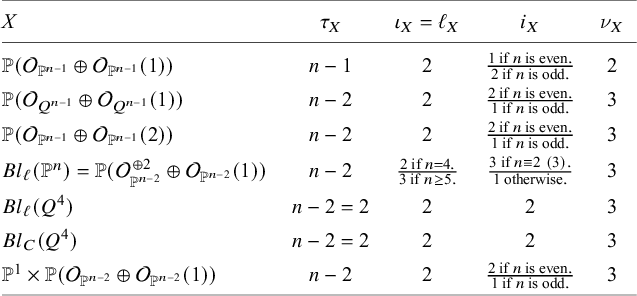

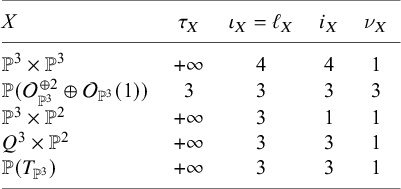


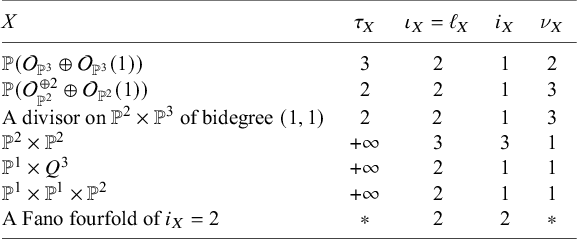


 Open access

