Implications
Based on estimates for genetic (co)variance components, breeding program scenarios showed that the use of in vivo ultrasound measurements for backfat thickness successfully improved the ultimate breeding goal ‘meat quality’ in the endangered pig breed Bunte Bentheimer. Selection response for meat quality in terms of intramuscular fat content was enhanced by including genetic marker information at the RYR1 locus from selection candidates. Alternative selection strategies aiming on alternative traits that do not rely on ex vivo measurements for related animals (full sibs, half sibs or progeny) might be a solution to achieve economic competiveness in niche markets for breeds characterized by small population and herd sizes.
Introduction
The Bunte Bentheimer (BB) belongs to the local and endangered pig breeds, having their area of origin in the northwestern region of Germany. Due to the increasing importance of higher lean meat percentage since the middle of the 20th century, and due to the restricted use of fatty pig breeds, the population size of the BB breed has decreased substantially. In the 1990s, only one BB breeding farm remained, and the effective population size decreased to a critical value of Ne=9 (Biermann et al., Reference Biermann, Pimentel, Tietze, Pinent and König2014). However, the preservation of the population succeeded, and is currently organized by the breeding organization ‘NORDSCHWEIN e.V.’ and the association ‘Verein zur Erhaltung des Bunten Bentheimer Schweines e.V.’ Detailed analyses of the BB population structure based on pedigree data were conducted by Biermann et al. (Reference Biermann, Pimentel, Tietze, Pinent and König2014).
Conventional pig breeding programs typically have a strong emphasis on increasing lean meat percentage by reducing backfat, improving feed conversion ratios, increasing daily gain and increasing litter size. The inferiority of local breeds concerning these traits requires an alternative production method focusing on niche markets to achieve economic competiveness. In several countries, local breeds were already used for the production of high-quality products (Pugliese et al., Reference Pugliese and Sirtori2012). The breeding program of the Iberian breeds, for example, target traits related to the production of high quality dry-cured products (e.g. carcass conformation traits as well as meat and fat quality traits (Fernández et al., Reference Fernández, de Pedro, Núñez, Silió, García-Casco and Rodríguez2003)). For the BB breed, no breeding program along with an overall breeding goal has been established. Accordingly, this pig breed was not under target-orientated genetic selection over decades.
Implementing a breeding program in the BB population initially requires the availability of genetic variance components and heritabilities, as well as the phenotypic and genetic correlations between traits of interest. For the estimation of genetic parameters for meat quality traits, phenotypes have to be generated through the use of meat samples from slaughtered animals. However, phenotyping of selection candidates for meat quality traits based on the carcass or meat samples is prohibitive, as it requires that these individuals are slaughtered. Furthermore, with a focus on endangered breeds of small population sizes and kept in small-scale production systems, there is a lack of suitable infrastructure for organized performance testing of full and half-sibs or of progeny. Therefore, these breeds are in need of alternative breeding programs based on alternative phenotypes. Pimentel and König (Reference Pimentel and König2012) suggested the application of a novel ultrasound recording technique to beef cattle selection candidates with the ultimate aim to achieve genetic progress for meat quality traits. Selection response for an overall breeding goal based on the phenotypic indicator trait ‘ultrasound measurement’ from the selection candidate was comparable to the selection response realized by genomic selection strategies targeting the trait ‘marbling score.’ In pigs, ultrasound measurements are mostly used to measure backfat and loin muscle depth in living pigs, or to determine correlations between ultrasound measurements and carcass composition (e.g. Ayuso et al., Reference Ayuso, González, Hernández, Corral and Izquierdo2013). Using in vivo ultrasound measurements from highly correlated traits (e.g. backfat measurements) might be an alternative and a practical approach to achieve genetic progress for meat quality traits (especially intramuscular fat content) in the BB population.
Another approach to achieve genetic progress for meat quality traits is the utilization of genetic markers or of major genes. One well known major gene in pig breeding is the halothane (ryanodine receptor, RYR1) gene, which causes malignant hyperthermia (Fujii et al., Reference Fujii, Otsu, Zorzato, De Leon, Khanna, Weiler, O'Brien and Maclennan1991). The halothane gene is of major relevance for German pig breeding programs with the two main objectives being reduction of stress susceptibility and improvement of meat quality. For the BB breed, divergent allele frequencies at the RYR1 locus compared with conventional pig breeds are expected, because of the restricted gene flow originating from conventional breeds (Piétrain and Landrace), and due to divergent breeding strategies. Such theories were postulated by Pugliese et al. (Reference Pugliese and Sirtori2012) for other local breeds.
The main objective of this study was to design and to evaluate breeding strategies for the improvement of meat quality within the BB breed based on parameter estimates from quantitative genetic and molecular genetic analyses. Specifically, the overall aim included the following tasks: (1) the estimation of genetic variance components, heritabilities, and phenotypic and genetic correlations for production traits (in vivo ultrasound measurements and carcass measurements) and for meat quality traits, (2) the estimation of allele substitution effects at the RYR1 locus on production and meat quality traits using a selective genotyping approach and (3) the evaluation of breeding strategies on meat quality by combining results from quantitative-genetic and molecular-genetic approaches.
Material and methods
Animals and traits
The genealogical background of the BB breed is described in detail by Biermann et al. (Reference Biermann, Pimentel, Tietze, Pinent and König2014). Pigs of the BB breed are almost exclusively reared and kept in small-scale organic or low-input family farms. With regard to the participating farms, the number of slaughtered animals per farm ranged from five pigs per year to five pigs per week. Hence, data collection was focused on eight contract herds to ensure a meat quality trait flow in short (mostly weekly) intervals. Data recording included in total 1116 pigs of equal sex ratio from September 2011 to August 2013. A subset of 613 pigs was used for in vivo ultrasound measurements, while carcass and meat quality trait records were available from 713 pigs. A total of 700 pigs with phenotypes were genotyped at the RYR1 locus. Additionally, parents and grandparents without phenotypic records were genotyped, resulting in a total of 1014 pigs being genotyped for their RYR1 status. The pedigree included 2797 individuals and was traced back through 16 generations.
Production traits included lean meat content and backfat thickness. Trait recording for in vivo ultrasound measurements was accomplished on farms using Piglog 105 (Carometec Food Technology). In vivo lean meat content (LMCiv) and in vivo backfat thickness (BFiv) were obtained from measurements between the third and fourth last rib and 7 cm from the midline. In slaughtered pigs, lean meat content (LMC) and backfat thickness (BF) were determined using the Fat-O-Meater (Carometec Food Technology). In small abattoirs, LMC and BF were estimated using the ‘Two-Point-Method’ (Bach and Sack, Reference Bach and Sack1987). From a sample of 75 pigs, LMC and BF were available from both measurement techniques Fat-O-Meater and ‘Two-Point-Method.’ The regression equation from this sample was used to calculate LMC and BF for all pigs on an identical ‘Fat-O-Meater basis.’
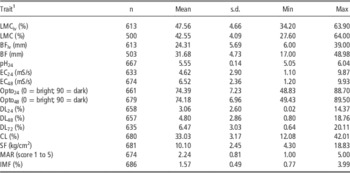
For determining meat quality traits, meat samples taken in the abattoir were analyzed in the meat laboratory at University of Kassel. Meat samples from slaughtered pigs were taken within 1 to 5 h postmortem from the m. longissimus dorsi between the third and fourth last rib. The samples of 5 to 10 cm in thickness were stored in a labeled plastic bag and transported to the laboratory under cooled conditions. Meat quality traits included pH-value, electric conductivity, brightness of the meat, drip loss, cooking loss, shear force, marbling and intramuscular fat content. The pH-value, electric conductivity and meat brightness were recorded using the technical equipment ‘pH-Star’, ‘LF-Star’ and ‘Opto-Star’ (Matthäus, Klausa, Germany) 24 h postmortem (pH24, EC24, Opto24) and 48 h postmortem (EC48, Opto48). For drip loss determination, a 1.5 cm thick slice was taken in abattoirs from each meat sample directly after cutting the sample from the carcass. Fat was trimmed from the slices, which afterwards were weighted and packed in a separately labeled plastic bag. Drip loss was defined as the difference between the weight before and after a storage time of 24 h (DL24), 48 h (DL48) and 72 h (DL72) at a temperature of 8°C. Cooking loss (CL) was recorded 48 h postmortem using a 1.5 cm slice of the meat sample, which was heated to a core temperature of 75°C. CL was defined as the difference between the weight before and after cooking. Subsequently, shear force (SF) of the cooking slice was measured using the Warner–Bratzler Chatillon SF fixture. Marbling (MAR) was determined by a trained technician and using a subjective scale (1=no marbling; 2=little marbling; 3=medium marbling; 4=strong marbling and 5=very strong marbling). The remaining meat sample was used to determine the intramuscular fat content (IMF) with Near Infrared Spectroscopy (FOSS NIRSystems, Hamburg, Germany). Number of observations and descriptive statistics for production and meat quality traits as analyzed in the present study are summarized in Table 1. The explanatory variable ‘weight of pigs at the slaughtering date’ ranged from 52 to 164 kg with a mean value of 102 kg. Weights of pigs for the in vivo ultrasound measurements ranged from 56 to 163 kg with a mean value of 105 kg.
Number of animals (n), mean (Mean), standard deviation (s.d.), minimum (Min) and maximum (Max) for production and meat quality traits

1 LMCiv=lean meat content measured by ultrasound on the live animal; BFiv=backfat thickness measured by ultrasound on the live animal; LMC=lean meat content measured on the carcass; BF=backfat thickness measured on the carcass; pH24=pH-value measured 24 h p.m.; EC24=electric conductivity measured 24 h p.m.; Opto24=meat brightness measured 24 h p.m.; DL24=drip loss measured 24 h p.m.; EC48=electric conductivity measured 48 h p.m.; Opto48=meat brightness measured 48 h p.m.; DL48=drip loss measured 48 h p.m.; DL72=drip loss measured 72 h p.m.; MAR=marbling; CL=cooking loss; SF=shear force; IMF=intramuscular fat content.
Estimation of genetic parameters
Variance components and heritabilities for production and meat quality traits were generated from univariate animal models. For the estimation of covariance components and genetic correlations, bivariate animal models for all trait combinations were applied. Mixed model equations were solved using the AI-REML procedure, as implemented in the DMU software package (Madsen and Jensen, Reference Madsen and Jensen2000). The following genetic statistical model was applied to all traits:
 $$\eqalignno{y_{{ijklmn}} =&\mu {\plus}{\rm }S_{i} {\plus}H_{j} {\plus}{\rm RYR1}_{k} {\plus}a_{l} {\plus}L_{{lm}} \cr &{\plus}b_{1} {\rm SW}_{{ijklmn}} {\plus}e_{{ijklmn}} ,$$
where y ijklmn is the observation for production/meat quality traits of the l th pig; μ the overall mean; S i the fixed effect of the i th sex of the l th pig; H j the fixed effect of the j th herd where the l th pig was bred/fattened; RYR1 k the fixed effect of the k th RYR1 genotype of the l th pig; a l the random additive genetic effect of the l th pig; L lm the random m th common environment effect of litter of l th pig; SW ijklmn the weight at the test/slaughtering date of the l th pig; b 1 the linear regression of the production/meat quality trait on the weight at the test/slaughtering date; and e ijklmn the random residual effect. The (co)variance structure of random effects for the bivariate model was
 $${\mathop{\rm var}} \left[ {\matrix{ {a_{1} } \cr {a_{2} } \cr {cl_{1} } \cr {cl_{2} } \cr {e_{1} } \cr {e_{2} } \cr } } \right]=\left[ {\matrix{ {g_{{11}} A} & {g_{{12}} A} & 0 & 0 & 0 & 0 \cr {g_{{21}} A} & {g_{{22}} A} & 0 & 0 & 0 & 0 \cr 0 & 0 & {l_{{11}} } & {l_{{12}} } & 0 & 0 \cr 0 & 0 & {l_{{21}} } & {l_{{22}} } & 0 & 0 \cr 0 & 0 & 0 & 0 & {r_{{11}} } & {r_{{12}} } \cr 0 & 0 & 0 & 0 & {r_{{21}} } & {r_{{22}} } \cr } } \right],$$
where index 1 indicates the first and index 2 indicates the second production or meat quality trait; a 1 and a 2 the vectors of random genetic animal effects for the two traits; cl 1 and cl 2 the vectors of random common environmental effects of the litter for the two traits; e 1 and e 2 the vectors of random residual effects for the two traits; g 11 the additive genetic variance for the first trait, g 12=g 21 the additive genetic covariance between both traits, g 22 the additive genetic variance for the second trait; l 11 the common environmental variance of the litter for the first trait, l 12=l 21 the common environmental covariance of the litter between both traits, l 22 the common environmental variance of the litter for the second trait; e 11 the residual variance for the first trait, e 12=e 21 the residual covariance between both traits, e 22 the residual variance for the second trait; and A the additive genetic relationship matrix.
Estimation of allele substitution effects at the RYR1 locus
For estimation of marker effects for production and meat quality traits at the RYR1 locus, a selective genotyping approach was used. The selection of extreme phenotypes with regard to meat quality was based on residuals for IMF using the following statistical model:
 $$Y_{{ijk}} =\mu {\plus}S_{i} {\plus}H_{j} {\plus}\beta X_{k} {\plus}e_{{ijk}} ,$$
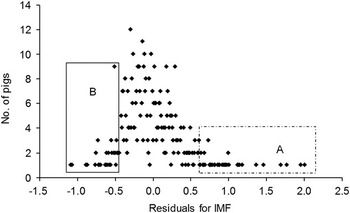
where Y ijk is the observation for IMF of the k th pig; S i the fixed effect of the i th sex of the pig; H j the fixed effect of the j th herd of the pig; X k the weight at the slaughtering date of pig k; β the linear regression of IMF on the weight at the slaughtering date; and e ijk the random residual effect for IMF.Group A consisted of 100 pigs with the highest values for IMF residuals and group B included 100 pigs with the lowest values for IMF residuals (Figure 1). For the estimation of allele substitution effects at the RYR1 locus, methodology for selective genotyping data, as suggested by Henshall and Goddard (Reference Henshall and Goddard1999), was applied. Methodology is based on a logistic model and by defining the RYR1 genotype as a dependent and binary trait. Heterozygous pigs with genotype Nn received the score=1, and homozygous pigs with genotype NN received the score=0. For the analysis of binary data, a generalized linear mixed model with a logit link function was applied. The statistical model for estimating the probability of genotype Nn v. a genotype NN was defined as follows:
 $${\rm logit }(\pi _{r} )={\rm log}\left[ {{{\pi _{r} } \over {1{\minus}\pi _{r} }}} \right]=a{\plus}b_{{\rm 1}} Y_{r} {\plus}S_{s} {\plus}H_{t} {\plus}{\rm b}_{{\rm 2}} {\rm SW}_{r} ,$$
Distribution of residuals for the meat quality trait intramuscular fat content (IMF). Pigs from extreme groups extracted for selective genotyping are highlighted within dashed lines (=highest values for IMF residuals=group A) and solid lines (=lowest values for IMF residuals=group B). (Style of figure according to Sharma et al., Reference Sharma, Jansen, Karrow, Kelton and Jlang2006 and Bagheri et al., Reference Bagheri, Miraie-Ashtiani, Moradi-Sharbabak, Nejati-Javaremi, Pakdel, von Borstel, Pimentel and König2013.)

where π r is the probability of the genotype Nn of a pig r; a the intercept; Y r the observation for the production/meat quality trait of pig r; b 1 the linear regression of genotype Nn on the phenotypic value of the production/meat quality trait; S s the fixed effect of the s th sex of the pig; H t the fixed effect of the t th herd of the pig; SW r the weight at slaughtering date of pig r; and b 2 the linear regression of IMF on the weight at the slaughtering date. The estimated slope of the regression coefficient b 1 was used for the calculation of allele substitution effects at the RYR1 locus, that is, the contrast α of the heterozygous genotype Nn to the homozygous genotype NN with regard to the production and meat quality trait of interest. Henshall and Goddard (Reference Henshall and Goddard1999) introduced the following equation, which was used in the present study:
 $$\alpha ={{{\minus}{\rm 1}{\plus}\sqrt {{\rm 1}{\plus}b_{{\rm 1}}^{{\rm 2}} \sigma _{X}^{{\rm 2}} } } \over {b_{{\rm 1}} }},$$
with
 $$\sigma _{X}^{2} $$
denoting the phenotypic variance of the production and meat quality trait in the unselected base population.
Breeding strategies on meat quality
Genetic gain in meat quality for an ultimate breeding goal including only meat quality (100% of the economic weight on the meat quality trait), and considering different combinations of phenotypic and genomic information (index) sources, was assessed by applying the selection index theory. The theoretical framework for combining phenotypic and genomic data as described by Dekkers (Reference Dekkers2007) was translated into the computer algorithm SIG-R (Pimentel and König, Reference Pimentel and König2012). SIG-R was used to evaluate the following three relevant and basic breeding program scenarios that can be applied to the BB population: (1) scenario PHENO_REL=phenotypic information for the meat quality trait IMF from slaughtered full-sibs of the selection candidate (2) scenario PHENO_OWN=phenotypic information for ultrasound measurements (BFiv) from the selection candidate used as indicator trait for IMF and (3) scenario PHENO_OWN_MARKER=phenotypic information (BFiv) of the selection candidate combined with the genomic information RYR1 status of the selection candidate referred to as genetic marker for IMF. Relevant quantitative genetic parameters for the three scenarios were: h 2 for IMF=0.78, h 2 for BFiv=0.27, genetic correlation between IMF and BFiv=0.39, phenotypic correlation between IMF and BFiv=0.25, phenotypic standard deviation for IMF=0.49%, and phenotypic standard deviation for BFiv=5.69 mm.
The approach for the evaluation of the scenario PHENO_OWN_MARKER combined quantitative genetic parameter estimates with allele substitution effects for IMF at the RYR1 locus. The allele substitution effect α IMF of the N allele was 0.207. Hence, the additive genetic variance for IMF explained by the genetic marker was
 $$\sigma_{\rm m{\vskip 1.8pt-}IMF}^{\rm 2} =2p(1{\minus}p)\alpha _{{{\rm IMF}}} ^{2} =0.351\,\%\,^{2} ,$$
with P=0.87 denoting the allele frequency of the desired N allele. Matrices and vectors for selection index calculations combining phenotypic information and marker were: matrix
 $$P=\left[ {\matrix{ {\sigma _{{{\rm BF}_{{{\rm iv}}} }}^{2} } & {{\mathop{\rm cov}} _{{{\rm BF}_{{{\rm iv}}} {\rm :m\_IMF}}} } \cr {{\mathop{\rm cov}} _{{{\rm BF}_{{{\rm iv}}} {\rm :m\_IMF}}} } & {\sigma _{{{\rm m\_IMF}}}^{2} } \cr } } \right]$$
including the (co)variance components for both information ‘traits’ IMF marker and phenotypic observation for BFiv from the selection candidate where
 $$\sigma _{{{\rm BF}_{{{\rm iv}}} }}^{2} $$
is the phenotypic variance for BFiv and
 $${\mathop{\rm cov}} _{{{\rm BF}_{{{\rm iv}}} {\rm :m\_IMF}}} $$
is the covariance between BFiv and the marker for IMF; the (co)variance matrix:
 $$G=\left[ {\matrix{ {\sigma _{{{\rm a\_BF}_{{{\rm iv}}} }}^{2} } & {{\mathop{\rm cov}} _{{{\rm BF}_{{{\rm iv}}} {\rm :m\_IMF}}} } \cr {{\mathop{\rm cov}} _{{{\rm BF}_{{{\rm iv}}} {\rm :m\_IMF}}} } & {\sigma _{{{\rm m\_IMF}}}^{2} } \cr } } \right]$$
between information ‘traits’ and the breeding value for IMF where
 $$\sigma _{{{\rm a\_BF}_{{_{{{\rm iv}}} }} }}^{2} $$
is the additive genetic variance for BFiv; and vector
 $${\bf w}=\left[ {\matrix{ 1 \cr 0 \cr } } \right],$$
representing the economic weight for the IMF phenotype.
The equation
 $${\bf b}={\bf P}^{{{\minus}{\bf 1}}} {\bf Gw}$$
was solved, where b-values=weighting factors in IMF genetic evaluations for BFiv and the IMF marker genotype of the selection candidate (boar or sow). The evaluation criteria for the different breeding scenarios were the correlation between index and aggregate genotype (=accuracy of the estimated breeding value (EBV) for the selection candidate (r
TI)), and selection response per generation by assuming a selection intensity of i=1.
Results and discussion
Genetic parameters for production and meat quality traits
At the phenotypic scale, and when compared with conventional pig breeds, traits recorded in the BB population are characterized by a large variation and a wide range (Table 1). Such a high variation at the phenotypic scale reflects the substantial differences in housing and feeding systems across herds. In addition, different pre-slaughter conditions, especially when comparing technical processes in large-scale commercial slaughterhouses with small abattoirs, may have influence on meat traits variability.
Heritabilities for production traits (LMCiv, LMC, BFiv, BF) were in a moderate range from 0.27 to 0.48 (Table 2) and correspond with estimates from previous studies (van Wijk et al., Reference van Wijk, Arts, Matthews, Webster, Ducro and Knol2005; Schwab et al., Reference Schwab, Baas and Stalder2010). Estimates for in vivo traits were lower in comparison with the same traits measured on the carcass. This is probably due to the higher common environmental litter variance for the in vivo traits caused by a greater number of in vivo measured full-sibs compared with the number of slaughtered full-sibs. Estimated heritabilities for meat quality traits ranged from 0.14 for Opto24 to 0.78 for IMF (Table 2). Our results are in agreement with the estimates of several other studies in conventional populations (de Vries et al., Reference De Vries, van der Wal, Long, Eikelenboom and Merks1994; Suzuki et al., Reference Suzuki, Irie, Kadowaki, Shibata, Kumagai and Nishida2005; van Wijk et al., Reference van Wijk, Arts, Matthews, Webster, Ducro and Knol2005; Borchers et al., Reference Borchers, Otto and Kalm2007; Gjerlaug-Enger et al., Reference Gjerlaug-Enger, Aass and Vangen2010; Schwab et al., Reference Schwab, Baas and Stalder2010; Dodenhoff et al., Reference Dodenhoff, Schuster, Wittmann, Littmann, Lindner and Götz2011). Hence, explanations for trait specific heritabilities are summarized in those studies, and will not be discussed in detail in the current context of endangered breeds.
Variance components (
 $$\sigma _{a}^{2} $$
=additive genetic variance,
 $$\sigma _{{cl}}^{2} $$
=common litter environmental variance,
 $$\sigma _{e}^{2} $$
=residual variance) and heritabilities (h
2
) for production and meat quality traits from the univariate model (corresponding standard errors of estimates in brackets)

1 LMCiv=lean meat content measured by ultrasound on the live animal; BFiv=backfat thickness measured by ultrasound on the live animal; LMC=lean meat content measured on the carcass; BF=backfat thickness measured on the carcass; pH24=pH-value measured 24 h p.m.; EC24=electric conductivity measured 24 h p.m.; Opto24=meat brightness measured 24 h p.m.; DL24=drip loss measured 24 h p.m.; EC48=electric conductivity measured 48 h p.m.; Opto48=meat brightness measured 48 h p.m.; DL48=drip loss measured 48 h p.m.; DL72=drip loss measured 72 h p.m.; MAR=marbling; CL=cooking loss; SF=shear force; IMF=intramuscular fat content.
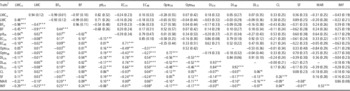
Phenotypic and genetic correlations between all production and meat quality traits are presented in Table 3. Phenotypic correlations between in vivo traits with the same traits from the carcass were moderate to high, and significantly different from zero. Genetic correlations among production traits were very high, that is, r g =0.94 between LMCiv and LMC, and r g =0.96 between BFiv and BF. These results agree with the high genetic correlations between ultrasound and carcass measurements found by Lo et al. (Reference Lo, McLaren, McKeith, Fernando and Novakofski1992) with r g =0.87 for lean meat area, and r g =0.85 for backfat. They conclude that a high genetic correlation in combination with moderate heritability favors selection based on ultrasound measurements to improve carcass characteristics. The phenotypic correlation coefficients between production and meat quality traits in this study were not significantly different from zero in most cases. As an exception, moderate phenotypic correlation coefficients were found between IMF and the production traits. Genetic correlations between IMF and the production traits were moderate and confirm the results by Lo et al. (Reference Lo, McLaren, McKeith, Fernando and Novakofski1992) and by Schwab et al. (Reference Schwab, Baas and Stalder2010). Quantitative genetic parameter estimates for production and meat quality traits in the BB population reflect estimates in conventional and local pig breeds, and are a solid basis for designing breeding strategies on meat quality in the BB population.
Genetic (above diagonal) and phenotypic correlationsFootnote 1 (below diagonal) among production and meat quality traits from a series of bivariate models (corresponding standard errors of genetic correlations in brackets)

1 Significance level: ***P⩽0.001, **P⩽0.01, *P⩽0.05, ns=P>0.05.
2 LMCiv=lean meat content measured by ultrasound on the live animal; BFiv=backfat thickness measured by ultrasound on the live animal; LMC=lean meat content measured on the carcass; BF=backfat thickness measured on the carcass; pH24=pH-value measured 24 h p.m.; EC24=electric conductivity measured 24 h p.m.; Opto24=meat brightness measured 24 h p.m.; DL24=drip loss measured 24 h p.m.; EC48=electric conductivity measured 48 h p.m.; Opto48=meat brightness measured 48 h p.m.; DL48=drip loss measured 48 h p.m.; DL72=drip loss measured 72 h p.m.; MAR=marbling; CL=cooking loss; SF=shear force; IMF=intramuscular fat content.
Allele frequencies and allele substitution effects for meat quality traits at the RYR1 locus
For the entire BB population, including 1014 genotyped pigs, the frequency of the unfavorable n allele at the RYR1 locus was q=0.13, and p=0.87 for the favorable allele N. Genotype frequency was 0.757 for NN, 0.226 for Nn and 0.017 for nn. Pugliese et al. (Reference Pugliese and Sirtori2012) reviewed allele frequencies at the RYR1 locus for several native pig breeds located in the southern part of Europe. Allele frequency q of the unfavorable n allele was zero for the Italian breeds Casertana, Nero Siciliano and Apulo Calabrese, for the Iberian pig sub-strain Manchado de Jabugo, as well as for the French breed Basque. In the local French breeds Bayeux and Blanc de l’Ouest, allele frequency of the n allele was comparably high (q=0.44 and q=0.34, respectively). The authors assumed introgression from commercial breeds such as Landrace or Piétrain.
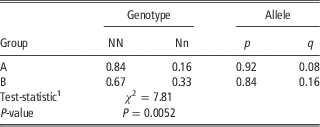
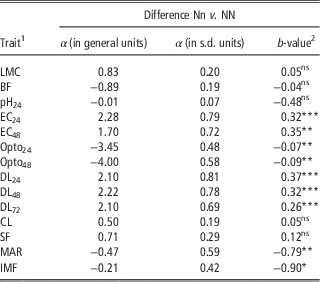
Using the selective genotyping approach, the frequency of the favorable NN genotype was significantly higher in group A, representing the 100 pigs with the highest residuals for IMF. Accordingly, within this group, a higher percentage of the favorable N allele was observed (Table 4). Frequency of the N allele was p=0.92 in group A, and p=0.80 in group B. The detrimental impact of the unfavorable n allele on meat quality traits was reflected by estimated allele substitution effects (Table 5). The highest values for α (in s.d. units) were estimated for EC, Opto, DL, MAR and IMF and ranged from 0.42 to 0.81. The presence of the n allele was associated with an increased EC, lower values for Opto (paler color), and a higher amount of DL, that is, the typical characteristics reflecting pale, soft and exudative meat (e.g. Rosenvold and Andersen, Reference Rosenvold and Andersen2003; Borchers et al., Reference Borchers, Otto and Kalm2007). Allele substitution effects were unfavorable for traits depicting the fat content of meat (MAR and IMF), and further indicating lower fat content when the n allele is present. The negative effect of the n allele on fat content is also documented by Zhang et al. (Reference Zhang, Knight, Stalder, Goodwin, Lonergan and Beitz2007) and coincides with the well-documented positive effect of the n allele on LMC (Rosenvold and Andersen, Reference Rosenvold and Andersen2003). In this study, however, the effect on LMC was small (α in s.d. units=0.20), and the regression coefficient from the logistic model (b-value=0.05) was not significant. This likely reflects the absence of target-orientated artificial selection on LMC in the BB population. Our results demonstrate the future opportunity to use genetic marker information at the RYR1 locus for improvements of meat quality traits in the BB population.
Genotypic and allele frequencies (p=frequency for the N allele and q frequency for the n allele) at the RYR1 locus for 100 pigs with the highest residuals for IMF (group A) and for 100 pigs with the lowest residuals for IMF (group B)

1 Application of a χ 2-test for genotype frequencies for a 2×2 contingency table (two groups A and B, and two genotypes NN and Nn; d.f.=1).
Allele substitution effect α (=effect of the unfavorable n allele) at the RYR1 locus for production and meat quality traits, and regression coefficients (b-value) from the logistic model

1 LMC=lean meat content measured on the carcass; BF=backfat thickness measured on the carcass; pH24=pH-value measured 24 h p.m.; EC24=electric conductivity measured 24 h p.m.; Opto24=meat brightness measured 24 h p.m.; DL24=drip loss measured 24 h p.m.; EC48=electric conductivity measured 48 h p.m.; Opto48=meat brightness measured 48 h p.m.; DL48=drip loss measured 48 h p.m.; DL72=drip loss measured 72 h p.m.; MAR=marbling; CL=cooking loss; SF=shear force; IMF=intramuscular fat content.
2 Significance level: ***P⩽0.001, **P⩽0.01, *P⩽0.05, ns=P>0.05.
Evaluation of breeding strategies for the improvement of meat quality
Different breeding strategies (Table 6) aimed at improving IMF, which was defined as the ultimate breeding goal. Breeding on improved IMF implies correlated increase in backfat, which is undesired in commercial pig breeds. For the BB meat production aiming on a market niche, and with a strong focus on gourmet restaurants, increase of backfat is without detrimental economic impact. For scenarios including phenotypic information from slaughtered full-sibs (PHENO_REL), accuracies of EBV were 0.44 including one full-sib and 0.52 including two full-sibs. Selection response for IMF per generation was 0.19% and 0.23%, respectively. Performance tests for selection candidates including ultrasound measurements (BFiv) from the selection candidate as an information source (PHENO_OWN) resulted in lower accuracy of EBV and selection response compared with PHENO_REL. BFiv is less heritable than IMF (h²=0.27 v. h²=0.78), causing lower accuracy and genetic gain when used as an index trait. Similar results were found by Newcom et al. (Reference Newcom, Baas, Stalder and Schwab2005). In their study, selection on IMF based on carcass traits revealed higher genetic gain (h²=0.42 for the carcass trait; genetic gain for IMF=0.75%) compared with selection based on IMF ultrasound measurements (h²=0.25 for the ultrasound measurement; genetic gain for IMF=0.32%). Schwab et al. (Reference Schwab, Baas and Stalder2010) also predicted higher selection response per generation for carcass IMF compared with ultrasonic IMF (0.49% v. 0.29%). However, the following essential practical aspects support selection strategies based on in vivo ultrasound information directly from potential selection candidates: (1) independence from the number of available full-sibs, (2) redundancy of elaborate trait recording and analysis schemes for meat samples and (3) availability of in vivo measurements as an on-farm breeding and management tool.
Correlation between index and aggregate genotype (r TI) and selection response from one round of selection for different breeding scenarios (section intensity=1)

IMF=intramuscular fat content; BFiv=backfat thickness measured by ultrasound on the live animal.
1 Scenarios as explained in the materials and methods.
2 Full-sibs of the selection candidate.
Genetic gain and accuracy of EBVs substantially increased when including both index sources, the ultrasound measurement and genetic marker information at the RYR1 locus from selection candidates. When adding the RYR1 status as a genetic marker to a selection candidates phenotype (scenario PHENO_OWN_MARKER), the accuracy of EBV and selection response increased by 20%. A similar strategy was suggested by Pimentel and König (Reference Pimentel and König2012) for the improvement of the meat quality trait ‘marbling score’ in beef cattle. With regard to the high average generation interval and to the small effective population size within the BB population (Biermann et al., Reference Biermann, Pimentel, Tietze, Pinent and König2014), a rigorous breeding program aiming at eliminating the undesired allele at the RYR1 locus is difficult to implement. Hence, a combination of ultrasound information with marker information used as selection index information sources might be a suitable compromise. Recommendations predominantly consider practical conditions and applications that can be implemented in small-scale production systems and for endangered populations. Recently, more candidate genes for meat quality, and specifically for IMF, have been reported (Schwab et al., Reference Schwab, Mote, Du, Amoako, Baas and Rothschild2009; Han et al., Reference Han, Jiang, Yang, Zhang, Wang, Fan and Liu2012). These candidate genes can be included in breeding program scenarios by extending the scenario ‘PHENO_OWN_MARKER’ to a broader variety of relevant genes affecting meat quality traits in pigs. A breeding focus on meat quality traits is imperative, because the economic competiveness of the BB population might only be realized when implementing and expanding breeding activities to achieve improved product quality. Such an approach is justified because meat from the BB is offered, for example, in gourmet restaurants and in delicatessen stores, in high price segments.
Conclusions
Estimated genetic parameters for production and meat quality traits in the BB population reflect estimates in conventional populations, and represent basic principles for implementing breeding strategies on meat quality. The unfavorable n allele at the RYR1 locus is still present in the BB population with a frequency of q=0.13. Allele substitutions effects on meat quality traits were significant and exhibit the future need for using genetic marker information at the RYR1 locus to improve meat quality traits in this population. Selection response and accuracy of selection increased by 20% when considering the genetic marker information at the RYR1 locus from selection candidates as an additional information source. A breeding strategy based on in vivo indicator traits can be directly applied on pig farms to potential selection candidates. Such a breeding strategy will improve meat quality within a moderate range. The combination of quantitative-genetic and molecular-genetic approaches is a practical and most efficient approach to achieve genetic progress in endangered and small populations.
Acknowledgements
This study is a part of the project ‘Entwicklung eines ökonomisch ausgerichteten Zuchtprogramms für die bedrohte Schweinerasse “Bunte Bentheimer”,’ which is funded by the Federal Office for Agriculture and Food (BLE) and the Landwirtschaftliche Rentenbank. The authors also thank Mrs S. Hartmann (Group Animal Nutrition and Animal Health, University of Kassel) for her assistance in generating meat quality traits in the laboratory.