I. INTRODUCTION
Cobalt-based alloys offer superior oxidation, corrosion, and wear resistance compared to many conventional materials. These properties make investment cast cobalt-based alloys suitable for a variety of applications including turbine vanesReference Beltran, Sims, Stoloff and Hagel1 and surgical prosthesis.Reference Noble2
The grain size of cobalt-based alloys (in bulk alloys and surface coatings) is reported to influence a variety of mechanical properties including strength, ductility, hardness/wear resistance, and fatigue resistanceReference Karimpoor, Erb, Aust and Palumbo3–Reference Della Valle, Becksac, Anderson, Wright, Nestor, Pellicci and Salvati8 as well as the alloy’s susceptibility to martensite formation.Reference Huang and Lopez9 For superalloys in general, component properties improve with decreasing grain size at room temperature, but coarse grains improve the high temperature properties (especially creep resistance).Reference Freeman, Sims, Stoloff and Hagel10 The final application of the component will determine the need for fine equiaxed grains or coarse columnar or single crystal grains. In any case, it is apparent that understanding the mechanisms controlling the grain size and morphology during solidification of cobalt alloys is important.
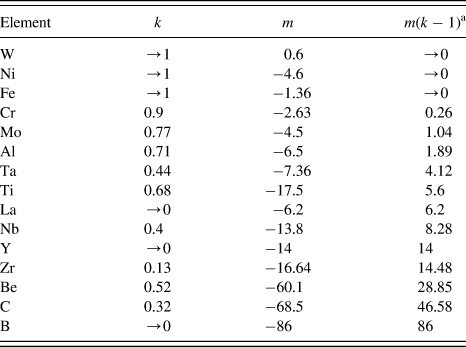
Traditionally, grain size and morphology of superalloys has been controlled by careful manipulation of the solidification parameters (cooling rate, thermal gradient, etc.) and mold design.Reference Reed11 In addition, it has also been demonstrated that grain size and morphology can be controlled through mold vibration (possibly due to dendrite fragmentation/grain multiplication)Reference Xiaoping, Yingju and Yuansheng12 or with surface coatings applied to the mold to enhanceReference Watmough13, Reference Jin, Bai, Li and Yin14 or inhibitReference Liu, Guo and Yang15, Reference Liu and Yang16 nucleation. Of the few studies examining grain refinement of cobalt alloys by chemical inoculants, there seems to be limited understanding on the important role that both nucleating agents and solute elements have on grain refinement. In other alloy systems, it is well understood that, in addition to potent nucleant particles, effective grain refinement also requires solute to provide constitutional undercooling and restrict growth.Reference StJohn, Qian, Easton, Cao and Hildebrand17–Reference Dargusch, Bermingham, McDonald and StJohn21 The grain-refining effectiveness of a solute can be predicted by a parameter known as the growth restriction factor (Q), given by Q = mC 0(k − 1), where m is the liquidus gradient (from the alloy phase diagram), C 0 is the composition of the alloy in wt%, and k is the partition coefficient. The growth restriction factor was first derived by Maxwell and HellawellReference Maxwell and Hellawell22 and was shown to have an inverse relationship with grain size. Grain refinement during solidification occurs because segregation of solute having a high value of mC 0(k − 1) causes a constitutionally undercooled zone to rapidly develop around the growing grain. This restricts further growth of the grain and allows adjacent nucleant particles in the constitutionally undercooled zone to become activated. The purpose of this study is to investigate the contribution of solute to grain refinement during the solidification of cobalt. Table I presents a list of calculated growth restriction factors for numerous elements in cobalt. It can be seen that boron has the highest growth restriction factor in the cobalt system, and its effect on the grain size of cast cobalt will be investigated in this work.
Calculated m(k − 1) for various elements in cobalt using binary phase diagrams.Reference Easton and StJohn23
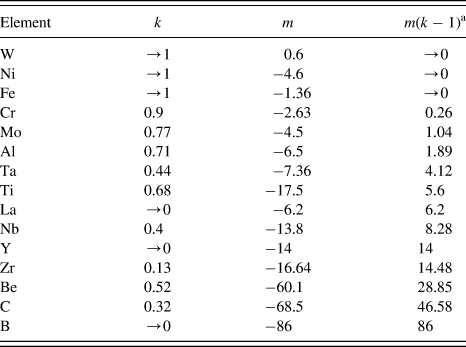
a To calculate Q, multiply m(k − 1) by C 0 in wt%.
II. EXPERIMENTAL
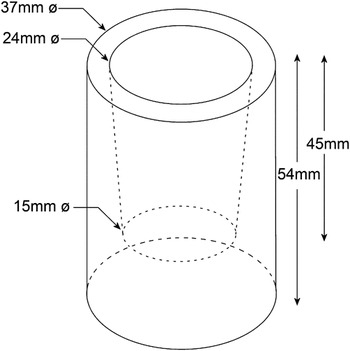
Samples were made by melting cobalt pieces (99.9+% purity) of the approximate mass of 25 g in a small tungsten arc furnace under a protective argon atmosphere. This mass of cobalt was selected because the furnace is limited to small melt sizes. Where necessary, the appropriate proportion of crystalline boron chips (99.7% purity) was added with the cobalt pieces before melting. The alloys of the following compositions were cast: unalloyed cobalt, Co-0.05B, Co-0.2B, Co-0.5B (all mass%). All alloys were melted in proprietary ceramic crucibles (Part No.: 090-161-00; Dentaurum, Ispringen, Germany) and were poured under gravity into a copper mold (dimensions shown in Fig. 1). The melting procedure was made identical for each casting. The small melt size produced castings with a height of ∼12–15 mm. Separate castings were performed to determine an approximate pouring temperature of the alloys. A type B thermocouple (0.2 mm Ø) was inserted into a specially designed mold of identical dimensions used for the study. The thermocouple wires were shielded by a ceramic sheath (alumina tube coated with zircon ceramic), and only the very tip of the wires were exposed to the molten metal and were located in the approximate center of the casting. Thermal analysis revealed pouring temperatures in excess of 1600 °C with an approximate solidification time of 3–5 s. The solidification temperature of the pure cobalt and Co-0.5B was ∼1490 °C and 1445 °C, respectively, close to predictions from the phase diagram melting point of 1495 °C for pure Co and 1455 °C for Co-0.5B.24 After casting, the cobalt samples were cut longitudinally, ground using 240–1200 grit SiC paper, and polished using 0.05 μm colloidal silica. After polishing, the samples were electrolytically etched using a solution of 1.5% HCl–4.5% HNO3–94% H2O with an applied voltage of 1.5–2 V for ∼10 s. The samples were viewed under polarized light with an optical microscope.
Schematic of the mold used for casting.

III. RESULTS AND DISCUSSION
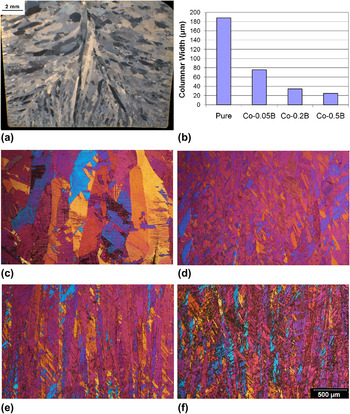
The microstructure of all castings comprised almost entirely of columnar grains that grew inwards from the mold wall. Despite the absence of equiaxed grains, the addition of boron refines the as-cast microstructure and in particular the width of the columnar grains. Using the same technique discussed elsewhere,Reference Easton and StJohn23 the average columnar width for each alloy was approximated (Columnar width was estimated by dividing the length of a line traversing perpendicular to the columnar grain orientation by the number of grain boundaries intersecting the line.) and is shown in Fig. 2 along with the microstructures of the alloys.
(a) Macro of pure Co casting showing columnar microstructure, (b) average columnar width, (c) pure Co, (d) Co-0.05% B, (e) Co-0.2%B, and (f) Co-0.5%B. Micrographs (c–f) were taken at the center bottom of the casting, less than 1 mm away from the mold wall.

Although boron has a high growth restriction factor and has refined the width of the columnar grains, it has failed to promote the columnar to equiaxed transition in the cobalt alloys. In other cast alloys that exhibit equiaxed grain structures such as Al, Mg, and Ti alloys, it is well known that grain size is inversely linked to the growth restriction factor.Reference StJohn, Qian, Easton, Cao and Hildebrand17, Reference Easton and StJohn18, Reference Greer, Cooper, Meredith, Schnider, Schumacher, Spittle and Tronche25, Reference Bermingham, McDonald, StJohn and Dargusch26 In these alloys, an increase in solute causes an initial rapid decrease in grain size but continued solute addition has diminishing effects on further refinement. Even though the cast cobalt alloys in this work lack equiaxed grains, a similar trend in the reduction of columnar grain width occurs with increasing boron solute additions.
The refinement of the columnar grains with increasing boron addition may be due to a number of reasons. Indeed, growth restriction theory would suggest that the constitutional undercooling produced by segregation of boron solute may enable the activation of more nucleant particles. However, since all nucleation events occur at or near the mold wall, the problem with this theory is that the very high thermal undercooling at the mold would almost certainly be more significant than any additional constitutional undercooling effects from boron solute. Another possible explanation is that the boron additions could contain foreign nucleant particles that become active in the thermally undercooled regions near the mold wall. However, this theory is also unlikely since the amount of boron added (and hence the number of nuclei added) is not proportional to the columnar width.
If the boron additions are not responsible for columnar width refinement through enhanced nucleation by either constitutional undercooling effects or the introduction of foreign nuclei particles, then the boron solute may be refining the columnar width during growth. Although the constitutionally undercooled zone ahead of a solid interface may provide the necessary undercooling to activate adjacent nucleant particles, the constitutionally undercooled zone concurrently serves to restrict the growth of the growing grain by lowering the growth temperature. Fundamentally, columnar grains in castings are formed by competitive growth of favorably orientated chill crystals that effectively outgrow crystals of less favorable orientations. If it is assumed for this case that the same number of chill crystals form in all castings (from thermal undercooling), segregation of boron solute during growth may have the effect of restricting growth on the columnar grains in the lateral direction, allowing the growth and coexistence of more grains. In the absence of boron segregation, lateral growth of the favorably orientated crystals may not be restricted and adjacent, and less favorably orientated crystals could be rapidly overgrown.
The lack of equiaxed grains in all castings may be caused by a combination of the thermal conditions during solidification and the quantity of available nucleant particles in the melt. HuntReference Hunt27 derived a criterion for predicting solidification morphology, which considers the nucleant population and potency, as well as the thermal solidification conditions. The criterion for fully equiaxed microstructures is given by Eq. 1,

where G is the temperature gradient, N 0 is the total number of heterogeneous nucleant particles, ΔT N is the undercooling at the heterogenous nucleation temperature (nucleant potency), and ΔT c is the growth temperature of the solid front. For pure cobalt, Drewes et al.Reference Drewes, Schaefers, Rosner-Kuhn and Frohberg28 have shown that the velocity of the solid front (V) can be predicted by Eq. 2,

where A and α are constants equal to 1.146 × 10⁻⁴ m·s−1·K−α and 2.48, respectively. Using thermal analysis and sample geometry to estimate the temperature gradient and growth velocity of the cobalt alloys, Eqs. (1) and (2) were used to calculate the effect of three different nucleant populations (N 0 = 10, 102, and 105) on grain morphology with a constant potency of ΔT N = 3 K and is shown in Fig. 3(a). Figure 3(b) also shows the effect of nucleant potency ΔT N on the equiaxed to columnar transition for a constant nucleant population. Although Fig. 3 is only an approximation and will inevitably depend on the assumptions used, it does demonstrate that the existence of an equiaxed zone for castings made under fixed thermal conditions is highly dependent on the number of nuclei and their potency.
Plot of growth velocity V (cm·s−1) against temperature gradient G (K·cm−1) for cobalt containing (a) different nucleation populations, N 0, at ΔTn = 3 K and (b) different nucleant potencies at N 0 = 105. The approximate location for the cobalt castings is shown by the shaded region.

The fact that the cast cobalt alloys have columnar morphologies indicates a lack of active nucleant particles in the melt. As Fig. 3 suggests, this may be due to an insufficient nucleant population in the melt or the potency of any nucleants in the melt being inadequate to promote heterogenous nucleation for the given solidification conditions.
A number of different theories for the origins of equiaxed grains in alloys absent of potent foreign nucleants are available.Reference Genders29–Reference Hutt and StJohn33 These theories all share the common assumption that solid fragments of the primary phase (such as detached dendrite arms) form in undercooled regions on or near the mold wall or surface and journey into the center of the casting to seed equiaxed grains. This process can occur during turbulent mold filling. The survivability of detached crystals is reduced if the pouring temperature (superheat) of the melt is increased.
The cobalt alloys in this work have at least 100 °C superheat during casting. If a crystal separation mechanism is possible in cast cobalt alloys, then it is likely that the large superheat of the melt may be sufficient to remelt any primary crystals that journey to the casting center. By reducing the superheat during casting, it may be possible to increase the survivability of detached crystals and form equiaxed grains.
There are accounts in the literature that lend support to this hypothesis. Zhuang and LangerReference Zhuang and Langer34 found that the as-cast grain size of Co–Cr–Mo alloys was finer at the mold wall compared to the casting interior, and although they did not specify the casting temperature, the authors reported that the grain size increases as mold preheat temperature increases. When water-cooled metal molds were used, the authors reported the presence of equiaxed grains and the absence of columnar grains. Others have also observed an increase in grain size with increasing pouring and preheated mold temperature.Reference Watmough13, Reference Riddihough35, Reference Gomez, Mancha, Salinas, Rodriguez, Escobedo, Castro and Mendez36 The fact that grain morphology and size depends strongly on mold and pouring temperature suggests an absence of nucleant particles in superheated melts.
A consequence of the lack of nucleating particles in superheated cobalt alloys is that equiaxed grain formation and refinement will not be possible until suitable nucleant particles are found. WatmoughReference Watmough13 introduced several ‘inoculating agents’ to the mold ceramic including cobalt oxide and cobalt aluminate and reported grain refinement of cast cobalt–chromium alloys at the mold wall. This promising work may indicate that these particles are suitable nucleants for cobalt alloys, which could (pending survivability in the superheated liquid) promote the columnar to equiaxed transition regardless of casting or mold temperature. Further work to identify suitable nucleating particles for cobalt alloys is required. Once nucleating particles are identified for cobalt alloys, the growth restriction theory can then be applied to cobalt alloys to provide a prediction of the as-cast equiaxed grain size for a range of compositions.
IV. CONCLUSIONS
The addition of boron solute to cast cobalt alloys failed to promote the columnar to equiaxed transition but significantly refined the width of the columnar grains. The constitutionally undercooled zone that is likely to form upon segregation of boron solute may refine the columnar width by restricting growth in the lateral direction and thus permitting the continued columnar growth of less favorably orientated neighboring grains. The lack of equiaxed grains in the cast alloys indicates a lack of potent nucleant particles, which may in part be due to the large melt superheat during casting. Therefore, effective grain refinement of cast cobalt-based alloys will not be possible until a suitable nucleating agent is identified or the thermal conditions are changed.
ACKNOWLEDGMENTS
The authors gratefully acknowledge the Defence Materials Technology Centre (DMTC), the CAST Cooperative Research Centre, and the Queensland Centre of Advanced Materials Processing and Manufacturing (AMPAM) for financial support and permission to publish this work. The DMTC was established and is supported under the Australian Government’s Defence Future Capability Technology Centres Programme. The CAST Cooperative Research Centre was established and is supported under the Australian Government’s Cooperative Research Centres Programme. AMPAM was established and is supported by the Queensland Government’s Smart State Innovation Building Fund. The authors also thank Mr. Oliver Thomas for his assistance during experimentation.