INTRODUCTION
The beaked whales of the family Ziphiidae are the least known of all cetacean families, with only 22 species having been described thus far. This group of cetaceans is rarely seen, their habitats poorly known, have long dive capacity and, for some species, abundance is low (Carpenter & Niem, Reference Carpenter and Niem2001).
Identification among beaked whales using morphology is often difficult because of the similarity in their overall appearance (Dalebout et al., Reference Dalebout, Helden, Waerebeek and Baker1998, Reference Dalebout, Mead, Baker, Baker and van Helden2002). The advent of genetic markers has helped in solving some of these issues involving the misidentification of beaked whales, including the resurrection of Mesoplodon traversii (Van Helden et al., Reference Van Helden, Baker, Dalebout, Reyes, van Waerebeek and Baker2002) and the discovery of a new species from the North Pacific, Mesoplodon perrini (Dalebout et al., Reference Dalebout, Mead, Baker, Baker and van Helden2002).
Mesoplodon hotaula was discovered as a new species by Deraniyagala (Reference Deraniyagala1963), but was synonimized with Mesoplodon ginkgodens two years later by Moore & Gilmore (Reference Moore and Gilmore1965). In 2014, Mesoplodon hotaula was recognized as a different species closely-related to Mesoplodon ginkgodens based on genetic evidence using mitochondrial, autosomal and paternal DNA and supported by its morphological features (Dalebout et al., Reference Dalebout, Baker, Steel, Robertson, Chivers, Perrin, Mead, Grace and Schofield2007, Reference Dalebout, Baker, Steel, Thompson, Robertson, Chivers, Perrin, Goonatilake, Anderson, Mead, Potter, Yamada, Thompson and Jupiter2014).
In the Philippines, three species of beaked whales in the family Ziphiidae have been recorded thus far: the Longman's beaked whale Indopacetus pacificus (Longman, Reference Longman1926) (Acebes et al., Reference Acebes, Bautista, Yamada, Dolar and Perrin2005; Tagarino & Daclan, Reference Tagarino and Daclan2007); Blainville's beaked whale Mesoplodon densirostris (Blainville, Reference Blainville1817) (Dolar & Wood, Reference Dolar and Wood1993; Dolar & Perrin, Reference Dolar and Perrin1996; Aquino & Calderon, Reference Aquino and Calderon2004; Dolar et al., Reference Dolar, Perrin, Taylor, Kooyman and Alava2006); and the Cuvier's beaked whale Ziphius cavirostris (Cuvier, Reference Cuvier1823) (Dolar et al., Reference Dolar, Perrin, Yaptinchay, Jaaman, Santos, Alava and Suliansa1997; Aquino, Reference Aquino2009). All cetaceans are protected under Philippine law and, specifically regarding beaked whales, they are assessed as Data Deficient in the Philippines under the IUCN Red List guidelines (Alava et al., Reference Alava, Dolar, Sabater, Aquino and Santos2012).
On December 19 2012, a 4.6 m female beaked whale along with its 2.4 m calf was found stranded in Maco, Compostela Valley, Southern Philippines at around 2:00 am (Figure 1). The calf was pushed back to the water while the mother died at around 10:00 am on the same day. The necropsy report (conducted by Mr Darrell Blatchley, unpublished) failed to specifically identify the cause of death but indicated that there was no food in the stomach and identified the presence of black nylon rope and a piece of coal which were found to have caused blockage to the intestines. Furthermore, the report indicates heavy parasite infection and the presence of kidney stones. Initially, the mother was identified as a Mesoplodon densirostris (Blainville, Reference Blainville1817). This paper aims to show that the stranded Compostela Valley beaked whale is actually a Mesoplodon hotaula (Deraniyagala, Reference Deraniyagala1963), using the mitochondrial genetic markers – Control Region (CR) and Cytochrome B (CytB) – and morphological characters of the skull and teeth. This marks the first record of this species in the Philippines and only the eighth specimen in the world.
Compostela Valley beaked whale found stranded on December 19 2012 in Compostela Valley, Southern Philippines, adult female: (A) head; (B) carcass (poto credit: Darrell Blatchley/D'Bone Collector Museum Inc.).

MATERIALS AND METHODS
Genetic identification was then carried out by taking muscle tissues from the specimen, preserving it in absolute ethanol, extracting DNA from the tissues, getting desired DNA sequences then analysing the results using bioinformatics. Specifically, the DNA analysis was conducted as follows: DNA was extracted using the modified CTAB method described by Santos et al. (Reference Santos, Lopez and Barut2010). The mitochondrial DNA markers CR and CytB were used. For the CR, primers M13-Dlp1.5-L (5′-TGTAAAACGGCCAGTTCACCCAAAGCTGRARTTCTA-3′) and Dlp5-H (5′-CCATCGWGATGTCTTATTTAGRGGAA-3′) were used to amplify 439 bp fragment (Dalebout et al., Reference Dalebout, Helden, Waerebeek and Baker1998). For CytB, the universal vertebrate primers GLUDG-L (5′- TGACTTGAARAACCAYCGTTG-3′) and CB2-H (5′-CTCAGAATGATATTTGTCCTCA-3′), which amplifies a 414 bp fragment, were used (Palumbi, Reference Palumbi, Hillis, Moritz and Mable1996). These markers were adapted from a study by Dalebout et al. (Reference Dalebout, Mead, Baker, Baker and van Helden2002), where it led to differentiate a new undescribed species, Mesoplodon perrini, which was morphologically similar to Mesoplodon hectori (Gray, Reference Gray1871). Sequences were edited using Geneious Pro 5.5.4, and were aligned and analysed with MEGA 5.0 (Tamura et al., Reference Tamura, Peterson, Peterson, Stecher, Nei and Kumar2011). Analyses were conducted using the Kimura 2-parameter model. All positions containing gaps and missing data were eliminated. Reference sequences of beaked whales were obtained from GENBANK (http://www.ncbi.nlm.nih.gov/genbank/).
Morphological identification was carried out by comparing photos and measurements of the stranded specimen, as well as comparing the skull and teeth to that of existing pictures of the Mesoplodon hotaula holotype (3WZS) provided by Dr Manori Goonatilake and the Director of the Department of National Museums of Sri Lanka and the National Museum of Natural History of the Smithsonian Institution.
RESULTS AND DISCUSSION
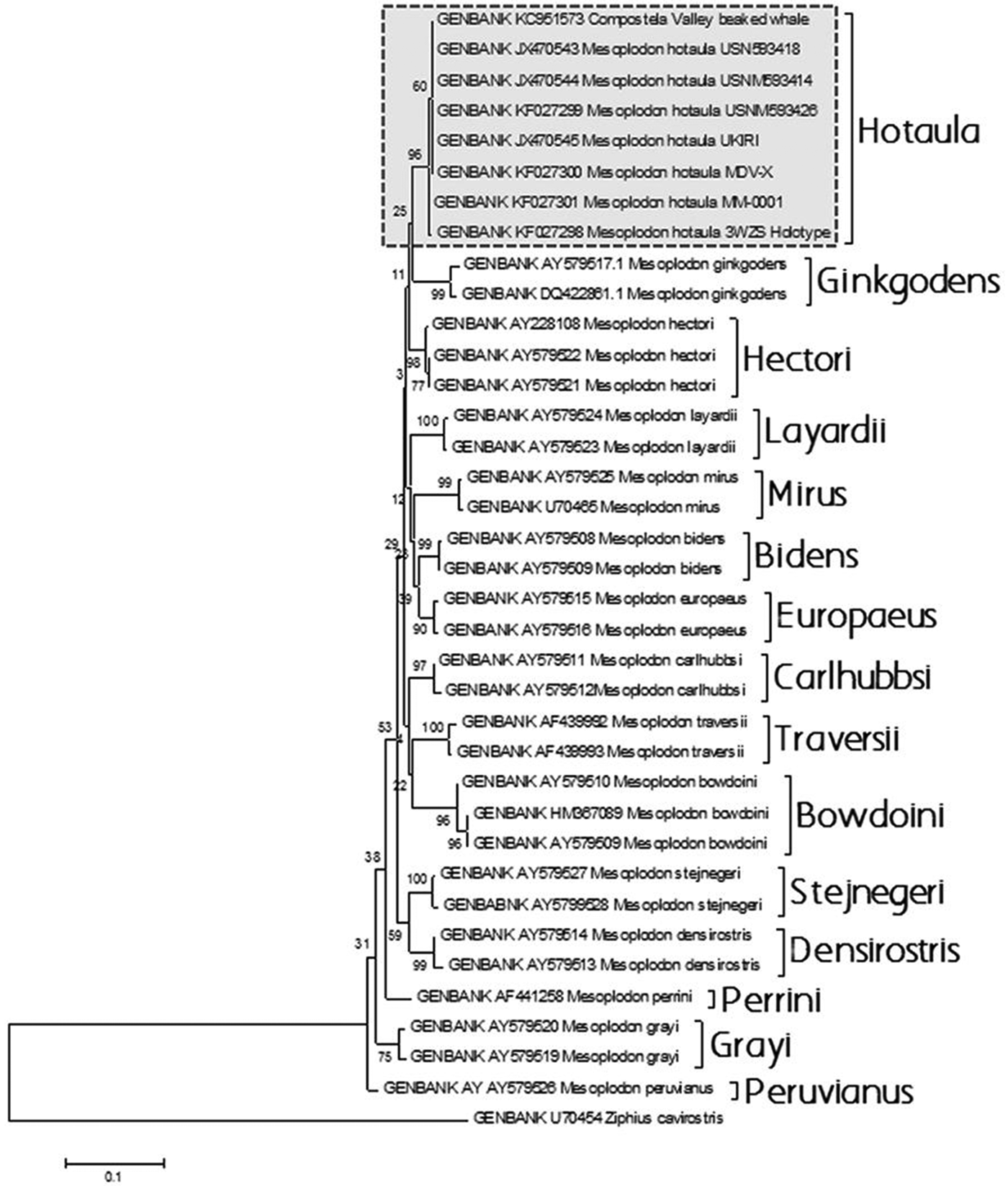
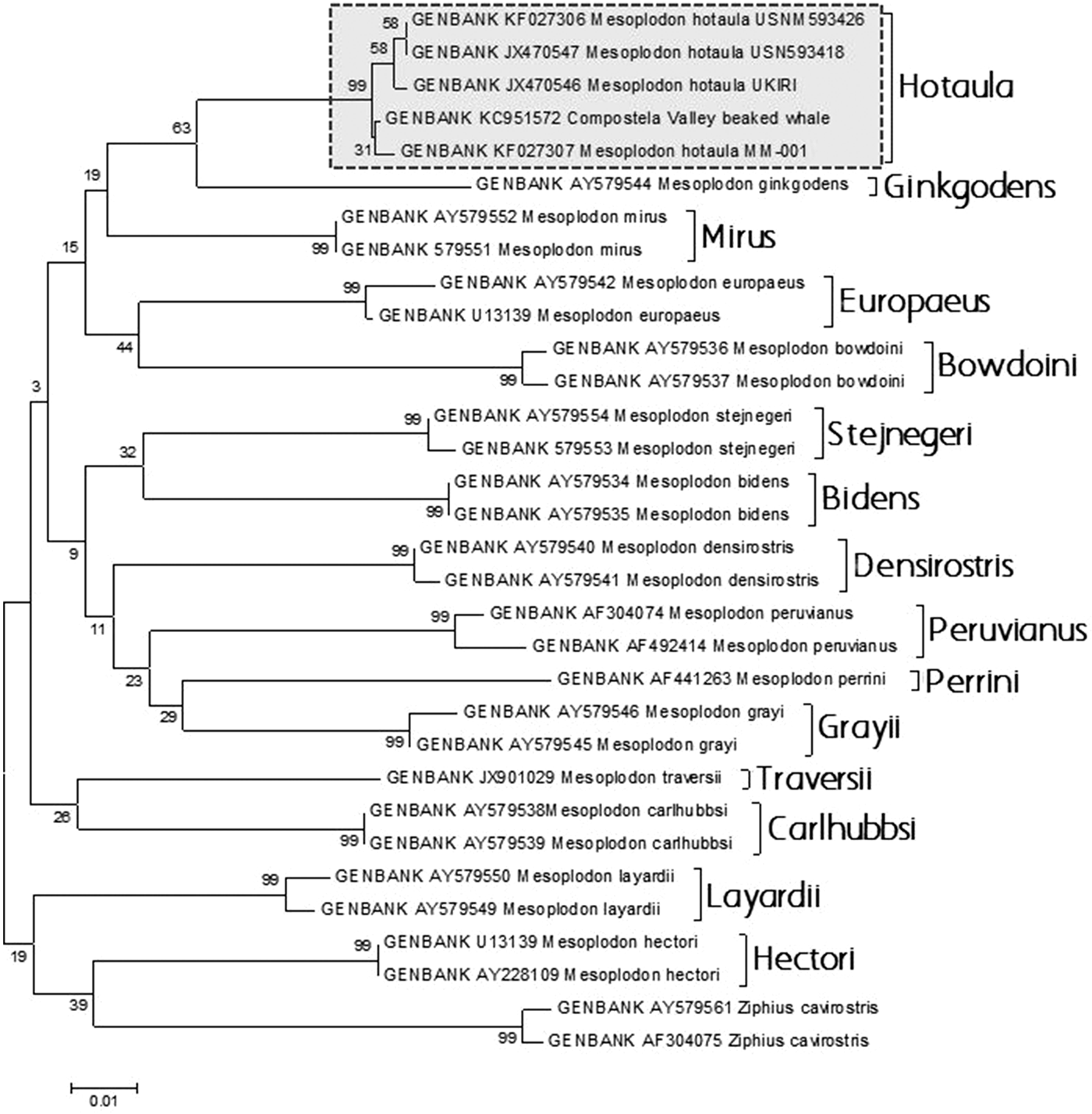
BLAST search of the generated partial sequences of CR with GENBANK Accession no: KC951573 and CytB with GENBANK Accession no: KC951572 from the Compostela Valley beaked whale showed that both genes have a 99% similarity to the published reference for Mesoplodon hotaula CR and CytB, and clustered with the same at 96% (Figure 2) and 99% (Figure 3) bootstrap values, respectively. These bootstrap scores are highly significant in suggesting a positive identification based on a simulation by Dalebout et al. (Reference Dalebout, Baker, Cockcroft, Mead and Yamada2004), where the bootstrap score cut-off for positive identification was set at ≥80%. The CR analysis involved 37 nucleotide sequences with 273 positions each in the final dataset, and 68 parsimony informative sites. While for CytB, analysis involved 32 nucleotide sequences with 266 positions each in the final dataset, with 92 parsimony informative sites. According to Dalebout et al. (Reference Dalebout, Mead, Baker, Baker and van Helden2002) and Dalebout et al. (Reference Dalebout, Baker, Cockcroft, Mead and Yamada2004), mtDNA CR and CytB are comprehensive and validated reference genetic markers for beaked whales.
Neighbour Joining Tree of Control Region sequences from Compostela Valley beaked whale sample and reference sequences using the Kimura 2-parameter model. All reference sequences obtained from GENBANK were labelled with database accession numbers.
Neighbour Joining Tree of Cytochrome B sequences from Compostela Valley beaked whale and reference sequences using the Kimura 2-parameter model. All reference sequences obtained from GENBANK were labelled with database accession numbers.
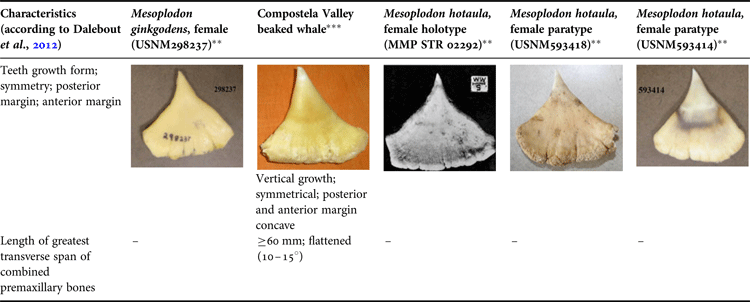
Photograph comparisons of the skull of the Compostela Valley beaked whale with the Mesoplodon hotaula holotype 3WZS (adult female; Sri-Lanka) show similarities in the forms of the skull and mandibles (Figure 4). According to Dalebout et al. (Reference Dalebout, Baker, Steel, Thompson, Robertson, Chivers, Perrin, Goonatilake, Anderson, Mead, Potter, Yamada, Thompson and Jupiter2014), teeth and skull characters are diagnostic for the Mesoplodon hotaula species where its teeth are taller than they are wide. For the Compostela Valley beaked whale specimen, the teeth were observed to be triangular in shape with teeth height and basal portion almost the same (left: H = 50 mm, B = 49 mm; right: H = 49 mm, B = 50 mm), forming a symmetrical concave-smooth anterior and posterior margins producing a narrow base rather than convex. Observation from the studies of Dalebout et al. (Reference Dalebout, Baker, Steel, Thompson, Robertson, Chivers, Perrin, Goonatilake, Anderson, Mead, Potter, Yamada, Thompson and Jupiter2012, Reference Dalebout, Baker, Steel, Thompson, Robertson, Chivers, Perrin, Goonatilake, Anderson, Mead, Potter, Yamada, Thompson and Jupiter2014), however, were not seen in this case, probably because the specimen they described was a male while the Compostela Valley beaked whale specimen is a female. Likewise, the teeth of the Compostela Valley beaked whale were compared with the female Mesoplodon hotaula holotype and paratypes from the Smithsonian Institution to which the specimen in this study clustered closest to in the genetic data analysis (Table 1). It showed that teeth of three female Mesoplodon hotaula type specimens were similar with the shape of the teeth of the Mesoplodon ginkgodens specimen, exhibiting concave-angular anterior and posterior margins producing a stout basal portion. Interestingly, the observed greatest transverse span of combined premaxillary bones was ≥60 mm and almost flattened, which is in accordance with one of the diagnostic characteristics given by Dalebout et al. (Reference Dalebout, Baker, Steel, Thompson, Robertson, Chivers, Perrin, Goonatilake, Anderson, Mead, Potter, Yamada, Thompson and Jupiter2014), which distinguishes the Mesoplodon hotaula species from Mesoplodon ginkgodens. The comparisons of the morphological characteristics of the skull and teeth still leave some questions, which could be answered if and when a male Mesoplodon hotaula specimen is recovered.
Compostela Valley beaked whale and Mesoplodon hotaula holotype (3WZS) comparisons. (A) Dorsal view of the skull of 3WZS (photo credit: Dr Manori Goonatilake/Department of National Museums, Sri-Lanka); (B) Dorsal view of the skull of Compostela Valley beaked whale (photo credit: Dr Mudjekeewis D. Santos/NFRDI); (C) Jaw of 3WZS (photo credit: Dr Manori Goonatilake/Department of National Museums, Sri-Lanka); (D) jaw of Compostela Valley beaked whale (photo credit: Dr Mudjekeewis D. Santos/NFRDI).
Diagnostic characteristics of teeth and skull based on Dalebout et al. (Reference Dalebout, Baker, Steel, Thompson, Robertson, Chivers, Perrin, Goonatilake, Anderson, Mead, Potter, Yamada, Thompson and Jupiter2012) comparing female Mesoplodon ginkgodens, Mesoplodon hotaula (from Smithsonian Institution Division of Mammals and Department of National Museums of Sri Lanka) and the Compostela Valley beaked whale specimen.
**Photos from: Smithsonian Institution Division of Mammals.
***Photo credit: Darrell Blatchley/D'Bone Collector Museum Inc.
Nevertheless, our results show that the Compostela Valley beaked whale is indeed Mesoplodon hotaula. This study is the first confirmed report of the presence of Mesoplodon hotaula in Philippine waters and only the eighth specimen in the world. Such a finding further underscores the importance of the Philippines and of the Coral Triangle in general, not only as the centre of marine biodiversity in the world, but as a haven for rare and endangered marine mammals that are in need of full protection.
ACKNOWLEDGEMENTS
The authors would like to acknowledge the National Fisheries Research and Development Institute (NFRDI) and the Department of Agriculture – Biotechnology Program (DA-Biotech) for providing the necessary funding for the study (project title: FISHCODES: Genetic Barcoding of CITES listed and Regulated Philippine Aquatic Species). Thanks are also due to the Director of the Department of National Museums of Sri Lanka and to Dr Manori Goonatilake of the same institution for providing the photographs of the Mesoplodon hotaula Deraniyagala 1963 holotype (3WZS). Bone specimens are kept in D'Bone Collector Museum Inc., Davao City, Philippines, while tissue samples are housed at the NFRDI – Genetic Fingerprinting Laboratory (GFL).