





LEARNING OBJECTIVES
After reading this article you will be able to:
-
• define infant mental health and recognise its lifelong and intergenerational significance
-
• identify infant and caregiver risk and protective factors for attachment disturbances and understand when to intervene or refer to other services
-
• understand the services that may be offered by specialist infant mental health teams and the contribution of psychiatrists to multidisciplinary care, risk management and ethical practice.
Infant mental health refers to the emotional, social and cognitive development of children in their first years of life, within the context of their key attachment relationships (Simpson Reference Simpson, Condon and Price2016). It is well established that secure attachment is associated with positive health and social outcomes, and that experiences of safe and consistent care are foundational for good future mental health (Ayre Reference Ayre and McLoughlin2025).
Children under 5 years of age are not routinely included in UK data collection on mental health conditions (Royal College of Psychiatrists (RCPsych) 2023), although a single 2017 survey in England reported that 5.5% of 2- to 4-year-olds had a mental disorder (NHS Digital 2018). Diagnostic criteria for infant mental disorders are codified in the Diagnostic Classification of Mental Health and Developmental Disorders of Infancy and Early Childhood (DC:0–5) (ZERO TO THREE 2021). Nonetheless, these remain significantly under-recognised. The 2023 RCPsych report into infant and early childhood mental health highlights a significant ‘implementation gap’ for under-5s and their parents, with only a minority of those requiring treatment receiving it (RCPsych 2023). Addressing this gap requires the involvement of multiple disciplines, including psychiatrists of all specialties whose patients may be caregivers or older siblings, as well as strategic implementation of specialist mental health services. This article aims to provide an introduction to this topic for general psychiatrists, including practical first steps relating to clinical practice.
Attachment research
The field of attachment research was pioneered by John Bowlby and Mary Ainsworth, who described differences in infant attachment between those who received responsive and consistent nurture from their mothers and those who did not (Simpson Reference Simpson, Condon and Price2016). This was informed by previous work by Anna Freud, Erik Erikson and Donald Winnicott, who all highlighted the first few years of life as a key developmental phase. Erikson’s work describes the tasks of the first two developmental stages as resolving conflicts between ‘trust and mistrust’ (in infancy) and ‘autonomy and shame/doubt’ (in early childhood), leading to the virtues of ‘hope’ and ‘will’ respectively (in contrast to ‘withdrawal’ and ‘compulsion’) (Dunkel Reference Dunkel and Harbke2017). During this period, infants are also learning behaviours and skills, such as relational repair or lack thereof, that are modelled for them by their caregivers (Simpson Reference Simpson, Condon and Price2016), as well as making meaning about themselves, their relationships and the world in general (Tronick Reference Tronick and Beeghly2011).
Infants are born primed for social interaction, with babies showing a preference for human faces from the newborn stage (Portugal Reference Portugal, Viktorsson and Taylor2024). An absence of social interaction from an attachment figure has been shown to lead to significant physiological stress, for example during the still-face experiment, where the adult is asked to adopt a ‘poker face’, remaining silent and unresponsive to the baby for a few minutes (Tronick Reference Tronick and Beeghly2011).
Early neurodevelopment
These socio-emotional experiences also shape wider neurodevelopment. During the first few years of life, more than a million neural connections are formed each second (Thompson Reference Thompson2024), providing potential for adaptation to a range of environments and experiences. These synaptic connections are then strengthened or pruned in response to the realities encountered, establishing neural circuits that underpin future learning, attention, motor skills and other developmental abilities. Both the absence of developmentally supportive experiences (such as exposure to language or nurturing touch) and the presence of adversity can be detrimental to development, altering both structure and function of the brain (Nelson Reference Nelson and Gabard-Durnam2020).
Critical and sensitive developmental periods have most clearly been identified for development of sensory and motor circuits (Dooley Reference Dooley and van der Heijden2024). However, there is evidence that infant adversity is associated with developmental differences in learning, memory, stress reactivity (Nelson Reference Nelson and Gabard-Durnam2020), threat perception and facial interpretation (Reilly Reference Reilly, Dickerson and Pierce2022). Persistently elevated stress, and associated hormonal changes, have been shown to damage brain architecture, alter epigenetic expression and affect immune function (Center on the Developing Child 2024). Electroencephalography studies show delayed maturation in children experiencing neglect, poverty or high parental stress, and parenting approaches that are harsh or controlling are associated with structural changes in brain regions associated with emotion regulation (Tan Reference Tan, Oppenheimer and Ladouceur2021). In contrast, supportive relationships can buffer this stress response and develop resilience, with evidence that attuned, predictable caregiving supports corticolimbic neural development (Gee Reference Gee and Cohodes2021). The early years period is therefore a critical stage to address intergenerational transmission of trauma, unhealthy relational patterns, insecure attachment and the developmental trajectories associated with these experiences.
‘Think family’
Regardless of specialty, every patient was once an infant. As part of a biopsychosocial formulation, consideration of that infant’s experience can shed light on a patient’s current relational patterns, assumptions of others and sense of identity, which may become especially prominent during periods of stress (Ayre Reference Ayre and McLoughlin2025). Many patients will also be parents or caregivers: although the field of attachment has traditionally focused on mothers, infants form meaningful attachments to multiple adults, and there is evidence that parents’ combined mentalisation abilities affect their children’s development (Trepiak Reference Trepiak, Deneault and Bureau2025). The RCPsych (2023: p. 72) has encouraged clinicians to ‘think family’, proactively ‘considering the impact of parental mental illness on the family system, including on unborn babies, infants and older children’. This includes family psychoeducation and care-planning in pre-conception and early-life discussions, considering the impact of medication (during pregnancy and breastfeeding) and the impact of sedation on levels of responsiveness to the child’s needs, as well as holding in mind the impact of their caregiver’s illness on the infant’s experience of them as a parent.
Never ‘too small to really understand or to remember’
There is a common myth that infants will be ‘too small to really understand or to remember’ (World Association of Infant Mental Health 2016), but we have already established that infants learn at a phenomenal rate, continually seeking out relationship with those around them, exploring their environment and being shaped by their experiences. Furthermore, cellular and molecular changes that alter developmental trajectory can occur without the need for the infant to remember or understand their experiences. These include epigenetic changes which are responsive to early intervention (Alexandra Reference Alexandra, Merrill and Konwar2024), and there is established evidence that both positive and negative experiences during childhood are a significant predictive factor of adult mental and physical health outcomes (Felitti Reference Felitti, Anda and Nordenberg1998; Narayan Reference Narayan, Rivera and Bernstein2018), as well as educational attainment and employment (Johnson Reference Johnson and Kossykh2008). Broader sociocultural factors and subsequent life experiences may further compound or mitigate these risks (Beeghly Reference Beeghly2024).
Intergenerational transmission of adversity
Early adversity and adult mental disorders, including substance misuse, are closely interrelated and there is a multitude of pathways by which intergenerational adversity may be transmitted. Early adverse experiences increase the risk of mental health difficulties later in life, and the stresses associated with parenting can exacerbate existing mental health conditions or precipitate poor mental health (e.g. postnatal psychosis, anxiety or depression). Caregivers experiencing mental health problems may also face challenges in parenting across developmental stages, contributing to cyclical patterns of adversity across generations. Their actions may affect the in utero environment (chemically, e.g. through substance use; biologically, e.g. through maternal cortisol levels; socio-emotionally, e.g. through how much they connect with and talk to their unborn child). Both illness and treatment may affect their ability to be physically or emotionally present with their infant (Garthus-Niegel Reference Garthus-Niegel, Benyamini and Horsch2021) and they may lack the skills or capacity to mentalise their infant’s experience and anticipate their needs. Becoming a parent may unearth their own negative experiences of being parented or lead them to question their competence as a caregiver. Or they may struggle with emotion regulation and therefore be unable to tolerate distress in their child, limiting their ability to co-regulate and soothe. These differences have been demonstrated on a neurological level: for example, infant distress elicits higher levels of amygdalar activity in mothers with a history of early adversity (Beeghly Reference Beeghly2024).
It is important to keep in mind that the infant’s experience of a situation may differ hugely from that of an adult: if we conceptualise trauma as an experience that overwhelms one’s ability to cope, then an infant whose caregiver (on whom they are wholly dependent) is struggling will seek to survive that experience in any way that they can, even if that means shutting themselves off from the very connections on which their development depends (Tronick Reference Tronick and Beeghly2011).
Nonetheless, negative outcomes for these infants are not a foregone conclusion. This sensitive period of development presents a unique opportunity for intervention that can interrupt these intergenerational cycles and alter developmental trajectories. General psychiatrists therefore have an important role to play in identifying dyads who may be struggling or who are at significant risk of doing so.
Identifying and responding to those at risk
The UK government has developed three conversation prompts as part of a framework to identify parent–infant difficulties (Department of Health and Social Care 2024a) (Box 1). The Australian Centre of Perinatal Excellence (2023) has also produced a concise guide to mother–infant interactions for healthcare professionals.
Three conversation starters to identify parent–infant difficulties
-
• ‘What three words or phrases would you use to describe your relationship with your baby?’
-
• ‘What brings you the most joy in the relationship with your baby?’
-
• ‘What is your biggest fear about your relationship with your baby?’
(Department of Health and Social Care 2024a)
Key definitions relating to early parent–child social interactions
Attachment – emotional connection between infants and their caregivers to ensure that the infants’ fundamental needs of protection, nurture, safety and regulation are met.
Attunement – caregiver’s ability to notice, interpret and respond to an infant’s cues in a timely and appropriate way.
Co-regulation – the process by which caregivers support their infant to soothe and organise their emotional experiences and physiological arousal.
Mentalisation – caregiver’s ability to understand their child as having distinct thoughts, feelings and intentions separate from their own.
Mirroring – the attuned reflection of an infant’s emotional expression by the caregiver, often in a slightly exaggerated way, providing validation and supporting the infant’s growing self-awareness.
Serve-and-return – back and forth interaction between infant and caregiver through vocalisation, gesture and facial expression.
Infant mental health ‘red flags’
-
• Recurrent conflict or distress in caregiver–infant interactions
-
• Concerns about bonding (e.g. lack of felt connection, fearful or disorganised responses from caregiver)
-
• Significant parental mental health difficulties affecting caregiving abilitya
-
• Lack of social engagement and emotional responsiveness in the infant (e.g. avoidant gaze, minimal emotional expression, lack of vocalisation)
-
• Marked sleep or feeding difficulties
-
• Persistent/inconsolable crying or extreme irritability
-
• Domestic abuse, neglect or exposure to traumaa
a. Also consider child protection referral.
Case vignette: supporting the infant’s mental health during an episode of maternal postpartum psychosis
A mother and her 2-week-old baby arrive on the mother and baby unit. The mother is experiencing postpartum psychosis. There has been an abrupt change in her mood, her speech is pressured and she is unable to sleep. She is especially anxious about her infant’s well-being and believes her baby is in danger. From the outset of admission the parent–infant relationship is held in mind and a care plan developed that focuses on the mother’s recovery, while protecting and promoting her developing bond with her infant. The clinical team are mindful that the infant has developed sensory-based ‘safety cues’ through familiarity with the sound and vibration of the mother’s voice, her rhythmical heartbeat, and the smell and taste of the amniotic fluid.a Where possible, and safe to do so, the infant is kept in close proximity to the mother, who is encouraged and supported to attend to baby care. When appropriate, the mother is prompted to talk to her baby, to be face to face and offer tactile experiences such as skin-to-skin contact.
The use of medication is carefully considered, to support sleep, treat psychotic symptoms and stabilise mood. When necessary, nursery nurses offer baby care and named members of staff are allocated to minimise the number of caregivers, ensuring consistent and predictable interaction. Staff are encouraged to place a muslin that the mother has slept on over their shoulder to simulate proximity to the mother during feeding. In return, the mother is prompted to smell the infant’s clothing to stimulate a release of oxytocin. These small, cumulative interventions help keep both the mother and the infant open to connection at a very difficult time. As the mother previously expressed a wish to maintain breastfeeding, she is supported to pump milk to maintain her supply, so that this can be re-established once levels of medication in the breastmilk are reduced to a safe level. As the mother’s mental state improves, she is encouraged to reflect on her baby’s needs, prompting mentalisation and enhancing her capacity for sensitive caregiving.
Following discharge, the mother struggled to remember the early weeks of her baby’s life, and was distressed that she could not offer the care she had envisaged. Her in-patient care plan was shared with her, and she was able to reflect that, despite her admission, her baby’s needs had been met and their relationship protected. This helped to reduce feelings of guilt and positively shift her perception of their early relationship.
a. Research suggests that breastmilk and amniotic fluid share similar smells and flavours and babies do recognise and respond to this familiarity (Laleh Reference Laleh, İnal, Maghalian and Mirghafourvand2025).
Case vignette: taking a culturally sensitive approach in a parent–infant relationship service
A 15-month-old girl was referred to a parent–infant relationship service because of unsettled sleep, prolonged crying at night and difficulties adjusting to nursery school. Her mother, who had moved to the UK a few years earlier, described significant fatigue and little support from relatives nearby. In the nursery setting, the girl clung to familiar adults, was hesitant to join play and her attendance was inconsistent.
The assessment highlighted cultural differences in expectations about infant care. In the family’s tradition, children were often raised with several generations under one roof, with babies sleeping close to caregivers for reassurance. Crying at night was seen as a healthy sign of vitality and there was little expectation that toddlers would spend time in group childcare before they could talk. These perspectives contrasted with the service’s usual emphasis on sleep routines, gradual separation and supporting early peer play.
The team reflected on how these cultural understandings shifted the meaning of the child’s behaviours. What staff initially saw as ‘dependence’ or ‘sleep problems’ was viewed by the caregiver as developmentally appropriate and even desirable. The dilemma was how to respond: would encouraging routines and independence risk undermining family values, or would not doing so risk missing opportunities to support the child’s development?
The team adapted by slowing down their approach, focusing less on nursery school attendance and more on strengthening responsive caregiving in ways that respected the family’s cultural framework. They worked collaboratively with the mother to identify small steps towards fostering exploration while validating her emphasis on closeness. Regular reflective discussions helped the team question their own assumptions and avoid imposing norms that might not fit this family.
Early social interactions (including attunement, joint and directed attention, mirroring, serve-and-return interactions and co-regulation of emotional responses) (Box 2) can be likened to a dance partnership, with both parties contributing to its success (or failure). From the caregiver’s side: pre-existing or ongoing mental illness, substance use, a history of abuse or neglect, unexpected pregnancy, fertility difficulties, traumatic delivery, early separation and lack of social support all increase the risk of relationship problems. Likewise, infant temperament, health difficulties or feeding problems can make an individual baby more challenging to ‘dance with’. Identification of any of these risk factors should prompt a more detailed assessment.
Prompt response to any direct risk to the infant is vital; however, assessment should be expanded to identify more subtle markers of attachment disturbance. This includes asking about the caregiver’s perspective on the relationship, observing the interaction between caregiver and infant, and observing the infant, mentalising their experience of the relationship. Antenatally, it is important to note any reluctance or inability to adequately prepare (e.g. buying clothes and building the crib). Other concerning features include an inability to identify and reflect on the baby’s needs (physical, social and emotional) as distinct from their own; a lack of enjoyment, pride or delight in the infant; an inability to cope with their child’s distress; and absent or inconsistent responses to the infant’s cues or bids for attention.
In some cases, caregivers may be excessively worried about their nurturing ability, yet observation of the relationship identifies warmth, responsiveness and normal socio-emotional development of the infant. In such cases, simple interventions to instil confidence and reduce anxiety may be all that is necessary. Conversely, over-reliance on a caregiver’s positive history risks missing infants who may be misunderstood as ‘easy babies’, but in reality have become ‘switched off’ to connection (Tronick Reference Tronick and Beeghly2011). Such infants may avoid the gaze of their caregiver, neglect to signal needs through vocalisation or crying, or be under-responsive to attempts to engage them. Older children may be excessively anxious in relation to separation from their caregiver, or overly familiar with strangers. More obvious signs of distress, such as constant crying, may also be observed.
If risk factors or mild relational difficulties are identified, non-specialists can offer a variety of interventions. Helping parents to reflect on their own experience of being parented can support both self-compassion and behavioural change. Highlighting and modelling positive interactions, such as mirroring, responsiveness or serve-and-return, can encourage caregivers to increase these behaviours. Inviting curiosity into the infant’s experiences and intentions can support attunement and mentalisation. Describing infant distress and behaviour in terms of communication, rather than negative intent, can build responsiveness and compassion, rather than irritation and frustration.
Red flags
Clinicians who recognise any of the ‘red flags’ listed in Box 3 should consider discussion with the family’s health visitor in the first instance, as that individual is often best placed to conduct a further assessment; specialist infant mental health, social work or third-sector services may also be available for consultation or referral.
Specialist teams
Provision of specialist infant mental healthcare in the UK is subject to enormous geographical variation, with a variety of models espoused. Perhaps the most common is integration of infant mental health within existing services, such as upskilling health visitors and other early years professionals in some of the interventions below. This builds on existing knowledge and expertise. However, competing demands may limit the time available for specialist interventions, and generalists may lack the skills to respond to more complex or severe presentations. Another approach is to integrate infant mental health within perinatal services, but most services will support women for only 1 year after childbirth. Some mainstream child and adolescent mental health services (CAMHS) have provision for 0- to 5-year-olds, however other CAMHS services do not accept referrals from this age group. Community paediatric services also have a key role in identifying developmental delays or neurodevelopmental conditions, but are generally not specifically trained to assess or treat infant mental health problems. Other services, such as infant feeding teams, family nurse partnerships and third-sector organisations, have expertise in supporting families facing specific challenges, and interdisciplinary working is vital where multiple services may be involved. However, specialist infant mental health teams are uniquely placed to provide specialised support for infants who are struggling, as well as offering training and consultation to other front-line workers.
In 2022, there were 42 specialist parent–infant teams across the UK (Parent–Infant Foundation Reference Foundation2022), organised into a range of structures. Professionals within these teams may include psychologists, psychotherapists, nurses, health visitors, support workers, social workers, occupational therapists and psychiatrists, all of whom have additional training in infant observation and attachment-focused interventions. Psychiatrists specifically have a training background that allows consideration of potential medical, genetic or neurodevelopmental causes across the lifespan that may be contributing to observed attachment difficulties, taking a truly biopsychosocial approach for both infant and caregiver. They also bring experience in risk assessment and management, as well as taking a lead role in liaising with other teams that may be involved, such as paediatrics or adult mental health services.
Assessment tools and therapeutic interventions
The case vignette in Box 4 illustrates some of the ways that teams can creatively work to support an infant’s mental health during an episode of acute parental mental illness (both case vignettes in this article are fictitious). However, once the situation is more stable, a more structured approach may be beneficial.
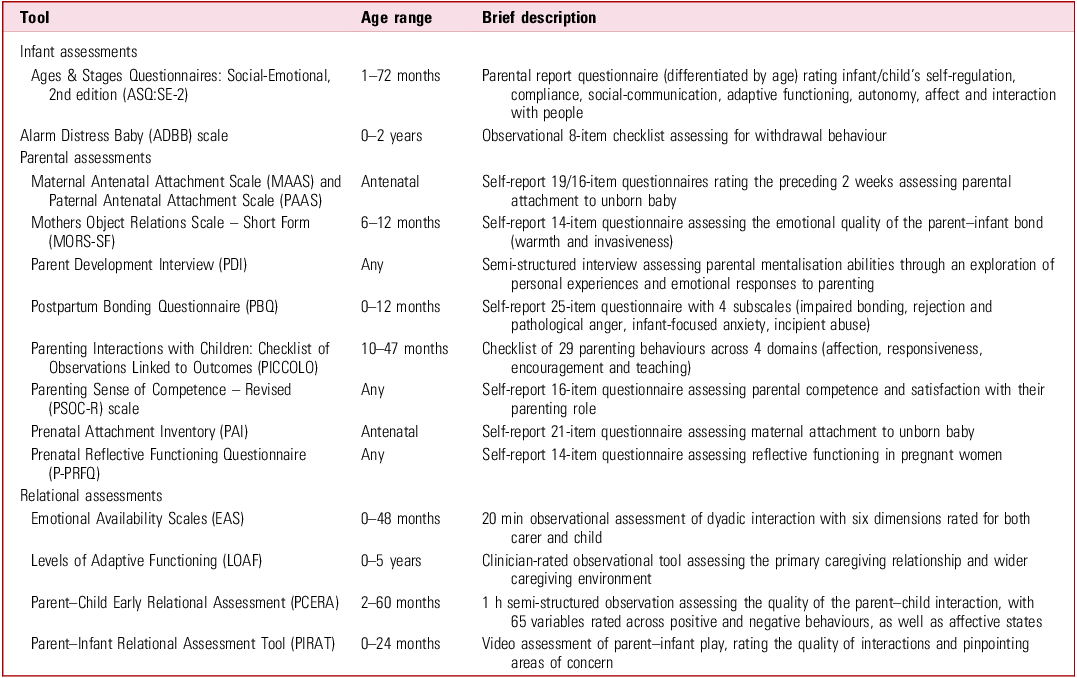
The Parent–Infant Foundation Toolkit (Bateson Reference Bateson, Lang, Hogg and Clear2019) has a comprehensive list of assessment tools that can contribute to a full infant mental health assessment. Some of these are also be used by teams as outcome measures or to monitor change over time, and many require specialist training. A selection of the more commonly used tools are summarised in Table 1.
Infant mental health assessment tools

TABLE 1 Long description
A table summarizing a selection of commonly used infant mental health assessment tools, categorized by tool type, age range, and brief description. The table has three columns: Tool, Age range, and Brief description. It includes 15 rows of data, each describing a different assessment tool. Row 1: Infant assessments, Ages & Stages Questionnaires: Social-Emotional, 2nd edition (ASQ:SE-2), 1-72 months, Parental report questionnaire differentiated by age rating infant/child’s self-regulation, compliance, social-communication, adaptive functioning, autonomy, affect and interaction with people. Row 2: Infant assessments, Alarm Distress Baby (ADBB) scale, 0-2 years, Observational 8-item checklist assessing for withdrawal behaviour. Row 3: Parental assessments, Maternal Antenatal Attachment Scale (MAAS) and Paternal Antenatal Attachment Scale (PAAS), Antenatal, Self-report 19/16-item questionnaires rating the preceding 2 weeks assessing parental attachment to unborn baby. Row 4: Parental assessments, Mothers Object Relations Scale - Short Form (MORS-SF), 6-12 months, Self-report 14-item questionnaire assessing the emotional quality of the parent-infant bond (warmth and invasiveness). Row 5: Parental assessments, Parent Development Interview (PDI), Any, Semi-structured interview assessing parental mentalisation abilities through an exploration of personal experiences and emotional responses to parenting. Row 6: Parental assessments, Postpartum Bonding Questionnaire (PBQ), 0-12 months, Self-report 25-item questionnaire with 4 subscales (impaired bonding, rejection and pathological anger, infant-focused anxiety, incipient abuse). Row 7: Parental assessments, Parenting Interactions with Children: Checklist of Observations Linked to Outcomes (PICCOLO), 10-47 months, Checklist of 29 parenting behaviours across 4 domains (affection, responsiveness, encouragement and teaching). Row 8: Parental assessments, Parenting Sense of Competence - Revised (PSOC-R) scale, Any, Self-report 16-item questionnaire assessing parental competence and satisfaction with their parenting role. Row 9: Parental assessments, Prenatal Attachment Inventory (PAI), Antenatal, Self-report 21-item questionnaire assessing maternal attachment to unborn baby. Row 10: Parental assessments, Prenatal Reflective Functioning Questionnaire (P-PRFQ), Any, Self-report 14-item questionnaire assessing reflective functioning in pregnant women. Row 11: Relational assessments, Emotional Availability Scales (EAS), 0-48 months, 20 min observational assessment of dyadic interaction with six dimensions rated for both carer and child. Row 12: Relational assessments, Levels of Adaptive Functioning (LOAF), 0-5 years, Clinician-rated observational tool assessing the primary caregiving relationship and wider caregiving environment. Row 13: Relational assessments, Parent-Child Early Relational Assessment (PCERA), 2-60 months, 1 h semi-structured observation assessing the quality of the parent-child interaction, with 65 variables rated across positive and negative behaviours, as well as affective states. Row 14: Relational assessments, Parent-Infant Relational Assessment Tool (PIRAT), 0-24 months, Video assessment of parent-infant play, rating the quality of interactions and pinpointing areas of concern.
Source: adapted from Bateson et al (Reference Bateson, Lang, Hogg and Clear2019).
Similarly, there are numerous potential interventions with a developing evidence base. Space precludes an exhaustive list of all available modalities, and availability will vary with local need and capacity. However, effective interventions share a relationship and attachment focus, supporting the caregiver to develop their attunement and responsiveness to their infant. Interventions are categorised below, along with illustrative examples of those with the strongest evidence base and/or that are available within NHS Scotland (where we are based). Direct treatment of a parental mental illness also benefits infant mental health, although we have not included adult-focused therapies (such as cognitive–behavioural therapy) in our summary.
Newborn Behavioural Observation (NBO) system
The NBO system is a structured, strengths-based, 18-item tool that can be used with parent–infant dyads during the first 3 months of life. It assumes that infants communicate through their behaviour and is designed to help parents understand and trust their infant’s cues. It highlights the uniqueness of each infant (e.g. differences in stimulation threshold; individual ways of eliciting parental engagement), identifying strengths and areas where they may need more support. The NBO is supported by four randomised controlled trials (RCTs) (NHS Education for Scotland 2021), with benefits to infant neurodevelopment, parental sensitivity and maternal mental health (lower rates of anxiety and depression).
Groups and courses
Group interventions (e.g. the Circle of Security; Group Attachment-Based Intervention; Mellow Babies) have benefits on several levels. They can be an effective use of limited resources, with multiple families benefitting from the input of one or two clinicians. They also facilitate peer support, which can be vital for parents, who may easily become isolated during this period, and reduce the stigma that can accompany parenting struggles.
A systematic review into the efficacy of manualised attachment-based interventions (Wittkowski 2025) identified Circle of Security as having the strongest evidence base for a group intervention, supported by five studies, three of which were RCTs. Overall, these suggest modest improvements in attachment security and parental sensitivity, with stronger effects observed in certain subgroups (e.g. highly irritable infants, mothers with their own attachment difficulties). Other group interventions were also found to have positive outcomes but were supported by fewer or lower-quality research studies.
Video-based interventions
A variety of video-feedback interventions have been shown to support parental reflective capacity and strengthen parent–infant attachment. Video Interaction Guidance (VIG) is a strengths-based video-feedback approach that helps caregivers to build on existing skills in responding to their child’s attempts at communication. Interactions between caregiver and child are filmed and edited to show positive interactions, which the practitioner then helps the caregiver to reflect on. This leads to a shift in how the caregiver perceives their own nurturing skills and provides motivation to continue behaviours that support their child’s development. VIG is one of several video-based interventions recommended in National Institute for Health and Care Excellence (NICE) guidelines, including those for the treatment of autism, attachment difficulties, and social and emotional well-being in early years (NHS Education for Scotland 2021). Other video interventions include Video-Feedback Intervention to Promote Positive Parenting and Sensitive Discipline (VIPP-SD) and the Attachment Video-feedback Intervention (AVI).
Psychodynamic therapies
Psychodynamic therapies focus on supporting the parent to reflect on their own past experiences, their child’s experiences and the parent–infant relationship, helping them to change their internal narrative and behavioural responses. Parent–infant psychotherapy (PIP) has been shown to improve mothers’ internal representations of their infants, as well as maternal mood and stress levels at 12 months (Fonagy Reference Fonagy, Sleed and Baradon2016). Child–parent psychotherapy (CPP) is targeted at dyads who have experienced abuse, family violence or neglect. CPP has been evaluated by four RCTs (Child–Parent Psychotherapy 2026) and found to significantly reduce children’s symptoms of trauma, with positive behavioural changes persisting at 6 months (Foundations 2025).
One-to-one coaching interventions
One-to-one coaching helps caregivers to follow their child’s lead, interpret their cues and reduce undesirable caregiver behaviour. In Parent–Child Interaction Therapy (PCIT), facilitators observe dyadic interactions and provide coaching in real time through an earpiece. Supported by four RCTs, it has been shown to improve parenting skills and reduce both parental stress and child behavioural problems (NHS Education for Scotland 2021). Attachment and Biobehavioral Catch-up (ABC) is a 10-session home-visiting intervention aimed specifically at families at risk of adversity or child maltreatment. Many RCTs of this intervention (NHS Education for Scotland 2021) have demonstrated higher rates of secure attachment that persist well into later childhood, with improved self-regulation skills, language development and executive functioning, as well as improved parental sensitivity and felt well-being.
Cultural and ethical considerations
Historically, research into infant attachment has been conducted predominantly in Westernised societies. Although there is ongoing debate about the degree to which it is a globally applicable construct, there is general consensus that the drive for infants to ensure proximity to, and care from, adults around them is an innate, biological and survival-oriented process (Granqvist Reference Granqvist2021). However, attachment relationships are also the foundation of social learning and cultural transmission, and so parenting goals will vary across cultures. For example, Rothbaum et al (Reference Rothbaum, Weisz and Pott2000) highlight that Western attachment theory prioritises individual autonomy and competence, whereas Japanese culture places a higher value on social harmony and interdependence. The structures within which secure attachment can develop will also vary, with some cultures having a stronger practice of communal parenting (alloparenting), rather than relying on one or two primary caregivers (Granqvist Reference Granqvist2021).
All clinicians will carry with them cultural expectations about caregiving practices, family structure, parental roles, communication styles and causes of both infant and parental distress. Humility, clinical skill and cultural competence are all vital in navigating situations where societal differences may be misidentified as pathology, or where culturally accepted practices have the potential to cause harm. The case vignette in Box 5 illustrates the importance of a culturally sensitive approach to parent–infant assessments and interventions, which may need to be adapted to be accessible and relevant to an individual family.
Although some interventions (such as the Circle of Security) have shown effectiveness across a wide range of populations and settings (Wittkowski Reference Wittkowski, Crompton and Wan2025), others have a narrower evidence base, and the needs of local populations should be considered alongside published evidence as part of service design.
Consent, justice and confidentiality
Ethical considerations include issues of consent, justice and confidentiality. In other situations, parents have the right and responsibility to consent on behalf of their children to medical or therapeutic interventions. However, in the case of infant mental healthcare, the parent is also a ‘co-patient’. Although the goal of an intervention is to improve the health of both infant and carer, there may be occasions where these come into conflict. For example, much of the literature promotes a strengths-based approach, but this may lead to a minimising of the impact of the carer’s behaviour on the infant, whose needs are consequently treated as less important, thus undermining the potential opportunity for change. Therapists may also be consulted about children being removed from their parents, creating conflict between maintaining hope for positive change and preventing ongoing harm (Zeanah Reference Zeanah, Korfmacher and Lim2023). Such interventions may also perpetuate systemic racial inequalities and replay parents’ own traumatic early experiences (Lim Reference Lim, Korfmacher and Steier2023).
The World Association for Infant Mental Health (2016) highlights that infants are even more vulnerable than other children, as they are unable to express their perspective, and therefore holding this in mind is central to responding to their distress and ensuring their rights are respected. If a family declines an infant mental health intervention, in what circumstances (if at all) should this be overridden? It is a well-established practice that child protection issues take precedence over any other concern, but where the potential for harm is less imminent, the boundaries can be less clear.
Similar potential conflicts of interest are relevant to confidentiality. In a family where several caregivers (including, perhaps, extended family or foster carers) may be involved with an infant, both maintaining trust and maximising infant development and nurture need to be held as high priorities.
Research and policy considerations
Government policies: commitments and realities
Beyond individual families, improving infant mental health is increasingly being understood as an important public health priority. In 2021, the UK government published The Best Start for Life: A Vision for the 1001 Critical Days (UK Government 2021), which was followed by Improving the Mental Health of Babies, Children and Young People: Examples of Government-Led Contributions in 2024 (Department of Health and Social Care 2024b). Both guidelines aim to improve the mental health of babies in England during this critical period, with £100 million of funding allocated to improving perinatal mental health and parent–infant relationships support (Department of Health and Social Care 2023). In 2019, the Scottish Government published its Perinatal and Infant Mental Health Delivery Plan, accompanied by a commitment to £50 million of funding (Scottish Government 2019). The provision of early years, relationship-based interventions is also mentioned in the 2023 Mental Health and Wellbeing Strategy (Scottish Government 2023). The Welsh and Northern Irish Governments have both pledged improvements to infant mental health support as part of their current 10-year mental health strategies (Department of Health (Northern Ireland) 2021; Welsh Government 2025). Several of these guidelines and policies were published by governments no longer in power, and it remains to be seen whether their commitments are honoured.
As already discussed, provision of infant mental health services continues to be subject to significant geographical variation, with many localities in the UK having no access to specialist resources. In addition to clinical work, psychiatrists have a key role in advocacy and shaping policy. With increasing demands on both CAMHS and adult mental health services, we cannot afford to ignore the benefits of early interventions. Not only is ‘prevention better than cure’, but child development interventions give up to a 13-fold return on investment (Bateson Reference Bateson, Lang, Hogg and Clear2019: p. 25) through reduced need of services in later life and increased economic contribution. The World Health Organization has stated that ‘investing in early childhood development is one of the best investments a country can make to boost economic growth, promote peaceful and sustainable societies, and eliminate extreme poverty and inequality’ (cited in Bateson Reference Bateson, Lang, Hogg and Clear2019: p. 25). It is also vital that supporting infant mental health is considered in wider policy decisions, such as improving access to perinatal support, childcare provision (including for children with complex needs), parental leave, poverty reduction and addressing intimate partner violence. This includes education for all who may influence the well-being of this age group: childcare providers, social workers, judges and magistrates, child protection officers, housing officers and other professionals who regularly support families.
Research priorities
There is an urgent need for research into the needs of infants in culturally diverse populations. Families in which either a parent or a child has an intellectual disability or is neurodivergent are also significantly under-represented in existing literature.
Although there is a substantial research base supporting the lifelong importance of good infant mental health, as well as a strong theoretical basis for the benefits of early intervention, there is a need for high-quality longitudinal studies to understand the longer-term impacts of interventions to improve infant mental health. This includes universal strategies (made widely available regardless of need, e.g. Scotland’s programme to widen access to NBO training to health visitors and other early years practitioners) (NHS Education for Scotland 2021), population-specific interventions (directed at higher-risk populations, such as Circle of Security groups for low-income families) and problem-specific interventions (for those identified with specific problems, e.g. VIG or PIP through specialist referral) can also be beneficial. Given the biological, and therefore potentially measurable, impacts of poor infant mental health (e.g. changes in the hypothalamic–pituitary–adrenal axis and immune signalling, epigenetic alterations, structural neurological changes), research into the predictive value of these may help improve diagnosis, personalise the interventions offered and help predict treatment responses.
Conclusion
The first years of life set the trajectory for a child’s cognitive, social and emotional development, fundamentally shaping brain architecture and influencing their future relationships, learning ability, emotion regulation, and both physical and mental health. Psychiatrists of all specialties can benefit from considering these early experiences as part of their formulation of patient presentations, and they have a key role in identifying and supporting patients who are parents and carers. By identifying dyads who may be at risk or by noticing infants in distress (including those who are ‘switched off’ to connection), we can ensure that families receive early intervention to support the development of secure attachment through attuned and responsive caregiving.
Specialist infant mental health teams have a unique role in supporting the most complex families and providing consultation and training to other clinicians. However, provision is currently subject to significant geographical variation and there is limited research into the efficacy of interventions in families from non-Western cultural backgrounds. There is a strong economic argument for further investment in infant mental health services and longitudinal research.
By applying a developmental and relational approach to both individual assessments and service design we have the opportunity to positively alter developmental trajectories, interrupt intergenerational cycles and address growing health inequalities.
MCQs
Select the single best option for each question stem
-
1 Which statement best captures the concept of infant mental health?
-
a It refers to the absence of psychiatric disorders in children under 5 years
-
b It encompasses the emotional, social and cognitive development of infants within key attachment relationships
-
c It is primarily concerned with cognitive milestones and educational attainment
-
d It only matters in perinatal psychiatry and child psychiatry
-
e It is limited to the study of mother–infant interactions in Western populations.
-
-
2 Which of the following scenarios captures both infant and caregiver risks for disrupted attachment?
-
a An infant born with mild developmental delays and a caregiver who is familiar with the infant’s cues, enjoys playing with their baby and attends regular community groups
-
b An infant with high sensitivity to sensory input and a caregiver who provides regular breaks in play when the infant appears overstimulated
-
c An infant with a cow’s milk protein allergy and a caregiver who is occasionally tearful when their baby is distressed
-
d An infant with feeding difficulties and frequent distress and a caregiver experiencing postnatal depression with limited social support
-
e An infant with a high curiosity temperament and a caregiver with a physical disability.
-
-
3 Which statement best describes how video-feedback interventions help caregivers to improve the parent–infant relationship?
-
a They provide a theoretical understanding of helpful parenting practices
-
b They highlight positive interactions to develop understanding of the infant’s cues and build on existing skills
-
c They allow detailed analysis of infant behaviour to identify potential developmental delays
-
d They provide evidence for clinicians of inadequate parenting skills
-
e They show video clips of other parents to demonstrate good practice that caregivers can imitate.
-
-
4 Which statement accurately reflects the role of psychiatrists and specialist infant mental health teams?
-
a They provide support focusing on infants under 1 year
-
b They focus on parental, rather than infant, mental health
-
c They contribute expertise in biopsychosocial assessment, risk management, multidisciplinary liaison and interventions for complex parent–infant dyads
-
d They replace the role of health visitors and CAMHS
-
e They primarily provide pharmacological interventions to infants.
-
-
5 Which of the following best illustrates an ethical or cultural consideration in infant mental health practice?
-
a Encouraging families to follow standardised sleep and childcare routines to promote consistency across services
-
b Prioritising caregiver preferences even when they conflict with the infant’s developmental needs
-
c Balancing the infant’s developmental needs with respect for cultural parenting practices, ensuring consent, confidentiality, equity and relevant national guidance
-
d Applying uniform intervention strategies for all infants to ensure equal treatment regardless of background
-
e Avoiding early intervention if the family expresses hesitancy.
-
MCQ answers
-
1 b
-
2 d
-
3 b
-
4 c
-
5 c
Data availability
Data availability is not applicable to this article as no new data were created or analysed in this study.
Author contributions
N.E. conceived the idea for the article, led the development of the manuscript, and coordinated drafting and revisions. R.M. and M.P. contributed specialist clinical expertise in perinatal and infant mental health and critically reviewed the manuscript’s intellectual content. G.W. contributed to the conceptual development of the article, proposed submission in an educational format, and assisted with drafting and refinement of the manuscript. All authors contributed to manuscript revision, approved the final version for submission and agree to be accountable for all aspects of the work.
Funding
This research received no specific grant from any funding agency, commercial or not-for-profit sectors.
Declaration of interest
None.

 Open access


eLetters
No eLetters have been published for this article.