Introduction
Hyponatraemia is frequent in older people,Reference Miller, Hecker, Friedlander and Carter1–Reference Miller4 and advanced age is a risk factor for its development.Reference Lindner, Pfortmüller, Leichtle, Fielder and Exadaktylos2 Even mild/moderate hyponatraemia can induce serious symptoms, often undetected in older individuals. Yet it is often overlooked, erroneously classified, inadequately diagnosed and frequently undertreated. Over the past year, comprehensive Expert Panel Recommendations as well as guidelines have been published on hyponatraemia.Reference Verbalis, Goldsmith, Greenberg, Korzelius, Schrier, Sterns and Thompson5,Reference Spasovski, Vanholder, Allolio, Annane, Ball, Bichet, Decaux, Fenske, Hoorn, Ichai, Joannidis, Soupart, Zietse, Haller, van der Veer, Van Biesen and NAgler6 A detailed roadmap has been presented on the management of inappropriate anti-diuretic hormone secretion (SIADH)-induced hyponatraemia.Reference Runkle, Villabona, Navarro, Pose, Formiga, Tejedor and Poch7 In this review we will outline a practical, step-by-step approach for the detection, diagnosis and treatment of hyponatraemia in the elderly.
Randomized clinical trials and meta-analyses are few and far between in the field of hyponatraemia, and are limited to the use of vaptans, particularly tolvaptan, for the treatment of SIADH. When deciding what bibliography to include, we have therefore given priority to articles, expert opinions and guidelines that have modified or could modify clinical practice. We have also included the results of our own research.
Incidence of hyponatraemia in older people
Defining hyponatraemia as a serum sodium level (SNa) below 135 mmol l−1, the incidence of hyponatraemia has been found to be 11% in ambulatory patients over 78 years of age,Reference Miller, Hecker, Friedlander and Carter1 and close to 17% in patients over 80 years of age seen at a university hospital emergency room over a 2-year period.Reference Lindner, Pfortmüller, Leichtle, Fielder and Exadaktylos2 Sixty-six per cent were females. The odds ratio (range) for hyponatraemia was 3.3 (2.8–3.8) in patients over 60 years old.Reference Lindner, Pfortmüller, Leichtle, Fielder and Exadaktylos2 Prevalence on a geriatric ward and in long-term institutionalized patients has been found to be as high as 22%.Reference Mannesse, Vondeling, van Marum, van Solinge, Egberts and Jansen3,Reference Miller4 A prospective study on medical wards revealed that 6.2% of hospitalized patients over 65 years old presented marked hyponatraemia, with SNa below 125 mmol l−1.Reference Shapiro, Sonnenblick, Galperin, Melkonyan and Munter8 These figures would be even higher if SNa had been corrected for serum total proteins (TP), as outlined below.
Factors favouring the development of hyponatraemia include gender, chronic pain, polypharmacy, heart failure, cancer, neurological disease and a reduced renal capacity to eliminate free water.Reference Cowen, Hodak and Verbalis9–Reference Rolls and Phillips11 Furthermore, elderly patients characteristically have diminished total body water. Consequently, small increases in renal water retention can exert significant clinical effects.Reference Cowen, Hodak and Verbalis9
SIADH is the most common cause of hyponatraemia in advanced age.Reference Shapiro, Sonnenblick, Galperin, Melkonyan and Munter8,Reference Cowen, Hodak and Verbalis9,Reference Rao, Sudhir, Anil Kumar, Saravanan, Mahesh and Punith12 Contributing factors include increased arginine vasopressin (AVP) secretion, cancer, neurological disease and polypharmacy, particularly with selective serotonin re-uptake inhibitors (SSRIs). Yet from 26 to 60% of cases of SIADH have been found to be idiopathic,Reference Miller, Hecker, Friedlander and Carter1,Reference Anpalahan13,Reference Hirshberg and Ben-Yehuda14 particularly in subjects over 81 years of age.Reference Arinzon, Feldman, Jarchowsky, Fidelman, Krasnyansky and Adunsky15 Increased AVP secretion together with inadequate renal elimination of free water have been proposed by Cowen et al. as an explanation for this high frequency in the older patient.Reference Cowen, Hodak and Verbalis9
Definition and detection of hyponatraemia
Hyponatraemia is usually defined as a SNa below 135 mmol l−1. However, adjustment must be made for hyperglycaemia-induced translocational hyponatraemia. For every 100 mg dl−1 of glycaemia over 100 mg dl−1, 1.6 mmol l−1 are added to SNa up to glycaemias of 400–440 mg dl−1, followed by a correction of 4 mmol l−1 per 100 mg dl−1 of additional glycaemia. As a less accurate alternative, 2.4 mmol l−1 can be used as a correction factor.Reference Hillier, Abbot and Barrett16 Pseudohyponatraemia must be ruled out when patients have high triglyceride or high total protein levels (TP) and indirect electrode measurements of SNa are usedReference Liamis, Liberopoulos, Barkas and Elisaf17 (Fig. 1), although their effect is usually minor. The importance of correcting SNa for low TP is often overlooked, although low TPs are frequently encountered in elderly patients. Under these circumstances, indirect electrode measurement can mask hyponatraemia and its severity substantially.Reference Chow, Fox and Gama18 Whole blood gas sodium determinations are not influenced by TP.
Formula for calculation of serum sodium level when using indirect electrode measurement. From Liamis G, et al. Am J Nephrol (2013). TP, total proteins in g dl−1; SNa, serum sodium in mmol l−1.

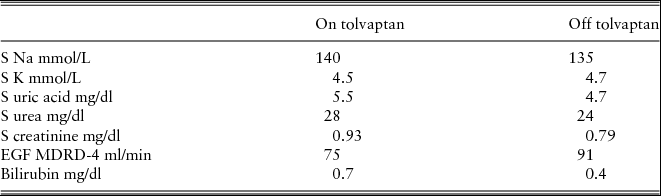
The finding of a minimum hospital and post-surgical mortality in patients with SNa between 138 and 142 mmol l−1 (Reference Wald, Jaber, Price, Upadhyay and Madias19,Reference Leung, McAlister, Rogers, Pazo, Wright and Bates20 ) has led to questioning the validity of the reference range of 135–145 mmol l−1 as normal or ideal. In fact, elderly patients with SIADH can already have increased body water and effective circulating volume (EFCV) with haemodilution when presenting a SNa of 135 mmol l−1 as opposed to 140, as shown in data from a 96-year-old patient (Table 1). In any event, a SNa below 135 mmol l−1 as corrected for TP, lipids and glycaemia, indicates frank hyponatraemia.
Data from a 96-year-old patient with idiopathic SIADH of the elderly, on tolvaptan, and 14 days after discontinuation of medication
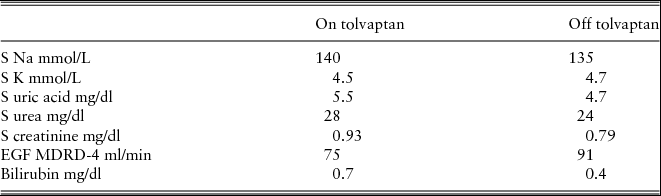
S, serum; Na, sodium level; K, potassium level; EGF, estimated glomerular filtration rate.
Clinical manifestations of hyponatraemia in older people
Severe/marked hyponatraemia can cause death through cerebral herniation induced by brain oedema. Cerebral atrophy protects the older patient from herniation, since the cranium has ‘more space’ to accommodate oedema. However, intracranial haemorrhage or tumours can place elderly patients at high risk. Furthermore, hypoxaemia, the most important risk factor for death in a patient with marked hyponatraemia (relative risk of 13.47 (4.7–38.4)),Reference Nzerue, Bonnie, You, Falana and Dai21 is not uncommon in older patients. Insufficiently aggressive treatment is associated not only with increased mortality, but also with a high rate of permanent neurological sequelae. Ayus and Arieff found that post-menopausal women with marked hyponatraemia had a much higher rate of death or institutionalization following an insufficient correction rate with fluid restriction than those who developed marked overcorrection following treatment with intravenous (i.v.) saline.Reference Ayus and Arieff22
Over the past decade, substantial progress has been made in understanding the consequences even of mild hyponatraemia, and the beneficial effects of treatment. Renneboog et al. found that patients with mild/moderate chronic ‘asymptomatic’ hyponatraemia present cognitive impairment upon testing, whereas the same patients with eunatraemia do not.Reference Renneboog, Musch, Vandemergel, Manto and Decaux23 Patients admitted to a geriatric unit with SNa ≤ 131 scored significantly worse on all tests performed (Activities of Daily Living, Mini Mental State Examination, Clock Completion Test, Geriatric Depression Score, Tinetti Mobility Test, and the Timed Up & Go Test) compared with matched eunatraemic controls.Reference Gosch, Joosten-Gstrein, Heppner and Lechleitner24 Gait instability is frequent in patients with mild/moderate hyponatraemia, and induces falls. In fact, ‘asymptomatic’ hyponatraemic patients were 67 times more likely to fall than normonatraemic controls in Renneboog's study. Furthermore, gait instability also improves upon correction of hyponatraemia.Reference Renneboog, Musch, Vandemergel, Manto and Decaux23
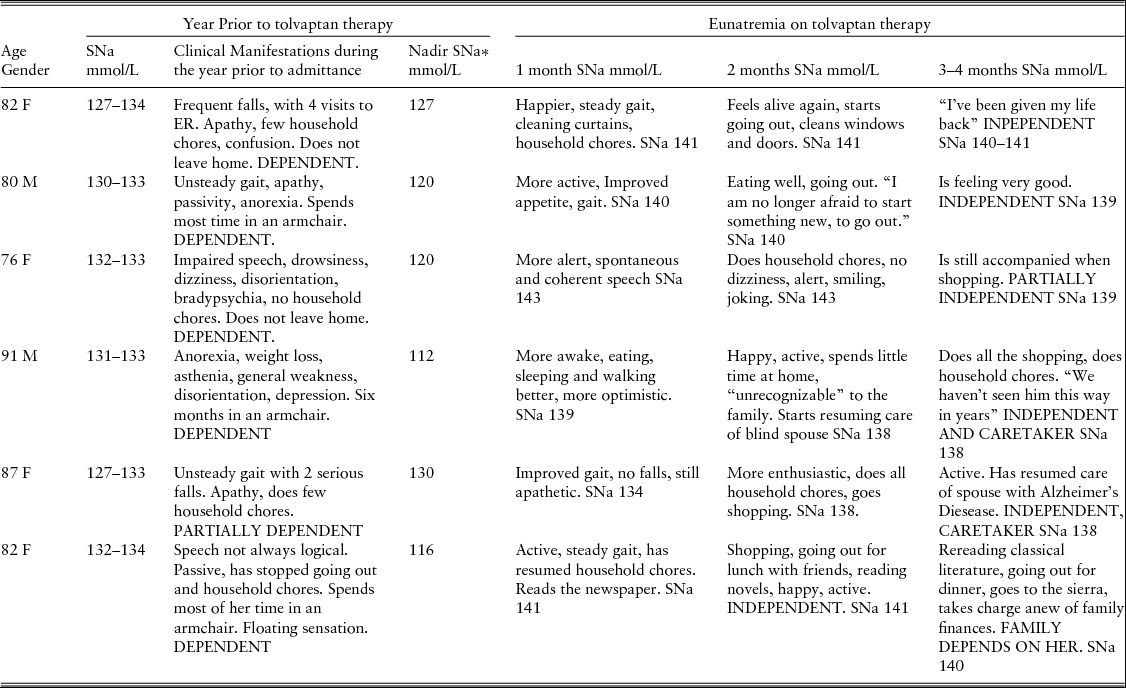
Our own clinical experience seems to support these findings. Elderly patients with chronic SIADH followed up in our hyponatraemia clinic (many previously diagnosed as having ‘mild chronic asymptomatic hyponatraemia’) show progressive improvement of cognitive and motor function over time, following maintenance of strict eunatraemia (SNa between 137 and 141 mmol l−1) on chronic tolvaptan therapy. Interestingly, maximum benefits are observed after 2–4 months of continued therapy (Table 2).
Evolution of clinical characteristics of patients with chronic SIADH on tolvaptan therapy following 1, 2 and 3–4 months of continued therapy
SNa, serum sodium level; ER, emergency room.
Verbalis et al. demonstrated that sustained severe hyponatraemia induces marked osteoporosis in experimental animals, with an increase in the number of osteoclasts and reabsorptive activity. In humans, mild hyponatraemia is associated with osteoporosis in the NHANES III database, with an adjusted odds ratio for osteoporosis at the femoral neck of 2.87 among hyponatraemic subjects.Reference Verbalis, Barsony, Sugimura, Tian, Adams and Carter25 The Rotterdam study did not detect increased osteoporosis in hyponatraemic subjects,Reference Hoorn, Rivadeneira, van Meurs, Ziere, Stricker, Hofman, Pols, Zietse, Uitterlinden and Zillikens26 possibly because of a high rate of thiazide use.Reference Rodenburg, Hoorn, Ruiter, Lous, Hofman, Uitterlinden, Stricker and Visser27 Furthermore, only one SNa was available, and sustained hyponatraemia was not demonstrated. The risk of fractures is increased in patients with hyponatraemia,Reference Hoorn, Rivadeneira, van Meurs, Ziere, Stricker, Hofman, Pols, Zietse, Uitterlinden and Zillikens26 due to a high rate of spontaneous falls, and possibly due to hyponatraemia-induced osteoporosis. Patients with hip fracture following an incidental fall are 4.8 times as likely to present hyponatraemia as matched controls.Reference Tolouian, Alhamad, Farazmand and Mulla28
Mild hyponatraemia can induce marked anorexia and hyponatraemic patients on a geriatric ward present significantly lower mini-nutritional assessment scores than matched eunatraemic controls.Reference Gosch, Joosten-Gstrein, Heppner and Lechleitner24 Non-correction of SNa for TP can also cause the frequency/severity of hyponatraemia to be underestimated. Correct evaluation of nutritional status is therefore essential, as are the detection and treatment of hyponatraemia in the malnourished elderly.
All degrees of hyponatraemia are associated with an increased mortality rate.Reference Wald, Jaber, Price, Upadhyay and Madias29,Reference Waikar, Mount and Curhan30 However, active correction of hyponatraemia reduces mortality to a third in hospitalized patients with SNa below 125 mmol l−1.Reference Hoorn, Lindemans and Zietse31 The relationship between mild/moderate hyponatraemia and mortality is less clear. Hyponatraemia could simply be a marker of the severity of underlying disease. However, extracellular hyponatraemia directly inhibits rat cardiomyocyte voltage-gated L-type calcium channels in vitro in a concentration-dependent manner, thus compromising contractilityReference Movafagh, Cleemann and Morad32 and mild/moderate hyponatraemia is a predictor of non-response to cardiac resynchronization therapy.Reference Arao, Fujiwara, Sakakura, Wada, Sugawara, Suga, Ako, Ishikawa and Momomura33 Correction of moderate hyponatraemia with chronic tolvaptan therapy reduced cardiovascular mortality and hospital re-admissions by 40% in patients with heart failure.Reference Hauptman, Burnett, Gheorghiade, Grinfeld, Konstam, Kostic, Krasa, Maggioni, Ouyang, Swedberg, Zannad, Zimmer and Udelson34 Therefore, mild/moderate hyponatraemia could contribute directly to morbidity and mortality in patients with heart failure.
Classification and diagnosis of hyponatraemia
Classification of the hyponatraemic patient by volaemia
This is essential for correct diagnosis and treatment. Patients are classified as hypervolaemic (increased total body water due to heart failure, ascites, substantial oedema), hypovolaemic (decreased body water), or euvolaemic. The first two cases are characterized by decreased EFCV, with baroreceptor-induced elevation in circulating AVP levels. AVP, through its G-protein-coupled, transmembrane V2 receptor, increases Na absorption at the ascending loop of Henle, and stimulates the insertion of aquaporin-2 channels into the luminal (apical) membrane of the principal cells of the collecting duct of the distal nephron.Reference Nielsen, Fror and Knepper35 Water reabsorption is induced, down an osmotic gradient between the collecting duct and the renal medulla (RM) and hyponatraemia ensues.Reference Verbalis, Goldsmith, Greenberg, Korzelius, Schrier, Sterns and Thompson5,Reference Wong and Verbalis36 Euvolaemic patients, on the other hand, often present an elevated EFCV.Reference Verbalis37
Physical examination
Examination is essential for classifying volaemia. Detecting patients with hypervolaemia is usually straightforward. However, distinguishing hypovolaemic from euvolaemic patients can be difficult.Reference Verbalis, Goldsmith, Greenberg, Korzelius, Schrier, Sterns and Thompson5 We have found that manual appraisal of ocular pressure (OP) is extremely useful in distinguishing hypovolaemia from euvolaemia in older patients.Reference Runkle, Villabona, Navarro, Pose, Formiga, Tejedor and Poch7 The examiner gently touches each ocular globe through the patient's closed eyelid. Hypovolaemic patients present a low ocular pressure, whereas euvolaemic hyponatraemic patients have a normal OP. In fact, in states where EFCV is elevated, as occurs in SIADH, patients usually present a normal OP with ocular globe elasticity, or ‘rebound’. We also use inspection to ascertain central venous pressure (CVP)Reference Runkle, Villabona, Navarro, Pose, Formiga, Tejedor and Poch7: in the recumbent hypovolaemic patient, the waves of the CVP are detected below the sternal angle, whereas CVP is normal in the euvolaemic patient. Skin turgor, on the other hand, is frequently reduced in older patients and should not be used to classify volaemia.
Hypovolaemic hyponatraemia: differential diagnosis and laboratory tests (see Table 3)
Patients with low EFCV (due to hyper- or hypovolaemia) tend to present a rise in serum urea and creatinine levels as SNa descends, whereas euvolaemic patients with SIADH, primary polydipsia or acute water intoxication will generally present a reduction in serum urea, creatinine and uric acid levels as SNa goes down. Figure 2 illustrates this point.
The differential diagnosis of hyponatraemia with low effective circulating volume
Posm, measured plasma osmolality; UNa, orinary sodium; Uosm, measured urinary osmolality.
The relationship between serum sodium and urea in hyponatraemia. A, relationship between serum urea (mg dl−1) and sodium (mmol l−1) levels of a 78-year-old hypovolaemic patient with a salt-wasting nephropathy as i.v. isotonic saline is added, raising serum sodium, or discontinued, with fall of serum sodium. B, relationship between serum urea (mg dl−1) and sodium (mmol l−1) levels in an initially 94-year-old patient with chronic idiopathic SIADH, over a 1-year period.
Patients with a low EFCV usually present low urinary sodium levels, below 20 mmol l−1,Reference Verbalis, Goldsmith, Greenberg, Korzelius, Schrier, Sterns and Thompson5 as the renin–angiotensin–aldosterone axis (RAAS) is stimulated, leading to angiotensin II and aldosterone-induced sodium retention by the nephron. Furthermore, more sodium is reabsorbed due to a slower flux through the descending and ascending loops of Henle. However, urinary sodium levels can be high in patients with hypovolaemic hyponatraemia characterized by renal sodium loss,Reference Verbalis, Goldsmith, Greenberg, Korzelius, Schrier, Sterns and Thompson5 as in diuretic use, hypoaldosteronism, hypoaldosteronism with glucocorticoid deficiency (primary adrenal insufficiency), cerebral/renal salt wasting or bicarbonate administration.
Patients over 65 years of age have been found to be ten times more likely to develop diuretic-associated hyponatraemia than younger subjects, with women exhibiting a relative risk of three.Reference Sharabi, Illan, Kamari, Cohen, Nadler, Messerli and Grossman38 In close to 75% of cases, thiazides are the diuretics employed. A retrospective cohort study detected that up to 30% of adults of all ages receiving thiazides developed hyponatraemia over a 5-year period.Reference Leung, Wright, Pazo, Karson and Bates39 Elderly subjects with a history of thiazide-induced hyponatraemia exhibit a decreased capacity for diluting urine upon receiving thiazide and an oral water load.Reference Clark, Shannon, Rosa and Epstein40 In fact, increased thirst could be a factor in thiazide-related hyponatraemia, together with up-regulation of aquaporin-2 expression.Reference Kim, Lee, Oh, Chang, Joo, Na, Earm, Knepper and Han41 The time elapsed since initiation of thiazide use to presentation of hyponatraemia is variable. A low BMI could be a risk factor.Reference Rodenburg, Hoorn, Ruiter, Lous, Hofman, Uitterlinden, Stricker and Visser27 The associated use of angiotensin converting enzyme inhibitors (ACEi),Reference Rastogi, Pelter and Deamer42 or angiotensin II receptor blockers (ARBs)Reference Yamada, Asano, Aoki, Ikoma, Yoshida, Kusaka, Kawakami, Kakei and Ishikawa43 can increase the risk and/or severity of hyponatraemia, as can hypokalaemia.Reference Rastogi, Pelter and Deamer42
We have observed that close to 60% of elderly patients with marked thiazide-related hyponatraemia are hypovolaemic, as classified by an initial physical examination that includes OP and CVP, with the remaining 40% euvolaemic.Reference Crespo Hernández, Ruiz Gracia, Gomez Hoyos, Ortola Buigues, Cuesta Hernandez, Fernandez Capel, de Miguel Novoa, Sanabria Perez, Calle Pascual and Runkle de la Vega44 In 27 elderly patients (median age 80 years; range 65–84 years) with a median initial SNa of 116 mmol l−1 (109–119), urinary Na tended to be lower in the hypovolaemic group: 40 mmol l−1 (18–69) vs 61 mmol l−1 (43–85) (P = 0.09). Over 44% presented severe initial neurological symptoms. SNa was significantly lower in patients with hypokalaemia: 113 mmol l−1 (109–115) vs 119 mmol l−1 (110–22) (P = 0.041). Eighty-five per cent of patients were women. Over 61% of patients were receiving hydrochlorothiazide. A low solute intake (from salt and protein) was present in the days prior to admission in 66%, and could be a precipitating event, as renal elimination of water becomes more difficult (see below).
Hypoaldosteronism (type IV renal tubular acidosis) is often overlooked as a cause of hyponatraemia and hyperkalaemia (or kalaemia in upper limits of normal) in patients with hypovolaemic hyponatraemia.Reference Talapatra, Kalavalapalli and Tymms45,Reference Gómez Hoyos, Montañez Zorrilla, Cuesta Hernández, de Miguel Novoa, Pelaz Berdullas, Matía Martín, Marcuello Foncillas, Pérez Ferre, Calle Pascual and Runkle de la Vega46 Hypoaldosteronism can be detected in up to 3.8% of hospitalized patients,Reference Haas, Pohlenz, Lindner, Muck, Arand, Suefke and Lehnert47 the majority between 60 and 80 years of age. Patients typically present with hyperkalaemia alone, yet when hypovolaemia is present, AVP elevation can induce hyponatraemia. After first ruling out primary adrenal insufficiency (Addison's disease), the transtubular potassium gradient (TTKG) can be calculated to assess the activity of the mineralocorticoid receptor, as a more precise measure of renal potassium excretion than urinary potassium alone. If, instead of a normal gradient (eight to nine), the calculated level is below five, the patient presents ‘hypoaldosteronism’, either due to a low aldosterone level, or mineralocorticoid resistance.Reference Haas, Pohlenz, Lindner, Muck, Arand, Suefke and Lehnert47–Reference Bhaskar, Fraser and Mullaney49
Cerebral salt wasting (CSW) is an infrequent cause of hypovolaemic hyponatraemia. In a recent prospective study of 100 consecutive patients with hyponatraemia following subarachnoid haemorrhage, not a single case was detected.Reference Hannon, Behan, O’Brien, Tormey, Ball, Javadpour, Sherlock and Thompson50
Euvolaemic hyponatraemia: differential diagnosis and laboratory tests (Table 4)
The most common causes of euvolaemic hyponatraemia (EH) are what we will refer to as ‘euvolaemic ADH states’: patients present normal or elevated EFCV induced by AVP, inadequately inhibited by a descent in plasma osmolality. This category includes patients with SIADH (including type D, or the nephrogenic syndrome of inappropriate anti-diuresis – NSIAD),Reference Robertson51 post-surgical hyponatraemia (sometimes considered to be a form of SIADH), patients with ACTH deficit, and physiologic stimuli of AVP secretion (nausea, vomiting or pain).
The differential diagnosis of euvolaemic hyponatraemia
Posm, measured plasma osmolality; UNa, urinary sodium; Uosm, measured urinary osmolality; ADH, anti-diuretic hormone; SIADH, the syndrome of inappropriate anti-diuretic hormone secretion; NSIAD, the nephrogenic syndrome of inappropriate anti-diuresis.
When ADH is inadequately detectable in euvolaemic hyponatraemic patients, AVP via its V2 receptor directly increases the osmolality of the RM, through stimulus of Na absorption at the ascending loop of Henle, and induces water reabsorption from the collecting duct, as in hypovolaemic hyponatraemia. The higher the AVP levels, the more aquaporin-2 channels are inserted into the apical membrane of the principal cells of the collecting duct, and a higher degree of anti-diuresis will ensue. When sufficient aquaporin-2 channels are open, osmolality in the distal collecting duct (i.e. urine) will have entered into equilibrium with the osmolality of the RM.Reference Sands and Layton52 Thus urine osmolality (Uosm) will directly reflect the osmolality of the RM, and indirectly indicate circulating AVP levels. Urinary sodium is over 40 mmol l−1 when salt intake is sufficient, but can go below 20 mmol l−1 in cases of severe salt depletion. Plasma osmolality is below 275 mosmol kg−1, and Uosm above 100 mosmol kg−1.Reference Verbalis, Goldsmith, Greenberg, Korzelius, Schrier, Sterns and Thompson5,Reference Janicic and Verbalis53 Activating mutations of the V2 receptor mimic AVP action in NSIAD.
ACTH deficiency (secondary adrenal insufficiency) can be indistinguishable from SIADH, since hyponatraemia is induced by elevated AVP secretion, although some patients will have low BP and blood glucose, or signs of hypopituitarism. The ‘culprit’ AVP in this case is synthesized by parvocellular neurons of the dorsomedial paraventricular hypothalamic nucleus, in neurons that also synthesize CRH. An integral part of the hypothalamic–pituitary–adrenal axis, parvocellular AVP will rise with CRH in conditions of stress and of hypocortisolaemia, as long as the parvocellular neurons are intact.Reference Kovács, Földes and Sawchenko54,Reference Aguilera and Liu55 Thus patients with suspected SIADH must be screened for ACTH deficit by measurement of serum cortisol, and/or a short synacthen test. A morning serum cortisol level >300 nmol l−1 (11 µg dl−1) has been considered sufficient to rule out the need for immediate glucocorticoid therapy,Reference Hannon, Behan, O’Brien, Tormey, Ball, Javadpour, Sherlock and Thompson50 although higher levels (>469 nmol l−1 or >17 µg dl−1) could be preferable in patients in situations of stress. If ACTH deficit is recent, a short synacthen test will not be adequate for diagnosis.
Pain and nausea must be controlled prior to diagnosing SIADH, since they are potent stimulators of AVP secretion. In experimental animals, nociceptive pain is a particularly potent stimulator of parvocellular AVP.Reference Suzuki, Kawasaki, Ohnishi, Otsubo, Ohbuchi, Katoh, Hashimoto, Yokoyama, Fujihara, Dayanithi, Murphy, Nakamura and Ueta56
Thiazides can induce euvolaemic hyponatraemia. However, we have yet to see a single case of ‘rebound’ ocular pressure in these patients, in spite of normal OP and CVP (authors’ unpublished data). Patients on diuretics can have underlying SIADH. Yet, until the diuretic has been discontinued and its effect has passed, SIADH cannot be diagnosed.Reference Verbalis, Goldsmith, Greenberg, Korzelius, Schrier, Sterns and Thompson5 Severe hypothyroidism can also induce euvolaemic hyponatraemia, although infrequently. One study found that for every mU l−1 elevation in TSH levels, SNa descent was limited to 0.14 mmol l−1.Reference Warner, Holding and Kilpatrick65
The diagnosis of SIADH is therefore one of exclusion – patients must be euvolaemic, have a normal adrenal and renal function, have pain and nausea under control, have severe hypothyroidism ruled out, not be on diuretics, and present a low plasma osmolality with an inadequately concentrated urine.
The differential diagnosis of CSW with SIADH should not be difficult. CSW patients are clearly hypovolaemic, with low OP and CPV, have polyuria, with an elevation of urea/creatinine levels as SNa lowers.Reference Sherlock, O’Sullivan, Agha, Behan, Rawluk, Brennan, Tormey and Thompson57 However, as opposed to other cases of hypovolaemia, uric acid levels also descend, presumably due to proximal tubule loss.Reference Maesaka, Gupta and Fishbane58,Reference Palmer59 Intravenous isotonic saline corrects hyponatraemia and the elevation in serum urea/creatinine as volaemia is restored. Since saline does not correct uricosuria, uric acid levels remain low until CSW is resolved. In SIADH, serum uric acid lowers, as do serum urea/creatinine, rising as hyponatraemia is corrected.
Primary polydipsia can be seen in elderly people. As part of the syndrome of ‘diabetes insipidus’, it is characterized by polydipsia and polyuria. Patients usually present SNa in the low–normal range, or only slightly below 135 mmol l−1, since decreased serum osmolality inhibits AVP secretion and polyuria ensues. However, these patients can develop marked hyponatraemia when polydipsia is accompanied by a low solute intake. The minimum Uosm is 50–60 mosmol kg−1 with normal renal function. In other words, the nephron needs at least 60 mosmol of solute to eliminate a litre of waterReference Berl60 in a normal kidney. Each molecule of sodium, chloride, potassium and urea contribute a mosmole. In absence of sufficient protein (urea) and salt intake, ingested liquid will not be excreted adequately and severe hyponatraemia can ensue. Elderly people already have a diminished capacity for free-water clearance. Thus decreased protein intake (urea), together with a low-salt diet, can induce marked hyponatraemia when maintaining liquid intake. Stress, pain or nausea, stimulating AVP regardless of plasma osmolality, can also induce marked hyponatraemia in the polydipsic patient, by opening aquaporin-2 channels. Urine is typically dilute, with Na below 20 and even 10 mmol l−1, and Uosm below 100 mosmol kg−1.Reference Verbalis, Goldsmith, Greenberg, Korzelius, Schrier, Sterns and Thompson5
Acute water intoxication can be seen in elderly patients during or following the preparation of colonoscopy. When assessing the severity of hyponatraemia in this disorder, the velocity of SNa descent must be considered, when information is available. A patient with initially moderate neurological symptoms can deteriorate rapidly if water is still being absorbed from the gastrointestinal tract.Reference Cherney, Davids and Halperin61 Peripheral venous natraemia is often inaccurate, as recently absorbed water will first dilute arterial blood.Reference Shafiee, Charest, Cheema-Dhadli, Glick, Napolova, Roozbeh, Semenova, Sharman and Halperin62 Therefore, arterial gas sodium measurement is preferable to assess the true degree of hyponatraemia. Gastric distension, nausea and vomiting can induce AVP secretion and urine sodium/osmolality can be high (over 40 mmol l−1 and 100 mosmol kg−1, respectively). However, in other cases, urine can be dilute.
Low sodium intake (LSI) alone is not a cause of hyponatraemia. Hyponatraemia can be induced when LSI is associated with external sodium losses (diuretics, fistulae) and/or low protein intake. However, low salt intake is often blamed for hyponatraemia in elderly patients receiving artificial nutrition, in spite of the accompanying generation of urea. The sodium content of parenteral nutrition is not related to the low SNa often observed.Reference Gómez Hoyos, Matía Martin, Cuesta Hernández, Hernández Núñez, Larrad Saiz, Soria Carreras, Pérez Ferre, Cabrerizo Garcia, Rubio Herrera and Runkle de la Vega63 Patients with hyponatraemia receiving artificial nutrition should be correctly classified (as hyper-, hypo- or eunatraemic) and diagnosed, since a correct diagnosis will be required for adequate therapy.Reference Gómez Hoyos, Cuesta Hernández, Fernández Capel, Ruiz Gracia, Martín Matía, Rubio Herrera, Cabrerizo García, Pérez Ferre, Calle Pascual and Runkle de la Vega64
Approach to the management of the elderly hyponatraemic patient (Fig. 3)
When evaluating a patient with hyponatraemia, it is important to first consider the severity of the neurological symptoms, take a short history when possible and determine volaemia by physical examination. Based on this information, together with the whole blood or serum sodium level corrected for glycaemia, a decision can be made as to whether 3% hypertonic saline infusion (HSS) is indicated.
A step-by-step approach to the management of hyponatraemia in the older patient
Step 1: Evaluate neurological symptoms (Fig. 4).Reference Verbalis, Goldsmith, Greenberg, Korzelius, Schrier, Sterns and Thompson5,Reference Runkle, Villabona, Navarro, Pose, Formiga, Tejedor and Poch7 Starting with an initial classification, we consider a series of parameters that make marked hyponatraemia more likely to induce death or permanent neurological sequelae if not aggressively treated.Reference Runkle, Villabona, Navarro, Pose, Formiga, Tejedor and Poch7 When one of these parameters is present we ‘upgrade’ or ‘correct’ severity.
Evaluation of neurological symptoms. Adapted from Runkle et al., Medicina Clinica (2013).
Step 2: Evaluate volaemia by physical examination, including OP and CVP. Patients with heart failure are treated specifically. Patients with other types of hypervolaemia and severe hyponatraemia can be treated as hypovolaemics initially.
Base indication for and use of 3% hypertonic saline i.v. on Steps 1 and 2. Patients with euvolaemic or hypovolaemic hyponatraemia with severe neurological symptoms should immediately be started on HSS as treatment for cerebral oedema.Reference Verbalis, Goldsmith, Greenberg, Korzelius, Schrier, Sterns and Thompson5,Reference Runkle, Villabona, Navarro, Pose, Formiga, Tejedor and Poch7 Patients with euvolaemic hyponatraemia ‘upgraded’ to severe should also start on HSS. Euvolaemic patients should not be treated with isotonic saline – not only can this therapy be inadequate for treatment of cerebral oedema, it can worsen it, by lowering SNa.Reference Musch and Decaux66 Patients with hypovolaemic hyponatraemia and moderate initial symptoms should receive i.v. isotonic saline. Before initiating HSS or isotonic saline, blood must be drawn for haemoglobin total proteins, urea, creatinine, glucose, electrolytes and osmolality. Cortisolaemia, thyroid hormones and transaminase levels should be measured as soon as possible.
When initial neurological symptoms are severe, or moderate symptoms present in patients with acute hyponatraemia or hypoxaemia, i.v. bolus HSS therapy should be considered.Reference Verbalis, Goldsmith, Greenberg, Korzelius, Schrier, Sterns and Thompson5,Reference Runkle, Villabona, Navarro, Pose, Formiga, Tejedor and Poch7 There is a growing body of experience with the use of 100 ml i.v. bolus therapy, initially employed in exercise-associated hyponatraemia.Reference Hew-Butler, Almond, Ayus, Dugas, Meeuwisse, Noakes, Reid, Siegel, Speedy, Stuempfle, Verbalis and Weschler67 The bolus can be administered three times, at 10-min intervals. Intravenous bolus therapy is stopped after neurological symptoms have improved, or after three bolus injections.Reference Verbalis, Goldsmith, Greenberg, Korzelius, Schrier, Sterns and Thompson5 The recent European guidelines recommend bolus therapy with 150 ml.Reference Spasovski, Vanholder, Allolio, Annane, Ball, Bichet, Decaux, Fenske, Hoorn, Ichai, Joannidis, Soupart, Zietse, Haller, van der Veer, Van Biesen and NAgler6 We prefer the use of 100 ml, given the absence of evidence/experience for the 150 ml regimen. In other cases, HSS can be infused at a rate of 0.5–2 ml kg−1 h−1.Reference Verbalis, Goldsmith, Greenberg, Korzelius, Schrier, Sterns and Thompson5,Reference Runkle, Villabona, Navarro, Pose, Formiga, Tejedor and Poch7
Urine should be collected for electrolyte and osmolality analysis as soon as HSS therapy is initiated, if not obtained previously. Diuresis must be closely monitored, since HSS can induce polyuria (particularly in patients with prior low solute intake), with an increased risk for overcorrection of SNa. An indwelling bladder catheter may be indicated. Desmopressin (DDAVP) (1 mg i.v. or s.c.) should be administered if polyuria is detected.Reference Runkle, Villabona, Navarro, Pose, Formiga, Tejedor and Poch7,Reference Sterns, Nigwekar and Hix68,Reference Perianayagam, Sterns, Silver, Grieff, Mayo, Hix and Kouides69 SNa or blood Na must be determined 2 h following HSS initiation and ideally every 2 h during HSS infusion. A specific roadmap for the use of hypertonic saline has recently been published.Reference Runkle, Villabona, Navarro, Pose, Formiga, Tejedor and Poch7
Step 3: Following start of HSS, or if HSS is not indicated, complete detailed history and physical examination. On-line primary care records should be accessed when available to ascertain the patient's medication history and other relevant data. Laboratory tests are ordered if not yet underway, both for diagnosis and management, as outlined above. Based on results, an initial classification and diagnosis should be made.
Step 4: Initiate therapy based on diagnosis. In patients that have started HSS, tests will help determine therapy to be instituted on the following day, since the initiation of additional treatments conducive to rises in SNa should be avoided until 24 h have elapsed from the start of HSS infusion, to avoid overcorrection. Specific therapies are discussed below. Avoid treatments/measures that could worsen the patient's nutritional status. Evaluate the need for nutritional supplements when deciding therapy.
Step 5: Set goals for SNa rise. When starting treatment, regardless of the type of therapy, 24- and 48-h objectives for SNa increment should be determined, based on the assessed risk for development of osmotic demyelination syndrome (ODS) (Table 5).Reference Verbalis, Goldsmith, Greenberg, Korzelius, Schrier, Sterns and Thompson5 The initial frequency of SNa determinations should be a function of the risk for overcorrection. Patients at high risk (adrenal insufficiency, discontinuation of medication with a short half-life, patients with marked hypovolaemic hyponatraemia, etc.) should be monitored every 6–8 h (unless they are receiving HSS, thereby needing continuous monitoring). If the 24-h objective for SNa increment is met before 24 h have elapsed from initiation of treatment, therapy should be discontinued when possible, and/or DDAVP (1 mg every 6–8 h i.v. or s.c.) should be administered to brake the rise.Reference Runkle, Villabona, Navarro, Pose, Formiga, Tejedor and Poch7
Correction goals and limits in chronic hyponatraemia

Values are given in mmol l−1. The 24-h goal should be met within the first 6 h of therapy if hyponatraemia is severe. ODS, osmotic demyelination syndrome. Adapted from Verbalis et al. Am J Med (2013) with authors’ permission.
Step 6: Promptly lower SNa if overcorrection occurs. This measure has been found to be effective in the prevention of ODS.Reference Perianayagam, Sterns, Silver, Grieff, Mayo, Hix and Kouides69–Reference Gankam Kengne, Soupart, Pochet, Brion and Decaux71 A high Uosm indicates anti-diuresis, facilitating reabsorption of administered liquids and i.v. dextrose alone can suffice (6 cm3 kg−1 h−1 for 2 h). However, in patients with Uosm below 500 mosmol kg−1, we recommend the association of DDAVP to i.v. dextrose, to assure adequate water reabsorption.Reference Runkle, Villabona, Navarro, Pose, Formiga, Tejedor and Poch7 When using DDAVP, the initial dextrose infusion rate should be lower, starting at 2–3 ml kg−1 h−1 for 2–3 h. SNa should be repeated at the end of dextrose infusion and dextrose reinitiated until the initial SNa goal is reached. Intravenous furosemide can rapidly brake the descent in SNa following DDAVP administration, if necessary.Reference Runkle, Villabona, Navarro, Pose, Formiga, Tejedor and Poch7
Step 7: Re-assess and reclassify patients if response to therapy is inadequate, repeating the physical examination/laboratory tests (i.e. start again).
Step 8: Determine whether the patient is a candidate for long-term, maintenance therapy. Decide whether treatment should be modified to permit chronic use.
Treatment of mild/moderate hypovolaemic hyponatraemia
Hypovolaemic patients with mild/moderate symptoms will initially be treated with i.v. isotonic saline as needed. In mild hyponatraemia, abundant oral liquids and salt sometimes suffice (salted broths, soups, etc. – ‘Granny's remedy’). Specific therapy should be administered as a function of diagnosis and the cause of hyponatraemia addressed. Patients with marked hyponatraemia (SNa below 125 mmol l−1) treated with i.v. isotonic saline frequently ‘overshoot’ the maximum recommended 24-h rise in SNa levels, and SNa should be monitored (i.e. every 6–8 h) to assess the need for interrupting the infusion or adding DDAVP.
Treatment of special cases
Hypoaldosteronism
Increased liquid and salt intake is necessary (either i.v. or orally). Medication that interferes with the RAAS and lowers aldosterone levels, or drugs that interfere with mineralocorticoid action, should be discontinued whenever possible. The former category includes NSAIDs, ACE inhibitors, ARBs, and heparin. The latter group includes NSIADs, spironolactone, eplerenone, amiloride, triamterene, trimethoprim and pentamidine.Reference Bhaskar, Fraser and Mullaney49,Reference Perazella72 Some patients will need administration of the mineralocorticoid fludrocortisone, at a starting dose of 0.05 mg daily. Fludrocortisone is also used for the differential diagnosis of hypoaldosteronism due to low aldosterone levels versus mineralocorticoid resistance, as patients with the latter will not respond.Reference Bhaskar, Fraser and Mullaney49 Aldosterone/renin levels can also be measured. However, in hospitalized patients these determinations are not always readily available or even reliable, since reference ranges are not based on values for recumbent patients. Marked hyponatraemia is rare in patients with hypoaldosteronism, and patients are at a low risk for overcorrection. Out-patients should carry a clinical report with their diagnosis and a list of medications to be avoided.
Addison's disease
Patients with Addison's disease must be treated specifically with glucocorticoid/mineralocorticoid therapy and i.v. saline and dextrose as needed, liquid and salt intake assured. Overcorrection is an important risk when initiating therapy and the physician should be ready to add DDAVP (1 mg every 6–8 h) as needed to brake the rise.
Diuretics should be discontinued and isotonic saline administered as needed in the hypovolaemic patient. The danger of early overcorrection is higher when patients are receiving short-acting hydrochlorothiazide than when using chlorthalidone. Patients who have developed thiazide-related hyponatraemia are at a high risk for a new episode. Thiazides should not be reintroduced.
Cerebral salt wasting: i.v. isotonic saline is the basis of treatment. In some cases fludrocortisone can be helpful once hypovolaemia is corrected.Reference Momi, Tang, Abcar, Kujubu and Sim73
Hypokalaemia alone induces or worsens hyponatraemia and its correction will raise SNa. Given that hypokalaemia is a risk factor for development of ODS, treatment should be limited to oral potassium chloride (KCl) supplements whenever possible, since KCl in isotonic saline will increase the risk for overcorrection. When i.v. saline infusion is deemed essential, DDAVP will often be necessary to brake the rise.
Treatment of hypervolaemic hyponatraemia
Patients with heart failure are initially treated with classic therapy directed towards increasing EFCV, lowering afterload. Reduction of preload with furosemide is also part of standard therapy. Patients with a history of low salt intake and aggressive diuretic therapy often become resistant to furosemide. Tolvaptan has been used successfully in these patients,Reference Hauptman, Burnett, Gheorghiade, Grinfeld, Konstam, Kostic, Krasa, Maggioni, Ouyang, Swedberg, Zannad, Zimmer and Udelson34 although it is not authorized for the treatment of heart failure in Europe. There is also experience with the administration of hypertonic saline and high doses of furosemide in refractory heart failure patients with hyponatraemia.Reference Licata, Di Pasquale, Parrinello, Cardinale, Scandurra, Follone, Argano, Tuttolomondo and Paterna74
Treatment of euvolaemic hyponatraemia
Pain and nausea must be controlled and a minimum salt intake assured (at least 6 g daily). Patients with acute hyponatraemia due to acute water intoxication have a low risk for ODS and a high risk for herniation or permanent neurological sequelae if undertreated. Therefore, aggressive initial correction of hyponatraemia is in order, as mentioned above. Patients with primary polydipsia and marked hyponatraemia can present important elevations of SNa upon reduction of oral fluid intake. Strict fluid restriction is to be avoided in these cases. Instead, SNa should be carefully monitored and desmopressin should be considered.
Patients with ACTH deficit should be treated with glucocorticoids, either orally (hydrocortisone at initial doses of 20 mg t.i.d.), or i.v. Patients are at high risk for overcorrection. SNa levels should be monitored every 6–8 h to determine the need for associated DDAVP therapy, to brake the rise.
Treatment of SIADH (Table 6)
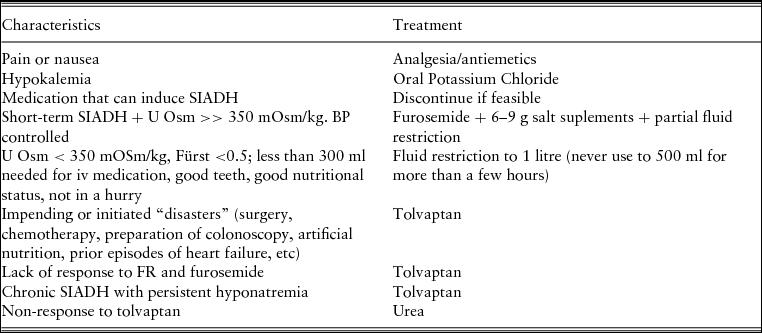
If initial therapy is HSS, no other treatment should be associated when HSS is discontinued until 24 h have elapsed from initiation of infusion to avoid overcorrection, with the possible exception of fluid restriction when indicated.Reference Runkle, Villabona, Navarro, Pose, Formiga, Tejedor and Poch7 SNa levels should be monitored every 6 h following HSS, to detect the need for DDAVP administration upon reaching the 24-h goal for correction before 24 h have elapsed and to detect any repeated descent of SNa. Medication that can induce SIADH should be discontinued whenever possible: ACEi and SSRIs should be stopped immediately and omeprazole replaced by ranitidine. Neurological opinion should be called in to consider modifications in anti-epileptic medication. Given the number of drugs that can cause SIADH, the most practical way to ascertain whether a specific therapy could be causal is to directly access an online database or PubMed. Physicians are often wary of interrupting ACEi therapy. However, given the increased EFCV that characterizes most patients with SIADH, patients’ RAAS is usually inhibited and agents such as aliskiren, ACEi and ARBs will be of limited use, even if not directly inducing SIADH (ACEi). Amlodipine can be given to control hypertension.
Treatment of SIADH with mild/moderate hyponatraemia
Assure adequate salt intake. Our protocol for the treatment of SIADH. Adapted from Runkle et al. Medicina Clínica (2013). FR, fluid restriction; Uosm, urine osmolality; Fürst, Fürst formula, Am J Med Sci (2000); SIADH, the syndrome of inappropriate anti-diuretic hormone secretion.
Diagnostic work-up to detect the cause of SIADH, unless evident, should include brain computerized tomography (CT) or MRI scan, cervicothoracic CT, abdominal CT or ultrasound and PSA and the underlying cause treated. Establishing the cause of SIADH is often the most challenging part of patient evaluation.
When HSS has not been used, or a minimum of 24 h have elapsed following its initiation, specific therapy for SIADH with mild/moderate hyponatraemia should be initiated.
Fluid restriction
Although fluid restriction (FR) is considered to be the mainstay of therapy, before its initiation the physician should ascertain whether its use can be harmful for the patient, and if it is feasible. Ideally, the nutritional status of the patient should be evaluated before initiating FR, and the need for nutritional supplements or artificial nutrition ascertained. Malnutrition is frequent in elderly patients and the evidence in favour of the use of nutritional/protein supplements is strong.Reference Stratton, Hébuterne and Elia75 Since supplements are usually in given in 400–500 ml daily, their administration makes fluid restriction untenable. Furthermore, extreme fluid restriction to 500 ml day−1 can be accompanied by a decreased intake of solid foods.Reference Gómez Hoyos, Cuesta Hernández, Ruíz Gracia, de Miguel Novoa, Molino González, Díaz Pérez, Calle Pascual and Runkle de la Vega76
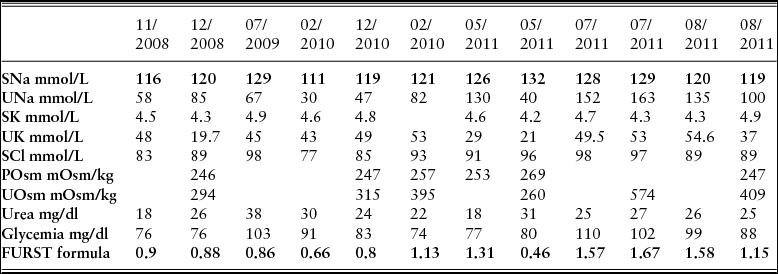
Not all patients respond to FR – their nephrons may be incapable of eliminating free water. The calculation of the Fürst formula can be useful to detect patients with a low probability of responseReference Furst, Hallows, Post, Chen, Kotzker, Goldfarb, Ziyadeh and Neilson77 (Fig. 5). Even applying the Fürst formula, many patients do not present a rise in SNa. Another pitfall for the use of FR is that the patient's response varies and the formula must be recalculated, as shown in the Fürst formulas of a 95-year-old patient with idiopathic SIADH over an 18-month period (Table 7).
Response to strictly-complied-with fluid restriction in a patient initially 92 years old with chronic SIADH, over a 33-month period
The Fürst formula varies between 0.46 and 1.67. SNa, serum sodium; SK, serum potassium; UNa, urinary sodium; UK, urinary potassium; SCl, serum chloride; Posm, plasma osmolality; Uosm, urine osmolality.
Use of the Fürst formulaReference Furst, Hallows, Post, Chen, Kotzker, Goldfarb, Ziyadeh and Neilson77. FR, fluid restriction; UNa, urinary sodium in mmol l−1; UK, urinary potassium in mmol l−1; SNa, serum sodium in mmol l−1.
Response to FR, when present, can be slow. It should not be used when it implies delaying or withholding needed therapy, such as surgery, chemotherapy, or artificial nutrition. Furthermore, a slow response to fluid restriction can increase hospital length-of-stay and thereby increase costs. To correctly apply FR, all i.v. and oral liquids must be taken into account (Fig. 6). Need for i.v. medication, even when concentrated, can make FR unfeasible. Fluid restriction can induce thirst, often intense, and patient compliance can be poor.
Fluid restriction: how to apply it
Furosemide
This can be useful in the treatment of short-term SIADH in hospitalized patients.Reference Runkle, Villabona, Navarro, Pose, Formiga, Tejedor and Poch7,Reference Decaux, Waterlot, Genette, Hallemans and Demanet78,Reference Decaux79 Furosemide interferes with the reabsorption of Na in the ascending loop of Henle, thus lowering RM osmolality. Much of the unabsorbed Na will reach the collecting duct, as the RAAS is usually inhibited in SIADH. Since in SIADH the osmolality in the distal portion of the collecting duct will often have reached equilibrium with that of the RM, a transitory decrease in RM osmolality, together with a transitory rise in collecting duct osmolality, will give rise to the elimination of free water down an osmotic gradient with ensuing diuresis. However, this effect is only observed in patients with high Uosm, well over 350 mmol l−1.
When using furosemide, RM osmolality must be restored via salt supplements (2–3 g t.i.d.), to maintain response and Uosm monitored. When calculating the need for salt supplements, the patient's oral salt intake with hospital meals should be taken into account – how much salt is in the hospital diet, as well the salt content of the food that is actually eaten. Whenever possible, salt should be added to meals, to make hospital food more palatable and increase protein intake. Some patients do not respond to furosemide unless a sodium load (4–5 g of oral salt) is given previously (we administer the load 3 h before 20 mg of i.v. furosemide). The associated use of salt can elevate blood pressure, which should be carefully monitored.
We apply ‘partial fluid restriction’ – i.v. medication is concentrated and patients are not encouraged to drink liquids without thirst. However, patients are allowed to drink freely. We thus avoid a low liquid intake that could interfere with the ingestion of solid foods, placing nutritional status at risk. Protein supplements are given as needed. We find furosemide therapy preferable to fluid restriction in the elderly hospitalized patient and consider it first-line treatment. Unfortunately, furosemide is not a feasible choice for chronic, ongoing SIADH, as its use is limited in time. Doses range from 40 mg p.o. 1–3 times a day, or 20 mg i.v. 1–3 times a day.
Tolvaptan
We use tolvaptan in patients with mild/moderate SIADH-induced hyponatraemia who are not candidates for or do not respond to fluid restriction or furosemide.Reference Runkle, Villabona, Navarro, Pose, Formiga, Tejedor and Poch7 It is also our treatment of choice in preparation for surgery, in patients that need artificial nutrition or protein supplements, and in preparation for and during chemotherapy. We have also found chronic tolvaptan therapy to be of great benefit in the treatment of elderly patients with chronic SIADH and sustained hyponatraemia (Table 2). In our series, continued tolvaptan use in patients with chronic SIADH was associated with a significant descent in emergency room visits, as well as a tendency towards reduced days of hospital stay due to readmissions.Reference Gómez Hoyos, Cuesta Hernández, Ruíz Gracia, de Miguel Novoa, Molino González, Díaz Pérez, Calle Pascual and Runkle de la Vega76
Vaptans are not recommended in European guidelines for treatment of SIADH, due to a high risk for overcorrection.Reference Spasovski, Vanholder, Allolio, Annane, Ball, Bichet, Decaux, Fenske, Hoorn, Ichai, Joannidis, Soupart, Zietse, Haller, van der Veer, Van Biesen and NAgler6 However, the authors chose to not specifically analyse tolvaptan, the only vaptan authorized for use in Europe. Rather, the analysis grouped together four vaptans: tolvaptan, conivaptan (authorized for i.v. use in the USA), satavaptan and lixivaptan, in spite of the fact that the latter two are not authorized for use in North America or in Europe.
When initiating treatment with tolvaptan, fluid restriction must be discontinued and the patient encouraged to drink freely. Elderly patients (including those over 90 years of age) do note thirst when starting on tolvaptan therapy, and will increase fluid intake when allowed to. We initiate tolvaptan at a dose of 7.5 mg on day 1,Reference Cuesta, Gomez-Hoyos, Montañez, Martin, Marcuello, de Miguel, Calle and Runkle80,Reference Runkle, Gomez Hoyos, Recio Blázquez, Cuesta Hernández, de Miguel Novoa, Ruiz Gracia, Sanabria Perez, Santiago Perez, Matia Martin and Calle Pascual81 almost always increasing to 15 mg daily from day 2 onwards. SNa is determined 6 h following the initial dose.Reference Runkle, Villabona, Navarro, Pose, Formiga, Tejedor and Poch7 If SNa has risen 5 mmol l−1 or more, we ‘brake’ the rise, adding 3 mg of DDAVP s.c. to i.v. dextrose (2–3 mmol kg−1 h−1 for 2–3 h) as needed. In a recent analysis of 39 patients with SIADH and mild/moderate hyponatraemia, with a median age of 78 (68–84) years, only one patient presented an increase of SNa over 4 mmol l−1 6 h after the initial 7.5 mg dose.Reference Runkle, Gomez Hoyos, Recio Blázquez, Cuesta Hernández, de Miguel Novoa, Ruiz Gracia, Sanabria Perez, Santiago Perez, Matia Martin and Calle Pascual81 Not a single patient presented overcorrection of SNa at 24 or 48 h. From a mean initial SNa of 127.6 mmol l−1 (SD 3.8), the average 24- and 48-h increments were 3.89 (SD 3.2) and 5.8 (SD 3.9) mmol l−1, respectively, with a maximum 24-h rise of 10 mmol l−1 in two patients at a low risk for ODS, and of 13 mmol l−1 at 48 h. The highest increments were observed in elderly patients with idiopathic SIADH. Initial SNa was negatively correlated with 24-h increment. Thus a starting dose of 7.5 mg was perfectly safe, although not always effective: 10% of patients did not respond to the initial 7.5 mg dose, but did to the following 15 mg dose.
As a precaution, day 2 and day 3 tolvaptan should not be administered before assuring that the 24- and 48-h SNa increment is not over maximum limits: these doses must be given after seeing the SNa level. If the limit is overshot, increased fluid intake (3 to 4 glasses of water) together with a 4–6 h delay in tolvaptan administration, will permit adequate lowering of SNa. Alternatively, tolvaptan can be reintroduced on the following day.Reference Runkle, Villabona, Navarro, Pose, Formiga, Tejedor and Poch7 Tolvaptan should never be given with hypertonic saline and should not be initiated with other treatments that increase SNa. Tolvaptan should never be administered to a hypovolaemic patient, nor to a patient in anuria. Although the maximum dose of tolvaptan authorized for use in SIAHD is 60 mg daily, patients with SIADH rarely need doses over 30 mg daily.
Tolvaptan can induce thirst, and dryness of mouth in patients on chronic therapy. Elevations in transaminase and bilirubin levels have been detected in patients with polycystic renal disease on chronic tolvaptan therapy, following doses of 120 mg daily.Reference Torres, Chapman, Devuyst, Gansevoort, Grantham, Higashihara, Perrone, Krasa, Ouyang and Czerwiec82 To our knowledge, not a single case of liver dysfunction has been attributed to tolvaptan in the treatment of SIADH. However, its use is not currently recommended in patients with marked liver dysfunction.
Chronic tolvaptan therapy achieves and maintains strict eunatraemia in elderly patients with chronic SIADH.Reference Gómez Hoyos, Cuesta Hernández, Ruíz Gracia, de Miguel Novoa, Molino González, Díaz Pérez, Calle Pascual and Runkle de la Vega76 Doses can be lowered over time and given intermittently, while still maintaining eunatraemia in an out-patient setting. Our protocol for dose reduction is shown in Fig. 7. Our goal is to maintain SNa levels of 138–140 mmol l−1, thus normalizing body water. As mentioned above, cognitive and motor function improve dramatically over 2–4 months. Patients with chronic SIADH can present episodes of hypovolaemia, secondary to infection, gastrointestinal bleeding, etc. In this case tolvaptan therapy can be safely interrupted for a few days, hypovolaemia and its cause treated and tolvaptan reinitiated when euvolaemia is restored, preferably before SNa falls again.
Our protocol for follow-up of patients on maintained tolvaptan therapy for chronic SIADH. TV, tolvaptan; SNa, serum sodium
Oral urea
Oral urea can be used in the treatment of hyponatraemia.Reference Spasovski, Vanholder, Allolio, Annane, Ball, Bichet, Decaux, Fenske, Hoorn, Ichai, Joannidis, Soupart, Zietse, Haller, van der Veer, Van Biesen and NAgler6 However, patients often do not reach levels of eunatraemiaReference Soupart, Coofernils, Couturier, Gankam-Kengne and Decaux83 and rarely reach the SNa levels associated with minimum mortality (138–142 mmol l−1). Furthermore, marked hypernatraemia can be seen in patients who stop drinking or are not drinking freely, as seen in up to 14% of ICU patients with mild/moderate hyponatraemia receiving urea,Reference Decaux, Andres, Gankam Kengne and Soupart84 as well as in the case of an 80-year-old male who developed pneumonia while on chronic urea therapy and whose SNa rose to 155 mol l−1.Reference Soupart, Coofernils, Couturier, Gankam-Kengne and Decaux83 When a 96-year-old patient of ours on chronic out-patient tolvaptan therapy was in the same circumstance, SNa levels remained normal (SNa 137 mmol l−1) and hypernatraemia and dehydration did not ensue (authors’ unpublished data). This different response could be explained by the mechanisms of action of urea and tolvaptan. Urea induces osmotic diuresis, interfering with reabsorption of water in the entirety of the nephron. A patient who stops drinking can then develop marked hypernatraemia and dehydration. Tolvaptan, however, only blocks water reabsorption at the collecting duct: initial hypovolaemia will be compensated by increased proximal nephron water reabsorption, acting as a safety valve that is unavailable in elderly patients on urea therapy.
Urea is given in doses from 15 to 120 g daily.Reference Soupart, Coofernils, Couturier, Gankam-Kengne and Decaux83 Some patients do not tolerate oral urea easily and can even develop nausea when taking it. Its use does not seem practical or feasible in patients at risk for chemotherapy-induced nausea, nor in patients on artificial nutrition. We believe that urea therapy should be attempted in patients that do not respond to tolvaptan, presumably due to type D SIADH,Reference Vandergheynst, Brachet, Heinrichs and Decaux85 although resistance to vaptans in the latter subtype has recently been called into question.Reference Fenske, Christ-Crain, Hörning, Simet, Szinnai, Fassnacht, Rutishauser, Bichet, Störk and Allolio86
Since urea is not considered to be a medication, no randomized clinical trials have been undertaken to ascertain side-effects. However, we know that 37% of ICU patients with marked hyponatraemia have ‘overcorrected’ on urea therapyReference Decaux, Andres, Gankam Kengne and Soupart84 and initial studies indicated that i.v. urea could increase calcium and magnesium renal clearance, with a fall in circulating levels of calcium, magnesium and phosphate.Reference Better, Gonick, Chapman, Varrady and Kleeman87 The ensuing effect of urea on circulating parathormone levels has not been studied, to our knowledge.
Conclusion
Hyponatraemia in older people is frequent and accompanied by marked cognitive and motor dysfunction, both of which improve upon correction of SNa. The initial steps in the management of hyponatraemia are the evaluation of neurological symptoms and the identification of volaemic status. SIADH is the most frequent cause of hyponatraemia in the elderly. Nutritional status, and the chronicity of anti-diuresis, should be taken into account when deciding therapy.
Conflicts of interest
Dr Runkle has served as an advisor to Otsuka, and given talks sponsored by Otsuka, Amgen, Novartis and Novo-Nordisk. Dr Gómez Hoyos has given talks sponsored by Otsuka. Dr de Miguel has given talks sponsored by Novo-Nordisk and Novartis. Dr Cuesta Hernández and Dr Chafer-Vilaplana declare no conflicts of interest.