Introduction
There about 27,000 species of vascular epiphytes, i.e. plants that grow non-parasitically on other plants, mostly trees (Zotz, Reference Zotz2013). A large percentage of them have tiny diaspores. Dust-like seeds are typical for orchids (c. 19,000 epiphytic species), as are tiny spores for ferns and fern-allies (c. 3000 epiphytic species). Besides their small size (length: 0.4–1.3 mm, width 0.08–0.3 mm; Arditti, Reference Arditti1992), orchid seeds are characterized by dead cells surrounding a tiny embryo, which create a large volume of air space (Arditti, Reference Arditti1992). The anemochorous habit is not restricted to these particularly species-rich groups; many other epiphytes have hairy appendices, which also keep seeds airborne for prolonged periods. For example, the seeds of more than 1000 species of tillandsioid bromeliads possess a so-called ‘coma’ (Benzing, Reference Benzing2000), and several hundred epiphytic Asteraceae and Apocynaceae species feature a ‘pappus’. It has long been acknowledged that seed characteristics are of major importance for the conquest of tree crowns (Schimper, Reference Schimper1888), but surprisingly little quantitative evidence is available of the aerodynamic properties of their diaspores. Because seed dispersal (a ‘hard’ trait sensu Weiher et al., Reference Weiher, van der Werf, Thompson, Roderick, Garnier and Eriksson1999) is hard to measure directly, dispersal potential is often derived from more readily measurable (‘soft’) traits, such as seed size or mass, or terminal velocity, i.e. the constant falling velocity of a diaspore in still air. Indeed, terminal velocity (V term), is central to theoretical models of seed dispersal by wind (Nathan et al., Reference Nathan, Katul, Bohrer, Kuparinen, Soons, Thompson, Trakhtenbrot and Horn2011), and the relevance of V term for dispersal in the field has also been demonstrated repeatedly (e.g. Tackenberg et al., Reference Tackenberg, Poschlod and Bonn2003). However, the claim that ‘falling velocity can easily be measured’ by the same author (Tackenberg, Reference Tackenberg2003) may simply not apply for tiny diaspores, which is a possible explanation for the dearth of quantitative information. The richest source of information on V term of orchid seeds is still a pioneering study by Burgeff (Reference Burgeff1936). Burgeff dropped seeds of about 50 species in a 150-cm-long glass cylinder and timed the fall with a stopwatch. Unfortunately, this author conducted no morphometric measurements. Hence, later correlations of these flotation times determined by Burgeff (Reference Burgeff1936) with seed mass and volume by Arditti and Ghani (Reference Arditti and Ghani2000) were not based on the same material. This may be problematic because at least some orchids show considerable intraspecific variation in seed length (Gamarra et al., Reference Gamarra, Galan, Pedersen, Ortunez and Sanz2015). There are very few other determinations of V term for orchid seeds, e.g. those for epiphytic Brassavola nodosa using stroboscopic photographs (Murren and Ellison, Reference Murren and Ellison1998). The D3 database (Hintze et al., Reference Hintze, Heydel, Hoppe, Cunze, König and Tackenberg2013), which includes data relevant for dispersal for more than 5000 taxa, lists V term for just eight additional terrestrial orchid species.
This scarcity motivated the present study. We conducted a full range of morphometric measurements for seeds of 45 species of orchids and – with the same seed batches – determined V term using a custom-built apparatus with a similar design to that described by Askew et al. (Reference Askew, Corker, Hodkinson and Thompson1997). We paid particular attention to the fact that orchid seeds frequently fall in groups and not individually (Burgeff, Reference Burgeff1936). The mass of a group scales linearly with group size. The cross-sectional area, however, is related to seed number2/3 if we assume spherical clumps. Since terminal velocity depends both on body mass and cross-sectional area, we would expect V term to scale with seed group size1/3. Such data of V term should be very useful for the understanding of dispersal of epiphytic orchids, particularly in fragmented habitats, which become increasingly common in tropical landscapes (Werner and Gradstein, Reference Werner and Gradstein2008; Poltz and Zotz, Reference Poltz and Zotz2011). Finally, we explored the possibility of using our device for even smaller diaspores by assaying spores of Polypodium vulgare, a fern frequently growing as an epiphyte in Europe (Zotz, Reference Zotz2005). Our results demonstrate that our device is indeed capable of reliably determining V term of such tiny spores.
Materials and methods
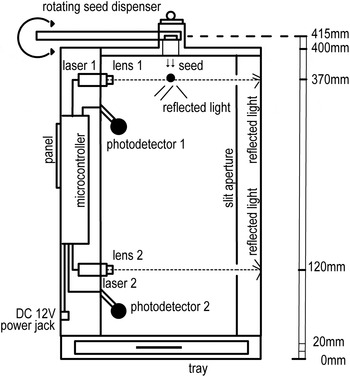
Seeds were obtained from mature fruits of plants growing in the Herrenhäuser Gärten, Hannover, from our collection at the Botanical Garden of Oldenburg, and from collections in Panama. Spores were obtained from a population of epiphytic ferns growing in the Neuenburger Urwald near Oldenburg, Germany. Material typically comprised seeds from several capsules from one to several individual plants. Species names follow The Plant List (2013). We determined the falling velocity of diaspores in air in a custom-built apparatus similar to that described by Askew et al. (Reference Askew, Corker, Hodkinson and Thompson1997). A black lightproof box provides a calm space for the determination of the falling velocity and encloses the electronical components (Fig. 1). The actual measurement chamber features two horizontal, parallel, fan-shaped beams of laser light, which are 250 mm apart. When passing, an object reflects the light produced by the laser diodes (Laserlyte-Flex, 635 nm, 5 mW, Global Laser, Gwent, UK) with built-on scattering lenses (Line Optic for LaserLyte Flex, Global Laser), which is then detected by two receivers (photodiodes OSD100-6, Centronic, Wartenberg, Germany) with amplifiers OPA656 U and OPA2277 U (Texas Instruments, Dallas, Texas, USA), and converted into electrical signals recognized by a microcontroller (Atmega 1284PU-AVR-40, Atmel, San Jose, California, USA). The time difference between the signal of detector 1 and 2 is used to calculate the fall velocity of a given seed.
Cross-section of the apparatus used to measure the rate of fall of tiny diaspores. Dashed lines indicate laser beams; thin solid lines, reflected light. The device is powered either via batteries or the mains.

The following optical and electronic features were essential to ensure adequate resolution and reproducibility. First, two slits were inserted in an extra wall opposite the lasers to reduce the amount of background light scatter. By using a microcontroller featuring two independent inputs it was possible to control both detectors independently. Temporal deactivation of the two photodiodes made sure that longer seeds or seeds with appendages could not trigger two consecutive signals of detector 1, or that reflected scatter from laser 1 would not trigger detector 2. As a default, the upper photodiode is deactivated after the first signal reaches the microcontroller for the time needed by a small metal sphere (diameter = 2 mm) to fall 250 mm, but this dead time is also adjustable by the user to avoid erroneous readings. Signals from the lower detector are ignored for a similar fixed time after detector 1 has sent a signal to the microcontroller. Additional shielding and grounding reduces the amount of static. Due to the high sensitivity of the system, opening the top lid would immediately trigger at least the upper photodiode. Therefore, the seeds are applied with a rotating, light-proof dispenser. Up to 1000 datasets can be stored and later transferred to a computer via a USB-interface.
The default release height of seeds is c. 5 cm above the first beam (Fig. 1). We tested whether this distance was sufficient to allow these tiny diaspores to reach constant speed by adding cylinders of different lengths, increasing the release height by 4, 8 and 13 cm. The measured velocities of Taraxacum officinale diaspores obtained from these four different heights were statistically indistinguishable [analysis of variance (ANOVA), F 3,36 = 0.42, P = 0.74]. Thus, the time difference between the triggering of the two sensors can be used to calculate terminal velocity without further corrections (Schäfer, Reference Schäfer2002). Our apparatus was equipped with more advanced sensors than the model described by Askew et al. (Reference Askew, Corker, Hodkinson and Thompson1997), which allowed us to measure reliably diaspores as small as 50 μm and less. Due to their small size, it was impossible to study the fall of seeds individually. Instead, a small quantity of dust-like diaspores was put in a small depression of the dispenser rod, which could be rotated to release some of them into the measurement chamber. A drawer at the base of the chamber allowed us to review the dropped diaspores after each individual run. We counted the total number of seeds under a dissecting microscope and noted whether diaspores had fallen singly or in groups, determining the number of diaspores for each group.
We also determined seed mass and morphometric parameters, i.e. length and width of seeds and embryos. From the latter we estimated the volume of both seeds and embryos. Arditti and Ghani (Reference Arditti and Ghani2000) suggested that orchid seeds are best approximated as fusiform objects, for which volume should be estimated as two cones joined at their bases, while the embryos should be approximated as prolate spheroids. However, the shape of many seeds is spheroid as well, and the application of Arditti and Ghani's (Reference Arditti and Ghani2000) suggestion frequently led to estimates of embryo volume exceeding those of the entire seed. Therefore, acknowledging the crude nature of such an estimate, in this study we opted for consistently estimating the volume of seed and embryo as two cones, using the equation:
 $${\rm volume} = 2/3\pi \; 0.5l\left( {0.5w} \right)^2$$
with l = length and w = width of the seed or embryo.
Seed mass was estimated as follows. About 1 mg of dry seeds were weighed with an analytical balance and then transferred into 5 ml distilled water with 25 drops of Tween 20® (Merck, Darmstadt, Germany). After soaking for a few hours, the seeds of five aliquots of the suspension were counted under a dissecting microscope. Extrapolating from the volume of the aliquots to the total volume gave total seed numbers, and the division of total seed mass by seed number yielded an estimate of the mass of individual seeds. This procedure was replicated ten times per species.
For statistical analysis we used R 3.0.3. (R Development Core Team, 2014). The relationship of terminal velocity (V term) to seed number was analysed with linear regressions of the log-transformed data.
Results
Orchid seeds
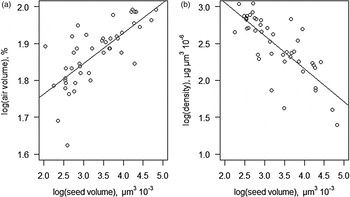
We studied a total of 45 orchid species, which typically grow as epiphytes, lithophytes or terrestrials. Seed length and width varied by about one order of magnitude from 0.2 to 2.6 mm and from 0.04 to 0.4 mm, respectively (Table 1). Seed mass differed about 50-fold from 0.1 to 4.5 μg, while the estimated seed volume showed the strongest variation, about 500-fold. The volume of the embryo varied much less, which resulted in a strong positive log-linear correlation between seed size (expressed as length, volume or dry mass) and the percentage of air space (Fig. 2a). Consequently, the average density of seeds decreased log-linearly with seed size (Fig. 2b).
Relationships of seed size (expressed as seed volume) and: (a) the relative proportion of air volume; (b) tissue density (seed mass/seed volume). Note the logarithmic scales. Each of the 45 data points represents a mean species value (Table 1). Both linear regressions are highly significant (P < 0.001, R 2 = 0.53 and P < 0.001, R 2 = 0.60).

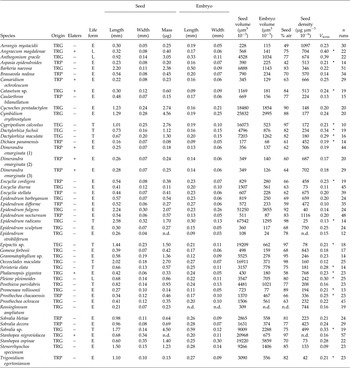
Seed characteristics of 45 orchid species. (For Dimerandra emarginata, seeds from three different individuals were tested separately.) The measured morphometric parameters (seed and embryo length and width), seed mass, derived morphometric parameters (seed and embryo volume, % air volume = (seed volume – embryo volume)/seed volume), estimated density and the terminal velocity (V term) are given. The last parameter is either the average of n measurements of single seeds (*) or derived regression equations of power functions solved for seed number = 1. These power functions are given in supplementary Table S1. The origin of the material (TRG, tropical, botanical garden; TRP, tropical, Panama; TEG, temperate, botanical garden), the presence of elaters (+, present; −, absent) and life form (E, epiphyte; L, lithophyte; T, terrestrial) are also given.

n.d., not determined.
Much of this morphological variation was related to life form. Seeds of epiphytes were significantly smaller than those of terrestrial species and weighed, on average, just about 50% of those of terrestrial and lithophytic taxa (Table 2). Although seeds of epiphytic taxa were significantly lighter and smaller than terrestrial ones, this did not lead to differences in V term, probably because the density of the larger terrestrial seeds was much lower.
Comparison of important seed characteristic among life forms. Shown are averages ± SD for epiphytes, lithophytes and terrestrial taxa. Different letters indicate significant differences (ANOVA, Tukey-test, P < 0.05)

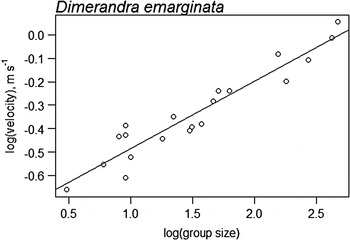
In a majority of species, a large proportion of the seeds did not fall individually, but in groups of up to several hundred seeds (Fig. 3; supplementary Fig. S1). In the remaining species, the seeds rarely, if ever, stuck to other seeds. Our device registered only the fastest object in each individual run, and a consistent pattern emerged when relating the measured V term to the largest group of seeds for each species. Applying a power function yielded a very good fit with the observations and allowed a standardized estimation of V term of an individual seed, even in cases when no runs without clumps could be recorded (Fig. 3). On average, 49% of the variation in V term of a given run could be explained by a power function. The average exponent was 0.32 ± 0.17 (n = 30, supplementary Table S1). In all cases with multiple measurements with single seeds only, the estimates derived from such runs were almost identical to the estimate derived from the power functions based on the entire dataset (see supplementary Fig. S1). Overall, the terminal velocity estimates of individual seeds of the 23 species (Table 1) varied relatively little, from 0.09 m s−1 (Stenorrhynchos speciosum) to 0.4 m s−1 (Angraecum magdalenae).
Relationship of the number of seeds in the largest clump of an individual measurement and the estimated velocity in Dimerandra emarginata. Note the logarithmic scales. Individual seeds never occurred in the 20 runs shown, but the relationship between the largest number of seeds in a clump and V term was highly significant (P < 0.001, R 2 = 0.62). The shown power function (see supplementary Table S1) solved for x = 1 yielded an estimate of V term of individual seeds.

We found no significant relationship between the estimated V term and any of the biometric characteristics of the seeds, i.e. seed length/width, seed mass or air volume (Pearson product moment correlations, P ≥ 0.4).
Fern spores
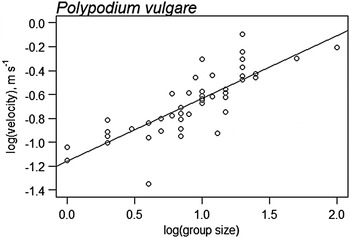
Spores of Polypodium vulgare are much smaller than even the smallest orchid seed in our study: the average diameter of the almost spherical spores being 48 ± 2 μm (n = 10) and mass averaging 0.03 ± 0.05 μg (n = 6). In spite of their tiny size, we were able to determine V term reliably. Similar to the orchid seeds, fern spores mostly fell in groups. Again, however, we found a highly significant relationship between V term and spore group size (Fig. 4). We arrived at an estimate of V term of a single spore of 0.06 m s−1.
Relationship of the number of spores in the largest clump of an individual measurement and the estimated velocity in Polypodium vulgare. Note the logarithmic scales. Individual spores rarely occurred in the 46 runs shown, but the relationship between the largest number of spores in a clump and V term was highly significant (P < 0.001, R 2 = 0.66). The shown power function (see supplementary Table S1) solved for x = 1 yields an estimate of V term of individual spores.

Discussion
Individual orchid seeds fall at a very low speed. The lowest value of the present study (0.09 m s−1, Table 1), which is comparable to a similarly low one (0.05 m s−1) observed by Burgeff (Reference Burgeff1936), matches the extreme value documented in the D3 database (Hintze et al., Reference Hintze, Heydel, Hoppe, Cunze, König and Tackenberg2013) with its >1500 entries. Although V term values of the seeds of most other orchid species are not that low, all of our estimates range among the lowest 10% in that particular database. These diaspores are clearly very well suited for far-distance dispersal into new habitats, a well-documented example being the fast colonization of Krakatau (Gandawijaja and Arditti, Reference Gandawijaja and Arditti1983). Unfortunately, a more detailed analysis of the sequence of arrival of different orchid species is not available. This could potentially shed light on the functional significance of the variation of V term within Orchidaceae. We found a fivefold difference in V term in our dataset; the interspecific variation observed by Burgeff (Reference Burgeff1936), was even larger, i.e. almost tenfold.
Many seeds did not fall individually, but in groups, which is consistent with earlier observations by Burgeff (Reference Burgeff1936). It is currently unclear whether this is largely an artefact of conditions in the laboratory, where low humidity could lead to increased electrostatic charging of these small particles. Field observations are necessary to clarify this issue. If seeds tend to clump under field conditions as well, the hygroscopic trichomes (elaters), which have been described for many Orchidaceae (Prillieux, Reference Prillieux1857; Hallé, Reference Hallé1986), may be of prime importance to loosen densely packed seeds to facilitate dispersal. In our particular set of species, however, elaters were not very common (Table 1), and for orchids in general, the frequency and the functional significance of elaters is largely unresolved.
From a purely methodological point of view, clumping is not a problem for the determination of V term because we found a consistent relationship between the number of seeds in the largest clump and the estimated V term. Although we can hardly assume that these clumps were perfect spheres, the average slope of the relationship of seed number and V term (0.32 ± 0.17; n = 20; see supplementary Table S1) was surprisingly close to theoretical expectations making this assumption, i.e. 0.33. Including all data clearly increases the robustness of our estimates for V term of single seeds. There are several observations, which indicate appropriate reproducibility of our data. First, the consistent result of comparisons of estimates of V term of single seed runs only and estimates from our power functions. Second, we compared seeds of three distinct batches of the same species, Dimerandra emarginata (Fig. 3 and supplementary Fig. S1) and obtained very similar estimates of V term (0.17, 0.18 and 0.19 m s−1; supplementary Table S1). Finally, estimates of V term of Brassavola nodosa using a different method (stroboscopic photographs, Murren and Ellison, Reference Murren and Ellison1998) were very similar to those obtained with our approach (0.16 vs. 0.14 m s−1).
Due to the relatively small variation in embryo size, an increase in size of the entire seed was mostly due to an increase in the relative proportion of the air space and, hence, a decrease in density (Fig. 2). While this result was consistent with findings of an earlier analysis by Arditti and Ghani (Reference Arditti and Ghani2000), we were not able to replicate the significant, positive correlation of Burgeff's (Reference Burgeff1936) V term data with morphometric data from other sources reported by Arditti and Ghani (Reference Arditti and Ghani2000). Neither were we able to replicate the observed relationship of percentage airspace and V term. Thus, currently, we cannot recommend using these morphometric data as a proxy for V term.
We found significant differences in seed size and seed mass with life form, but these morphological differences did not translate into similar differences in V term. A few other studies have directly compared seed characteristics of epiphytic and terrestrial orchids. Yoder et al. (Reference Yoder, Imfeld, Heydinger, Hart, Collier, Gribbins and Zettler2010) studied ten North American endemics, Tsutsumi et al. (Reference Tsutsumi, Yukawa, Lee, Lee and Kato2007) compared seeds of six epiphytic and terrestrial Liparis species and Zhang et al. (Reference Zhang, Zhang, Yan, Hu and Zhang2015) compared epiphytic and terrestrial Paphiopedilum species. The results of these studies are inconsistent: while epiphytic orchids in the first study had smaller, lighter and more porous seeds, which agrees with our findings, the opposite observation was made in the comparison of congeneric Liparis: epiphytes had larger seeds with smaller air volume. Paphiopedilum seeds had smaller air volumes as well, but again very few epiphytic species (two) were included in the study. Thus, generalizations are still difficult and it remains unresolved whether seeds of epiphytic species differ in size and other traits compared to terrestrial ones of the same clade (Arditti and Ghani, Reference Arditti and Ghani2000). Moreover, since our data indicate that air space increases with seed size, the functional implications of possible morphological differences between life forms are yet another issue. Although significantly larger and heavier (Table 2), V term values of the seeds of terrestrial taxa were statistically indistinguishable from those of epiphyte seeds.
In conclusion, we report estimates of the terminal velocity of 45 orchid species, along with morphometric data, almost doubling the currently available database for this family. We show that our approach allows the rapid determination of V term values by correcting for the variation of the raw measurements due to the size of the largest seed clump using a power function. We also demonstrate that our device is sensitive enough to determine V term of even smaller particles, e.g. fern spores. The obtained information on V term will be highly useful in a range of studies with plants with tiny diaspores, and will allow researchers to address quantitatively basic ecological and conservation issues related to the dispersal of diaspores.
Supplementary material
To view supplementary material for this article, please visit http://dx.doi.org/10.1017/S0960258516000155
Acknowledgements
Orchid seeds were obtained from the custodian of the Botanical Garden Oldenburg, Dr Bernhard von Hagen, and external sources. Help of the custodian of the Herrenhäuser Gärten, Hannover, Dr Boris Schlumpberger, is gratefully acknowledged. We also acknowledge permission granted by the Panamian authorities to collect and export material from Panama. Thanks to Ingeborg Eden and Maike Westhoff, both of Oldenburg, for help with the measurements. Finally, thanks to Thomas Schmidt, Oldenburg, who supplied the spores of Polypodium vulgare.
Financial support
This research received no specific grant from any funding agency, commercial or not-for-profit sectors.
Conflicts of interest
None.