The distribution of many invasive plant species is closely associated with human use (e.g., Gravuer et al. Reference Gravuer, Sullivan, Williams and Duncan2008; Lavergne and Molofsky Reference Lavergne and Molofsky2004; Procheş et al. Reference Procheş, Wilson and Richardson2012; Wilson et al. Reference Wilson, Richardson, Rouget, Proches, Amis, Henderson and Thuiller2007, Reference Wilson, Gairifo, Gibson, Arianoutsou, Bakar, Baret, Celesti-Grapow, DiTomaso, Dufour-Dror, Kueffer, Kull, Hoffmann, Impson, Loope, Marchante, Marchante, Moore, Murphy, Tassin, Witt, Zenni and Richardson2011). Human introduction effort and assistance during establishment significantly contributes to invasion success (e.g., see Kowarik Reference Kowarik2003; Lockwood et al. Reference Lockwood, Cassey and Blackburn2005; Thuiller et al. Reference Thuiller, Richardson, Rouget, Proches and Wilson2006). Although a number of species have become invasive after accidental introductions, many species have only become invasive after an extended history of cultivation (Dehnen-Schmutz et al. Reference Dehnen-Schmutz, Touza, Perrings and Williamson2007a; Mack Reference Mack2000). Examples include Australian Acacia species planted for sand dune stabilization in South Africa, Pinus species planted for timber, Pueraria montana var. lobata (Willd.) Maesen & S. M. Almeida (kudzu) planted for fodder, and Banksia and Hypericum species planted for horticultural and ornamental purposes (Forseth and Innis Reference Forseth and Innis2004; Geerts et al. Reference Geerts, Moodley, Gaertner, Le Roux, McGeoch, Muofhe, Richardson and Wilson2013b, Reference Geerts, Mashele, Visser and Wilson2016; reviewed in Richardson and Rejmanek Reference Richardson and Rejmanek2011). In these genera, closely related species with reduced introduction effort are less invasive (Mgidi et al. Reference Mgidi, Le Maitre, Schonegevel, Nel, Rouget and Richardson2007; Richardson and Rejmanek Reference Richardson and Rejmanek2011). This highlights the fact that purposefully introduced species benefit from introduction effort and human assistance to become invasive (Dehnen-Schmutz et al. Reference Dehnen-Schmutz, Touza, Perrings and Williamson2007a, Reference Dehnen-Schmutz, Touza, Perrings and Williamson2007b).
Management Implications
Invasive species—and invasive ornamental (horticultural) species in particular—have, until the past decade or so, received less attention if not invading natural areas. We argue that these species warrant more attention at an early stage of invasion. We use Centranthus ruber in South Africa as a case study and determine the possibilities and barriers for early eradication in urban environments. Centranthus ruber was introduced into Cape Town, South Africa, more than a century ago as a garden ornamental, but until recently was not considered invasive. The number of identified populations increased from 64 in mid-2013 to more than 530 by the end of 2015, both due to spread and increased awareness. Centranthus ruber was found to invade near-pristine areas. We found no difference in plant mortality between chemical and hand pulling, but because hand pulling stimulates the soil seedbank, we recommend chemical clearing. Based on climate models, the category 1b regional listing in NEM:BA is justified, but we suggest a listing in other parts of the country, where the climate is suitable, might be appropriate. We argue that based on the limited distribution and low cost of clearing, C. ruber extirpation from South Africa is feasible. We suggest that the goal for management should be to limit spread where possible, raise awareness, get buy-in from residents, and encourage adherence to the relevant legislation. However, without legislation buy-in from local residents in urban environments, reinvasion will render extirpation impossible. This study therefore highlights the importance of managing and legislating potential ornamental plant invaders at an early stage of the invasion process before they become widespread and have negative impacts.
One of the most important pathways of spread for invasive alien plant species (hereafter referred to as “invasive species”) is escape from horticulture (Faulkner et al. Reference Faulkner, Robertson, Rouget and Wilson2016; Reichard and White Reference Reichard and White2001; Richardson and Rejmanek Reference Richardson and Rejmanek2011), and indeed, horticultural species are among the most important invaders in many parts of the world (Baskin Reference Baskin2002; Reichard and Hamilton Reference Reichard and Hamilton1997). Consequently, cities act as points of introduction from which alien species can spread to surrounding areas (Gaertner et al. Reference Gaertner, Larson, Irlich, Holmes, Stafford, Van Wilgen and Richardson2016; Pyšek Reference Pyšek1998). Natural areas at the urban–wildland interface are therefore particularly vulnerable to invasion, largely because suburban gardens are important sources of alien plants, but also because these areas at the urban–wildland interface are more susceptible to disturbance (see, e.g., Alston and Richardson Reference Alston and Richardson2006; Kowarik Reference Kowarik2008; Raloff Reference Raloff2003). Ecosystems that are subject to disturbances are known to be more susceptible to invasions (Hobbs and Huenneke Reference Hobbs and Huenneke1992; Kowarik Reference Kowarik2003; Mack Reference Mack1989; Rejmánek Reference Rejmánek1989), and consequently human disturbances have aided plant invasions such as Lythrum salicaria L. (purple loosestrife) in the United States (Blossey et al. Reference Blossey, Skinner and Taylor2001) and [Genista monspessulana (L.) L.A.S. Johnson] (French broom) in South Africa (Geerts et al. Reference Geerts, Botha, Visser, Richardson and Wilson2013a). Until recently, plant invasions at the urban–wildland interface have been perceived as less important than plant invasions from forestry or agriculture, particularly if the invasion of natural habitat did not seem imminent. However, a more proactive approach, whereby emerging invaders in urban areas are identified and acted upon at an early stage, will be more cost-effective in the long run (e.g., Lodge et al. Reference Lodge, Williams, MacIsaac, Hayes, Leung, Reichard, Mack, Moyle, Smith, Andow, Carlton and McMichael2006).
To address some of these issues, we consider Centranthus ruber, an ornamental invader in South Africa. Native to Mediterranean Europe, this species has been introduced globally through the horticulture industry and has been widely cultivated as an ornamental plant (e.g., see Harden Reference Harden1992; Thonner Reference Thonner1915). Centranthus ruber often naturalizes where it is planted (Brickell and Zuk Reference Brickell and Zuk1997; Wagner et al. Reference Wagner, Herbst and Sohmer1999) and has invaded parts of southwestern Asia, Micronesia, Australia, Tasmania, New Zealand, the Czech Republic, the British Isles, and areas in North and South America (Cory and Knapp Reference Cory and Knapp2014; Delucchi Reference Delucchi2013; Gardner and Burningham Reference Gardner and Burningham2013; Hitchmough and Woudstra Reference Hitchmough and Woudstra1999; Howell Reference Howell2008; O’Shea and Kirkpatrick Reference O’Shea and Kirkpatrick2000; Parnell and Foley Reference Parnell and Foley2000; Pyšek Reference Pyšek2012; Randall Reference Randall2007; Starr et al. Reference Starr, Starr and Loope2006; Welch Reference Welch1905; Williamson Reference Williamson2002; Wilson et al. Reference Wilson, Rapson, Sykes, Watkins and Williams1992).
Until about 1910, most species introduced into South Africa entered through the country’s oldest port, Cape Town (Wells et al. Reference Wells, Poynton, Balsinhas, Musil, Joffe, van Hoepen and Abbott1986), which is situated within the Cape Floristic Region, an area of exceptional biodiversity and endemism (Myers et al. Reference Myers, Mittermeier, Mittermeier, da Fonseca and Kent2000). This region’s biodiversity is principally threatened by invasive species (Latimer et al. Reference Latimer, Silander, Gelfand, Rebelo and Richardson2004; Richardson et al. Reference Richardson, Van Wilgen, Higgins, Trinder-Smith, Cowling and McKelly1996; Rouget et al. Reference Rouget, Richardson, Cowling, Lloyd and Lombard2003) and land-use change around Cape Town, the fastest-growing metropolis in South Africa (Cowling et al. Reference Cowling, Macdonald and Simmons1996). Centranthus ruber has recently been recognized as an invasive species in the Cape Metropolis (Forsyth Reference Forsyth2013), with anecdotal evidence of invasion into near-pristine areas. But whether C. ruber has the ability to invade natural areas and to what extent South Africa is climatically suitable still need to be determined. Furthermore, little is known about effective control methods of C. ruber in South Africa (Herbiguide 2013; Starr et al. Reference Starr, Starr and Loope2003), and whether C. ruber can potentially still be extirpated. Therefore we aim to: (1) determine the current distribution, spread dynamics, and potential future distribution of C. ruber in South Africa; (2) determine the most effective control methods; and 3) provide recommendations for legislation and management.
Materials and Methods
Study Species
Centranthus ruber (Caprifoliaceae) is a drought-resistant, small perennial shrub native to Mediterranean Europe (Richardson 1975). In South Africa it produces white, red, or pink flowers mostly in spring and summer, but some flowering might occur throughout the year (Richardson 1975). Flowers attract a wide range of pollinating insects, including butterflies and bees (Bergerot Reference Bergerot2010; Brickell and Zuk Reference Brickell and Zuk1997). Centranthus ruber produces large quantities of wind-dispersed seeds (Lisci et al. 2003), with secondary dispersal in soil attached to vehicles, road-maintenance machinery, and storm-water runoff (T Rossenrode, personal observation). Seeds germinate rapidly under ideal conditions, but can remain in the seedbank for at least 1 yr (Lavorel et al. Reference Lavorel, Lebreton, Debussche and Lepart1991; Mattana et al. Reference Mattana, Daws and Bacchetta2010).
Centranthus ruber Distribution in South Africa
To locate C. ruber populations in South Africa, we collated records from the South African Plant Invaders Atlas (accessed 2013; Henderson Reference Henderson1998), the South African herbarium species database (PRECIS 2013), a civil society spotters’ website (www.ispotnature.org), and an online spotter network (www.capetowninvasives.org.za). We distributed pamphlets with a description and photographs of C. ruber among relevant conservation agencies, conservation officers, and local experts. We then visited all localities from the compiled list between March and August of 2013 and marked each plant found with a GPS waypoint (handheld Garmin GPS GPSmap 60CSx, Garmin International Inc., Olathe, KS). Searching distance was 25 m in all directions beyond the last plant encountered. Using the terminology of Richardson et al. (Reference Richardson, Pysek, Rejmanek, Barbour, Panetta and West2000) (updated by Blackburn et al. [Reference Blackburn, Pyšek, Bacher, Carlton, Duncan, Jarošik, Wilson and Richardson2011]), we classified these populations as casual, naturalized, or invasive. Although the survey was conducted in 2013, records from spotter networks were continuously added until 2015.
Spread Dynamics
During 2013, we contacted 17 nurseries within the Cape Town metropolis to establish whether C. ruber was still being sold.
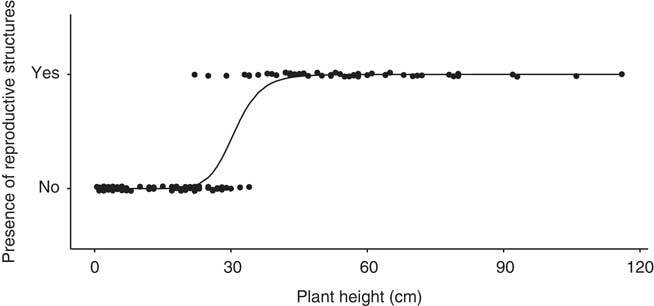
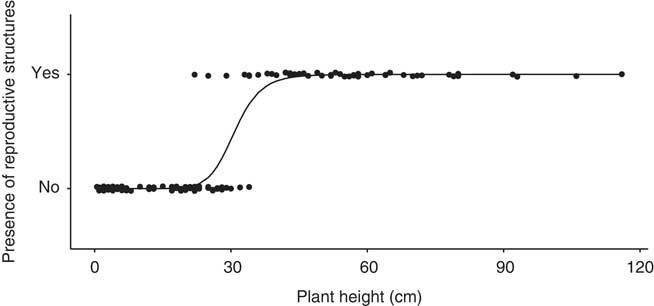
To determine C. ruber age structure and size at reproduction, we measured plant height (n=150 haphazardly selected individuals) and recorded the presence of reproductive structures. To determine the significance of plant height in predicting the presence of reproductive structures, we used a generalized linear model, with a binomial error distribution, with presence of reproductive structures (yes/no) as the response variable and height (log) as the predictor variable. To determine spread rate, that is, whether many seedlings occur on the periphery of a population, we mapped and measured all individuals in the largest population (Supplementary Fig. S1).
Species Distribution Modeling
We obtained C. ruber occurrence records from the Global Biodiversity Information Facility (GBIF Global Biodiversity Information Facility 2016; www.GBIF Global Biodiversity Information Facility.org/species) and included additional occurrences for South Africa (from this study up to December 2015). After data cleaning, we were left with 6,068 occurrences. We used Maxent in R to predict the potential distribution of C. ruber in South Africa, using the approach suggested by Merow et al. (Reference Merow, Allen, Aiello-Lammens and Silander2016), which allows one to use offsets that can provide additional biological information (“informative offsets”; e.g., niche occupancy elsewhere in the world) and offsets that can account for sampling bias (“nuisance offsets”) (see Supplementary Material for more details). We modeled the distribution of C. ruber in three different parts of the world (its native range of Europe, and two alien ranges in Australasia and the West Coast of the United States) as informative offsets, using three climatic variables and two soil variables. We modeled nuisance offsets in each range (including South Africa) to account for sampling bias, using a model of target group species in each range predicted by distance to roads and population density. To produce a final modeled distribution for South Africa, we used as offsets models for each range outside South Africa projected to South Africa and a sampling bias offset (as described above). We identified environmental space that was poorly sampled in the models using the approach of Zurell et al. (Reference Zurell, Elith and Schröder2012).
Effectiveness of Different Control Methods
Currently no herbicide is registered for control of C. ruber in South Africa. Therefore, in a preliminary study, we compared the effectiveness (measured as the percentage of plants killed) of two commonly used active ingredients, triclopyr (Garlon®) and glyphosate (KleenUp®). We observed no significant difference between these two herbicides (n=27 plants for Garlon®; n=24 plants for KleenUp®; P=0.36 from a chi-square test comparing generalized linear models with and without treatment as a predictor variable); the more cost-effective glyphosate was therefore used for further experiments.
To determine the effectiveness of various concentrations of glyphosate versus manual control, we set up five 4-m2 plots at 10 different sites (n=4,985 plants). In these plots, we marked and counted all C. ruber plants. At one plot at each site, we implemented the following treatments: (1) manual treatment, complete removal of plants by hand pulling; (2) 0.25% herbicide concentration; (3) 0.5% herbicide concentration; (4) 1% herbicide concentration; and (5) left unmanipulated as a control. We applied all chemical treatments to the foliage using a handheld sprayer with glyphosate herbicide 360 g L–1 mixed with water, following standard herbicide application procedures. Plots were at least 2 m apart to prevent effects of herbicide drift. At 1 month after treatment, we recorded surviving and resprouting adult plants and counted new seedlings. We analyzed treatments with an ANOVA and post hoc Tukey test in R (R Development Core Team 2016).
Management and Cost of Clearing
To calculate the cost and efficacy of current clearing methods, we monitored teams from the City of Cape Town’s Early Detection and Rapid Response program and recorded the amount of herbicide used and the number of person-days required. To calculate the effort required for C. ruber extirpation from South Africa, we assumed similar costs and clearing efforts for all populations. To determine increased cost and extirpation potential, we did this exercise twice, first based on the 2013 records and then based on the 2015 (up till December) records. Based on current management data, we assumed in our calculations that a maximum of 10 sites can be accessed in a single day and not more than 500 plants cleared per person-day. This assumes no delays in gaining access to properties and minimal driving between sites. Costs were increased by 7% per annum based on recent rates of inflation in South Africa. The cost calculations do not consider the complexities of sites (clearing individual plants on rocky slopes vs. clearing large patches on flat transformed land), time to gain access to properties, or distances between sites, and are likely an underestimation. However, we applied the same methods to both 2013 and 2015, which makes comparisons possible.
Risk Assessment
We assessed the risk of C. ruber becoming invasive in South Africa using the Australian weed risk assessment protocol of Pheloung et al. (Reference Pheloung, Williams and Halloy1999) and the guidelines of Gordon et al. (Reference Gordon, Riddle, Pheloung, Ansari, Buddenhagen, Chimera, Daehler, Dawson, Denslow, Tshidada, LaRosa, Nishida, Onderdonk, Panetta, Pyšek, Randall, Richardson, Virtue and Williams2010) for application of this system outside Australia, using an assessment for Hawaii (Hawaii Pacific Weed Risk Assessment) adapted to South African conditions. In answering question 2.01 of the protocol (“Is the species suited to South African climates?”), we used the predictions of the species distribution model.
Results and Discussion
Centranthus ruber Distribution in South Africa
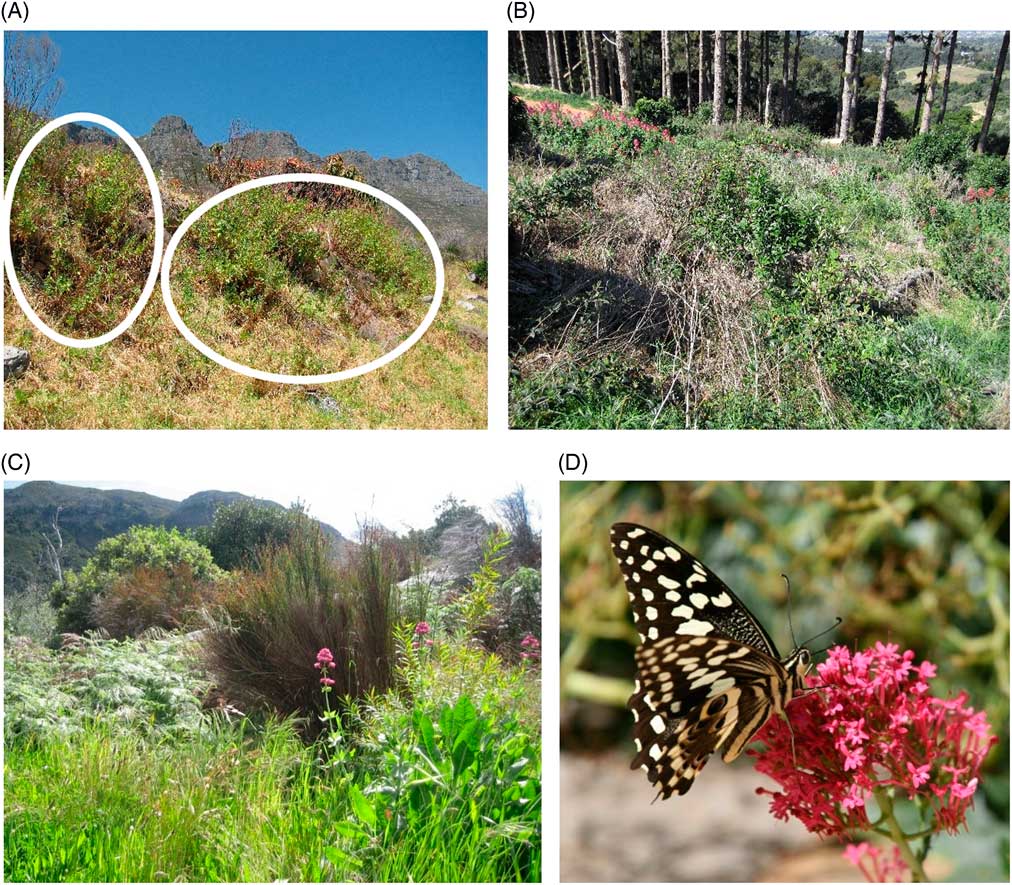
The first report of C. ruber in South Africa was from 1858 (Alston and Richardson Reference Alston and Richardson2006), with the first naturalization record on the Cape Peninsula in the 1990s (Compton Herbarium, Kirstenbosch). Based on our visits to known localities, we found that Centranthus ruber occurs mostly as a garden escapee (Fig. 1A), from which it invades disturbed areas, such as forestry plantations and roadsides (Fig. 1B), but also near-pristine vegetation (Fig. 1C). We found that most recorded populations occurred on roadsides and disturbed areas, but one population was several meters away from a footpath within a large area of pristine vegetation in the Table Mountain National Park (Appendix 1). This population most likely originated from contaminated soil attached to shoes (T Rossenrode personal observation). By August 2013, we had found a total of 64 populations (6,500 individual plants), of which 27 were naturalized, 6 invasive, and 31 casual (Appendix 1). By December 2015, the number of populations we had recorded increased to approximately 530 (about 45,000 individual plants) (Supplementary Table S1), of which approximately 50% were naturalized, and at least 15 populations were invasive (U Ulrich, personal observation).
Centranthus ruber in South Africa. (A) Escaped and now growing outside the perimeters of a neglected garden (circles indicate C. ruber clumps). (B) Growing underneath indigenous and alien vegetation in disturbed areas. (C) Following disturbance, in this case a footpath, C. ruber is able to invade near-pristine fynbos vegetation. (D) A number of pollinator species, including Pseudacraea spp., Acraea horta, Pieris rapae, and the Papilio demodocus demodocus (shown here), visit C. ruber flowers.

Spread Dynamics
Centranthus ruber is not traded by nurseries anymore (n=17 nurseries in this study; and n=41 in Cronin et al. [Reference Cronin, Kaplan, Gaertner, Irlich and Hoffman2017]), but we have anecdotal evidence that informal exchange among gardeners does still take place regularly.
Plants reach maturity at a height of 22 cm, with all plants taller than 34 cm reproducing (Fig. 2). Moreover, we found height to be a good predictor of reproduction (P<0.01 from a chi-square test comparing generalized linear models with and without height as a factor). At the largest population consisting of 1,473 plants, of which 294 were seedlings, spread rate is slow, as we found no seedlings farther than 20 m from a reproducing plant (Supplementary Fig. S1). Centranthus ruber can also survive in shade under a tree canopy (Supplementary Fig. S2)
The relationship between height and reproductive maturity in C. ruber. The line shown is from a fitted generalized linear model with binomial errors and plant height as an explanatory variable.
Species Distribution Modeling
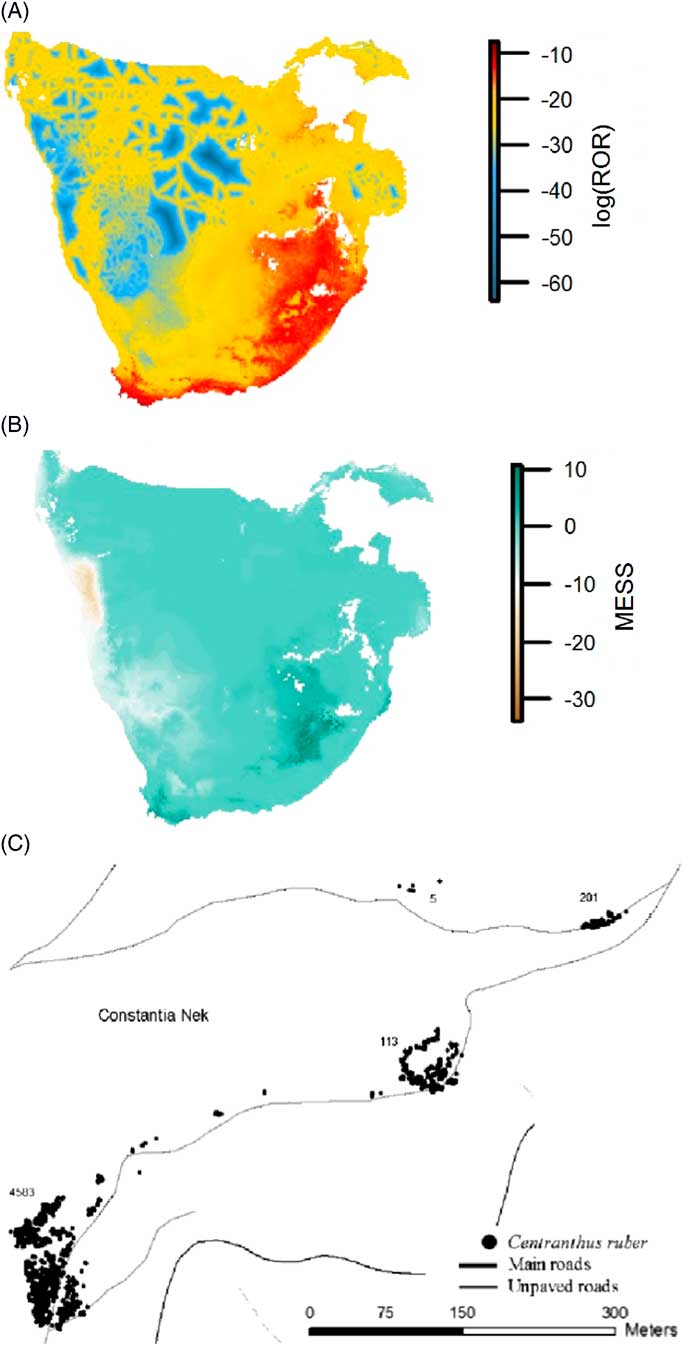
Much of the native range of C. ruber, the Mediterranean, was predicted by a species distribution model to be highly suitable (Supplementary Fig. S3). In South Africa, the southern coastline and the eastern highlands are predicted to be highly suitable for C. ruber, with the Cape Peninsula and southern coast being particularly suitable (Fig. 3A and B; Supplementary Figs. S3 and S4).
Effectiveness of Different Control Methods
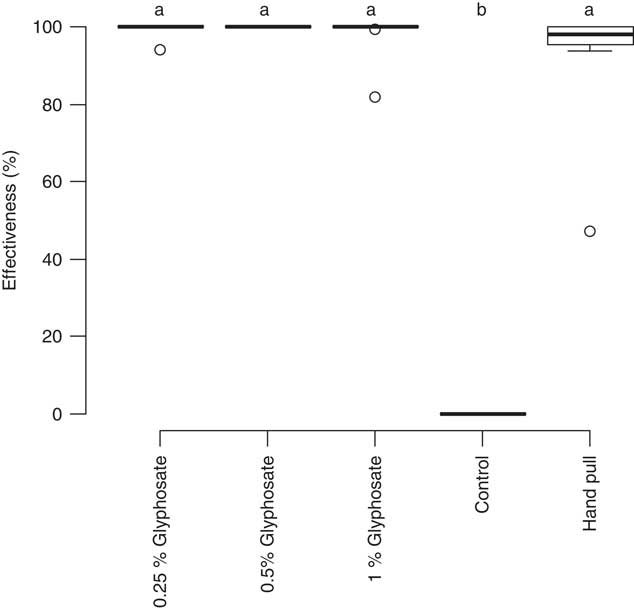
There is no significant difference between chemical and manual control or among the different glyphosate concentrations in the number of plants killed. All treatments were significantly different from the control (P<0.01 from a chi-square test comparing generalized linear models with and without treatment as a factor; Fig. 4). Seven out of the 2,822 (0.2%) chemically treated plants resprouted, while 17 out of the 1,119 (1.5%) hand-pulled plants resprouted, but the small sample size does not warrant further analysis. Postclearing seedling emergence was 1.6% for chemical treatments and 4.4% for hand pulling (as a percentage of the number of plants from before the treatment).
(A) The potential distribution of C. ruber in Southern Africa after accounting for sampling bias and informative offsets. Colors range from blue (low) to red (high), representing the relative occurrence rate (ROR), which is a measure of the probability of any given locality containing a presence. (B) Multivariate environmental similarity surfaces (MESS), indicating a novel environmental space (negative MESS values; brown colors). (C) Centranthus ruber mostly occurs in previously disturbed sites such as along rivers, roads, or footpaths, from which it can invade near-pristine vegetation (the Table Mountain National Park in this case).

Management and Cost of Clearing
Initial chemical treatment of a population of 933 plants takes approximately 2 person-days, and at 0.25% glyphosate concentration, will cost ZAR 372.50 (ZAR 0.40 plant−1 at 2013 rates; 1 ZAR=US$0.076 as of August 18, 2017). After initial clearing, 1 person-day for 5 yr will be required for a total cost of ZAR 1,518.56 for this population (initial clearing plus 5 yr of follow-up and monitoring). The total cost to clear and monitor all 64 recorded populations of 2013 is ZAR 10 642.97 and 13 person-days (with locally sourced teams for outlying populations) (Table 1). In 2015, this cost increased 8.5-fold to ZAR 90,046.15, largely due to the much greater number of recorded populations (Table 1).
Cost estimation for Centranthus ruber extirpation from South Africa.Footnote a

a We compare costs between the number of sites and individual plants between 2013 and 2015. Costs were calculated using the current 7% annual increase and assuming no more than 500 plants and/or 10 sites day−1 can be cleared. Costs are conservative estimates and likely to be an underestimation due to the complex nature of urban environments and property accessibility.
Risk Assessment
A weed risk assessment score of 14 (12 for biogeography, 3 for undesirable attributes, and −1 for biology/ecology) together with the predicted potential distribution of this species (Fig. 3A) indicates a high potential invasiveness for C. ruber in the southwest and on the eastern escarpment of South Africa (Appendix 2). For parts of the country (mainly the drier central areas), the climate is less suitable (Fig. 3A), and the weed risk assessment score for these areas drops to 9.
The percentage of plants killed by three different glyphosate concentrations compared with hand pulling. Box plot displays the median with a solid line, 25th and 75th percentiles in the lower and upper boxes, respectively; the data range is indicated by the whiskers. Open circles indicate outliers (values >1.5 times interquartile distance below 25th percentile). Different letters above the boxes indicate significant differences between treatments.

Our results show that the ornamental species C. ruber is a common invader of disturbed areas at the urban–wildland interface, and at least for one detected population, can invade near-pristine areas in the Table Mountain National Park. However, this is only one population that seemingly has little impact on the native vegetation. Centranthus ruber requires disturbance to invade, and apart from human disturbance at the edges of natural areas and roads traversing protected areas, fire is a natural and regular disturbance in many areas of South Africa. After a fire in C. ruber–invaded but degraded fynbos, C. ruber seedlings were abundant, and adult plants resprouted (E Kellerman personal communication). The current increase in fire frequencies in fynbos (van Wilgen et al. Reference Van Wilgen, Forsyth, de Klerk, Das, Khuluse and Schmitz2010) might therefore favor C. ruber. In addition, the climate is highly suitable where the known and verified populations of C. ruber occur in South Africa (Fig. 3a). Based on this, we suggest that extirpation of existing populations is desirable, but extirpation from South Africa might not be feasible due to new invasions constantly arising from urban gardens. Management of C. ruber therefore remains problematic, mainly because public awareness is lacking and access to invaded private properties is limited (Gaertner et al. Reference Gaertner, Larson, Irlich, Holmes, Stafford, Van Wilgen and Richardson2016; Irlich et al. Reference Irlich, Potgieter, Stafford and Gaertner2017). Furthermore, C. ruber is not currently recognized by national government agencies as a problematic species, so funding and capacity support are limited.
Apart from being a hardy plant with beautiful flowers, the appeal of C. ruber as a garden plant is enhanced by the impression that it has a positive effect on the local fauna: butterflies (Fig. 1D), bees, and other insects visit the flowers, which results in many people holding a favorable impression of this species in a built-up environment (Benvenuti Reference Benvenuti2004). We found that, since being legislated in 2014, C. ruber is not being sold by nurseries in South Africa (Cronin et al. Reference Cronin, Kaplan, Gaertner, Irlich and Hoffman2017; this study), but informal trading is still occurring. Fortunately, after recent public awareness campaigns (Maditla Reference Maditla2012; Montgomery Reference Montgomery2012, Reference Montgomery2013; www.facebook.com/ctinvasives; www.capetowninvasives.org.za), ornamental use has declined, and some private landowners have removed C. ruber from their gardens (personal observation by the authors). Various cultivars and subspecies of C. ruber occur in South African gardens, and these may differ in their potential invasiveness, but accurate identification of these taxa will require genetic screening (Le Roux et al. Reference Le Roux, Geerts, Ivey, Krauss, Richardson, Suda and Wilson2010).
Other than benefiting from a high introduction effort and being cultivated widely, C. ruber has a number of traits that are correlated with invasiveness in plants: a long flowering period, seeds capable of germinating across a wide temperature range (Mattana et al. Reference Mattana, Daws and Bacchetta2010), rapid establishment in harsh conditions, high seed viability, seeds capable of germinating in both sun and shade, shade tolerance (Supplementary Fig. S2), soil-stored seedbanks (Mattana et al. Reference Mattana, Daws and Bacchetta2010), a resprouting rootstock, being a pollinator generalist (Fig. 1D), wind-dispersed seeds, the ability to grow in dry and harsh environments such as walls (Benvenuti Reference Benvenuti2004), preferential recruitment and survival in disturbed environments, and the ability to survive fire. Consequently the 7-fold increase of C. ruber from 6,500 to more than 45,000 individuals from August 2013 to late 2015 is not unexpected. It should be noted that we cannot fully disentangle the influence of spread from awareness-raising by the general public on the aforementioned increase of C. ruber populations. However, a number of new populations detected after August 2013 were almost certainly the result of natural or anthropogenic spread and were unlikely to have already existed before this date and not been detected. We base this reasoning on three pieces of information: First, the three spotters, who have been involved in the program since 2012 (and have submitted more than 10 populations each), each contributed 40 populations before and 30 populations after August 2013. Second, most new reported populations are small (<50 individuals). Third, only 12% of the new populations located after August 2013 were identified by the public. The listing of C. ruber as a priority species for management by local government (City of Cape Town) is thus justified (Forsyth Reference Forsyth2013). Furthermore, large parts of South Africa are predicted to be suitable for C. ruber (Fig. 3A and B; Supplementary Fig. S2A). These climatically suitable areas are also the most densely populated areas of the country, creating ideal conditions for C. ruber naturalization and invasion (Moodley et al. Reference Moodley, Geerts, Rebelo, Richardson and Wilson2014). This supports the high weed risk assessment score for South Africa and justifies the listing as NEM:BA 1b (Western Cape only).
Despite the invasive traits of C. ruber, we argue that extirpation from South Africa would be possible if all source populations (i.e., gardens) could be accessed, and funding made available for control and monitoring. This is supported by the fact that we observed limited seed dispersal, with seedlings rarely occurring more than 20 m from reproducing plants, and all populations exhibiting a clumped distribution. Only along roads and footpaths are seeds dispersed over longer distances (Fig. 3C), probably in mud attached to shoes, vehicles, and mowing equipment. Dispersal in this way is common for invasive plants (Parendes and Jones Reference Parendes and Jones2000; Rodgers and Parker Reference Rodgers and Parker2003). Although invasiveness in other, climatically similar regions of the world is often a good indicator of potential invasiveness in the region of interest, this is not always the case. For example, Spartium junceum L. (Spanish broom) is invasive in the western United States, but despite being in South Africa for more than 150 yr and fairly widespread, it is not a major invader (DiTomaso and Healy Reference DiTomaso and Healy2007; Geerts et al. Reference Geerts, Botha, Visser, Richardson and Wilson2013a). This suggests that the precautionary principle is the rational approach to take.
Moreover, removing incipient invaders such as C. ruber before they become widespread will limit costs and impacts (Lodge et al. Reference Lodge, Williams, MacIsaac, Hayes, Leung, Reichard, Mack, Moyle, Smith, Andow, Carlton and McMichael2006). Examples of the potential costs of C. ruber control exist from Great Britain, where—although C. ruber is more widespread—management costs are high (Hulme Reference Hulme2012). The costs calculated in this study are likely an underestimation, due to the complexity of managing invasive species in urban environments. Regardless, due to the increased number of populations found during the 2 yr of this study, we show that management costs increase 8.5-fold and will escalate further if clearing of C. ruber is not prioritized. However, if no clearing had been conducted at all during the study period, the cost increase would arguably have been much greater.
Where possible, we recommend chemical control, because not only is resprouting higher for hand-pulling, but the associated soil disturbance increases seed germination (Griffiths Reference Griffiths2010). Because there is a rapid decline in seed viability in the soil seedbank over time (Mattana et al. Reference Mattana, Daws and Bacchetta2010), stimulation of the soil seedbank must be avoided. Rapid seedbank decline after clearing (Mattana et al. Reference Mattana, Daws and Bacchetta2010) as a result of relatively short seed viability (i.e., up to 5 yr; Thompson and Hodgson Reference Thompson and Hodgson1993), coupled with the low cost and ease of control, makes extirpation—while the distribution of this species is still relatively limited—much more likely and will significantly reduce impact and cost later. We did not consider impacts of C. ruber in this study, but one of the most significant impacts will be C. ruber outcompeting native plants in post-fire environments.
Over the past few decades invasive plants at the urban–wildland interface have gained more attention (Gaertner et al. Reference Gaertner, Larson, Irlich, Holmes, Stafford, Van Wilgen and Richardson2016), in particular if found to be invading natural habitat. Cape Town, similar to many towns in South Africa, is an urban lowland area bordering mountainous natural areas. Because most invasive species originate from urban gardens, gardens as a source of plant invasions for mountainous regions deserve more attention (McDougall et al. Reference McDougall, Alexander, Haider, Pauchard, Neville and Kueffer2011). Increased disturbance at the urban–wildland edge will make it more likely that garden escapees will become invasive, in particular because many ornamental species have life history traits and the seed biology characteristic of invasive alien species (Alston and Richardson Reference Alston and Richardson2006).
In conclusion, C. ruber serves as an example of a species that has favorable traits and has legislation supportive for its extirpation, but for which management activities will ultimately fail. Buy-in from landowners via public awareness programs will determine whether C. ruber is successfully extirpated. One advantage of dealing with an invasive species in (or near) urban environments is that there are more volunteers in highly populated areas to assist in extirpation attempts. Finally, we advocate a larger focus—and a more proactive approach—on the identification (based on traits) and early management of ornamental species that are potentially invasive in urban environments. Removing incipient invaders such as C. ruber, which are relatively easy and cost-effective to clear, is critical in preventing higher costs and impacts later.
Acknowledgments
We acknowledge support from the Invasive Species Unit of the City of Cape Town Environmental Resource Management Department and thank Mfundo Wotsitsa, Ludwe Ntantiso, Mfundo Tafeni, Ntsikelelo Baba, and Zola Raya for assistance with fieldwork. This work was funded by the Working for Water (WfW) Programme of the South African Department of Environmental Affairs through the South African National Biodiversity Institute’s Invasive Species Programme. SG acknowledges support from the National Research Foundation of South Africa (grant 87843) and the Cape Peninsula University of Technology (grant PD-2016-000521).
Supplementary materials
For supplementary material/s referred to in this article, please visit https://doi.org/10.1017/inp.2017.35