Introduction
On the southern wall of the terrace of Persepolis (close to its southwestern corner), there are four Achaemenid inscriptions—DPd, e, f, and g—on a stone slab (length ca. 7.20 m and height 2.05 m) at the top of the wall. They are “foundation inscriptions” of Darius I written during his reign (522‒486 BC). The stone-cutter(s) used almost all of the stone block’s surface for the inscriptions. Although they have been carved in the usual order (from left to right Old Persian, Achaemenid Elamite, and Achaemenid Babylonian), they do not compose an awaited unified trilingual Achaemenid inscription, with—more or less—the same text repeated in each language. There is no reason to deny that they were written at the same time, to give the same impression and to deliver the same message. Moreover, with some differences, “the total volume of the two Old Persian inscriptions is equal to the sum of the non-Persian texts so that we can speak of equipollence.”Footnote 1
Based on paleographical, phraseological and functional elements, it is generally accepted that DPd-g are the oldest Achaemenid inscriptions at Persepolis.Footnote 2 Moreover, those inscriptions are very peculiar in the history of Achaemenid studies. Several western travelers visiting Persepolis between the seventeenth and nineteenth centuries wrote remarkable notes about those inscriptions.Footnote 3
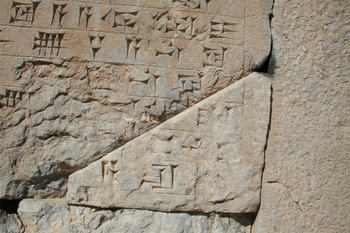
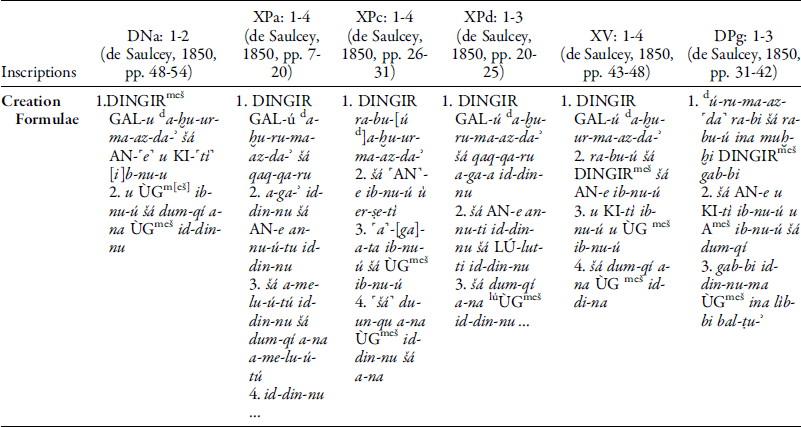
On the bottom right corner of the stone block, there is an oblique cut and a triangular piece of stone inserted to fill the gap and allow enough space for the rest of the Babylonian inscription (see Figure 1). It is not clear when the stone-cutters decided to add this piece into the slab.Footnote 4
Right bottom corner of DPg: oblique cut of the stone slab and triangular piece of stone bearing the rest of the ending parts of lines 22, 23, and 24 (© G. P. Basello).

Text
Transliteration
dú-ru-ma-az-˹da˺ ra-bi šá ra-bu-ú ina muḫ-ḫi DINGIRmeš gab-bi
šá AN-e u KI-tì ib-nu-ú u Ameš ib-nu-ú šá dum-qí
gab-bi id-din-nu-ma ÙGmeš ina lìb-bi bal-ṭu-ʾ šá a-n[a]
mda-a-ri-i̭a-muš LUGAL ib-nu-ú u ˹a-na˺ mda-a-ri-i̭a-˹muš˺
LUGAL LUGAL-ú-tu id-din-nu ina qaq-qar a-ga-a rap-šá-a-˹tu 4 ˺
šá KUR.KURmeš ma-de-e-tu 4 ina lìb-bi-šú KUR par-su
KUR ma-da-a-a u KUR.KURmeš šá-né-ti-ma li-šá-nu
šá-né-tu 4 šá KURmeš u ma-a-tu 4 šá a-ḫa-na-a-a
a-ga-a šá íd mar-ra-tu 4 u a-ḫu-ul-lu-a-a
ul-li-i šá íd mar-ra-tu 4 šá a-ḫa-na-a-a
a-ga-a šá qaq-qar ṣu-ma-ma-i-tu 4 u a-ḫu-ul-lu-a-a ˹ul-li-i˺
šá qaq-qar ṣu-ma-ma-i-tu 4 m da-a-ri-i̭a-muš LUGAL
i-qab-bi ina gišGI6 šá d ú-ru-ma-az-da a-ga-a[n]-˹né˺-tu 4
KUR.KURmeš šá a-ga-a i-pu-šá-ʾ šá a-kan-na ep-˹ši˺
KUR par-su KUR ma-da-a-a u KUR.KURmeš šá-né-˹ti˺-ma
li-šá-nu šá-né-tu 4 šá KURmeš u ma-a-tu 4 šá a-ḫa-˹na˺-a-a
a-ga-a šá íd mar-ra-tu 4 u a-ḫu-ul-lu-a-a ul-˹li˺-˹i˺
šá íd mar-ra-tu 4 u a-ḫa-na-a-a a-ga-a šá qaq-qar
ṣu-ma-ma-i-tu 4 u a-ḫu-ul-lu-a-a ul-li-i
šá qaq-qar ṣu-ma-ma-i-tu 4 lìb-bu-ú šá a-na-ku
ṭè-e-mì áš-ku-un-nu-uš-šú-nu [šá] ˹a˺-na-ku
e-pu-uš gab-bi ina gišGI6 šá d˹ú˺-[ru-m]a-˹az-da˺
e-te-pu-uš a-na-ku d˹ú˺-ru-ma-˹az˺-[da li-iṣ-ṣu]r-˹an˺-n[i]
it-ti DINGIRmeš gab-bi a-na ana-ku u a-na šá ana-[ku] a-˹ra-mu˺
Translation
(1)Ahuramazdā (is) great, who (is) great over all gods, (2)who created the heaven and the earth and created water. Who (3)gave all (2)prosperity (3)and people to live on, who (4)made Darius the king, and to Darius (5)the king (he) gave the kingship in this wide earth (6)of many lands, among (them) Persia, (7)Media and other lands of (8)another (7)tongue, (8)of mountains and plain, of (9)this (8)near side (9)of the sea and (10)that (9)far side (10)of the sea, of (11)this (10)near side (11)of the waterless desert and that far side (12)of the waterless desert. Darius the king (13)says: in the protection of Ahuramazdā these (are) (14)the lands which did this which was done here: (15)Persia, Media, and other lands (16)of another tongue, of mountains and plain, of (17)this (16)near side (17)of the sea and that far side (18)of the sea, and this near side of the (19)waterless (18)desert (19)and that far side (20)of the waterless desert, as I (21)had ordered them. [What] I (22)did, all in the protection of Ahuramazdā (23)I have done. Me Ahuramazdā [may pro]tect, (24)with all the gods, me and what I love.
Commentary
1. The first line corresponds to the beginning part of DPd (1f.): Auramazdā vazṛka haya maθišta bagānām.Footnote 5
2. u Ameš (mē): The reading is based on the photographs prepared in the framework of the DARIOSH project. For the history of reading and translation of this word see below.
5. The form qaq-qar is only attested to in DPg: 5, 11, 12, 18, 20 and DNa: 5.
rap-šá-a-˹tu 4 ˺ is attested to in this form only in DPg.
6. The orthography of ma-de-e-tu 4 is attested to only in DPg.
8. KURmeš: šadû “mountain, mountain region; open country, steppes” (for attestations from Old Babylonian period onward see The Assyrian Dictionary of the University of Chicago (CAD 17, pp. 49‒59).
a-ḫa-na-a-a: aḫannā: “this side, the nearer shore or bank” (CAD 1, p. 169). There are no attestations of this or similar words in other Achaemenid royal inscriptions.
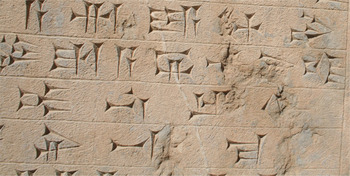
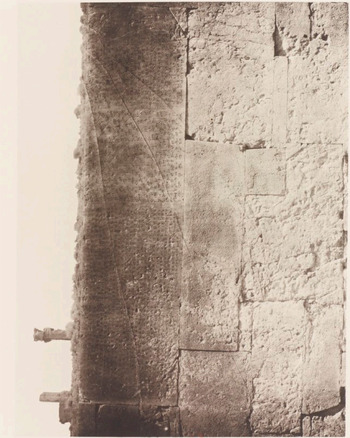
13. a-ga-a[n]-˹né˺-tu 4 (see Figure 2): Weissbach distinguished the following elements: a-ga-˹né˺-e-tum.Footnote 6
Right end of lines 12-15 (© G. P. Basello)
14. ep-˹ši˺ (3. sg. m. stative, G-stem of epēšu ending with “-i”):
Weissbach: ip-˹ḫu˺-[rum];Footnote 7 Stolper: ep-šú.Footnote 8 One could expect ep-šú (3. sg. m. stative, G-Stem of epēšu), as Stolper suggested, as being stative of the same stem. There is no parallel of this form of the word in the whole corpus of Achaemenid inscriptions except for two attestations, i.e. ep-šu in DSe (23, 34), and ep-šú in A3Sa (6). The photographs of the DARIOSH project clearly show three anticipated elements of “ši,” i.e. (from left to right) a Winkelhaken, the upper part of a vertical wedge and a damaged horizontal wedge on the right side of the vertical wedge (see Figure 2). According to Kuhrt, “the reference [in lines 13-14] is to the participation of the imperial subjects in the building of Persepolis.”Footnote 9
20. lìb-bu-ú šá: “as”. “als ob”,Footnote 10 “just as, because, until” (CAD 9, p. 173-174), “comme”.Footnote 11 A similar form occurs in DB 97. “lìb-bu-u šá” is also attested to in DB 28 and DNa 24.
21f. [šá] ˹a˺-na-ku e-pu-uš: “what I did.” It corresponds to OP. taya manā kṛtam.
24. a-˹ra-mu˺: “I love” from râmu “to love” (CAD 14, p. 137). According to the photograph, the presence of those three signs, i.e. a-ra-mu, is certain. The first sign “a” is obvious. The second sign “ra” is slightly damaged, and all elements of the third sign “mu”—despite damage—are recognizable (see Figure 1).
The reading of Weissbach is correct.Footnote 12 Stolper also has the same translation,Footnote 13 with a slightly different transliteration, i.e. ara[mmu]. Cameron on the other hand, proposes “I construct(?).”Footnote 14 Because of our lack of access to the Cameron transliteration, it is not clear what he distinguished in this part which brought him to such a conclusion.
Peculiarities in DPg
Peculiarities of the text can be divided into four categories: (1) the orthography of the words; (2) peculiar formulae; (3) geographical terms; and (4) water in the creation formula.
The orthography of the words: the case of Ahuramazdā. One can see in the previous part (i.e. commentary) that there are peculiarities regarding the orthography of several words. Some, such as rap-šá-a-tu 4 (l. 5) and ma-de-e-tu 4 (l. 6), do not have any similar orthographies in other inscriptions. On the other hand, for some of the other words, one can find similar orthographies, such as qaq-qar (DPg 5, 11, 12, 18, 20 and DNa 5) and lìb-bu-ú šá (DPg 20 and DB 97).
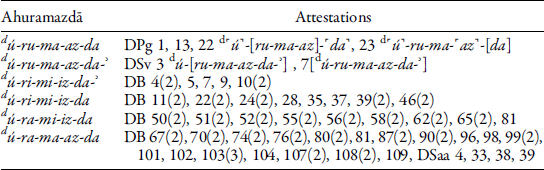
One of the peculiarities in the orthography of the words is “Ahuramazdā” (Bab. d ú-ru-ma-az-da). In the whole corpus of the Achaemenid royal inscriptions, there are not as many similar orthographies as one can see in DPg, i.e. beginning with “ú” instead “a-ḫu.” There are three other inscriptions which have the same beginning for Ahuramazdā, i.e. DB, DSv,Footnote 15 and DSaa. Moreover, Ahuramazdā in Babylonian version of DB is written in four different forms; all of them begin with “ú.” “d ú-ra-ma-az-da” is the fourth form (DB l. 67‒109) which is also attested to in DSaa.Footnote 16 Table 1 shows those attestations beginning with the sign “ú.”
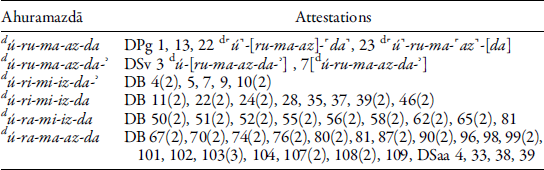
In the Elamite versions of Achaemenid royal inscriptions as well as PFA (Persepolis Fortification Archive) tablets, the word Ahuramazdā begins with “u.” As a result, some Babylonian attestations of Ahuramazdā correspond to its Elamite version regarding the use of /u/ instead of /ahu/ or /a.u/. However, those are different from each other regarding the use of “ú” (in Babylonian) and “u” (in Elamite texts) for /u/.Footnote 17
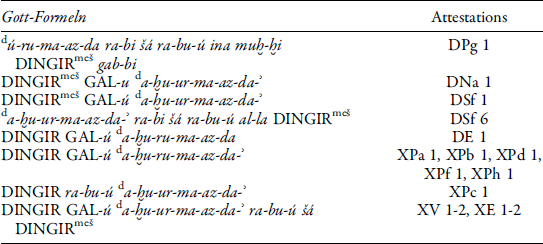
Gott-Formel. Footnote 18 In Babylonian versions of Achaemenid royal inscriptions, there are seven types of beginning formula regarding Ahuramazdā and his greatness. The only formula which does not have any equivalent occurs in DPg.Footnote 19 Remarkably, on the same slab there is more or less the same formula but in Old Persian, i.e. DPdFootnote 20 (see commentary).
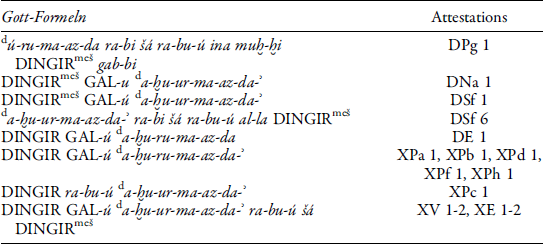
Note: According to Hauri (1973, p. 22): “Der Titel haya mθišta bagānām an der der G-Formel [D. Gott-Formel] folgenden Stelle XE 2 haya mθišta bagānām ‘der größte der Götter’ wurde für die X[erxes]-Periode gewonnen, wo ihn sonst nur die Stelle XV 1-2 haya mθišta bagānām ‘der größte der Götter’ aufweist.”
Geographical terms in Reich-Formel. DPg is a peculiar inscription not only for its orthographies and formulae but also for the geographical terms used to describe the whole empire under the command of the Great King. What is called “Reich-Formel” in other major inscriptions refers to the list of lands and peoples.Footnote 21 In DPh and DHa, there are some selected lands which are the most distant in the empire. Those outermost lands mentioned in DPh and DHa can denote the common title of “the king of four quarters” of the world (šar kibrāti erbetti) as we can find in the Cyrus Cylinder (l. 20) and the other Mesopotamian royal inscriptions. What the composer of the text is presenting in DPg is a mixture of two major lands “KUR par-su KUR ma-da-a-a” with other lands of another tongue “u KUR.KURmeš šá-né-ti-ma li-šá-nu šá-né-tu 4.” This empire also includes mountains and a plain “KURmeš u ma-a-tu 4” and spreads from this near side of the sea “a-ḫa-na-a-a a-ga-a šá íd mar-ra-tu 4” to that far side of the sea “a-ḫu-ul-lu-a-a ul-li-i šá íd mar-ra-tu 4,” and from this near side of the waterless desert “a-ḫa-na-a-a a-ga-a šá qaq-qar ṣu-ma-ma-i-tu 4” to that far side of the waterless desert “a-ḫu-ul-lu-a-a ul-li-i šá qaq-qar ṣu-ma-ma-i-tu 4.” It is a peculiar combination of lands and geographical terms which occurs only in DPg and in no other inscription. One may imagine that the composer of the inscription wanted to present the greatness of the empire in a form close to the Babylonian map of the world. Since there are no clues left to us about the Achaemenid scribal curriculum, it would be nearly impossible to guess whether the scribe was familiar with a similar format of the known world’s depiction in the Late Babylonian period. A possible interpretation of this part of DPg is that the scribe imagined the center of the empire as Persia and Media, surrounded by the other lands with other tongues. This territory has some geographical features: mountains, plains, seas, and desert. The seas bordered the empire at least on two corners (most probably in northwestern and southeastern parts where the Indian Ocean and the Mediterranean Sea are located), and the deserts surround the other corners of the empire (probably the Amon desert and the Central Asian desert). This description may also correspond to the traditional term “the king of four quarters.” Ahuramazdā, the Great God, bestowed upon the Great King what is between those natural barriers. The familiarity of the scribe with geographical terms such as šadû (KURmeš), aḫannā, aḫullā, and qaq-qar ṣu-ma-ma-i-tu 4 attested to in various periods in Mesopotamia would probably be connected to his point of view, which is known to us via the Babylonian map of the world.Footnote 22
“Water” in Gott-Formel . The main difference between this current work and the previous studies on DPg is in distinguishing the word “water” instead of “people” in the creation formula of the inscription. Looking through the long history of studies on DPg would help familiarize us with the different readings of this part and the ideas behind those readings. The history of textual analysis of the inscription starts with the work of de Saulcy in 1850.Footnote 23 Table 3 shows which inscriptions with similar “creation formulae” were investigated by de Saulcy. The transliterations are updated and edited by the author.
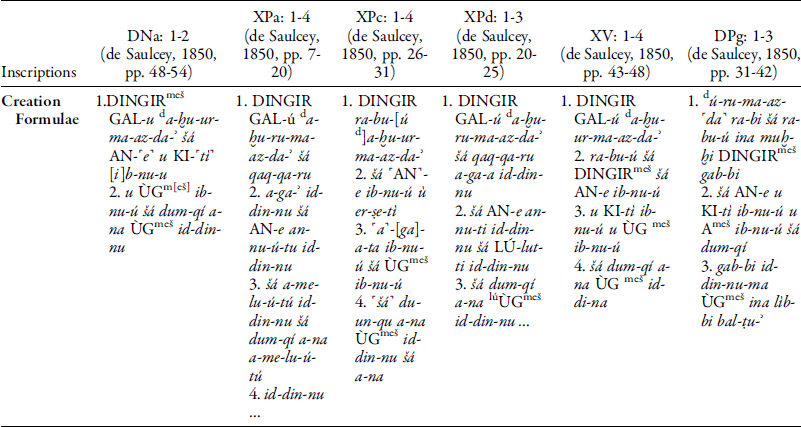
From Table 3, one can see to what extent the creation formulae are similar and how often the term “people/men” comes after “heaven and earth.” Since de Saulcy used the drawings by Westergaard,Footnote 24 he could distinguish three clear elements of “u,” “A” and “meš” in the second line. However, given the constraints imposed by the underdeveloped state of cuneiform studies in the 1840s, and because he was working with a more limited number of known “creation formulae” in already deciphered Old Persian inscriptions, de Saulcy concluded that the third element must be “people.” In fact, the creation formulae that were available to de Saulcy at the time of his attempt at deciphering the inscriptions would naturally lead anyone to expect that “u Ameš” is just another form of the “u ÙGmeš” attested to in DNa (l. 2) and XV (l. 3).
The idea of interpreting “u Ameš” as “people” was echoed by Oppert and Schrader despite drawings made by other authors.Footnote 25 Despite some errors in the drawings, all of them could show all three elements (u Ameš) in the second line. Looking at the works of de Saulcy and Oppert cannot reveal much information about what they thought of the peculiar form of this word. Oppert noticed that the sign “Ameš” is not normal, but he interpreted “A” as a sign which has other meanings including a son (Akk. aplu)—already known to them in the Achaemenid royal inscriptions—which can be interpreted as “people” in plural form too.Footnote 26
With the development of Assyriology in the nineteenth century, the problem of “misinterpretation” of the word “Ameš” in DPg remained.Footnote 27 Carl Bezold in 1882 repeated the same translation as well. Following de Saulcy, Oppert and Schrader, he wrote that the written “A” should be read “niši.”Footnote 28
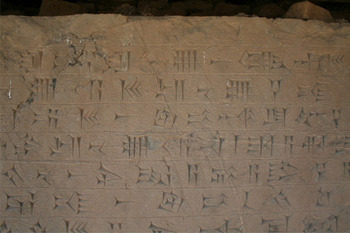
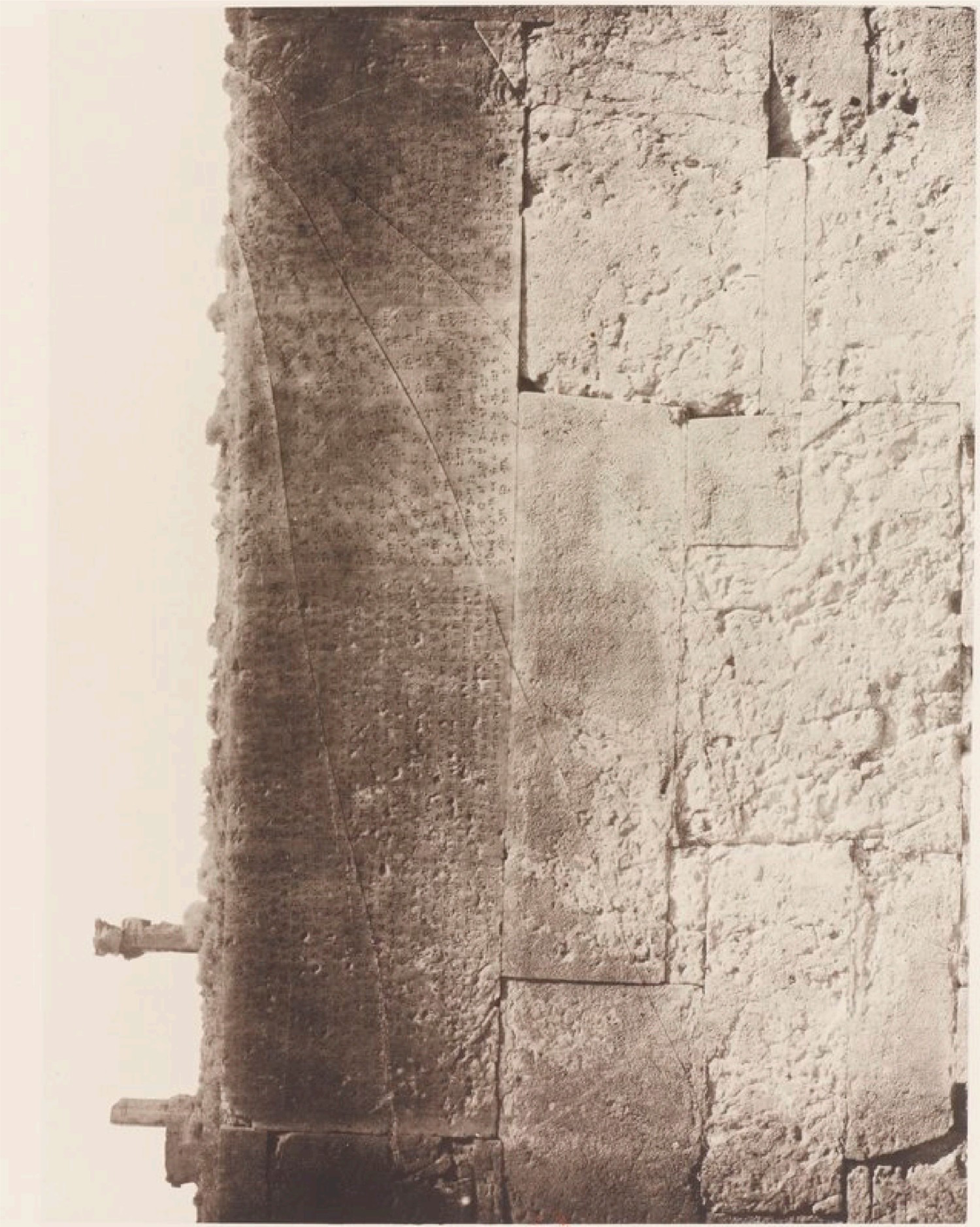
Years after Bezold, F. H. Weissbach was the first researcher to notice that there is a problem with the former works regarding this part of the inscription. Although his hesitation in accepting the former interpretation of “u Ameš” as “and people” was potentially crucial, his approach to resolving the mystery was ultimately flawed. With the help of photographs from Stolze and Andreas, he tried to solve the problem.Footnote 29 He rejected the existence of “u Ameš” and proposed instead “niše(= UN)meš.”Footnote 30 So he read this part as “UN” which simply means “people” (Akk. nišū).Footnote 31 The problem might have been that the photograph made by Stolze and Andreas (Pl. 95) was not sufficiently clear for Weissbach’s purpose (because of cracks in the negative), especially in the second line (see Figure 3).
Photograph by Andreas and Stolze (Vol. II, Pl. 95).
Excavations at Persepolis in the 1930s by the Oriental Institute made it possible to look at the royal inscriptions again and republish some of them, together with comprehensive excavation reports. As a result, Cameron prepared an updated translation of DPg and published it in the first volume of the excavation reports of the Oriental Institute from Persepolis.Footnote 32 Because of the lack of any transliteration of DPg published by Cameron, we do not know if he managed to distinguish “u Ameš” or “niše(UN)meš” in the inscription’s creation formula (as Weissbach did). It is highly probable that he did not accept Weissbach’s suggested reading and instead followed the earlier works since he translated it as “and men,” which denotes that he managed to observe those three elements mentioned above.
Stolper was the last researcher who prepared an updated transliteration and translation of DPg.Footnote 33 He precisely distinguished “u Ameš,” but repeated the traditional interpretation of this part, and transliterated it as “u nišē(!)” (“and people”). However, he could not ignore the fact that those three elements are very peculiar, and therefore tried to explain this peculiarity from another plausible point of view, i.e. “stone-cutter’s error.”
Why Could “u Ameš ” Be Correct?
There is no doubt that the creation formulae of the Achaemenid royal inscriptions always contain all or some of the following elements: “god”; “Ahuramazdā” and his “greatness”; the creation of “earth”; “heaven”; “people”; and “happiness” (“prosperity” in Bab.). Peculiarities in the creation formula of DPg come from the fact that all four inscriptions (DPd-e-f-g) “do not show the common standard formulae which elsewhere are constantly repeated and scarcely ever varied. They seem to go back to a period before the stereotyped character of the inscriptions had developed.”Footnote 34
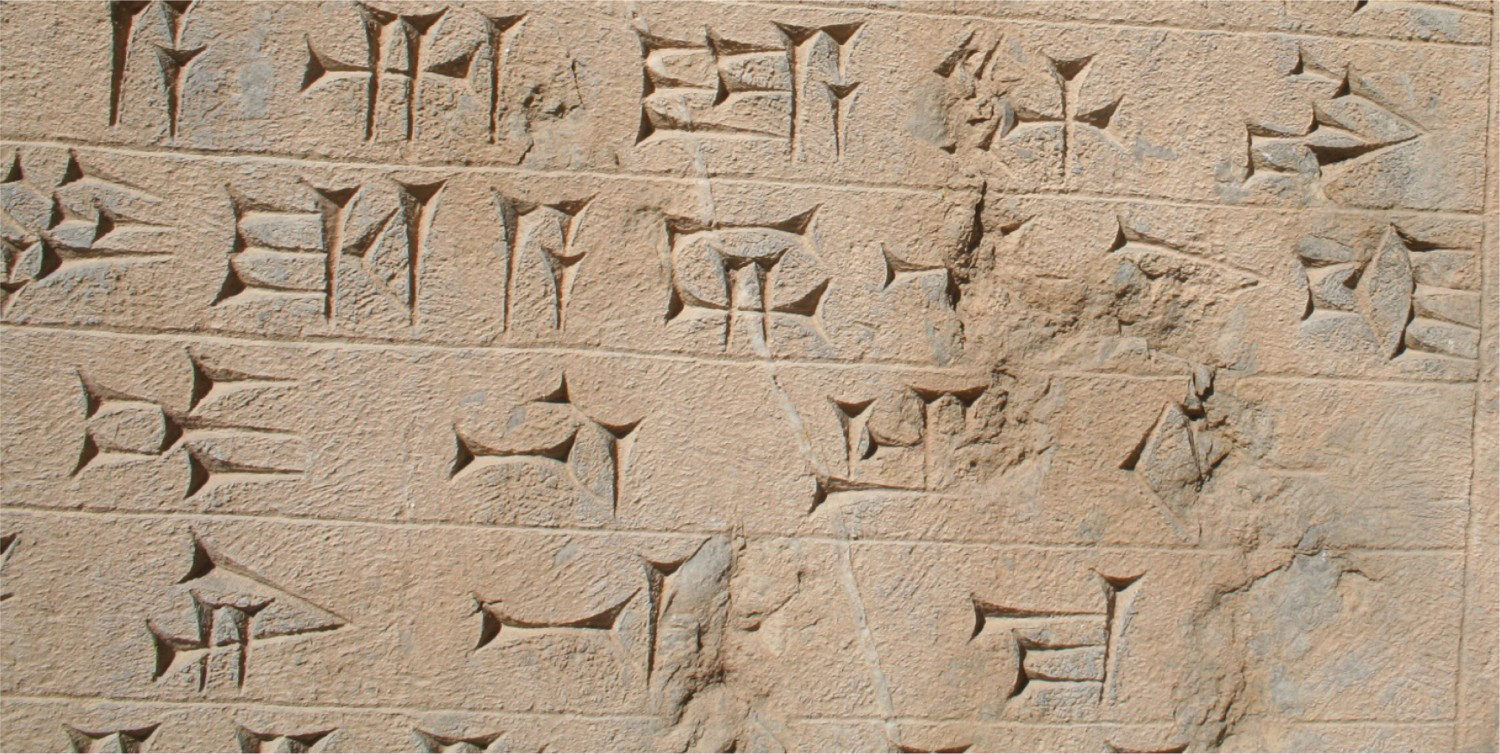
Regarding the “stone-cutter’s error” explanation for the apparent misspelling which Stolper suggests,Footnote 35 since the engraver in the following line (l. 3) clearly depicts the expected correct form of “ÙGmeš”(see Figure 4), it is my opinion that an error(s) made by the stone-cutter or engraver is an unlikely explanation for the discrepancy between the observed elements in the disputed cuneiform character and the previously suggested readings. In fact, the error of the scribe and the stone-cutter is the last thing that we expect in such cases. There is no doubt that we can find numerous mistakes made by the scribes and the individuals who wrote the inscriptions on various material supports such as stone, metals, and so forth. Still, we should explain each type of error in its context in comparison with the related copies and related words in the same inscription.
A part of DPg depicting the cuneiform elements of “and water(s)” (u Ameš) in the second line and “the people” (ÙGmeš) below it in the third line (© G. P. Basello).
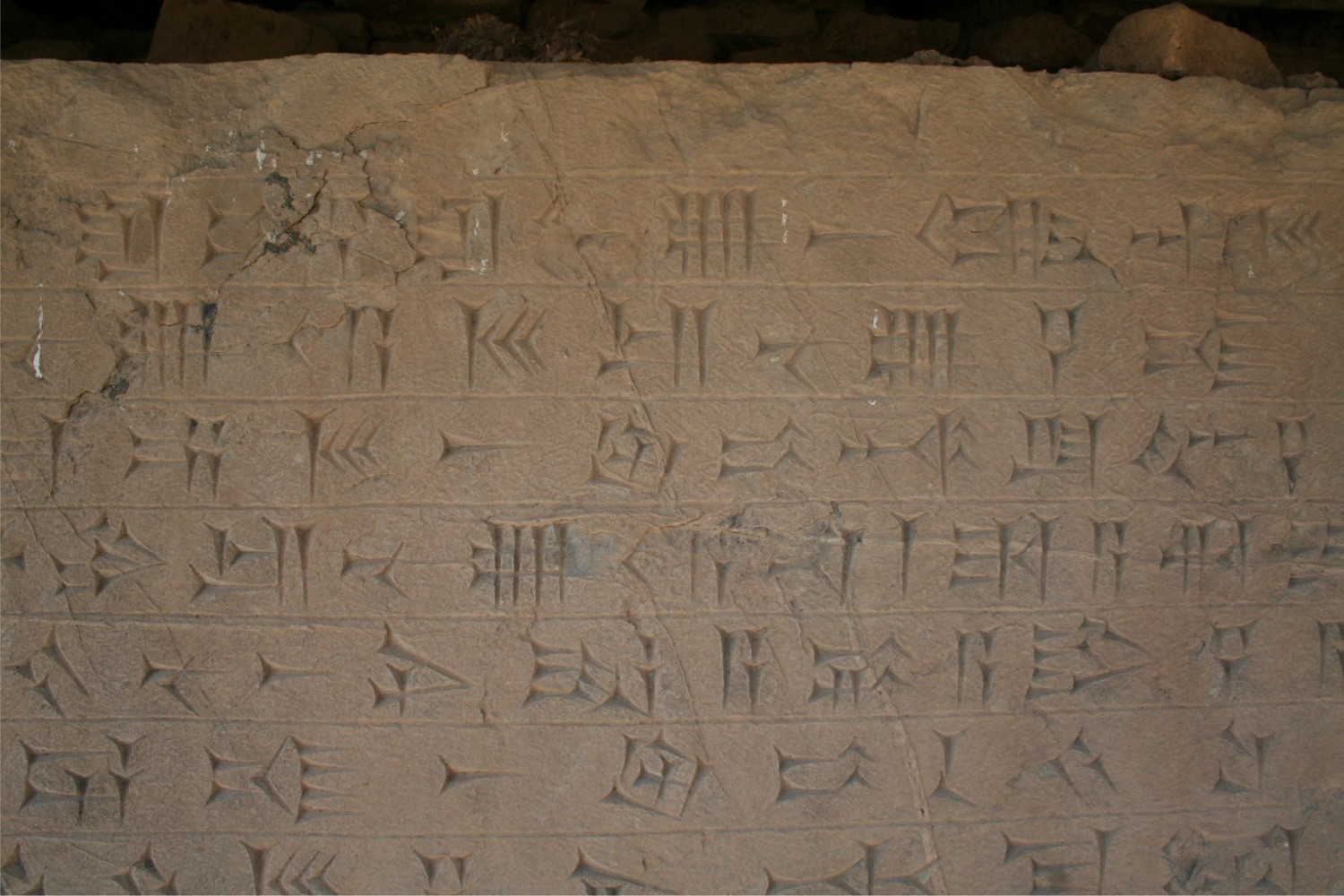
Here, since we do not have any other copy of DPg, the so-called intertextual comparison between the same word would be a great help to discuss whether this peculiarity is an error or not. As mentioned above, the only example of the same word is written in the following line (DPg: 3), and its form fits perfectly to what we expect. However, one cannot entirely leave aside the possibility that the stone-cutter might have made an error in cutting the correct form of “ÙG.”