The history of Senegalese wrestling is said to be one of commercialization. Looking at the scholarship on this sport, the narrative that is told is one of a move away from so-called pure traditionality, reflected in the festive evening games practiced in rural areas to celebrate the end of the harvest (mbapat), to the ultra-mediatized and monetized daytime sport of làmb that is practiced today in the stadiums of Dakar and other urban centers.Footnote 1 For many researchers, the gap between these two versions of the activity is encapsulated in the fact that professionalized, televised wrestling allows punching with the hand. The use of punching is thought to have been introduced in the French colonial era in order to generate a more violent, and therefore lucrative, spectacle, resembling boxing, for which tickets could be bought and sold. Generally speaking, so-called “traditional” wrestling as practiced in the regions and villages outside of the capital does not allow punching.Footnote 2 Thus, the very term of “traditional” wrestling (lutte traditionnelle) bears an ambiguity of meaning. It can refer to all forms of Senegalese wrestling, in opposition to the international sport practiced at the Olympics, or it can specifically refer within Senegal to bëre-sempal or lutte simple as opposed to bëre-dóor or lutte avec frappe, that is, wrestling without punching as opposed to with (Havard Reference Havard, Chevé, Wane, Barthélémy, Kane and Sow2014:164 n. 1; Faye Reference Faye and Diop2002:313, 318). Laden with connotations of a “truly African” or “national” character, Senegalese wrestling rivals soccer for the status of most popular sport in the country.
The historical narrative of the shift from traditionality to commercialization in contemporary Senegalese wrestling fits strikingly well with scholarship on cultural production in the neoliberal age. In the aftermath of structural adjustment programs imposed by the World Bank from 1979 on, public services in Senegal and other African countries collapsed, leaving everyday people to scrape by with no help from the state. As such, a specifically neoliberal aesthetics of survival, of individual self-reliance in the face of tremendous obstacles, has emerged as a major theme of cultural production in multiple African contexts. This art of survival is known in French as débrouillardise or in Wolof as góorgóorlu or lijjanti—that is, living one day to the next, making do with whatever scraps are available, in the absence of state support.Footnote 3 Following this framework, wrestling matches are said to no longer serve as a communal event or “miroir de la communauté traditionnelle” (mirror of the traditional community) (Kane & Wane Reference Kane, Wane, Chevé, Wane, Barthélémy, Kane and Sow2014:67); instead, they glorify wealth, produce larger-than-life pop-culture sensations, and promote the image of the wrestling star as self-made man. Perhaps the most famous example of the sport’s star system is the champion Tyson (Mohamed Ndao), so named after the American boxer Mike Tyson, who took the wrestling world by storm in the 1990s. He is credited in the popular imagination with revolutionizing the sport; thanks to him, success in a homegrown athletic activity became synonymous with the opportunity to escape from poverty, to rake in buckets of money, and to be crowned in an aura of extraordinary individual achievement.
Given this perceived shift from “traditional” to “modern” or “neoliberal” iterations of Senegalese wrestling, scholars have emphasized the hybridity and bricolage of the sport as a form of invented tradition or “dedans-dehors” (inside-outside), that is, a practice which borrows from multiple sources to invent modernity and reinvent tradition (Havard Reference Havard2001:64, Reference Havard, Chevé, Wane, Barthélémy, Kane and Sow2014:174). This analysis echoes the resistance in African studies to any approach that might see human subjects as passive victims of neoliberal macroeconomic policy. Rather, the argument goes, social actors in the world of wrestling—athletes, secondary artists (singers, dancers, marabouts), producers, governing bodies, fans, and, for my purposes, writers and filmmakers—negotiate the available interpretative schemes surrounding the sport in order to assert their own agency and advance their own (often monetary) interests. While this emphasis on hybridity is certainly well-founded, I argue that it has glossed too quickly over the work of romanticization which remains at play in the sport. In this contribution, I would like to emphasize that wrestling continues to be invested with a romanticized essentialism, an imagined core of purity and authenticity that is thought to survive in spite of the vicissitudes of history—especially the cultural changes wrought by colonialism, the rise of neoliberal economics, and globalization, all of which it serves to critique. This romanticization of “wrestling as tradition” constitutes a form of nostalgia, that is, a “social construction of regret characterized either by a tension between a devalued present and an idealized past, or by a relation to the past established outside any lived reality or any personal connection” (Basset & Baussant Reference Basset, Baussant and Brown2018). Indeed, the longing for an imagined precolonial paradise that stands in contrast to the violence of colonialism or the disappointments of independence pervades a substantial chunk of African literature.
Significantly, the case of wrestling suggests that nostalgic evocations of Senegalese identity seem to have been resuscitated, rather than erased, in the neoliberal age. In these visions, the traditional sport is imagined as an exceptional bastion of authentically African identity as expressed in mystical rituals (amulets, potions, divinations, etc.), performances of ancient oral panegyric genres, and an image of the wrestler as incarnation of the hero of West African oral epic.Footnote 4 Traditionally, praise songs (bàkk) are sung to the wrestlers by women or griots to honor the wrestlers, their ancestors, and past wrestlers. L.S. Senghor identified this genre, which he referred to as chants gymniques, as exemplifying the influence of oral tradition on his own highly romantic poetry.Footnote 5 Wrestlers also sing their own songs of self-praise (bàkku), vaunting their own prowess in the arena. These two genres of panegyric songs are closely related and accompanied by drums and dancing.Footnote 6 Their strategies of crowning an athlete with praise echo the praise songs reserved for the heroes of oral epic.
Thus, a nostalgic vision of “wrestling as tradition” continues to mobilize idealizations of Senegal’s national sport and its champions. In a restricted, social-scientific sense, tradition refers to practices or oral genres, such as folktales, epics, or wrestling itself, which claim some degree of transmission from, and continuity with, previous generations. But aesthetically, tradition, especially in the context of postcolonial nostalgia, can also mean something more fraught: everything that was good and wholesome before colonial alienation set in. In the visions of wrestling which I study here, the nostalgic and traditional dimensions of the sport are conflated. Tradition is imagined as an object of melancholy, a precious ancient legacy that is always at risk of disappearing. Within this framework, wrestling is constructed as an extraordinary environment of precolonial glory and unbroken tradition, where the deep African soul can still find its full expression. Evocations of Senegalese wrestling as nostalgic constructions of tradition continue to persist and coexist, albeit uneasily, with the neoliberal ideal of the wrestler as self-made man. This analysis contradicts the omnipresent metanarrative, reiterated in the very structure of postcolonial nostalgia, that tradition is always being lost in the modern world. Senegalese wrestling hovers, so to speak, between a nostalgic aesthetics of “paradise lost” and a neoliberal one of “make your own fortune.”
This paradox needs to be explored. In this article, I examine three cultural artefacts produced from the 1980s to the present in order to trace the changing relationships of Senegalese wrestling to nostalgia and neoliberalism. Though it might seem that these two points of reference ought to be conceived as opposites, the neoliberal turn in Senegalese aesthetics can actually harbor and cultivate new nostalgic articulations of the precolonial past. As such, the tendency of nostalgia to essentialize an ideal past can function as a creative force for reimagining the future, rather than as a dead end.Footnote 7 First, the francophone novel L’appel des arènes (Call of the Arena) by Aminata Sow Fall (1982) exemplifies the nostalgic position by prescribing the arena as a possible cure for self-loathing caused by postcolonial alienation. This may be compared to the film adaptation of the same name made by Cheikh Ndiaye (Reference Ndiaye2005, 105 min.), starring none other than Tyson himself, plus his onetime (real) opponent in the arena, Tapha Gueye. Ndiaye’s film updates Sow Fall’s novel for a hip, young adult, Dakarois audience, setting the economic unease of the postcolonial metropolis on full display, while nevertheless sharing the novel’s nostalgic concern for the traditional heart of wrestling. Finally, a passage from Boubacar Boris Diop’s labyrinthine bilingual Wolof-French novel Doomi Golo (Children of the Monkey) (2003 and 2009) will provide an ambivalent conclusion to this analysis by suggesting that wrestling both does and does not deserve its imagined status as traditional soul of the Senegalese people. This corpus of fictions can help deepen our understanding of the “fictions of culture” by plumbing the imaginary that has come to surround this “total cultural phenomenon,” which has been studied by others from ethnographic, historical, oral traditional, and sports studies angles.Footnote 8 By illuminating Senegalese wrestling through the multifaceted prism of literature and cinema, these artistic representations can function as an experiment: how do fictions about Senegalese wrestling expose, negotiate, and contest the fictions at play in the “real” sport?
Paradise Lost: L’Appel des arènes
Perhaps the single clearest expression of a parallel between Senegalese wrestling and an idealized world of epic heroes is to be found in Aminata Sow Fall’s 1982 novel L’Appel des arènes. The novel articulates a stunningly straightforward vision of wrestling as object of nostalgia, where ancient traditions and self-affirming values, though under threat, can continue to be revived in order to exert a positive influence on society. For Sow Fall, the traditions surrounding wrestling can provoke a kind of spiritual awakening within the African soul. The story was remade into a 2005 film by Cheikh Ndiaye, which echoes the novel’s concerns but is set in a tumultuous urban context. The film brings the spiritually heroic wrestler envisaged by Sow Fall to bear on the economic realities of the postcolonial city. Both text and film identify romanticized ideals of traditional masculinity that the wrestler is called upon to embody, but they offer very different visions of what it means for such ideals to persist in contemporary Senegal.
L’Appel des arènes, the novel, tells the story of Nalla, a twelve-year-old boy in the northwestern town of Louga, who struggles with his parents because of his love for wrestling, understood as a provincial practice of làmb that includes punching but has not been corrupted by money. His passion causes him to daydream about the arena and its attendant traditions. The novel opens by recounting Nalla’s boredom while his French teacher drones about grammar. Instead of paying attention, his mind conjures up a romanticized scene of pre-match bàkk for the wrestler Malaw, his champion:

The little boy thinks of his hero, the wrestler Malaw Lô, and specifically of a bàkk in which female singers crown him with praise. The excited tone of this passage, expressed through references to the “frantic” and “inebriating” rhythm of the drums, seems very close to the poems of L.S. Senghor, where tom-toms serve as an expression of the emotive African soul, and the opposite of colonial reason. Throughout the novel, processes of romanticization and traditionalization are conflated: the arena exerts its ineluctable grip on Nalla’s imagination precisely because it is traditional, in contrast to the French school, which symbolizes neocolonial alienation. The authenticity of Senegalese wrestling serves as an antidote to the inferiority complex caused by colonialism and its legacy.
As the plot progresses, Nalla undergoes an initiation into traditional knowledge—storytelling, mystical practices, codes of conduct—by associating with the world of the wrestlers. His is welcomed into it by two adult practitioners, first André and then Malaw himself, who take him under their wing. They regale him with folktales and idyllic images of rural life, making him dream of a world untainted by the ennui of francophone civilization. Meanwhile, Diattou, his mother, is furious. Exemplifying the type of the alienated African francophile, she sees wrestling and the culture associated with it as backwards and barbaric. She insists that her son focus exclusively on his studies at the francophone public school. The story culminates in a suspenseful combat where Nalla, following the untimely death of André and against the will of his mother, must serve as garçon-fétiche or ritual assistant to Malaw. Given the buildup to this big match, where Malaw will face an adversary named Tonnerre, Nalla’s father attends, in support of his son’s passion. The novel’s message is clear: knowledge and understanding of wrestling can decolonize the mind. The arena is an exceptional space where Senegal finds its traditional soul intact.
In this text, wrestling is inseparable from a wider constellation of idealized images of an authentic precolonial culture. The notion of tradition is constantly romanticized as the opposite of urban, colonially imposed modernity. For example, André’s instructive conversations with Nalla, which serve as a counter-education to the school, veer constantly between the sharing of folktales and information about customs (tradition in an anthropological sense) and paradisiac visions of rural life (tradition as romantic aesthetic):
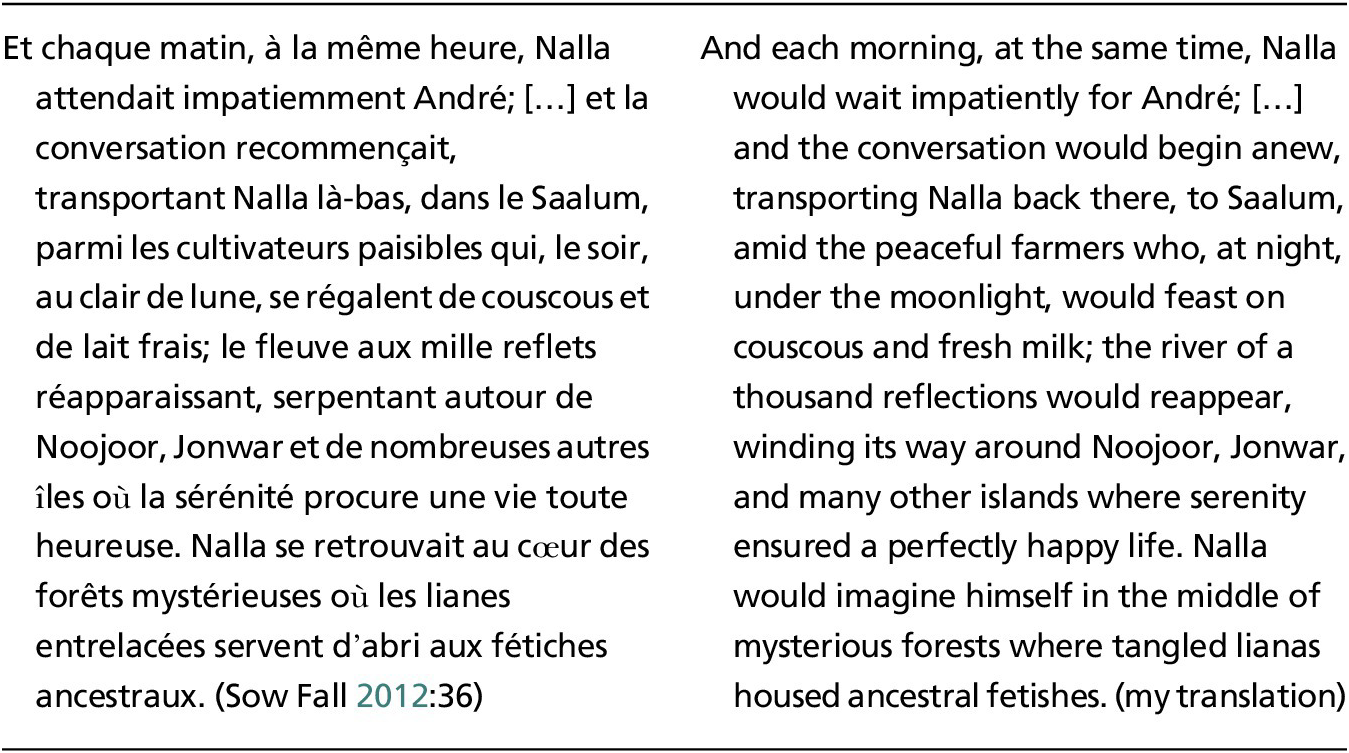
André’s one-on-one lessons paint Saalum, his home province, as a serene space where “peaceful farmers” enjoy their “perfectly happy life”—in contrast, it is implied, to the urbanized francophone middle class of Louga, the victims of colonially induced neurosis. Nalla’s mind, under André’s guidance, glides effortlessly from a moonlit pastoral paradise to the rituals around “ancestral fetishes,” reserved for the forests near the farms. This detail reveals how the two meanings of tradition, ethnographic and romantic, are united into a single network of connotations. At another moment, André describes for Nalla the kinds of fruits and trees that inhabit these forests; the rapt pupil listens “comme on écoute un conte dont on ne souhaite pas la fin” (as one listens to a tale which one does not want to end) (Reference Fall and Aminata2012:33-4). Once again, the beauty of nature slips into a comparison with the folktale, a genre of oral tradition. Tradition in the narrow sense is woven seamlessly into a romanticized state of nature.
Cheikh Ndiaye’s film adaptation of L’Appel des arènes largely keeps this novel’s idealization of wrestling intact but puts a twist on the setting. The film maintains an unflinching fidelity to the spirit of the original while painting an entirely different portrait of Senegalese society. Rather than ignoring the capital city altogether, it brings the novel’s message of “Know your roots” to the chaotic, seedy streets of Dakar. It thus transforms the narrative frame, eliminating the small-town setting of Louga and casting the discipline of làmb as an island of virtue under threat from an ocean of big-city vice. Nalla is now eighteen or twenty, not a preteen, and actually enters an écurie or training club to learn the sport himself under André’s guidance. The French school disappears completely, though Nalla’s mother Diattou still plays the role of alienated francophile opposed to her son’s involvement in the barbarism of wrestling. The most important difference between novel and film is that the adaptation problematizes the commercial popularity of the sport. Indeed, it tries to capture the contradictions of the world of professional wrestling in Dakar by dividing the story into two halves. On one side, Malaw and André are the good role models for Nalla and the viewer. These athletes are concerned above all with honor, courage, decency, and respect for tradition. Illustrating this last point, they retain griots for performing bàkk and for assisting with mystical rituals and preparations. As in the novel, they introduce Nalla into the world of the traditions associated with wrestling. Nalla is no longer a little boy who daydreams of the arena, but a young man and aspiring athlete learning its secrets for himself. Yet all is not well in paradise; the film introduces two negative models who were minor characters or nonexistent in the book. Malaw’s adversary, Tonnerre, is developed into a major character, an archnemesis who indulges in partying and skirt-chasing. His behavior contrasts with that of Nalla’s mentors, representing a kind of debasement of the sport. Similarly, the film gives Nalla a negative alter-ego, Sory. Sory is an unemployed teenage delinquent who lives off of petty crime and handouts from his girlfriend; he even sells his own blood to make an extra few francs. He gets into the world of wrestling by taking bets on Tonnerre, thereby incorporating themes into the film such as the mass commercialization of làmb and the shady informal economy of the urban underworld. Malaw eventually defeats Tonnerre in a climactic matchup, ensuring the didactic message that it is better to be like Malaw and Nalla, and by extension for wrestling to maintain its character based on self-control and respect for elders, than it is to be like Tonnerre and Sory, who participate in the corruption of the sport by turning it into a source of scandalous wealth. Wrestling still has a nostalgic potential, but only insofar as it can serve as a refuge from the urban nightmare without being subsumed into it. It is surrounded, and threatened, by outright corruption. The film ends in a long funeral scene for André, who, as in the novel, has died prematurely. The songs honoring him lament nostalgically for the old ways he represented, transforming the tropes of bàkk into a dirge for a lost hero.
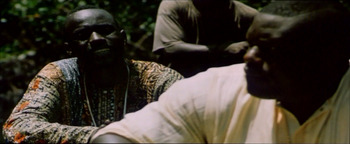
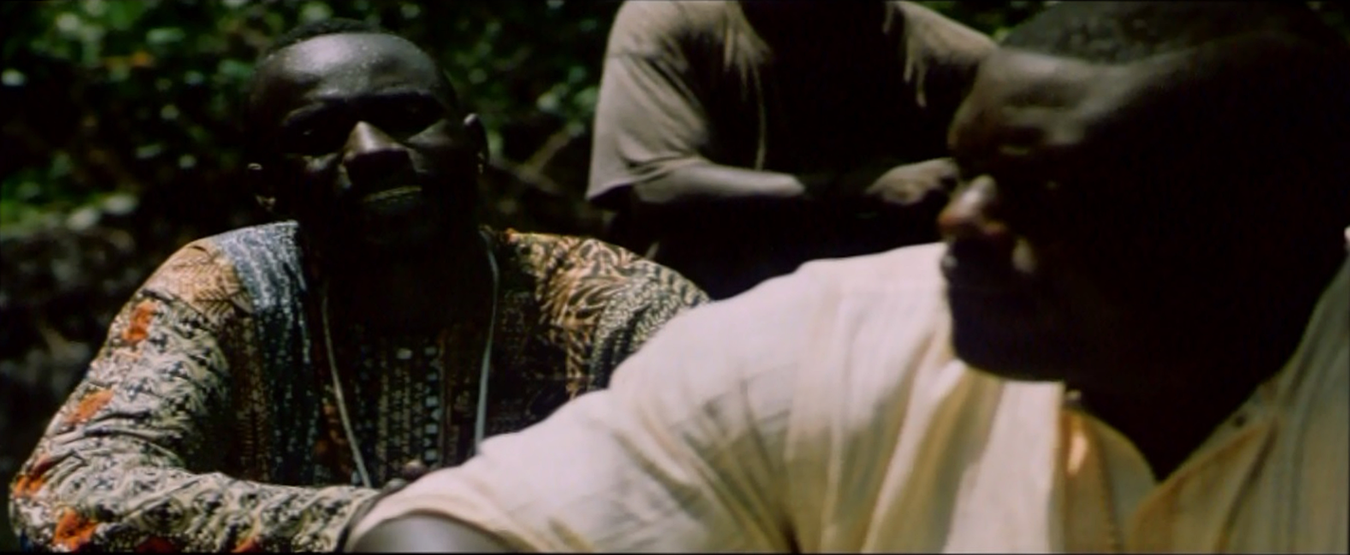
The incommensurability of the two halves of the film’s story—Malaw/André/Nalla vs. Tonnerre/Sory—diagnoses the world of Senegalese wrestling, and by extension life in Dakar more generally, with a certain schizophrenia. On the one hand, the movie repeats the novel’s idealization of traditionality for didactic purposes. This is demonstrated in multiple scenes of bàkk and bàkku performance, the most striking of which involves a trip to the forest—visibly the Siin/Saalum delta, in homage to the book’s association of oral tradition with natural paradise—where Nalla learns the story of Malaw’s ancestors from the latter’s griot. Figures 1 and 2 illustrate this scene.
Malaw’s griot sings his bàkk amid the lianas of the Siin/Saalum delta.

Closeup from the same scene, with griot seated, and Malaw (played by Tyson) in the foreground, listening.
On the other hand, we have a shift from a friendly small town and idyllic villages to Dakar, a poverty-stricken conurbation defined by economic precarity and no-holds-barred capitalism. This transformation puts the thematic focus on the imperative of self-reliance in the neoliberal African city. Just as Sory is forced to engage in a self-destructive form of débrouillardise by selling his own blood, his girlfriend works as an allumeuse (a bar employee paid to flirt with patrons); both turn their bodies into commodities in the absence of anything else to sell. When Sory accepts a dangerous underground job as an illicit bookmaker, his motive is to make enough money to save himself and his girlfriend from their demoralizing occupations. This attempt to provide for the woman in his life and to pull himself out of his shameful financial dependence on her illustrates the gendered valence of the Wolof term góorgóorlu. Though it generally means “to do one’s best in the face of adversity,” the word is derived from góor, “man”: morphologically, it means “to try to be a man.”
In contrast to this depiction of the desperation of urban poverty, the novel version of L’Appel des arènes—published in 1982, before the effects of structural adjustment could be fully felt—foregrounds the presence of state services and pays no attention to economic precarity as a problem. In the book, all of Nalla’s adult custodians are employees of the state: his father, Ndiogou, is a public veterinarian; his mother works in a public maternity ward; and his French tutor, Monsieur Niang, is a public school teacher. The text even emphasizes the point by remarking that Ndiogou and Monsieur Niang first met because “tous les fonctionnaires se connaissaient” (all the civil servants knew each other) (Reference Fall and Aminata2012:17). In the film, all three of these state institutions—the animal clinic, the delivery ward, and the French school—are gone. The complete abandonment of francophone education, in particular, as a theme underscores the historical decline of the prestige of literacy and bureaucracy as viable paths to prosperity in the years that have elapsed between the 1980s and 2000s (Diouf Reference Diouf, Diouf and Fredericks2013:88). In the film, Nalla’s parents are visibly wealthy, but all we know about their income that is that his father goes on business trips and his mother can afford to take half-days off. Both wear elegant, European-style clothes.
Furthermore, it is not only Sory who suffers from the effects of neoliberal instability. The film’s opening sequence shows Nalla fleeing down a deserted Dakar street from a pack of robbers in broad daylight. One of these is Sory; this is the only time the two protagonists meet. André, portrayed as a mechanic clad in a pair of half-unbuttoned overalls, spies the scene from underneath a truck and saves the day. In this version of events, Nalla gets interested in wrestling not because he longs for the inebriating rhythm of the tam-tams, but because he wants to be able to defend himself. Even he, the good protagonist from a middle-class family, is pushed by the city’s insecurity, combined with the apparent moral bankruptcy of his bourgeois parents, to search for an alternative form of identity. Once again, it is an ultimately romantic vision of tradition, embodied in wrestling, that is prescribed as a partial solution to society’s ills: Nalla discovers not only a way to protect himself in the street, but a positive vision of masculinity that is rooted in honor, discipline, and respect for elders.
This analysis suggests that neoliberal economics and urban chaos are far from killing off traditionality, in defiance of the nostalgic metanarrative according to which “tradition” is always being lost in the “modern” world. Even in the text of L’Appel des arènes, Aminata Sow Fall writes, through the voice of Nalla’s grandmother, that “Cosaan se meurt” (tradition is dying) (Reference Fall and Aminata2012:93). Yet the very forcefulness with which Sow Fall celebrates wrestling’s romantic, Négritude-esque, traditional character in this novel, and its transformation into an art film twenty-plus years later, suggest quite the opposite. On the contrary, the general sense of economic malaise has kept alive the longing for an authentically African essence insulated from universal precarity. The wrestling arena serves this function in the public imagination. Wrestling is constantly being re-traditionalized, that is, invested with a traditional character (invented or not), in spite of the profoundly capitalistic changes it has undergone.
It is here that the two seemingly disconnected sides of the sport—the romantic/traditional and the commercial—meet up. Indeed, one explanation for wrestling’s continuing popularity in Senegal may be that economic disorder is felt as a crisis of masculinity, as young men fail to meet expectations of founding and supporting families (Comaroff & Comaroff Reference Comaroff, Comaroff and Weiss2004:336–39). A male-dominated society needs models of heroic masculinity in order to feel uplifted in light of everyday men’s inadequacies in their roles as providers and protectors. The ideal wrestler’s perceived proximity to the epic hero becomes a perfect commodity for a public hungry for images of successful masculinity. But because of this idealization, young unemployed men are drawn to wrestling without a clear promise of a lucrative career or even a dependable mentor in the image of André or Malaw. The masses of young men who are drawn to train their muscles on the beaches of Dakar or to knock on the doors of écuries asking for admission are at risk of living like Sory rather than like Nalla, who has good moral support and a middle-class cushion to land on. As noted above, góorgóorlu has a specific, masculinized connotation in the light of ubiquitous neoliberal insecurity. In the case of aspiring wrestlers, góorgóorlu is an attempt to be manly, to provide for oneself, and perhaps others, by cobbling together a living and hoping for a future return on one’s investment. In this way, an economically weak man affirms his moral fortitude and hopes, without any guarantees, to achieve an economically and symbolically strong manhood down the line. In this way, the schizophrenic personalities of wrestling feed off of each other.
Doomi Golo: A Critique of Nostalgia, or Nostalgia as Critique?
Boubacar Boris Diop’s novel Doomi Golo, first published in Wolof in 2003 and followed in 2009 by an adaptation into French by the author, simultaneously challenges and affirms the authenticity of Senegalese wrestling celebrated in L’Appel des arènes.Footnote 9 On the one hand, it demythologizes the sport as an invented and foreign-influenced tradition, rather than a profoundly African one; on the other, as we shall see, its critique of Afro-romanticism seems nevertheless to romanticize certain aspects of wrestling as more authentic than others. This twisted logic befits the labyrinthine structure of the novel. The text consists, for the most part, of a series of letters written by an aging grandfather, Nguirane, to his absent émigré grandson, Badou. The letters describe life in contemporary Dakar and are interspersed with digressions on Senegalese culture. One such digression is on wrestling, specifically on how the historical figure Maurice Jacquin, a Frenchman, invented the paying spectacle of wrestling with punching sometime around 1930. Nguirane recounts a fictionalized story of how he met Maurice Jacquin in his youth and witnessed the birth of the sport as commercial spectacle. For Nguirane, that moment was like an original sin which began a longer process of wrestling’s corruption; although it is seen as “traditional” and “national” today, he insists that, under historical scrutiny, it ought rather to be seen as the product of French, and later American, influence:

This passage refutes the romanticization of wrestling offered in both versions of L’Appel des arènes. Senegalese wrestling as we know it today—bëre-dóor (wrestling with punching)—is not an ancient custom inherited from the Lebou, the Sereer, and the Diola, but rather an invented tradition. The text singles out the use of American flag and dance steps done “like Westerners.” These references warrant some clarification. Both hint at the legacy of Tyson, the emblematic star of wrestling as neoliberal aesthetic in the 1990s, though he is left unnamed. Both are clearly envisioned by the text as corruptions of what Senegalese wrestling once was. As though to incarnate the neoliberalization of the sport, Tyson would arrive in the arena draped in an American flag. This gesture suggested that, through sheer dedication and athletic artistry, this champion had realized the American dream of wealth and self-sufficiency in spite of an impoverished upbringing. He also helped popularize the use of dancing influenced by mbalax (Senegalese pop music) and hip-hop by groups of fans as a compliment or replacement for the older style of bàkk(u) songs before a match. Tellingly, the style of pre-match dance that he popularized is still referred to today as bàkk or bàkku, even though it minimalizes or eliminates any verbal or poetic element. (Note that in the passage above, dance steps are referred to as bàkku in the Wolof original and bàkk in the French adaptation.) Bàkk(u) choreographies function as displays of physical exuberance, typically in the style of a dance-off by two groups of young men who serve as each wrestler’s entourage. Tyson seems to have incarnated the perceived “de-traditionalization” of the sport exemplified by the supposed dilution—or modernization, depending on your perspective—of the art of bàkk(u) from oral poetry into Westernized dance steps, as well by as the rise of exorbitant monetary prizes for winners and profits for organizers.Footnote 10 Put simply, Nguirane’s interpretation follows the commonly held notion that the degeneration of the sport’s traditionality corresponds with its increasing commercialization and globalization.
The allusion to Tyson is even clearer in Wolof than in French: the former laments that wrestlers “tànnal seen bopp ay turi Amerikeŋ” (choose American names for themselves) rather than African-sounding ones, while the latter phrases the accusation slightly differently, positing that wrestlers “s’appellent […] à peu près n’importe comment” (“call themselves whatever they fancy”). Tyson’s haunting of the passage is all the more striking since he is the star of L’Appel des arènes, the film, where he paradoxically plays a character (Malaw) who is extremely attached to the rituals and oral traditions that surround wrestling. This idealized character contrasts with the real Tyson, who is remembered as having turned the sport toward outside influences in order to set himself off from his competitors and appeal to a young public bedazzled by American pop culture. In one match in 1999, he famously gestured to his adversary, Manga II, to hurry up, because Manga’s mystical preparations were taking too long. Tyson stuck out his wrist to the audience, gesturing to an imaginary watch (Havard Reference Havard2001:67–68). Although Tyson’s career in the arena declined in the 2000s, the allure that he and the associated movement of pop culture from the 1990s known as Bul Faale (Don’t Worry) defined continues to entice young unemployed men to drop out of school and join écuries.Footnote 11 While this story of precarious investment will be familiar to observers of soccer, the global sport par excellence where dreams of success are tied up with emigration fever, it is paradoxical in the case of Senegalese wrestling. In spite of wrestling’s neoliberal turn, Tyson’s role as the uber-traditional hero Malaw in the film demonstrates how the sport continues to be imagined as a thoroughly local phenomenon, invested with the masculine virtues of respecting elders, protecting family, perfecting the body, and amassing symbolic capital while—indeed, by—remaining on African soil.
Yet, as the passage I quoted above shows, Doomi Golo’s most biting criticism is reserved not for the legacy of Tyson, but for the practice of punching. The acceptance of punching in contemporary Senegalese wrestling is not universal, but it certainly applies to all matches which promise fame and fortune to participants. Today, professional wrestling is regulated by a state body called the Comité national de gestion or CNG, which oversees rules for both bëre-dóor or lutte avec frappe, the most widely followed version of the sport, and the more niche tournaments of bëre-sempal or lutte simple, which it is trying to promote. The practice of punching is thought to have become widespread in Dakar in the late 1920s or early 1930s, though it may have existed in the earliest practices of làmb which emerged among the Lebou in the late nineteenth century. It has been suggested that this earliest form of làmb (with punching) may be a relic from an even more ancient Senegambian practice of wrestling (with punching) as a means of preparing soldiers during the generalized warfare which defined the centuries of the Atlantic slave trade; however, this possibility is difficult if not impossible to verify.Footnote 12 In this narrative, wrestling with hitting all but disappeared in recent memory, with a very few exceptions, only to be revived in colonial Dakar sometime after 1920. As such, Maurice Jacquin is indeed credited by historians as having opened the first arena in Dakar with paid tickets for a kind of wrestling that incorporated boxing moves, but he did not single-handedly invent bëre-dóor (Bidiar Reference Bidiar1990:16–19). And yet, Doomi Golo insists in the above passage that wrestling with punching exists nowhere outside of Dakar because it is not native to Senegal. This is not quite accurate; in addition to the fact that some forms of làmb with hitting predated Maurice Jacquin, làmb matches can be found today in several major cities of Senegal. Remember that L’Appel des arènes, the novel, takes place in Louga, not Dakar. Nevertheless, it is true that the spread of bëre-dóor to provincial cities is due to the influence of money and television broadcasts concentrated in Dakar. And, whether or not punching was authorized in some form in centuries past, such a fact was clearly lost to public memory. Therefore, the above exceptions to the association of bëre-dóor with colonial influence are just that, exceptions. It remains true that the most ancient known forms of Senegalese wrestling, up to and including contemporary forms of mbapat and professionally regulated lutte simple, have never allowed punching, because it simply does too much damage to the body.
Thus, with a few caveats, the novel’s point that bëre-dóor as it exists today is an urban, colonial innovation, rather than a relic of time immemorial, stands. This twentieth-century reinvention of wrestling creates a spectacle of the “martyrisation du corps” (martyred body) rather than merely causing an opponent to fall, as one does in lutte simple (Faye Reference Faye and Diop2002:318). This is an important point, because both the text and the film versions of L’Appel des arènes specifically indicate that they envisage wrestling as including punching, even as they identify the sport with a romantic vision of authentic African traditionality.Footnote 13 We also see various wrestlers in the film training by practicing boxing. In effect, neither version of L’Appel des arènes problematizes the issue of punching. Both take it for granted as part and parcel of the sport of làmb, and both take làmb for granted as part and parcel of Senegalese tradition. Doomi Golo attributes this lack of attention to the meddling of colonialism, especially, but also to the role of American-dominated globalization in shaping the discipline that is so reflexively associated with deep Senegalese culture.
In Doomi Golo, as we have seen, this meddling is incarnated in the person of Maurice Jacquin. Yet historical scholarship shows that wrestling’s embeddedness in coloniality went far beyond the influence of a single person (Biaye Reference Biaye2011:15–20). The colonial administration both tolerated and feared Senegalese wrestling as an outlet for pent-up violence, an expression of Africans’ dissatisfaction with their lack of freedom and, in Dakar, with their crowded, miserable living conditions. Wrestling in the colonial period expressed a latent anticolonial frustration as the black public imagined it as a space where the colonizer had no place, even though it was regulated and surveilled from the outside by the colonizer. As such, the intense traditionalization of the sport which we observe today has its roots in the colonial period: the romantic, deep African character with which it has been endowed reflects a historical reaction against colonial oppression, rather than a static, pristine, precolonial village life where mbapat supposedly served as a mirror to the traditional community.
This analysis leads us to our key paradox. Doomi Golo criticizes the inauthenticity of Senegalese wrestling as it is practiced in Dakar and on television, yet it seems to imply the possibility of a purer essence in the sport, one which flourished before Tyson or Maurice Jacquin got their hands on it. Such an essence may or may not continue to persist today: the two versions of the novel speak differently to this point. A section of the French text, absent in the corresponding Wolof original, develops the issue of bàkk(u) as a lost art. It praises several famous wrestlers of the early to mid-twentieth century—luminaries such as Pathé Diop and Abdourahmane Ndiaye Falang, among others—as oral poets, practitioners of a skill which is said to be lost on younger athletes and fans. This generation of wrestlers’ heyday ranged from the 1920s to the 1970s (Bidiar Reference Bidiar1990:18; Tang Reference Tang2007:145). The Wolof text also mentions several of the same names, but limits its commentary:

The Wolof text emphasizes its critique of wrestling as invented tradition by lumping the older and younger generations of athletes under the influence of Maurice Jacquin. In contrast, the French text expounds on the artistry of bàkk(u), which flourished well after Jacquin, even though it has supposedly deteriorated today. Wrestling, in this view, once went beyond celebrating the village or neighborhood (as in mbapat), even beyond creating a spectacle of manly strength or martyred bodies (as in mbapat and/or làmb); the (italicized) voice, gestures, and melodies of oral poetry seem to represent art for art’s sake, an art “both perfect and unique in the world.” Wrestlers of old were not just “monsters,” but rather bards of oral tradition. Diop’s homage to bàkk(u) seems surprisingly close to Senghor’s celebration of chants gymniques here. In a parallel way, according to Doomi Golo, the bàkk performed by entourages in order to praise athletes are, today, “bâclés”—literally, hastily and unsatisfactorily done. A touch of interlingual alliteration (“bàkk” vs. “bâclés”) drives the point home.
According to this passage in French, the traditionality of wrestling is lost not only because of punching and commercialization, but because of the degradation of bàkk(u) as linguistic and musical skill among young performers. Conversely, according to the Wolof text, both the older and younger generations share in the sport’s inauthenticity, since both have practiced punching since the time of Maurice Jacquin. Depending on which emphasis the reader of Doomi Golo chooses to follow, we could come to one of at least two different conclusions: (a) the phenomenon of làmb, which developed in colonial Dakar and is now celebrated as the national sport of Senegal, was always already inauthentic in some way; or (b) it evolved from a more authentic precolonial ancestor which is now irretrievable.
Conclusion: What is Self-Knowledge?
Might we gather from this analysis that Doomi Golo shares in the romanticism, even essentialism, of L’Appel des arènes? Both the Wolof and French versions of Diop’s novel make it clear that wrestling was changed by colonial influence; the French adaptation goes further in lamenting that one aspect of this change was the deterioration of the traditional art of bàkk(u). Indeed, on this point, all of the works studied here are in agreement: this genre is of striking beauty, and it is set in contrast to the corruption of today.Footnote 14 In L’Appel des arènes, the inebriating rhythms of bàkk make Nalla’s heart beat faster (in the novel) while teaching him the ancient values of heroic athleticism that are neglected by Tonnerre (in the film); in Doomi Golo, the poetic, and especially linguistic, virtuosity of the genre’s old stars stands as a monument to Wolof literary creativity, one which Diop’s novel is self-consciously attempting to reinvigorate in spite of the ubiquitous dominance of the Francophonie.
Given the rest of Doomi Golo, where heroic legends are debunked as frauds, “Yesterday” is shaped by “Today,” and people turn into monkeys (or do they?), it is only fair to conclude in favor of proposition (a): Doomi Golo delights in poking holes in the romanticization of wrestling exemplified by both versions of L’Appel des arènes. At the same time, its unapologetic militancy as a “defense and illustration of the Wolof language” occasionally gives it a veneer of nostalgic essentialism, especially as regards the literary creativity of bàkk(u), as suggested in proposition (b). Thus, its critique of nostalgia is blurred with apparent nostalgia. For connoisseurs of Diop’s maze-like writing, this contradiction will hardly be surprising. Indeed, the French text explicitly recognizes the paradox in this position:
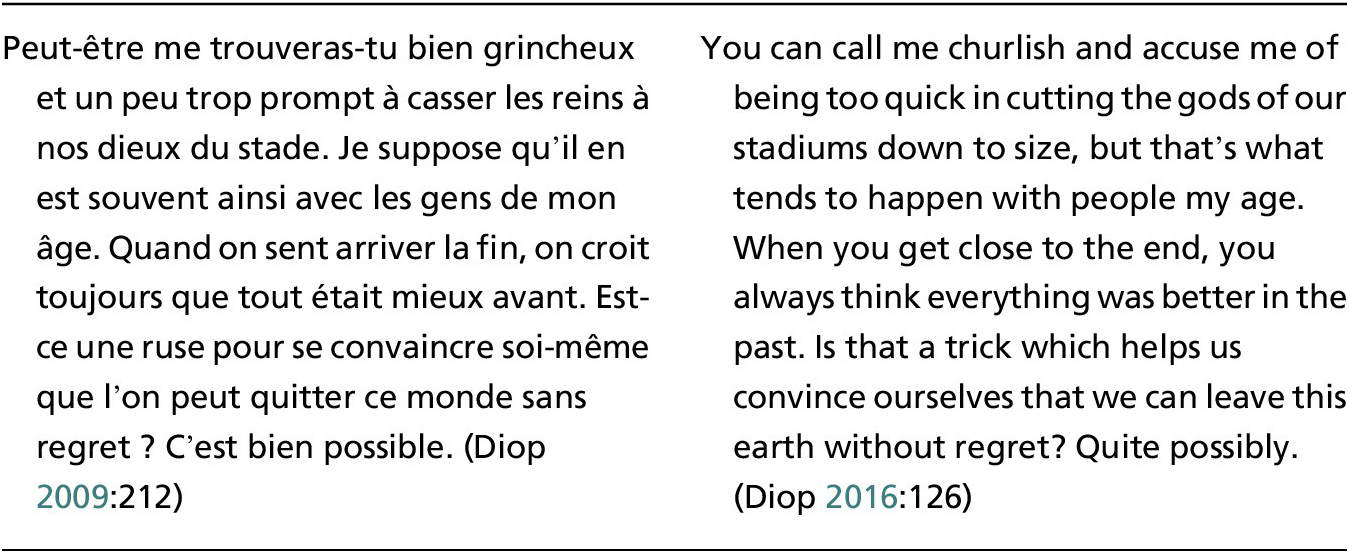
Here, the narrator turns his critical eye for a moment away from the traditionality of wrestling and toward himself. This self-reflexive gaze, which is never absent in the text, encapsulates the heart of this novel’s message: one must critique tradition while remaining aware of the limits of critique. Even if Senegalese wrestling is an invented tradition, is still an amazing phenomenon. Jacquin or no Jacquin, wrestlers are still “dieux,” and, more specifically, “nos dieux” (our gods). The prescription to xam sa bopp (know thyself) applies to the self both as imagined community and as individual whose perception is slanted by self-interest (Diop Reference Diop2003:199).
Indeed, the imperative to xam sa bopp is the moral of all of the cultural artifacts which I have studied in this article, although they differ in their implications. Aminata Sow Fall’s novel L’Appel des arènes prescribes knowledge of the traditions around wrestling as a remedy for the enduring postcolonial inferiority complex. Cheikh Ndiaye’s cinematic adaptation reiterates this message while holding up a social realist mirror to the dangers of neoliberal Dakar. Finally, Doomi Golo, while sympathetic to the beauty of traditions, demands more precise historical knowledge, including a healthy dose of skepticism, when it comes to the link between traditional practices and identity. This is a connection which is made all the more tenuous and in need of clarification in the muddle of the neoliberal, globalized world. Together, these different aspects of self-knowledge can make the reader simultaneously more critical and more celebratory of Senegalese fictions of culture.