Introduction
The first limiting nutrients in diets formulated for rearing hens are normally the sulphur amino acids (Rose et al., Reference Rose, Craig and Pritchard2004), and in particular, methionine. These requirements are normally met by a dding synthetic methionine. However, since December 2004, when the EU derogation (Council Regulation (EEC) no. 1804/99) was removed, producers rearing hens under organic certification body standards are no longer allowed to use feed that includes synthetic amino acids. The impact of the inability to add synthetic amino acids is exacerbated by the requirement that an increasing proportion of organic materials is required in organic diets in the EU with each year (Council Regulation (EEC) no. 2092/91, 85% in 2007, rising to a projected 100% by 2012; DEFRA, 2007). Organic ingredients are in limited supply, yet a wide variety of ingredients is needed to achieve required sulphur amino acid levels in the bird’s diet. Furthermore, even if a wide range of ingredients were available, the preparation of adequate diets is difficult to achieve in commercial systems because of the limited storage available to feed compounders. Birds fed conventional diets that provide methionine at suboptimal levels have been shown to be predisposed to health-, welfare- and production-related problems (Friedman et al., Reference Friedman, Bar-Shira and Sklan2003; Kidd, Reference Kidd2004; Klasing, Reference Klasing2006). Furthermore, birds cannot necessarily compensate for inadequate amino acid levels by increased food intake (Whitehead, Reference Whitehead2002). It can therefore be postulated that poultry feed formulations that meet organic certification standards have the potential to adversely affect bird health and welfare, particularly where high-output genotypes are used.
The poorer nutrient balance associated with methionine-deficient diets affects growth (Sklan and Noy, Reference Sklan and Noy2003) and the efficiency of the immune system, the latter being of particular significance for birds on organic systems that have access to range and are challenged repeatedly with pathogens (Pennycott and Steel, Reference Pennycott and Steel2001; Kidd, Reference Kidd2004). Apart from the nutritional impact on birds, it has been proposed that diets deficient in the essential nutrients may lead to behaviours such as feather pecking and cannibalism, which have a detrimental affect on bird welfare (Wahlström et al., Reference Wahlström, Tauson and Elwinger1998; Kjaer and Sørensen, Reference Kjaer and Sørensen2002). Concerns about the ability of diets to meet organic certification body standards while also meeting the bird’s requirement for methionine have led a number of feed compounders to include betaine derived from sugar beet in the diet (R. Kempsey, personal communication), a quaternary ammonium compound with methyl donor and osmolytic properties. While the evidence in poultry is not consistent, betaine has many potentially beneficial properties, including supplying methyl groups for the conversion of homocysteine to methionine (Bedford, Reference Bedford2000; Neto et al., Reference Neto, Pesti and Bakalli2000) and thus might compensate, at least in part, for the demands caused by the reductions in sulphur amino acids.
The health of birds is also influenced by the microflora in the digestive tract. Imbalanced diets, such as those formulated in the absence of synthetic methionine, can result in high contents of non-starch polysaccharide, and undigested carbohydrate and protein, each of which encourages the proliferation of disadvantageous bacterial and endoparasite populations in the gastro-intestinal tract (GIT) (Gilbert et al., 2000; Cross et al., Reference Cross, Acamovic and McDevitt2004; Athanasiadou and Kyriazakis, Reference Athanasiadou and Kyriazakis2004). The inclusion of betaine may allow the formulation of a better balanced diet and as such may limit the levels of protein and carbohydrate that reach the lower gut. While the use of prophylactic antimicrobials is not permitted in organic pullet rearing systems, there are potentially a number of plant-derived compounds that have been shown to have antimicrobial properties and are classified as acceptable under organic conditions. Oligosaccharides, such as fructo-oligosaccharides (FOS), which are frequently inulin derived, have been reported to enhance innate immunity either by binding to specific bacteria and hence reducing their ability to attach to the epithelia within the GIT or by blocking the site on the epithelial tissue and preventing microbial adhesion (Kelly et al., Reference Kelly, Campbell, King, Grant, Jansson, Coutts, Pettersson and Conway2004; Roberfroid, Reference Roberfroid2005). Unlike the so-called ‘competitive exclusion’ products, that tend to have a relatively short-lived impact, this approach has the advantage that a beneficial microbial population can be established and maintained.
Apart from the microbial challenge, surveys have shown that hens with access to range can carry a significant endoparasite burden (Pennycott and Steel Reference Pennycott and Steel2001; Acamovic et al., 2004). Continual treatment with prophylactics is not sustainable but it is feasible that plant secondary metabolites, such as saponins, may allow alternative strategies to ameliorate the effects of endoparasites (Sliwinski et al., Reference Sliwinski, Kreuzer, Sutter, Machmuller and Wettstein2004; Wallace, Reference Wallace2004; Acamovic and Brooker, Reference Acamovic and Brooker2005), as has been demonstrated in ruminants (Athanasiadou and Kyriazakis, Reference Athanasiadou and Kyriazakis2004). Saponins are highly surface active and have been shown to be effective against endoparasites (Newbold et al., Reference Newbold, El Hassan, Wang, Ortega and Wallace1997; Hristov et al., Reference Hristov, Ivan, Neill and McAllister2003; Wallace, Reference Wallace2004).
The aim of this study was to determine if either the nutritional value of an organic pullet diet could be enhanced by the addition of betaine, or the health of the birds could be maintained, compared with those fed a conventional (non-organic) diet, through the addition of saponin or FOS.
Material and methods
Experimental animals and procedures
The animal Experiments Committee of SAC approved the conduct of the study reported here. At day old, 1536 chicks were placed into groups of 64 (stratified according to weight) in one of 24 pens (n = 3 replicates per treatment) at a density of one bird per 548 cm2. The pens were distributed evenly across three environmentally controlled rooms. By 3 weeks of age, when 10 chicks per pen had been culled for sampling, the space allowance had increased to 650 cm2 per chick. The floor in each pen was covered with wood shavings, and contained a perch. Food and water were provided ad libitum from a food hopper and bell drinker. Birds were given 23 h of light at day old, which was reduced to 16 h at 3 days, 14 h at 7 days, and finally to 8 h at 2 weeks of age, which was maintained until the birds were placed ‘on range’. Supplementary heat was provided from day old and was decreased gradually until it was removed at 4 weeks of age. Birds were individually weighed at 5 and 9 weeks of age.
At 11 weeks of age, birds were bulk weighed and distributed by treatment into one of the 48 huts on range (n = 6 replicates per treatment, 24 to 27 birds per replicate), where they remained until 17 weeks of age. Each hut had a floor area of 3 m2 (covered with wood shavings) and a range area of 2 × 43 m to which the birds had daytime access (January–February, approximately 0900 to 1500 h). Each hut contained a light (illuminated from 0830 to 1630 h), raised perches and a food trough and nipple drinkers from which feed and water were provided ad libitum. The range area had been grazed by sheep within the month of housing.
Experimental diets
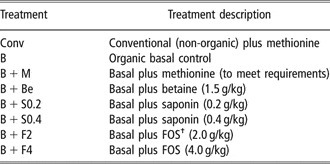
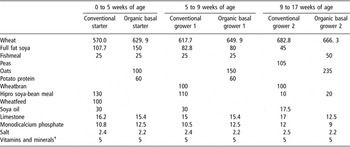
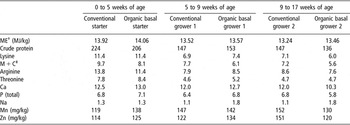
Groups of birds were fed one of eight diets from day old (Table 1). There were three controls. The first was a conventional diet, which contained synthetic amino acids, including methionine, and was formulated to allow the birds to perform to their maximum potential (Table 2). The second and third control diets were based on a basal diet of typical organic feedstuffs and contained either no added methionine (B) or added methionine (B + M), to determine if this alone could compensate for the potential poorer nutrient specification of the organic diet. Treatment B was used as the basis for examining the effect of betaine (B + Be), saponin (included at 0.2 and 0.4 g/kg, B + S0.2 and B + S0.4, respectively) or FOS (included at 2 and 4 g/kg, B + F2 and B + F4, respectively). Betaine was supplied as ‘Betafiin’ (Danisco Animal Nutrition, Marlborough, UK), saponin as ‘Quiponin Q’ and FOS as ‘Raftifeed’ (both Nor-Feed, Copenhagen, Denmark). The determined composition of the conventional and organic basal diets fed at various ages is shown in Table 3. Feed intake was measured at 0 to 5, 5 to 9, 9 to 11 and 11 to 16 weeks of age to assess feed efficiency. Once a week, birds were given grit (1 g per bird). While birds were housed in the controlled environment building, they were also provided with a small quantity (∼27 cm3 per pen) of cut grass.
Dietary treatment and description (fed to chicks from day old to 17 weeks)

†Abbreviation is: FOS = fructo-oligosaccharide.
Dietary ingredients (in g/kg fresh) for conventional and organic basal control, fed as a starter (0 to 5 weeks of age), grower 1 (5 to 9 weeks of age) and grower 2 (9 to 17 weeks of age) diet (in the organic basal diets, all ingredients including fish meal were organic)

†Vitamin and minerals to supply per kg diet: Roslin Nutrition Ltd. Vitamin A 12 000 i.u./kg; vitamin D3 5000 i.u./kg; vitamin E 50 i.u./kg; vitamin K 3 mg/kg; vitamin B1 2 mg/kg; vitamin B2 7 mg/kg; vitamin B6 5 mg/kg; vitamin B12 15 μg/kg; nicotinic acid 50 mg/kg; pantothenic acid 15 mg/kg; folic acid 1 mg/kg; biotin 200 μg/kg; iron 80 mg/kg; copper 10 mg/kg; manganese 100 mg/kg; cobalt 0.5 mg/kg; zinc 80 mg/kg; iodine 1 mg/kg; selenium 0.2 mg/kg; and molybdenum 0.5 mg/kg.
Determined composition for conventional and organic basal diets (in g/kg dry matter unless otherwise stated) fed as a starter (0 to 5 weeks of age), grower 1 (5 to 9 weeks of age) and grower 2 (9 to 17 weeks of age) diet

†Calculated metabolisable energy.
‡Methionine + cysteine.
Microbiology and parasite burden
At 1, 12 and 16 weeks of age, one bird per replicate was culled by an overdose of barbiturate for digesta samples (10 birds per replicate were sampled at 1 week of age due to bird size and quantity of material available from each bird and samples pooled). The ileal and caecal digesta samples were assessed for Escherichia coli, Lactobacilli, Clostridia, Salmonella and Campylobacter. Clostridia, E. coli and Campylobacter were expressed relative to Lactobacilli because of the variability associated with the digesta dry matter (DM) and total microbes present.
At 1 and 15 weeks of age, excreta were collected (either by placing 15 to 20 chicks in a cage within the home pen and collecting excreta on the tray below after 4 h at 1 week of age, or by collecting droppings directly from the range at 15 weeks of age), refrigerated and analysed for strongyle egg counts using a modified flotation technique (Christie and Jackson, Reference Christie and Jackson1982).
Behaviour and feather scores
Each pen of birds was continuously observed for numbers of gentle and vigorous feather pecks given between birds during two 10-min observation sessions (one in the morning, one in the afternoon) at 7 and 16 weeks of age. Mean numbers of pecks per 10 min per pen were calculated, with data at 16 weeks of age doubled to account for the reduction by half in group sizes compared with replicates at 7 weeks of age.
Ten birds per pen at 9 weeks of age (i.e. while in group pens indoors) and four birds per hut at 16 weeks of age (i.e. when in huts with access to range) were individually assessed for feather damage to the back, wings, tail, breast, belly and neck. Damage was scored according to a 0 to 3 rating system, where: 0 = no damage to feathers; 1 = slight feather damage/loss, some feathers have a scruffy appearance, no bare skin (due to feathers being pulled out/worn away); 2 = some feather damage, with up to 1 cm2 bare skin; and 3 = feather damage, with up to 5 × 5 cm2 bare skin, or up to 1 cm2 bare skin with minor haemorrhage (adapted from Savory and Mann, Reference Savory and Mann1999).
The total score per bird and then the mean score per pen were calculated. At 16 weeks of age, the maximum numbers of birds on range and the maximum distance ranged were assessed during feather-pecking observations.
Statistical analysis
All data were assessed for normal distributions. Where data were not normally distributed (body weights, feed efficiency, faecal worm egg counts, microbiology, feather pecks), they were transformed by loge (body weights), log10(n + 1) (microbiology, behaviour, egg counts) or −1/(x)2 (efficiency) prior to statistical analysis. Data were blocked by pen/hut, room and side of range. All data were analysed with Genstat (VSN International, 2004), using ANOVA, residual maximum likelihood (REML), repeated measures ANOVA or Friedman’s ANOVA as appropriate.
Results
Diet composition, body weights, feed intake and efficiency
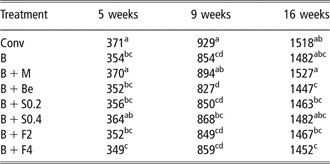
As can be seen (Table 3), the determined composition of diets demonstrated that they were similar although the starter for the conventional diet was about 8% higher in crude protein than the corresponding organic diet. There was little difference in the calculated metabolisable energy (from determined composition) of the diets between conventional and organic diets. The major difference between the conventional and organic diets was the content of sulphur amino acids, which were consistently lower in the organic diets than in the conventional diets. The Ca and P content of the organic grower diets were lower (by about 14%) than the conventional diet. Mean bird weights by treatment were the same at day old (39 (s.e.d. 0.3) g). Body weights at 5 and 9 weeks of age (when birds were housed indoors, n = 3) were significantly affected by dietary treatment (P = 0.035) (Table 4). Mean body weights of birds when housed in huts with access to range (16 weeks, n = 6) also showed a significant effect of diet (P = 0.026). With treatments, body weights were equal to or greater than target body weights given by the Lohmann Tradition Management Guide (Anonymous, 2005) at the same ages (5 weeks: 350 g; 9 weeks: 770 g; 16 weeks: 1355 g) with the exception of birds on B + F4 at 5 weeks of age.
Back transformed mean body weights (g per bird) by treatment, with target body weight shown

a,b,c,dWithin columns, means are significantly different where superscripts differ at P < 0.05. Analysis by residual maximum likelihood (REML). For an explanation of treatments, see Table 1.
At 5 weeks of age the conventional diet (Conv), the basal diet supplemented with methionine (B + M) and the basal diet supplemented with saponin at 0.4 g/kg (B + S0.4) gave heavier mean body weights than other diets and this trend was maintained until the conclusion of the study. At no time did the body weight of birds reared on the conventional diet differ significantly (P > 0.05) from those reared on the basal diet supplemented with methionine, but the basal diet without methionine (B) gave lighter mean body weights than the Conv or B + M treatments at both 5 and 9 weeks of age. At 5 weeks of age, body weights of birds on the organic treatment diets (excluding B + M) did not differ from each other, except that B + S0.4 gave a higher mean body weight than B + F4. Similarly, at 9 weeks of age, body weights of birds on the organic treatment diets (excluding B + M) did not differ from each other, except that birds on the B + Be treatment had significantly lower mean body weights than those on the B + S0.4 diet. At 16 weeks of age, body weights of birds on the organic treatment diets (excluding B + M) did not differ from each other. This tended to be due to an improvement in growth of birds on the poorer diets rather than a depression in growth of birds fed the conventional and B + M diets. The organic basal diet (B) resulted in a mean weight at 16 weeks, which was not significantly different from the birds fed the conventional (Conv) and methionine-supplemented (B + M) basal diet.
Throughout the study, mean feed intake (22, 34, 42 and 76 g per bird per day) was similar for the breed standard (23, 36, 42 and 75 g per bird per day for the respective periods 0 to 5, 0 to 9, 0 to 11 and 11 to 16 weeks of age). There were no treatment-associated differences (P > 0.05) in feed intake at any age.
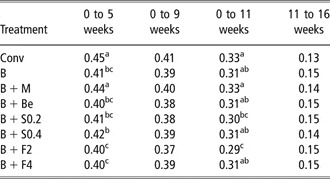
Feed conversion efficiency (weight gain/feed intake) in birds was low and differed significantly at 0 to 5 weeks of age (P < 0.001) with birds fed the Conv and B + M diets being the most efficient (Table 5). These effects disappeared by 9 weeks of age (P = 0.057), but at 11 weeks of age efficiency for birds fed the B + F2 diet was significantly poorer than for birds on all other diets except for B + S0.2 (P = 0.039). The efficiency of feed conversion was similar (P > 0.05) between 11 and 16 weeks of age. Efficiencies at all ages were similar to expected values, based on feed intake and weight gain given by the Lohmann Tradition Management Guide (Anonymous, 2004) (calculated efficiency 0 to 5 weeks: 0.38; 0 to 9 weeks: 0.32; 0 to 11 weeks: 0.29; 11 to 16 weeks: 0.14).
Back transformed mean feed conversion efficiencies (body weight gain/feed intake) by treatment

a,b,cWithin columns, means are significantly different where superscripts differ at P < 0.05. Analysis by residual maximum likelihood (REML). For an explanation of treatments, see Table 1.
Mortality was low, and not treatment related, with 16 deaths or culls during the indoor phase (∼1%). Only one death occurred when birds were on the range (on treatment B + Be).
Microbiology and parasite burden
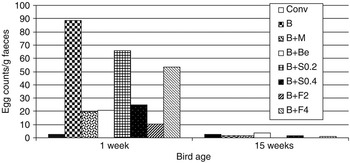
At 1 week of age, ileal and caecal samples were pooled due to the small amounts of material and there was no significant difference between treatments in terms of the numbers of bacteria detected at that age (P > 0.05). Levels of Lactobacilli increased between 12 and 16 weeks of age (mean 106.8 to 107.3 colony-forming units (c.f.u.) per g digesta; P < 0.001), and Lactobacilli were higher in caecal than in ileal contents (mean 107.6v. 106.5 c.f.u. per g digesta, P < 0.001), but were not affected by diet or diet × age interaction. Campylobacter/Lactobacilli ratios decreased from 12 to 16 weeks of age (mean 0.018 v. 0.001, P < 0.001) and were also greater in caecal than ileal contents (mean 0.015 v. 0.004, P < 0.001) but were also not affected by diet or diet × age interaction. Within age (12 or 16 weeks) and within sample source (ileal or caecal), there was no effect of diet on bacteria. There were no significant effects on ratios of E.coli/Lactobacilli. Counts of Clostridium were too low to perform analyses, and Salmonella was not detected in any of the samples. Strongyle egg counts per g faeces decreased significantly with bird age (P < 0.001), but were not affected by diet or age × diet interaction (Figure 1).
Back transformed mean faecal strongyle egg counts per gram faeces in droppings from birds at 1 and 15 weeks of age when fed various treatment diets. For an explanation of diets, see Table 1.

Behaviour and feather scores
There was no significant effect of treatment, age or their interaction (P > 0.05) on feather pecking (gentle or vigorous). The mean number of gentle and vigorous pecks at 7 weeks of age ranged from 1.1 to 3.3 and from 0.0 to 0.7, respectively. No vigorous pecks were seen at 16 weeks of age, but mean gentle pecks ranged from 1.4 to 4.3 pecks per 10 min per pen. Mean feather scores increased with bird age (overall mean 1.27 at 9 weeks v. 1.87 at 16 weeks, P < 0.001) but were not affected by treatment (P > 0.05).
At 16 weeks of age, the mean numbers of birds on range and distance from the house varied between 10 and 13 out of a maximum of 27 birds and the distance from the house from 16.19 to 27.53 m, with neither result being significant (P > 0.05).
Discussion
The basis of this study was that although diets would be formulated to meet, as well as possible, the requirements of the pullets, diets that were consistent with current organic regulations would result in birds being subjected to a low and imbalanced amino acid supply, which would not be compensated for by increasing food intake. This could manifest itself in a number of ways including suboptimal growth, an increase in the incidence of deleterious behaviours and a compromised immune response. This would be of particular concern when birds are given access to range, where they will be subjected to greater microbial and parasitic challenge compared with conventionally housed pullets (i.e. not given access to range).
Prior to the birds going out on to the range, the data tended to support this assertion. At 5 and 9 weeks of age, the birds on the conventional and the organic diet supplemented with methionine had heavier mean body weights than any other diet apart, notably, from the organic diet supplemented with saponin at the 0.4 g/kg level. Although supplementing the diet with methionine was all that was required to enable birds on the organic diet to match the body weights of birds on the conventional diet, it was notable that supplementing the diet with betaine did not have a similar effect. Betaine has been postulated to compensate for low levels of methionine in the diet (Virtanen and Rosi, 1995) by donating methyl groups. At 9 weeks of age, in our study, the birds fed the organic diet supplemented with betaine had significantly lower body weights than birds on the other organic diets. It is feasible that the potentially beneficial effects of betaine were negated by the fishmeal in the diet, which would have provided choline (Kidd et al., Reference Kidd, Ferket and Garlich1997). However, the inability of betaine to compensate for suboptimal levels of methionine are consistent with the findings of McDevitt et al. (Reference McDevitt, Mack and Wallis2000).
Although the microbial challenge to the birds up to 9 weeks of age should have been relatively minor, albeit the birds were receiving a weekly allocation of cut grass from the range, the organic feed supplemented with saponin at the 0.4 g/kg level allowed birds to achieve a similar mean body weight to those being fed either the basal diet supplemented with the methionine or the conventional diet, suggesting that saponin has a beneficial effect on bird growth. The mode of action of saponins when added to poultry diets has not been fully elucidated; however, they are considered to have a surface-active effect and may interfere in the activity/presence of protozoal components (Wina et al., Reference Wina, Muetzel and Becker2005). Because of their surface-active nature, they can also have antibacterial effects (Avato et al., Reference Avato, Bucci, Tava, Vitali, Rosato, Bialy and Jurzysta2006, Shanmugavelu et al., Reference Shanmugavelu, Ruzickova, Zrustova and Brooker2006). This may reduce the microbial load in the digestive tract and thereby increase the efficiency of nutrient absorption. Although the microbiology data did not support this contention, this may simply reflect the highly variable nature of the microbiology data which prevented treatment-specific differences from being identified. It is also feasible that the saponins were acting on microbial populations that were not individually enumerated in this study.
At 16 weeks of age, having been given access to the range, the significant differences observed in body weights at 9 weeks of age had almost all been lost. Body weights of birds on the organic diets (excluding B + M) did not differ from each other and birds fed saponin (both B + S0.2 and B + S0.4) and one level of FOS (B + F2) did not differ significantly from the birds fed the conventional diet. It is notable that the lack of differences associated with the birds fed the organic diets tended to be due to an improvement in growth of birds on the poorer diets rather than a depression in growth of birds fed the conventional and methionine-supplemented diets. At no time point were there significant differences in the mean feed intake, although birds on diets low in methionine might have been expected to eat more to compensate (Whitehead, Reference Whitehead2002). It is feasible that the improved growth in birds fed diets B + S0.2 and B + F2 that coincided with the birds having access to range is due to those birds ingesting enough nutritionally valuable products from the range (such as worms, insects, seeds, grass), as seen previously in various gallinaceous species (Savory, Reference Savory1989). The efficiency with which nutrients were converted to body mass (as determined by FCE values) during the 11- to 16-week period do not differ significantly, irrespective of treatment. This would support the conclusion that ‘range-derived’ nutrients may compensate for nutrient deficiencies in the manufactured diet. Anecdotal evidence from feed compounders indicates that larger flock sizes of 1000 or more birds in organic systems are particularly prone to cannibalism and that this occurs because, unlike smaller flocks, they are unable to cope with inadequate diets by obtaining additional nutrients from the range environment. Data from this study and previous reports (Hegelund et al., Reference Hegelund, Sørensen, Kjær and Kristensen2005) support the view that smaller flocks utilise the range well and more efficiently than larger flocks. In this study, the relatively low concentration of sulphur amino acids in the diets, which appears to have an over-riding effect on growth, appears to be compensated for, at least in part, by the ability of the birds to scavenge extra feed material. The lack of feather pecking and evidence for pecking damage would support this, as amino acid deficiencies are well known to cause such unwanted behaviour (for a review, see Van Krimpen et al., Reference Van Krimpen, Kwakkel, Reuvekamp, Van der Peet-Schwering, Den Hartog and Verstegen2005).
The birds were given access to range during the winter months and this may have resulted in a relatively low parasitic and microbiological load on the pasture and thus challenge to the birds. Also, due to the weather conditions the birds were given access to the range relatively late in the rearing cycle. It could be hypothesised that either or both of these contributed to the lack of consistent and significant differences between the basal diet and the basal diet supplemented with FOS or saponin (although as noted above there was a tendency for one of the saponin treatments to give heavier body weights than the basal diet alone or the basal diet supplemented with betaine or FOS). This is further supported by data from others who demonstrated the beneficial effects of betaine in the diets of birds that were subjected to coccidial infections (Kettunen et al., Reference Kettunen, Tiihonen, Peuranen, Saarinen and Remus2001). Glycine has been shown previously to enhance levels of Clostridium perfringens (Dahiya et al., Reference Dahiya, Hoehler, Wilkie, Van Kessel and Drew2005). Given that betaine consists of glycine (with three methyl groups), it might be expected that levels of C. perfringens in the betaine treatment would have been significantly higher than in the other treatments. In this study, however, C. perfringens occurred at levels too low for statistical analysis.
The pullet’s commercial value comes from its ability to lay eggs during the reproductive phase of its life. When considering the relevance of the findings from this study to commercial organic pullet rearers, a number of points need to be considered.
(a) Body weight is an important but relatively crude indicator of reproductive fitness and assumes that a disproportionate amount of fat has not deposited. If, as has been postulated, the organic diet is imbalanced, then birds may attempt to compensate by increased food intake and deposit the subsequent excess energy as fat (Whitehead, Reference Whitehead2002). Further studies will be conducted to determine whether the body composition of the pullet is altered by the types of treatments used in this study.
(b) Fish meal, while considered to be appropriate at the time the study was undertaken, is unlikely to be used in organic poultry diets to any significant extent in the future. The reasons for this are both logistical (e.g. most of the smaller feed-mills producing organic diets for poultry also produce diets for other species, thus they would not use fishmeal even if available to them) and regarding consistency with organic ethos (e.g. the use of fishmeal even when it is a by-product is considered by some to be unacceptable). In this context it may be notable that the recent experience of one certification body (A. Basset, personal communication) is that problem flocks are more likely to be associated with diets formulated without fishmeal. Studies are therefore required to ascertain the effect of formulating fishmeal-free diets that satisfy organic certification bodies.
(c) It is apparent that under the conditions of our studies, the sulphur amino acid content and availability in the diets had the over-riding effect, depressing growth, and that the other supplements had little effect in overcoming this. It was notable that the birds that were fed diets that were considered to be inadequate in the supply of sulphur amino acids overcame this hindrance when given access to range and achieved the same weights as controls at the end of the study. It is possible that scavenged nutrients from the range, especially in the small colonies used in this study, allowed performance to be improved to the level achieved by the birds fed the control and the methionine-supplemented basal diet. Thus, the major problem that requires to be overcome where larger flocks are used, and perhaps on previously used land, is that of a balanced amino acid supply. It may be that the dietary supplements used in this study would have some beneficial effects when included in the diets of birds that have a greater challenge from the environment and when sulphur amino acids are not limiting. It remains to be seen what the effects on health and performance are when birds progress into lay.
Acknowledgements
This study was financially supported by BOCM Pauls Ltd, Burcombe Organic Hatchery, Danisco Animal Nutrition, EcoS Consultancy Ltd, Nor-Feed APS, Sheepdrove Organic Farm, Soil Association, Stonegate Farmers, with match funding from DEFRA and SEERAD through the Sustainable Livestock Production LINK programme.