Without myth every culture forfeits its healthy creative natural power
(Nietzsche, Reference Nietzsche and Johnston2017 [1886] The Birth of Tragedy 78)
Introduction
Popular music and religion
Post-secular neo-religions seem to pop up everywhere in our times: Forbes mentions songs by U2, Lady Gaga and Carrie Underwood; the animated program The Simpsons; all kinds of angels, demons, witches, vampires, and zombies; superhero comic books; Batman portrayed in a crucifix pose; and the Super Bowl as a religious festival (Reference Forbes, Forbes and Mahan2017, pp. 1–2). The list enlarges with the cult to the Beatles and Grateful Dead, and ‘Graceland as an Elvis shrine and pilgrimage site’ (Ibid, p. 17). Sports and movie stars induce real devotion among their fans, and popular films may bear hidden religion, like those of Harry Potter and the Disney factory, Star Wars (Reference Lucas1977), and E.T. As Forbes argues:
Many theologically oriented viewers find allegorical Christ figures in movies, such as the extraterrestrial in E.T. (Reference Spielberg1982), a special being with healing powers who descends to earth, is loved by many, misunderstood and feared by the authorities, and finally undergoes death and resurrection. (Ibid, p. 12)
In a different sociological frame, nationalism has been understood as a religion (Hayes Reference Hayes2016; Gemie Reference Gemie2017), and modern revivals, like the Celtic one, are replete with religious significance (Bowman Reference Bowman2007; Campos Reference Campos, Kärjä and Kärki2016). In many of these phenomena the supposedly mundane and de-sacralised territory of popular music occupies a preeminent place. This field of research has grown considerably in the last few decades, namely the volumes edited by Margry (Reference Margry2008), Weston and Bennett (Reference Weston and Bennett2013), Moberg and Partridge (Reference Moberg and Partridge2017), Forbes and Mahan (Reference Forbes and Mahan2017), Häger (Reference Häger2018), and Engelhardt and Bohlman (Reference Engelhardt and Bohlman2018). Also relevant are the individual books by Till (Reference Till2010) and Kärjä (Reference Kärjä2022), as well as journals like Culture and Religion, Journal of Religion and Popular Culture, Journal for Religion, Film and Media, and the Yale Journal of Music & Religion. This bibliography can provide an in-depth examination of certain concepts that shall not be discussed here due to a lack of space. In broad terms the sociological theory elaborated one century ago by Émile Durkheim remains influential. He understood religion as a social construction, arguing that anything can be sacred, and nothing is inherently sacred. Thus, the sanctity of a thing or being is due to ‘the collective feeling of which it is the object’ (Reference Durkheim1995, p. 416). Flexible orientations are increasingly widespread among scholars, such as Cusack and Robertson’s view of today’s religion as ‘not exclusively a tradition-based or faith-based practice, but a rationale, an experience, a framework that is implicitly and explicitly present in a variety of cultural contexts’ (Reference Cusack, Robertson, Cusack, Morehead and Robertson2019, p. 2).
The synergistic intersection between popular music and religion lacks a clear causal explanation: ‘whether this [bond] is culture-dependent, a pure neuropsychological phenomenon, or a combination of both remains empirically unanswered’; it may emerge ‘from the primordial experience of the child in the womb’, while some authors confer an ‘evolutionary advantage to religion and music’ (Demmrich Reference Demmrich2019, p. 35). The link is strong and seemingly innate; perhaps the ontology of popular music entails a religious nature ‘regardless of religious motifs in lyrics or video clips and regardless of star-musicians’ (Fritz and Höpflinger Reference Fritz and Höpflinger2020, p. 101). Weinstein detects ‘distinctive forms of religiosity endogenous to rock that involve the relations of artist and audience’ (1995, p. 185) and calls them ‘religio-rock’. Interestingly, ‘rock music’s basic audience, youth, has the lowest rates of attendance of any age group at church services’ (Ibid, p. 186), but Anderson underlines ‘the socially, politically and spiritually transformative potential of progressive rock’ and its capacity to generate ‘re-enchantment’ in the modern world (Reference Anderson2020, p. 82; Till Reference Till2010).
Identity
Identity is the third and decisive element coming into play in the music-religion dialectic. Cultural identity is formed through the arts, and spirituality in music is a medium to explore it (Fung Reference Fung2017). Nonetheless, many individuals lean towards a religion-music binary in the struggle to consolidate the self, but lacking awareness: ‘the musical subculture functions as a religion in these people’s lives, but they do not consciously recognise it as such’ (Sylvan Reference Sylvan2002, p. 4). Youths are especially affected; for them music is central ‘to master developmental tasks … regulate emotions, manage difficulties and provide points of reference in the process of constructing personal and social identities’ (Kuntsche, Le Mével and Berson Reference Kuntsche, Le Mével and Berson2016, pp. 219–20). Other contributions from neuroscience and behavioural psychology coincide:
A developmental task specific to adolescence is developing a coherent sense of self … Music is a powerful tool in resolving this task. It facilitates the choice of an identity … and situate oneself in the social world. (Mulder et al. Reference Mulder2010, p. 69)
Macdonald, Hargreaves, and Miell state that for youth, music plays ‘an absolutely fundamental role in the development and maintenance of identity’ (Reference MacDonald, Hargreaves, Miell, Hallam, Cross and Thaut2012, p. 462). For Schäfer and Sedlmeier, the reasons people adduce to prefer one music or another are secondary compared to the underlying recognition of personal identity (Reference Schäfer and Sedlmeier2009). Peck and Grealey proved empirically that ‘music can support a wide range of self-identity-relevant meanings, and fundamentally transform our sense of who we are’ (Reference Peck and Grealey2020, p. 1). Hence, Giddens was probably right in stating that, in contemporary societies, identity is the most important problem individuals must face (Reference Giddens1991).
Pete Townshend and the Who
The protagonist of this study is Pete Townshend (Chiswick, London, 1945), a rock star. Either with the Who—his band—or in his solo career, his music became a popular force of cultural mediation, redressing aesthetic and social values, and building religious meanings, supported by a legion of devoted followers. Around him there is an important literature, namely Giuliano (Reference Giuliano1996), Dotter (Reference Dotter2005), Wilkerson (Reference Wilkerson2006), and Townshend’s own memoirs (Reference Townshend2012). Some of his works have received specific attention, like in Johnson (Reference Johnson, Gennaro and Harison2016), Daniels (Reference Daniels2016), Thurschwell (ed., Reference Thurschwell2018), and Cosmen (Reference Cosmen2019). About the Who there are referential biographies by McMichael and Lyons (Reference McMichael and Lyons1997), Atkins (Reference Atkins2000), Grantley and Parker (Reference Grantley and Parker2010), Harison (Reference Harison2015), and Gennaro and Harison (Reference Gennaro, Harison, Gennaro and Harison2016). The devotion that either the band, Townshend specifically, or the characters he created (Tommy, Jimmy) raised among their fans has been stressed altogether by scholars and chroniclers.Footnote 1
Concerning religion, Townshend embraced and divulged the vague and mystical creeds of Indian guru Meher Baba. Other celebrated contemporary rockers poured out spiritual content in different ways. In a brief overview, some have been rather stable Christians (Bob Dylan, Cliff Richard, Kris Kristofferson, and Bono), while others were/are convinced atheists (John Lennon, Bob Geldof, David Gilmour, and Brian Eno. Campos Reference Campos2019). There are varied in-between positions: Jimi Hendrix famously asserted, ‘music is my religion’ (qtd in Brown Reference Brown2012, p. 103); Lou Reed and (mostly) David Bowie led lives dotted with either manifestations of devotion or profanations—somewhat two sides of the same coin. Patti Smith aimed to communicate ‘an idea of God with a living sense of spiritual and religious purpose’ (Whiteley Reference Whiteley and Inglis2006, p. 90). AC/DC occupies the ‘extreme hedonistic wing’ of a ‘positive atheism’, as in ‘Highway to Hell’ (Weinstein Reference Weinstein1995, p. 188). Bruce Springsteen’s concerts have been lived as ‘some of the most transcendent experiences of holy community’ (McCarthy Reference McCarthy, Mazur and McCarthy2001, p. 23). Tina Turner was a convinced Buddhist, while Prince joined Jehovah’s Witnesses in 2001 (public domain). The mysticism of Leonard Cohen, George Harrison, and Cat Stevens marked their careers. Neil Young adopted a pantheistic stance: ‘I do feel the Great Spirit in all that is around me … The moon means a lot to me, as does the forest. All things natural speak to me with a rhythm that I feel’ (Reference Young2014, p. 155, Spanish edition).
The context played a crucial role. After WWII the boomers became a hypercritical generation in the face of the devastation left behind, the ongoing Cold War, and the values inherited; their feelings were of ‘shame and anger’ (Townshend Reference Townshend2012, p. 233). The rejection of their elders’ society entailed a God-less reaction and scepticism towards the established Church. But Homo religiosus survived the counterculture, adopting different forms and performative practices, like attraction towards orientalism.Footnote 2 Meher Baba and other gurus spread a spirituality perfectly suited to the boomers’ dogma-less mood. In this context the Who stood out, as Townshend’s beliefs made them a rather out-of-reality band, particularly reactive to some trends: according to Burns, they were among ‘the most prominent disavowers’ of the counterculture (Reference Burns1987, p. 48). In ‘Baba O’Riley’ (a song consecrated to Baba; Who’s Next, 1971) the content is clear: only teenage wasteland. In the same album ‘Won’t Get Fooled Again’ was an overt message against the hippie culture and, overall, their anti-system nihilism preceded the punk movement:
I wrote [‘Won’t Get Fooled Again’] at a time when I was getting barraged by people at the Eel Pie Island commune. They lived opposite me. … They dug me because I was like a figurehead … and I dug them because I could see what was going on over there. (Townshend qtd in Grantley and Parker Reference Grantley and Parker2010, p. 96)Footnote 3
Instead, Townshend’s religious interaction was intense, in three forms. Two of them were inner: the conscious (voluntary) and the unconscious (a reflection); the third was a sacralisation process by his fans. In the first one he assumed the religious legacy of Christ and Baba, developing an apostolic labour although frequently in coded messages. Most of his creations participate in this intentional category, such as the albums Who Came First, Tommy, and Quadrophenia (see below). The unconscious level (hidden, subliminal) emerged spontaneously in lyrics, body language, and declarations. And thirdly, Townshend became a (surrogate) god for his fans, same as other rock celebrities. In this case the religious ground was completely different, as a follower (enthusiastic though they might be) will never believe that their hero is a supernatural being: ‘in contrast to religion, fandom lacks an absolute, other-worldly framework through which social realities are constructed and legitimized’ (Sandvoss Reference Sandvoss2005, p. 63).
According to Townshend’s religious evolution, four periods arise: childhood, idealism, secularisation, and maturity.
Childhood and education
Townshend was brought up in a Christian-based culture, as was normal in mid-twentieth-century Western Europe. He belonged to a de-structured family and lived a traumatic childhood, but his father—Cliff Townshend—was an alto saxophonist in The Squadronaires (a band of the Royal Air Force), and his mother—Betty Dennis—a singer with the Sydney Torch and Les Douglass orchestras. When the marriage broke up, the boy lived some years with his paternal grandmother, Dorothy (Denny), a nightmare for him: ‘her favourite punishment was denying me food’; she was ‘a perfect wicked witch’ (Townshend Reference Townshend2012, pp. 18–9). In this period, he may have suffered sexual abuse, but the information is unclear; those negative memories were projected in Tommy’s song ‘Fiddle’ (by John Entwistle), and the album was a ‘completely autobiographical work … “See me, feel me, touch me”? Where did that come from? It came from that little four-and-a-half-year-old boy in a fucking unlocked bedroom in a house with a madwoman’ (qtd. in Giuliano Reference Giuliano1996, pp. 3–4). This turbulent period might have indirectly triggered his religious vocation, as according to evolutionary psychology ‘religious sentiments are heightened when subjects are primed using stories that evoke existential anxiety’ (Rossano Reference Rossano2006, p. 349).
There is no evidence that Acton County Grammar School (which he attended from 1956) was particularly religious, but England was then governed by the Education Act of 1944,Footnote 4 which broadly endorsed the teaching of Christian-Anglican religion in schools. The seed grew: by 1970 Townshend declared that ‘I love Jesus far more now than I ever did at infant school as I sang, “Yes, Jesus loves me”’ (qtd. in Wilkerson Reference Wilkerson2006, p. 103). Townshend attended the Congregational Church, where he met for the first time a music-religion conflation: ‘the Confederates [Footnote 5] had another great advantage: a ready-made audience consisting of members of the Congo Club, a youth center run by the Acton Congregational Church’ (Giuliano Reference Giuliano1996, p. 15).
In the following years, Townshend underwent a major change in his personal beliefs, which permeated his entire musical career.
Transforming God through Meher Baba
Townshend’s faith in Baba was an elective spirituality (voluntarily adopted). It all started with a revelation in the summer of 1967 in the room of a Holiday Inn in Rolling Meadows, Illinois, literally hearing the voice of God: ‘in an instant, in a very ordinary place at an unexceptional time’. He lived it as ‘a singular, momentous epiphany – a call to the heart’ (Townshend Reference Townshend2012, pp. 112–3).Footnote 6 The scene recalls the conversion of Paul the Apostle, who ceased persecuting Christians to become a follower of Jesus after a miraculous appearance. Townshend would be henceforth consistent: God had spoken to him, and he would proclaim his glory, like Paul of Tarsus in his time. He then undertook the composition of Tommy.
Baba was an optimal guru for him, because in his ambiguous writings there is no resident theology—apart from the notion of a universal Love—so any follower could adapt them to his/her own purposes. Baba took most of his doctrine from Hinduism, Buddhism, and Christian Neo-Platonism, affirming that he was the God Man: ‘I am the Greatest … the Greatest of all … an infallible truth’ (qtd. in Kerkhove Reference Kerkhove1996, p. 2). Such an omnipotent master triggered a fertile creative reaction. Who Came First (1972) was dedicated to him, and he lyrically influenced numerous songs from Who’s Next, Odds and Sods, Tommy, Quadrophenia, Rough Mix, Who Are You, and Empty Glass (Townshend and Lane 1977; Calef Reference Calef, Gennaro and Harison2016; see Mukherjee Reference Mukherjee2017 for a critical perspective on Baba). The other Who members did not share his enthusiasm: ‘Pete’s devotion to Meher Baba was always questioned—if not mocked—mainly among his peers’ (Cosmen Reference Cosmen2019, p. 95. Spanish original), but ‘solipsism’ became their main source of inspiration (Ibid, p. 18).
The central themes of Pete Townshend’s religious education—re-routed via Baba—were released in creative transmediations: body-soul dualism, evil versus good, the feeling of guilt, and philanthropic love. Dualism was probably the main principle stemming from Baba’s teachings: ‘I am not this body. It is only a coat I put on when I visit you’, he proclaimed (qtd. in Kerkhove Reference Kerkhove1996, p. 46). This idea appears in the content of Tommy (1969), ‘Bargain’ (Who’s Next, 1971), and ‘Parvardigar’ (Who Came First, 1972), while the body as mere coat was textually echoed in ‘Don’t Let Go the Coat’ (Face Dances, 1981). Townshend thus inherited the binary opposition between spirituality and the pleasures of life that has presided over Western philosophy for the last twenty-five centuries.
In a brief synopsis, certain song titles were expressive, like ‘I Can’t Reach You’ (The Who Sell Out, 1967). ‘The Seeker’ (single, 1970; Meaty Beaty Big & Bouncy, 1971) fully addressed the identity/religion problem, in Townshend’s typically encrypted style. Lifehouse was a 1970s science fiction film project of a post-apocalyptic dystopia as neo-religion (Campos Reference Campos2019). Jai Baba is a 2001 compilation dedicated to Meher Baba integrated by three records: Happy Birthday (1970), I Am (1972), and With Love (1976; see below). They were ‘devotional albums’, according to Pete Townshend’s official website on Meher Baba. However, his main tribute to the master possibly was ‘Parvardigar’ (an appellation to God in Persian language). Lyrics came from Baba’s ‘Universal Prayer’, which had impressed him deeply; Townshend attributed the composition of the song to divine inspiration. ‘The Shout’ (released on Another Scoop, 1987) stressed once more: ‘I was writing about something that I thought was higher than simple love’ (Pratt and Cady).
How did he combine this asceticism with being a rock star? Jesus was the hero of his childhood, but as a battering ram of the juvenile rebellion, he rejected the officiality of the Anglican Church. In ‘I’m Free’ Tommy encourages his supporters to have the guts to leave the temple, a direct disregard for conventional religion. At the beginning of Quadrophenia Jimmy describes the priest as full of lies and hate. ‘A Man in a Purple Dress’ (Endless Wire, 2006) was an open attack against the clergy; the purple dress represented ‘a pope or a cardinal and Pete rages at their hypocrisy and cowardice’ (Grantley and Parker Reference Grantley and Parker2010, p. 230). However, Tommy was the most successful, influential, and religious album in the career of the Who.
Tommy
In 1969 Pete declared that writing Tommy was controlled by his direct involvement with Baba: ‘His stuff is completely self-contained … songs like “I’m Free”, “Pinball Wizard” and a couple of others are very much Baba, songs of the quiet explosion of divinity. They just rolled off the pen’ (qtd. in Sanders and Dalton Reference Sanders and Dalton1969, p. 18).Footnote 7 The influence was not limited to some vague inspiration; Littmann (Reference Littmann, Gennaro and Harison2016) outlines how Tommy’s muteness was an intentional echo of Baba’s vow of silence since 1925. Muteness was not an isolated disability; Baba had stressed that those engaged with earthly things cannot perceive God, and this principle led Townshend to create a deaf, dumb, and blind boy, thus staging human ignorance and spiritual void: ‘Tommy is a spiritual journey’, and his disabilities are metaphors for those of the whole humanity (qtd. in Wilkerson Reference Wilkerson2006, p. 455). Blindness has a deep meaning in the Bible as an inability to contemplate divinity (Psalm 146:8. John 9:35–9).Footnote 8 In Mark’s gospel Jesus cures a deaf-mute man (7:32–5), and then scolds his disciples for misunderstanding the analogy of the senses: ‘Do you have eyes but fail to see, and ears but fail to hear?’ (8:18). In the well-known episode of the raising of Lazarus (John 11:1–44), Jesus brings back to life a man who had died (i.e. lost all his senses). Tommy’s social success, suddenly returning to sensorial life as a pinball winner (banal as this is), revives the biblical message.Footnote 9 Further on, the abandonment of his followers can be compared to Jesus’ Calvary, betrayed by Judas and denied by Peter. Tommy’s final redemption resembles Christ’s resurrection (reaching the top of the mountain in the final scene of the 1975 movie, merging with the setting sun).
In Tommy the core song ‘See Me / Feel Me’ implores help in a mystical rapture.Footnote 10 But it ends with the Baba-inspired message ‘Listening to You’, full of hope, as in many contrasting cadences of liturgical chanting: ‘the intensity builds to a climax of joyous celebration, blurring the lines between the experience of rock’n’roll and the sacred experience of religion’ (Grantley and Parker Reference Grantley and Parker2010, p. 72). The inner architecture of ‘See Me / Feel Me / Listening to You’ constitutes a remarkable symbiosis of music and lyrics. The initial progression E flat – F – G provides an intimate air, with the double suspension 9–8 and 4–3 in F. ‘Listening to You’ ascends a semitone (to E major) and rests on the dominant (B) to suddenly descend to the subdominant (A) and ascend again with the bass to reach C major. The repetition finishes with C – G – D – B. The sequence is then replayed in its entirety. Thus, the transition from one song to the other uses no less than eight triad chords, all of them major (!): no wonder the exultant joy of the whole passage.Footnote 11 Moreover, in ‘Listening to You’ the progression by step degrees is almost identical to that in ‘See Me’, picking up its potential energy and giving the double song a great thematic unity.
Biblical rock
As can be seen throughout this article, many motifs of Townshend’s lyrics appear in the Bible. Broadening the analysis of Tommy, the expression of seeing the glory (‘Listening to You’) figures in the Old Testament as an image of light and power (Ezekiel 8:4; Leviticus 9:23; Hebrews 1:3; Isaiah 40:5 and 60:1), as well as in Matthew 24:30, Luke 21:27, and John 11:40; in Revelation God’s glory lights the heavens (21:23). Climbing the mountain to follow him (same song) evokes the communion with God in the highest (Luke 2:14; Isaiah 2:2, 49:11; Micah 4:2). Salvation from the eternal grave (‘Christmas’) is rife in the Bible, for instance, in several Psalms and Matthew.
‘Faith in Something Bigger’ (1968; Odds & Sods, 1974), expressed that the more we learn the less we know (1 Corinthians 3:19). ‘Getting in Tune’ (Who’s Next) is a prayer to reach salvation. On the same album, ‘Bargain’ has strong religious contents:
Bearing the Baba influence, the titular ‘Bargain’ is a man’s trading of all his earthly possessions in exchange for spiritual enlightenment. ‘This song is simply about losing one’s ego as a devotee of Meher Baba,’ Townshend commented. ‘I constantly try to lose myself, and find him. … this song expresses how much of a bargain it would be to lose everything in order to be one with God.’ (Grantley and Parker Reference Grantley and Parker2010, p. 92)
‘Bargain’ can be confused with a mainstream love piece. Its lyrics express, however, the ancient dilemma of pain to achieve spiritual plenitude, as a wholehearted prayer of adoration and surrender: to find God he will suffer anything, stand naked, stoned, and stabbed, all of which is a bargain. Interestingly, the song is musically vibrant, a good illustration of the Who’s very physical rock.
Continuing with Who’s Next, the middle section of ‘Behind Blue Eyes’ asks for help to resist temptation (of falling in love with a beautiful groupie, while Townshend got married in 1968): ‘a first-person cry for help from the lonely pinnacle of rock stardom and brimming with self-loathing, self-castigation and self-pity’ (Ibid, p. 95). Temptation leading to condemnation is omnipresent in the Bible, which is also glimpsed in ‘Behind Blue Eyes’ in the invocation to open the hands (Deuteronomy 15:7–11).
Were all these coincidences intentional? In 1976 Geoffrey Giuliano met Townshend at the opening of the Oceanic Centre for Baba followers in London. In their conversation the musician cited the Bible: ‘more blessed is he who has not seen and yet believes’ (John 20:29; qtd. in Giuliano Reference Giuliano1996, p. 135). The song ‘Empty Glass’ (from the 1980 homonymous album—see below) was created ‘when I read Ecclesiastes again, and it was so powerful’ (qtd. in Wilkerson Reference Wilkerson2006, p. 315). Doubtlessly Townshend was familiar with these ancient texts and used them in his lyrics, but unintentional reflections of his religious culture are also possible.
Christ on stage
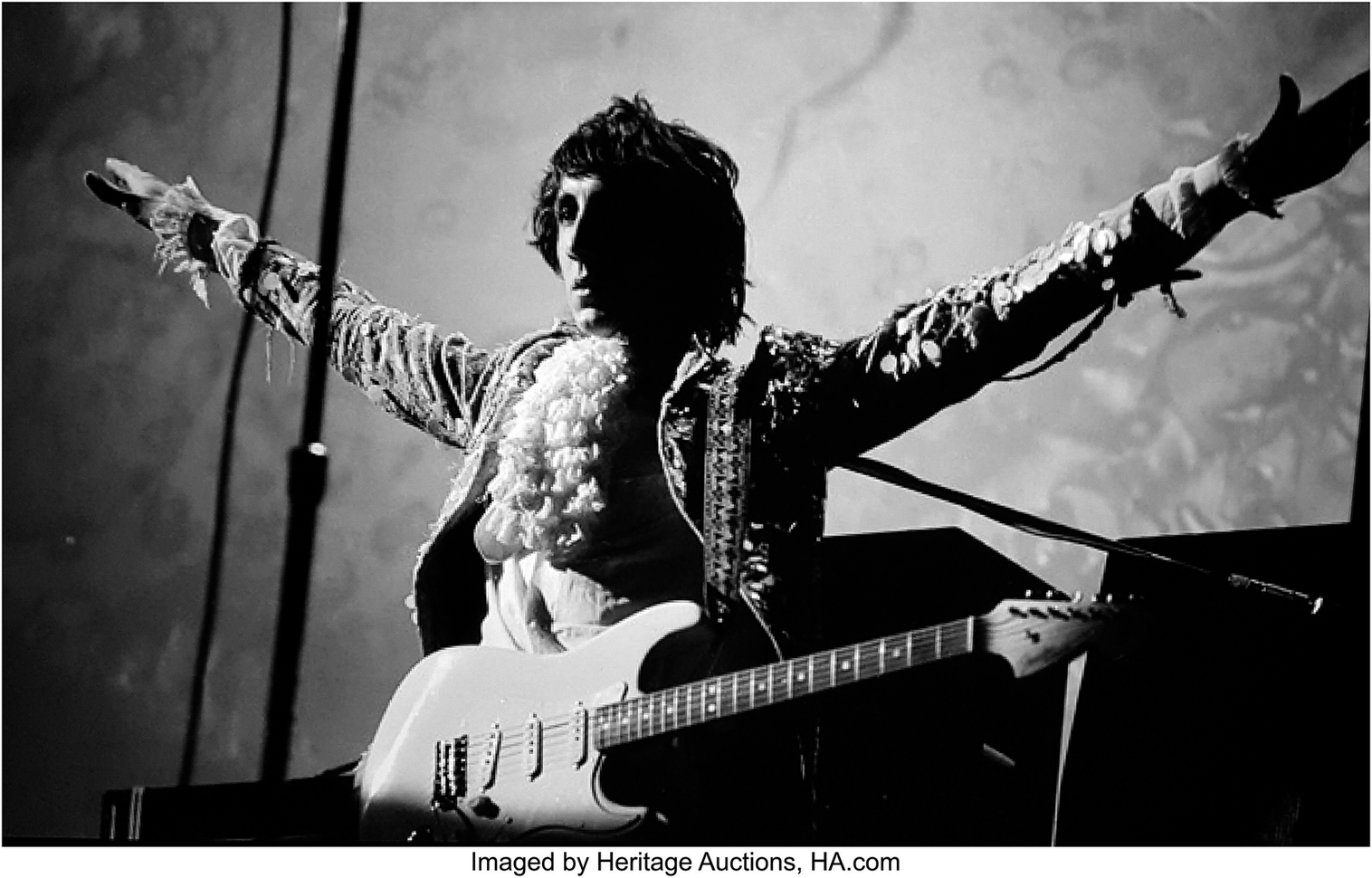
A paradox of Townshend’s Eastern-inspired spirituality was his involvement in drugs, violence, and extreme loudness. But it probably formed part of his role as a social hero: ‘The specific charismatic role (subject-position) the rock star plays is that of the romantic artist-hero … above and apart from ordinary humanity [and] to be beyond the profane is to be sacred’ (Weinstein Reference Weinstein1995, p. 189). Seemingly he had little choice: the license given to the star was an obligation ‘to transgress more general moral codes. These transgressions, in turn, confirm and enhance the star’s charisma’ (Ibid, p. 190). There were risks involved, such as neglecting personal safety. Townshend lacerated himself, shattered his beloved guitars, crashed cars, destroyed a hotel room, drank cognac beyond measure, and was close to death due to his excesses. In parallel he fell on his knees before Baba’s image confessing his sins, and evoked the image of Christ on stage (Figure 1):
Pete Townshend on stage, 1 December 1967, at Long Island Arena in Commack, New York. Image and permission courtesy of Heritage Auctions, HA.com.

In the photograph he was not intentionally imitating the crucifixion of Christ (in this case the mimesis must be unconscious) but an airplane in a nuclear war (Townshend Reference Townshend2012, p. 56), nonetheless a dramatic evocation of suffering and death.
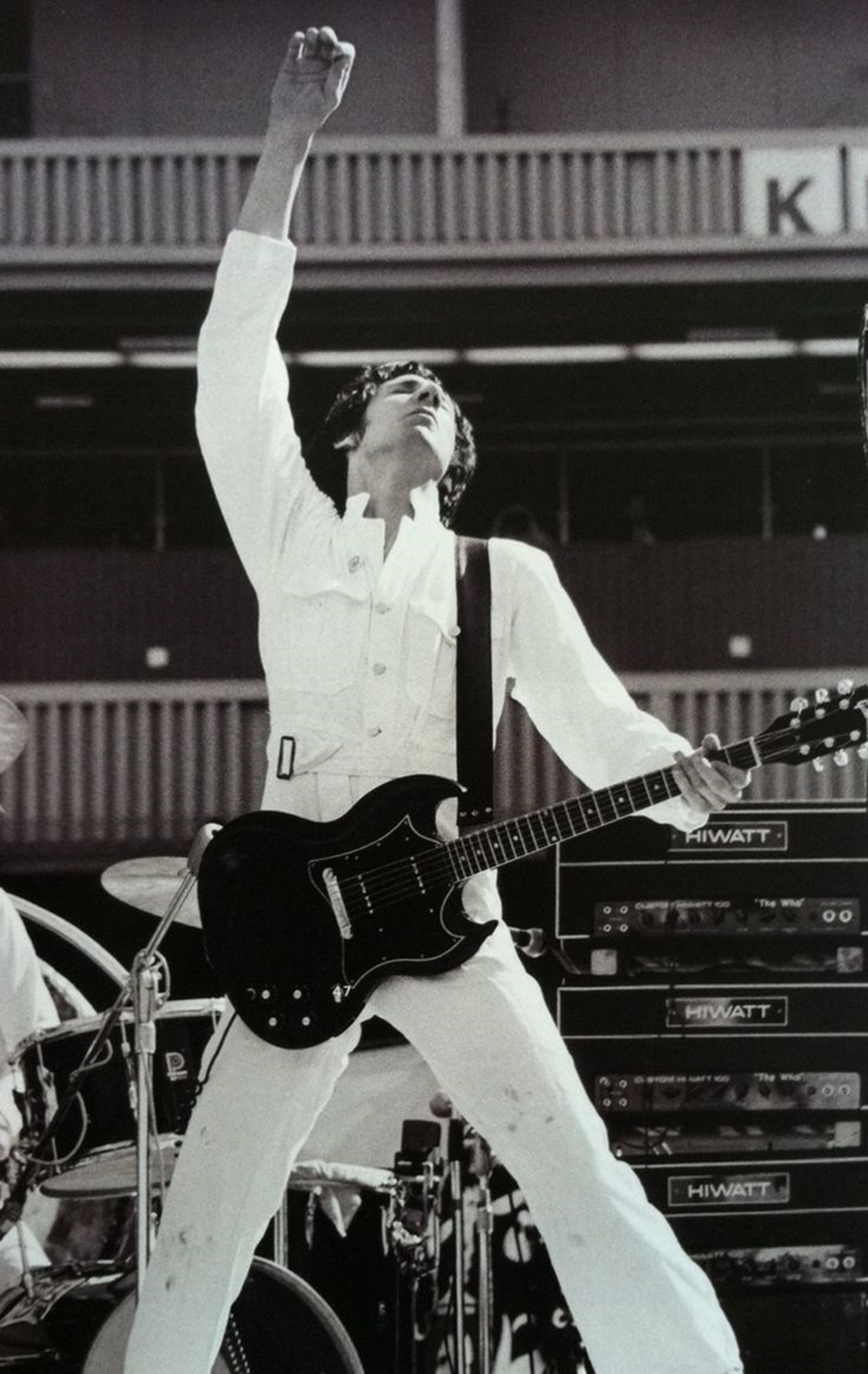
In other photos he resembles the Greek Pantocrator (Maiestas Domini—God as majesty), who raises his right hand to impart the blessing while the left holds the Holy Scriptures; both symbols being replaced by the windmill effect and the guitar, respectively (Figure 2).
Pete Townshend with the Who at Anaheim Stadium, California, 14 June 1970. Image and permission courtesy of the author, Neil Zlozower – Atlas Icons.

If these analyses are right, the musician dramatised on stage Christ and God in their most distinctive iconography, in a subliminal reenactment wrapped in hard rock. Another reading of the images is the implicit vanity they can convey, if not straightforward self-worship, paradoxical as it may seem compared to his chronic feeling of guilt: ‘ironically, Pete’s towering sense of self … also clearly exposes the often petulant child he carries within’ (Giuliano Reference Giuliano1996, p. 129; on the narcissism implicit in Tommy, see Daniels Reference Daniels2016; for the transition from religious fandom to worshipping the self, see Campos Reference Campos, Gregory and Dines2021). Maybe his impulse to be a guide played a role: ‘Pete Townshend, like it or not, is a teacher’ (Giuliano Reference Giuliano1996, p. ix).
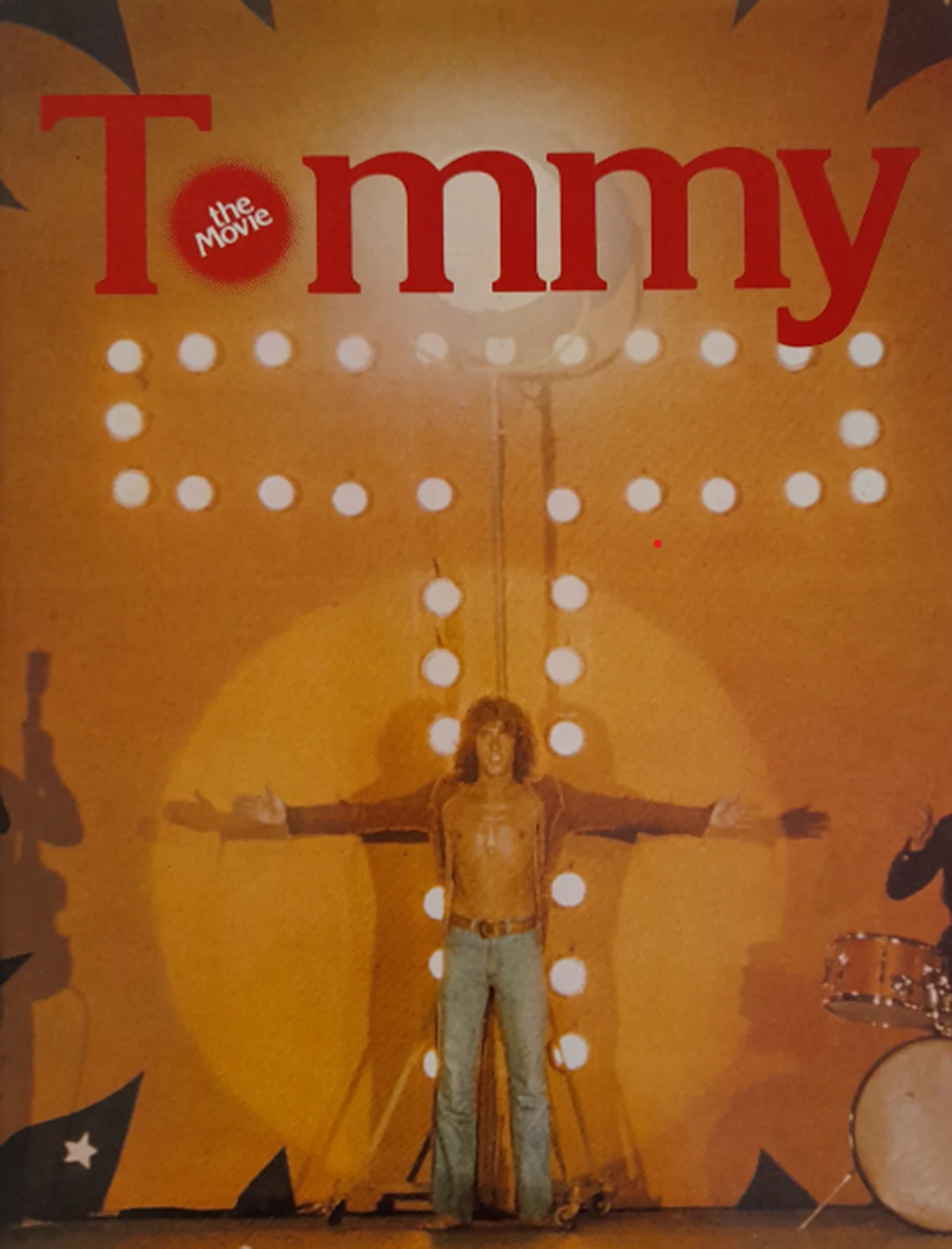
He was not the only one to adopt religion-inspired body language. Jesus Christ remains a fascinating icon of authenticity and mystery, ‘a versatile trope that contemporary artists embraced’ (Barbier 2021, p. 11). For example, Brazilian artist Eduardo Varez created several images for the 2016 Kiss FM’s In Gods We Trust campaign, showing David Gilmour, Jim Morrison, and George Harrison with long hair and beard. Varez stated that ‘at some point in their careers, these and others great rock stars adopted a visual of hair and beard, very similar to the image that we have of God’ (qtd. in Ibid, pp. 308–9). The brochure cover for Ken Russell’s Reference Russell1975 film Tommy shows Daltrey bare-chested, with arms outstretched as in Christian artwork images of the crucifixion, and backed by a cross with lights (Figure 3); in this case the similarity should cast no doubts. Comparable cases are those of Cliff Richard in his concerts, and Michael Jackson’s performance at the 1996 Brit Awards ‘in a way unmistakably suggestive of Jesus Christ’ (Löbert Reference Löbert2012, p. 125).
Official brochure cover artwork for Ken Russell’s 1975 film Tommy. Public domain.

Other practices and gestures of the Who admit an interpretation as veiled rites of Christian inspiration. The stage itself was a sacred space, and Townshend went so far as to hit those who profaned the Temple, the best-known being Abbie Hoffman at Woodstock. The destruction of the guitar, as well as drums, speakers, and light equipment, became a secular ritual comparable to shrine sacrifices (see below). The windmill on the guitar was a painful practice, ending up in finger injury and bleeding that may evoke the nails in the cross. Smoke bombs on stage were another resource of the Who, like incense in churches. The deafening potency was a proclamation of aural sovereignty, just as in cathedrals the organ and choir loudly sing the greatness of God. Attendees—most of whom had grown up in a Christian milieu—displayed their own ‘worshipping’ rituals: chanting the refrains, dressing according to the occasion, and flicking their lighters (comparable to the candles in churches). In fact, another coincidence is darkness: rock concerts take place normally at night, as well as in churches, where obscurity is dominant, contrasting with the sparkling lights from above. Similarly, the apparel and body language resembled the hierarchy of the high priest over the faithful (Townshend and Daltrey often dressed in gleaming white, with ornaments and pendants). Like many other rockers, Townshend genuflected to emphasise his guitar performance, although technically this is not necessary.
Some of these interpretations come directly from Townshend, as when he justified the incident with Hoffman in Woodstock: ‘I feel the stage is a sacred platform. If you’re taking responsibility for it, you have to be sure it’s used for the right purpose’ (qtd. in Giuliano Reference Giuliano1996, pp. 91–2). He threatened to kill the next person to come up; Daltrey recalled the incident with irony: ‘music and peace’ (Reference Daltrey2018, p. 167). Thus, for Townshend ‘playing rock & roll well becomes an act of grace’, the concert a religious ritual and the stage an altar (Marsh Reference Marsh1980, pp. 71–2). Comparable cases are Dylan Masses and the U2charist (Häger Reference Häger and Häger2018). Additionally, diverse secular elements were re-semanticised as sacred in the counterculture age:
We see sexuality, formerly understood as promiscuity and hedonism, now reinterpreted as tantric practice, the body’s way to God. … Drugs, popularised as causing anything from addiction to demon possession, are now sacraments, with peyote, ayahuasca, and marijuana used in rituals to contact an immanent divinity. (McDaniel Reference McDaniel2018, p. 159)
In this historical turn rock played a crucial role, fostering an alternative culture that challenged the repressive lack of sensoriality imposed by the Church: ‘when the mainstream religions close their doors to religious ecstasy, people seek and find it in other places’ (Ibid, pp. 159–60).
The sacrifice
The onstage destruction of instruments soon became an identifier of Pete Townshend and the Who, strongly demanded by the audience. He has explained how it started due to a chance event, but from an anthropological point of view it rather suggests a spontaneous re-enactment of the old practice of religious sacrifices, with him as high priest and the smashed-up guitar as scapegoat victim.Footnote 12 The guitar sacrifice involved violating the established order and, paradoxically, building social concord, because the sacrifice entails an exercise of the officiant’s power over the victim (obviously) but also over the attendees, as the victim is ‘a substitute for all the members of the community, offered up by the members themselves’ (Girard Reference Girard2005, p. 8). In so doing, ‘the sacrifice serves to protect the entire community from its own violence’, thus, ‘the purpose of the sacrifice is to restore harmony to the community’ (Ibidem; emphasis original). The ceremony becomes a blood covenant that unites those present and makes them participants in the qualities of the victim (Frazer Reference Frazer1981, pp. 219–23). According to these functionalist approaches, when Townshend smashed his guitar against the stage floor, he was not instigating brutality but providing an outlet for the audience, a means of therapeutic release that fostered social cohesion.Footnote 13 Daltrey perfectly understood the sacrificial essence:
It was like watching an animal being slaughtered … Pete wasn’t just smashing his guitar. He used to stick the neck of it right up into the amps and through the speakers to make all kinds of surreal noises. It was animalistic. It was sacrificial. The guitar used to scream, and it used to go on for about five minutes until it was wrecked. The critics missed it, but the fans got it first time. (2018, p. 89)
The loudness of the whole event probably obeyed the same logic: the Who’s live performances were a ‘cathartic redemption’ (Harison Reference Harison2014, p. 206; for listening to extreme music as a healthy practise, see Thompson, Geeves, and Olsen Reference Thompson, Geeves and Olsen2019). They were really deafening; Roger Daltrey could hardly ever hear his own voice until he joined the Chieftains in 1994: ‘for the first time in my life onstage with a band, the first time in thousands of gigs, I could hear myself sing’ (Reference Daltrey2018, p. 289).
All this visual and sonic violence ultimately reflected a nihilistic rebellion arising from the brokenness of the self as boomers came of age, leading them to openly defy a society that dropped napalm bombs in Vietnam, and rendered many people marginalised, while maintaining a system of economic and moral/religious values false and hypocritical for them. Quadrophenia would be the second long narrative by Townshend, and a mirror of this generational crossroads in which identity played a key role.
Identity: You’ll all see I’m the one
The cry who are you? is omnipresent in Townshend’s career. Moreover, he founded what may be called a concept band with the word ‘Who’ as its semantics have largely driven their career. Simultaneously, his music became a symbol for many followers who were experiencing a similar struggle: ‘Townshend and the band (however ambiguously) mirror a collective search for identity on the part of audiences and society-at-large’ (Dotter Reference Dotter2005, p. 255).
Probably his creations helped to relieve the strains that had haunted him since infancy, projecting himself in characters like Tommy and Jimmy as a self-imposed therapy to find the compass of his own life. In fact, Tommy and Quadrophenia are Townshend’s most important compositions, both revolving around the discovery of the true self in a hostile and de-sacralised environment. However, there is a song and record that can dispute the primacy among these identity-based creations. ‘Who Are You’ (from the 1978 homonymous album) addresses God himself (which goes unnoticed by most listeners), steadily repeating those words and including a furious who the fuck are you? The inquiry about the self is central in the New Testament: ‘who do you say I am?’ Jesus asked his disciples (gospels of Matthew, Mark, and Luke; Acts 9:5). Probably this is the song that best reflects the main dialogical questioning that Townshend addresses to himself, to the world, and mostly to God:
Who Are You … is very misunderstood. … It’s actually a prayer, believe it or not … [I was] trying to sort of ask who and where, what God was … The song was … about the hell of living on the street and going through money trouble and all that stuff, and continually looking up to the sky and saying ‘who are you, who are you, who are you?’. (Qtd. in Wilkerson Reference Wilkerson2006, p. 276)
The piece closes the album as a final discourse, at the end of its author’s full faith stage. It was the last one with Keith on drums.
Quadrophenia
In Tommy Townshend explores the eternal search for identity through the main character. The album exerted a formidable didactic task for his unconditional fans, who received it as a triumph of their culture, in combination with the festival of Woodstock the same year (and mostly the documentary by Wadleigh Reference Wadleigh1970). They identified with the boy who feels alone and helpless before modern life. However, Quadrophenia went further.
Released in 1973, Quadrophenia is a fully conceptual album. The bleak front cover shows Jimmy, a young man undergoing a deep existential crisis that leads him to question his own identity. That is why we do not see his face, but those of the four members of the Who in the mirrors of the scooter. He tried to locate the self in the band, but by appearing as a reflection of Jimmy, the Who also transmitted a twinning with their fans, like signifying that ‘we all are Jimmy’. Quadrophenia was born with its author in a ‘sad, lonely mood’, from a ‘moment of epiphany’ (Townshend Reference Townshend2012, p. 207).
The story begins with Jimmy questioning the real him, because he wants to be one, not a quadrophenic freak.Footnote 14 Later on, ‘I’m one’ is an interesting combination of form and content, with a sharp contrast between the ‘hard’ part (most of the song) and the initial ‘lilting country-tinged ballad’ that surprises the listener (Grantley and Parker Reference Grantley and Parker2010, p. 112). In the ‘soft’ refrain, the locution ‘I’m one’ is obsessively sung around the dominant (D) passing successively through D, D9, Dm7, and D9—somehow musically portraying Jimmy’s four personalities. They form an almost monochord expansion while the root remains, as if Jimmy’s tonal self were a metaphor for the personal self. In the hard entries of the refrain, the harmonic sequence is D – C/D (as triple appoggiatura) – F – C, based on an assertive discharge of energy with dry instrumental strokes in dotted beat. D major remains the referential chord, and the rhythmic unison of voice and instruments in the dotted beat culminates the uniqueness of all the selves together. The last stanza returns to G major, giving the song tonal unity (see Who Reference Who2013, pp. 44–51). Significantly, the refrain expands the key verse to ‘I’m the one’ (my emphasis), an iconic expression in Isaiah, John, and Revelation as prelude to transcendent words by Yahweh, Jesus, and God, respectively. It is preceded by the also biblical announcement: ‘you’ll all see’, in a victorious triple repetition of one-ness that ends the piece. So, finally Jimmy finds himself, and he is no other than God in this world (vanity can be here reconsidered). The narrative of this song is central to the life and musical career of Pete Townshend, who would often perform ‘I’m One’ during the first Quadrophenia tour and it became a favourite of his solo recitals.
The final song is a discourse of union with God and sublimated self-realisation. ‘Love reign over me’ is the ultimate revelation and apotheosis of the whole album. The lyrics are unmistakably Christian, proclaiming the supreme value of spiritual love, in a synthesis with its carnal dimension (citing the lovers laying in the fields). The song starts in E flat minor and modulates to the relative major (G–flat), with a notable assertive strength in the additional tone-up shift (to A–flat major; verse of the cool rain). Also remarkable is the very end, with Daltrey screaming ‘Love!’ followed by a chaotic release of instrumental energy, as if passionate intercourse has come to its end. For this conclusion, Townshend revived a well-known resource since the Baroque period, modifying the minor third of the tonic half-tone up (the Picardy cadence), so instead of E–flat minor we hear the major chord, as if light has overcome darkness and love actually reigns.
The years of secularisation
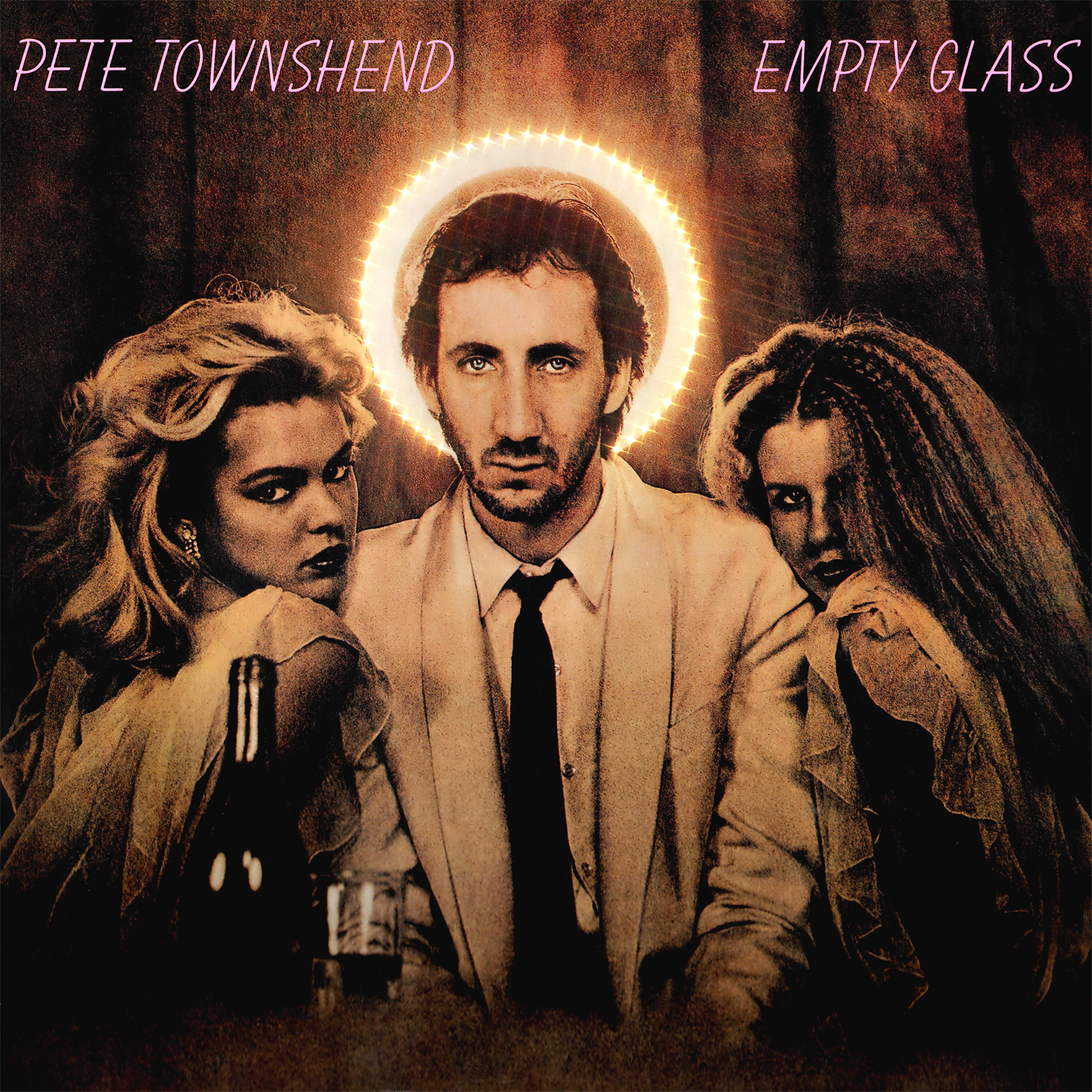
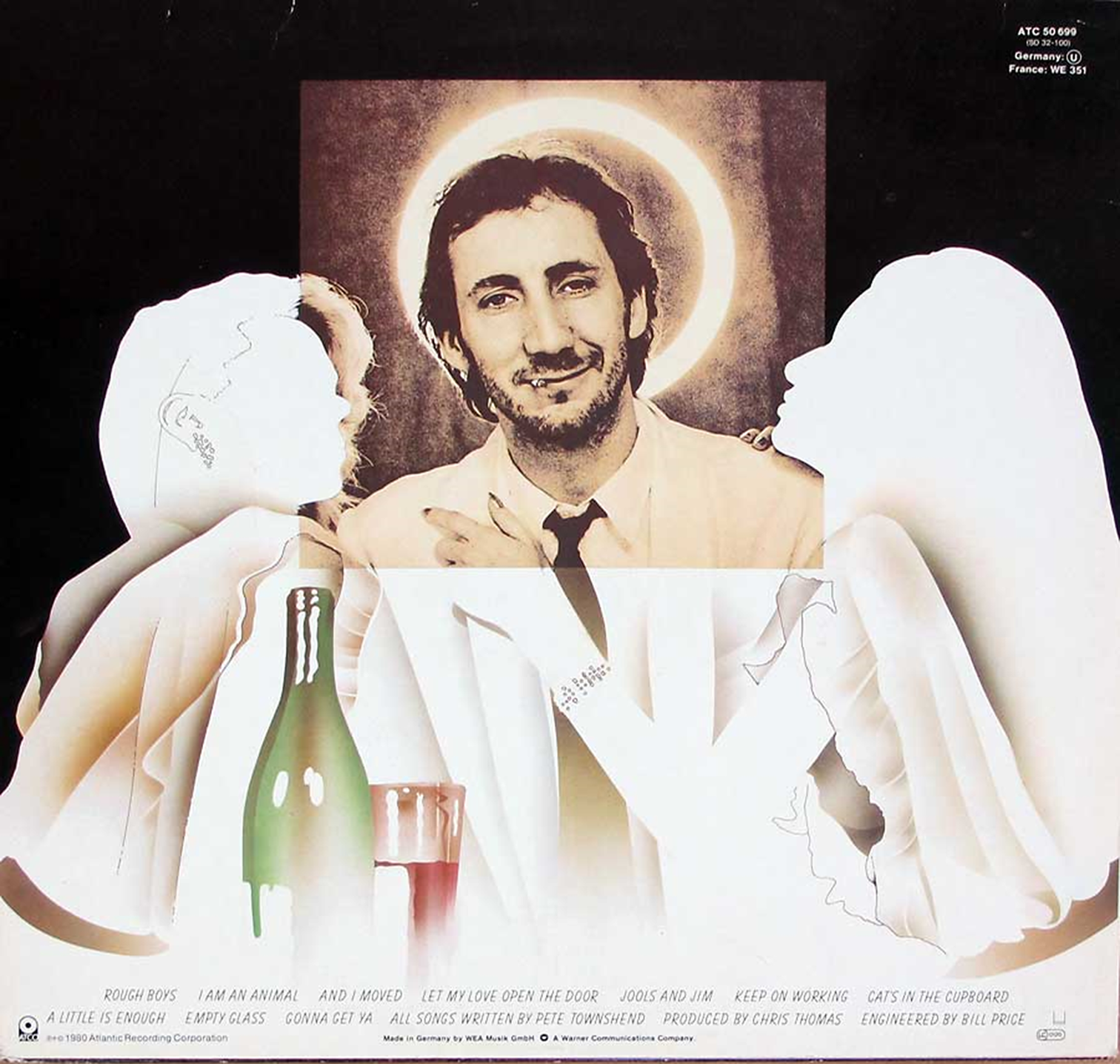
With Tommy’s momentum, Pete Townshend lived some years full of faith—both religious and with the aim to change the world. Possibly it was the period of his life of the greatest plenitude, within the frame of an exceptional era in the history of Western popular music. However, tough times were coming. Quadrophenia was followed by a profound crisis that erupted towards the end of the decade and materialised in Empty Glass (1980), an album that somehow sealed his secularisation and farewell to mysticism. The nimbus and deep look on the cover bring him close to the standard image of Jesus Christ, but instead of Apostles and the chalice, two sensual girls and a bottle accompany him, a provocative combination (Figure 4). The back cover looks like a de-sacralising continuation, with Townshend now smoking, showing a sideways smirk, facing an appealing wine, and enjoying the company (the girls are close to kissing him, Figure 5). The gloomy colours have turned light, and he seemingly declares that life’s pleasures should no longer be sinful.
Front cover of Empty Glass. Second solo studio album by P. Townshend. Atco Records, 1980. Cover artwork designed by Bob Carlos Clarke.

Back cover of Empty Glass. Second solo studio album by P. Townshend. Atco Records, 1980. Cover artwork designed by Bob Carlos Clarke.

Figure 5. Long description
At the center upper region is a sepia-toned square photograph of a man in a suit and tie, with a glowing halo ring behind his head. His face is obscured. Extending from the left and right sides are stylized white silhouettes of two women facing inward toward the man, rendered with minimal facial detail and faint linework. The left silhouette overlaps a green wine bottle and a red glass, both semi-transparent and positioned at the lower left. The right silhouette's arm extends downward, with a bracelet visible. Along the bottom edge, white text lists the album tracks from left to right: Rough Boys, I Am an Animal, And I Moved, Let My Love Open the Door, Jools and Jim, Keep On Working, Cat's in the Cupboard, A Little Is Enough, Empty Glass, Gonna Get Ya. Additional credits and copyright information are printed in small text at the lower right and left corners.
Empty Glass was received as a religious record: ‘[it] isn’t just an album with vaguely religious connotations. It’s as consciously spiritual as any rock & roll record ever made’ (Marsh Reference Marsh1980, p. 72). Among its songs, ‘Let My Love Open the Door’ was another encrypted piece; it did not mean a girl’s love, but divine love. ‘Empty Glass’—the album’s title track—was based on Ecclesiastes, though it ended up advising not to worry but smile and dance, avoid down moods, take the wine, and shout; this philosophy probably stemmed from the sceptical and epicurean metamorphosis the musician was experiencing. The rest of the pieces were introspective and obscure, yet far removed from religion, perhaps except for ‘A Little Is Enough’. Therefore, the emotional bias was different compared to the hopeful faith of previous years. Additionally, the nascent punk generation probably made him feel old: the opening song—‘Rough Boys’—makes fun of them.
Townshend had lost the battle of his dreams: ‘I couldn’t handle what I’d asked for. So I’ve decided now I’m not a soldier for God. I’m a servant as much’ (qtd. in Giuliano Reference Giuliano1996, p. 220). For the first time in his life, he put the master under question: ‘I can’t say I’m a better person because of him [Baba] or otherwise’ (Ibid, p. 219). This reorientation of his existence is what Clarke’s back cover design may reflect, involving an embrace of the mundane world, and Townshend absolutely embraced it. With Empty Glass he detached from the Who, consolidated as an individual musician, found a new identity, and the imperative need for a god-guide gave way. Family friend Kathy Browning considered that ‘he became disillusioned … he realised he had to find what he was looking for within himself, not an avatar or icon’ (qtd. in Ibidem). Maybe tiredness was an additional reason since long ago; only in 1965 the Who played 236 live shows (Daltrey Reference Daltrey2018, p. 99). The fact is that Townshend composed eighteen ‘Baba inspired songs’, mostly from the late 1960s and early 1970s, but only two after 1980 (Pratt and Cady).
The metamorphosis had started years before, when he gradually sank into loneliness, self-inflicted damage, and creative crisis. In 1973, while rehearsing, Townshend and Daltrey hit each other, and the former bore the brunt of it. In the 14 June 1974 gig at Madison Square Garden ‘Pete smashed three Gibson Les Paul Deluxes, perhaps demonstrating the heights his frustrations had reached’ (Wilkerson Reference Wilkerson2006, p. 233). Note the harsh and insulting tone of his comments in 1975:
I got fed up with being lectured, and I got fed with people telling me what rock and roll was all about, and what rock musicians were supposed to do now … So fuck off the lot of you. And I take great pleasure in saying it now. (Qtd. in Ibid, p. 178)
The abysmal contrast between Townshend’s whirlwind life and spiritual idealism was becoming unbearable. The passing of Keith Moon in 1978 by overdose, followed by the death of eleven fans on 3 December 1979 trying to get into a Who concert at Cincinnati’s Riverfront Coliseum, must have hit him hard. Kit Lambert also died in 1981. In 1988 Townshend wrote in his dairy: ‘The Who have their collective karma: Cincinnati, Keith, and Kit. Do we really have the right to celebrate a 25th anniversary?’ (Townshend Reference Townshend2012, p. 330). Nonetheless, his first outward reaction to the youths’ tragedy was extremely bitter: ‘It was, fuck it! We’re not gonna let a little thing like this stop us. … we don’t fuck around, worrying about eleven people dying’ (qtd. in Marcus Reference Marcus1980, p. 38. Emphasis original).Footnote 15 Instead, Daltrey expressed sincere devastation, and joined the families of the dead youngsters, naming God for the first and only time in his memoir:
I’m agnostic, bordering on atheist. The whole God thing seems to me to have caused most of humanity’s problems. But in that bleak winter, it would have been nice to have had someone else to have talked to, to pretend there was some divine plan and that what happened in Cincinnati was a part of it (Reference Daltrey2018, p. 270).
Townshend was aware of having released the burden of apostolate: ‘now, to be quite frank, I don’t give a shit. I just want to be happy and enjoy the people around me and try to enjoy life’, he declared in 1980 (qtd. in Wilkerson Reference Wilkerson2006, p. 297). That year he tried cocaine in Los Angeles and soon became addicted. He drank ‘about a bottle and a half of cognac a day’, falling into a ‘deadly alcohol cocaine oscillation’, as he admitted in 1982 (Ibid, p. 321). The family estrangement from Karen (his wife) and his daughters reached an extreme, and his physical degradation increased. After the performance at the baseball stadium in Miami, on 9 August 1976, Chris Charlesworth described him dramatically: ‘exhausted, slumped in a corner, his fingers shredded and covered in blood, his skinny, loose-limbed body wrapped in a towel, he knocked back a huge plastic beaker of brandy in one gulp’ (qtd. in Ibid, p. 252). He had car accidents, blows on his arms and wrists, fingers shattered by the windmill, and his deafness grew. In November 1981 he entered a clinic for alcoholics but continued with drugs (he had become addicted on heroin too). Bill Curbishley—the Who manager after Lambert—realised then ‘Pete’s near-death condition’ (qtd. in Ibid, p. 347). In those years of self-immolation he might be compared to mediaeval flagellants given to self-punishment and penance, overwhelmed by the awareness of eternal damnation. Perhaps these concerns were on his mind when he composed ‘Give Blood’, with David Gilmour (White City: A Novel, 1985), which warns of doomsday, when the sins shall be redeemed with fire, a cruel threat that Christian education instilled in children.
The crisis had far-reaching repercussions. In 1983 Townshend announced that he would no longer perform live or record an album with the Who. In 1994 he confirmed the downfall of his ideals; nevertheless, he blamed not Baba but himself:
I set off on two pathways (in my life) … One was the ideological pathway of rock’n’roll. We were going to change the world. We didn’t. The second was a spiritual pathway. I thought I was going to grow spiritually by following an Indian master and meditating and being a good boy. And I didn’t. (Qtd. in Wilkerson Reference Wilkerson2006, p. 455)
Hunting martians
Pete Townshend moved away from mysticism but turned to science fiction, especially the game Space Invaders, which caused him a feverish addiction. Amazingly, on the 1979 American tour: ‘we nearly missed every flight that took off from an airport that had one [machine] in the coffee shop … He even got Yellow Pages and rung around all the bars to discover if any had one’, Richard Barnes recalled. Townshend was given a Space Invaders machine later during the tour (Wilkerson Reference Wilkerson2006, pp. 302–3).Footnote 16 It may seem too twisted to look for spiritual connotations in an innocent video game, but there may be. According to Grigg (Reference Grigg2018) nineteenth-century technology provoked the secularisation of the world, but now it can re-enchant it, fulfilling with science fiction the human nostalgia for a sacred emotion that can no longer be experienced in the secular age. In the words of Wildt: ‘God may be “dead”, but not in videogames’ (Reference Wildt2023, p. 98). Once more the enigma of identity emerges: ‘the celebration of identity is the fundamental, critical, absolute core point of virtual worlds … everything that players do ultimately concerns the development of their own identity’ (Bartle Reference Bartle2003, p. 159). If this postulate can be straightforwardly applied to Townshend, he was still tangled up in his permanent problem, and the break with his spiritual years did not affect it essentially. The Iron Man (his fourth solo album, 1989) was an adaptation of the homonymous fantasy story by Ted Hughes. The plot revolves around a metal giant and the invasion of a fearsome space dragon, but as the composer confessed: ‘what is at the center of Iron Man is a little boy who is isolated and afraid. It’s the Tommy story, it’s the Quadrophenia story, it’s my story’ (qtd. in Wilkerson Reference Wilkerson2006, p. 411).
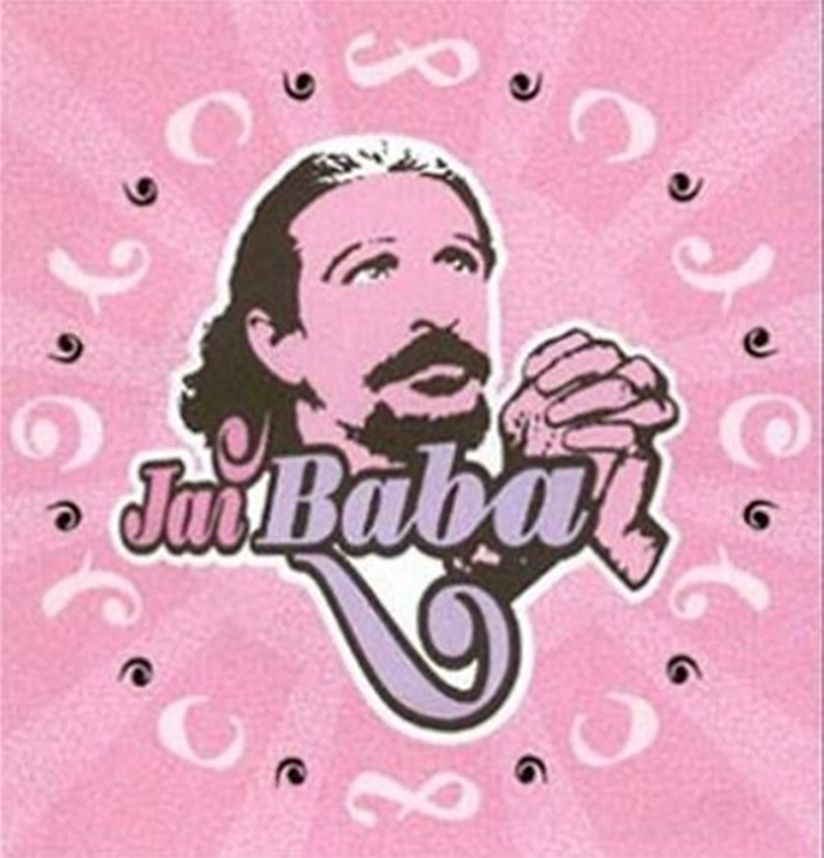
After the years of deep crisis, Townshend recovered certain stability in his life and beliefs. In 2001 he released Jai Baba (see above) whose front cover admiringly shows the master praying (Figure 6). In the closing ceremony of the London 2012 Summer Olympics, the Who started their brief participation with ‘Baba O’Riley’, which suggests that in the twenty-first century Townshend remains engaged with Baba and religion. Although he shows sporadic doubts—as when he claimed in 2013 that ‘sometimes I am unsure of the sanity of believing that Meher Baba is God in human form’ (Pratt and Cady)—he has never abandoned his nuclear faith. His creativity declined, but this is a widespread phenomenon in rock celebrities as they age (opposite to the evolution of most classical composers). It appears that Townshend will continue for the rest of his life rockin’ the Lord.
Front cover of Jai Baba. P. Townshend double CD compilation, 2001. Public domain.

Conclusions
The most outstanding religious feature of Pete Townshend is that he gathers in his person virtually all the possible ones: both inner (for himself) and outer (for the fans), conscious (as the devotion to Christ and Baba) and unconscious (his rituals on stage), mixing elements of conventional religions, neo-pagan cults and even escapist fictions, with explicit allusions and by subtle/hidden means, generating fictional characters who personify his own existentialism (like Tommy and Jimmy), and re-enchanting reality through his music. He is a completely religious being, and without religion he would have never been the same, nor would the Who. However, the ultimate nature of this overwhelming spirituality might lie in the search for identity, as possibly it was his personal disorientation and shyness that pushed him to the described processes. The context of post-war British society played an important role for him and his diehard fans, who directly or indirectly shared his concerns and projected them back onto him in a dialogic interaction that resembles that between high priest and faithful. The outcome was a complex set of intersections between religion, identity search, and popular music, in which neuroscience, sociology, and cultural anthropology can provide relevant causal explanations.
Townshend de-officialised Christendom, building a bridge to counterculture in the figure of a transmediated Jesus/Baba grounded in rock-biblical language. The combination of music and religion worked perfectly, as he composed and performed a paradigmatic repertoire that stands out among the best years of rock, and he did it in his own particular way, achieving a great popular echo. In fact, the charisma Tommy (especially) and Jimmy emanate is unique in the history of popular music, probably above any other fictional character created by rockers. By these means, Townshend bequeathed to the new generations a literary-musical model for conveying transcendent meanings, thereby contesting secularisation in the transition from traditional religion to a renewing cultural spirituality. At a personal level, despite his turbulent biography and permanent crises, he has always remained loyal to his religious principles. Perhaps this perseverance, together with the musical vocation, encloses the response to his eternal question: Who are you?
Acknowledgements
I am grateful to both Neil Zlozower (Atlas Icons) and Heritage Auctions (HA.com) for their respective photographs and permissions. Special thanks to Dr. Tom Kitts (St. John’s University) for his advice on the always thorny issue of quoting lyrics, and to Paloma Rey Hernando (Biblioteca Central, UAM), who made it possible to locate certain elusive bibliography. The anonymous reviewers of Popular Music helped clarify several details of the article and provided interesting insights.
Conflict of interests
The author reports there are no competing interests to declare.