


1 Introduction
The analysis of alternations in Optimality Theory (OT; McCarthy & Prince Reference McCarthy, Alan, Beckman, Dickey and Urbanczyk1995, Prince & Smolensky Reference Prince and Smolensky2004) typically assumes either positional markedness or positional faithfulness. Positional markedness posits constraints that prohibit the occurrence of certain properties in a designated part of the string. A typical example is the Coda Condition (Itô Reference Itô1986, Reference Itô1989), which may appear in a number of different guises. For instance, it may bar a consonant in the coda from having place features of its own, with the consequence that such a consonant must draw place features from the consonant in the onset of the following syllable (coda-to-onset assimilation). Thus, in nasal assimilation, the candidate [an.ka] from the hypothetical input /anka/ violates CodaCond[Place], because [n] is in the coda and has retained its place feature [coronal]. This candidate loses to the candidate [aŋ.ka], which has obtained [dorsal] from [k], which is not in the coda.
The same result can be achieved by invoking positional faithfulness, which designates privileged positions in a word and mandates faithful mapping of input structure in these positions.Footnote 1 For instance, if place features of the onset consonant are protected by an Ident constraint (onset faithfulness), then, as noted by Beckman (Reference Beckman1999), coda-to-onset nasal assimilation is enforced by feature-markedness constraints militating against the occurrence of features in the output, for example *Labial (don't be labial), *Coronal (don't be coronal) and *Dorsal (don't be dorsal). Then, given the candidate set [an.ka] and [aŋ.ka] from the input /anka/, the feature-markedness constraints select [aŋ.ka] as optimal. The reason is that [aŋ.ka] violates only one feature-markedness constraint, *Dorsal, while [an.ka] violates both *Dorsal and *Coronal, for [k] and [n] respectively. A third candidate, [an.ta], where /k/ has assimilated to [n], is comparable to [aŋ.ka], because it exhibits only one place feature, [coronal]. This candidate is eliminated by onset faithfulness, specifically by Ident([Place]ons), which mandates the preservation of the input [Place] feature in the segment that is in the onset in the output string. In the instance at hand, [an.ta] from /anka/ violates Ident([Place]ons) because the input /k/ has been mapped to [t] in the output. This mapping is unfaithful, as the [dorsal] of /k/ is not preserved in the output [t], because [t] is [coronal] (I return to nasal assimilation in §4).
According to some researchers, positional markedness and positional faithfulness need not be mutually exclusive. For example, Lombardi (Reference Lombardi and Lombardi2001) claims that both of these approaches must be used, the choice being dependent on the type of process that is analysed. This claim has been challenged by Beckman (Reference Beckman2004), who demonstrates that Lombardi's evidence for positional markedness yields to reanalysis in terms of positional faithfulness.
In the generative paradigm, positional faithfulness has its roots in Lombardi's early work on voicing contrasts, in which she assumes a constraint that licenses the privative feature [voice] on an obstruent in the presonorant position in the onset (Lombardi Reference Lombardi1991). Subsequent work in OT has decoupled licensing in the onset (Beckman Reference Beckman1997, Reference Beckman1999, Casali Reference Casali1997) from licensing in the presonorant position (Steriade Reference Steriade1997, Blevins Reference Blevins, Féry and Vijver2003, Petrova Reference Petrova, Browne, Kim, Partee and Rothstein2003, Petrova et al. Reference Petrova, Plapp, Ringen and Szentgyörgyi2006).Footnote 2
Licensing in the onset makes a claim that positional faithfulness is prosody-based because it refers to syllable structure in a crucial way. Licensing before a sonorant is string-based, because it claims that positional faithfulness is entirely independent of syllable structure and is defined with reference to the sequence of segments in a string. According to Steriade (Reference Steriade1997), this view is supported by generalisations regarding the perception of speech. Steriade's observation is that some contexts promote phonological contrasts while others obliterate them. The former are the contexts with a richness of phonetic cues, which facilitates perception. The latter show a deficit of cues and are a natural locus for the neutralisation of contrasts. In other words, the preservation vs. the loss of contrast is directly related to the occurrence of perceptual cues (the licensing-by-cue theory). Particularly salient because of the richness of cues is the context before a sonorant, so this context is the locus of presonorant faithfulness.Footnote 3
The empirical material discussed in this article is drawn from several different languages, but Polish, Ukrainian and Bulgarian play the most important roles. To facilitate subsequent discussion, I will clarify the relevant syllabification patterns in these languages, which have been established on the basis of the existing literature and my own fieldwork.
Polish syllabification is discussed in detail in Rubach & Booij (Reference Rubach and Booij1990a, Reference Rubach and Booijb), which serve as the sources for the basic generalisations. The most important observation is that Polish maximises onsets, so the default syllabification of VCCV is V.CCV.Footnote 4 Ukrainian follows the same pattern (Bilodid Reference Bilodid1969, and my fieldwork with a group of 15 native speakers from western Ukraine; see the acknowledgements). Onset maximisation is systematically not observed when sonority violations involving sonorants would ensue. Thus, the words warta ‘guard’ and bomba ‘bomb’, which are the same in Polish and Ukrainian, are syllabified uniquely as war.ta and bom.ba. In contrast, sonority violations involving obstruents are totally disregarded and do not block onset maximisation, so a word such as pasta ‘paste’ is syllabified pa.sta.
Bulgarian syllabification is based on Tilkov (Reference Tilkov1982) and native speaker intuitions elicited from four speakers (see the acknowledgements), who showed perfect consistency in their judgements. Bulgarian does not maximise onsets, so VCCV is syllabified VC.CV. This is shown by the data in (2) below. I should add that Tilkov (Reference Tilkov1982) permits the V.CCV pattern in clusters of obstruents and liquids, as in obraz ‘picture’, which he syllabifies as o.braz. My native speakers challenge this syllabification and insist on ob.raz. In the case of obstruent clusters, both Tilkov (Reference Tilkov1982) and my native speakers agree that VC.CV is the only admissible pattern, so iskane ‘request’ is syllabified uniquely as is.ka.ne. Similarly, ličba ‘likeliness’ and prosba ‘request’ in (2) below are syllabified lič.ba and pros.ba.
In this article, I explore the idea that prevocalic context is a privileged position which motivates its own positional faithfulness. Even though prevocalic faithfulness could be treated as an expansion of presonorant faithfulness, it has an independent status, a claim that I put forward in §§3 and 4. I begin the presentation by introducing the concept of positional faithfulness with regard to onsets and presonorant/prevocalic contexts in §2. In §5, I consider typological predictions of prevocalic faithfulness and address the question of whether prevocalic faithfulness can eliminate onset faithfulness. A further question is whether positional markedness can be abandoned. §6 considers voicing contrasts in Belarus, which are relevant in the sense that they do not yield to reanalysis in terms of either onset faithfulness or positional markedness. The discussion of presonorant faithfulness and prevocalic faithfulness reveals that, counter to the assumptions of the string-based theory, both types of faithfulness exhibit prosodic conditioning, but the conditioning is more subtle than assumed by onset faithfulness. §7 is a summary of the most important conclusions.
2 Presonorant faithfulness
The goal of this section is to show that onset faithfulness is unable to account for the attested facts in a fragment of a voice assimilation grammar of Polish, and must therefore be supplemented or replaced by presonorant faithfulness. I assume the following constraints.
(1)

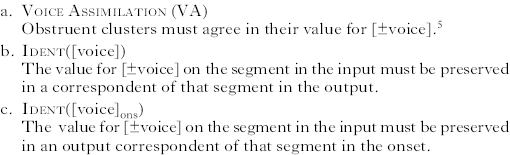
Ident([voice]ons) is successful in accounting for the facts of voice assimilation in Bulgarian, exemplified in (2).Footnote 6
(2)
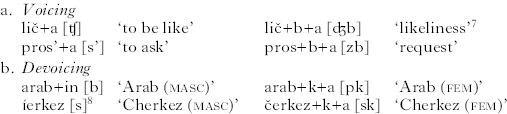
Since Bulgarian syllabifies VCCV as VC.CV, the consonant governing voice assimilation in (2) is in the onset while the consonant that undergoes voice assimilation is in the coda. The direction of assimilation is correctly predicted by Ident([voice]ons). This is illustrated in (3), where I consider lič+b+a /liʧ+b+a/ ‘likeliness’ (3a) and čerkez+k+a /ʧεrkεz+k+a/ ‘Cherkez (fem)’. Syllabification constraints (not shown in (3)) derive the attested CVC.CV pattern.
(3)

Using onset faithfulness to delegate the decision regarding the direction of assimilation to the consonant in the onset does not take into account the possibility that two obstruents with different values for [±voice] in the input may form a cluster contained wholly in the onset of the output representation. If this happens in a language such as Polish, in which voice assimilation in obstruent clusters is exceptionless, onset faithfulness is unable to offer the correct analysis. The problem is that Ident([voice]ons) coupled with VA is satisfied in equal measure by both of the following two conflicting candidates: a candidate with a uniformly voiced cluster and a candidate with a uniformly voiceless cluster. Yet only one of these candidates is the correct output. The Polish data in (4) show that the attested output can contain obstruents that are both voiced (4a) and voiceless (4b).
(4)
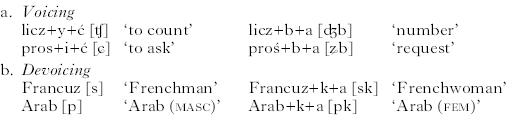
As (3) and (4) show, the voice assimilation facts in Bulgarian and Polish are exactly the same. However, the syllabification facts are different: Polish maximises onsets while Bulgarian does not. That is, VCCV is syllabified V.CCV in PolishFootnote 9 and VC.CV in Bulgarian. This difference is detrimental to the success of Ident([voice]ons), which fails to provide the correct analysis for Polish.
Given onset maximisation, the entire obstruent cluster in /frantsuz+k+a/ ‘Frenchwoman’ is contained in the onset, and therefore comes under the protection of Ident([voice]ons). The prediction then is that the candidate which is fully faithful is the winner, the wrong result.Footnote 10 This failure of Ident([voice]ons) is exemplified in (5).
(5)
The re-ranking of VA above Ident([voice]ons) would eliminate [fran.tsu.zka], but this is of little help. The problem is that Ident([voice]ons) cannot discriminate between the candidates [fran.tsu.ska] and [fran.tsu.zga], because in each case the whole cluster is in the onset, and VA is satisfied since there is no disagreement in [±voice].Footnote 11 Yet only one pattern is correct: /frantsuz+k+a/→[fran.tsu.ska]. Notice that there is no way of repairing the evaluation by bringing in root faithfulness (McCarthy & Prince Reference McCarthy, Alan, Beckman, Dickey and Urbanczyk1995), specifically, Ident([voice]rt). In fact, by activating this constraint we would achieve the opposite of the desired result: Ident([voice]rt) would favour candidate (5c), while it is candidate (5a) that is the correct surface form.
Exactly the same difficulty arises in the analysis of /liʧ+b+a/→[l'i.ʤba] in (4a): Ident([voice]ons) cannot discriminate between the candidates [l'i.ʤba] and [l'i.ʧpa] and Ident([voice]rt) gives the wrong output as the winner: *[l'i.ʧpa], rather than the actually attested [l'i.ʤba].
The failure of Ident([voice]ons) is documented further by the alternations in (6). The alternation between e and zero here as well as in (26) below is the celebrated pattern of yer deletion and vocalisation (see Rubach Reference Rubach1984, Reference Rubach1986 for an analysis).
(6)

The situation is parallel to that analysed in (5). The onset contains two obstruents that disagree in voicing after the vowel has been deleted: /dxu/ and /vʃɨ/, and Ident([voice]ons) is unable to discriminate between the candidates [txu] and [dɣu] as well as between [fʃɨ] and [vʒɨ], yet only [txu] and [fʃɨ] are attested outputs.
I conclude that onset faithfulness is not the appropriate mechanism for the analysis of voice assimilation in Polish. Yet the generalisation is clear: the decision as to whether the clusters in (4) and (6) surface as voiced or voiceless lies with the obstruent that precedes the vowel. Inspection of further data shows that the direction of assimilation is also governed by obstruents before sonorant consonants, as in czas drogi ‘the time of the journey’: [z dr], not *[s tr]. In sum, the generalisation is that the obstruent determining the direction of voice assimilation is the one occurring before a sonorant, regardless of whether the sonorant is a vowel or a consonant. As noted earlier, this observation has already been made in the literature,Footnote 12 but there is disagreement as to whether the obstruent occurring in the presonorant position should be in the onset (Lombardi Reference Lombardi1999) or whether the restriction to onsets should be abandoned (Blevins Reference Blevins, Féry and Vijver2003, Petrova Reference Petrova, Browne, Kim, Partee and Rothstein2003, Petrova et al. Reference Petrova, Plapp, Ringen and Szentgyörgyi2006). The argument for the latter view is that obstruents maintain voicing not only in the onset but also in the coda, as long as the following segment is a sonorant. For instance, Polish has voiced [z] in the prefix bez of bez+alkohol+ow+y [bεz.al.kɔ.xɔ.lɔ.vɨ] ‘non-alcoholic’ (Rubach & Booij Reference Rubach and Booij1990b) and Russian has [z] in raz+lit' ‘spill’, which is syllabified [raz.l'it'] (Petrova et al. Reference Petrova, Plapp, Ringen and Szentgyörgyi2006).Footnote 13 Similarly, as noted by Rubach (Reference Rubach1997a), Slovak, which has final devoicing, contrasts voiced and voiceless obstruents in presonorant codas: vodný [vɔd.niː] ‘water (adj)’ vs. zvratný [zvrat.niː] ‘reflexive’. Such contrasts cannot be accounted for by Ident([voice]ons), but they present no problem to an analysis that uses presonorant faithfulness. I conclude that Ident([voice]ons) should be replaced by Ident([voice]preson).
(7)

Ident([voice]preson) accounts not only for the facts of Bulgarian in (3), but also for the facts of Polish in (4) and (6). This is shown in tableau (8), which evaluates Francuz+k+a.
(8)
The associate editor raises the question of the behaviour of extrasyllabic sonorants vis-à-vis presonorant faithfulness. This is an important issue, as the following discussion shows.
The role of extrasyllabic consonants in voice assimilation has been studied for Polish by Rubach & Booij (Reference Rubach and Booij1990a, Reference Rubach and Booijb) and Rubach (Reference Rubach1996, Reference Rubach1997a, Reference Rubach and Booijb) and for Russian by Halle (Reference Halle1959), Jakobson (Reference Jakobson and Jakobson1962), Hayes (Reference Hayes, Aronoff and Oehrle1984), Kiparsky (Reference Kiparsky1985), Lombardi (Reference Lombardi1991) and Petrova (Reference Petrova, Browne, Kim, Partee and Rothstein2003), among others. The relevant alternations in Polish are shown in (9).
(9)
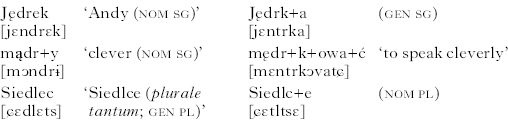
The pattern is clear. The syllabified sonorants in the words on the left in (9) protect the preceding obstruent from devoicing: [jεndrεk], [mɔndrɨ], [ɕεdlεts]. This is an expected effect of Ident([voice]preson). Unexpected is the behaviour of the same sonorants in the forms on the right in (9), because the obstruents devoice, so the sonorant must have withdrawn its protection. The key to the dilemma is the syllable structure of the forms on the right in (9).
In their study of Polish syllable structure, Rubach & Booij (Reference Rubach and Booij1990a, Reference Rubach and Booijb) establish that a sonorant trapped between two consonants in words such as those in (9) remains unsyllabified, because it cannot be syllabified in either the onset or the coda without violating the permissible sonority relations in syllable margins. Thus, for Jędrka, both [jεntr.ka] and [jεnt.rka] yield ill-formed syllables. When asked to divide such words into syllables, native speakers are confused and cannot decide which syllabification is correct. Rubach & Booij (Reference Rubach and Booij1990b) conclude that r remains extrasyllabic, so the syllabification of Jędrka is (jεnt)σr(ka)σ.Footnote 14 A further generalisation is that extrasyllabic consonants are transparent, i.e. invisible to voice assimilation. In effect, then, the /d/ and the /k/ are adjacent segments in Jędrka. Voice assimilation applies, yielding [jεntrka] (see Rubach Reference Rubach1996, Reference Rubach1997a, Reference Rubach and Rocab for the details of this analysis).
From the perspective of presonorant faithfulness, this analysis means that extrasyllabic consonants cannot act as licensors. In other words, presonorant faithfulness is activated only if the sonorant is syllabified (Rubach Reference Rubach1997a, Reference Rubach and Rocab, Petrova Reference Petrova, Browne, Kim, Partee and Rothstein2003).
The data in (9) appear to provide evidence for yet another different analysis, one that does not rely on presonorant faithfulness. Observe that the /d/ which undergoes devoicing is in the coda: (jεnd)σr(ka)σ→(jεnt)σr(ka)σ. It seems that the desired result can be delivered by onset faithfulness. Specifically, Ident([voice]ons) protects obstruents in the onset, so the nominative singular form Jędrek [jεndrεk] is not at risk of undergoing devoicing. In contrast, the genitive singular Jędrka (jεnd)σr(ka)σ has d in the coda, and is hence outside the jurisdiction of Ident([voice]ons). The feature-markedness constraint *[+voice], prohibiting voiced obstruents, selects (jεnt)σr(ka)σ, the correct result.
(10)
The success of this analysis is short-lived. The data in (11) show that coda obstruents do not devoice. These data are entirely parallel to those in (9), because they have an extrasyllabic sonorant.Footnote 15
(11)

Ident([voice]ons) and Ident([voice]preson) make different predictions for the data in (11). The former predicts devoicing, the wrong result, because the obstruent is not in the onset. The latter predicts that the obstruent must retain its voicing, the correct result, because it is in the presonorant position. The licensing sonorant here is [n], because [r] is extrasyllabic, exactly as in (9).
A different argument for restricting the class of licensors to syllabified sonorants can be derived from a comparison of final devoicing in Polish and Russian, as well as from the behaviour of word-initial sonority violators in Polish. I begin with a comparison of Polish and Russian.
Both Polish (12a) and Russian (12b) exhibit final devoicing, but Polish ignores extrasyllabic consonants (12c). This is not true in Russian (12d), which retains voiced obstruents before final sonorants (e.g. Jakobson Reference Jakobson and Jakobson1962, Petrova Reference Petrova, Browne, Kim, Partee and Rothstein2003).
(12)

We can observe that word-final sonority violators are transparent to final devoicing in Polish, but not in Russian. This behaviour also holds for voice assimilation, which applies in both languages (13a, b), showing that the transparency effects are true only for Polish (13c) and not for Russian (13d).
(13)

The observation that syllabified sonorants do not count as licensors for presonorant faithfulness, but extrasyllabic sonorants do, provides an analytical tool for a straightforward characterisation of the difference between Polish and Russian. In Polish, sonority-violating sonorants are extrasyllabic, and hence invisible to presonorant faithfulness. In Russian, they are syllabified into the coda and hence count as licensors (see Petrova Reference Petrova, Browne, Kim, Partee and Rothstein2003). As a consequence of this fact, final devoicing yields different results in Polish and Russian in the analysis of the word meaning ‘bison’.
(14)
A different way of looking at the facts of Polish and Russian is to undermine the logic of the argument that presonorant faithfulness is sensitive to the sonorant being syllabified. It would be unreasonable to assume that the whole analysis is on the wrong track, because the data in (9), (11), (12) and (13) could not then be accounted for, but the following, less radical, assumption appears to be possible: whether an extrasyllabic sonorant is a licensor for presonorant faithfulness is a matter of how the parameter for the visibility of extrasyllabic consonants is set in a given language. In this view, the difference between Polish and Russian is reduced to a difference in parameter setting: extrasyllabic consonants are invisible in Polish, but visible in Russian.Footnote 18 Inspection of further data from Polish shows that this view is false.
In contrast to word-final and word-medial extrasyllabic sonorants, word-initial sonority violators are not transparent to voice assimilation. In (15), I compare near-minimal pairs, where (15a) and (15b) are different in that sonority violators are found in (15a), but not in (15b). Voice assimilation applies in (15b), but not in (15a).
(15)

In the face of such facts, Rubach (Reference Rubach1997a) concludes that word-initial sonority-violating consonants are syllabified by adjunction to the onset. This conclusion fits the logic of presonorant faithfulness: if the [r] of rdzy and the [m] of mżawki in (15a) are syllabified, they protect the preceding obstruent from voice assimilation through the action of Ident([voice]preson). This protection does not extend to the phrases in (15b), because the consonant that follows k is an obstruent. The result is that /k/ is voiced to [g], an effect of voice assimilation.
In sum, Polish exhibits both types of behaviour with respect to sonority-violating sonorants: first, transparency in word-internal and word-final positions, and second, opacity in word-initial position. This dual behaviour makes untenable the assumption that the visibility vs. the invisibility of extrasyllabic sonorants for presonorant faithfulness can be set individually for a given language. Interestingly, the same conclusion emerges from a more detailed analysis of Russian than given so far.
Halle (Reference Halle1959), Jakobson (Reference Jakobson and Jakobson1962), Hayes (Reference Hayes, Aronoff and Oehrle1984), Kiparsky (Reference Kiparsky1985) and Petrova (Reference Petrova, Browne, Kim, Partee and Rothstein2003) point out that word-initial extrasyllabic sonorants are transparent to voice assimilation, the exact mirror image of Polish. This is exemplified by the prepositions iz /iz/ ‘out of’ and ot /ɔt/ ‘from’, which assimilate to the obstruent across an extrasyllabic sonorant in (16). The examples are from Petrova (Reference Petrova, Browne, Kim, Partee and Rothstein2003).
(16)

Word-initial sonority-violating sonorants can be analysed as extrasyllabic, in contrast to the word-final sonority violating sonorants, which are syllabified.
I conclude that both Polish and Russian provide evidence against a parametric analysis of the visibility vs. the invisibility of sonority violators with regard to presonorant faithfulness. The overall conclusion is that presonorant faithfulness requires that the sonorant be syllabified. However, it does not matter whether the licensing sonorant is in the nucleus, in the onset or in the coda. It is only in this sense that sonorant faithfulness is blind to syllable structure.
In the following sections, I discuss further the question of whether presonorant faithfulness should replace onset faithfulness. I focus on the prevocalic context and argue that it constitutes a privileged position, providing motivation for prevocalic faithfulness.
§3 shows that neither onset faithfulness nor presonorant faithfulness can provide an adequate framework for an analysis of labial depalatalisation in Polish. I conclude that we need prevocalic faithfulness. §4 develops this idea further, and shows that prevocalic faithfulness must build on syllable structure, but the relation between faithfulness and syllable structure is much more subtle than assumed by onset faithfulness.
3 Labial depalatalisation in Polish
Polish exhibits a contrast between hard (velarised) and soft (palatalised) consonants (Wierzchowska Reference Wierzchowska1963, Reference Wierzchowska1971), a distinction that affects the entire consonantal system, including labials. Examples of contrast are given in (17). In the case of coronals, palatalisation is accompanied by a change of place of articulation, with stops becoming affricates. Standard Polish decomposes palatalised labials into labial+[j] clusters. This complication is not true of eastern Polish or of Vilnius Polish, a dialect spoken in Lithuania (Turska Reference Turska, Rieger and Werenicz1983). In these dialects, palatalised labials show a classic secondary articulation effect, surfacing as [p' b' f' v' m']. In what follows, I will use data from eastern Polish.
The data in (17) document the fact that palatalisation is contrastive in Polish.
(17)

The palatalised consonants in (17) all come from the underlying representation, because they appear before back vowels or at the end of the word, where they could not be derived from hard consonants by a palatalisation process.
In the context of i, labials are always palatalised, giving evidence for productive palatalisation in modern Polish.
(18)
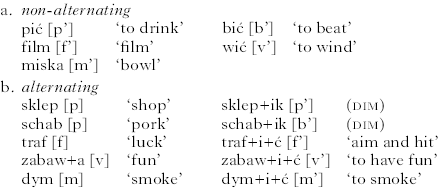
The significance of the distinction between hard and soft consonants is documented further by the fact that Polish morphology has different declension patterns for hard and soft stems, including labials. Some examples are cited in (19).
(19)

Soft labials lose their palatalisation word-finally. In (20), the occurrence of a soft labial before a back vowel shows that the labial must be palatalised in the underlying representation. Its palatalisation is lost in the declension cases that do not have a vowel ending.
(20)

Furthermore, soft labials lose their palatalisation before consonant clusters which force the labial into the coda.
(21)
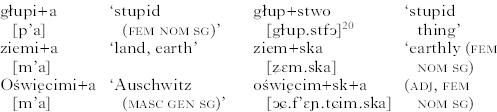
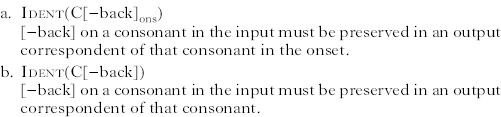
Given the data in (20) and (21), the analytical strategy of positional faithfulness is clear. Since soft labials occur in onsets but not in codas, they fall under the jurisdiction of an Ident constraint that is relativised to onsets. The constraint need not specifically mention palatalised labials, because other consonants also retain their palatalisation in onsets. We thus arrive at the onset-faithfulness constraint in (22a), whose generic equivalent is the constraint in (22b).
(22)
Depalatalisation of soft labials is enforced by a segment-inventory constraint that bans soft labials.
(23)
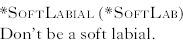
The ranking Ident(C[−back]ons)≫*SoftLab≫Ident(C[−back]) derives the desired result: labials retain their palatalisation in the onset and lose it elsewhere. The tableaux in (24) evaluate ziemi+a ‘land (fem nom sg)’, ziem (gen pl) and ziem+ska (adj fem nom sg).
(24)
Consonants that are hard in the underlying representation but soft in the phonetic representation, due to Palatalisation, as in (18), are not protected by Ident(C[−back]ons), because they are not [−back] in the input. The correct surface forms are derived if Palatalisation dominates *SoftLab, as in (25), sklep+ik, the diminutive of sklep ‘shop’.
(25)
The success of the analysis based on Ident(C[−back]ons) is undermined by the data in (26), which show vowel deletion when an inflectional ending is added to the stem. The contrast between soft and hard labials stem-internally in (a) and (b) indicates that the palatalisation of labials is not predictable and must be encoded in the underlying representation: /p'/ and /v'/ in (26a) vs. /b/ and /v/ in (26b).
(26)

Ident(C[−back]ons) runs into trouble with the depalatalisation of labials in the locative plural forms in (26a). Depalatalisation occurs in onsets, i.e. in the position in which Ident(C[−back]ons) mandates the preservation of [−back]. Ident(C[−back]ons) incorrectly selects *[p'sax] and *[f'ɕax] as the optimal outputs.
It seems that the analysis can be repaired by invoking presonorant faithfulness.
(27)

Given (27), depalatalisation is correctly predicted to occur in [psax] and [fɕax], because input /p'/ and /v'/ occur before obstruents in the output, and are therefore outside the domain of Ident(C[−back]preson). Further, for the examples in (24) and (25), Ident(C[−back]preson) can replace Ident(C[−back]ons) without affecting the outcome of the evaluation. However, this conclusion does not extend to the data in (28).
(28)

We observe depalatalisation before sonorants; interestingly, the depalatalised labials occur in the onset. Both Ident(C[−back]preson) and Ident(C[−back]ons) predict, incorrectly, that the underlying soft labials in (28) should retain their palatalisation in the surface representation.Footnote 21
The correct analysis, stemming from positional faithfulness, must recognise that soft labials are retained only when they stand directly before vowels. Elsewhere, i.e. word-finally and before consonants, they depalatalise, regardless of whether the consonant is an obstruent or a sonorant. The relevant faithfulness constraint is therefore the following.
(29)

Ident(C[−back]prevoc) derives the correct outputs for all the data. Thus, in the first example in (28), it prevents the /b'/ in gołębi+ach [gɔ.łεm.b'ax] ‘pigeon (loc pl)’, but not in gołęb+nik [gɔ.łεm.bɲik] ‘pigeon hut’ from losing palatalisation.
(30)
Ident(C[−back]prevoc) is not sensitive to syllable structure, so there is no trouble depalatalising the labials in the onset of [psax] and [fɕax] in (26).
To conclude, prevocalic faithfulness is motivated independently of presonorant faithfulness. I return to labial depalatalisation in §5.2, where I review an analysis that is based on positional markedness.
4 /r'/-depalatalisation in Ukrainian
This section offers an analysis of /r'/-depalatalisation in Ukrainian and sharpens our understanding of prevocalic faithfulness by showing that ‘prevocalic position’ must refer to the position before a true vowel and not before a glide. In effect then, prevocalic faithfulness is related to syllable structure, but the relation is more subtle than assumed by onset faithfulness.
Ukrainian, like Polish, exhibits an opposition between hard and soft consonants, including a contrast between /r/ and /r'/ (Medushevs'kyj & Zyatovs'ka Reference Medushevskyj and Zyatovska1963, Zhovtobryukh & Kulyk Reference Zhovtobryukh and Kulyk1965, Bilodid Reference Bilodid1969, Buryachok et al. Reference Buryachok, Palamarchuk, Rusanovskij and Tockaya1973, Gryshchenko Reference Gryshchenko1986, Rusanovskij et al. Reference Rusanovskij, Zhovtobryukh, Gorodenskaya and Gryshchenko1986, Chukina et al. Reference Chukina, Pochtarenko and Mykolayivna1998, Ponomareva Reference Ponomareva2001).
(31)
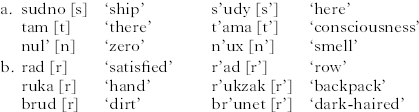
Underlying soft /r'/ is depalatalised in two contexts: before a word boundary and before a consonant, regardless of whether the consonant is an obstruent (32a) or a sonorant (32b).
(32)
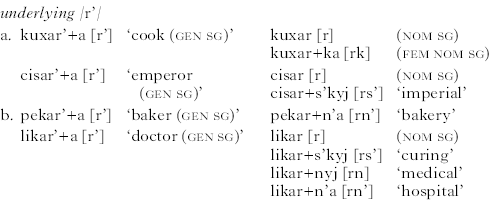
It is clear from (32b) that presonorant faithfulness is not the correct strategy to account for the pattern of the retention vs. the loss of palatalisation, because depalatalisation occurs before sonorants. Onset faithfulness appears to be a better option, since /r'/→[r] is invariably in the coda in (32): [r] is either in the final coda of the word or in the coda of a word-internal syllable. The latter contention follows from the fact that even though Ukrainian, like Polish, maximises onsets, it respects sonority relations in syllable margins. Thus, kuxarka and pekarn'a are syllabified as [ku.xar.ka] and [pε.kar.n'a] respectively.
Inspection of further data shows that onset faithfulness does not play a role in the distribution of soft vs. hard r. The /r'/ in (33) (from Medushevs'kyj & Zyatovs'ka Reference Medushevskyj and Zyatovska1963) is depalatalised in syllable onsets.Footnote 22
(33)
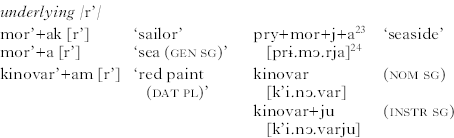
Since j is more sonorous than r, [rj] is a well-formed onset.
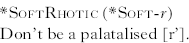
Onset faithfulness predicts that /r'/ should retain palatalisation in onsets, but it does not. The generalisation is different: /r'/ retains palatalisation only when it is directly followed by a vowel, and loses it in all other contexts. This pattern falls out from the interaction of two constraints that exist in the grammar anyway: Ident(C[−back]prevoc) (29), familiar from Polish, and a segment-inventory constraint that bans soft r'.
(34)
The evaluations of kuxar'+a, kuxar and kuxar+k+a are now as follows. Syllabification is not marked in (35), because it is irrelevant from the point of view of Ident(C[−back]prevoc).
(35)
*Soft-r is motivated independently of the depalatalisation processes. Specifically, it is necessary to block palatalisation before [j].
Looking at the details, Soft-r interacts with palatalisation in two ways: it permits it before i (36a) but blocks it before j (36b). Consonants other than r palatalise before both i and j (36c).
(36)

The key to the understanding of the pattern in (36) is the distinction between Palatalisation-i (Pal-i) and Palatalisation-j (Pal-j), reflecting the processes of palatalisation triggered by i and j respectively. Rubach (Reference Rubach2000b) argues that Pal-i and Pal-j are independent constraints, a position that I will adopt here.Footnote 25
The independence of Pal-i and Pal-j is supported by the data in (36), where we see the palatalisation of r before i, but not before j. This pattern follows from the ranking Pal-i≫*Soft-r≫Pal-j. Thus it is more important to obey Pal-i than to obey *Soft-r, hence r→r' before i, and, furthermore, producing [r'] before j is a worse offence than disobeying Pal-j, hence the palatalisation of r before j cannot occur in the optimal candidate. Consonants other than r are free to palatalise before both i and j, because there are no high-ranked segment inventory constraints against the palatalisation of these consonants.
To conclude, /r'/-depalatalisation in Ukrainian argues for the recognition of prevocalic faithfulness and against onset faithfulness. A point of special interest is the observation that depalatalisation occurs before j. This means that a consonant before j cannot be within the scope of prevocalic faithfulness. Further, given the widely held assumption that j is represented as [i] on the melodic tier, prevocalic faithfulness must be understood as operating before vowels that function as syllable nuclei. To put it differently, prevocalic faithfulness treats as privileged the consonant directly before a nucleus in a CV string. Such a consonant is normally in a syllable onset, so prevocalic faithfulness seems to be equivalent to onset faithfulness. However, the equivalence is not complete. Onset faithfulness treats any consonant in the onset as privileged and does not discriminate between single and multiple consonants in an onset, i.e. CV, CCV, CCCV, etc. are treated alike. Prevocalic faithfulness has jurisdiction only over the consonant that is directly before a vowel and says nothing about other consonants in the onset.
The understanding that prevocalic faithfulness is onset faithfulness limited to the prenuclear consonant gains support from the observation that neither labial depalatalisation in Polish nor /r'/-depalatalisation in Ukrainian can be blocked by vowels that occur across word boundaries.Footnote 26
(37)
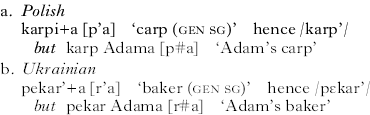
Technically, the word-final /p'/ and /r'/ in (37) are prevocalic, because they are followed by a vowel in the next word. Moreover, this vowel is a nucleus, so prevocalic faithfulness should block the depalatalisation of /p'/ and /r'/, but it does not. The contrasts in (37), [p'] and [r'] before [a] word-internally, but [p] and [r] before [a] across word boundaries, coincide with the fact that neither Polish nor Ukrainian permits syllabification across word boundaries. That is, the [p] in karp Adama and the [r] in pekar Adama are in the coda, in contrast to the [p'] and the [r'] in karpi+a and pekar'+a, which are in the onset: [kar.p'a] and [pε.ka.r'a] respectively. I conclude that prevocalic faithfulness is activated only if the consonant in a CV string is in the onset. Ident(C[−back]prevoc) must therefore be restated as follows.
(38)

Now Ident(C[−back]prevoc) protects the /p'/ and the /r'/ from losing palatalisation in karpi+a [kar.p'a] and pekar'a [pε.ka.r'a], but not in karp Adama [karp.a.da.ma] and pekar Adama [pε.kar.a.da.ma], the correct result.
5 Further issues
This section addresses the question of typological predictions (§5.1), and highlights unresolved problems, including counterexamples and the relation between positional faithfulness and positional markedness (§5.2).
5.1 Typological predictions
In an ideal world, all permutations of OT constraints should generate an existing language (factorial typology), because the central claim is that languages differ from one another solely in the ranking of constraints. Thus, given three constraints, A, B and C, OT predicts that each of the rankings in (39) represents an attested language.
(39)
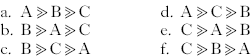
In reality, some but not all constraint permutations yield attested languages, so predictions such as those in (39) are better treated as a research agenda rather than as empirical facts. If it is clear that a given permutation of constraints yields an impossible language, the prediction can be cancelled by imposing a fixed ranking. For example, assume that languages (39b, c, e, f) do not exist. This generalisation is expressed by fixing the ranking of constraint A as higher than the ranking of both B and C. The prediction then is that only (39a, d) are possible languages.
In the following paragraphs, I consider the predictions made by presonorant faithfulness and prevocalic faithfulness with regard to the constraints introduced in the preceding sections. These predictions raise interesting questions, some of which can be answered immediately, but many others of which must be left open for future research.
If prevocalic faithfulness exists independently of sonorant faithfulness, as this article has proposed, then the grammar includes not only Ident([voice]preson), but also Ident([voice]prevoc) as a legitimate constraint. The interaction of these constraints with *[+voice] makes a number of predictions, one of which is particularly interesting (see (42) below).
The examples in the tableaux below are the Polish words do [dɔ] ‘to’ and zdrow+y [zdrɔvɨ] ‘healthy’. I assume that VoiceAssimilation must be obeyed, and hence it is not shown in the tableaux.
(40)
The relative ranking of Ident([voice]preson) and Ident([voice]prevoc) has no effect on the selection of the optimal candidate, as both (40a) and (b) converge on the same winner. The tableaux in (40) derive a language with no voiced obstruents, an attested pattern, for example in Hawaiian.Footnote 27
The ranking of *[+voice] below the two positional faithfulness constraints yields the pattern attested in Polish: the voicing contrast is maintained before both vowels and consonantal sonorants.
(41)
As was the case in (40), the relative ranking of Ident([voice]preson) and Ident([voice]prevoc) has no effect on the selection of the optimal candidate, as both (41a) and (b) converge on the same winner.
The ranking of *[+voice] between the two positional faithfulness constraints reaffirms the Polish pattern when Ident([voice]preson) outranks Ident([voice]prevoc) (42a), but the reversal of the ranking predicts a new pattern (42b).
(42)
The point of interest is (42b). The novelty is that the system predicts voiced obstruents in singleton onsets, /dɔ/→[dɔ] (no change), but voiceless obstruents in clusters in which the obstruent occurs before a sonorant consonant, /zdrɔvɨ/→[strɔvɨ].Footnote 28 This pattern follows from the fact that Ident([voice]prevoc) has no jurisdiction over such inputs. Interestingly, the prediction in (42b) is correct.
Steriade (Reference Steriade1997, based on Watson Reference Watson1964) points out that obstruents in Pacoh, a Mon-Khmer language, have a voicing contrast before vowels but not before consonantal sonorants. The generalisation is that clusters of obstruents with sonorant consonants may involve only voiceless obstruents, so, for example, [pr] and [pl] exist, but [br] and [bl] are unattested. This is exactly what (42b) predicts.
Further, notice that the winners in (42) are the attested outputs in Polish and Upper Sorbian, which reaffirms the observation that the predictions in (42) are correct.
(43)

The word strowy is a known ‘mysterious’ historical development in Upper Sorbian (Heinz Schuster-Šewc, personal communication), the only Slavic language to have devoiced Proto-Slavic [zdr] to [str]. Given Ident([voice]prevoc), the devoicing is no longer mysterious. In fact, it is exactly the pattern that (42b) predicts.Footnote 29 In what follows, I will restrict the discussion of typological predictions to the issue highlighted in (42): the behaviour of singleton onsets and presonorant clusters.
The pattern of labial depalatalisation attested in Polish (see §3) involves depalatalisation everywhere except before vowels. This result is obtained if Ident(C[−back]prevoc) outranks both *SoftLab and Ident(C[−back]preson), as shown in (30). The reverse ranking, Ident(C[−back]preson)≫*SoftLab≫Ident(C[−back]prevoc), generates the pattern with soft labials retaining their [−back] property not only before vowels but also before sonorant consonants. In this system, ziem+n+y /ʑεm'+n+ɨ/ ‘land (adj masc nom sg)’ surfaces with [m'] and is thus parallel to ziemi+ach [ʑεm'ax] ‘land (loc pl)’, where the context is prevocalic (see the data in (28)).
(44)
The loss of palatalisation is then restricted to pre-obstruent and word-final contexts, as in ziem+sk+a ‘earthly (fem nom sg)’ and ziem ‘land, earth (gen pl)’, cited in (20) and (21).
(45)
I do not know of a language that exhibits the patterns in (44) and (45). If indeed it is true that such patterns are unattested, the grammar must include a fixed ranking of *SoftLab above Ident(C[−back]preson).
The depalatalisation of /r'/ in Ukrainian (§4) leads to a similar conclusion. The ranking Ident(C[−back]preson)≫*Soft-r≫Ident(C[−back]prevoc) predicts the pattern parallel to that discussed for soft labials in Polish: /r'/ depalatalises before obstruents and word-finally, but not before vowels and sonorant consonants. As in the case of Polish soft labials, I do not know of a language that exhibits this pattern. If it is indeed true that such a language is unattested, the solution is the same as in Polish: a fixed ranking of Ident(C[−back]preson) below *Soft-r and Ident(C[−back]prevoc).
The associate editor points out that the theory including both presonorant faithfulness and prevocalic faithfulness predicts a language in which nasals assimilate to stops in singleton onsets (46a), but not in complex onsets (46b). The issue can be illustrated with the hypothetical inputs /an+pa/ and /an+pra/. The interacting constraints are NasalAssimilation (nasals and stops agree in [place]), Ident([place]preson), Ident([place]prevoc), *Lab (‘don't be a labial’) and *Cor (‘don't be a coronal’). The ranking is as given in (46) (in (46) and (47) I ignore the violations of *Cor caused by [r]).
(46)
I do not know if the pattern in (46) is attested. If it is not, the ranking must be fixed in such a way that Ident([place]prevoc) and Ident([place]preson) switch places, as in (47).
(47)
The pattern in (47) is well supported empirically; it is found in English, for example.
(48)

To sum up, the interaction of presonorant and prevocalic faithfulness constraints with markedness constraints makes a wide range of predictions, some but not all of which are supported empirically at the current stage of phonological research. The undesired predictions, if they turn out to be really undesired, can be avoided by appealing to fixed ranking.
5.2 Unresolved issues
A strong version of the theory proposed in this article is the claim that onset faithfulness can be eliminated altogether and replaced with prevocalic and presonorant faithfulness. A reviewer points out that this strong claim runs into empirical difficulties in Catalan.
Catalan exhibits a [±voice] contrast in presonorant obstruents in the onset (the data and the generalisations are taken from Wheeler Reference Wheeler2005a, Reference Wheelerb).
(49)

The voicing contrast is neutralised if the obstruent is in the coda and the sonorant is in the onset.
(50)
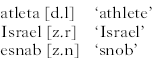
Even though Wheeler makes the observation that the voicing contrast is maintained only in onsets, he states the assimilation constraint in terms of positional markedness rather than positional faithfulness, by requiring a coda obstruent to agree in voicing with the following consonant. This analysis is revised by Beckman & Ringen (Reference Beckman and Ringen2007) in terms of onset faithfulness. The crucial constraint is Ident([voice]ons), which makes sure that the voicing contrast in (49) is maintained.
It appears that the Catalan data cannot be reanalysed in terms of Ident([voice]preson). If this constraint outranks *[+voice], then, correctly, it protects the voicing contrast in (49) but, incorrectly, it blocks the voicing process in (50). This means that presonorant and prevocalic faithfulness cannot eliminate onset faithfulness and positional markedness (but see below). Apparently, one of these theories needs to be adapted to handle what are hopefully residual cases. The choice between onset faithfulness and positional markedness is not easy to make, because each theory complicates the OT grammar in significant ways.Footnote 30
Onset faithfulness complicates the grammar in two ways, firstly by adding new constraints and secondly by weakening the adequacy of typological predictions. Incorporating onset faithfulness has the consequence of admitting a large number of constraints, because every faithfulness constraint is now relativised with regard to the onset in addition to being relativised with regard to presonorant and prevocalic positions. Thus, we have new constraints such as Ident([voice]ons), Ident(C[−back]ons), Ident(C[+back]ons), Ident([place]ons), Ident([+high]ons), Ident([−high]ons) and so forth. The predictions of factorial typology have also been magnified, yielding new patterns which appear to be implausible. One such pattern involves devoicing in a language with variable syllabification.
Variable syllabification is not an uncommon phenomenon. For example, as mentioned in note 4, Polish has a preference for maximising onsets, VCCV→V.CCV, but the less common VC.CV pattern is also attested (Rubach & Booij Reference Rubach and Booij1990a). A word such as nudny can be syllabified in two ways: nu.dny (the preferred syllabification) and nud.ny (the less preferred syllabification). Onset faithfulness predicts that in a language with the syllabification patterns of Polish and a devoicing process, the occurrence of voiced and voiceless obstruents should coincide with the variation in syllabification, a prediction that is shown in (51), where nudny serves as an example in this hypothetical language.
(51)
The problem is that the pattern in (51) is unheard of: variation in syllabification is known not to coincide with variation in devoicing (Rubach Reference Rubach and Roca1997b). Notice that the fixed ranking Ident([voice]preson)≫Ident([voice]ons) is not possible, because, as shown above, Catalan requires the reverse ranking, Ident([voice]ons)≫Ident([voice]preson).
The difficulties with onset faithfulness suggest that positional markedness (PM) might be a better solution for Catalan than positional faithfulness (PF). The problem is that PM is not an attractive theory. First, it is virtually unconstrained, in the sense that it generates a huge number of constraints which are entirely implausible or plainly wrong. Second, in spite of its vastly overgenerating power, PM cannot eliminate PF. In sum, PM is both too strong and too weak as a theory.
In the majority of cases, PM can restate PF analyses, albeit at the price of adding new constraints. Labial depalatalisation in Polish is a typical example.
Recall (see §3) that Polish depalatalises labials in two contexts: at the end of the word and before a consonant. PM simply states the facts in a heavy-handed manner by adding two new constraints: *SoftLab /—# and *SoftLab /—[+cons]. The correct result is obtained if these constraints are ranked above Ident(C[−back]) and *SoftLab: *SoftLab /—#, *SoftLab /—[+cons]≫Ident(C[−back])≫*SoftLab.
Ukrainian /r'/-depalatalisation (§4) is much like Polish labial depalatalisation, but it highlights a new problem. In addition to *Soft-r /—# and *Soft-r /—[+cons], we need *Soft-r /—j, because, given the standard assumptions that [j] is a melodic [i] that is not syllabified as a nucleus, depalatalisation before [j] cannot be subsumed under depalatalisation before a consonant.
Constraints such as *Soft-r /—j highlight a serious deficiency of PM: the absence of restrictions on what constitutes a legitimate constraint. For example, nothing stands in the way of postulating a huge number of constraints whose validity can be doubted. Thus, looking at r'-depalatalisation, we open the possibility that languages may have constraints such as *Soft-r /—m, *Soft-r /—n, *Soft-r /—l, *Soft-r /—r, *Soft-r /—obstruents, *Soft-r /—back vowels, etc.
A further problem is that typological predictions get out of control. For instance, the ranking FinalDevoicing≫*[+voice]≫VoiceAssimilation predicts a language with final devoicing but no voice assimilation, but such a language is impossible (see Steriade Reference Steriade1997). In sum, PM has excessive power and overgenerates on an enormous scale in ways that are not open to PF. Given this conclusion, it is surprising to observe that PM cannot eliminate PF, which means that PM is too weak as a theory.
The best-known argument supporting PF against PM is directionality in assimilation processes (Beckman Reference Beckman1999). PM alone cannot distinguish between [fran.tsu.ska] and [fran.tsu.zga] or between [prɔ.ɕpa] and [prɔ.ʑba], the candidates in the evaluation of the Polish data cited in (4): Francuzka and prośba. Both of the assimilating consonants are in the onset, so PM, which prohibits the occurrence of [+voice] obstruents in the coda, has no leverage with such candidates. In contrast, PF has no trouble resolving the directionality problem: Ident([voice]preson) selects [fran.tsu.ska] and [prɔ.ʑba] as the optimal outputs, the correct result.
Since, as we have just seen, both PM and onset faithfulness are problematic, it seems warranted to revisit the analysis of Catalan from a new perspective.Footnote 31 The idea is to postulate Ident([voice]presonσ) as an expansion of Ident([voice]preson) that is limited to the domain of the syllable. Now the data in (49), but not in (50), are within the purview of Ident([voice]presonσ). That is, the protective power of this constraint extends to plau [pl] ‘pleases’ and blau [bl] ‘blue’, in which the obstruent and the sonorant are in the same syllable, but not to at.leta [t.l] ‘athlete’, in which the obstruent and the sonorant are in different syllables. If the ranking is Ident([voice]presonσ)≫VA≫Ident([voice]preson), then at.leta must undergo voicing because it is more important to obey VA than to obey the generic Ident([voice]preson), and, crucially, Ident([voice]presonσ) is mute on heterosyllabic clusters. While this analysis incorporates syllables, it treats them as strings and is blind to the syllable-internal hierarchy. Importantly, onset faithfulness plays no role and can be eliminated.
Analysis of Belarus final devoicing in the next section provides a new type of argument against PM and for PF. In particular, the analysis argues for presonorant faithfulness and against both PM and onset faithfulness.
6 Belarus devoicing
Belarus exhibits the familiar type of voice assimilation: obstruents assimilate to the following obstruent both inside words (52a) and across word boundaries (52b).
(52)

The novelty is that in the standard dialect, that of central Belarus, the voicing contrast is maintained before sonorants not only inside words (53a, b), the expected pattern, but also across word boundaries (53c, d), an unexpected pattern (Padluzhny Reference Padluzhny1983, Czekman & Smułkowa Reference Czekman and Smułkowa1988).Footnote 32
(53)

It might appear that Belarus simply does not exhibit final devoicing, but this is incorrect, as (54) shows.
(54)
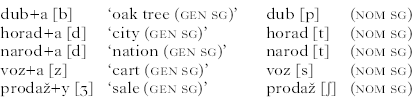
The generalisation is that final devoicing is restricted to the context before a pause.
A PF analysis of the Belarus data in (53) and (54) is simple: the preservation of the voicing contrast in (53) is an effect of Ident([voice]preson)≫*[+voice]≫Ident([voice]). The neutralisation of the voicing in (54) follows from the same ranking: the voiced obstruent devoices because it is not followed by a sonorant, so Ident([voice]preson) is mute on the inputs in (54).
This analysis cannot be recast in terms of onset faithfulness or positional markedness. Onset faithfulness, specifically Ident([voice]ons), has no jurisdiction over the data in (53c, d), because the obstruent and the following sonorant are heterosyllabic: the obstruent is invariably in the coda, while the sonorant is in the onset or constitutes the syllable nucleus, if it is a vowel.
PM has no viable analysis either. Prohibiting [+voice] word-finally accounts for the data in (54) but is wrong for the data in (53d), where word-final obstruents are voiced. The descriptive fact is that the devoicing occurs before a pause, but this context cannot be built into a PM analysis. The reason is that ‘pause’ is not a primitive in phonological theory. In other words, ‘pause’ is not a primary but a derivable context, a generalisation that has been consistently maintained in all phonological paradigms beginning with SPE (Chomsky & Halle Reference Chomsky and Halle1968). Processes that appear to be conditioned by pauses are in fact conditioned by word-final position. Surface effects, such as devoicing, may be masked by interaction of processes that compete over the same set of data. For example, final devoicing is obscured by voice assimilation if the following word begins with a voiced obstruent, as in voz Borysa [z#b] ‘Boris's cart’ (cf. (52b)). To conclude, since ‘pause’ is not a phonological primitive, PM has no way of accounting for the Belarus data, so PM is too weak as a theory. We need PF, specifically presonorant faithfulness.
7 Conclusion
The debate concerning PF asks the question whether PF should be prosody-based or string-based. If PF is prosody-based, then it is built on syllable structure, with onsets and onset faithfulness playing a prominent role. On the other hand, if PF is string-based, then the tenet is that no reference to syllable structure is ever necessary. In this view, PF is defined strictly with regard to the linear order of segments in a string, in particular, with regard to sonorants (sonorant faithfulness) and vowels (prevocalic faithfulness which this article has proposed). The raison d'être of string-based PF is drawn from grounding in speech perception, in particular from licensing-by-cue.
The strict division into prosody-based PF and string-based PF is incorrect, because string-based PF must make reference to prosody, but this reference is much more subtle than assumed by onset faithfulness. First, sonorants that function as licensors must have syllabic association. Second, prevocalic faithfulness encompasses a prenuclear segment in the onset.
Finally, the question is whether presonorant and prevocalic faithfulness can totally eliminate both onset faithfulness and PM. It is clear that onset faithfulness is unnecessary, but some version of PM or an extension of presonorant faithfulness to the domain of the syllable by postulating Ident([voice]presonσ) is unavoidable for the analysis of coda voicing in Catalan. The expectation is that cases such as that of Catalan are residual.


