The Second World War had only just ended when the Dutch economist Pieter Hennipman delivered his inaugural address as a full professor in economics. Aware of the unusual historical circumstances, he dedicated his lecture to the value of economic theory for post-war reconstruction. According to the newly inaugurated professor, economists had a responsibility towards society, especially at times of increased socio-economic contestation. While socialists and liberals fiercely debated the merits and pitfalls of social security, economists should keep their distance from heated ideological debates to find ‘objective’ grounds for consensus.Footnote 1 Revealing the contemporary increase of market-oriented directions within socialism and the movement away from laissez-faire among liberals, Hennipman proposed a ‘synthesis’ between both: he favoured a government that would deliberately foster free competition by combatting monopolies and cartels.Footnote 2
Hennipman’s plea for a ‘synthesis’ between two parties is nowadays identifiable as a clear stance in a heated international debate among economic experts, with strong political implications. By simultaneously rejecting socialism and classical liberalism while proposing a state-led battle against monopolies and cartels, Hennipman sided with the advocates of a new branch of liberal thought: the self-proclaimed ‘neoliberals’. Forerunners of this new political movement, most notably the Austrian-British economist Friedrich Hayek and the German economist Wilhelm Röpke, claimed that free markets underpinned and fostered individual freedom. Consequently, any curtailment of the market (either through government intervention or by the establishment of monopolies and cartels) equalled the curtailment of human freedom as such. In doing so, the neoliberals fiercely opposed social democratic and social liberal political theorists who argued that state planning and social security were prerequisites for individual freedom and claimed that the heydays of liberalism were over.Footnote 3
The resulting theoretical debate on social security and the conditions for human freedom strongly influenced government policies all over Western Europe. Its effects are clearly noticeable in the British Beveridge Report (1942) on social security, in the conceptualisation of the Ludwig Erhard’s ‘Social Market Economy’ – nowadays interpreted as a neoliberal cornerstone of Western Germany’s post-war reconstruction – and in the establishment of the post-war welfare state as such.Footnote 4 Given the international contestation among liberals over these issues, Hennipman’s plea for a synthesis between liberalism and socialism might have struck his colleagues in the economy department as naïve. Yet, within a decade the fierce ideological contest over welfare that had seemed so fundamental to the post-war future of Europe in 1945 was largely forgotten. This article highlights the role of the ‘moderate’, centrist portion of the Dutch neoliberal movement in the depoliticisation of the post-war ideological ‘war over welfare’.
By studying the establishment of the early neoliberal movement in the Netherlands during the late 1940s and early 1950s I aim to underline three points. First, I will use the Dutch case to illustrate that from the start neoliberalism was a transatlantic affair. It concerned the United States and Europe, was rooted in the interwar years and emerged in response to the rise rather than the demise of the welfare state. Although intellectual historians have made this point before, it is worth emphasising because many scholars still identify neoliberalism primarily with the stagflation crisis of the 1970s, that era’s growing scepticism towards the welfare state and the subsequent ascension of Margaret Thatcher and Ronald Reagan.Footnote 5 This perspective has contributed to the view that neoliberalism came to the fore as an Anglo-American political project, an interpretation that neglects the continental European origins and deep historical roots of the neoliberal movement.
My second point stresses that the early neoliberal movement gained its contemporary appeal primarily from continental Europe’s struggle with the rise of fascism and war. Contrary to most of the literature on the subject, which focuses mostly on the role of international think tanks and their closed-door debates on neoliberalism, I highlight the public visibility of the neoliberal movement in the Netherlands. I show that internationally renowned neoliberal political theorists were featured in Dutch newspapers, and that their ideas were disseminated within Dutch political parties. As I will demonstrate, neoliberal ideas fell on fertile ground in the Netherlands and were especially popular among right-wing adherents of the influential three centrist confessional parties. I will explain their embrace of neoliberal thought by bringing in a third point: the significance of the neoliberal ‘third way’ as a moderate road between socialism and capitalism. Although the third way, for which the German neoliberal economist Wilhelm Röpke was a key advocate, has received relatively little attention in the current literature on neoliberalism, his centrist political strategy proved vitally important for the dissemination of neoliberal thought in the Dutch multiparty system. Moreover, this political strategy played a seminal role in the depoliticisation of neoliberal ideas.
The Netherlands provides a compelling case for studying the depoliticisation of neoliberalism for various reasons. Its multiparty system, revolving around a Christian democratic centre, offers a striking contrast to the Anglo-American two-party system, and is representative of most Western European countries in the first decades after the Second World War, an era dominated by Christian democratic parties.Footnote 6 Moreover, and more significantly, in the spring of 1940 the Dutch cabinet had fled to London, where its members found themselves at the heart of the Allied debate on social security. Its proximity to these discussions resulted in the Dutch government’s establishment of a committee on social security in imitation of the efforts of the British administration. In its 1944 report, this committee, headed by the Dutch policymaker A. A. van Rhijn, recommended extensive state interventions in the economy.Footnote 7 The first post-war interim cabinet took these measures to heart, even though they clashed fiercely with the liberal leanings of pre-war Dutch politics and with the former historical orientation of Dutch policy elites towards international trade. As a result, Dutch debates over the welfare state emerged early (the Dutch post-war elections were held three years before the establishment of the Federal Republic of Germany) and were particularly contentious.Footnote 8
Mapping the neoliberal contributions to these debates and assessing their impact is necessarily an eclectic undertaking, as these efforts were by no means confined to political parties and parliaments. On the contrary, widely disseminated political contributions were vital to the emergence of the early neoliberal movement. Therefore, this article is based on various sources and consists of archival research on two emerging neoliberal movements in the Netherlands in the late 1940s, an analysis of the ways that newspapers covered the debates on neoliberalism and a (preliminary) assessment of the influence of neoliberal and social democratic thought within existing Dutch political parties.
The Establishment of the Dutch Neoliberal Network
Any research on neoliberalism starts with the question of what neoliberalism is. A select group of Dutch social democrats were confronted with that very question after the party congress of the Dutch Labour Party had appointed them members of a special committee, established to write a major ideological report on the future of social democracy. In 1951 they published The Road to Freedom, in which they carved out social democracy’s ideological future by opposing it to ‘the neoliberal solution’, the only rival ideology to which the social democrat committee members devoted an entire section. In this section they defined neoliberalism as a politics of economics
which is against the abuse of bodies of power, but instead aims to prevent their emergence. This form of politics aims to re-establish absolute freedom of competition by abolishing state intervention in the economy, as well as power concentrations. According to this line of reasoning, state intervention is only allowed under the condition that it realises full competition.Footnote 9
Here the Dutch social democrats emphasised three aspects of its contender’s ideology. First, they claimed that neoliberals aimed to establish absolute freedom of competition by abolishing state intervention in the economy. In this respect, neoliberalism seemed in line with classical liberalism and its economic dogma of laissez-faire. Second, however, they asserted that neoliberals actively combatted ‘power concentrations’. These power concentrations could be found in the economy, in the form of monopolies and cartels, but also in the state, for instance through the nationalisation of banks or the provision of state-guaranteed social security. Finally, both forms of power concentrations could be countered by a state which established the conditions for full competition. Neoliberals did not prescribe the government’s absence from economic life but rather aimed to ensure that the state reinforced the free market by fostering the mechanism of free competition. In doing so, neoliberals differed from social liberals, who delimited the market but also departed from the principle of laissez-faire, which allowed the market to run its course.
The concision and precision of the Dutch social democrats’ definition of neoliberalism are remarkable. This was no accident. From the 1930s on the ideological renewal of liberalism had generated ample debate. Politicians, policymakers and journalists thoroughly discussed the limitations and pitfalls of laissez-faire, while the idea of a renewed liberalism gained urgency and traction due to fifteen years of experience with mass unemployment, fascism, war and occupation. One of the first organisations working on the development of neoliberal thought was the Dutch Committee for Economic Orders (Comité ter Bestudering van Ordeningsvraagstukken), founded in 1938 by fifteen captains of industry, a small group drawn from the policy elite and a member of the Dutch cabinet. They observed with growing uneasiness that the Dutch government’s interventions in economic life had expanded tremendously. Although these interventions had initially been unavoidable responses to international economic developments, the state had recently started to employ methods of structural economic planning on ideological grounds – a development which filled these neoliberal thinkers with growing apprehension.Footnote 10 Refusing to side with classical liberalism or to reject economic planning altogether, the group’s founders proposed delimiting the use of state planning by assuming ‘the precondition that it will strengthen economic life, foster the employment of the economic forces and accelerate necessary changes’.Footnote 11
The establishment of the Committee for Economic Orders was primarily a response to the growth of economic state intervention in the Netherlands. During the interwar years the Dutch government had initially adopted remarkably liberal economic policies. The Netherlands had been among the last countries to remove itself from the gold standard in the 1930s; its economy had largely been dependent on international trade. Before the economic crisis of the 1930s politicians and policy makers considered social security predominantly a local, and not a national affair.Footnote 12 This all changed during the second half of the 1930s when Dutch politicians took the country off the gold standard. Meanwhile, price regulations transformed the agricultural sector and economic theories that took the ‘full employment’ of the means of production as its point of departure were on the rise. Especially the publication of the social democrat’s ‘Labor Plan’ in 1935 contributed to the ascendency of these Keynesian ideas in the Dutch political arena, and mixed a (proto-) Keynesian approach with a far older tradition of economic planning. Appalled by the combination of Keynesian demand management and state planning, but also believing that the classical liberal laissez-faire principle was insufficient to meet the economic and political challenges of industrialised mass society, the members of the Committee for Economic Orders combatted what they perceived to be economic collectivism.Footnote 13
They were not alone. Intellectuals in the United States and in other parts of Europe undertook similar attempts to formulate a new form of competition centred liberalism in opposition to classical liberalism and social liberalism. Less than two years earlier the American journalist Walter Lippmann had published his influential political essay The Good Society, in which he claimed that free competition alone could avert the accumulation of power in the hands of the few, and therefore safeguarded individual freedom as such.Footnote 14 Inspired by Lippmann’s views, a small group of intellectuals gathered in Paris in 1938 to discuss the implications of this new liberal stance. The assembled scholars at the ‘Lippmann Colloquium’ allegedly coined the term ‘neoliberalism’, although it remained contested even among its advocates and did not yet reach a broader audience.Footnote 15 The outbreak of the Second World War made follow up meetings impossible for years to come.
Meanwhile, the Allied debate on social security gained traction due to the experience of crisis, mass unemployment and war. The emerging neoliberal movement in the Netherlands gained most of its political relevance from this debate. In the United Kingdom, the rise of Keynesianism, together with the publication of the Beveridge Report on social insurance in 1942, contributed to a growing consensus about the necessity of state planning. The Dutch cabinet, stationed in London during the war, established a committee to investigate the issue of welfare politics. The report ‘Social Security’, written by a committee led by A. A. van Rhijn, was comparable to the Beveridge Report and had far-reaching ideological consequences. It stated that the Wall Street Crash of 1929 had spurred a massive economic crisis; mass unemployment had unrooted the middle classes and in Germany had made them vulnerable to the temptations of National Socialism.Footnote 16 To prevent a similar chain of events in the future, the state should provide social security to its citizens, and large-scale economic planning should underpin post-war mass democracy.
Much to their dismay, liberal Dutch opponents of the welfare state found that the ideal of social security, combined with economic theories of full employment and direct economic interventions by the state, quickly caught on in the Netherlands. By December 1945 Frits Willink, a captain of industry and an early advocate for neoliberal thought in the Netherlands, wrote a letter to his colleague and political ally Henri Keus. According to Willink, a new political organisation which called itself the ‘National People’s Movement’ had managed to gain considerable support in the run-up to the first post-war parliamentary elections in 1946. ‘They arrange “house-parties” everywhere’, Willink contended, and it had become ‘completely clear that they want to establish the Dutch Labour Party. They openly confess their socialism and anti-capitalism and support [the] planned economy’.Footnote 17 To make matters worse, they were gaining increasing support from Catholics and Protestants.
The message must have struck Keus, who was on a business trip to the United States at the time. Shortly before the outbreak of the war Keus had attended the Committee for Economic Orders’s inaugural meeting. Showing a strong interest during the war in the development of liberal thought, he became acquainted with several neoliberal theorists abroad. Moreover, he contributed to the development of neoliberal thought through the publication of The Entrepreneur and His Socio-Economic Problems in 1943, in which he fiercely criticised economic planning. During the war Keus gradually expanded his political views beyond economic matters, especially after he read Die Gesellschaftskrisis der Gegenwart and Civitas Humana by the German economist Wilhelm Röpke.Footnote 18
Keus’s interest in Röpke’s work was no coincidence. Especially during the last years of the war Röpke had fiercely opposed the monopolistic tendencies of socialism and capitalism, arguing that laissez-faire capitalism (which he carefully distinguished from the free market as such) had produced economic concentrations of power, whereas socialism, by combatting these power concentrations through the government, had produced an economically omnipresent totalitarian state.Footnote 19 The only way to prevent an abolition of economic (and hence political) freedom was to combat monopolies and cartels. To do so would prevent concentrations of economic and political power. To achieve this goal, Röpke argued that the state should deliberately employ the mechanism of free competition. Keus wholeheartedly supported these views and underlined their vital importance for the revitalisation of neoliberalism, emphasising to Röpke that ‘the concrete realisation always trails far behind the intellectual preparation’.Footnote 20
In his strong critique of social and classical liberalisms’ inability to combat power concentrations, his faith in the mechanism of free competition and his strong reliance on the political power of ideas, Keus had adopted a new form of liberalism. As if to underline his newly adopted political views, he started to distance himself from classical liberalism and social liberalism in political lectures and publicly declared himself an ‘entrepreneur neo-libéral’ [original emphasis] at a public meeting in Belgium in November 1945.Footnote 21 By January 1947 the Dutch lawyer Abraham Zeegers invited Keus to join the newly established Dutch Business Federation (Federatie Nederlandsche Bedrijven), which aimed to organise Dutch entrepreneurs against economic planning.Footnote 22 By the end of the year the FNB had gained support of anywhere from 5,000 to 6,000 entrepreneurs, including the backing of HEEMAF, Keus’s own firm, which specialised in industrial and household electronics, not unlike the German SIEMENS.Footnote 23
Undoubtedly encouraged by the resonance of Keus’s ideas, but also stimulated by the conviction that the dangers of economic planning were not confined to the economy alone, the federation turned itself into a broader political movement by the end of 1947 and established the Committee for Civil Rights (Comité Burgerrecht). Burgerrecht rejected direct economic interventions by the state on economic and democratic grounds. Moreover, it supported the mechanism of free competition as a central underpinning for democracy, and described itself as a political ‘shock troop’ and as a ‘societal current . . . within political parties’.Footnote 24 As the Committee’s chairman J. van den Berge explained at the committee’s inaugural meeting, working within the current political configuration was preferable to establishing a separate political party, for ‘if the masses start to think along different lines, political leaders will surely follow. We have to work towards this new situation. Therefore, we have to infiltrate.’Footnote 25
The Dissemination of Neoliberal Thought in Newspapers
Burgerrecht’s ideational political strategy, aimed at exerting influence within existing parties, might appear farfetched on its surface. However, by the time that the Second World War had ended, many who had endured the economic crisis of the 1930s and the experiences of mass unemployment and war were convinced that the impact of ideas on politics was very real. Mark Blyth, who asserts that institutions and interests underpin political systems under ‘normal’ circumstances, emphasises the key value of ideas in times of transformative political crisis, when political actors fail to separate risk from uncertainty.Footnote 26 Distrusting the institutions they had previously relied on (such as banks, political parties or ‘the government’) and uncertain about their current interests, actors use ideas to reinterpret the world around them. Examples of this phenomenon in the 1930s can be found among the left and the right, and include Keynesian pleas for full employment, the Beveridge Plan and corporatist policy interventions. Fifteen years of crisis, unemployment and war amply demonstrated the political transformative power of ideas. By adopting an ideational strategy aimed at existing parties, the neoliberals of Burgerrecht acted in not unexpected ways, given that they were members of a generation shaped by political uncertainty.
Comprehensible and potentially effective as the adoption of these neoliberal ideas may have been, little is known about their dissemination in politics, and the main reason for this dearth of understanding concerns methodology. Like their Dutch political allies, neoliberals elsewhere complied with an idea driven conception of politics and refrained from establishing parties of their own. Friedrich Hayek aptly summarised the neoliberal political strategy in the epigraph he chose for the introduction to The Road to Serfdom, Lord Acton’s claim that ‘few discoveries are more irritating than those which expose the pedigree of ideas’.Footnote 27 Moreover, Hayek dedicated his book to ‘the socialists of all parties’. Aiming at ideational influence within various existing parties, he founded the Mont Pèlerin Society to achieve this goal. Scholars of neoliberalism have so far mostly confined themselves to studying the Mont Pèlerin Society and similar international political networks, mostly for pragmatic reasons.Footnote 28 After all, the influence of ideas is difficult to assess without institutional benchmarks such as seats in parliament or participation in cabinets.
Acknowledgment of these difficulties might help to explain why the current historiography holds the public visibility of the early neoliberal movement in low regard, despite evidence that points in a different direction. Mark Mazower described Friedrich Hayek as a ‘voice in the wilderness’ whose message ‘fell on deaf ears’, even though Hayek sold forty thousand copies of The Road to Serfdom in the United Kingdom alone, despite paper scarcity.Footnote 29 Moreover, the widely read American magazine Reader’s Digest sent out an abridged version to its 600,000 subscribers. The Conservatives’ party leadership initially adopted Hayek’s pro-market views, and Winston Churchill based one of his most noteworthy (although clumsy) speeches of the 1945 election campaign on Hayek’s work.Footnote 30 The internationally renowned economist John Maynard Keynes left for the Bretton Woods conference with The Road to Serfdom in his suitcase.Footnote 31 Meanwhile, the work of the German economist Wilhelm Röpke, arguably the most influential continental neoliberal theorist of his days, was translated into almost all European languages. He delivered well-attended lecture tours across Western Europe and was the key ideologue behind the West German ‘economic miracle’. Still, the historian Angus Burgin holds that he held no noteworthy status as public intellectual.Footnote 32 It seems that these sorts of conclusions derive from methodological constraints rather than empirical research.
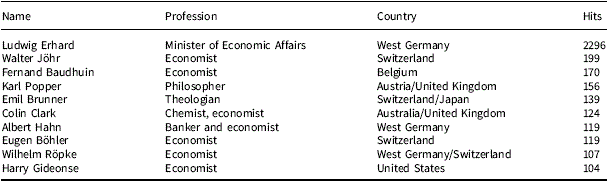
One way to work around such constraints is to use newspapers as a source and to analyse them with an eye to the places where neoliberal political theorists are mentioned, the audiences they addressed and the political movements with which they were connected. Sources provided by the Dutch the Committee for Economic Orders enable such an approach. Shortly after the end of the Second World War the Committee for Economic Orders resumed its political activities. Libraries in the Netherlands contain remnants the committee’s most important accomplishment: the translation and publication of neoliberal political essays and lectures. Between 1948 and 1957 the Committee for Economic Orders published sixty-six texts by forty-eight different political theorists and policy experts, whose names I tracked down in the digital newspaper database of the Netherlands.Footnote 33
The search results demonstrate that political and economic theories seldom make headlines. With the exception of Ludwig Erhard, West Germany’s minister for economic affairs throughout the 1950s, foreign neoliberal theorists all generated less than 200 hits.Footnote 34 However, it is remarkable how relatively well the neoliberals performed in comparison to John Maynard Keynes (385 hits), who is usually depicted as the paradigmatic (though by then deceased) economic theorist of the 1950s.Footnote 35 Although all neoliberals on the list scored lower than Keynes, the gap is considerably smaller than one would expect when comparing a dominant economic theorist with marginalised political thinkers. However, many neoliberals on the list owed their visibility in the newspapers to activities that were unrelated to the neoliberal cause. Many are therefore irrelevant for this research. Filtering out all irrelevant results, a closer qualitative analysis demonstrates that journalists linked four intellectuals in particular with the neoliberal movement: Emil Brunner (139 hits), Wilhelm Röpke (107 hits), Ludwig von Mises (92 hits) and Friedrich Hayek (34 hits) (Table 1)
Most frequently mentioned neoliberal intellectuals (Dutch intellectuals excluded)

.
Given Hayek’s prominence in the literature about early neoliberalism, his relative absence in Dutch newspapers is remarkable, as is the prominence of the Swiss theologian Emil Brunner, who is hardly mentioned in the literature. Brunner was a prominent and well-known theologian at the time, a personal friend of the Swiss theologian Karl Barth and a dedicated ‘personalist’ who (in stark contrast to the so-called ‘personalist socialists’ of his day) rejected economic collectivism, individualist capitalism and ‘the tyranny of state socialism’.Footnote 36 He believed that the classical antithesis of socialism versus capitalism should be replaced by a deliberate struggle against the totalitarian state through the market mechanism, but without a return to old-fashioned capitalism or laissez-faire policies.Footnote 37 Due to his emphasis on a path between capitalism and socialism, his faith in the market mechanism and his rejection of laissez-faire, journalists repeatedly compared him to Wilhelm Röpke.Footnote 38 However, like Mises and Hayek, he never gained Röpke’s public standing.
Röpke’s success in the Netherlands was truly remarkable. By the middle of the 1950s he had delivered several highly successful lecture tours, attended by influential policymakers, academics, journalists and members of the Dutch cabinet. Several of his books and lectures were translated into Dutch and were published by the publishing company Civitas Humana, named for Röpke’s most influential book in the Netherlands. Various political parties, most notably the Christian democrats, showed interest in his work. Journalists began to consider the possibility that neoliberalism, rather than social democracy, would shape the socioeconomic future of the Netherlands.Footnote 39
Röpke’s success partly derived from the way he positioned himself politically. A quick comparison with Friedrich Hayek illustrates this point. Hayek, who wrote The Road to Serfdom during his residency in London, addressed a primarily British audience and depicted neoliberalism as the opposite of socialism and the perfection of liberal thought.Footnote 40 In doing so, he made a political argument that fitted a two-party system, in which he implicitly depicted neoliberalism as right wing. His fellow neoliberal Wilhelm Röpke, however, while holding similar ideological views, presented his political philosophy as a ‘third way’ between capitalism and socialism and accordingly aimed for a middle road that was far better suited to the multiparty systems of continental Western Europe.Footnote 41 As the next section will demonstrate, Röpke’s ideas gained traction within the Netherlands’ centrist political parties due to his depiction of neoliberalism as a moderate ‘third way’ between capitalism and socialism. However, before we can examine this matter in detail, I will briefly return to the polarised debate on social security out of which Röpke’s third way emerged.
The Struggle for Political Impact
By the end of the Second Wold War welfare had become a highly politicised matter in the Netherlands. The country was by no means unique in this respect. As the British Beveridge Plan and comparable ambitious plans for social insurance were being developed, and Keynesian macro-economic policies were on the rise, anxieties about state socialism arose everywhere. In June 1945, in the heat of an election campaign, Winston Churchill warned of potential dangers represented by Clement Attlee’s Labour Party, claiming that any party that would put such faith in economic planning ‘would have to fall back on some form of Gestapo, no doubt very humanely directed in the first instance’.Footnote 42 When West Germany held its first post-war elections in 1949 the campaign revolved around the question, Markt oder Plan?Footnote 43
Three years earlier, the very same question had dominated the first post-war elections in the Netherlands. While the newly established Labour Party aimed to replace the pre-war separation of a liberal and social-democratic ‘left’ versus a confessional ‘right’ with a division that pitted the social-democratic ‘left’ against the liberal ‘right’ and placed the confessional parties uncomfortably between these two blocs, some confessional parties embraced their newly assigned role. The Protestant Anti-Revolutionary Party (Anti-Revolutionaire Partij; ARP) claimed, in a tone remarkably akin to that of Hayek’s The Road to Serfdom, that social democracy would end in ‘medieval serfdom, which found its modern counterparts in the Soviet Union and Hitler-Germany’.Footnote 44 By engaging in such rhetoric, the Protestants found allies among the new liberal Party of Freedom, who claimed that socialism ‘would subject all spheres of life to coercion’.Footnote 45
The outcomes of the struggle between market and plan were by no means clear. In the United Kingdom, Clement Attlee’s Labour Party won the elections of 1945, which was followed three years later by the establishment of the National Health Service, a monument of welfare politics for years to come. By contrast, the Christian democratic-led Adenauer coalition governed West Germany throughout the 1950s (1949 to 1963), with Ludwig Erhard serving as minister of economic affairs. As a member of the Mont Pèlerin Society, Erhard believed in the intrinsic connection between economic and political freedom.Footnote 46 Therefore, he fostered post-war reconstruction by advocating the ‘social market economy’, a concept he borrowed from the neoliberal theorist Alfred Müller-Armack, to emphasise that the market was inherently social – as long as monopolies and cartels were sufficiently thwarted by the state. Whereas West German Christian democrats thus adopted neoliberal policies inspired by neoliberal theorists such as Müller-Armack, Walter Eucken and Wilhelm Röpke, the Dutch confessional parties were divided over the question of market or plan. However, the largest confessional party, the Catholic People’s Party (Katholieke Volkspartij; KVP), by and large sided with the social democrats and supported policies of fixed loans and prices, national health care and social security for workers.Footnote 47 Whereas in West Germany Christian democrats, inspired by neoliberal thought, directed the socio-economic reconstruction of the country throughout the 1950s, a coalition of Catholics and social democrats governed the Netherlands, headed by the social democratic prime minister Willem Drees.
The cooperation between social democrats and Catholics put the Dutch neoliberals in a very difficult situation. Having come together in opposition to an interim cabinet, which had drawn inspiration from British debates on social welfare, and inspired by the polarising literature written by Hayek, the Dutch neoliberals found it difficult to adapt to a political context in which the striving for social security had effectively become the ‘middle road’. Members of Burgerrecht initially thought that their fierce tone and their polarising dedication were effective tools in the struggle against economic planning and the welfare state. Leo van Breen, one of the key organisers of Burgerrecht, wrote with satisfaction to his political ally Henri Keus that Burgerrecht’s weekly journal was making an impact: ‘the journal gains attention. During the last three weeks, I received a call from minister [of Financial Affairs] Lieftinck, two angry letters from minister In ‘t Veld . . . and an angry letter from . . . [the Labour Party’s chairman] v.d. Goes van Naters’.Footnote 48 However, gaining attention by means of polarisation had its side effects, as the members of Burgerrecht soon found out. Newspapers portrayed the movement as ‘demagogic’, ultraliberal and ill-fated; it was counted among ‘the most boisterous and least scrupulous of all opponents of the planned economy’.Footnote 49 With no higher than 6 and 9 per cent of the electorate voting for liberal parties in the late 1940s and early 1950s, respectively, and with a confessional majority in parliament, the Dutch neoliberals would marginalise themselves if they confined their search for political allies to self-proclaimed liberal parties.
At this point Wilhelm Röpke entered the scene. In 1948, undoubtedly due to his close ties with Keus, Burgerrecht invited him to the Netherlands. Accepting the invitation, Röpke travelled across the country for two weeks, delivering lectures to audiences made up of businessmen, academics, journalists, politicians and policymakers, in short ‘most members of the Dutch political and economic elite’, according to the Catholic newspaper De Tijd.Footnote 50 Röpke’s political views ran parallel to the ideas of Hayek. He emphasised the inseparability of economic and democratic freedom, argued that the market mechanism was a vital tool in the prevention of power concentrations and equated socialism with collectivism and totalitarianism. However, he made a much greater effort to criticise capitalism as well, dedicating entire chapters of his book Civitas Humana to rejecting the effects of capitalism, particularly because of its tendency to ‘proletarise’ the masses. According to Röpke, farmers and craftsmen had traditionally lived decent, worthy lives based on (limited) private property which had secured their existence and had also fostered virtues such as a sense of responsibility, wariness and prudence.Footnote 51 However, since the nineteenth century industrialisation had produced gigantic firms, which had deprived farmers and craftsmen of their former lives and possessions by turning them into contractors. The socialist movement had emerged as a protest against proletarisation but, according to Röpke, it subconsciously advanced rather than obstructed the process. After all, socialists supported an omnipresent state, which would socialise entire economic sectors and would effectively turn all citizens into wage slaves of the state.Footnote 52
Röpke successfully carved out a ‘third way’ between capitalism and socialism by rejecting capitalism and socialism on similar grounds, namely by rejecting their tendencies towards power concentration. Moreover, he denounced the process of proletarisation they subconsciously fostered and advocated anti-monopolist policies and the reinstatement of the market. He was careful to align his political stance with Christian democratic and humanist political language, emphasising the importance of subsidiarity and calling for a return to Christian humanism and human standards. In doing so, Röpke succeeded where Burgerrecht failed. The Catholic newspaper De Tijd, which had consistently opposed Burgerrecht on various occasions, approved of Röpke’s moderate political position while describing him as a promoter of ‘the neoliberal doctrine’.Footnote 53 Enthusiastically remarking that Röpke acknowledged the complex relation between economic planning and freedom, the Protestant Leeuwarder Courant compared him favourably to the members of Burgerrecht who, according to the editor, ‘fit these neo-liberal ideas in simplified black-and-white schemes and solve the most complex political issues with the stroke of a pen’.Footnote 54
While most journalists were sceptical about the national campaigns Burgerrecht launched against the planned economy, they took far more seriously similar messages from Röpke and other scholars from abroad. In 1948 a Frisian journalist attended a lecture of the neoliberal theologian Emil Brunner, in which Brunner warned against omnipresent state power and defended the principle of subsidiarity. The journalist compared Brunner’s political views with Röpke’s political ideas and shared his puzzlement at the fact ‘that we are far more inclined to sympathise with such messages when brought about by foreigners, although the third way has been advocated for years by our Christian political and societal associations’.Footnote 55 His comparison of Röpke’s and Brunner’s ‘third way’ to the ‘sphere sovereignty’ principles of pre-war Dutch Protestants and Catholic principles of subsidiarity demonstrates how easily neoliberal assumptions resonated within Christian democratic circles when presented in line with, rather than opposed to, subsidiarity and sphere sovereignty.
As a result, the introduction of a ‘third way’ played a key role in raising suspicions about the eventual outcomes of social democratic policies and fostered the impression that socialists, rather than liberals, held extreme political views. Dutch liberals and orthodox Protestants, most notably within the Anti-Revolutionairy Party (ARP), had consistently maintained these views from 1945 onwards. The Party of Freedom (Partij van de Vrijheid; PvdV) claimed in its first election programme that socialism, due to its proposals for the nationalisation of economic sectors, produced ‘a position of power, which subjugates all spheres of life to coercion’.Footnote 56 The ARP called ‘state power and state socialism the most dangerous phenomena of our times’.Footnote 57 However, the Catholic party KVP was far more influential than these relatively small parties, partly due to its electoral backing but also because of its central position within the post-war coalition. Although Catholics had initially committed themselves to policies of social security and economic planning, the availability of a viable third position between socialism and capitalism generated renewed internal debate.
This debate was initiated by the departure of Charles Welter, a Catholic member of parliament who left the KVP due to its position on the decolonisation of the Dutch Indies and because of his discontent with what he perceived to be the socialist leanings of his party. He developed close ties with Burgerrecht and established a rival Catholic party, the Catholic National Party (Katholieke Nationale Partij; KNP) in 1948. Although Welter ultimately failed to obtain more than two seats (out of one hundred) in parliament, the debate on the KVP’s socioeconomic ideological underpinnings did not die out after his departure. A conservative group, led by Max Steenberghe and Frans Duynstee, rallied against Carl Romme, their chairman in parliament. Duynstee, who had publicly declared that he sympathised with neoliberalism despite its inconsistencies, argued that the KVP’s political direction would ultimately lead to state socialism.Footnote 58 His critique resonated to such an extent that Romme grudgingly acknowledged the danger of ‘sinking into socialist structures’ at the party’s annual conference, thereby risking the curdling of good relations with its social democratic coalition partner.Footnote 59
Not all supporters of Christian democratic parties greeted the proposed third way with enthusiasm. Some made efforts to sustain the politicised atmosphere of the first post-war elections in an attempt to re-politicise the issue of social security and to combat the neoliberals within their own parties. The Protestant Leeuwarder Courant complained, for instance, about the ‘neoliberals’ within the ARP ‘who carry Röpke and Hayek in their pockets’.Footnote 60 The Catholic journalist W. van Gent warned sombrely that ‘a neoliberal breakthrough’ threatened to overturn the policy goal of social security.Footnote 61 However, other members of the various parties were impressed by the neoliberal third way, not only in the Netherlands but also in West Germany, where the Social Market Economy of Ludwig Erhard seemed to have generated an ‘economic miracle’. It was therefore unsurprising that Ludwig Erhard’s political pamphlet Prosperity for All (Wohlstand für Alle) was swiftly translated into Dutch after its initial publication. Considerably more salient was the invitation that the Protestant Christian National Labour Union (Christelijk Nationaal Vakverbond; CNV) extended to the German neoliberal minister to deliver a keynote lecture at one of its major conferences of the 1950s.Footnote 62 By that time, P. J. Oud, the chairman of the liberal People’s Party for Freedom and Democracy (Volkspartij voor Vrijheid en Democratie; VVD), which had succeeded the Party of Freedom, could claim with satisfaction at a party conference that ‘the neoliberalism that we advocate is appreciated more and more’.Footnote 63
Conclusion
In 1951 the Dutch Labour Party published its most voluminous political leaflet. Aimed to provide ideological guidance, it had been written over the course of two years by a committee of political heavyweights. The results were eagerly anticipated, as this was the first major ideological report since the Social Democratic Workers’ Party, the most influential forerunner of the Labour Party, had published its ‘Labour Plan’ in 1935, a report whose status was sufficiently high that the post-war party’s name still referred to it. By 1951 it was fitting that the report was baptised The Road to Freedom – a reference to Hayek not missed by reviewers at the time.Footnote 64 The report attempted to re-politicise the issue of social security in order to force confessional parties to choose between liberalism and social democracy. As the national newspaper De Telegraaf had concluded the year before, the battle over welfare seemed to have lost its edge. The market mechanism had gradually made its comeback, while the ideal of social security did not require the drastic economic interventions that politicians had initially anticipated.Footnote 65
This moderate tone, however, was adopted only after five years of heated political debate about social security. By focusing on the neoliberal contribution to these debates in the Netherlands, I have demonstrated here that Dutch neoliberal political networks emerged as early as the late 1930s and played a vital role in early debates about the emerging welfare state. Although neoliberals opposed the welfare state, they did not rely on pre-war classical liberal assumptions, nor did they confine themselves to the classical Catholic notion of subsidiarity or a Calvinist faith in sphere sovereignty. Instead, they gained their political credibility from a new ideological narrative, which analysed the economic crisis of the 1930s and the subsequent rise of fascism as an effect of power concentrations and proposed to combat these power concentrations through the state’s deliberate enforcement of the free market. In doing so neoliberals carved out a new liberal ideology that was strongly opposed to social democracy and social liberalism and provided answers to the urgent political and economic issues of the late 1940s. Although the neoliberal ideology was initially conceived as the antithesis of the socialist ‘road to serfdom’, continental European neoliberal theorists, most notably Wilhelm Röpke, soon adapted the neoliberal message for multiparty systems by presenting neoliberal ideas as a ‘third way’ between socialism and capitalism. Thus, a centrist neoliberal strategy became conceivable.
The Dutch case also demonstrates that the neoliberals’ stance against social security resonated in the aftermath of the Second World War. Although it is hard to measure the exact influence of neoliberal ideas, a closer analysis of the Dutch newspapers and political parties demonstrates that various parliamentary parties, most notably those of liberals, Catholics and Calvinists, were influenced by and sometimes explicitly embraced neoliberal ideas. Initially, the Dutch debate about ‘market or plan’ had been highly politicised. The Dutch interim cabinet of 1945–6, heavily influenced by the Allied debate on social security, strongly contributed to the post-war politicisation by pushing an agenda of economic planning and social security, which early neoliberals fiercely opposed. However, as the Dutch neoliberals soon found out to their cost, strident opposition was a delicate strategy in a multiparty system where liberal parties had almost vanished from parliament and Christian democratic parties held a majority. Therefore, advocacy of a ‘third way’ between capitalism and socialism became a feasible alternative, and Wilhelm Röpke’s ideas provided the ideological underpinnings for such a vision. Through his moderate message and not least his lecture tours Röpke became a prominent economic expert in the Netherlands. Whatever the exact influence of the neoliberal battle of ideas was in terms of policy measures, this debate was a public battle that drew the attention of liberals, Christian democrats and social democrats.
Finally, this article suggests that although neoliberals initially attracted attention through a polarising war of ideas, their ultimate political success depended on their influence within Christian democratic parties, and thus on their ability to develop a centrist form of neoliberalism. Due to the prominence of Anglo-American scholarship concerning neoliberalism, little is yet known about the dissemination of neoliberalism in continental European societies, where multiparty systems dominate and political centrism is often key to political success. However, neoliberal ideological resistance may have strongly influenced the relatively slow development of the Dutch welfare state throughout the 1950s, which previous studies mostly ascribed to the difficult cooperation between Christian democrats and social democrats.Footnote 66 A thorough assessment of the influence of neoliberal ideas on the welfare state’s development requires a closer examination of local neoliberal networks and extensive policy analysis. Both these tasks are beyond the scope of this article. However, the broad availability of neoliberal ideas in the post-war context indicates that such research may offer rewarding results.
Also, given the successes of Erhard in West Germany, together with the fact that many of the prominent neoliberal theorists, among them Hayek, Röpke, Baudhuin and Brunner, embarked on lecture tours across Western Europe, it is very likely that similar ideational struggles occurred elsewhere.Footnote 67 We still know very little about the effects of neoliberal thought within continental European multiparty systems. A closer examination of social security’s early opponents is therefore highly important for scholars seeking to comprehend the rise of the European welfare state – as well as the fierce political opposition it encountered.