Introduction
Behavioral and psychological symptoms of dementia (BPSD), such as aggression, agitation, anxiety, depression, and psychosis, are common among individuals with dementia (Selbaek et al., Reference Selbaek, Kirkevold and Engedal2008), and psychotropic drugs are widely used to treat them (Lövheim et al., Reference Lövheim, Sandman, Kallin, Karlsson and Gustafson2006; Selbaek et al., Reference Selbaek, Kirkevold and Engedal2008; Nijk et al., Reference Nijk, Zuidema and Koopmans2009). Studies indicate prevalence of psychotropic drug use in 43–88% nursing home patients with dementia (Chiu et al., Reference Chiu, Chen, Yip, Hua and Tang2006; Selbaek et al., Reference Selbaek, Kirkevold and Engedal2008; Zuidema et al., Reference Zuidema, de Jonghe, Verhey and Koopmans2011).
This is of particular concern given the high risk of adverse effects among old people treated with psychotropic drugs and also the limited efficacy of these drugs in this population. For example, increased sensitivity to benzodiazepines has been observed and is associated with dependence problems (Ashton, Reference Ashton2005) and cognitive decline (Glass et al., Reference Glass, Lanctôt, Herrmann, Sproule and Busto2005) among old people. Individuals with dementia are particularly at risk of adverse cognitive effects of drugs that have anticholinergic properties (Cancelli et al., Reference Cancelli, Beltrame, Gigli and Valente2009), such as antipsychotics (Ballard et al., Reference Ballard2005). The serious side effects of antipsychotics are generally well known, e.g. extrapyramidal symptoms, falls, or stroke (Gauthier et al., Reference Gauthier2010), while many studies show association between antipsychotics and increased mortality (Schneider et al., Reference Schneider, Dagerman and Insel2005; Gauthier et al., Reference Gauthier2010).
Antipsychotic drugs have been shown to have some efficacy in treating certain BPSD symptoms such as aggression and psychosis (Ballard and Waite, Reference Ballard, Waite and Birks2006), but adverse effects might well offset the clinical benefit of such treatment for these symptoms (Schneider et al., Reference Schneider2006). Moreover, the evidence regarding other BPSD symptoms is not convincing (Ballard and Waite, Reference Ballard, Waite and Birks2006). Despite this weak evidence, antipsychotics are still widely used among people with dementia, and inappropriate long-term treatment is common (Gustafsson et al., Reference Gustafsson, Karlsson and Lövheim2013).
On the other hand, antidepressant drugs have been shown to have some efficacy in treating BPSD symptoms such as agitation and even psychosis in persons with dementia (Pollock et al., Reference Pollock2007) and could possibly serve as an alternative to antipsychotics among elderly individuals (Henry et al., Reference Henry, Williamson and Tampi2011). However, recently published results concerning the antidepressant effect of antidepressant drugs show no benefits and several side effects among individuals with dementia (Banerjee et al., Reference Banerjee2011).
Previous studies have investigated the associations between various factors and psychotropic prescribing among individuals with dementia. Lower age has been found to be associated with psychotropic prescribing (Nijk et al., Reference Nijk, Zuidema and Koopmans2009). Antipsychotic drugs were found to be more common among males in some studies (Lövheim et al., Reference Lövheim, Sandman, Kallin, Karlsson and Gustafson2006), while in other studies this association could not be shown (Nijk et al., Reference Nijk, Zuidema and Koopmans2009). Various behavioral and psychological symptoms are also associated with the use of psychotropic drugs in a number of studies (Chiu et al., Reference Chiu, Chen, Yip, Hua and Tang2006; Lövheim et al., Reference Lövheim, Sandman, Kallin, Karlsson and Gustafson2006; Nijk et al., Reference Nijk, Zuidema and Koopmans2009).
Taking these findings together, it is important to understand more about prescribing patterns for and factors associated with different psychotropics (antipsychotics, anxiolytics, hypnotics and sedatives, and antidepressants). Since anti-dementia drugs are sometimes used in the treatment of behavioral and psychological symptoms among cognitively impaired individuals, we also included these drugs in the analyses. The aim of this study was therefore to describe the prevalence and associated factors concerning psychotropic and anti-dementia drug use among individuals with cognitive impairment living in a geriatric care environment.
Methods
Material
A survey in the form of a questionnaire was conducted in 2007 in the county of Västerbotten in northern Sweden, which included all those living in institutional care settings for old people. In 2007, the population of the county was approximately 258,000, of whom 47,000 (18.2%) were aged 65 years or older (Statistics Sweden, 2010). The number of individuals living in institutions that provided geriatric care was 3,578, corresponding to 7.6% of the 65+ years old population.
Institutional geriatric care comprised nursing homes, residential care units, group dwellings for dementia patients, short-stay or rehabilitation units, and geriatric and psychogeriatric hospital wards. The questionnaires were completed and returned by 3,070 individuals, a response rate of 85.8%. Persons less than 65 years old or for whom no age was registered were excluded from the analysis. From the remaining 2,914 individuals, those who had a cognitive score indicating cognitive impairment (Gottfries’ cognitive scale score of less than 24 points, see Procedures section for further details) were selected. Thus, 2,019 patients with cognitive impairment were selected for the current analysis.
The Regional Ethics Review Board in Umeå approved the study (registration number 07–028M).
Procedure
The questionnaire was sent to all care units of the county that provided institutional geriatric care. The member of staff who knew the resident best was asked to complete the individual assessment scales based on observations of the resident's condition during the preceding week. Written instructions about how to carry out the assessments were included and the staff was informed that members of the research team could be contacted by telephone to answer questions or provide additional guidance.
Assessments
The Multi-Dimensional Dementia Assessment Scale (MDDAS; Sandman et al., Reference Sandman, Adolfsson, Norberg, Nyström and Winblad1988) was used to make the assessments. The scale includes assessments of functioning in activities of daily living (ADL), cognition and behavioral and psychological symptoms, and registration of current drug prescriptions. The MDDAS has good inter- and intra-rater reliability (Sandman et al., Reference Sandman, Adolfsson, Norberg, Nyström and Winblad1988).
A registered nurse completed the data concerning prescribed medication from the resident's prescription record. Drugs’ data were grouped and coded by members of the research team and each person was assigned a dichotomous value for each group, hence this value represents whether or not the person was on each class of drug regardless of the number of drugs in each class. Information about doses and pro re nata (“as needed”) medication was not coded, thus only figures for ongoing medication are given. The WHO ATC drug classification was used to group the drugs. The following classes were included in this analysis: N05A (antipsychotics), N05B (anxiolytics), N05C (hypnotics and sedatives), N06A (antidepressants), and N06D (anti-dementia drugs).
Cognitive impairment was measured using the scale developed by Gottfries and Gottfries (Adolfsson et al., Reference Adolfsson, Gottfries, Nyström and Winblad1981), which consists of 27 items that measure person's level of cognitive functioning. A score of less than 24 is considered to indicate cognitive impairment, which correlates with a sensitivity of 90% and a specificity of 91% (Adolfsson et al., Reference Adolfsson, Gottfries, Nyström and Winblad1981) to the usual 24/30 Mini-Mental State Examination (MMSE) cut-off. An ADL score was calculated based on the assessment of dependence in dressing, hygiene, eating, and bladder and bowel control (Sandman et al., Reference Sandman, Adolfsson, Norberg, Nyström and Winblad1988). All ADL categories score 1–5, except that for bladder control, which scores 0–4. Hence, the ADL score ranges from 4 to 24, where a higher score indicates greater ADL independence.
The MDDAS contains 25 items concerning behavioral symptoms and 14 items concerning psychological symptoms. Each item is rated on a three-point scale, indicating whether the symptom or behavior occurs at least once a day, at least once a week, or not at all during the one-week observation period. The variables were dichotomized between at least once a week and less than once a week, and prevalence numbers therefore indicate a one-week prevalence.
Statistics
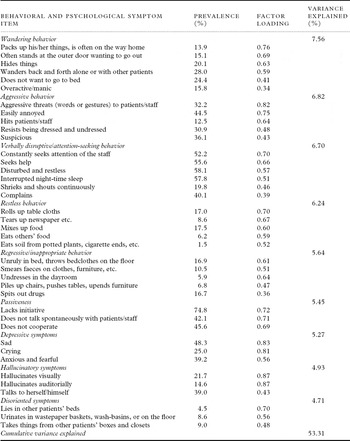
The 39 behavioral and psychological symptoms of the MDDAS were entered into the factor analysis to extract underlying factors. The factor analysis (principal component analysis) with Varimax rotation was performed extracting factors with an eigenvalue of 1 or above. Items are presented in Table 1 under the factor to which they loaded the most, together with their prevalence in the sample, the factor loading (correlation between factor and variable), and, for each factor, the proportion of the total variance in the sample for which the factor accounted.
Behavioral and psychological symptoms

Note: A factor analysis (principal component analysis) with Varimax rotation was performed, extracting factors with an eigenvalue of 1 or above. Items are presented in the table under the factor to which they loaded the most.
The factor structure closely resembled previous factor analyses of the MDDAS in other samples, and factors were also labeled in accordance with these previous analyses (Lövheim et al., Reference Lövheim, Sandman, Kallin, Karlsson and Gustafson2006; Lövheim et al., Reference Lövheim, Sandman, Karlsson and Gustafson2008).
The relationship between the use of different classes of psychotropic drugs (N05A, N05B, N05C, and N06A), anti-dementia drugs (N06D), and behavioral and psychological symptoms were investigated using multiple logistic regressions. The models had drug use as a dependent variable and included behavioral and psychological symptom factors of the MDDAS as well as ADL score, cognitive score, age, and sex as independent variables. The multiple logistic regressions were performed using a step-wise backward selection algorithm based on likelihood ratios in order to select variables for the final models; p < 0.05 was considered statistically significant.
Statistical calculations were performed using the PASW Statistics 18.0 software for Mac.
Results
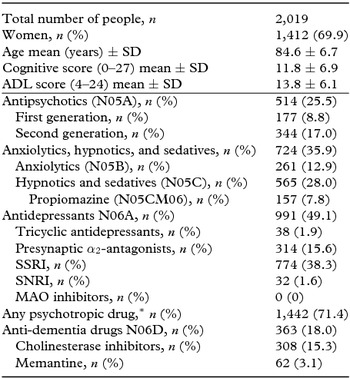
Basic characteristics of the sample and prevalence of psychotropic drug use are presented in Table 2. The mean age in the sample was 84.6 years and 69.9% of the individuals were women. The individuals in the study used an average of 7.3 regular drugs (range 0–20 drugs), while 42 patients (2.1%) were prescribed no regular drugs.
Characteristics of participants and use of psychotropic and anti-dementia drugs

Note: *ATC classes: N05A, N05B, N05C, or N06A.
Antipsychotic drugs were used by 514 individuals (25.5%), with 66.9% (344/514) using second generation antipsychotics. The most commonly prescribed antipsychotic substance was risperidone, and the most common first generation antipsychotic substance was haloperidol. Anxiolytics were used by 261 (12.9%) individuals, and hypnotics and sedatives were used by 565 (28.0%) individuals. Among anxiolytics, hypnotics, and sedatives, zopiclone and oxazepam were the most common substances. Propiomazine was used by 7.8% (157/2,019) individuals.
Antidepressants were used by 991 (49.1%) participants. Selective serotonin reuptake inhibitors (SSRI) accounted for the majority of antidepressant prescriptions (774/991, 78.1%) with citalopram and sertraline being the most common substances. Anti-dementia drugs were used by 363 (18.0%) individuals, comprising mainly acetylcholine esterase inhibitors, which were used by 84.8% (308/363) patients. Sixty-two individuals took memantine, showing that the combination of a cholinesterase inhibitor and memantine was unusual (seven out of the 363 (1.9%) individuals who used anti-dementia drugs).
Just over 71% (71.4%, 1,442/2,019) of the participants took at least one psychotropic drug from the ATC classes: N05A, N05B, N05C, or N06A.
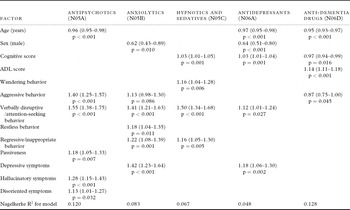
Multiple logistic regression analyses were performed for all psychotropic drug classes: antipsychotics (N05A), anxiolytics (N05B), hypnotics and sedatives (N05C), antidepressants (N06A), and also for anti-dementia drugs (N06D) (Table 3).
Logistic regressions of factors associated with psychotropic and anti-dementia drug use

Notes: For each group of psychotropic drugs and anti-dementia drugs, a multiple logistic regression was performed, using a backward selection algorithm based on likelihood ratios to select variables for the final models. Background variables (age, sex, cognitive-, and ADL-scores) and behavioral and psychological symptom factors (see Table 2) were entered into the regression models. Empty cells represent variables that did not qualify for a final model. Numbers in the table represent odds ratio (confidence interval) and p-values.
In this study population with people aged 65 years and over, age, sex, cognitive score, and ADL score were significantly associated with the use of various psychotropic and anti-dementia drugs. Younger persons were at increased risk of being prescribed antipsychotics, antidepressants, and anti-dementia drugs, and females significantly more often used anxiolytics and antidepressants. A higher cognitive score was significantly associated with the prescribing of hypnotics and sedatives as well as antidepressants, while a lower cognitive score and a higher ADL score were associated with anti-dementia drugs.
The regression models also revealed significant associations between psychotropic drug use and several behavioral and psychological factors. Five of these factors were significantly associated with the use of antipsychotics: aggressive behavior, verbally disruptive/attention-seeking behavior, passiveness, hallucinatory symptoms, and disoriented symptoms all correlated significantly. Further, verbally disruptive/attention-seeking behavior, restless behavior, regressive/inappropriate behavior, and depressive symptoms were associated significantly with the use of anxiolytics. Three behavior and psychological factors were associated with the use of hypnotics and sedatives: wandering behavior, verbally disruptive/attention-seeking behavior, and regressive/inappropriate behavior. Use of antidepressant drugs was associated with verbally disruptive/attention-seeking behavior and depressive symptoms. Finally, use of anti-dementia drugs was significantly associated with a lower risk of aggressive behavior.
Discussion
The seemingly high prevalence of psychotropic drug use (71.4%) in the study population is in agreement with the findings of other studies (Zuidema et al., Reference Zuidema, de Jonghe, Verhey and Koopmans2011). Almost every second person was prescribed an antidepressant drug, with citalopram and sertraline being the most common substances. Antipsychotic drugs, two-thirds of them atypical, were used by 25.5% of patients in this group, while anxiolytics, hypnotics, and sedatives were used by 36%, with zopiclone and oxazepam being the most common substances.
The regression analysis performed revealed six factors associated with use of antipsychotics. The association with lower age is in line with other studies that show that antipsychotics were prescribed more frequently to younger people (Lövheim et al., Reference Lövheim, Sandman, Kallin, Karlsson and Gustafson2006). Individuals who exhibited aggressive behavior or demonstrated hallucinatory symptoms were also prescribed more antipsychotics. These associations might be expected since antipsychotics have been shown to have some efficacy in treating symptoms such as aggression and psychosis (Ballard and Waite, Reference Ballard, Waite and Birks2006) and these symptoms are also approved indications for prescribing antipsychotics (Medical Products Agency, 2008). Associations between antipsychotics and both aggressive behavior and hallucinatory symptoms are well known and comparable with the results of other studies (Chiu et al., Reference Chiu, Chen, Yip, Hua and Tang2006; Lövheim et al., Reference Lövheim, Sandman, Kallin, Karlsson and Gustafson2006; Zuidema et al., Reference Zuidema, de Jonghe, Verhey and Koopmans2011).
Furthermore, this study showed that verbally disruptive/attention-seeking behavior, disoriented symptoms, and passiveness were associated with the use of antipsychotics. The association with passiveness contrasts with the results of other studies (Nijk et al., Reference Nijk, Zuidema and Koopmans2009; Zuidema et al., Reference Zuidema, de Jonghe, Verhey and Koopmans2011) and might possibly reflect a side effect of antipsychotics rather than being an indication for treatment.
The finding that verbally disruptive/attention-seeking behavior, in addition to antipsychotics, was associated with all other psychotropics was unexpected. Evidence of the efficacy of psychotropic drugs for treating patients with these symptoms (constantly seeks attention of the staff, seeks help, disturbed and restless, interrupted night-time sleep, continuous shrieks and shouts, continuous complaints) is limited (Cerejeira et al., Reference Cerejeira, Lagarto and Mukaetova-Ladinska2012). This highlights the question of whether in some cases psychotropic drugs may be prescribed for the wrong reason.
There is growing evidence that discontinuation of antipsychotics is possible – studies have shown that the symptoms of people with dementia remained stable or actually improved when antipsychotics were withdrawn (Ruths et al., Reference Ruths, Straand, Nygaard and Aarsland2008). Furthermore, non-pharmacological approaches, such as psychosocial interventions, are primarily recommended in guidelines (Medical Products Agency, 2008). Music, physical exercise, and recreation might well have some effect on psychological symptoms in individuals with dementia (O’Connor et al., Reference O’Connor, Ames, Gardner and King2009).
In this study, among behavioral and psychological factors, antidepressant drugs were associated with verbally disruptive/attention-seeking behavior and depressive symptoms. The association with depressive symptoms is expected and has been also seen in other studies (Nijk et al., Reference Nijk, Zuidema and Koopmans2009; Zuidema et al., Reference Zuidema, de Jonghe, Verhey and Koopmans2011). However, recently published results show that not only antidepressant drugs fail to produce an antidepressant effect in patients with dementia, compared with placebo, but also show an increased risk of adverse events (Banerjee et al., Reference Banerjee2011). This is an alarming result given the extensive prescription of antidepressants in individuals with cognitive impairment.
Some studies have been published supporting the use of antidepressant drugs as treatment for BPSD other than depression (Lanctôt et al., Reference Lanctôt, Herrmann, van Reekum, Eryavec and Naranjo2002; Pollock et al., Reference Pollock2002), and in Sweden, SSRI is recommended as the first line of treatment for irritability, agitation, and anxiety in individuals with dementia (Medical Products Agency, 2008). However, antidepressants also have many potential side effects and should be used with caution in this generally frail population. The high prevalence of antidepressant drug use in this study deserves concern.
Patients who were prescribed anti-dementia drugs were younger, had a lower cognitive score, and a higher ADL score than those who were not prescribed anti-dementia drugs. The use of anti-dementia drugs was also significantly negatively associated with aggressive behavior. These drugs might in some cases reduce agitation, irritability, and aberrant motor behavior (Tariot et al., Reference Tariot, Farlow, Grossberg, Graham, McDonald and Gergel2004; Gauthier et al., Reference Gauthier2010), and one possible explanation could therefore be that negative association represents a treatment effect rather than a reduced risk of anti-dementia drug prescription in individuals with aggressive behavior.
Some limitations of this study have to be taken into account. The reasons for drug prescription were not recorded in this study, the doses of the drugs were not registered, and we had no information about pro re nata medication. Furthermore, we did not know the duration of psychotropic drug treatment, or whether any attempts at dose reduction or using non-pharmacological treatment of BPSD had been made. The background or other diseases of the participants were not recorded. The observation period was just one week, and therefore reflects only the symptoms the patient exhibited at that time.
The study includes patients from both specialized care units for dementia as well as non-specialized units such as nursing homes and residential care facilities, where the staff might have had less knowledge and experience concerning behavioral and psychological symptoms among patients with cognitive impairment. Whether these differences in knowledge and experience of staff have affected the assessments of behaviors and symptoms is not known.
Cognitive impairment was measured using a scale developed by Gottfries and Gottfries (Adolfsson et al., Reference Adolfsson, Gottfries, Nyström and Winblad1981). This scale has good sensitivity and specificity to the usual 24/30 MMSE cut-off. Nevertheless, some of the persons in the study have been probably estimated false positive or false negative. Since we do not know any diagnoses, we also do not know the causes of person's cognitive impairment. This might have been a dementia disorder but there could also be some other cause. These limitations should be borne in mind when interpreting the results.
The strength of the study includes its large, unselected population of old people with cognitive impairment living in institutional geriatric care settings, the high participation rate, and generally good quality of the recorded data.
The MDDAS instrument has been used to investigate individuals living in institutional geriatric care settings since 1975, and has good inter- and intra-rater reliability. The factor analysis of behavioral and psychological symptoms also closely resembles previous factor analyses of the MDDAS (Lövheim et al., Reference Lövheim, Sandman, Kallin, Karlsson and Gustafson2006), and thus confirms the stable factor structure of this instrument.
Conclusion
The associations between behavioral and psychological symptoms and psychotropic drugs found in this study indicate that these drugs are used to treat behavioral and psychological symptoms in patients with cognitive impairment despite limited evidence for their efficacy. Given the significant risk of adverse effects in old patients with cognitive impairment, it is important to ensure appropriate and safe use of medication.
Conflict of interest
None.
Description of authors’ roles
M. Gustafsson and H. Lövheim analyzed and interpreted the data and prepared the manuscript. P.O. Sandman, S. Karlsson, and Y. Gustafson were responsible for the study concept, design, and acquisition of participants. All authors carried out a critical revision of the manuscript, contributed with comments, and approved the final version.
Acknowledgments
This study was supported financially by grants from the Swedish Dementia Association, Swedish Brain Power, and the County Council of Västerbotten.