One of the most famous tunes ever has also been one of the most peripatetic. Written in 1888 by an Otomí Indian named Juventino Rosas (1868–94) who lived not far from Mexico City, the waltz “Sobre las olas” (“Over the Waves”) soon made its way to North America and beyond, reverberating in the great airy spaces of the circus, fairground, skating rink, dance hall, and park. Recycled in cartoons and films beginning in the 1930s, in television a few decades later, and in various cover versions over its history, Rosas's waltz has become a kind of popular liminal music. Moreover, its ubiquity and the complex, circuitous ways in which it has been reactivated decade by decade has resulted in a musical convention of substantial proportions. This essay will attempt to lay bare the mechanisms at work in the dissemination of such a widely known piece of music.
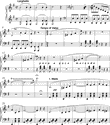
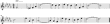
A cursory look at a few adaptations of Rosas's waltz suggests the difficulties for the scholar in attempting to define precisely what “Sobre las olas” has meant, and continues to mean, to its listeners. Consider two recordings of “Sobre las olas” made within two years of each other by Guy Lombardo and his Royal Canadians (1949) and Mario Lanza (1951) titled, respectively, the “Merry-Go-Round Waltz” and “The Loveliest Night of the Year.” Not only do the two performances vary considerably in style, orchestration, and vocal delivery, but their respective themes range from nostalgia for the fairground carousel to a timeless, intense evocation of the sensation of love. Also during the 1940s and 1950s, “Sobre las olas” was heard in animated cartoons as a single eight-measure musical quote paired with a mischievous ice-skating flea (An Itch in Time, 1943) and as a bird-hunting cat running across a set of electric trolley lines (Canary Row, 1950). Example 1 gives the first eight bars of the melody.

Example 1. Juventino Rosas, melody of “Sobre las olas,” mm. 1–8.
One takes strange comfort in David Bordwell's assertion that “the humanities have not yet solved the problem of how to understand conventions.”1
David Bordwell, “Convention, Construction, and Cinematic Vision,” in Post-Theory: Reconstructing Film Studies, ed. David Bordwell and Noël Carroll (Madison: University of Wisconsin Press, 1996), 87.
With respect to the first level of inquiry, four topoi connected with this waltz are identified: space/locale, nostalgia, romance, and, to a lesser extent, technology.2
For an account of the long-standing relationship between technology and the waltz, see Teresa Magdanz, “The Waltz: Technology's Muse,” Journal of Popular Music Studies 18/3 (2006): 251–81.
Martin Rubin, Showstoppers: Busby Berkeley and the Tradition of Spectacle (New York: Columbia University Press, 1993), 14–19.
The omnipresence of Rosas's waltz early in the twentieth century had portentous consequences for new listening experiences. Its increasing saturation in the public-popular realm meant that it began to operate below pop culture's aural and visual radar, being so ubiquitous that it became inaudible. This omnipresence was due to the proliferation of numerous seeing and hearing technologies, as Richard Middleton identifies them.4
Richard Middleton, Studying Popular Music (Milton Keynes: Open University Press, 1990), 64–72.
Finally, in order to understand the evolving sonic requirements of “Sobre las olas,” I examine Ola Stockfelt's treatment of “adequate modes of listening” which is illuminated by Mozart's Symphony no. 40 in G minor, a work that, like Rosas's waltz, is so widely recognized that its very ubiquity has shaped common knowledge and apprehension of it. Stockfelt analyzes various performance arrangements and transcriptions in which Mozart's work has been heard in order to theorize a “sound bite” experience, a mode of listening he proposes to be “adequate” for many of the situations, spaces, and realms for which it has been arranged.5
Ola Stockfelt, “Adequate Modes of Listening,” trans. Anahid Kassabian and Leo G. Svendsen, in Keeping Score: Music, Disciplinarity, Culture, ed. David Schwarz, Anahid Kassabian, and Lawrence Siegel, 129–46 (Charlottesville: University Press of Virginia, 1997). This article is the final chapter of Stockfelt's Musik som lyssnandets konst: en analys av W.A. Mozarts symfoni no 40, g moll (Göteborg: Musikvetenskapliga Institutionen, Göteborg, 1988).
A Mexican Waltz and Its Young Prince
When Rosas left Mexico City early in 1893 to travel with members of the Orquesta Típica Mexicana to Chicago, site of the World's Columbian Exposition, his music—in particular the waltz “Sobre las olas”—was already known in Mexico, Europe, and North America.6
Henceforth, I refer to the World's Columbian Exposition by its more widely accepted name, the “Chicago World's Fair.” For information on publications, arrangements, new editions, and important performances from the late 1880s to ca. 1950 of Rosas's compositions, see the “Thematic Catalog of Works,” in Helmut Brenner, Juventino Rosas: His Life, His Work, His Time (Warren, Mich.: Harmonie Park Press, 2000), 112–62.
James R. Smart, The Sousa Band: A Discography (Washington, D.C.: Library of Congress, 1970), 84; Brenner, Rosas, 127.
For a discussion on the development of musical forms in Mexico, see Ricardo Miranda, Ecos, Alientos y Sonidos: Ensayos sobre Música Mexicana (Xalapa, Ver.: Universidad Veracruzana; México, D.F.: Fondo de Cultura Económica, 2001).
Ricardo Miranda, review of Juventino Rosas: His Life, His Work, His Time by Helmut Brenner, Latin American Music Review 23/1 (Spring–Summer 2002): 147.
When Rosas entered this tradition in the last third of the nineteenth century, he inherited the sensibilities of a sociopolitical system that had profound consequences for the composition and dissemination of Mexican-European popular dance forms. After decades of political and economic turmoil, the rise to power of Porfirio Díaz, who became president in 1876, led to a relatively prosperous era—prosperous, that is, for the middle and upper-middle classes. With an influx of largely foreign capital to boost Mexico's infrastructure, the porfiriato sought to create a second Paris and its cultural-artistic counterpart. This meant a further emphasis on European forms, with the waltz prominent among them.10
Brenner, Rosas, xvii.
This view owes much to Stuart Hall, who argues for a reconsideration of the “popular” culture of all working classes, 1880–1920. See Hall, “Notes on Deconstructing ‘the Popular’,” in People's History and Socialist Theory, ed. Raphael Samuel (London: Routledge & Kegan Paul, 1981), 227–28.
For a composer-musician like Rosas, the porfiriato afforded a thriving atmosphere with many opportunities for performance. By age fifteen, Rosas was reputed to have acquired enough skill as a violinist to accompany the noted Mexican opera singer Ángela Peralta on several of her Mexican tours.12
Brenner, Rosas, 12.
Though the group was named after its bandolón player, José Reyna, sources contemporary with Rosas state the young violinist was the true leader. A photo supports this view (Brenner, Rosas, 34–35), for Rosas is seen sitting in the place reserved for the leader.
Ibid., 29.
Ibid., 12–17.
Ibid., 29.
Ibid., 22–23.
Brenner has included Wagner y Levien's general catalogue of compositions; it shows that Rosas's number of works is only second to that of Ignacio Tejada, an important composer of the time but virtually unknown today. See ibid., 33.
Ibid., 127.
The reasons for Rosas's second trip to the United States, in 1893, are not clear; presumably, the group of which Rosas was a member and sometimes leader wished for better performing opportunities.20
Brenner cites a prior trip to the cotton exhibition of New Orleans in 1884–85. Most likely, Rosas traveled with a military band from the 8th Cavalry Regiment, sent by Porfirio Díaz. Ibid., 45.
See Patrick Warfield, “Making the Band: The Formation of John Philip Sousa's Ensemble,” American Music 24/1 (Spring 2006): 30–66; Reid Badger, The Great American Fair: The World's Columbian Exposition & American Culture (Chicago: Nelson Hall, 1979), 93.
Julio Paulat, “El universal en Chicago,” El Universal (Mexico City), 31 May 1893. Reproduced in Brenner, Rosas, 49.
Joe McKennon, A Pictorial History of the American Carnival},vol. 1 (Sarasota, Fla.: Carnival Publications of Sarasota, 1972), xiii; Badger, Great American Fair, 92–94.
In his book La ciudad blanca (1893), Manuel Serafín Pichardo recounts that he witnessed between 40,000 and 50,000 in attendance at one of Rosas's Chicago concerts. See Brenner, Rosas, 48.
Even by today's standards, it is hard to imagine the magnitude of such an event. Photographs of the interior of the Manufactures building, the largest such structure anywhere at the time of its construction, reveal a mammoth space with an arched roof large enough to contain several land- and cityscapes complete with their own towers and spires. In addition to a few hundred spaces for bazaars and smaller exhibitions, one sees several upper levels where a performing group might situate itself for maximum amplification and light from the glass panels installed above. Rosas's group, comprising two young female dancers and a variety of instrumentalists—playing violins, a clarinet, cornet, saxophones, cello, bajo sexto (a type of guitar with six pairs of strings), double bass, and timpani—dressed in the traditional clothing of the Mexican charros would have made for an arresting aural-visual experience. It is not known if Rosas performed the solo line of “Sobre las olas” as a violin solo during one of the concerts. However, at an important concert in Havana, Cuba, some months later, Rosas was the featured violin soloist in “Sobre las olas” and this particular performance netted him several accolades.25
Brenner cites four reviews covered by the most important of Havana's newspapers, El País (18 January), La Discusión (26 January), El Fígaro (14 January), and La Habana Elegante (28 January), with the last two publishing photographs of Rosas. See Brenner, Rosas, 56.
The photo appeared in El Fígaro (28 January 1894); reproduced in Brenner, Rosas, 54.
By January 1894, Rosas made his way south to Florida, giving concerts in Jacksonville and Tampa before sailing to Cuba. In Havana, Santa Clara, and Trinidad, Rosas found his greatest audience and success, finally reaping considerable financial rewards.27
Brenner, Rosas, 54–56.
The waltzes “Carlota,” “Ensueño,” and “Teresa” are lost; however, their origin is vouched for through reviews of the Cuban press; see ibid., 162.
Rosas surfaced at the moment Europe, North America, and Latin America intersected in their use of the waltz, and was able to tap in to this popular dance form just when it would take on new social significance, particularly in how it became aligned with a rapidly developing mass culture. What set Rosas's waltz apart from those of his contemporaries, Miranda asserts, was the “concept of music” his works implied—“utilitarian, popular and without any type of formal pretensions.”29
Miranda, review of Juventino Rosas, 148.
“Después del baile,” Cronista Mexicano (San Antonio, Tex.), 14 October 1893. Cited in Brenner, Rosas, 50.
“Sobre las olas”: Anatomy of a Waltz
Rosas's waltzes, at least the ones extant, have an introductory section either in 4/4, 3/4, or 6/8 (“Sobre las olas” combines the first two—seven measures of 4/4 followed by fifteen of 3/4), four to eight strains that enfold versions of the first and second themes, and a closing section.31
Of the nineteen waltzes in Rosas's catalogue, eight are missing with no known editions. See ibid., 130–33.

Example 2. Juventino Rosas, “Sobre las olas,” Vals para Piano (México: A. Wagner y Levien, 1888), mm. 1–154; repr. in William E. Studwell, Charles P. Conrad, and Bruce R. Schueneman, Circus Songs: An Annotated Anthology (New York: Haworth Press, 1999).
As Brenner notes, the form of “Sobre las olas” is fairly standard, beginning with an introduction (X A1), followed by part 1 (AA BB A), part 2 (X CC DD C1 C1), and a coda (A B A2).32
Ibid., 126.
Registral conventions used here follow those established by the Acoustical Society of America, in which middle C is C4.
The second and fourth themes (in mm. 57–90 and 161–94, respectively) are reworked versions of the principal theme: the accented lower neighbor's placement—or displacement, more accurately—gives a different vitality and rhythmic sense to the tune(s). The three-note turnaround, B4, A-sharp4, B4, as a complete 3/4 measure, begins the second theme, and the power of the lower note A-sharp is deferred. But only just, for there are signs of life with the statement of the melody now an octave higher, and the addition of two quick grace notes (B4, C5) that proceed the B4 (downbeat of m. 57). Theme four is the first strain to incorporate chords; alternating every other measure, these first and/or second inversion triads are reinforced by an emphatic repetition of a two-measure rhythmic cell. In short, Rosas's melody is a prism refracting variants of one well-focused idea. Although the second theme contains the first instance of syncopation—a dotted-quarter-note followed by an eighth note (m. 58)—there is a curious restraint: this “snap” is placed in mm. 58, 62, 74, and 78 following the turnaround measure, appearing only in the A sections marked energico (mm. 57–64 and 73–80) of the alternating thirty-two-measure ABAB structure of the second theme, and not the B/sentimental sections (mm. 65–72, 81–87).
The third strain (mm. 127–60) creates something new. In a consistent hemiola rhythm interrupted every eight measures by a two-measure cadence on the downbeat, melody and countermelody pair off in a succession of thirds, fourths, fifths, and sixths whose charm is intensified by the virtual stasis of the lower voice. Here, then, is the creolized texture and flavor of Mexican music for which Miranda argues. During much of the nineteenth century, Mexican composers infused the waltz with such melodies and rhythms; one such form, the danza mexicana, is based on the hemiola-laden habanera. Though the danza is in duple meter (Rosa also composed several of these) and the waltz is not, the uplifting third strain suggests more than a trace of folk cross-rhythms. Given the unique rhythmic nature of the third melody, and considering that audiences who saw and heard Rosas as he concertized on his way to the Chicago World's Fair witnessed a performance of the band dressed in Mexican charro costumes with large, embroidered sombreros and trouser seams edged in silver buttons, it is fair to suggest that this portion of the waltz was heard by Rosas's audience north of the Bravo River as a unique blend of Mexican and European musical accents.
More than a century after Rosas crafted this waltz, it is doubtful that listeners identifying this piece would do so by hearing anything other than the first and second strains. Yet for years, the waltz was heard in its entirety. What the modern listener does seem to recall, a feature to which listeners circa 1900 probably also responded, was Rosas's inspired use of the B–A-sharp–B turnaround. In developing this figure, Rosas forged it into an aural calling card hard to forget upon a first hearing.
The Waltz, Genrefication, and Commercial Song Formats
The comparison, as cited above, between “Sobre las olas” and “After the Ball” in terms of mass appeal and commercial success merits a closer look. That two waltzes—one a waltz song about a man pining for a lost love and his youth, the other an instrumental waltz with a captivating melody—could go head-to-toe in the public/popular perception speaks volumes about evolving perceptions of this European genre. And if Rosas's waltz, known at least to some to originate in Mexico, where it “moved with ease between the area of public dances…the concerts of the folk orchestras and the private world and living rooms of the porfiriato families,”34
Miranda, review of Juventino Rosas, 148.
Middleton, Studying Popular Music, 12.
Rosas's fame was not entirely the result of opportunistic publishers, for he was able to synthesize features of the Continental waltz with a pensive, expansive melodic style. Lacking the kind of formal training that might have resulted in a more learned, harmonically complex type of composition, Rosas wrote popular anthems according to his ability. Some have argued that the melancholic tone of Rosas's melody was the result of reckoning with the forces of popular imperialism.36
Miranda, review of Juventino Rosas,147.
Ramón López Velarde, “Melodía Criolla,” in Obras, ed. José Luis Martínez (México: Fondo de Cultura Económica, 1971), 445.
Both Charles Hamm and Nicholas E. Tawa have remarked on the trajectory of the waltz in North America, commenting on its enormous popularity in the last third of the nineteenth century. Hamm ruminates on the possible influence of mid-nineteenth-century German songs (often in triple time), as well as citing the immense popularity of the operettas of Johann Strauss.38
Charles Hamm, Yesterdays: Popular Song in America (New York: W. W. Norton, 1979), 294.
Nicholas E. Tawa, The Way to Tin Pan Alley: American Popular Song, 1866–1910 (New York: Schirmer, 1990), 175–76.
What happened to the waltz in late nineteenth-century Tin Pan Alley set the stage for its subsequent use and meaning in the twentieth century. Market pressures meant that many older musical styles—the schottische and reel come to mind—succumbed to forms more amenable to commercial song formats. The march and the waltz, both venerable forms, flourished; both had metric properties and formal structures that made them compatible with newer forms. One finds, for example, Kerry Mills's “At a Georgia Camptown Meeting” described as “A Characteristic March which can be used effectively as a Two-Step, Polka or Cake Walk.”40
Kerry Mills, “At a Georgia Camptown Meeting” (New York: F. A. Mills Inc., 1899).
Hamm, Yesterdays, 281. Structurally, the waltz song is fairly standard (with the exception of fewer verses as the songs approach and pass the date of 1900), and thus it marks the transition from bourgeois dance form to commercial song ready to infiltrate new markets and spaces (290–94).
The waltz is a more leisurely paced, sentimental, and tragically themed piece than its European counterpart.42
As Hamm notes, several waltz songs have tragic themes. See Hamm, Yesterdays, 296.
Ibid., 292.

“Sobre las olas” fit the pattern of the new commercially viable waltz song. At least two printed versions for voice are known before 1900: one for voice and piano put out by Wagner y Levien in the early 1890s (author of text unknown) and another for men's choir and orchestral or piano accompaniment titled “Wonneseliges Wiegen auf dem blauen Wellenmeer,” words by Julius Gerstorf and published by Hofmeister in 1899.44
Brenner, Rosas, 127.
This list is drawn from three sources: items from Brenner, Rosas (163–64), from John Koegel (personal correspondence), and my own findings.
Dissemination of “Sobre las olas,” ca. 1890–1920
Listening to a recording of “Sobre las olas” made by members of Sousa's band in 1903, one is struck by the slow, elegant pacing of the low brass, the lengthy phrases languidly delivered by clarinets and trumpets, and the adherence to the waltz's original structure with its numerous sections and themes.46
Sousa rarely participated in the recording sessions of the studio bands using his name, although most or all of the musicians recruited for the recordings were either current or former Sousa band members. See Paul E. Bierley, John Philip Sousa: American Phenomenon (Englewood Hills, N.J.,: Prentice-Hall, 1973), 19. For this recording, Arthur Pryor is listed as the leader.
Pryor also made a recording in 1906 of another of Rosas's waltzes, “Enseuño Seductor,” better known as “Impassioned Dream.” See Brenner, Rosas, 23.
Smart, Sousa Band, 62.
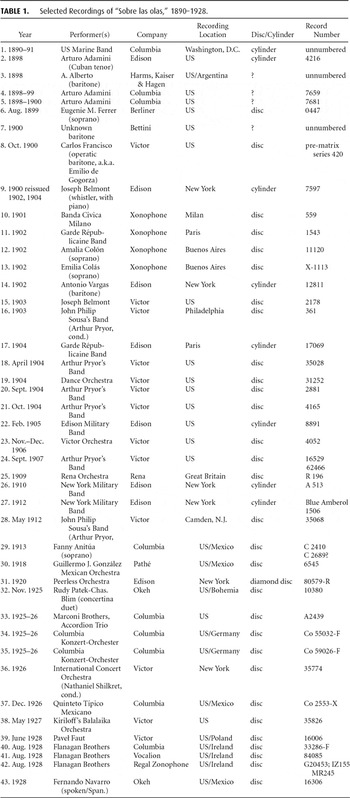
As Table 1 shows, “Sobre las olas” became widely known through a variety of recordings, not only those featuring wind/brass bands such as Sousa's or Pryor's, but also orchestras of varying sizes, trios and quartets, vocalists, concertina and accordion ensembles, and even novelty acts such as a “whistler” with piano accompaniment. This list is not comprehensive, but it indicates the scope of Rosas's waltz, particularly up to and including the late 1920s. I have chosen to highlight the 1903 Sousa recording because it underscores a crucial aspect of the correlation between live band performance and cylinder/disc replication. Rosas's waltz rose to prominence at precisely the same time wind/brass bands were performing throughout North America, Latin America, and Europe. When the Mexican poet Amado Nervo visited Europe in the first years of the twentieth century, he reported hearing several live performances of “Sobre olas olas.”49
Amado Nervo, “Sobre las olas,” in El exodo y las flores del camino. Obras completas, vol. 1, ed. Francisco Gonzalez Guerrero, 1474–76 (Madrid: Editorial Aguilar, 1962).
Margaret Hindle Hazen and Robert M. Hazen, The Music Men: An Illustrated History of Brass Bands in America, 1800–1920 (Washington, D.C.: Smithsonian Institution, 1987), 2, 12.
Ibid., 12.
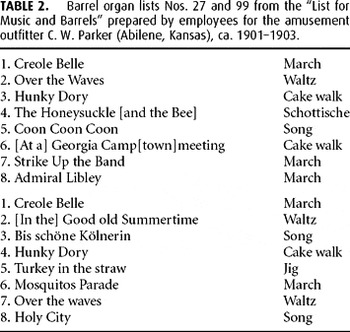
By the turn of the century, “Sobre las olas” had also been arranged for pinned cylinder and player roll configurations. Even before recording technology made strides in terms of mass production and widespread public-personal use circa World War I, these playback technologies were plentiful, and one saw a rapid proliferation during the 1880s and 1890s of automatic musical instruments such as organs, music boxes, polyphons, orchestrions, and mechanical pianos. Their placement in the theater, dance hall, restaurant, indoor skating pavilion, lodge, nickelodeon, as well as the circus and fairground resulted in music's transmission cutting across several uses and locations at once. One finds, for example, the inclusion of “Sobre las olas” in the records workers kept from 1901 to 1903 of musical selections arranged for fairground organ for the large amusement outfitter C. W. Parker of Abilene, Kansas (Table 2 reproduces this list).

The records not only contain an inventory of selections from which customers could choose the content and order of their music roll but also the details of over one hundred customer orders.52
I am indebted to Matthew Caulfield who provided me with a copy of the Parker Company catalogue contents. The original is from the private collection of Barbara Fah Charles.
Two waltzes that appear more than any other are “Estudiantina” and “Skaters' Waltz,” both by Emile Waldteufel, as well as the “Waltz” from the opera Faust by Charles Gounod.
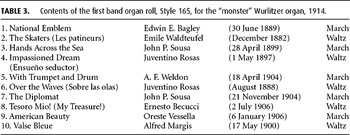
Soon after 1900, Wurlitzer marketed various-sized automatic instruments as well as the perforated paper player rolls intended for them. After 1906, the company began to sell a series of enormous organs targeted to proprietors of vast spaces, particularly the fairground, skating rink, and dance hall. Not until 1914 did the company solve the problem of loading several tunes of a decent length onto one roll, and thus the “monster” organ caught on.54
For a detailed history of the Wurlitzer Style 165, see Ron Bopp, The American Carousel Organ: An Illustrated Encyclopedia, ed. Matthew Caulfield (St. Cloud, Minn.: Palmer Printing, 1998), 127–36.
“Section One: Rolls Issued by the Rudolph Wurlitzer Company,” in A Catalog of Music Rolls for the Wurlitzer Military Band Organ Style 165, ed. Matthew O. Caulfield, comp. Gary Watkins, http://wurlitzer-rolls.com.

In contrast with the widespread practice of producing monthly and sometimes weekly rolls catering to the hit parade and thus timely music, the “Style 165” roll contains a careful compilation of both marches and waltzes already several years old and each with a known history; such a roll was introduced with the idea it could be re-cut and reissued in the decades to come. Although one might expect to see a waltz by Strauss, there is none; instead the roll contains two of Rosas's better-known waltz compositions. Rosas is not the only composer of a hit tune whose name was relatively unknown to the public—consider the roll's final selection, “Valse Bleue,” a graceful waltz long associated with high-wire and trapeze acts written by the little-known French musician Alfred Margis (1874–?). Regarding the actual band organ arrangement of “Sobre las olas,” one hears all verses of the waltz; a much brighter tempo than, say, the 1903 Sousa recording; a strident, garish tonal quality to cut through any din; and the intricate arrangement of numerous parts not originating with Rosas's composition. Earlier pinned-cylinder roll versions such as the tunes listed in the Parker catalogue rarely provided more than the first theme or two of a work. Thus Rosas's waltz was beginning to be heard in abbreviated form alongside versions of the complete waltz; this use of excerpts had implications for its increased presence through quotations.
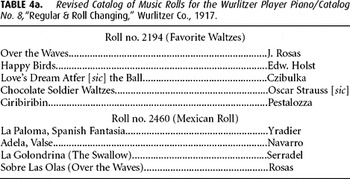
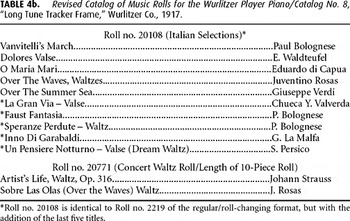
Explorations of the music roll, player piano technology, and motion picture exhibition house around 1910 to 1920 potentially offer the most tantalizing prospects for uncovering the roots of a relatively early mediated aural-visual idea of “Sobre las olas.” If this waltz had any currency in early twentieth-century vaudeville and variety theater, the ways in which it was utilized would also appear in film of the 1910s, the date by which the link between such theater and early film practice was well established. Yet compared with the “evidence” that synchronous film would provide beginning 1927, precisely how music was used in film during the second decade of the twentieth century is sketchy at best. We know that “Sobre las olas” was well represented in the player roll manuals for motion-picture exhibition during this pre-synchronous time. A comprehensive catalogue put out by Wurlitzer in 1917 contains a list of 590 rolls and their contents, including song titles from back issues. In addition, the catalogue's title page states that the rolls accommodate fourteen different kinds of automated music instruments, indicating a massive scale of industry coverage of music for 1910s film.56
Revised Catalog of Music Rolls for the Wurlitzer Player Piano/Catalog No. 8/“Regular and Roll Changing” (New York: Rudolph Wurlitzer Co., 1917).
Revised Catalog of Music Rolls for the Wurlitzer Player Piano/Catalog No. 8/“Long Tune Tracker Frame” (New York: Rudolph Wurlitzer Co., 1917).


Several of these pieces are still known today. Classics such as “Over the Summer Sea” (a song version of Verdi's famous aria “La donna è mobile” from Rigoletto) or a medley of the more popular waltzes from Oscar Straus's comedic operetta enjoyed crossover success;58
Several of Verdi's operas and arias—“La donna è mobile,” for example—were known in North America in the 1850s, concurrent with their success in Europe. Straus's The Chocolate Soldier opened at the Lyric Theater in 1909 to public acclaim.
“Sobre las olas” was thus widely accessible to many listeners a century ago—to those attending the Chicago World's Fair who heard Rosas's orquesta render the famous waltz, to those who encountered the tune through other performing forces (wind/brass bands, trios, quartets, singers, pianists, and orchestras), and to audiences who heard a recording on a phonograph, radio, or player piano.
Modes of Listening: “Sobre las olas”
The various situations in which “Sobre las olas” has been encountered for over a century have encouraged “modes of listening,” to paraphrase Stockfelt, different from the concentrated, autonomous listening one generally associates with the concert hall.59
Stockfelt, “Adequate Modes of Listening,” 133.
Ibid.
Middleton, Studying Popular Music, 68.
Ibid.
Stockfelt, “Adequate Modes of Listening,” 133.
Each hearing person who listens to the radio, watches TV, goes to the movies, goes dancing, eats in restaurants, goes to supermarkets, participates in parties…has been forced (in order to be able to handle her or his perceptions of sound)…to build up an appreciable competence in translating and using the music impressions that stream in from loudspeakers in almost every living space.64
Ibid., 132.
Such competence may transcend age, race, and class, and is predicated on the following criteria. First, it is forged through daily learning “on the spot.” In this education which takes place in the classroom of the everyday, individuals learn “which different types of music correlate with which activity and…subculture [and] which type of intramusical meanings attach to different types of sound in different musical contexts.”65
Ibid., 132–33.
A crucial implication of Stockfelt's idea for the “Sobre las olas” sound image is his notion of “sound bite” listening.66
Chosen by the author in consultation with the article's translators, “sound bite” is meant to convey ideas of speed and discreteness, both notions that the original Swedish term momentant lyssnande denotes. Ibid., 143.
My emphasis. Ibid., 131–32.
Schematizing “Sobre las olas”: Topoi, the Aggregate, and Cinematic Imagination
There is a profound sense in which the majority of listening situations over the past one hundred years or so of Rosas's waltz have produced a ubiquitous yet unexamined musical message. Its link with the huge spaces of the circus and fairground, with their cacophony of sound and activity, seem emblematic of this sense. By the time moviegoing became an activity for all classes, the experience of hearing “Sobre las olas” was widespread and in some sense sublimated. My observation of the public-popular experience of Rosas's waltz during mass culture's early years places film as receiving rather than originating the sense of the sound images associated with Rosas's waltz. The very work of film has left a legacy of reenactment strategies further impacting auditor-viewer perception. It is these strategies, as I will demonstrate with examples of several widely known films and animated cartoons, that have led to our collective knowledge and experience of “Sobre las olas” as implicit rather than explicit.
Whereas much has been made of the visual quality of the picture-taking scene in George Stevens's bio-picture Annie Oakley (1935), virtually nothing has been said of its sonic characteristics.68
See for example, Donald Richie, George Stevens: An American Romantic (New York: Garland, 1985), 48; George Stevens, George Stevens: Interviews, ed. Paul Cronin (Jackson: University Press of Mississippi, 2004), 36–37.
Stevens himself referred to this approach as “frame composition,” incorporating it in other of his films such as Laddie and Alice Adams, both released 1935.
What does this invocation of nostalgia mean to an understanding of Rosas's waltz? It suggests that the sense or feeling of the picture-taking scene is more critical to the auditor-viewer's experience than an accounting of its details. This is not to say that audiences did not hear the waltz, but rather, its recognition as a piece of music with a title, history, list of associations, etc., may not have been essential to comprehending and immersing oneself in the scene. At the same time, the use of Rosas's waltz to “time” or cover the entire sequence also bore consequences for its comprehension. In this way, its use was similar to that of silent film practice whereby accompanists or “synchronizers,” as they were known, calculated the correct length of music to fill a scene. The main purpose of this widespread practice, as Kathryn Kalinak asserts, was to avoid a lapse into ghastly silence that might disrupt the spectator from the fictive (visual) reality on the screen.70
Kathryn Kalinak, Settling the Score: Music and the Classical Hollywood Film (Madison: University of Wisconsin Press, 1992), 58.
If sound bite listening is not a factor in the scene from Annie Oakley, the animated cartoon evinces a wholesale adoption of its procedures and postures; as well, it seems to have Stockfelt's criteria in place by the 1940s if not sooner. Consider, for example, the Warner Bros. cartoons An Itch in Time (1943; dir. Robert Clampett) and Canary Row (1950; dir. Friz Freleng). In these animated shorts, a brief quotation works to transport the audio-viewer to realms outside the present time, particularly to spaces of leisure and fun. But these spaces, temporary retreats or bubbles carved apart from reality and gravity, are never far from peril—thus the cartoon character who ice-skates or gracefully walks a tightrope faces an almost certain demise.71
My thanks to one of JSAM's anonymous readers for clarifying the waltz's ability to invoke pastness, a purposeful destabilization of the present.
Canary Row displays a similar idea. Sylvester the Cat spots Tweety Bird in a San Francisco apartment and tries to gain access but cannot make it past Granny or the cat-hating desk clerk. Towards the cartoon's end, after Sylvester has tried several tactics to ensnare his canary prey, he climbs up a drainpipe and onto some trolley lines hoping to jump into the nearby apartment building where Tweety is sitting in a cage. The instant Sylvester steps onto the electrically charged trolley line, a four-measure vamp links the previous melody to the first eight measures of the “Sobre las olas” main theme; helped by Rosas's waltz, Sylvester has momentarily become a tightrope walker. Any grace the music is felt to possess is countered by the tongue-wagging I-told-you-so tone of the theme's delivery by a flutter-tongued flute. At the clanging of a trolley bell, Sylvester performs the most Disneyesque of actions—a quick leap in the air with a black-and-white jagged cloud above to signal the realization of his dire predicament. For Sylvester is, after all and notwithstanding the circus music, in an urban environment and in imminent danger of being electrocuted by a trolley driven by Tweety and Granny, his keeper.
How does the use of this famous tune—its brief appearance between countless other musical quotes—structure auditor-viewers' understanding and perception of it? Dick Van Dyke's performance in Mary Poppins (1964; dir. Robert Stevenson) fourteen years later points to an answer. Bert (Van Dyke) is intent on introducing the Banks children (Karen Dotrice and Matthew Garber) to the transformative ways of imagining and playing; his tools for this work are chalk and a walking stick. With the former, he draws situations and playscapes on the pavement that one would like to visit. With the latter, he sets about performing both of his suggested scenarios “Punting on the Thames” and the high-wire act “At the Circus,” first using the stick as an oar for pushing the flat-bottomed punt along, and next, as an aid to keep balanced on the imaginary tightrope. As Bert wobbles on the tightrope, pretending to teeter while clapping one hand over both eyes in an action suggesting he is terrified to look down, he frames his performance by singing “Ta-da,” making the corresponding gestures of bowing and holding out his arms. Immediately he begins humming a sort of tune under his breath as he seeks to gain his balance on the pretend wire. The orchestra (hidden) attempts to follow Bert, starting slowly and gaining in tempo as he picks up the pace of his physical storytelling. He does not get very far before, interrupting his action and vocalizing with a triumphant “Ta da,” he is on to the next “performance.” Less than ten seconds long, this moment is over before one can digest it.
Is the brevity of the musical quote, the method of burying the music through the lens of improvisation and vocal extemporization, the key to ascertaining the mystery waltz's ubiquitous yet invisible-and-inaudible status? On audio-viewing the tightrope scene several times, one has the sense that the actor improvised it in rehearsal, his almost certain knowledge of cartoons and the place of “Sobre las olas” within them helping him to bracket his movement, mime, and singing with the very strategies implicit in other ubiquitous media. That the orchestra is unable to keep pace with his vocalizing gives the added sense of an unrehearsed and improvised performance. Bert's physical and vocal improvisation is utterly immersive and demands a level of attention and participation from the auditor-viewer different from, say, narrative film. It is this immersion, I argue, that virtually guarantees the music's inaudibility. In An Itch in Time and Cannery Row, our perception of the cartoon characters' ability to improvise various solutions to the “flea” or “bird” problem is due not just to the script but to the technique known as “Mickey Mousing,” in which the gestural in music is precisely wedded to the actions and thoughts of the character, making him/her appear as though motivated. The creation of a sound bite of Rosas's waltz here reveals a curious duality: whereas the characters of Mary Poppins and the animated shorts discussed above do not actually originate the musical quote, the techniques implicit in both movie musical and cartoon nevertheless work to get across the natural and wholly convincing notion of the music's originating at the hands of an onscreen character.
The previous examples make clear how ideas of space and the activities connected with those spaces have impacted meanings ascribed to “Sobre las olas.” In Annie Oakley, the Wild West comprises the great outdoors that nonetheless is mediated by finite spaces such as the show ring and shooting range; moreover, these spaces are viewed through a blend of the “real” (apparent motion) and “photographic” (still frames). Even the cartoonish and the comedic rely on certain notions of space aligned with a particular activity: for example, the physical comedy of Sylvester the Cat and Dick Van Dyke emphasizes the precariousness of their respective situations due to the extreme height of the aerial maneuvers. Space defines the shape of Rosas's waltz in relation to the activity presented. Space is also a convenient metaphor by which to “double up” meanings and associations. In An Itch in Time, Canary Row, and Mary Poppins, pleasure skating, tightrope walking, and vaudeville theatricality are elided because historically they have taken place in similar locales and configurations.72
The association of “Sobre las olas” with circus aerial acts is almost as old as Rosas's waltz itself. A recent edition of works by Manuel Manilla (ca. 1830–90s?) includes an engraving showing a young man perched atop a high-wire platform, one hand on the safety rope, the other on the center pole; the engraving is titled “‘Sobre las olas’ for 1892.” Monografía de 598 estampas de Manuel Manilla, grabador mexicano, ed. Mercurio López Casillas (México, D.F.: Editorial RM, 2005), 67. My thanks to John Koegel for bringing this image to my attention.
Rubin, Showstoppers, 17.
Ibid.
In The Ape (1940; dir. William Nigh), Boris Karloff plays Dr. Adrian, a scientist determined to find a cure for paralysis by developing a vaccine from human spinal fluid. With his wife and daughter dead from polio and a young neighbor Frances (Maris Wrixon) now afflicted with the disease, Adrian allows a patient to die so that he can tap the dead man's spine. The patient, an animal trainer from the local circus, was mauled by the now escaped ape; the dying man, we are led to believe, provoked the ape and his subsequent treatment at the hands of Dr. Adrian is thus fitting. In a bid to help Frances overcome her despondency at being confined to a wheelchair, Dr. Adrian suggests that she and a friend, Danny (Gene O'Donnell) visit the circus. We see the doctor and Danny lift the young woman and wheelchair, carefully placing her at the back of the small wagon. The highlight of the evening for Frances, as for the circus audience, is the aerial act occurring inside the big tent. As the camera focuses on the activity in the tent's center, with horses in plumage running amok, clowns chasing after them, and a huge dipper rotating on a vertical axis and carrying two acrobats, the small band (briefly seen) begins to play Rosas's waltz.
The capacious, stately, big-gestured themes of the waltz so beautifully emphasize the sculpting in air of the large swinging motions of the aerial artists, especially as the camera closes in on the activity near the ceiling. We see shadow play as the aerial artists execute their maneuvers. During two strains of the waltz, the routines of the trapeze artists interspersed with the fascinated gaze of spectators below are seen. The reason for the camera's fascination with the air play is finally revealed; Frances remarks on the muscular grace and coordination of the artists—something she hopes to have if she ever regains her mobility. This scene reenacts two things simultaneously: polio and its paralytic effects are remembered in tandem with a popular, spellbinding entertainment of the time. Historically, the circus has been a place of transgression, of the carnivalesque, and of change; here, the somersaulting and slowly twisting male and female acrobats offer hope to the protagonist and, by extension, to the movie audience of 1940. Because “Sobre las olas” accompanies the aerial circus action and underlines the grace and ease of the onscreen motions, its part in the double reenactment is keenly felt.
Although Busby Berkeley's Strike up the Band (1940) employs one of Rubin's aggregate pairs—the theater/amusement park duo—it does this by a loose association of the stage and fairground in entirely separate scenes. Thus “Sobre las olas” is heard as part of a play within the film's plot (ostensibly indoors) while in an earlier scene and outdoors, a carousel and Ferris wheel rotate to the strains of another waltz, “Oh Where, Oh Where Has My Little Dog Gone.” Jimmy (Mickey Rooney) and Mary (Judy Garland) are high school students from a small town in the Midwest who are determined to raise funds to send the school's dance band to Chicago for the finals of a talent contest being broadcast over radio. One of the events is a fully staged 1880s farce-melodrama called Nell from New Rochelle starring Garland as the innocent and poverty-stricken Nellie, her often drunk suitor Billy (Rooney), and the villain Squire Poultice (William Tracy), who schemes to take Nellie away from Billy. This “show within a show” generates its own musical pastiche: bits of movie orchestration mix with old standards such as “Ta-Ra-Ra-Boom-De-Ay!” (1891), “Come Home, Father” (1864), “After the Ball,” and “Sobre las olas.” The Squire has taken Nellie off the streets and to a ball with the promise of dinner and champagne. An elaborate dance is under way as we see the pair sitting down to eat. The music is a generically scored waltz, which, as we focus on Nellie and the Squire, smoothly changes to the main theme of Rosas's waltz. Ostensibly music to accompany their candle-lit dinner, the effect turns comedic as Nell who is offered a “demitasse” of coffee by the Squire is heard to exclaim: “You may tempt the upper classes with your villainous demitasses, but Lord protect the working girl!” Rosas's waltz has been heard for approximately twenty seconds. One could ask why the film's music arrangers and orchestrators bothered to weave in parts of this waltz. Why not simply employ generic scoring for the entire farce, as was done for its opening number and other parts of the act? Does it connote authenticity, helping Berkeley's audience to recall the immediacy of the older theatrical traditions? “Sobre las olas” does not accompany the dancers or the protagonists' dinner conversation, as much as it evokes a feeling of “pastness” for the movie audience, which by design is the secondary one. (The melodrama's audience is seen briefly at the show's end as the curtain closes.) In this way, Rosas's waltz is recast to sound and look like historically accurate music for the rendering of a nineteenth-century theatrical presentation within a modern film.
“Sobre las olas” and the Commercial Song Format Revisited
Docudramatic reenactments, such as those discussed above, presented the North American public with sonic visions of leisure activities for the most part in decline. When James Agee recalled the days of the nickelodeon theater, for example, he included the mechanical waltz as a critical feature of his remembrance: “The barefaced honky-tonk and the waltzes by Waldteufel, slammed out in [sic] a mechanized piano; the searing redolence of peanuts and demirep perfumery, tobacco and feet, and sweat; the laughter of unrespectable people having a hell of a fine time, laughter as violent and steady and deafening as standing under a waterfall.”75
James Agee, “Comedy's Greatest Era,” Life, 5 September 1949, 74; repr. in James Agee, Agee on Film, vol. 1, Reviews and Comments (New York: Grosset & Dunlap, 1967), 6–7.
One finds similar criteria inscribed in a recording that Guy Lombardo and his Royal Canadians made the same year Agee wrote his article. Aired live on radio twice in early 1949 and then recorded in April, “The Merry-Go-Round Waltz” was none other than a new rendering of Rosas's “Sobre las olas.”76
Recorded for Decca (No. 24624) on 4 April 1949 in New York City.

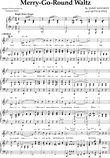
Example 3. Jimmy Kennedy and Arthur Finn, “Merry-Go-Round Waltz,” introduction and chorus.
MERRY-GO-ROUND WALTZ
Written by JIMMY KENNEDY and ARTHUR FINN
Used by Permission of Shapiro, Bernstein & Co., Inc.
All rights reserved International Copyright Secured
One immediately hears an important aspect of this new version: Jimmy Kennedy and Arthur Finn updated the traditional multi-strain arrangement by putting the waltz into a more accessible verse-chorus format by dropping three strains from the original five, instead employing Rosas's main tune as the opening chorus and the second strain as the verse, or, as it is called here, the interlude. Moreover, Finn gave the waltz a set of lyrics that would appeal to Lombardo's listeners, enshrining Lombardo's credo of “cheek-to-cheek” dancing in a colorful sound image giving a double-sided resonance to the ballroom/fairground experience.77
This was not the first time Rosas's waltz was set to words. According to Brenner, the first version is from the early 1890s and appears to have been published in Mexico City by Rosas's publisher Wagner y Levien. The second version, titled “Lisettchen. Walzer nach der Melodie Über den Wellen” with lyrics by Alexander von Biczó, was published “before 1918” in Vienna by Josef Eberle & Co. In 1928, Fernando Navarro recorded a version of Rosas's waltz that declaimed a spoken text in Spanish over the waltz (Okeh, No. 16306). Navarro's version is available at the Frontera Collection of Mexican American Music/UCLA Music Library website, http://digital.library.ucla.edu/frontera. Brenner does not include the Kennedy/Finn adaptation in the list of publications, nor the Lombardo recording in the discography. See Brenner, Rosas, 127.
A critical aspect of the song with respect to this discussion pertains to the carousel music's quality. On the one hand, the lyrics seem to indicate that a live band is responsible for providing the carousel's music: “There's a thrill in the waltz that they play.” Lombardo began to perform before 1920 in London, Ontario's open-air bandstands and fairgrounds. The lyrics, then, could be heard as establishing this bit of Lombardo's early history, thus rewarding the Royal Canadians' fan with an inside bit of knowledge that the average radio listener might not possess. On the other hand, in the 1949 recording, one is presented with a variety of strategies for portraying the sound possibilities of the carousel. First, the five-sectioned structure (chorus, interlude, chorus, interlude, and chorus) gives the band the musical space in which to deliver various sonic “impressions” of the carousel. Throughout the first chorus and interlude the band alternates between group singing in three-part harmony (in either eight-measure or sixteen-measure sections) and the solo baritone voice of Kenny Gardner (eight-measure sections). Various little instrumental fills, whether ascending piano glissandos, trumpet shots, or descending woodwind lines periodically punctuate the ends of sections, always on the final two beats. Already, the Royal Canadians' performance suggests a carousel organ arrangement where the piccolo, trumpet, or violin stops of the bigger fairground organs typically would be given such figurative musical bits.78
For a discussion of the classic American carousel organ sound, see Caulfield, Appendix (observations on roll makers and arrangers), A Catalog of Music Rolls for the Wurlitzer Military Band Organ Style 165, http://wurlitzer-rolls.com.
There is yet another sonic impression crucial to this song and all it signifies: if the “figurative bits” suggest a fairground organ arrangement, then the short alternating phrases are emblematic of the sound bite listening Lombardo's fans might have experienced outdoors and through turn-of-the-century organ arrangements. That this might be a crucial way to hear and to remember the Royal Canadians' performance is attested to by the late-1949 issuance by the T.R.T. Manufacturing Company of North Tonawanda, New York, of a band organ roll that included an arrangement of the Kennedy/Finn version of Rosas's waltz.
Why would someone take the trouble to rearrange this waltz since the original one had already been arranged several times for fairground organ, and could easily be reproduced from an old master? Whereas listeners coming across this version in a fairground or indoor skating rink might associate it with the Royal Canadians' recording, it seems unlikely, since the characteristics that would highlight this connection—its lyrics, Kenny Gardner's voice and the band's performance, as well as the sound effects “treatment”—are absent. The answer lies in the increasing experience of Rosas's waltz as a brief quote of music, much like the cellular phone ringtones of the early twenty-first century that often produce only two or three measures of a similarly well-known piece of music.
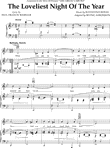
The most significant spin-off of the Kennedy/Finn adaptation was a dreamy waltz ballad written for Mario Lanza by friend and colleague Irving Aaronson and lyricist Paul Francis Webster. Like the “Merry-Go-Round Waltz,” “The Loveliest Night of the Year” was an adaptation of “Sobre las olas” incorporating a chorus-verse format. Example 4 gives the first half of the chorus.

Example 4. Irving Aaronson and Paul Frances Webster, “The Loveliest Night of the Year,” mm. 1–20.
THE LOVELIEST NIGHT OF THE YEAR
Music and Lyrics by PAUL FRANCIS WEBSTER and IRVING AARONSON
© 1950, 1951 (Renewed 1978, 1979) METRO-GOLDWYN-MAYER INC.
and WEBSTER MUSIC CORP.
Rights for METRO-GOLDWYN-MAYER INC. Assigned to EMI CATALOGUE PARTNERSHIP
All Rights Controlled and Administered by EMI ROBBINS CATALOG INC. (Publishing) and
ALFRED PUBLISHING CO., INC. (Print)
All Rights Reserved Used by Permission of ALFRED PUBLISHING CO., INC.
Without a doubt, Kennedy and Finn's adaptation had provided Aaronson and Webster with two crucial ingredients: by reworking the nineteenth-century waltz into a contemporary song arrangement and imbuing it with contemporary notions of romantic love, it was proven marketable for radio play. In the Kennedy/Finn arrangement, as we saw, the fairground carousel was emblematic of heterosexual romance seen and heard through a veil of nostalgia. The Aaronson/Webster version, however, employs various physical sensations and experiences not directly linked to the carousel, as a metaphor for being/falling in love. Romantic love in this second adaptation is likened to the meaning-sense a song and its poetry produce for the receiver (“Words fall into rhyme, any time you are holding me near”), or the sense of being able to commune with one's natural environment (“Stars twinkle above, and you almost can touch them from here”). The question is how listeners of the early 1950s might process the latest incarnation of Rosas's waltz with so many other versions still in the airwaves, most notably the Guy Lombardo version?
In terms of subject matter and sense, the two adaptations are not as far apart as they might initially seem. Both inscribe romance through close physical contact of the slow, languid, close-dancing type. The sensation of being in love, as I earlier argued, is linked with feelings of voluminousness, fullness, and abundance—the very attributes Martin Rubin attributes to the popular, gargantuan forms of late nineteenth-century entertainment that strive to create a sense of fullness, variety, and wonder in their inclination towards spectacle.79
Rubin, Showstoppers, 4.
See Derek Mannering, Mario Lanza: Singing to the Gods (London: Robert Hale, 2001); and Mario Lanza: A Biography (London: Robert Hale, 1991) for a discussion of Lanza as the supreme 1950s crossover artist.
Mannering, Singing to the Gods, 94–97.
In many ways, these adaptations circa 1949–1951 represent the most fascinating and telling attempts to repatriate “Sobre las olas” into everyday North American culture. First, the two song versions were meant primarily for radio and home phonograph use rather than the cinema. True, “The Loveliest Night of the Year” was heard and seen in the MGM bio-picture The Great Caruso; however, it was not sung by Lanza but rather to him by co-star Ann Blyth as they dance in a close embrace. Its recording by Lanza on 23 February 1951 was meant for record release only.82
Recorded for RCA at the Manhattan Center, New York, with the RCA Victor Orchestra conducted by Constantine Callinicos (#E1RB-1166-1).
Ann Blyth was equally feted by the press ca. 1950. Multitalented as both an operatically trained singer and actor, Blyth made several films in the late 1940s and starred in the popular family drama Our Very Own (1950; dir. David Miller). In 1951, the year of The Great Caruso, she starred in five films.
If record sales are any indication, the Royal Canadians were still a major force in popular music, reportedly selling eleven million records annually during the late forties and early fifties. See Guy Lombardo and Jack Altshul, Auld Acquaintance (Garden City, N.Y.: Doubleday, 1975), 150, 208.
Lombardo and Altshul's Auld Acquaintance describes how Lombardo and his brother and fellow band member Carmen Lombardo regularly dealt with the song pluggers, their agencies, and publishing companies (117–51).
The dust jacket of Brenner's Juventino Rosas shows Rosas proudly wearing the four medals won at the Chicago World's Fair for four of his compositions.
“Sobre las olas” as Postmodern Melancholy
The Kennedy/Finn and Aaronson/Webster adaptations are important moments in the trajectory of Rosas's waltz; however, they alone do not constitute a complete recording history for “Sobre las olas” circa 1950. Recordings include performances by a diverse group of artists, among them: the Bob Crosby Big Band (1940), George Lewis (1945, 1951), Pedro Infante (1950),87
Pedro Infante, Mexico's biggest star for approximately three decades, also starred in the Mexican-filmed Sobre las olas (1950), a sentimentalized rendering of Rosas's life.
Tom Lord, The Jazz Discography (West Vancouver, B.C.: Lord Music Reference, 1992–2004), lists 118 recordings of “Sobre las olas,” with a number of them made during the 1940s and 1950s Dixieland revival.
Television became a prime medium during the 1950s and 1960s in which to hear “Sobre las olas.” Annie Oakley, for example, was programmed frequently on daytime television. In addition to movies, animated shorts also were a vehicle through which to see and hear “Sobre las olas.” These cartoons, of course, were a crucial part of a young viewer's television diet. As Ray Bradbury wrote: “How many of us, coming out of a theatre, or seated in front of the set, have tried to remember, in all its crazed detail, the exact dialogue of ‘Duck Season, Rabbit Season, shoot 'em, shoot 'em!’”89
Ray Bradbury, foreword to Steve Schneider, That's All Folks! The Art of Warner Bros. Animation (New York: Henry Holt, 1988), 10.
Eventually a phenomenon—in this case, a sound image—reinvents itself to be relevant to a culture and society. Put another way, a society decides what it wants to keep, which stories or myths it wants to tell about itself, and which symbols will accomplish such a task. From the 1960s on, one was confronted with a different cultural order. The epoch of the North American circus (1850–1950) was over, and the fairground did not have the same impact it had twenty years earlier. Live vaudeville and revue-style theater were replaced by television and “format” shows such as Jackie Gleason and The Ed Sullivan Show. How then does one situate “Sobre las olas” within late-modern society when one is listening to and looking at mimetic reenactments, a palimpsest of the past?
When it popped up in Irvin Kershner's 1972 film Up the Sandbox, “Sobre las olas” was conspicuously displayed, not because it was paired with a famous location (New York's Central Park) or with a celebrity, Barbra Streisand, but because it dealt with an explosive issue in the early 1970s, abortion. Margaret Reynolds (Streisand) is a university-educated aspiring writer, housewife, and mother yearning for intellectual stimulation. We see Margaret's staged fantasies of bombing the Statue of Liberty with a group of militants, or debating with and then seducing a cross-dressing Fidel Castro. Another fantasy occurs as she leaves an abortion clinic after deciding she cannot go through with the procedure. After a wild ride on a gurney through Manhattan, Margaret “wakes up” as she is unceremoniously dumped at a playground. Moments later we see Margaret who is staring at the whirling mass of the carousel ride at Central Park searching for her husband and two children. The big, booming sound and stately rhythm of the carousel organ as it plays “Sobre las olas” is a new sound and type of music in this film. Until now, the soundtrack has been part of Margaret's imaginary world; accordingly, her imagined soundscape is dreamy, nightmarish, and chaotic. In contrast, the sounds of the carousel and its appearance in Central Park are staunchly real. When Margaret shouts to her husband, Paul, who is riding the carousel with the couple's two children, that she is pregnant, yet another of her fantasies begins. A good portion of the carousel organ arrangement cuts out as dialogue between the two adults begins. Sounding like a faint music box but with the added sound effects of whistling wind, we hear the voice-over narration of Margaret's and Paul's conversation as they muse on whether to have more children. The film reenacts a switch between two modes of listening and thus plays upon some of the conventions of hearing discussed earlier. Crucially, both listening postures are “environmental” and are listening situations at the behest of a primary activity (i.e., gazing, speaking, imagining). In this way, an entire history of hearing “Sobre las olas” is enacted in a single scene.
One would think that after Lombardo and Lanza, certainly long after the fairground had enjoyed popular status, that the sound of the carousel and its music would be irrelevant. Yet it is the music in this scene reminding us of what it is to be free of encumbrance and responsibility; the sounds of the carousel hint at innocence and whimsy. At the same time the carousel's riders are having a marvelous time, however, its music symbolizes the toll exacted on a mother who on the one hand desires safety and stability for her family but on the other yearns to break free from such restraints. In this way “Sobre las olas” can be heard as reinforcing the kinds of ideals presented in the earlier song versions, but with a difference: where the former stressed romantic love, the more recent film suggests the tyranny of such an ideal.
The use of “Sobre las olas” in Kershner's film is part of a trajectory of uses signifying the desire to circumvent one's circumstance, whether physical or spiritual. For example, there is the polio-stricken Frances who marvels at the physical grace of the acrobats while the circus band plays Rosas's waltz in The Ape. Similarly, Bert's brief improvisation in Mary Poppins while he vocalizes “Sobre las olas” is meant to show the value of creative play. Certainly Lanza's recording of “The Loveliest Night of the Year” with its setting in a romantic “somewhere” impossible to define, and the beautifully effortless singing—at least, Lanza's performance is meant to convey this—offers listeners the possibility of catharsis (both physical and emotional) over rational thought. When in Peter Jackson's Heavenly Creatures (1994) we see and hear the two teenage protagonists swoon to “The Loveliest Night of the Year,” we behold one of the rare moments of joy in this otherwise tragic film. Perhaps it is this possibility of transcendence that helps to account for the popularity of “Sobre las olas” to this day.
But transcendence may be slightly misplaced when considering Thomas and Friends' toy carousel. If we can speak at all of transcendence in the same breath we discuss the latest incarnation of circus/waltz/carousel, it is to claim that the miniaturized and mechanized version evinces a yearning for transcendence, rather than transcendence per se. The miniaturization of the toy's various elements suggests a longing to exert control, to make this toy speak as a history one can participate in—if illusorily—by holding it in one's hands. All items of the mechanized toy are smaller working parts of a bigger apparatus, and their separation from the technological whole strives to say something about the awe in which such miniature yet perfectly formed objects are regarded. Susan Stewart suggests that an inanimate toy such as the automaton “repeats the still life's theme of arrested life, the life of the tableau.” Once the toy is animated, however, “it initiates another world, the world of the daydream.” Moreover, it initiates “an entirely new temporal world, a fantasy world parallel to (and hence never intersecting) the world of everyday reality.”90
Susan Stewart, On Longing: Narratives of the Miniature, the Gigantic, the Souvenir, the Collection (Durham, N.C.: Duke University Press, 1993), 57.
Ibid., 69.
From the top of its tricolored dome to the sideshow backdrop where painted pictures of “carnies” beckon to passers-by to come and knock off yellow ducks and bottles, the “Musical Carousel” attempts to signify many things at once.92
The “Musical Carousel” was one of several items marketed by HIT Entertainment PLC in an effort to widen consumer product sales of the Thomas & Friends property. In 2002, HIT acquired Gullane Entertainment, which owned the rights to Thomas; shortly after, the toy carousel was sold in retail outlets. HIT Entertainment, according to its website, is a “fully integrated global studio,” with divisions in the UK, US, Canada, Germany, and Japan. It controls all broadcast production and distribution, video and audio sales, consumer products licensing and marketing not only for Thomas & Friends but also for other classic properties such as Barney, Bob the Builder, and Angelina Ballerina. “Corporate Company Information,” Hit Entertainment, http://www.hitentertainment.com/biz.
The manufacturer has included a music box version, shown in Example 5, of the famous theme of Rosas's “Sobre las olas.” The juxtaposition of the first and fourth eight-measure segments of the waltz's principal theme at once stands in for the entire version of the waltz. Since the music has no visual correlate (i.e., no picture of a marching band, outward display of musical mechanism, or turning mechanism) it is free to permeate and attach itself to all parts of the circus/fairground/sideshow aggregate. It thus becomes the core of the entire toy and what it represents. One is tempted to say that music, or the waltz “Sobre las olas,” is the carousel. However, it is not that simple. In this symbolically packed and contrived toy, the triple meaning of the red plastic ball-in-sleeve would have us consider a more complex relationship between the toy carousel and waltz. The ball is a clown nose; at the same time, it doubles as the finishing decoration for the carousel top, and the technical means by which the music is produced. By turning the red scalloped sleeve of the nose/tent top—with one hand on the carousel's wooden base to provide leverage—a mechanical cranking sound is produced that stops upon release of the turning mechanism and coincides with the beginning of the music. The carousel and its music may constitute a kind of core essence, but other symbols—some deeply embedded, others displayed with an almost crude exuberance—demand to be read as a single yet multilayered whole.

Example 5. Music for Thomas & Friends' “Musical Carousel.”
As I have suggested by analyzing a variety of media and situations in which “Sobre las olas” has become known, one comes across this waltz in a multitude of realms where people look, listen, name, and make meaning. Clifford Geertz has conceptualized such a world where the roots of artistic and cultural expression are viewed as a kind of “natural history of signs and symbols.”93
Clifford Geertz, Local Knowledge: Further Essays in Interpretive Anthropology (New York: Basic Books, 1983), 118.
An earlier version of this paper was read at the annual meeting of the International Association for the Study of Popular Music (IASPM), Los Angeles, 2003. I extend my sincere thanks to Leslie Korrick, Mary Ann Parker, Robert Falck, Will Straw, and Gage Averill, who offered valuable advice on earlier drafts. I am grateful as well to JSAM's anonymous readers for their constructive criticism. John Koegel, in particular, earns my undying thanks for having taken the time to gather numerous bits and pieces of the “Sobre las olas” “story” and to supply me with materials such as a list of early recordings and a rare image incorporating Rosas's famous waltz well before 1900.