INTRODUCTION
Onuphidae are tubicolous polychaetes, occurring in all oceans from the intertidal to the deepest depths (Paxton, Reference Paxton1986). The genus Australonuphis Paxton, Reference Paxton1979 comprises six species characterized by the presence of a limited number of parapodia directed anterolaterally, antennae and palps with moderately long ceratophores and short styles, mid-dorsal part of peristomium without distinct anterior fold, with the anterior pseudocompound hooks uni- to weakly bidentate, and subacicular hooks distally entire (Paxton, Reference Paxton1986). Four species of this genus are known from the American coast: A. beltrani de León-González & Góngora-Garza, Reference de León-González and Góngora-Garza1993 from western México; A. casamiquelorum (Orensanz, Reference Orensanz1974) from Brazil and Argentina; A. hartmanae (Friedrich, Reference Friedrich1956) from El Salvador; and A. violacea Rozbaczylo & Castilla, Reference Rozbaczylo and Castilla1981 from Chile. The other two are known from Australian waters: A. parateres Paxton, Reference Paxton1979; and A. teres (Ehlers, Reference Ehlers1868) both from Australia. The American species differ from Australian ones by the presence of a cirriform interramal process between the dorsal cirri bases and prechaetal lobe.
Specimens here studied were collected from a sandy beach at Santa Elena Bay, San Pedro, Guayas province, Ecuador, at low tide. Once the opening of the tube was located, a small piece of fish was used as a bait to attract the worm to the anterior end of the tube. The specimens were pulled out of the sediment by hand, after grabbing the polychaete behind the head. Type materials were deposited in the Colección Poliquetológica, Universidad Autónoma de Nuevo León (UANL), Los Angeles County Museum of Natural History, Allan Hancock Foundation (LACM-AHF) and the National Museum of Natural History, Smithsonian Institution (USMN).
Material examined
Holotype (UANL 6488), paratype (UANL 6489), paratype (LACM-AHF 0000), paratype (USNM-000000), 15 November 2006; 5 specimens, January 2007; 6 specimens, February 2007; 2 specimens, March 2007, Santa Elena Bay, Ecuador 1°56′ 30″S and 80°43′30″W; intertidal, coll. Maria Herminia. Cornejo-Rodríguez et al.
Description
Holotype complete, body robust, cylindrical anteriorly until segment 10, later flattened dorsally, convex ventrally. Chaetigers 2 to 8 light brown, rest of body without colour pattern. With 720 chaetigers, 420 (365–420) mm long, 7 (7–8) mm wide including parapodia. Anterior end modified, first 7 parapodia directed anteriorly in all specimens.
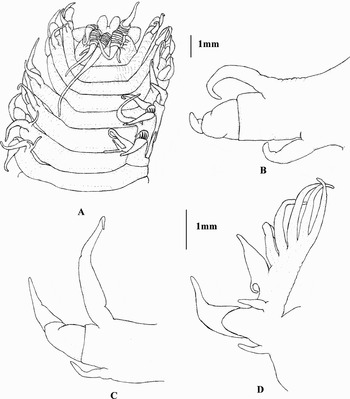
Prostomium small, without eyes; with two oval frontal lips, three occipital antennae, and a pair of palps, last two structures with ringed ceratophores and tapering styles. Ventrally with a pair of triangular upper lips, basally fused and divided distally. Median antenna reaches anterior end of chaetiger 5 (5–6), ceratophore with 12 (8–12) rings; lateral antennae reach chaetiger 2, ceratophore with 9 (8–9) rings; palps shorter, not reaching the posterior end of peristomium, ceratophore 4 (4–5) rings. Peristomium 1.5x longer than first chaetiger, mid-dorsal part of peristomium lightly marked as an anterior fold, when median antenna is manipulated to the anterior end, then peristomium appears like a continuous extention to basis of median antenna. With a pair of peristomial cirri inserted distally, shorter than peristomium (Figure 1A).
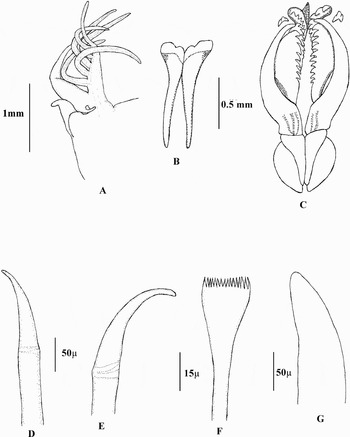
Parapodia of seven anterior chaetigers similar in structure, greatly enlarged, stout and directed anteriorly. First parapodium biggest, formed by a basal truncate structure followed by a rounded prechaetal lobe expanded in the first chaetigers, present along the body, diminishing their size gradually until prepygidal segments. Postchaetal lobe cirriform, well developed in the first seven parapodia, diminishing in size towards the posterior chaetigers, always cirriform. Dorsal cirri slender, distally thin. Ventral cirri subulate to cirriform, shorter than dorsal cirri (Figure 1B–D). From chaetiger 8, dorsal cirri with a recurved basal digital process (Figures 1D & 2A). Ventral cirri digitiform in the first 17 (16–19) chaetigers, posteriorly transformed in a ventral pad. From chaetiger 8 (7–10) to 17 (16–18) with a cirriform interramal process between the dorsal cirri bases and prechaetal lobe (Figure 1D), from chaetiger 18 to 53 rounded anteriorly, diminishing in size until disappearing from chaetiger 54.
Australonuphis paxtonae sp. nov. (A) Anterior end, dorsal view; (B) first parapodium, anterior view; (C) parapodium 5, anterior view; (D) parapodium 17, anterior view.

Australonuphis paxtonae sp. nov. (A) Parapodium 626, anterior view; (B) mandible, anterior view; (C) maxillary apparatus; (D) pseudocompound hook from first parapodium; (E) pseudocompound hook from parapodium 5; (F) pectinate chaeta from parapodium 170; (G) subacicular hook from same parapodium.

Branchiae from chaetiger 6 (6–8) with one filament, chaetiger 7 with 2, 8 with 3, 9 with 4, from chaetiger 10 to 157 with 5, from chaetiger 158 to 317 with 6, from chaetiger 318 to 337 with 7 filaments, from chaetiger 338 towards posteriors with 6 filaments, the last prepygidal chaetigers only with one filament appears. In paratypes and non-type material, branchial filaments show a similar distribution.
Anterior 7 parapodia with stout, unidentate pseudocompound hooks in all specimens, those of anterior parapodia with hooks slightly curved and short blade (Figure 2D), from chaetiger 5 to 7 these hooks are curved with long blade (Figure 2E). These types of hooks are accompanied with 1–2 limbate chaetae per parapodium. Following chaetigers with simple limbate chaetae. Pectinate chaetae from chaetiger 8, with 15–16 teeth (Figure 2F). Subacicular hooks from chaetiger 50 (43–57), distally entire (Figure 2G).
Pygidium with terminal anus, a dorsal process enlarged with two slender cirri, and a shorter ventral process without cirri.
Jaws calcified, robust. Mandibles fused distally, with two bilobulate anterior calcified cutting plates (Figure 2B). Maxillary apparatus not seen in holotype, paratypes dissected, maxillary formula: MxI = 1 + 1; MxII = 7 + (8–10); MxIII = 8 + 0; MxIV = (6–7)+ (6–9); MxV = 1 + 1 (Figure 2C).
Etymology
The specific name is a modest homage to Hannelore Paxton for her work on onuphid polychaetes.
DISCUSSION
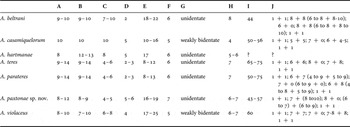
Australonuphis paxtonae sp. nov. differs from all Australonuphis species by the presence of 7 modified parapodia. Australonuphis beltrani and A. hartmanae have 6 modified parapodia, A. casamiquelorum, and A. violaceus have 5, A. parateres and A. teres have 5 or 6. In the case of A. hartmanae Friedrich (Reference Friedrich1956) comments in his paper that the parapodia 7 and 8 are transitional to normal parapodia.
Australonuphis paxtonae is close to A. beltrani, both these species differ in the following characteristics: relative size of median antennae, number of ceratophore rings on lateral palps, number of anterior parapodia with pseudocompound hooks, shape of interramal process, number of teeth on Maxillae III, and shape of Maxillae V. In A. beltrani style of median antenna reaches chaetiger 2, ceratophore of lateral palps with 7 rings in holotype and 9–10 in both paratypes, unidentate pseudocompound hooks on first six parapodia, cirriform interramal process located between the dorsal cirri bases and prechaetal lobe from chaetiger 8, on chaetiger 9 this structure is transformed in a subconical lobe, diminished in size to the end of fragment in holotype (with 52 chaetigers) and paratypes, Maxillae III formed by 6 conical teeth and Maxillae V like a chitinous flat plate. While in A. paxtonae style of median antenna reaches chaetigers 5 to 6, ceratophore of lateral palps formed by 4 to 5 rings, unidentate pseudocompound hooks on first seven parapodia invariably, interramal process cirriform on first (7–10) to (16–18) parapodia, posteriorly transformed in a rounded lobe which diminishes its size posteriorly, Maxillae III formed by 8 conical teeth, and Maxillae V with a well formed tooth. The variations of characters of the other species can be seen in Table 1.
Comparison of main morphological features between Australonuphis species: (A) number of ceratophore rings on median antenna; (B) number of ceratophore rings on lateral antennae; (C) number of ceratophore rings on lateral palps; (D) relative length of median antenna style (reach chaetiger __); (E) digitiform ventral cirri to chaetiger __; (F) number of parapodia with pseudocompound hooks; (G) shape of pseudocompound hooks; (H) maximal number of branchial filaments; (I) start of subacicular hooks (parapodia); (J) maxillary formula.

Interramal process between dorsal cirri bases and prechaetal lobe is described only in American Australonuphis species with the exception of A. hartmanae which is known only from its original description. Besides A. beltrani and A. paxtonae described previously, A. casamiquelorum presents this structure cirriform from chaetiger 7 to chaetiger 170 where that structure disappears. In A. violacea this structure appears from chaetiger 7 like a cirriform appendix, from parapodia 12 to 15 the structure becomes a rounded lobe, from parapodia 40 this lobe moves ventrally fusing with the prechaetal lobe resulting in a presetal lip which replaces the prechaetal lobe on chaetigers 65–70 (Rozbacylo & Castilla, 1981). In A. paxtonae the interramal process never replaces the prechaetal lobe.
Peristomium anterior end in A. casamiquelorum and A. paxtonae is slightly marked, but this character can be due to the fixation of specimens (Orensanz personal communication). In A. paxtonae when median antenna is manipulated and directed anteriorly, then there appears a continuous mark from anterior end of prostomium to median antenna basis, characteristic of Australonuphis species.
ACKNOWLEDGEMENTS
This study was funded by a grant from CENAIM (Centro Nacional de Acuicultura e Investigaciones Marinas of Ecuador). Samples were collected with the help of Angela Silvia Suarez-Flores, Elsy Elizabeth Orrala-Neira, Holger Quirumbay and Daniel Suarez. The first author thanks José María (Lobo) Orensanz and Leslie Harris who kindly revised the holotype and paratypes of Australonuphis casamiquelorum and a paratype of A. teres respectively, to value the development of the interramal process in those species. We are much indebted to Luis F. Carrera-Parra and Movio Londoño Mesa for their constructive criticism on the early draft of the manuscript. The careful reviews by Hannelore Paxton and an anonymous referee improved the manuscript.