Defining the problem
In Malaysia, voluntary private funding of parties and poor regulation of their financing have contributed to the increasing monetization of politics. The volume of private money seeping into the political arena has been growing, although some parties have far greater access than others to these funds, leading to unfairness in federal and state elections. Disclosure is not consistently required, but there have been serious allegations of the covert funding of politicians by Malaysians and non-Malaysians as well as by organized criminals.
While the general literature on financing politics talks mainly about the sources of party funding and how money is used in presidential or parliamentary election campaigns, in Malaysia two other fundamental issues feature. First, Malaysia is one of very few countries where parties own corporate enterprises, a trend known as ‘political business’.Footnote 1 The corporate assets of these parties include Malaysia's leading newspaper, television and radio firms.
Then there is the matter of how campaigns are funded during elections within parties, particularly in the ruling coalition, the Barisan Nasional (National Front), where more is said to be spent than during general elections, due to high levels of factionalism.Footnote 2 Party factionalism is based not on differences of ideology or politics but on which party leader has the most to spend on winning grassroots support. Money-based factionalism, popularly known as ‘money politics’, is threatening the existence of parties. Since party leaders control the executive arm of government, money politics gravely undermines their legitimacy, not to mention their willingness to stem corruption. Studies on money politics and political business in Malaysia say too little about the ties between party factionalism and the abuse of funds in elections. They fail to analyse in any depth why oversight institutions and legislation have not been able to curb the growth of money politics and political business.Footnote 3
In party elections, candidates receive money for their campaigns from a variety of sources, so those with most access to business—or public—resources are likely to have an unfair advantage. The concentration of access to funding sources in the hands of just a few politicians has contributed to the rise in personalized politics,Footnote 4 whereby a few select individuals dominate parties, and thus the politics of patronage, and politicians use funds to ensure they retain power or rise in the political hierarchy.
This study provides a historical account of the political landscape to obtain insights into the strengths and weaknesses of legislation and institutions that oversee the financing of politics. It reviews the degree of transparency built into current legislation, patterns of party and electoral funding, and the capacity of regulatory bodies to ensure fairness and accountability in elections. It concludes by proposing legislative and institutional reforms to help ensure that parties account for and disclose the sources of their funds.
Definitions
Political financing
Political financing refers primarily to the funding of parties and electoral campaigns. Yet it covers many issues.Footnote 5 Pinto-Duschinsky notes that political financing is normally seen as ‘money for electioneering’, but adds that it covers the cost of maintaining permanent offices, carrying out policy research, conducting polls and political education, mounting public campaigns, and mobilizing voters.Footnote 6
Parties normally raise funds through membership fees and donations, but there are other sources. They include ‘secret funds’ and money given to politicians by companies and foreign donors. The role of ‘international money’ in domestic politics has precipitated heated debates in several countries. The ‘personal wealth’ of individual politicians, normally rich businesspeople and royalty, is also an important issue.Footnote 7 Slush funds, foreign donations, and personal wealth all figure in debates about the financing of politics in Malaysia.
Individuals or companies back a party mainly because they support its ideology or ideals. For example, private firms enthusiastically fund parties that endorse neoliberal policies that aim to limit state intervention in the economy. They might also do so to obtain material benefits, such as contracts and licences, from the government. A third reason would be to secure access to government or obtain public honours.Footnote 8 The sources of funding can therefore shape public policies and legislation and influence the distribution of government rents.
The way in which politics is financed can thus contribute to political corruption. Narrow definitions of political corruption, such as the ‘use of public office for unauthorized private gain’,Footnote 9 exclude many forms of corruption related to political finance. Walecki observes that ‘illegal’ acts, for example foreign funding of parties, are not necessarily corrupt, while corrupt acts, such as contributions from organized crime, are not necessarily illegal.Footnote 10 In Malaysia politicians are alleged to have obtained funds from abroad and from organized crime, though these allegations have been strongly denied.Footnote 11 Another common form of political corruption in Malaysia, linked to the financing of politics, is vote-buying. For the purposes of this study, the term political financing covers all factors in electoral competition, both within and between parties.
Money politics and political business
A long-standing and increasingly widespread issue in political corruption is vote-buying during intra-party elections, a practice that remains unregulated by external bodies and is difficult to control internally. In the absence of firm guidelines, an adequate supply of legitimate funding, and non-partisan oversight of internal party elections, candidates might seek financial support from dubious sources, regardless of the repercussions. The consequences of such irregularities include accusations of corruption and increasing public mistrust of the political process.Footnote 12
Money politics in Malaysia usually means buying votes during party and general elections by disbursing current and future material benefits. It also refers to political patronage and abuse of power, i.e., favouritism and nepotism in awarding government concessions. It connotes with ‘political business’,Footnote 13 a term used to describe the links between politics and business, specifically party ownership of firms, the direct and indirect control of companies by politicians and parties, and the direct and indirect interference of politicians in the corporate sector.
Political business happens when politicians in government use their power to give party members or business associates state-created rents in the form of licences, contracts, subsidies and privatized projects. Funds to acquire these rents are secured through favourable loans from banks owned or controlled by the state and well-connected businesspeople. Their distribution to party members helps party leaders secure or promote their positions in the party and in government. Recipients use corporate manoeuvres, such as shares‑for‑assets swaps, mergers and reverse takeovers, to win control of publicly listed firms. As share prices escalate, corporate equity is used as security to secure more loans from banks for further acquisitions. These corporate strategies help drive up market capitalization.
These unproductive but sophisticated corporate manoeuvres have led to the emergence of a well-connected new rich sector. Its rise has resulted in a concentration of corporate wealth, and the selective distribution of government rents has led to corruption, scandals and conflicts of interest. Firms controlled by well-connected businessmen have engaged in insider trading and the manipulation of stock prices.Footnote 14 Money politics and political business have brought massive sums of money into the political process.
The political system in Malaysia
Monitoring bodies
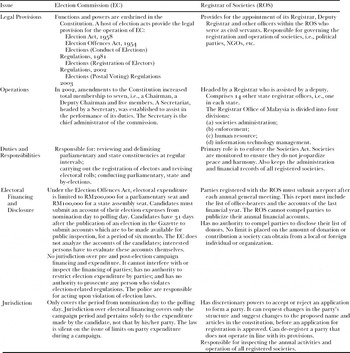
The two major institutions responsible for monitoring elections and political parties are the Election Commission and the Registrar of Societies.Footnote 15 Political parties are regulated by the Societies Act, which oversees all societies, including welfare and social bodies. The Election Commission is responsible for conducting elections, keeping electoral rolls, and reviewing the division of the country into parliamentary and state constituencies. By ensuring that all citizens can elect a representative freely, and that all those who desire to stand as candidates can present themselves to the voting public, it ensures fairness.
Table 1, which compares the features and responsibilities of the Election Commission and Registrar of Societies from the perspective of their jurisdiction, duties and responsibilities, suggests that both institutions have little autonomous regulatory capacity. Applications to form a party have to be approved by the Registrar of Societies, a body under the ambit of the Ministry of Home Affairs, so the Executive can block the formation of any organization it considers undesirable. The Prime Minister, who is responsible for the appointment of the Minister of Home Affairs, traditionally selects a trusted political ally for this post.Footnote 16
Responsibilities of the Election Commission and Registrar of Societies

Sources: Lim Hong Hai (2005), ‘Making the system work: the Election Commission’, in Mavis Puthucheary and Norani Othman, Elections and Democracy in Malaysia, Bangi: Universiti Kebangsaan Malaysia Press; S. Sothi Rachagan (1993), Law and the Electoral Process in Malaysia, Kuala Lumpur: University of Malaya Press.
The Election Commission is, by structure, an impartial and independent body, under the direct control of the King.Footnote 17 To guarantee its autonomy from the Executive, the Constitution provides safeguards to ensure that members of the Commission cannot be removed from office, except under specific conditions. However, it has lost some of its autonomy. In 1962, the Constitution was amended to reduce its powers and independence, and its power to redraw constituency boundaries was reduced to one of merely making recommendations to Parliament, now the final arbiter by means of a simple majority.Footnote 18 Under the amended constitution, the Prime Minister can revise the Commission's recommendations before submitting them to parliament for approval. Although the King appoints the Chairman of the Commission after consultation with the Conference of Rulers, candidates are nominated by the Prime Minister.Footnote 19 This further reduces the Commission's independence.
The political parties
Since most parties are ethnically-based, the formation of coalitions has helped to gather under one umbrella organizations that represent the interests of a cross-section of the population. The nucleus of the ruling party, the Barisan Nasional, was originally a tripartite coalition, named the Alliance, between the United Malays’ National Organization,Footnote 20 the Malaysian Chinese AssociationFootnote 21 and the Malaysian Indian Congress.Footnote 22 The Alliance was widened into a larger coalition, the Barisan Nasional, in 1974.Footnote 23 This coalition, which currently comprises 13 parties, and its predecessor, the Alliance, have formed the government since elections were first held in 1955.
The Barisan Nasional acts like a single party during elections. Although it is the governing coalition, it is not an actively functioning body. Given the United Malays’ National Organization's hegemonic position in the executive, and since representation in the cabinet is the sole prerogative of the Prime Minister, inter-party consultations are not on an equal footing. The Supreme Council, the coalition's governing body comprising leaders of all component parties, meets infrequently, usually before a general election, to decide on the distribution of seats. The Supreme Council is seen as a perfunctory body, although it is presented as the medium through which consultations are held to maintain ethnic cooperation and harmony. The activities of the Barisan Nasional's component parties are individually based and geared towards their particular target groups.
The opposition coalition, Pakatan Rakyat (People's Alliance), formed on 1 April 2008, comprises Parti Keadilan Rakyat (the People's Justice Party), the Democratic Action Party, and Parti Islam SeMalaysia (Malaysian Islamic Party). This coalition was forged to enable these parties to form the government in states where they collectively had a majority after the twelfth general election in March 2008. The Pakatan Rakyat was then able to form the government in the states of Penang, Kedah, Perak, Selangor and Kelantan.Footnote 24
This was not the first time that these three parties had forged a coalition. They formed the Barisan Alternatif (Alternative Front) in 1999, a consequence of a social movement called the reformasi that had emerged in 1998. The Democratic Action Party, however, quit the Barisan Alternatif two years later, due to bitter disagreements with the Parti Islam SeMalaysia over the latter's stance on an Islamic state. There had long been serious ideological differences between these two parties.
The socialist-based Democratic Action Party, formed in 1966, though seen as a Chinese party, has some notable non-Chinese in its top hierarchy. Parti Islam SeMalaysia, a breakaway United Malays’ National Organization faction, was formed in 1951 and was originally led by left-leaning politicians. Its objective at the outset was to secure mass rural-based Malay support. In 1982, following a radical change of leadership, Parti Islam SeMalaysia adopted a predominantly Islamic posture.Footnote 25 The People's Justice Party was formed in 2003, though it has its roots in the reformasi movement that emerged following the dismissal of Anwar Ibrahim as Deputy Prime Minister in 1998.Footnote 26 Anwar is, at present, its de facto leader.
Electoral and party financing
The regulation of expenses during parliamentary and state elections is outlined in the Election Offences Act which covers the types of permissible expenses and the total amount that can be spent.Footnote 27 The cost of conducting an election is borne by the government, but individual candidates or parties fund their own campaigns. No variation in expenses is permitted on the basis of the geographical size or any other characteristic of a constituency, for example, whether it is rural or urban.
Only expenses incurred during the campaign period are subject to financial ceilings. There is nothing to prevent a candidate from raising money or incurring considerable expenses in the run-up to the election, before the actual campaign starts.Footnote 28 Despite the requirement to disclose how funds are spent during a campaign, it is often alleged that the amount far exceeds that permitted, due to irregularities such as vote-buying. Legislation outlaws bribery and coercion in the form of treats or threats, but such practices are said to be commonplace.Footnote 29 Complaints about irregularities can be made to the Election Commission, but most parties, particularly those in the opposition, tend to seek redress through the courts.
Compared to that of the opposition, the Barisan Nasional's campaign machinery is efficient and effective, mainly because it has better access to funds. Public rallies are banned, so door-to-door canvassing, which is labour-intensive, is the most common form of campaigning. Most Barisan Nasional campaign workers are remunerated, while the opposition relies heavily on unpaid voluntary help. The number of campaign posters and vehicles is not limited by law, which benefits parties with greater access to funds, invariably those in the ruling coalition.Footnote 30 All candidates are required to report the amount of funds used during an election campaign to the Election Commission, but they are not required to divulge the sources of their funding.
Political business and party finances
Political campaign costs have soared over the years, so the traditional sources of party funding, membership dues and private donations, are hardly adequate. Parties assert that their funds come mainly from membership fees.Footnote 31 However, information on how Barisan Nasional and Pakatan Rakyat members secure funds is difficult to obtain. One persistent allegation is that the People's Justice Party receives large sums of foreign money, suggesting Malaysia's economic interests would be deeply compromised if Pakatan Rakyat took control of the federal government.Footnote 32 The opposition, on the other hand, has long criticized Barisan Nasional parties for abusing power to channel rents to businesses that funnel funds back to them, a process that helps sustain their position in government. Inevitably, one of the most controversial aspects of political financing has been the ownership and control of businesses by parties.
In the post-colonial period, the United Malays’ National Organization's financial woes arose because its mainly rural peasant membership could not provide it with sufficient funds to participate effectively in elections. It was extremely dependent on the cash‑rich Malaysian Chinese Association, established by businesspeople, to fund its campaigns.Footnote 33 By the late 1950s, the growing concern of the United Malays’ National Organization over its heavy financial dependence on the Malaysian Chinese Association led party leaders to establish covert ‘special funds’ to which firms could make regular contributions.Footnote 34 To consolidate its position, the United Malays’ National Organization's first business venture was its takeover in 1961 of the independent Malay newspaper, Utusan Melayu, which had been quite critical of the party's policies.
When the Alliance came close to losing power in the 1969 General Election and the Malaysian Chinese Association said it would not participate in an Alliance government, the United Malays’ National Organization realized it urgently needed to be financially independent.Footnote 35 In 1972, it acquired a controlling stake in The New Straits Times Press which published the leading English-language newspaper, The New Straits Times, and a major Malay newspaper, Berita Harian. By the early 1970s, the party had secured control of Malaysia's leading Malay and English-language newspapers.
Other Barisan Nasional parties secured a controlling stake in major newspapers. The Malaysian Chinese Association's holding company, Huaren Holdings, has a majority interest in Star Publications, which publishes The Star, Malaysia's top-selling English-language tabloid. The Malaysian Indian Congress leaders are closely associated with the country's major Tamil newspapers.
Ethnic violence following the 1969 elections was attributed to Malays’ discontent over their lack of economic progress, so an affirmative action-based New Economic Policy was introduced in 1970 to achieve national unity by eradicating poverty, irrespective of race, and achieving inter‑ethnic economic parity by ‘restructuring’. The New Economic Policy, along with privatization, introduced in 1983, emerged as two key policies through which United Malays’ National Organization leaders could channel government-created rents to select businesspeople and politicians.
By the 1980s, the United Malays’ National Organization had become the owner of some of Malaysia's most important corporate stock.Footnote 36 Patronage contributed to the emergence of a new breed of well-connected Malay businesspeople with extensive ownership of the corporate sector in the early 1990s. Government leaders who had exploited their influence to help businesspeople expand their corporate interests and cultivated close ties with businesses had an advantage in party elections. Political patronage was a key factor in numerous business scandals.
According to one report, a conservative estimate of the volume of funds lost due to business scandals involving Barisan Nasional since the 1980s was approximately US$100 billion. This amount included government bailouts of businesspeople nurtured by the state under the New Economic Policy and the re-nationalization of privatized projects.Footnote 37 Allegations of secret funding led to increased calls for a legislative review of the issue of disclosure.
Financing opposition politics
Leaders of the Democratic Action Party claim that funds for running the party and electoral campaigns are obtained primarily through ‘grassroots financing’, i.e., membership fees and donations from private individuals. The party collects money through the internet and other fundraising activities, including the holding of public forums to discuss topical issues. Another source of its, also regarded as grassroots financing, is ‘assessments’, whereby members elected as state assemblymen or parliamentarians are expected to contribute a portion of their allowance to the party. A major source of funds for the party was revenue from the sale of its news organ, The Rocket, until the government restricted the sale of this paper to party members. As for the party's involvement in business, it established a cooperative to supplement party funds. This cooperative failed to emerge as a business enterprise of any significance and appears to have been moribund since the late 1980s.
Parti Islam SeMalaysia leaders also claim that their primary source of funding is grassroots financing. Apart from donations, money is collected during party ceramah, or public rallies, collectively a rather substantial amount. The volume of money collected at a ceramah is publicly announced at the end of the event. A third major source of funds is income from the sale of the party organ, the Harakah. Revenue from the sale of the Harakah is reportedly huge, as two editions are issued each week and more than 800,000 copies are sold each month.Footnote 38 The Harakah is presently sold at RM2 per copy. Apart from running the Harakah, the party claims to have no business ventures or corporate investments.Footnote 39
People's Justice Party officials claim that membership subscriptions (RM2 a year) are nowhere near enough to fund the party and not even enough to meet the cost of convening its annual general meeting. They add that potential donors hesitate to give money because they fear the Barisan Nasional will take action against them if they do so.Footnote 40
Factionalism, party elections and money politics
Different parties employ a variety of measures to promote ethical conduct among members and punish those who engage in unscrupulous behaviour or violate party laws. However, politicians tend to agree that codes of conduct are inadequate to check irregularities during party electoral campaigns. Party regulations remain largely ignored and ineffective in the absence of effective (preferably external) evaluation, monitoring and disciplinary processes.
All parties have an official internal disciplinary process, but informal pressure and reprimands are used. These disciplinary practices are unclear or opaque and at times applied inconsistently or on the basis of factional favouritism, so they can weaken respect for a particular party's official laws and rules and foster a culture of impunity. For example, critics consistently maintain that the United Malays’ National Organization has not been able to weed out unethical practices during party elections because it has not instituted an effective mechanism to deal with members who use money to climb the party hierarchy. It has a code of ethics and a disciplinary committee to handle complaints about money politics, but these are hardly tough deterrents, and the effectiveness and even the impartiality of the committee has been queried.Footnote 41
The disciplinary committee has purportedly dealt with thousands of alleged cases of money politics and other breaches of party ethics, but it has not issued any official report.Footnote 42 A possible reason for this secrecy is the funding of key politicians by business interests.
United Malays’ National Organization leaders have publicly admitted that the party went into business to raise funds to achieve financial independence, but there has been little or no public disclosure of fund transfers to the party by any of its corporate holdings. Its leaders needed to claim to have an impartial relationship with business, in spite of distributing privatized rents, because by the mid-1980s the party's corporate activities were being criticized for patronage and corruption. Even senior party leaders eventually began levelling such criticisms at Prime Minister Mahathir Mohamad's kitchen cabinet. This led to factional disputes that culminated (in 1988 and 1998) in the rise of new opposition parties led by former United Malays’ National Organization stalwarts. For this reason, many of the Organization's corporate assets are currently held in the name of its nominees, a point acknowledged by party leaders.
The problem of money politics pervades party elections in the United Malays’ National Organization. The party's organizational structure is decentralized. It consists of a national headquarters, divisions and branches. Party leaders are selected at the General Assembly, which meets annually, though its office-holders are elected every third year.Footnote 43 Delegates are chosen by the divisions. The composition of the delegates has changed considerably over the past 50 years. Previously, about half were teachers and almost a quarter were civil servants. At present, businesspeople constitute more than 30 per cent of its membership.Footnote 44
The practice of buying support during party elections started in 1981, during an epic contest between Musa Hitam and Razaleigh Hamzah for the post of deputy president to the United Malays’ National Organization. Musa won, but Razaleigh returned to challenge him in 1984. This contest was described as one of the ‘dirtiest to date’, involving the offer of free meals as well as death threats and massive vote buying.Footnote 45 A study pointed out that ‘[a]t the 1984 UMNO elections, the total money spent on votes was allegedly well in excess of (RM)$20 million’.Footnote 46
In 1993, when the United Malays’ National Organization deputy presidency was contested following Anwar Ibrahim's decision to challenge the incumbent, Ghafar Baba, allegations abounded that RM200–300 million had been spent by just one faction during a highly divisive campaign.Footnote 47 One study described in greater detail this growing monetization of the United Malays’ National Organization:
While money had been used to buy support at the party's assemblies, now it was also extensively used to buy support at the divisional level to ensure that candidates for the top two leadership positions received sufficient nominations to ‘reflect’ their supposed popularity.Footnote 48
During the March 2009 United Malays’ National Organization election campaign, Rais Yatim, a candidate for Vice-President, lamented that if
the scourge [of money politics] should take further hold in the party, it would be just better for UMNO to have a tender system so that anyone who contributes the highest amount can be a leader.Footnote 49
Rais’ comment reflected the persistence of patronage in determining how factions formed. Covert funding of party factions by businesspeople has also affected other Barisan Nasional members. A political scandal that erupted in 2009 involving the construction of a massive free trade zone and implicated component parties of the Barisan Nasional drew attention to the covert channelling of business funds to politicians in government and the quid-pro-quo in terms of the award of lucrative contracts. These allegations have been denied by the people named in this incident, referred to as the Port Klang Free Trade Zone scandal.Footnote 50
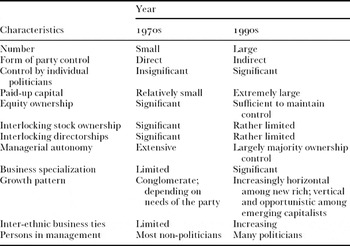
Table 2 illustrates changing trends in the links between politics and business. The number of firms associated with the United Malays’ National Organization has grown substantially and politicians are increasingly involved in business. In the 1970s, when parties began acquiring firms, a small number of leaders had overwhelming influence over them. By the 1990s, a large number of politicians had come to own a slew of companies.Footnote 51 The professional managers of firms owned by the United Malays’ National Organization were largely people who had been politicians in the 1970s, but by the 1990s most politicians were involved in the management of companies under their control. While political parties used to have direct control over companies, the present form of ownership and control is increasingly obscure.
The changing nature of companies linked to the United Malays’ National Organization (UMNO), 1970s and 1990s

Source: Gomez, Political Business in East Asia: p. 99.
These changing trends in the links between politics and business suggest two crucial things. First, big changes have occurred that necessitate a review of existing legislation. These changes particularly affect the United Malays’ National Organization. Businesspeople are gaining a stranglehold on party positions at grassroots level, while they dominate delegates at the general assembly. As for the Malaysian Chinese Association, businesspeople no longer dominate its senior leadership, but recent scandals have exposed the party's continuing ties with leading corporate figures. Second, the links between politics and business have become far more complex and covert, which brings into question the capacity of existing legislation to deal with the improper financing of politics and shows the need for greater disclosure.
Legislative and institutional reforms
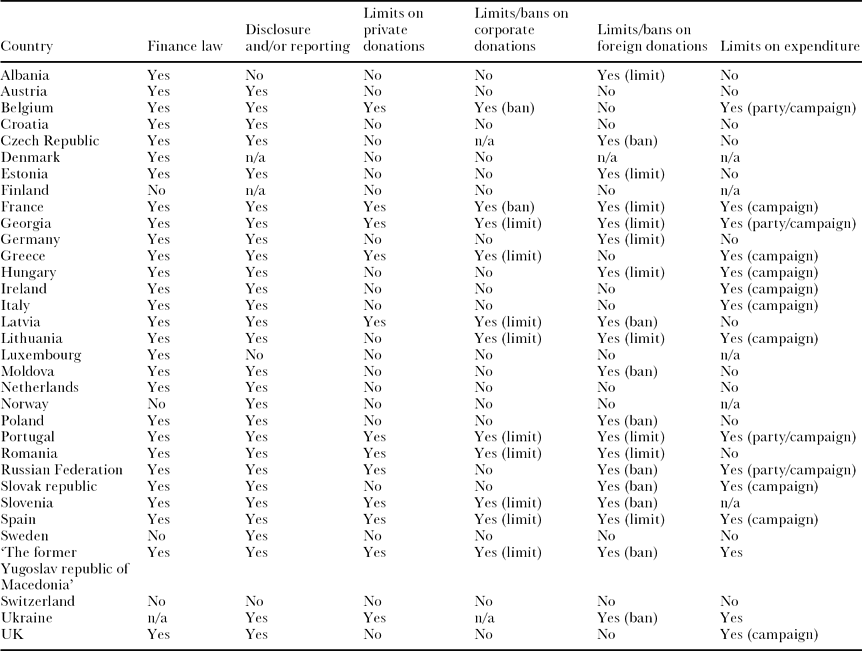
This review of the monetization of Malaysian politics indicates two major issues that require attention: legislative and institutional reform. A new legislation, say, a Political Parties Act governing such organizations, is necessary, given the limitations of the current Societies Act. Table 3 provides a list of principal issues that need to be considered in any review of legislation dealing with the financing of politics. It indicates that legislation would need to contain provisions for limits on expenditure; caps on donations from individuals, corporations and trade unions; and disclosure of the sources of funds, including the need to regulate—or ban—foreign funding of domestic politics.Footnote 52 Such a law would also aim to help strengthen linkages between parties and constituencies and would not stand in the way of parties representing different societal interests.
Issues of concern in the financing of politics
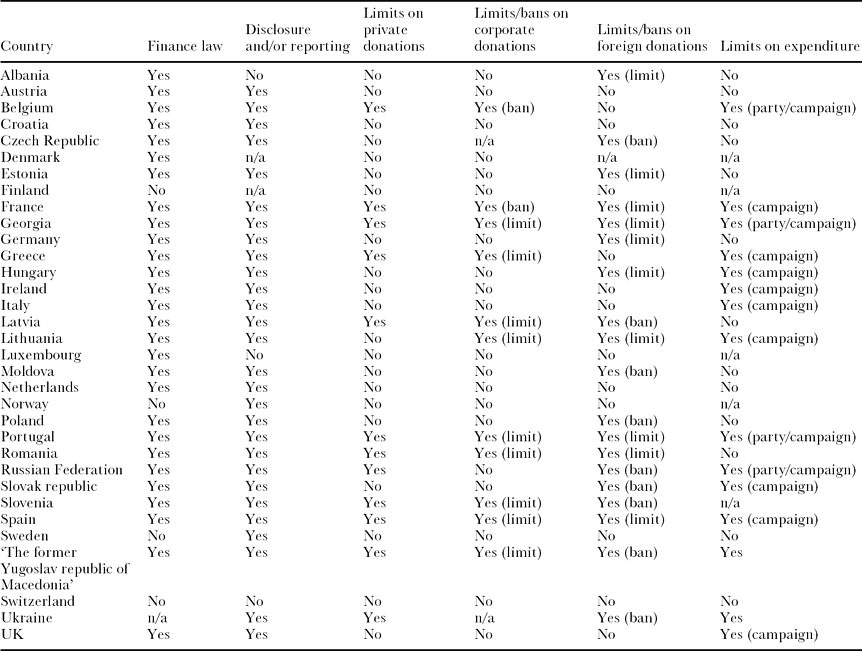
Source: van Biezen 2003: pp. 52–53.
New legislation should also allow for the monitoring of party elections in Malaysia to reduce money politics and ownership by political parties of corporate enterprises, in particular, media companies.
Public financing of parties and elections
Forms of public funding include financially supporting parties, funding election candidates, allowing tax incentives to individuals who donate to political organizations, and allowing free or discounted use of the media.Footnote 53 Where public financing of politics is permitted, the rules on funding parties and elections are generally based on the following principles:
• an equitable balance between public and private funding;
• fair criteria for the distribution of government aid to parties;
• strict rules on private donations;
• caps on party expenditure during election campaigns;
• transparent accounts and an independent audit authority;
• strict penalties against parties that violate the rules.Footnote 54
Reforms in Malaysia need to be divided into regulations and subventions. Most countries restrict the use of private donations, either by banning them or by setting ceilings. A number of countries, including the United States, Canada, Britain, Germany, France, India and Japan, partially or completely ban foreign contributions. Britain's Political Parties, Elections and Referendum Act bans foreign funding, whilst in America foreign residents (where they are not permanent residents) are not allowed to contribute financially to federal and state political contests.Footnote 55
Banning special funds
The practice of maintaining secret or special funds appears to be widespread amongst the leaders of Malaysian parties. This suggests that businesses, well aware of the personalized nature of politics and the concentration of power at the apex of these parties, find it advantageous to channel funds to select politicians. Maintaining secret funds should be deemed illegal under law.
Public disclosure
Effective public disclosure requires that candidates and parties report in detail on income and expenditure; and that reports on campaign and party funding are made regularly available for public scrutiny. Public disclosure, founded on the principles of transparency and accountability, allows the public to vote in an informed way. The media and civil society would be able to ‘follow the money’, thereby keeping a check on politicians.Footnote 56
Malaysian parties are required under the Societies Act to elect office bearers, hold annual meetings, and keep audited accounts. However, they are not required to publicize their accounts and disclose the sources and amounts of donations received before, during, or after elections. Such information should be released publicly. Disclosure rules should clearly specify when this information should be released. For example, public disclosure should occur before polling day, since knowledge about financial backers might sway votes. During non-election periods, all parties must be required to publish donation sources on a regular basis, e.g., quarterly, and daily during election periods.Footnote 57
Contribution limits
Legal limits on donations are imperative, with different criteria for individuals and corporations, and a clear list of those who qualify as donors in each case. Private firms would obviously be allowed to contribute more than individuals (although, as the Malaysian case shows, personal donations to politicians can be considerable).
In Malaysia, donors, corporate or individual, are not required by law to disclose the size of their donations. Financial patronage by firms is not divulged in company accounts or to public shareholders, even though many government-linked companies are said to channel financial resources to parties or politicians.Footnote 58 Legal provisions are necessary to ban companies in which the government has a financial stake or over which it has administrative control from funding parties or electoral candidates.
Expenditure limits
One can restrict either the amount a party or candidate can spend or the amount that can be spent in specific ways and on particular activities. These limits could consist of an absolute sum for each candidate or party.Footnote 59 Expenditure limits are reportedly a more popular option for parties than contribution limits. Where expenditure is limited, a cap is placed on either the gross amount of expenditure of each candidate or party or the candidate's or party's expenditure per voter.Footnote 60
In Malaysia, the law should require that all expenditure, even before the start of the campaign, by both individuals and their parties, is recorded. Controlling candidates without controlling parties would render disclosure meaningless.
Internal party elections and money politics
Israel's Parties Law caps expenditure for internal elections; the cap is adjusted annually. The cost of internal elections is not fixed and the volume varies between parties. Parties prefer to comply with legal demands rather than pay heavy fines.Footnote 61
Media access and political business
Critics contend that the conduct of electoral campaigns heavily favours the Barisan Nasional, due to what has been termed the ‘3Ms’—money, media and machinery.Footnote 62 The 3Ms refer to the ruling coalition's excessive use of money, abuse of the media, and misuse of government machinery in election campaigns. In the case of the media, the government's direct control of electronic media—TV1, TV2 and the radio networks—has allegedly been abused by the Barisan Nasional to curb public dissent and cast the opposition in an unfavourable light. Barisan Nasional parties have direct and indirect control of private media—television and radio networks and the major Malay, Chinese, Tamil and English newspapers.
A vast number of voters cite the mainstream media, which includes the free-to-air television networks, radio stations and major vernacular newspapers, as their primary source of information about politics. However, the ‘believability rating’ of the mainstream media is said to be relatively low.Footnote 63 Most respondents in a poll gave fairly low scores to the credibility of reports on political events or about politicians.Footnote 64
Promotional campaigns in the form of advertisements are not open to all parties. There is no law requiring the media to allow all parties access to their facilities, a deficiency that undermines the capacity of opposition parties to publicize their views. One way of dealing with the unequal access of parties to the press would be to mandate all media supported by the tax-payer to act impartially during elections and to give all competing organizations equal air time.
But a review of ownership of media by parties has to be approached with caution, as legislation might violate the constitutional right to own property. In Europe, party-owned businesses are well regulated, but commercial enterprises are rarely banned. When parties were banned from owning firms or participating in commercial activities, including publishing a news organ, in the Czech Republic, the ban was set aside by the constitutional court. Parties in the Czech Republic are allowed equity ownership of publishing and advertising enterprises.Footnote 65
In Taiwan, following public pressure as a result of a series of controversial scandals, the Kuomintang began to divest its corporate assets. Taiwan's Political Party Law bans parties from operating or investing in a profit-making enterprise. This legislation also regulates the access of parties to the media.
A related problem is that party businesses have been transferred into private hands. This suggests a lack of transparency in the ownership of corporations by parties. In the case of publicly listed firms, other issues arise, including accountability to minority shareholders about how company funds are channelled to parties.
Parties in business—corporate accountability
Party ownership of major enterprises has led to a series of scandals in Malaysia, so legislative oversight is imperative to enforce ownership disclosure of corporate entities, in order to make sure the public knows about funds channelled from these sources to politicians and parties. A transparent and accountable system of ownership and control of firms is crucial, as major enterprises are now allegedly owned by proxies, making it difficult to track how politics influences the corporate sector and vice versa.
If parties are allowed to own businesses, such as publicly-listed firms, and cooperatives and investment holding companies, the Companies Act must require that shareholders be given the right to determine whether their firms should fund politics. In Britain, a firm can only donate to a party after its shareholders have voted on the matter. This authorization is valid for four years, with a cap on the contribution the company can make to a party.Footnote 66 In Japan, shareholders hold companies to account for their campaign contributions as well as other forms of political involvement, such as lobbying.Footnote 67
In Malaysia, the objective of legislation to monitor the financing of politics is to enhance transparency, so all forms of indirect ownership and control of companies should be banned. Since government-linked companies (GLCs) are said to fund politicians, they require independent supervision. At the October 2009 United Malays’ National Organization general assembly, one delegate was quoted as stating: ‘Many GLCs are sending tithe money to the Prime Minister and Deputy Prime Minister's constituencies and ignoring other areas that are poor and really need help’. Another party delegate went on to accuse the ‘directors of GLCs of tidur sebantal [sharing the same bed] with the Opposition’, before adding: ‘There should be good links between UMNO and the GLCs and there should be undivided loyalty of GLC board of directors for UMNO’.Footnote 68
This is further proof that an independent commission, reporting to parliament, would be essential to impose conformance by companies with legislation.
Institutional reforms
Legislative reforms would prove effective only if accompanied by institutional reform. An assessment of the institutional framework in place in Malaysia indicates that the Election Commission and the Registrar of Societies are greatly hindered from acting independently in their attempts to ensure fair oversight of the running of parties and elections. Institutional reform should therefore devolve power to agencies responsible for overseeing the running of parties and the conduct of parliamentary and state elections.
An institutional framework for guaranteeing free and fair elections can be non-partisan, as in Britain, which has an independent Election Commission; or by-partisan, involving members from both main parties, as in the United States; or led by federal judges or an Attorney General independent of the Executive, a method common in Latin America. In Asia, South Korea provides an interesting model of an agency, the National Election Commission, responsible for monitoring elections as well as political parties. The National Election Commission comprises nine members with three each nominated by the Chief Justice of the Supreme Court, the legislature or National Assembly, and the President. The chairperson is normally a judge nominated by the Chief Justice.
Reforms in Malaysia would necessitate provisions for an institution with the power to investigate and prosecute the violation of election laws. The Election Commission has no authority to charge those who violate the law, a serious shortcoming. Only the police, who are under the jurisdiction of the Executive through the Home Affairs Minister, can do so. The new commission would need to ensure that certain rights are protected, including equality of opportunity and the non-discriminatory treatment of parties, respect for national sovereignty, and the prevention of bribery as a means of obtaining electoral support. It would guarantee free and fair elections to the greatest extent possible and provide citizens with access to information during campaigns so they can make informed decisions. It would provide citizens and parties with legal recourse in the event of an infringement of their rights.
Conclusion
This paper has discussed the interconnections between politics and business in the financing of elections, both within parties and in general elections. It has shown how the state seeks, often in a calculated and systematic way, to channel rents into the hands of the political and economic elite. And yet the state is fraught with contradictions, due primarily to serious factionalism within parties in the Barisan Nasional, whose members compete for rents. The professed neutrality of key institutions such as the Election Commission and the Registrar of Societies has been further undermined by executive interference in the form of appointing members.
This suggests that while legislation to regulate the financing of parties and elections is one way of curbing money politics, significant change must also happen within parties. The benefits of internal reform go beyond strengthening the party system and ensuring free and fair elections.Footnote 69 Studies show that when parties integrate democratic procedures into the selection process, the quality of their candidates improves and the acquisition of party positions becomes more infrequent.Footnote 70 A transparent voting process by the entire membership to determine who leads the party will further hinder patronage and cronyism.Footnote 71 A discussion along these lines is now going on within the United Malays’ National Organization, as it grapples with the problem of money politics.
Disclosure is fundamental if the role of money in politics is to be made accountable and voting is to be done on a properly informed basis, so that public trust in democracy and parties grows. Disclosure about the financing of elections and the activities of parties must be required by new legislation, since party practices and conduct shape the behaviour of a country's leaders and legislators. An accountable and transparent system of the management of party funding will help ensure that politicians act in the interest of the constituents and beliefs they profess to represent.