Introduction
The genus Crocus belongs to the family Iridaceae, a worldwide monocot family which geographically favours dry Mediterranean climates (Davies et al., Reference Davies, Savolainen, Chase, Goldblatt and Barraclough2005). Depending on the species, these plants behave as either autumn- or spring-flowering geophytes. While on a global scale geophytes represent only 3% of the flora, they are more important than this in Mediterranean regions (Hoffmann et al., Reference Hoffman, Liberona, Hoffman, Rundel, Montenegro and Jaksic1998; Esler et al., Reference Esler, Rundel and Voster1999; Procheş et al., Reference Procheş, Cowling, Goldblatt, Manning and Snijman2006), accounting for 15% of the flora in the Mediterranean Basin (Buide et al., Reference Buide, Sánchez and Guitián1998; Dimopoulos et al., Reference Dimopoulos, Raus, Bergmeier, Constantinidis, Iatrou, Kokkini, Strid and Tzanoudakis2013).
The genus consists of c. 100 species (Harpke et al., Reference Harpke, Meng, Rutten, Kerndorff and Blattner2013) occurring in central and southern Europe, in North Africa and from south-western Asia to north-western China (Petersen et al., Reference Petersen, Seberg, Thorsøe, Jørgensen and Mathew2008). Nonetheless, the vast majority of the species grow in the Balkans and Anatolia, especially in their respective Mediterranean regions (Mathew, Reference Mathew1982). In Greece, the genus is represented by 24 species and 29 taxa (Dimopoulos et al., Reference Dimopoulos, Raus, Bergmeier, Constantinidis, Iatrou, Kokkini, Strid and Tzanoudakis2013; Harpke et al., Reference Harpke, Peruzzi, Kerndorff, Karamplianis, Constantinidis, Randelović, Randelović, Jušković, Pasche and Blattner2014); nine taxa are Greek endemics, five are included in the two Red Data Books of Greece (Phitos et al., Reference Phitos, Strid, Snogerup and Greuter1995, Reference Phitos, Constantinidis and Kamari2009) and one taxon is protected by the Bern Convention (Appendix I; Council of Europe, 1979).
The genus has not been studied in terms of seed germination, apart from the very recent publication of two papers, referring to a species from north-western China and three from central Italy (Fu et al., Reference Fu, Tan, Baskin and Baskin2013; Carta et al., Reference Carta, Probert, Moretti, Peruzzi and Bedini2014). Information on the germination of Mediterranean geophytes is also limited (Baskin and Baskin, Reference Baskin and Baskin2014) and the majority of them seem to have similar germination characteristics, such as an afterripening requirement and photoinhibition [e.g. Cyclamen persicum (Corbineau et al., Reference Corbineau, Neveur and Côme1989); Colchicum macrophyllum (Antonidaki-Giatromanolaki et al., Reference Antonidaki-Giatromanolaki, Dragassaki, Papadimitriou and Vlahos2008)]. Similar conclusions were reached by our working team through previous research (Doussi and Thanos, Reference Doussi and Thanos2002; K. Koutsoura, unpublished data).
Different definitions have been attributed to the term ‘afterripening’ throughout the years (Geneve, Reference Geneve2005). In the present study, afterripening (AR) will be referred to as ‘the process of gradual release of primary physiological dormancy of the seeds, which starts during seed maturation and dehydration on the mother plant and continues as a post maturation event at dry and warm conditions, either naturally in the field (on plant or after seed dispersal) or artificially in the lab (as seed collection in storage)’ (Fournaraki, Reference Fournaraki2010). Therefore, afterripening is distinguished from a dormancy-release treatment under warm conditions in the imbibed state; the latter is hereafter referred to as warm stratification (WS).
The duration of AR required for complete dormancy release varies among species, and it usually ranges from 2 months to 1 year (Iglesias-Fernández et al., Reference Iglesias-Fernández, Rodríguez-Gacio and Matilla2011). The main factors affecting the rate of AR include temperature, moisture and oil content of dry seeds and seed-covering structures (Finch-Savage and Leubner-Metzger, Reference Finch-Savage and Leubner-Metzger2006; Iglesias-Fernández et al., Reference Iglesias-Fernández, Rodríguez-Gacio and Matilla2011). Both the presence of primary physiological dormancy and its release by AR are considered as the principal factors preventing germination during a generally warm and dry summer, in environments such as deserts and Mediterranean regions, and hence they are very common in these habitats (Iglesias-Fernández et al., Reference Iglesias-Fernández, Rodríguez-Gacio and Matilla2011; Baskin and Baskin, Reference Baskin and Baskin2014). Another means of primary dormancy release in diverse cases, but mainly in autumn-germinating species, is WS (Allen and Meyer, Reference Allen and Meyer1998; Baskin and Baskin, Reference Baskin and Baskin2014).
Light stimuli provide important information about the optimal time and place for seedling establishment (Fenner and Thompson, Reference Fenner and Thompson2005). Depending on the response of seed germination to light, species can be divided into light indifferent, light requiring and photoinhibited. Photoinhibition results in the reduction of the percentage and/or the rate of germination in light and has been found in many angiosperms with black or dark-coloured and relatively large-sized seeds (Thanos, Reference Thanos, Hendry and Grime1993; Thanos et al., Reference Thanos, Fournaraki and Makri2005; Fournaraki, Reference Fournaraki2010) inhabiting desert (Koller, Reference Koller1957; Koller et al., Reference Koller, Sachs and Negbi1964; Barbour, Reference Barbour1968; Gutterman, Reference Gutterman, Black, Bewley and Halmer2006) and sandy coastal environments (Thanos et al., Reference Thanos, Georghiou and Skarou1989, Reference Thanos, Georghiou, Douma and Marangaki1991, Reference Thanos, Georghiou and Delipetrou1994; Delipetrou, Reference Delipetrou1996; Doussi and Thanos, Reference Doussi and Thanos2002; Del Vecchio et al., Reference Del Vecchio, Mattana, Acosta and Bacchetta2012; De Vitis et al., Reference De Vitis, Seal, Ulian, Pritchard, Magrini, Fabrini and Mattana2014) as well as semi-arid and open disturbed habitats (Thanos et al., Reference Thanos, Fournaraki and Makri2005).
This study examines specific aspects of seed germination requirements in 23 Crocus taxa indigenous to Greece and aims to answer, through both laboratory and outdoor experiments, the following questions: (1) Do these taxa have an AR requirement and thus primary dormancy? (2) Can WS substitute for AR in promoting germination? (3) Is seed germination photoinhibited? (4) Does the embryo grow to a critical size prior to germination? Finally, based on the results of the present study and in combination with literature data, we raise the question whether the germination requirements of Crocus seeds are phylogenetic or habitat-related traits.
Materials and methods
Seed material
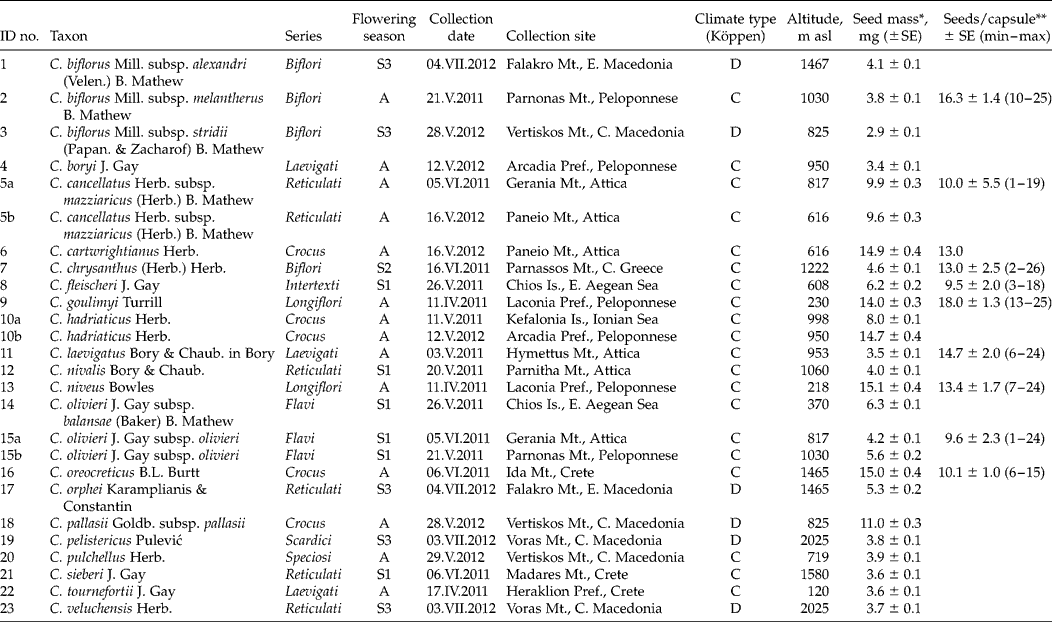
Seeds of 23 taxa (26 seed samples; 9 Greek endemic taxa) were collected from several localities and various altitudes (20–2025 m), with either a Mediterranean or temperate climate all over Greece (Table 1). Greek crocuses belong to the subgenus Crocus, in both sections Crocus and Nudiscapus and in nine (out of 15) series; in the present study, representatives of all nine series have been collected. Flowering season is species-specific, while seed and fruit maturation in Greece always take place from April to early July and seem to depend on altitude and latitude. In total, 13 autumn- and 10 spring-flowering taxa were included in this study. Most taxa (21) occur mainly in typical Mediterranean habitats (phrygana and maquis); some of them (nine taxa) grow additionally in woodlands but only rarely in Greece; therefore, seed collection from woodlands was not feasible. Finally, Crocus veluchensis and C. pelistericus grow additionally or exclusively, respectively, in subalpine meadows.
Seed collections of Crocus taxa studied. Taxonomy follows Dimopoulos et al. (Reference Dimopoulos, Raus, Bergmeier, Constantinidis, Iatrou, Kokkini, Strid and Tzanoudakis2013) and Harpke et al. (Reference Harpke, Meng, Rutten, Kerndorff and Blattner2013, Reference Harpke, Peruzzi, Kerndorff, Karamplianis, Constantinidis, Randelović, Randelović, Jušković, Pasche and Blattner2014)

A, autumn (Oct.–Nov.); S1, early spring (Jan.–Feb.); S2, mid spring (Mar.–Apr.); S3, late spring (May–Jun.); C, Mediterranean climate and D, temperate climate.
* Average of 100 individual seeds (except for 10a and 15a, where 10 and 58 seeds were weighed, respectively).
** Average of 10 closed capsules (except for 5a, 6 and 8, where 3, 1 and 8 capsules were available, respectively).
The fruits (capsules) of Crocus are three-locular, opening in maturity from top to bottom. In the taxa studied, the mean length and width of capsules ranges from 1.35 to 2.04 cm and from 0.54 to 0.95 cm, respectively. Crocuses have been reported to produce numerous seeds per capsule (e.g. Mathew, Reference Mathew1982); however, in the present study seed yield per capsule was quantified (for ten taxa) and was found to be relatively low (13 on average; min–max: 1–26; Table 1). This result is in agreement with some data provided for cultivated species of the genus (Rukšāns, Reference Rukšāns2010). It should be stressed that the seed yield measurements were carried out in ripe but closed capsules in dry weather. This is because we observed that capsules closed rapidly upon wetting during rain and reopened rapidly when dried again, a phenomenon known as xerochasy (van der Pirl, Reference van der Pirl1969). While open, some seeds may have been dispersed; therefore, we were certain that the ripe, closed capsules in dry weather had never opened before. Due to the small number of seeds per capsule, collecting large quantities of seeds is not always possible. In addition, it is quite hard to spot mature capsules in the field. Therefore, seed collections were based exclusively on labels placed adjacent to each plant during the flowering season, when it was possible to identify each species. Mean seed mass for the studied taxa ranged between 2.9 and 15.1 mg (Table 1). Moisture content of freshly collected seeds was determined according to ISTA Rules (2013) and ranged from 8.5 to 18.1% in 25 out of 26 collections (the mean value was 12.8%); in one collection of C. olivieri subsp. olivieri (15b) the moisture content of fresh seeds was 25.3%. Thereafter, a fraction of seeds was tested for germination immediately after seed collection and after various durations of AR and WS (see Figs 1, 2, 3, 5 and 6), and the remaining seeds (see Fig. 4) were either dehydrated for 10 d (to c. 8% water content) and stored at 5°C (2011 seed samples) or stored at − 20°C immediately after collection (2012 seed samples).
(A) Final germination at the optimal temperature in continuous darkness for 23 Crocus taxa: immediately after seed collection (white dotted bars), after the optimal (for each taxon) duration of AR under lab conditions (grey bars) and after similar durations of WS at 20°C (black bars). Taxon numbering follows Table 1. The ‘a, b, c’ labels represent a significant difference among the three values within each taxon (P < 0.05). Vertical lines on each bar represent standard error. Optimal temperature for germination was 5°C (taxon 19), 10°C (#1, 3, 12, 20, 21, 23) or 15°C (the remaining taxa). The optimal (or the only one tested) duration of AR was 1 month (#16), 2 months (#5a, 7, 8, 11, 21, 23), 3 months (#1, 4, 10a, 13, 17, 22), 4 months (#2, 9, 12, 20) and ≥ 5 months (#3, 6, 14, 15a, 18, 19). The respective duration of WS was 1 month (#13), 2 months (#5a, 6, 7, 12, 15, 21, 22, 23), 3 months (#8, 10a, 11, 14, 16, 20), 4 months (#1, 3, 4, 9, 18, 19) and ≥ 5 months (#2). (B) Optimal duration of AR, based on results from 16 AR-requiring taxa (with final germination >30%) for which different durations were examined. The numbers inside the graph pieces represent the number of taxa in each category. The optimal duration of AR for these 16 taxa was 1 month (#16), 2 months (#5a, 7, 8, 11, 21, 23), 3 months (#4, 10a, 13, 22), 4 months (#9, 12) or ≥ 5 months (#14, 15a, 18).

(A) Final germination at the optimal temperature in continuous darkness for nine Crocus taxa: immediately after seed collection (white dotted bars), after the optimal duration of AR under lab conditions (grey bars) and after 3 months of AR outdoors (stripped bars), buried at 5 cm below the soil surface. Taxon numbering follows Table 1. The ‘a, b, c’ labels represent a significant difference among the three values within each taxon (P < 0.05). Vertical lines on each bar represent standard error. (B) Temperature at the seed level (grey line) and daily precipitation (black line) for the entire duration of the experiment outdoors. The monthly means of daily minimum, maximum and average temperatures are shown in dashed lines.

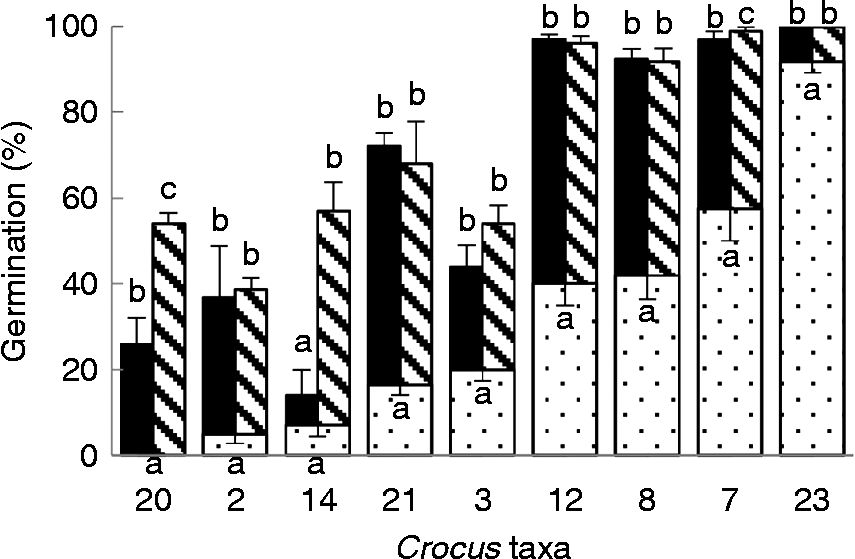
Final germination at the optimal temperature in continuous darkness for nine Crocus taxa: immediately after seed collection (white dotted bars), after WS at 20°C (black bars) and after similar stratification durations at 20/10°C (stripped bars). Taxon numbering follows Table 1. The ‘a, b, c’ labels represent a significant difference among the three values within each taxon (P < 0.05). Vertical lines on each bar represent standard error.

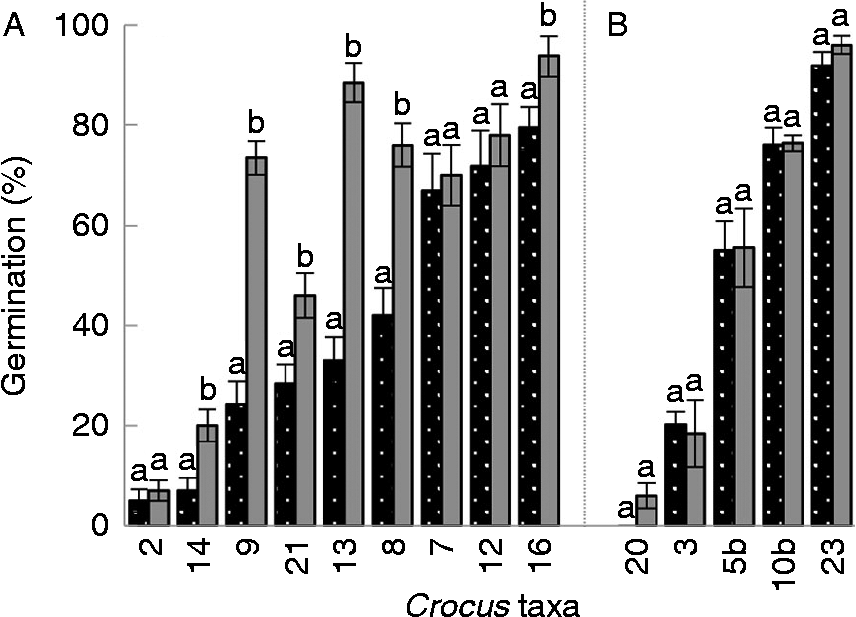
Final germination at the optimal temperature in continuous darkness for 14 Crocus taxa: before (dotted black bars) and after (grey bars) storage at cold temperatures for at least 1 year either at 5°C for 15–17 months (A) or at − 20°C for 11–13 months (B). Taxon numbering follows Table 1. The ‘a, b, c’ labels represent a significant difference among the three values within each taxon (P < 0.05). Vertical lines on each bar represent standard error.

Germination conditions
For each species, germination experiments were carried out using five samples of 20 seeds each (or 10 depending on seed availability) which were sown on two layers of filter paper moistened with distilled water in Petri dishes that subsequently were placed inside lightproof, metal containers. Seeds were incubated in continuous darkness at 5, 10, 15, 20 and 20/10°C, but only the results at the optimal constant temperature for each taxon are presented in this paper, unless indicated otherwise. Measurements were made under a dim green safelight and germinated seeds were removed from the dishes regularly (3 times weekly at the beginning, and once every week or month later on). The experiments were terminated when no additional seeds germinated for a period of 3 months; cut-tests were performed and germination percentages were corrected for viable seeds; non-viable seeds were in the range of 2–6% and exceeded 10% only in C. orphei and after warm stratification at high temperatures.
The effect of gibberellic acid (GA3) on primary dormancy was examined at the optimal germination temperature, in seven taxa, by applying aqueous solutions of 1000 ppm GA3 either at the beginning of the experiment or after 3 months of imbibition in non-germinated seeds.
Afterripening (AR) in the laboratory
To determine whether fresh seeds require AR, germination experiments were conducted for all taxa immediately after seed collection and after various durations of AR. During AR, seeds were kept dry for 1 to 12 months under lab conditions [c. 22°C, 53% relative humidity (RH)] in the dark. Moreover, the effect of AR at high temperatures (simulating summer conditions) on seed germination was investigated in six taxa by maintaining dry seeds at 35°C for 3 months in the dark.
Afterripening (AR) outdoors
In order to test whether seeds can afterripen during a 3-month-long dry summer in the field, seeds of nine taxa in two samples of 25 or 50 seeds each, depending on seed availability, were enclosed in nylon, perforated envelopes (5 × 5 cm) and then buried at a depth of 5 cm in labelled pots (6 × 6 × 14 cm) filled with nursery soil and perlite. Seeds were buried from 3 June 2013 until 3 September 2013, under natural Mediterranean temperature and rainfall conditions in an open-air atrium at our campus. Soil temperature at a depth of 5 cm was recorded at 2-h intervals by StowAway TB132 Tidbit data loggers (Onset Computer Corporation, Bourne, Massachusetts, United States). Pots were not watered and rainfall data were obtained from a nearby weather station (http://hoa.ntua.gr/). At the end of the experiment (3 September 2013) seeds were removed from the envelopes (under a green safe light) and subsequently tested for germination in the laboratory as described above.
Warm stratification (WS)
To determine whether WS can substitute for AR, germination experiments were conducted for seeds of all taxa, except for C. orphei due to low seed availability. During WS, imbibed seeds were incubated at 20°C in continuous darkness for 1–6 months. For each taxon the duration of WS tested was similar to the optimal duration of AR. In addition, the effect of WS at higher temperatures was studied in six taxa by incubating seeds at 25°C in the dark for 2–4 months. Besides, for nine taxa with null germination at 20/10°C, we examined whether stratification at 20/10°C for 2–3 months can also satisfy their AR requirements.
In three taxa, the effect of exposing the seeds to water supply conditions intermediate between dry lab conditions (AR) and water (WS) was also investigated: Seeds were kept under a RH-saturated atmosphere, at c. 20°C, for 2 or 4 months and then sown for germination at the optimal or suboptimal temperature of each taxon.
Dry storage at cold temperatures
Seeds of 14 taxa were stored dry in darkness at either 5°C for 15–17 months or − 20°C for 11–13 months, in order to study the effect of dry storage at cold temperatures. After each storage period, seeds were imbibed and incubated at the optimal temperature for each taxon in continuous darkness.
Photoinhibition
Germination experiments were performed in the light (12-h photoperiod) and in continuous darkness at the optimal temperature for each taxon, immediately after seed collection and in fully afterripened seeds. White light was provided at 15°C by a canopy of several incandescent bulbs and fluorescent tubes, roughly simulating sunlight, and the total photon flux density in the visible range (400–800 nm) was 125 μmol m− 2s− 1 (Thanos, Reference Thanos, Hendry and Grime1993; Doussi and Thanos, Reference Doussi and Thanos2002), while at 5 and 10°C by one and two cold white fluorescent tubes and the total photon flux density in the visible range (400–800 nm) was c. 5 and 10 μmol m− 2s− 1, respectively. Based on preliminary experiments in light and due to limited seed availability, germination immediately after seed collection was tested only for a few taxa and in some cases a single sample of 20 or 50 seeds was used. On the other hand, the effect of white light on afterripened seeds was examined in all taxa, except for one (C. pallasii subsp. pallasii).
Phenology of embryo growth
The mean embryo length:seed length (E:S) ratio was measured in nine taxa: (a) in non-afterripened seeds (dry seeds were allowed to imbibe for 6 h); (b) after 3 months of AR at 20°C and 1 week imbibition at the optimal temperature of each taxon; (c) after 3 months of WS at 20°C; and (d) immediately after seed-coat split, before radicle protrusion (critical E:S ratio). Moreover, in three taxa the mean E:S ratio was measured after 10, 20 and 30 d of incubation at the optimal temperature in darkness. Taxon selection was based primarily on seed availability and secondarily on germination percentage and rate at the optimal temperature (5, 10 or 15°C). Embryo and seed length were measured in 15 seeds of C. laevigatus and C. sieberi and 20 seeds of the remaining taxa, with the use of a stereoscope connected to a digital, colour, microscopy camera (INFINITY1-3, Lumera corporation, Ottawa, Ontario, Canada) equipped with Infinity Analyze software (Lumera corporation). Seed length refers to the length of the inner seed cavity that can be occupied optimally by the growing embryo.
Statistical analysis
In order to determine whether seeds show an AR requirement and which is the optimal duration of AR, to define the optimal method for dormancy release (AR or WS) or the optimal AR (lab or outdoors) or WS (20°C or 20/10°C) conditions and to assess embryo growth, one-way analysis of variance (ANOVA), followed by a Tukey multiple comparisons test, or the non-parametric Kruskal–Wallis H test was performed in the IBM SPSS Statistics environment for Windows (IBM Corp. 2013, version 22.0, Armonk, New York, USA) for each taxon separately, depending on whether the ANOVA assumptions were met. Germination percentages were arcsine transformed prior to analysis. A Kolmogorov–Smirnov test was performed to examine whether the data were approximately normally distributed for all groups and a Levene's F test verified the equality of variances (homogeneity). An f-test followed by a t-test for each taxon separately was used to investigate the effect of light, GA3 and storage at cold temperatures on seed germination. The rate of germination was measured by the t 50, which is the time to 50% of final germination and was calculated according to the following formula:
 $$\begin{eqnarray} t _{50} = t _{1} + \{( N /2 - N _{1})\times ( t _{2} - t _{1})/( N _{2} - N _{1})\} \end{eqnarray}$$
where N is final germination, N 1 and N 2 are germination percentages prior to and after N/2, respectively and t 1 and t 2 are the time taken to N 1 and N 2, respectively.
Results
Afterripening (AR) in the laboratory
Immediately after seed collection, seeds tested over the entire range of temperatures (data not shown), germinated poorly (for most taxa) in the dark, even at the optimal temperature of each taxon (Fig. 1A). Final germination percentages were significantly improved by increasing durations of AR (P < 0.025), and seeds of most taxa were fully afterripened when kept dry for 2–3 months under lab conditions (Fig. 1B) while AR for more than 5 months was required for seeds of three taxa (#14, 15a, 18; Table 1). Increasing the duration of AR beyond the optimal length had no additional effect on germination.
Taking into consideration both final germination percentage and t 50 values for fresh and fully afterripened seeds, the taxa can be arranged into three categories: (A) 20 taxa with an AR requirement in which seed germination is either induced or increased (and accelerated) in a statistically significant way; (B) two taxa with a slight AR requirement (#6, 23), which significantly affects only the germination rate; and (C) one taxon (C. orphei) with no AR requirement.
The vast majority of the taxa in category ‘A’ germinated below 50% immediately after seed collection and only in four taxa did initial germination range from 50 to 73% (Fig. 1A). After the optimal duration of AR, final germination in 13 taxa exceeded 90% and in two taxa exceeded 70%. In the remaining five taxa (#2, 3, 14, 18, 20) although final germination significantly increased with AR, it remained rather low ( ≤ 55%) and these taxa are thereafter considered as ‘hard-to-germinate’ taxa. Final germination of the three taxa in categories ‘B’ and ‘C’ always exceeded 80%, both immediately after seed collection and after the optimal duration of AR. For fresh seeds of groups ‘A’ and ‘B’, the t 50 value ranged between 35 and 108 days (mean t 50= 59 d) and seed germination started 21–96 d after onset of imbibition (44 d on average). For afterripened seeds, t 50 decreased remarkably to 21–76 d (mean t 50= 41 d) while seed germination started after 15–50 d (28 d on average, data not shown).
In the four ‘hard-to-germinate’ taxa (#2, 3, 18, 20) as well as in two other taxa (#10a, 21), AR at high temperatures (35°C) increased final germination by 10%, but results were not statistically significant. Furthermore, the addition of gibberellic acid (GA3) in seven taxa (#2, 3, 5a, 7, 12, 13, 14) did not affect final germination (data not shown).
Afterripening (AR) outdoors
Afterripening was investigated in the field, during the three summer months, for nine taxa (Fig. 2A): five taxa (#7, 8, 11, 12, 13) with final germination exceeding 70% after 2–4 months in dry lab conditions and four ‘hard-to-germinate’ taxa (#2, 3, 14, 20) with final germination < 50% after 4–6 months of AR. During the entire seed burial period, the mean minimum, maximum and average daily temperature was 23, 44 and 29°C, respectively, while total precipitation amounted to 25 mm (Fig. 2B).
All five taxa of the former group (see previous paragraph) were found to germinate more than 90% after seed burial. In the latter, ‘hard-to-germinate’ group, two taxa (C. biflorus subsp. melantherus, C. biflorus subsp. stridii) germinated >60%, a statistically significant increase of final germination compared with AR under lab conditions (P= 0.008 and 0.009, respectively). In the third species of the latter group (C. pulchellus) seed germination increased by 20%, but the difference was not statistically significant (P= 0.241). Finally, in the fourth taxon (C. olivieri subsp. balansae) seed germination was lower compared with AR under lab conditions.
For fresh seeds of the nine taxa studied, mean t 50 was 63 d (41–103 d) and seed germination started after 49 d on average (34–87 d). After the optimal duration of AR, mean t 50 was reduced considerably to 44 d (25–76 d) and seed germination started after 31 d on average (16–55 d). After seed burial in summer conditions, mean t 50 was further decreased to 39 d (18–71 d) while seed germination started after 28 d on average (9–51 d; data not shown).
Warm stratification (WS)
For the vast majority of the taxa studied, WS substituted for AR (Fig. 1A). In 17 taxa, both AR and WS were equally efficient in releasing primary dormancy; in 13 taxa, final germination after WS exceeded 80%, while in the four ‘hard-to-germinate’ taxa (#2, 3, 18, 20) it remained low, ranging from 26% to 55%. In three additional taxa, AR was the best dormancy release method: in 2 of them (#1, 14) germination was enhanced only by AR, while in C. cancellatus subsp. mazziaricus WS not only did not enhance germination but also imposed a secondary dormancy. Finally, the two species from the highest altitude and latitude (#19, 23) germinated optimally after WS. Similarly to AR, WS resulted in a reduction of the mean t 50 to 40 d (16–83 d) while seed germination started more rapidly compared with AR, at day 21 on average (2–68 d; data not shown).
Five taxa (#7, 8, 12, 21, 23) with null germination at 20/10°C, along with two ‘hard-to-germinate’ taxa (#2, 3), germinated to similar percentages after 2–3 months of stratification either at 20 (WS) or at 20/10°C. However, in two other ‘hard-to-germinate’ taxa (#14, 20), stratification at 20/10°C was the best treatment for dormancy release (Fig. 3). In all nine taxa, mean t 50 was initially 58 d (40–102 d) and seed germination started after 46 d on average (24–87 d). After a period of WS at 20°C or 20/10°C, mean t 50 was remarkably reduced to 45 or 29 d (19–83 or 20–42 d), respectively, and seed germination started after 29 or 7 d (14–68 or 3–13 d), respectively (data not shown).
Incubation at a higher stratification temperature (25°C) in four ‘hard-to-germinate’ taxa (#2, 3, 14, 20) enhanced seed germination but also eventually increased the number of dead seeds, whereas seeds from two other taxa (#7, 22) died after 2 months at 25°C (data not shown).
The effect of seed treatment in a RH-saturated atmosphere for 2 or 4 months was investigated in three taxa (#7, 9, 13) which germinate better after WS compared with AR, at the incubation temperatures tested. In all cases this treatment (RH-saturated atmosphere) proved equally (#7, 13) or more (#9) efficient than WS in primary dormancy release (data not shown).
Dry storage at cold temperatures
Seed storage in a freezer ( − 20°C) for 11–13 months had no effect on seed germination (Fig. 4B), whereas storage at cold temperatures (5°C) for 15–17 months increased final germination in all nine taxa studied (statistically significantly in six of them, 0.001 ≤ P ≤ 0.026) (Fig. 4A). Nonetheless, dry storage at 5°C for smaller durations (2 or 8 months) in C. niveus did not enhance germination (data not shown). In fresh seeds of the nine taxa, mean t 50 was 49 d (31–82 d) and seed germination started after 41 d on average (21–87 d). After cold storage, mean t 50 remained at similar levels whereas seed germination started a bit earlier, after 36 d on average (22–84 d; data not shown).
Photoinhibition
White light inhibited germination immediately after seed collection in all 12 taxa studied (Fig. 5A). Based on the light response of afterripened seeds at the optimal temperature, the 22 studied taxa can be arranged into three categories: (i) 16 fully photoinhibited taxa with seed germination in the light lower than 10%; (ii) five partially photoinhibited taxa (#10a, 11, 16, 17, 23), in which light germination exceeded 10% but it was lower (statistically significant, P ≤ 0.001) compared with germination in continuous darkness; and (iii) a single taxon (C. pelistericus) with no photoinhibition at 5°C (Fig. 5B). In addition, at suboptimal temperatures, light indifference was observed in a single case (C. veluchensis, 5°C; Skourti, PhD thesis in preparation).
Final Crocus seed germination at the optimal temperature: in continuous darkness (dark grey bars) and in white light (white bars) immediately after seed collection (A) and after the optimal duration of AR under lab conditions (B). Taxon numbering follows Table 1. Vertical lines on each bar represent standard error.

Phenology of embryo growth
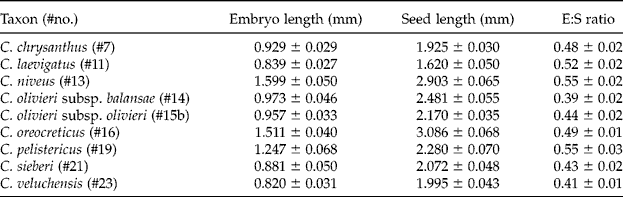
Embryo and seed length showed considerable variation among the nine Crocus taxa studied and the average values were 1.084 ± 0.100 and 2.281 ± 0.157 mm, respectively (Table 2). In the studied taxon with the smallest seed mass (C. laevigatus) embryo and seed length were 0.839 ± 0.027 and 1.620 ± 0.050 mm, respectively. On the contrary, in the taxon with the largest seeds (C. niveus), embryo and seed length were 1.599 ± 0.050 and 2.903 ± 0.065 mm, respectively. The mean E:S ratio (Fig. 6) of fresh (non-afterripened) seeds of all the taxa studied was 0.47 ± 0.02 (0.39 ± 0.02 to 0.55 ± 0.03).
Mean (± SE) values of embryo length, seed length and E:S ratio for nine Crocus taxa. Samples of 20 dry seeds were used (15 seeds for taxa 11 and 21). Taxon numbering follows Table 1

E:S ratios in dry, untreated seeds (white dotted bars); seeds afterripened for 3 months at 20°C and imbibed for 1 week at the optimal temperature of each taxon (grey bars); seeds warm-stratified for 3 months at 20°C (black bars) and critical E:S ratio (stripped bars). Mean values are obtained from samples as described in Table 2. Taxon numbering follows Table 1. The ‘a, b, c, d’ labels represent a significant difference among the four values within each taxon (P < 0.05). Vertical lines on each bar represent standard error.

After 3 months of AR at 20°C and 1 week imbibition at the optimal temperature for each taxon, the mean E:S ratio slightly increased by 0–20%, with a mean increase of 7%. However, after 3 months of WS at 20°C, at which time seeds had not germinated, the mean E:S ratio increased in almost all taxa studied by 8–36%, with an average increase of 19%, and in five taxa the increase was statistically significant (P ≤ 0.024).
The critical E:S ratio was 0.75 ± 0.02 (0.70 ± 0.01 to 0.81 ± 0.01). The ratio increase (61% on average, ranging from 27 to 106%) was statistically significant in all taxa studied (P ≤ 0.004). Approximately 40 d since the release of physiological dormancy were required for the completion of embryo growth (critical E:S ratio; data not shown). The average embryo and seed length of all taxa prior to germination was 1.932 ± 0.138 and 2.569 ± 0.178 mm, respectively. In the smallest-seeded taxon, critical embryo length and seed length were 1.286 ± 0.046 and 1.790 ± 0.058 mm, respectively; in the largest-seeded taxon these were 2.332 ± 0.065 and 3.305 ± 0.059 mm, respectively.
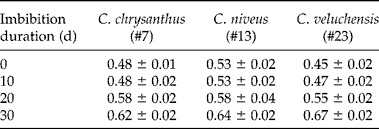
In general, embryos grew only after WS, except for C. chrysanthus and C. veluchensis, in which AR significantly affected the E:S ratio (P= 0.026 and P= 0.001, respectively). To examine whether this increase can be attributed to the AR or to the imbibition itself, the effect of the latter on embryo growth, at the optimal temperature, was investigated in these two and in one other taxon (#13, as a kind of control). In all three taxa, it was found that embryo elongation started only after 20 d following imbibition (Table 3).
E:S ratio values (mean ± SE, n=20) in three Crocus taxa, after various durations of seed imbibition at the optimal germination temperature for each taxon, in continuous darkness. Taxon numbering follows Table 1

Discussion
Fresh seeds of 22 out of the 23 taxa studied (categories ‘A’ and ‘B’) were primarily dormant, but when treated with an optimal duration of AR, seed germination usually exceeded 90%. An afterripening requirement was found previously in four other Crocus species, which occur in different habitats and are phylogenetically distant from the studied taxa (Fu et al., Reference Fu, Tan, Baskin and Baskin2013; Carta et al., Reference Carta, Probert, Moretti, Peruzzi and Bedini2014): C. neapolitanus, C. etruscus and C. ilvensis are expected to fall within category ‘A’, since they did not germinate after seed collection, whereas the subalpine C. alatavicus will probably fit in category ‘B’, since seed germination after seed collection exceeded 90% after 14 weeks of imbibition and WS accelerated seed germination. On the basis of the results of the present and the above-mentioned studies, it is postulated that the presence of primary physiological dormancy and an AR requirement for dormancy break are collective characteristics of Crocus seeds. Environmental, habitat-driven effects on the diversification of germination strategies are quite common (Probert et al., Reference Probert, Smith and Birch1985; Skordilis and Thanos, Reference Skordilis and Thanos1995; Veasey et al., Reference Veasey, Karasawa, Santos, Rosa, Mamani and Oliveira2004; Ascough et al., Reference Ascough, Erwin and Van Staden2007); on the other hand, it is well known that phylogeny is also very important in determining germination behaviour. Therefore, species of the same genus (e.g. Carex; Schütz and Rave, Reference Schütz and Rave1999) or even the same family (such as Campanulaceae and Cistaceae; Thanos et al., Reference Thanos, Georghiou, Kadis and Pantazi1992; Koutsovoulou et al., Reference Koutsovoulou, Daws and Thanos2014) may share similar germination patterns.
In most cases of the present study, the AR requirement was satisfied by keeping dry seeds at lab conditions for a rather short duration (maximum 3 months), and hence it is assumed that seeds would be fully afterripened by the end of summer. Results of the field experiment have confirmed this postulate. Moreover, AR outdoors proved to be better than AR in the lab, in terms of rate and percentage of germination, despite the fact that the duration of AR was shorter. Only in C. olivieri subsp. balansae was the AR requirement not fully satisfied during the 3 summer months; however, it should be borne in mind that a typical Mediterranean summer usually lasts more than 3 months. Differences in the release of primary dormancy by AR in the lab and in the field have been reported previously in several species (e.g. Pérez-Fernández et al., Reference Pérez-Fernández, Lamont, Marwick and Lamont2000; Baskin and Baskin, Reference Baskin and Baskin2014).
Afterripening enhances germination in many Mediterranean species (Bell et al., Reference Bell, Plummer and Taylor1993; Baskin and Baskin, Reference Baskin, Baskin and Cheplick1998; Schütz et al., Reference Schütz, Milberg and Lamont2002; Turner et al., Reference Turner, Merritt, Ridley, Commander, Baskin, Baskin and Dixon2006; Fournaraki, Reference Fournaraki2010). This is in agreement with the fact that in such climatic regions, dry conditions required for AR occur naturally (Probert, Reference Probert and Fenner2000). Apart from Crocus, an AR requirement has also been recorded in some other Iridaceae (Carpenter et al., Reference Carpenter, Wilfret and Cornell1991) as well as several geophytes (Corbineau et al., Reference Corbineau, Neveur and Côme1989; Copete et al., Reference Copete, Herranz, Ferrandis, Baskin and Baskin2011; Narbona et al., Reference Narbona, Delgado, Encina, Miguez and Buide2013). An AR requirement is likely to be more widespread than already known, since in many germination studies the effect of AR is either avoided or circumvented (by pre-storing dry seeds at lab conditions for various durations) or even not tested at all (Baskin and Baskin, Reference Baskin and Baskin2014). In regions with dry summers, AR probably correlates with spring- or early-summer-dispersed species that germinate in autumn (Allen and Meyer, Reference Allen and Meyer1998; Côme et al., Reference Côme, Corbineau, Footitt, Holdworth, Black, Bewley and Halmer2006; Fournaraki, Reference Fournaraki2010), thus preventing germination prior to or during the dry season and the subsequent death of the dried-out seedlings (Grime et al., Reference Grime, Mason, Curtis, Rodman, Band, Mowforth, Neal and Shaw1981; Iglesias-Fernández et al., Reference Iglesias-Fernández, Rodríguez-Gacio and Matilla2011).
In the majority of the Crocus taxa studied (18 of the 22) the AR requirement was satisfied by WS at 20°C, but not at higher temperatures (25°C), at which seed viability was lost. Although the optimal temperatures for both AR and WS were much lower than those expected (Murdoch and Ellis, Reference Murdoch, Ellis and Fenner2000; Probert, Reference Probert and Fenner2000; Baskin and Baskin, Reference Baskin and Baskin2014), results are in agreement with those reported for other Mediterranean species (Schütz et al., Reference Schütz, Milberg and Lamont2002). Stratification at 20/10°C had a similar effect on seed germination compared with WS at 20°C and therefore it can be concluded that seeds were stratified during the ‘day’ (20°C) while the cool ‘night’ intervals (10°C) did not affect germination. Similar results have been reported in three other Crocus taxa (Carta et al., Reference Carta, Probert, Moretti, Peruzzi and Bedini2014). Gibberellic acid was also tested as a dormancy release method and proved to be inefficient, as previously documented in C. alatavicus (Fu et al., Reference Fu, Tan, Baskin and Baskin2013).
Although the release of physiological dormancy by high summer temperatures in Mediterranean species and in winter annuals is a rather common characteristic (Grime et al., Reference Grime, Mason, Curtis, Rodman, Band, Mowforth, Neal and Shaw1981; Baskin and Baskin, Reference Baskin and Baskin1985, Reference Baskin, Baskin and Cheplick1998, Reference Baskin and Baskin2014; Kigel, Reference Kigel, Kigel and Galili1995), the majority of the studies do not take into account the imbibition treatment, and thus AR and WS are not tested in parallel. Whenever both methods were studied, they have yielded relatively similar results (Hoyle et al., Reference Hoyle, Daws, Steadman and Adkins2008; Karlsson and Milberg, Reference Karlsson and Milberg2008; Vandelook et al., Reference Vandelook, Van de Moer and Van Assche2008; Conversa et al., Reference Conversa, Lazzizera and Elia2010; Tuckett et al., Reference Tuckett, Merritt, Hay, Hopper and Dixon2010), as is the case of the present study. In addition, seed treatment in an RH-saturated atmosphere satisfied the WS requirement for the Crocus taxa tested. Therefore, it is concluded that regardless of the seed hydration state – dry seeds, imbibed seeds or seeds exposed to a water vapour saturated atmosphere – germination is promoted by a period of seed exposure to c. 20°C, despite the general consensus that a high moisture content of seeds (>20%) prevents AR and may result in loss of seed viability (Leopold et al., Reference Leopold, Glenister and Cohn1988; Leubner-Metzger, Reference Leubner-Metzger2005; Bair et al., Reference Bair, Meyer and Allen2006; Turner et al., Reference Turner, Merritt, Renton and Dixon2009; Bazin et al., Reference Bazin, Batlla, Dussert, El-Maarouf-Bouteau and Bailly2010; Iglesias-Fernández et al., Reference Iglesias-Fernández, Rodríguez-Gacio and Matilla2011; Bewley et al., Reference Bewley, Bradford, Hilhorst and Nonogaki2013).
Dry seed preservation at cold temperatures (5°C), for more than 1 year, enhanced germination in the majority of the Crocus taxa studied and released primary dormancy in the weakly AR-requiring taxa. On the contrary, cold stratification, a common method for release of physiological dormancy in temperate habitats (Probert, Reference Probert and Fenner2000; Baskin and Baskin, Reference Baskin and Baskin2014), not only failed to substitute for AR but also induced secondary dormancy in non-dormant Crocus seeds (Skourti and Thanos, Reference Skourti, Thanos, Zhimin, Bo, Jinlei and Qiaoling2013). Germination enhancement by dry storage at cold temperatures has been documented for only a few species, including Mediterranean (Mira et al., Reference Mira, González-Benito, Ibars and Estrelles2011), wetland (Carta et al., Reference Carta, Bedini, Müller and Probert2013) or subalpine ones (Wang et al., Reference Wang, Baskin, Chen and Du2010). Storage at freezing temperatures ( − 20°C) proved to be an efficient method to store Crocus seeds without changing their dormancy status, as previously recorded for Triticum durum (Stefani et al., Reference Stefani, Meletti, Sbrana and Onnis2000) and Helianthus annuus (Bazin et al., Reference Bazin, Batlla, Dussert, El-Maarouf-Bouteau and Bailly2010).
Another important germination characteristic found in all Crocus taxa studied (with the exception of C. pelistericus) is photoinhibition, either absolute (16 taxa, category ‘i’) or partial (five taxa, category ‘ii’). Although germinability in the dark has been reported previously (Holloway, Reference Holloway1987; Swart et al., Reference Swart, Kulkarni, Finnie and Van Staden2011; Carta et al., Reference Carta, Probert, Moretti, Peruzzi and Bedini2014), to our knowledge this is the first clear-cut and extensive record of photoinhibition in the family Iridaceae. Light inhibits germination in seeds of many geophytes from relatively dry habitats (e.g. Allium staticiforme, Thanos et al., Reference Thanos, Georghiou, Douma and Marangaki1991; Muscari weissii and M. neglectum, Doussi and Thanos, Reference Doussi and Thanos2002; Leucojum autumnale, Narcissus cavanillesii, Narcissus serotinus, Scilla autumnalis and Urginea maritima, Marques and Draper, Reference Marques and Draper2012; Eremurus anisopterus, Mamut et al., Reference Mamut, Tan, Baskin and Baskin2014). It is well established that photoinhibition may be ecologically advantageous for species growing in dry habitats, by ensuring below-surface germination and hence protecting seedlings from dehydration and exposure to extremely high temperatures (Koller et al., Reference Koller, Sachs and Negbi1964; Thanos et al., Reference Thanos, Georghiou, Douma and Marangaki1991). In dry, open habitats, both water shortage and high temperatures inhibit germination during summer (Pons, Reference Pons and Fenner2000; Fenner and Thompson, Reference Fenner and Thompson2005; Tobe et al., Reference Tobe, Zhang and Omasa2005), whereas photoinhibition prevents germination on the soil surface when water and temperature conditions are suitable for germination. For example, photoinhibition may prevent germination after a casual rainfall event at the beginning of autumn, when the water supply is not consistently favourable for subsequent seedling growth, in regions with a Mediterranean climate. Hilton (Reference Hilton1984) suggested that photoinhibition may also act as a delay mechanism, for burial of seeds to take place (in addition to the AR requirement), leading to the manifestation of germination late in autumn or early in winter (according to the temperature range for germination of the species) and therefore safeguarding seedling survival. Dormancy release may modify the response of seeds to light, mainly in light-requiring species (Baskin and Baskin, Reference Baskin and Baskin2014); yet non-dormant Crocus seeds remained highly photoinhibited.
It is noteworthy that light indifference was observed in the present study only at 5°C, which could possibly be due to the fact that the light irradiance provided in the specific incubator was not adequate for photoinhibition. On the other hand, there might be an ecological aspect in the two exceptions found, since the non-photoinhibited taxa were the only ones collected from subalpine meadows, which are also open but relatively wet compared to phrygana and maquis. Likewise, Fu et al. (Reference Fu, Tan, Baskin and Baskin2013) found that seed germination of C. alatavicus, inhabiting subalpine grasslands and forest edges, is light indifferent. Seeds of the woodland species C. etruscus and C. ilvensis are similarly light indifferent (Carta et al., Reference Carta, Probert, Moretti, Peruzzi and Bedini2014) and their habitats are certainly less susceptible to drying out than typical Mediterranean shrublands (Fenner and Thompson, Reference Fenner and Thompson2005). On the other hand, photoinhibition of germination has been reported for C. neapolitanus (Carta et al., Reference Carta, Probert, Moretti, Peruzzi and Bedini2014), a species inhabiting open temperate meadows which are relatively dry compared with subalpine habitats. As a result, photoinhibition within the genus seems to be correlated with relatively dry habitats and not simply with open ones, as previously suggested by Carta et al. (Reference Carta, Probert, Moretti, Peruzzi and Bedini2014). In small-seeded species, photoinhibition does not seem to be an option, due to limited nutrient reserves (Pons, Reference Pons and Fenner2000; Smith, Reference Smith2000; Koutsovoulou et al., Reference Koutsovoulou, Daws and Thanos2014); it has already been postulated that germination becomes less dependent on light with increasing seed mass (Bell et al., Reference Bell, Rockich, McChesney and Plummer1995, Reference Bell, King and Plummer1999; Milberg et al., Reference Milberg, Andersson and Thompson2000). In a genus with relatively medium-sized seeds like Crocus, where the seed mass is well above the assumed threshold of 1.5 mg for light requirement (Jankowska-Blaszczuk and Daws, Reference Jankowska-Blaszczuk and Daws2007), photoinhibition is rather more advantageous as an adaptive mechanism compared with light requirement, provided of course that water is available in the habitat. In other words, for the seedling that can afford to emerge from below the surface, this dark germination would certainly confer an obvious advantage, i.e. a lower probability of early seedling death compared to that of a seed germinating on the soil surface. This might also explain why large seeds are correlated with dry habitats (Leishman et al., Reference Leishman, Wright, Moles, Westoby and Fenner2000; Daws et al., Reference Daws, Crabtree, Dalling, Mullins and Burslem2008; Vandelook et al., Reference Vandelook, Verdú and Honnay2012).
The seeds of the Crocus taxa studied have relatively small (underdeveloped) linear embryos at the time of dispersal, as has been documented for Iridaceae in general (Martin, Reference Martin1946; Baskin and Baskin, Reference Baskin and Baskin2007). At least for the studied taxa, we found that after the release of physiological dormancy (at autumn temperatures) the embryos grow slowly and continuously. The embryo was found to elongate mainly after WS compared with AR; this may explain why seed germination started more rapidly after the former pretreatment. The overall seed length also increased and hence a conclusion based exclusively on the embryo length or size would be misleading. The E:S ratio increased continuously following imbibition and therefore embryo growth is considered to be a component of the slow and continuous developmental process during germination, as pointed out by other researchers (Karlsson et al., Reference Karlsson, Hidayati, Walck and Milberg2005; Vandelook and Van Assche, Reference Vandelook and Van Assche2008; Carta et al., Reference Carta, Probert, Moretti, Peruzzi and Bedini2014), rather than a discrete block of germination that has to be overcome. From a different perspective, according to Baskin and Baskin (Reference Baskin and Baskin2014), the seeds of the Crocus taxa studied could be considered as having deep simple morphophysiological dormancy. The E:S ratio of fresh Crocus seeds, along with the critical E:S ratio, found by Fu et al. (Reference Fu, Tan, Baskin and Baskin2013) and Carta et al. (Reference Carta, Probert, Moretti, Peruzzi and Bedini2014), falls within the range observed for the taxa of the present study, with the exception of the lower critical ratio found in C. alatavicus (0.62, Fu et al., Reference Fu, Tan, Baskin and Baskin2013). The presence of underdeveloped embryos, which have to grow prior to germination, was found in all Crocus taxa studied [nine in the present study, three in Carta et al. (Reference Carta, Probert, Moretti, Peruzzi and Bedini2014) and one in Fu et al. (Reference Fu, Tan, Baskin and Baskin2013)], despite the fact that the above species inhabit climatically and geographically distinct regions and are phylogenetically distant. The above characteristic is quite rare in the Mediterranean region (Baskin and Baskin, Reference Baskin and Baskin2014; but see Copete et al., Reference Copete, Herranz, Ferrandis, Baskin and Baskin2011, Reference Copete, Herranz, Copete and Ferrandis2014; Hidayati et al., Reference Hidayati, Walck, Merritt, Turner, Turner and Dixon2012), but common in wetter regions, mainly among spring-flowering woodland geophytes (Kondo et al., Reference Kondo, Miura, Okubo, Shimada, Baskin and Baskin2004; Vandelook and Van Assche, Reference Vandelook and Van Assche2008; Mondoni et al., Reference Mondoni, Probert, Rossi and Hay2009, Reference Mondoni, Orsenigo and Rossi2013; Carasso et al., Reference Carasso, Hay, Probert and Mucciarelli2011).
In summary, the effects of AR and light on seed germination of Crocus have been studied for the first time in 23 out of 29 Greek taxa (both autumn- and spring-flowering), from all available habitats within the Greek territory (phrygana, maquis and subalpine meadows); the taxa studied belong to all nine taxonomic series and occur all over the altitudinal and latitudinal range of distribution of the genus in Greece (and are thus exposed to either typical Mediterranean or temperate climate). Primary physiological dormancy and the AR/WS requirement have been revealed in virtually all Crocus taxa studied (22 in the present work plus four in the literature) and thus it is postulated that they are collective characteristics of the genus. It is also demonstrated that an AR requirement can be fulfilled in nature, during the Mediterranean-type summer. The embryos of the studied taxa are underdeveloped and have to grow prior to germination. Differences within the genus are observed only in the response of seed germination to light and may be correlated with habitat diversification, with photoinhibition being predominant in the species from drier environments. The findings of the present study are in agreement with the general consensus that temperature (high summer temperature in this case) is the principal factor controlling seed germination and dormancy, whereas light is responsible for a complementary, fine-tuning control of germination.
Acknowledgements
We thank the Institute of Mediterranean Forest Ecosystems and Forest Products Technology – Hellenic Agricultural Organization ‘DEMETER’, since part of the experiments took place at their facilities. Dr T. Constantinidis and T. Karamplianis are acknowledged for providing information on species distribution during seed collections. We are grateful to Katerina Koutsovoulou, Apostolos Kaltsis and Athanasia Sergentani for their assistance in seed collections.
Financial support
This research has been co-financed by the European Union (European Social Fund – ESF) and Greek national funds through the Operational Program ‘Education and Lifelong Learning’ of the National Strategic Reference Framework (NSRF) – Research Funding Program: ‘Heracleitus II. Investing in knowledge society through the European Social Fund’.
Conflicts of interest
None.