The term restricted and repetitive behavior (RRB) refers to a wide range of movements and behaviors that are frequently seen in atypical development, but which also feature in typical development (Leekam, Prior, & Uljarevic, Reference Leekam, Prior and Uljarevic2011; Leekam et al., Reference Leekam, Tandos, McConachie, Meins, Le Couteur and Parkinson2007). Although studies on RRB generally include typically developing children as a comparison group for children at risk for developmental disorder or delay, recent research has begun to chart the developmental course of RRB in typical development. RRB moves from sensory and motor behaviors in early infancy to rigidity in performing tasks, insistence on routine, and restrictive interests in later infancy (Arnott et al., Reference Arnott, McConachie, Meins, Fernyhough, Le Couteur and Turner2010; Cevikaslan, Evans, Dedeoglu, Kalaca, & Yazgan, Reference Cevikaslan, Evans, Dedeoglu, Kalaca and Yazgan2014), and appears to have an adaptive function. Sensory and motor repetitive behavior (e.g., body rocking, spinning, and hand mannerisms) in the first to second year of life is thought to facilitate the acquisition of motor skills (Arnott et al., Reference Arnott, McConachie, Meins, Fernyhough, Le Couteur and Turner2010; Kravitz & Boehm, Reference Kravitz and Boehm1971; Piaget, Reference Piaget1952; Thelen, Reference Thelen1981). In later infancy and the preschool years, children begin to show preference for routine and some resistance to novelty, which may function to regulate anxiety (Evans et al., Reference Evans, Leckman, Carter, Reznick, Henshaw and King1997; Leekam et al., Reference Leekam, Tandos, McConachie, Meins, Le Couteur and Parkinson2007). Other posited functions of RRB include overflow of excess energy, tension release or arousal regulation, learning, and self-stimulation (Berkson & Tupa, Reference Berkson and Tupa2000; Kravitz & Boehm, Reference Kravitz and Boehm1971; Thelen, Reference Thelen1981).
Little is known about how individual variation in the display of RRB in typically developing children relates to other areas of development. The endurance of sensory and motor repetitive behavior beyond infancy has been proposed to be associated with low IQ, given that this type of RRB is frequently seen in children and adults with intellectual disabilities, as well as those who have suffered severe neglect or environmental deprivation (Berkson & Tupa, Reference Berkson and Tupa2000; Bishop, Richler, & Lord, Reference Bishop, Richler and Lord2006). Understanding individual variability may be important for distinguishing normal and abnormal levels of RRB (Rogers, Reference Rogers2009; Symons, Sperry, Dropnik, & Bodfish, Reference Symons, Sperry, Dropik and Bodfish2005). Despite the combination of RRB and social cognition and language impairment as diagnostic criteria for autism spectrum disorders (ASD), there is debate as to whether these areas share a common causal pathway or arise from co-occurring but unrelated difficulties (Charman & Swettenham, Reference Charman, Swettenham, Burack, Charman, Yirmiya and Zelazo2001; Happé & Ronald, Reference Happé and Ronald2008; Mandy & Skuse, Reference Mandy and Skuse2008). Moreover, while some quantitative and qualitative differences exist in the expression of RRB in children with and without ASD, there is considerable overlap (Bodfish, Symons, Parker, & Lewis, Reference Bodfish, Symons, Parker and Lewis2000; McDonald et al., Reference McDonald, Green, Mansfield, Geckeler, Gardenier and Anderson2007). Consequently, better understanding of the trajectory and correlates of these behaviors in typical development is likely to be informative for understanding the precursors of developmental psychopathology (Barber, Wetherby, & Chambers, Reference Barber, Wetherby and Chambers2012; Tregay, Gilmour, & Charman, Reference Tregay, Gilmour and Charman2009), and in particular for identifying children at risk for ASD, who show high levels of RRB in infancy (American Psychiatric Association, 2013; Rogers, Reference Rogers2009; Wolff et al., Reference Wolff, Botterton, Dager, Elison, Estes and Gu2014).
Motor development shapes the child's interaction with and experience of the world, providing opportunities for language and communication: when an infant begins to crawl, the opportunities for joint attention to distal referents with the caregiver are likely to increase, leading to more advanced social communication (Iverson, Reference Iverson2010). In line with this suggestion, Harrop et al. (Reference Harrop, McConachie, Emsley, Leadbitter and Green2014) reported that sensory and motor repetitive behavior was negatively correlated with typically developing 2-year-olds’ language concurrently and 13 months later, but there were no relations between sensory and motor repetitive behavior and language 7 months later, or with children's nonverbal IQ at any time point. Ray-Subramanian and Weismer (Reference Ray-Subramanian and Weismer2012) also found negative correlations between repetitive behaviors (sensory interest, hand and finger, and excessive interest/stereotypy) and both language and nonverbal cognitive skills in children with ASD at age 3. However, increases in both receptive and expressive language between 2 and 3 years predicted a decrease in RRB even when nonverbal cognitive skills were controlled.
Rigidity/routines/restricted interests relate to typically developing children's cognitive flexibility rather than language development. Tregay et al. (Reference Tregay, Gilmour and Charman2009) reported that higher scores on the repetitive behavior subscale of the Childhood Routines Inventory (Evans et al., Reference Evans, Leckman, Carter, Reznick, Henshaw and King1997) were associated with lower cognitive flexibility in 3- to 5-year-olds. This subscale indexes rigidity/routines/restricted interests such as acting out the same thing over and over in pretend play or repeating certain actions over and over. Furthermore, cognitive inflexibility in children aged 5 to 8 years was associated with higher concurrent scores on both the repetitive behavior and “just right” behavior (e.g., prefers to have things done in a particular order or in a certain way, and insists on having certain belongings around the house “in their place”) Childhood Routines Inventory subscales. These findings suggest that, unlike repetitive behavior, “just right” behaviors are only related negatively to developmental outcomes if they persist into later childhood. The authors argued that elevated RRB arising from anxiety or lower developmental level may inhibit learning opportunities required for executive function abilities, but they called for further research on concurrent correlates of RRB in typically developing samples.
Previous research thus suggests that both types of RRB (sensory and motor and rigidity/routines/restricted interests) are negatively associated with certain aspects of development. However, it has been argued that these different types of RRB are only associated with less advanced development if they persist beyond the point at which they are adaptive or appropriate (Evans, Lewis, & Iobst, Reference Evans, Lewis and Iobst2004; Thelen, Reference Thelen1981). While sensory and motor repetitive behavior appears to be adaptive in the first to second year of life, one would expect its persistence after this age to be negatively related to children's development. For example, engagement in sensory and motor repetitive behavior beyond infancy may impede language development due to reduced opportunities for social engagement (Iverson, Reference Iverson2010). This argument is echoed by researchers in ASD who conjecture that infants whose focus is consumed by RRB may be less likely to take up social learning opportunities, or conversely, that children with lower social motivation may be more likely to engage in RRB to occupy or stimulate themselves (Leekam et al., Reference Leekam, Prior and Uljarevic2011; Wolff et al., Reference Wolff, Botterton, Dager, Elison, Estes and Gu2014). In contrast, rigidity/routines/restricted interests are more adaptive during late infancy and the early preschool years because of the increasing need for preschoolers to regulate their own behavior (Evans et al., Reference Evans, Lewis and Iobst2004). One might thus expect this type of RRB in early childhood not to be associated with less advanced development. High levels of rigidity/routines/restricted interests at the end of infancy may even be a positive predictor of later language and social cognition.
The present study investigated how sensory and motor repetitive behavior and rigidity/routines/restricted interests at age 26 months related to concurrent language abilities in typically developing children. Given the previous findings discussed above, we expected sensory and motor repetitive behaviors at 26 months to be negatively correlated with children's language abilities, but we made no directional hypothesis for the relation between language and rigidity/routines/restricted interests. We also investigated how the two types of RRB related to children's concurrent symbolic play abilities. We assessed two aspects of symbolic play: elicited and instructed (Lewis & Boucher, Reference Lewis and Boucher1988; Meins, Fernyhough, Arnott, Leekam, & de Rosnay, Reference Meins, Fernyhough, Arnott, Leekam and de Rosnay2013; Meins & Russell, Reference Meins and Russell1997). Elicited symbolic play indexes the child's baseline symbolic representational abilities, whereas instructed symbolic play indexes the child's tendency to incorporate another person's perspective into their symbolic play. It is thus a marker of children's burgeoning social cognition and ability to metarepresent (Hobson, Reference Hobson1990, Reference Hobson1991; Leslie, Reference Leslie1987). In addition to engaging in high levels of RRB, children with ASD have difficulty adopting others' symbolic acts within the context of social symbolic play (Hobson, Hobson, Cheung, & Calo, Reference Hobson, Hobson, Cheung and Caló2015). The present study therefore sought to investigate whether instructed symbolic play and RRB were negatively related in typically developing children. Specifically, we hypothesized that the persistence of sensory and motor repetitive behavior at age 26 months would be negatively related to children's concurrent instructed symbolic play.
We were also interested in whether such RRBs at age 2 were negatively related to typically developing children's social cognition and language later in development. It may be that sensory and motor repetitive behaviors at age 2 relate only to concurrent social cognition and language and are not markers of poorer future development. However, it may equally be the case that such repetitive behaviors are markers of sustained nonoptimal development in these areas. To explore this issue, the present study investigated how RRB at age 26 months related to children's later language and social cognition abilities, using theory of mind (ToM) tasks as the measure of social cognition. As is the case for language and social symbolic play, ToM abilities have been reliably found to be compromised in children with ASD (e.g., Baron-Cohen, Leslie, & Frith, Reference Baron-Cohen, Leslie and Frith1985). The present study was the first to investigate links between RRB and ToM in typical development, exploring how sensory and motor repetitive behavior and rigidity/routines/restricted interests at 26 months related to children's ToM performance at ages 4 and 5. If the persistence of RRB beyond the age at which it is adaptive predicts poorer future development, one would predict that sensory and motor repetitive behavior at age 26 months would be negatively related to children's language and social cognition in the preschool years. Given this hypothesis, it was also important to establish whether any observed relations between sensory and motor repetitive behavior and later language and social cognition were mutually independent.
In summary, the present study investigated concurrent and predictive links between RRB at age 26 months and language and social cognition. We hypothesized that sensory and motor repetitive behavior at 26 months would be negatively related to children's concurrent language and symbolic play abilities, and we investigated whether this negative association was maintained in relation to children's later language and ToM performance. Relations between rigidity/routines/restricted interests at 26 months and concurrent and later language and social cognitive performance were explored, but no directional hypotheses were made. Finally, we explored developmental pathways, investigating whether (a) any observed relations between RRB and language and ToM abilities were mutually independent, and (b) age 4 ToM mediated any observed relations between RRB and age 5 ToM.
Method
Participants
Participants were 206 mothers and children (108 girls), recruited through mother and baby groups and healthcare professionals in the local area when infants were age 8 months; the majority (203) were White. Participating families came from a wide range of socioeconomic status (SES) backgrounds, with almost half of the sample (n = 90) from the two lowest levels (no post-16 education, unemployed/unskilled–menial/semiskilled–manual occupation) of the Hollingshead index (Hollingshead, Reference Hollingshead1975), with scores ranging from 11 to 66. The study was approved by the relevant university and health service ethics committees. Mothers gave full informed consent at each testing phase. All research procedures were in line with guidelines from the American Psychological Association and the British Psychological Society.
All testing sessions were conducted in the university developmental laboratory. Information on demographics was collected at entry to the study when infants were age 8 months, and mean age for mothers at entry was 28.08 years (SD = 5.48, range = 16–41). At Phase 1, infants were age 26 months (M = 26.04, SD = 0.86, range = 24–28). At Phase 2, children were age 51 months (M = 51.53, SD = 0.85, range = 49–53). At Phase 3, children were age 61 months (M = 61.35, SD = 1.08, range = 58–64). Of the 206 participants at Phase 1, 161 were available for follow-up at Phases 2 and 3. Attrition was due to families having moved from the area or being unable to schedule convenient times for testing. Participants who remained in the study at Phase 3 had higher language scores and lower sensory and motor repetitive behavior scores at age 26 months (ps .003 and .026, respectively), and higher SES scores (p < .001), but the sample remained socially diverse, with 63 families in the low SES group at Phase 3. Participants who were retained did not differ from those who were not with respect to rigidity/routines/restricted interests and play scores at 26 months, and ToM and language scores at 51 months (ps > .108). One child in the sample went on to be diagnosed with ASD, with clinical description of Asperger syndrome, mildly affected. Excluding this child from analyses had no impact on the results; the analyses reported below include this child.
Overview of testing procedures
At Phase 1 (age 26 months), mothers completed a questionnaire measure on their children's RRB, children participated in a procedure to assess their symbolic play, and children's expressive and receptive language were assessed using a standardized assessment. At Phase 2 (age 51 months), children completed a battery of measures to assess ToM, and their receptive verbal ability was assessed using a standardized assessment. The ToM battery was repeated at Phase 3 (61 months).
Repetitive behavior
Mothers completed the Repetitive Behavior Questionnaire—2 (Leekam et al., Reference Leekam, Tandos, McConachie, Meins, Le Couteur and Parkinson2007) to assess their children's RRB at Phase 1. The Repetitive Behavior Questionnaire—2 consists of 20 items, scored 1, 2, or 3 (never/rarely, mild/occasional, or marked/notable), describing a variety of restricted and repetitive behaviors in which the child may have engaged over the previous month. Items include motor behaviors (e.g., rocking backward and forward, or side to side, either when sitting or when standing), sensory behaviors (e.g., having a special interest in the smell of people or objects), restricted interests (e.g., playing the same music, game, or video, or reading the same book repeatedly), and routines (e.g., insisting that aspects of daily routine must remain the same). Higher scores on the items indicate greater frequency, severity, or impact of the RRB, depending on the item. RRB can be scored according to two subscales (Arnott et al., Reference Arnott, McConachie, Meins, Fernyhough, Le Couteur and Turner2010; Leekam et al., Reference Leekam, Tandos, McConachie, Meins, Le Couteur and Parkinson2007): sensory and motor repetitive behaviors and rigidity/routines/restricted interests. Only the first 19 items are used in the calculation of the subscales. The internal reliabilities of these two subscales were α = 0.80 and 0.76, respectively. Scores for each subscale are averaged for the number of items, giving potential scores between 1 and 3.
Symbolic play
At Phase 1, children's symbolic play was assessed using a task based on procedures used by Lewis and Boucher (Reference Lewis and Boucher1988) and Meins and Russell (Reference Meins and Russell1997), involving junk objects (e.g., a cardboard box) and two representational toys (car and doll). In the elicited play condition, the experimenter presented the child with a toy–junk object pair (e.g., the car and a cardboard box) and asked, “What can you do with these?” After that play sequence, or if the child did not spontaneously engage in play, the instructed play condition ensued, where the experimenter asked for a specific play sequence to be enacted (e.g., “Can you show me how the car drives in to the garage?”). In the instructed condition, the experimenter did not explicitly tell the child to use the box as a garage or demonstrate the suggested action.
Both conditions were scored using criteria based on the level of sophistication of play, with higher scores for more in-depth demonstrations (e.g., lifting the flap of the cardboard box as a pretend garage door, “driving” the car inside and closing the “door” again). The potential range of scores was 0–24. The researcher who coded the play sequences was blind to the hypotheses of the study and to the other measures. A randomly selected 20% of observations were coded by a second blind researcher; interrater reliability (intraclass correlation) was 0.81 for elicited play and 0.78 for instructed play.
Language
Children's expressive and receptive language was assessed at Phase 1 using the Preschool Language Scales—Third Edition (PLS; Boucher & Lewis, Reference Boucher and Lewis1997). The PLS yielded standardized scores for children's total language abilities, which were used in the analyses.
At Phase 2, children completed the British Picture Vocabulary Scales—Second Edition (Dunn, Dunn, Whetton, & Burley, Reference Dunn, Dunn, Whetton and Burley1997), which provided a measure of receptive language ability. Standardized scores are presented and used in the analyses.
ToM
At Phases 2 and 3, a battery of ToM tests based on Wellman and Liu (Reference Wellman and Liu2004) was administered to children: (a) diverse beliefs task to assess the child's ability to recognize a belief that differed from his/her own and to predict the character's behavior on the basis of that belief; (b) knowledge access task to assess the child's understanding that knowledge relies on having had access to crucial information; (c) contents false belief (other) to assess whether the child can recognize that a person will predict the contents of a container based on its outward appearance (potato chips) rather than its actual content (a toy pig); (d) contents false belief (self) to assess whether the child recognizes his or her own initial false belief about the unexpected contents of a container; (e) explicit false belief task to assess the child's ability to predict where a character will search for an object based on the information the character has, rather than the actual location of the object; and (f) unexpected transfer task to assess the child's ability to predict a character's behavior on the basis of a false belief. The child was required to pass control questions of memory and reality in order to be credited for passing a test item. Scenarios were structured such that the gender of the characters in the stories matched the child's gender, and the order of administration of the tasks was counterbalanced and randomized. Children received a score of 1 for each task passed, resulting in a range of possible scores from 0 to 6.
Internal reliability for the ToM battery was acceptable (Cronbach α = 0.63 at 51 months and 0.68 at 61 months), and in line with the internal reliability reported in studies that have employed similar ToM batteries (e.g., Astington & Jenkins, Reference Astington and Jenkins1999).
Results
Descriptive statistics and preliminary analyses
Due to partial completion or noncompletion of certain measures, data were missing for some variables as follows: RRB data were available for 192 children, 203 children completed the PLS, 202 children completed the symbolic play task, and 157 children completed the British Picture Vocabulary Scales.
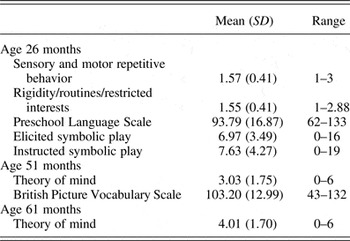
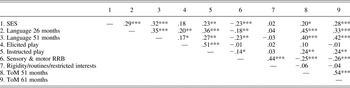
Descriptive statistics for all variables are shown in Table 1. As shown in Table 2, SES was negatively correlated with children's sensory and motor repetitive behavior at age 26 months, but was unrelated to rigidity/routines/restricted interests. SES was positively correlated with language, symbolic play, and ToM (see Table 2).
Descriptive statistics for all variables

Zero-order correlations among all variables

Note: SES, Socioeconomic status; RRB, restricted and repetitive behavior; ToM, theory of mind.
*p < .05. **p < .01. ***p < .001.
Girls (M = 10.64, SD = 3.00) did not differ from boys (M = 11.38, SD = 3.77) with respect to sensory and motor repetitive behavior, t (190) = 1.52, p = .130, d = 0.22, but boys (M = 16.35, SD = 4.17) were reported to engage in more rigidity/routines/restricted interests than were girls (M = 15.03, SD = 3.62), t (190) = 2.34, p = .020, d = 0.34.
Concurrent correlates of restricted and repetitive behaviors
As shown in Table 2, sensory and motor repetitive behavior was negatively correlated with children's concurrent language and instructed symbolic play scores, but was unrelated to elicited symbolic play. When SES was partialled out, the negative correlation with concurrent language was reduced to a nonsignificant trend, r (188) = –.13, p = .085, and the correlation with instructed symbolic play became nonsignfiicant, r (188) = –.07, p = .334. Rigidity/routines/restricted interests were unrelated to children's concurrent language and play.
Do restricted and repetitive behaviors predict language performance over time?
Prior to testing whether restricted and repetitive behaviors predicted language and ToM in a mutually independent way (i.e., accounting for the variance common to both language and ToM), we performed a hierarchical multiple regression using Mplus 7.3 (Muthén & Muthén, Reference Muthén and Muthén2008–Reference Muthén and Muthén2014) to examine whether the indices of RRB predicted changes in language performance from age 26 months to 51 months. The initial model with SES and gender explained 10% of the variance, while the model with sensory and motor repetitive behavior and rigidity/routines/restricted interests added explained 24%. The difference was significant, Δ–2 log likelihood (Δdf = 3) = 42.41, p < .001. Language at 26 months was a positive and significant predictor (estimate = 0.24, SE = 0.05, 95% confidence interval [CI] = 0.13–0.34); thus, this accounted for autocorrelation in language performance over time. SES was also a positive and significant predictor (estimate = 0.17, SE = 0.06, 95% CI = 0.04–0.30). With all variables entered into the regression equation, sensory and motor repetitive behavior predicted decreases in language performance (estimate = –0.91, SE = 0.31, 95% CI = –1.51 to –0.31). Rigidity/routines/restricted interests were unrelated to the language variables.
Do restricted and repetitive behaviors predict ToM performance over time?
To examine the effects of sensory and motor repetitive behavior and rigidity/routines/restricted interests on ToM performance at 51 and 61 months, we conducted a path analysis using Mplus 7.3 (Muthén & Muthén, Reference Muthén and Muthén2008–Reference Muthén and Muthén2014). In this path model, we used manifest (observed rather than latent) variables of RRB at 26 months to predict ToM performance at 51 months, while also controlling for gender and SES. We also predicted ToM performance at 61 months from these same variables, including ToM at 51 months into the model; this allowed for testing the indirect effect from RRB to ToM at 61 months via earlier ToM. These were fully saturated models (χ2 = 0.00, df = 0, p = .00, comparative fit index = 1.00, Tucker–Lewis index = 1.00, root mean square error of approximation = 0.00). We then tested the effect of verbal ability as a time-varying covariate to determine any changes in the model based on the covariation of verbal ability and ToM. We also controlled for early play in the final model, as instructed symbolic play was associated with ToM in zero-order correlations. These models were run with the delta method of determining direct and indirect effects. We used bootstrapping of standard errors and confidence intervals with 5,000 samples as recommended (Hayes, Reference Hayes2013; Preacher & Hayes, Reference Preacher and Hayes2008). Confidence intervals were included to show the magnitude of the effect sizes. Confidence intervals that are further away from zero denote stronger effect sizes; those that include zero are nonsignificant.
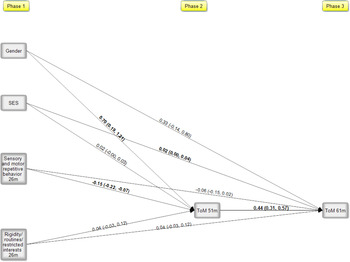
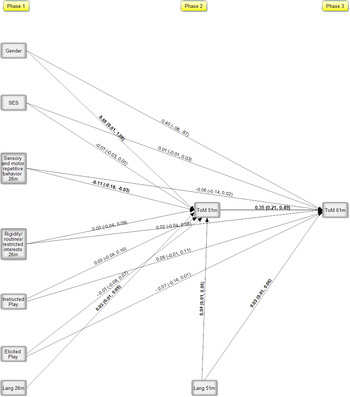
A model testing only the effects of gender and SES on ToM was tested against the model including RRB, which showed the RRB model was a significant improvement over the effects of only gender and SES, Δ–2 log likelihood (Δdf = 4) = 19.07, p < .001. While the initial model explained 7% and 10% of the variance in ToM at 51 and 61 months, respectively, the model including RRB explained 13% and 33%, respectively. The results of the path analysis are noted in Figure 1 with unstandardized estimates and confidence intervals. Sensory and motor repetitive behavior significantly and negatively predicted ToM at 51 months (estimate = –0.15, SE = 0.04, p < .001, 95% CI = –0.22 to –0.07), with a confidence interval well below zero. Girls also scored more highly than boys on ToM at 51 months (estimate = 0.70, SE = 0.26, p = .008, 95% CI = 0.19–1.21). ToM showed moderate stability, with ToM at 51 months predicting ToM at 61 months (estimate = 0.44, SE = 0.07, p < .001, 95% CI = 0.31, 0.57). In the model shown in Figure 1, higher SES was also related to ToM at 61 months (estimate = 0.02, SE = 0.01, p = .025, 95% CI = 0.002–0.04). Further, although there was no direct effect from sensory and motor repetitive behavior to ToM at 61 months, the indirect effect was significant (estimate = –0.06, SE = 0.02, p = .001, 95% CI = –0.10 to –0.03). Thus, sensory and motor repetitive behavior was associated with ToM at 61 months via its association with ToM at 51 months. The model shown in Figure 1, then, included both sensory and motor repetitive behavior and rigidity/routines/restricted interests as well as important demographic covariates as predictors of ToM, but only sensory and motor repetitive behavior predicted decreases in ToM over time.
(Color online) Path analysis from sensory and motor repetitive behavior and rigidity/routines/restricted interests to theory of mind (ToM). Total and indirect effects from sensory and motor repetitive behavior were significant (estimate = –0.13, SE = 0.04, p = .002, 95% confidence interval [CI] = –0.21 to –0.05; estimate = –0.06, SE = 0.02, p = .001, 95% CI = –0.10 to –0.03, respectively). Total and indirect effects from rigidity/routines/restricted interests were nonsignificant (estimate = 0.05, SE = 0.04, p = .192, 95% CI = –0.02 to 0.12; estimate = 0.02, SE = 0.02, p = .237, 95% CI = –0.01 to 0.05, respectively). Significant paths are shown in bold.

Do restricted and repetitive behaviors predict ToM performance over time when controlling for language and symbolic play?
Next, we tested a model including language ability as a time-varying covariate of the effects on ToM ability at 51 months and 61 months to examine whether associations were unique to each outcome. Children's elicited and instructed symbolic play were further included. Thus, in this model associations among the language, play, and ToM measures were accounted for by adding them to the model. This model was a significant improvement over the model without the time-varying covariates and play, Δ–2 log likelihood (Δdf = 7) = 57.66, p < .001. The model explained 30% and 40%, respectively, for ToM at 51 and 61 months, showing that language ability is an important covariate. The model is shown in Figure 2.
(Color online) Path analysis from sensory and motor repetitive behavior and rigidity/routines/restricted interests to theory of mind (ToM), accounting for associations among the language, play and theory of mind measures. Total and indirect effects from sensory and motor repetitive behavior were significant (estimate = –0.10, SE = 0.04, p = .024, 95% confidence interval [CI] = –0.18 to –0.01; estimate = –0.04, SE = 0.02, p = .021, 95% CI = –0.07 to –0.01, respectively). Total and indirect effects from rigidity/routines/restricted interests were nonsignificant (estimate = 0.03, SE = 0.03, p = .378, 95% CI = –0.04 to 0.10; estimate = 0.01, SE = 0.01, p = .437, 95% CI = –0.02 to 0.04, respectively). Significant paths are shown in bold.

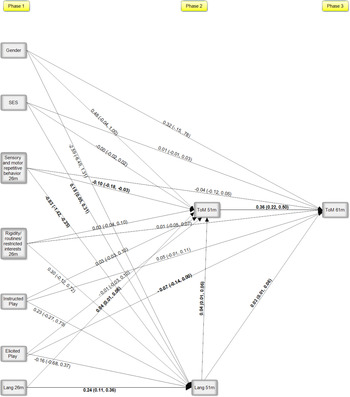
We also considered the possibility that, in addition to language being a time-varying covariate, it might also mediate the link between sensory and motor repetitive behavior and later ToM. We therefore conducted a further mediation via language at 51 months. Because language at 26 months was measured concurrently to the predictors, we did not test its role as a mediator, although the pathway from language at 26 months to language at 51 months was included in the model. To conduct the mediation, language at 51 months had to be treated as an exogenous variable, so we regressed it on the measures collected at 26 months (see paths added in Figure 3). Thus, we tested the indirect effects from RRB to ToM at 61 months via language at 51 months and ToM at 51 months (two sequential mediators).
(Color online) Path analysis from sensory and motor repetitive behavior and rigidity/routines/restricted interests to theory of mind (ToM), with language as a time-varying covariate. Total and indirect effects from sensory and motor repetitive behavior were significant (estimate = –0.11, SE = 0.04, p = .007, 95% confidence interval [CI] = –0.19 to –0.03; estimate = –0.08, SE = 0.02, p < .001, 95% CI = –0.11 to –0.04, respectively). Total and indirect effects from rigidity/routines/restricted interests were nonsignificant (estimate = 0.03, SE = 0.03, p = .345, 95% CI = –0.04 to 0.10; estimate = 0.02, SE = 0.02, p = .162, 95% CI = –0.01 to 0.06, respectively). Significant paths are shown in bold.

Figure 3 illustrates the findings of this mediation model. Sensory and motor repetitive behavior continued to predict ToM at 51 months (estimate = –0.10, SE = 0.04, p = .005, 95% CI = –0.18 to –0.03), although both language at 26 months and 51 months were associated with ToM (estimate = 0.03, SE = 0.01, p < .001, 95% CI = 0.01–0.06; estimate = 0.04, SE = 0.01, p = .003, 95% CI = 0.01–0.06, respectively). Language ability at 51 months was also associated with ToM at 61 months (estimate = 0.03, SE = 0.01, p = .011, 95% CI = 0.01–0.06). The indirect effect from sensory and motor repetitive behavior to ToM at 61 months remained significant (estimate = –0.04, SE = 0.02, p = .018, 95% CI = –0.07 to –0.01), and sensory and motor repetitive behavior showed a negative indirect effect on ToM at 61 months via the effect of both language and ToM at 51 months (estimate = –0.01, SE = 0.01, p = .046, 95% CI = –0.02 to 0.00), but this indirect effect represented a small effect size, because it included zero in the confidence interval. In the final model, the direct effect from sensory and motor repetitive behavior to ToM at 61 months was not significant (estimate = –0.04, SE = 0.04, p = .389, 95% CI = –0.12 to 0.05). Therefore, this model included 26-month language and play as covariates while examining the predictive effects of sensory and motor repetitive behavior and rigidity/routines/restricted interests on 51-month language and ToM and 61-month ToM. The findings of this analysis were generally similar to those presented in Figure 2; the time-varying covariates and the indirect effects of language were small in the mediation model, and sensory and motor repetitive behavior continued to predict lower ToM at 51 months and have an indirect negative effect on ToM at 61 months via ToM at 51 months.
Comparing the time-varying model (Figure 2) with the mediation model (Figure 3), the increase in Akaike's information criterion and Bayesian information criterion suggests that the model with language as a mediator is penalized for complexity (Dziak, Coffman, Lanza, & Li, Reference Dziak, Coffman, Lanza and Li2012). The mediation model presented was more complex and not as parsimonious as the time-varying model presented in Figure 2: the Bayesian information criterion and Akaike information criterion increased from 1,136.22 and 1,075.74 to 2,375.93 and 2,286.21, respectively. These were not nested models; thus, these indices are better indicators of parsimony than a change in log likelihood (Dziak et al., Reference Dziak, Coffman, Lanza and Li2012). Taking these indices into account, the model presented in Figure 2 is the best fitting and most parsimonious model tested. In this model, children's sensory and motor repetitive behavior at age 26 months was related to lower ToM at 51 months, which led to lower ToM at 61 months.
Discussion
The aim of the present study was to examine whether elevated levels of RRB in late infancy were associated with children's language and social cognition, both concurrently and predictively. Sensory and motor repetitive behavior at the end of infancy was negatively associated with (a) concurrent language and instructed symbolic play (although these relations were not independent of SES), (b) language and ToM abilities at age 4, and (c) ToM performance at age 5. In contrast to these consistent negative relations with language and ToM abilities, sensory and motor behavior was unrelated to concurrent elicited symbolic play. The path analyses, controlling for gender, SES, language, and symbolic play, showed that sensory and motor repetitive behavior had a direct negative effect on children's ToM performance at age 4, with age 4 ToM mediating the relation between sensory and motor repetitive behavior and ToM performance at age 5. These findings indicate that the persistence of sensory and motor repetitive behavior beyond infancy is associated with poorer language and social cognition both concurrently and later in development. Our results are thus consistent with prior research. For example, Harrop et al. (Reference Harrop, McConachie, Emsley, Leadbitter and Green2014) reported that RRB was negatively associated with concurrent language abilities in 2-year-old typically developing children, and Ray-Subramanin and Weismer (Reference Ray-Subramanian and Weismer2012) found that language increases were related to decreases in RRB between 2 and 3 years of age in children with ASD. However, these previous studies focused exclusively on sensory and motor repetitive behaviors. In contrast, the present study included measures of both sensory and motor repetitive behavior and rigidity/routines/restricted interests. Our findings show that the negative relations between RRB and cognitive development are specific to sensory and motor repetitive behavior: rigidity/routines/restricted interests scores were unrelated to all of the cognitive variables.
The link between sensory and motor repetitive behavior and ToM found in the present study may be relevant for research on ASD. Our finding that elevated sensory and motor repetitive behavior relates to poorer language and social cognition in typical development suggests that, in ASD, the co-occurrence of these two deficits is unlikely to be coincidental (see Brunsdon & Happé, Reference Brunsdon and Happé2014). Given that our study involved a community sample, with only one of the children going on to be diagnosed with ASD, it was not possible to establish whether RRBs at age 2 played a role in predicting a diagnosis of ASD. Future research could explore this question in children with a familial risk of developing ASD to establish whether children at risk of ASD will show elevated levels of age-inappropriate RRBs. Including measures of early language and social cognition would enable researchers to test different causal models for ASD. For example, such research would adjudicate between models explaining ASD in terms of a single causal pathway or cascading effects of deficit (e.g., Elsabbagh & Johnson, Reference Elsabbagh and Johnson2010), or impairments in multiple areas (Bedford et al., Reference Bedford, Pickles, Gliga, Elsabbagh, Charman and Johnson2014).
The results of our path analyses suggest that sensory and motor repetitive behaviors at age 2 directly predict both language and social cognition at age 4; these effects were independent of age 2 language, which also predicted language and social cognition at age 4. The model in which age 4 language acted as a mediator of the relation between sensory and motor repetitive behavior and age 4 social cognition was less parsimonious than the model without language as a mediator. These findings suggest that, at least in typical development, there is weak evidence for a cascading effect from RRB to poorer language to poorer social cognition. In contrast, children's social cognition at age 2 did not predict children's later ToM or language in the path analyses. It would be interesting to investigate whether the same pattern holds for children at risk of ASD; if this were found to be the case, high levels of sensory and motor repetitive behavior and poorer language skills at the end of infancy would appear more important than early social cognition in identifying children who are likely to go on to be diagnosed with ASD.
The present study was unique in looking separately at sensory and motor repetitive behavior and rigidity/routines/restricted interests in typically developing children in order to tease apart their differential relation to development, as researchers working with ASD populations have begun to do (e.g., Bishop et al., Reference Bishop, Richler and Lord2006). The finding that children's language and social cognition were not associated with elevated levels of rigidity/routines/restricted interests is consistent with the notion that there is a hierarchy in RRB, with sensory and motor repetitive behavior representing more immature, lower order behaviors that may be a potential marker of suboptimal development if they persist beyond infancy. While RRB is typical of early development, our results indicate that there are specific time periods within which the two forms of RRB are adaptive and beyond which they may be associated with less advanced concurrent and subsequent cognitive development. This suggestion is in line with Tregay et al.'s (Reference Tregay, Gilmour and Charman2009) finding that repetitive behavior was negatively associated with cognitive flexibility in 3- to 5-year-olds and 5- to 8-year-olds, whereas “just right” behaviors were negatively related to cognitive flexibility only in children aged 5 and upward. Our null findings for relations between rigidity/routines/restricted interests at age 2 and concurrent and later cognitive performance are thus consistent with previous research. However, further research is needed to establish the age beyond which this form of RRB becomes maladaptive.
This point raises one limitation of the present study: RRB was not assessed at ages 4 or 5. In the absence of measures of RRB later in development, it is not possible to conclude that age 2 sensory and motor repetitive behavior predicted later language and social cognition independently of later RRB. No study has yet investigated the longitudinal trajectories of sensory motor repetitive behavior and rigidity/routines/restricted interests in typically developing children. It may be that children who engage in high levels of particular types of RRB at age 2 will continue to engage in high levels later in the preschool years. Conversely, high levels of sensory and motor repetitive behavior at age 2 may predict age inappropriate levels of rigidity/routines/restricted interests later in development. In charting the longitudinal development of RRB, it is important to recognize that behaviors may decline over time and yet still remain at a level that is not appropriate for the child's age. It is therefore crucial to identify those RRBs that are adaptive and commonplace at particular ages and those that are not. Future research that assesses RRB, language, and social cognition at multiple points in development is thus needed to establish the exact age at which high levels of RRB are indicative of less optimal development.
Given that Tregay et al. (Reference Tregay, Gilmour and Charman2009) focused exclusively on children's cognitive flexibility and executive function, future research should investigate whether rigidity/routines/restricted interests in later childhood are negatively related to other core aspects of cognitive development, such as language and ToM. It would also be interesting to establish how the two forms of RRB relate to social and emotional development across childhood. At the very least, the divergent profiles of sensory and motor repetitive behavior and rigidity/routines/restricted interests mean that these forms of RRB should be distinguished more clearly in research studies, as well as in clinical evaluations (Bishop et al., Reference Bishop, Richler and Lord2006).
What might account for the observed association between sensory and motor repetitive behavior and cognitive development? One possibility is related to Thelen's (Reference Thelen1981) proposal that elevated repetitive behavior involving internal stimuli such as auditory, visual, or kinesthetic feedback may maintain the child's focus on self-stimulation and limit engagement with social learning opportunities that are necessary for cognitive development. However, the direction of causality for such a proposal needs to be established, and the findings of the present study do not allow this kind of distinction: it may be the case that the infant's preoccupation with RRB inhibits social engagement, or that low social motivation or engagement predisposes an infant to attend to internal stimuli and stimulation, or it might be a combination of both processes. The second explanation is consistent with the observation that lower levels of environmental stimulation can lead to sensory and motor repetitive behavior, both in children and in animals (Berkson & Tupa, Reference Berkson and Tupa2000). This may also go some way to explaining the negative association between sensory and motor repetitive behavior with SES in the current study, because less stimulating, or more stressful, social environments may predispose infants to engage more frequently in repetitive behavior. Alternatively, sensory and motor repetitive behavior and cognitive deficits may both stem from a common cause such as poor executive function (see Carlson, Mandell, & Williams, Reference Carlson, Mandell and Williams2004). However, such a link with executive function may hold only in typical development. In children with ASD, repetitive behaviors precede executive function development, and executive function is not impaired in the preschool years (see Leekam et al., Reference Leekam, Prior and Uljarevic2011; Tregay et al., Reference Tregay, Gilmour and Charman2009, for discussion). Further longitudinal research charting the two forms of RRB along with social, cognitive, and executive function development would help to distinguish among these possibilities.
In summary, the present study highlighted the importance of recognizing the heterogeneity of RRB and distinguishing between sensory and motor repetitive behavior and rigidity/routines/restricted interests. Our study presents the first data on how these two types of RRB in the early preschool years relate to typically developing children's concurrent and later language and social cognition, showing that the persistence of sensory and motor repetitive behavior beyond infancy is consistently associated with poorer social–cognitive performance and language. These results suggest that this form of RRB may be an important predictor of developmental outcomes in typical as well as atypical development.