INTRODUCTION
Pipe-clay figurines have been a matter of scholarly interest since the first focused studies cataloguing the artefacts from Gaul were conducted during the nineteenth century.Footnote 1 Since then the systematic application of typological and contextual methodologies has provided a particularly detailed impression of the circulation and consumption of pipe-clay figurines, as well as the potential religious function and social significance of these objects, throughout various provincial regions of Western Europe.Footnote 2 However, the investigation of pipe-clay figurines remains comparatively under-developed in Britain where, other than their occasional mention as noteworthy religious objects in site reportsFootnote 3 and important grave goods from interesting burials,Footnote 4 the most significant contribution to the subject is an unpublished PhD thesis which catalogued 390 artefacts recovered by the 1970s.Footnote 5
The aim of this paper is to conduct a study of pipe-clay figurines recovered from Roman London, including finds from Southwark and extramural cemeteries.Footnote 6 Modelled using two-piece moulds by craftsmen (plastes) working from terracotta-production centres (officinae) in the Allier-Valley, France,Footnote 7 this collection is particularly significant in that it probably constitutes one of the largest and most diverse assemblages of these first- to second-century statuettes thus far recovered from Britain, providing a very useful snapshot of the wider under-researched and unpublished material now available from the province. After formulating a typological catalogue quantifying the different types of deity, human and animal figurines, the composition of the assemblage will be compared with that of continental collections to explore the nature of regional consumption of pipe-clay figurines in London, Britain, Gaul and the Rhineland. The subsequent spatial and social distribution analyses will assess the contexts of the material to explore the diverse social and temporal character of consumption throughout Londinium. A preliminary fragmentation assessment will also begin to explore whether subtle breakage patterns reflect religious beliefs and ritual practices. As such, this paper hopes to provide a nuanced impression of the consumption of such figurines while exploring the function and social significance of these objects to better understand the religious lives of those who inhabited Roman London and Britain.
TYPOLOGICAL CATALOGUE AND QUANTITATIVE ANALYSIS
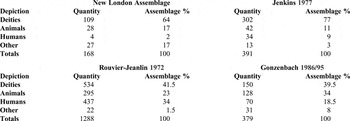
A total of 168 pipe-clay figurines have been recovered from Roman London. This number includes 109 deities (64 per cent), 28 birds or other animals (17 per cent), and four humans (2 per cent). The remaining 27 unidentifiable artefacts include three circular bases, three square-plinth bases and 21 figurine fragments. The 141 identified deities, animals and humans have been classified into groups of depictions and, where possible, types and sub-types based on morphological and/or stylistic variation. This analysis has been conducted according to the typological categories established by Rouvier-JeanlinFootnote 8 which have been traditionally adopted to classify other assemblages from Britain and Europe.Footnote 9 In certain instances identifying figurine types can be difficult as incomplete artefacts are often missing diagnostic body parts and/or stylistic features, while different figurine types can sometimes exhibit similar stylistic features. However, the large proportion of identifiable figurine types from the settlement provides a relatively detailed impression of their consumption in Roman London.
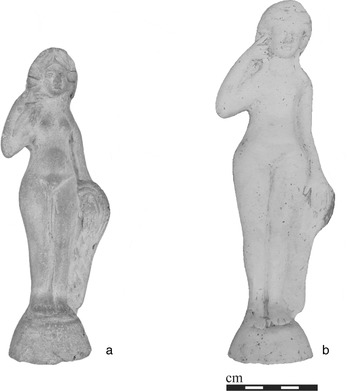
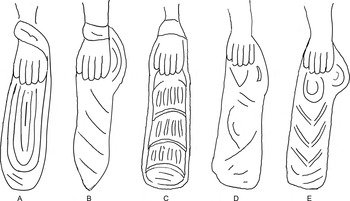
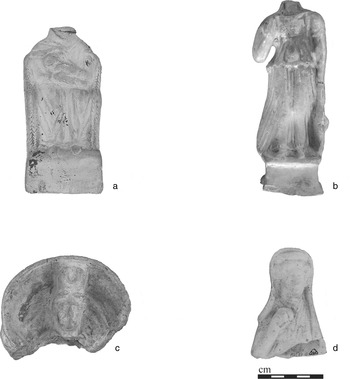
The assemblage of 109 deity figurines includes depictions of Venus, Dea Nutrix, Minerva, Luna/Diana Lucifera and Juno. Venus is the most common, with the 85 examples comprising four different types (Types 1–4) constituting the most extensive and typologically diverse group of figurines recovered from the entire settlement. Nine of these are Type 1 figurines which are defined by the garment draped over the left wrist of the goddess (fig. 1a), whereas 26 are of Type 2 which portrays the garment being held by the fingertips (fig. 1b). Of these 35 figurines, 33 depict garment designs which are conducive to sub-typological classification (fig. 2), with the range of motifs including elongated concentric ovals (Garment A), regularly spaced diagonal incisions (Garment B), crescent-shaped divisions with vertical folds (Garment C), plain folded drapery (Garment D), and chevrons (Garment E). Garment E is the most common, while it is also clear that specific garment motifs are associated with particular types of Venus. For example, Garments A, B and C are exclusive to figurines of Type 1 while Garments D and E are only depicted on statuettes of Type 2, a trend that has also been observed among continental assemblages.Footnote 10 Ten additional finds depicting alternative garment designs are probably also of Venus figurines of Types 1 or 2.
(a) Type 1 Venus figurine from Upper Thames Street; (b) Type 2 Venus figurine from Mansell Street. (Reproduced courtesy of Museum of London)

Venus figurine garment designs.

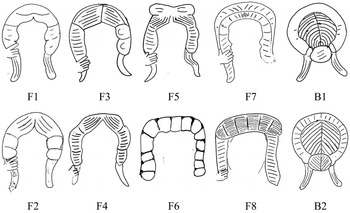
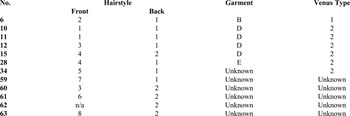
Seven of the 35 figurines of Types 1 and 2, as well as a further five unclassified Venus figurines, can be grouped into further sub-categories by hairstyle (fig. 3). In total eight frontal and two reverse hairstyles have been identified, but the blurring of mould-copying and the wear on some figurines could account for a degree of this variation. Table 1 highlights the greater variety of front as opposed to back hairstyle designs which feature among the assemblage, although this limited dataset does not elucidate any particularly strong typological relationships between hairstyles, garments and/or particular types of Venus. Elsewhere, the remaining group of 35 Venus figurines recovered from the city includes two statuettes of Type 3 which depict the garment around the waist, 11 aedicule fragments of Type 4, and 22 fragmented remains which depict the stylistic attributes of the goddess but lack distinctive typological traits.
Venus figurine hairstyle designs.

VENUS FIGURINE HAIRSTYLE SUB-GROUPS FROM ROMAN LONDON

Of the other deities, figurines of Dea Nutrix are much less common, with only 18 examples. Three are of Type 1 representing the goddess nursing two small infants, while three of Type 2 depict a single infant feeding at the breast (fig. 4a). However, 12 other fragments, including three heads, and nine pieces displaying stylistic attributes which are commonly associated with figurines of Dea Nutrix, are unclassifiable. The remaining deity figurines include three depictions of Minerva (fig. 4b), two of Luna and/or Diana Lucifera (fig. 4c) and a single representation of Juno (fig. 4d). The latter two goddesses are often associated with childbirth and the family and, therefore, possibly share in the wider connotations of fertility more commonly connected with the imagery of Venus and Dea Nutrix.Footnote 11
(a) Type 2 Dea Nutrix figurine from Throgmorton Street; (b) Minerva figurine from Newgate Street; (c) Luna/Diana Lucifera figurine from Leadenhall Street; (d) Juno figurine from Mansell Street. (Reproduced courtesy of Museum of London)

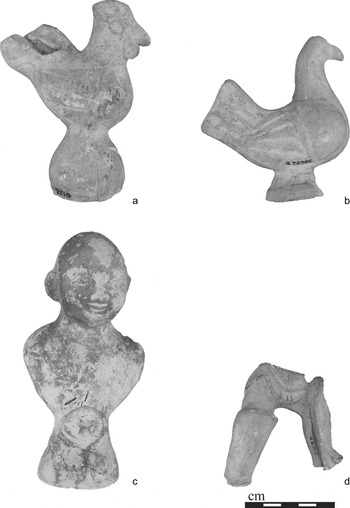
The 28 animal and bird figurines include a range of typological forms. The most common of the birds are cockerels (fig. 5a), with two figurines, each of different type, present alongside a single cockerel fragment. Two pigeons, each of the same type, and single depictions of a hen (fig. 5b) and dove also feature; five other indistinct bird fragments have been identified, two of which are bases that probably come from another type of cockerel. Indeed, some of these birds are closely associated with deities: doves and pigeons with Venus and cockerels with Mercury for example.Footnote 12 Horses are the most common of the animal figurines with ten examples, although these fragmented remains do not permit refined classification. Other animal figurines include a bull, a single lizard, a dolphin and one depiction of a panther. The animal and bird assemblage is accompanied by a small group of four human figurines which includes a single Risus figurine (fig. 5c), a gladiator (fig. 5d) and two circular plinth bases featuring round discs which come from busts of women or children.
(a) Cockerel figurine from Bishopsgate; (b) Hen figurine from King William Street; (c) Risus figurine from Liverpool Street; (d) Gladiator figurine from Queen Street. (Reproduced courtesy of Museum of London)

Comparing the composition of this assemblage with other collections highlights the distinctive character of the consumption of pipe-clay figurines in Roman London as opposed to Britain as a whole and other regions of continental Europe. In doing so two factors must be taken into consideration. The first is the greater size and wider typological variation of the continental assemblages. The second is the fact that the London assemblage represents the finds from a single settlement, while many of the continental publications are concerned with museum collections and regional surveys which are strongly affected by selection and curatorial biases. As such like is not being compared with like, although an analysis of the available material still provides a number of interesting observations.
In general the high frequency of deity as opposed to the lower proportion of both animal and human figurines from London corresponds with a broader trend identified among other collections from the Western provinces (Table 2). The only exception is Rouvier-Jeanlin's collection of material recovered from central Gaul where human forms are more common than animal figurines.Footnote 13 Yet closer inspection reveals numerous distinctive typological similarities and differences between the various collections. For example, although the assemblage from London includes a rather limited range of deity types, depictions of Venus are still the most common figurine type in each collection. However, figurines of Type 1 are more frequent than those of Type 2 on the Continent, while a greater proportion of examples of Type 2 are found in London and Britain. It is unclear when each Venus type arrived in Britain, but the recovery of figurines of Type 1 from mid-first-century deposits and those of Type 2 from early second-century contexts on the Continent could indicate that the former were the first to be imported from continental Europe.Footnote 14
QUANTITIES OF DEITY, ANIMAL AND HUMAN FIGURINES FROM BRITISH AND CONTINENTAL ASSEMBLAGES

Of the other deities, figurines of Dea Nutrix and Minerva feature notably amid every collection, yet the latter are more common on the Continent than in Britain.Footnote 15 However, perhaps the most striking observation about the assemblage from London in particular, is the notable absence of pipe-clay figurines depicting male gods from the settlement, while deities such as Apollo and Mercury occur more frequently on the Continent and rare gods such as Mars, Genii and Bacchus in Britain.Footnote 16 At the same time, bird and horse statuettes comprise significant proportions of each collection, yet with continental assemblages generally featuring a much more extensive range of animal types than that recovered from Britain.Footnote 17 The relatively low quantity of human depictions from London and Britain is also notable considering the greater proportion of these figurine types recovered across central-southern and eastern Gaul.Footnote 18
The assemblage of figurines from Roman London contains a number of distinctly rare deity, animal and human types. For instance, the two depictions of Luna/Diana Lucifera from Leadenhall Street and Bond Court are unique among the material retrieved from Britain and Europe, with only one other comparable yet non-identical figurine recovered from a cemetery near Nijmegen, Holland.Footnote 19 The single Juno figurine recovered from Mansell StreetFootnote 20 is also unique, with only broadly comparable depictions recovered from Gaul,Footnote 21 while the dolphin from One PoultryFootnote 22 and panther from Borough High Street are the first examples of these types recovered from Britain and supplement only a small collection of similar figurines from Clermont-Ferrand and Toulon-sur-Allier in central France.Footnote 23 Similarly, the gladiator recovered from Queen Street remains only the third known example of this particular type identified among the European material, the first coming from the Roman fort of VindonissaFootnote 24 and the second from a nearby tomb in Windisch, Brugg, Switzerland.Footnote 25 However, perhaps the most notable example is the lizard from Leadenhall CourtFootnote 26 which represents a completely new type of figurine never before documented in Britain or Europe; the only broadly comparable artefact comes from Vichy in the Allier Valley region of central France.Footnote 27
The typological composition of the figurine assemblage from London reveals a rather distinctive pattern of consumption within the settlement compared with the remainder of Roman Britain and continental Europe. However, it is still extremely difficult to evaluate the significance of these patterns and determine whether they reflect anything about the inhabitants who used these objects or, rather, trade and supply patterns. In general terms the recovery of a number of uncommon and unique figurine types could reflect the particular social character of Londinium. For example, the presence of the lizard figurine, with its associations with the eastern god Sabazius,Footnote 28 may mirror the cosmopolitan nature of the ancient city much like other objects, such as hairpins,Footnote 29 which also depict eastern and exotic deities. In her recent study of bronze figurines from the settlement Durham argues that such rare and exotic depictions could reflect the presence and social identities of the élite who governed this culturally diverse centre of provincial administration,Footnote 30 while merchants and carriers regularly visiting the settlement may have been involved as well.
SPATIAL AND SOCIAL DISTRIBUTION
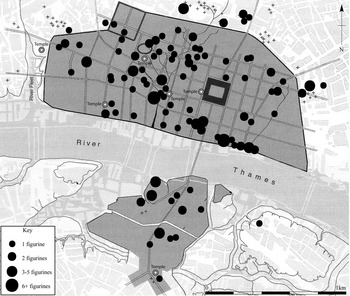
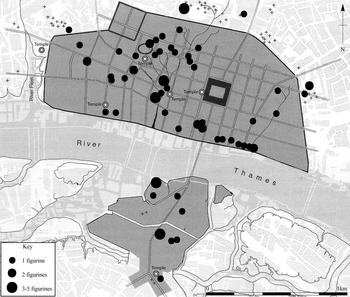
Out of 168 figurines, 163 can be plotted on a map of Roman London showing that they are found throughout the settlement (fig. 6). The only finds not represented are the two unprovenanced finds and three other antiquarian discoveries vaguely associated with ‘London Wall’. As with all such maps, the patterns to some extent reflect the extent of excavation in the city, with this perhaps most evident in Southwark where the topography has only been clarified recently.Footnote 31 However, comparison with bronze figurines,Footnote 32 samian potteryFootnote 33 and Firmalampen lampsFootnote 34 that were also imported during the first and second centuries, reveals the distinctive circulation of pipe-clay figurines in the settlement. On the north side of the Thames the greatest concentration lies throughout the Walbrook Valley, while a smaller, yet denser, cluster of figurines occurs immediately south of the forum and along the northern bank of the river where the Roman port once stood.Footnote 35 A number of finds are also distributed throughout the north-east, south, west and north-west, with a few discoveries located outside of the city walls in the northern, western and eastern cemeteries. The relatively high proportion of Venus figurines (mainly Types 1 and 2) around the Walbrook stream is particularly interesting (fig. 7). Although there was some degree of general dumping in the area and not all of these finds come from the stream itself, it is possible that these statuettes could have been deposited as part of a water-orientated healing ritual or votive practiceFootnote 36 similar to that associated with comparable figurines recovered from sacred spring sites at Springhead in Kent and Vichy in Gaul.Footnote 37
Spatial distribution of pipe-clay figurines in Roman London (total = 163 figurines). (Base map adapted from Rowsome Reference Rowsome, Clark, Cotton, Hall, Sherris and Swain2008, 31, fig. 1.3.7; © MoLA)

Spatial distribution of Venus figurines in Roman London (total = 81 figurines). (Base map adapted from Rowsome Reference Rowsome, Clark, Cotton, Hall, Sherris and Swain2008, 31, fig. 1.3.7; © MoLA)

The distribution of figurines north of the Thames contrasts starkly to the picture south of the river in and around Southwark, where the relatively few finds are located in the north and north-east, close to the main road and along the southern bank of the Thames. Another interesting observation is the complete absence of discoveries made near military structures throughout the settlement, with the only two examples possibly associated with the Cripplegate fort in fact pre- and post-dating that structure. However, perhaps the most surprising aspect is that very few finds have been found within the vicinity of known temple sites despite the religious iconography of these objects, a factor which could indicate an association with private rather than public religious practices.
An analysis of the types of site and deposit from which pipe-clay figurines are recovered elucidates the varied social character of their consumption throughout Roman London, though the lack of available data in some instances highlights the poor quality of antiquarian records and the value of publishing accessible modern information. Adopting a modified version of Eckardt's methodology,Footnote 38 the 115 figurines from known site types have been divided into three categories: habitation, trade and religious sites. Habitation sites are those where archaeological evidence indicates domestic and/or industrial human activity, while the trade group comprises sites connected with the infrastructure and buildings of the settlement's port. The religious category includes finds from burial and ritual locations.
Pipe-clay figurines are most commonly found on habitation sites (76 finds), with these distributed mainly throughout the north, north-east and north-west, close to roads and away from the Thames. A smaller cluster of habitation sites also features along the main road and the southern bank of the river in Southwark, where archaeological investigation indicates that they were probably industrial in character.Footnote 39 The majority of figurines from habitation sites come from pit, ditch and landfill contexts associated with refuse disposal, although another small group derives from deposits associated with construction activity. A small number of finds from Austin Friars, One PoultryFootnote 40 and Noble StreetFootnote 41 were recovered with objects reflective of habitation activity, with these three figurines, for example, accompanied by items including ceramic, metal and bone household objects and personal items of adornment comprising assemblages distinctly domestic in social character. In the majority of cases these deposits most probably do not reflect anything other than discarded rubbish. However, it is possible that some deposits might have some ritual significance. For instance, the composition of object assemblages recovered alongside some figurines is very similar to that of other collections recovered from analogous contexts across London and Britain which have recently been re-interpreted as ‘structured’ ritual deposits.Footnote 42 It has also been suggested that the figurines recovered from drains could have been water-orientated votive offerings, while those recovered from construction deposits could have been votive offerings associated with ritual regeneration practices.Footnote 43
The 30 figurines from trade sites associated with the settlement's port are densely distributed along the north-eastern bank of the Thames. The 28 finds with contextual information show that figurines mainly come from infill and levelling deposits connected with the wooden quayside revetment structure and nearby buildings. A number of other finds are from poorly recorded and unspecified deposits situated close to the revetment which are most likely also associated with the quayside structure, while two residual finds come from Saxon contexts. Seven finds were recovered with other objects indicative of trade activity. The figurines from Custom House, New Fresh Wharf and Three Quays House, for instance, were accompanied by broken pottery, fragments of wood and ceramic tile, and wooden beams, woodchips, charcoal and samian pottery dated to the first and second centuries.Footnote 44 In most instances these deposits probably represent the unfit, unsold and/or uncollected goods and refuse of a busy maritime trading centre which were deposited as levelling fills during the development of the port area and expansion of the quayside revetments.Footnote 45 However, a rare deposit containing three figurines and a number of complete samian vessels could indicate a degree of ritual significance.Footnote 46 The organic ‘peaty’ revetment fill from Waterfront 4 Upper Thames Street is also an interesting deposit in that it contained an object assemblage distinctly domestic in character, which could reflect either the wider range of imported goods discarded near the port or a localised habitation site.Footnote 47
All nine finds from religious sites come with contextual information. Two were recovered from deposits which could be considered ritual in character. The first comes from a pit within the vicinity of a public shrine area at Courage's Brewery,Footnote 48 while the second was recovered from a poorly recorded context overlying an external timber drain located near the south-west corner of the city's Mithraeum.Footnote 49 The latter find displays no stratigraphic relationship with the temple itself but the late third- to early fourth-century date of the deposit does correspond with the known use of the temple from a.d. 240.Footnote 50
The other seven figurines from religious sites come from various types of deposit in the northern and eastern cemeteries. The first is a burnt and residual Venus figurine from an irregular truncated double inhumation containing disarticulated human bone at Tower HamletsFootnote 51 which may have been burnt on a pyre at some stage.Footnote 52 On the other hand, two other finds — a horse figurine from a probable rubbish dump at Tower HamletsFootnote 53 and the rare depiction of Juno from an unstratified or disturbed deposit at Mansell StreetFootnote 54 — show signs of sooting. It is difficult to determine whether this residue represents deliberate scorching as part of some funerary ritual or accidental accumulation caused by close proximity to heat sources, such as lamps, within domestic shrines. However, their recovery from a cemetery suggests that these two figurines could have been either discarded ritual objects which did not make it into the burial, or ritual grave goods which were disturbed and redeposited as a result of later grave cutting and cemetery activity.Footnote 55
Finally, four figurines come from burial deposits. The first is the depiction of Risus recovered from a disturbed mass cremation in the northern cemetery.Footnote 56 Figurines of this type are relatively common from graves and shrines across Gaul where images of infants are also often associated with healing sanctuaries. With this in mind, it is possible that the Risus figurine from London may have been placed in the grave as a dedicatory representation of the deceased and a companion accompanying the dead to the underworld.Footnote 57 The other three finds, all Venus figurines, come from a mid-third- to mid-fourth-century child inhumation located in the city's eastern cemetery (B392). This burial comprised a single lead coffin decorated with beads, encased within an exterior wooden structure, while the figurines were accompanied by a rich assemblage of grave goods that included whole and fragmented glass bowls and vessels, glass bottles, a pair of gold earrings, a bone pyxis, an ivory figurine and a coin dated to the Hadrianic–Antonine period.Footnote 58 As depictions of Venus in this form are often associated with health, protection and fertility,Footnote 59 the figurines from London could well have been deposited in the grave to protect the deceased infant in the underworld and/or as offerings made by the parents of the child with the aim of encouraging the conception and good health of any future offspring. The lack of wear on these three Venus figurines also indicates that they may have been curated, adding to their significance as grave goods.
Although common among graves, shrines and tombs in Gaul,Footnote 60 pipe-clay figurines are very rarely recovered from burial contexts in Britain, with the handful of known instances from the province coming mainly from the graves of children.Footnote 61 One example is the Claudio-Neronian child cremation in Colchester, Essex, which included a large collection of figurines featuring depictions of a child, Hercules and ten comic figures.Footnote 62 Another instance derives from a second-century inhumation at Ermine Street in Arrington, Cambs., where a smaller collection of eight figurines, including a ‘bonnet-style’ mother-goddess, bald-headed infant, seated and cloaked human figures, a ram or ox and two sheep, recovered alongside the remains of a child who died from hydrocephalus (water on the brain),Footnote 63 has been closely associated with the maternal and paternal protection of the infant in the afterlife.Footnote 64 Discoveries such as this might promote the suggestion that pipe-clay figurines could have had a particular association with the healing and protection of ill, sick and diseased infants and children across the south-east of Roman Britain.Footnote 65 Unfortunately the poorly preserved skeletal remains from other burials containing pipe-clay figurines in this region have not been conducive to pathological analysis. However, confirmation that the inhumed child from burial B392 suffered from rickets further supports this particular hypothesis.Footnote 66
Identifying more about the social character of the London burial with its pipe-clay figurines is a rather difficult task considering the lack of comparable finds from the settlement and the contradictory information provided by burial B392. The problem here is that the overall quality of the grave-good assemblage is above the normative patterns encountered throughout the cemetery despite the fact that the stunted skeletal remains equally indicate nutritional and environmental stress commonly associated with inhabitants of a lower social standing;Footnote 67 although this could also reflect poor medical practice by parents unaware of the value of sunshine and vitamin D. Yet comparing burial B392 with similar graves containing pipe-clay figurines across the province provides a more informed indication as to the social character of the deposit. The first particularly useful example comes from Baldock, Herts., where a single figurine of Dea Nutrix was not only unique among the 1,800 burials from the cemetery, but was also carefully positioned upon the chest of a young child in an overly large grave perhaps designed for public viewing prior to interment.Footnote 68 The other significant factor regards the broadly similar composition of the grave-good assemblages from London, Colchester and Godmanchester, each of which included a varied assortment of pottery vessels, metal objects and exotic goods indicative of wealth.Footnote 69 This is not to mention the grave from Arrington which featured an almost identical lined lead coffin to that recovered from burial B392, containing extremely rare aromatic resins which were most probably expensive and luxurious imports.Footnote 70 As such, the wider corpus of evidence from the province indicates that pipe-clay figurines recovered from burial contexts were probably important objects associated with high-status child funerary practices conducted by the more prosperous inhabitants of south-east Roman Britain.
The grave goods and dating of burials containing pipe-clay figurines offer an insight into the changing character of this practice. For example, the burials from Arrington, Baldock, Colchester, Godmanchester and LondonFootnote 71 demonstrate that cremations containing relatively opulent grave-good assemblages, including pipe-clay figurines, featured until the mid-second century, during which time inhumations involving the placement of grave goods outside coffins commenced. By the fourth century, grave-good assemblages not only comprised fewer luxurious items but were alternatively being placed inside coffin structures.Footnote 72 It is, of course, extremely difficult to account for these changes in practice. One hypothesis is that such adaptations symbolise the introduction of various newcomers to the province,Footnote 73 an idea that would certainly account for the presence of the rare incense and ‘bonnet-style’ mother-goddess figurine from Arrington, sourced from the Rhineland, which may have been associated with the presence of immigrant groups travelling through and/or residing in the region.Footnote 74 However, it is notable that these developments were not confined to the child burials with pipe-clay figurines of the South-East, as a similar general pattern is found among the wider corpus of Roman burials from Britain.Footnote 75 Thus, as one of the latest opulent inhumations, burial B392 not only potentially represents a transitional phase of the practice of child burials containing pipe-clay figurines in the South-East, but also further evidences the changing character of the broader complex and temporally varied burial rites that developed throughout Roman Britain.
FRAGMENTATION ANALYSIS
Fragmentation analysis is a relatively recent avenue of archaeological enquiry.Footnote 76 Derived from Chapman's studies of Mesolithic to Copper-Age material culture from the Balkans,Footnote 77 this innovative approach has since been instrumental in re-evaluating the function and cultural significance of fragmented artefact assemblages, such as broken terracotta figurines, within some prehistoric societies of Britain and Europe.Footnote 78 Nanoglou, for instance, argues that the treatment of anthropomorphic terracotta figurines from Neolithic Greece symbolises differences in the complex social practices associated with the conceptualisation of the human body.Footnote 79 In a similar manner, Chapman and Gaydarska's investigations of Hamangia figurines from settlements such as Durankulak in north-east Bulgaria have highlighted the high number of worn head, torso, lower body and leg fragments from habitation contexts, compared with the much lower proportion of less-fragmented and whole specimens from other settlement deposits and burials. It is argued that the associations between certain types of deposit and different fragment types reflect engendered notions of identity, personhood and enchainment, and the androgynous character of death, within communities of the Eastern Balkans during the Neolithic.Footnote 80
The application of fragmentation methodologies to Roman material has been comparatively limited, but there has been initial progress. For example, Ferris has recently re-evaluated evidence from France, Italy and Britain to suggest that fragmented bronze, stone and ceramic figurines may be customised ex-voto objects associated with ritualised healing practices.Footnote 81 Croxford has also observed that fragmented statuary from temples at Uley, Caerleon, Colchester and London could be associated with Romano-British magical practices rather than Christian iconoclastic attacks that took place during the fifth and sixth centuries.Footnote 82 Merrifield has equally suggested that such broken figurines are probably associated with the broader practice of ritual or magic-orientated statuary fragmentation which has already been observed throughout settlements such as Roman London.Footnote 83 With this in mind, the remainder of this paper assesses whether the pipe-clay figurines recovered from Roman London were similarly subjected to processes of fragmentation by identifying the extent of any patterning among the surviving material before briefly exploring the potential functional and cultural significance of these broken objects within the settlement.
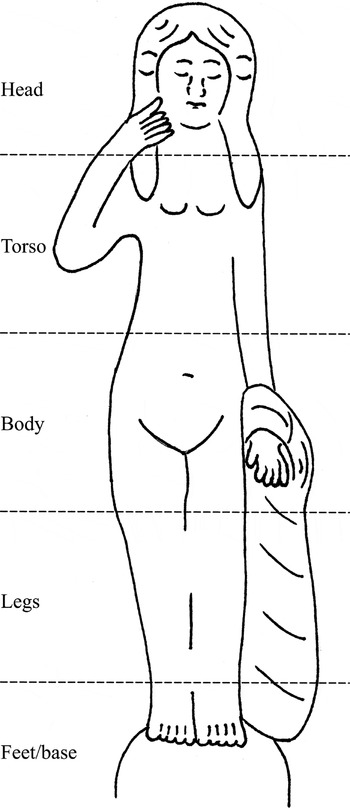
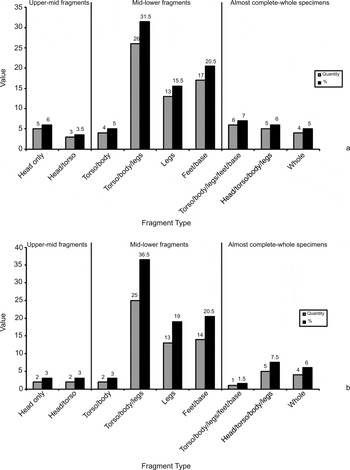
Fragmentation patterns are recognisable by identifying different fragment types among figurine assemblages,Footnote 84 but the methodology is not without problems. The first regards the limited number of animal and human statuettes, so that only the larger collection of deity figurines is likely to reveal any distinctive trends of activity. Of these 109 deity figurines, 26 insubstantial fragments have also been excluded from the analysis as they most probably represent discarded rubbish rather than any deliberately broken and deposited pieces. The remaining 83 substantial fragments and whole specimens are categorised into nine groups defined by surviving anatomical parts (fig. 8): the head (5 figurines); head and torso (3); torso and body (4); torso, body and legs (26); legs (13); feet and base (17); torso, body, legs, feet and base (6); head, torso, body and legs (5); and whole figurines (4). The second concern regards the predominance of the 68 Venus figurines that undoubtedly bias the validity of general trends identifiable among the deity group. To combat this an exclusive assessment of Venus figurines has additionally been conducted to highlight refined fragmentation patterns among this assemblage, with figurines categorised into similar anatomical groups: the head (2 figurines); head and torso (2); torso and body (2); torso, body and legs (25); legs (13); feet and base (14); torso, body, legs, feet and base (1); head, torso, body and legs (5); and whole Venus figurines (4).
Pipe-clay figurine fragmentation types.

fig. 9 demonstrates that torso/body/leg fragments, or those figurines missing the head and feet, and thus broken in areas considered the weakest anatomical points most susceptible to deliberate and/or accidental breakage, are commonly associated with Venus figurines. Other prominent categories include leg and feet/base fragments, while the head, head/torso, torso/body and torso/body/legs/feet/base fragment groups are relatively uncommon. Grouping fragment types into broader categories also highlights some additional trends. For instance, mid-to-lower body fragments are the most numerous compared with those upper body and almost complete specimens, the latter of which may have continued to circulate and/or were deposited elsewhere, particularly in burials. It is possible that mid-to-lower body parts are more common because they were important objects associated with fertility which were curated and carefully deposited. On the other hand, perhaps upper body parts and heads were more important and were thus not discarded as rubbish. Although it is difficult to tell, the majority of fragments recovered from rubbish contexts in London indicate that the latter scenario was more likely the case. Thus, this analysis demonstrates that Venus figurines were used more than any other deity figurine for fragmentation practices (although this is, of course, also a reflection of the numerical dominance of this type) and were one of the few figurine types maintained as whole specimens for use during burial practices; the only other example is the complete Risus figurine from the disturbed mass cremation burial at Liverpool Street. The other interesting observation is that all the near-complete figurines of Dea Nutrix are broken at the neck (the most fragile/breakable part of this type), perhaps indicating that their heads remained in circulation and/or were deposited for an alternative purpose.
(a) Fragmentation profile of deity figurine assemblage (total = 83 figurines); (b) Fragmentation profile of Venus figurine assemblage (total = 68 figurines).

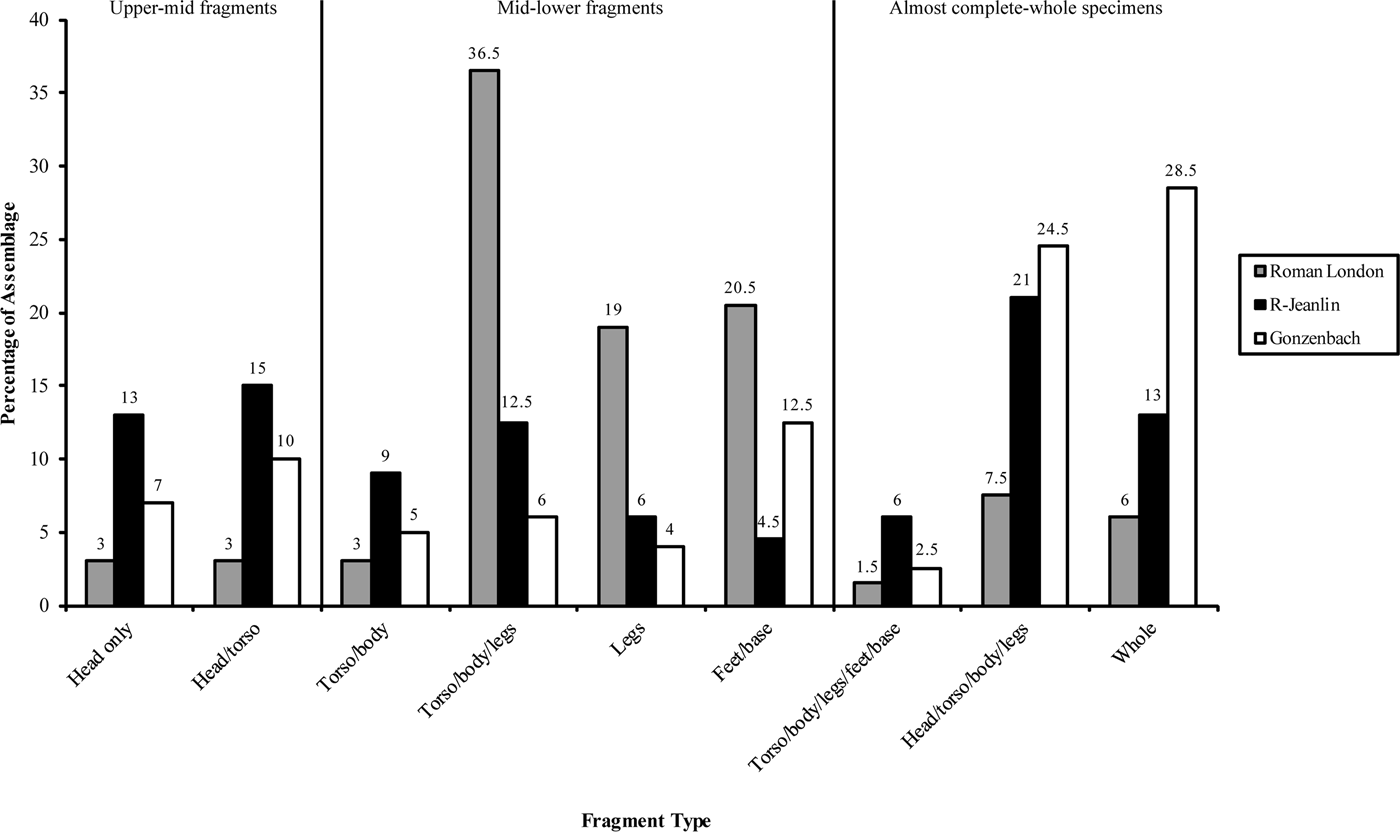
The fragmentation profile of Venus figurines from London can be compared with similar patterns identifiable among other collections to further explore the nature of this social practice throughout Western Europe (fig. 10). Unfortunately a study of the wider material from Britain is not yet possible due to the very limited collection of illustrated evidence provided by Jenkins.Footnote 85 However, continental collections are much more informative. It is important to note at this point that the usefulness of such an approach is limited by two factors. The first regards the fact that the continental assemblages are primarily museum collections which tend to have a bias towards complete rather than fragmented artefacts. The second is the relative lack of illustrated examples available from which to assess continental material, with this including only 145 of the 275 finds from central-southern, and 81 of the 136 figurines recovered from eastern, Gaul.Footnote 86 Nevertheless, analysis of the available material still provides a number of interesting observations. For instance, the figurines from central-southern Gaul include a much higher proportion of upper-to-mid body fragments than the eastern collection, as well as a lower proportion of mid-to-lower fragments and a higher quantity of almost-complete, whole figurines than the material from London. Conversely, Gonzenbach's eastern collection features far fewer mid-to-lower fragments and a much higher proportion of almost-complete, whole figurines than the other assemblages, as well as a distinctly larger proportion of upper-to-mid fragments than the London collection. Although requiring verification from a survey of additional material, these patterns possibly indicate that fragmentation practices varied between different provincial regions.
Fragmentation profiles of London and continental figurine assemblages.
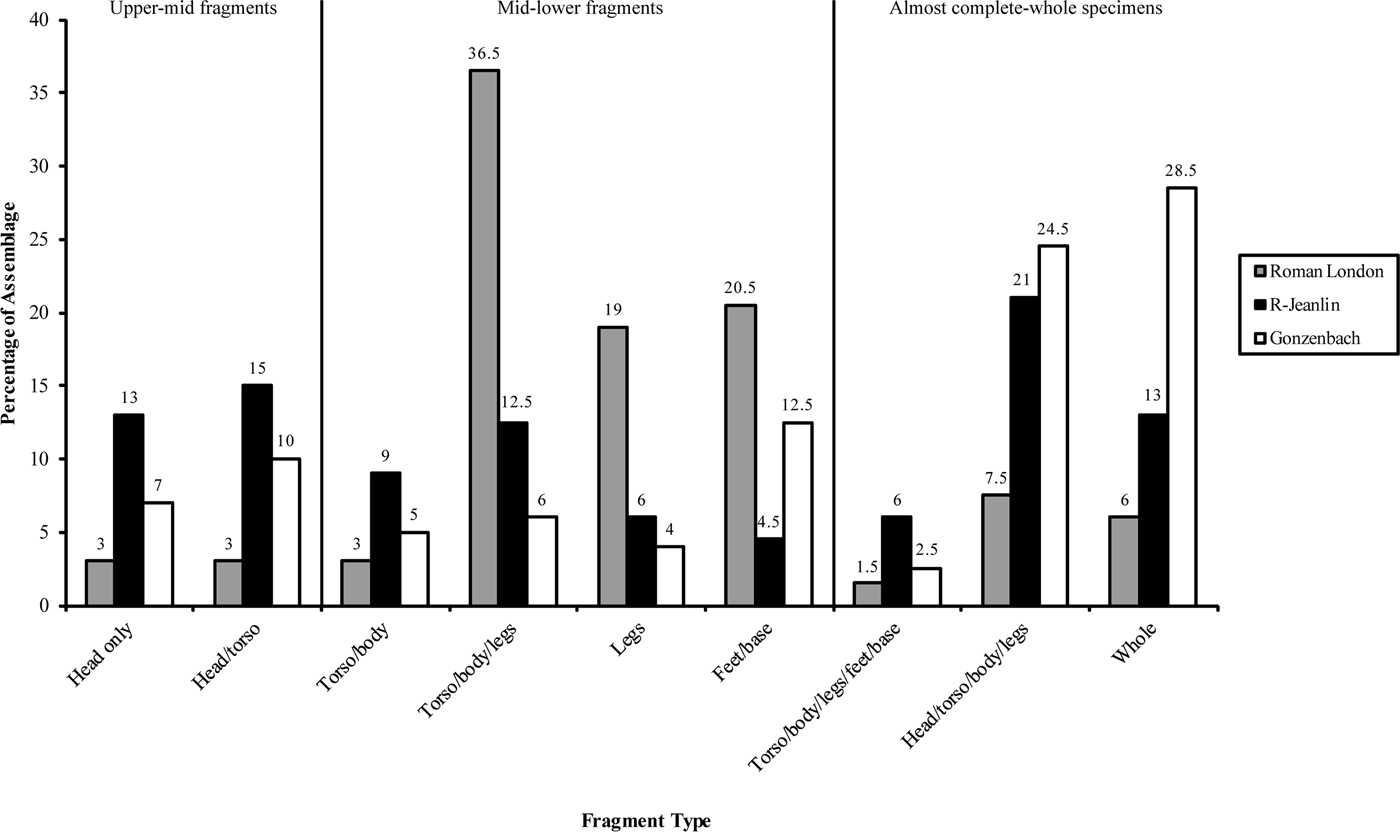
It is very difficult to determine the precise function and social significance of the fragmented figurines from Roman London, yet similar material recovered from elsewhere in Britain highlights the potential importance of the practice. For example, a small assemblage of 16 similarly broken pipe-clay figurines from the canabae at Caerleon has recently been interpreted as ex votos possibly linked with ritual healing and medicinal practices.Footnote 87 With this in mind, it is possible that the prominence of mid-to-lower Venus figurine fragments from London could be inherently connected with the iconography of the goddess and reflect a healing or fertility ritual whereby the broken parts represent areas of the body requiring the care of the gods, or some alternative practice associated with encouraging the economic and social prosperity of the settlement. Indeed, perhaps they are the more humble reflections of those deliberately made body parts sometimes recovered from shrines and temples.Footnote 88 However, when considering these options it is important to remember that the fragmentation of stone and bronze statuary, with selection of their individual limbs, often contrasts with the character of pipe-clay figurines, where arms are attached to the torso and legs are held together as a single piece, which could reflect a completely different type of ritual activity or at least some variation of the ex-voto practice, potentially by those inhabitants who were unable to afford figurines made of more expensive materials. At the same time, the distinctive lack of heads from the collection could well be associated with the cult of the Head that was prevalent in the city throughout the first and second centuries.Footnote 89 If heads were retained for such a purpose it is difficult to account for their relative scarcity, although it is possible that they were deposited somewhere not accessible archaeologically, such as in the Thames, where they eroded and/or were washed away. Whatever the case it is still worth recording these interesting proportions.
There is now clearly a need to assess fragmentation practices across Roman Britain and the North-Western provinces to further test these tentative patterns.
CONCLUSION
This study presents the first typological catalogue of 168 pipe-clay figurines recovered from Roman London. Categorising the assemblage from the settlement reveals interesting patterns of consumption, demonstrating that deities are the most common figurine type. Of these, Venus figurines are the most common, with those of Type 2 being the most numerous of the four types identified, whereas depictions of other deities such as Dea Nutrix, Minerva, Diana/Luna and Juno and other animal and human figurines are less common. Comparing this assemblage with continental collections shows that this higher proportion of deities and the lower proportion of animal and human figurines corresponds with the wider trend throughout Europe, although the continental assemblages generally feature a greater variety of animal and human types than the British material. On the other hand, the recovery of extremely rare figurine types such as Juno, Diana/Luna, the gladiator, panther and lizard indicates a unique pattern of consumption within Roman London compared with broader patterns identified throughout the remainder of Britain and mainland Europe.
The study of the spatial and social distribution of pipe-clay figurine usage throughout Roman London identifies that these objects are associated with particular types of site and deposit. The 76 finds from habitation sites are widely distributed across the settlement and come from pit, ditch and landfill rubbish and construction deposits, a number of which could be ritually significant; while the 28 figurines from levelling and/or natural fill deposits on trade sites located within the port area probably represent discarded imported goods rather than overtly ritual practices. On the other hand, the nine finds from religious contexts indicate that a small proportion of figurines were being incorporated into ritual practices and/or deposited as special grave goods, perhaps even heirlooms, associated with children during high-status funerary rituals from the third century.
Finally, a fragmentation analysis identifies that, other than in burial contexts, pipe-clay figurines are often only partially preserved. This may be the result of ‘natural’ breakage at structurally weak points but detailed analysis shows some subtle patterns which may provide new and important information about religious belief and the nature of ritual practices conducted in the settlement. This initial study indicates that figurines were intentionally broken into fragments resembling particular morphological body parts prior to their deposition and that other fragments remained in circulation and/or were discarded or deposited elsewhere, possibly as part of an alternative practice. A detailed study of Venus figurines also highlights the prominent mid-to-lower body fragmentation profile of this particular group and the notable absence of head fragments, while a comparison with the fragmentation profiles of continental assemblages reveals varied patterns and the possible suggestion of different cultural practices.
Future work on pipe-clay figurines in Britain should further help our understanding of the complex character of religious life in the province and provide important information about British-Romano cultural identities.
ACKNOWLEDGEMENTS
I would especially like to thank my PhD supervisor Dr Hella Eckardt for first directing me towards this material, her comments on this article and her continuing support. Thanks are also due to Professor Michael Fulford for reading an earlier version of this paper. I would like to thank Caroline McDonald and Richard Dabb from the Museum of London who granted me access to the collection of figurines and gave permission to reproduce images, as well as Michael Marshall of Museum of London Archaeology and Dan Nesbitt from the Museum of London Archaeological Archive and Research Centre who provided further collections and additional materials. Gratitude is also extended to Peter Rowsome and David Bowsher (MoLA) for granting permission to reproduce the maps and the two anonymous referees whose comments and recommendations undoubtedly improved the final piece.