1. Introduction
1.1. The key questions
We want to consider the question of how listeners make sense of electroacoustic music and, most importantly, how they understand it as art. But before focusing on electroacoustic listening, we need to consider the broader question of what listeners do in everyday life when making sense of the world around them. This question is far more significant for electroacoustic music than for traditional acoustic music because the expansive acoustic palette of electroacoustic music incorporates the sounds of the everyday world – not just the sounds but, by immediate extension, the listening strategies, knowledge of auditory patterns and history of auditory associations that are inextricably linked to everyday listening.
Relating electroacoustic music broadly to everyday experience expands the possibilities for electroacoustic analysis whose literature frequently emphasises specialised approaches to sound and to listening (Schaeffer Reference Schaeffer1966; Smalley Reference Smalley1986; Schaeffer and Reibel Reference Schaeffer and Reibel2005). The alternative is to envision electroacoustic music in a continuum with the everyday world, in which the listening experience partakes of meaning whatever the source and context of the sound. If we spend more time and effort listening to electroacoustic music, then we will have a richer set of experiences and connections relating to it than to other things – such as the sound of sporting events. This idea is essentially in agreement with an ecological perspective on listening that stresses the correspondence between listeners’ perceptions and the world around them (Gaver Reference Gaver1993; Clarke Reference Clarke2005). But in order to fully consider artistic meaning in electroacoustic music, we have to look beyond the level at which sounds simply specify sources: we will make observations about the specific idioms of electroacoustic art that give rise to the listener’s experience of meaning.
We especially want to connect the ways in which the electroacoustic listener experiences meaning with the ways the mind constructs meaning in everyday life. The everyday mind is engaged in a constant process of determining the meaning of things. We have sensory experiences that give rise to our awareness of the elements, attributes and dynamics around us. We attempt to comprehend and understand our context by interpreting what we experience, recognising patterns, establishing relationships, making connections, and so on. In everyday life, the meaning of things depends on the web of relationships we weave with other things, and comprehending the significance of a situation often depends on how we relate things to outcomes. Meaning and understanding are situated in time and limited to the scope of what we are currently thinking about. We can think of this as everyday situational awareness, an active process in which ongoing perception, knowledge of patterns and long-term memory are combined without our conscious awareness. As Mark Johnson says, ‘Meaning is happening without our knowing it’ (Johnson Reference Johnson2007: 17).
1.2. Mental processes
The study of meaning in electroacoustic music must address the question of how the listener’s mental processes give rise to the experience of meaning. For example, a listener may recognise that certain events occur while listening to an electroacoustic piece. But how did the listener come to this conclusion and what does this recognition signify? The apparent ease with which the listener arrives at such conclusions masks the hidden complexity of the cognitive unconscious. Clearly listeners make associations among things. From moment to moment auditory experiences are related to typical patterns, and an effort is made to grasp the current context and to discern meaning. For purposes of discussion and study, we can codify these recurrent patterns of understanding as cognitive schemas and use them to clarify our understanding of mental processes. Our most important schemas capture fundamental relationships, not just particular situations. It is not just the child’s pattern of dropping a block into a box; it is the generalisation of such experiences in the schema for Container. The individual components of a schema are often associated with exemplars: we say that there is a slot that needs a filler and has a typical default value. In fragmentary situations where some components of a schema are missing, the default values help to maintain the overall context. For the child, the schema may have started off as a pattern with a particular block, a particular container and a certain feel and sound. Containment is eventually recognised from the sound of the block dropping into the container alone. Relational schemas are also called frames (Minsky Reference Minsky1975) and sequential schemas are also called scripts (Schank and Abelson Reference Schank and Abelson1977). Although there are numerous differences connected with these terms and the contexts in which they are used – schemas, frames and scripts – they capture very similar mental processes. Importantly, all of these terms imply an idealisation of circumstances that may include general prototypes and typical background information.
In addition to schemas that the listener may develop and refine over a lifetime, there are immediate and short-term connections that the listener makes from moment to moment. Fauconnier and Turner (Reference Fauconnier and Turner2002) use the term mental space (Fauconnier Reference Fauconnier1994) to describe the dynamic structures that hold ongoing information and associations whether they are directly experienced, remembered or just imagined. We can say that the listener constructs and organises the mental spaces in which relational associations are made. Whatever associations there are, these are the mental spaces. With the aid of this concept, we can clarify and conceptualise the dynamic construction of meaning as the building and connecting of a network of mental spaces. This is the pervasive activity of the everyday mind whether it is engaged with everyday life or electroacoustic art.
1.3. Focus on electroacoustic music
Our purpose here is to examine and discuss idioms that give rise to meaning in electroacoustic music. We especially want to focus on idioms that involve the special kind of sonic relationships and meanings that are crucial to electroacoustic art. We take the term electroacoustic music to include the wide range of sonic art that utilises electronic technology in the creation and organisation of sound. But the living meaning of the term electroacoustic music cannot be adequately framed in terms of technical issues alone. Electroacoustic music also encompasses a multiplicity of traditions with shared attitudes, practices and experiences. The artistic idioms of electroacoustic music are unlikely to be unique to this one domain of experience. In fact, our goal here is to situate these idioms within the realm of the everyday mind and to emphasise the continuity between the experience of meaning in everyday life and in electroacoustic art.
2. Meaning
There are some important observations we can make about the emergence of meaning in the everyday mind. One is the centrality of multimodal understanding. An important task of the cognitive unconscious is to integrate experience from our multiple perceptual domains and to form a centralised understanding of the world around us. And while we may have special knowledge that is visual or auditory, experience in one domain almost always invokes connections with another. Electroacoustic music certainly recruits knowledge from other domains as part of its meaning, a point that is particularly relevant for combined media of all forms. From this perspective, we can also see that the everyday mind must be making sense of the look, the feel and the sound of objects in the world around us. For Lakoff and Johnson (Johnson Reference Johnson1987; Lakoff Reference Lakoff1987; Lakoff and Johnson Reference Lakoff and Johnson1999), our recurring patterns of understanding for objects, their relationships and physical forces are captured as image schemas, fundamental cognitive patterns that are established through multimodal body experience. Image schemas not only capture patterns of spatial and dynamic relationships in the world around us, but also situate our understanding of such patterns directly in the realm of bodily experience. We understand image schemas such as Source–Path–Goal and Removal-of-Restraint in a mind–body combination. In his book The Meaning of the Body, Johnson (Reference Johnson2007) also connects these insights with Daniel Stern’s (Reference Stern1985) notion of vitality-affect contours, ‘not the classic emotions’ (Johnson Reference Johnson2007: 43) but ‘the patterns of process and flow of our felt experience’ (2007: 238), an integral part of our innate sensations and feeling capacity. Johnson makes the essential point, ‘The reason that the meaning of certain things can be so rich for us is that so many parts of our bodily experience are neurally connected and continually interact’ (2007: 274).
The activity of understanding the world around us gives rise to the apparent continuity of our experience. Continuity requires an ongoing notion of one’s context, and part of our grasp of context is our attempt to make projections about the future. The appraisal of our context informs our estimation of how everything will affect our wellbeing and our goals. Our emotional state embodies our assessment of our situation, moment-to-moment and ongoing. Emotions are part of our cognitive engagement with the world, an intrinsic component of meaning and understanding. Our ongoing projection of outcomes affects us whether the context is the contingencies of everyday life or the evolution of an electroacoustic work. Certainly we are aware of the differences between artistic and practical outcomes, but listening, even artistic listening, gives rise to meaning as a direct manifestation of this everyday cognitive process of finding meaning in the world around us. We can recognise a commonality between the ways that meaning in everyday life and artistic experience are embodied in feelings and emotions. We may differ about how to express our feelings about a particular passage of an artistic work and its meaningfulness to us, but we are all probably in agreement that it has some form of meaning of this kind.
2.1. Context dependency
The experience of meaning is generally as complete as it can be given the limitations of the listener’s situation and capacity to make sense of things. In the case that the grasp of context is impoverished, the listener might well need to make inferences about that context. So what constitutes a grasp of context? That would be knowledge of the appropriate domain into which the attributes of the present moment are mapped. This domain-specific knowledge enables the listener to fill in the many blanks with default values, and listening to electroacoustic music can involve many domain-specific mappings and associations. Are the synthesis techniques familiar from other works? Is the piece acousmatic? Was it composed by Stockhausen? Meaning varies within the context of each of these circumstances. Consider the case of the young initiate to electroacoustic music who lacks much of this domain-specific knowledge. When listening to Jean-Claude Risset’s Sud, meaning will not be entirely lost on this listener, but meaning will likely be more complex and nuanced for someone who has a richer set of mental connections, who knows how innovative the piece was for Risset and how closely it relates to compositions in the soundscape tradition.
We can observe that meaning is what we make of an artwork. We can turn that statement around and also say that what we make of an artwork is its meaning to us. There may be kinds of meanings that can be discussed in common language and shared. There may also be meanings that are more idiosyncratic and personal. And, while one might think that there are as many hearings of a passage as there are listeners, in truth, there are a limited number of plausible hearings within the context of the appropriate domain. Consider the difference in context for works that are regarded as being either in the category of acousmatic or soundscape compositions. In the case of acousmatic works, we might expect that the physical identity of many sound sources is not apparent and is probably immaterial to the meaning of the piece. In the case of soundscape compositions, the meaning of the sounds is deeply connected to physical locations and situations. This is true even when the location is purely mythic, as in the case of Barry Truax’s Island.
In everyday life, meaning is obviously dependent on the ongoing context and identical factors function in art. Sounds may take on particular meaning depending on their context. They can take on the role of opening, closing, marking boundaries, and so on. For example, in Edgard Varèse’s Poème électronique a church bell has the role of being the opening sound. When it returns later, it has the role of closing a major subsection. Then, too, another source of artistic meaning is the highlighting of novel sounds in the context of the art work. For example, electroacoustic art can strive to bring the acoustic background into the foreground of the listener’s attention. These sounds could be unnoticed or simply inaudible (such as David Dunn’s insect sounds). Coulson says, ‘Contextual variation in meaning is ubiquitous because context is an inherent component in the meaning construction process’ (Coulson Reference Coulson2001: 17).
3. Events
3.1. The event schema
The everyday mind characterises and organises much of the activity in the world around us as events. Our concept of event presumably develops in early life when interacting with the physical world, but once the concept is established the notion of event quickly becomes a metaphorical way of organising and understanding the complexity of our experience in broad terms. The discussion that follows will focus a great deal on events. This decision is in large part motivated by the many ways that the concept of event participates in the construction of meaning in electroacoustic music. We are interested in events, not only in relation to the listener’s understanding of single sounds, but also the understanding of groups of sounds and entire compositions.
Events have universal properties that can be captured in a cognitive schema. We are indebted to the work of Srini Narayanan, who codified a schema for events called the Controller schema. He says that the Controller schema ‘capture[s] the basic temporal structure of our conceptualisation of events’ (Narayanan Reference Narayanan1997: 103). Listeners know effortlessly whether an event is beginning, continuing or ending. The particular name Narayanan chose for this schema, Controller, derives from his study of sensorimotoric events such as walking and climbing that preceded his study of events in language. The direct connection that Narayanan makes between sensorimotor activity and language supports Johnson and Lakoff’s belief in the embodied nature of knowledge. This is also well supported by the work of Bernhard Hommel and his colleagues on the Theory of Event Coding, which posits that ‘perceiving and action planning are fundamentally equivalent, … merely alternative ways of … internally representing external events’ (Hommel, Müsseler, Aschersleben and Prinz Reference Hommel, Müsseler, Aschersleben and Prinz2001: 860).
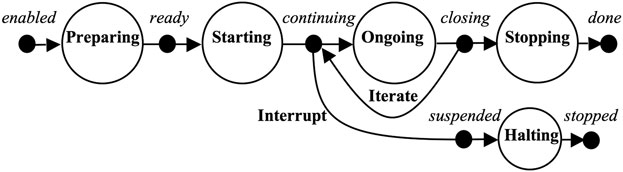
We will adapt Narayanan’s Controller schema to our discussion, simplify it and rename it as the Event schema (Kendall Reference Kendall2008). As shown in figure 1, Event is a dynamic schema in two respects. First, it changes state over time; it has components that capture state as well as ones that represent processes. Second, it has alternative paths that accommodate the possibilities of interations or interruptions.
Representation of the Event schema. Processes are represented as circles and states as dots. (After Kendall Reference Kendall2008.)

3.2. Active and dynamic states
As a model that executes through time, the Event schema can provide valuable insight into real-time mental processes. While an event is unfolding in time, the Event schema is in a dynamic state. The timing of its evolution and even the path of its evolution are unknown. Once the schema for this event has progressed to done or stopped, it is no longer dynamic and no longer evolving within listener’s mental space. It becomes part of the characterisation of something in the past, a past event. We can say that it changes from its dynamic state to a non-dynamic one. The non-dynamic state may or may not be active depending on whether it is connected to the listener’s mental spaces. If the listener begins to relate something to this past event, it is activated again.
While an event is active, there will certainly be numerous other items that are active within the listener’s mental spaces. Among those items will be ones that the listener will have reason to bind with the event. After the event has concluded, access to this non-dynamic event in memory will be limited to those items that were bound to the event within the active mental space. We can say that whatever we have access to in memory, that was bound to the event. Of course, the scope of the listener’s mental spaces is shaped by active attention, and inattention certainly leads to fewer bindings. This is important for understanding the mental processes of real listeners, not just idealised ones.
3.3. Felt experience and flow dynamics
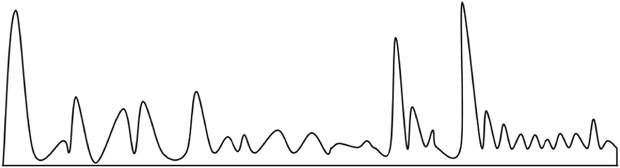
In everyday life, the experience of events is interwoven with the flow of felt experience. Similarly, Johnson, speaking of the embodied nature of image schemas, explains that bodily movements are characterised not only by their image schemas, but also by their ‘distinctive qualities’ (Johnson Reference Johnson2007: 21). These he relates to the four dimensions of body movement described by Sheets-Johnstone (Reference Sheets-Johnstone1999): tension, linearity, amplitude and projection. This terminology could equally well be applied to the flow of energy in musical events. The everyday mind relates the dynamics of energy flow to felt experience, an innate part of every listener’s feeling capacity and an intrinsic component of how the everyday mind experiences meaning. The embodied basis of such energy flow explains how listeners so easily relate sonic events to physical gestures. The felt qualities of experience are clearly recognised by listeners, but words often fail to capture the nuances and immediacy of direct experience. Figure 2 represents the moment-to-moment flow of energy in the first 3.5 seconds of Denis Smalley’s Pentes. As clear as the experience of the energy might be when we listen to this excerpt, how do we describe it? There is an ineffable quality to moment-to-moment experience.
Representation of the flow of energy in the first 3.5 seconds of Denis Smalley’s Pentes. The curve represents the short-term envelope of sound intensity.

How such moment-to-moment flow dynamics are remembered by the listener is an important matter. After the conclusion of an event, access to that event’s history is limited to what was bound to the event. Importantly, the temporal history of the flow dynamics is not likely to be bound to the event unless there is something special for the listener to hold onto. Often what is retained is a general characterisation of the flow dynamics, a sense of the texture of the energy flow that could be captured with words such as rough, bumpy, grainy, smooth or flowing. When recalling the event, the listener may more easily retrieve an overall sense of the event’s energy than the pattern of its flow. One way in which the energy associated with an event is generalised is through the concept of resources, the listener’s impression of the total effort expended in the event (Kendall Reference Kendall2008). The listener’s estimation of the effort associated with an event accumulates as energy is expended during the course of the event and the overall magnitude of the event’s resources is only known after the event has concluded.
3.4. Types of events and agency
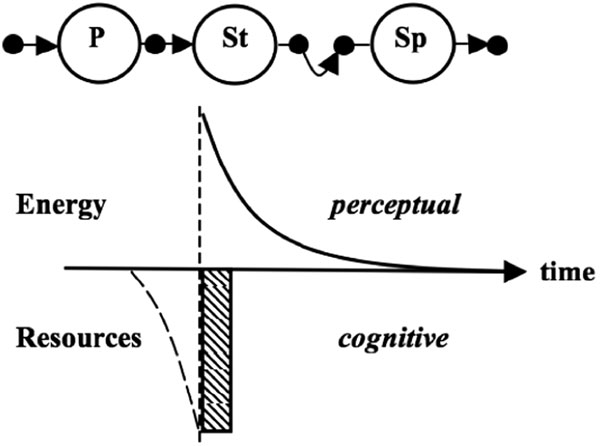
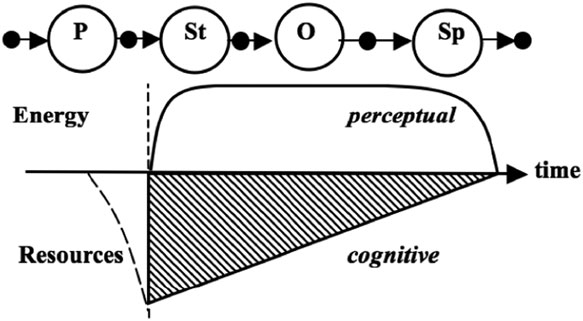
Listeners encounter many events that have their own recurrent patterns of states, processes and energy flow. Kendall (Reference Kendall2008) describes schemas for two fundamental types of Events called Burst and Disburse. As shown in figures 3 and 4, these are each characterised by the combination of their pattern of states and processes and by their prototypical pattern of energy flow. Because Burst and Disburse are easily associated with physical sound production, they include a slot to be filled by the source of the sound. For such familiar types of Events as these, listeners may have default sources in mind.
Representation of the Burst schema, also illustrating its relationship to energy and resources. (After Kendall Reference Kendall2008.)

Representation of the Disburse schema, also illustrating its relationship to energy and resources. (After Kendall Reference Kendall2008.)

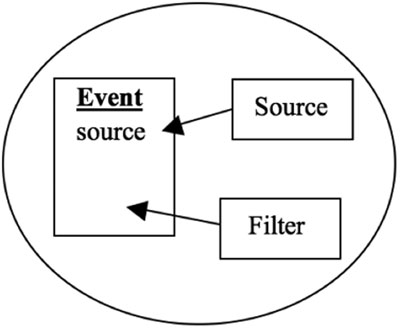
These are familiar types of Events, but a key property of the Event schema is that it adapts flexibly to novel circumstances. The variety of temporal pathways through the Event schema provides a flexible framework for the listener who is attempting to grasp unfamiliar or unpredictable behaviours. Then, too, the more experienced a listener is, the more schemas for types of Events are likely to have been established and retained. Of course, there cannot be a schema for every kind of event that might occur. What we are calling types of Events capture the general patterns that the listener finds useful. Their utility depends both on their generality and their ability to be customised to the listener’s moment-to-moment experience. For example, many events are particularised by the character of their energy flow – smooth, grainy, accented, and so on. Then, too, a schema for a type of Event might be linked to the schema of a sound-modifying process, a schema that the listener understands as amending sound behaviours. For example, acoustic events could be muted and electroacoustic events could be filtered. This possibility is represented in figure 5, where the mental space holds the schemas for the linked relationship of source and modifier.
Representation of Event schema linked to a modifying schema.

In the everyday world, listeners identify agency with the cause of the changes of state associated with the event. We can readily understand that most types of Events have a slot for agency. In the case that the agency of an event is unknown or unknowable, there are potential default values. In live performance, the default agent is likely the to be the performer. For many listeners of electroacoustic concert music, the default agent is the composer. Interestingly, many listeners associate electroacoustic music with physical gestures and human agency even when no physical activity was involved in its creation. This is in some part a reflection of the importance of agency to the everyday mind’s sense of meaning.
4. Perceptual Thinking
A large part of what listeners do can be described as perceptual thinking (Arnheim Reference Arnheim1969). It is largely invisible to them and to us as observers, part of the activity of the cognitive unconscious. Nonetheless, we can make strong inferences about these mental activities based on both general and specific knowledge of human cognition. In his great elucidation of visual art, Visual Thinking, Arnheim enumerates the activities of visual perceptual thinking: ‘active exploration, selection, grasping of essentials, simplifications, abstraction, analysis and synthesis, completion, correction, comparison, problem solving, as well as combining, separating, putting in context’ (Arnheim Reference Arnheim1969: 13). These are activities of perception in the everyday world as well as in art.
4.1. Gist as meaningful understanding
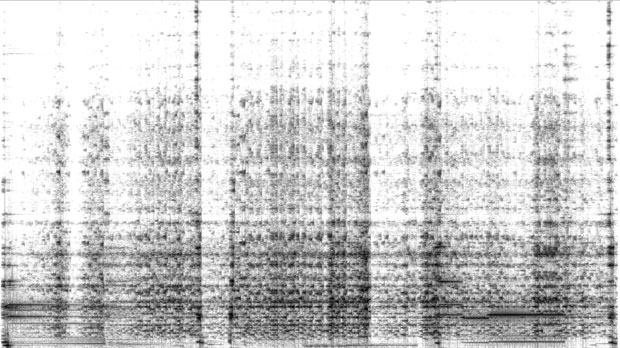
As a window into the essential commonality of listening in the everyday world with listening to electroacoustic music, let us consider one of the practical problems of meaning formation: the experience of not being able to keep up with real time. Whatever the context, the demands of the moment often surpass the listener’s mental capacity to fully assimilate what is heard. But listeners are able to grasp the gist of what they hear, even when the details are too complex to follow (Harding, Cooke and König Reference Harding, Cooke and König2008). As an example, let us consider the sonogram shown in figure 6, a short excerpt from Francis Dhomont’s Novars in which two layers of sound are superimposed over one another. The first layer, a more continuous one concentrated in the bottom third of the graph, is a stream of sonic particles extracted from Machaut’s Messe de Nostre Dame. The detail of the individual particles is of relatively little significance to the listener, who will most likely focus on what is meaningful – the gist of the entire stream with its overall rough texture. The other layer of sound consists of filter-swept chords that appear with an irregular rhythm. The gist of the entire excerpt captures the juxtaposition of these two layers. Gist is a working sketch for meaning, a snapshot of essential relationships. In one sense gist enables the listener to keep up with the essentials of ongoing experience and in another sense it is a product of the listener’s understanding of what is essential in the current context. Gist separates foreground from background, the prominent from the inconspicuous. What gist does not generally include is a sense of outcomes or consequences.
Sonogram of Francis Dhomont’s Novars from 2′58″ to 3′35″.

4.2. Events as meaningful understanding
Auditory scene analysis provides a compelling framework for understanding the relationship between acoustic signals and the perceptual grouping processes that result in auditory events (Bregman Reference Bregman1990). These grouping processes contribute to the multimodal mix of experiences that gives rise to our schema for events. For the everyday mind, meaning is essentially multimodal, and it is important to remind ourselves that the meaning we make of auditory experience does not arise from within the context of auditory perception alone. The understanding we form of auditory events as events is forged in the multimodal, embodied experience of objects and actions. These events have a typical timescale conditioned by the acoustic behaviour of objects and the speed of physical movement. But just as we must continually make sense of bodily experience that extends beyond the timeframe of individual sensorimotor actions, so must we continually make sense of ongoing auditory experience. While the Event schema presumably emerges out of direct sensorimotor experience, it is quickly extended to understanding experiences that are both more complex and of longer duration.
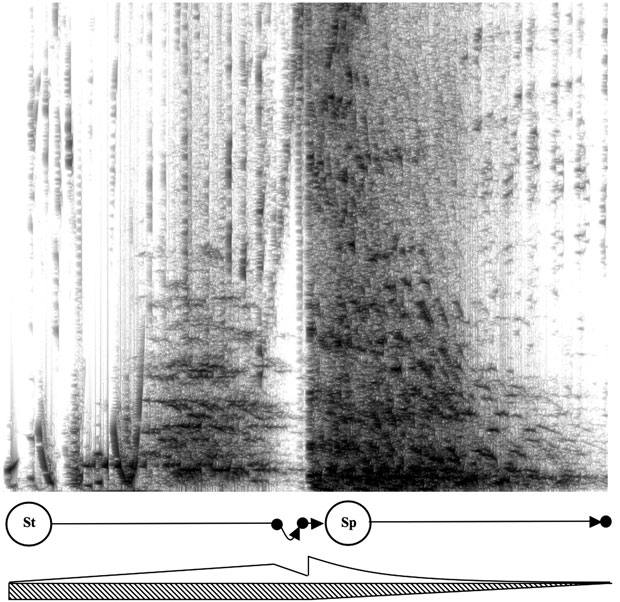
For example, consider the short excerpt from Smalley’s Pentes represented in figure 7. Here a large number of rapid auditory events occur within a short timeframe. Gist seemingly guides the listener to the level of organisation that is the primary carrier of significance and meaning – not the level of the individual auditory events, but the composite of the whole that is heard as a single event. (We might be tempted to describe this as a kind of metaphorical understanding, similar to those discussed by Fauconnier and Turner (Reference Fauconnier and Turner2002), but it is questionable whether this is metaphorical in any real sense.) Grasping such seemingly complex events appears as effortless as grasping simple auditory events. This suggests that the listener’s understanding of such complex events is not built up by assembling together the component events. As with gist, such complex events are simply understood directly. Gist and events are part of the listener’s meaningful understanding.
Representation of a 4′ excerpt that occurs at 0′41″ in Pentes by Denis Smalley. At the top is a sonogram; in the middle is the Event schema diagram for this event; at the bottom is an illustration of its energy and resources.

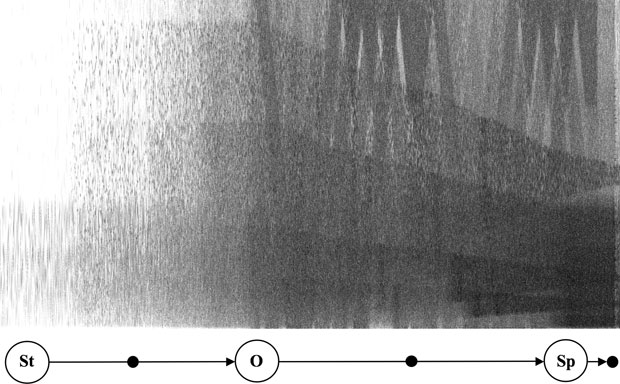
The direct recognition of the event in Pentes is probably facilitated by the fact that the timeframe of the event is typical of sensorimotor movement and that its flow dynamics are easily related to a physical gesture. This event does not have a single acoustic source, but the clarity of the gesture suggests singular human agency. An opposite situation can be illustrated with the excerpt from Riverrun shown in figure 8. Gist guides the listener’s focus to the meaningful level, the level at which the sonic grains are slowly being transformed. There are several simultaneous events that are part of the 5.5-minute event that constitutes the opening section of the piece. The timeframe of this event and its slow evolution are more suggestive of the natural world than of human agency, and this contributes to the listener’s perception of the piece as a natural soundscape. This example also helps to illustrate why our primary focus has been on events rather than gestures. While this excerpt from Riverrun clearly has an overarching shape, relating it to a physical gesture seems obviously inappropriate. Events are a more inclusive category than gestures.
Sonogram of the initial 5.5 minutes of Riverrun by Barry Truax with an Event schema diagram for the section as a whole.

5. Artistic Binding and Blending
5.1. Binding events and circumstances
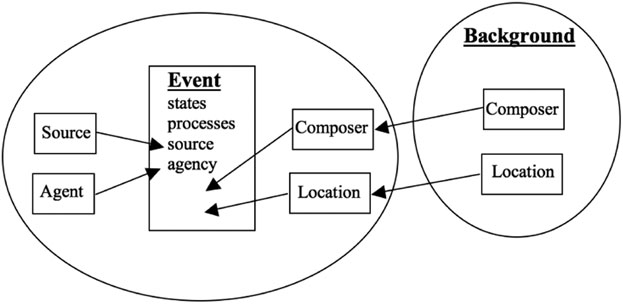
The Event schema aids the listener’s process of making sense of what is heard, but it is essentially an abstract container that must be linked with other active elements in the listener’s mental spaces in the act of forming meaning. Event takes on a sense of meaning when it is bound with specific Circumstances (figure 9). We have already mentioned that source and agency are two typical slots that need to be connected to fillers, but meaning is also created in the fusion of all the connections that the listener makes. For example, the listener holds active background knowledge that constitutes the context in which an event is formed. That background information may include the composer of the work, knowledge of previous works that have been heard, attitudes toward sonic material, and so forth. Whatever is being held in the listener’s mental spaces, this is the context of the listening experience. But especially in artistic contexts, the listener can make connections that are particularly rich or novel in meaning, connections that go beyond simply filling slots. For example, there could be novel linkages to specific locations, people or historical events. Consider the listener’s experience of the way Dhomont’s Novars links our associations of Machaut’s vocal music to decidedly electroacoustic textures. In StrinGDberg, Normandeau links together our associations of cellos with hurdy-gurdies. Connecting mental spaces is the activity of the everyday mind, but the particular connections made in art can infuse events with uniquely artistic meaning.
The binding of the Event schema with Circumstances that include the Background.

Artistic meaning also arises in the situation of frame-shifting (Coulson Reference Coulson2001) – in other words, when preceding connections are reevaluated in a new context. When listeners hear the entrance of the Northumbrian bagpipes in Smalley’s Pentes, their sense of the entire preceding piece is thrown into a new light. Then too, the technology of electroacoustic music creates some unique openings for artistic meaning. Kendall (Reference Kendall2006) discusses meaning in relation to the spatial idioms in audio reproduction. One of his examples involves the image schemas Object and Collection which have well-defined auditory and spatial traits. The distinctions between these schemas can be artfully blurred by disrupting the grouping and localisation of auditory events. He also mentions the violations of the auditory behaviours associated with the schemas for Containers and Rooms, a factor that plays a major role in Denis Smalley’s Empty Vessels, where the listener’s point of view alternatively shifts between being on an outdoor terrace and being inside of a large garden pot.
5.2. Conceptual blending
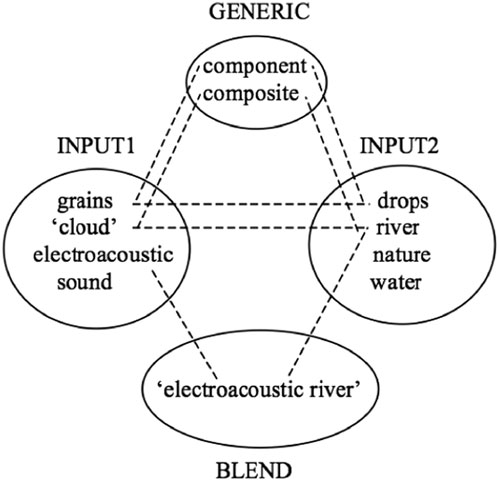
Meaning in electroacoustic music also emerges in the form of conceptual blending (sometimes called conceptual integration) that has most often been studied and discussed in relation to language and reasoning. Fauconnier and Turner (Reference Fauconnier and Turner2002) analyse such blends as arising in networks of mental spaces, and they have developed models for the common forms of networks called conceptual integration networks. The prototype integration network has four spaces. Two represent the mental spaces for the input elements that are being blended. One represents the space of the common elements that relate the two inputs, the generic space. Finally, selective content of the input spaces is projected into a new space that represents the blend, which now contains relationships that cannot be represented in either input.
We can illustrate these concepts using Barry Truax’s composition Riverrun. The composition is important in several respects. One is that it represents the first significant artistic use of granular synthesis. The sonogram of the initial 5.5 minutes in figure 8 shows us some of the long-term sound patterns that emerge from the manipulation of the sonic grains, but not the grains themselves, whose manipulation creates the large-scale form. Another important aspect of this composition is that way in which it invokes the sense of a natural soundscape without recourse to recorded sound. The work is heard as an analogy to a river in the natural world, an example of conceptual blending. We can understand the structure of this blend by examining the conceptual integration network shown in figure 10. The two inputs are the mental frames for the granular synthesis and for the flowing water. These two spaces have in common the concept of component and composite elements. The grains correspond to drops of water and the granular clouds correspond to the body of water. The conceptual blend produces a novel space that contains an electroacoustic river, exactly the kind of impression informally described by listeners. (The representation of the integration network has been somewhat simplified here for the sake of illustration.)
Simplified conceptual integration network for Riverrun by Barry Truax.

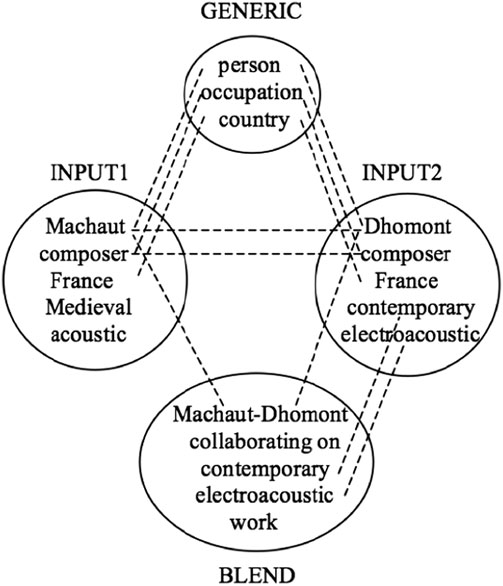
An example that illustrates conceptual blending with time compression is Dhomont’s Novars. In figure 6 we see a passage in which Dhomont utilises a recording of Machaut’s Messe de Nostre Dame. The inclusion of Machaut is a significant artistic choice. Dhomont is making connections between his work as a French composer and that of a medieval predecessor. The result is a conceptual blend with a tremendous compression of time in which the listener experiences Machaut and Dhomont collaborating to create a contemporary work of electroacoustic music. The conceptual integration network is shown in figure 11. The two inputs are the composers and their contexts. The generic space represents their common characteristics. The blend contains both composers collaborating on the current work.
Simplified conceptual integration network for Francis Dhomont’s Novars that illustrates the compression of time.

Conceptual blending with spatial compression is illustrated by Karlheinz Stockhausen’s Hymnen.The listener visits various countries across the globe that are aurally represented by their national anthems. This travel across vast distances is particularly highlighted when the compositional plan requires a quick jump from the USA to Spain. We know this because the listener at this point hears a recording of Stockhausen and his assistants discussing the issue while they are working on the piece! The composer and the listener are both participating in this spatial compression while also compressing the time when Stockhausen confronted the problem and the listener’s experience of the solution.
6. Journeys are Events
Listeners have an understanding of spatial motion that is deeply connected with sensorimotor experience. Spatial motion follows paths, often encounters resistance, and generally requires the expenditure of energy. One way that this understanding is connected to events is in the location event-structure metaphor (Lakoff and Johnson Reference Lakoff and Johnson1999). Lakoff and Johnson offer the following mappings between the domain of events and the domain of spatial motion:
States are Locations
Changes are Movements
Causes are Forces
Causation is Forced Movement
Actions are Self-propelled Movements
Purposes are Destinations
Means are Paths
Difficulties are Impediments to Motion
Freedom of Action is the Lack of Impediments to Motion
External Events are Large, Moving Objects (that exert force)
Long-term, Purposeful Activities are Journeys
(Lakoff and Johnson Reference Lakoff and Johnson1999: 179).
During the process of listening to electroacoustic music, many sonic events are perceived as moving from one location to another. The listener may infer that the moving sound source expends energy as it follows a path and that forces are at work causing the spatial motion even when the agency of such forces is unknown. For Lakoff and Johnson, motion along a path is captured and generalised through image schemas such as Path and Source–Path–Goal (Johnson Reference Johnson1987; Lakoff Reference Lakoff1987), which they view as deeply intertwined with our experience of energy flow. The listener’s experience of spatial motion is understood to be fused with this energy flow and, depending on the flow dynamics, the listener might judge whether a path has reached a goal or not. It might be tempting to conclude that the listener’s felt experience of the flow dynamics is in essence the meaning of such an event, but as we have come to understand, meaning is also dependent on context and shaped by Circumstances.
The electroacoustic listener also experiences metaphorical movement from one location to another, yet one more example of a conceptual blend. An important product of this blend is that a sense of continuity is created for a sequence of experiences. This is especially important for making sense of long-term events in relation to their constituent events. In Truax’s Island, the listener is able to make sense of the composition’s progress as changes of location on a mythic island. The sonic scene moves from the shoreline to a stream to a cave to a forest, and so on. The return to the shoreline at the end is literally a return to the original starting location, but at a different point in time. The listener knows this because the surf is much stronger at the end. The listener’s experience of Riverrun is somewhat analogous. We could say that the listener experiences the river at numerous locations, but the sequence of locations does not invoke a referential map as clearly as Island does. Riverrun’s journey is better described as a collage of shifting perspectives that reveal and explore the many sonic facets of the river. Interestingly, the first movement of Risset’s Sud is both a metaphorical journey from the shore to a forest, and so on, and an electroacoustic variant of sonata form.
Metaphorical journeying is one way in which a listener can make sense of some number of events as constituents of a long-term event, but as Risset’s Sud teaches us, there are clearly multiple ways of understanding the journey’s path. It seems that the listener can experience a sense of journeying even when there are no literal locations. In fact, the metaphorical journey does not really depend on literal spatial relationships at all. At the beginning of Luc Ferrari’s Presque rien n o 2, the listener experiences an intimate journey literally moving about and exploring a nighttime environment. Later on, when the listener leaves that reality for a purely creative exploration of that nighttime sound world, the journey simply continues in a different sense. Something similar occurs in Hildegard Westerkamp’s Kits Beach Soundwalk. In the beginning when there are environmental sounds in the background, the listener imagines that the composer is speaking from within the environment of the beach. Later, when these sounds change to other environments, the listener realises that the walk is also a journey of discussion through a series of topics. Individual sounds help to mark locations and subtopics. Beneath the metaphorical imagery, the journey is a form of Event, pre-linguistic and deeply infused with sensorimotor knowledge. We can imagine that various types of journeys are understood in ways that are completely analogous to those we have described for types of Events: the general structure of the journey can be adapted to a variety of situations and particularly familiar patterns have their own schemas. Then, too, the meaning of the journey is shaped by context and Circumstances.
One schema of the listener’s journey could be likened to navigation through a cathedral. The various spaces in the cathedral are not just locations; they are also manifestations of meaning and significance. The listener can understand changes of meaning and significance metaphorically as changes of location. A sequence of metaphorical locations provides a way of organising the whole of the listening experience. In the case of Sud I, there are both locations in nature and locations in the sonata form (the beginning of the development section, the return, etc.). A listener’s sense of navigation might also be guided by sonic signposts. In Stockhausen’s Telemusik the beginning of each section in its moment form is marked by the sound of a percussive Japanese temple instrument. Then, too, silence is a familiar signpost that marks formal divisions. In fact, signposts seem to be a near necessity if the listener is to have a clear sense of location on the journey. These analogies to cathedrals and signposts are most easily related to compositions with clear sectional divisions and formal characteristics – Poème électronique, Telemusik, Sud and Novars. This is not to discount other kinds of journey. Another schema for the listener’s navigation could be likened to floating down a river. In this metaphor, the listener’s journey is propelled by the current of the river and its moment-to-moment flow. There may be fewer signposts along the way and the locations may be little more than fluctuations in the energy flow. In the opening of Smalley’s Pentes, the signposts are quick eruptions of energy (such as that shown in figure 7) and the sense of location is constantly evolving and moving forward to a surprising arrival.
While a composition is unfolding in time, the listener is always making connections, forming and releasing mental spaces, and attempting to make sense of the unfolding experience. But what guides the listener to establish a thread of continuity like the metaphorical journey, linking the mental space of one event to another? Why and how does the listener string together particular events from among many simultaneous and overlapping events? In everyday life, we experience continuity among events that have particular things in common, usually things that have common consequences. For example, while driving in the car, everything having to do with traffic is one thread of continuity and the conversation on the radio is another. Listeners to electroacoustic music could establish continuity in similar ways. For example, a listener might thread together those events that appear to take place in a similar environment or which appear to result from the same agency. Source, flow dynamics, agency, place – these are all factors that might influence the listener’s lines of continuity. We can think of these factors as analogous to those that shape auditory perceptual streaming, but these factors are clearly all cognitive ones. They are factors whose influence on auditory continuity is a reflection of the continuities in the physical world. The everyday mind has learned to establish continuity in ways that are very practical. Objects, people and places persist. So powerful is this influence that violations by technological art are clearly understood. In Trevor Wishart’s VOX–5, when a human voice turns into a horse’s neigh, the continuity of the transformation is possible because of the expectation that sources do not change form.
The weighing of factors that shape continuity is interwoven with the gist of the situation and the relative importance of perceived outcomes. An agent’s course of action may persist beyond individual events and this gives rise to threads of continuity based on the persistence of the goals and purposes of the perceived agent. The unfolding of events that are related to goals is particularly invocative of anticipation and suspense in the listener. In this way, electroacoustic events take part in a broad tradition in the temporal arts of manipulating anticipation as part of the artistic meaning. Meaning is importantly shaped by the listener’s appraisal of the context that informs an estimation of how everything will affect future outcomes. The listener’s emotional state embodies the assessment of the situation, moment-to-moment and ongoing. In this way, we can see how the listener’s experience of the temporal artwork may unfold in a way that is in essential continuity with the experience of everyday life.
Of course, discontinuities occur too. In the process of listening, when the listener’s evolving understanding requires making connections that reach outside of existing spaces, new mental spaces are created. The listener experiences just such a moment nearly 4 minutes into Novars, when Dhomont suddenly changes his sonic material from the pitched filter sweeps and Machaut-based textures that start the piece to door creaks and slams. The listener must release previous mental spaces and establish new ones. Of course, the listener’s intention to make sense of things will motivate an attempt to maintain the mental space of the entire work. The initial sounds are not forgotten, but this discontinuity does open up a huge gap between the kinds of sonic materials that are now part of this one composition. The listener probably expects that these materials will relate to one another, but exactly how? What follows in Novars is a journey in which the materials are further developed and the sonic gap is filled in with other sounds. The overall sense of things becomes clearer when Dhomont begins to quote Schaeffer. Dhomont’s conceptual and artistic context for the material is then made explicit.
All of the situations described here, whether continuous or discontinuous, suggest that when listeners hold the intention they can indeed sustain the mental spaces associated with the unfolding of meaning over the entire course of an electroacoustic composition. In most circumstances, this sustained engagement is relatively effortless in the same way that navigating our way down the street is relatively effortless. We maintain the mental space and the continuity of our overall context with remarkable ease. Another essential point to make here is that listening is a fluid process and that there are a diversity of ways in which the listener might experience meaning in the unfolding of a composition. The ease with which listeners, experienced and inexperienced, negotiate this varied terrain reveals the fertility and resiliency of the cognitive unconscious.
7. Conclusion
Our discussion has considered at a number of specific ways in which a listener may experience meaning in electroacoustic music. In particular, we have explored the notion that the experience of meaning in electroacoustic art is in essential harmony with that in everyday life. We have pursued this goal from within the perspective of cognitive psychology and rooted our discussion in cognitive processes of the everyday mind. Meaning has been described as a product of the cognitive unconscious, the consequence of the relationships and connections formed moment-to-moment and day-to-day. This happens as the listener’s network of mental spaces is connected and organised to produce an ongoing sense of meaning. In electroacoustic art, this network of relationships is seen to be particularly rich in novel connections.
In his article entitled ‘What in the World Do We Hear? An Ecological Approach to Auditory Event Perception’, William Gaver (Reference Gaver1993) draws a sharp distinction between everyday listening and musical listening. His essential idea is that everyday listening is focused on events and music on the attributes of sounds. Electroacoustic music is indeed a kind of music, but our discussion of meaning in electroacoustic music offers little to support Gaver’s distinction. Of course, listeners can always choose to listen in a particular way (like focusing sound attributes), and there are very strong traditions of selective listening that have been promulgated by Schenker (Reference Schenker1935) in the Western masterwork tradition and Schaeffer (Reference Schaeffer1966) in the acousmatic tradition. But when we focus on the listener’s experience of meaning, Gaver’s distinction becomes essentially unimportant.
Our discussion has propounded the view that there is an essential and underlying continuity to how the mind experiences meaning whether in everyday life or art. Our survey of idioms that give rise to the listener’s experience of meaning should convince us that what we have described here is, in fact, essential to our understanding and appreciation of meaning in electroacoustic art. The essential workings of the everyday mind reveal to us that the experience of art is inextricably joined with everyday experience and that electroacoustic art is in a continuum with every other kind of experience that gives rise to meaning.