




No CrossRef data available.
Word-internal /t,d/ deletion in spontaneous speech: Modeling the effects of extra-linguistic, lexical, and phonological factors
Published online by Cambridge University Press: 05 January 2006
Abstract
The deletion of word-internal alveolar stops in spontaneous English speech is a variation phenomenon that has not previously been investigated. This study quantifies internal deletion statistically using a range of linguistic and extra-linguistic variables, and interprets the results within a model of speech production. Effects were found for speech rate and fluency, word form and word predictability, prominence, and aspects of the local phonological context. Results of the study are compared to results from the numerous studies of word-final alveolar stop deletion, internal deletion in laboratory speech, and also to another internal alveolar stop process, flapping. Our findings suggest that word-internal alveolar stop deletion is not a unitary phenomenon, but two different processes that arise at different points during speech production. In syllable codas, deletion results from cluster simplification to achieve gestural economy and is introduced during segment planning. In syllable onsets, deletion is one outcome of gradient lenition that results from gestural reduction during articulation.The research reported here was supported by NIDCD grant DC004330 to Mark Pitt, Keith Johnson, and Elizabeth Hume. Our thanks to Mark Pitt, Keith Johnson, William Labov, David Sankoff, two anonymous reviewers, and numerous participants of NWAV02 for useful comments and constructive feedback that helped us develop the article.
Information
- Type
- Research Article
- Information
- Copyright
- © 2006 Cambridge University Press
Phonetic variation occurs naturally in conversational speech, both within and across talkers. Indeed, to the extent that no two words are ever acoustically identical, variation occurs in all speech. Extensive research on variation has documented the influence of multiple factors on variation, including phonological context, properties of words, as well as a range of extra-linguistic variables, such as age, gender, and socioeconomic status. However, little is known about how factors relating to language usage influence variation, or how variation arises. In fact, for most phenomena, even information on the relative frequencies of specific words can be difficult to come by.
In this study, we analyze one common variation phenomenon in spontaneous American English speech: the deletion of the alveolar stops /t/ and /d/ when they occur word-internally, that is, in any position other than the beginning or end of an orthographic word, as in stop, better, advice, or it's. Our study examines numerous factors affecting internal alveolar stop deletion, and we use the analytic results as a means of understanding the nature of /t,d/ deletion. In modeling deletion, we assume the notion of a variable rule (Cedergren & Sankoff, 1974), in which the probability of a phonetic output is a function of a number of contextual factors. The contribution of a factor to predicting deletion is assessed statistically with logistic regression in the complete dataset and partial datasets, or by chi-square tests in some smaller subsets. Using statistical tests of significance in a variable rule framework allows us to quantify the nondeterministic nature of the variation contingent on multiple factors and their interactions.
The data analyzed in this study were taken from the Buckeye corpus of spontaneous interview speech, which will be described in more detail later. The decision to use spontaneous speech was motivated by a number of factors, including the observation that spontaneous speech data reveal a richer range of phonetic variation than is typically found in laboratory speech (Keating, 1998), and that variation generally occurs in a broader set of environments in spontaneous speech than in read speech. The focus on /t,d/ deletion was due in part to practical considerations. Both /t/ and /d/ are frequent sounds in the English lexicon and occur in many very frequent words, making it possible to test usage-based factors. These stops are also produced with considerable variability in spontaneous speech. In the Buckeye corpus, /t/ and /d/ occurred in the canonical, or dictionary, pronunciation of approximately 40% of all word tokens in the corpus. Furthermore, of the words canonically containing alveolar stops, 45% of all tokens resulted in a phonetic realization other than [t] for /t/ or [d] for /d/, and deletion was a common realization of the stops, occurring in 16.5% of the tokens. High deletion rates for /t/ and /d/ are consistent with findings from studies of word- (and stem-) final alveolar stops (e.g., Guy, 1980; Neu, 1980).
Another key reason for choosing to study word-internal /t,d/ is that there already exists an extensive literature on word-final alveolar stop deletion that has used similar methodological approaches (Fasold, 1972; Guy, 1980, 1997; Jurafsky et al., 2001; Labov, 1967; Neu, 1980; Wolfram, 1969, among others). Factors shown to be significant in the study of word-final deletion were also considered in the present study. Additional factors were identified from the extensive literature on variation in spontaneous speech (see later discussion). Although our results confirm that many of the factors shown to influence word-final stop deletion also influence internal deletion, important differences also emerged, which was expected given the differing properties of the two environments. For example, although for a word-internal segment the distribution of sounds on both sides of a stop is phonologically constrained, for a word-final stop only the preceding context is. Moreover, word-final stops are typically also syllable-final, unless they are resyllabified in connected speech. By examining word-internal sequences we were thus also able to study the effect of syllable position on deletion more directly. As we will show, a number of crucial differences in the deletion patterns emerged depending on whether the stop was in coda or onset position. Besides the expected finding that a stop deletes more often in coda than in onset position, there are also differences based on position of phonological environment, unit frequencies, prominence, and speaker age.
A goal of this study is to use knowledge of variation patterns to explain the origins of deletion. Deletion is generally considered a type of reduction, but it has been alternatively explained as resulting from segment lenition or cluster simplification, depending on phonological environment. Simplification is proposed for segments in consonant clusters. In a lenition account, Rhodes (1992) noted that deletions occur in flapping environments, and thus proposed that flaps and deletions are both outcomes of a single lenition process, with deletion being a more extreme form of lenition. Zue and Laferriere's (1979) study of read speech found some deletion in the post-nasal flapping environment, providing some support for this view. Although the amount of deletion that Zue and Laferriere found in read speech was limited, we would expect deletion that is part of a spectrum of gradient lenition to be more likely in fluent spontaneous speech, such as faster speech, because greater fluency is associated with segment shortening (Byrd & Tan, 1996). On the other hand, when contextual factors strengthen one outcome, such as flapping, deletion would be less likely. As a means of coming to a better understanding of deletion as a potential type of lenition, throughout the course of this study deletion is compared to the alternate alveolar stop process of flapping.
Because lenition and simplification have been proposed for specific segmental environments, it is reasonable to assume that the primary correlates of deletion can be found in phonological contexts. If so, then processes sensitive to context, such as speech planning and articulation, will underlie these reductions. This observation suggests an approach to explaining deletion that is based on the language production process. To anticipate our findings, evidence did indeed emerge in support of the view that two different deletion processes are involved: one finding its explanation in consonant cluster simplification and the other in segment lenition. Moreover, the two processes are argued largely to arise at different stages of speech production, with the consequence that the two processes are differentially affected by factors that influence deletion, as we will show.
We begin the article with a description of the Buckeye corpus and the dataset used in our study. We then introduce the methods and details of our variable coding, drawing on the results of previous studies on alveolar stop deletion to motivate the selection of specific factors and to make predictions of their effects on word-internal deletion. Results of the analyses are then presented for the extra-linguistic, lexical, and phonological variables. Finally, we present a summary of our results and interpret them in terms of a model of speech production.
THE DATASET: THE BUCKEYE CORPUS
The data analyzed in this study were created from a lexically and phonetically transcribed subset of the Buckeye corpus of spontaneous speech (Pitt et al., 2005). The Buckeye corpus contains over 300,000 words of speech from 40 individual speaker interviews. Speakers were asked to express opinions on a variety of topics for about an hour. The speaker sample for the corpus was stratified for age (under 35 and over 40) and gender, and all speakers were natives of central Ohio.
The transcribed subset of the corpus consisted of about 100,000 words from 14 of the corpus speakers. The transcribed speech from the 14 speakers comprises all or the vast majority of each speaker's complete interview (in a continuous interval from the beginning of the interview). Interviews from 7 male (2 older and 5 younger) and 7 female (2 older and 5 younger) speakers were included in the subset.
The source of the dataset taken from the transcribed subset consisted of the set of all orthographic words in the transcribed subset whose dictionary pronunciation contained an internal /t/ or /d/. Internal /t,d/ tokens were defined as /t/ or /d/ phones in complete words that were neither the first nor last phone in a word's dictionary pronunciation. Internal /t,d/ tokens may thus be in initial onsets of words if preceded by /s/ (e.g., still, stable) or in final codas of words if followed by /s/ (e.g., that's, kids), as well as in onset and coda syllable positions elsewhere in words (e.g., better, advice). Dictionary pronunciations were taken from the Buckeye corpus dictionary, which consists of over 66,000 lexeme entries based on the CELEX English dictionary lexicon (Baayen, Piepenbrock, & van Rijn, 1993) augmented to include all vocabulary in the corpus and with Standard American pronunciations.
Phonetic labeling and label alignment with the speech signal were performed using a combination of automated and manual transcription procedures by trained transcribers. Transcribers labeled and aligned speech with the aid of spectrograms of the speech signal. In transcribing the internal /t,d/ phones, transcribers used 18 different segment labels. Of these 18 labels, only five labels were selected by transcribers for more than 2% of the /t,d/ tokens in the transcribed subset. The five frequently used variant labels were [t], [d], flap, nasal flap, and glottal stop. (The [t] and [d] variants were not further subcategorized with respect to other features, such as the presence or absence of aspiration or release.) Internal alveolar stop realizations other than the five most frequent variants were excluded from the final dataset. The excluded outcomes were largely assimilations (e.g., “abministration” for administration). Deletions (i.e., no transcribed label) accounted for 16.5% of the realizations of canonical internal alveolar stops, making deletion the fourth most likely realization of word-internal /t/ or /d/ phones.
In the phonetic transcription protocol for the corpus, deletion was defined as the absence in the speech signal of any acoustic evidence for some segment realization, with clear segment boundaries, corresponding to /t/ or /d/ in the dictionary pronunciation of a word. Intervocalically, stop outcomes were recognized by a perceptible closure, perhaps with an accompanying burst, in a spectrogram of the token. Oral and nasal flaps are quite short and generally lack a release burst, but result in a brief closure or a significant disturbance in the formants of adjacent vowels that clearly distinguishes them from deletion. When a /t/ or /d/ variant was adjacent to another stop consonant or a silence, it could be identified as a stop (alveolar or glottal) based on details of formant transitions, the presence of a release burst, and/or closure length.
A study of the transcription consistency in the corpus indicated that agreement on labeling for internal /t,d/ tokens overall in the Buckeye corpus was seen in 81% of transcriber pairs (Raymond et al., 2002). This agreement rate is comparable to other studies of consistency in labeled spontaneous speech. Raymond et al. (2002) found differences in labeling consistency among the labels used for lexical alveolar stops. Most notably, there was little consistency on glottal transcription, with transcribers agreeing that the realization of a canonical /t/ or /d/ was a glottal stop only 33% of the time. Although most disagreement in the study involved glottal stop and [t] (and never deletion), tokens transcribed with glottal stops were excluded from the final dataset. Exclusion of glottals was due to the desire to consider variables based on knowledge of contexts that promote alternate realizations, which would have been unreliable for glottalizing environments. Unlike the transcription of glottals, transcribers agreed on identification of deletions (vs. all other variants) in 80% of transcriber pairs, making deletion more consistently transcribed than [t] (78% agreement) or [d] (51% agreement in all environments). Although agreement on word-internal [d] transcription was low, there was disagreement between [d] and deletion in only 2% of transcriber pairs. There were similar low levels of disagreement between deletion and other noncanonical labels. Labelers disagreed between deletion and nasal flapping in only 5% of transcriber pairs, and between deletion and oral flapping in only 4% of transcriber pairs. Transcription of deletions was thus generally consistent and reliable.
After excluding tokens with infrequently used labels and glottal labels, the transcribed subset yielded a dataset of 7,241 internal /t,d/ tokens (2,014 /d/ tokens and 5,227 /t/ tokens).The distribution of the five variant outcomes (including deletion) in the final dataset is shown in Table 1.
Distribution of transcribed variants of canonical internal /t,d/ phones

VARIABLE IDENTIFICATION AND CODING
Factors examined in the study include extra-linguistic and lexical variables, and a range of phonological influences. For each class of variables, identification of factors will be motivated by previous studies. Discussion of previous work is followed by the details of our selection and coding of variables in the dataset. Predictions for their influences on medial deletion are found at the end of the section.
Extra-linguistic variables
Speaker group: Age and gender
In Guy's (1992) study of word-final /t,d/ deletion, older speakers deleted word-final stops less often than younger speakers. Furthermore, speaker group differences were found in Wolfram's (1969) study of final deletion, in which there were more deletions among men than women. Neu's (1980) study of word-final alveolar stop deletion found that the relative tendencies of a preceding sibilant, stop, or nasal consonant to promote deletion differed according to the speaker's gender, with men showing significantly more deletion after sibilants than after nasals or stops, but women having no significant difference in deletion rates among the three classes. However, in the study by Zue and Laferriere (1979) of /t,d/ variation in flapping environments, there was more /t/ deletion in a nasal flapping environment (VntV) by females than by males. The full range of preceding consonant types examined by Neu was not tested by Zue and Laferriere, however, so it is difficult to compare the results of the two studies.
Given the results from these studies, speaker gender and age were analyzed in the present study. Age was coded both as a continuous variable (age in years) and also as a binary variable (older, younger), based on a speaker's age category in the Buckeye corpus. Gender was coded as a binary variable (male, female).
It should be noted that other social factors, such as dialect or social class, were not analyzed in this study despite the importance of such factors to understanding variation in the realization of alveolar stops (e.g., Labov, 1967; Labov & Cohen, 1967; Labov et al., 1968; Wolfram, 1969). The reason is that many dimensions of the social group were controlled in the design of the Buckeye corpus by limiting participants to a small geographic area and excluding nonstandard dialects.
Speech rate and speech fluency
Speech rate is known to affect many reduction phenomena, including final /t,d/ deletion (Fosler-Lussier & Morgan, 1999; Guy, 1980; Jurafsky et al., 2001; Labov & Cohen, 1967; Labov et al., 1968; Wolfram, 1969). Guy (1980) noted that, impressionistically, word-final /t,d/ deletion increased with speech rate. Fosler-Lussier and Morgan (1999) found that the rate of segment deletion increased from 9.3% in very slow conversational speech to 13.6% in very fast speech. Higher deletion rates at faster speech rates would be consistent with articulatory studies showing that faster speech is associated with segment shortening and gestural overlap (Byrd & Tan, 1996), assuming that deletion is the end result of shortening and so is also sensitive to rate.
A number of measures were developed to investigate effects of local speech rate on deletion. An adequate measure should average over a domain large enough to estimate rate independently of segment deletion while ensuring reasonably local scope. Consequently, rate measures were computed over four domains: (1) the /t,d/ word; (2) a three-word window centered on the /t,d/ word; (3) a five-word window centered on the /t,d,/ word; and (4) the pause-bounded utterance containing the /t,d/ word. The duration of speech units were calculated from the phonetically annotated and aligned speech signal. Although there are a number of different units over which rate could be calculated, the syllable was chosen because it is less likely to be deleted in speech than the phone (Fosler-Lussier & Morgan, 1999), and so the canonical syllable count can be used.
Note that measures of local rate do not take into account speakers' overall rate differences, which ranged from 4.77 syllables/sec to 7.20 syllables/sec. To accommodate for these potential differences, we created a binary variable that encoded relative rate. Each token's three-word rate was categorized relative to the speaker's mean speech rate (fast, slow).
Many studies have reported effects of dysfluent production on deletion and other reduction phenomena. Dysfluency types that have been reported to affect deletion include adjacent pauses, fillers (e.g., uh or um), word repetitions, and word cutoffs. A dysfluency following a word has generally been reported to result in durational lengthening, fuller phonetic forms, and the inhibition of final segment deletion (Fox Tree & Clark, 1997; Jurafsky et al., 1998; Shriberg, 1999; Van Santen, 1992). In a study of function word reduction in spontaneous speech, Jurafsky et al. (1998) found that the final /d/ of and was more likely to be present when the word was followed by a repetition of and, a filled pause (uh or um), or a silence than when it was not. They found no effect, however, on the likelihood of deletion in dysfluent contexts of the final /t/ in it or that, suggesting that fluency may differ with word function, word identity, or perhaps alveolar stop identity. In some sociolinguistic studies, a following silence promoted deletion (Fasold, 1972; Labov, 1967), but in other studies it inhibited deletion (Wolfram, 1969). Differing results of the effect of a following silence reflected dialectal differences in Guy (1980). For New Yorkers in his study, a following pause promoted deletion, but for Philadelphians a pause inhibited deletion.
To investigate the influence of dysfluent speech, tokens in the dataset were coded using binary variables (fluent, dysfluent) for four types of dysfluency with preceding lexical context and following lexical context. The variables indicate whether or not a word containing an internal /t,d/ token was preceded or followed by: (1) a filled pause (i.e., uh or um, e.g., “a a former uh basketball player”); (2) a word repetition (e.g., “that's that's really hard to say um”); (3) a lexical cutoff (e.g., preceding, “his po- [position] title was”, and following, “… was pretty moderate actually and it is pretty mod- [moderate] people …”); or (4) a pause (e.g., “〈silence〉 absolutely no meaning”).
Predictions for word-internal alveolar stop deletion
Based on previous studies, we anticipate that overall deletion rates will be higher in more fluent speech, where fluent speech is defined as being faster and with fewer pauses, fillers, repetitions, and word cutoffs than less fluent speech. The effects of fluency should be seen in those phonetic environments in which deletion results from gestural shortening, but may not be as strong in environments where deletion is not a consequence of gestural shortening. There may also be an effect of gender, with males deleting more than females, and perhaps an effect of age, with younger speakers having higher deletion rates than older speakers. Age and gender differences may themselves ultimately be attributable to differences in fluency or variant choice between speaker groups. The origins of group differences can be explored by controlling for other fluency factors when performing group comparisons.
Lexical variables
Word form
There is evidence that suggests word-level effects on final /t,d/ deletion. Neu (1980) found greater rates of deletion of /d/ in the word and than would be expected from the phonetic context of the final /d/. Labov (1975) found similar high deletion rates of the /t/ in the word just. Note that the effects may be word-specific, or may be generalizable to wider subsets of the lexicon based on word structure or word use.
At the broadest level of word classification, a distinction based on use is often made between (closed-class) function words and (open-class) content words, although this classification is confounded with word structure and word probabilities. The two classes are generally distinguished by semantics and productivity. Function words, unlike content words, have low semantic content, and new members are not readily admitted to the set. Function words are also common, generally short, and usually unaccented in production. For these reasons, they are generally less salient than content words (Pollack & Pickett, 1964), and are often cliticized to content words in connected speech, signaling their susceptibility to reduction, including deletion. On the other hand, content words are frequently multisyllabic and more likely to be accented in production, resulting in fuller forms.
To tease apart various aspects of word form, tokens of internal alveolar stops were categorized in the present study by a binary classification of the word containing the token (function, content). Function words included personal and indefinite pronouns, prepositions, articles, modal and auxiliary verbs, and wh-words. All other words were classified as content words. Tokens were also coded for length (in canonical syllables) of the word in which they occurred. We also took into account the relative position of the internal /t,d/ token within the word, which was coded as one continuous variable and two binary variables. The continuous position variable was calculated as the syllable in which the token occurred (counting from the left edge of the word) divided by word length. For example, the length of better is 2, and the relative position of the canonical /t/ in the words is 1 (= 2/2, being in the second syllable of a two syllable word). The binary position variables coded: (1) whether the token occurred in the first syllable of a word or a subsequent syllable, and (2) whether it occurred in the last syllable of a word or an earlier syllable.
Word probabilities
Although word frequencies, which may be considered nonconditional word probabilities, and other conditional word probabilities are all highly correlated with word class and word structure, previous studies have established effects of word probabilities on a variety of processes in spontaneous speech, including deletion, that appear to be independent of word class and many other factors (Bybee, 2000; Jurafsky et al., 2001). Jurafsky et al. (2001) found that after controlling for many correlated factors, more frequent content words had higher rates of final alveolar stop deletion than less frequent words. Final /t,d/ deletion was also found to be encouraged in content word pairs with high word bigram frequencies, that is, when a content word ending in a /t/ or /d/ and either of its neighbors in the speech context were likely to occur together. Jurafsky et al. (2001) also reported that the word probabilities examined in their study affected word duration, with more likely words being durationally shorter. Importantly, they showed that durational shortening was not simply the result of final segment deletion, so that word probabilities may influence phonetic reduction within the word and not just at word ends.
Word frequency measures were coded for each token in the dataset from two sources, the CELEX English corpus counts, and the Buckeye corpus. Raw counts of words from both corpora were log transformed for analysis. The two log frequencies are correlated (r2 = .67), but because of its larger text base, the CELEX measure may be more discriminating. However, CELEX counts are based largely on text counts rather than spontaneous speech, and counts are not available for some words in the Buckeye corpus, in particular, proper names and nouns ending with 's (n = 336; e.g., Mauldin and kid's). Although Buckeye token counts are available for the words of all /t,d/ tokens in the dataset, the counts of many words are low, with 428 words (5.9%) occurring only once (and thus estimated to occur only about three times per million words of speech). As a result, a combined measure of frequency per million was created from the Buckeye counts and the CELEX counts, and this measure, log transformed, was used in the analyses.
Frequency measures of word bigrams, or pairs of words that occurred contiguously, were calculated from the Buckeye corpus. Word bigram counts were calculated from the full (300,000 word) Buckeye corpus by counting the fluent word pair types (i.e., unique pairs). A fluent pair was defined as any two consecutive orthographic words not separated in speech by a perceptible silence. Using the bigram counts, a preceding and a following word bigram frequency measure were coded for each /t,d/ token that occurred in a word not adjacent to a silence. Bigram frequencies were undefined for words adjacent to a silence.
Bigram counts were also calculated for dysfluent environments. A dysfluent pair was defined as a word preceded or followed by a filled pause or a word cutoff, where the dysfluent element was not separated from the word by a silence. Using these bigram counts, preceding and following word bigram frequencies were coded for all /t,d/ tokens preceded or followed by a dysfluency.
The predictability of a /t,d/ token word based on the immediately preceding or following word was also tested. Predictability measures were calculated using the word and the word bigram frequencies described earlier. Specifically, the predictability of a word w from an adjacent word w′ was estimated using (1). For example, the predictability of let's from the preceding word in the context so let's would be the word bigram frequency of so let's divided by the frequency of so.

The predictability of a word preceding or following a silence is undefined. As with word frequencies, word predictabilities were log transformed to create variables used in the analyses.
Morphological structure
In studies of word-final /t,d/ deletion, independent morphological status of /t/ or /d/ was shown to inhibit deletion (Guy, 1980, 1992; Labov et al., 1968; Neu, 1980). When a final stop is the realization of a past tense morpheme (e.g., missed) there is less deletion than when it is not (e.g., mist). Irregular past tense forms (e.g., left) have an intermediate rate of deletion. Although past tense morphology will not apply to internal alveolar stop segments, other word morphology may, as where an alveolar stop is stem-final but not word-final (e.g., writing, let's). Neu (1980) included stem-final stops in her study, but found no difference in deletion rates between stem- and word-final stops. However, Hay (2000) found less deletion of stem-final /t/ in words whose stems were more transparently related to the morphologically complex form (e.g., swiftly) than in words with a less transparent relationship between stem and word (e.g., listless), even after controlling for frequency of word and stem. Morphological structure is not controlled for in our study.
Predictions for internal stop deletion
Function words and more likely words have been shown to be associated with higher final alveolar stop deletion rates, and both have been associated with shorter word durations. This suggests that processing of these words may promote internal stop deletion, as well, assuming that these factors are not limited in their effects on word ends but influence production parameters across the word. However, the correlation between word class and word probabilities may make distinguishing the underlying source of deletion difficult. Moreover, because function and content words differ in their segmental and metrical phonology, interactions with phonological variables are likely, and an effect of word class may ultimately be the result of the structural properties of words and not fundamental processing differences between the two classes. In addition, previous studies have shown a correlation between phonological structure and word frequency (Frauenfelder et al., 1993; Landauer & Streeter, 1973), so that effects of word probabilities may be ultimately explained more locally in terms of the probabilities of their phones or phone sequences, which will be discussed in the next section. These more local phone probabilities have more transparent consequences for articulation, but word probabilities are more easily interpreted as influencing lexical access and speech planning. Finally, there may be effects of morphological structure on deletion, with more deletion in words that are less readily semantically decomposed, in cases where morphological structure is a factor.
Phonological variables
Syllable position
Studies of word-final stop deletion indicate that deletion is high when there are flanking consonants, and unless the stop is resyllabified as onset of the following word-initial syllable, word-final stops occur in syllable codas. Consistent with this, Greenberg (1999) found that productions of onset consonants resulted in less variation in spontaneous speech than productions of coda consonants. Because segmental context and syllable structure are correlated, explanations of deletion involving specific phonological contexts and morphological structure also implicate the role of syllable position in deletion.
To examine the effects of syllable structure on deletion, tokens of /t,d/ were coded for syllable position (onset, coda) based on the CELEX dictionary syllabification of canonical pronunciations that were modified to Standard American pronunciation. Adjustments were made to make syllable structure consistently a function of phonological context and not morphological structure. In particular, alveolar stops whose dictionary syllabification placed them in coda position, but whose following context was a vowel, a liquid, or a glide that allowed for resyllabification of the stop, were coded as onsets (e.g., wait.ing > wai.ting, had.n't > ha.dn't, broad.way > broa.dway). Taking into account these adjustments, the possible onset and coda values coded for the analyses in all CV contexts are as in Table 2. Note that the set defined by C can differ by context in keeping with English phonotactics. For example, onsets can only be followed by the consonants /w, r/.
Possible consonant–vowel combinations in onsets and codas

Prominence
The importance of prominence factors, such as stress and accent, is indicated by findings showing that stress-accented syllables exhibit less variation and reduction than unaccented syllables (Greenberg, Carvey, & Hitchcock, 2002), and that the segments in these syllables are lengthened and strengthened (Turk & White, 1999). Studies of word-final stops have also found that deletion is more likely in unstressed syllables than in stressed syllables (Fasold, 1972; Labov, 1972; Labov et al., 1968; Wolfram, 1969). Zue and Laferriere (1979) found that a prevocalic /t/ is shorter when it is the onset of an unstressed syllable than a stressed syllable. Stop deletions only occurred, however, when the stop was also preceded by a stressed syllable, suggesting that the stress level on the syllable preceding a word-internal /t,d/ is important, as well. In these studies, we can interpret lexical stress as prosodic prominence, because of the association of pitch accents to lexically stressed syllables in words produced in isolation.
In the present study, dictionary representations were used to code three levels of prominence (stressless, secondary stress, primary stress) on the syllable containing the canonical alveolar stop and for the preceding and following syllables. Because of the low proportion of secondarily stressed syllables (15.6% of the syllables containing an internal /t,d/ segment), a binary stress variable (stressed, unstressed) was also coded by conflating primary and secondary stress levels. Finally, note that monosyllabic function words are lexically stressed, but are less likely to be accented in production than content words. In fact, an examination of one hour of speech in the Buckeye corpus coded for pitch accent revealed that content words were 50% more likely than function words to have an accent of any kind. A second binary prominence variable was thus coded that conflated primary and secondary stress levels for all syllables except for the monosyllabic function words, which were coded as “unstressed” to reflect the observation that they are less likely than content words to receive prominence in production. The assumption that a monosyllabic function word is unaccented may be thought of as a predictive variable to which speakers are sensitive in a manner similar to their sensitivity to word probabilities. Note that defining stress levels in this way could also be handled as an interaction of stress and word class.
Alveolar segment identity
There is some evidence that /t/ and /d/ may pattern differently with respect to deletion. Zue and Laferriere (1979) found articulatory differences between /t/ and /d/ released into a nasal (e.g., sweeten, Sweden). A tendency for /t/ in this environment to be produced without a burst suggests that /t/ is more likely to be deleted than /d/. Conversely, Rhodes (1992) noted that /d/ is more likely to flap than /t/, suggesting that /d/ is also more likely to delete than /t/ in flapping environments. To examine the effects of alveolar stop identity on deletion, tokens in the dataset were coded based on canonical stop identity using a binary variable (/t/, /d/).
Following segmental context
Studies of word-final alveolar stop deletion have shown that a following consonant promotes deletion of final alveolar stops, but a following vowel inhibits it (Guy, 1980; Labov, 1967; Labov & Cohen, 1967; Labov et al., 1968; Neu 1980; Wolfram, 1969). The tendency for following consonants to promote deletion of final alveolar stops over vowels is consistent with the more specific claim that the less sonorous the following segment, the greater the likelihood of deletion, assuming the sonority ranking: obstruent > liquid > glide > vowel (Fasold, 1972; Guy, 1980; Labov, 1972, 1975; Labov et al., 1968; Neu, 1980; Wolfram, 1969). Guy (1991) and Labov (1995) noted, however, that for following liquids and glides the sonority of the following segment cannot account for deletion patterns. Both studies observed that the probability of final stop deletion was much higher before /l/ than before /r/, although the sounds are of comparable sonority. In fact, deletion before /l/ approaches the high level for obstruents in Labov's study, and it exceeds the rate of deletion before obstruents in Guy (1991). Labov also found the glide /w/ to behave like an obstruent in promoting deletion, although deletion before /y/ is very low, and before /h/ it is intermediate.
There is also some evidence that the place of articulation of a following consonant affects final alveolar stop deletion. Fasold (1972) found that if the consonant following an alveolar stop was homorganic, the deletion rate was higher than if it was nonhomorganic. In Neu's (1980) study, a following consonant's place was not significant, however, leaving the role of place uncertain.
Preceding segmental context
As with following context, studies have shown a clear difference between preceding consonants and vowels in their effect on final alveolar stop deletion. Although preceding consonants have been found to promote deletion, for speakers of standard American English, preceding vowels have been assumed to almost categorically inhibit deletion, given the absence of post-vocalic deletion observed in the data used in previous word-final stop deletion studies (Guy, 1992; Guy & Boberg, 1997). Postvocalic deletion was also not observed in the Zue and Laferriere (1979) study. However, they did find that the quality of the preceding vowel influenced flap production. Vowels ending with high front tongue positions (i.e., high off-glides, such as the diphthong

) were associated with longer flap durations than other vowels. This class may thus inhibit deletion in flapping environments, because of the strengthening of the flap segment.
In general, preceding obstruents (limited to stops and fricatives) have been seen to favor deletion, although sonorant consonants, such as nasals and liquids, inhibit it (Guy, 1980, 1997; Labov et al., 1968; Neu, 1980; Wolfram, 1969). For most speakers in the study by Guy (1980), the rate of deletion decreased in the order: sibilant > stop > nasal > liquid (> vowel = 0). Note that the strength of manner effects on deletion is ranked roughly the same in preceding and following contexts, with greater sonority associated with less deletion.
Fasold's (1972) finding that a homorganic following consonant promotes deletion also holds for a preceding homorganic consonant (cf. Neu 1980). Zue and Laferriere (1979) found that slightly over 10% of internal alveolar stops are deleted after the homorganic nasal /n/ (e.g., winter), the only environment in which they observed deletion.
Coding segmental context
As we have seen, numerous differences have emerged in the patterning of segments in the context of alveolar stops. Consequently, in the present study consonants adjacent to /t,d/ tokens were coded by phone identity rather than assuming a priori groupings based on broader phonological categories (e.g., based on place and manner of articulation). We chose this more detailed classification to allow for potential similarities and differences in the effects of individual consonants to emerge. To the extent that consonants patterned as natural classes, the groups were subsequently coded and tested. This approach led to the eventual creation of codes for categories of consonant place (homorganic, nonhomorganic; labial, alveolar, palato-alveolar, velar, glottal) and manner (sonorant, obstruent; stop, fricative, affricate, liquid, glide). Adjacent canonical phones were also categorized as peak (syllabic) or nonpeak (nonsyllabic). Syllabic segments included vowels, syllabic /n/, and syllabic /l/. All other segments were coded as nonsyllabic. The syllabic segments will be referred to hereafter as V or syllabics; nonsyllabic segments will be referred to as C or consonants.
Vowels preceding and following alveolar stops were categorized in two ways. Following Zue and Laferriere (1979), one classification of vowels was based on whether the vowel has a high off-glide

or not (all others). Vowels were also categorized as nonlax

or lax (all others).
Phone bigrams
Labov (1995) proposed that the frequency with which consonant clusters are learned may explain final stop deletion rankings for some following segments. This suggests that a gradient measure of phonotactic likelihood, such as phone bigram frequencies or phone transitional probabilities, may be correlated with deletion likelihood. These measures reflect acquisition order because more common phone sequences are also more likely to be encountered earlier by language learners. To our knowledge, nonstructural, probabilistic properties of segments have not previously figured into studies of alveolar stop deletion. We see these measures as potentially important, given psycholinguistic research on speakers' use of probabilistic knowledge in production and perception (Coleman & Pierrehumbert, 1997; Frisch, Large, & Pisoni, 2000; Luce, 1986; Makashay, 2001; Pierrehumbert, 1994; Pitt & McQueen, 1998; Pitt & Samuel, 1990; Saffran, Newport, & Aslin, 1996; Savin, 1963; Vitevitch & Luce, 1999). For example, Pitt and McQueen (1998) found that the transitional probabilities of voiceless coronal fricatives at the end of nonwords influenced listeners' identification of an ambiguous fricative, as well as that of the following stop consonant. We thus expect deletion to occur at a higher rate in contexts where the alveolar stop is highly predictable from its immediate phonological context.
As a means of studying the potential effect of the predictability of sound sequences on stop deletion, two frequencies were coded for each /t,d/ token, one for the frequency of the stop in combination with the preceding segment, and one for the frequency of the stop and the following segment. These bigram frequencies were estimated using the corpus dictionary pronunciations of words and CELEX word frequencies. Bigram frequencies were calculated by summing the word token frequencies of all words in the corpus dictionary containing the bigram in its pronunciation. To simulate the casual interview speech of the corpus, only words with frequencies over 10 per million words were used. The result of the estimations was a bigram count for each canonical phone before and after /t/, and a count for each phone before and after /d/. The most frequent preceding phone bigram was /st/ (e.g., listed, start), accounting for 16.4% of all bigrams of a phone followed by an alveolar stop of either kind. Other frequent preceding phone bigrams were /nt/ (12.7%; e.g., hints, enter),

(10.4%; e.g., it's, limits), and /nd/ (7.6%; e.g., hundred, nintendo). The most frequent following phone bigram, with /t/ or /d/ as the first element, was

(9.7%; e.g., noticed, stereotypical), followed by /ts/ (9.5%; e.g., hates, sorts) and

(8.1%; e.g., hated, protestant). Preceding and following bigram frequencies were log transformed for use in the analysis.
Phonological factors: Predictions for word-internal /t,d/ deletion
Consistent with earlier studies, we expect to find phonological context to play an important role in the word-internal deletion process. In consonant contexts, word-internal deletion rates may be higher when neighboring segments are homorganic, less sonorous, or more generally share more features with the alveolar stop (Guy & Boberg, 1997). Effects of phonological context must also include investigation of syllable structure, although syllable structure and segmental context are confounded to a certain degree because of phonotactic constraints. Syllable position of a word-internal stop should play a role in deletion, given reports of low rates of deletion in intervocalic contexts (stops in onsets) but high rates of word-final /t,d/ deletion in consonant contexts (stops most likely in codas). In intervocalic contexts, features of the neighboring vowels may affect deletion of the stop. Furthermore, deletion rates for /t/ and /d/ may differ in flapping environments and in any other environments where /t/ and /d/ are produced differently in pertinent ways.
Earlier studies have shown that more probable words and word combinations exhibit more variation (Bush, 2001; Bybee, 1995; Bybee & Scheibman, 1999; Cooper, Egido, & Paccia, 1978; Hooper, 1976; Jurafsky et al., 2001; Phillips, 1984). Thus, we expect /t,d/ deletion to occur at a higher rate when the stop or the word containing it is highly predictable from its immediate phonological context, although it is not clear which measure will be significant.
Finally, lexical stress on a syllable containing an alveolar stop has been shown to inhibit deletion of both final and some internal stops, most likely because of its association with pitch accent in speech. We thus expect deletion of word-internal alveolar stops to be inhibited in stressed syllables. There is also the possibility that stress on the syllable preceding the stop may influence deletion. Deletion was observed to occur in stressed–unstressed syllable sequences, where flapping is also possible; however, flapping does not appear to be dependent on stress on the syllable preceding the stop, which may be the case for deletion, as well.
We must also keep in mind that word probabilities have not been investigated in combination with measures of phone likelihood, with which they are correlated. In addition, sonority, syllable structure, and phone probabilities are closely interrelated. A determination of which factors are most explanatory for deletion may depend on a broader theoretical perspective.
ANALYSIS AND RESULTS
General comments on the analyses
Analysis of data was performed in two steps. The contribution of a factor to deletion was first assessed in the regression model without controlling for other factors. For categorical variables, this was accomplished by comparing the proportion of deleted and undeleted tokens for all variable values. Deletion proportions were compared using a chi-square test to identify significant differences in deletion rates. For continuous variables, means of variable values for deleted and undeleted tokens were compared using a t-test. Multiple logistic regression was subsequently used to model internal /t,d/ deletion, allowing us to identify independent contributions of factors after controlling for other significant predictors of deletion. In logistic regression, the outcome of a categorical variable, in this case the presence or absence of /t/ or /d/, is statistically modeled based on any number of other explanatory factors. Logistic regression is the basis of varbrul analysis (Cedergren & Sankoff, 1974) and results in a comparable model of variation.
When factors in the study influenced subsets of the dataset differently, the subsets were modeled independently, thus allowing us to establish effects more clearly and avoiding complex interactions of variables that might complicate interpretation. For example, variables based on place and manner of articulation applied only to /t,d/ tokens adjacent to a consonant. Rather than model the dataset as a whole, with factors representing the interaction of segment class and each consonant class, variables were tested on subsets of tokens with preceding (or following) consonants or vowels separately. Similarly, inclusion of one factor in the model may exclude another, as where the speech rate measure based on a three-word window of fluently produced words centered on the /t,d/ token word excluded testing simultaneously for the effects of adjacent silences. In these cases as well, different subsets of the data were modeled separately. As a result, a variable will be reported as significant for the applicable subset of the data and after controlling for previously analyzed variables, except for necessary exclusions. It is occasionally necessary to anticipate effects of variables not yet discussed because of an interaction between variables from different levels. These interactions will be explicitly stated. Notable variables not significant in subset models are also reported when they relate to results from the literature.
Extra-linguistic variables
Speech rate
Speech rate was found to be a strong predictor of word-internal /t,d/ deletion in the complete dataset, with more deletion occurring in faster speech. The effect of rate reflected the fact that the mean three-word speech rate for deleted tokens was higher (6.87 syllables/sec) than the mean rate for nondeleted tokens (5.93 syllables/sec). In fact, the mean rate for deleted tokens was higher than the mean rate for any other variant, as shown in Table 3. As with the overall mean, for each speaker the mean absolute three-word speech rate for deleted tokens was higher than the rate for tokens of other variant types.
Mean absolute and relative three-word speech rate for tokens of each variant (sec)

There was a consistent effect of speech rate, regardless of the rate measure used; however, more local contexts produced larger contributions to predicting deletion, with the largest contribution coming from the three-word rate measure. The three-word measure was used in all subsequent analyses, and results using other measures will not be reported.
Relative speech rate also predicted deletion. As shown in Table 3, the mean speech rate relative to the speaker's mean rate was higher for deleted tokens (.707) than for nondeleted tokens (−.178). In fact, the relative speech rate was a predictor of deletion for tokens in onsets as well as for those in codas when these subsets were tested separately. For tokens in syllable onset position the mean was 1.39 for deleted tokens and −.036 for nondeleted tokens, so that for onset tokens there was a greater difference between the relative rate means than between the absolute rate means. For deleted tokens in codas, the mean relative speech rate is −.160 and for nondeleted tokens it is −.718.
Dysfluencies
The results show that tokens in words preceded by a silence had a slightly higher deletion rate (19.3%) than tokens in words not preceded by silence (17.0%). However, there was no effect of a preceding silence after controlling other factors. On the other hand, the absence of a following silence predicted deletion in the dataset, reflecting the fact that words not followed by a silence had a deletion rate almost twice as high (18.6%) as words followed by a silence (9.7%). A following silence also inhibited deletion for tokens in onsets (p < .001; β = −.838) and codas (p < .001; β = −.633), when these subsets were tested separately.
No other dysfluencies that we examined individually had an effect on deletion, although tokens in words adjacent to dysfluent productions were almost always associated with lower deletion rates than tokens in more fluent environments. Lexical repetitions had lower deletion rates in both the first and second occurrences of the word than words that were not repeated. Words containing /t,d/ tokens that were preceded or followed by filled pauses also had lower deletion rates compared to words not adjacent to fillers. A following lexical cutoff inhibited deletion in words with /t,d/ tokens relative to /t,d/ words not followed by cutoffs as well, but when the word containing a /t,d/ was preceded by a cutoff, deletion was promoted relative to tokens in words not preceded by cutoffs.
Age and gender
Age predicted deletion in the dataset, although the contribution to modeling deletion was not great and the effect was not seen in all subsets of tokens, suggesting that other factors interact with, or may account for, the observed effect. The effect of age reflects the fact that younger speakers had higher rates of deletion (19.0%) than older speakers (15.4%), consistent with the findings of Guy (1992) for word-final /t,d/ deletion. Two factors that might provide an explanation for age differences are the absolute and relative rate measures discussed earlier, because both measures affected deletion and may be different in the two age groups. The effect of age was not due to absolute speech rate differences in the two age groups, because older talkers spoke, on average, faster than younger speakers. However, younger talkers' mean speech rate for deleted tokens exceeded their overall mean speech rate by only .59 syllables/sec, whereas for the older speakers the difference was .87 syllables/sec. That is, the younger speakers tended to delete at rates that were on average 30% lower, relative to their mean rate, than the older speakers. The lower threshold for deletion for younger speakers combined with their greater range of rates largely accounts for the higher deletion rate among these speakers.
There was an additional interaction between age and the syllable position of the alveolar stop tokens. For tokens in syllable codas the older speakers had higher rates of deletion (30.9%) than younger speakers (24.3%), and older speakers produced these tokens at faster rates than younger speakers did, consistent with the older speakers' overall higher speech rate. However, after controlling rate, age did not emerge as a significant factor influencing deletion for tokens in syllables codas. On the other hand, for tokens in syllable onsets, age predicted deletion (p < .001; β = −.608), even after controlling speech rate. Although the older speakers had lower rates of deletion than the younger speakers, these tokens were, once again, on average produced at faster rates by older speakers than by younger speakers.
There was no effect of gender on deletion rate. However, like Zue and Laferriere (1979), who reported higher internal /t,d/ deletion for read speech in the environment

in female speakers than in male speakers, the deletion rate in this flapping environment in our data was also higher for females (24.4%) than for males (20.2%).
The results of analyses of extra-linguistic variables on deletion are summarized in (2).

Lexical variables
Word class
Word class predicted deletion in the complete dataset (p < .001, β = −.566), reflecting the fact that there was more deletion in function words (29.2%) than in content words (12.8%). Note that word class is highly correlated with word length, word frequency, and predictability from neighboring words, as shown by the differing means and standard deviations of function and content words shown in Table 4. For all lexical variables, there was a broader distribution of values in content words than in function words. Because of the correlation of word class with other lexical factors, further analyses with lexical variables were performed separately on tokens in function words and tokens in content words, as well as on the complete dataset. Correlations between word class and other structural factors will be considered in the analysis of phonological variables.
Mean values (and standard deviations) of some lexical variables by word class

Word structure
There was substantially more deletion of tokens in monosyllabic words (22.2%) than in polysyllabic words (14.7%) in the overall dataset. This binary length variable proved significant in predicting deletion in the dataset (p = .009, β = −1.25), as well as for tokens in content words (p = .001, β = 1.570) and function words (p = .001, β = 1.570) when these subsets were tested separately. Interestingly, the binary length effect was in the opposite direction for content and function words. As seen in Table 5, there was more deletion in monosyllabic function words and polysyllabic content words than the reverse. This result appears to be a consequence of structural differences between function and content words. Function words are fairly evenly distributed between monosyllabic (43.5%) and polysyllabic words (56.5%). However, in polysyllabic function words, 99% of all stops occurred in a syllable onset, whereas in monosyllabic function words, all stops occurred in a coda. This confound largely explains the higher deletion rate in monosyllabic as opposed to polysyllabic function words, because (to anticipate the discussion of phonological variables) there was a much higher deletion rate for coda tokens than for onset tokens.
Deletion rates by word length and word class

Table 5 shows deletion rate for function words as a function of two properties, length in syllables and syllable position of the alveolar stop. When the subset of function word onset tokens is tested, there is a small effect of length in syllables on deletion (p = .031, β = .312), reflecting the fact that onset tokens in longer words are more likely to delete than those in shorter words. The effect comes from some three- and four-syllable function words—the indefinite pronouns (e.g., somebody and anybody)—that have unusually high rates of deletion of /d/ in onsets, although deletion of /t/ in onsets of longer words was not unusually high. The high deletion rate in the indefinite pronouns reflects idiosyncratic reduced pronunciations of these words (e.g., somebody,

; nobody,

; anybody,

). After taking the identity of the class of indefinite pronouns into account, there was no effect of syllable length on onset tokens in function words, and hence on function words in general.
Note from Table 5 that as content word length increased, the deletion rate for tokens in syllable codas also increased. In contrast, tokens in syllable onsets had about the same deletion rate in words of all lengths. In fact, length in syllables was not a significant predictor of deletion before controlling syllable position of the stop token. When syllable position of the word-internal stop was taken into account, syllable length predicted deletion in content words for tokens in codas (p < .001, β = .600), but not for tokens in onsets. For coda tokens, deletion likelihood increased with word length.
The effect of syllable length on tokens in onsets and in codas was reversed when we considered the effect of ordinal syllable position on deletion. The data showed a correlation between content word length and the syllable in which the stop occurred. In longer words, stops tended to occur in later syllables. In content words, the ordinal syllable in which a stop occurred predicted deletion for onset tokens (p = .002, β = .225), but not for coda tokens. The effect reflected the fact that there was more deletion of tokens in syllable onsets when they occurred later in a word.
The results of analyses involving word structure variables are summarized in (3).

Word probabilities
Word probabilities investigated included the word frequency of words containing word-internal /t,d/ tokens, frequencies of adjacent words, and the predictabilities of /t,d/ token words from adjacent words. The frequency of the word containing a word-internal alveolar stop did not predict deletion in the overall dataset, nor did it predict deletion in function or content words when these were tested separately. In the complete dataset, the mean word frequency of words with deleted tokens was higher (3.39) than words with nondeleted tokens (3.13), but this was the result of the higher mean frequency of function words which, as we have seen, had higher deletion rates than content words.
In both function and content words there was little difference between the mean frequency of deleted and nondeleted tokens, as shown in Table 6. If an effect of word frequency is to be found that is independent of word class, it is more likely to be detectable in content words than in function words, because of the greater range of frequencies in content words. Nonetheless, when content words were tested separately they showed no effect of word frequency. However, as Table 6 also shows, mean frequencies of words with and without deletions differed by syllable position (onsets and codas) and preceding phonological context (V_ and C_ environments) of the stop token. Interestingly, when the four subsets of content words defined by syllable position and preceding segment class were tested separately, frequency of the token word did predict deletion, but only for onset tokens in V_ contexts of content words (p < .001, β = .746). This context largely comprises the V_V0 flapping environment in words like better and lady, where V0 represents an unstressed syllable; but the context also includes words in nonflapping environments, in words like attract. Indeed, word frequency predicted deletion in the V_V0 flapping environment in content words (p < .001; β = .798) when this subset was tested separately, and these words appear to be the source of the effect in the broader class.
Mean log frequency of deleted and nondeleted tokens by word class, syllable position, and preceding phonological context

In analyses including frequencies of words adjacent to words containing a /t,d/ token, subsets based on syllable position and preceding context were tested separately, as they were in token word frequency analyses. Analyses of following word frequency showed an effect for content word onset tokens in V_ contexts (p = .01; β = −.268) and in the V_V0 flapping environment (p = .008; β = −.303). Note (from the negative beta values) that the effects reflect less deletion of tokens in words followed by higher frequency words than of tokens in words followed by lower frequency words. No effects of preceding word frequency were found in any content or function word subsets tested, or in function words.
The failure to find word frequency effects more broadly, seems at odds with previous findings (Jurafsky et al., 2001). However, note that in the environments in which word frequency effects were found, deletion is associated with higher frequency token words (w), but with lower frequency following words (w + 1). The word frequency results can thus be readily interpreted in terms of word predictabilities, defined in terms of the probabilities of w and w + 1 [cf. equation (1)]. Given the effects just reported, we thus expect an effect of p(w|w + 1) on tokens in V_ environments of content words. Higher predictability from the following word results from two factors: (1) higher word bigram frequency of the pair 〈w, w + 1〉; and (2) lower frequency of w + 1. This is precisely what the results indicate if we additionally assume that higher w frequencies will generally be associated with higher 〈w, w + 1〉 frequencies.
When word predictabilities were substituted for word frequencies in the regression model, the predictability of a word containing a word-internal /t,d/ from the word that followed it in speech p(w|w + 1) emerged as a predictor of deletion in the overall dataset (p < .001, β = .268), reflecting the fact that there is more deletion of tokens in more predictable words than in less predictable words.
The (log) mean predictability from the following word was higher for deleted tokens (−1.95) than for nondeleted tokens (−2.31). When word class subsets were tested separately, p(w|w + 1) also predicted deletion for tokens in content words (p < .001, β = .283), but not in function words, so that the overall effect came from the effect in content words. As expected, the effect in the overall dataset could once again be isolated to tokens in V_ contexts in syllable onsets in content words (p < .001; β = .554). Predictability from the following word in speech also predicted deletion in tokens in the V_V0 flapping environment in content words (p < .001; β = .662), reflecting the fact that deletion was more likely in more predictable words than in less predictable words.
There were no effects of predictability from the following word on any other subset defined in terms of preceding context and syllable position of the word-internal /t,d/ token. There were also no effects on deletion of the predictability of a /t,d/ word from the word that preceded it in speech in the overall dataset in any subsets defined using preceding context and syllable position in content words.
The results of the effects of word predictability measures are summarized in (4).

Phonological variables
In analyses of phonological variables, two correlations between structural variables were controlled by analyzing subsets of the data. First, syllable position is highly correlated with the major segment class (consonant or vowel) of the segment following the alveolar stop. The correlation is reflected in Table 7 by the small number of /t,d/ tokens in onsets that are followed by a consonant (N = 294) and the lack of coda tokens followed by vowels. Because of this confound, the effects of phonological context variables were separately tested in subsets of onset and coda tokens, as well as in the overall dataset. Second, the class of a word and its segmental content are also correlated. Phonological context variables were therefore tested separately on function and content word subsets, as well as on the overall dataset. A summary of the effects of phonological factors in deletion is found at the end of this section.
Deletion rates by syllable prominence on /t,d/ syllable and the preceding syllable

Syllable position
After controlling for lexical and extra-linguistic variables, syllable position of the alveolar stop token was a predictor of deletion for the overall dataset (p < .001, β = −1.174). The effect reflected the fact that there was a higher rate of deletion for word-internal /t,d/ tokens in syllable codas (29.1%) than for tokens in onsets (11.1%). For both tokens in onsets and codas there was more deletion in function words than in content words. However, there was a stronger effect of word class on tokens in onsets than on tokens in codas. For tokens in onsets, the odds of deletion in content words were about half the odds of deletion in function words (eβ = .52); in coda tokens, the odds in content words were about two-thirds the odds in function words (eβ = .67). The stronger effect of word class on onset tokens was a result of the high deletion rates of /d/ in indefinite pronouns (cf. the discussion of word length effects). Taking the identity of indefinite pronouns into account eliminates the interaction between syllable position and word class.
Prominence
Prominence level predicted deletion in the overall dataset (p < .001, β = .662) and for tokens in onsets (p < .001, β = .931). There was only a marginal effect in coda tokens (p = .06). Note that the prominence variable analyzed all monosyllabic function words as nonprominent. Including this variable in the model, the deletion rate for tokens of /t,d/ in nonprominent syllables was 21.2%, and the deletion rate in prominent syllables was 9.5%. Prominence on the syllable containing the stop token also predicted deletion in content words (p < .001, β = .807), but not in function words, when these subsets were tested separately. In all subsets, an effect of prominence reflects the fact that tokens in nonprominent syllables were more likely to delete than tokens in prominent syllables. The failure to find an effect in function words can be explained by the fact that most function words are monosyllabic, and so unaccented by definition, leaving few function words to be distinguished by prominence. When effects were found in function word subsets, they were consistent with the results for corresponding content word subsets.
When the four subsets of content words defined by syllable position and preceding segment class were tested separately, all subsets showed effects of prominence. Deletion was more likely in nonprominent syllables for onset tokens in postvocalic position (p < .001; β = .845), for onset tokens in post-consonantal position (p = .002; β = .637), and for coda tokens occurring after a vowel (p = .004; β = 1.37). However, deletion was less likely for tokens in codas of nonprominent syllables in C_ contexts (p = .002; β = −1.26). The effect also held when the stop occurred intervocalically in content words (p = .005; β = .876), but not in the extended flapping environment V{n r l}_V0.
When the syllable preceding the alveolar stop was prominent (e.g., in supposedly, water), the deletion rate was 17.0%, and 14.0% when nonprominent (e.g., in attempt, validate). Prominence level of the syllable preceding the /t,d/ token predicted deletion in the overall dataset, but not for tokens in onsets or codas when they were tested separately. For onset tokens, there was an interaction between prominence on the /t,d/ syllable and prominence on the preceding syllable, reflecting the fact that there were lower deletion rates when the preceding syllable is nonprominent and the /t,d/ syllable is prominent, as shown in Table 7. The interaction was not significant for coda tokens, although the pattern was the same. Thus, as has been proposed for flapping, only the prominence level of the syllable containing the /t,d/ token affects deletion. Finally, the prominence of the syllable following the alveolar stop had no effect on deletion for tokens in codas, in onsets, or overall.
Alveolar stop identity
After controlling for extra-linguistic and lexical variables, there was a marginal effect of alveolar stop identity on deletion (p = .052, β = −.171), with deletion more likely for /d/ tokens than for /t/ tokens. The weakness of the effect is compatible with the fact that the overall deletion rate was about the same in /t/ tokens and /d/ tokens, as seen in Table 8. Alveolar stop identity strongly interacted with word class, and to understand the interaction, function and content word subsets were tested separately.
Deletion rates for /t/ and /d/ by word class and syllable position

As shown in Table 8, tokens of /t/ and /d/ are distributed in about the same proportion in function words (/d/ = 25.3%) and content words (/d/ = 21.8%), although there was more /d/ deletion in function words and slightly more /t/ deletion in content words. The content word effect disappeared, however, when this subset was tested separately. On the other hand, the effect of stop identity for tokens in function words remained when function words were tested separately (p = .003, β = −.629), reflecting the higher deletion rate of /d/ than /t/ in these words. The effect in function words can be further limited to words with tokens in onsets (p < .001, β = −1.89), which had an unusually high deletion rate of 33.3%. This subset of words consisted of only 19 types (430 tokens), which can, except for three tokens, be further grouped into three subclasses: indefinite pronouns ending with -body (e.g., somebody, nobody), contracted forms with 've (e.g., could've, would've), and contracted forms with n't (e.g., wouldn't, shouldn't). The deletion rate in the subclass of indefinite pronouns was 30.2% and the deletion rate for the contractions was 42.0%.
As discussed in the section on word length effects, high rates of deletion in the indefinite pronouns accounted for the effect of word length in functions words, and it was suggested that the high deletion rates were a consequence of idiosyncratic pronunciations of these words. We would like to test whether effects of these subclasses, found there and again in this analysis, were a result of the phonological properties of the words or their lexical identities. If we compare deletion rates of these subclasses to phonologically similar words, the deletion rate of the function word subclasses is much higher than that of comparable words. For example, the deletion rate of /d/ in the VLax_iy0 environment (e.g., idiot, comedy, which are comparable to the -body words) was only 8.7%. [The mean frequency of VLax_iy0 context words (3.15) was comparable to the mean frequency of -body words (3.14).] The deletion rate of /d/ in the

environment, which is comparable to the contractions, was 8.6%. These deletion rates are very similar to the deletion rate of /t/ in the V_V0 environment in function words (6.6%). The greater likelihood of deletion of /d/ than /t/ in onset tokens in function words is thus most likely attributable to idiosyncratic pronunciations in these word subclasses and is not the result of phonological context or of a difference in deletion between /t/ and /d/.
Recall Rhodes' (1992) claim that the greater ease of flapping of /d/ over /t/ leads to greater rates of deletion of /d/ over /t/. To test this hypothesis, an analysis was performed on tokens in flapping environments. No effect of stop identity on deletion for tokens in the intervocalic flapping environment (i.e., V._V0), was found. However, there was more deletion in VdV0 tokens (21.3%) than in VtV0 tokens (12.3%), as Rhodes observed for flapping. There was also no effect of stop identity on deletion for tokens in the extended flapping environment V{l r n}_V0 when this set was tested separately. In the extended environment, there was more deletion of /t/ (23.9%) than of /d/ (19.3%).
Differences in the patterning of /t/ and /d/ were also proposed in Zue and Laferriere (1979), who suggested that /t/ is more likely to delete than /d/ in a nasal release context V′_N (where N represents a syllabic /n/). Although there was a higher deletion rate for /d/ (34.3%) than for /t/ (14.3%), generalizations are problematic, because the number of types in the dataset with this context was small (n = 17; although there were 294 tokens). The high deletion rate for /d/ can once again be attributed to deletion in some specific words, in this case, the -n't contractions (e.g., wouldn't). If we exclude these function words, then the deletion rate for /d/ drops to 4%.
Consonant/Vowel: Preceding context
Proportions of deletions for tokens preceded by consonants and vowels in the overall dataset, and in the onset and coda subsets, are shown in Table 9. Interestingly, in the complete dataset, a preceding vowel promoted deletion relative to a preceding consonant (p < .001, β = −.763). Note that this overall pattern reflects the pattern in onsets, because 72% of tokens in the dataset (and consequently 52% of all deletions) were in onsets. In postvocalic position, deletion was promoted for onset tokens in all words (p = .003, β = −.346), as well as for onset tokens in content words (p < .001; β = −.832). A preceding consonant was shown to strongly promote deletion when the stop was in a coda for all words (p < .001, β = 1.97), but when it was in an onset, deletion only proved significant in content words (p < .001; β = 2.20).
Deletion rates by segmental context

Consonant/Vowel: Following context
Unlike results from studies of word-final /t,d/ deletion, the class of the following segment as consonant or vowel did not predict deletion in the overall dataset after controlling for syllable position. We assume that this is because, word-internally there is a strong correlation between syllable position and following segment class; recall that in our dataset, codas cannot be followed by vowels, by definition. Note that the class of the following segment also did not predict deletion for tokens in onsets when this subset was tested separately.
Preceding vowel contexts
The analysis of /t,d/ deletion in tokens following a vowel compared contributions from three variables: (1) the binary classification of vowels as lax and nonlax; (2) the classification of vowels following Zue and Laferriere (1979), based on the presence or absence of a high off-glide; and (3) the phone bigram frequency of the alveolar stop and the preceding vowel.
For onset tokens occurring after a vowel, in the complete dataset there was no effect on deletion of the two vowel classes tested or on preceding phone bigram frequency. Interestingly, when postvocalic onset tokens were tested separately, an effect of preceding phone bigram frequency emerged (p = .004, β = .615), but the two vowel classifications of the preceding vowel remained nonsignificant. The effect of preceding phone bigram frequency reflected the fact that the mean bigram frequency of deleted onset tokens was higher (4.64) than for nondeleted onset tokens (4.57) in postvocalic environments. Preceding phone bigram frequency was also a predictor of deletion for prevocalic onset tokens in content words (p = .005, β = 1.813) and in function words (p = .005, β = 1.813). For coda tokens, neither preceding phone bigram frequency nor either of the verb classifications predicted deletion in the overall dataset or in function or content words.
Consistent with Zue and Laferriere's (1979) findings, we found less deletion in the intervocalic flapping environment for tokens preceded by a vowel with a high off-glide (10.0%; e.g., liter, lady), than for those with no high off-glide (16.9%; e.g., matter, ladder). However, there was no general effect of this vowel classification on deletion of tokens in the flapping context. In this environment there was also no effect on deletion of the distinction between lax and nonlax vowels or of preceding phone bigram frequency.
Following vowel contexts
Contrary to the findings for prevocalic position, vowel bigram frequency was not a significant predictor of deletion in onsets for tokens in prevocalic environments. The mean following vowel bigram frequency (i.e., the mean bigram frequency of the /t,d/ and the following vowel) was about the same for deleted tokens (4.86) and nondeleted tokens (4.81). Deletion rates for tokens in onsets followed by a lax vowel were lower (10.9%) than deletion rates for nonlax vowels (13.4%), but there was no contribution to predicting deletion from this vowel class for tokens in onsets followed by a vowel. There was also no effect for prevocalic onset tokens of the classification of vowels by off-glide. Following vowel bigram frequency and classes of following vowels are not applicable to coda tokens, which cannot be followed by vowels.
Preceding consonant contexts
For /t,d/ onset tokens preceded by a consonant, there was a robust pattern of deletion when the preceding consonant was a homorganic sonorant (/l/, /n/, or /r/), as shown in Table 10. Examples of deletion in this environment from the corpus include children, ended, wanted, and started. As indicated in Table 10, chi-square tests revealed no significant difference between the rates for the /n/_ and /r/_ environments, nor between those for /r/_ and /l/_, although /n/_ differs from /l/_ (p = .03). Environments with these homorganic sonorants produce more deletion than the /s/_ environment (p = .009) and all other preceding segments. The difference between word-internal /t,d/ segments preceded by homorganic sonorants and other consonants was a predictor of deletion for /t,d/ tokens in onsets (p < .001; β = −1.39). After controlling for preceding consonant context using this binary variable, there was no additional contribution to predicting deletion in onset tokens from preceding consonant bigram frequency.
Deletion by preceding consonant for tokens in onsets (with vowel context included for comparison)

Rates of deletion of onset stops preceded by a homorganic sonorant (16.4%) were similar to flapping rates in these contexts (19.1%). However, although deletion was highest in /n/_ environments, flapping was highest in /l/_ and /r/_ environments. It is interesting to note that the higher rate of deletion after a homorganic sonorant was similar to that after a vowel (11.8%), also a flapping context. In fact, the difference between /l/_ and V_ contexts was nonsignificant by chi-square test, but rates in /n/_ differed from rates in V_ (p = .03).
The findings differ from previous studies of final /t,d/ deletion in which obstruents (stops and fricatives) were found to promote deletion, although sonorant consonants (nasals and liquids) inhibited it (Guy 1980, 1997; Labov et al., 1968; Neu, 1980; Wolfram, 1969). Our finding that a homorganic sonorant promotes deletion is consistent with the findings of Fasold (1972), Neu (1980), and Zue and Laferriere (1979), who each found that a preceding homorganic consonant promoted deletion both for final and nonfinal /t,d/ (in Zue & Laferriere, only /n/ was tested). However, our results revealed that homorganicity alone is not an effective predictor, because deletion rates for tokens in onsets after a homorganic obstruent were low. Rather, homorganicity is relevant when the consonant is also a sonorant. The results are summarized in (5). The differences between the findings of this and earlier studies relate to the fact that syllable position of the alveolar stop was not previously taken into account; as we show next, the conditioning factors differ for tokens in codas.

As shown in Table 11, deletion of /t,d/ in coda position was most likely when preceded by a nonhomorganic obstruent, /f, p, k/. Although the number of tokens in the environments /f/_ and /p/_ were low, the results were consistent with the patterning of /k/_. Deletion was next highest in the contexts /s/_ or /n/_, differing significantly from the highest group (/k/_ vs. /s/_; p = .04). Deletion was least frequent when the preceding consonant was a liquid. For comparison, Table 11 includes the deletion rate of coda /t,d/ after a vowel, which had a deletion rate between the environments with preceding liquids (p < .01) and /s, n/_ (p < .001).
Deletion by preceding consonant for tokens in codas (with vowel context included for comparison)

When we restricted our analysis to content words, vowel contexts did not differ significantly from liquid contexts. Preceding vowels and liquids patterned as a class, which we refer to as the class of approximants (Clements, 1990; Ladefoged,1982). (Because the glides /w, y/ did not occur before an alveolar stop in coda position in the data, /l, r/ are the only consonantal approximants in this context in the dataset.) Thus, tokens in codas had lower deletion rates when preceded by an approximant than when preceded by a nonapproximant. The class of nonapproximants may be divided further, with deletion more likely when the consonant is nonhomorganic. The results are summarized in (6).

The distinction between approximants and nonapproximants predicted deletion in the dataset (p < .001; β = 2.50), reflecting the fact that tokens preceded by nonapproximants had higher rates of deletion than those preceded by approximants. After controlling for this distinction, homorganicity of the preceding consonant also predicted deletion (p = .017; β = 1.03), reflecting the fact that deletion of a word-internal alveolar stop was more likely when preceded by a nonhomorganic consonant than when preceded by a homorganic consonant. After controlling for preceding consonant context using these two variables, there was no additional contribution to predicting deletion in coda tokens from preceding consonant bigram frequency.
Recall that previous studies found that the manner of articulation of a preceding consonant influenced final /t,d/ deletion. Obstruents (stops, fricatives) favored deletion but sonorant consonants, such as nasals and liquids, inhibited it. Our findings for coda /t,d/ are similar in that obstruents generally promoted deletion but liquids inhibited it. However, the classification of segments into the familiar manner categories (fricative, stop, nasal, liquid) is less revealing than the broader classification of sounds in terms of the categories approximant and homorganic.
Following consonant contexts
There were differences in the rate of /t,d/ deletion depending on the identity of the following consonant. Chi-square tests revealed a significant difference in the deletion rates between word-internal stops followed by /b, m, f, l/ and followed by /s/, as indicated in Table 12. However, there was no difference between the contexts _/b, m, f/, and _/l/. Similarly, no difference was revealed among _/s, n, v/. Deletion rates also differed significantly between _/s/ and _/z/. Deletion rates in the overall dataset thus suggested no classification of these following consonants based on phone features that might be used to predict deletion. That is, the environments _/b, m, f, l/ do not form a natural class, nor do _/s, n, v/. The deletion rate difference between _C onset tokens (or /t,d/ followed by a glide) and _C coda tokens (followed by a nonglide) were marginally significant by chi-square test. However, the distinction for following consonant of glide–nonglide did not predict deletion in the overall dataset or for tokens in onsets when this subset was tested separately.
Deletion rates by following consonant in onsets and codas

Our results are at odds with the results of previous studies of final /t,d/ deletion that found deletion to be negatively correlated with the sonority of the following segment, with less sonorous segments promoting deletion. In the present study, some of the highest rates of deletion occurred before a sonorant consonant (e.g., _m, 66.7%; _l, 50.5%). On the other hand, deletion before some obstruents was significantly lower (e.g., _s, 31.5%; _v, 23.1%; _z, 14.3%). Our results of internal /t,d/ deletion indicating that sonority is irrelevant in predicting deletion is in agreement with Guy (1991) and Labov (1995), who noted that the sonority of the following consonant in word-final /t,d/ deletion is insufficient to account for observed deletion patterns. Their alternative proposals were tested in the dataset.
Guy (1991) proposed that deletion of word-final /t,d/ is more likely when the stop is unable to syllabify with a following consonant. Our results for _/r/ and _/l/ are consistent with Guy's proposal. If the explanation is generalizable, then we would expect that word-internal alveolar stop deletion rates would pattern according to the syllable position of the preceding word-internal alveolar stop. Consonants that cannot be syllabified with a preceding /t,d/ include /b, f, m, l/, which are all in the group with the highest deletion rates in Table 12. However, /n, v/ also cannot be syllabified with a preceding /t,d/, and these two phones had lower deletion rates than the /b, f, m, l/ group. The phones /s, z, r, w/ will almost always (except for a very small number of cases with /s, z/, such as kids'll and whatsoever) syllabify with a preceding /t,d/. Because the groups /b, f, m, l, n, v/ and /s, z, r, w/ do not differ in their deletion rates, there is no relation between deletion rate and the ability of a consonant to syllabify with a preceding /t,d/.
In an alternative phonotactic account, Labov speculated that deletion rates may be tied to the frequency with which consonant cluster patterns are learned. Under the assumption that phone bigram frequencies in the lexicon reflect exposure of phone clusters to language learners during acquisition, then phone bigram frequencies of /t,d/ and the following consonant might be expected to predict deletion rates, with more deletion in higher frequency bigrams. Following consonant bigram frequency did predict deletion for /t,d/ for tokens in codas (p < .001; β = −.781) but not for tokens in onsets. The effect was limited to tokens in C_ contexts of codas (p = .029; β = −.600). The effect reflects the fact that alveolar stops in less frequent stop–consonant bigrams were more likely to delete than in more frequent bigrams; the mean following bigram frequency in C_ codas of deletions (5.02) was lower than for nondeleted /t,d/ (5.04). The direction of the effect is unexpected from Labov's proposal. Although we found no direct evidence that /t/ and /d/ behave differently in the contexts examined, the effect of following phone bigram frequency could provide evidence for a difference based on alveolar stop identity, because bigram frequencies are computed relative to the identity of the canonical /t/ or /d/ segment.
Finally, the difference in deletion rates between /s/ and /z/ shown in Table 12 might suggest that alveolar stop deletion is promoted by a following voiceless fricative. Note that generalizing the role of voicing to any following consonant would be problematic, because the highest rates of deletion are observed before the voiced segments /b, m, l/. Alternatively, because adjacent obstruents frequently share the same voicing property, the observation that more stops deleted before /s/ might be taken as synonymous with saying that more /t/'s deleted than /d/'s. Further analysis of the data revealed that neither explanation provides a straightforward account of the patterns. As shown in Table 13, although the proportion of deletion is greater for /d/ before voiceless consonants than voiced consonants, the observation that /t/ did not occur before voiced consonants makes it impossible to choose between the two accounts.
Deletion rates for /t/ and /d/ tokens by following sibilant context

Taking into account whether a consonant or vowel preceded the sequence is more elucidating. A /t/ or /d/ followed by a coronal fricative was more likely to delete when preceded by a consonant, regardless of which stop was at issue, as shown in Table 14. Conversely, when the sequence was preceded by a vowel, deletion of /d/ was rare, but it was more likely with /t/. Although this latter observation might suggest a fundamental difference between /t/ and /d/, on closer scrutiny, the cases in which /t/ deleted in this context were overwhelmingly function words, as shown in Table 14.
Deletion for /t/ and /d/ in sibilant contexts by preceding CV context

From these analyses, we may conclude that the higher deletion rate before /s/ is a consequence of both the part of speech and the preceding context. Specifically, when the stop-obstruent sequence is preceded by a vowel, deletion is higher when the /t,d/ is in a function word. This higher deletion rate in function words was particularly striking for /t/; the paucity of tokens with /d/ in this context made it impossible to determine whether /d/ deleted at greater rates in function words than in content words. Furthermore, when a coda /t,d/ was both followed by an obstruent and preceded by a consonant, deletion was highest. This finding is consistent with the results of the previous section, in that coda /t,d/ was more likely to delete when flanked by consonants.
Summary of phonological effects
Our results indicate a significant difference in the patterning of deletion in onset and coda tokens. When in onset position, an alveolar stop is more likely to delete when preceded by a vowel than by a consonant. Conversely, when the stop is in coda position, deletion is more likely when the stop is preceded by a consonant than by a vowel. After controlling for syllable position of the word-internal alveolar stop, whether the following segment was a consonant or a vowel was not significant, because of the fact that, by definition, stops in onsets are always followed by vowels (or glides in a small number of cases), and stops in codas are always followed by consonants. Thus, the overall finding that deletion was higher for coda stops than for onset stops is consistent with claims that deletion is more likely when a word-internal alveolar stop is followed by a consonant than by a vowel.
The effects of prominence were also different for tokens in onsets and codas. Tokens in the onsets of nonprominent syllables exhibited more deletion than tokens in prominent syllables. Tokens in the codas of nonprominent syllables also showed more deletion than those in prominent syllables, if they were in a V_ environment; however, if they were in a C_ environment, prominence enhanced deletion over nonprominence. These effects were only significant for tokens in content words, but tokens in functions words followed the same pattern, although the results were not significant, because of the small numbers of function words in many subsets.
When we examined the effects of individual vowels on deletion, we found that higher frequency vowel–stop bigrams promoted deletion of /t,d/ tokens in onsets, but not in codas. Stop–vowel bigram frequencies did not affect deletion in onsets or codas. Furthermore, no effects of the vowel classifications tested were found for vowels that preceded or followed word-internal alveolar stops. In particular, vowels with high off-glides had no effect on deletion of a following word-internal alveolar stop. However, there was a tendency for less deletion in flapping environments in which the stop is preceded by a high off-glide vowel, supporting the notion that high off-glides strengthen flaps, and thus make deletion in these words less likely.
When we examined individual consonants, deletion in syllable onsets was promoted when the stop was preceded by a coronal sonorant. This observation is expected if deletion and flapping are gradient outcomes of the same process, because this environment is largely the extended flapping environment V{nrl}_V0. For coda stops in C_ contexts, on the other hand, rates of deletion were higher when the word-internal stop was preceded by a nonapproximant than an approximant, and higher when it was preceded by a noncoronal than a coronal. After controlling for the quality of the preceding consonant context using these features, there was no contribution to predicting deletion from consonant–stop bigram frequencies in onset tokens or in coda tokens, confirming that it was the quality of a consonant, and not its likelihood in speech, that influenced deletion of a following alveolar stop. Moreover, deletion was more likely in contexts where consonant transitions involved changing the place of articulation, which encouraged cluster simplification.
There were no robust effects indicating that /t/ and /d/ exhibit different patterns of deletion, either in the overall dataset or in specific environments about which claims for differences based on stop identity have been made in the past. Higher rates of deletion of /d/ than /t/ in function words could be attributed to the behavior of subclasses of /d/-internal words (the indefinite pronouns, -n't contractions, and -'ve contractions) that exhibited higher than expected deletion rates given their phonological structure. Rhodes' claim that /d/ deletes more than /t/ in flapping environments was supported by higher rates of deletion of /d/ than of /t/ in the intervocalic flapping environment, although the difference was not significant, but in the extended flapping environment there was more deletion of /t/ than /d/. There was some support for Zue and Laferriere's (1979) claim that /t/ deletes more than /d/ in the nasal release environment, but only if we exclude the subclass of /d/ words with -n't contractions. With these words omitted, /t/ tends to delete more than /d/ in the nasal release environment, which may indicate a difference between /t/ and /d/ in nonlexicalized variation.
No features defining natural classes of consonants that followed word-internal alveolar stops predicted deletion of the preceding stop, although different consonants were associated with different rates of /t,d/ deletion. Deletion could also not be predicted based on the ability of an alveolar stop to resyllabify with a following consonant. However, less frequent alveolar stop–consonant bigrams promoted deletion for tokens in C_ contexts of syllable codas, accounting for some of the variation in deletion rates across individual following consonants in this one context. There was also evidence in some contexts that an effect of the following consonant was the result of an interaction of the following consonant's identity with the identity of, or class of, the segment preceding the alveolar stop. In short, no clear conclusions regarding the effects of different following consonants on word-internal alveolar stop deletion can be drawn from these results.
GENERAL DISCUSSION: MODELING DELETION
The present study indicates that numerous factors influence the deletion of alveolar stops in word-internal positions, some phonological, some lexical, and some extra-linguistic. We argue in this section that the results support the view that deletion in all environments is a reduction process. However, evidence will be presented that also suggests that there are two different reduction processes leading to deletion. One applies to /t,d/ segments in syllable onsets, and the other to /t,d/ in syllable codas. We will further argue that the two processes can be understood in terms of a model of speech production (e.g., Levelt, 1989) by proposing that the two processes arise at different stages of production. If the origins of the two processes during production are different, then this predicts that the processes will be differently influenced by some of the factors investigated; we provide evidence that this was the case.
Deletion was promoted by faster speech in all environments. This result extends to internal alveolar stops the findings for word-final alveolar stops in Jurafsky et al. (2001), that is, a faster utterance rate increased the likelihood of deletion. The effect of speech rate on deletion argues that the deletion process is similar to other reduction processes, which have been shown to increase with speech rate. The fact that higher speech rates resulted in deletion of word-internal segments also indicates that rate can effect changes in segmental production across the word and not just at word edges.
Fluency is known to affect reduction processes, with reduction less likely in dysfluent speech. The tendency for less fluent speech to inhibit deletion was seen in the behavior of some of the categorical measures of fluency that we tested. Deletion in all contexts was inhibited in words followed by a pause in speech, consistent with general findings that words followed by a pause tend to have fuller, less reduced final segments, as well as specific findings of lower deletion rates in words followed by a pause of word-final alveolar stops (Jurafsky et al., 1998; Wolfram, 1969). Although no significant results were found for other categorical fluency factors that were examined, such as adjacent fillers and repetitions, words in dysfluent environments defined by these categories had lower proportions of deletions than words in fluent contexts. We suspect that a larger data sample would show a broader effect of dysfluency on the inhibition of deletion within the word.
Although speech rate and the fluency factors that we examined similarly influenced tokens in both onsets and codas, this was not the case for other factors, which affected alveolar stops in onsets and codas differently. One explanation for the differences is that reduction through deletion results from different processes in the two structural environments. In fact, deletion in the two environments has previously been described in two different ways. Deletion in codas (especially in consonant contexts) has been attributed to cluster simplification, and deletion in onsets (especially in flapping contexts) has been characterized as resulting from segment lenition. Our results for onsets and codas support this interpretation, because of important differing results for alveolar stops in onsets and in codas.
There were substantially more deletions in codas than in onsets. Recall that a /t,d/ in coda position was necessarily followed by a consonant. Deletion patterns for coda tokens were thus consistent with many previous studies of final /t,d/ deletion (cf. Guy, 1980), which have found that following consonants promote deletion. For coda tokens, deletion was higher when the stop was preceded by a consonant than when preceded by a vowel. A cluster of three consonants is the context in which an intermediate stop has been observed to be most susceptible to deletion (cf. e.g., Wright, 1996) and supports the conclusion that deletion in coda position can be viewed as a consequence of consonant cluster simplification. It is thus not surprising that coda stops preceded by approximant consonants showed rates of deletion similar to stops preceded by vowels, given the vowel-like nature of approximants. Among the nonapproximants, cluster simplification resulting in deletion was more likely when the consonant differed in place of articulation from the alveolar stop, increasing the articulatory difficulty of the cluster.
Contrary to coda stops, word-internal onset stops were more likely to delete when preceded by a vowel than a consonant, although deletion rates were not as disparate in the two contexts as they were in codas. This result is not anticipated by previous studies for two reasons. First, onset stops are not typically assumed to delete; and second, previous studies have not generally found post-vocalic deletion word-internally (Zue & Laferriere, 1979) or word-finally (Guy, 1992). The reason for deletion in this context, we would suggest, is that 65.3% of postvocalic onsets were in a flapping environment. Post-vocalic deletion of stops in onsets is thus consistent with the proposal of Rhodes (1992) that deletion in these environments is simply a more extreme version of lenition than flapping. A relation between flapping and deletion is also supported by the fact that there tended to be more deletion of /d/ than /t/ in post-vocalic flapping contexts, consistent with Rhodes' observation that /d/ flaps in a wider range of phonological environments than /t/. In addition, higher preceding vowel bigram frequencies promoted deletion, indicating that deletion in this context is a gradient process that is sensitive to usage factors. A further indication of the relation between deletion and flapping can be seen in post-consonantal environments, in which deletion was more likely to occur following consonants that allow for flapping (V{l r n}_V0) than when a medial alveolar stop followed some other (nonhomorganic, nonsonorant) consonant. Moreover, when the post-consonantal onset deletion rate was highest (Vn_V0 environment), flapping rates were lower, compared to environments where flapping rates were higher (V{lr}_V0 environments), in which deletion was less common. Deletion of alveolar stops in onset position thus appears to result predominantly from gradient lenition that includes flapping, and so was promoted in environments that also encouraged flapping.
Some differences between our results and results from earlier studies of word-final /t,d/ deletion may be attributed to the fact that syllable structure was distinguished in the current work. Alveolar stops analyzed in studies of final /t,d/ deletion, particularly those of connected speech, may have included stops that occurred in coda position as well as in onset position. This is because of the fact that in connected speech, a word-final coda stop will generally resyllabify as the onset of the following syllable if it creates a licit onset with the following segments. We may estimate an upper bound on the rate of resyllabification across word boundaries by determining how often word-final alveolar stops are followed by a vowel or glide in spontaneous speech, cases in which resyllabification typically occurs. Using the transcribed subset of the Buckeye corpus (approximately 100,000 words), proportions of word-final alveolar stops in onsets and codas were estimated. Of the words not followed by a silence, 43.9% of final /t,d/ tokens were followed by a word whose initial segment would allow for resyllabification of the final stop and may thus have been produced in an onset. Therefore, it is reasonable to assume that the data in previous studies of word-final /t,d/ deletion were likely dominated by alveolar stops in codas, though were not exclusively coda tokens. By comparison, in the current dataset, 80.6% of all word-internal /t,d/ tokens in the transcribed subset (a superset of the dataset used for the analysis) were in onsets, because phonotactics prohibits many consonant sequences that can occur at word boundaries. Deletion of alveolar stops in onsets with vowel contexts would thus have been masked in previous studies by the preponderance of alveolar stops in codas. Moreover, given the differences in the effects of context variables on onset and coda tokens found in the current study, it is not surprising that there are discrepancies across reported results from word-final alveolar stop studies. Previous results crucially depended on the mix of onset and coda productions in the data sample analyzed.
The lower rate of deletion in faster and less fluent speech indicates that deletion is the result of reduction. Moreover, there is evidence for two deletion processes, lenition in syllable onsets and cluster simplification in syllable codas. Can the two processes be distinguished in a model of speech production? We can examine this question by considering how reductions may occur in a production model.
Reductions can arise at different levels of speech production. First, the deletion of a word-internal alveolar stop may be part of a variant pronunciation that is stored in the lexicon. Previous studies have proposed that this is the case for the words and (Neu, 1980) and just (Labov, 1975). We have found evidence that some frequently occurring subclasses of functions words—the indefinite pronouns and -n't and -'ve contractions—exhibit deletion rates that are unexpectedly high, when compared with words with similar phonological structures. That these frequently used words have lexicalized pronunciation variants is consistent with models of lexicalization in which change occurs in more frequent environments (cf. Bybee, 2000).
Current production models propose that after lexical access, word segments are linearized within metrical frames in the process of segment planning (e.g., Levelt, 1989). During segment planning, regular but nonobligatory pronunciation variants are introduced. Such variants include assimilations (e.g., nasal place assimilation) and also segment deletions. Segment planning reductions are largely computed based on phonological context, but whether they are used will depend on production parameters (like speech rate) and on speech context (i.e., register, style, or fluency). Planning variants are thus more likely to be selected to meet the requirements of faster, more fluent speech or a more casual speech style. They will be dispreferred in slower or more careful speech, or when there are planning problems, as signalled by dysfluencies in production. When planning is complete, the segment plan is then incrementally used to generate a gestural score that can drive articulation. During articulation, further reduction may occur in fluent speech, in part in response to extreme parameter settings for rate and prominence, through gestural overlap and gestural reduction. These articulatory adjustments result in gradient productions, and gestures may, in the extreme, be omitted completely (or substantially enough), so that an associated segment target is not perceived; that is, the segment is deleted.
The differing behavior of medial alveolar stops in syllable codas and in syllable onsets suggest that they can be interpreted in terms of these different methods of introducing reduction during production. We propose that coda deletions, which result from cluster simplification, can be explained largely as the result of segment plans that omit alveolar stop targets in consonant environments for greater gestural economy. Gestural economy is achieved at the expense of alveolar stops that are not final in a consonant sequence, through planned assimilations with neighboring consonants, or complete target omission. Onset deletions, on the other hand, are the outcome of a gradient process of gestural lenition of planned targets during articulation that can result in shortened stops, flaps, target approximation, or even nearly complete gestural omission.
Once again, the goal of economy of gestural sequencing is to meet rate and style requirements in fluent speech. However, note that when gestural omission of coda stops in planning is not exercised, the resulting stop segment is subsequently subject to lenition during articulation. This lenition may lead in some productions to gestural omission, just as it does in some onset stops, so that coda stops may also be deleted by lenition, and thus may show a low degree of sensitivity to lenition factors. We have seen that this is the case for rate and fluency factors.
Having two sources of reduction, articulatory lenition and planning simplification, means that there will be further differences between the two reduction types that are reflected in the behavior of alveolar stops in onset and coda tokens. Evidence for the separate origins of deletions through gestural lenition or gestural economy in the proposed model comes from the interaction between the onset and coda medial alveolar stop positions with speaker age, word and phone probabilities, and syllabic prominence.
Deletion was more likely in the speech of younger talkers than older talkers, consistent with the findings of Guy (1992). The effect of age could not be attributed to speech rate, because in our data older speakers spoke, on average, faster than younger speakers. The difference between the two age groups resulted from the tendency for younger speakers to delete at lower rates (relative to their mean rate) than older speakers do. This tendency among the younger speakers is perhaps best explained by a difference in articulatory practice between the two age groups that allows older, more practiced speakers to produce gestures at faster (absolute or relative) rates than younger speakers. If the difference is indeed articulatory, then we would expect different behaviors in the two age groups, depending on whether we look at word-internal alveolar stops in syllable onsets or syllable codas, and an interaction was found. For words with word-internal alveolar stops in syllable codas, the older speakers' faster rate of speech resulted in more deletions, but there was no difference between the two age groups after controlling for speech rate, which increases all reductions. For tokens in syllable onsets, older speakers showed fewer deletions even at their higher speech rates. The older speakers' greater practice in articulating apparently allows them to produce stops in onsets without deletion at higher speech rates, but articulatory practice had no effect on deletion in syllable codas. To the arguments based on age, we can add that, despite some previous evidence for gender differences in deletion rates, no overall differences were found in deletion rates of males and females. This result would be expected if the source of deletion is articulatory reduction and not differences in the planning choices that may be made by different speaker groups.
A further difference in the patterning of deletion in syllable onsets and codas emerged and was seen in effects of word probabilities. Word predictability only affected deletion of alveolar stops in syllable onsets. Deletion for word-internal alveolar stops in V_ onsets in content words was higher when a word containing the stop was more predictable from the following word. The effect is consistent with results from studies of final alveolar stops that have shown that words that are more predictable from the following word are more reduced, that is, they show more word-final alveolar stop deletion (Jurafsky et al., 2001) and have shorter durations (Raymond et al., 2001) than less predictable words. In our study, more predictable words were also produced at a significantly faster rate (6.19 syll/sec) than less predictable words (6.02 syll/sec) (F = 10.125; p = .001). However, there was an additional effect of predictability on deletion of alveolar stops in onsets, even after rate was controlled for. The effect is perhaps because words that are more expected in context will be produced more fluently, resulting in more reduction in words containing stops in syllable onsets during articulation through gestural lenition. This word predictability measure had no effect on deletion of stops in codas, presumably because predictability does not influence the earlier stage of phonological planning. However, the proportion of coda deletions was higher in more predictable words than in less predictable words, indicating that fluency factors may minimally affect coda deletion as well, as predicted for fluency factors.
Word-internal alveolar stops in onsets and codas were also affected differently by prominence. In onsets, alveolar stops were more likely to delete if the syllable was nonprominent. Nonprominent syllables are produced with weaker consonant articulations, and this lenition promotes deletion of onset stops. In codas, on the other hand, stops in C_C consonant contexts were more likely to delete if the syllable was prominent. This result is unexpected if coda deletion is also the result of gestural adjustments during articulation, because prominence generally strengthens segments. However, it may be explained if the strengthening of clusters can be enhanced by the gestural omission of cluster-internal (alveolar) consonants during planning. If there is no cluster-internal stop, as in V_C environments, then strengthening due to prominence is possible, resulting in lower deletion rates, like for tokens in onsets, which is what was observed.
Finally, phone bigram frequency measures affected onsets and codas differently. In onsets, deletion was more likely in postvocalic contexts when the vowel–stop bigram frequency was high. Not only were high bigram frequency pairs more likely to delete than low frequency pairs, but they also deleted at a lower mean rate (6.62 syll/sec) than low bigram frequency pairs (7.20 syll/sec), indicating a fluency effect. As with more predictable words, words with higher frequency bigrams will be produced more fluently, encouraging more articulatory lenition. In C_C context codas, on the other hand, there was an effect of stop–consonant bigram frequency, but unlike the bigram effect in onsets, deletion was more likely when the frequency was low than when it was high. An increase in deletion for low frequency sequences can be explained as perhaps a planning effect, in which less commonly used articulatory plans within words are more likely to be simplified during segment planning than more common plans, leading to increased deletion in low bigram frequency environments.
In conclusion, we have found that deletions of word-internal alveolar stops is the result of two reduction processes. In syllable onsets, deletions can be understood as a consequence of gestural lenition in less practiced, more fluent, or less prominent productions. Deletions of word-internal alveolar stops in syllable codas, on the other hand, are the result of a different process, because there were only weak effects of lenition factors on this environment. Coda deletions were, rather, predominantly sensitive to segmental context, and so are better characterized as the result of meeting speech requirements through simplification of gestural sequences during speech planning, with only weak effects of articulatory fluency.
Word-internal alveolar stop deletion was widespread in the spontaneous speech that was analyzed. It occurred in all contexts examined in the speech of our corpus. The word-internal data that we employed in the study and a methodological approach that acknowledges the probabilistic nature of variation in spontaneous speech encouraged understanding of variation as a complex phenomenon that can be explained within the broader context of speech production.
References
REFERENCES
Baayen, H.,
Piepenbrock, R., &
van Rijn, H.
(1993).
The CELEX lexical database
[CD-ROM].
Linguistic Data Consortium, University of Pennsylvania, PA.
Bush, Nathan.
(2001).
Frequency effects and word-boundary palatalization in
English. In
J. Bybee &
P. Hopper (eds.),
Frequency and the emergence of linguistic structure. Typological
studies in language 45.
Philadelphia:
Benjamins.
255–280
Bybee, Joan.
(1995).
Regular morphology and the lexicon.
Language and Cognitive Processes,
10(5):425–455.Google Scholar
Bybee, Joan.
(2000).
Lexicalization of sound change and alternating environments.
In
M. Broe &
J. Pierrehumbert (eds.),
Papers in laboratory phonology V: Acquisition and the
lexicon.
Cambridge:
Cambridge University Press.
250–268.
Bybee, J., &
Scheibman, J.
(1999).
The effect of usage on degrees of constituency: The reduction of
don't in English.
Linguistics
37:575–596.Google Scholar
Byrd, Dani., &
Tan, Cheng
(1996).
Saying consonant clusters quickly.
Journal of Phonetics
24:263–282.Google Scholar
Cedergren, Henrietta, &
Sankoff, David.
(1974).
Variable rules: Performance as a statistical reflection of
competence.
Language
50:333–355.Google Scholar
Clements, G. N.
(1990).
The role of the sonority cycle in core syllabification. In
J. Kingston &
M. Beckman (eds.),
Papers in laboratory phonology I: Between the grammar and physics of
speech.
Cambridge:
Cambridge University Press.
283–333.
Coleman, J., &
Pierrehumbert, J.
(1997).
Stochastic phonological grammars and acceptability.
Computational phonology: Proceedings of the 3rd Meeting of the ACL
Special
Interest Group in Computational Phonology.
Somerset, NJ:
Association for Computational Linguistics.
49–56.
Cooper, W. E.,
Egido, C., &
Paccia, J. M.
(1978).
Grammatical control of a phonological rule: Palatalization.
Journal of Experimental Psychology: Human Perception and
Performance
4:264–272.Google Scholar
Fasold, R.
(1972).
Tense marking in Black English.
Arlington, VA:
Center for Applied Linguistics.
Fosler-Lussier, E., &
Morgan, N.
(1999).
Effects of speaking rate and word frequency on pronunciations in
conversational speech.
Speech Communication
29:137–158.Google Scholar
Fox Tree, Jean E., &
Clark, Herbert H.
(1997).
Pronouncing “the” as “thee” to signal
problems in speaking.
Cognition
62:151–167.Google Scholar
Frauenfelder, U. H.,
Baayen, R. H.,
Hellwig, F. M., &
Schreuder, R.
(1993).
Neighborhood density and frequency across languages and
modalities.
Journal of Memory and Language
32:781–804.Google Scholar
Frisch, S.,
Large, N., &
Pisoni, D.
(2000).
Perception of wordlikeness: Effects of segment probability and
length on the processing of nonwords.
Journal of Memory and Language
42:481–496.Google Scholar
Greenberg, Steven.
(1999).
Speaking in shorthand—A syllable-centric perspective for
understanding pronunciation variation.
Speech Communication
29:159–176.Google Scholar
Greenberg, Steven,
Carvey, H., &
Hitchcock, L.
(2002).
The relation between stress accent and pronunciation variation in
spontaneous American English discourse.
Proceedings of the
International Speech Communication Association Workshop on Prosody and
Speech Processing 2002.
351–354.
Guy, Gregory R.
(1980).
Variation in the group and the individual. In
W. Labov (ed.),
Locating language in time and space.
New York:
Academic Press.
1–36.
Guy, Gregory R.
(1991).
Contextual conditioning in variable lexical phonology.
Language Variation and Change
3:223–239.Google Scholar
Guy, Gregory R.
(1992).
Explanation in variable phonology: An exponential model of
morphological constraints.
Language Variation and Change
3:1–22.Google Scholar
Guy, Gregory R.
(1997).
Violable is variable: Optimality theory and linguistic
variation.
Language Variation and Change
9:333–347.Google Scholar
Guy, Gregory R., &
Boberg, Charles.
(1997).
Inherent variability and the obligatory contour principle.
Language Variation and Change
8:149–164.Google Scholar
Hay, J. B.
(2000).
Causes and consequences of word structure.
Ph.D. Dissertation,
Northwestern University.
Hooper, J. B.
(1976).
Word frequency in lexical diffusion and the source of
morphophonological change.
In
W. Christie (ed.),
Current progress in historical linguistics.
Amsterdam:
North Holland.
96–105.
Jurafsky, Daniel,
Bell, Alan,
Fosler-Lussier, Daniel,
Girand, Cynthia, &
Raymond, William D.
(1998).
Reduction of English function words in Switchboard.
Proceedings of the International Conference on Spoken Language
Processing, Sydney. 7: 3111–3114.
Jurafsky, Daniel,
Bell, Alan,
Gregory, M., &
Raymond, William D.
(2001).
Probabilistic relations between words: Evidence from reduction in
lexical production.
In
J. Bybee &
P. Hopper (eds.),
Frequency and the emergence of linguistic structure. Typological
studies in language 45.
Philadelphia:
Benjamins.
229–254.
Keating, P. A.
(1998).
Word-level phonetic variation in large speech corpora. In
A. Alexiadou,
N. Fuhrop,
U. Kleinhenz, &
P. Law (eds.),
ZAS Papers in Linguistics 11.
Berlin:
ZAS.
35–50
Ladefoged, Peter
(1982).
A course in phonetics.
New York:
Harcourt Brace Jovanovich.
Labov, William.
(1967).
Some sources of reading problems for Negro speakers of non-standard
English.
In
A. Frazier (ed.),
New directions in elementary English.
Champaign, IL:
National Council of Teachers of English.
Labov, William.
(1972).
Sociolinguistic patterns.
Philadelphia:
University of Pennsylvania Press.
Labov, William.
(1975).
The quantitative study of linguistic structure. In
K. H. Dahlstedt (ed.),
The Nordic languages and modern linguistics.
Stockholm:
Almquist and Wiksell.
188–234.
Labov, William.
(1995).
Resyllabification. In
R. Van Hout &
F. Hinskens (eds.),
Proceedings of the International Workshop on Language Variation and
Linguistic Theory.
145–179.
Labov, William, &
Cohen, P.
(1967).
Systematic relations of standard and non-standard rules in the
grammars of Negro speakers.
Project literacy reports 8.
Ithaca, NY:
Cornell University.
Labov, William,
Cohen, P.,
Robins, C., &
Lewis, J.
(1968).
A study of the non-standard English of Negro and Puerto Rican
speakers in New York City
(vol. 1).
Final research report, Cooperative Research Project No.
3288.
Washington, DC:
US Office of Education.
Landauer, Thomas K., &
Streeter, L. A.
(1973).
Structural differences between common and rare words: Failure of
equivalence assumptions for theories of word recognition.
Journal of Verbal Behavior
12:119–131.Google Scholar
Levelt, Willem J. M.
(1989).
Speaking: From intention to articulation.
Cambridge, MA:
MIT Press.
Luce, P. A.
(1986).
Neighborhoods of words in the mental lexicon.
Research on Speech Perception.
Technical Report No. 6,
Indiana University,
Bloomington, IN.
Makashay, Matthew.
(2001).
Lexical effects in the perception of obstruent ordering.
Studies on the Interplay of Speech Perception and Phonology, The
Ohio State University Working Papers in Linguistics
55:88–116.Google Scholar
Neu, Helen.
(1980).
Ranking of constraints on /t,d/ deletion in American
English: A statistical analysis.
In
W. Labov (ed.),
Locating language in time and space.
New York:
Academic Press.
37–54.
Phillips, B. S.
(1984).
Word frequency and the actuation of sound change.
Language
60:320–342.Google Scholar
Pierrehumbert, J.
(1994).
Knowledge of variation.
Papers from the Parasession on Variation. 30th Meeting of the
Chicago Linguistic Society, CLS 30.
232–256.
Pitt, Mark,
Johnson, Keith,
Hume, Elizabeth,
Kiesling, Scott, &
Raymond, William D.
(2005).
The Buckeye corpus of conversational speech: Labeling
conventions and a test of transcriber reliability.
Speech Communication
45:90–95.Google Scholar
Pitt, Mark A., &
McQueen, James M.
(1998).
Is compensation for coarticulation mediated by the lexicon?
Journal of Memory and Language
39:347–370.Google Scholar
Pitt, Mark, &
Samuel, Authur.
(1990).
Attentional allocation during speech perception: How fine is the
focus?
Journal of Memory and Language
29:611–632.Google Scholar
Pollack, I., &
Pickett, J.
(1964).
Intelligibility of excerpts from fluent speech: Auditory vs.
structural content.
Journal of Verbal Learning and Memory
3:79–84.Google Scholar
Raymond, W. D.,
Jurafsky, D., &
Bell, A.
(2001).
The asymmetric effect of local context on word duration:
Consequences for models of production.
Paper presented at Architectures and Mechanisms of Language
Processing, Saarbrucken. September, 2001.
Raymond, W. D.,
Pitt, Mark,
Johnson, Keith,
Hume, Elizabeth,
Makashay, Matthew,
Dautricourt, Robin, &
Hilts, Craig.
(2002).
An analysis of transcription consistency in spontaneous speech from
the
Buckeye corpus.
Proceedings of the International Conference on Spoken Language
Processing.
1125–1128.
Rhodes, Richard A.
(1992).
Flapping in American English. In
W. U. Dressler,
M. Prinzhorn, &
J. R. Dennison (eds.),
Proceedings of the 7th International Phonology
Meeting.
271–232.
Saffran, Jenny,
Newport, Elissa, &
Aslin, Richard.
(1996).
Word segmentation: The role of distributional cues.
Journal of Memory and Language
35:606–621.Google Scholar
Savin, H. B.
(1963).
Word-frequency effect and errors in the perception of speech.
The Journal of the Acoustical Society of America
35:200–206.Google Scholar
Shriberg, Elizabeth E.
(1999).
Phonetic consequences of speech disfluency.
Proceedings of the International Congress of Phonetic Sciences,
San Francisco.
619–622.
Turk, Alice E., &
White, Laurence.
(1999).
Structural influences on accentual lengthening in English.
Journal of Phonetics
27:171–206.Google Scholar
Van Santen, J. P. H.
(1992).
Contextual effects on vowel duration.
Speech Communication
11:513–546.Google Scholar
Vitevitch, Michael S., &
Luce, Paul A.
(1999).
Probabilistic phonotactics and neighborhood activation in spoken
word recognition.
Journal of Memory and Language
40:374–408.Google Scholar
Wolfram, W.
(1969).
A sociolinguistic description of Detroit Negro speech.
Washington, DC:
Center for Applied Linguistics.
Wright, Richard.
(1996).
Consonant clusters and cue preservation in Tsou.
Ph.D. Dissertation,
University of California–Los Angeles.
Zue, Victor W., &
Laferriere, Martha.
(1979).
Acoustic study of internal /t,d/ in American English.
Journal of the Acoustic Society of America
66:1039–1050.Google Scholar
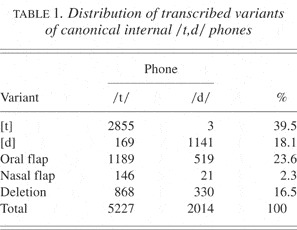
Distribution of transcribed variants of canonical internal /t,d/ phones
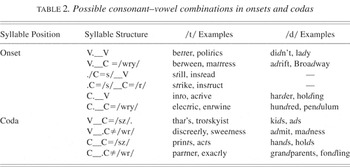
Possible consonant–vowel combinations in onsets and codas
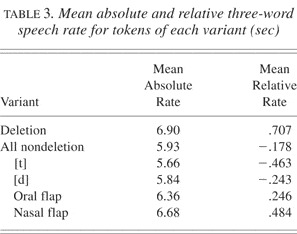
Mean absolute and relative three-word speech rate for tokens of each variant (sec)
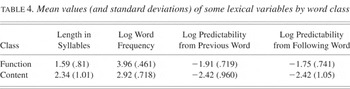
Mean values (and standard deviations) of some lexical variables by word class
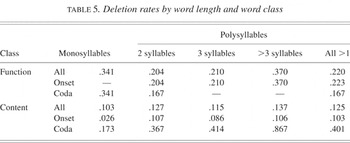
Deletion rates by word length and word class
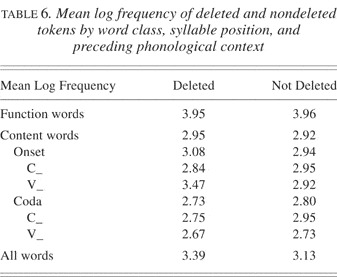
Mean log frequency of deleted and nondeleted tokens by word class, syllable position, and preceding phonological context
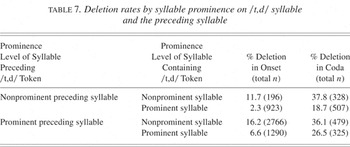
Deletion rates by syllable prominence on /t,d/ syllable and the preceding syllable
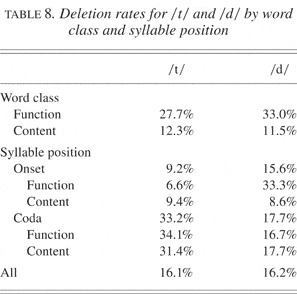
Deletion rates for /t/ and /d/ by word class and syllable position
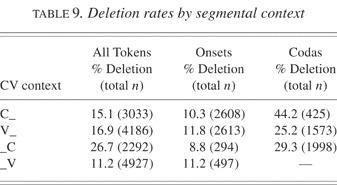
Deletion rates by segmental context
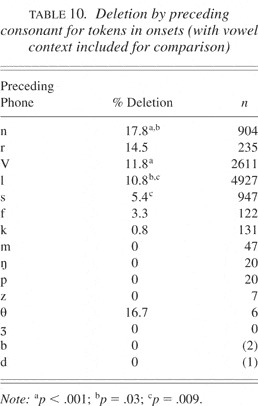
Deletion by preceding consonant for tokens in onsets (with vowel context included for comparison)
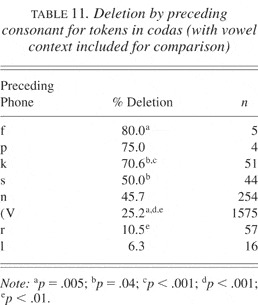
Deletion by preceding consonant for tokens in codas (with vowel context included for comparison)
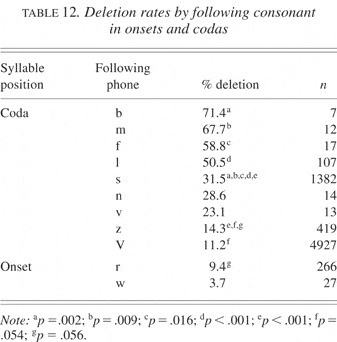
Deletion rates by following consonant in onsets and codas
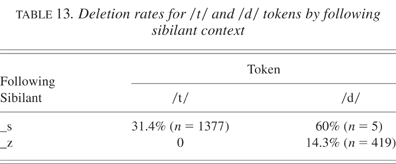
Deletion rates for /t/ and /d/ tokens by following sibilant context
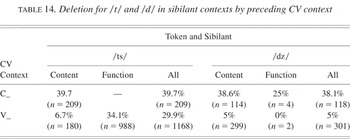
Deletion for /t/ and /d/ in sibilant contexts by preceding CV context
 You have
Access
- 74
- Cited by