For nearly a century scholars have suggested that dramatic precedents for English ballad opera might be found in the French theatre. In 1937 Edmond Gagey was the first modern theatrical historian to speculate that French musical theatre works of the late seventeenth and early eighteenth centuries were models for John Gay's supposedly ‘original’ new genre:
The indebtedness of Augustan drama to French comedy has never fully been analyzed. In all probability it is far wider than ordinarily supposed, and it is not surprising to find that ideas and situations in English ballad opera have been anticipated in the Comédie-Italienne, the Comédie-Française, and the Théâtre de la Foire.Footnote 1
The players in France's Théâtres de la Foire performed what they termed comédies en vaudevilles (or opéras comiques en vaudevilles), light entertainments featuring vaudeville tunes (simple, strophic topical songs) with new words that punctuated the action of the farces.Footnote 2 Gagey suspected that these popular fair entertainments might have influenced Gay, writing: ‘How convenient it would be at this point to discover a neat little passage … proving beyond question that Gay was familiar with the French comédies en vaudevilles!’.Footnote 3 Despite Gagey's hunch, however, he could not find any compelling evidence that credibly linked the comédies en vaudevilles with Gay.
Gay probably saw the comédies en vaudevilles performed during his trips to France in 1717 and 1719. Calhoun Winton, in his 1993 book John Gay and the London Theatre, hypothesized that Gay might also have observed the Parisian troupes while they were in London and heard them sing their vaudevilles live.Footnote 4 In 1999 Daniel Heartz outlined some dramatic similarities between Gay's The Beggar's Opera and certain opéras comiques en vaudevilles by Alain-René Lesage, touching briefly on parallel musical features.Footnote 5 However, Heartz stopped short of making an overt connection between these two genres of popular musical theatre; furthermore, he made no attempt to tackle the seven unidentified French tunes which make an appearance in Gay's penultimate ballad opera Polly (1729). These seven airs have greatly puzzled musicologists and theatre historians, especially since they are found in a genre in which the musical content is generally made up of common English tunes. Though Gay had previously used four French tunes in The Beggar's Opera, the sources were all available to him in contemporary English publications, and these English sources had been identified by Jack Westrup in 1928.Footnote 6 However, the provenance of the French music in Polly, Gay's sequel to The Beggar's Opera, remained obscure.
As it turns out, at least four of the tunes Gay employed in Polly are popular French vaudevilles from the repertory of the Parisian Théâtres de la Foire. This raises some new questions about the relationship between French and English musical theatre in the early eighteenth century. Why did Gay choose these particular French tunes? How might he have come to know this foreign repertory? And what are the implications of learning that Gay, the inventor of ballad opera, was familiar with the music of the Théâtres de la Foire?
Despite the unsuccessful early twentieth-century attempts to link Gay and the French fair theatres in the music of The Beggar's Opera,Footnote 7 the most striking connection has been available all along in the music of Polly, its sequel. As we shall see, it is the musical (rather than dramatic) features which tie ballad opera to the comédies en vaudevilles. These musical similarities hint at a closer relationship than has yet been acknowledged between French musical practices and the development of English ballad opera.
The Influence of French Music and Drama in Early Eighteenth-Century Britain
French music, dance and opera had long influenced cultural production in England, and they quickly seeped into the popular dramatic sphere.Footnote 8 Charles II, an admitted Francophile, encouraged French music and musicians at his court; Roger North confided that during the first years of Charles II's reign ‘all music affected by the beau-mond’ tended to ‘run into the French way’.Footnote 9 The Chapel Royal added a band of twenty-four strings in the French style; English music (and especially opera), as North complained, ‘brought up the ’rere’.Footnote 10 John Dryden and Thomas Shadwell worked with French composer Louis Grabu on operas, most notably Dryden's Albion and Albanius (1685), French-style allegorical prologues graced English ‘Dramatick Operas’ like Dryden and Purcell's King Arthur (1691), and others used French sources for their adaptations.Footnote 11 Purcell's music tutor, Pelham Humfrey, had reportedly studied secular French music with Lully in France, and Purcell was not immune to the hegemony of French music at court, incorporating French dance styles and overtures into his stage music.Footnote 12 Indeed, the French overture (often spelled ‘ouverture’ in the French manner) remained ubiquitous into the first third of the eighteenth century in Britain, from the Italian operas that were all the rage in London (Ariosti, Giovanni Bononcini, Handel) to the English musical comedies that traversed the country and its colonies (Pepusch, Boyce, Arne). Lighting effects (sconces and footlights), scene-ladders and the theatrical tambour (drum) were additional imports from French theatres.Footnote 13
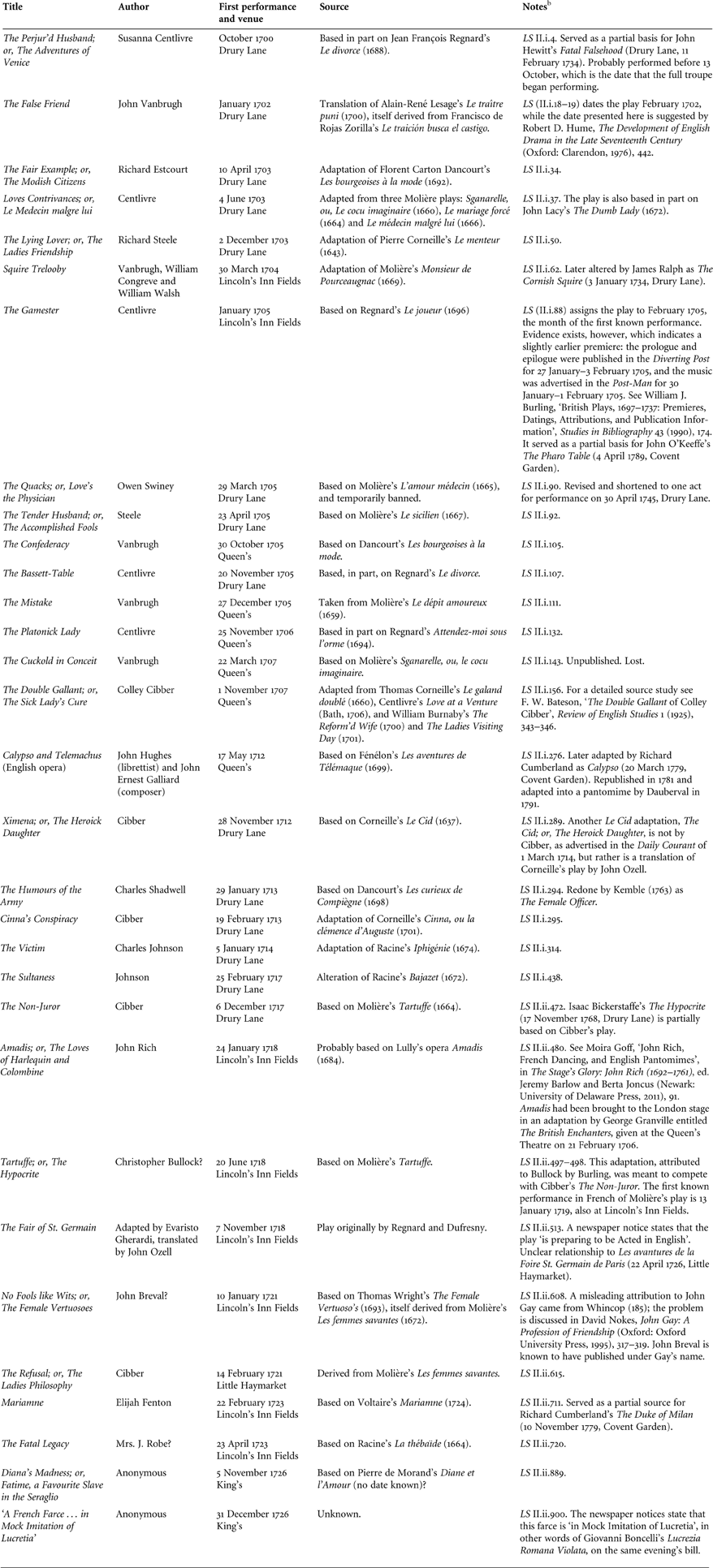
These Restoration-era appropriations indicate that England was highly attentive to French musical and dramatic practices, and such borrowings persisted into the mid-eighteenth century. Most significantly, the comedies of Molière, Dancourt and Regnard held sway on the English stage for many decades, influencing the most important playwrights of the Restoration and Augustan eras, including Centlivre, Vanbrugh, Fielding and a score of others.Footnote 14 (See Table 1, which lists premieres of French-influenced pieces in English given on the London stage between 1700 and 1728.)
Premieres of French-influenced pieces in English on the London stage, 1700–1728a

a Information taken from William J. Burling, New Plays on the London Stage, 1700–1810 database (2006), archived at: <http://es.convdocs.org/docs/index-18448.html> (14 August 2013). This table represents only a sample; there are likely to be many more English pieces that I have missed or whose provenance is unknown.
b Each entry includes a citation from The London Stage calendar [LS] (part, volume and page number). See The London Stage, 1660–1800: A Calendar of Plays, Entertainments & Afterpieces, part 2: 1700–1729, two volumes, ed. with a critical introduction by Emmett L. Avery (Carbondale: Southern Illinois University Press, 1960), and the revision of part 2 by Robert D. Hume and Judith Milhous, archived online at Hume's personal website: <www.personal.psu.edu/hb1/London%20Stage%202001/preface.pdf> (26 March 2013).
When the afterpiece regularly began to make up a full evening's entertainment in London's theatres (especially after 1714), authors had to look further afield for comic scenes to adapt.Footnote 15 Many of the French farces and comedies were published, making it easy for French-speaking playwrights in London to lift scenes and make translations.
The greatest contribution of France to the English popular theatre in this era was undoubtedly in the arena of dance. Many French dancers went back and forth between London and the Continent; several chose to stay and make their fortunes in Britain, especially in the theatres.Footnote 16 Anthony Abbé (c1666–c1753), who had come to dance in the London theatres in the 1690s, taught many of the era's leading young theatrical dancers, and was by 1720 the dancing-master to George I's granddaughters; Anthony Francis Roger (probably Rogier) was a French dancer and choreographer who alternated between the Opéra-Comique in Paris and playing Pierrot in commedia dell'arte scenes in London.Footnote 17 He became the leading master for theatrical dancers in London after Abbé, and might even have brought his English dancers back to Paris to dance at the Opéra-Comique.Footnote 18
Moira Goff has explained how young manager John Rich, opening the new Lincoln's Inn Fields theatre in 1714 and facing competition from the bigger house (Drury Lane), turned to entr'acte dancing to draw in audiences. Trained in French styles and techniques, imported dancers put Rich's theatre on the map. Many of the dancers were poached by Drury Lane in the next season, beginning a long-running rivalry with Rich's company. The most popular dances were set to tunes that are found frequently in ballad operas, such as ‘Sir Roger de Coverley’ and the ‘Black Joke’; advertisements tout that the ballad operas are ‘Intermix'd with Country-Dances’, naming the specific dances and dancers, who appear on the bills with the theatre's leading actor-singers. Nearly all of the leading male dancers in London in this era were French; Louis Dupré, Charles Delagarde, Louis Nivelon and Francis Sallé were among those billed most often.Footnote 19 Goff has found that ‘about a third of Rich's male dancers and about a fifth of his female dancers may have been French in origin’.Footnote 20 Many of the dancers also performed at the Paris fairs during the same decades; for instance, Marie Sallé's father was a fairground performer in France, and she probably grew up performing in the fair theatres before starting her career in England. After dancing in London for some years, she returned to the French fair theatres in the early 1720s.Footnote 21 All of the top dancers hired by Drury Lane and Lincoln's Inn Fields appeared in the theatres' popular musical entertainments, whether in pantomime or between the acts or before the afterpiece; occasionally they were dancer-actors who also had speaking parts in plays or ballad operas.Footnote 22 Goff has posited that Rich himself was trained as a harlequin in the Paris fairs.Footnote 23
Singing in French was not as fashionable as singing in Italian in the early decades of the eighteenth century, but the number of English publications incorporating new French songs attests to a market for music in this language. There are French airs in Henry Playford and John Young's collection of popular songs Wit and Mirth, or, Pills to Purge Melancholy (1719–1720). John Walsh – who would later have the monopoly on printing Handel's music – also published Nicolas Cloes's One Hundred French Songs (1703, reprinted 1749), dedicated to their Royal Highnesses the Prince and Princess of Wales. French tunes – or airs translated from the French – were also published by English song composers in the 1720s, including Henry Carey, John Abell, Thomas D'Urfey and John Wilford.Footnote 24
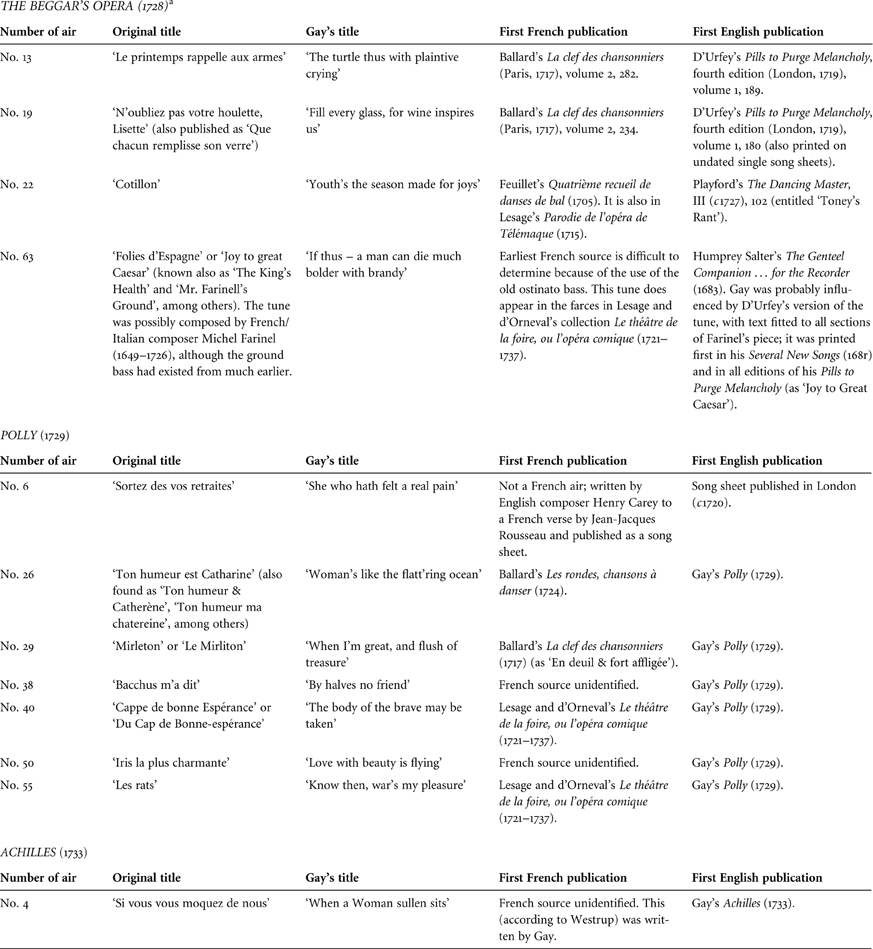
Carey and D'Urfey, two of the composers whose melodies were most often borrowed for use in ballad opera, also had experience writing songs in French. Carey's cantata The Precaution was published in both French and English in 1724. Carey also published a French song, ‘Sortez des vos retraites’, which was used by Gay in Polly (see Table 2), and D'Urfey arranged ‘The Moderate Man’ (‘ye words by Mr. D'urfey to a pretty French tune’) in 1710. D'Urfey transformed ‘N'oubliez pas votre houlette’ into ‘Fill Ev'ry Glass’ for the celebrated Pills to Purge Melancholy collection. These songs morphed into ‘English’ ballad tunes after they were published with English words, reappearing for decades in ballad operas and later English song collections.Footnote 25
French tunes in Gay's operas
a For the most accurate information on the history of each of the tunes in The Beggar's Opera see Jeremy Barlow, ed., The Music of John Gay's ‘The Beggar's Opera’ (Oxford: Oxford University Press, 1990), 108–116.
Few scholars have taken much notice of the vast network of French musicians working in Britain in the first decades of the eighteenth century. Many contributed to the development of English theatrical music, though here I shall mention only two. James (born Jacques) Paisible (c1656–1721) was a virtuoso recorder player who also made a career as a theatre composer in London. Paisible, who was sometimes called ‘Peasable’, wrote act-tunes (incidental music) for Dorset Garden Theatre in the 1690s, and later played cello and recorder in the Drury Lane orchestra, the Queen's Theatre at the Haymarket and then Lincoln's Inn Fields (where he played the flute). He was house composer for Christopher Rich at Drury Lane, and wrote overtures and act-tunes for enduring comedies by Colley Cibber (Love's Last Shift, 1696, and She Wou'd and She Wou'd Not, 1702) and others (Betterton's The Humours of Sir John Falstaff, 1700). He published French dances dedicated to members of the Royal family, and D'Urfey set words to his airs; several of Paisible's songs appear later in ballad operas, including ‘Room, room for a rover’ and ‘Woe is me!’. His music was reportedly good enough to have been mistaken for that of Henry Purcell.Footnote 26 Charles Dieupart (c1667–c1740) was a French keyboardist and violinist who also composed music for plays and masques. At the keyboard in the Drury Lane orchestra (and later the Haymarket orchestra), he was involved with the production of Arsinoe (1705), the first all-sung opera in the Italian style to be staged in London, and the performances of Camilla (1706); both operas would later prove to be fruitful sources for ballad-opera tunes.Footnote 27 According to contemporary newspaper advertisements, Dieupart's concertos were played between the acts at Drury Lane; in addition, he composed English songs for inclusion in the era's many song collections and miscellanies. Some of these songs made their way into ballad opera, especially ‘The Wheedler’ (also known as ‘In vain, dear Chloe’).
French instrumentalists populated all of the London theatre bands in the early eighteenth century, and frequently made their living teaching or publishing music as well. On the payrolls at Drury Lane and the opera house (Queen's Theatre, later King's) in the first decades of the century were Paisible, Dieupart, Claude Rogier (first violin), John Baptist Granom (trumpet), Peter La Tour (oboe), Louis Mercy (flute), John Baptiste Loeillet (oboe) and many others.Footnote 28 It should be noted also that the ballad-opera orchestra was nearly identical in size and make-up to that used in the French fair theatres – about twelve players, depending on the playhouse.Footnote 29
The English were accustomed to French theatrical practices, as English playhouse impresarios often brought over foreign troupes from the Paris fairgrounds and the Théâtre-Italien during the early decades of the eighteenth century.Footnote 30 These Parisian troupes had a long history of travelling abroad, as well as a repertory that reflected their international interests. After the Italian company was expelled from Paris in 1697, the Paris fair actors began incorporating parts of the Italian repertory into their own comedies, especially plays by Evaristo Gherardi. As this was an illegal enterprise, the Paris fair comedians tried clever stratagems to get around restrictions, performing unrelated scenes, playing in mime and holding up placards with words instead of speaking. Often they parodied the serious theatrical and operatic repertory.Footnote 31 It is highly likely that the English and Parisian fair theatres are related, as the parades (for enticing fee-paying spectators inside the booths), the licentious scenes borrowed from the repertory of the old Italian commedia dell'arte and the practice of parodying legitimate playhouse plays are characteristic of both.Footnote 32
Like earlier commedia dell'arte troupes, the French forains (fair-theatre players) exploited the commercial possibilities of travelling widely, and English theatres frequently figured in their travel itineraries. Joseph Sorin (died c1730) was probably the first fair-theatre entrepreneur to make his way to England; in the 1696–1697 season he worked for Thomas Betterton as dancing master at Lincoln's Inn Fields, and even played guitar on the stage.Footnote 33 In 1702 the Foire St Laurent theatres were closed down, and Sorin, Louis Nivelon and the Alard brothers came to London, where they danced at Drury Lane and performed ‘night scenes’ (sometimes also called ‘mimick scenes’, since they were mimed scenes) at the London fairs.Footnote 34 In succeeding years these dancers – and a number of others – appeared in the London fairs during the summer. In England, the French fair actors added acrobatics and dancing to their repertory of plays.
From the substantial number of French plays produced in London it is evident that English audiences were exposed to various types of French comédies, including comédies en vaudevilles, before ballad opera arrived in January 1728 (see the Appendix, which details performances of French fair-theatre pieces and plays in French in London). In 1718 Rich – the manager who would produce Gay's Beggar's Opera a decade later – brought French fair theatre troupes to Lincoln's Inn Fields; led by Francisque Moylin (who was related by marriage to the Sallés), the troupe stayed until March and performed thirty-two different French plays that season.Footnote 35 Their visit to London was a decided success, the troupe returning in March 1720 and then once more in the 1720–1721 season. In 1721–1722 there was a second troupe (under the patronage of the Duke of Montagu) trying out French tragedies for the first time. French troupes returned to London again in the 1724–1725 season, and for the last time that decade in spring 1726; no more French strolling troupes appeared in London again until the 1734–1735 season.Footnote 36
A commentary on current entertainments written in 1720 reveals that the London theatres were unfavourably affected by the success of the French comedians at the Little Haymarket.Footnote 37 A letter from Aaron Hill to Rich dated 9 September 1721 describes his frustration in working out the use of the Little Haymarket with the French players: ‘I suppose you know, that the duke of Montague, and I, have agreed, and that I am to have that house half the week, and his french vermin, the other half’.Footnote 38 The success of the French comedians in England was also unpopular with the French authorities. The Princess of Wales invited a Comédie-Italienne troupe in 1723, but permission was denied by Louis XV; the incident was made into a play by Marc-Antoine Legrand for the Théâtre-Italien in Paris: Le départ des Comédiens Italiens pour l'Angleterre (1723).Footnote 39 It is clear that the encouragement of foreign troupes – especially after a recent war with France – was seen as unpatriotic in many quarters.Footnote 40 Newspapers decried impresario John Jacob Heidegger's project of bringing to London a troupe of French comedians in 1717.Footnote 41 England already has excellent actors and plays, wrote one anonymous correspondent to the Weekly Journal or Saturday's Post, and not even ancient Greece ‘could boast a Sett of Actors so just to Nature, as at present adorn our English Theatres’:
It is well known, that the French Theatres never produced one good tragedy well performed; all they have signalized themselves for, have been the Parts of Buffoons, Scaramouches, Harlequins, &c. which when we borrowed from them, have been thought, by Men of Sense and Taste, to tend to our Disgrace; but now it seems we are to prefer not only their Plays, but also their Actors to our own … Footnote 42
The annoyed correspondent appeals to George I, whom he asks not to ‘prefer the Efforts of another Nation, to the Genius of his own’; he also snidely remarks that His Majesty should undertake to improve his own knowledge of the English language instead of trying to impose French on his people.Footnote 43
The multiple appearances of the Parisian forains undoubtedly influenced the developing genre of English theatrical pantomime, which started in the 1716–1717 season with Rich at Lincoln's Inn Fields and John Weaver at Drury Lane.Footnote 44 These pieces consisted of a serious plot line from classical mythology with interspersed commedia dell'arte characters, the Italian-style ‘night scenes’, stage effects, farce, and singing and dancing.Footnote 45 English pantomime had a close relationship with ballad opera, as the same performers and composers were involved in both genres, and they were staged in the same theatres. Pantomime would grow to become one of the most important genres on the British stage in the eighteenth century, incorporating instrumental and vocal scores from the nation's leading composers together with spectacular transformations and magical effects. Rich and Weaver were not the only proponents of nascent English pantomime in Britain, however: the English dancer Richard Baxter (died 1747), who collaborated with Sorin at the Paris fairs, travelled through the provinces of Britain with his entertainments from 1717 to 1721.Footnote 46
Ballad Opera and opéra comiques en vaudevilles
Gay's The Beggar's Opera was the first of nearly two hundred ballad operas. With thieves and prostitutes substituting for lofty heroes and heroines, it satirized the British beau monde, morals, and contemporary theatrical and musical taste, delighting audiences across the spectrum of English society. John Christopher Pepusch composed for The Beggar's Opera a proper (French-style) overture, and Gay filled his so-called ‘opera’ with sixty-nine musical numbers, all of which were popular tunes of the day, mainly those sung at the theatres or known as street ballads. The Beggar's Opera was a smash hit, and it broke records with its run of sixty-two performances. Gay's imitators hastened to write their own ballad operas in the wake of this literary and popular triumph. One of these authors was William Chetwood, who wrote in his General History of the Stage in 1749 that ‘the French have borrowed from us, as well as we have from them’.Footnote 47 This comment reveals that the exchange of dramatic ideas and practices was thought to have been reciprocal, and not just a one-way flow from France to England.
Daniel Heartz and Jeremy Barlow have both connected the music of ballad opera and the comédies en vaudevilles by tracing the history of a French dance air called ‘Cotillon’, which Gay used in The Beggar's Opera.Footnote 48 However, ‘Cotillon’ was only the first of several French vaudevilles employed by Gay. Indeed, of the twelve tunes with French titles in Gay's three operas, four additional vaudevilles from the Paris fair-theatre repertory can now be identified in Polly (see Table 2).Footnote 49
Vaudevilles made up the largest part of the music for the French fair repertory, the comédies en vaudevilles, which also consisted of short opera excerpts, dances and instrumental interludes. Lesage rather vaguely defines the vaudeville as a ‘type of poetry peculiar to the French’ (‘espèce de Poësie particulière aux François’) in the Preface to his collection Le théâtre de la foire, ou l'opéra comique (compiled in collaboration with Jacques-Philippe d'Orneval), saying that it has the esteem of everyone, and especially foreigners.Footnote 50 Like their English counterparts, the street ballads, vaudevilles were often disseminated orally by street singers, and were airs for dancing and drinking, often serving satirical purposes.Footnote 51 Though the airs vary in type and structure, they are chiefly in binary form, with or without repeats.Footnote 52 In this way, they are similar to the English tunes that make up the preponderance of the music in ballad opera. The vaudevilles were soon separated from their original texts but could still be identified by their timbres: the refrain (as in ‘which nobody can deny’) or the first line (‘For he's a jolly good fellow’) which indicated to the listener which tune was being sung.Footnote 53 Incidentally, this French song type was familiar in Britain; an English dictionary in 1706 defined ‘Vaudevil’ as ‘a Country-Ballad, or Song’.Footnote 54
There are three main collections of the fair theatres' vaudeville tunes. The comedies of the Théâtre-Italien were published in Gherardi's six volumes in 1694, and were first sold in England by Jacob Tonson in 1714,Footnote 55 with the tunes being included at the end of each volume. In 1717 Ballard in Paris published an anthology of over three hundred vaudevilles entitled La clef des chansonniers. The most significant compilation, though, was Lesage and d'Orneval's six-volume Le théâtre de la foire, ou l'opéra comique, first published in Paris in 1721. As in the Gherardi collection, the tunes for the plays were included in the back of each volume.
Jean-Claude Gillier (1667–1737) was perhaps the most important composer and arranger of music for the Théâtres de la Foire.Footnote 56 Gillier began his career composing music for Regnard and Dancourt's plays for Louis XIV; he began working for the Théâtres de la Foire in 1713 and collaborated with Favart, Fuzelier, Lesage and d'Orneval in over one hundred plays, from a parody of Télémaque (1715) to La répétition interrompue, ou le petit-maître malgré lui (1735).Footnote 57 Gillier visited England, where he wrote music for plays and performed on the ‘Hand Organ’ at Lincoln's Inn Fields Theatre during one of John Rich's English pantomimes.Footnote 58 From 1698 to 1715 he published collections in English and a number of single sheet songs.Footnote 59 Gillier's Recueil d'airs François … composé en Angleterre (London, 1723) contains airs and duets along with vaudevilles; its list of subscribers comprises such luminaries as Lord Edgecumbe, the Duke of Montagu, Lady Harvey, the composers Ariosti and Bononcini, and fellow French supporters L'Abbé and Nivelon. Gillier's uncomplicated, singable music is very much like the English ‘ballad’ airs of the same period – airs which populated the plays and (later) ballad operas.Footnote 60 He also began to incorporate new music along with the old vaudevilles in his later plays; this practice parallels the development of ballad opera in the 1730s (for instance in the operas of Henry Fielding).
In 1716 the Paris Opéra consented to allow the Théâtres de la Foire to give ‘spectacles mixed with music, dance and symphonies under the name of Opéra-Comique’.Footnote 61 The longer term opéra comique en vaudevilles usually designated spoken comedy interlarded with familiar tunes. This genre was later transformed – with the introduction of Italianate airs in the style of the intermezzo – into opéra comique (sometimes also called comédies mêlées d'ariettes) in the 1750s and 1760s, the decades in which the corresponding genre of English comic opera developed from ballad opera and the same Italian influences.Footnote 62
Heartz has stated that ‘in manner of construction there is no difference between ballad opera and opéra-comique en vaudevilles’.Footnote 63 Though musically there are many similarities between the two, Heartz's assertion is erroneous in terms of the genres' dramatic construction. Most significantly, ballad operas were frequently derived from Restoration-era farces or French comedies, while the foire entertainments were often newly written works.
There are further structural differences between the two genres. For instance, although satire was the aim of both, specific French operas were usually the focus of the parodic comédies en vaudevilles; ballad operas rarely ridiculed serious opera in London, and instead mocked particular singers (usually the castratos) or English supporters of these expensive ‘foreign’ entertainments.Footnote 64 In addition, in France, high- and low-style genres were divided officially into separate theatres and locations, whereas in London, high- and low-style entertainments were sometimes combined in a single genre.Footnote 65 Ballad opera is an excellent example: it mixed opera arias and bawdy broadside airs, and high-style blank verse with double entendre.
Despite structural differences between the two genres, there are also similarities, including analogous pastoral and realistic themes, political critique and stock characters (duplicitous valets, judges, lawyers, bankers, licentious wives, even actors). Of course, it must be noted that many of these elements are characteristic of comic theatrical genres in general. Additionally, both genres made use of double entendre, and addressed the audience directly to garner favour.Footnote 66
The vaudeville final was the common ending for comédies en vaudevilles and often appeared at the end of acts. Vaudevilles finals were sung by the main characters, a verse or two for each, while a chorus usually repeated a refrain.Footnote 67 The final scene of Le tombeau de Nostradamus (1714), one of the farces in the repertory of the fair theatres, ends with a vaudeville final. Bringing all of the main characters on stage to sing a couplet or verse of a multi-stanza song was also the usual way of concluding ballad operas.Footnote 68 For instance, Fielding's An Old Man Taught Wisdom; or, The Virgin Unmask'd (1736) ends with an air similar in structure to a vaudeville final. Each of Fielding's characters (Blister, Coupee, Quaver and Lucy) sings a verse of the finale, and all join in on the refrain ‘With his Down, down …’; this is analogous to the ending of Lesage's Le tombeau de Nostradamus, where the characters each sing a verse alternating with the chorus's cry of ‘Vive Michel Nostradamus!’.
Musically, the French vaudevilles – like the popular tunes used in ballad operas – usually contain simple, memorable melodies in major keys with written-out ornaments. Many ballad-opera airs have sections that are very much like the recurring timbres used in the vaudevilles. For instance, it might be said that ‘The Yorkshire Ballad’ given above has a timbre: its refrain ‘With his Down, down’ indicates to the readers of Fielding's play (and indeed performers in the ballad opera) which tune ought to be sung to his words, even if the air is not supplied. Early ballad operas published with the tunes include them at the end of the publication, as in Lesage and d'Orneval's collection.
Ballad opera most resembles the comédies en vaudevilles in its employment of pre-existing music together with new texts supplied by the authors. Since new verses were set to familiar music, a humorous effect could be made when audiences were able to compare the two versions. For instance, the relatively tame Air 21 in The Beggar's Opera (‘If the Heart of a Man is deprest with Cares’) might be contrasted against its bawdy original in a contemporary popular song collection (its original title being ‘Would ye have a young Virgin’).Footnote 69
Ballad Opera and the théâtres de la foire
Gagey conjectured that Gay's two trips to France with William Pulteney, first Earl of Bath, and his wife in 1717 and 1719 might have sown the seeds for his innovation of the ballad opera.Footnote 70 The Pulteneys were attuned to French culture in Britain; they are listed among the subscribers to Gillier's Recueil d'airs and might even have introduced Gillier to Gay. Gay indicated his own interest in French culture when he ridiculed it in his 1720 epistle To the Right Honourable William Pulteney Esq, which is full of Gallic stereotypes.Footnote 71 The poem also makes clear that Gay did know his French dramatists:
Gay also must have had some knowledge of French dance conventions: in the fourth scene of Act 2 of The Beggar's Opera he inserted a dance ‘a la ronde in the French manner’.
The ever-perceptive Gay was well versed in contemporary theatrical trends, and probably attended the playhouses when the French and Italian troupes were in town. In 1727 he wrote to Brigadier James Dormer with the news that Voltaire was visiting London, and also reported on a visiting troupe of Italian strollers: ‘There is a set of Italian Comedians who act twice a week at the Opera house’, he tells Dormer, ‘but they are very little approv'd off [sic], for the Harlequin is very indifferent, so that they find but small encouragement’.Footnote 73
Like other English authors of the period, Gay had mixed feelings regarding the widespread practice of translating dramatic works from the French. In the Preface to his Three Hours after Marriage (1717) Gay expresses contempt for those authors who translate a work and then blame the French for their failure with critics by protesting ‘damn not us, but damn the French that made it’.Footnote 74 He offers his play up to the audience as an English original, but still worries about its reception: ‘How shall our author hope a gentle fate, / Who dares most impudently – not translate?’.Footnote 75
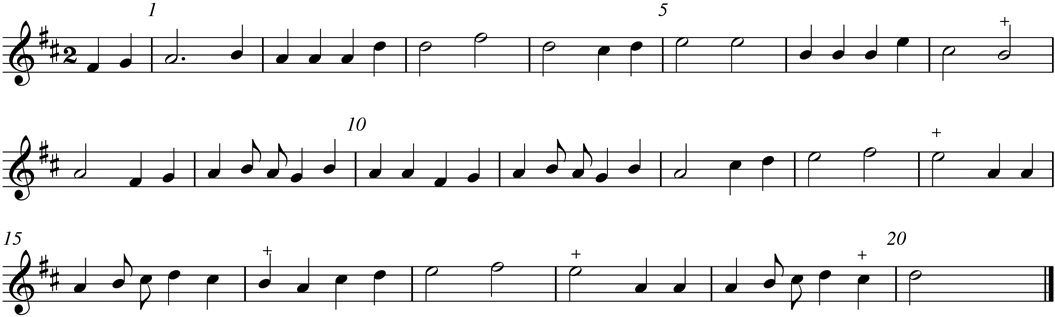
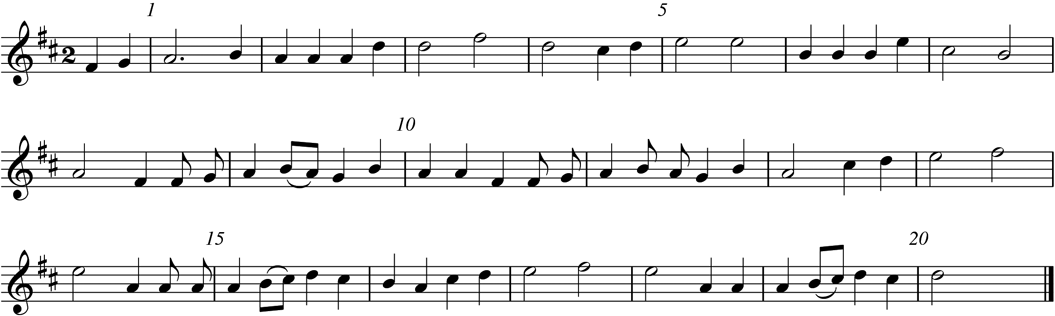
As mentioned earlier, Jack Westrup had noted in 1928 that the four French tunes Gay used in The Beggar's Opera were all accessible from English sources.Footnote 76 This means that the best evidence of Gay's direct knowledge of the French comédies en vaudevilles lies in the music he selected for his second ballad opera, Polly, as none of these French tunes were printed in English publications. Four of the French airs in Polly are certainly vaudevilles (see Table 2). They can all be found in Lesage and d'Orneval's six-volume Le théâtre de la foire: ‘Ton humeur est Catherine’, ‘Mirleton’, ‘Cappe de bonne Espérance’ (‘Du Cap de bonne-espérance’) and ‘Les rats’. Comparing the music of the two publications side-by-side, it becomes apparent that the presentation of each tune in the French and English publications is virtually identical; the tunes are even in the same key. See Examples 1 and 2, which provide the respective versions of ‘Les rats’. The obvious conclusion is that Gay must have had access to a copy of Lesage and d'Orneval's collection.Footnote 77
Anonymous, ‘Les rats’, vaudeville tune in Alain-René Lesage and Jacques-Philippe d'Orneval, Le théâtre de la foire, ou l'opéra comique (Paris and Amsterdam: chez Z. Chatelain, 1722–1734), volume 1, page 15 (of the Table des Airs). British Library 241.I.18-27. The clef has been changed from its original soprano clef to modern treble clef, and the order of the sharps has been modernized
John Gay, ‘Know then, war's my pleasure (Les rats)’, Air 55, Polly (London: Printed for the Author, 1729), page 24 (of the Airs). British Library 79.i.30(.2.)
These four vaudevilles were used repeatedly in the forains' farces, as they found their way into at least twenty-seven different comedies in Lesage and d'Orneval's collection. Some of the tunes were employed more frequently than others; for instance, ‘Cappe de bonne Espérance’ was used the most often, and is even found four times in one work, Arlequin Traitant (1716). James R. Anthony has written that the fair playwrights ‘often used the same tune repeatedly for a specific situation until it became associated with that situation from play to play’.Footnote 78 However, Polly's four vaudevilles are given new meanings by Gay in English; he did not carry over their original contexts from the French.
We know from newspaper advertisements that at least three of the pieces from the Lesage and d'Orneval collection were performed in London. These are Les eaux de Merlin (premiered 12 December 1721), L'isle des Amazones (17 December 1724) and Les funerailles de la foire (8 January 1724), and all were produced at the Little Haymarket Theatre (refer to the Appendix). Perhaps Gay even heard the tunes sung live during their London performances. All four vaudevilles would have been heard in these three comedies, although no single piece contains all four of them.
In addition to this new confirmation of Gay's familiarity with the French fair theatre, there is proof of Henry Fielding's awareness of the comédies en vaudevilles as well. Fielding wrote some of the most successful and enduring ballad operas and thereby exerted much influence over his contemporaries. Two of Fielding's operas are based on plays by Molière and Regnard, and he also owned copies of significant early collections of French fair-theatre repertory and vaudevilles in his library.Footnote 79 According to its inventory, he owned the original three-volume set of Lesage and d'Orneval's Le théâtre de la foire (although he did not seem to own the additional volumes published later), as well as all six of Gherardi's Théâtre-Italien volumes.Footnote 80 From this we can see that Fielding was aware of the farces of the Théâtres de la Foire, even if he did not utilize the music or its action.
Although Fielding did not use any vaudevilles in his operas, his friend James Ralph (1705–1762) employed two of them in his hit The Fashionable Lady; or, Harlequin's Opera (1730).Footnote 81 Air 24 in The Fashionable Lady is the vaudeville ‘Plus inconstant que l'Onde & le Nuage’, and – like the four vaudevilles used by Gay – it is also found in volume six of Lesage and d'Orneval's Le théâtre de la foire (as No. 158). It is an old French air – Montaigne even made reference to it in his Essays, and Ralph's employment of it in The Fashionable Lady seems to be its only appearance on the British stage. A second French tune in The Fashionable Lady is Ballard's lively ‘Mirleton’ (Air 16), which Gay used first in his Polly.Footnote 82The Fashionable Lady burlesques pantomime in several scenes, and includes in its list of dramatis personae Harlequin, Colombine, Scaramouche, Pierrot, Punch and Pantaloon.Footnote 83
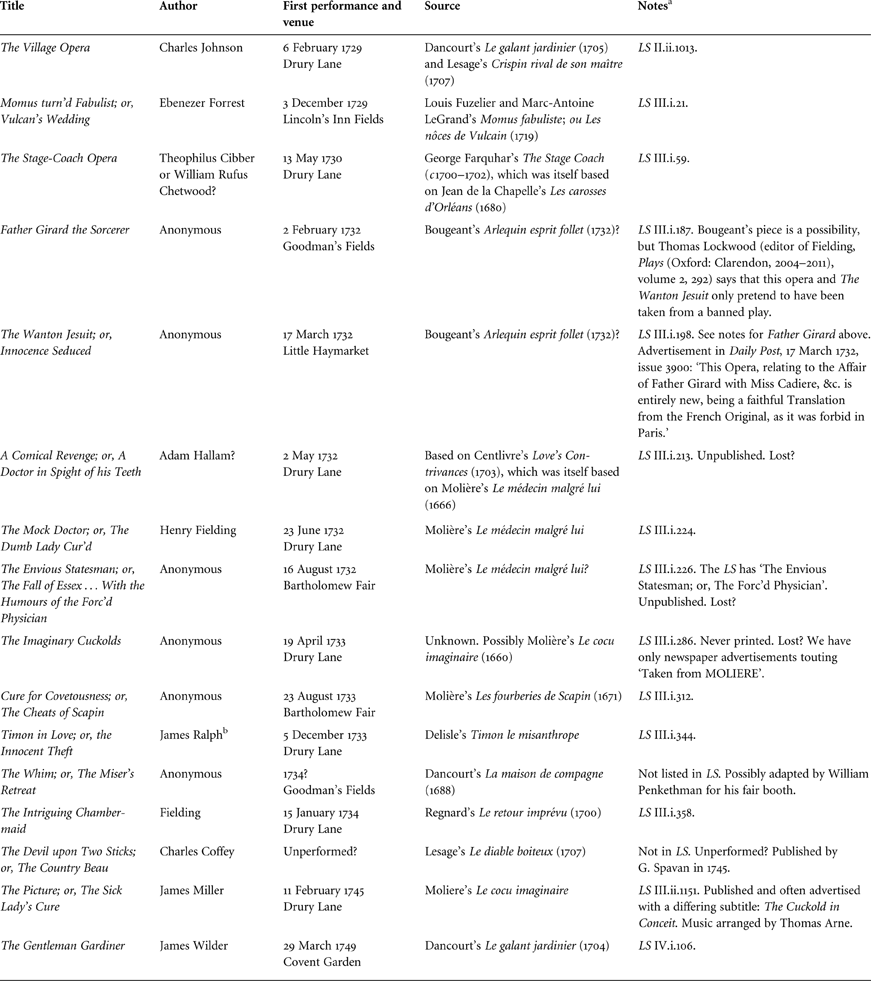
In addition to the use of French vaudevilles in the ballad operas of Gay and Ralph, the fact that many other ballad operas were based on French sources (see Table 3) demonstrates that the genre's authors had a broad knowledge of the repertory, whether high-style or low.
Ballad operas with French sources
a Each entry includes a citation from The London Stage calendar [LS] (part, volume and page number). See The London Stage, 1660–1800: A Calendar of Plays, Entertainments & Afterpieces, part 2: 1700–1729, two volumes, ed. with a critical introduction by Emmett L. Avery (Carbondale: Southern Illinois University Press, 1960), and the revision of part 2 by Robert D. Hume and Judith Milhous, archived online at Hume's personal website: <www.personal.psu.edu/hb1/London%20Stage%202001/preface.pdf> (26 March 2013).
b Misattributed to John Kelly in numerous sources, despite eighteenth-century attributions to Ralph (probably because of Benjamin Victor's attribution in the influential History of the Theatres of London and Dublin (London: Printed for T. Davies, 1761), volume 2, 113). But see the contract between Ralph and publisher John Watts transcribed in ‘Fly Leaves’ (signed ‘Eu. Hood’) in The Gentleman's Magazine 94/1 (1824), 223.
Ebenezer Forrest's successful Momus turn'd Fabulist; or Vulcan's Wedding (1729) took its situation from Louis Fuzelier and Marc Antoine LeGrand's Momus fabuliste; ou Les nôces de Vulcain (1719).Footnote 84 In the Introduction to Momus turn'd Fabulist, a Player discusses the conception of the opera with a Gentleman (a stand-in for Forrest himself), who tells the Player:
Sir, I was my self an Eye-witness of it, being in France when this Piece first appear'd on the Stage, and saw it represented several Nights with a considerable share of Pleasure, which put me upon rendering it into English. In this Performance I have taken the Liberty of turning the Fables, which were Spoke in France, into Ballads to be Sung, and have heighten'd several of the Scenes by the Addition of other Ballads, suitable to the present Taste of the Town. In short, I have made that an English Opera, which was but a French Farce.Footnote 85
Other ballad operas followed suit. Charles Johnson's The Village Opera (1729) was based on Dancourt's Le galant jardinier (1705) and Lesage's Crispin rival de son maître (1707).Footnote 86 Fielding's ballad-opera success The Mock Doctor (1732) was a translation of Molière's Le médecin malgré lui – and it was one of the most-performed ballad operas of the decade.Footnote 87 When critics attacked the piece for ‘indecency’, Fielding wrote a letter to the Daily Post in his own defence under the name of ‘Philalethes’ (‘Lover of Truth’):
P.S. Whether his Scurrility on the Mock Doctor be just or no, I leave to the Determination of the Town, which hath already declared loudly on its Side. Some Particulars of the Original are omitted, which the Elegance of an English Audience would not have endur'd; and which, if the Critick had ever read the Original, would have shown him that the chaste Molière had introduced greater Indecencies on the Stage than the Author he abuses … Footnote 88
The anonymous The Envious Statesman … with The Humours of the Forc'd Physician (1732) was based on Molière as well, and it appeared at a booth at a London fair theatre. The advertisement in the Daily Post promises a very entertaining performance:
Done from the French of MOLIÈRE, and intermix'd with Variety of Songs to old Ballad Tunes and Country-Dances…. All the Characters to be entirely new dress'd With several Entertainments of Dancing between the Acts, by Mons. D'Ferrou Ville, lately arriv'd from Paris … N. B. An Extraordinary Band of MUSICK is provided, to entertain the Audience, of Violins, Hautboys, Bassoons, Kettledrums and Trumpets … And further, to engage the Company before the Opera begins, the famous PHILLIPS [the English harlequin] performs on the Stage his surprising Postures.Footnote 89
There may be many further scenes, characters and translations from the French that will become more visible with further study of the genre of ballad opera.
‘The French have borrowed from us’: A Reciprocal Relationship
At first, French spectators were not much impressed with The Beggar's Opera. A letter from a contemporary French traveller in London gives an account of a performance:
They also performed a kind of comic opera, called the Beggar's Opera, because it is about a band of highwaymen with their Captain; there were only two good actors, and a girl called Fenton who was quite pretty. The orchestra is as bad as the other [at Drury Lane]. It is all ballads with worthless music.Footnote 90
Perhaps the appearance of prostitutes on stage was thought immodest. César de Saussure, who attended a performance in 1728, seemed to have been shocked by the vulgar ladies depicted in the opera. His view of the opera is significant because he uses the word ‘vaudevilles’ to describe the songs that were performed; this shows that the musical format of The Beggar's Opera was recognizable to him:
C'est une espèce de farce, les décorations représentent une prison et des maisons de débauche; les acteurs sont des voleurs de grand chemin et des libertins fieffés, les actrices sont des catins. Je vous laisse à penser ce qui peut sortir du cœur et de l'esprit de gens de cet ordre. La pièce est remplie de vaudevilles très jolis mais trop libres pour être chantés devant des dames qui ont de la pudeur et de la modestie.Footnote 91
It is a kind of farce; the decorations represent a prison and brothels, the actors are highwaymen and errant libertines, and the actresses are whores. I leave you to imagine what can come out of the hearts and minds of people of that order. The piece is filled with very pretty vaudevilles, but they are far too debauched to be sung to ladies who have any decency and modesty.
Despite ambivalent feelings about the English in France, the Paris fair theatres presented an increasing number of adaptations of English works in the first half of the eighteenth century, including plays by Vanbrugh, Behn, Centlivre, Pope, Gay, Lillo, Cibber and Addison, and later Garrick and Sheridan.Footnote 92 An announced visit to Paris by the Drury Lane troupe in summer 1720 appears to have been cancelled, but Phillips, the English harlequin, found success (along with his wife and the dancer Baxter) in the Parisian Théâtres de la Foire, performing in opéra comique in the 1730s; one show he presented in Paris in August of 1737 was even entitled (in English) ‘a new entertainment of dancing and singing’, in the same way it might have been advertised in the London playhouses.Footnote 93 Henry (Henri) Delamain (fl.1733–1755?), a dancer and choreographer for London theatres, also found employment at the fairs between 1738 and 1739 with his ‘Troupe des Sauteurs & Danseurs Anglais de Delamain’.Footnote 94
As France became more interested in English drama and literature, The Beggar's Opera was found to fit the requirements of Anglophile and philosophe critics.Footnote 95 The opera was translated into French (as L'opéra du gueux) by Adam Hallam for performances at London's Little Haymarket in February 1749 and was a success, although it was given (astonishingly) by English performers.Footnote 96 This unusual production can perhaps be added to the list of eighteenth-century novelty versions of The Beggar's Opera (along with the cross-dressing version and the ‘Lilliputian’ productions done by child actors). Hallam's French version might have been politically motivated (the War of Austrian Succession had ended the year before, and France and England were still involved in political wrangling on the Indian subcontinent in 1749), or it might be an indicator of increasing interest in French literary and dramatic material. When Hallam tried to take the piece to Paris, however, it was apparently banned.Footnote 97 Forty years later, the General Evening Post printed their account of Hallam's failure:
Hallam was a performer of some reputation, who belonged to Covent Garden Theatre, and a man of education and talents. When he had finished his translation, he took it to Paris, in hopes of bringing it upon the French stage. The French Managers agreed to have it represented, provided the Translator would alter the catastrophe [conclusion], and, according to his deserts, let the hero be hanged. Hallam, however, would not suffer the work of an admired English Poet to undergo any change, but that of a mere translation, and therefore brought it back with the indignation of patriotic pride.Footnote 98
Sybil Goulding has found that Hallam's French adaptation of The Beggar's Opera was even more off-colour than the original (a more likely reason for its failure in Paris).Footnote 99 Antoine Yart's 1753 translation (in his Idée de la poësie angloise), on the other hand, cut out any moral improprieties, as did Claude-Pierre Patu's 1756 version.Footnote 100 The final eighteenth-century attempt at translating The Beggar's Opera into French was a 1767 rendering by Mme De Kéralio for her Nouveau théâtre anglois. Only one other ballad opera made its way to Paris: Charles Coffey's The Devil to Pay (1732) was translated into French and later partially set by Gluck (1759), to great success.Footnote 101
The airs Gay used in The Beggar's Opera were the most frequently employed tunes for later ballad-opera authors, and the (originally) French airs were no exception. ‘Fill ev'ry Glass’ (Air 19) appeared in a later anonymous ballad opera, The Downfal of Bribery (1733). Charles Coffey used ‘Youth's the Season’ (Air 22) in his The Devil Upon Two Sticks; or The Country Beau (1745) for an air which makes fun of the French, and it appears with its French indication, ‘Cotillon’, in a further four ballad operas.Footnote 102 Air 63 (‘Folies d'Espagne’) circulated most widely under its English names, ‘Joy to Great Caesar’ or ‘State and Ambition’, and appeared in five later ballad operas.Footnote 103 On the other hand, Gay's unusual musical choices for Polly and Achilles never took hold, and the French airs found in these two operas never recurred in later ballad operas.Footnote 104
If the music in Polly escaped the notice of Gay's contemporaries and imitators, why would we today find importance in the appearance of French vaudevilles in his English ballad operas? First, this information – that he knew the French fair repertory and its music – enhances our existing knowledge of Gay, and it can perhaps change our perception of the music in the new genre he invented. Roger Fiske found Gay's art-music choices to be greatly ‘unexpected’,Footnote 105 probably because they counter the modern notion that music in ballad opera is made up of ‘traditional’ English ballad-type tunes. Calhoun Winton was convinced that Gay was possessed of ‘a musical sophistication much greater than he has generally been given credit for’, and this assessment is certainly correct.Footnote 106 Not only did Gay have a wide knowledge of common tunes, he also knew Corelli's output quite well, using several of the melodies of the celebrated master in Polly.Footnote 107 Furthermore, two of Gay's borrowings from Handel, Fiske has found, were based on minuets in the Water Music, which Handel had not yet officially published at the time of Polly's appearance.Footnote 108 From its inception, then, ballad opera was certainly not made up of ‘traditional’ music, nor was it exclusively English in its borrowings. And although many later writers of ballad operas did mainly use common airs for their musical appropriations, Gay – who created the genre – often did not.
The music of Polly serves as the most convincing evidence to date that Gay knew the music of the comédies en vaudevilles. In addition, the contents of Fielding's library and Ralph's deliberate use of a new vaudeville tune in The Fashionable Lady show that Gay was not the only ballad-opera author who may have derived inspiration from this French genre.Footnote 109 Clearly, French travelling troupes and theatrical works written for the foires provided useful sources for London playwrights in the early eighteenth century.
By the time that ballad opera appeared in 1728 there had been a long-standing custom of translation and cross-fertilization in the London theatre. Gay's ballad operas showed how French practices might be suitably appropriated for London audiences. His breadth of musical and theatrical knowledge, including his awareness of the Théâtres de la Foire, helped to make his ballad operas more sophisticated and richly layered than works by most of his imitators. Fielding shared Gay's particular talents, and the two led the genre of ballad opera (and London's theatrical world) in the 1730s because they were among the most versatile and educated in theatrical, literary and musical traditions. As most would-be ballad-opera authors soon found, it would not be enough simply to imitate the characteristics of a successful work (The Beggar's Opera) or interpolate popular tunes into plays. A successful writer for the stage had to have some awareness of music and musical conventions and be able to set verses, he had to be an able translator, knowledgeable about dramatic traditions (both foreign and English), and he had to be acquainted with widely different theatrical genres (tragedy, pantomime, Italian opera and others). Furthermore, composers like Carey, Galliard and Handel were among the most successful composers in Britain because they were adept at tailoring the best aspects of foreign music to English tastes. This is akin to the way that Fielding (and other dramatic playwrights) brought the best of their French counterparts into the English dramatic tradition.
The relationship between the two countries was not just a matter of one-way influence, but instead involved a reciprocal exchange of ideas. The appropriation of French musical and dramatic practices in Restoration-era England mentioned earlier was only the beginning of a give-and-take relationship between the two nations at the dawn of the eighteenth century. We have already seen that dancers appeared in front of both French and English audiences (Delamain's troupe, the Alards, the Sallés, Sorin and Baxter), and that Dieupart and Gillier's songs ended up in ballad operas, and consequently became part of English ‘traditional’ song culture. Similarly, French fair theatres staged English works and hired English performers, and the full story of these practices remains to be told.Footnote 110
All of this occurred in spite of wars between the two nations and, even when they were supposedly political allies, old prejudices. Significantly, despite the deep distrust of foreigners that is explicit in newspapers, pamphlets and other sources, we can see that French participation and influence in London theatres in the early eighteenth century was far greater than has yet been realized. Ballad-opera authors may have mocked the French, and anglicized their music and farces, but they were still looking to France for creative inspiration and cultural cues. These ties must be investigated further so that we can more fully understand the development of British musical theatre in the early eighteenth century.
Appendix