INTRODUCTION
Because of the increasing, widespread development of resistance to anthelmintics in nematode populations of the gastrointestinal tract in small ruminants (Jackson and Coop, Reference Jackson and Coop2000), the potential use of tannin-rich plants as an alternative to chemicals for the control of these parasites has been explored in several studies during the last decade. In particular, several legume forages like sulla (Hedysarum coronarium), big trefoil (Lotus pedunculatus), birdfoot trefoil (Lotus corniculatus) or sainfoin (Onobrychis viciifolia) have been studied for their anthelmintic properties (see reviews by Kahn and Diaz Hernandez, Reference Kahn, Diaz-Hernandez and Brooker2000; Min and Hart, Reference Min and Hart2002; Hoste et al. Reference Bahuaud, Martinez-Ortiz De Montellano, Chauveau, Prevot, Torres-Acosta, Fouraste and Hoste2006). An improvement of host resilience and a modulation of the nematode biology have usually been associated with the consumption of such tannin-rich forages by small ruminants. For most forages, the role of tannins in the anthelmintic activity has been suspected (Molan et al. Reference Molan, Waghorn, Min and McNabb2000b; Paolini et al. Reference Paolini, Fouraste and Hoste2004). However, the mode of action of these polyphenolic compounds on nematodes remains obscure.
In the life-cycle of trichostrongyle nematodes, the exsheathment of the infective 3rd-stage larvae represents a key-step forming the transition from the free-living to the parasitic stages (Sommerville and Rogers, Reference Sommerville and Rogers1987; Hertzberg et al. Reference Hertzberg, Huwyler, Kohler, Rehbein and Wanner2002). In a recent study, we investigated the effects of extracts from 4 tannin-rich plants on the in vitro larval exsheathment of 2 nematode species, Haemonchus contortus and Trichostrongylus colubriformis (Bahuaud et al. Reference Bahuaud, Martinez-Ortiz De Montellano, Chauveau, Prevot, Torres-Acosta, Fouraste and Hoste2006). Either a delay or total inhibition of larval exsheathment was observed after prolonged contact with the various extracts. Moreover, the normal rates of exsheathment were restored after addition of PEG, an inhibitor of tannins (Makkar et al. Reference Makkar, Blummel, Borowy and Becker1995). The results of these studies thus suggested that extracts of bioactive plants might interfere with larval exsheathment and that tannins were largely involved in the process. Further studies have confirmed these proposals using monomers of different classes of condensed tannins (Brunet and Hoste, Reference Brunet and Hoste2006). However, (i) the possible dose-dependent relationship of the interaction between tannin-rich plant extracts and exsheathment has never been explored; (ii) the effect of a tanniniferous legume forage on nematode exsheathment rate has never been examined and (iii) the current data have been obtained under in vitro conditions without verification of a possible in vivo occurrence.
Sainfoin (Onobrychis viciifolia) is a tanniniferous legume forage which is highly palatable for goats and sheep and is reported to prevent bloat in ruminants. In vitro studies have demonstrated that sainfoin extracts had an inhibitory effect on the mobility of 3rd-stage larvae of different nematode species (Molan et al. Reference Molan, Waghorn, Min and McNabb2000b, Reference Molan, Sivakumaran, Spencer and Meagher2004; Paolini et al. Reference Paolini, Fouraste and Hoste2004). The role of condensed tannins (CTs) in these effects has been substantiated through bioassays of biochemical fractions (Barrau et al. Reference Barrau, Fabre, Fouraste and Hoste2005). In addition, from in vivo studies, consumption of sainfoin has been associated with positive effects against gastrointestinal parasitic nematodes in goats (Paolini et al. Reference Paolini, Dorchies and Hoste2003a, Reference Paolini, De La Farge, Prevot, Dorchies and Hoste2005; Hoste et al. Reference Barrau, Fabre, Fouraste and Hoste2005) and to a lesser extent in sheep (Thamsborg et al. Reference Thamsborg, Mejer, Bandier and Larsen2003). For these reasons, sainfoin was used as a model of tannin-rich legume forage to examine its effects on larval exsheathment in in vitro and in vivo studies. The abomasal nematode, Haemonchus contortus was used as a parasite model.
The objectives of the current study were (i) to test the hypothesis of an inhibitory effect of sainfoin on the exstheathment of 3rd-stage larvae based on both in vitro and in vivo studies; (ii) to verify whether these effects are dose-dependent both under in vitro and in vivo conditions; (iii) to evaluate the specificity of the effects, by comparing in vitro data acquired with the abomasal species H. contortus with those from the intestinal species, T. colubriformis; (iv) to define the role of tannins in the observed in vitro effect after pre-incubating sainfoin extracts with polyethylene glycol, an inhibitor of tannins.
Two different sets of experiments were performed: a first one testing the in vitro effect of sainfoin extracts on larval exsheathment rates and, a second one, using rumen-cannulated sheep fed with a different proportion of sainfoin to verify the in vivo validity of the in vitro observations.
MATERIALS AND METHODS
In vitro assays
Sainfoin extracts
Sainfoin (Onobrychis viciifolia) hay was collected in the South-East of France in June 2005. The method of extraction has been described previously (Barrau et al. Reference Barrau, Fabre, Fouraste and Hoste2005). Briefly, 500 g of the whole plant were extracted with 2X3L of 70:30 acetone:water (v/v) containing ascorbic acid (1 g/l) for 24 h. The acetone was removed under low pressure at a temperature <35°C and the aqueous solution was washed 4 times with 500 ml of methylene chloride to remove chlorophyll and lipids. The solution was then concentrated under low pressure at 35°C. Finally the extract was frozen and lyophilized for 24 h to obtain a dry ground sample which was used in the in vitro biological assay.
Infective larvae
The 3rd-stage larvae were obtained respectively from donor goats infected with pure strains of either H. contortus or T. colubriformis. The same batches of 2 to 3-month-old larvae were used in the assays.
The artificial larval exsheathment assay
The larval exsheathment assay was artificially performed, as described by Bahuaud et al. (Reference Bahuaud, Martinez-Ortiz De Montellano, Chauveau, Prevot, Torres-Acosta, Fouraste and Hoste2006), to determine the effect of a 3-h incubation of H. contortus and T. colubriformis 3rd-stage larvae with extracts of sainfoin, at different concentrations.
First, 1000 ensheathed 3rd-stage larvae (L3) of each nematode species were first incubated for 3 h at 20°C with sainfoin extract at the concentrations of 150, 300, 600 and 1200 μg/ml in phosphate buffer solution (PBS; 0·1 m phosphate, 0·05 m NaCl, pH 7·2). The use of PBS aimed at avoiding interference with any non-specific effect due to pH change. After incubation, the larvae were washed and centrifuged, 3 times in PBS, pH 7·2. Thereafter, the larvae were submitted to the artificial process of exsheathment by contact with a solution of sodium hypochloride (2% w/v) and sodium chloride (16·5% w/v) diluted in 1 to 300 in PBS, pH 7·2.
The comparative kinetics of exsheathment obtained with the different concentrations was measured by identification of the proportion of exsheathed larvae by microscopical observation at ×200 magnification. Regular examination was performed at 10, 20, 30, 40, 50 and 60 min for H. contortus and at 10, 20, 30, 40, 50, 60 and 70 min for T. colubriformis, after contact with the solution for exsheathment. For each concentration, 6 replicates were run per assay. Negative controls (L3 in PBS) were run in parallel.
Effects of a pre-incubation of sainfoin extract with polyethylene glycol (PEG) on larval exsheathment
In order to confirm the role of tannins, we examined the influence of an inhibitor of tannins, polyethylene glycol (PEG, MW 3350; SIGMA) on the extracts at the highest concentration. Sainfoin extract, at 1200 μg/ml, was pre-incubated with PEG at a concentration of 2 μg/μg sainfoin extract, for 2 h at 20°C in order to bind the tannins (Molan et al. Reference Molan, Waghorn, Min and McNabb2000b, Reference Molan, Duncan, Barry and McNabb2003; Bahuaud et al. Reference Bahuaud, Martinez-Ortiz De Montellano, Chauveau, Prevot, Torres-Acosta, Fouraste and Hoste2006). The treated extract was then tested as previously described to examine the possible effects on larval exsheathment. In addition, negative controls (L3 in PBS) were run in parallel in the assay.
In vivo experiment
Experimental design
The study was carried out on 12 Texel sheep weighing 61·0±4·8 kg and fitted with rumen cannulae. These sheep have been kept indoors since their birth. Four weeks before the start of the experimental period for adaptation to food regime, the sheep were treated with ivermectin (Ivomec® Merial Ltd). During the experimental period, the animals were housed in individual pens and allowed free access to water and a salt block.
The animals were fed on 4 fresh diets of sainfoin in chopped form (Onobrychis viciifolia) and/or lucerne (Medicago sativa L.). The proportions of sainfoin to lucerne in each diet were: (1) whole lucerne (S0); (2) 25% of sainfoin (S25); (3) 75% of sainfoin (S75) and (4) whole sainfoin (S100). The whole lucerne diet (S0) was considered as the negative control diet for the in vivo exsheathment test. The experimental groups were composed of 4 sheep in S0, 3 sheep in S25, 3 sheep in S75 and 4 sheep in S100. The dry matter intake was 1558±110, 1782±77, 1508±22, 1103±157 g/j for S0, S25, S75 and S100, respectively. The fresh sainfoin (45 cm) and lucerne (50 cm) were collected at vegetative stage every day to feed the animals.
A pre-experimental period including a 15-day adaptation phase to the diet regime was followed by an experimental period of 1 week.
Infective larvae
The 3rd-stage larvae were obtained respectively from donor goats infected with a pure strain of H. contortus. The same batch of 2-to-3-month-old larvae was used in the assays and was stored at 4°C. At 24 h before the experiment, the larvae were adapted to room temperature. The viability and the proportion of exsheathed larvae were checked before the experiment. All the larvae were ensheathed.
Measurement of in vivo exsheathment
Around 900 ensheathed L3, kept in PBS, were transferred into a microtube (1 cm diameter×3 cm long) closed with an 8·0 μm polycarbonate membrane (Nunc Cell Culture Inserts). Two microtubes were placed in a 5 cm×10 cm bag with a 50 μm pore size (ANKOM Technology), which allowed the free flow of rumen fluid into the bag, but not those of large particles. Four bags (8 microtubes) were placed in each sheep at time 0, which corresponded approximately to 1 h after the forage distribution.
Through the open cannula, the bags were placed deeply inside the rumen compartment and were fixed with a 20 cm-long cord at the cannula. One bag was removed per sheep after 40, 80, 120 and 160 min contact with the rumen content. Due to difficulties in the collection of some bags, the total number of microtubes collected per group was eventually 30 for the S0 group, 22 for the S25 group, 24 for the S75 group and 28 for the S100 group.
After rinsing the microtubes with PBS, the viability of larvae was checked by microscopical observation. After verification, the larvae were fixed in 10% formaldehyde in PBS before further examination. In the different groups, the proportion of exsheathed larvae, according to time, was measured under microscopical observation at ×200 magnification. At least 100 larvae were examined per microtube.
Measurement of ruminal pH
The pH of the rumen content was measured 3 h after feeding with a portable hand-held pH-meter (VWR, pHmeter 100) fitted with an extender probe. Prior recording pH, the pH-meter was calibrated according to the manufacturer's instructions.
Tannin contents
The tannin contents of sainfoin hay, fresh sainfoin and fresh lucerne were measured according to the method of the European Pharmacopea (2001).
Statistical analyses
The statistical comparisons of differences in mean of the in vitro exsheathment rates were based on the results from the 6 replicates, depending on plant treatments and time. The statistical difference across time was assessed through the general linear model (GLM) procedure using Systat 9 software (SPSS Ltd). A similar analysis was performed for the in vivo data obtained at different times.
RESULTS
Tannin contents
The tannin contents were estimated at 3·2% of the DM in the sainfoin hay used in the in vitro test, 3·9% in the fresh sainfoin and 0·9% in fresh lucerne used in the in vivo test.
In vitro assays
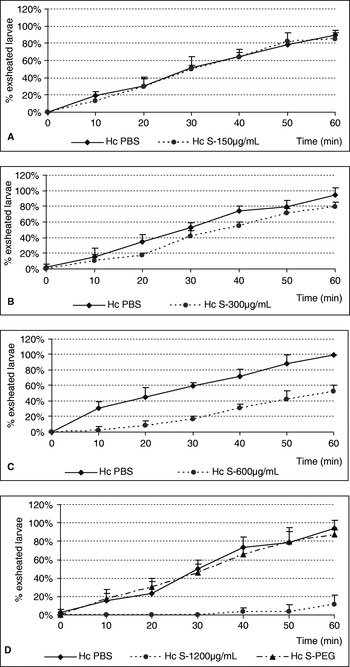
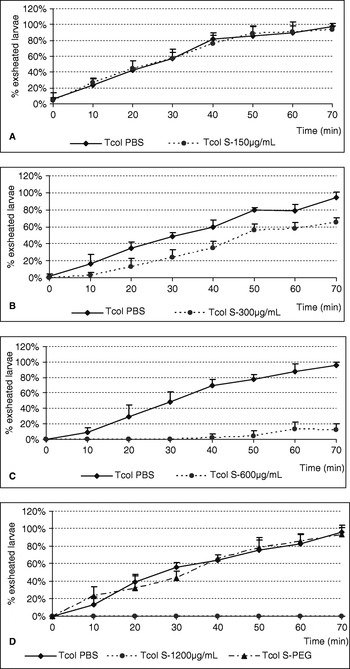
Dose-dependent response of exsheathment of H. contortus with sainfoin extracts. In controls, more than 90% of the H. contortus larvae were generally exsheathed after 60 min of contact with the exsheating solution (Fig. 1). In contrast for T. colubriformis larvae, the exsheathment process was slightly delayed since 80–85% of the larvae were exsheathed after 60 min whereas the proportion was 95% at 70 min (Fig. 2).
The effects of increasing concentrations of sainfoin extracts on the artificial in vitro exsheathment of Haemonchus contortus 3rd-stage larvae. The 3-h incubations were performed at 150 (1A), 300 (1B), 600 (1C) and 1200 μg/ml (1D). The effect of PEG was tested for the sainfoin extract at 1200 μg/ml (1D). Six replicates were performed per concentration.

The effects of increasing concentrations of sainfoin extract on the artificial in vitro exsheathment of Trichostrongylus colubriformis 3rd-stage larvae. The 3-h incubations were performed at 150 (2A), 300 (2B), 600 (2C) and 1200 μg/ml (2D). The effect of PEG was tested for the sainfoin extract at 1200 μg/ml (2D). Six replicates were performed per concentration.

For the 2 nematode species, the results of the statistical analyses according to the different concentrations of sainfoin extracts are summarized in Table 1. For both nematodes, the incubation with the sainfoin extracts led to an apparent dose-dependent response (Figs 1 and 2). At 150 μg/ml, the acetone extract of sainfoin had no effect on the larval exsheathment for both nematode species (Figs 1A and 2A). At 300 μg/ml, a significant delay (P<0·001) of the larval exsheathment was observed for both nematode species (Figs 1B and 2B, Table 1). At 600 μg/ml, in the case of H. contortus larvae, the larval exsheathment process was significantly delayed (P<0·001) (Fig. 1C). In contrast, a nearly total inhibition of exsheathment was observed for T. colubriformis since only 11% of the larvae were exsheathed at 70 min (Fig. 2C, Table 1). At 1200 μg/ml, the 3 h contact with the sainfoin extracts led to a high level of inhibition of the larval exsheathment of H. contortus (Fig. 1D, Table 1) since only 12% of the larvae was exsheathed at 60 min. For T. colubriformis larvae a total inhibition of exsheathment was observed (Fig. 2D, Table 1).
Summarized statistical results on the in vitro exsheathment rate of Haemonchus contortus and Trichostrongylus colubriformis 3rd-stage larvae either in control or after a 3-h incubation in increasing concentrations of sainfoin extracts
(The comparison was also performed between batch of larvae in contact with sainfoin extracts at 1200 μg/ml with addition of PEG.)

Consequences of the addition of PEG to the sainfoin extract
The sainfoin extract at 1200 μg/ml caused a significant inhibition (P<0·001) of the larval exsheathment for both nematode species compared to the PBS control (Fig. 1D and 2D). In contrast, the addition of PEG to the extracts removed this inhibitory effect since no significant differences were observed between the controls and the treated extract (Fig. 1D, 2D and Table 1) for both species.
In vivo experiments
In vivo exsheathment
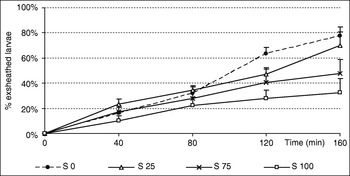
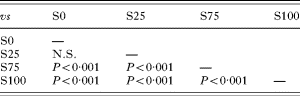
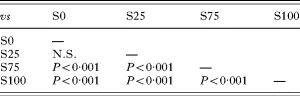
The exsheathment kinetics of H. contortus larvae measured at regular time-intervals in the rumen are shown in Fig. 3. The results of the statistical analyses according to the different experimental groups are summarized in Table 2. In the case of the whole lucerne diet (S0), approximately 80% of H. contortus larvae were exsheathed after a 160 min incubation in the rumen (Fig. 3). For the in vivo exsheathment of H. contortus larvae, the incubation in the rumen compartment impregnated with sainfoin led to significant differences to the control S0 group in the S75 and S100 animals (P<0·001) but not in the S25 group (Fig. 3; Table 2). In addition, the existence of a dose-dependent relationship was suggested since significant differences were assessed between the 3 groups with different proportions of sainfoin in the diets (P<0·001) as assessed by the statistical analysis (Fig. 3).
The effect of different proportions of sainfoin in the diets on the in vivo exsheathment of Haemonchus contortus 3rd-stage larvae in cannulated sheep. The proportions of sainfoin to lucerne in each diet were respectively 100% lucerne in S0, 25% of sainfoin in S25, 75% of sainfoin in S75 and 100% sainfoin in S100.

Summarized statistical results on the in vivo exsheathment of Haemonchus contortus 3rd-stage larvae according to the proportion of sainfoin in the diet in cannulated sheep
Measurements of ruminal pH
The mean pH of the rumen compartment (and the range of pH) was as follows: 5·72 (5·56–5·86) for the S0 group, 5·75 (5·63–5·76) for the S25 group, 5·70 (5·62–5·77) for the S75 group and 5·75 (5·43–5·98) for the S100 group. These pH values did not differ significantly.
DISCUSSION
Previous in vitro results indicated that extracts of various tannin-rich woody plants or bushes delayed or inhibited the exsheathment of nematode L3 (Bahuaud et al. Reference Bahuaud, Martinez-Ortiz De Montellano, Chauveau, Prevot, Torres-Acosta, Fouraste and Hoste2006). However, these are the first results suggesting that similar consequences occur in vivo. In addition, this is the first time that such effects have also been demonstrated with tanniniferous forage.
Overall, our results indicate (i) that the consumption of sainfoin by sheep interferes with the very early step of the parasitic phase of nematodes, i.e. the exsheathment of 3rd-stage larvae, (ii) that the phenomenon is dose-dependent, (iii) based on in vitro results, it appears probably to be non-specific and, lastly, (iv) that tannins are responsible for these effects.
The role of signals related to the digestive environment on the larval exsheathment of nematode larvae has been identified from early studies (Petronijevic et al. Reference Petronijevic, Rogers and Somerville1985, Reference Petronijevic, Rogers and Somerville1986; Sommerville and Rogers, Reference Sommerville and Rogers1987; Petronijevic and Rogers, Reference Petronijevic and Rogers1987). However, only a few recent studies have examined how the local conditions in the rumen, depending either on the host species (Hertzberg et al. Reference Hertzberg, Huwyler, Kohler, Rehbein and Wanner2002) or on the host diet (De Rosa et al. Reference De Rosa, Chirgwin, Fletcher, Williams and Klei2005) might modulate the exsheathment of larvae. In particular, the results acquired by De Rosa et al. (Reference De Rosa, Chirgwin, Fletcher, Williams and Klei2005) showed differences in the rate of exsheathment of Ostertagia ostertagi larvae in calves fed on low or high roughage diets. Although the differences in experimental conditions (time of measurement, host and parasite species) make comparisons difficult, nonetheless the delay in the exsheathment process in the current study appeared much greater than that recorded by De Rosa et al. (Reference De Rosa, Chirgwin, Fletcher, Williams and Klei2005) and was particularly evident in the groups offered a high proportion of sainfoin. In calves, it has been proposed that the observed changes could be due to variations in ruminal pH related to the diet composition. However, this hypothesis does not seem to be confirmed in our study since no statistical differences were measured in the ruminal pH values between the 4 experimental groups. Previous results obtained on ruminally-cannulated sheep have demonstrated that larval exsheathment is a restricted time-frame process and that any delay in this early process might affect the success of parasite establishment in the host (Dakkak et al. Reference Dakkak, Fioramonti and Bueno1981; Hertzberg et al. Reference Hertzberg, Huwyler, Kohler, Rehbein and Wanner2002). It can thus be hypothesized that the changes in exsheathment kinetics relating to the consumption of sainfoin could have consequences on the nematode establishment in the abomasum. Some results acquired on experimentally infected goats indeed indicated that the ingestion of larvae concomitant to the distribution of a tannin-rich substance might be associated with a reduction in parasite establishment, the process being dependent on the parasite species involved (Paolini et al. Reference Paolini, Fouraste and Hoste2004, Reference Paolini, Frayssines, De La Farge, Dorchies and Hoste2003b). Lastly, it is worth pointing out that although the sheep in our study received sainfoin for 3 weeks, in field conditions, it should be possible to provide animals with tannin-rich forages for longer periods, as has been previously performed with sulla (Niezen et al. Reference Niezen, Waghorn, Charleston and Waghorn1995, Reference Niezen, Robertson, Waghorn and Charleston1998) or Lespedeza cuneata (Min et al. Reference Min, Hart, Miller, Tomita, Loetz and Sahlu2005; Shaik et al. Reference Shaik, Terrill, Miller, Kouakou, Kannan, Kaplan, Burke and Mosjidis2006) in sheep or with sainfoin in goats (Paolini et al. Reference Paolini, De La Farge, Prevot, Dorchies and Hoste2005; Hoste et al. Reference Barrau, Fabre, Fouraste and Hoste2005). This extended exposure to tannin-rich forages could contribute to promote the efficiency of such nutraceuticals.
Our in vitro results, by comparing the degree of interference with the exsheathment of Haemonchus larvae according to increasing concentrations of sainfoin extracts, suggest that this is a dose-dependent phenomenon since more severe delays or even inhibition of exsheathment were recorded with the highest concentrations of extracts. In a previous study using extracts of 4 different tannin-rich bushes (Bahuaud et al. Reference Bahuaud, Martinez-Ortiz De Montellano, Chauveau, Prevot, Torres-Acosta, Fouraste and Hoste2006), the question of the dose-dependent response was not directly addressed by comparing the effects associated with different tannin concentrations derived from the same plant. However, there was some evidence of dose-dependent effects in that study since the intensity of inhibition of exsheathment varied according to the tannin content of the different plant species. Using different in vitro bioassays applied on nematode eggs, infective larvae or adult worms, similar dose-effect relationships have been described previously (Molan et al. Reference Molan, Alexander, Brookes and McNabb2000a, Reference Molan, Duncan, Barry and McNabbb; Athanasiadou et al. Reference Athanasiadou, Kyriazakis, Jackson and Coop2001; Paolini et al. Reference Paolini, Fouraste and Hoste2004). Moreover, the statistical results obtained in the 4 experimental groups from the in vivo study confirmed differences in the rate of larval exsheathment depending on the proportion of sainfoin in the diet. This conclusion also strongly supports the existence of a dose-effect relationship. From our in vitro results acquired on both nematode species, it can be hypothesized that a threshold concentration must be reached to modulate the larval exsheathment since no difference was observed between the control and the larvae in contact with 150 μg/ml of sainfoin. The existence of such a threshold tends to be confirmed by our in vivo results since no significant differences were observed between the S0 and the S25 groups.
Possible differences in susceptibility to tannin-rich extracts according to the nematode species have been previously suggested from comparative in vitro results obtained with whole extracts of woody plants or forages (Molan et al. Reference Molan, Alexander, Brookes and McNabb2000a; Paolini et al. Reference Paolini, Fouraste and Hoste2004), with tannins extracted from plants (Molan et al. Reference Molan, Hoskin, Barry and McNabb2000c, Reference Molan, Sivakumaran, Spencer and Meagher2004) or with commercially available monomers (Brunet and Hoste, Reference Brunet and Hoste2006). Therefore, our third objective was to examine possible differences in the effects on exsheathment depending on the nematode species. Overall, the results obtained on H. contortus and T. colubriformis showed strong similarities. Only minor variations were observed in the response of the two nematodes depending on the sainfoin concentrations. This modulation was especially illustrated by the results of larval incubation with extracts at the concentration of 600 μg/ml which induced a delayed exsheathment for H. contortus and a nearly total inhibition for T. colubriformis. Unfortunately, we did not have the possibility to verify in vivo the validity of our conclusions based on in vitro data. The in vivo exsheathment of L3 occurs in the digestive organ immediately anterior to the site of infection with adult worms (Hertzberg et al. Reference Hertzberg, Huwyler, Kohler, Rehbein and Wanner2002). Accordingly, the in vivo exsheathment of T. colubriformis larvae normally occurs in the abomasum. However, abomasal cannulated sheep are more difficult to maintain than sheep with rumen cannulae, and they were not available.
For both the abomasal and the intestinal parasite species, the changes in the in vitro larval exsheathment, due to contact with the sainfoin extracts, disappeared after addition of PEG, an inhibitor which has a high affinity for tannins (Makkar et al. Reference Makkar, Blummel, Borowy and Becker1995; Silanikove et al. Reference Silanikove, Perevolotsky and Provenza2001; Makkar, Reference Makkar, Sandoval-Castro, DeB Hovell, Torres-Acosta and Ayala-Burgos2006). In a similar way, the addition of PEG to extracts of rangeland plants was associated with a restoration towards control values (Bahuaud et al. Reference Bahuaud, Martinez-Ortiz De Montellano, Chauveau, Prevot, Torres-Acosta, Fouraste and Hoste2006). Also, monomeric units of different tannins have been found to affect the exsheathment (Brunet and Hoste, Reference Brunet and Hoste2006). These repeated observations strongly support the hypothesis that tannins are one of the main plant secondary metabolites involved in the interactions with larval exsheathment. In addition, since condensed tannins are the sole tannins occurring in sainfoin (Marais et al. Reference Marais, Mueller-Harvey, Brandt and Ferreira2000; Barrau et al. Reference Barrau, Fabre, Fouraste and Hoste2005), our results tend to confirm that this class of biochemical compounds plays a major anti-parasitic role.
Condensed tannins have the properties to form complexes with macromolecules, including proteins, especially proline-rich proteins (Bravo, Reference Bravo1998; Waterman, Reference Waterman and Brooker1999). The degree of complexation of tannins with proteins depends on the molecular mass, structure and the configuration of both substances (Waterman, Reference Waterman and Brooker1999; Mueller-Harvey, Reference Mueller-Harvey2006; Poncet-Legrand et al. Reference Poncet-Legrand, Edelmann, Putaux, Cartalade, Sarni-Manchado and Vernhet2006). These interactions are usually due to hydrogen bonds and/or hydrophobic interactions (Hagerman et al. Reference Hagerman, Rice and Ritchard1998; Poncet-Legrand et al. Reference Poncet-Legrand, Edelmann, Putaux, Cartalade, Sarni-Manchado and Vernhet2006). It could thus be proposed that the interactions of CTs with the surface proteins of larvae might explain the effects on exsheathment as it has been suggested for the larval motility (Kahn and Diaz-Hernandez, Reference Kahn, Diaz-Hernandez and Brooker2000; Molan et al. Reference Molan, Duncan, Barry and McNabb2003, Reference Molan, Sivakumaran, Spencer and Meagher2004). Such a hypothesis of binding between tannins and parasite proteins could explain the dose-response relationship and the existence of a threshold in activity.
Our results suggest that any application of tannin-rich bioactive forages to control parasite infections in farm conditions should be preceded by measurement of the concentration of condensed tannins. However, further basic research is still required to understand the mechanism of action of these polyphenols on nematodes. Besides dose-response relationships, it is also essential to examine possible differences in anthelmintic activity depending on the quality of the condensed tannins.
The authors would like to thank sincerely Mr Daniel Thomas and Mr Philippe Gaydier of the Animal Annexe (CR INRA Theix) for their technical assistance and their useful advice during the experiment on the cannulated sheep. This work received the financial support from the European Union as part of the Marie-Curie project ‘Healthy Hay’. The financial help of the Région Midi-Pyrénées (contract 030121196) is also sincerely acknowledged.