Introduction
Of the myriad factors that help children learn language, maternal input is one of the most robust. In general, the more parents talk to children, the more rapid children's language acquisition (e.g., Hart & Risley, Reference Hart and Risley1995; Hoff & Naigles, Reference Hoff and Naigles2002; Huttenlocher, Haight, Bryk, Seltzer & Lyons, Reference Huttenlocher, Haight, Bryk, Seltzer and Lyons1991; Huttenlocher, Vasilyeva, Cymerman & Levine, Reference Huttenlocher, Vasilyeva, Cymerman and Levine2002). Parent input has been studied by examining children's acquisition of general vocabulary, which consists mainly of non-mental state words (e.g., dog, kitty, ball, banana), and can be differentiated from mental state vocabulary (e.g., want, think, know, sad). In the present study, like previous researchers, we examined how parent input related to children's non-mental state vocabulary. However, in addition, we examined the relation between parental input and children's mental state vocabulary during their second year of life.
Acquiring mental state (MS) terms arguably presents a thornier problem than non-mental state (NMS) term acquisition because MS terms tend to be less frequent than NMS terms (Ruffman, Slade & Crowe, Reference Ruffman, Slade and Crowe2002), and because the physical manifestation for MS terms is often subtle and less reliable than non-mental state terms (Hall, Scholnick & Hughes, Reference Hall, Scholnick and Hughes1987). That is, mental states are not things out there in the world, but, rather, states of being that someone experiences internally. Nevertheless, there are likely similarities in the way in which NMS and MS terms are learned, and, for this reason, we describe several studies that have examined the role of input in children's acquisition of NMS vocabulary. We also describe key abilities of the child that evolve in early childhood and likely assist language learning, and then describe why it is of interest to examine links between parent input and MS terms.
Input from parents
Parental input that is responsive – “prompt, contingent and appropriate reactions to children's activities” (Tamis-LeMonda & Bernstein, Reference Tamis-LeMonda and Bornstein2002, p.93) – is particularly likely to link to children's language ability. Carpenter, Nagell, and Tomasello (Reference Carpenter, Nagell and Tomasello1998) examined mother-infant talk while exploring objects, finding that mother responsive talk (that followed 9- and 12-month-old infants’ attention to an object) related to infants’ concurrent and subsequent productive and receptive vocabulary at 13 and 15 months of age, as measured using the MacArthur Communicative Development Inventory (MCDI, Fenson, Dale, Reznick, Thal, Bates, Hartung, Pethick & Reilly, Reference Fenson, Dale, Reznick, Thal, Bates, Hartung, Pethick and Reilly1993). Likewise, comparable findings have been obtained in other studies for children aged 15 and 17 months of age when examining maternal talk that followed children's attention to an object (Tomasello & Farrar, Reference Tomasello and Farrar1986). Also supporting the importance of responsive talk, Tamis-LeMonda and Bornstein (Reference Tamis-LeMonda and Bornstein2002) videoed mothers’ interactions with children at 9.5 and 13.5 months, and demonstrated that maternal talk that followed children's vocalizing or play with an object was a more important determinant of children's subsequent general language acquisition (up to 21 months of age) compared to the total quantity of maternal language. These studies converge to indicate that parental talk that responds to or follows children's activities is related to their general acquisition of language in the early phase of language development. Below, we describe how children's attention is also key to language acquisition.
Input and attention
Althaus and Mareschal (Reference Althaus and Mareschal2014) and Althaus and Plunkett (Reference Althaus and Plunkett2016) examined the effect of labeling an object for 12-month-olds. The objects in a category shared a common feature and were presented either in silence or while labeling the common feature. Labeling resulted in infants learning about categories in a different way compared to silence. With labeling, infants looked at the parts of objects that were intrinsic to a category, whereas with silence they did not look to the common parts of objects. Moreover, Althaus and Marseschal (Reference Althaus and Mareschal2014) showed that such learning only occurs if objects are accompanied by linguistic labels but not by non-linguistic sounds. Thus, labels seem to draw infants’ attention to objects and events in a way that helps them notice the common features.
More recently, the role of children's attention in language learning has been examined using head cameras. Head cameras are useful because they provide information about the child's visual field, and therefore, maternal responsiveness to objects of attention in the visual field. Yu and Smith (Reference Yu and Smith2012) found that 18-month-olds were more likely to learn labels for novel objects if the object's label coincided with the centralized image in the head camera (i.e., if infants were paying attention to the object when the object was labelled). Indeed, research indicates that about 87% of centralized head camera images correspond with infant eye gaze (Yoshida & Smith, Reference Yoshida and Smith2008). Yu and Smith also found that children's successful labeling of the object was accompanied by stabilizing of their head movement towards the object. Less head movement away from the object, and a correspondence between children's head direction and eye gaze, converge on the idea that infants’ attention on the object is key to their learning the novel object's label. Moreover, infants’ successful learning of object labels was characterized by the object's uncluttered presence in the head camera image for at least five seconds prior to labeling, and five seconds after the naming event. Once again, this pattern is consistent with the infant singling out one object for attention, and the parent using responsive talk by honing in on an infant's attention and naming the object.
Developmental differences after 18 to 20 months of age
As summarized above, responsive language and infant attention are crucial for language acquisition up to at least 18 to 20 months of age. However, the picture might begin to change after this age as children's own abilities evolve, and make it less important that parents respond to older children's attention and activities. Indeed, for at least three reasons we argue that 18 months might mark an approximate point of inflection for the utility of maternal responsiveness. The first reason for thinking this is that other aspects of children's language ability (the development of phonology, vocabulary, and syntax) have undergone considerable evolution by around 18 months of age (Ganger & Brent, Reference Ganger and Brent2004; Hoff, Reference Hoff, McCartney and Phillips2005) and would allow for a better understanding of language without the need for maternal responsiveness.
A second important development about this time is in children's ability to engage in joint attention, likely meaning that maternal responsiveness is less crucial over time. That is, there is continued development in children's understanding and ability to follow parental attention cues such as eye gaze between 12 and 18 months of age (Butterworth & Jarrett, Reference Butterworth and Jarrett1991; Meltzoff & Brooks, Reference Meltzoff, Brooks, Flom, Lee and Muir2007; Mundy, Block, Delgado, Pomares, Van Hecke & Parlade, Reference Mundy, Block, Delgado, Pomares, Van Hecke and Parlade2007). Thus, whereas with a younger child it makes sense to talk about things the child is already attending to, an older child is better able to pick up on parental attention cues such as gaze, enabling them to learn words without the necessity for parents to follow the child's own gaze cues. Indeed, the combination of developments in children's own language understanding and joint attention skills means that older children could likely grasp the meaning of a parent's utterance from the words alone, enabling them to learn words simply by overhearing the conversations of others: that is, to learn words non-ostensively (Akhtar, Jipson & Callanan, Reference Akhtar, Jipson and Callanan2001).
A third development, also related to joint attention, concerns infants’ handling of objects. Burling and Yoshida (Reference Burling and Yoshida2019) examined infants between 5 and 24 months of age. They found that, early in development, parents draw infants’ attention to objects through handling, but that parent handling of objects declines steadily over age. In contrast, infant handling of objects increases over age as their ability to manipulate objects increases, with the crossover point in parent/infant handling at about 18 months of age. These findings again suggest a process of scaffolding early in development with parents doing the handling when infants can't, and then giving control of proceedings as infants’ handling of objects advances. In the first 18 months, when parents are doing most of the object handling, they will tend to talk about the thing they are handling, but would need to ensure that infants are looking in order for learning to occur. Ideally, a parent will establish joint attention (e.g., by saying, “Look”), then talk about a thing after infants are attending (Estigarribia & Clark, Reference Estigarribia and Clark2007). Yet inevitably, this process will sometimes fail because parents do not successfully elicit an infant's attention. After 18 months, when infants are doing most of the handling, it is less essential that parents draw the child's attention to the object because (a) infants will already be looking at the thing they are handling and (b) when infants begin to handle objects they increase their looking to adults (Libertus & Needham, Reference Libertus and Needham2011), resulting in an increase in joint attention between infant, parent and object. This means that the onus is on parents before but not after 18 months to ensure that their talk is responsive, and that breakdowns in this process will be particularly important during this period.
Thus, to summarize, we can see at least three reasons – developing language skills, joint attention and infant handling of objects – for why maternal responsive talk that accompanies infant attention might be particularly beneficial early in development, but that, later, the advantages might dwindle. In the present study, we examined children in their second year of life using a median split at 18 months of age as a rough marker for when children's language acquisition might be less reliant on mothers’ responsive language (i.e., mother language that follows the cues of children). As stated above, we examined two types of child language. Like others, we examined children's NMS language, but, in addition, we examined children's MS language. Having discussed the factors that assist children's acquisition of NMS language above, below we discuss children's acquisition of MS language in more detail (Ruffman, Reference Ruffman2014).
Children's acquisition of mental state terms
Children begin to acquire MS words in their second year. It is probable that this initial acquisition allows them to participate in conversations and social activities but is not accompanied by an understanding that such terms refer to mental states (Nelson, Reference Nelson1998; Shatz, Wellman & Silber, Reference Shatz, Wellman and Silber1983). Nevertheless, these first insights will eventually evolve into such as children refine their understanding through continued engagement in the social world, and are therefore an important first step in acquiring a theory of mind.
In studies of 2- to 4-year-old children, there is clear evidence that maternal MS talk is related to children's subsequent success on theory-of-mind tasks and growth in MS vocabulary. For instance, Ruffman et al. (Reference Ruffman, Slade and Crowe2002) asked mothers to describe pictures to children with a mean age of 3 years, and then assessed children twice (five months and one year) later. Mothers sometimes talked about the mental states of the individuals depicted in photographs and sometimes described the pictures non-mentalistically, including talk about the senses and physical states. Maternal MS talk correlated with children's subsequent MS talk and theory-of-mind task performance even after controlling for maternal NMS talk and children's earlier MS talk and theory-of-mind task performance. Indeed, there is now a wealth of such evidence for children aged 2 to 4 years of age (e.g., Adrian, Clemente, Villaneuva & Rieffe, Reference Adrian, Clemente, Villanueva and Rieffe2005; Kirk, Pine, Wheatley, Howlett, Schulz & Fletcher, Reference Kirk, Pine, Wheatley, Howlett, Schulz and Fletcher2015; Ruffman, Puri, Galloway, Su & Taumoepeau, Reference Ruffman, Puri, Galloway, Su and Taumoepeau2018; Taumoepeau & Reese, Reference Taumoepeau and Reese2013; Taumoepeau & Ruffman, Reference Taumoepeau and Ruffman2006, 2008), which is summarized in a recent meta-analysis (Devine & Hughes, Reference Devine and Hughes2018).
In contrast, there is not such clear evidence for children younger than 2 years. Beeghly, Bretherton, and Mervis (Reference Beeghly, Bretherton and Mervis1986) examined maternal internal state language with children aged 13 to 28 months. This included MS terms (desires, emotions, cognitions, modulations of assertions) but also sensory terms (e.g., feels as in ‘feels sick’, heard), physiological terms (e.g., hungry, thirsty), moral terms (e.g., have to, supposed to), and terms indicating volition (e.g., need). Although they found that maternal talk about internal states was associated with subsequent internal state talk in children, they did not isolate maternal MS terms from mothers’ other internal state language, nor did they isolate children's MS talk from other internal state language. Thus, it was not clear whether maternal MS talk was beneficial to child MS vocabulary in this age group. In the only study to clearly distinguish between these different types of talk in very young children (Taumoepeau & Ruffman, Reference Taumoepeau and Ruffman2006), there was no within time-point relation between maternal MS talk and children's MS vocabulary at 15 months of age. We examined this issue further in the present study.
As stated above, several features of MS terms might result in their acquisition being protracted. Here we expand on these ideas. First, MS terms are much less frequent than NMS terms (Ruffman et al., Reference Ruffman, Slade and Crowe2002). Each repetition of an MS term would help children learn the referent, yet because instances are limited, MS term acquisition would be protracted, resulting in no relation between mother and child MS talk in early childhood (i.e., the relation would only become evident later when instances have accumulated sufficiently). Second, the physical manifestation for MS terms is often less reliable than non-mental state terms (Hall et al., Reference Hall, Scholnick and Hughes1987). For instance, wanting can be manifest in reaching for an object, emoting positively when obtaining it, or emoting negatively when failing to obtain it. Third, mental states are not directly observable and must be inferred (i.e., due to reaching for an object), so that young children might need to rely more on the surrounding language in an utterance to acquire an MS term. That is, they must hear and acquire enough knowledge of the structure of language in which the MS terms are embedded to take advantage of maternal MS talk. In this respect, it would help to understand something about the syntactic frames for MS words (Mintz, Reference Mintz2003) as well as the meaning of words comprising a statement in which a mental state word is embedded, a process referred to as discourse bootstrapping (Sullivan & Barner, Reference Sullivan and Barner2016). If so, it might be only after 18 months that maternal MS talk is beneficial for children's acquisition of MS vocabulary.
Present study
We used a head camera to examine episodes of joint attention during free play as potential opportunities for children learning MS and NMS language. We examined children aged 10 to 26 months because they move from little or no language output to multi-word utterances during this time, making it a key period for understanding the process of language acquisition. As described above, head cameras provide information about which aspects of the environment an infant is attending to. In particular, we examined maternal responsiveness, which we defined narrowly as occurring when children interacted with an object and mothers talked about the object or the child's actions. This was the clearest example of mothers talking about something the child was attending to because the child was not simply glancing fleetingly at an object; instead, the child had chosen to interact with the object and therefore in all likelihood was attending to that object.
We had three main aims. The first was to examine whether maternal responsiveness was linked to children's NMS vocabulary before but not after 18 months of age. Whereas previous research has shown that maternal responsiveness is linked to child vocabulary before 18 months of age, we hypothesized that it would be less related after 18 months of age. The second aim was to examine whether maternal responsiveness was also linked with children's MS vocabulary. As far as we are aware, we are the first to examine this question. Finally, the third aim was to examine whether mother MS talk related to children's MS vocabulary after but not before 18 months of age. As described above, meta-analytic findings indicate that maternal MS talk is beneficial for older children but the two studies relevant to younger children have not provided clear evidence for this idea.
Method
Participants
We studied 59 children, including 28 younger children (M = 13.96, range = 10.79 to 18.23 mos, 12 girls) and 31 older children (M = 22.75, range = 18.33 to 26.52 mos, 17 girls). All children spoke English as their first language. Upon the birth of their child, mothers were sent notices informing them of the opportunities to participate in research at the university and volunteers were subsequently contacted for this particular study.
Mother and father socio-economic status (SES) was indexed by their highest educational achievement. Education was coded on a 6-point scale based on responses from a demographic questionnaire: 1 = no high school qualification (left school at 15), 2 = high school qualification, 3 = some university or polytechnic papers, 4 = polytechnic diploma, 5 = undergraduate degree, 6 = university postgraduate degree. Fathers’ mean educational attainment was 3.90 (range = 0-6), and mothers’ mean educational attainment was 4.47 (range = 1-6). Mean mother/father SES was computed on the basis of both parents’ individual scores.
Materials and procedure
Participants were tested in a room in a small house on the university campus. The experimenter first greeted mothers and made children feel welcome. The child then sat on the floor with 17 different toys (e.g., ball, barn, dump-truck, house, rolling pin, mixer, etch-a-sketch®, cupcake stand, cupcakes, robot, train, sun, mugs, plastic knife) arranged in a semi-circle around her/him. When the child was settled, the experimenter placed the baby bonnet with camera attached on the child's head, lining up the camera so that it sat over the bridge of the child's nose and was aligned with the child's eyes. The chinstrap was then fastened to ensure the camera did not move. To test whether the camera was correctly aligned, it was turned on, and the child's attention was drawn to two different toys, one at a time, held by the experimenter an arm's width apart. Once the child had attended to both toys, the video was checked to see whether the camera was accurately tracking the child's head turns. If both toys were in the center of the recording, the camera was correctly aligned. If not, the calibration process was repeated until the camera was aligned. Following this, the child and mother were left alone in the room for a 10-minute free-play session. Before leaving the room, the experimenter turned on the camera. After 10 minutes, the experimenter returned to the room and turned off the camera before removing it from the child's head. If the child removed the bonnet (as sometimes happened) the mother replaced it on the child's head or the experimenter returned and did so. The mother was remunerated for travel costs and the child was given a small gift.
Mothers completed two questionnaires to measure children's receptive and productive vocabulary: the MacArthur Communicative Development Inventory (MCDI): Words and Gestures (Fenson, Dale, Reznick, Thal, Bates, Thal, Pethick, Tomasello, Mervis & Stiles, Reference Fenson, Dale, Reznick, Thal, Bates, Thal, Pethick, Tomasello, Mervis and Stiles1994), along with a Mental State Supplement (Taumoepeau & Ruffman, Reference Taumoepeau and Ruffman2006, Reference Taumoepeau and Ruffman2008). The MCDI measured children's NMS vocabulary. The Mental State Supplement measured children's MS vocabulary, including 10 desire words (e.g., want, hope, wish, like, love, etc.), five cognitive words (think, know, believe, expect, wonder), and 32 emotion words (e.g., annoyed, hurtful, bored, unhappy, sad, etc.). We examined only productive vocabulary because receptive vocabulary was expected to be at or near ceiling for the oldest children (although for the sake of completeness, report values for receptive vocabulary).
Coding
Coding of mothers’ and children's language and behavior was subsequently carried out on the basis of the infant's head camera video using two coders and the computer software, Interact 9®. An utterance was defined as intelligible speech that ended with a rising or falling intonation or a pause of 1 sec. One coder (blind to the hypotheses and child vocabulary data) coded all of the data and a second coder coded 25% of the data by deleting all information from a completed video except for the event signatures that indicate when an action took place and whether it represented maternal language, maternal action or no event. The primary coder's data were used in all analyses.
Of particular interest was maternal responsiveness in which the child looked at and acted on an object (so that the object was visible in the head camera) and the mother commented on the object or the child's actions at some point during the time the child acted on the object. All things had to be present: the object visible in the head camera, the child acting on the object, and the mother commenting on the object or actions. For instance, the child could gesture toward (point to) or act on an object in some way (e.g., hold, pull, place, rotate, reach for, etc.). Since the child was actually acting on the object, this seemed the clearest instance of child attention, and can be contrasted with an object being visible in the head camera (amongst many objects) but the child not acting on it and therefore not necessarily attending to it. Children could also carry out actions with a variety of objects, and coders coded which object the child was engaged with. Each utterance and child action was coded for whether it included one or more of these categories, with multiple codes possible for each utterance or action. Thus, the dependent measures were the number of utterances or actions of each type. A summary of the coding categories and inter-rater reliabilities are included in Table 1. Reliability for all categories was in Cohen's range of “almost perfect” (McHugh, Reference McHugh2012).
Coding Categories

Note. Each utterance could obtain multiple codes (e.g., could be from mother, be responsive, include a mental state, be about a particular object, and describe a particular child action).
Maternal MS terms were the same terms used to code child MS vocabulary (see above), plus a few additional terms to allow for mothers’ more extensive vocabulary. Conversational uses of MS terms (e.g., “You know what?”), or homonyms (e.g., “Like” used to refer to similarity) were not coded as MS terms. Maternal NMS utterances consisted of all conversational turns in which the mother did not include an MS word. These utterances were varied, including general descriptions of a picture, links to the child's own life, descriptions of physical states such as smiling or crying, orienting responses (e.g., “Look!”), etc.
Results
For all variables, outliers (+3 SDs from the mean) were adjusted by reducing extreme values to the largest non-outlier + 1. In so doing, the individual ranks for extreme values were maintained for each variable (e.g., adding 1 to the lowest extreme value, +2 to the second lowest extreme value, etc., Tabachnik & Fidell, Reference Tabachnik and Fidell1989). We used non-parametric statistics because of many violations of normality, and correlation rather than regression for the analyses because we would have violated the minimum cases per variable assumption if we had used regression.
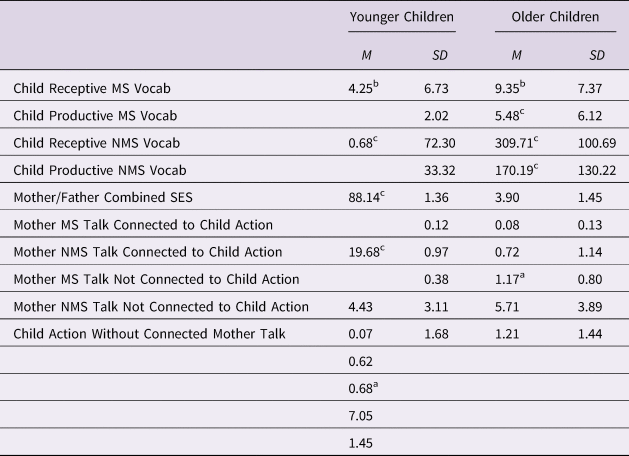
Descriptive statistics for key child and maternal variables are shown in Table 2. Mother talk variables are shown as proportion per minute, to eliminate differences in playing time between mother-child pairs. Proportions were lowest for mother MS talk connected to child actions. When examined as a raw number, there was a mean of .857 such utterances in younger children (range: 0 to 6) and .871 in older children (range: 0 to 5). Older children's vocabulary was consistently better than that of younger children (as tested using Mann-Whitney U tests). In addition, mother MS talk not connected to child actions was greater in the older than the younger age group, whereas there were no differences in any of the other variables listed in Table 2 (all ps > .11). SES was similar in the two age groups and was unrelated to maternal talk (all rs < .16, all ps > .25). Nevertheless, as a conservative measure, we controlled for SES when examining mother talk (see below).
Descriptive Statistics for Key Variables

Note. Mother talk variables represent proportions per minute. MS: mental state. NMS: non-mental state. ap < .05, bp < .05, cp < .05 (Mann-Whitney U tests comparing age groups).
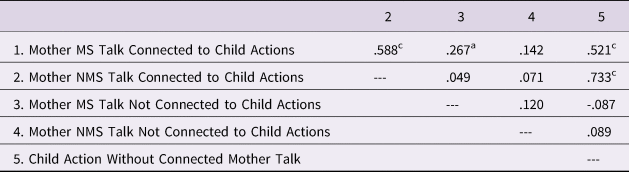
Table 3 lists the Spearman's correlations between different types of maternal talk. Mothers’ connected MS talk correlated significantly with mothers’ unconnected MS talk, r s = .267. However, a more substantial correlation was obtained between the two types of responsive talk (MS and NMS talk connected to children's actions, r s = .588), although maternal responsiveness also correlated with occasions in which the infant acted but the mother did not comment (MS: r s = .521, NMS: r s = .733). This raises the possibility that some children tended to act on the world more than others, creating opportunities both for mothers to be responsive, but also to say nothing. Thus, the key question is whether it was simply the case that children who acted on the world had better language, or it was only when mothers commented on children's actions that children had better language. We examined this question below.
Spearman's Correlations Between Maternal Talk Variables

Note. ap < .05, cp < .001.
Because mothers’ connected MS and NMS talk correlated highly, because they both indexed maternal responsiveness, and because we hypothesized at the outset that responsiveness would be important for the early acquisition of MS and NMS terms, we collapsed to form one variable for maternal responsiveness (MS and NMS talk connected to children's actions) and one for maternal MS and NMS talk not connected to children's actions. In the analyses below, we compared each of these variables to a third variable: children's actions that mothers did not comment on. Our interest was in whether (a) more active children had better vocabulary development (which would result in a correlation between children's vocabulary and their actions that were not commented on by mothers), (b) mothers’ general language (connected and unconnected) related to children's vocabulary (which would result in a correlation between children's vocabulary and mothers’ language not related to children's actions), or (c) only mothers’ connected language (maternal responsiveness) related to children's vocabulary (which would result in a correlation between children's vocabulary and maternal responsiveness).
We also collapsed to form one variable for maternal MS talk (connected and unconnected) and another for maternal NMS talk (connected and unconnected). This was because of the correlation between mothers’ connected and unconnected MS talk, and based on our aim of examining the effect of maternal MS talk on children's MS vocabulary before 18 months of age.
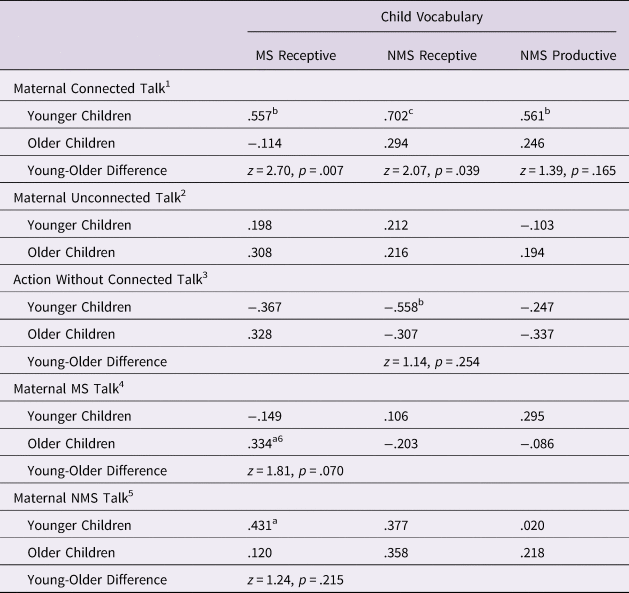
Our main interest was in whether a particular mother talk variable (e.g., maternal responsiveness) explained unique variance in children's vocabulary, having accounted for all other mother talk variables. These partial correlations are shown in Table 4. In all cases, children's age and joint mother/father education (SES) are partialled out. Age was partialled out because older children stand to have better vocabulary and our interest was in vocabulary differences independent of age. SES was partialled out to ensure that it was mother talk that correlated with children's vocabulary as opposed to some other confounding variable related to SES. In addition, for each correlation, we partialled out one or more mother talk variables. For instance, for mother connected talk, we partialled out mother unconnected talk and children's actions without mother connected talk (see the footnotes to Table 4 for details of other partial correlations). Correlations are shown separately for younger and older children given our a priori hypothesis that maternal responsiveness would be particularly beneficial for younger children. Correlations for productive MS vocabulary are not shown because only five of 28 younger children possessed any productive MS vocabulary.
Spearman's Correlations Between Mothers’ Talk and Child Vocabulary

Note. All correlations are shown after partialling out age, and mother and father education. 1In addition to age and education, we partialled out maternal unconnected talk and child action's without maternal connected talk. 2In addition to age and education, we partialled out maternal connected talk and child action's without maternal connected talk. 3In addition to age and education, we partialled out maternal connected and unconnected talk. 4In addition to age and education, we partialled out maternal NMS talk. 5In addition to age and education, we partialled out maternal MS talk. 6As explained in the text, one-tail was used for this correlation given meta-analytic findings that maternal MS talk facilitates children's MS vocabulary. ap < .05, bp < .01, cp < .001.
We were interested in two aspects of the correlations: (a) individual correlations that were significant (marked by the superscripts a, b or c in Table 4) and (b) for individual correlations that were significant, whether the correlations for young and older children were also significantly different from one another (indicated by a significant z). If an individual correlation was significant (e.g., between mother connected talk and younger children's NMS productive vocabulary) then we could be confident that connected talk was helpful for younger children, but if the z-test comparing the correlations for younger and older children was not significant, we could not be confident that the pattern was stronger for the younger age group. If the individual correlations were not significant, we did not compute z-tests comparing correlations for younger and older children because we didn't have confidence in the first place that individual correlations were significantly different than 0 and anything but random.
Maternal connected talk
The main findings were that (a) maternal connected talk correlated with all three types of younger children's vocabulary but not with older children's vocabulary, and (b) the correlations for younger children were significantly higher for younger children's receptive MS and NMS vocabulary compared to the correlations for older children's receptive MS and NMS vocabularies (see Aims 1 and 2). The overall pattern of correlations (all three significant for younger children), coupled with the a priori prediction that this would be the case, is consistent with a meaningful relation between maternal connected talk and younger children's vocabulary rather than chance findings.
Maternal unconnected talk
Mothers’ unconnected talk was not related to children's vocabulary in either age group.
Children's actions without mother connected talk
The more younger children acted on the world without mothers commenting, the worse was their receptive NMS vocabulary. Thus, consistent with Aim 1, an absence of responsive talk was related to worse NMS vocabulary for younger children. Overall, there was no evidence that more active children have more advanced vocabulary (see above).
Maternal MS talk
Given the consistent correlation between mother mental state talk, child mental state vocabulary and theory of mind obtained in many studies (see the Devine & Hughes, Reference Devine and Hughes2018 meta-analysis), we only expected a positive correlation, meaning that the correlation between maternal MS talk and older children's MS vocabulary was significant on a one-tailed test. In contrast, maternal MS talk was not related to younger children's MS vocabulary as anticipated (see Aim 3).
Maternal NMS talk
There was a significant correlation between mothers’ NMS talk and younger children's receptive MS vocabulary. In the introduction, we suggested that this might be the case because children would need enough understanding of NMS terms before they could understand the MS words in an utterance.
Regression
Finally, we double-checked the age group differences using three linear regressions (predicting child receptive MS vocabulary, child receptive NMS vocabulary, and child productive NMS vocabulary). Each regression included three predictors: age group (dummy coded as 0 or 1), maternal connected talk, and the interaction between these two variables. Our interest was in the interaction, with all variables in the prediction equation. A significant interaction would indicate a larger effect for maternal connected talk in the younger age group than the older age group. We used a one-tailed test given the a priori prediction of a larger effect in the younger age group. The interaction was significant in all three regressions; receptive NMS vocabulary: t = 1.90, p = .032, productive NMS vocabulary: t = 1.83, p = .036, and receptive MS vocabulary: t = 2.13, p = .019.
Discussion
Several studies have shown that parental input that is linked to children's focus of attention (maternal responsiveness) from about 9 to 17 months of age relates to children's concurrent and subsequent acquisition of NMS vocabulary. In the present study, we (a) examined whether maternal responsiveness was more strongly related to children's NMS vocabulary before 18 months than after, (b) extended this enquiry to children's MS vocabulary, and (c) examined whether maternal MS talk correlated with children's MS vocabulary before 18 months of age. We examined a specific form of maternal responsiveness in which mothers referred to a child's actions on an object. This represented a clear form of maternal responsiveness because the child's actions with the object made it highly likely that they were focusing on the object. As hypothesized, we found that maternal responsiveness was particularly likely to correlate with children's vocabulary acquisition (MS and NMS) before but not after 18 months of age. In addition, we did not find any evidence that maternal MS talk was related to children's MS vocabulary before 18 months of age. We discuss each of these findings below.
Mother responsiveness
The findings for younger children were very clear. Even after accounting for children's age, mothers’ and fathers’ education, mothers’ non-connected talk, and children's actions not accompanied by maternal talk, mothers’ responsive talk related to younger children's receptive MS vocabulary, and their receptive and productive NMS vocabularies. Furthermore, in 2 of 3 instances, the correlations for younger children were significantly higher than those for older children.
Thus, our study provides the following pieces of information with regard to maternal responsiveness: (a) maternal responsiveness is related to children's NMS vocabulary before 18 months of age (replicating previous findings), (b) maternal NMS talk is related to children's NMS vocabulary (replicating previous findings), (c) maternal responsiveness is related to children's MS vocabulary before 18 months of age (a novel finding), and (d) there was no evidence of a relation between maternal responsive talk and children's vocabulary (MS or NMS) after 18 months of age (a novel finding). Granted, if we had more children over 18 months of age, we might have found a significant relation between maternal responsive talk and children's vocabulary. However, such a concern would miss the point because (a) we had a similarly-sized sample in the younger age group yet found significance, and (b) our finding was not just that responsive talk correlated with vocabulary before 18 months but not after, but that the correlations in younger children were significantly larger than those in older children. Thus, again, it seems safe to say that maternal responsiveness is more important before 18 months than after.
We also note that the correlations between maternal responsiveness and vocabulary in younger children are not likely to be spurious because they are consistent with previous findings, and were consistent across all three types of vocabulary measured. Importantly, there was no difference in the number of mothers’ utterances that were responsive (MS or NMS) in the younger and older age groups (see Table 2) so that it was not this that made the correlation with younger children's vocabulary higher compared to the older group.
A crucial question is why maternal responsiveness might be important early in language acquisition but less so later. We argued that there are three likely reasons. First, in the initial phase of language acquisition, children need the rich context provided by parents who comment on the child's focus of attention to overcome their relatively poor ability to pick up meaning from the words alone due to impoverished linguistic knowledge (e.g., phonology, semantics, syntax). Second, although parents give cues to their attention (e.g., eye gaze), these gaze cues are better understood after 18 months of age (Butterworth & Jarrett, Reference Butterworth and Jarrett1991; Meltzoff & Brooks, Reference Meltzoff, Brooks, Flom, Lee and Muir2007; Mundy et al., Reference Mundy, Block, Delgado, Pomares, Van Hecke and Parlade2007). Therefore, to ensure joint attention, it makes more sense to talk about things a younger child is already attending to. Third and relatedly, whereas infants do most of the object handling after 18 months of age and will typically attend to the object they handle, parents do most of the handling before 18 months, with no guarantee that infants will look at handled objects or the things parents might talk about. This, therefore, places the onus on parents to elicit infants’ attention to assist their vocabulary development, but parents will sometimes fail in their efforts to do so. Hence, it is only when parents are successful in eliciting infants’ attention (i.e., when their talk is responsive) that infants will best acquire language, and why we saw a stronger correlation between responsive talk and vocabulary in the younger age group.
Mother talk about mental states
We examined whether maternal MS talk would relate to children's MS vocabulary before 18 months of age. Our failure to find a positive relation between maternal MS talk and children's MS vocabulary before 18 months is similar to Taumoepeau and Ruffman (Reference Taumoepeau and Ruffman2006) who found no within-time relation between mother MS talk and children's MS vocabulary at 15 months of age. In contrast, maternal NMS talk did correlate with younger children's MS vocabulary. This is consistent with our argument in the introduction that younger children would initially need to understand enough NMS terms to make sense of MS terms in an utterance. The findings were different for older children. With their superior all-round understanding of language, they were able to take advantage of maternal MS talk, with a significant one-tailed correlation between maternal MS talk and children's MS vocabulary.
Strengths, limitations and conclusions
There are several important strengths of our study. First, we used a head camera to examine maternal talk that coincided with the child's attentional focus in a relatively large sample of 59 children. Coding of such data is laborious, but yields rich insights into links between maternal input and infants’ exposure to environmental information. Second, we extended the study of maternal input and children's mental state vocabulary to children at the very cusp of acquiring mental state language. This period is key to understanding the process of acquisition and the nuances in maternal input related to such learning. Thus, our findings provide important novel information about the process of acquisition of MS and NMS vocabulary.
Nevertheless, we note two limitations. We have interpreted our findings as indicating that maternal talk facilitates children's vocabulary. However, we acknowledge that our findings were cross-sectional. Given the findings of longitudinal studies demonstrating that maternal input relates to children's subsequent vocabulary development (see above), there is a high plausibility that our findings are also interpretable along similar lines (e.g., that maternal responsiveness facilitates children's MS and NMS vocabulary before 18 months of age). However, we acknowledge that our cross-sectional findings do not allow this conclusion with any degree of certainty, so that our study should be regarded as an important first step in understanding the process of children's acquisition of MS vocabulary. Second, we note that socially desirable responding might have occurred when in the lab, leading mothers to be more responsive or talkative than they might otherwise have been. Thus, future research might examine similar relations in a real-world setting.
In sum, the present study provides converging evidence that maternal talk that is connected to a child's actions relates to children's acquisition of MS and NMS vocabulary in the first half of the second year, although not thereafter.