INTRODUCTION
Managing populations of long-lived plant species for their conservation requires an understanding of their growth, size-age allometry (Steenkamp et al. Reference Steenkamp, Vogel, Fuls, van Rooyen and van Rooyen2008) and their spatial and temporal dynamics of recruitment and mortality which form the basis for understanding plant demography (Horvitz and Sternberg Reference Horvitz and Sternberg1999). Deriving growth/size-age relationships can be achieved using many methodologies. Repeat measures over time is a common approach used for both shorter-lived plants (Turnbull et al. Reference Turnbull, Paul-Victor, Schmid and Purves2008; Hautier et al. Reference Hautier, Hector, Vojtech, Purves and Turnbull2010) and longer-lived plants such as trees (Trouvé et al. Reference Trouvé, Nitschke, Robinson and Baker2017) and tree ferns (Bystriakova et al. Reference Bystriakova, Bader and Coomes2011; Blair et al. Reference Blair, Blanchard, Banks and Lindenmayer2017). The long-lived nature of many species and the short time periods of measurement however are problematic for capturing the long-term patterns of growth within individual plants and long-term population dynamics (Middendorp et al. Reference Middendorp, Vlam, Rebel, Baker, Bunyavejchewin and Zuidema2013). Determining the long-term interplay between disturbances and plant demography is fundamental to understanding how populations have developed their current structure and for predicting how they might change in the future (Butler et al. Reference Butler, White, Elliot and Seymour2014).
Dendroecology is a common approach used to overcome limitations associated with long-term processes and species longevity (Fritts and Swetnam Reference Fritts and Swetnam1989; Bergeron Reference Bergeron2000; Simkin and Baker Reference Simkin and Baker2008). Tree-ring analyses have been used to develop age/size- growth relationships (Rozendaal et al. Reference Rozendaal, Brienen, Soliz-Gamboa and Zuidema2010) and to reconstruct past disturbances and stand/ species dynamics (Smale et al. Reference Smale, Burns, Smale and Whaley1997; Bergeron Reference Bergeron2000; Rentch et al. Reference Rentch, Fajvan and Hicks2003; Butler et al. Reference Butler, White, Elliot and Seymour2014). These studies have provided insights into species recruitment patterns, population dynamics, periodicity and intensity of disturbance and successional dynamics (Smale et al. Reference Smale, Burns, Smale and Whaley1997; Abrams and Copenheaver Reference Abrams and Copenheaver1999; Fichtler et al. Reference Fichtler, Clark and Worbes2003; Oddi and Ghermandi Reference Oddi and Ghermandi2015). The problem with standard dendroecology approaches is that they require the formation of annual growth rings or near annual growth zones in woody plants which limits the use of the technique in species that do not produce annual growth rings or growth zones (Heinrich and Allen Reference Heinrich and Allen2013). Radiocarbon (14C) dating is an alternative approach that can be used to age organisms and determine growth rates in such species (Horvitz and Sternberg Reference Horvitz and Sternberg1999; Pearson et al. Reference Pearson, Huan, Allen and Bowman2011; Nielsen et al. Reference Nielsen, Hedeholm RB, Heinemeier, Bushnell, Christiansen, Olsen, Bronk Ramsey, Brill, Simon, Steffensen and Steffensen2016; Linares et al. Reference Linares, Santos, Brandes, Barros, Lisi, Balieiro and de Faria2017).
From a dendroecological perspective, 14C dating has been most commonly used in tropical forests to estimate tree age (Linares et al. Reference Linares, Santos, Brandes, Barros, Lisi, Balieiro and de Faria2017), the age of forest gaps created by disturbance (Horvitz and Sternberg Reference Horvitz and Sternberg1999), and forest dynamics (Hart Reference Hart2010). In southeast Australia, 14C dating has been used to determine if growth rings in woody species are annual to elicit information on tree age (Wood et al. Reference Wood, Huan, Allen and Bowman2010; Pearson et al. Reference Pearson, Huan, Allen and Bowman2011). 14C dating has been used to a lesser extent to age plants that do not form growth rings or zones. One clear example is provided by tree ferns as these species have a fibrous caudex with a central woody core and a terminal bud instead of growth rings or zones (Mueck et al. Reference Mueck, Ough and Banks1996; see Appendix 1 in the supplemental material). Mueck et al. (Reference Mueck, Ough and Banks1996) used 14C dating to create age-size relationships for the tree ferns Dicksonia antarctica [Dicksoniaceae] and Cyathea australis [Cyatheaceae]; however, bomb-pulse aging (Hua et al. Reference Hua, Barbetti, Jacobsen, Zoppi and Lawson2000, Reference Hua, Barbetti and Rakowski2013; Hua Reference Hua2009) was not applied at the time of study, and low sample sizes, and biased size class sampling led to very wide confidence intervals for estimated ages.
Tree ferns are widely distributed across many temperate and tropical regions of Australia, Asia, Central and South America, and Oceania of which there are about 20–25 species of Dicksonia and 600–650 species of Cyathea (Moura et al. Reference Moura, Simões-Costa, Garcia, Silva and Duarte2012). Dicksonia spp. and Cyathea spp. are a long-lived (250–550 years) and dominant component of the understorey of many vegetation communities in the temperate forests of the Southern Hemisphere (Mueck et al. Reference Mueck, Ough and Banks1996; Brock et al. Reference Brock, Perry, Lee and Burns2016). They are commonly associated with areas with cool and wet microclimates (Ashton and Bassett Reference Ashton and Bassett1997). Tree ferns are a dominant component of the fire-prone forests of southeast Australia (Fedrigo et al. Reference Fedrigo, Kasel, Bennett, Roxburgh and Nitschke2014; Blair et al. Reference Blair, Blanchard, Banks and Lindenmayer2017) where fire is the primary disturbance agent that shapes forest structure (Fairman et al. Reference Fairman, Nitschke and Bennett2016). Tree ferns can resprout after fire (Ough Reference Ough2001; Brock et al. Reference Brock, Perry, Lee and Burns2016; Blair et al. Reference Blair, Blanchard, Banks and Lindenmayer2017) but also regenerate over time. Fern density increases in gaps and shady conditions (Richardson et al. Reference Richardson, Holdaway and Carswell2014; Brock et al. Reference Brock, Perry, Lee and Burns2016) due to their intermediate shade-tolerance (Bystriakova et al. Reference Bystriakova, Bader and Coomes2011). This behavior suggests a complex population structure may develop over time in response to large-scale disturbance driven by fire and smaller scale canopy disturbances due to storm damage that can occur between fires (Ashton Reference Ashton2000; Simkin and Baker Reference Simkin and Baker2008).
Tree ferns can make a large contribution to the total basal area and stem density in both New Zealand and Australian temperate forests (e.g. Smale et al. Reference Smale, Burns, Smale and Whaley1997; Ough Reference Ough2001; Fedrigo et al. Reference Fedrigo, Kasel, Bennett, Roxburgh and Nitschke2014). They are considered as “key-stone species” because their dense crowns act as filters on tree regeneration processes (Bystriakova et al. Reference Bystriakova, Bader and Coomes2011) and promote epiphyte recruitment (Gaxiola et al. Reference Gaxiola, Burrows and Coomes2008) and richness (Ashton Reference Ashton1986; Roberts et al. Reference Roberts, Dalton and Jordan2005; Turner and Pharo Reference Turner and Pharo2005; Floyed and Gibson Reference Floyed and Gibson2006). Long-term data on tree fern dynamics in southeast Australia is lacking however with most studies in Australia focusing on space for time chronosequences (Chuter Reference Chuter2003; Turner and Pharo Reference Turner and Pharo2005), experiments on recruitment (Chuter et al. Reference Chuter, Jordan, Dalton and Wapstra2008) and ecophysiology (Volkova et al. Reference Volkova, Bennett and Tausz2009a, Reference Volkova, Tausz, Bennett and Dreyer2009b, Reference Volkova, Bennett, Merchant and Tausz2010, Reference Volkova, Bennett and Tausz2011), short-term measurements on abundance and survivorship of individual ferns (see Ough Reference Ough2001; Ough and Murphy Reference Ough and Murphy2004) or short-term growth responses (Blair et al. Reference Blair, Blanchard, Banks and Lindenmayer2017) following disturbance. In general, there is a lack of information on key ecological events such as the recruitment of tree ferns over time and cohort survivorship (Brock et al. Reference Brock, Perry, Lee and Burns2016). Notable exceptions to this are studies of New Zealand tree fern dynamics by Smale et al. (Reference Smale, Burns, Smale and Whaley1997), Ogden et al. (Reference Ogden, Braggins, Stretton and Anderson1997), and Bystriakova et al. (Reference Bystriakova, Bader and Coomes2011). Understanding the population dynamics of tree ferns may provide insight into the influence they have on forest dynamics in southern temperate forests (Brock et al. Reference Brock, Perry, Lee and Burns2016) but also on the role of disturbance history on their demography.
Studies that have attempted to elicit population dynamics of tree ferns have relied on size class models (Smale et al. Reference Smale, Burns, Smale and Whaley1997) or modeled ages using linear models derived from repeat measures of growth over time. Bystriakova et al. (Reference Bystriakova, Bader and Coomes2011) developed an age model based on tree fern growth measured over a 28-year period in New Zealand while Blair et al. (Reference Blair, Blanchard, Banks and Lindenmayer2017) explored tree fern growth over a 5-year period in southeast Australia. A limitation with these approaches is they all assume a linear relationship between time and growth which ignores the temporal dynamics of growth (i.e. they assume the quantity of biomass added in each unit of time is constant) and the influence of size on plant growth (i.e. they assume biomass increment is independent of current biomass; Paine et al. Reference Paine, Mathews, Vogt, Purves, Rees, Hector and Turnbull2012). This is supported by Blair et al. (Reference Blair, Blanchard, Banks and Lindenmayer2017) who found that the growth rates over a 5-year period in C. australis and D. antarctica in southeast Australia were influenced by initial tree fern size with taller ferns growing more than shorter ferns. The divergence in growth rates was attributed to larger ferns having greater photosynthetic capacity and higher light availability post fire (Blair et al. Reference Blair, Blanchard, Banks and Lindenmayer2017). Another limitation in these models is they do not typically account for the influence of environmental variation on growth rates. For example, while Blair et al. (Reference Blair, Blanchard, Banks and Lindenmayer2017) found that elevation and aspect had no influence on growth rates of C. australis and D. antarctica; for the latter, slope had a significant effect. Blair et al. (Reference Blair, Blanchard, Banks and Lindenmayer2017) also found a strong location effect with ferns growing faster/slower in different geographic locations. These models are problematic if you want to explore population dynamics in these long-lived organisms using size as proxy for age (i.e. Smale et al. Reference Smale, Burns, Smale and Whaley1997) and using linear models of growth will likely lead to both an underestimation and overestimation of tree fern ages (Blair et al. Reference Blair, Blanchard, Banks and Lindenmayer2017).
In this study, we examine the use of 14C dating to provide new insights into tree fern population dynamics and their relationship to known disturbance history. Our specific objectives were to (1) develop age-size relationships based on 14C dating for two common tree fern species in southeast Australia, (2) reconstruct the age distribution of tree fern species to identify temporal pulses of recruitment and cohort survivorship, and (3) compare tree fern population dynamics with the population dynamics of co-occurring tree species and known disturbance history.
METHODS
Study Area and Site Selection
Our study was located in the Central Highlands of Victoria in southeast Australia (see Figure S1 in supplemental Appendix 1). Annual rainfall ranges from 600−2000 mm, with mean annual temperatures from 5.4−14.2°C (1950–2000, BIOCLIM data; Hijmans et al. Reference Hijmans, Cameron, Parra, Jones and Jarvis2005). The area spans an elevation gradient of 75–1600 m asl characterized by moderate to steep slopes (Figure S1). The underlying parent material is predominantly sedimentary, volcanic and granitic rocks of Devonian origin, and associated soils are classified as dermosols, rudosols and tenosols (Isbell Reference Isbell2016).
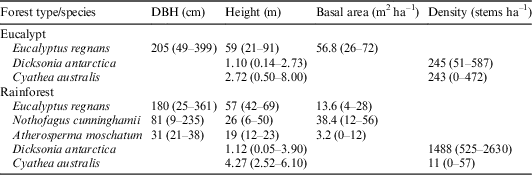
To test the validity of the modeled tree fern age distributions we compared them to the age distributions of rainforest and understory trees (see below) within five paired rainforest and eucalypt stands (Figure S1) located at mid to lower slopes with an elevation range of 655 to 894 m asl, variable slope (5–26º) and predominantly southeasterly to southwesterly aspect. The eucalypt forest is defined by a tall overstorey stratum of 40–90 m dominated by Eucalyptus regnans [Myrtaceae], above an understory (10–30 m) of trees and tall broad-leaved shrubs comprised of a mixture of short-lived, fire-cued pioneer species (Acacia dealbata [Fabaceae], A. frigescens [Fabaceae], A. melanoxylon [Fabaceae], Pomaderris aspera [Rhamnaceae], Polyscias sambucifolia [Araliaceae], Ziera arborescens [Rutaceae]) and more shade-tolerant “successional” species (Hedycarya angustifolia [Monimiaceae], Nothofagus cunninghamii [Nothofagaceae], Olearia argophylla [Asteraceae], Pittosporum bicolor [Pittosporaceae]) that are able to regenerate in the absence of fire (Ashton Reference Ashton2000). Tree ferns C. australis and D. antarctica occasionally occur in these stands. Rainforest is described as closed forest to 50 m height, dominated in all strata by obligate rainforest species (e.g. Nothofagus cunninghamii; Atherosperma moschatum [Monimiaceae]), with occasional emergent E. regnans, an understorey characterized by C. australis and D. antarctica, and a ground layer dominated by a diversity of ground ferns (Table 1).
Structural characteristics of dominant tree species and tree ferns within the five paired eucalypt and rainforest sites. Values are means of five sites with range in brackets.

Overstorey site characteristics were assessed between March and June 2014 via a variable radius plot using a prism wedge with a basal area factor of four. All trees captured in the wedge were measured for species, diameter at breast height over bark (DBH) and height using a Haglöf vertex hypsometer (Table 1). A fixed area plot of 40×10 m was located at the center of the variable radius plot and used to calculate stem density of tree ferns (Table 1). Height (nearest cm) measured from the ground to the top of the solid woody part of the caudex was recorded for all tree ferns within the fixed area plot with additional ferns that fell within the basal area sweep also measured.
The 100-year fire history database provided by the State Government of Victoria indicates that the last major disturbance to potentially influence all study sites was an extensive wildfire in 1939. However, previous wildfires in 1926, 1851, and 1730 are anecdotally known to have occurred in the region. The occurrence of extreme snowfall events in the region causing canopy damage were reported by Ashton (Reference Ashton2000) to occur in 1951 and 1977 but areas of impact were not mapped.
Radiocarbon Dating
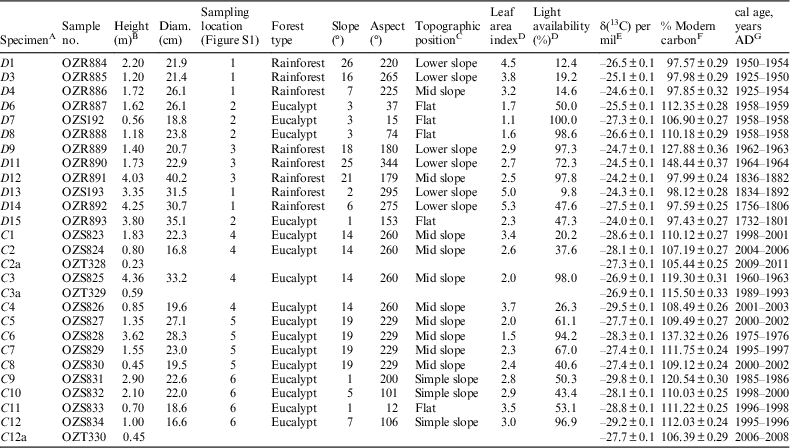
14C dating was used to age the majority of the destructively harvested tree ferns from Fedrigo et al. (Reference Fedrigo, Kasel, Bennett, Roxburgh and Nitschke2014) (D. antarctica n=12, C. australis n=12; see Figure S1 for sample locations). The 14C dated ferns covered a range of heights and environmental conditions (Table 2). The sample tree ferns represented the typical height distribution of ferns in the study area (Table 1). Tree ferns grow new fronds from the top of the caudex and for this reason the oldest material is at the base. Approximately 10-cm-thick disks were cut from the base of each tree fern with some additional disks of the same thickness taken further up the caudex (samples C.2a, C.3a, C.12a; Table 2; Fedrigo et al. Reference Fedrigo, Kasel, Bennett, Roxburgh and Nitschke2014). The disks were oven dried at 70ºC to constant weight to develop biomass allometric equations (see Fedrigo et al. Reference Fedrigo, Kasel, Bennett, Roxburgh and Nitschke2014) prior to sample extraction for 14C dating. Each disk was split in half vertically to expose the inside cross section of the tree fern and any remaining pith was removed. Sample material was extracted, using a sterilized chisel, from the dictyostele (Figure S2 in Appendix 2) from the mid-region of the disk to minimise any potential contamination that may have occurred at the edges of the disks. The dictyostele is both vascular and structural tissue for the fern with the cell wall material largely composed of lignin and cellulose, which can be extracted during the sample preparation for 14C dating. The lignin and cellulose is created when the cells at that particular part of the caudex are formed. This allows the dictyostele to give a better indication of age compared to other components such as the pith, which have a greater likelihood of incorporating more recent photosynthetic products (therefore lowering the age) (pers. comm. David Cantrill, pers. comm. Steve Mueck, 2014).
Summary of destructively harvested tree ferns and radiocarbon dating estimates.

A D, Dicksonia antarctica; C, Cyathea australis.
B Total height of the tree fern as measured from the ground to the top of the solid woody part of the caudex. The exception to this is samples C2a, C3a, C12a where height represents sampling height of discs additional to those taken at the base (all other samples).
C Topographic position based on Speight (Reference Speight2009).
D Mean 4 ring LAI and estimated light availability by total vertical gap fraction from Hemisfer 2.2 (Schleppi et al. Reference Schleppi, Conedera, Sedivy and Thimonier2007; Thimonier et al. Reference Thimonier, Sedivy and Schleppi2010) calculated from hemispherical photography following Kasel et al. (Reference Kasel, Bennett, Aponte, Fedrigo and Nitschke2017).
E Mean±1σ.
F Mean±1σ; % Modern carbon following Stuiver and Polach (Reference Stuiver and Polach1977).
G AD=Anno Domini.
Dictyostele samples were processed at the Australian Nuclear Science and Technology Organisation facility following the alpha-cellulose extraction procedure (Hua at al. Reference Hua, Barbetti, Zoppi, Fink, Watanasak and Jacobsen2004a). The samples were pretreated to alpha-cellulose using a modified method of Hua et al. (Reference Hua, Barbetti, Jacobsen, Zoppi and Lawson2000), in which cyclohexane is substituted for highly toxic benzene. The process can briefly be summarised as (1) Soxhlet extraction with 2:1 cyclohexane–ethanol mixture, then ethanol, followed by deionized water; (2) bleaching with hot NaClO2/HCl; (3) treatment with hot NaOH under a stream of nitrogen; and (4) rinsing with HCl. The pretreated material was sealed in quartz combustion tubes and combusted at 900°C, as described elsewhere (Hua et al. Reference Hua, Jacobsen, Zoppi, Lawson, Williams, Smith and McGann2001). Evolved carbon dioxide was cryogenically purified and collected, and its yield determined prior to conversion to graphite following standard graphitization procedures (Hua et al. Reference Hua, Zoppi, Williams and Smith2004b). Graphite targets were pressed into aluminum cathodes, and carbon isotopic ratios were measured for graphite targets on accelerator mass spectrometry installation STAR and EA-IRMS (Fink et al. Reference Fink, Hotchkis, Hua, Jacobsen, Smith, Zoppi, Child, Mifsud, van der Gaast, Williams and Williams2004). Matching measurements to the atmospheric 14C bomb pulse curve allowed for the determination of the start of growth for younger samples (Hua Reference Hua2009) using the CALIB software (Stuiver and Reimer Reference Stuiver and Reimer1993) and Southern Hemisphere atmospheric post-bomb dataset (Hua et al. Reference Hua, Barbetti and Rakowski2013). For older dates the Southern Hemisphere 2013 calibration curve (SHCal13) was used (Hogg et al. Reference Hogg, Hua, Blackwell, Niu, Buck, Guilderson, Heaton, Palmer, Reimer, Reimer, Turney and Zimmerman2013).
Allometric Equations for Size-Age Relationships
To simplify the estimation of tree fern biomass and enable comparison of size-age models with Mueck et al. (Reference Mueck, Ough and Banks1996) we developed a new allometric equation based on tree fern height. Data from 16 D. antarctica and 12 C. australis that were destructively sampled by Fedrigo et al. (Reference Fedrigo, Kasel, Bennett, Roxburgh and Nitschke2014) were used in this new height-only allometric equation that included both tree fern species. A factorial analysis of variance (ANOVA) was conducted to determine if the combined height only allometric equation differed significantly from the species-specific equations published in Fedrigo et al. (Reference Fedrigo, Kasel, Bennett, Roxburgh and Nitschke2014).
Modeling Approaches Used to Predict Individual Fern Age
Following Paine et al. (Reference Paine, Mathews, Vogt, Purves, Rees, Hector and Turnbull2012), a series of model approaches were explored to predict individual fern age using the height and biomass values of destructively harvested tree ferns and corresponding 14C ages. Models explored for each tree fern species include exponential, power-law, Gompertz, Michaelis-Menten, three-parameter and four-parameter logistic models. Akaike information criterion (AIC) score and model proximity to origin (0, 0) were used to identify the best performing model. The best performing models for each species using both height and biomass were identified and 95% confidence intervals calculated using Monte Carlo simulation. Ages for all tree ferns in the paired sites were then predicted using the best model for each species (either height or biomass). To test for the role of light availability on tree fern growth as postulated by Blair et al. (Reference Blair, Blanchard, Banks and Lindenmayer2017) we tested the influence of leaf area index and light availability on tree fern age. Details of this method are provided in Appendix 6 in the supplemental material.
Extraction of Tree Cores and Determination of Tree Age
Tree ages were determined via tree ring analysis (without cross-dating) of cores extracted from each site between March and May 2015. For each site, all trees recorded within the fixed or variable radius plots, with a DBH >5 cm, had cores removed using a Suunto increment corer. One to three cores were removed from each stem until the pith was reached and the age of the oldest core was used as an estimate of age for each stem. Cores were mounted on grooved wooden blocks, sanded using progressively finer grades of sandpaper (from 100 to 1200 grit), and digitally scanned at 2400 dpi to count the number of growth rings via WinDENDRO (Régent Instruments 2009). Where the core missed the pith of the tree, Duncan’s (Reference Duncan1989) geometric method was used to estimate the number of missed rings.
Overstorey E. regnans were not sampled due to constraints associated with the practicalities of sampling very large trees with pronounced buttressing, very hard dense wood, ubiquitous internal stem rot, and poorly formed growth rings (Simkin and Baker Reference Simkin and Baker2008; Wood et al. Reference Wood, Huan, Allen and Bowman2010). To provide an estimate of the ages of E. regnans cohorts in the plots we used the diameter at breast height- age model for the species developed by Ashton (Reference Ashton1976) in combination with finite mixture modeling (Benaglia et al. Reference Benaglia, Chauveau, Hunter and Young2009). Details of this method are provided in Appendix 7 in the supplemental material.
Statistical Analyses
All modeling, error propagation and statistical analyses were performed in R, version 3.3.0 (R Core Team 2016). Confidence intervals were generated for non-linear models using the propagate package (Spiess Reference Spiess2014). Kolmogorov-Smirnov tests were used to examine significance of differences in tree and tree fern age distributions within each site.
RESULTS
Allometrics
There were no significant differences (F [1, 24]=0.415; P>0.5) between the species-specific tree fern allometrics used in Fedrigo et al. (Reference Fedrigo, Kasel, Bennett, Roxburgh and Nitschke2014) and the height only allometric developed here (Equation 1). Subsequent analyses employed the combined species height only allometric to estimate size-age relationships.
 $${\rm }TF_{{AGB}} {\equals}0.003608H^{{1.6669}} $$
TF AGB is aboveground biomass (kg) of each individual tree fern and H is the total height (cm) of the tree fern. The model efficiency value is 0.995 with a Snowdon (Reference Snowdon1991) correction factor of 1.06.
Radiocarbon Dates
Results of the 14C dating are provided in Table 2. Comparison of 14C dates for samples collected at the base relative to those collected further up the caudex for three C. australis (C2a, C3a, C12a) indicates that age decreases from the base towards the top of the caudex, in support of our sampling strategy and previous assertions that the oldest material lies at the base of the caudex (Mueck et al. Reference Mueck, Ough and Banks1996). Results also suggest that study locations contain tree fern populations comprised of multiple age cohorts, particularly within rainforests (e.g. D11, 1964 vs. D12, 1836–1882; Table 2) and this is considered in detail in our analysis of stand dynamics across a broader range of sites.
Model Selection
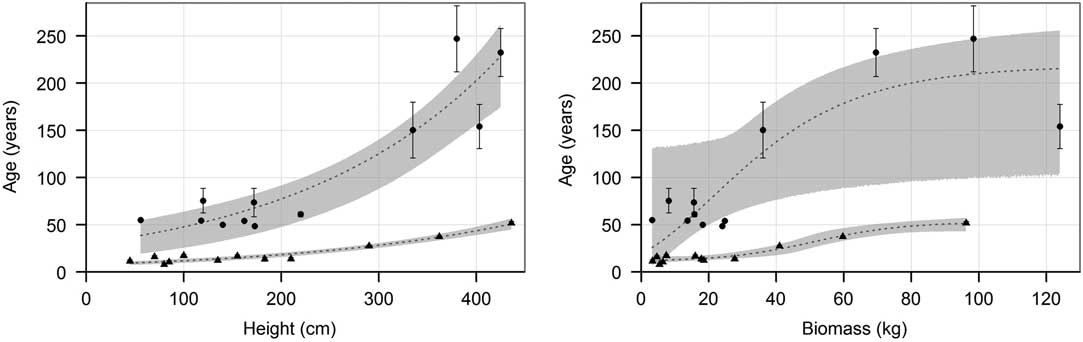
Exponential models provided the best fit for age trajectories based on height for both C. australis (Equation 2) and D. antarctica (Equation 3). C. australis grew up to four-fold faster than D. antarctica and there were no overlaps in age estimates for a given height (Figure 1).
 $$Age_{{C.{\rm }australis}} {\equals}7.8139372{\rm }e^{{0.0043036{\times}height}} $$
 $${\rm }Age_{{D.{\rm }antarctica}} {\equals}29.57e^{{0.004814{\times}height}} $$
Optimal tree fern age trajectories with 95% confidence intervals (Monte Carlo simulation) based on height and biomass for Cyathea australis ▲ and Dicksonia antarctica ●. Trajectories based on height are exponential, while those based on biomass are 4P logistic for C. australis and Gompertz for D. antarctica.

The best models for age trajectories based on biomass were 4P logistic for C. australis (Equation 4) and Gompertz for D. antarctica (Equation 5) (Figure 2).
 $$Age_{{C.australis}} {\equals}{{52.842{\minus}11.177} \over {1{\plus}e\left( {{{50.974{\minus}biomass} \over {13.284}}} \right)}}$$
 $$Age_{{D.antarctica}} {\equals}218.43224{\times}e\left( {{\minus}2.43256{\times}0.95923^{{biomass}} } \right)$$
Fitted models and equations are provided in Appendix 3 in the supplementary material.
As exponential height models outperformed models based on biomass all subsequent age predictions were based on the former models (see Figure S3 in Appendix 3). Age predictions from tree fern populations located in the five paired plots were limited to minimum and maximum height ranges used in the models as model predictions were unreliable outside the bounds of our data points. For this reason, model predictions provide for age estimates in the range of 30–230 years for D. antarctica and 9–51 years for C. australis (Figure 2). Where tree fern heights fell outside model limits, a minimum or maximum age is provided. No significant effects (P<0.05) of light availability on tree fern ages were found (see Appendix 6).
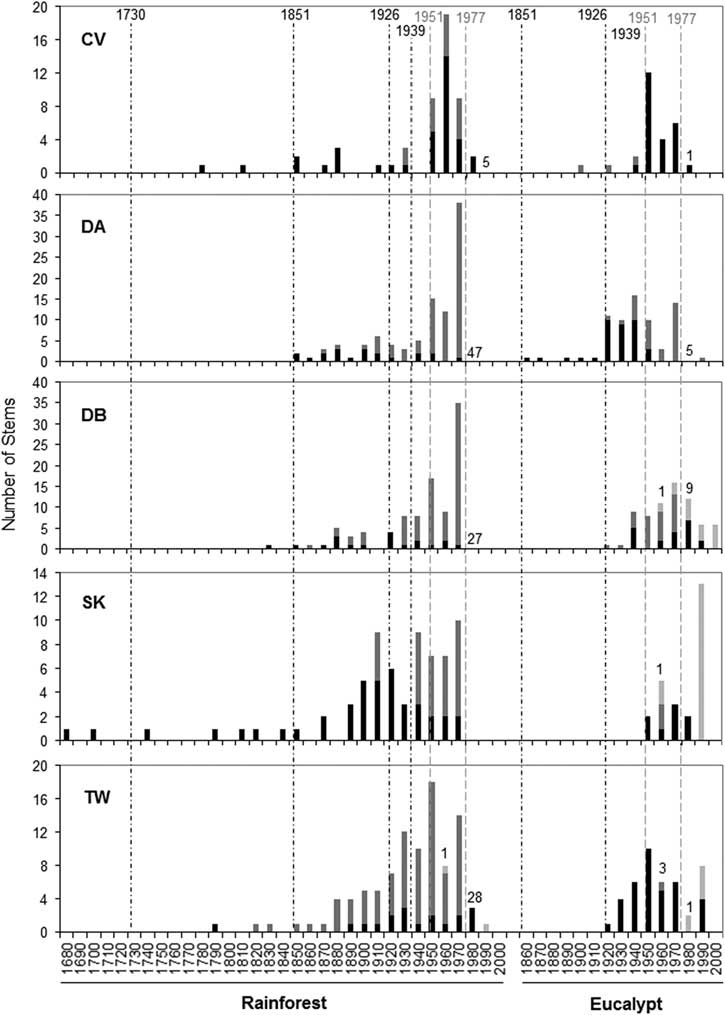
Histogram of tree ages (black bars) from tree coring and tree fern ages (Dicksonia antarctica – dark grey bars; Cyathea australis – light grey bars) predicted using exponential height-age models for paired rainforest and eucalypt sites. Establishment date indicates the year the trees reached the sampling height of 1.3 m. Dashed lines denote wildfire events (1730, 1851, 1926, 1939) reported in study area and 1951 and 1977 extreme snowfall events. Only the 1939 fire is mapped spatially for the region. The x-axis indicates the starting year for each 10 year interval. For each site, a number above the column for 1980 indicates the number of D. antarctica that are<30 years in age, and a number above the column for 1960 indicates the number of C. australis that are >51 years in age. These numbers represent tree fern individuals that were out of the prediction range for the respective height – age models.

Tree Fern Population Age Predictions
A total of 50 C. australis and 470 D. antarctica were measured for height with differences in sampling intensity primarily due to the thousand-fold greater stem density of D. antarctica in the rainforest (Table 1) where C. australis was restricted to one site (TW, Figure 2). The height of C. australis spanned 0.5–8.0 m and D. antarctica 0.1–3.9 m and Cyathea australis was taller than D. antarctica in all sites where the species co-occurred (see Figure S4 in Appendix 4). Of the 50 C. australis, 44 were used to predict age, with 6 stems above the height range (i.e. >4.36 m) of the final model. A total of 347 D. antarctica were used to predict age, with 123 stems below the height range of the final model (i.e. <0.56 m). The predicted age of D. antarctica ranged from 37 to 193 years across all sites, and 10 to 50 years for C. australis. Where the species co-occurred, predicted ages of all D. antarctica individuals were older than C. australis individuals with the exception of five individuals in the eucalypt site at DB and one individual at the rainforest site at TW (Figure S4).
Tree Ages and Stand Dynamics
A total of 259 individual tree stems were aged and results are presented as histograms with year of establishment in 10 year bins (Figure 2; see Figure S5 in supplemental Appendix 5 for tree species-specific results, see Figure S8 in supplemental Appendix 7 for eucalypt age cohorts). The age distributions of understory trees and tree ferns within the eucalypt forest sites were consistent (Table 3) with known broad-scale fire history and snowfall events indicating that pulses of recruitment tended to follow these events while recruitment also occurred between disturbance events (Figure 2). For three eucalypt sites: CV, DB, SK, regeneration of understorey trees coincided with the 1939 wildfire. Eucalypt cohort aging at the CV site suggests that fires also occurred in this site in the 1770s–1790s and 1851 while at DB and SK a fire around 1820 likely occurred (see Figure S8). A eucalypt cohort dating to the 1983 wildfire also occurred at the SK site which aligns with a pulse in C. australis recruitment in the 1990s (Figure 2). For two eucalypt sites, DA and TW, regeneration of trees coincided with the 1926 wildfire that has been documented to have occurred in the area but not mapped. For the eucalypt site at DA, there were a small number of understory trees which pre-dated the 1926 and 1939 wildfires, with one dating back to the 1851 fire suggesting the site may have burned in both 1851 and 1939 (Figure 2). Eucalypt cohort aging for the DA site also identified an 1851 cohort but also identified two other cohorts suggesting fires also occurred in the 1650s–1680s and 1770s–1790s (see Figure S8). Eucalypt cohort aging at the TW site identified a 1926 cohort and a 1730s cohort. Tree ferns, at all eucalypt sites, appeared to recruit continuously post-fire with only one site having ferns that pre-dated the 1926/1939 fires (eucalypt site CV). Eucalypt sites DA and CV exhibited pulses of recruitment following the 1951 and 1977 snowfall events recorded in the region. The population dynamics also suggest that gaps in tree fern regeneration have occurred in the CV, SK, and TW eucalypt stands between the 1950s–1980s, 1970s–1980s, and 1920s–1950s, respectively.
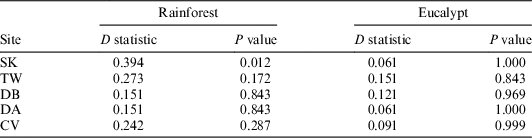
Kolmogorov-Smirnov test results comparing tree fern and tree age distributions within each site.

There were no significant differences in the age distribution of D. antarctica relative to trees in the rainforest sites with the exception of SK (Table 3) where rainforest trees were older than D. antarctica (Figure 2). The stand ages of the rainforest sites were older than the 1926 and 1939 wildfires with several trees also pre-dating the 1851 wildfire, particularly at CV and SK while at DA, almost all trees were older than 1926 (Figure 2). Cohorts of N. cunninghamii that pre-date 1851 at SK, TW and CV suggest fires may have occurred in the 1770s–1790s. Pre-1851 cohorts at DB suggest a fire may have occurred around the 1820s–1830s, while pre-1700 cohorts at SK suggest a fire may also have occurred in the mid-to-late 1600s. Eucalypt cohort aging suggests that fires likely occurred in 1851 at TW, ~1820 and 1926 at DB, ~1730, ~1820 and 1983 at SK, ~1770s to 1790s and 1926 at DA; and, ~1770s to 1790s and 1939 at CV (see Figure S8). At all rainforest sites except CV, D. antarctica also outdated the 1939 wildfire with several individuals dated within the 1800s across three of the sites (Figure 2). D. antarctica also pre-dated the 1851 wildfire at the TW site.
At all rainforest sites there were observable pulses of tree fern recruitment following and between the 1951 and 1977 snowfall events. At four of the rainforest sites, there were also a large number of D. antarctica that are smaller than the size range that bounds the models; however, the presence of these individuals suggests continual tree fern recruitment has occurred over the last 30+ years in the absence of known disturbance events (Figure 2). The population dynamics also suggest that gaps in tree fern regeneration have occurred in the CV and SK rainforest stands in the 1940s and 1920s–1930s, respectively.
DISCUSSION
Our results highlight the potential that 14C dating can have for understanding the growth dynamics of long-lived plants that cannot be aged using classic dendroecological approaches. We found that the age-size relationships for the two dominant tree fern species in southeast Australia were best explained as exponential functions of height rather than functions of biomass. Our findings support the use of non-linear growth models for these tree fern species as identified by Blair et al. (Reference Blair, Blanchard, Banks and Lindenmayer2017) and highlights that previous studies that have used linear models to estimate age from size are biologically implausible for such long-lived organisms (Paine et al. Reference Paine, Mathews, Vogt, Purves, Rees, Hector and Turnbull2012).
Previous work on 14C dating of tree ferns in the region (Mueck Reference Mueck, Ough and Banks1996) was limited in sampling (two C. australis and six D. antarctica) and did not sample across a wide range of size classes. Mueck (Reference Mueck, Ough and Banks1996) also did not utilize bomb-pulse dating which increases the accuracy of age estimates, especially in post-modern ferns. The bomb-pulse data also allowed for the accurate growth rates determined in the post-modern ferns to be used as priors to inform the determination of potential ages of pre-modern ferns. Due to these constraints, anyone extrapolating the simple size-age model identified by Mueck et al. (Reference Mueck, Ough and Banks1996) to tree ferns occurring across a range of size classes would be doing so in a biologically implausible manner. By increasing the number of samples, sampling across a range of size classes, and improved accuracy of the 14C dating methods we were able to overcome these limitations. Developing non-destructive methods for sampling tree ferns for future 14C dating is recommended to further build on the models developed and for extending this work to other tree fern species.
Despite the two tree fern species having similar growth allometries, the growth rates were different. Similar to Mueck et al. (Reference Mueck, Ough and Banks1996) and Blair et al. (Reference Blair, Blanchard, Banks and Lindenmayer2017) we found that D. antarctica grows slower than C. australis. Our results indicate that across our study sites, C. australis grows nearly four times faster than D. antarctica at any given size. This divergence in growth rates is higher than reported by Blair et al. (Reference Blair, Blanchard, Banks and Lindenmayer2017) who found that on average C. australis grew 2.2 times faster than D. antarctica. Differences in growth rates are likely due to the divergent methodologies and temporal resolution of the height age metrics as Blair et al. (Reference Blair, Blanchard, Banks and Lindenmayer2017) measured ferns over a 5-year period with ferns of different heights exhibiting different absolute growth rates. Our models captured the non-linearity in relative growth rates with increasing fern height allowing for a cumulative estimation of growth over time (Paine et al. Reference Paine, Mathews, Vogt, Purves, Rees, Hector and Turnbull2012).
The non-linear relationship between height and age suggests that tree fern relative growth rates (RGR) slow with time. The slowing of growth rates in the sampled tree ferns coincided with an increase in biomass (see Figure 1) which leads to a decrease in RGR in plants (Paine et al. Reference Paine, Mathews, Vogt, Purves, Rees, Hector and Turnbull2012). This decrease occurs because the rate of biomass accumulation as a proportion of total biomass slows due to increasing respiration costs which cannot be offset by increased resource availability (Paine et al. Reference Paine, Mathews, Vogt, Purves, Rees, Hector and Turnbull2012). Blair et al. (Reference Blair, Blanchard, Banks and Lindenmayer2017) found that larger ferns were growing faster than smaller ferns and suggested that light availability may be an important factor. We found a non-significant effect of light availability with tree ferns of similar sizes and ages growing under a range of light conditions (supplemental Appendix 6) suggesting that light availability has not had a strong influence on RGR. The contrasting findings with Blair et al. (Reference Blair, Blanchard, Banks and Lindenmayer2017) might be due to the difference in methodology. To capture temporal dynamics in growth we used non-linear models which account for the variation in plant RGR due to ontogeny (Paine et al. Reference Paine, Mathews, Vogt, Purves, Rees, Hector and Turnbull2012). Blair et al. (Reference Blair, Blanchard, Banks and Lindenmayer2017) used linear models on sampled individuals that varied in initial size and presented absolute growth rates not RGR. A calculation of RGRs based on initial tree fern size from the model data provided in Blair et al. (Reference Blair, Blanchard, Banks and Lindenmayer2017) showed that the RGR for their tree ferns was non-linear and decreased with increasing tree fern size (see supplemental Appendix 8 and Figure S9) which is consistent with our findings and with metabolic theory (Paine et al. Reference Paine, Mathews, Vogt, Purves, Rees, Hector and Turnbull2012).
The identified population dynamics of tree ferns in this study provided insights into the disturbance history of the studied stands. Consistent with work elsewhere, the data presented here suggests that tree ferns can survive fires and recruit over time, either in the shade or in response to canopy disturbances (Ough Reference Ough2001; Bystriakova et al. Reference Bystriakova, Bader and Coomes2011; Richardson et al. Reference Richardson, Holdaway and Carswell2014; Brock et al. Reference Brock, Perry, Lee and Burns2016). Gaps in recruitment were followed by pulses of tree and tree fern recruitment suggesting the occurrence of canopy disturbances that coincided with the 1939 and 1926 fires at respective sites. Some stands also had surviving tree ferns and trees indicating that the wildfires may have partially burnt these stands and created conditions that prevented recruitment of tree ferns for a 10–20-year period. The 1926 fire coincided with a period of drought while a period of extended drought (~6 years) followed the 1939 fire in Victoria (see Nitschke et al. Reference Nitschke, Nichols, Allen, Dobbs, Livesley, Baker and Lynch2017). High light and warm dry conditions are known to limit recruitment of tree ferns in temperate regions (Brock et al. Reference Brock, Perry, Lee and Burns2016). It is possible that higher irradiance due to canopy removal by wildfire and drier soil conditions associated with open canopy conditions and drought may have limited recruitment following these wildfires. Established tree ferns may facilitate the recruitment of other tree ferns within their neighbourhood. Where eucalypt stands had evidence of past fire, we found that recruitment in these stands appears to have happened more quickly in the stands with surviving tree ferns (~10 years) compared to stands without surviving tree ferns (~30–40 years). Our approach has limitations; there is uncertainty around the age estimates with increasing tree fern size and it does not provide any insights into the rate of tree fern mortality in response to allogenic, autogenic or biogenic processes. Longer-term monitoring of tree fern populations over time would be required to understand these latter processes and increase sampling of older ferns to resolve the former.
Dicksonia antarctica responded similarly to the associated tree and shrub species that are known to regenerate in the absence of fire. They all showed continual recruitment with increasing time since last fire but also exhibited notable pulses of recruitment in the 1950s and 1970s (see supplemental Figure S5 and Appendix 5). We had too few observations of C. australis to make any inferences about the relationship with associated tree and shrub species across most sites; however, at the SK eucalypt site a pulse of C. australis recruitment appears to align with the establishment of a eucalypt cohort that likely resulted from the 1983 fire (supplemental Figure S8 and Appendix 7). The interesting pattern of the pulse of tree fern recruitment in 80% of sites during the 1950s and 70% of sites during the 1970s coincided with extreme snowfall events in the region in 1951 and 1977, respectively (Ashton Reference Ashton2000). These events caused widespread canopy damage in the region (Ashton Reference Ashton2000) leading to the formation of gaps that stimulated recruitment and growth release events in understorey shrubs and rainforest trees (Ashton Reference Ashton2000; Simkin and Baker Reference Simkin and Baker2008). Such canopy disturbances likely stimulated the regeneration of tree ferns. These population dynamics make tree fern species suitable for investigating the spatial and temporal occurrence of canopy disturbance events as the temporal structure of establishment dates reflected the occurrence of known disturbance events (Middendorp et al. Reference Middendorp, Vlam, Rebel, Baker, Bunyavejchewin and Zuidema2013). The increased frequency of younger tree fern cohorts (skewed age class distribution) with increasing time since fire and occurrence of pulse recruitment following inter-fire canopy disturbance events suggests that on sites suitable for tree ferns, forests of the region may shift towards an understorey increasingly dominated by tree ferns over time in the absence of stand replacing disturbance (e.g. Ashton Reference Ashton2000; Ough Reference Ough2001; Chuter Reference Chuter2003; Turner and Pharo Reference Turner and Pharo2005).
CONCLUSION
We have shown how 14C dating can be used to elicit growth rates and population dynamics for species that are not suitable for classic dendroecology approaches and in doing so extend the ability to reconstruct population recruitment dynamics in response to known disturbance events in southeast Australian forests. The tree fern species D. antarctica and C. australis were found to exhibit population dynamics that are sensitive to wildfires and other canopy disturbances. Both species were found to have individuals that survived known wildfires that impacted studied sites and exhibited continual recruitment with increasing time since fire. Over time, canopy disturbances such as large snowfall events can stimulate pulses of recruitment in tree ferns facilitating their increased abundance in the forest understorey in the absence of wildfire. The congruency between tree and tree fern population dynamics suggests that tree ferns may be used to reconstruct disturbance history where suitable shrub and tree species for dendroecology are not available and provide a deeper understanding of the impacts of disturbances on community dynamics. 14C dating however can be cost prohibitive, still contains uncertainties in age estimates, and may not reflect the entire disturbance history of a site so it should ideally be used in combination with dendroecology techniques. The size-age models developed in this study however now provide a cost-effective sampling approach for measuring tree fern populations in the region. This approach has implications for studying tree fern communities across the temperate forests of the Southern Hemisphere in which tree ferns are significant components but also for studying plant demography and population dynamics in other long-lived plants that are not suitable for dendroecology or where short-term measurements of growth are inappropriate.
Supplementary material
To view supplementary material for this article, please visit https://doi.org/10.1017/RDC.2018.119
ACKNOWLEDGMENTS
This research was undertaken with approval by the Victorian Department of Environment, Land, Water and Planning (DELWP) under research permit numbers 10006440 and 10006691. The work was funded by the DELWP Integrated Forest Ecosystem Research program (IFER C2016–19:05) as well as the CSIRO Sustainable Agriculture Flagship program. Tree fern 14C dating was funded by the Australian Institute of Nuclear Science and Engineering under award numbers ALNGRA 15038 and ALNGRA 14033 with additional in kind contributions from the Australian Nuclear Science and Technology Organisation. We would like to thank those who contributed to data collection and processing, including B. Smith, B. Minnis, T. Fairman, M. Chick, D. Navarrete. We would also like to acknowledge Cristina Aponte, Lauren T. Bennett, Stephen H. Roxburgh, and David Cantrill for their contributions. We thank the editor and four anonymous reviewers for constructive comments that improved the manuscript.