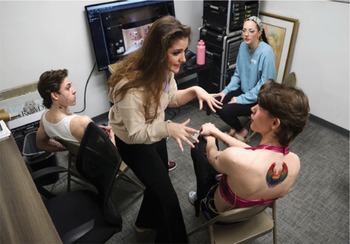
Act 2, Suze and Beverly. Foreground: Suze (Nicolet Endean) talks at Beverly (Nylah Walker) about her relationship with Mabel. Background, from left: Mack (Matt Bush) with Bets (Matthew Berman); and Jimbo (Robert Longo). Fairview by Jackie Sibblies Drury, directed by Ray Black, Colorado State University‚ School of Music, Theatre and Dance, Fort Collins, Colorado, 29 February 2024. (Photo John Eisele/Colorado State University Photography; John.Eisele@colostate.edu)

We are two black male directors who created a virtual black barbershop as a safe place for us to discuss our 2024 productions of Jackie Sibblies Drury’s 2019 play Fairview at two different universities. Sitting in this familiar space, we discuss our understanding of the white gaze, how black people are created and viewed in the white imagination, in both Fairview and in our daily lives as black men in predominantly white spaces. In our black barbershop, a space where we do not have to contend with our blackness created by the white gaze, we share how this awareness guided our directorial decisions. We talk about how we balanced the tensions of race and racialized perceptions with cast and crew while staying true to our understanding of Fairview as making the white gaze visible and tangible and thus making audiences uncomfortable. As directors, we talked about how Fairview’s inversion of common perceptions of race worked in practice. As black men, we talked about how Drury’s Fairview helped us see how we inverted the racialized spaces of our campuses and communities—how we created Our Fairview.
Director’s Note
By Way of Introduction
Jackie Sibblies Drury’s three-act play Fairview (2018) presents the Frasier family preparing a birthday dinner for their matriarch. Here in our own three acts, we present “Our Fairview,” our experiences directing Fairview, a black play, as black directors who are black faculty at predominantly white institutions. Drury is a black female playwright who features strong black women characters. Fairview, winner of a 2019 Pulitzer Prize, is her fourth play. In our view as directors of Drury’s Fairview, we see it as a play focused on exposing the white view on black life, trying to have the audience see everything “to be fair,” as per the closing words of the character Keisha (Drury Reference Drury2019:106). This view comes from our experiences as black men at white institutions who live in larger communities as minoritized people where our awareness of the white gaze—how whites create us as black people, how we should act—influences our own actions. As we talked about our Fairviews, one in a Southern state (Kentucky) and the other in the West (Colorado), it felt like we were in a black barbershop, a place where black people “believe themselves to be free to talk to one another beyond the gaze of the racial others” (Harris-Lacewell Reference Harris-Lacewell2004:9). This is one way we dealt with the white gaze in Fairview: as a version of our lived experience, another way of dealing with how our images are created by others. We invite you here to enter our barbershop. Herein, the italicized Fairview refers to Drury’s play and without italics it speaks to our experiences. When we create the productions, they become ours, they are new Fairviews, what we call Our Fairview.
Act 1 of Drury’s Fairview features wife Beverly Frasier, her sister Jasmine, daughter Keisha, and husband Dayton as they set the stage for dinner. From the first line of the stage directions, “Lights up on a negro,” we know the Frasier family is black. Drury titles the second act as “Act Two watches Act One” (Drury Reference Drury2019:6). Act 3 is the matriarch’s dinner—with mainly white actors from act 2 entering the play as black characters who are part of the Frasier family. Our Fairview also unfolds in three acts: Act One explores the theory of Fairview, our understandings of the text and the white gaze; Act Two discusses us as directors, how Act One’s theory impacted our decisions in creating Our Fairview; and Act Three articulates bringing Fairview to life on the stage. While we are different in our specific life experiences, careers, and academic focuses, we come together as black men in the academy who face similar experiences as artists. Our Fairview is about how we had to make those around us—colleagues, production staff, student actors, and the community—comfortable in creating our Fairview, a play we see as making everyone distinctly uncomfortable.
With this Director’s Note, our stage is set. We seek to address the following questions: What does it mean for black men, as black faculty, to direct a black play at white institutions, in different geographical locations? Could we exercise full creative power? Did the academic structure limit how we presented Fairview? Could we really speak truth to power? We answer these questions in our black barbershop, where we talk to each other without explanations or precautions. Have a seat, get comfortable, indulge in your drink of choice with us as director Jeremy Gillett, an assistant professor of acting in the Department of Theatre and Dance at the University of Kentucky; and Ray Black, an associate professor of African American studies in the Department of Race, Gender, and Ethnic Studies at Colorado State University, who served as guest director for the theatre department, present Our Fairview. This discussion is an insider’s view on presenting Fairview, by black men, shared in the safe space of our barbershop.
Act 1, Keisha. From left: Beverly (Najiya Clayborn) dancing with Dayton (Mbake Kekia); Keisha (Gabrielle Copeland) saying how much she loves her family; and Jasmine (Alexandra Brown). Fairview by Jackie Sibblies Drury, directed by Jeremy Gillett, Briggs Theatre University of Kentucky College of Fine Arts, Lexington, Kentucky, 29 February 2024. (Photo by Mark R. Cornelison/University of Kentucky Photography; mark.cornelison@uky.edu)

Act One: Theory
For us, Fairview centers on the white gaze, how black people are always under the scrutiny and expectations of white people. In our roles as both theatre directors and faculty, overtly we were charged with bringing Fairview to life while implicitly working under the white gaze. As academic professionals, we explored the scholarly understanding and theory of the white gaze. With this scholarly understanding as one guide, we could be sure that our directing, and thus the dramatization, were truthful to our experiences. In other words, our task was to make sure that the meaning of the white gaze, in theory and in practice (how we both understood and experienced it), was accessible and fully digestible for the audience. Fairview is entertainment, not a college lecture.
Our theoretical foundation of the white gaze is that being white does not need explanation, and being white is a norm, a universal standard. Black artists—which includes Black Indigenous People of Color (BIPOC) or other nonwhite artists—need to explain themselves because they are inherently different, not universal, and not the standard. In a documentary about her work, Toni Morrison explained the white gaze:
The assumption [is] that the default reader or observer is coming from a perspective of someone who identifies themselves as white, or that people of color sometimes feel the need to take into account the white reader or observer’s reaction. (in Greenfield-Sanders 2019)
Morrison spoke specifically against this assumption of the white reader’s view, their gaze, and created work without consideration of their reaction. Another view of the origin of the white gaze is as an imposition of a white universal, a white standard, that derived from the “white colonial gaze […] that constructs the Black body into its own colonial imaginary” (Yancy Reference Yancy2008:6). This colonial imaginary places whites in control of descriptions of others, as well as decisions on whether privileges would be granted or denied. Black bodies were not human in this colonial gaze, and thus could be treated like property, as chattel slaves. Further, the white gaze “allows a dominant group to control the social spaces and social interaction of all groups. Blacks are made visible and invisible at the same time under the gaze” (Mao and Zhang Reference Mao and Zhang2009:27). The white gaze creates others through a lens of white definition and not as black people see themselves. This white gaze marks “black” as a race, and thus different, not the norm. In turn, “the white gaze is a concept whereby white people resist inclusion in a racialized category yet render people of color as representatives of racialized groups” (Snyder-Young Reference Snyder-Young2020:xxiv). In this way, white is not a race. The ability to define black as different than white is key to our understanding of the white gaze.
As black people, one thing we have had in common was that we normally operated on a presumption of white as the invisible prefix, that any “play” has “white” as a prefix: a play is a white play. On the other hand, a play featuring or centered on black people is a black play, visibly marked with the prefix “black.” Hence, Fairview is a black play. In our barbershop safe space, we understood this visible white and invisible black because we were not responding to a white gaze where we would have to account for this normative view. Since our normal presumption is an inversion of the larger norm, we made this invisible prefix, white, visible while making the prefix for plays with black people “black,” invisible. For us, the white gaze is always visible, always an aspect of how we move through our institutions and the world. With whiteness always visible for us as people, as directors we flipped the white gaze from being an invisible force to being a visible presence in the daily lives of cast and crew. Thus, in Our Fairview, this presumption meant that we inverted the racial dynamic of whiteness as invisible from the moment we encountered Fairview before becoming directors of Drury’s work. Our presumptions were so obvious to us that we did not realize or articulate it until we were sitting in our barbershop. We make our theory of the white gaze explicit because we understand, in the safe space of our barbershop, that this presumption is not the norm.
Our Fairview understands that Fairview makes the white gaze visible. Making this invisible white gaze visible is a means to confront it:
Challenging the dominant discourse requires disturbing and decentering the White gaze. This means first naming it and then engaging it. Once it is engaged, the task is to deeply interrogate and challenge the claims associated with it. (Powell Reference Powell1999:433)
In order for us, as black directors, to disturb and decenter, we named the white gaze for ourselves, from our scholarly research and lived experience. In this disturbing and decentering naming, we were bringing our presumptions of the white gaze into our own discussion. We lived with and reacted to the white gaze in our lives without naming it. Only when we were considering how to present the white gaze in Fairview on the stage and as we talked in our black barbershop—our safe space beyond the white gaze—did we see and name it for Our Fairview. We would specifically call the white gaze out by name in a college lecture but would not be so didactic in a play. Fairview brings the normally invisible white gaze into view without naming it. However, bringing it into view in and of itself does not mean it is confronted. We return to Morrison to show how making the white gaze visible in itself is not enough:
My project is an effort to avert the critical gaze from the racial object to the racial subject; from the described and imagined to the describers and imaginers; from the serving to the served. (1993:90)
This inversion from object to subject focuses on the viewers, those whose vision creates the white gaze; Morrison makes it visible and turns the focus to white people so they can see themselves as the ones doing the describing, creating the others from their imagination. The three acts of Fairview apply Morrison’s inversion to create a dynamic theatrical experience for audience members to see and digest the white gaze. In Fairview’s act 1, the audience observes the Frasiers, a black family, using the default white gaze, watching in a normative setting; in act 2, the audience listens as mainly white actors comment on blackness as the Frasier family silently replays act 1; and with all of the actors onstage in act 3, the white gaze is a bright unmistakable presence. The audience witnesses the deep intrusion—the descriptions and imagination of the white actors imposing and altering the black family’s actions.
We had an issue with what we call the groups of student actors in Fairview, the Frasier family and the non-Frasier others. As we discussed our understandings of the white gaze, we began to consider how this theorizing played out in designing Our Fairview. What is clear to us from Fairview’s three acts is that the Frasiers, the black family, are onstage during the whole play. We each had terms for the non-Frasier cast: initially Jeremy called them spectators and Ray called them the watchers. The director’s first decisions are how the white actors observe act 2 and interact in act 3. We began our discussion thinking about what we should call the white actors.
JEREMY: I called them “the spectators” initially, but “the intruders” is what I ultimately called them throughout the process. It’s funny bruh, because I can’t believe I was calling them “the white cast” in the beginning. I went home one night and said to myself, “If I keep calling these kids ‘the white cast’ I might lose my job.” So—I switched to calling them the intruders.
Act 2, Intruders. From left: Jimbo (Matt Flannery), Bets (Ellie Phillips), Mack (Maxx Megibben), and Suze (Chloe Huettman). The intruders interact with one another as they say their dialog and watch the TV monitor. Fairview by Jackie Sibblies Drury, directed by Jeremy Gillett, Briggs Theatre University of Kentucky College of Fine Arts, Lexington, Kentucky, 29 February 2024. (Photo by Mark R. Cornelison/University of Kentucky Photography; mark.cornelison@uky.edu)

Act 2, Intruders. From left: Jimbo (Matt Flannery), Bets (Ellie Phillips), Mack (Maxx Megibben), and Suze (Chloe Huettman). Fairview by Jackie Sibblies Drury, directed by Jeremy Gillett, Briggs Theatre University of Kentucky College of Fine Arts, Lexington, Kentucky, 29 February 2024. (Photo by Mark R. Cornelison/University of Kentucky Photography; mark.cornelison@uky.edu)

Act 2, Frasiers and Appropriators. From left: Mack (Matt Bush), Jasmine (Faith Buckley), Keisha (Bolu Saliuis), and Bets (Matthew Berman). Fairview by Jackie Sibblies Drury, directed by Ray Black, Colorado State University‚ School of Music, Theatre and Dance, Fort Collins, Colorado, 29 February 2024. (Photo John Eisele/Colorado State University Photography; John.Eisele@colostate.edu)

A casual passerby who hears a black man calling white students white could think the black man was racially insensitive rather than describing the actors. For Jeremy, only when he was out of the rehearsal space did he realize the inversion of the white gaze he was operating in: black was his normative and white was different. Thus, the one aspect of understanding what was obvious to both of us that might not be to others: making the normally invisible white prefix plainly visible.
What we called the cast was an evolution in our directorial process as we brought our concepts and experiences into our productions. There is a progression from “spectators,” those who witness from beyond, to “intruders,” interacting with and imposing themselves on the Frasier family. In a similar manner, Ray explained his progression:
RAY: The production team was calling them “the watchers.” I’m like no, it’s more than watching. Because they were changing the way the Frasiers acted, it hit me to call them “the appropriators.” They appropriated the white gaze understanding of blackness—the way the gaze recasts black people in a negative light—and made the Frasiers act in this stereotypical way.
We both saw the non-Frasiers as being separate and beyond the Frasier family. The how of the Frasier’s engagement with the non-Frasier characters is a major difference that distinguishes our specific productions. The non-Frasiers (the white cast) presented themselves as part of the family. Our naming of the Frasiers (black cast) and non-Frasiers (white cast) reveals a subtle difference in our directorial understandings of intruders (Jeremy) and appropriators (Ray) and in how we displayed them in the production. Our initial descriptions of “watchers” (Jeremy) and “spectators” (Ray) are similar ideas: the non-Frasiers watch the Frasiers from the sidelines. Our thinking behind “intruders” and “appropriators” is how we each viewed the execution of how the non-Frasier characters interact with the Frasiers.
Jeremy came to the term “intruders” because the “white cast members,” the non-Frasiers, were doing more than watching and spectating: whether they knew it or not, they had an agenda of supremacy as this control is a feature of the white gaze. This naming process also touched on the duality of them being white people and students as well as representing a version of whiteness, an enactment of the white gaze, in Fairview. Whenever they deemed it necessary, these intruders in Fairview were going to create the Frasiers, and by extension, all black people, by making them fit into their white understanding of blackness. The intruders understood and acted on their view of being black, an experience from another world, one that was distinctly different and inferior to their own.
Ray came to the term “appropriators” because the characters own and perform their understanding of blackness without crediting or respecting the source, freely applying their understanding to the Frasier family. This cultural appropriation is a taking and creating of another’s culture, and then applying a universal standard, a normal way to understand everything. Anything different from this normal standard is inferior. This universal understanding is the basis of the white gaze, and guide for the non-Frasiers to perform their version of black culture. One way of thinking about cultural appropriation is to consider how it changes the original culture:
Cultural appropriation is an act knowingly conducted by an appropriator, i.e., it is the deliberate use of a cultural practice or symbol from others and adopting it as one’s own, where this use is contested, and where one knows that the practice or symbol is central to the culture of others. (Lenard and Balint Reference Lenard and Balint2020:342)
The appropriators took their view of black culture and made it something they could own. For both directors, the intruders and appropriators perform their view, their white gaze, of blackness. For us, these intruders’ and appropriators’ performance of blackness was not the authentic experience or dynamic of the Frasier family in Fairview.
In our naming of the cast groups, we made the normally invisible white prefix and idea of the white gaze visible. As directors, we wanted and needed the cast and crew to feel comfortable. This was a challenge as we saw Fairview as a play designed to make people feel uncomfortable, to confront how they see themselves in a racialized world. In a review of the June 2018 Soho Rep production, New York Times critic Ben Brantley wrote of the performance, “you will not be comfortable.” Brantley continued that the play “is all about race, and especially about how white people look at black people” (Brantley Reference Brantley2018). In this process of discerning how white people look at black people, as directors creating a production, we had to further adjust ourselves to the white gaze, to subsume our personalities and emotions more than we do normally in order to keep cast and crew comfortable. For example, the normative image of “faculty” is calm and reasoned, people who are “expected to behave in a logical and professional manner” (Stupnisky, Hall, and Pekrun Reference Stupnisky, Hall and Pekrun2019:1490). Faculty should not express intense emotions or high energy, which is often attributed to non-normative groups. Black faculty (as well as some other faculty members of color and difference) and white faculty members “function in disparate realities […] where blackness is discredited and devalued” (Harlow Reference Harlow2003:362). While we are directors, we are also black faculty at white institutions and as such have to be cautious of being perceived as racially biased. When directing a black play about the white gaze, and inverting what is normally visible and invisible, the universal norms of the white gaze could alter our actions in ways similar to the way the intruders and appropriators did to the Frasier family.
This inversion of visible and invisible was noted in reviews of other productions of Fairview. For example, in his review essay of the 2019 Fairview production at London’s Young Vic, Michael Pearce considered the makeup of the audience when he noted that Drury’s work made “white spectators feel uncomfortable by confronting us with white privilege. [Drury] manages white guilt by limiting empathy and emphasizing accountability” (2021:5). White audiences are aware of themselves “as white spectators and the relationship this has to perpetuating the kinds of racist representations we see before us” (5). For us as black directors and faculty, the accountability for seeing how racist views were promoted extended to the cast and crew—they were spectators or readers of Fairview before coming together to create Our Fairview. Therefore, as directors, we had to anticipate and reconcile the representations and accountability throughout the production process.
Naming the white non-Frasier characters of act 2 “intruders” and “appropriators” was part of the production and rehearsal process, two different points in bringing Drury’s work to the stage. Ray wanted to change the thinking during the pre-production meetings while Jeremy made the change during rehearsals. In production meetings for Jeremy, the black cast were always called the “Frasier family.” Ray always called them the “Family” without their Frasier name or reference to race. Neither of us ever referred to the Frasiers as the “black actors.” We saw black as normal and named anyone different intruders and appropriators. In Jeremy’s case, the white actors were called the “white actors” or “white cast members.” We both assigned race to the intruders and appropriators—the white characters, rather than what was normally done in predominantly white spaces, naming the black people or the black actors, and thus black as the other. This naming was based in our experiences at our institutions.
RAY: I teach Black Studies here, I have sometimes 90, 100 students in my African American history class, and most have no clue. My own experience here is that I can’t presume that they know anything about being black, other than watching music videos, or maybe their one black friend. I didn’t want them to dismiss the appropriators as just voices in somebody’s head.
The major concern for Ray was for the audience to engage with the appropriators without being able to dismiss them. He did not want the unseen appropriators to be considered as a mistake or something the audience had imagined. Further, Ray did not want the whites in the audience to be able to discount the thoughts they shared with the appropriators about blackness.
For Jeremy, the concern was managing the relationship between the character that the actor was playing and the actor’s true being:
JEREMY: The text of Fairview is tethered so closely to racial issues and themes occurring in real time that the play itself pulled students into the work. I discovered the actors wanted to tackle their characters and wanted to do the work, but they were afraid that they as human beings would be associated with the content. They were more than actors.
Jeremy understood that the actors wanted to deliver a convincing performance but also be able to return to their human selves. His actors feared becoming intruders to some degree. He addressed this in acting classes:
JEREMY: In my acting class some students proved ready for and had a strong appetite for controversial, moving, and/or gut-wrenching text. For the most part, those same students had the talent to engage mature texts with explicit themes and deliver a truthful performance. But to ensure those students delivered performances that honored and did justice to the text, they needed a voice in the process.
By listening to and respecting the actors’ voices, and respecting what they brought to the production, Jeremy was confident that the actors could relay their truth. His work was to bring it out in his actors in the best way.
JEREMY: For example, before we work, we engage in a process that helps each student disassociate themself from the text. First, we discuss the text openly and create an ethos in which actors feel comfortable explaining why they, as individuals, agree or disagree with their characters (these conversations go far deeper than table reading work). This process must happen more than five times. Next, after they have performed said text in rehearsal, we debrief their experience working with the text with the actors still on their feet. I’ve found that the second phase of this process might take several rehearsals and post-rehearsal performance conversations, allowing the students to be themselves and have a voice about how they feel moving from reading the text to performing said mature text on their feet with their scene partner. Part three of this process includes me as director and faculty checking in with each student before, during, and after rehearsal regarding how they feel.
Act 1, Beverly. Beverly (Najiya Clayborn) prepares for her mother’s big birthday dinner. Fairview by Jackie Sibblies Drury, directed by Jeremy Gillett, Briggs Theatre University of Kentucky College of Fine Arts, Lexington, Kentucky, 29 February 2024. (Photo by Mark R. Cornelison/University of Kentucky Photography; mark.cornelison@uky.edu)

There are stages of learning, where the actors become more familiar with the play, considering the sensitivity of discussing and acting out racial stereotypes, giving the actors time to build into their roles. We were committed to these stages of learning. Therefore, our rehearsal process for this production required more time due to the sensitivity of the material on the white gaze.
JEREMY: Typically, after disassociating the actors from the text and debriefing after rehearsal, each student is engrossed in the work, and they are not worried about what people think of them as persons but if they’re hitting their mark as actors…I love seeing this transition. The students’ transition from concerns about the perceptions of others to a focus on the craft of acting and the text was possible because of the deliberate and intentional prep time as a cast. Like I said, I love seeing the transition.
This process breaks down the play while inviting the actors to develop their relationship to it and its issues. Jeremy is constantly directing, engaging, and helping the actors evaluate their emotions and deal with matters that they may not consciously touch. This process also created a bond between him and his cast.
Our understanding of Fairview finally turned to the act 3 dinner for the matriarch. The question that became key for us was what motivated the characters? The play opens with Beverly setting up her mother’s dinner. We both agreed that this dinner was the focal point of the play. We talked a lot about who had the most at stake in the dinner’s success.
JEREMY: Who has the most investment in dinner?
RAY: Suze.
JEREMY: Out of all the characters in the play?
RAY: Suze because that’s her dream, that’s why she’s so happy at the beginning of act 3. When they sit her down at the table, “Mama, you look so gorgeous,” nobody looks at her strange or odd. Except for Keisha who is in shock. Nobody looks at Suze likes she’s an alien that just landed on the planet except for Keisha. That’s her [Suze’s] moment when everything comes to light for her.
Beverly, opening act 2. Beverly (Nylah Walker) setting up the birthday dinner. Fairview by Jackie Sibblies Drury, directed by Ray Black, Colorado State University‚ School of Music, Theatre and Dance, Fort Collins, Colorado, 29 February 2024. (Photo John Eisele/Colorado State University Photography; John.Eisele@colostate.edu)

Act 3, food fight. From left: Mack (Maxx Megibben) throwing food, Suze (Chloe Huettman) trying to stop Bets (Ellie Phillips) from throwing food across the stage. Fairview by Jackie Sibblies Drury, directed by Jeremy Gillett, Briggs Theatre University of Kentucky College of Fine Arts, Lexington, Kentucky, 29 February 2024. (photo by Mark R. Cornelison/University of Kentucky Photography; mark.cornelison@uky.edu)

Act 3, food fight. From left, foreground: Jasmine (Faith Buckley), Mack (Matt Bush), Suze (Nicolet Endean), Dayton (Kaleb Chaney), Jimbo (Robert Longo); Keisha (Bolu Saliuis) backs up to stair landing; and Beverly (Nylah Walker) crouches under dining room table. Bets (Matthew Berman) runs towards kitchen around dining room table. Fairview by Jackie Sibblies Drury, directed by Ray Black, Colorado State University‚ School of Music, Theatre and Dance, Fort Collins, Colorado, 29 February 2024. (Photo John Eisele/Colorado State University Photography; John.Eisele@colostate.edu)

In Ray’s production of Fairview, Suze is extremely happy to be accepted at the head of the table. Relishing the position of honor and respect, Suze admonishes Jimbo’s disrespectful language when he enters. For Jeremy, the core is Beverly’s investment in the dinner.
JEREMY: Yes, but as an investment. Investment means you’ve poured into it, you’ve created it. Who tended to this dinner like it was their own personal garden, I would say it’s Beverly. Beverly has the most investment in that dinner, the success of that dinner. In my opinion, if we look at it from a gardening perspective, she’s been mulching, she’s been pulling the weeds, she’s been preparing this garden for a great outcome. Suze may want this, this moment may be big for her—to be seen as a grandmother—but the investment in the dinner, the success of it I think is Beverly’s. In that moment when the food fight happens, I guess I’m seeing it through Beverly’s eyes. In this moment her table is getting destroyed, everything she’d been preparing. When Keisha runs out with the smoking ruined cake, Beverly is so shocked that she faints. She’s been saying from act 1, “This has to go right, it just has to be right” and what would the person who’s actively been talking about how important this dinner has to be, what would they do when they start to see it being destroyed in their own house? As opposed to having her think, “I just can’t take this anymore, I got to go.”
From the beginning and throughout Fairview for Jeremy, it is Beverly’s primary energy, anxiety, hope, and fear that the dinner goes well, that what she has planted grows well. The difference in our understandings of motivation and investment meant we saw the dinner from different perspectives.
JEREMY: Ray, I know what you’re thinking: why does she need to go? The dinner is the circus, the subplot of the dinner in my opinion is to show how the older people in the Frasier family respond to the white gaze and how the youthful Keisha reacts to the white gaze. Do we perform under the white gaze reacting to it without acknowledging it, like Beverly, Jasmine, and Dayton? Or will there be a change as Keisha does NOT perform under the white gaze? All this leads to the larger question aimed at white America: Are you going to fix this white gaze shit?
Our discussion of the importance of the dinner matters in how we turn the focus from Suze or Beverly to Keisha. If this is Beverly’s dinner, it’s about how Keisha sees her family ignoring the white gaze. If this is Suze’s dinner, it’s about how Keisha tries to show her family how to resist the white gaze.
RAY: I think that our focus was different because, for me, Beverly is the catalyst for everything. But a part of her tension, part of her tightness, part of her inability to be comfortable is that she may have the same kind of insight that Keisha does, that is evident with Keisha. Beverly knows there’s something wrong and she’s always on edge.
As mother and daughter, Keisha acts on the white gaze that is visible to her while invisible, but a presence, to Beverly. Instead of acting in response to this white gaze like Keisha, Beverly pauses, unaware of the gaze. Keisha’s response and Beverly’s pause come through in Jeremy’s directing.
JEREMY: Keisha’s tension comes from another layer of the white gaze: how whites unapologetically insert themselves into our lives. Beverly’s tension/edge is not consciously from the white gaze; I believe it is a subconscious moment, which the actor playing Beverly might discover through analysis of the Fairview text and character. But Beverly’s overt consciousness has developed a tension and edge in act 3 because from the moment the play starts, Beverly’s desire and quest is to host the perfect dinner. Keisha, however, is saying “Mama what’s happening right now is bigger than this dinner and we can’t ignore it” (the white gaze). In this moment, I believe Keisha is representing the young generation of today, that says: “WE AIN’T GOING FOR NO BS!” Once they catch on and understand what is happening around them, they are fearless in speaking truth to power. As it relates to the play Fairview, Keisha sees the white gaze for what it is—a way to impose white privilege on the lives of black people.
Keisha resists what she sees while Beverly absorbs what she can feel but cannot see. Our understanding of the relationships of Ray’s Beverly, as the catalyst who is affected but does not acknowledge the white gaze, and Jeremy’s Keisha, who sees the white gaze clearly and acts on it, meant a difference in our approach. For Jeremy, it played out in the close relationship to the actors.
JEREMY: As a director, I knew the actress playing Keisha understood the plight of her character, but I don’t believe she felt safe expressing herself in Keisha. Meaning, she was emotionally connected to Keisha in a visceral way, and she didn’t want to overstep her performance by making it “too real.”
The concept Jeremy was emphasizing here was of the actor being safe, being whole physically and mentally, not damaged by playing the role. He kept this at the forefront when guiding her to the limit of her performance, convincingly bringing the raw and deep emotion to the stage, an emotion not typically shared.
JEREMY: When I fully understood what she was going through, I did the following: I pulled the young Keisha to the side and I said “Yo, you have an opportunity right here, to tell white people how you feel as a young, black girl, and in this dinner moment you and Keisha identify as a black woman tired of this shit, but your family and Suze still see you as a teenager who doesn’t understand this moment.” I told my young black actress, “I want you to bring the Keisha resonating inside of you to this performance—[the Keisha] who is yearning to put all this shit in check with no filter.” And mannnnnnn, she just started to put shit together. I was like, “Where the heck did that come from—? I’ll take that Keisha.” I said, “Okay, woman—tell your family and these intruders how you really feel.”
RAY: I think Keisha is something like 18, yeah. That’s technically an adult. How old was your actress?
JEREMY: I told her, “Yeah, but you have that opportunity, in contrast you’re 17, 18, 19 years old but they still see you as a young kid. You have this opportunity, lights, camera, take all that off, to tell them how you feel being from this small town in Kentucky, what the white gaze has done to you. Then you have a moment to talk to your people, you got a moment to connect to your people and tell us—you’ve been trying to talk to us all day. [Close to the end of the play, Keisha asks the white people in the audience to come onstage.] If the white people don’t come onstage, you know what, they don’t come onstage. [In each production white audience members come onto the stage. Keisha ignores the white people onstage, and then talks to the non-whites who remain in the audience.] But the true moment is about you talking to black people as a black young woman who has finally found her voice in Racist Ass America. And Racist America can eat you alive if you let it.”
Keisha tells her truth, her experience as a young black woman. Ultimately, bringing act 3 to life and making sense of the dinner meant making sense of the white gaze and taking action to interrupt it. Keisha’s role is a catalyst and metaphor for such change. Unpacking the meaning and theory of Drury’s Fairview along with finding ways to make it happen in Our Fairview with student actors, designers, music, and rehearsals meant on some level bringing all this theory into the realities of a director’s practical needs and context. As black directors at white institutions, at the end of the day it was about putting a show up that resonated with the audience, being truthful to the content and context of the play while honoring our lived experiences. We produced an enlightening, edifying, and entertaining experience for our audience. Our jobs depended on it.
Act Two: Directing
In one sense, the director provides the overall vision for the entire production. In practice, directing is not a solo project nor is the production their vision alone. Our view of directing is to ensure that all of the moving parts connect, from preproduction and auditions to deciding on cast, assembling and guiding the production team, leading rehearsals, and staging the play under the director’s vision. This is all true—but in addition, in late 2023 and early 2024 (our premieres were 29 February and 1 March 2024), as black directors working in a predominantly white academic setting, part of our challenge was making a space where we felt safe to truly help the actors and production team arrive at a place that spoke authentically to our vision. Today, we can only push student actors so far before we cross the academic theatre line, to move beyond the role of professor or director into a personal space, and potentially engage the student actors in areas of pain or unreconciled trauma. As black men, crossing this line in the academy might have consequences for our long-term employment and promotion. However, this risk is balanced by our recognition that the black community on campus and in the surrounding area is expecting an authentic encounter that unpacks the experiences captured by Fairview.
As directors, we felt that the black community wanted to see our truth come through in Fairview. Yet, our truth is different, our truth as black people is complex, and when white people enter the space, our truth becomes a shared experience. Fairview sets the stage in act 1 for black audience members to identify with the characters onstage, see the Frasiers as versions of their own families, while white audience members have the luxury of being entertained by stories somewhat familiar (a family event) or quite foreign to them (the inner workings of a black family). But in act 2 things get real: the views of the intruders or appropriators—“the eyes of others”—displace the Frasiers’ actions (Du Bois Reference Du Bois1903:3). When the intruders enter the space, their voices override the Frasier family of act 1. As Paul J. Edwards wrote in his essay on the 2019 Washington, DC, production at Woolly Mammoth, Fairview “demands that each act be given a different kind of attention and a different kind of engagement” (2021:176).
Act 2 forces the black community and the white community to face their separate realities.
In Fairview, the moment people sit and deal with the real themes of the show, with the invisible white gaze brightly exposed, the performance becomes a very different theatrical experience. Fairview becomes a moment, scary or liberating, a glorious unveiling or brutal ripping off of the bandage, because now white people and black people must unpack the racially charged themes in the show together “through,” as Drury said in a 2018 interview, “all these different ideas about different ways to have an audience aware of being watched and watching other people and making judgments” (in Soloski Reference Soloski2018). In her review of the 2019 Woolly Mammoth production, Faedra Chatard Carpenter wrote, “The theme of surveillance activated word and deed; white thoughts soon became white scripts that Black bodies were driven to enact” (2020:368). As black directors, we engaged theory with our lived experiences of the surveillance of the white gaze, experiences that are tied so closely to Fairview. In many ways, we had to condition ourselves to be an open book, that is to be vulnerable enough about our truth so that others could also be fully present in their roles as crew and cast. If we did not take this course of action, we feel that the play on the stage would have suffered. Through it all, we both dealt with how we were perceived and how we actually are as black men.
One way of thinking that guided our perceptions about being black in a white world and having to meet the latter’s expectations comes from W.E.B. Du Bois. In the Souls of Black Folk, he explains both the problem and the solution:
It is a peculiar sensation, this double-consciousness, this sense of always looking at one’s self through the eyes of others, of measuring one’s soul by the tape of a world that looks on in amused contempt and pity. One ever feels his two-ness—an American, a Negro; two souls, two thoughts, two unreconciled strivings; two warring ideals in one dark body, whose dogged strength alone keeps it from being torn asunder. […] He simply wishes to make it possible for a man to be both a Negro and an American, without being cursed and spit upon by his fellows, without having the doors of opportunity closed roughly in his face. (1903:4)
Rather than focus on the double-consciousness, the white gaze and our views of ourselves, we sought to inhabit the duality: black directors delivering the black truths of Fairview. The problem we face as black academics as well as black people is that we have to change ourselves because we are seen through the white gaze, the “eyes of others,” who have power over our careers. One solution is for us to be us, both black and American, as equal parts working together.
We continued our barbershop talk by outlining how we handled the flow of the show and how we hoped our directing choices would impact our audience. A major decision was how to transition from act 1 to act 2. Fairview’s act 2 repeats act 1 with the Frasiers’ silent performance under the white gaze of the intruders or appropriators who make their presence known to the audience.
RAY: If you are walking into a space where everything is the same, then you don’t see a change. For me, the underlying theory of this sameness and subtle difference is that the white gaze sees us differently than we see ourselves. In our production, we had three racks of lights visibly hanging from overhead, racks like on a television set, to kind of get that live stage feeling. We figured the audience would feel like they were watching a live action family sitcom.
In Ray’s Fairview, the sameness at the beginning of act 2 was to repeat the opening welcoming announcement, the same music and the Frasiers’ actions of act 1. For act 2, Ray’s Frasiers wore costumes similar to those from act 1, but in different colors. The appropriators were part of the crew who came out at the end of act 1 as the Frasiers left the stage. The backstage crew, in one-quarter light, reset the stage to the beginning of play. Some of this crew were dressed in a shade of green that would disappear in a television show’s postproduction process. As act 2 began, appropriators Jimbo and Suze came onstage as part of the backstage crew who reset the scene to the top of act 1 set. However, they did not leave with the rest of the backstage crew when the lights came up and Beverly began repeating her act 1 performance. The blocking had the Frasiers and appropriators occupying the same space but without interacting with each other.
In contrast to Ray, Jeremy kept his intruders offstage.
JEREMY: We had two different perspectives and approaches to the same challenges. I kept the intruders, the white actors, offstage, in a separate room, watching the stage through a TV monitor, unseen by the audience as the Frasier family repeated their exact blocking from act 1 in act 2.
With the voices offstage, Jeremy’s Fairview is consistent with Drury’s stage directions, identical to act 1 but with the addition, “We hear the following conversation, and it begins in medias res” (2019:32). The hearing is key:
JEREMY: My designer Kate Field played a big part in this decision. She was like, “We can have the white actors, the intruders, piped into the theatre in real time, as if the intruders are watching act 2 from offstage as if it is a TV show.” I said, “I need the audience to hear what they are saying very clearly.” She said, “The audience will hear their commentary, trust me.” This staging highlighted the second phase of the white gaze: a running commentary on the black experience of act 1. This commentary is a distortion of the truth. The distortion was reflected in the design and directing choices.
Act 2, Jimbo with Black Jesus painting delivers his monolog on the stair landing. Fairview by Jackie Sibblies Drury, directed by Ray Black, Colorado State University‚ School of Music, Theatre and Dance, Fort Collins, Colorado, 29 February 2024. (Photo John Eisele/Colorado State University Photography; John.Eisele@colostate.edu)

For Jeremy, the distortion was an elongated musical glitch that was previously heard in act 1 but drawn out in act 2. Whereas Ray wanted the audience to see his appropriators, Jeremy wanted to make sure his intruders were heard and thus felt. The advantage of the voices without the bodies is the focus on their words, avoiding the distraction of their physical presence. Drury allows for both approaches in her conclusion of the act 2 directions: “But you do you” (2019:32).
The tug of war between directing a play and directing a play as black men at a white institution was a true struggle. The emotional, psychological, and spiritual strain it puts on our minds, bodies, and souls was not in our job descriptions when we were hired. Nevertheless, we must do the job—we must teach while presenting our point of view—we must put the show up because life and work go on. With all the above in mind, what did these brothers do with this show?
Act Three: Our Fairview
Directorially, Fairview is an extraordinarily complex show. While the payoff is one for the ages, the process to get there is an uphill battle. One of our challenges was to keep the audience engaged during act 2. In his review of Fairview at the Young Vic Theatre in London, Pearce commented on two people walking out before the end: “It is impossible to know if this was in protest; however, a few people in the online forum admitted to leaving early on account of feeling bored, confused or irritated” (2021:16). We wanted our audiences to be entertained and engaged, even if it meant that they were sometimes confused.
Much of our early work focused on theory, preproduction meetings, and living within our own creative minds. As we met with the production staff, all our hours of theoretical research, our experience living within the academic double-consciousness, and our directorial ideas finally turned into practice. From the moment we shared our ideas as directors to those who would bring the production to the stage, we had to adjust our approach to the parts of Fairview that were specifically important to us. We had to act on how the parts of Fairview reflected the community at large and presented the black experience.
The first pivotal issue was the transition between acts 1 and 2; how to keep the flow while showing both the similarity and the difference between these acts.
RAY: My thinking was not, “How am I going to relate this to a sitcom?” My thinking was, “How do I simply get from act 1 to act 2 in a way where we don’t have to go into a complete blackout. How do we give the audience some signs, some hints, some landmarks and benchmarks that we are about to go through something again.”
This transition had to be a clear but subtle change, a reset, but with something different, and only slightly noticeable. A key for Ray was to continue to make the invisible white gaze visible in the mainly white actors.
RAY: The white actors have to be onstage, but how? About the fourth time I read it, it came to me: “It’s like the voices in your head.” You can miss that. My wife has been dealing with migraines, and from her research, she told me that it seems probable that some people in the 17th, 18th, and 19th centuries who were deemed insane when they heard voices and saw flashing lights were just going through migraine.
Placing the appropriators onstage made the difference visible in a manner Ray hoped could be interpreted as voices in one’s head, a type of insanity, an imaginary. For Jeremy, the problem was where to direct the audience’s focus.
JEREMY: Sometimes we dismiss what people are feeling and saying because it’s not linear. To unpack their thoughts and feelings sometimes requires an effort that one does not want to embark on. Thus, we miss out on the focal point of the problem. If you’re not careful, you could dismiss or overlook the focal point or points of Fairview as you transition from act to act.
In this transition, the move was a reset to what happened but slightly differently, familiar if subtly unsettling.
RAY: For me it is about the intimacies, how close they feel they are to each other. For example, in act 1, Beverly has a monolog ranting about how Dayton did not pick up the right root vegetables. As this moment replayed in act 2, Beverly wordlessly repeats the root vegetable monolog,Footnote 1 physically shadowed by Suze.Footnote 2 Both actors are downstage center-left. There’s a point where Beverly is looking stage right with Suze standing behind her saying, “Mabel is my…she’s my mom. She’s my heart” (2019:52). Suze comes around to be in front of Beverly (downstage center). Suze almost embraces her, puts her hands literally around, almost touching Beverly’s face. It was such a powerful intimate moment for Suze. Beverly was completely unaware of Suze’s presence.
JEREMY: Wait, what? You got them that close? That is a very intimate moment. I’m curious to know what made you make such a bold directorial choice in that moment? Did you think about it beforehand or did it just come to you during the rehearsal process from a choice the actor made?
RAY: My ideas about the relationships came before the production and the physical closeness came when I was working with the actors. In act 2, Beverly’s ability to do the scene without reacting to Suze was possible because they were very talented actors. The intimacy between Beverly and Dayton was set up in act 1, the love and the strength, even that tension with Beverly and Keisha about Erika was set up in act 1.
Act 3, after the food fight. From left, Keisha (Gabrielle Copeland) confronts Suze (Chloe Huettman). Fairview by Jackie Sibblies Drury, directed by Jeremy Gillett, Briggs Theatre University of Kentucky College of Fine Arts, Lexington, Kentucky, 29 February 2024. (Photo by Mark R. Cornelison/University of Kentucky Photography; mark.cornelison@uky.edu)

For Ray, Suze, the appropriator, became Beverly’s mother (Keisha’s grandmother in act three). Suze expresses her love for her caretaker Mabel. For Suze, this was an emotional breakthrough, an intimate moment, with her physically coming close to embracing Beverly. However, there is no Mabel onstage or in the play beyond Suze’s memory. There is no Mable standing in place of or next to Beverly. That Beverly was unaware of this connection conjured by Suze made this intimate act an appropriation—an imposition of an action based on Suze’s white gaze. For Suze, Beverly was Mabel because all black maternal figures were the same. Beverly and the other Frasiers could not see or react to Suze’s embrace. At this point, Keisha, who is also onstage, has a sense of the appropriators’ presence but does not interact directly with them until act 3.
The differences between how Jeremy and Ray staged act 3 presented an interesting moment of discovery for us as directors. The different directorial choices of two different black men are not surprising—even though it contradicts what the mainly white characters in Fairview appeared to believe. The intruders and appropriators had a stereotypical negative understanding of blackness. Which is to say that being black, to them, means only having a narrow perspective on the experiences of black people. They view the black experience as monolithic. This same narrow perspective can also be seen in those who do not understand the black theatre experience. Thus, while we are two black men, working at white institutions, directing the same play, we did not make the same directorial choices. In the safety of our black barbershop, beyond the ever-present white gaze, we see and name that we are different.
Act 3, Keisha Speaks to Suze. From left, Dayton (Kaleb Chaney), Jimbo (Robert Longo), and Jasmine (Faith Buckley) behind the couch, look at audience; Suze (Nicolet Endean) looks up at Keisha (Bolu Saliuis) on stair landing; and Bets (Matthew Berman), Beverly (Nylah Walker), and Mack (Matt Bush), stand behind dining room table. Fairview by Jackie Sibblies Drury, directed by Ray Black, Colorado State University‚ School of Music, Theatre and Dance, Fort Collins, Colorado, 29 February 2024. (Photo John Eisele/Colorado State University Photography; John.Eisele@colostate.edu)

One major difference is how we understood and brought the family relationships to the stage. The Frasiers are a typical close family until the intruders or appropriators interfere.
JEREMY: How did you keep that throughline of intimacy until the end of act 2? And then, how do you close it?
RAY: So, at the end of act 2 when Jimbo is giving his monolog, I wanted to emphasize how he was talking about himself. Initially, the Frasiers and the appropriators were dancing together around the dining room table. Drury’s directions had only the Frasiers around the table [Drury Reference Drury2019:48]. I moved the appropriators to surround Jimbo. When Jimbo hits the line “somebody’s homicidal and super rich” [69], the Frasiers stop dancing around the table and exit the stage. I wanted the focus just to be on Jimbo and his actions, and what the appropriators were doing and how that affected them, because there’s when he says the rich guy “slips in blood or something and […] decapitates himself”; and then what is it, “it’s obvious what that means. Do you know what I mean? It means he’s the victim of his own shit, like we’re all the victim of our own shit, right?” (70). Yeah, I wanted to focus there. You and I, we’ve definitely had a different way of looking at Jimbo’s view of the world.
Ray put Jimbo’s monolog onstage, removing the others, first the Frasiers then the other non-Frasiers, so he was the visible and auditory focus. For Jeremy, Jimbo’s monolog affected the Frasiers who were still onstage.
JEREMY: Well, we did have a different way, but I think our outcome was the same, because the goal is what you were saying. It’s all about Jimbo and how he’s affecting this family. What I did, even though they were dancing around the table, I changed the color of the lights to a throw-up green. You could see what was happening, the music got weird, it was like in a vortex, Jimbo’s voice came through. It was as if he was imposing himself on this situation. He has completely turned a loving family moment seen in act 1 (the Frasier family setting the table for dinner—laughing and dancing) into something it is not: a family built on trauma and pain. The sound distortion and lighting in act 2 was a juxtaposition to the joyful sound and light cues of act 1 during this moment. So, if you peered through the ugly light, through the ugly sound, you still see a loving family. But it’s hard to peer through that sometimes. You have this guy who you can hear imposing his will—and that is the black experience.
Both of us understood Jimbo’s monolog to be a major reveal of how the intruders and appropriators thought of the world. Ray wanted the focus to be on Jimbo himself, his thoughts and actions, so he was alone onstage at the end of act 2. Jeremy wanted the focus to remain on the Frasiers, their close connection despite the vile of Jimbo’s words over and around them. Jeremy’s Frasiers were acting on Jimbo’s words.
Another point of difference was how we looked at the ending of Fairview. The key was the food fight, setting up this moment of transition. First, the dialog between Keisha and Suze:
KEISHA (Aside): I need to ask you something.
SUZE (Aside): Of course. Keisha. You can ask me anything. You know that don’t you.
KEISHA (Aside): I know that you think you know what’s best for me—
SUZE (Aside): I do, Keisha.
The food fight is continuing under these asides. The task was to draw down the fight and center the asides into a focus on this exchange between Keisha and Suze. Here is how we thought of the food fight transition to Keisha’s closing monolog.
RAY: I said to the cast and crew that if you’re in the audience sitting watching this, at first, you’re like, “Wow, it’s a food fight.” It’s like, “Oh, everything is lost, everything is crazy, this has just gone to hell.” Then Keisha and Suze start their bit. At the beginning of the food fight Keisha’s at the upstage center slowly moving further upstage and up the staircase, the only one not participating in it. Then she kind of walks away, downstage in front of the food fight, and Suze follows her, and they have their exchange.
JEREMY: As the food fight happens, Keisha’s in that living room area (stage left). As the full fight happens (upstage right), she’s watching, she’s observing. As they’re getting exhausted—I’ve blocked it so that it is destructive—they have thrown almost all the food on the table.
Here Jeremy refers to the exchange between Keisha and Suze noted above.
JEREMY: Although Suze is participating in the food fight, the actor playing Suze has a motivation to defend who she imposed upon as her family (the Frasiers) against these white people who don’t understand the black experience. In short, through my direction and staging, Suze views herself as an ally. Suze is throwing food in defense of the family, because she’s mad at Jimbo and the others. Suze’s inner monolog during this moment is: “WHITE PEOPLE, YOU’RE RUINING MY FAMILY.” I have Suze playing this moment like, “I’m here for US, Keisha!” This was the moment that infuriated Keisha so much that she was forced to find her voice and confront the “white gaze” head on.
Where Ray’s Keisha is observing but not actively participating in the food fight and Suze is fully involved, Jeremy’s Suze is focused and defending Keisha, playing into the bond between them that she created in her white gaze. In staging this food fight, the different size of our stages made a difference. Ray had a large stage where there was plenty of room for the cast to run around and between the full-sized couch and a dinner table. Jeremy had a smaller space, which meant once the intruders enter the space, they removed all the oxygen in the room—despite where the Frasier family moved onstage, they could not breathe, they could not be, they could not live, until they eradicated the problem or, at its core, until the intruders accepted that they were the problem and left the stage. In Ray’s Fairview, all actors remained onstage through the food fight. Jeremy’s intruders left. His food fight was more restrained in terms of movement throughout the space, but it was suffocating to watch beautiful blackness dismantled by the white gaze. Nevertheless, both versions had plenty of action.
RAY: Where do you have the actors on the stage at this moment? I need a visual description.
JEREMY: Suze is upstage, left, at the start of the food fight; Keisha, downstage right as the food fight goes on. When Keisha calls Suze to talk—“I need to ask you something”—they move center stage.
RAY: Did you have the food fight stop when Keisha starts talking?
JEREMY: Yes, when she says, “Hey, can I talk to you?” the food fight stops. It was already coming to an end. The rest of the intruders start to take their seats at the table. They’re spectators again; they’re going to watch this part of the show, because they haven’t seen it before.
RAY: I had them throw food until Keisha says, or yells, “Stop. Please, stop.” Everyone stops and after a beat, Dayton drops a piece of food on the table, which got a laugh.
Act 3, Keisha’s monolog. Keisha (Gabrielle Copeland) addresses the audience. Fairview by Jackie Sibblies Drury, directed by Jeremy Gillett, Briggs Theatre University of Kentucky College of Fine Arts, Lexington, Kentucky, 29 February 2024. (Photo by Mark R. Cornelison/University of Kentucky Photography; mark.cornelison@uky.edu)

Act 3, Keisha (Bolu Saliuis), in center stage spotlight delivers her closing monolog. Fairview by Jackie Sibblies Drury, directed by Ray Black, Colorado State University‚ School of Music, Theatre and Dance, Fort Collins, Colorado, 29 February 2024. (Photo John Eisele/Colorado State University Photography; John.Eisele@colostate.edu)

Both of us wanted to bring the focus to center stage where Keisha leads Suze in dialog. For Ray, the food fight continues after Keisha calls to Suze so that the opening of her speech is in the midst of the chaos. For Jeremy, stopping the food fight meant the chaos stopped with Keisha’s words. She was in control. On some level this point of control is what Fairview is all about: Who can act of their own accord without undue influence? Our Fairview deals with the question, “Can black people live their lives fully without thinking about, without considering, the white gaze?”
Moving into our barbershop to have this discussion is similar to Keisha making space in the midst of, or away from the food fight, away from Suze’s influence. This point in Fairview is a place where Keisha could overcome her own fear and control her actions, and we directors return to thinking about how we created Our Fairview. Returning to our opening questions, black male faculty directing a black play at a white institution meant exposing how we worked through and around the white gaze, showing our colleagues, crew, and cast how we lived under this scrutiny and influence. Our full creative power was limited by the usual budget and physical restraints. However, we were also inhibited by the need to recognize the racial disparities between us as black men; between the Frasiers, a family we understood without the prefix black, and whites who we saw with their visible prefix—white. We were limited within the academy because we had to fulfill the role of director while being faculty, to create a learning environment while exposing uncomfortable truths about the white gaze and the black lived experience. Ultimately, the question of our ability to speak truth to power depends on what you take from our barbershop conversation.
What we have shared here is a sense of Our Fairview experience that brought us joy, struggle, concern, and pure exhilaration. We hope to add another quilt patch in the tapestry of what it means to be the director of a black play, while being black people, and working at white institutions. We don’t believe our way is the only way, but it is the way we have developed Our Fairview. We have an opinion. We have thoughts. We are different. Yet we’re both black and experiencing similar highs and lows in the academy—the perceptions versus reality in a manner similar to the Frasier family but without the fourth wall and without the resolution of act 3.
Postscript: Lessons Learned
We end this experience—our time in the safe space of our barbershop—with some but not all of the answers to the questions posed at the beginning of our conversation. We began with the question, “Could we exercise full creative power?” In a sense, we could consider and contend with the limits of the perceptions of the crew, cast, and audience, and the omnipresent white gaze. Did the academic structure limit how we presented Fairview? Our status as Jeremy seeking tenure while Ray already having tenure meant that we were conscious of staying within the boundaries of the cultures of our departments and institutions. While seeking security and being somewhat secure respectively, we were as aware of our institution’s norms as the white gaze. Finally, could we speak truth to power? With our similar ideas of Fairview and how the play exposes the white gaze, we were in overt ways—like how we staged Keisha’s closing monolog—drawing attention out of chaos. In the subtle ways we conceived of the intruders and appropriators, staging their voices or their bodies in the Frasiers’ actions, we spoke our truth, showing how the white gaze is present and influences our actions. The answers to these questions are as complex and as nuanced as our experiences.
As we prepare to leave the comforts of our barbershop, with Our Fairview as a memory, we leave you with an unsatisfactory yes and no to these questions. Not unlike a barbershop experience when the conversations are cut short by one or more people leaving, the demands of life meant leaving the safe space. Yet we have very real insights and lessons that we learned to share. The idea of the work, the understanding of the issues in Fairview, how whites look at black people, the expectations placed on the latter by the white gaze, these are the main takeaways.
JEREMY: This is something I learned, if we think about this generation, because the text is tethered so closely to racial issues that are happening right now, pulling us in. What I found in my actors, who were great thinkers, was that they don’t mind doing the work, but they are afraid that their person will be associated with the content of the work. At every step when we were off, not working, we were in rehearsal, but not in rehearsal.
For Jeremy, casting actors who were students with whom he had positive relationships encouraged trust and allowed the process to unfold and expose the white gaze. Being a guest director, on the same campus but outside of the theatre department, Ray leaned on the knowledge of the head of performance in the department for final casting decisions. Only one actor in the main cast had a relationship with Ray before the show. In this manner, Ray’s lesson was more about the structure around the production.
RAY: I do think for anybody doing this play you got to make space and be supported top to bottom, by whatever administration decides to do it. I was an outsider, and I was treated as an outsider. There needs to be unequivocal, unwavering support. Further, there needs to be some education before the production. Like: “Here are the things about the white gaze, here are the things about racial formation, here are the things about African American history that you don’t get, because you haven’t taken an African American studies class, and you don’t have this experience.” This is a heavy lift for dramaturgy to deliver to the audience in the moments before the play.
Ray felt that there was tension because Fairview was the first play by a black author focused on the black experience produced by the theatre department. The efforts to truly diversify university theatre require more than a sole black director or a few individuals within the unit pushing for change.
Our decisions as directors were important to creating a working relationship that was both between professor and student as well as director and cast while staging a challenging text. For Your Fairview, selecting a cast that can handle mature themes and understand difficult subjects is a must. How to select cast and crew from a student population, within and beyond theatre, should be a prime consideration. Future directors should prioritize the actor’s willingness to work. Caring for that cast as they grow is the director’s responsibility, a partnership that requires mutual trust. Keisha says it better in her closing words: “to be fair” (Drury Reference Drury2019:106).