A black screen with white credits in old-fashioned typographic font. The sound of distant birdsong. A typewriter’s carriage thudding; its keys clacking: the word ‘Atonement’ appears on the screen. So begins Joe Wright’s 2007 adaptation of Ian McEwan’s 2001 novel. The foregrounding of a typewriter at the film’s outset informs us immediately of Wright’s intention to find creative ways of rendering cinematically one of the novel’s key preoccupations: the business of writing itself. It is significant, however, that we do not immediately see a typewriter (although we will do so shortly, as the camera pans to the film’s quasi-narrator, thirteen-year-old Briony Tallis, who is writing a play) but, rather, that we hear one – and that we continue to throughout the opening scene, merged with the soundtrack, even once Briony has left her desk. Typewriter noises were central to Wright’s conception of the film’s sound-world from the start,Footnote 1 and the striking way in which the purely sonic is foregrounded here alerts us to the vital role that both sound and music will play in the film’s code of narrative signification.
The fact that we hear but do not see the typewriter keeps the identity of the person doing the typing (and telling the story we are about to witness) a secret, something that is fundamental to a key plot twist both in the film and in its source text. McEwan’s Atonement is a novel replete with ambiguities and allusions, which experiments with unorthodox approaches to narrative in order to explore the act of storytelling and the question of authorial reliability. Rather than simply attempting a faithful reproduction of Atonement, Wright offers an interventionist reworking, further expanding its web of external references. And where McEwan reflects upon the writing process, Wright reflects in similarly meta-textual manner upon how films function, their artifice, their relationship to other artworks and how they engage audiences.Footnote 2 Atonement therefore offers scholars of adaptation particularly rich pickings and has been the subject of several analyses by literary scholars.Footnote 3 As is customary in adaptation studies, however, these have focused upon the transition from the written word to what appears visually on screen, almost entirely overlooking the film’s aural world.Footnote 4
This article demonstrates that music can play a far more important role in the adaptation process than has often hitherto been recognised: its role in creating character, atmosphere and a sense of period are undoubtedly vital considerations, but it can do much more than this. In Atonement, music is employed in sophisticated ways in order to represent the film’s central theme of disputed authorship. It also functions reflexively within the film: we know, for instance, that Wright was particularly interested in using sonic devices in order to paper over the boundaries between the interior world of the film and the external world of the audience and the film’s makers.Footnote 5 It should be noted, however, that I do not limit myself here to discussing Wright’s documented intentions, instead undertaking a personal reading of Atonement based upon its signifiers, analysing the broader cultural and aesthetic implications of Wright’s strategies and allowing for the fact that some of the film’s uses of music allow for competing hermeneutic interpretations.
Although my discussion of Atonement’s music here is wide ranging, I am particularly interested in its use of opera. In order to address two questions connected by the theme of ‘unreliability’, I focus upon a key scene that employs ‘O soave fanciulla’ from La bohème. First, I demonstrate how opera, at once ostensibly realistic (at least in the case of this opera) and at the same time far removed from reality, is employed to create an ambiguity within the narrative about what is trustworthy and what is not. Second, I explore the way in which opera helps to negotiate the balance imperative in period drama between supposed historical ‘authenticity’ and contemporary taste, while at times subtly signalling the ‘authorial unreliability’ of the genre itself. The contemporary film-maker is as likely to reveal the artifice of period film as to try to conceal it and Atonement’s use of opera contributes to a broader postmodern tendency to construct the past in a manner that is stylised and, we might argue, ‘operatic’.Footnote 6 In the reflexive play of deception that is Atonement, Wright tells us a story and then subverts it; similarly, he creates an ostensibly ‘authentic’ vision of the past and subverts that. Opera offers a way of navigating our way through these multiple layers of signification.
Beyond adding a musical perspective to the primarily literary discussions about processes of adaptation, this article seeks to contribute to broader debates in film music studies about the use of multiple voices in film, about who is controlling the soundtrackFootnote 7 and about whether the music is ‘real’ to the characters within the film as well as to the audience.Footnote 8 It explores how music can be used to create fantasies – both the fantasies of the characters on screen and the historical fantasies of the audience – and to evoke nostalgia. Existing period film literature does not address the important contribution music makes to the representation of past eras; rather, when considering historical ‘authenticity’ in film, and audience expectations of it, the scholarly focus has been upon costume, décor and language.Footnote 9
Finally, this article engages with the expanding body of literature on opera in film. In a blurring of traditional ideas about musical diegesis, opera functions in Atonement as a means for simultaneously mediating not only the audience’s but also the characters’ experience of the sequence of events. Scholars have recently addressed the role of opera in a wide range of films, from the art house to the Hollywood mainstream, examining the reciprocal relationship between the genres.Footnote 10 Topics that have been explored include the historical rapport between opera and film music composition;Footnote 11 the ways in which some films function ‘operatically’;Footnote 12 the distinctive qualities of the operatic soundtrack;Footnote 13 and the fundamental contribution opera makes to a film’s meaning in terms of articulating subjectivity and desire.Footnote 14 Although some of the films thus far considered are set in the past, little specific attention has been paid to the ways in which opera is used to mediate past and present.
Contexts and intertexts
A brief plot summary of the film (which differs slightly in places from that of the novel), an explanation of its significant musical moments and a discussion of the intertexts implied by McEwan and Wright will help readers to orientate themselves in the analysis that follows. The film, which opens on a sweltering summer’s day in 1935, recounts a doomed love affair between Cecilia Tallis (Keira Knightley), eldest daughter of a nouveau riche English family, and Robbie Turner (James McAvoy), son of the family’s cleaner. There is an unacknowledged sexual tension between the two and an argument they have beside a fountain confuses Cecilia’s precocious younger sister Briony (Saoirse Ronan). Robbie later writes a letter to Cecilia apologising for his behaviour. He asks Briony to deliver it, before realising that the wrong draft (one containing sexually explicit language) has been sent. Briony opens the letter before delivering it.
After Cecilia reads Robbie’s letter, the pair consummate their relationship in the library, a scene also witnessed by Briony. Later that evening, Briony discovers her cousin, Lola, being raped. Lola cannot (or will not) identify her attacker but Briony, now convinced that Robbie is a dangerous man, accuses him. Four years pass and when we next encounter Robbie (in the second part of the film), he has been released early from prison on condition that he join the army, in a junior rank. In a flashback we see him and Cecilia (now a nurse) when they are briefly reunited in London. Back in France, Robbie – who is injured – makes his way to the beach at Dunkirk. In part three, Briony (now played by Romola Garai), who is also training as a nurse, visits Cecilia and Robbie in London, seeking atonement. Although they will not forgive her, they insist she tell the police the truth. Briony admits that the ‘rapist’ was Paul Marshall, a friend of her brother’s; however, as Paul and Lola have married, he cannot be tried.
The action shifts to the present: the elderly author Briony Tallis (Vanessa Redgrave) is being interviewed for a television documentary. She announces that she is dying and that her current novel, which she has been writing for many years, will be her last. It is entitled Atonement. We now realise that it was the adult Briony who was typing the opening credits and in a shocking ‘reveal’, we learn that much of what we have seen in the latter part of the film was a figment of her imagination. She was never able to apologise to Cecilia and Robbie; indeed, the couple were never even reunited, Robbie having died of septicaemia at Dunkirk and Cecilia having been killed in the bombing of Balham underground station. Briony’s novel, however, gives the pair a happy ending, and Wright’s film ends with an idyllic depiction of them strolling carefree beside the sea.
Dario Marianelli’s original music for Atonement is part contemporary, part pastiche, recalling the sweeping romantic film scores of the 1930s and 1940s. Elsewhere, extracts of pre-existing music are employed: a hymn and some popular songs during the Dunkirk scene; Debussy’s ‘Clair de Lune’ as Briony tends a wounded French soldier. By far the most prominent use of pre-existing music, however, is in the letter-writing scene, where ‘O soave fanciulla’ is played upon a gramophone record. This episode is certainly important in McEwan’s novel, contributing to the setting in motion of a series of tragic events. However, by turning it into an extended lyrical ‘set piece’, Wright makes it the decisive turning point in the film. The way in which music and drama are combined here – and the foregrounding of music in ways that transcend a scene-setting capacity – makes this sequence stand out in relief visually and sonically from the surrounding scenes and gives it a special place within the film’s sound world.
Although music is not mentioned in McEwan’s version of the scene, in Wright’s the act of listening to an opera recording functions as a crucial narrative device. Suffused with romantic and erotic fantasy, the sequence takes on the quality of a reflective ‘aria’ that foregrounds Robbie’s perspective. He does not merely listen passively but engages with the music in a more active manner, appearing to hear it as a ‘soundtrack’ to his own actions. However, the plot twist at the end of the film will make us wonder whether this is actually Robbie’s point of view, or a retrospective reconstruction by Briony, who may be controlling what we hear as well as what we see. In Wright’s adaptation, I propose, music plays a vital role in setting up the ambiguity at the heart of the film, and the attentive listener will understand the music’s function differently on first and second viewings, in a version of what Guido Heldt calls retrospective prolepsis: ‘a kind of anticipation that shows itself for what it is … only in retrospect’.Footnote 15
Wright uses music and other devices to pile additional layers of signification onto a complex network of intertextual references already put in place by McEwan, particularly as a device by which to interrogate authorial authority. A prefatory quotation from Northanger Abbey identifies Briony with Catherine Moreland, ‘a heroine of similarly self-dramatizing leanings’.Footnote 16 There are direct plot connections to L.P. Hartley’s The Go-Between, which concerns another confused thirteen year old who, during another hot summer, delivers love letters between an upper-class woman and a working-class man: this protagonist will also reflect upon the tragic outcome of his actions from the standpoint of adulthood. McEwan seems to emulate the style of a variety of different authors, including Virginia Woolf, Rosamund Lehmann, Elizabeth Bowen and Ernest Hemingway,Footnote 17 and was even accused by the Daily Mail of plagiarising the wartime memoirs of nurse Lucilla Andrews.Footnote 18 At the end, when we realise that the entire account has been Briony’s novel, we will understand that the assumption of these different voices represents her immature efforts to find an independent authorial voice, in a book written over a period of many years.
In the novel’s first section, McEwan plays with narrative structure, eschewing a straightforward linear trajectory and doubling back to present events from multiple perspectives.Footnote 19 This technique is one that transfers easily and effectively to the screen and Wright uses the presence or absence of music to distinguish between different versions. Moreover, he extends McEwan’s interrogation of the process of writing to an interrogation of artistic process in other media.Footnote 20 Film’s histories and the business of film making are explored here just as writing is explored by McEwan; for instance, Wright’s use of dissolves and montage, and an extended one-take Steadicam shot for the Dunkirk scene, consciously draw attention to filmic techniques.Footnote 21 Wright also appears to be reflecting upon the role of music in film, specifically the ways in which music and the act of listening contribute to the creation of fantasy.
Scoring the unreliable narrator
During the first part of Atonement, Wright establishes a connection between music and ‘fantasy’, and between music’s absence and ‘reality’. Prior to the letter-writing sequence, music is almost entirely associated with Briony. As she marches from room to room in the opening scene, we hear a distinctive theme (see Ex. 1) played on a piano, accompanied by urgent, percussive typewriter rhythms. (The typewriter signals to us Briony’s identity as a writer but also reinforces the point that the entire narrative is about ‘making things up’.) This theme, which will be heard in numerous variations, scorings and keys throughout the film, here captures the feverishness both of a stiflingly hot summer’s day and of Briony’s thoughts. A sense of unease is created by the prominent diminished 4th between the D natural and G flat (when heard in this key), by the alternation of D naturals and D flats, and by the accompaniment: rapid repeated triplets that are harmonically ‘stuck’.
Theme from Atonement with ‘faulty brakes’ motif.

Marianelli labels this motif, which recurs throughout the film, the ‘faulty brakes’ idea, stating: ‘I was interested in bringing out the relentless quality of Briony’s imagination, which is constantly on overdrive but which can get stuck in an obsessive loop.’Footnote 22 In contrast, events in the first part of the film that happen to other characters usually take place without musical accompaniment, although various non-musical sounds are atmospherically foregrounded: sheep, birds, a fan, rippling water. Lengthy passages of the film are unaccompanied and at times the silence seems to call attention to itself, becoming, as Peter Kivy has put it, ‘an expressive absence’.Footnote 23
While the significance of the music as fantasy/absence of music as reality binary might in ordinary circumstances go unnoticed by all but the most perceptive of listeners, Wright underlines the point clearly where the same events unfold several times. The first instance of this technique is in the scene by the fountain. When Robbie tries to help Cecilia with a vase she is filling with water, a piece breaks off; Cecilia strips and dives in to retrieve it. We observe the scene initially from Briony’s perspective, through a window. Although she cannot hear the argument, she is disturbed by the pair’s angry body language and by Cecilia’s emergence from the fountain with wet clothes revealing the imprint of her breasts and pubic hair. A slowed down version of the faulty brakes motif, this time scored for strings and horn rather than piano and combined with the sound of a buzzing wasp, signals Briony’s construction of this episode as something alarming, which speaks to her adolescent confusion about matters sexual. Soon after, we see the same scene close up, as if we were with Cecilia and Robbie, rather than via Briony as intermediary. This version has no accompanying music.
The same technique of playing a scene twice, with and without music, is used when Robbie and Cecilia have sex in the library. We first see the episode as witnessed by Briony, accompanied by a long, unwinding chromatic theme that rises progressively higher and higher in pitch and ends on an unresolved harmony, akin to the sort of sinister music that might be used in a thriller. Seen from this perspective, the act of love-making, with Cecilia spread-eagled crucifix-like by Robbie against the bookshelves, seems shocking, grotesque. However, the replaying of the scene (prefaced by Robbie’s arrival, which contextualises what subsequently happens) feels very different. The close ups, the lack of music, and the fact that we hear every breath intensifies the scene’s realism and eroticism.
Music continues to be associated specifically with Briony throughout this first part of the film: when she discovers Lola, as she is interrogated by police, as she searches for the letter and as she watches Robbie’s arrest. Already, the attentive listener will pick up on the fact that music is being used as an indication of Briony’s overblown thoughts and on a second viewing will realise that these are the source of the counterfactual storytelling that will come later. Later in the film, music is conspicuously absent at moments that are intended to depict an un-sentimentalised ‘real life’ – none accompanies the off-colour banter of Robbie’s army colleagues, for instance. Music, by contrast, is used for moments where characters are fantasising: pastiche early twentieth-century film music, richly scored for strings, is heard as Robbie romanticises the brief reunion he had with Cecilia. And in the scene on the beach, the use of an elegiac cello theme, blended with soldiers singing ‘Dear Lord and Father of Mankind’, is sentimental, calculated to instil a nostalgic pang, going against McEwan’s efforts to ‘be as concrete, and un-mythical, as possible’ in his account of the events at Dunkirk.Footnote 24 Wright could be unwittingly falling into cinematic cliché here but more plausible, given the tricks he plays on the viewer elsewhere, is that he is well aware that this ‘epic’ version of events is a romanticisation, and that he seeks to reflect visually and sonically upon the way in which films have historically striven to mythologise the past.Footnote 25
At the very end of the film, meanwhile, as Briony is interviewed for the documentary, the absence of music underscores what appears to be an emphatic insistence upon ‘truth’. She states that: ‘I had for a very long time decided to tell the absolute truth – no rhymes, no embellishments.’ She frowns and pauses, however, as if the words have triggered a sense of doubt. (‘No rhymes, no embellishments’ is an expression we have already heard Robbie say as he asked Briony to tell the police the truth, although the words were, of course, Briony’s all along.) She continues to assert her veracity – ‘I got first-hand accounts of the things I didn’t personally witness’ – but the start of a romantic string theme signals the fact that she is not telling the truth. Briony is forced to admit that she ‘couldn’t understand any more what purpose would be served by honesty, or reality’, and that the entire latter part of the narrative has been an imaginative construct.
There are, however, occasional moments in the film which are sonically more ambiguous: scenes where events seem to be ‘actually’ unfolding, but where music is used. The strong association that has been established between music, fantasy and Briony thus undermines the credibility of these sequences, making us question later whether they might, after all, be just a part of Briony’s fictional construct. For instance, a quasi-Baroque string theme is heard as her brother and Paul Marshall drive up to the house. Music appears here to be merely atmosphere-inducing but in retrospect we might interpret it as Briony’s melodramatic way of signalling the arrival of the film’s real ‘villain’. Second, between the two versions of the fountain scene is what we might call a ‘bridging scene’ where the use of music seems intended to disconcert. Wright spools back to Cecilia running with a bunch of flowers, taking them to the house and placing them in a vase, which she will subsequently take to the fountain, as the sequence with Robbie recommences. This segues immediately from Briony’s version of events and is initially accompanied by the ‘faulty brakes’ motif. The music therefore seems to suggest that this is the scene as reimagined by Briony. Yet at the end, Cecilia leans into the piano and plucks a string, sounding a note that gives harmonic resolution to the restlessly dissonant music and bringing it to a halt with the effect of a sonic question mark, making us query whether she too can ‘hear’ the music.
Understanding that music denotes what is imagined and its absence denotes what actually happens, but that Wright seems at times to be creating deliberate ambiguities, gives us a frame of reference for interpreting the letter-writing scene. This sequence stands out in the first part of the film as a scene in which music is used prominently in the absence of Briony, with whom it has thus far been closely associated. In the close reading that follows, we shall see that opera undertakes a range of diverse functions in this sequence, some narrative, some reflexive, which contribute to Wright’s meditation on unreliable authorship and unreliable history. It becomes apparent that there is a great deal more going on than initially meets the eye – and the ear.
Smoke and mirrors
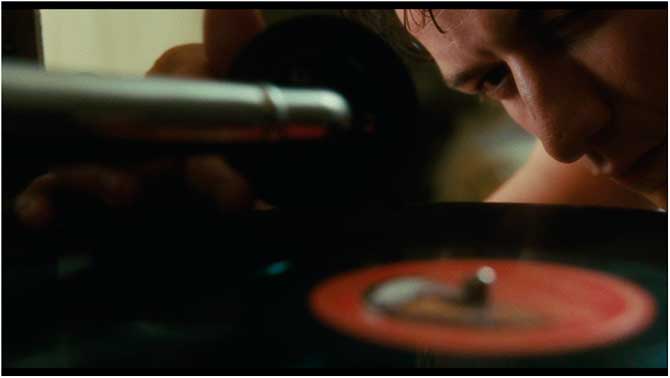
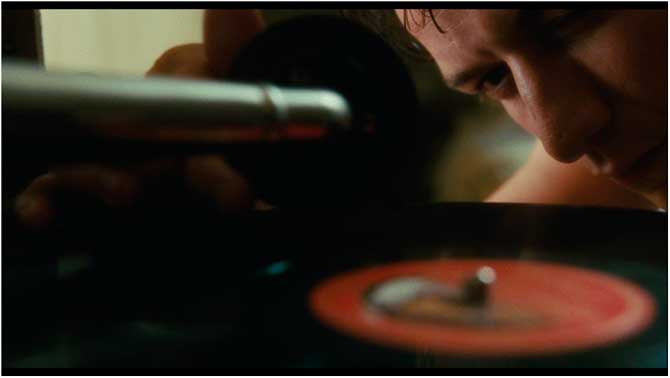
The camera approaches Robbie from behind as he sits typing at his desk. Robbie writes and reads aloud a draft of his letter, screws it up and throws it in the bin. He then puts on the gramophone record, selecting ‘O soave fanciulla’ (see Fig. 1). The stylus falls first on the highly charged moment where Mimì and Rodolfo first sing together (from ‘Fremon già nell’anima’). As Mimì sings ‘Ah! tu sol comandi, amor!’ (‘Ah! Love, you alone guide us!’), the camera pans to Cecilia, seen in a mirror through a haze of cigarette smoke and feathers. The images of Robbie are crystal clear; those of Cecilia are at first blurred, then become sharper.
(colour online) James McAvoy as Robbie Turner in the letter-writing scene from Atonement, directed by Joe Wright and produced by Tim Bevan, Eric Fellner and Paul Webster.
With the singers mid-phrase, the music stops abruptly: we hear the stylus being ripped from the record as Robbie tears up another draft. He then places the stylus a little further on (‘Sarebbe così dolce restar qui’/‘It would be so nice if we could stay here’). After taking a pause to stretch, Robbie returns to his typing with renewed intensity. The camera continues to cut between close ups of him at his typewriter and Cecilia in the mirror (lingering in particular as Mimì sings ‘Vi starò vicina’/‘I’ll stay close by you’). As Rodolfo sings ‘Dammi il braccio, mia piccina’ (‘Take my arm, my little one’), we see Robbie reclining in his chair intercut with further images of Cecilia. As the singers sing their repeated ‘Amor!’, we see a close up of the typewriter keys striking out the words ‘In my dreams I kiss your cunt, your sweet wet cunt’ onto the sheet of paper. In the duet’s peroration, Robbie chuckles to himself before glancing over his shoulder – the camera panning to a further shot of Cecilia selecting her dress for the evening – at which point his expression becomes pensive. Once the music stops, and the reverie is over, Robbie takes out a fountain pen and a fresh sheet of paper and composes the sensible, coy letter he intends to send, telling Cecilia merely that he feels ‘light-headed and foolish’ in her presence. An interlude follows in which Robbie talks to his mother, dresses for dinner and walks towards the Tallis house, stopping to ask Briony to run ahead with the letter.
As Briony runs away we hear a repeated piano motif (part of the foreboding theme associated with her at the start). Robbie, seen from behind, glances to one side, says ‘Briony’ and then commences a mental flashback of sealing the letter. A thudding pizzicato cello heartbeat-like motif intermingles with the tapping of a typewriter’s keys and distorted fragments of ‘O soave fanciulla’. The camera, as if mentally retracing Robbie’s actions in reverse, makes its way back through the house to the study, where it settles upon the handwritten letter upon the desk. Robbie shouts Briony’s name. The string motif and the typing continue, more urgently, as Briony runs to the Tallis house and opens the letter. Typewriter keys can be heard striking violently as we see the sheet of paper, the offending sentence once more being imprinted onto the page. The visual flashback is, we understand, Robbie’s, but the fact that ‘Robbie’s’ music (the Puccini) mingles with music akin to that hitherto associated with Briony might make us pause to consider who, precisely, is doing the imagining.
The letter-writing scene is treated quite differently by McEwan and the use of music is fundamental to the shift in emphasis that we find in the adaptation. In the novel, the preamble to writing the letter is shot through with sensual, watery descriptions that create an atmosphere of erotic anticipation, from Robbie’s awareness of his skin and muscles as he reclines in a bath, to a frisson as he remembers Cecilia’s body emerging from the fountain. However, the letter-writing episode per se is cerebral and plodding, capturing the limitations of what could be said in the etiquette-bound 1930s.Footnote 26 Whereas in the film the camera focuses largely upon Robbie rather than upon what he is writing (until the very end), in the novel we read successive stilted versions of the letter as Robbie adopts a tone that is by turns jokey and plaintive, and finally (as his eye falls upon an anatomy textbook) frank. There is much discussion of rhetorical questions and of punctuation marks – the mechanics of writing – but no reference is made to Robbie putting on a gramophone, nor does McEwan mention any records among the objects cluttering Robbie’s desk. Nevertheless, there are hints at a more romanticised undercurrent: when Robbie imagines kissing Cecilia, he ‘indulge[s] a cinema fantasy’; he questions whether her earlier anger might have been ‘too theatrical’; he wonders whether his letter is leaning towards ‘melodrama’.Footnote 27
Although the letter-writing scene in the novel is significant to the narrative, it is brief – five paragraphs in a book of 372 pages – and could pass without rousing particular interest from the reader were it not for the jolt created by the seemingly incongruous obscene word. Wright, however, lingers over the letter-writing episode, with the result that it looms much larger, proportionally speaking, in the film than in the novel.Footnote 28 The way in which the scene has been shot very differently from the rest of the film further serves to mark out its significance. The result is that it becomes the defining moment that sets in motion a chain of events, eclipsing other important plot turns that contribute to the film’s central tragedy. Notably we might point to an earlier episode in the novel (shown in the film only briefly and in flashback) in which Briony jumps into a lake in order to force Robbie to save her from drowning: her subsequent embarrassment at being chastised and ‘rejected’ by her fantasy hero undoubtedly creates resentment that will later fuel the vindictive false accusation. The foregrounding of the letter-writing scene as key to the narrative is one of the film’s meta-critical ploys, a way of interrogating the mechanics of storytelling.
Wright adopts a technique, increasingly common in the period film genre, of ‘choreographing’ the action of a key scene closely onto a well-known piece of pre-existing music.Footnote 29 The sequence, rich in colour and visual detail, takes on the qualities of a painting and there is an almost balletic way in which the actors’ movements are mapped onto the music, such as the moment where Robbie swivels around in his desk chair. The lighting is also aestheticised, particularly the hazy, bright white shots of Cecilia that then come into focus. Wright captures the scene’s eroticism via shots of Robbie’s exposed arms, close-ups of Cecilia’s neck and fleeting glances of her starting to dress. The mood of intensifying desire is captured by the way in which Wright juxtaposes shots of the two, whereas in the novel the scene where Cecilia dresses is in a separate chapter and interrupted by some rather prosaic interaction with a young cousin. Wright also uses the act of smoking (by Robbie and Cecilia simultaneously) and shots of Robbie reclining to create an implied post-coital atmosphere.
But what does opera, and Puccini’s music specifically, bring to the process of adapting this scene from McEwan’s novel, and how does it relate to Wright’s interrogation of truthfulness? At the simplest level, one might argue that pivotal scenes naturally cry out for accompaniment when rendered cinematically and that the choice of a highly charged love duet is an obvious one, capturing the intensity of Robbie’s feelings, while also signalling that Cecilia is more than a passive addressee. The music alters the tone of the letter-writing scene considerably, voicing passionately, unmissably, and yet still intimately the more hesitantly expressed eroticism of McEwan’s novel. One might argue that this is merely typical of the direct manner of communication required by the medium of film but there seems to be something more knowing in what we might call Wright’s ‘operatisation’ of this scene. He aptly draws our attention to the way in which letters are used in opera as dramatic devices that either set in motion chains of confusion (albeit more often to comic than tragic effect) or express highly wrought doomed passions. The effect of Wright’s allusion to the tradition of the operatic letter scene is to aggrandise the love affair between Robbie and Cecilia and further to crystallise the significance of this episode within the narrative.
Wright also uses Puccini’s music as a tool through which to establish Robbie’s personality. In the novel, Robbie’s desire to explore the world physically and intellectually is signalled by hiking maps, compasses and books of poetry on his desk, described in painstaking detail. In the film, all such references disappear, with the camera focusing in upon the gramophone, the typewriter, Robbie, or Cecilia’s face: the music takes on the character-defining function fulfilled in the novel by material signifiers. The correlation that the music establishes between Robbie and Rodolfo constructs the former as a would-be ‘poet’: in the novel, his desk is cluttered with rejection slips from publishers. Thus Wright uses music in order to draw a connection between writers both within and without the filmic text.
More significantly, introducing the music diegetically on a gramophone record throws emphasis onto the act of listening and invests it with narrative agency. Wright makes a bold departure from the novel in implying that the music is actually the driving force behind the first draft of the letter. In the film it is seemingly only by listening to Puccini’s music that Robbie is able to access his inner fantasies and find the words he privately wishes to say. The association between ‘O soave fanciulla’ and the words in Robbie’s letter – taboo, ill-advised and yet at the same time honest – constructs Puccini’s music as something with a dangerously sensual potency.Footnote 30 Robbie has a moment of weakness, which will set in motion a series of terrible events, because he allows himself to succumb to the music’s erotic charms and to be manipulated by it in ways that would ordinarily be against his better judgement.
Robbie appears to be identifying and engaging with Puccini’s music in an even more active manner, however, to the extent that he visualises himself as taking part in an imaginary opera, at least as we understand things on a first viewing. When Rodolfo sings, the camera focuses on Robbie and whenever Mimì sings it pans to Cecilia. Robbie is casting himself and Cecilia as the operatic lovers, the emerging passion between them mirroring his own newly ignited (or newly acknowledged) feelings for Cecilia. As the duet intensifies, so too do Robbie’s thoughts, his typing quickening and becoming louder as the scene develops. When the singers reach their closing ‘Amor! Amor! Amor!’, the camera settles for the first time upon the piece of paper in the typewriter as Robbie writes the offending words.
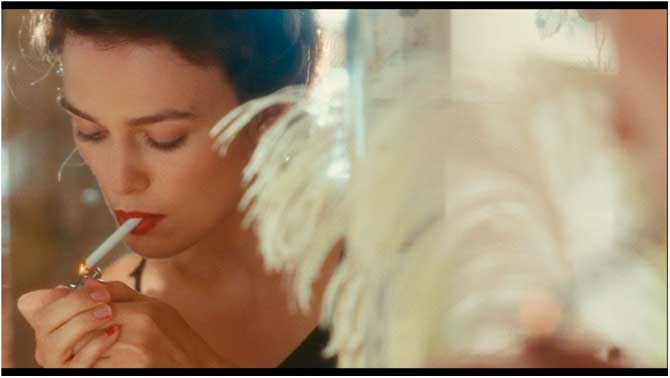
The merging of the operatic duet with the superimposed clacking of the typewriter’s keys and the whirr and thud of the machine’s carriage further signals the fact that Robbie is constructing his fantasy in operatic terms. Within the broader context of the filmic narrative, this scene fulfils a similar function to that which an aria would fulfil in an opera: the action slows and the spotlight is shone onto an individual character’s state of mind. Moreover, the manner in which the sequence has been shot compounds the ‘operatic’ qualities of this scene. The visual iconography of the theatrical dressing room – the brightly lit mirror, the application of make-up, the smoke and feathers – is transparent: Robbie imagines Cecilia as ‘Mimì’ preparing for her entrance onto the stage (see Fig. 2).
(colour online) Keira Knightley as Cecilia Tallis in the letter-writing scene from Atonement, directed by Joe Wright and produced by Tim Bevan, Eric Fellner and Paul Webster.

Although she is alone, she is animated and appears to be saying something to herself in the mirror, perhaps rehearsing her lines. The camera-work here is also overtly ‘theatrical’: the deliberate focusing of the camera and bright white lighting evocative of footlights highlight the presence of the camera as mediator.
It is unclear whether we are seeing Cecilia as Robbie imagines her or whether we see her as she actually is at the same moment, unseen by Robbie. We presume that she cannot hear the music, yet we have the impression that she is, in a sense, participating in the duet. Questions of musical diegesis are thereby complicated here, and deliberately so: the music appears to function at once diegetically (for Robbie) and in a displaced diegetic manner, accompanying images of Cecilia that are taking place somewhere else. But the question of whether the characters are aware that they are part of the narrative or not may be a moot point. So stylised is this sequence that we might question its credibility altogether and wonder whether any of this really took place at all or whether we see the scene as subsequently reimagined by Briony, a point to which I shall return in greater detail below.
‘Sounding’ the past and the (in)authentic machine
The particular duet – and indeed the particular recording – chosen for the scene impart further levels of signification to Wright’s reimagining of the 1930s setting. As the first admission by Rodolfo and Mimì of their mutual attraction, the duet has dramatic logic within the context of the film and ‘knowing’ listeners will catch the intertextual reference to doomed lovers. There are, of course, countless ill-fated operatic couples, but the specific choice of this duet seems apposite within the context of a film that exposes the mechanics of how period drama functions. La bohème is, after all, an opera whose central theme is that of nostalgia. Written by a composer on the brink of middle age, it is, in essence, a poem to lost youth – either as it really happened, or as the artist and the audience subsequently re-imagine it. Much of the emotional power of the opera lies in how Puccini, Giacosa and Illica capture the way in which memories are preserved and embodied in ostensibly insignificant objects, as well as in recurring musical motifs. Similarly, a preoccupation with what might have been pervades the narrative of Atonement. Most explicitly, this theme is manifested via the written word: Robbie re-reads Cecilia’s letters as he lies dying at Dunkirk; Briony, obsessed with the past, aspires to rewrite it in rose-tinted terms. But in referencing La bohème, Wright is able to flag up the theme of nostalgia far earlier in the film and to connect it with another act of writing (Robbie’s letter to Cecilia). Furthermore, we might contend that the director uses an excerpt from a nostalgia-infused opera – ignoring the gritty social realism that Puccini and his librettists may have intended – in order to symbolise the broader sense of collective nostalgia, the yearning for an idealised past that underpins our impulses for watching period drama.
The nostalgic qualities to La bohème arguably become even more pronounced when the opera is heard in older recordings: the vulnerability of the characters – Rodolfo and Mimì, but also Robbie and Cecilia – is intensified in our imaginations by the experience of hearing youthful voices whose owners we know to be dead. The recording chosen for Atonement is the 1956 Jussi Björling and Victoria De Los Angeles version with the RCA Victor Orchestra under Thomas Beecham. We might interpret the recording as, at a certain level, simply contributing to the generalised ‘period feel’ of the film, complementing costumes, sets and locations. The use of a historical rather than a contemporary recording in period drama means that its ‘grain’ can be exploited in order to give the scene a sense of apparent authenticity. Even though this recording post-dates the film’s setting by two decades and is not a recording Robbie could have heard, the sound is sufficiently crackly to evoke a generalised ‘period’ feel. Moreover, it operates as part of a broader fetishisation of pronounced textures in this sequence, all of which contribute to a feeling of luxurious oldness: the highly textured paper in Robbie’s typewriter, for instance, and the heavy green silk of Cecilia’s dress that thuds to the floor at the end.
Yet subtle changes have been made to the recording that complicate this sense of period atmosphere. For the recording is only initially scratchy: it then becomes noticeably cleaner, analogous to the way in which the visual shots alternate between being blurred and sharp. In the sharper portions, the music sounds almost too modern for the images on the screen, reminding us of the fact that period films propose to depict the past in an ‘authentic’ manner yet actually offer a vision of the past fashioned in the spirit of the present. In a film that claimed to pay scrupulous attention to other aspects of period detail such as the use and delivery of language,Footnote 31 it is telling that a recording of ‘O soave fanciulla’ from the 1930s was not used, such as the still readily available 1938 recording with Licia Albanese and Beniamino Gigli. A near-contemporaneous recording may have been deemed too distorted in its sound quality – or possibly too mannered in the delivery of its singers – for the tastes of a twenty-first-century audience. The Björling/De Los Angeles recording, still considered a seminal rendition of Puccini’s opera, gives just the right air of ‘oldness’ while simultaneously sounding sufficiently ‘clean’ for a present-day listener.
The combined presence of the gramophone and the typewriter in the letter-writing scene also merits scrutiny. In the novel, as in the film, Robbie writes the early drafts on a typewriter and the final draft by hand. However, Wright adds an additional layer of machine symbolism in pairing the typewriter with the gramophone and the two operate closely together: Robbie’s typing is noisy and the clacking and whirring of the typewriter is superimposed prominently on top of the music. Moreover, the sound of Robbie tearing the first draft from the machine coincides exactly with the sound of the needle being ripped from the record (even though he is nowhere near the gramophone at this point). The way in which the two machines are combined contributes to Wright’s stylised vision of the era, calculated to appeal to early twenty-first-century sensibilities. The contemporary ‘retro’ movement, with its ironic attitude towards history, has embraced the kitsch-ness of the fashions and designs of the 1930s and 1940s; it also adores the technologically obsolete machines of the period – typewriters, manual cash registers and the like.Footnote 32
Wright also combines the typewriter and the gramophone in his critique of notions of narrative reliability, leading us to question which is the more honest of Robbie’s two letters. Typing and music were often associated in the early twentieth century: analogies were drawn between the typewriter and the piano and stenographers of the 1930s and 1940s claimed that listening to music on record helped them to type more quickly.Footnote 33 However, ever since the rise of mechanised communication, there has been a pronounced strand of discourse that posits machines as the enemy of genuine expression.Footnote 34 The typewriter (conveyer of standardised font) has been conceived as a ‘prosthetic’ form of communication, a poor relation to the more ‘genuine’ fountain pen (conveyer of distinctive handwriting; connected directly to the body), which is traditionally regarded as the agent of direct personal expression.Footnote 35
Wright appears to be engaging in a dialogue with such ideas in the letter-writing scene but the question of whether he is mapping authentic feeling onto the machine-written or the handwritten letter is a moot point. If we interpret him as playing upon the common conceit of technology suppressing spontaneity, the typed letter becomes not so much an expression of Robbie’s deepest feelings, but a playful reduction of them to their purely sexual element. Robbie writes the explicit letter, one might argue, as a way of venting his frustration with not being able to find the right words: this frustration is reflected in the repeated playing of the record and is tied up with the trope of the ‘dishonest’ machine. In this interpretation we read the act of writing by hand as genuine: Robbie, suddenly reflective, seizes the pen and writes in a single, spontaneous flow. The silence, punctuated only by the sound of birdsong, contrasts sharply with the preceding operatic music, which suddenly seems overblown. For the first time we hear Robbie’s voice reading the text, speaking in an unaffected manner that creates a human quality and an intimacy that has been lacking in the mechanically inspired and mechanically created drafts.
However, we might argue that Wright is reversing stereotypes about technology and expression. Robbie’s typed letter undoubtedly betrays an honest quality: sexual desire will be fundamental to his and Cecilia’s painfully brief relationship. Thus, expression as mediated by machine could be read here as genuine, and one form of mechanised yet honest communication (the heartfelt operatic duet transmitted via the gramophone record) inspires another (true feelings committed to the page by mechanical means). According to this reading, we might say that Robbie turns to pen and ink with the objective of making the second letter to Cecilia appear to be honest and personal,Footnote 36 yet it in fact represents the repression and polite stultification of emotion: a music-less moment of social conventionality. Two quite different readings of this multilayered scene and its use of mechanised music are, therefore, possible.
Operatic allusions
Wright’s use of intertextual references serves further to undermine certainties about narrative reliability and historical authenticity. Across the course of the film as a whole, he evokes a variety of 1930s and 1940s melodramas, romances, war films and realist dramas, as well as more recent period films such as Gosford Park (2001), in a subtle nod to the pastiche nature of the film.Footnote 37 And in a truly meta-critical step, Wright would then go on to reference Atonement itself – the letter-writing scene specifically – in an external text of his own making: the first in a series of ‘advertising films’ for the Chanel perfume Coco Mademoiselle, released in the direct aftermath of Atonement, starring Knightley and using the same creative team, notably Atonement’s director of photography, Seamus McGarvey.
The advertisement deliberately plays upon the ‘theatricality’ of the Atonement scene, featuring the same hallmarks of smokiness, unfocused camera-work, bright white lighting, art deco styling (albeit in a contemporary setting) and images of Knightley contemplating her image in a mirror.Footnote 38 Perfume is almost always branded in ways that evoke not only luxury but also desire and fantasy. Thus, it was appropriate for Wright to evoke the key scene in Atonement that addresses constructions of the two latter qualities. The advertisement also points up the way in which the letter-writing episode appears to be rich in period detail but is in fact a present-day construction of the period in question. The ‘lyrical’ way in which the scene has been shot is – one realises after watching the advert – actually highly contemporary, close to the iconography of present-day advertising and even reminiscent, in both its ‘detachability’ and its aesthetics, of pop video (opera is replaced in the advert by a pop song, Nat King Cole’s ‘L-O-V-E’, performed by Joss Stone).
Atonement’s use of musical intertexts adds further nuance, building upon a complex web of narrative and visual references. Marianelli’s score is allusive in places – making a deliberate nod to Brief Encounter in its evocation of the post-Romantic music of Rachmaninov – but the use of Puccini’s music in the letter-writing scene adds deeper levels of reflexivity.Footnote 39 We detect a connection with Moonstruck (Norman Jewison, 1987), which employs the same extract of operatic music in a markedly similar way: here we have an example of Melanie Lowe’s concept of the musical ‘feedback loop’, in which certain pieces of popular Western art music have been used repeatedly in films, acquiring compounded layers of signification with each new use.Footnote 40 As Marcia Citron has discussed in detail, the use of Puccini’s music is fundamental to Moonstruck’s construction of desire and it fulfils a similar function here.Footnote 41 Both Moonstruck and Atonement feature lower-class young men who are in love with socially superior women. Both men play ‘O soave fanciulla’ on a record, channelling their desire for opera – as well as for their respective love interests – into opera recordings. Both men have names that begin ‘Ro’ (Robbie, Ronny) which seem to denote their identification with Rodolfo and their status as quasi-poets. Atonement appears to invite us to recall the La bohème love duet’s pre-existing filmic associations, which are then in turn compounded afresh in a new cross-class erotic fantasy.
More interesting for my purposes of considering adaptation within the period film genre is a connection between how music is used in Atonement and in the 1985 Merchant Ivory adaptation of E.M. Forster’s A Room with a View. The shared presence of Puccini’s music (albeit not the same piece) serves to highlight close narrative connections between the two source novels that might otherwise go unnoticed: a musical intertext flags up a literary intertext. Both novels concern relationships between women who inhabit grand country houses in the south of England and intelligent, cultured yet socially inferior men, and in both cases it is clear that the driver of the self-realisation and personal freedom that the characters seek is sexual fulfilment as opposed to purely romantic love. More specifically, both novels feature wallflower-like observers who conceive events in melodramatic terms, and both adaptations associate opera with an act of fanciful retelling. Paying attention to the use of music in the earlier film can thus help us to understand the use of music in the later one.
Although Puccini’s music is used extensively in A Room with a View (particularly music from Gianni Schicchi, establishing the Florentine setting), my brief diversion here focuses upon the film’s central love scene. The heroine Lucy Honeychurch is pulled into a spontaneous embrace by George Emerson in a barley field in the Tuscan countryside, to the accompaniment of ‘Chi il bel sogno di Doretta’ (La rondine). As in Atonement, Puccini’s music is used to articulate a moment of sexual awakening. We might debate, however, whether we are witnessing the scene in the field as it happened or as it is retrospectively recalled by Charlotte Bartlett, Lucy’s maiden-aunt-like cousin and chaperone. As we hear the aria’s opening bars, the camera cuts between Lucy approaching a carriage driver for directions and Miss Bartlett gossiping with her new friend Eleanor Lavish, a romantic novelist, who recounts a scandalous tryst between an Englishwoman and a younger Italian man (itself an intertextual reference to Forster’s Where Angels Fear to Tread). Miss Bartlett hints at an ‘adventure’ she may have had many years previously but cannot compete with Miss Lavish’s salacious anecdote. As Lucy approaches the barley field and spots George, Miss Bartlett – remembering her responsibilities – scurries behind her and witnesses all that subsequently takes place. We view the embrace from her position in the field, as if through her eyes.
Even though ‘Chi il bel sogno di Doretta’ appears to be being used in a simple atmospheric manner, the question of whether the characters in the film are at some level aware of the music is not as clear as might first appear. I propose that the operatic excerpts in this film are integral to the film’s narrative: they help to articulate the characters’ experience of the events that unfold.Footnote 42 Forster’s Edwardian tourists’ perspective upon Italy would have been shaped by what is likely to have been their principal previous encounter with Italian culture, the medium of opera. Thus, they experience Italy ‘operatically’, an idea Forster had previously explored directly in Where Angels Fear to Tread, in which the British visitors attend a performance of Lucia di Lammermoor and observe the relaxed responses of the Tuscan audience through the lens of a set of preconceived ideas about the Italian character.
With no real romantic experience of her own, and anxious about the sensual dangers of Italy, Miss Bartlett conceptualises Lucy’s encounter with George according to the only romantic frame of reference she has, that of opera.Footnote 43 We might even read the romanticised film kiss that we see in the field as the version of events that later appears second-hand in Miss Lavish’s novel: it has been mediated for a second time, each version becoming progressively more melodramatic. The operatic pretensions of Lavish’s Under a Loggia are made clear by Forster: its plot is one of ‘love, murder, abduction, revenge’, its focus is upon the ‘neglected Italians’ so beloved of the then recent Verismo school,Footnote 44 and its heroine is called Leonora.Footnote 45 Whereas Forster places deliberate emphasis upon the silence of the barley field, filmic conventions dictated that such a crucial scene needed underscoring.Footnote 46 Scholars have suggested that the choice of Puccini’s music was an unimaginative one, and that the film’s makers were simply falling back on a long tradition of using Puccini’s music for love scenes in film – relying upon its embodiment of what Citron calls ‘the sense of fin-de-siècle expressive excess’.Footnote 47 Michelle Fillion has argued that a more fitting accompaniment would have been Beethoven’s music, which is used throughout Forster’s novel to represent Lucy’s self-awakening.Footnote 48 However, if the scene is meant to be understood as having been mediated via Misses Barlett and Lavish, the more ‘obvious’ choice of Puccini’s music becomes entirely appropriate, mirroring the fact that, in Under a Loggia, Lucy’s romantic experience becomes the stuff of cheap cliché.
There are clear parallels between Charlotte Bartlett and Briony: both create fiction out of love scenes at which they have been troubled eavesdroppers, and mediate between the principal players and the audience. In both adaptations, the use of music indicates that the central love affair is being imagined and reconstructed in operatic terms by a ‘young girl’ of sorts, prone to exaggeration and melodrama. The emotionally immature Miss Bartlett recounts the kiss in the field to her friend in operatic terms and we might contend that Briony does something similar. It becomes clear at the end of Atonement that the scene we have watched in which Briony goes to apologise to Robbie and Cecilia has been nothing more than a fictional construct. This will subsequently lead us to question whether anything we have seen in the film really happened as depicted or whether all of the film’s scenes have been shot as retrospectively re-imagined by Briony.
It is logical, then, to ask whether the music is also a part of Briony’s romantic gloss on the events and propose that she is, in a way, controlling the soundtrack. Thus, on a first viewing of the film, we naturally assume that Robbie actually hears Puccini’s music, whereas on a second viewing we are led to consider whether Briony hears it as she imagines Robbie writing the letter. One might observe, of course, that Briony is a writer rather than a film-maker, and that there is a tension between the idea of Briony as the author of a novel when we are reading a novel and Briony as the author of a novel when we are watching a film of a novel. However, there is no reason why music should be any less a part of Briony’s re-conceptualisation of events than the stylised shots we see on screen.
If we bear the metaphorical meeting of Forster and McEwan in mind when re-watching Atonement, this theory undermines our certainty about what unfolded before us on a first viewing. The distinction between the letter-writing scene and the previous scene (in which Briony is sitting in the grass writing) is blurred by the use of sound. Visually we are in a new scene as the camera approaches Robbie’s desk, but sonically we are not. We can still hear Briony’s voice in her head as she writes (‘The most dangerous man in the world’), together with the faulty brakes motif obsessively associated with her, which blends with the clacking of Robbie’s typewriter keys. This establishes a connection between Briony the unreliable narrator and the letter-writing scene, casting doubt upon the narrative trustworthiness of the latter.
While there is no suggestion that Briony actually witnesses the letter-writing scene, we later wonder whether the version of it that we see on screen is the version subsequently re-imagined for her novel. On a first viewing we assume that Robbie is ‘controlling the camera’, imagining Cecilia in front of the mirror, but once we are alert to Briony’s fictionalisation of events, we wonder whose perspective we were actually seeing: whether the editing of the images is a collusion between diegetic character and filmic narration, which had hinted at the scene’s fictitious nature all along. The highly lyrical, carefully choreographed letter-scene can be interpreted as the retrospective construction of a naïve, drama-obsessed young girl prone to fantasising: in a word, operatically. Brian Finney argues that ‘Briony is shaped by a melodramatic imagination that originates in the books she has read … The young Briony suffers from an inability to disentangle life from the literature that has shaped her life. She imposes the patterns of fiction on the facts of life.’Footnote 49 Wright finds a musical correspondence for this melodramatic imagination in opera. So obsessed has Briony become with Cecilia and Robbie by the later years of her life, so desperate for atonement, that she reinvents them as Mimì and Rodolfo: romanticised, ever young, frozen in time.