Produced and consumed in Latin America, mainly Brazil and Argentina, Dulce de leche (DL) is a product held in universal high regard for its flavor (Silva et al., Reference Silva, Ferreira, Souza, Almeida, Stephani, Pirozi, Carvalho and Perrone2015). In addition to flavor, it has a typical color and texture acquired during the process of product concentration due to non-enzymatic browning reactions (Francisquini et al., Reference Francisquini, Neves, Torres, Carvalho, Perrone and Da Silva2018). Although Brazilian legislation determines the mandatory and permitted components for the manufacture of DL (Brasil, 1997), the product can present different characteristics that vary significantly between processors and regions of the country (Gaze et al., Reference Gaze, Costa, Monteiro, Lavorato, Júnior, Raices and Freitas2015). Different treatment patterns, such as heating time and temperature, directly interfere with the final product's physico-chemical and sensory attributes (Stephani et al., Reference Stephani, Francisquini, Perrone, Carvalho and de Oliveira2018). These characteristics are strongly related to the nutritional and technological parameters as well as sensory quality of the DL, and as a consequence affect the consumer's purchase intention (Gaze et al., Reference Gaze, Costa, Monteiro, Lavorato, Júnior, Raices and Freitas2015).
There are some drawbacks associated with eating dairy products by those who are lactose intolerant or allergic to milk proteins (Suri et al., Reference Suri, Kumar, Prasad, Tanwar, Goyal, Kaur, Gat, Kumar, Kaur and Singh2018). Lactose intolerance is the name given to the inability to digest milk's predominant sugar, which occurs in organisms that do not produce or insufficiently produce the digestive enzyme called lactase, or β-d-galactosidase. This enzyme breaks down lactose into two monosaccharides, glucose and galactose, allowing it to be absorbed through the intestinal mucosa (Garballo-Rubio et al., Reference Garballo-Rubio, Soto-Chinchillaa, Morenoa and Zafra-Gómezb2017; Suri et al., Reference Suri, Kumar, Prasad, Tanwar, Goyal, Kaur, Gat, Kumar, Kaur and Singh2018).
Lactose intolerance is one of the most common food sensitivities in the world and it is estimated that 70% of the world's adult population has some level of intolerance to this sugar, with a higher incidence in individuals from South America, Africa, and Asia (Francisquini et al., Reference Francisquini, Rocha, Martins, Stephani, Da Silva, Renhe, Perrone and Carvalho2019; Jansson-Knodell et al., Reference Jansson-Knodell, Krajicek, Savaiano and Shin2020). Food industries have a role in keeping up with trends in the population's eating habits and needs, so the inclusion of lactose-free foods in the market is desirable. Consequently, the dairy market has continuously launched new products to fit this profile (Garballo-Rubio et al., Reference Garballo-Rubio, Soto-Chinchillaa, Morenoa and Zafra-Gómezb2017).
The process for removing lactose typically includes the addition of the enzyme β-D-galactosidase (lactase) to milk (Francisquini et al., Reference Francisquini, Rocha, Martins, Stephani, Da Silva, Renhe, Perrone and Carvalho2019). In addition to the purpose of allowing lactose intolerants to consume the product, lactose hydrolysis promotes the reduction of lactose crystals formation in Dulce de leche, avoiding a potential problem as perceptible crystals can be considered a defect for conferring a sandy texture to the product (Stephani et al., Reference Stephani, Francisquini, Perrone, Carvalho and de Oliveira2018). However, some modifications will occur due to the hydrolysis process, mainly the Maillard Reaction (MR), the viscosity and the sweetness of the product. (Stephani et al., Reference Stephani, Francisquini, Perrone, Carvalho and de Oliveira2018). MR is represented by a complex sequence of reactions, which arise mainly during the heating and prolonged storage of food products. It is a non-enzymatic reaction that involves a reducing sugar and an amine group, usually from an amino acid, peptide, or protein (Fennema et al., Reference Fennema, Srinivasan and Kirk2007; Francisquini et al., Reference Francisquini, Neves, Torres, Carvalho, Perrone and Da Silva2018).
Given the above, the present study aimed to formulate lactose-free DL to evaluate the influence of the hydrolysis of this sugar on the product's final characteristics. It was also decided to use milk homogenization in the experiment, which, despite being a non-mandatory step for the production of DL, can affect the rheological properties of the product during the production stage, especially if the milk used has a high content of fat. Two hypotheses guided this work. The first was: under standardized technological parameters (pH of milk, boiling temperature, and evaporation duration), lactose hydrolysis is the main reaction governing HMF production and color intensity. The second was: lactose hydrolysis affects the texture parameters of Dulce de leche increasing the viscosity of the product.
Materials and methods
Dulce de leche production
The first stage of production consisted of the enzymatic hydrolysis of lactose. Pasteurized whole milk was divided into two portions, in which 0.1 (g 100−1) of the enzyme lactase (LACTLOW 2600L, Granolab/Granotec) from Bacillus licheniformis was added in one portion. Lactose free Dulce de leche could present problems related to luminosity (Francisquini et al., Reference Francisquini, Rocha, Martins, Stephani, Da Silva, Renhe, Perrone and Carvalho2019) and texture (Giménez et al., Reference Giménez, Ares and Gámbaro2008), and to avoid those problems milk was homogenized prior to evaporation. Homogenization of milk was carried out in two stages (1st stage at 15 MPa and 2nd stage at 5 MPa) in half of the samples according to the flowchart in the online Supplementary Fig. S1.
Since the Brazilian regulation determines sucrose addition to a maximum of 30 kg/100 l of milk (Brasil, 1997), 1500 g of whole milk and 300 g of sucrose (20% of the milk mass), was selected as the best DL recipe after preliminary formulation tests, both obtained in the local grocery stores of Juiz de Fora. Sodium citrate was added to stabilize proteins, and potassium sorbate was added as a preservative. A system developed by the research group itself was used, which simulates industrial evaporation devices on a lab bench scale. The system comprises a commercial Thermomix® TM5 processor (Vorwerk, Wuppertal, Germany) coupled to a load cell (Ramuza IDR 7.500, Santana de Parnaíba, Brazil) with 1 g precision and a PT-100 temperature sensor. The function of the load cell is to monitor the evaporation of water throughout the process. This evaporation system allows us to monitor the loss of water mass and then stop the process at the desired final composition, based on previous mass balance calculations. The mixture (milk, sugar, and additives) was concentrated until reaching values between 66 ° to 68 ° Brix (Stephani et al., Reference Stephani, Francisquini, Perrone, Carvalho and de Oliveira2018). This process was performed at atmospheric pressure with an average concentration time of 103 min, using ‘Varoma’ temperature of the process simulator Thermomix® TM5. The hot products were then packaged in plastic containers and stored at room temperature until further analysis.
Analyses
The physico-chemical analyses were performed as described in the online Supplementary material. Texture analysis (gumminess, elasticity, hardness, adhesiveness, and chewability) performed in a Brookfield CT3 texturometer, according to Francisquini et al. Reference Francisquini, Oliveira, Pereira, Stephani, Perrone and da Silva2016. Color data was obtained with the CM-5 spectrophotometer (Konica Minolta brand), operated according to the CIE L* a* b scale. L* being the luminosity that varies from 0 (black) to 100 (white), and a* and b* being the chroma coordinates (–a = green, +a = red, –b = blue and +b = yellow). The spectral separation device model was the planar diffraction grid using SCI (specular component included), reflectance measurement range, and wavelength from 360 to 740 nm (Francisquini et al., Reference Francisquini, Rocha, Martins, Stephani, Da Silva, Renhe, Perrone and Carvalho2019).
The extent of the Maillard reaction can be monitored by the appearance of compounds such as 5-hydroxymethylfurfural (HMF), which allows evaluating thermal processing intensity (Francisquini et al., Reference Francisquini, Neves, Torres, Carvalho, Perrone and Da Silva2018). HMF is a marker of the intermediate phase of the Maillard reaction and has chromophoric groups in its chemical structure, making it favorable for spectrophotometric analysis. For HMF analysis, 5 ml of the 20 g⋅100 g−1 solution of Dulce de leche was transferred to a test tube with 2.5 ml of 0.3 mol l−1 oxalic acid and 2.5 ml of 40% (w v−1) trichloroacetic acid. The solutions were then filtered through qualitative filter paper into a 50 ml beaker from which 4 mL of the filtrates were transferred to another test tube and added of 1 ml of 0.05 mol l−1 thiobarbituric acid. The tubes were placed under heating in a thermostatic bath at 40°C for 30 min. Subsequently, the system was cooled down until it reached a temperature between 20–25°C, then the absorbance was read at 443 nm on an Ocean Optics spectrophotometer (model DH-2000-BAL). The concentration of 5-hydroxymethylfurfural was obtained employing a standard curve, according to Keeney and Bassete (Reference Keeney and Bassete1959).
The final carbohydrate composition of the products (lactose, sucrose, glucose, and galactose) was performed by HPLC (Shimadzu) with a Refractive Index Detector (RID). 10 μl of the sample was injected into Bio-rad HPX-87P column at 60°C and eluted in a 0.6 ml min−1 flow gradient of ultrapure water (Type I) for 25 min long run. After checking the equipment's stability with the control of suitability of the system (through 5 injections of level 3 of the calibration curve and the relative standard deviation not exceeding 2% between repeated injections), the 6 points calibration curve was analyzed before the analyses of the samples. During the runs, at least three controls (flask containing the compounds of interest in lower concentration than the standard curve points) were included to monitor the equipment for correct detection/quantification of the analytes. The approximate retention time of each carbohydrate was lactose 12.18 min, sucrose 11.079 min, glucose 13.531 min, galactose 15.963 min. The limit of quantification (LOQ) was the same for all samples (0,016%)
Results and discussion
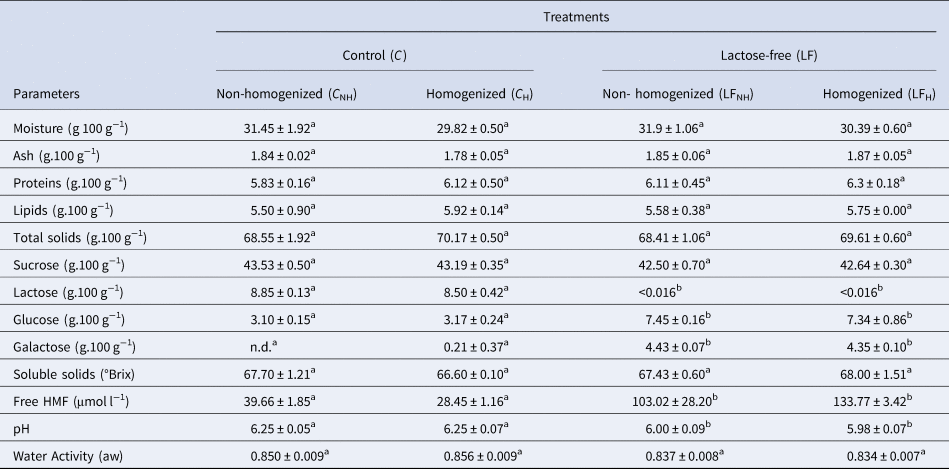
In Brazil, the composition of a food product has to be in agreement with the parameters established in the legislation (Brasil, 1997; Brasil, 2017) and should satisfy the consumer's expectations, which highlights the importance of process monitoring and compositional and physico-chemical analyses. Table 1 shows the main results of the analyzes of the final products.
Results of compositional and physico-chemical parameters of manufactured Dulce de leches

Means followed by the same letter, on the same line, do not differ by Tukey's test, at 5% probability level
The values referring to the determination of free HMF indicated a higher concentration of this component in hydrolyzed formulations. As the extension of MR is intimately linked to the darkening of the product, this result corroborates what was expected since the products of the hydrolyzed lactose treatments showed a darker color that nears the usual color (caramel) of the most commercially popular DLs on the market. Francisquini et al. (Reference Francisquini, Rocha, Martins, Stephani, Da Silva, Renhe, Perrone and Carvalho2019) also achieved results that show lactose-free dairy products with higher HMF formation.
Regarding the concentration of carbohydrates in the samples, there was no significant difference in sucrose concentration between the manufactured DLs, indicating good control of this ingredient during the production stage. The results of the other compounds are important to evaluate the efficiency of the applied hydrolysis. More than 99% of lactose hydrolysis was observed in LF treatments, resulting in concentrations below 0.016 g⋅100 g−1 of lactose in these samples. These values meet the legal requirements in Brazil, which considers a zero-lactose product to have a lactose concentration below 100 mg per100 g−1 of product (Brasil, 2017). As expected, in the control treatments, the lactose concentrations reached values up to 8.85 ± 0.13 g per 100 g−1, values twice higher than the lactose content of the milk used. According to the literature, lactose hydrolysis drives the darkening of the product, directly interfering in the Maillard reaction as both of the molecules released (glucose and galactose) can react more effectively than lactose, increasing the extent of the reaction (Stephani et al., Reference Stephani, Francisquini, Perrone, Carvalho and de Oliveira2018). Both hydrolyzed DL (LFNH and LFH) were visibly darker and presented higher values of free HMF. These were expected behaviors considering the degree of hydrolysis greater than 99%. Also, concentrations values of 3.17 ± 0.24 g⋅100 g−1 of glucose and 0.21 ± 0.37 g⋅100 g−1 of galactose were found on the carbohydrate analysis for samples without lactose hydrolysis (C NH and C H). This fact was not expected as only sucrose was added in the manufacturing process, without the lactose hydrolysis step, which could generate these compounds in the medium. The products with hydrolyzed lactose (LFNH and LFH) expressed levels of up to 7.45 ± 0.16 g⋅100 g−1 for glucose and 4.43 ± 0.07 g⋅100 g−1 for galactose. Considering that lactose hydrolysis forms two monosaccharides in the same molecular proportion, the concentrations of both should be the same, which is not in agreement with the result found.
One of the possibilities of hydrolyzing the sucrose is submitting the molecule to heating in an acid medium. As the evaporation process reaches high temperatures at a pH around 6.7, caused by the development of the Maillard reaction (Fennema et al., Reference Fennema, Srinivasan and Kirk2007), there is a possibility that sucrose hydrolysis was induced during the processing. This fact would justify the high glucose content, as sucrose is constituted of glucose residues that are released in the solution when hydrolyzed.
There is also the perspective from the biochemical point of view that an epimerization may have occurred, as glucose and galactose are epimers (they differ only in the configuration of a chiral center). This conversion of galactose into glucose may be considered because epimerization can be caused by acid or heat (Fennema et al., Reference Fennema, Srinivasan and Kirk2007).
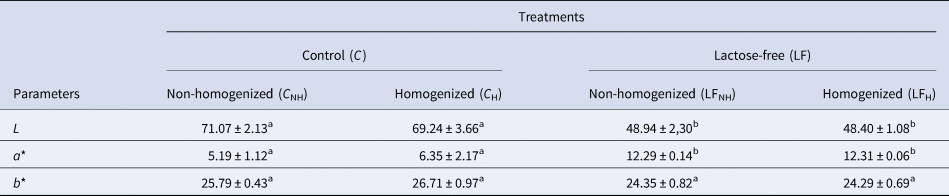
For a better evaluation of the darkening of the products, Table 2 shows the color analysis results. The parameter ‘L*’ indicates that lactose-free products achieved less luminosity when compared to traditional products and these values are statistically different between treatments. This analysis is in accordance with what has been described so far since the DLs that underwent hydrolysis showed a more significant accumulation of free HMF and, consequently, reached a darker color due to the extent of the Maillard reaction. The parameter ‘a*’ indicates that hydrolyzed DLs presented a coloration closer to red when compared to products that did not undergo hydrolysis. These colorimetric results agree with visual observation (online Supplementary Fig. S2). The parameter ‘b*’ was the same for all treatments and is therefore not significant for this analysis.
Color analysis data by colorimetry for manufactured Dulce de leches

L*, brightness; a*, red/green coordinate (+ a indicates red and –a indicates green); b* = yellow/blue coordinate (+ b indicates yellow and –b indicates blue).
Means followed by the same letter, on the same line, do not differ by Tukey's test, at 5% probability level.
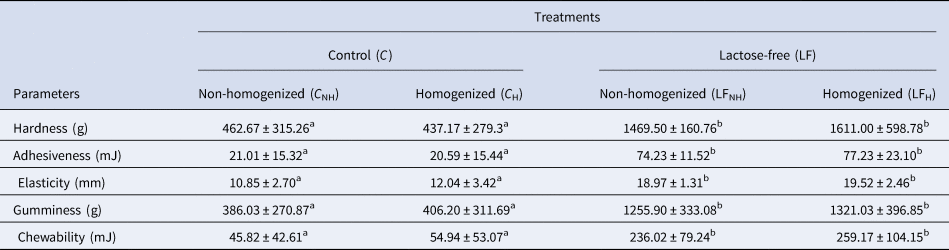
Food texture is defined as ‘all the mechanical, geometrical and surface attributes of a product perceptible by mechanical, tactile, or visual and auditory receptors’ (International Standards Organization, ISO, 1994). Table 3 shows the data from the texture analysis carried out for this work. Treatments LFNH and LFH, which were the hydrolyzed products, reached higher values in all analyzed texture parameters. Hydrolysis influenced the texture of the DLs that were submitted to it since the only differential factor among C NH/C H and LFNH/LFH treatments was the lactose hydrolysis process applied to LFNH and LFH. In this case, the lower water activity may have contributed to the firmer aspect of the lactose-free products' texture. Although all the water activity data was statistically the same, DLs have more molecules and less water available in the medium, which allows the possibility that a small variation is sufficient to impact the texture. In particular, the parameters hardness and gumminess obtained the highest values among all parameters, indicating that the hydrolyzed DL needs more force to be compressed and disintegrated during chewing compared to the products without hydrolysis (Stephani et al., Reference Stephani, Francisquini, Perrone, Carvalho and de Oliveira2018). We expected to observe some alterations throughout the texture results with the homogenization, but this was not the case.
Texture analysis data for manufactured Dulce de leches Means followed by the same letter, on the same line, do not differ by Tukey's test, at 5% probability level

Francisquini et al. (Reference Francisquini, Oliveira, Pereira, Stephani, Perrone and da Silva2016) evaluated the texture parameters of twelve commercial brands of traditional Dulce de leche. Their work found mean values of 1015.58 ± 900.35 g for hardness, 619.67 ± 400.75 g for gumminess, 16.13 ± 4.34 mJ for elasticity, 59.20 ± 69.79 mJ for adhesiveness, and 107.52 ± 106.01 mJ for chewing. All of the texture results that we obtained here, including for lactose-free products, are within the values range found by Francisquini and coworkers. Therefore, despite the analytical differences, the DL obtained in this study had a similar texture profile to those of traditional commercial products.
In conclusion, our studies with hydrolyzed lactose DL emphasize the increase in browning, an effect confirmed by the concentration of free HMF. We also showed that lactose hydrolysis affects the characteristics of DL mainly in the attributes of texture (gumminess, elasticity, hardness, adhesiveness, and chewability), but that these changes are within the range of values found for normal commercial Dulce de leche products. Finally homogenization of the milk at 20 MPa prior to manufacture of the Dulce de leche did not significantly affect the final product.
Supplementary material
The supplementary material for this article can be found at https://doi.org/10.1017/S0022029921000820
Acknowledgments
We are grateful to the funding agencies CAPES, CNPq, and FAPEMIG for the research grant and Fadepe for their support in this project's execution. We would also like to thank the institutions involved in this work, which were indispensable for the realization of it: Federal University of Juiz de Fora, Cândido Tostes Dairy Institute, and the GranoLab laboratory of GranoTec®.