INTRODUCTION
Immigration and growing ethnic diversity are transforming the politics of Western democracies. The rise of anti-immigrant parties in Europe, the referendum on British exit from the European Union, and the divisions that emerged during 2016 presidential election in the United States have all revealed pervasive tensions rooted in changing social demography. One common feature of the nativist reaction has been “welfare chauvinism,” an unwillingness to extend social benefits to newcomers, especially social assistance benefits that are allocated on the basis of need alone and are funded by tax revenues. Democracies everywhere are erecting barriers to immigrant use of social assistance, usually by requiring longer periods of residence as a condition of eligibility.
These concerns figure centrally in the burgeoning literatures on public attitudes to immigration, multiculturalism, and social welfare policy (for reviews, see Schaeffer, Reference Schaeffer2014; Stichnoth and Van der Straeten, Reference Stichnoth and Van der Straeten2013; Van der Meer and Tolsma, Reference Van der Meer and Tolsma2014). It is already well established that ethnic and racial cues play a role in determining peoples’ willingness to support redistribution (Fox, Reference Fox2004; Gilens, Reference Gilens1996, Reference Gilens2009; Kinder and Kam, Reference Kinder and Kam2009; Peffley et al., Reference Peffley, Hurwitz and Sniderman1997; Schram et al. Reference Schram, Soss and Fording2010). A prevailing theme in these accounts is that welfare policies become linked or “coded” as disproportionately benefitting minority groups. “Immigration” is often used as a coded proxy for ethnicity (Nannestad, Reference Nannestad2007; Reeskens and van Oorschot, Reference Reeskens and van Oorschot2012; Rydgen, Reference Rydgen2008; Senik et al., Reference Senik, Stichnoth and Van der Straeten2009; van der Waal et al., Reference van der Waal, Achterberg, Houtman, de Koster and Manevska2010). To this point, however, the existing literature has been unable to disentangle the relative impact of immigrant status and ethnic difference. Often immigrant status is used as a surrogate for ethnic difference, and this may be justifiable demographically speaking, at least in some countries. Even where this is the case, however, we are left with a poor understanding of the political psychology of welfare chauvinism. We have only a very partial sense for whether it is immigration or ethnic difference that drives individuals to wish to exclude newcomers from social benefits.
Plausible interpretations can be advanced for both possibilities. Perhaps the reaction is to immigrant status as such. In this interpretation, the resistance is rooted in the norm of reciprocity, which can often be a powerful engine motivating altruistic behavior. But altruism can be blocked if immigrants are perceived as having been attracted to the country originally by the lure of social benefits, or relying on social assistance for long periods without contributing to the redistributive mechanism by working hard and paying taxes. Alternatively, the reaction may be to ethnic /racial /religious difference as such. Here the mechanism is rooted in the psychology of identity, cultural insecurity, and bright lines between in-groups and out-groups. The underlying mechanism in this case is an unwillingness to share resources with people who are not part of “us.”
As nativity and ethnicity have been subject to discursive conflation, the only satisfactory identification strategy is an experiment with separate representation of immigrant and ethnic dimensions. This paper presents a web-based survey experiment using representative samples from the United States, Quebec, and the rest of Canada. Subjects are offered a vignette in which a hypothetical social assistance recipient is some combination of an (a) immigrant or (b) native-born person of white or Arab descent. Somewhat surprisingly, nativity dominates ethnicity.
THE EXPERIMENT
Our data are drawn from the Identity Diversity and Social Solidarity (IDSS) survey, an online survey fielded simultaneously in Canada and the United States from 22 to 30 January 2014. The survey includes three separate samples: 2,000 respondents in the United States, roughly 1,000 French-language respondents in Quebec, and 1,000 English-language respondents in the rest of Canada.Footnote 1 The Canadian sample is divided between Quebec and the rest of the country because previous evidence suggests that Québécois respond differently than do other Canadians to immigration and the challenges of social integration (Banting and Soroka, Reference Banting and Soroka2012). (Details on the representativeness of samples are included in the Supplementary material.)
The experiment presented here is designed to go beyond observational studies, to specifically extract the independent impact that (a) ethnicity and (b) immigrant status have on support for redistribution. It is based on the following vignette (with manipulations indicated in square brackets):
Now we want to ask you a question about an individual who is eligible for social assistance. Please read about his background, and tell us whether you support his application.
[John(Jean)/Sulaiman] is 37 year old and rents a small apartment with his wife and 13-year-old son. He is trained as an automobile mechanic. [He immigrated to [Canada/Quebec/the United States] as an adult. He was born and raised in [Canada/Quebec/the United States]].
[John(Jean)/Sulaiman] has been without work for some time. He has run out of savings and has applied for social assistance. Under current rules, he will receive $1250 a month and will have to take part in job training.
Do you support or oppose [John(Jean)/Sulaiman] receiving this assistance? 1. strongly support; 2. somewhat support; 3. somewhat oppose, 4. strongly oppose
To be clear, the manipulations include: native-born white, immigrant white, native-born non-white, and immigrant non-white. The native-born white is effectively the null treatment here—it is the baseline, against which other treatments are measured.Footnote 2
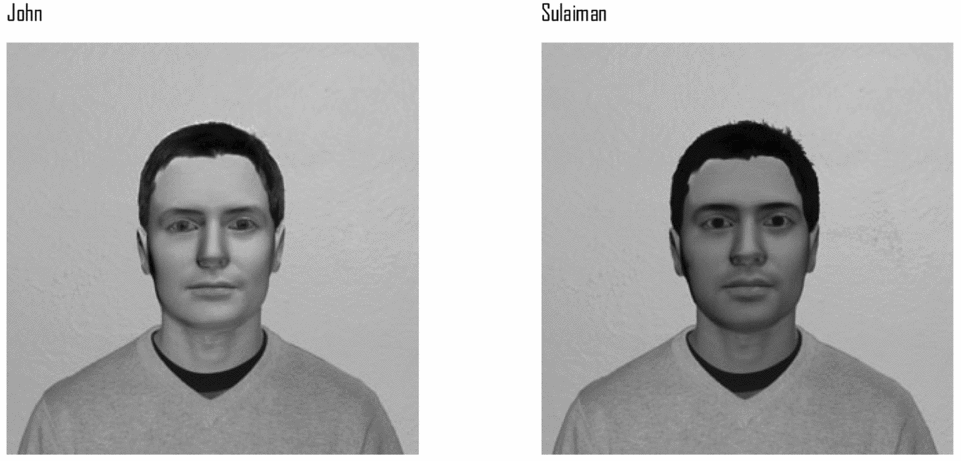
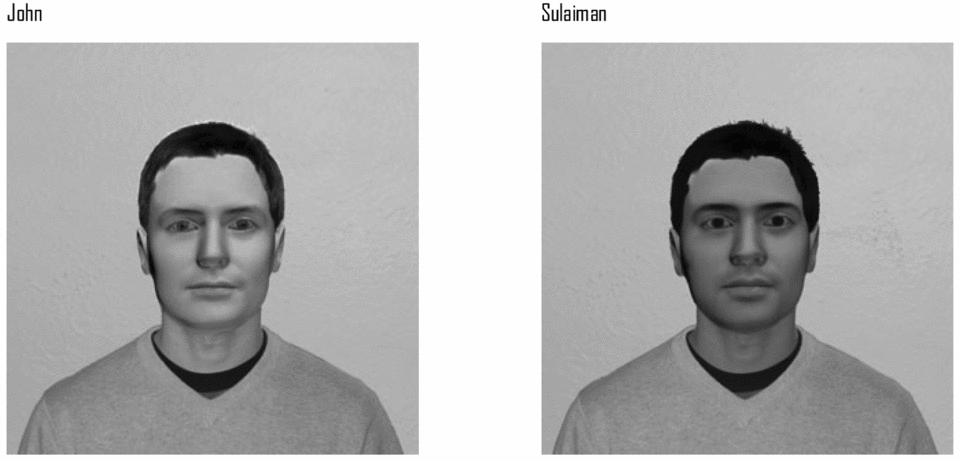
Ethnicity is cued by the name John/Jean or Sulaiman, as well as through the morphed images shown in Figure 1. Note that we opt for an immigrant photo and name that are somewhat ambiguous in terms of source country, which (with a name like Sulaiman) could be from the Middle East, North Africa, or East Asia. Although Sulaiman can also be Christian, we expect respondents to regard him as a Muslim, and test this expectation by a manipulation check, described later.
Morphed Images. Images are drawn from Harell et al. (Reference Harell, Soroka and Iyengar2016), where they are tested for both attractiveness (with no difference between them) and ethnic stereotypicality.
Note too that Muslims from either the Middle East or North Africa are a relatively small minority of immigrants to both the United States and Canada; certainly, their numbers pale in comparison to Hispanics (in the United States) or Asians. One advantage here is that we have a group that is roughly similar proportionally-speaking in both countries. Moreover, Muslim immigrants are a highly politicized group in all three regions—that is, in all three cases, there is a good deal of discussion about Muslims, colored in large part by concerns about ISIS and terrorism. While we must be cautious generalizing these results to other non-White immigrant groups, we regard this as a strong test of citizens’ willingness to support redistribution to non-white immigrants.
We explore the impact of treatments using a very basic OLS model regressing our four-category support variable (rescaled from 0 to 1, where high values indicate high support) on three variables: one binary measure capturing immigration status (1 = immigrant), another binary measure capturing ethnicity (1 = non-White), and an interaction between the two (allowing for immigration status to matter differently for White versus non-White respondents); which captures the basic, 2*2 factorial design of the experiment. The survey includes a limited number of non-citizens; as our interest is in citizens’ reactions we restrict our sample to native-born citizens only. Tables in the Supplementary material confirm that the demographics of respondents are effectively randomized across treatments. We thus omit demographic (or attitudinal) controls from our analysis.
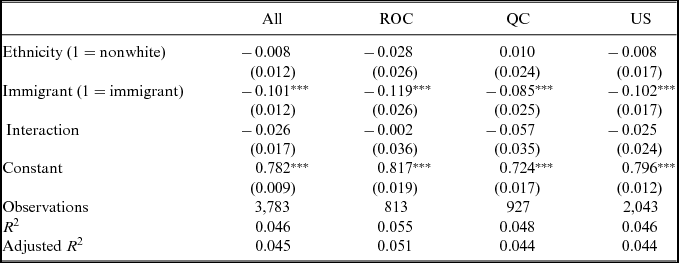
The basic results are reported in the Supplementary material; here, we focus on regression results in Table 1. Note that constants capture support for white, non-immigrant recipients; and these are in all cases relatively high—between 0.7 and 0.8 on a 1-point scale. There clearly is strong support for redistributive benefits, then. But there is variation as well. The impact of treatments is indicated by the Ethnicity and Immigrant coefficients, and the top rows of the table already make clear the importance of the latter (which is always statistically significant) rather than the former (which is never statistically significant). Indeed, coefficients for Immigrant are statistically different from zero (as indicated by significance levels in table), and statistically different from the Ethnicity coefficients (based on F tests);Footnote 3 this finding is important given our interest in exploring the relatively importance of each cue.
Modeling Support for John/Sulaiman
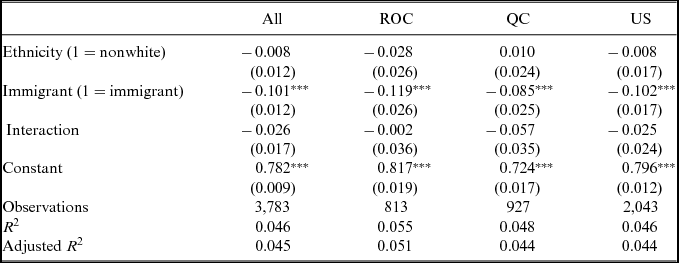
*p < 0.10; **p < 0.05; ***p < 0.01. Note that there is no significant two- or three-way interaction between region and experimental treatments, based on a three-way ANOVA.
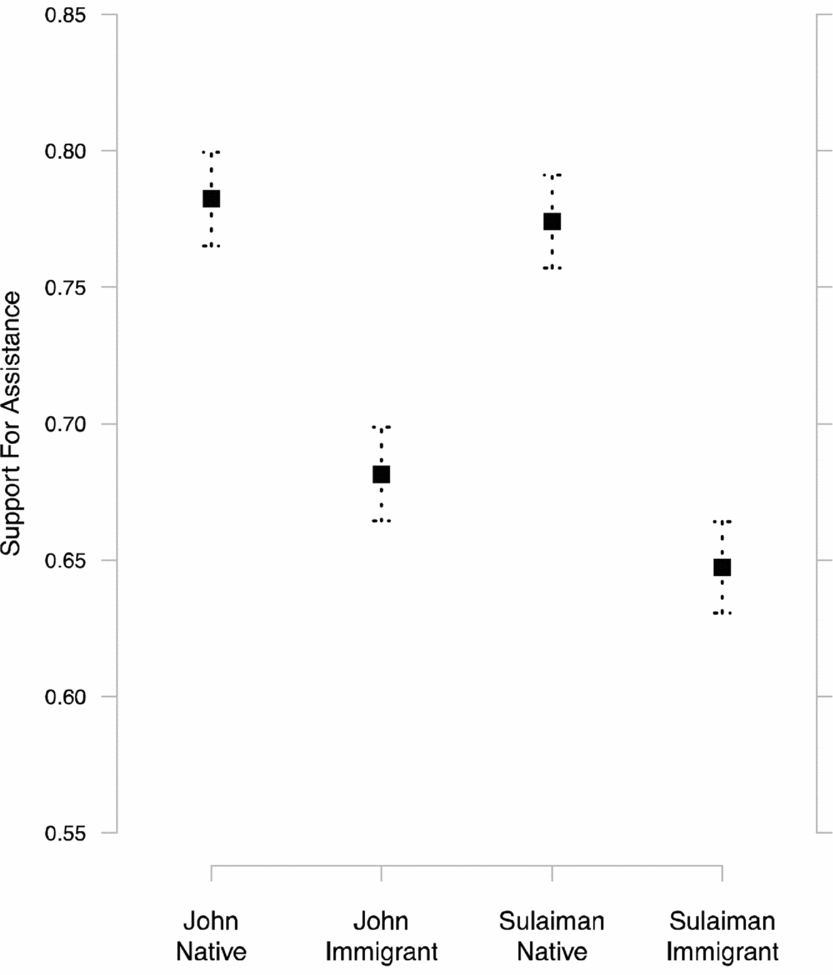
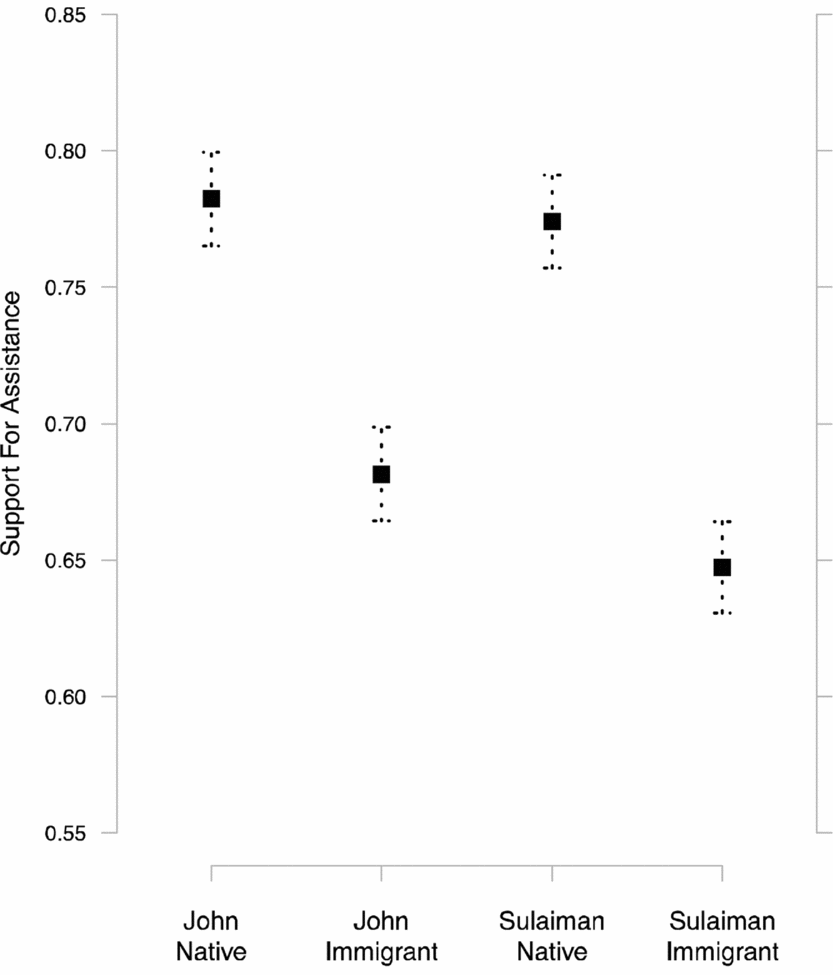
Note that the interaction between Ethnicity and Immigrant is insignificant in all cases except Quebec. This is the only sample in which the negative impact of immigrant status increases when that immigrant is non-white. Interpreting the combination of direct and interactive effects is more straightforward in Figure 2, which illustrates the estimated mean level of support across each treatment, based on the model combining all regions.Footnote 4 There clearly are significant differences across treatments, but these are driven primarily by immigrant status, not ethnicity. There is a slight hint in the overall estimation behind Figure 2 that Sulaiman receives less support than John, in particular when Sulaiman is an immigrant. Table 1 suggests that this interactive finding is primarily driven by Quebec respondents; although even here, the interaction narrowly misses statistical significance. Immigrant status, in contrast, has a powerful direct effect on support across all samples. Overall, using an immigrant in our vignette pushes mean support down by roughly 0.1 on a 0–1 scale.Footnote 5
Support for Assistance Across Treatments.
Manipulation Check: Conditioning on Religious Effect
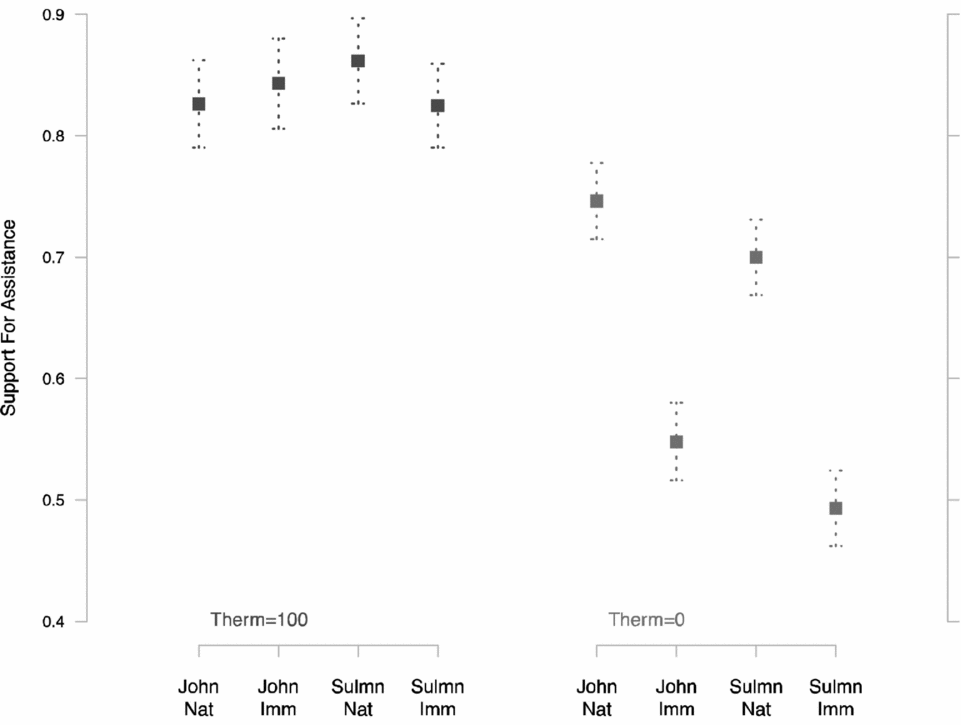
Although the manipulation is modest, we surmise that respondents regard Sulaiman as a Muslim. That is, the weakness of the ethnoreligious effect relative to the immigrant/native one is not the result of confusion over Sulaiman's identity. We thus expect that the size of the ethnoreligious effect is conditional on feelings toward Muslims. Figure 3 bears this out, by showing a three-way interaction between our experimental treatments and a thermometer score on feelings toward “Muslims” administered as part of a 10-item battery. For visual clarity, we focus on impact at very cool and very warm feelings. The full results of that estimation are in the Supplementary material.
Support for Assistance Across Treatments, by Anti-Muslim Sentiment.
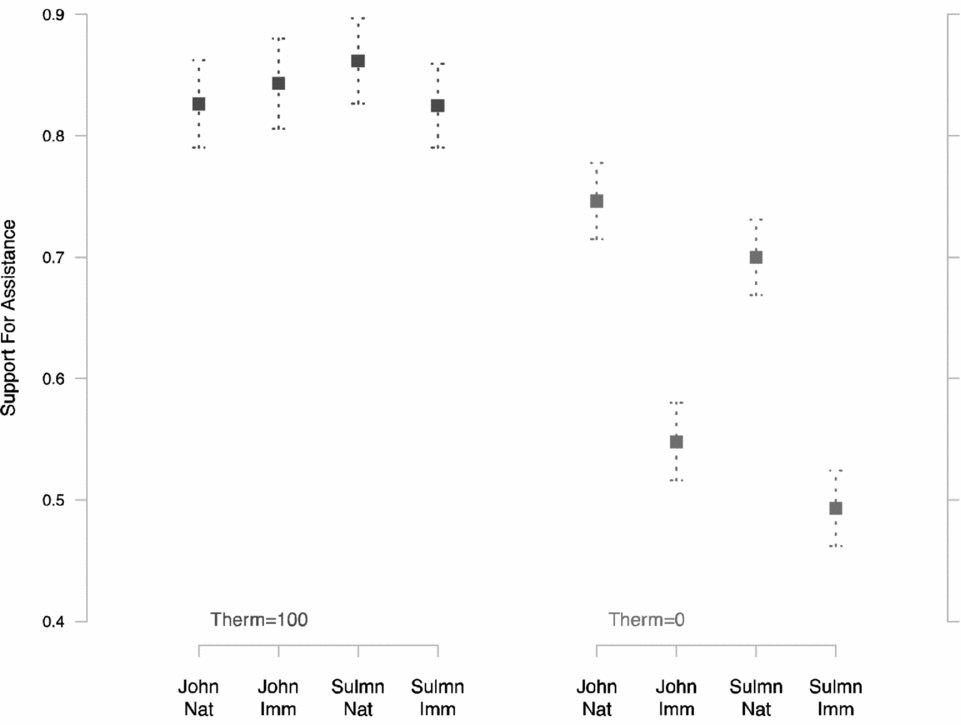
Figure 3 distinguishes between treatment effects for those who show no anti-Muslim sentiment (100 on the thermometer scale, on the left), and those who show very strong anti-Muslim sentiment (0 on the thermometer scale, on the right).Footnote 6 Note that we observe no significant treatment effect for those who show no anti-Muslim sentiment: they support an inclusive welfare program, regardless of either immigrant status or ethnicity of the beneficiary. For those who indicate strong anti-Muslim sentiment, in contrast, ethnicity merges as a factor, most strongly when John and Sulaiman are both immigrants. The difference across ethno-racial groups is now statistically significant. We believe, then, that our treatment does cue ethnicity. Respondents for the most part simply do not rise to the bait.Footnote 7
DISCUSSION
In sum, our experimental evidence shows that, once disentangled, the status of being an immigrant is a far stronger predictor of the willingness of the native-born to extend welfare protection to the newcomer than are his or her ethno-racial characteristics. On its face, the impact of nativity buttresses claims for the importance of perceived reciprocity. The finding is consistent with much of the European literature.
The weak to null impact of the ethnoreligious difference, except among those strongly opposed to the implicit target group, sits uneasily with the main thrust of work in North America. This is all the more awkward as our study is a North American one. There, ethnicity and race are the main story in welfare state support. We suspect that there are several reasons for this difference. For one thing, although Muslim immigrants are among the most highly politicized immigrant groups in North America, they do not typically feature in debates about welfare support. Indeed, such debate is mostly about native-born racial minorities; this is true for the study that is most like ours, Harrell et al. (Reference Harell, Soroka and Iyengar2016). North American findings involving immigrants (including supposed immigrants) are in contrast not about social assistance but about cultural accommodation. Our results thus present what we believe to the among the first explorations of welfare support as a function of both ethnicity and immigrant status, manipulated independently of each other, in North America.
The degree to which ethnicity and immigrant status can be manipulated independently is an issue worth considering. One concern here may be that even native-born Sulaiman is regarded as an immigrant, and thus the estimated impact of ethnicity incorporates an immigrant component. We see no evidence of this in our results. First, if Muslim religion or Arab ethnicity cued immigrant status, given the apparent strength of the immigrant status manipulation, we would expect to see stronger effects for religion or ethnicity. Second, estimating our models with either Ethnicity or Immigrant, and then both, results in no significant change in the coefficients for either. We take this absence of collinearity as further evidence that our manipulation of Ethnicity operated largely independently of immigrant status. This is of course central given our interest in testing the relative impact of each.
The degree to which our results are generalizable, to other ethnic groups, and to other countries, is as yet unclear. Rules about eligibility, and expansiveness of welfare programs, will change the context in which respondents are making decisions about generosity generally, and the risks of sharing with newcomers in particular. Ethnic stereotypes will also change across countries, and shift the relative impact of any given ethnic cue. We cannot yet say that immigrant status always matters more than ethnicity. But in North America in 2014, it appears as though immigrant status mattered to support for social assistance far more than Muslim ethnicity.
To conclude, our experiment demonstrates the need to disentangle the complicated nexus between attitudes toward newcomers on one hand and ethno-racial differences on the other. It illustrates the power of random assignment in effecting that disentanglement. Future research should focus more directly on the role of citizenship as well in demarcating support for inclusion in the welfare system. Greater clarity on these differences would make a powerful contribution, not only to scholarship, but also to the larger societal challenge of maintaining social integration in an increasingly globalized era.
SUPPLEMENTARY MATERIAL
To view supplementary material for this article, please visit https://doi.org/10.1017/XPS.2017.13